EP0189530A2 - Element zum Verankern von mit diesem vereinigbaren Wandteilen in der hinterschnittenen, einen Öffnungsschlitz aufweisenden Längsnut eines Aufnahmeteils - Google Patents
Element zum Verankern von mit diesem vereinigbaren Wandteilen in der hinterschnittenen, einen Öffnungsschlitz aufweisenden Längsnut eines Aufnahmeteils Download PDFInfo
- Publication number
- EP0189530A2 EP0189530A2 EP85113769A EP85113769A EP0189530A2 EP 0189530 A2 EP0189530 A2 EP 0189530A2 EP 85113769 A EP85113769 A EP 85113769A EP 85113769 A EP85113769 A EP 85113769A EP 0189530 A2 EP0189530 A2 EP 0189530A2
- Authority
- EP
- European Patent Office
- Prior art keywords
- extension
- longitudinal groove
- rear part
- head
- slot
- Prior art date
- Legal status (The legal status is an assumption and is not a legal conclusion. Google has not performed a legal analysis and makes no representation as to the accuracy of the status listed.)
- Granted
Links
- 238000004873 anchoring Methods 0.000 title claims abstract description 5
- 238000003780 insertion Methods 0.000 claims abstract description 11
- 230000037431 insertion Effects 0.000 claims abstract description 11
- 239000000463 material Substances 0.000 claims abstract description 7
- 239000011343 solid material Substances 0.000 claims abstract description 3
- 238000013459 approach Methods 0.000 description 2
- 230000000694 effects Effects 0.000 description 1
- 230000002349 favourable effect Effects 0.000 description 1
- 230000003993 interaction Effects 0.000 description 1
- 239000004753 textile Substances 0.000 description 1
Images

Classifications
-
- F—MECHANICAL ENGINEERING; LIGHTING; HEATING; WEAPONS; BLASTING
- F16—ENGINEERING ELEMENTS AND UNITS; GENERAL MEASURES FOR PRODUCING AND MAINTAINING EFFECTIVE FUNCTIONING OF MACHINES OR INSTALLATIONS; THERMAL INSULATION IN GENERAL
- F16B—DEVICES FOR FASTENING OR SECURING CONSTRUCTIONAL ELEMENTS OR MACHINE PARTS TOGETHER, e.g. NAILS, BOLTS, CIRCLIPS, CLAMPS, CLIPS OR WEDGES; JOINTS OR JOINTING
- F16B5/00—Joining sheets or plates, e.g. panels, to one another or to strips or bars parallel to them
- F16B5/06—Joining sheets or plates, e.g. panels, to one another or to strips or bars parallel to them by means of clamps or clips
- F16B5/0692—Joining sheets or plates, e.g. panels, to one another or to strips or bars parallel to them by means of clamps or clips joining flexible sheets to other sheets or plates or to strips or bars
-
- E—FIXED CONSTRUCTIONS
- E04—BUILDING
- E04F—FINISHING WORK ON BUILDINGS, e.g. STAIRS, FLOORS
- E04F10/00—Sunshades, e.g. Florentine blinds or jalousies; Outside screens; Awnings or baldachins
- E04F10/02—Sunshades, e.g. Florentine blinds or jalousies; Outside screens; Awnings or baldachins of flexible canopy materials, e.g. canvas ; Baldachins
-
- E—FIXED CONSTRUCTIONS
- E04—BUILDING
- E04H—BUILDINGS OR LIKE STRUCTURES FOR PARTICULAR PURPOSES; SWIMMING OR SPLASH BATHS OR POOLS; MASTS; FENCING; TENTS OR CANOPIES, IN GENERAL
- E04H15/00—Tents or canopies, in general
- E04H15/32—Parts, components, construction details, accessories, interior equipment, specially adapted for tents, e.g. guy-line equipment, skirts, thresholds
- E04H15/64—Tent or canopy cover fastenings
- E04H15/642—Tent or canopy cover fastenings with covers held by elongated fixing members locking in longitudinal recesses of a frame
- E04H15/644—Tent or canopy cover fastenings with covers held by elongated fixing members locking in longitudinal recesses of a frame the fixing members being a beading
-
- E—FIXED CONSTRUCTIONS
- E04—BUILDING
- E04H—BUILDINGS OR LIKE STRUCTURES FOR PARTICULAR PURPOSES; SWIMMING OR SPLASH BATHS OR POOLS; MASTS; FENCING; TENTS OR CANOPIES, IN GENERAL
- E04H15/00—Tents or canopies, in general
- E04H15/32—Parts, components, construction details, accessories, interior equipment, specially adapted for tents, e.g. guy-line equipment, skirts, thresholds
- E04H15/64—Tent or canopy cover fastenings
- E04H15/642—Tent or canopy cover fastenings with covers held by elongated fixing members locking in longitudinal recesses of a frame
- E04H15/646—Tent or canopy cover fastenings with covers held by elongated fixing members locking in longitudinal recesses of a frame the fixing members being locked by an additional locking member
Definitions
- the invention relates to an element for anchoring wall parts which can be combined therewith in the undercut longitudinal groove of an accommodating part which has an opening slot and into which the element can be inserted, the thickness of the element being less than the width of the opening slot of the longitudinal groove, such that that the element can be inserted through the opening slot into the interior of the longitudinal groove and, after being inserted into the longitudinal groove, has a contour change which reliably prevents the element from being pulled out of the longitudinal groove in the direction transverse to its longitudinal extent.
- the invention provides that the element consists of a head part designed as a hollow profile body and of a rear part containing a wedge-like, undercut extension that can be combined with it, both on its front side and in its rear region, the The wedge thickness of the rear extension is larger than that of the front extension, and that the rear wall of the head part has an insertion slot for the rear part and has at least one inwardly projecting rib-shaped projection on the inside of its two side walls, these approaches when the head is united - and rear section the front extension of the rear section reach behind and serve as a guide for the web connecting the two wedge-like extensions of the rear part, and that the rear expansion of the rear part widens the head part as a result of the relative movement between head and rear part taking place when the element is inserted into the longitudinal groove of the receiving part and in the end position of the Elements the undercuts of the rear extension of the rear part are gripped by the two walls of the head part delimiting the insertion slot.
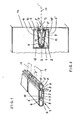
- the element consists of a head part 1 designed as a hollow body and of a rear part 2 detachably combined therewith.
- the head part is approximately hollow box-shaped and has an insertion slot 4 on its rear wall 3 Provide rear section.
- the latter points to his Front a wedge-like extension 5 and in its rear area a wedge-like extension 6, the wedge strength or wedge height of the extension 6 being larger than that of the extension 5.
- Both extensions 5 and 6 have undercuts 5 'and 6' and are by means of a Web 7 connected to each other.
- At least one rib-shaped extension 10, 11 is provided on the inside of the two side walls 8, 9 of the head part, each of which projects inwards and engages behind the front-side extension 5 of the rear part 2 in the starting position of the element according to FIG. 1.
- the two approaches 10 and 11 serve simultaneously as a guide for the web 7 of the rear part.
- FIG. 2 shows, when the element is pushed in through the opening slot 12 into the interior of the longitudinal groove 13 in the receiving part 14, the front of the head part comes into contact with the inner wall 15 of the longitudinal groove, as a result of which the rear part is displaced relative to the head part or the insertion force is maintained. moved on.
- the wedge effect exerted by the wedge-like extension 6 on the end faces of the two wall parts 3 'and 3 "delimiting the insertion slot 4 these wall parts are pressed apart.
- the two wall parts 3' and 3" of the head part finally undercut the undercuts 6 The wedge-like extension 6.
- the rear part is fixed in position within the head part.
- the wall parts 3 'and 3 "of the head part come into contact with the inner sides 16 and 16' of the longitudinal groove 13, as a result of which the element is secured against being pulled out of the opening slot 12 of the longitudinal groove 13 of the receiving part 14.
- the head part may also have any other suitable hollow or cross-sectional shape, may likewise the rear portion are modified accordingly.
- the interaction of the head and rear parts in the sense of the invention is essential.
- a so-called hard or soft plastic is suitable as the material, for example injectable hard or soft PVC.
- the wall part 17 consisting of deformable flat material or of solid material can be attached to the rear 6 ′′ of the wedge-like extension 6 of the rear part 1.
- the wedge-like extension 6 can optionally also be designed without a cavity and have a full cross-section.
- wall parts 17 can be provided with a hemstitch into which the element is inserted.
- a hemstitch is indicated in dashed lines in FIG. 2 and designated 18.
- the element serves, for example, as a piping for anchoring awnings in the undercut groove of a hollow shaft.
- the element is inserted in reverse into the longitudinal groove 13 of the receiving part 14, that is to say with the rear part 2 ahead (see arrow direction).
- This type of insertion is particularly suitable when material webs 17 provided with a hemstitch 18, for example in the form of an awning or the like are to be anchored in the longitudinal groove.
- the course of the hemstitch in the region of the opening slot of the longitudinal groove is more favorable in this case because of the front side of the head part located here.
- the element is to be inserted with its head part 1 or with its rear part 2 ahead through the opening slot 12 into the longitudinal groove of the receiving part depends on the given conditions with regard to the nature of the wall parts to be anchored and the design and depth of the longitudinal groove of the receiving part .
Landscapes
- Engineering & Computer Science (AREA)
- Architecture (AREA)
- Civil Engineering (AREA)
- Structural Engineering (AREA)
- General Engineering & Computer Science (AREA)
- Mechanical Engineering (AREA)
- Joining Of Building Structures In Genera (AREA)
- Dowels (AREA)
Abstract
Description
- Die Erfindung bezieht sich auf ein Element zum Verankern von mit diesem vereinigbaren Wandteilen in der hinterschnittenen, einen öffnungsschlitz aufweisenden Längsnut eines Aufnahmeteils, in welche das Element einbringbar ist, wobei die Stärke des Elements geringer bemessen ist als die Breite des Öffnungsschlitzes der Längsnut, derart, daß das Element durch den öffnungsschlitz hindurch in das Innere der Längsnut einführbar ist und nach dem Einschieben in die Längsnut eine solche Konturenveränderung aufweist, die ein Herausziehen des Elements aus der Längsnut in Richtung quer zu deren Längserstreckung sicher verhindert.
- In Weiterbildung und weiterer Ausgestaltung eines derartigen Elements sieht die Erfindung vor, daß das Element aus einem als Hohlprofilkörper ausgebildeten Kopfteil und aus einem mit diesem vereinigbaren, sowohl an seiner Frontseite als auch in seinem rückwärtigen Bereich eine keilartige, hinterschnittene Erweiterung enthaltenden Heckteil besteht, wobei die Keilstärke der rückwärtigen Erweiterung größer bemessen ist als diejenige der frontseitigen Erweiterung, und daß die heckseitig gelegene Wandung des Kopfteils einen Einführschlitz für das Heckteil aufweist und an der Innenseite seiner beiden Seitenwandungen jeweils wenigstens einen nach innen ragenden rippenförmigen Ansatz besitzt, wobei diese Ansätze bei vereinigtem Kopf- und Heckteil die frontseitige Erweiterung des Heckteils hintergreifen und als Führung für den die beiden keilartigen Erweiterungen des Heckteils miteinander verbindenden Steg dienen, und daß die rückwärtige Erweiterung des Heckteils infolge der beim Einschieben des Elements in die Längsnut des Aufnahmeteils stattfindenden Relativbewegung zwischen Kopf- und Heckteil das Kopfteil aufweitet und in der Endlage des Elements die Hinterschneidungen der rückwärtigen Erweiterung des Heckteils von den beiden den Einführschlitz begrenzenden Wandungen des Kopfteils hinterfaßt werden.
- Ein Ausführungsbeispiel der Erfindung wird im nachstehenden anhand der Zeichnung erläutert.
- Es zeigen: Figur 1 eine Seitenansicht des Elements bei vereinigtem Kopf- und Heckteil im Ausgangszustand und perspektivisch angedeuteter Längserstreckung.
- Figuren 2 und 3 ein Element gemäß Figur 1 in seiner Einführungsend- und Verriegelungslage in der Längsnut eines Aufnahmeteils, wobei das Element im Falle der Figur 3 umgekehrt, also mit dem Heckteil voraus, in die Nut eingeschoben ist.
- Wie die Figuren 1 bis 3 erkennen lassen, besteht das Element aus einem als Hohlkörper ausgebildeten Kopfteil 1 und aus einem mit diesem lösbar vereinigten Heckteil 2. Das Kopfteil ist beim Ausführungsbeispiel etwa hohlkastenförmig ausgestaltet und an seiner heckseitig gelegenen Wandung 3 mit einem Einführschlitz 4 für das Heckteil versehen. Letzteres weist an seiner Frontseite eine keilartige Erweiterung 5 und in seinem rückwärtigen Bereich eine keilartige Erweiterung 6 auf, wobei die Keilstärke bzw. Keilhöhe der Erweiterung 6 größer bemessen ist als diejenige der Erweiterung 5. Beide Erweiterungen 5 und 6 besitzen Hinterschneidungen 5' und 6' und sind mittels eines Stegs 7 miteinander verbunden. An der Innenseite der beiden Seitenwandungen 8, 9 des Kopfteils ist jeweils wenigstens ein rippenförmiger Ansatz 10, 11 vorgesehen, von denen jeder nach innen ragt und in der Ausgangslage des Elements gemäß Figur 1 die frontseitige Erweiterung 5 des Heckteils 2 hintergreift. Die beiden Ansätze 10 und 11 dienen dabei gleichzeitig als Führung für den Steg 7 des Heckteils.
- Wie Figur 2 zeigt, kommt beim Einschieben des Elements durch den öffnungsschlitz 12 hindurch in das Innere der Längsnut 13 im Aufnahmeteil 14 die Frontseite des Kopfteils zur Anlage an die Innenwandung 15 der Längsnut, wodurch sich bei aufrechterhaltener Einschubkraft das Heckteil relativ zum Kopfteil verschiebt bzw. weiterbewegt. Infolge der dabei durch die keilartige Erweiterung 6 auf die Stirnseiten der beiden den Einführschlitz 4 begrenzenden Wandungsteile 3' und 3" ausgeübten Keilwirkung werden diese Wandungsteile auseinandergedrückt. In der Endlage des Heckteils hinterfassen die beiden Wandungsteile 3' und 3" des Kopfteils schließlich die Hinterschneidungen 6' der keilartigen Erweiterung 6. Damit ist das Heckteil innerhalb des Kopfteils in seiner Lage fixiert. Zugleich kommen die Wandungsteile 3' und 3" des Kopfteils zur Anlage an die Innenseiten 16 und 16' der Längsnut 13, wodurch das Element gegen Herausziehen aus dem Öffnungsschlitz 12 der Längsnut 13 des Aufnahmeteils 14 gesichert ist.
- Anstelle der beim Ausführungsbeispiel gewählten Hohlkastenform mit frontseitiger Abrundung kann das Kopfteil auch eine andere geeignete Hohl- bzw. Querschnittsform aufweisen, desgleichen kann das Heckteil entsprechend modifiziert werden. Wesentlich ist das Zusammenwirken des Kopf- und Heckteils im Sinne der Erfindung.
- Als Werkstoff eignet sich je nach Anwendungsfall ein sogenannter harter oder weicher Kunststoff, beispielsweise spritzfähiges Hart-oder Weich-PVC.
- Das aus verformbarem Flachmaterial oder aus festem Material bestehende Wandteil 17 kann an der Rückseite 6" der keilartigen Erweiterung 6 des Heckteils 1 befestigt werden. Die keilartige Erweiterung 6 kann gegebenenfalls auch ohne Hohlraum ausgeführt sein und Vollquerschnitt besitzen.
- Im Falle aus verformbarem Flachmaterial, beispielsweise aus textilem Material, bestehenden Wandteilen 17 können diese mit einem Hohlsaum versehen sein, in welchen das Element eingeschoben wird. Ein solcher Hohlsaum ist in Fig. 2 gestrichelt angedeutet und mit 18 bezeichnet. In einem solchen Fall dient das Element beispielsweise als Keder bei der Verankerung von Markisen in der hinterschnittenen Nut einer Hohlwelle.
- Im Falle der Figur 3 ist, anders als bei der Darstellung gemäß Figur 2, das Element umgekehrt in die Längsnut 13 des Aufnahmeteils 14 eingeschoben, das heißt, mit dem Heckteil 2 voraus (siehe Pfeilrichtung). Diese Einführart bietet sich insbesondere dann an, wenn mit einem Hohlsaum 18 versehene Materialbahnen 17, zum Beispiel in Form einer Markise oder dergleichen in der Längsnut verankert werden sollen. Der Hohlsaumverlauf im Bereich des Öffnungsschlitzes der Längsnut ist in diesem Fall wegen der hier befindlichen Frontseite des Kopfteils günstiger. Ob das Element mit seinem Kopfteil 1 oder mit seinem Heckteil 2 voraus durch den öffnungsschlitz 12 hindurch in die Längsnut des Aufnahmeteils eingeschoben werden soll, hängt von den jeweils gegebenen Voraussetzungen hinsichtlich der Beschaffenheit der zu verankernden Wandteile und der Ausbildung und Tiefe der Längsnut des Aufnahmeteils ab.
Claims (3)
Priority Applications (1)
| Application Number | Priority Date | Filing Date | Title |
|---|---|---|---|
| AT85113769T ATE56255T1 (de) | 1985-01-28 | 1985-10-29 | Element zum verankern von mit diesem vereinigbaren wandteilen in der hinterschnittenen, einen oeffnungsschlitz aufweisenden laengsnut eines aufnahmeteils. |
Applications Claiming Priority (2)
| Application Number | Priority Date | Filing Date | Title |
|---|---|---|---|
| DE19853502728 DE3502728A1 (de) | 1985-01-28 | 1985-01-28 | Element zum verankern von mit diesem vereinigbaren wandteilen in der hinterschnittenen, einen oeffnungsschlitz aufweisenden laengsnut eines aufnahmeteils |
| DE3502728 | 1985-01-28 |
Publications (3)
| Publication Number | Publication Date |
|---|---|
| EP0189530A2 true EP0189530A2 (de) | 1986-08-06 |
| EP0189530A3 EP0189530A3 (en) | 1988-04-20 |
| EP0189530B1 EP0189530B1 (de) | 1990-09-05 |
Family
ID=6260940
Family Applications (1)
| Application Number | Title | Priority Date | Filing Date |
|---|---|---|---|
| EP85113769A Expired - Lifetime EP0189530B1 (de) | 1985-01-28 | 1985-10-29 | Element zum Verankern von mit diesem vereinigbaren Wandteilen in der hinterschnittenen, einen Öffnungsschlitz aufweisenden Längsnut eines Aufnahmeteils |
Country Status (3)
| Country | Link |
|---|---|
| EP (1) | EP0189530B1 (de) |
| AT (1) | ATE56255T1 (de) |
| DE (2) | DE3502728A1 (de) |
Cited By (3)
| Publication number | Priority date | Publication date | Assignee | Title |
|---|---|---|---|---|
| DE4032807C1 (de) * | 1990-10-16 | 1992-05-07 | Hans-Peter 7312 Kirchheim De Rueck | |
| GB2366185A (en) * | 2000-08-22 | 2002-03-06 | Eml Ltd | Channel member for support purposes |
| FR3017596A1 (fr) * | 2014-02-17 | 2015-08-21 | Christian Leviel | Ralingue d'ancrage |
Family Cites Families (2)
| Publication number | Priority date | Publication date | Assignee | Title |
|---|---|---|---|---|
| FR1333639A (fr) * | 1962-09-18 | 1963-07-26 | Raymond A | Attache en u, notamment pour le revêtement de bords de panneaux minces |
| FR2484501A1 (fr) * | 1980-06-13 | 1981-12-18 | Michelet Marceau | Cloisons amovibles a double panneaux et elements pour leur realisation |
-
1985
- 1985-01-28 DE DE19853502728 patent/DE3502728A1/de not_active Withdrawn
- 1985-10-29 DE DE8585113769T patent/DE3579583D1/de not_active Expired - Fee Related
- 1985-10-29 AT AT85113769T patent/ATE56255T1/de not_active IP Right Cessation
- 1985-10-29 EP EP85113769A patent/EP0189530B1/de not_active Expired - Lifetime
Cited By (4)
| Publication number | Priority date | Publication date | Assignee | Title |
|---|---|---|---|---|
| DE4032807C1 (de) * | 1990-10-16 | 1992-05-07 | Hans-Peter 7312 Kirchheim De Rueck | |
| EP0481260A3 (de) * | 1990-10-16 | 1994-04-20 | Ivera H P Rueck Textilhandel U | |
| GB2366185A (en) * | 2000-08-22 | 2002-03-06 | Eml Ltd | Channel member for support purposes |
| FR3017596A1 (fr) * | 2014-02-17 | 2015-08-21 | Christian Leviel | Ralingue d'ancrage |
Also Published As
| Publication number | Publication date |
|---|---|
| EP0189530B1 (de) | 1990-09-05 |
| EP0189530A3 (en) | 1988-04-20 |
| DE3579583D1 (de) | 1990-10-11 |
| ATE56255T1 (de) | 1990-09-15 |
| DE3502728A1 (de) | 1986-07-31 |
Similar Documents
| Publication | Publication Date | Title |
|---|---|---|
| DE69604426T2 (de) | Vorrichtung zur präzisen Positionierung eines Stossfängers zu einem Kotflügelteil eines Fahrzeuges | |
| DE69201864T2 (de) | Methode zum verbinden von bauteilen, profil und baueinheit mit einer vielzahl von profilen. | |
| DE69920305T2 (de) | Diebstahlsicherungsmarkierer für Artikel mit stabförmigen Teilen | |
| DE4113725A1 (de) | Anordnung fuer eine loesbare verbindung von flexiblen bahnen oder dergleichen an mit nuten versehenen profilen | |
| EP0032408B1 (de) | Wärmeisolierender Profilkörper | |
| DE3736211A1 (de) | Aus mindestens zwei teilkoerpern, beispielsweise aus profilschienen zusammengesetzter koerper | |
| DE69614237T2 (de) | Befestigungssystem für eine Kraftfahrzeuginnenverkleidung | |
| EP0189530A2 (de) | Element zum Verankern von mit diesem vereinigbaren Wandteilen in der hinterschnittenen, einen Öffnungsschlitz aufweisenden Längsnut eines Aufnahmeteils | |
| DE29607346U1 (de) | Anschlußprofil zwischen Fensterrahmen und Mauerwerksputz im Bereich einer Fensterlaibung | |
| DE6909680U (de) | Rueckwandhalteprofil fuer moebel | |
| DE19607820A1 (de) | Vorrichtung zum Verbinden von zwei Profilen | |
| WO1999036148A1 (de) | Bausteinsystem, insbesondere f�r spielbausteine | |
| DE3439921C1 (de) | Element zum Verankern von Wandteilen in der hinterschnittenen, einen Öffnungsschlitz aufweisenden Längsnut eines Aufnahmeteils | |
| EP0481260B1 (de) | Leistenförmiges Element zum Verankern von mit diesem vereinigbaren Wandteilen in der hinterschnittenen, einen Öffnungsschlitz aufweisenden Längsnut eines Aufnahmeteils | |
| EP0248430A2 (de) | Entwässerungsrinne | |
| DE202011000065U1 (de) | Vorrichtung zum Aufhängen einer Gardine oder dergleichen | |
| DE9215844U1 (de) | Beschlagteileverbindung | |
| DE9401420U1 (de) | Profil für die Bildung von Gerüstkonstruktionen | |
| DE2710224A1 (de) | Vorrichtung zur positionierung von teilen, insbesondere von schalungselementen im betonbau | |
| DE3526729C2 (de) | ||
| DE69606079T2 (de) | Zusammenbauverfahren für Möbelelemente und Möbel das von diesen Zusammenbau gebildet ist | |
| DE7235547U (de) | Rahmen aus vertikalen Pfostenprofilen und horizontalen Sprossenprofilen, vorzugsweise für eine Hallenbadfassade | |
| DE2151144A1 (de) | Dichtleiste fuer Fahrzeugschiebefenster | |
| DE9109806U1 (de) | Sammelschelle | |
| EP1582688A2 (de) | Rollladenkasten |
Legal Events
| Date | Code | Title | Description |
|---|---|---|---|
| PUAI | Public reference made under article 153(3) epc to a published international application that has entered the european phase |
Free format text: ORIGINAL CODE: 0009012 |
|
| 17P | Request for examination filed |
Effective date: 19851029 |
|
| AK | Designated contracting states |
Kind code of ref document: A2 Designated state(s): AT BE CH DE FR GB IT LI NL |
|
| PUAL | Search report despatched |
Free format text: ORIGINAL CODE: 0009013 |
|
| AK | Designated contracting states |
Kind code of ref document: A3 Designated state(s): AT BE CH DE FR GB IT LI NL |
|
| 17Q | First examination report despatched |
Effective date: 19890306 |
|
| GRAA | (expected) grant |
Free format text: ORIGINAL CODE: 0009210 |
|
| AK | Designated contracting states |
Kind code of ref document: B1 Designated state(s): AT BE CH DE FR GB IT LI NL |
|
| REF | Corresponds to: |
Ref document number: 56255 Country of ref document: AT Date of ref document: 19900915 Kind code of ref document: T |
|
| REF | Corresponds to: |
Ref document number: 3579583 Country of ref document: DE Date of ref document: 19901011 |
|
| PGFP | Annual fee paid to national office [announced via postgrant information from national office to epo] |
Ref country code: FR Payment date: 19901017 Year of fee payment: 6 |
|
| PGFP | Annual fee paid to national office [announced via postgrant information from national office to epo] |
Ref country code: GB Payment date: 19901019 Year of fee payment: 6 |
|
| PGFP | Annual fee paid to national office [announced via postgrant information from national office to epo] |
Ref country code: AT Payment date: 19901023 Year of fee payment: 6 |
|
| PGFP | Annual fee paid to national office [announced via postgrant information from national office to epo] |
Ref country code: CH Payment date: 19901030 Year of fee payment: 6 |
|
| PGFP | Annual fee paid to national office [announced via postgrant information from national office to epo] |
Ref country code: NL Payment date: 19901031 Year of fee payment: 6 |
|
| ITF | It: translation for a ep patent filed | ||
| ET | Fr: translation filed | ||
| GBT | Gb: translation of ep patent filed (gb section 77(6)(a)/1977) | ||
| PGFP | Annual fee paid to national office [announced via postgrant information from national office to epo] |
Ref country code: BE Payment date: 19910116 Year of fee payment: 6 |
|
| PGFP | Annual fee paid to national office [announced via postgrant information from national office to epo] |
Ref country code: DE Payment date: 19910429 Year of fee payment: 6 |
|
| PLBE | No opposition filed within time limit |
Free format text: ORIGINAL CODE: 0009261 |
|
| STAA | Information on the status of an ep patent application or granted ep patent |
Free format text: STATUS: NO OPPOSITION FILED WITHIN TIME LIMIT |
|
| 26N | No opposition filed | ||
| PG25 | Lapsed in a contracting state [announced via postgrant information from national office to epo] |
Ref country code: GB Effective date: 19911029 Ref country code: AT Effective date: 19911029 |
|
| ITTA | It: last paid annual fee | ||
| PG25 | Lapsed in a contracting state [announced via postgrant information from national office to epo] |
Ref country code: LI Effective date: 19911031 Ref country code: CH Effective date: 19911031 Ref country code: BE Effective date: 19911031 |
|
| BERE | Be: lapsed |
Owner name: RUCK HANS-PETER Effective date: 19911031 |
|
| PG25 | Lapsed in a contracting state [announced via postgrant information from national office to epo] |
Ref country code: NL Effective date: 19920501 |
|
| NLV4 | Nl: lapsed or anulled due to non-payment of the annual fee | ||
| GBPC | Gb: european patent ceased through non-payment of renewal fee | ||
| PG25 | Lapsed in a contracting state [announced via postgrant information from national office to epo] |
Ref country code: FR Effective date: 19920630 |
|
| REG | Reference to a national code |
Ref country code: CH Ref legal event code: PL |
|
| PG25 | Lapsed in a contracting state [announced via postgrant information from national office to epo] |
Ref country code: DE Effective date: 19920701 |
|
| REG | Reference to a national code |
Ref country code: FR Ref legal event code: ST |