EP0192897A2 - Mischung aus Polyäthylen und Polypropylen - Google Patents
Mischung aus Polyäthylen und Polypropylen Download PDFInfo
- Publication number
- EP0192897A2 EP0192897A2 EP85309484A EP85309484A EP0192897A2 EP 0192897 A2 EP0192897 A2 EP 0192897A2 EP 85309484 A EP85309484 A EP 85309484A EP 85309484 A EP85309484 A EP 85309484A EP 0192897 A2 EP0192897 A2 EP 0192897A2
- Authority
- EP
- European Patent Office
- Prior art keywords
- blend
- polyethylene
- polypropylene
- fiber
- melt
- Prior art date
- Legal status (The legal status is an assumption and is not a legal conclusion. Google has not performed a legal analysis and makes no representation as to the accuracy of the status listed.)
- Granted
Links
Images

Classifications
-
- C—CHEMISTRY; METALLURGY
- C08—ORGANIC MACROMOLECULAR COMPOUNDS; THEIR PREPARATION OR CHEMICAL WORKING-UP; COMPOSITIONS BASED THEREON
- C08L—COMPOSITIONS OF MACROMOLECULAR COMPOUNDS
- C08L23/00—Compositions of homopolymers or copolymers of unsaturated aliphatic hydrocarbons having only one carbon-to-carbon double bond; Compositions of derivatives of such polymers
- C08L23/02—Compositions of homopolymers or copolymers of unsaturated aliphatic hydrocarbons having only one carbon-to-carbon double bond; Compositions of derivatives of such polymers not modified by chemical after-treatment
- C08L23/04—Homopolymers or copolymers of ethene
- C08L23/06—Polyethylene
-
- C—CHEMISTRY; METALLURGY
- C08—ORGANIC MACROMOLECULAR COMPOUNDS; THEIR PREPARATION OR CHEMICAL WORKING-UP; COMPOSITIONS BASED THEREON
- C08L—COMPOSITIONS OF MACROMOLECULAR COMPOUNDS
- C08L23/00—Compositions of homopolymers or copolymers of unsaturated aliphatic hydrocarbons having only one carbon-to-carbon double bond; Compositions of derivatives of such polymers
- C08L23/02—Compositions of homopolymers or copolymers of unsaturated aliphatic hydrocarbons having only one carbon-to-carbon double bond; Compositions of derivatives of such polymers not modified by chemical after-treatment
- C08L23/10—Homopolymers or copolymers of propene
- C08L23/12—Polypropene
-
- D—TEXTILES; PAPER
- D01—NATURAL OR MAN-MADE THREADS OR FIBRES; SPINNING
- D01F—CHEMICAL FEATURES IN THE MANUFACTURE OF ARTIFICIAL FILAMENTS, THREADS, FIBRES, BRISTLES OR RIBBONS; APPARATUS SPECIALLY ADAPTED FOR THE MANUFACTURE OF CARBON FILAMENTS
- D01F6/00—Monocomponent artificial filaments or the like of synthetic polymers; Manufacture thereof
- D01F6/44—Monocomponent artificial filaments or the like of synthetic polymers; Manufacture thereof from mixtures of polymers obtained by reactions only involving carbon-to-carbon unsaturated bonds as major constituent with other polymers or low-molecular-weight compounds
- D01F6/46—Monocomponent artificial filaments or the like of synthetic polymers; Manufacture thereof from mixtures of polymers obtained by reactions only involving carbon-to-carbon unsaturated bonds as major constituent with other polymers or low-molecular-weight compounds of polyolefins
-
- D—TEXTILES; PAPER
- D04—BRAIDING; LACE-MAKING; KNITTING; TRIMMINGS; NON-WOVEN FABRICS
- D04H—MAKING TEXTILE FABRICS, e.g. FROM FIBRES OR FILAMENTARY MATERIAL; FABRICS MADE BY SUCH PROCESSES OR APPARATUS, e.g. FELTS, NON-WOVEN FABRICS; COTTON-WOOL; WADDING ; NON-WOVEN FABRICS FROM STAPLE FIBRES, FILAMENTS OR YARNS, BONDED WITH AT LEAST ONE WEB-LIKE MATERIAL DURING THEIR CONSOLIDATION
- D04H1/00—Non-woven fabrics formed wholly or mainly of staple fibres or like relatively short fibres
- D04H1/40—Non-woven fabrics formed wholly or mainly of staple fibres or like relatively short fibres from fleeces or layers composed of fibres without existing or potential cohesive properties
- D04H1/42—Non-woven fabrics formed wholly or mainly of staple fibres or like relatively short fibres from fleeces or layers composed of fibres without existing or potential cohesive properties characterised by the use of certain kinds of fibres insofar as this use has no preponderant influence on the consolidation of the fleece
- D04H1/4282—Addition polymers
- D04H1/4291—Olefin series
-
- D—TEXTILES; PAPER
- D04—BRAIDING; LACE-MAKING; KNITTING; TRIMMINGS; NON-WOVEN FABRICS
- D04H—MAKING TEXTILE FABRICS, e.g. FROM FIBRES OR FILAMENTARY MATERIAL; FABRICS MADE BY SUCH PROCESSES OR APPARATUS, e.g. FELTS, NON-WOVEN FABRICS; COTTON-WOOL; WADDING ; NON-WOVEN FABRICS FROM STAPLE FIBRES, FILAMENTS OR YARNS, BONDED WITH AT LEAST ONE WEB-LIKE MATERIAL DURING THEIR CONSOLIDATION
- D04H1/00—Non-woven fabrics formed wholly or mainly of staple fibres or like relatively short fibres
- D04H1/40—Non-woven fabrics formed wholly or mainly of staple fibres or like relatively short fibres from fleeces or layers composed of fibres without existing or potential cohesive properties
- D04H1/42—Non-woven fabrics formed wholly or mainly of staple fibres or like relatively short fibres from fleeces or layers composed of fibres without existing or potential cohesive properties characterised by the use of certain kinds of fibres insofar as this use has no preponderant influence on the consolidation of the fleece
- D04H1/4326—Condensation or reaction polymers
- D04H1/435—Polyesters
-
- D—TEXTILES; PAPER
- D04—BRAIDING; LACE-MAKING; KNITTING; TRIMMINGS; NON-WOVEN FABRICS
- D04H—MAKING TEXTILE FABRICS, e.g. FROM FIBRES OR FILAMENTARY MATERIAL; FABRICS MADE BY SUCH PROCESSES OR APPARATUS, e.g. FELTS, NON-WOVEN FABRICS; COTTON-WOOL; WADDING ; NON-WOVEN FABRICS FROM STAPLE FIBRES, FILAMENTS OR YARNS, BONDED WITH AT LEAST ONE WEB-LIKE MATERIAL DURING THEIR CONSOLIDATION
- D04H1/00—Non-woven fabrics formed wholly or mainly of staple fibres or like relatively short fibres
- D04H1/40—Non-woven fabrics formed wholly or mainly of staple fibres or like relatively short fibres from fleeces or layers composed of fibres without existing or potential cohesive properties
- D04H1/54—Non-woven fabrics formed wholly or mainly of staple fibres or like relatively short fibres from fleeces or layers composed of fibres without existing or potential cohesive properties by welding together the fibres, e.g. by partially melting or dissolving
- D04H1/541—Composite fibres, e.g. sheath-core, sea-island or side-by-side; Mixed fibres
-
- D—TEXTILES; PAPER
- D04—BRAIDING; LACE-MAKING; KNITTING; TRIMMINGS; NON-WOVEN FABRICS
- D04H—MAKING TEXTILE FABRICS, e.g. FROM FIBRES OR FILAMENTARY MATERIAL; FABRICS MADE BY SUCH PROCESSES OR APPARATUS, e.g. FELTS, NON-WOVEN FABRICS; COTTON-WOOL; WADDING ; NON-WOVEN FABRICS FROM STAPLE FIBRES, FILAMENTS OR YARNS, BONDED WITH AT LEAST ONE WEB-LIKE MATERIAL DURING THEIR CONSOLIDATION
- D04H3/00—Non-woven fabrics formed wholly or mainly of yarns or like filamentary material of substantial length
- D04H3/08—Non-woven fabrics formed wholly or mainly of yarns or like filamentary material of substantial length characterised by the method of strengthening or consolidating
- D04H3/16—Non-woven fabrics formed wholly or mainly of yarns or like filamentary material of substantial length characterised by the method of strengthening or consolidating with bonds between thermoplastic filaments produced in association with filament formation, e.g. immediately following extrusion
-
- C—CHEMISTRY; METALLURGY
- C08—ORGANIC MACROMOLECULAR COMPOUNDS; THEIR PREPARATION OR CHEMICAL WORKING-UP; COMPOSITIONS BASED THEREON
- C08L—COMPOSITIONS OF MACROMOLECULAR COMPOUNDS
- C08L2203/00—Applications
- C08L2203/12—Applications used for fibers
-
- Y—GENERAL TAGGING OF NEW TECHNOLOGICAL DEVELOPMENTS; GENERAL TAGGING OF CROSS-SECTIONAL TECHNOLOGIES SPANNING OVER SEVERAL SECTIONS OF THE IPC; TECHNICAL SUBJECTS COVERED BY FORMER USPC CROSS-REFERENCE ART COLLECTIONS [XRACs] AND DIGESTS
- Y10—TECHNICAL SUBJECTS COVERED BY FORMER USPC
- Y10T—TECHNICAL SUBJECTS COVERED BY FORMER US CLASSIFICATION
- Y10T442/00—Fabric [woven, knitted, or nonwoven textile or cloth, etc.]
- Y10T442/60—Nonwoven fabric [i.e., nonwoven strand or fiber material]
- Y10T442/69—Autogenously bonded nonwoven fabric
- Y10T442/692—Containing at least two chemically different strand or fiber materials
Definitions
- This invention relates to a blend of low density polyethylene and crystalline polypropylene and fibers produced therefrom.
- the invention concerns an improved blend that can be melt-spun at high temperature and high speed into fibers which are particularly useful as binder fibers for nonwoven fabrics.
- Nonwoven fabrics which contain fibers having different melting temperatures are known in the art.
- the fibers with the lower melting temperature act as an adhesive agent which bonds the higher melting-temperature fibers to each other.
- the lower melting-temperature fibers are referred to as "binder" fibers.
- the web is compressed and heated to a temperature which causes the binder fibers to melt and bond the other fibers to each other. Temperatures which do not detrimentally affect the tensile characteristics of the non-binder fibers are desired for the binding operation.
- Polyethylene because of its relatively low melting temperature and other desirable characteristics, has been considered for use as binder fibers for nonwoven fabrics, especially for those made of polypropylene filaments.
- polyethylene generally has been found to be unsatisfactory for binder fibers because of its poor spinnability.
- the melt-spinning of polyethylene into fine filaments at high speed and high temperature has generally been unsatisfactory. Yet, such high temperature, high speed melt-spinning is highly desirable for successful commercial production of polyethylene binder fibers. Accordingly, it is an object of this invention to provide a composition that can be melt-spun at high speed and high temperature into binder fibers that would have melting characteristics similar to those of polyethylene.
- Blends of low density polyethylene and isotactic polypropylene are known for various purposes.
- Maloney et al.. U.S. Patent 3.355.520. suggests that branched polyethylene in which is incorporated polypropylene amounting to 3.1 to 5.3% (by weight of the polyethylene) improves the wire-coating, film, and bottle-forming characteristics of the polymer.
- the examples of Maloney et al. disclose branched polyethylene of 0.922 and 0.970 g/cm 3 density and 0.17 and 0.07 melt index in which is incorporated up to 11.0% of polypropylene of 0.905 g/cm 3 density and 0.78 melt flow rate.
- the present invention provides an improved blend consisting essentially of low density polyethylene and crystalline polypropylene, which blend can be melt-spun into fibers at surprisingly much higher speeds and temperatures than non-blended polyethylene can be melt-spun.
- the polyethylene amounts to 65 to 95% by weight of the blend and has a density in the range of 0.90 to 0.92 g/cm 3 , a melting temperature of less than 107°C and a melt index of at least 25, and the polypropylene amounts to 5 to 35% by weight of the blend and has a melt flow rate of at least 3, and a ratio of weight-to-number average molecular weight of at least 4.
- the polyethylene density, melting temperature and melt index are respectively in the ranges of 0.905 to 0.913 g/cm 3 , 102 to 106°C and 30 to 70, and the polypropylene melt flow rate and molecular weight ratio are respectively less than 35 and less than 12.
- the polyethylene amounts to 75 to 85% and the polypropylene, 15 to 25% of the blend weight.
- the present invention also provides a fiber made from the above blend.
- the polyethylene forms a continuous phase in which the polypropylene is dispersed as a second phase.
- a process for making fibers from the blend in which the blend is melt-spun at a temperature in the range of 205 to 265°C, preferably at least 230°C. and at a speed of at least 1740 m/min, preferably at least 2500 m/min.
- the invention provides a process for making and bonding a nonwoven fabric formed with binder fibers melt-spun from the blend.
- the blends of the present invention are formed from crystalline (i.e., isotactic) polypropylene and particular low-density, branched polyethylene polymers.
- the polyethylene is the major component, amounting to between 65 and 95%, preferably 75 to 85% by weight of the blend.
- the polypropylene is the minor component of the blend and provides the complemental amount of polymer to complete the blend (i.e.. 35 to 5%, preferably 25 to 15%).
- the usual additives, such as thermal, oxidative and ultraviolet stabilizers may be added to the blend in conventional amounts.
- the low-density polyethylene suitable for use in the blends of present invention generally is a branched polyethylene having a melting temperature of less than 107°C. a density in the range of 0.90 to 0.92 g/cm and a melt index of at least 25 and usually below 200.
- polyethylenes of 0.905 to 0.913 g/cm density, 102 to 106°C melting temperature and 30 to 70 melt index are preferred.
- the crystalline polypropylene suitable for use in the blends of the present invention generally is an isotactic polypropylene having a melt flow rate of at least 3 and a molecular weight distribution, as determined by gel permeation chromatography such that the weight average molecular weight, Mw, is at least 4 times the number average molecular weight, Mn.
- the melt flow rate is less than 35 and the ratio of weight-to-number average molecular weight is less than 12.
- Such polypropylenes have a wide molecular weight distribution and are of the type that are obtained directly from the polymerization reactor without a further "cracking" treatment. These polymers are sometimes called "reactor grade" polypropylenes.
- the polyethylene and polypropylene may be blended together and then melt spun in conventional equipment by conventional techniques.
- the blend compositions of the invention are clearly superior in high-speed and high-temperature spinning performance as compared to blends made with high-density polyethylene or with low-density polyethylenes that have melt indices below about 25. These latter blends have very erratic spinning characteristics at high temperatures, especially above about 250°C. These latter blends also exhibit much lower filament-breaking speeds than those that can be achieved under the same conditions by melt-spun blends of the invention.
- the fibers melt-spun from blends of the invention contain two phases, a polypropylene phase which is dispersed in a continuous phase of polyethylene.
- the polypropylene takes the form of elongated droplets in the filaments. Many of the droplets measure about 7 microns in length by about 5 microns in diameter. However, there is considerable variation in the droplet size. These fibers exhibit two distinct melting temperatures which correspond to the melting temperatures of each component.
- the process of the invention for producing the above-described fibers comprises melt-spinning a blend of the invention at a temperature in the range of 205°C to 265°C and at a speed of at least 1740 meter/min (1900 yds/min).
- the spinning speed preferably is no more than 60% of the speed at which filaments break when melt spun at the particular spin temperature.
- Preferred temperatures and speeds for melt spinning filaments in accordance with the invention are respectively 240 to 265°C and at least 2300 meters/min.
- the present invention also includes a process for producing a nonwoven fabric.
- the process comprises melt-spinning as described hereinbefore a polymer blend of the invention to form a first group of filaments, quenching the first group of filaments, bringing the first group of filaments together with a second group of filaments which have a higher melting temperature than the polyethylene component of the first group of filaments, forming a composite web of the two groups of filaments and bonding the web by compressing the web while heating it to a temperature above the melting temperature of the polyethylene component.
- the second group of filaments may be of a polyester, polypropylene, high-density polyethylene or other polymer. Isotactic polypropylene is the preferred polymer for the second group of filaments.
- the compressing of the web may be accomplished with flat or embossed rolls. Embossed rolls provide a bonded pattern to the fabric.
- Fiber of this invention can also be employed to make nonwoven fabric without the use of another higher melting temperature fiber.
- very careful control of the bonding time and bonding temperature are necessary.
- the bonding time should be short and the bonding temperature should be approximately equal to the melting temperature of the polyethylene component of the low-density polyethylene/polypropylene fiber. In this manner nonwoven fabrics made completely of fibers of the blends of the invention can be produced.
- Example 1 shows the melt-spinning of textile-denier filaments from blends of the invention.
- Example 2 describes in detail the manufacture of a nonwoven fabric made with binder filaments in accordance with the invention.
- Example 3 illustrates the advantageous manner in which a preferred blend of the invention can be melt-spun into filaments at higher speeds than either component of the blend could be spun by itself.
- Example 4 summarizes data from a series of tests which helped establish the various preferred limits on parameters of the claimed invention.
- filaments of textile denier were melt-spun at high speed from a preferred blend of low density polyethylene and crystalline polypropylene:
- a nonwoven fabric was prepared from filaments of polypropylene and binder filaments of a polyethylene/polypropylene blend in accordance with the invention.
- This example also demonstrates the advantageous capability of the binder filaments to be melt-spun at the same high speeds as the main filaments (i.e., the polypropylene filaments, also called "matrix" filaments) of the web.
- a twenty-position, commercial machine for making continuous filament, spunbonded, nonwoven fabrics was used to melt spin matrix filaments of polypropylene and binder filaments of a polyethylene/polypropylene blend in accordance with the invention and to combine the filaments into a nonwoven fabric.
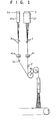
- the apparatus included at each position of the machine is represented diagramatically in Figure 1. Isotactic polypropylene, containing thermal and ultraviolet stabilizers and having a melt flow rate of 32, was melt spun through spinneret 2 to form matrix filaments. Spinneret 2 contained 1050 holes of circular cross-section measuring 0.97 mm (0.020 inch) in diameter and 2.41 mm (0.095 inch) in length. Throughput was 0.47 g/min/hole.
- Binder filaments consisting of a blend of 80 parts polyethylene and 20 parts polypropylene were melt spun from spinneret 20 which had 95 Y-shaped holes each measuring 0.38-mm long by 0.13-mm wide by 0.17-mm deep (0.015 x 0.005 x 0.007 inch). Binder filament throughput was 0.80 g/min/hole.
- the polypropylene polymer for the matrix filaments was melted in a 120-mm diameter twin screw extruder which operated with a 232°C outlet temperature and then melt spun into filaments of 2.6 dtex (2.3 denier per filament) through spinneret 2 which was maintained at 250°C.
- the 80/20 melt blend of polyethylene and polypropylene for the binder filaments was blended in flake form and then melted and further blended in a 83-mm diameter twin screw extruder. The blend was then melt spun into filaments of 4.3 dtex (3.9 dpf) through spinneret 2a which also was maintained at 250°C.
- the same polymer blend as used in Example 1 was used in the blend of the binder filaments of this example.
- the polypropylene matrix filaments were quenched to a temperature below 60°C by radial flow of cooling air in radial quench chimney 37.
- the melt-blend polyethylene/polypropylene binder filaments also were quenched to a temperature below 60°C by a cross-flow of cooling air in cross-flow quench chimney 37a.
- the thusly formed bundle of matrix filaments and bundle of binder filaments were then respectively passed over guides 3 and 3a, charged by corona discharge devices 41 and 41a to 27,000 esu/m , and passed over guide 3 1 and 3a'. Then, both bundles were converged on a pair of rolls 40, each of which operated at a surface speed of 1829 meters/min (2000 yards/min).
- the combined matrix and binder filaments were then advanced as a ribbon from the last roll 40 through high pressure, pneumatic-slot-jet diffuser 5. The width of the filament ribbon was 26.7 cm (10.5 inches).
- the ribbon of combined filaments was then forwarded from jet diffuser 5 to a moving collection belt on which the filaments were deposited to form a swath.
- the twenty swath-forming positions were arranged in four rows of jets with five positions per row. Each row was perpendicular to the direction of collection-belt movement. The slot jet of each position was at an angle to the perpendicular so that the swath formed by each jet overlapped by about 50% the swaths formed by adjacent jets in the row. In this manner, an overlapped, layered, wide sheet was formed.
- the sheet was then exposed to steam at 100°C and compacted under a load of 14.3 kg/linear cm (80 lbs/linear inch) by under a consolidation roll. The speed of the collection belt was adjusted to provide consolidated sheet of two unit weights, 50. 9 g/m 2 (1.5 oz/yd 2 ). and 67 . 8 g /m 2 ( 2 oz/ y d 2 ).
- a portion of the consolidated, not calendered sheet of 50.9-g/m (1.5 oz/yd 2 ) unit weight was pattern bonded at a speed of 6.1 m/sec (20 ft/min). at a temperature of 140°C and under a load of 89.5 kg/linear cm (500 lbs/linear inch) between a patterened roll having 20% compacting area and a smooth, heated back-up roll.
- Properties of the resultant pattern-bonded fabric were as follows:
- This example illustrates the advantage of a preferred polypropylene/polyethylene blend of the invention in providing higher speeds of melt-spinning than could be obtained with 100% polyethylene or 100% polypropylene or with blends of the same polymers having compositions that were outside the polyethylene/polypropylene ratios required by the present invention.
- a series of blends of polyethylene and polypropylene pellets was fed to a twin-screw extruder, melted and forced by means of a gear (metering) pump through a filter pack and spinneret plate to form filaments.
- the spinneret plate had 70 capillaries of circular cross-section arranged in two concentric circles of 5.1-cm (2-inch) and 3.8-cm (1.5-inch) diameter, which respectively accommodated 40 and 30 capillaries.
- Each capillary was 0.038 cm (0.015 inch) in diameter and 0.229 cm (0.090 in) in length and had an included entrance angle of 60°.
- the filaments were melt-spun with the spinneret at a temperature of 260°C and were then quenched by a cross flow of cooling air at room temperature.
- the polymer flow rate per hole was 0.90 grams/min.
- the quenching zone provided a uniform cross-flow of air at a velocity of 0.46 m/s (1.5 ft/sec) and extended from 3.9 cm (1.5 inches) below the spinneret to 57.2 cm (22.5 inches) below the spinneret.
- a feed roll i.e., filament withdrawal roll
- a U-guide was located about 3.15 meters (124 in) from the spinneret.
- the feed roll surface speed at which filaments broke was determined by increasing the feed roll speed until most of the filaments broke (usually all of the filaments broke at about the same speed) and by averaging at least three such measurements of break speed for each polymer blend.
- polyethylene of 0.9096 g/cm density, 103.4°C melting temperature and 70 melt index and polypropylene of 0.90 22 g/cm density. 164.0°C melting temperature. 8.7 melt flow rate, and 8.8 ratio of weight-to-number average molecular weight were used.
- This example describes the melt-spinning of blends of various polyethylene and polypropylene polymers.
- the particular polymers used are designated herein with upper-case letters and had the following properties:
- Polyethylene polymer A was "Petrothene” NA-270 manufactured by USI Chemicals; B was LD-502 manufactured by Exxon; C was “Alathon” 20 manufactured by Du Pont; and D was PE-9122 manufactured by Gulf.
- Polypropylene polymer Q was a virgin blend; and polymers R, S, T and U were respectively PLDT-147, PLDT-167, PLDT-168 and PD-3125, each manufactured by Exxon.
- Example 3 The same equipment and procedure as was used in Example 3 was employed in this example to melt-spin at 260°C polymer blends of 80 parts polyethylene and 20 parts polypropylene into filaments. As in Example 3 the speeds at which the filaments broke were determined for each blend and compared to the breaking speed of filaments made of 100% of the same polyethylene and of 100% of the same polypropylene as was used in the blend. The following table summarizes results of the tests. Tests C-1 and C-2 are comparison tests.
- polyethylene polymers A and B which were low-density (i.e., in the 0.90 to 0.92 g/cm 3 range) branched polyethylenes having a melt index of greater than 25 and melting temperatures of less than 107°C, were readily melt spun at 260°C at speeds of greater than 3000 meters/min.
- low-density polyethylene C i.e., 0.9 1 5 g/mc3
- polyethylene polymer C had a melting temperature of 109.9°C and a melt index of 1.9.
Landscapes
- Chemical & Material Sciences (AREA)
- Chemical Kinetics & Catalysis (AREA)
- Engineering & Computer Science (AREA)
- Textile Engineering (AREA)
- Medicinal Chemistry (AREA)
- Health & Medical Sciences (AREA)
- Polymers & Plastics (AREA)
- Organic Chemistry (AREA)
- General Chemical & Material Sciences (AREA)
- Nonwoven Fabrics (AREA)
- Artificial Filaments (AREA)
- Compositions Of Macromolecular Compounds (AREA)
- Multicomponent Fibers (AREA)
Applications Claiming Priority (4)
| Application Number | Priority Date | Filing Date | Title |
|---|---|---|---|
| US68691784A | 1984-12-27 | 1984-12-27 | |
| US686917 | 1985-10-22 | ||
| US06/788,351 US4634739A (en) | 1984-12-27 | 1985-10-22 | Blend of polyethylene and polypropylene |
| US788351 | 1985-10-22 |
Publications (3)
| Publication Number | Publication Date |
|---|---|
| EP0192897A2 true EP0192897A2 (de) | 1986-09-03 |
| EP0192897A3 EP0192897A3 (en) | 1989-05-24 |
| EP0192897B1 EP0192897B1 (de) | 1992-07-15 |
Family
ID=27103895
Family Applications (1)
| Application Number | Title | Priority Date | Filing Date |
|---|---|---|---|
| EP19850309484 Expired - Lifetime EP0192897B1 (de) | 1984-12-27 | 1985-12-24 | Mischung aus Polyäthylen und Polypropylen |
Country Status (7)
| Country | Link |
|---|---|
| US (1) | US4634739A (de) |
| EP (1) | EP0192897B1 (de) |
| JP (2) | JPH0662815B2 (de) |
| KR (1) | KR950000195B1 (de) |
| CA (1) | CA1287424C (de) |
| DE (1) | DE3586353T2 (de) |
| IE (1) | IE58148B1 (de) |
Cited By (14)
| Publication number | Priority date | Publication date | Assignee | Title |
|---|---|---|---|---|
| EP0260974A3 (en) * | 1986-09-19 | 1989-05-24 | The Dow Chemical Company | Biconstituent polypropylene/polyethylene fibers |
| EP0227010A3 (de) * | 1985-12-16 | 1989-09-13 | Hercules Incorporated | Zusammensetzung und Verfahren zum Schmelzspinnen von Filamenten |
| EP0277707A3 (en) * | 1987-01-12 | 1989-11-23 | Unitika Ltd. | Polyolefinic biconstituent fiber and nonwoven fabric produced therefrom |
| EP0416620A3 (en) * | 1989-09-08 | 1991-11-21 | Kimberly-Clark Corporation | Nonwoven fabric laminates |
| EP0462188A4 (en) * | 1989-03-07 | 1992-06-03 | The Dow Chemical Company | Biconstituent polypropylene/polyethylene bonded fibers |
| WO1993006169A1 (en) * | 1991-09-16 | 1993-04-01 | Exxon Chemical Patents Inc. | Plastomer compatibilized polyethylene/polypropylene blends |
| US5266392A (en) * | 1991-09-16 | 1993-11-30 | Exxon Chemical Patents Inc. | Plastomer compatibilized polyethylene/polypropylene blends |
| EP0620294A3 (de) * | 1993-04-16 | 1995-04-26 | Hercules Inc | Mehrkomponentenfasern mit statistisch verteilten Makrobereichen, ihre Herstellung und daraus hergestellte Vliesstoffe. |
| FR2721949A1 (fr) * | 1994-04-26 | 1996-01-05 | Fiberweb Sodoca | Non-tisses a bas de melanges polyethylene/polypropylene et leur procede de fabrication |
| EP0788081A1 (de) * | 1996-02-01 | 1997-08-06 | Eteno AB | Sicherheitsbeutel |
| WO2000020668A1 (en) * | 1998-10-02 | 2000-04-13 | Plasticisers Limited | Heat-bondable fibre |
| US20240062931A1 (en) * | 2021-01-08 | 2024-02-22 | Borealis Ag | Composition |
| US20240071646A1 (en) * | 2021-01-08 | 2024-02-29 | Borealis Ag | Composition |
| US20240071647A1 (en) * | 2021-01-08 | 2024-02-29 | Borealis Ag | Composition |
Families Citing this family (43)
| Publication number | Priority date | Publication date | Assignee | Title |
|---|---|---|---|---|
| US4634739A (en) * | 1984-12-27 | 1987-01-06 | E. I. Du Pont De Nemours And Company | Blend of polyethylene and polypropylene |
| US4931348A (en) * | 1987-08-31 | 1990-06-05 | International Business Machines Corporation | Reduced thickness resin substrate in film printing ribbon |
| JP2675034B2 (ja) * | 1987-12-26 | 1997-11-12 | 株式会社吉野工業所 | 冷凍容器用蓋体 |
| US5023142A (en) * | 1988-08-04 | 1991-06-11 | Reynolds Consumer Products, Inc. | Non-telescoping polyethylene film roll and method for producing same |
| US5108827A (en) * | 1989-04-28 | 1992-04-28 | Fiberweb North America, Inc. | Strong nonwoven fabrics from engineered multiconstituent fibers |
| US5593768A (en) * | 1989-04-28 | 1997-01-14 | Fiberweb North America, Inc. | Nonwoven fabrics and fabric laminates from multiconstituent fibers |
| JPH03199414A (ja) * | 1989-12-27 | 1991-08-30 | Kaikei Ri | 熱融着糸及び熱融着複合糸 |
| FI112252B (fi) * | 1990-02-05 | 2003-11-14 | Fibervisions L P | Korkealämpötilasietoisia kuitusidoksia |
| DK0552013T3 (da) * | 1992-01-13 | 1999-10-18 | Hercules Inc | Fiber, som kan bindes termisk, til ikke-vævede tekstiler af høj styrke |
| US5346756A (en) * | 1992-10-30 | 1994-09-13 | Himont Incorporated | Nonwoven textile material from blends of propylene polymer material and olefin polymer compositions |
| US5554437A (en) * | 1993-04-06 | 1996-09-10 | Hercules Incorporated | Gamma-sterilizable barrier fabrics |
| CA2120104A1 (en) * | 1993-04-19 | 1994-10-20 | Randall E. Kozulla | Multiconstituent fibers, and nonwoven structures of such fibers |
| SG50447A1 (en) * | 1993-06-24 | 1998-07-20 | Hercules Inc | Skin-core high thermal bond strength fiber on melt spin system |
| US6270867B1 (en) | 1993-06-24 | 2001-08-07 | Pechiney Plastic Packaging, Inc. | Structures of polymers made from single site catalysts |
| US5698480A (en) | 1994-08-09 | 1997-12-16 | Hercules Incorporated | Textile structures containing linear low density polyethylene binder fibers |
| US5460884A (en) * | 1994-08-25 | 1995-10-24 | Kimberly-Clark Corporation | Soft and strong thermoplastic polymer fibers and nonwoven fabric made therefrom |
| US6420285B1 (en) | 1994-11-23 | 2002-07-16 | Bba Nonwovens Simpsonville, Inc. | Multicomponent fibers and fabrics made using the same |
| US6417121B1 (en) | 1994-11-23 | 2002-07-09 | Bba Nonwovens Simpsonville, Inc. | Multicomponent fibers and fabrics made using the same |
| US5921973A (en) * | 1994-11-23 | 1999-07-13 | Bba Nonwoven Simpsonville, Inc. | Nonwoven fabric useful for preparing elastic composite fabrics |
| US5543206A (en) * | 1994-11-23 | 1996-08-06 | Fiberweb North America, Inc. | Nonwoven composite fabrics |
| US6417122B1 (en) | 1994-11-23 | 2002-07-09 | Bba Nonwovens Simpsonville, Inc. | Multicomponent fibers and fabrics made using the same |
| US6207602B1 (en) | 1994-11-23 | 2001-03-27 | Bba Nonwovens Simpsonville, Inc. | Nonwoven fabrics and fabric laminates from multiconstituent polyolefin fibers |
| EP0719879B1 (de) * | 1994-12-19 | 2000-07-12 | Hercules Incorporated | Verfahren zur Herstellung von Fasern für hochfeste Vliesstoffen und daraus hergestellte Fasern und Vliesstoffe |
| US5616408A (en) * | 1995-12-22 | 1997-04-01 | Fiberweb North America, Inc. | Meltblown polyethylene fabrics and processes of making same |
| US6117546A (en) * | 1996-03-03 | 2000-09-12 | Hercules Incorporated | Yarns containing linear low density polyethylene fibers |
| US6159882A (en) * | 1997-09-09 | 2000-12-12 | Boricel Corporation | Nonwoven fibrous product |
| US6305920B1 (en) | 1998-01-18 | 2001-10-23 | Boricel Corporation | Nonwoven fibrous product forming apparatus |
| US6026819A (en) | 1998-02-18 | 2000-02-22 | Filtrona International Limited | Tobacco smoke filter incorporating sheath-core bicomponent fibers and tobacco smoke product made therefrom |
| KR100662827B1 (ko) | 1998-12-16 | 2006-12-28 | 미쓰이 가가쿠 가부시키가이샤 | 복합섬유 부직포 |
| US6680265B1 (en) † | 1999-02-22 | 2004-01-20 | Kimberly-Clark Worldwide, Inc. | Laminates of elastomeric and non-elastomeric polyolefin blend materials |
| US6346350B1 (en) * | 1999-04-20 | 2002-02-12 | Celgard Inc. | Structurally stable fusible battery separators and method of making same |
| WO2002053374A1 (en) * | 2001-01-02 | 2002-07-11 | Dow Global Technologies Inc. | Peelable seal and method of making and using same |
| US7168232B2 (en) * | 2001-02-21 | 2007-01-30 | Forta Corporation | Fiber reinforcement material, products made thereform, and method for making the same |
| US6753081B1 (en) * | 2001-02-21 | 2004-06-22 | Forta Corporation | Fiber reinforcement material, products made therefrom, and method for making the same |
| US7261849B2 (en) * | 2002-04-30 | 2007-08-28 | Solutia, Inc. | Tacky polymer melt spinning process |
| KR20030086401A (ko) * | 2002-05-04 | 2003-11-10 | 홍영기 | 마이크로파 조사 급속 열융착 복합기능 부직포 |
| EP1544121B1 (de) | 2002-08-30 | 2013-12-18 | Suntory Holdings Limited | Stopfen für behälter und herstellungsverfahren dafür |
| EP1565220A4 (de) | 2002-10-09 | 2011-08-31 | Circuport Inc | Implantierbarer dialysezugangsport |
| US7122601B2 (en) * | 2003-07-28 | 2006-10-17 | Fina Technology, Inc. | Properties of polyolefin blends and their manufactured articles |
| EP2207917A1 (de) | 2007-10-31 | 2010-07-21 | ExxonMobil Chemical Patents Inc. | Polypropylenspinnvliesfasern |
| US9018310B2 (en) * | 2009-04-06 | 2015-04-28 | Polyone Designed Structures And Solutions Llc | Polymer blend composition for automotive flooring applications |
| US10618799B2 (en) | 2015-02-13 | 2020-04-14 | Dow Global Technologies Llc | Cushioning network structures, and methods of manufacturing thereof |
| KR20260040442A (ko) * | 2023-07-20 | 2026-03-24 | 다우 글로벌 테크놀로지스 엘엘씨 | 섬유 혼합물을 포함하는 스펀본드 부직포 |
Family Cites Families (17)
| Publication number | Priority date | Publication date | Assignee | Title |
|---|---|---|---|---|
| US3112160A (en) * | 1963-11-26 | Method for producing textile yarn from a mono | ||
| US3097991A (en) * | 1957-06-10 | 1963-07-16 | Union Carbide Corp | Synthetic fibrous products |
| GB978633A (en) * | 1961-03-01 | 1964-12-23 | Du Pont | Polyolefin blends |
| NL297313A (de) * | 1962-08-30 | 1900-01-01 | ||
| US3335520A (en) * | 1965-03-30 | 1967-08-15 | Edward H Yeager | Miniature automobile racing game utilizing adhesive connection |
| US3474051A (en) * | 1966-01-03 | 1969-10-21 | Monsanto Co | Polymer foams reinforced with crystalline polyolefins |
| JPS4891319A (de) * | 1972-02-29 | 1973-11-28 | ||
| US4189338A (en) * | 1972-11-25 | 1980-02-19 | Chisso Corporation | Method of forming autogenously bonded non-woven fabric comprising bi-component fibers |
| IT995549B (it) * | 1973-10-02 | 1975-11-20 | Anic Spa | Procedimento per la produzione di strutture fibrose |
| US4107243A (en) * | 1976-06-10 | 1978-08-15 | Suntech, Inc. | Preparation of thermoplastic polymer fibrilla and fibril |
| JPS564712A (en) * | 1979-06-25 | 1981-01-19 | Showa Denko Kk | Yarn for artificial turf and its production |
| US4359553A (en) * | 1981-09-14 | 1982-11-16 | Eastman Kodak Company | Polyethylene extrusion coating compositions |
| JPS58191215A (ja) * | 1982-04-28 | 1983-11-08 | Chisso Corp | ポリエチレン系熱接着性繊維 |
| FR2529563B1 (fr) * | 1982-06-30 | 1986-01-24 | Charbonnages Ste Chimique | Compositions de polypropylene et de copolymeres ethylene/a-olefine et leur application a la fabrication de fils mono-orientes |
| JPS59112023A (ja) * | 1982-12-14 | 1984-06-28 | Chisso Corp | 高結節強力モノフイラメントの製造方法 |
| US4634739A (en) * | 1984-12-27 | 1987-01-06 | E. I. Du Pont De Nemours And Company | Blend of polyethylene and polypropylene |
| JP3645072B2 (ja) * | 1997-07-08 | 2005-05-11 | 光洋精工株式会社 | 電動パワーステアリング装置 |
-
1985
- 1985-10-22 US US06/788,351 patent/US4634739A/en not_active Expired - Lifetime
- 1985-12-19 CA CA 498142 patent/CA1287424C/en not_active Expired - Lifetime
- 1985-12-23 IE IE329285A patent/IE58148B1/en not_active IP Right Cessation
- 1985-12-24 DE DE8585309484T patent/DE3586353T2/de not_active Expired - Lifetime
- 1985-12-24 EP EP19850309484 patent/EP0192897B1/de not_active Expired - Lifetime
- 1985-12-25 JP JP29091585A patent/JPH0662815B2/ja not_active Expired - Lifetime
- 1985-12-27 KR KR1019850009873A patent/KR950000195B1/ko not_active Expired - Lifetime
-
1994
- 1994-02-10 JP JP6036339A patent/JPH089806B2/ja not_active Expired - Lifetime
Cited By (16)
| Publication number | Priority date | Publication date | Assignee | Title |
|---|---|---|---|---|
| EP0227010A3 (de) * | 1985-12-16 | 1989-09-13 | Hercules Incorporated | Zusammensetzung und Verfahren zum Schmelzspinnen von Filamenten |
| EP0260974A3 (en) * | 1986-09-19 | 1989-05-24 | The Dow Chemical Company | Biconstituent polypropylene/polyethylene fibers |
| EP0277707A3 (en) * | 1987-01-12 | 1989-11-23 | Unitika Ltd. | Polyolefinic biconstituent fiber and nonwoven fabric produced therefrom |
| EP0462188A4 (en) * | 1989-03-07 | 1992-06-03 | The Dow Chemical Company | Biconstituent polypropylene/polyethylene bonded fibers |
| EP0416620A3 (en) * | 1989-09-08 | 1991-11-21 | Kimberly-Clark Corporation | Nonwoven fabric laminates |
| US5188885A (en) * | 1989-09-08 | 1993-02-23 | Kimberly-Clark Corporation | Nonwoven fabric laminates |
| WO1993006169A1 (en) * | 1991-09-16 | 1993-04-01 | Exxon Chemical Patents Inc. | Plastomer compatibilized polyethylene/polypropylene blends |
| US5266392A (en) * | 1991-09-16 | 1993-11-30 | Exxon Chemical Patents Inc. | Plastomer compatibilized polyethylene/polypropylene blends |
| EP0620294A3 (de) * | 1993-04-16 | 1995-04-26 | Hercules Inc | Mehrkomponentenfasern mit statistisch verteilten Makrobereichen, ihre Herstellung und daraus hergestellte Vliesstoffe. |
| US5554441A (en) * | 1993-04-16 | 1996-09-10 | Hercules Incorporated | Random macrodomain multiconstituent fibers, their preparation, and nonwoven structures from such fibers |
| FR2721949A1 (fr) * | 1994-04-26 | 1996-01-05 | Fiberweb Sodoca | Non-tisses a bas de melanges polyethylene/polypropylene et leur procede de fabrication |
| EP0788081A1 (de) * | 1996-02-01 | 1997-08-06 | Eteno AB | Sicherheitsbeutel |
| WO2000020668A1 (en) * | 1998-10-02 | 2000-04-13 | Plasticisers Limited | Heat-bondable fibre |
| US20240062931A1 (en) * | 2021-01-08 | 2024-02-22 | Borealis Ag | Composition |
| US20240071646A1 (en) * | 2021-01-08 | 2024-02-29 | Borealis Ag | Composition |
| US20240071647A1 (en) * | 2021-01-08 | 2024-02-29 | Borealis Ag | Composition |
Also Published As
| Publication number | Publication date |
|---|---|
| EP0192897B1 (de) | 1992-07-15 |
| JPH0754215A (ja) | 1995-02-28 |
| IE58148B1 (en) | 1993-07-14 |
| IE853292L (en) | 1986-06-27 |
| DE3586353T2 (de) | 1993-01-14 |
| JPH0662815B2 (ja) | 1994-08-17 |
| CA1287424C (en) | 1991-08-06 |
| JPS61179246A (ja) | 1986-08-11 |
| EP0192897A3 (en) | 1989-05-24 |
| DE3586353D1 (de) | 1992-08-20 |
| KR950000195B1 (ko) | 1995-01-11 |
| KR860004929A (ko) | 1986-07-16 |
| JPH089806B2 (ja) | 1996-01-31 |
| US4634739A (en) | 1987-01-06 |
Similar Documents
| Publication | Publication Date | Title |
|---|---|---|
| US4634739A (en) | Blend of polyethylene and polypropylene | |
| US4632861A (en) | Blend of polyethylene and polypropylene | |
| US4874666A (en) | Polyolefinic biconstituent fiber and nonwove fabric produced therefrom | |
| DE69812946T2 (de) | Ethylenpolymerzusammensetzungen und daraus hergestellte gegenstände | |
| EP0964889B1 (de) | Polypropylen copolymer legierung, verfahren zu ihrer herstellung und verwendungen der legierung | |
| US5112686A (en) | Linear ethylene polymer staple fibers | |
| US4048364A (en) | Post-drawn, melt-blown webs | |
| US4842922A (en) | Polyethylene fibers and spunbonded fabric or web | |
| EP0527489B1 (de) | Schmelzgeblasener Vliesstoff aus Polyethylenterephthalat und Verfahren zu dessen Herstellung | |
| US3900549A (en) | Method of spinning composite filaments | |
| KR0164585B1 (ko) | 말레산 무수물-그래프트된 폴리올레핀 섬유, 이의 제조방법 및 이를 포함하는 직물 | |
| US5549867A (en) | Distribution enhanced polyolefin meltspinning process and product | |
| US20030171054A1 (en) | Multiple component spunbond web and laminates thereof | |
| EP1597418A1 (de) | Polypropylenfasern | |
| DE69409231T2 (de) | Elastische fasern, gewebe und daraus hergestellte artikel | |
| JP2001512189A (ja) | コンパクトな長紡糸装置 | |
| JPS63243324A (ja) | 熱接着繊維及びその不織布 | |
| JPH01111016A (ja) | ポリエチレン系複合繊維及びその製造方法 | |
| EP0843753A1 (de) | Endlosfädenvliesstoff | |
| JP2533289B2 (ja) | ポリエチレンとポリプロピレンとのブレンド構造体からなる繊維 | |
| KR100219966B1 (ko) | 고강도 부직포용 열결합성 섬유 | |
| JP2788140B2 (ja) | ポリプロピレン系複合短繊維と不織布の製造方法 | |
| JPH0653977B2 (ja) | ポリエチレンとポリプロピレンとのブレンド構造体からなる繊維の製造方法 | |
| JPH1060760A (ja) | 熱可塑性フッ素系樹脂繊維布及び短繊維 |
Legal Events
| Date | Code | Title | Description |
|---|---|---|---|
| PUAI | Public reference made under article 153(3) epc to a published international application that has entered the european phase |
Free format text: ORIGINAL CODE: 0009012 |
|
| AK | Designated contracting states |
Kind code of ref document: A2 Designated state(s): BE DE FR GB IT LU NL |
|
| PUAL | Search report despatched |
Free format text: ORIGINAL CODE: 0009013 |
|
| AK | Designated contracting states |
Kind code of ref document: A3 Designated state(s): BE DE FR GB IT LU NL |
|
| 17P | Request for examination filed |
Effective date: 19891103 |
|
| 17Q | First examination report despatched |
Effective date: 19910212 |
|
| GRAA | (expected) grant |
Free format text: ORIGINAL CODE: 0009210 |
|
| AK | Designated contracting states |
Kind code of ref document: B1 Designated state(s): BE DE FR GB IT LU NL |
|
| ITF | It: translation for a ep patent filed | ||
| REF | Corresponds to: |
Ref document number: 3586353 Country of ref document: DE Date of ref document: 19920820 |
|
| ET | Fr: translation filed | ||
| PLBE | No opposition filed within time limit |
Free format text: ORIGINAL CODE: 0009261 |
|
| STAA | Information on the status of an ep patent application or granted ep patent |
Free format text: STATUS: NO OPPOSITION FILED WITHIN TIME LIMIT |
|
| 26N | No opposition filed | ||
| EPTA | Lu: last paid annual fee | ||
| REG | Reference to a national code |
Ref country code: GB Ref legal event code: IF02 |
|
| PGFP | Annual fee paid to national office [announced via postgrant information from national office to epo] |
Ref country code: NL Payment date: 20041205 Year of fee payment: 20 |
|
| PGFP | Annual fee paid to national office [announced via postgrant information from national office to epo] |
Ref country code: FR Payment date: 20041208 Year of fee payment: 20 |
|
| PGFP | Annual fee paid to national office [announced via postgrant information from national office to epo] |
Ref country code: DE Payment date: 20041216 Year of fee payment: 20 |
|
| PGFP | Annual fee paid to national office [announced via postgrant information from national office to epo] |
Ref country code: GB Payment date: 20041222 Year of fee payment: 20 |
|
| PGFP | Annual fee paid to national office [announced via postgrant information from national office to epo] |
Ref country code: LU Payment date: 20041228 Year of fee payment: 20 |
|
| PGFP | Annual fee paid to national office [announced via postgrant information from national office to epo] |
Ref country code: BE Payment date: 20050629 Year of fee payment: 20 |
|
| PG25 | Lapsed in a contracting state [announced via postgrant information from national office to epo] |
Ref country code: GB Free format text: LAPSE BECAUSE OF EXPIRATION OF PROTECTION Effective date: 20051223 |
|
| PG25 | Lapsed in a contracting state [announced via postgrant information from national office to epo] |
Ref country code: NL Free format text: LAPSE BECAUSE OF EXPIRATION OF PROTECTION Effective date: 20051224 |
|
| REG | Reference to a national code |
Ref country code: GB Ref legal event code: PE20 |
|
| NLV7 | Nl: ceased due to reaching the maximum lifetime of a patent |
Effective date: 20051224 |
|
| BE20 | Be: patent expired |
Owner name: E.I. *DU PONT DE NEMOURS AND CY Effective date: 20051224 |