EP0195477A2 - Verfahren zur Herstellung einer Halbleiteranordnung mittels eines Plasmaätzverfahrens für eine auf einer Siliciumoxidschicht abgeschiedene Doppelschicht aus Polysilicium und Silicid - Google Patents
Verfahren zur Herstellung einer Halbleiteranordnung mittels eines Plasmaätzverfahrens für eine auf einer Siliciumoxidschicht abgeschiedene Doppelschicht aus Polysilicium und Silicid Download PDFInfo
- Publication number
- EP0195477A2 EP0195477A2 EP86200378A EP86200378A EP0195477A2 EP 0195477 A2 EP0195477 A2 EP 0195477A2 EP 86200378 A EP86200378 A EP 86200378A EP 86200378 A EP86200378 A EP 86200378A EP 0195477 A2 EP0195477 A2 EP 0195477A2
- Authority
- EP
- European Patent Office
- Prior art keywords
- layer
- silicon oxide
- silicide
- etched
- plasma
- Prior art date
- Legal status (The legal status is an assumption and is not a legal conclusion. Google has not performed a legal analysis and makes no representation as to the accuracy of the status listed.)
- Granted
Links
Images
Classifications
-
- H—ELECTRICITY
- H10—SEMICONDUCTOR DEVICES; ELECTRIC SOLID-STATE DEVICES NOT OTHERWISE PROVIDED FOR
- H10P—GENERIC PROCESSES OR APPARATUS FOR THE MANUFACTURE OR TREATMENT OF DEVICES COVERED BY CLASS H10
- H10P50/00—Etching of wafers, substrates or parts of devices
- H10P50/20—Dry etching; Plasma etching; Reactive-ion etching
- H10P50/26—Dry etching; Plasma etching; Reactive-ion etching of conductive or resistive materials
- H10P50/264—Dry etching; Plasma etching; Reactive-ion etching of conductive or resistive materials by chemical means
- H10P50/266—Dry etching; Plasma etching; Reactive-ion etching of conductive or resistive materials by chemical means by vapour etching only
- H10P50/267—Dry etching; Plasma etching; Reactive-ion etching of conductive or resistive materials by chemical means by vapour etching only using plasmas
- H10P50/268—Dry etching; Plasma etching; Reactive-ion etching of conductive or resistive materials by chemical means by vapour etching only using plasmas of silicon-containing layers
Definitions
- Method of manufacturing a semiconductor device in which a double layer - consisting of poly Si and a silicide - present on a layer of silicon oxide is etched in a plasma.
- the invention relates to a method of manufacturing a semiconductor device, in which a double layer consisting of a layer of polycrystalline silicon and a top layer of a silicide is applied to a surface of a semiconductor substrate coated with a layer of silicon oxide, after which the double layer, after it has been provided with an etching mask, is locally etched away from the layer of silicon oxide in a chlorine-containing etching plasma.
- Such a method is more particularly suitable for the manufacture of very large and complicated integrated circuits (especially MOS IC's).
- MOS IC's very large and complicated integrated circuits
- conductor tracks can be formed, which combine the advantages of known transitions from silicon oxide to polycrystalline silicon and of a low resistance of silicides.
- etching the double layer described present on a layer of silicon oxide and consisting of a layer of polycrystalline silicon and a top layer of a silicide, a high etching selectivity of polycrystalline silicon with respect to silicon oxide is required; if this selectivity is low, the layer of silicon oxide may in practice be attacked to an unfavourable great extent.
- silicides are etched anisotropically, but this is not the case with polycrystalline silicon. This results in underetching of the layer of polycrystalline silicon.
- the conductor tracks formed will then have cavities located below the top layer at their edges. During further operations, residues of other materials can remain in these cavities and these residues may lead, for example, to shortcircuits.
- the invention has for its object to provide a method, which permits of etching into the double layer present on the silicon oxide layer conductor tracks having straight profiles, the silicon oxide layer being attacked only to a very small extent in practice.
- the method mentioned in the opening paragraph is characterized in that the etching plasma is formed in chlorine gas, to which, until the layer of polycrystalline silicon is etched, up to 20 % by volume of tetrachloromethane is added.
- an etching plasma formed in chloriene gas to which up to 20 % by volume of tetrachloromethane is added, silicides and polycrystalline silicon are etched anisotropically.
- the etching selectivity of polycrystalline silicon with respect to silicon oxide is low, however.
- polycrystalline silicon can also be etched anisotropically, but moreover very selectively with respect to silicon oxide.
- straight profiles can thus be realized in the double layer, while the layer of silicon oxide will be slightly attacked.
- The-method according to the invention leads to a method that can be carried out in a simple manner because only the supply of a gas has to be stopped, while moreover the instant at which this should be effected is not very critical. In fact this instant has to lie between the instant at which the layer of polycrystalline silicon is reached and the instant at which it is entirely removed from the layer of silicon oxide. In practice, there is a time inter- interval of a few minutes between these instants.
- the silicon oxide layer is attacked to an even smaller extent if, after the addition of tetrachoromethane to the chlorine gas has been stopped, up to 10 % by volume of hydrogen is added to the chlorine gas. Due to the addition of hydrogen, the etching selectivity of polycrystalline silicon with respect to silicon oxide considerably increases, while the anisotropic etching character remains unchanged.
- the layer of silicide consists of molybdenum or tungsten silicide because these silicides are etched comparatively rapidly and strongly anisotropically by the method according to the invention; in these cases, no noticeable lateral etching occurs.
- the etching plasma is preferably produced by an electromagnetic alternating field having a frequency of 50 to 500 kHz.
- an electromagnetic alternating field having a frequency of 50 to 500 kHz.
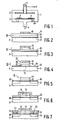
- Fig. 1 shows diagrammatically an apparatus for carrying out a method in accordance with the invention comprising a gas-tight housing 1 in which two electrodes 2 and 3 are arranged substantially parallel to each other. A flow of gas indicated by arrows 4 is passed through the housing 1. One electrode 2 is connected to a connection terminal 5, while the other electrode 3 is connected to the housing 1, which in turn is earthed.
- connection terminal 5 When a high-frequency voltage source is connected to connection terminal 5, a high-frequency electromagnetic alternating field is produced between the electrodes 2 and 3, as a result of which a plasma is produced in the flowing gas in the space between the electrodes 2 and 3.
- a semiconductor substrate 6 present on one electrode 3 can be etched by the plasma thus formed.
- Figures 2 to 7 show successive stages in the manufacture of a semiconductor device - in this example a MOS transistor - obtained by means of a method in accordance with the invention.
- a double layer 12 consisting of a layer of polycrystalline silicon 13 and a top layer of a silicide 14 is applied to a surface 11 of a semiconductor substrate 6 coated with a layer of silicon oxide 10.
- an etching mask 15 made, for example, of a usual photolacquer has been provided, the double layer 12 is locally etched away from the silicon oxide layer 10 in the apparatus shown in Fig. 1. This is effected in a chlorine-containing plasma.
- conductor tracks can be formed, which combine advantages of known transitions from silicon oxide 10 to polycrystalline silicon 13 and of a low resistance of silicides 14.
- the etching plasma is formed in chlorine gas to which, until the layer of polycrystalline silicon 13 is etched, up to 20 % by volume of tetrachloromethane is added.
- Both silicides and polycrystalline silicon are etched anisotropically in an etching plasma formed in chlorine gas to which up to 20 % by volume of tetrachloromethane is added.
- the etching selectivitiy of polycrystalline silicon with respect to silicon oxide in such a plasma is low, however. If the etching process should be continued with such a plasma until the non-masked parts of the double layer 12 would be entirely removed from the silicon oxide layer 10, the conductor tracks would have straight profiles, but the silicon oxide layer 10 could then be locally attacked to a great extent.
- the method according to the invention leads to a process that can be carried out in a simple manner because only the supply of a gas has to be stopped. Moreover, the instant at which this has to take place is not very critical. In fact, this has to be.effected after the etching process has advanced so far that the transition between the layers 14 and 1-3 has been passed, but before the silicon oxide layer 10 has been reached. In practice, there is a time interval of a few minutes between these instants.
- Fig.3 indicates diagrammatically the instant at which the supply of tetrachloromethane is stopped.
- the silicon oxide layer 10 is attacked to even a smaller extent if, after the addition of tetrachloromethane to the chlorine gas has been stopped, up to 10 % by volume of hydrogen is added to the chlorine gas. As a result, the etching selectivity of polycrystalline silicon with respect to silicon oxide increases, while the anisotropic etching character remains unchanged.
- the layer of silicide 14 preferably consists of molybdenum silicide or tungsten silicide because these silicides are etched comparatively rapidly and strongly by the method described. No noticeable lateral etching occurs.
- such a voltage is furthermore applied to the connection terminal 5 that the etching plasma is produced by an electromagnetic alternating field present between the electrodes having a frequency of 50 to 500 kHz.
- the part of the silicon oxide layer 10 exposed by a plasma excited at this comparatively low frequency has a clear surface 19.
- a MOS transistor is obtained, whose gate electrode is constituted by the conductor track 16 obtained by means of the method according to the invention.
- such a gate electrode has the advantages of a gate formed from polycrystalline silicon (the transistionbetween polycrystalline silicon and silicon oxide) and the advantage of a gate electrode formed from a silicide (very low electrical resistance). Due to this favourable combination of properties, such a gate electrode can be very narrow, as a result of which a transistor of the kind shown diagrammatically in Fig. 7 is particularly suitable for the use in large and complicated integrated circuits.
- a"silicon oxide layer having a thickness of about 50 nm was applied to a silicon substrate having a diameter of about 100 mm by thermal oxidation.
- a layer of polycrystalline silicon having a thickness of about 200 nm was deposited thereon by means of a usual LPCVD process from dichlorosilane and hydrogen.
- a layer of a silicide having a thickness of about 200 nm was deposited on the layer of polycrystalline silicon.
- a photolacquer mask consisting of HPR 204 marketed by Hunt Company subjected after an irradiation with shortwave ultraviolet radiation to a heat treatment at about 180 0 had been provided, the substrate was arranged in an apparatus of the kind shown in Fig.1 and etched, a current of about 1.5 A from a 380 kHz transmitter being passed through the reactor.
- the layer of silicide consisted of molybdenum silicide, which was applied in a usual manner by co-sputtering of molybdenum and silicon.
- a gas current of 250 sec per minuted of Cl 2 was passed through the etching reactor, to which initially 15 ssc per minute of CC1 4 was added.
- the etching had advanced into the layer of polycrystalline silicon.
- the supply of CCl 4 was stopped.
- the etching profiles were straight; the layer of silicon oxide was attacked to an extent of less than 10 nm.
- Example 2 differed from Example 1 only with regard to the plasma with which the polycrystalline silicon was etched.
- CC1 4 to the Cl 2 had been stopped
- about 7 soc per minute of H 2 was added to the Cl 2 .
- the silicon oxide layer was now attacked to an extent of less than 5 nm.
- the layer of the silicide consisted of tungsten silicide, which was deposited by means of a usual LPCVD process from tungsten fluoride and silane.
- a pressure of 20 Pa 150 scc per minute of C1 2 was passed through the etching reactor, to which 15 sec per minute of CC1 4 was added.
- the etching had advanced into the layer of polycrystalline silicon and the addition of CC1 4 was stopped.
- About 6 minutes afer the beginning of the etching process, the unmasked part of the silicon oxide layer was exposed throughout the surface of the silicon substrate.
- the etched profiles were straight; the layer of silicon oxide was attacked to an extent of less than 10 nm.
Landscapes
- Drying Of Semiconductors (AREA)
- Internal Circuitry In Semiconductor Integrated Circuit Devices (AREA)
Applications Claiming Priority (2)
| Application Number | Priority Date | Filing Date | Title |
|---|---|---|---|
| NL8500771A NL8500771A (nl) | 1985-03-18 | 1985-03-18 | Werkwijze voor het vervaardigen van een halfgeleiderinrichting waarbij een op een laag siliciumoxide aanwezige dubbellaag - bestaande uit poly-si en een silicide - in een plasma wordt geetst. |
| NL8500771 | 1985-03-18 |
Publications (3)
| Publication Number | Publication Date |
|---|---|
| EP0195477A2 true EP0195477A2 (de) | 1986-09-24 |
| EP0195477A3 EP0195477A3 (en) | 1988-03-30 |
| EP0195477B1 EP0195477B1 (de) | 1991-06-05 |
Family
ID=19845697
Family Applications (1)
| Application Number | Title | Priority Date | Filing Date |
|---|---|---|---|
| EP86200378A Expired EP0195477B1 (de) | 1985-03-18 | 1986-03-10 | Verfahren zur Herstellung einer Halbleiteranordnung mittels eines Plasmaätzverfahrens für eine auf einer Siliciumoxidschicht abgeschiedene Doppelschicht aus Polysilicium und Silicid |
Country Status (6)
| Country | Link |
|---|---|
| US (1) | US4698126A (de) |
| EP (1) | EP0195477B1 (de) |
| JP (1) | JPS61214524A (de) |
| CA (1) | CA1243133A (de) |
| DE (1) | DE3679577D1 (de) |
| NL (1) | NL8500771A (de) |
Cited By (3)
| Publication number | Priority date | Publication date | Assignee | Title |
|---|---|---|---|---|
| EP0284308A1 (de) * | 1987-03-26 | 1988-09-28 | Applied Materials, Inc. | Materialien und Verfahren zum Ätzen von Wolframpolyziden unter Zuhilfenahme der Silizide als Maske |
| WO1989001701A1 (en) * | 1987-08-07 | 1989-02-23 | Cobrain N.V. | A method and apparatus for dry processing or etching a substrate |
| EP0473344A3 (en) * | 1990-08-23 | 1992-03-25 | Fujitsu Limited | Process for etching a conductive bi-layer structure |
Families Citing this family (7)
| Publication number | Priority date | Publication date | Assignee | Title |
|---|---|---|---|---|
| US4728391A (en) * | 1987-05-11 | 1988-03-01 | Motorola Inc. | Pedestal transistors and method of production thereof |
| JPH01243430A (ja) * | 1988-03-25 | 1989-09-28 | Nec Corp | モリブデンシリサイドのエッチング方法 |
| JPH0294520A (ja) * | 1988-09-30 | 1990-04-05 | Toshiba Corp | ドライエッチング方法 |
| US5000771A (en) * | 1989-12-29 | 1991-03-19 | At&T Bell Laboratories | Method for manufacturing an article comprising a refractory dielectric body |
| US5169487A (en) * | 1990-08-27 | 1992-12-08 | Micron Technology, Inc. | Anisotropic etch method |
| JP2638573B2 (ja) * | 1995-06-26 | 1997-08-06 | 日本電気株式会社 | 半導体装置の製造方法 |
| US6165375A (en) * | 1997-09-23 | 2000-12-26 | Cypress Semiconductor Corporation | Plasma etching method |
Family Cites Families (12)
| Publication number | Priority date | Publication date | Assignee | Title |
|---|---|---|---|---|
| GB1417085A (en) * | 1973-05-17 | 1975-12-10 | Standard Telephones Cables Ltd | Plasma etching |
| US4182646A (en) * | 1978-07-27 | 1980-01-08 | John Zajac | Process of etching with plasma etch gas |
| JPS56137635A (en) * | 1980-03-31 | 1981-10-27 | Toshiba Corp | Ion etching method |
| JPS5731140A (en) * | 1980-07-31 | 1982-02-19 | Toshiba Corp | Etching method by reactive ion |
| EP0054201B1 (de) * | 1980-12-11 | 1986-11-05 | Kabushiki Kaisha Toshiba | Apparat zum Trockenätzen und Verfahren |
| CA1202597A (en) * | 1981-05-22 | 1986-04-01 | Jean S. Deslauriers | Reactive ion layers containing tantalum and silicon |
| JPS57198632A (en) * | 1981-05-30 | 1982-12-06 | Toshiba Corp | Fine pattern formation |
| JPS5855568A (ja) * | 1981-09-25 | 1983-04-01 | Toshiba Corp | 反応性イオンエツチング方法 |
| NL8105559A (nl) * | 1981-12-10 | 1983-07-01 | Philips Nv | Werkwijze voor het aanbrengen van een smalle groef in een substraatgebied, in het bijzonder een halfgeleidersubstraatgebied. |
| DE3315719A1 (de) * | 1983-04-29 | 1984-10-31 | Siemens AG, 1000 Berlin und 8000 München | Verfahren zum herstellen von strukturen von aus metallsiliziden bzw. silizid-polysilizium bestehenden doppelschichten fuer integrierte halbleiterschaltungen durch reaktives ionenaetzen |
| JPS60117631A (ja) * | 1983-11-30 | 1985-06-25 | Toshiba Corp | 化合物半導体のドライエッチング方法 |
| US4608118A (en) * | 1985-02-15 | 1986-08-26 | Rca Corporation | Reactive sputter etching of metal silicide structures |
-
1985
- 1985-03-18 NL NL8500771A patent/NL8500771A/nl not_active Application Discontinuation
-
1986
- 1986-03-03 US US06/835,488 patent/US4698126A/en not_active Expired - Fee Related
- 1986-03-10 EP EP86200378A patent/EP0195477B1/de not_active Expired
- 1986-03-10 DE DE8686200378T patent/DE3679577D1/de not_active Expired - Lifetime
- 1986-03-14 CA CA000504192A patent/CA1243133A/en not_active Expired
- 1986-03-15 JP JP61056109A patent/JPS61214524A/ja active Pending
Cited By (5)
| Publication number | Priority date | Publication date | Assignee | Title |
|---|---|---|---|---|
| EP0284308A1 (de) * | 1987-03-26 | 1988-09-28 | Applied Materials, Inc. | Materialien und Verfahren zum Ätzen von Wolframpolyziden unter Zuhilfenahme der Silizide als Maske |
| WO1989001701A1 (en) * | 1987-08-07 | 1989-02-23 | Cobrain N.V. | A method and apparatus for dry processing or etching a substrate |
| US5298466A (en) * | 1987-08-07 | 1994-03-29 | Cobrain N.V. | Method and apparatus for dry anisotropically etching a substrate |
| EP0473344A3 (en) * | 1990-08-23 | 1992-03-25 | Fujitsu Limited | Process for etching a conductive bi-layer structure |
| US5487811A (en) * | 1990-08-23 | 1996-01-30 | Fujitsu Limited | Process for preparation of semiconductor device |
Also Published As
| Publication number | Publication date |
|---|---|
| CA1243133A (en) | 1988-10-11 |
| US4698126A (en) | 1987-10-06 |
| EP0195477A3 (en) | 1988-03-30 |
| NL8500771A (nl) | 1986-10-16 |
| EP0195477B1 (de) | 1991-06-05 |
| DE3679577D1 (de) | 1991-07-11 |
| JPS61214524A (ja) | 1986-09-24 |
Similar Documents
| Publication | Publication Date | Title |
|---|---|---|
| CA1061915A (en) | Method of fabricating metal-semiconductor interfaces | |
| US6255221B1 (en) | Methods for running a high density plasma etcher to achieve reduced transistor device damage | |
| CA1160761A (en) | Fabrication of microminiature devices using plasma etching of silicon and resultant products | |
| US5203957A (en) | Contact sidewall tapering with argon sputtering | |
| US5306671A (en) | Method of treating semiconductor substrate surface and method of manufacturing semiconductor device including such treating method | |
| US5405491A (en) | Plasma etching process | |
| US4473436A (en) | Method of producing structures from double layers of metal silicide and polysilicon on integrated circuit substrates by RIE utilizing SF6 and Cl2 | |
| US20060252265A1 (en) | Etching high-kappa dielectric materials with good high-kappa foot control and silicon recess control | |
| EP0631308A2 (de) | Verfahren zum Steuern der Dicke des Gate-Oxyds für die Herstellung von Halbleiterbauelementen | |
| EP1825500A2 (de) | Behandlung zur resteentfernung nach dem ätzen | |
| EP0195477B1 (de) | Verfahren zur Herstellung einer Halbleiteranordnung mittels eines Plasmaätzverfahrens für eine auf einer Siliciumoxidschicht abgeschiedene Doppelschicht aus Polysilicium und Silicid | |
| US5702566A (en) | Conductive photoresist to mitigate antenna effect | |
| US4057460A (en) | Plasma etching process | |
| US20040058541A1 (en) | Sample surface processing method | |
| US6647994B1 (en) | Method of resist stripping over low-k dielectric material | |
| US3419761A (en) | Method for depositing silicon nitride insulating films and electric devices incorporating such films | |
| US4243865A (en) | Process for treating material in plasma environment | |
| US4445966A (en) | Method of plasma etching of films containing chromium | |
| GB2081160A (en) | Method of manufacturing a semiconductor device | |
| US6465349B1 (en) | Nitrogen-plasma treatment for reduced nickel silicide bridging | |
| JPH11340213A (ja) | 試料の表面加工方法 | |
| KR0161883B1 (ko) | 반도체장치의 금속배선 형성방법 | |
| JPH03109728A (ja) | 半導体装置の製造方法 | |
| JPH06204192A (ja) | シリコン窒化膜のエッチング方法 | |
| JP2628729B2 (ja) | 半導体デバイスの製造方法 |
Legal Events
| Date | Code | Title | Description |
|---|---|---|---|
| PUAI | Public reference made under article 153(3) epc to a published international application that has entered the european phase |
Free format text: ORIGINAL CODE: 0009012 |
|
| AK | Designated contracting states |
Kind code of ref document: A2 Designated state(s): DE FR GB IT NL |
|
| PUAL | Search report despatched |
Free format text: ORIGINAL CODE: 0009013 |
|
| AK | Designated contracting states |
Kind code of ref document: A3 Designated state(s): DE FR GB IT NL |
|
| 17P | Request for examination filed |
Effective date: 19880920 |
|
| 17Q | First examination report despatched |
Effective date: 19900426 |
|
| GRAA | (expected) grant |
Free format text: ORIGINAL CODE: 0009210 |
|
| AK | Designated contracting states |
Kind code of ref document: B1 Designated state(s): DE FR GB IT NL |
|
| PG25 | Lapsed in a contracting state [announced via postgrant information from national office to epo] |
Ref country code: NL Effective date: 19910605 |
|
| REF | Corresponds to: |
Ref document number: 3679577 Country of ref document: DE Date of ref document: 19910711 |
|
| ITF | It: translation for a ep patent filed | ||
| ET | Fr: translation filed | ||
| NLV1 | Nl: lapsed or annulled due to failure to fulfill the requirements of art. 29p and 29m of the patents act | ||
| PLBE | No opposition filed within time limit |
Free format text: ORIGINAL CODE: 0009261 |
|
| STAA | Information on the status of an ep patent application or granted ep patent |
Free format text: STATUS: NO OPPOSITION FILED WITHIN TIME LIMIT |
|
| 26N | No opposition filed | ||
| ITPR | It: changes in ownership of a european patent |
Owner name: CAMBIO RAGIONE SOCIALE;PHILIPS ELECTRONICS N.V. |
|
| REG | Reference to a national code |
Ref country code: FR Ref legal event code: CD |
|
| PGFP | Annual fee paid to national office [announced via postgrant information from national office to epo] |
Ref country code: GB Payment date: 19960229 Year of fee payment: 11 |
|
| PGFP | Annual fee paid to national office [announced via postgrant information from national office to epo] |
Ref country code: FR Payment date: 19960327 Year of fee payment: 11 |
|
| PGFP | Annual fee paid to national office [announced via postgrant information from national office to epo] |
Ref country code: DE Payment date: 19960523 Year of fee payment: 11 |
|
| PG25 | Lapsed in a contracting state [announced via postgrant information from national office to epo] |
Ref country code: GB Effective date: 19970310 |
|
| GBPC | Gb: european patent ceased through non-payment of renewal fee |
Effective date: 19970310 |
|
| PG25 | Lapsed in a contracting state [announced via postgrant information from national office to epo] |
Ref country code: FR Free format text: LAPSE BECAUSE OF NON-PAYMENT OF DUE FEES Effective date: 19971128 |
|
| PG25 | Lapsed in a contracting state [announced via postgrant information from national office to epo] |
Ref country code: DE Effective date: 19971202 |
|
| REG | Reference to a national code |
Ref country code: FR Ref legal event code: ST |
|
| PG25 | Lapsed in a contracting state [announced via postgrant information from national office to epo] |
Ref country code: IT Free format text: LAPSE BECAUSE OF NON-PAYMENT OF DUE FEES;WARNING: LAPSES OF ITALIAN PATENTS WITH EFFECTIVE DATE BEFORE 2007 MAY HAVE OCCURRED AT ANY TIME BEFORE 2007. THE CORRECT EFFECTIVE DATE MAY BE DIFFERENT FROM THE ONE RECORDED. Effective date: 20050310 |