EP0204659B1 - Polyepoxide und deren Verwendung - Google Patents
Polyepoxide und deren Verwendung Download PDFInfo
- Publication number
- EP0204659B1 EP0204659B1 EP86810235A EP86810235A EP0204659B1 EP 0204659 B1 EP0204659 B1 EP 0204659B1 EP 86810235 A EP86810235 A EP 86810235A EP 86810235 A EP86810235 A EP 86810235A EP 0204659 B1 EP0204659 B1 EP 0204659B1
- Authority
- EP
- European Patent Office
- Prior art keywords
- allyl
- polyepoxide
- bisphenol
- bis
- compound
- Prior art date
- Legal status (The legal status is an assumption and is not a legal conclusion. Google has not performed a legal analysis and makes no representation as to the accuracy of the status listed.)
- Expired - Lifetime
Links
- 229920000647 polyepoxide Polymers 0.000 claims description 42
- IISBACLAFKSPIT-UHFFFAOYSA-N bisphenol A Chemical compound C=1C=C(O)C=CC=1C(C)(C)C1=CC=C(O)C=C1 IISBACLAFKSPIT-UHFFFAOYSA-N 0.000 claims description 24
- 150000001875 compounds Chemical class 0.000 claims description 24
- ISWSIDIOOBJBQZ-UHFFFAOYSA-N phenol group Chemical group C1(=CC=CC=C1)O ISWSIDIOOBJBQZ-UHFFFAOYSA-N 0.000 claims description 22
- -1 triallylphenol Chemical compound 0.000 claims description 22
- PXKLMJQFEQBVLD-UHFFFAOYSA-N bisphenol F Chemical compound C1=CC(O)=CC=C1CC1=CC=C(O)C=C1 PXKLMJQFEQBVLD-UHFFFAOYSA-N 0.000 claims description 20
- 235000013824 polyphenols Nutrition 0.000 claims description 19
- 239000000203 mixture Substances 0.000 claims description 18
- 125000003903 2-propenyl group Chemical group [H]C([*])([H])C([H])=C([H])[H] 0.000 claims description 16
- KFSLWBXXFJQRDL-UHFFFAOYSA-N Peracetic acid Chemical compound CC(=O)OO KFSLWBXXFJQRDL-UHFFFAOYSA-N 0.000 claims description 16
- 239000003822 epoxy resin Substances 0.000 claims description 14
- 229920003986 novolac Polymers 0.000 claims description 13
- WSFSSNUMVMOOMR-UHFFFAOYSA-N Formaldehyde Chemical compound O=C WSFSSNUMVMOOMR-UHFFFAOYSA-N 0.000 claims description 12
- 239000004848 polyfunctional curative Substances 0.000 claims description 11
- VEORPZCZECFIRK-UHFFFAOYSA-N 3,3',5,5'-tetrabromobisphenol A Chemical compound C=1C(Br)=C(O)C(Br)=CC=1C(C)(C)C1=CC(Br)=C(O)C(Br)=C1 VEORPZCZECFIRK-UHFFFAOYSA-N 0.000 claims description 10
- ATUOYWHBWRKTHZ-UHFFFAOYSA-N Propane Chemical compound CCC ATUOYWHBWRKTHZ-UHFFFAOYSA-N 0.000 claims description 10
- 239000000047 product Substances 0.000 claims description 10
- RTZKZFJDLAIYFH-UHFFFAOYSA-N Diethyl ether Chemical compound CCOCC RTZKZFJDLAIYFH-UHFFFAOYSA-N 0.000 claims description 9
- 239000007795 chemical reaction product Substances 0.000 claims description 9
- 125000002887 hydroxy group Chemical group [H]O* 0.000 claims description 9
- 150000008442 polyphenolic compounds Chemical class 0.000 claims description 9
- 238000006735 epoxidation reaction Methods 0.000 claims description 7
- 125000002496 methyl group Chemical group [H]C([H])([H])* 0.000 claims description 7
- 150000004965 peroxy acids Chemical class 0.000 claims description 7
- 125000005843 halogen group Chemical group 0.000 claims description 6
- 125000004178 (C1-C4) alkyl group Chemical group 0.000 claims description 5
- WOCGGVRGNIEDSZ-UHFFFAOYSA-N 4-[2-(4-hydroxy-3-prop-2-enylphenyl)propan-2-yl]-2-prop-2-enylphenol Chemical compound C=1C=C(O)C(CC=C)=CC=1C(C)(C)C1=CC=C(O)C(CC=C)=C1 WOCGGVRGNIEDSZ-UHFFFAOYSA-N 0.000 claims description 5
- GYZLOYUZLJXAJU-UHFFFAOYSA-N diglycidyl ether Chemical compound C1OC1COCC1CO1 GYZLOYUZLJXAJU-UHFFFAOYSA-N 0.000 claims description 5
- 125000001997 phenyl group Chemical group [H]C1=C([H])C([H])=C(*)C([H])=C1[H] 0.000 claims description 5
- 239000001294 propane Substances 0.000 claims description 5
- 239000000853 adhesive Substances 0.000 claims description 4
- 230000001070 adhesive effect Effects 0.000 claims description 4
- 125000000229 (C1-C4)alkoxy group Chemical group 0.000 claims description 3
- 125000006017 1-propenyl group Chemical group 0.000 claims description 3
- LJGHYPLBDBRCRZ-UHFFFAOYSA-N 3-(3-aminophenyl)sulfonylaniline Chemical compound NC1=CC=CC(S(=O)(=O)C=2C=C(N)C=CC=2)=C1 LJGHYPLBDBRCRZ-UHFFFAOYSA-N 0.000 claims description 3
- 125000001309 chloro group Chemical group Cl* 0.000 claims description 3
- 238000002360 preparation method Methods 0.000 claims description 3
- 125000000999 tert-butyl group Chemical group [H]C([H])([H])C(*)(C([H])([H])[H])C([H])([H])[H] 0.000 claims description 3
- 229910052801 chlorine Inorganic materials 0.000 claims description 2
- UCFFGYASXIPWPD-UHFFFAOYSA-N methyl hypochlorite Chemical group COCl UCFFGYASXIPWPD-UHFFFAOYSA-N 0.000 claims description 2
- 229940118056 cresol / formaldehyde Drugs 0.000 claims 2
- 125000006536 (C1-C2)alkoxy group Chemical group 0.000 claims 1
- 239000011248 coating agent Substances 0.000 claims 1
- 238000000576 coating method Methods 0.000 claims 1
- HEMHJVSKTPXQMS-UHFFFAOYSA-M Sodium hydroxide Chemical compound [OH-].[Na+] HEMHJVSKTPXQMS-UHFFFAOYSA-M 0.000 description 18
- HEDRZPFGACZZDS-UHFFFAOYSA-N Chloroform Chemical compound ClC(Cl)Cl HEDRZPFGACZZDS-UHFFFAOYSA-N 0.000 description 14
- 239000004593 Epoxy Substances 0.000 description 13
- 239000002253 acid Substances 0.000 description 10
- VNWKTOKETHGBQD-UHFFFAOYSA-N methane Chemical compound C VNWKTOKETHGBQD-UHFFFAOYSA-N 0.000 description 10
- YXFVVABEGXRONW-UHFFFAOYSA-N Toluene Chemical compound CC1=CC=CC=C1 YXFVVABEGXRONW-UHFFFAOYSA-N 0.000 description 9
- BRLQWZUYTZBJKN-UHFFFAOYSA-N Epichlorohydrin Chemical compound ClCC1CO1 BRLQWZUYTZBJKN-UHFFFAOYSA-N 0.000 description 7
- 125000001931 aliphatic group Chemical group 0.000 description 7
- LNEPOXFFQSENCJ-UHFFFAOYSA-N haloperidol Chemical compound C1CC(O)(C=2C=CC(Cl)=CC=2)CCN1CCCC(=O)C1=CC=C(F)C=C1 LNEPOXFFQSENCJ-UHFFFAOYSA-N 0.000 description 7
- 229920005989 resin Polymers 0.000 description 7
- 239000011347 resin Substances 0.000 description 7
- UHOVQNZJYSORNB-UHFFFAOYSA-N Benzene Chemical compound C1=CC=CC=C1 UHOVQNZJYSORNB-UHFFFAOYSA-N 0.000 description 6
- PMZURENOXWZQFD-UHFFFAOYSA-L Sodium Sulfate Chemical compound [Na+].[Na+].[O-]S([O-])(=O)=O PMZURENOXWZQFD-UHFFFAOYSA-L 0.000 description 6
- FAPWRFPIFSIZLT-UHFFFAOYSA-M Sodium chloride Chemical compound [Na+].[Cl-] FAPWRFPIFSIZLT-UHFFFAOYSA-M 0.000 description 6
- 150000001412 amines Chemical class 0.000 description 6
- 239000003054 catalyst Substances 0.000 description 6
- 238000006243 chemical reaction Methods 0.000 description 6
- 239000003795 chemical substances by application Substances 0.000 description 6
- RAXXELZNTBOGNW-UHFFFAOYSA-N imidazole Natural products C1=CNC=N1 RAXXELZNTBOGNW-UHFFFAOYSA-N 0.000 description 6
- XNGIFLGASWRNHJ-UHFFFAOYSA-N phthalic acid Chemical compound OC(=O)C1=CC=CC=C1C(O)=O XNGIFLGASWRNHJ-UHFFFAOYSA-N 0.000 description 6
- 229920000768 polyamine Polymers 0.000 description 6
- 229920005862 polyol Polymers 0.000 description 6
- 229910052938 sodium sulfate Inorganic materials 0.000 description 6
- GEHJYWRUCIMESM-UHFFFAOYSA-L sodium sulfite Chemical compound [Na+].[Na+].[O-]S([O-])=O GEHJYWRUCIMESM-UHFFFAOYSA-L 0.000 description 6
- 235000011152 sodium sulphate Nutrition 0.000 description 6
- 239000000243 solution Substances 0.000 description 6
- ZCUJYXPAKHMBAZ-UHFFFAOYSA-N 2-phenyl-1h-imidazole Chemical compound C1=CNC(C=2C=CC=CC=2)=N1 ZCUJYXPAKHMBAZ-UHFFFAOYSA-N 0.000 description 5
- ULKLGIFJWFIQFF-UHFFFAOYSA-N 5K8XI641G3 Chemical compound CCC1=NC=C(C)N1 ULKLGIFJWFIQFF-UHFFFAOYSA-N 0.000 description 5
- 150000008064 anhydrides Chemical class 0.000 description 5
- 239000011541 reaction mixture Substances 0.000 description 5
- 150000003512 tertiary amines Chemical class 0.000 description 5
- MCTWTZJPVLRJOU-UHFFFAOYSA-N 1-methyl-1H-imidazole Chemical compound CN1C=CN=C1 MCTWTZJPVLRJOU-UHFFFAOYSA-N 0.000 description 4
- BUGIFNPYQVKODR-UHFFFAOYSA-N 2-methylhexane-1,6-diamine Chemical compound NCC(C)CCCCN BUGIFNPYQVKODR-UHFFFAOYSA-N 0.000 description 4
- YBRVSVVVWCFQMG-UHFFFAOYSA-N 4,4'-diaminodiphenylmethane Chemical compound C1=CC(N)=CC=C1CC1=CC=C(N)C=C1 YBRVSVVVWCFQMG-UHFFFAOYSA-N 0.000 description 4
- IKHGUXGNUITLKF-UHFFFAOYSA-N Acetaldehyde Chemical compound CC=O IKHGUXGNUITLKF-UHFFFAOYSA-N 0.000 description 4
- MHAJPDPJQMAIIY-UHFFFAOYSA-N Hydrogen peroxide Chemical compound OO MHAJPDPJQMAIIY-UHFFFAOYSA-N 0.000 description 4
- QIGBRXMKCJKVMJ-UHFFFAOYSA-N Hydroquinone Chemical compound OC1=CC=C(O)C=C1 QIGBRXMKCJKVMJ-UHFFFAOYSA-N 0.000 description 4
- VMHLLURERBWHNL-UHFFFAOYSA-M Sodium acetate Chemical compound [Na+].CC([O-])=O VMHLLURERBWHNL-UHFFFAOYSA-M 0.000 description 4
- 150000007513 acids Chemical class 0.000 description 4
- 125000003118 aryl group Chemical group 0.000 description 4
- MVPPADPHJFYWMZ-UHFFFAOYSA-N chlorobenzene Chemical compound ClC1=CC=CC=C1 MVPPADPHJFYWMZ-UHFFFAOYSA-N 0.000 description 4
- XXBDWLFCJWSEKW-UHFFFAOYSA-N dimethylbenzylamine Chemical compound CN(C)CC1=CC=CC=C1 XXBDWLFCJWSEKW-UHFFFAOYSA-N 0.000 description 4
- VKYKSIONXSXAKP-UHFFFAOYSA-N hexamethylenetetramine Chemical compound C1N(C2)CN3CN1CN2C3 VKYKSIONXSXAKP-UHFFFAOYSA-N 0.000 description 4
- NAQMVNRVTILPCV-UHFFFAOYSA-N hexane-1,6-diamine Chemical compound NCCCCCCN NAQMVNRVTILPCV-UHFFFAOYSA-N 0.000 description 4
- 150000002460 imidazoles Chemical class 0.000 description 4
- 238000004519 manufacturing process Methods 0.000 description 4
- 239000000155 melt Substances 0.000 description 4
- 229910052757 nitrogen Inorganic materials 0.000 description 4
- QWVGKYWNOKOFNN-UHFFFAOYSA-N o-cresol Chemical compound CC1=CC=CC=C1O QWVGKYWNOKOFNN-UHFFFAOYSA-N 0.000 description 4
- 150000002978 peroxides Chemical class 0.000 description 4
- 150000003077 polyols Chemical class 0.000 description 4
- 239000001632 sodium acetate Substances 0.000 description 4
- 235000017281 sodium acetate Nutrition 0.000 description 4
- 235000010265 sodium sulphite Nutrition 0.000 description 4
- 238000006277 sulfonation reaction Methods 0.000 description 4
- GETQZCLCWQTVFV-UHFFFAOYSA-N trimethylamine Chemical compound CN(C)C GETQZCLCWQTVFV-UHFFFAOYSA-N 0.000 description 4
- XLYOFNOQVPJJNP-UHFFFAOYSA-N water Substances O XLYOFNOQVPJJNP-UHFFFAOYSA-N 0.000 description 4
- ZWEHNKRNPOVVGH-UHFFFAOYSA-N 2-Butanone Chemical compound CCC(C)=O ZWEHNKRNPOVVGH-UHFFFAOYSA-N 0.000 description 3
- RNLHGQLZWXBQNY-UHFFFAOYSA-N 3-(aminomethyl)-3,5,5-trimethylcyclohexan-1-amine Chemical compound CC1(C)CC(N)CC(C)(CN)C1 RNLHGQLZWXBQNY-UHFFFAOYSA-N 0.000 description 3
- ZRYCRPNCXLQHPN-UHFFFAOYSA-N 3-hydroxy-2-methylbenzaldehyde Chemical compound CC1=C(O)C=CC=C1C=O ZRYCRPNCXLQHPN-UHFFFAOYSA-N 0.000 description 3
- QTBSBXVTEAMEQO-UHFFFAOYSA-N Acetic acid Chemical compound CC(O)=O QTBSBXVTEAMEQO-UHFFFAOYSA-N 0.000 description 3
- CSCPPACGZOOCGX-UHFFFAOYSA-N Acetone Chemical compound CC(C)=O CSCPPACGZOOCGX-UHFFFAOYSA-N 0.000 description 3
- YMWUJEATGCHHMB-UHFFFAOYSA-N Dichloromethane Chemical compound ClCCl YMWUJEATGCHHMB-UHFFFAOYSA-N 0.000 description 3
- XEKOWRVHYACXOJ-UHFFFAOYSA-N Ethyl acetate Chemical compound CCOC(C)=O XEKOWRVHYACXOJ-UHFFFAOYSA-N 0.000 description 3
- LYCAIKOWRPUZTN-UHFFFAOYSA-N Ethylene glycol Chemical compound OCCO LYCAIKOWRPUZTN-UHFFFAOYSA-N 0.000 description 3
- ZMANZCXQSJIPKH-UHFFFAOYSA-N Triethylamine Chemical compound CCN(CC)CC ZMANZCXQSJIPKH-UHFFFAOYSA-N 0.000 description 3
- 125000000217 alkyl group Chemical group 0.000 description 3
- MTHSVFCYNBDYFN-UHFFFAOYSA-N diethylene glycol Chemical compound OCCOCCO MTHSVFCYNBDYFN-UHFFFAOYSA-N 0.000 description 3
- 150000002170 ethers Chemical class 0.000 description 3
- 239000000835 fiber Substances 0.000 description 3
- SLGWESQGEUXWJQ-UHFFFAOYSA-N formaldehyde;phenol Chemical compound O=C.OC1=CC=CC=C1 SLGWESQGEUXWJQ-UHFFFAOYSA-N 0.000 description 3
- 150000002334 glycols Chemical class 0.000 description 3
- 229910052739 hydrogen Inorganic materials 0.000 description 3
- 125000004435 hydrogen atom Chemical group [H]* 0.000 description 3
- 238000000465 moulding Methods 0.000 description 3
- 229920001568 phenolic resin Polymers 0.000 description 3
- 239000011780 sodium chloride Substances 0.000 description 3
- 239000002904 solvent Substances 0.000 description 3
- 239000000126 substance Substances 0.000 description 3
- JGUXXFPMOABQHJ-UHFFFAOYSA-N (2,6-dichlorophenyl)-(2-phenylimidazol-1-yl)methanone Chemical compound ClC1=CC=CC(Cl)=C1C(=O)N1C(C=2C=CC=CC=2)=NC=C1 JGUXXFPMOABQHJ-UHFFFAOYSA-N 0.000 description 2
- MUTGBJKUEZFXGO-OLQVQODUSA-N (3as,7ar)-3a,4,5,6,7,7a-hexahydro-2-benzofuran-1,3-dione Chemical compound C1CCC[C@@H]2C(=O)OC(=O)[C@@H]21 MUTGBJKUEZFXGO-OLQVQODUSA-N 0.000 description 2
- KMOUUZVZFBCRAM-OLQVQODUSA-N (3as,7ar)-3a,4,7,7a-tetrahydro-2-benzofuran-1,3-dione Chemical compound C1C=CC[C@@H]2C(=O)OC(=O)[C@@H]21 KMOUUZVZFBCRAM-OLQVQODUSA-N 0.000 description 2
- WZCQRUWWHSTZEM-UHFFFAOYSA-N 1,3-phenylenediamine Chemical compound NC1=CC=CC(N)=C1 WZCQRUWWHSTZEM-UHFFFAOYSA-N 0.000 description 2
- CBCKQZAAMUWICA-UHFFFAOYSA-N 1,4-phenylenediamine Chemical compound NC1=CC=C(N)C=C1 CBCKQZAAMUWICA-UHFFFAOYSA-N 0.000 description 2
- HYZJCKYKOHLVJF-UHFFFAOYSA-N 1H-benzimidazole Chemical compound C1=CC=C2NC=NC2=C1 HYZJCKYKOHLVJF-UHFFFAOYSA-N 0.000 description 2
- DPQHRXRAZHNGRU-UHFFFAOYSA-N 2,4,4-trimethylhexane-1,6-diamine Chemical compound NCC(C)CC(C)(C)CCN DPQHRXRAZHNGRU-UHFFFAOYSA-N 0.000 description 2
- ZQVIKSBEYKZIJR-UHFFFAOYSA-N 2,4,6-tris(prop-2-enyl)phenol Chemical compound OC1=C(CC=C)C=C(CC=C)C=C1CC=C ZQVIKSBEYKZIJR-UHFFFAOYSA-N 0.000 description 2
- AHDSRXYHVZECER-UHFFFAOYSA-N 2,4,6-tris[(dimethylamino)methyl]phenol Chemical compound CN(C)CC1=CC(CN(C)C)=C(O)C(CN(C)C)=C1 AHDSRXYHVZECER-UHFFFAOYSA-N 0.000 description 2
- JSETXDOJYIQIST-UHFFFAOYSA-N 2,6-dimethyl-4-prop-2-enylphenol Chemical compound CC1=CC(CC=C)=CC(C)=C1O JSETXDOJYIQIST-UHFFFAOYSA-N 0.000 description 2
- FALRKNHUBBKYCC-UHFFFAOYSA-N 2-(chloromethyl)pyridine-3-carbonitrile Chemical compound ClCC1=NC=CC=C1C#N FALRKNHUBBKYCC-UHFFFAOYSA-N 0.000 description 2
- QIRNGVVZBINFMX-UHFFFAOYSA-N 2-allylphenol Chemical compound OC1=CC=CC=C1CC=C QIRNGVVZBINFMX-UHFFFAOYSA-N 0.000 description 2
- FZZMTSNZRBFGGU-UHFFFAOYSA-N 2-chloro-7-fluoroquinazolin-4-amine Chemical compound FC1=CC=C2C(N)=NC(Cl)=NC2=C1 FZZMTSNZRBFGGU-UHFFFAOYSA-N 0.000 description 2
- ISPYQTSUDJAMAB-UHFFFAOYSA-N 2-chlorophenol Chemical compound OC1=CC=CC=C1Cl ISPYQTSUDJAMAB-UHFFFAOYSA-N 0.000 description 2
- YIWUKEYIRIRTPP-UHFFFAOYSA-N 2-ethylhexan-1-ol Chemical compound CCCCC(CC)CO YIWUKEYIRIRTPP-UHFFFAOYSA-N 0.000 description 2
- VPWNQTHUCYMVMZ-UHFFFAOYSA-N 4,4'-sulfonyldiphenol Chemical compound C1=CC(O)=CC=C1S(=O)(=O)C1=CC=C(O)C=C1 VPWNQTHUCYMVMZ-UHFFFAOYSA-N 0.000 description 2
- WXQZLPFNTPKVJM-UHFFFAOYSA-N 4-[(4-hydroxycyclohexyl)methyl]cyclohexan-1-ol Chemical compound C1CC(O)CCC1CC1CCC(O)CC1 WXQZLPFNTPKVJM-UHFFFAOYSA-N 0.000 description 2
- CDBAMNGURPMUTG-UHFFFAOYSA-N 4-[2-(4-hydroxycyclohexyl)propan-2-yl]cyclohexan-1-ol Chemical compound C1CC(O)CCC1C(C)(C)C1CCC(O)CC1 CDBAMNGURPMUTG-UHFFFAOYSA-N 0.000 description 2
- FWMPKHMKIJDEMJ-UHFFFAOYSA-N 4-allyl-2,6-dimethoxyphenol Chemical compound COC1=CC(CC=C)=CC(OC)=C1O FWMPKHMKIJDEMJ-UHFFFAOYSA-N 0.000 description 2
- TYOXIFXYEIILLY-UHFFFAOYSA-N 5-methyl-2-phenyl-1h-imidazole Chemical compound N1C(C)=CN=C1C1=CC=CC=C1 TYOXIFXYEIILLY-UHFFFAOYSA-N 0.000 description 2
- MWSKJDNQKGCKPA-UHFFFAOYSA-N 6-methyl-3a,4,5,7a-tetrahydro-2-benzofuran-1,3-dione Chemical compound C1CC(C)=CC2C(=O)OC(=O)C12 MWSKJDNQKGCKPA-UHFFFAOYSA-N 0.000 description 2
- PAYRUJLWNCNPSJ-UHFFFAOYSA-N Aniline Chemical compound NC1=CC=CC=C1 PAYRUJLWNCNPSJ-UHFFFAOYSA-N 0.000 description 2
- 229940126062 Compound A Drugs 0.000 description 2
- XZMCDFZZKTWFGF-UHFFFAOYSA-N Cyanamide Chemical compound NC#N XZMCDFZZKTWFGF-UHFFFAOYSA-N 0.000 description 2
- MQJKPEGWNLWLTK-UHFFFAOYSA-N Dapsone Chemical compound C1=CC(N)=CC=C1S(=O)(=O)C1=CC=C(N)C=C1 MQJKPEGWNLWLTK-UHFFFAOYSA-N 0.000 description 2
- QUSNBJAOOMFDIB-UHFFFAOYSA-N Ethylamine Chemical compound CCN QUSNBJAOOMFDIB-UHFFFAOYSA-N 0.000 description 2
- PEDCQBHIVMGVHV-UHFFFAOYSA-N Glycerine Chemical compound OCC(O)CO PEDCQBHIVMGVHV-UHFFFAOYSA-N 0.000 description 2
- NLDMNSXOCDLTTB-UHFFFAOYSA-N Heterophylliin A Natural products O1C2COC(=O)C3=CC(O)=C(O)C(O)=C3C3=C(O)C(O)=C(O)C=C3C(=O)OC2C(OC(=O)C=2C=C(O)C(O)=C(O)C=2)C(O)C1OC(=O)C1=CC(O)=C(O)C(O)=C1 NLDMNSXOCDLTTB-UHFFFAOYSA-N 0.000 description 2
- KFZMGEQAYNKOFK-UHFFFAOYSA-N Isopropanol Chemical compound CC(C)O KFZMGEQAYNKOFK-UHFFFAOYSA-N 0.000 description 2
- DNIAPMSPPWPWGF-UHFFFAOYSA-N Propylene glycol Chemical compound CC(O)CO DNIAPMSPPWPWGF-UHFFFAOYSA-N 0.000 description 2
- QAOWNCQODCNURD-UHFFFAOYSA-N Sulfuric acid Chemical compound OS(O)(=O)=O QAOWNCQODCNURD-UHFFFAOYSA-N 0.000 description 2
- WYURNTSHIVDZCO-UHFFFAOYSA-N Tetrahydrofuran Chemical compound C1CCOC1 WYURNTSHIVDZCO-UHFFFAOYSA-N 0.000 description 2
- GWEVSGVZZGPLCZ-UHFFFAOYSA-N Titan oxide Chemical compound O=[Ti]=O GWEVSGVZZGPLCZ-UHFFFAOYSA-N 0.000 description 2
- 239000000654 additive Substances 0.000 description 2
- WNLRTRBMVRJNCN-UHFFFAOYSA-N adipic acid Chemical compound OC(=O)CCCCC(O)=O WNLRTRBMVRJNCN-UHFFFAOYSA-N 0.000 description 2
- 150000001338 aliphatic hydrocarbons Chemical class 0.000 description 2
- 150000004945 aromatic hydrocarbons Chemical class 0.000 description 2
- WPYMKLBDIGXBTP-UHFFFAOYSA-N benzoic acid Chemical compound OC(=O)C1=CC=CC=C1 WPYMKLBDIGXBTP-UHFFFAOYSA-N 0.000 description 2
- 230000015572 biosynthetic process Effects 0.000 description 2
- VCCBEIPGXKNHFW-UHFFFAOYSA-N biphenyl-4,4'-diol Chemical group C1=CC(O)=CC=C1C1=CC=C(O)C=C1 VCCBEIPGXKNHFW-UHFFFAOYSA-N 0.000 description 2
- 238000009835 boiling Methods 0.000 description 2
- WTEOIRVLGSZEPR-UHFFFAOYSA-N boron trifluoride Chemical compound FB(F)F WTEOIRVLGSZEPR-UHFFFAOYSA-N 0.000 description 2
- WERYXYBDKMZEQL-UHFFFAOYSA-N butane-1,4-diol Chemical compound OCCCCO WERYXYBDKMZEQL-UHFFFAOYSA-N 0.000 description 2
- 235000013877 carbamide Nutrition 0.000 description 2
- 125000004432 carbon atom Chemical group C* 0.000 description 2
- JHIVVAPYMSGYDF-UHFFFAOYSA-N cyclohexanone Chemical compound O=C1CCCCC1 JHIVVAPYMSGYDF-UHFFFAOYSA-N 0.000 description 2
- XBDQKXXYIPTUBI-UHFFFAOYSA-N dimethylselenoniopropionate Natural products CCC(O)=O XBDQKXXYIPTUBI-UHFFFAOYSA-N 0.000 description 2
- 125000005842 heteroatom Chemical group 0.000 description 2
- 239000004312 hexamethylene tetramine Substances 0.000 description 2
- 235000010299 hexamethylene tetramine Nutrition 0.000 description 2
- 238000011065 in-situ storage Methods 0.000 description 2
- BDAGIHXWWSANSR-UHFFFAOYSA-N methanoic acid Natural products OC=O BDAGIHXWWSANSR-UHFFFAOYSA-N 0.000 description 2
- 238000000034 method Methods 0.000 description 2
- BMLIZLVNXIYGCK-UHFFFAOYSA-N monuron Chemical compound CN(C)C(=O)NC1=CC=C(Cl)C=C1 BMLIZLVNXIYGCK-UHFFFAOYSA-N 0.000 description 2
- UQKAOOAFEFCDGT-UHFFFAOYSA-N n,n-dimethyloctan-1-amine Chemical compound CCCCCCCCN(C)C UQKAOOAFEFCDGT-UHFFFAOYSA-N 0.000 description 2
- 125000004108 n-butyl group Chemical group [H]C([H])([H])C([H])([H])C([H])([H])C([H])([H])* 0.000 description 2
- BDJRBEYXGGNYIS-UHFFFAOYSA-N nonanedioic acid Chemical compound OC(=O)CCCCCCCC(O)=O BDJRBEYXGGNYIS-UHFFFAOYSA-N 0.000 description 2
- 150000004967 organic peroxy acids Chemical class 0.000 description 2
- 239000003960 organic solvent Substances 0.000 description 2
- 229910052760 oxygen Inorganic materials 0.000 description 2
- 239000003973 paint Substances 0.000 description 2
- 150000002989 phenols Chemical class 0.000 description 2
- WLJVNTCWHIRURA-UHFFFAOYSA-N pimelic acid Chemical compound OC(=O)CCCCCC(O)=O WLJVNTCWHIRURA-UHFFFAOYSA-N 0.000 description 2
- 239000000843 powder Substances 0.000 description 2
- YPFDHNVEDLHUCE-UHFFFAOYSA-N propane-1,3-diol Chemical compound OCCCO YPFDHNVEDLHUCE-UHFFFAOYSA-N 0.000 description 2
- WQGWDDDVZFFDIG-UHFFFAOYSA-N pyrogallol Chemical compound OC1=CC=CC(O)=C1O WQGWDDDVZFFDIG-UHFFFAOYSA-N 0.000 description 2
- 238000010992 reflux Methods 0.000 description 2
- GHMLBKRAJCXXBS-UHFFFAOYSA-N resorcinol Chemical compound OC1=CC=CC(O)=C1 GHMLBKRAJCXXBS-UHFFFAOYSA-N 0.000 description 2
- CXMXRPHRNRROMY-UHFFFAOYSA-N sebacic acid Chemical compound OC(=O)CCCCCCCCC(O)=O CXMXRPHRNRROMY-UHFFFAOYSA-N 0.000 description 2
- 235000012239 silicon dioxide Nutrition 0.000 description 2
- 239000007787 solid Substances 0.000 description 2
- 238000003756 stirring Methods 0.000 description 2
- TYFQFVWCELRYAO-UHFFFAOYSA-N suberic acid Chemical compound OC(=O)CCCCCCC(O)=O TYFQFVWCELRYAO-UHFFFAOYSA-N 0.000 description 2
- 229940014800 succinic anhydride Drugs 0.000 description 2
- XFNJVJPLKCPIBV-UHFFFAOYSA-N trimethylenediamine Chemical compound NCCCN XFNJVJPLKCPIBV-UHFFFAOYSA-N 0.000 description 2
- MGNFFUHBTQWOSG-UHFFFAOYSA-N (2-phenylimidazol-1-yl)-(2,4,6-trimethylphenyl)methanone Chemical compound CC1=CC(C)=CC(C)=C1C(=O)N1C(C=2C=CC=CC=2)=NC=C1 MGNFFUHBTQWOSG-UHFFFAOYSA-N 0.000 description 1
- OYHQOLUKZRVURQ-NTGFUMLPSA-N (9Z,12Z)-9,10,12,13-tetratritiooctadeca-9,12-dienoic acid Chemical compound C(CCCCCCC\C(=C(/C\C(=C(/CCCCC)\[3H])\[3H])\[3H])\[3H])(=O)O OYHQOLUKZRVURQ-NTGFUMLPSA-N 0.000 description 1
- 0 **(**C(*)(*)C(F)(F)F)**(*)*(*1O*1)=C Chemical compound **(**C(*)(*)C(F)(F)F)**(*)*(*1O*1)=C 0.000 description 1
- VYMPLPIFKRHAAC-UHFFFAOYSA-N 1,2-ethanedithiol Chemical compound SCCS VYMPLPIFKRHAAC-UHFFFAOYSA-N 0.000 description 1
- OUPZKGBUJRBPGC-UHFFFAOYSA-N 1,3,5-tris(oxiran-2-ylmethyl)-1,3,5-triazinane-2,4,6-trione Chemical compound O=C1N(CC2OC2)C(=O)N(CC2OC2)C(=O)N1CC1CO1 OUPZKGBUJRBPGC-UHFFFAOYSA-N 0.000 description 1
- RYHBNJHYFVUHQT-UHFFFAOYSA-N 1,4-Dioxane Chemical compound C1COCCO1 RYHBNJHYFVUHQT-UHFFFAOYSA-N 0.000 description 1
- VLDPXPPHXDGHEW-UHFFFAOYSA-N 1-chloro-2-dichlorophosphoryloxybenzene Chemical compound ClC1=CC=CC=C1OP(Cl)(Cl)=O VLDPXPPHXDGHEW-UHFFFAOYSA-N 0.000 description 1
- RTBFRGCFXZNCOE-UHFFFAOYSA-N 1-methylsulfonylpiperidin-4-one Chemical compound CS(=O)(=O)N1CCC(=O)CC1 RTBFRGCFXZNCOE-UHFFFAOYSA-N 0.000 description 1
- 125000001637 1-naphthyl group Chemical group [H]C1=C([H])C([H])=C2C(*)=C([H])C([H])=C([H])C2=C1[H] 0.000 description 1
- OOYFNCJLUBFONQ-UHFFFAOYSA-N 1H-benzimidazole 2-methyl-1H-imidazole Chemical compound CC=1NC=CN1.N1=CNC2=C1C=CC=C2 OOYFNCJLUBFONQ-UHFFFAOYSA-N 0.000 description 1
- VILCJCGEZXAXTO-UHFFFAOYSA-N 2,2,2-tetramine Chemical compound NCCNCCNCCN VILCJCGEZXAXTO-UHFFFAOYSA-N 0.000 description 1
- RMXNSQWYMVTLEU-UHFFFAOYSA-N 2,6-bis(prop-2-enyl)phenol Chemical compound OC1=C(CC=C)C=CC=C1CC=C RMXNSQWYMVTLEU-UHFFFAOYSA-N 0.000 description 1
- XEDOURVJTJGZAF-UHFFFAOYSA-N 2,6-ditert-butyl-4-prop-2-enylphenol Chemical compound CC(C)(C)C1=CC(CC=C)=CC(C(C)(C)C)=C1O XEDOURVJTJGZAF-UHFFFAOYSA-N 0.000 description 1
- RIAIKPXVFURCBS-UHFFFAOYSA-N 2-(2,2,4-trimethylpentoxymethyl)oxirane Chemical compound CC(C)CC(C)(C)COCC1CO1 RIAIKPXVFURCBS-UHFFFAOYSA-N 0.000 description 1
- YSUQLAYJZDEMOT-UHFFFAOYSA-N 2-(butoxymethyl)oxirane Chemical compound CCCCOCC1CO1 YSUQLAYJZDEMOT-UHFFFAOYSA-N 0.000 description 1
- SZCFDTYKNQJQKT-UHFFFAOYSA-N 2-(oxiran-2-ylmethoxy)-6-oxabicyclo[3.1.0]hexane Chemical compound C1CC2OC2C1OCC1CO1 SZCFDTYKNQJQKT-UHFFFAOYSA-N 0.000 description 1
- CUFXMPWHOWYNSO-UHFFFAOYSA-N 2-[(4-methylphenoxy)methyl]oxirane Chemical compound C1=CC(C)=CC=C1OCC1OC1 CUFXMPWHOWYNSO-UHFFFAOYSA-N 0.000 description 1
- XORJNZNCVGHBDZ-UHFFFAOYSA-N 2-[2-(6-oxabicyclo[3.1.0]hexan-2-yloxy)ethoxy]-6-oxabicyclo[3.1.0]hexane Chemical compound C1CC2OC2C1OCCOC1C2OC2CC1 XORJNZNCVGHBDZ-UHFFFAOYSA-N 0.000 description 1
- CQOZJDNCADWEKH-UHFFFAOYSA-N 2-[3,3-bis(2-hydroxyphenyl)propyl]phenol Chemical compound OC1=CC=CC=C1CCC(C=1C(=CC=CC=1)O)C1=CC=CC=C1O CQOZJDNCADWEKH-UHFFFAOYSA-N 0.000 description 1
- GLVYLTSKTCWWJR-UHFFFAOYSA-N 2-carbonoperoxoylbenzoic acid Chemical compound OOC(=O)C1=CC=CC=C1C(O)=O GLVYLTSKTCWWJR-UHFFFAOYSA-N 0.000 description 1
- MLMGJTAJUDSUKA-UHFFFAOYSA-N 2-ethenyl-1h-imidazole Chemical compound C=CC1=NC=CN1 MLMGJTAJUDSUKA-UHFFFAOYSA-N 0.000 description 1
- ZTMADXFOCUXMJE-UHFFFAOYSA-N 2-methylbenzene-1,3-diol Chemical compound CC1=C(O)C=CC=C1O ZTMADXFOCUXMJE-UHFFFAOYSA-N 0.000 description 1
- QTWJRLJHJPIABL-UHFFFAOYSA-N 2-methylphenol;3-methylphenol;4-methylphenol Chemical compound CC1=CC=C(O)C=C1.CC1=CC=CC(O)=C1.CC1=CC=CC=C1O QTWJRLJHJPIABL-UHFFFAOYSA-N 0.000 description 1
- 125000001622 2-naphthyl group Chemical group [H]C1=C([H])C([H])=C2C([H])=C(*)C([H])=C([H])C2=C1[H] 0.000 description 1
- GRWFFFOEIHGUBG-UHFFFAOYSA-N 3,4-Epoxy-6-methylcyclohexylmethyl-3,4-epoxy-6-methylcyclo-hexanecarboxylate Chemical compound C1C2OC2CC(C)C1C(=O)OCC1CC2OC2CC1C GRWFFFOEIHGUBG-UHFFFAOYSA-N 0.000 description 1
- VKTKFTYFNDNPTD-UHFFFAOYSA-N 3-(2-hydroxy-4-nitrophenyl)-1,1-dimethylurea Chemical compound CN(C)C(=O)NC1=CC=C([N+]([O-])=O)C=C1O VKTKFTYFNDNPTD-UHFFFAOYSA-N 0.000 description 1
- VYKYSTWKUAETPR-UHFFFAOYSA-N 3-(2-hydroxyphenyl)-1,1-dimethylurea Chemical compound CN(C)C(=O)NC1=CC=CC=C1O VYKYSTWKUAETPR-UHFFFAOYSA-N 0.000 description 1
- YNJSNEKCXVFDKW-UHFFFAOYSA-N 3-(5-amino-1h-indol-3-yl)-2-azaniumylpropanoate Chemical compound C1=C(N)C=C2C(CC(N)C(O)=O)=CNC2=C1 YNJSNEKCXVFDKW-UHFFFAOYSA-N 0.000 description 1
- WVRNUXJQQFPNMN-VAWYXSNFSA-N 3-[(e)-dodec-1-enyl]oxolane-2,5-dione Chemical compound CCCCCCCCCC\C=C\C1CC(=O)OC1=O WVRNUXJQQFPNMN-VAWYXSNFSA-N 0.000 description 1
- ORTUYCUWCKNIND-UHFFFAOYSA-N 3-[2-(2-aminoethylamino)ethylamino]propanenitrile Chemical compound NCCNCCNCCC#N ORTUYCUWCKNIND-UHFFFAOYSA-N 0.000 description 1
- FGQUIQAGZLBOGL-UHFFFAOYSA-N 3-non-1-enyloxolane-2,5-dione Chemical compound CCCCCCCC=CC1CC(=O)OC1=O FGQUIQAGZLBOGL-UHFFFAOYSA-N 0.000 description 1
- OSWFIVFLDKOXQC-UHFFFAOYSA-N 4-(3-methoxyphenyl)aniline Chemical compound COC1=CC=CC(C=2C=CC(N)=CC=2)=C1 OSWFIVFLDKOXQC-UHFFFAOYSA-N 0.000 description 1
- DZIHTWJGPDVSGE-UHFFFAOYSA-N 4-[(4-aminocyclohexyl)methyl]cyclohexan-1-amine Chemical compound C1CC(N)CCC1CC1CCC(N)CC1 DZIHTWJGPDVSGE-UHFFFAOYSA-N 0.000 description 1
- HDPBBNNDDQOWPJ-UHFFFAOYSA-N 4-[1,2,2-tris(4-hydroxyphenyl)ethyl]phenol Chemical compound C1=CC(O)=CC=C1C(C=1C=CC(O)=CC=1)C(C=1C=CC(O)=CC=1)C1=CC=C(O)C=C1 HDPBBNNDDQOWPJ-UHFFFAOYSA-N 0.000 description 1
- ZHVYIZVNKGAJBE-UHFFFAOYSA-N 4-[2-(4-amino-3-methylcyclohexyl)propan-2-yl]-2-methylcyclohexan-1-amine Chemical compound C1CC(N)C(C)CC1C(C)(C)C1CC(C)C(N)CC1 ZHVYIZVNKGAJBE-UHFFFAOYSA-N 0.000 description 1
- BDBZTOMUANOKRT-UHFFFAOYSA-N 4-[2-(4-aminocyclohexyl)propan-2-yl]cyclohexan-1-amine Chemical compound C1CC(N)CCC1C(C)(C)C1CCC(N)CC1 BDBZTOMUANOKRT-UHFFFAOYSA-N 0.000 description 1
- VHQITFPYPJKSGM-UHFFFAOYSA-N 4-[2-(4-hydroxy-3-prop-1-enylphenyl)propan-2-yl]-2-prop-1-enylphenol Chemical compound C1=C(O)C(C=CC)=CC(C(C)(C)C=2C=C(C=CC)C(O)=CC=2)=C1 VHQITFPYPJKSGM-UHFFFAOYSA-N 0.000 description 1
- YWVFNWVZBAWOOY-UHFFFAOYSA-N 4-methylcyclohexane-1,2-dicarboxylic acid Chemical compound CC1CCC(C(O)=O)C(C(O)=O)C1 YWVFNWVZBAWOOY-UHFFFAOYSA-N 0.000 description 1
- UMFCIIBZHQXRCJ-UHFFFAOYSA-N 4-prop-1-enylphenol Chemical class CC=CC1=CC=C(O)C=C1 UMFCIIBZHQXRCJ-UHFFFAOYSA-N 0.000 description 1
- YIROYDNZEPTFOL-UHFFFAOYSA-N 5,5-Dimethylhydantoin Chemical compound CC1(C)NC(=O)NC1=O YIROYDNZEPTFOL-UHFFFAOYSA-N 0.000 description 1
- SVLTVRFYVWMEQN-UHFFFAOYSA-N 5-methylcyclohex-3-ene-1,2-dicarboxylic acid Chemical compound CC1CC(C(O)=O)C(C(O)=O)C=C1 SVLTVRFYVWMEQN-UHFFFAOYSA-N 0.000 description 1
- KNDQHSIWLOJIGP-UHFFFAOYSA-N 826-62-0 Chemical compound C1C2C3C(=O)OC(=O)C3C1C=C2 KNDQHSIWLOJIGP-UHFFFAOYSA-N 0.000 description 1
- OSDWBNJEKMUWAV-UHFFFAOYSA-N Allyl chloride Chemical compound ClCC=C OSDWBNJEKMUWAV-UHFFFAOYSA-N 0.000 description 1
- 239000005995 Aluminium silicate Substances 0.000 description 1
- 229910015900 BF3 Inorganic materials 0.000 description 1
- 239000005711 Benzoic acid Substances 0.000 description 1
- ADAHGVUHKDNLEB-UHFFFAOYSA-N Bis(2,3-epoxycyclopentyl)ether Chemical compound C1CC2OC2C1OC1CCC2OC21 ADAHGVUHKDNLEB-UHFFFAOYSA-N 0.000 description 1
- LCFVJGUPQDGYKZ-UHFFFAOYSA-N Bisphenol A diglycidyl ether Chemical class C=1C=C(OCC2OC2)C=CC=1C(C)(C)C(C=C1)=CC=C1OCC1CO1 LCFVJGUPQDGYKZ-UHFFFAOYSA-N 0.000 description 1
- ZOXJGFHDIHLPTG-UHFFFAOYSA-N Boron Chemical compound [B] ZOXJGFHDIHLPTG-UHFFFAOYSA-N 0.000 description 1
- WKBOTKDWSSQWDR-UHFFFAOYSA-N Bromine atom Chemical compound [Br] WKBOTKDWSSQWDR-UHFFFAOYSA-N 0.000 description 1
- 125000000041 C6-C10 aryl group Chemical group 0.000 description 1
- 229920000049 Carbon (fiber) Polymers 0.000 description 1
- VEXZGXHMUGYJMC-UHFFFAOYSA-M Chloride anion Chemical compound [Cl-] VEXZGXHMUGYJMC-UHFFFAOYSA-M 0.000 description 1
- 239000005494 Chlorotoluron Substances 0.000 description 1
- FBPFZTCFMRRESA-FSIIMWSLSA-N D-Glucitol Natural products OC[C@H](O)[C@H](O)[C@@H](O)[C@H](O)CO FBPFZTCFMRRESA-FSIIMWSLSA-N 0.000 description 1
- FBPFZTCFMRRESA-JGWLITMVSA-N D-glucitol Chemical compound OC[C@H](O)[C@@H](O)[C@H](O)[C@H](O)CO FBPFZTCFMRRESA-JGWLITMVSA-N 0.000 description 1
- RPNUMPOLZDHAAY-UHFFFAOYSA-N Diethylenetriamine Chemical compound NCCNCCN RPNUMPOLZDHAAY-UHFFFAOYSA-N 0.000 description 1
- ZAFNJMIOTHYJRJ-UHFFFAOYSA-N Diisopropyl ether Chemical compound CC(C)OC(C)C ZAFNJMIOTHYJRJ-UHFFFAOYSA-N 0.000 description 1
- PIICEJLVQHRZGT-UHFFFAOYSA-N Ethylenediamine Chemical compound NCCN PIICEJLVQHRZGT-UHFFFAOYSA-N 0.000 description 1
- 239000004606 Fillers/Extenders Substances 0.000 description 1
- XEEYBQQBJWHFJM-UHFFFAOYSA-N Iron Chemical compound [Fe] XEEYBQQBJWHFJM-UHFFFAOYSA-N 0.000 description 1
- OKIZCWYLBDKLSU-UHFFFAOYSA-M N,N,N-Trimethylmethanaminium chloride Chemical compound [Cl-].C[N+](C)(C)C OKIZCWYLBDKLSU-UHFFFAOYSA-M 0.000 description 1
- LRHPLDYGYMQRHN-UHFFFAOYSA-N N-Butanol Chemical class CCCCO LRHPLDYGYMQRHN-UHFFFAOYSA-N 0.000 description 1
- 239000007832 Na2SO4 Substances 0.000 description 1
- ALQSHHUCVQOPAS-UHFFFAOYSA-N Pentane-1,5-diol Chemical compound OCCCCCO ALQSHHUCVQOPAS-UHFFFAOYSA-N 0.000 description 1
- FQYUMYWMJTYZTK-UHFFFAOYSA-N Phenyl glycidyl ether Chemical compound C1OC1COC1=CC=CC=C1 FQYUMYWMJTYZTK-UHFFFAOYSA-N 0.000 description 1
- LGRFSURHDFAFJT-UHFFFAOYSA-N Phthalic anhydride Natural products C1=CC=C2C(=O)OC(=O)C2=C1 LGRFSURHDFAFJT-UHFFFAOYSA-N 0.000 description 1
- 239000004146 Propane-1,2-diol Substances 0.000 description 1
- AWMVMTVKBNGEAK-UHFFFAOYSA-N Styrene oxide Chemical compound C1OC1C1=CC=CC=C1 AWMVMTVKBNGEAK-UHFFFAOYSA-N 0.000 description 1
- KDYFGRWQOYBRFD-UHFFFAOYSA-N Succinic acid Natural products OC(=O)CCC(O)=O KDYFGRWQOYBRFD-UHFFFAOYSA-N 0.000 description 1
- ZJCCRDAZUWHFQH-UHFFFAOYSA-N Trimethylolpropane Chemical compound CCC(CO)(CO)CO ZJCCRDAZUWHFQH-UHFFFAOYSA-N 0.000 description 1
- FDLQZKYLHJJBHD-UHFFFAOYSA-N [3-(aminomethyl)phenyl]methanamine Chemical compound NCC1=CC=CC(CN)=C1 FDLQZKYLHJJBHD-UHFFFAOYSA-N 0.000 description 1
- OXIKYYJDTWKERT-UHFFFAOYSA-N [4-(aminomethyl)cyclohexyl]methanamine Chemical compound NCC1CCC(CN)CC1 OXIKYYJDTWKERT-UHFFFAOYSA-N 0.000 description 1
- ISKQADXMHQSTHK-UHFFFAOYSA-N [4-(aminomethyl)phenyl]methanamine Chemical compound NCC1=CC=C(CN)C=C1 ISKQADXMHQSTHK-UHFFFAOYSA-N 0.000 description 1
- MSILJOYZYPRFDK-UHFFFAOYSA-N [4-[4-(sulfanylmethyl)phenoxy]phenyl]methanethiol Chemical compound C1=CC(CS)=CC=C1OC1=CC=C(CS)C=C1 MSILJOYZYPRFDK-UHFFFAOYSA-N 0.000 description 1
- 235000011054 acetic acid Nutrition 0.000 description 1
- 150000008065 acid anhydrides Chemical class 0.000 description 1
- 230000002378 acidificating effect Effects 0.000 description 1
- 239000002318 adhesion promoter Substances 0.000 description 1
- 239000001361 adipic acid Substances 0.000 description 1
- 235000011037 adipic acid Nutrition 0.000 description 1
- 230000001476 alcoholic effect Effects 0.000 description 1
- 150000001298 alcohols Chemical class 0.000 description 1
- 229910052783 alkali metal Inorganic materials 0.000 description 1
- 150000008044 alkali metal hydroxides Chemical class 0.000 description 1
- 229910001413 alkali metal ion Inorganic materials 0.000 description 1
- XAGFODPZIPBFFR-UHFFFAOYSA-N aluminium Chemical compound [Al] XAGFODPZIPBFFR-UHFFFAOYSA-N 0.000 description 1
- 235000012211 aluminium silicate Nutrition 0.000 description 1
- IMUDHTPIFIBORV-UHFFFAOYSA-N aminoethylpiperazine Chemical compound NCCN1CCNCC1 IMUDHTPIFIBORV-UHFFFAOYSA-N 0.000 description 1
- JFCQEDHGNNZCLN-UHFFFAOYSA-N anhydrous glutaric acid Natural products OC(=O)CCCC(O)=O JFCQEDHGNNZCLN-UHFFFAOYSA-N 0.000 description 1
- 239000003963 antioxidant agent Substances 0.000 description 1
- 239000008346 aqueous phase Substances 0.000 description 1
- 239000010425 asbestos Substances 0.000 description 1
- 239000010426 asphalt Substances 0.000 description 1
- JPNZKPRONVOMLL-UHFFFAOYSA-N azane;octadecanoic acid Chemical class [NH4+].CCCCCCCCCCCCCCCCCC([O-])=O JPNZKPRONVOMLL-UHFFFAOYSA-N 0.000 description 1
- 238000010533 azeotropic distillation Methods 0.000 description 1
- 235000010233 benzoic acid Nutrition 0.000 description 1
- 229910052796 boron Inorganic materials 0.000 description 1
- GDTBXPJZTBHREO-UHFFFAOYSA-N bromine Substances BrBr GDTBXPJZTBHREO-UHFFFAOYSA-N 0.000 description 1
- 229910052794 bromium Inorganic materials 0.000 description 1
- 229940045348 brown mixture Drugs 0.000 description 1
- 239000000872 buffer Substances 0.000 description 1
- HQABUPZFAYXKJW-UHFFFAOYSA-N butan-1-amine Chemical compound CCCCN HQABUPZFAYXKJW-UHFFFAOYSA-N 0.000 description 1
- KDYFGRWQOYBRFD-NUQCWPJISA-N butanedioic acid Chemical compound O[14C](=O)CC[14C](O)=O KDYFGRWQOYBRFD-NUQCWPJISA-N 0.000 description 1
- JHIWVOJDXOSYLW-UHFFFAOYSA-N butyl 2,2-difluorocyclopropane-1-carboxylate Chemical compound CCCCOC(=O)C1CC1(F)F JHIWVOJDXOSYLW-UHFFFAOYSA-N 0.000 description 1
- 239000004202 carbamide Substances 0.000 description 1
- 239000006229 carbon black Substances 0.000 description 1
- 239000004917 carbon fiber Substances 0.000 description 1
- 125000003178 carboxy group Chemical group [H]OC(*)=O 0.000 description 1
- 150000001244 carboxylic acid anhydrides Chemical class 0.000 description 1
- 150000001733 carboxylic acid esters Chemical class 0.000 description 1
- 238000005266 casting Methods 0.000 description 1
- 150000001805 chlorine compounds Chemical class 0.000 description 1
- JXCGFZXSOMJFOA-UHFFFAOYSA-N chlorotoluron Chemical compound CN(C)C(=O)NC1=CC=C(C)C(Cl)=C1 JXCGFZXSOMJFOA-UHFFFAOYSA-N 0.000 description 1
- PMMYEEVYMWASQN-IMJSIDKUSA-N cis-4-Hydroxy-L-proline Chemical compound O[C@@H]1CN[C@H](C(O)=O)C1 PMMYEEVYMWASQN-IMJSIDKUSA-N 0.000 description 1
- 239000011280 coal tar Substances 0.000 description 1
- 239000008199 coating composition Substances 0.000 description 1
- 239000002131 composite material Substances 0.000 description 1
- 239000004567 concrete Substances 0.000 description 1
- 229930003836 cresol Natural products 0.000 description 1
- IFDVQVHZEKPUSC-UHFFFAOYSA-N cyclohex-3-ene-1,2-dicarboxylic acid Chemical compound OC(=O)C1CCC=CC1C(O)=O IFDVQVHZEKPUSC-UHFFFAOYSA-N 0.000 description 1
- QSAWQNUELGIYBC-UHFFFAOYSA-N cyclohexane-1,2-dicarboxylic acid Chemical compound OC(=O)C1CCCCC1C(O)=O QSAWQNUELGIYBC-UHFFFAOYSA-N 0.000 description 1
- GCIDAUVMQWKJLE-UHFFFAOYSA-N cyclohexane;1,4-dioxane Chemical compound C1CCCCC1.C1COCCO1 GCIDAUVMQWKJLE-UHFFFAOYSA-N 0.000 description 1
- HPXRVTGHNJAIIH-UHFFFAOYSA-N cyclohexanol Chemical class OC1CCCCC1 HPXRVTGHNJAIIH-UHFFFAOYSA-N 0.000 description 1
- 238000007033 dehydrochlorination reaction Methods 0.000 description 1
- WMWXXXSCZVGQAR-UHFFFAOYSA-N dialuminum;oxygen(2-);hydrate Chemical compound O.[O-2].[O-2].[O-2].[Al+3].[Al+3] WMWXXXSCZVGQAR-UHFFFAOYSA-N 0.000 description 1
- 150000004985 diamines Chemical class 0.000 description 1
- 150000001991 dicarboxylic acids Chemical class 0.000 description 1
- QGBSISYHAICWAH-UHFFFAOYSA-N dicyandiamide Chemical compound NC(N)=NC#N QGBSISYHAICWAH-UHFFFAOYSA-N 0.000 description 1
- 239000003085 diluting agent Substances 0.000 description 1
- BNIILDVGGAEEIG-UHFFFAOYSA-L disodium hydrogen phosphate Chemical compound [Na+].[Na+].OP([O-])([O-])=O BNIILDVGGAEEIG-UHFFFAOYSA-L 0.000 description 1
- 229910000397 disodium phosphate Inorganic materials 0.000 description 1
- 235000019800 disodium phosphate Nutrition 0.000 description 1
- 238000004821 distillation Methods 0.000 description 1
- 239000012153 distilled water Substances 0.000 description 1
- 150000004662 dithiols Chemical class 0.000 description 1
- 239000000975 dye Substances 0.000 description 1
- 238000000921 elemental analysis Methods 0.000 description 1
- 238000005538 encapsulation Methods 0.000 description 1
- 238000005516 engineering process Methods 0.000 description 1
- 150000002118 epoxides Chemical class 0.000 description 1
- 150000002148 esters Chemical class 0.000 description 1
- CCGKOQOJPYTBIH-UHFFFAOYSA-N ethenone Chemical compound C=C=O CCGKOQOJPYTBIH-UHFFFAOYSA-N 0.000 description 1
- 125000001495 ethyl group Chemical group [H]C([H])([H])C([H])([H])* 0.000 description 1
- 239000000945 filler Substances 0.000 description 1
- 239000000706 filtrate Substances 0.000 description 1
- 239000003063 flame retardant Substances 0.000 description 1
- 125000001153 fluoro group Chemical group F* 0.000 description 1
- DYDNPESBYVVLBO-UHFFFAOYSA-N formanilide Chemical compound O=CNC1=CC=CC=C1 DYDNPESBYVVLBO-UHFFFAOYSA-N 0.000 description 1
- 235000019253 formic acid Nutrition 0.000 description 1
- 238000009472 formulation Methods 0.000 description 1
- 125000000524 functional group Chemical group 0.000 description 1
- 239000011521 glass Substances 0.000 description 1
- 239000003365 glass fiber Substances 0.000 description 1
- 235000011187 glycerol Nutrition 0.000 description 1
- 238000010438 heat treatment Methods 0.000 description 1
- 125000000623 heterocyclic group Chemical group 0.000 description 1
- WJSATVJYSKVUGV-UHFFFAOYSA-N hexane-1,3,5-triol Chemical compound CC(O)CC(O)CCO WJSATVJYSKVUGV-UHFFFAOYSA-N 0.000 description 1
- AVIYEYCFMVPYST-UHFFFAOYSA-N hexane-1,3-diol Chemical compound CCCC(O)CCO AVIYEYCFMVPYST-UHFFFAOYSA-N 0.000 description 1
- 150000001469 hydantoins Chemical class 0.000 description 1
- 239000001257 hydrogen Substances 0.000 description 1
- 125000004464 hydroxyphenyl group Chemical group 0.000 description 1
- YAMHXTCMCPHKLN-UHFFFAOYSA-N imidazolidin-2-one Chemical compound O=C1NCCN1 YAMHXTCMCPHKLN-UHFFFAOYSA-N 0.000 description 1
- 238000007654 immersion Methods 0.000 description 1
- 238000010952 in-situ formation Methods 0.000 description 1
- 239000012442 inert solvent Substances 0.000 description 1
- 229910052500 inorganic mineral Inorganic materials 0.000 description 1
- 150000004966 inorganic peroxy acids Chemical class 0.000 description 1
- 125000001449 isopropyl group Chemical group [H]C([H])([H])C([H])(*)C([H])([H])[H] 0.000 description 1
- NLYAJNPCOHFWQQ-UHFFFAOYSA-N kaolin Chemical compound O.O.O=[Al]O[Si](=O)O[Si](=O)O[Al]=O NLYAJNPCOHFWQQ-UHFFFAOYSA-N 0.000 description 1
- 150000002576 ketones Chemical class 0.000 description 1
- 239000004922 lacquer Substances 0.000 description 1
- 238000010030 laminating Methods 0.000 description 1
- 239000004611 light stabiliser Substances 0.000 description 1
- FPYJFEHAWHCUMM-UHFFFAOYSA-N maleic anhydride Chemical compound O=C1OC(=O)C=C1 FPYJFEHAWHCUMM-UHFFFAOYSA-N 0.000 description 1
- 239000011159 matrix material Substances 0.000 description 1
- 229910052751 metal Inorganic materials 0.000 description 1
- 239000002184 metal Substances 0.000 description 1
- 239000010445 mica Substances 0.000 description 1
- 229910052618 mica group Inorganic materials 0.000 description 1
- 239000011707 mineral Substances 0.000 description 1
- 239000006082 mold release agent Substances 0.000 description 1
- 150000002763 monocarboxylic acids Chemical class 0.000 description 1
- UDGSVBYJWHOHNN-UHFFFAOYSA-N n',n'-diethylethane-1,2-diamine Chemical compound CCN(CC)CCN UDGSVBYJWHOHNN-UHFFFAOYSA-N 0.000 description 1
- QOHMWDJIBGVPIF-UHFFFAOYSA-N n',n'-diethylpropane-1,3-diamine Chemical compound CCN(CC)CCCN QOHMWDJIBGVPIF-UHFFFAOYSA-N 0.000 description 1
- TXXWBTOATXBWDR-UHFFFAOYSA-N n,n,n',n'-tetramethylhexane-1,6-diamine Chemical compound CN(C)CCCCCCN(C)C TXXWBTOATXBWDR-UHFFFAOYSA-N 0.000 description 1
- ZMVMYBGDGJLCHV-UHFFFAOYSA-N n-methyl-4-[[4-(methylamino)phenyl]methyl]aniline Chemical compound C1=CC(NC)=CC=C1CC1=CC=C(NC)C=C1 ZMVMYBGDGJLCHV-UHFFFAOYSA-N 0.000 description 1
- 125000004123 n-propyl group Chemical group [H]C([H])([H])C([H])([H])C([H])([H])* 0.000 description 1
- 125000004433 nitrogen atom Chemical group N* 0.000 description 1
- 239000012074 organic phase Substances 0.000 description 1
- 125000004430 oxygen atom Chemical group O* 0.000 description 1
- WXZMFSXDPGVJKK-UHFFFAOYSA-N pentaerythritol Chemical compound OCC(CO)(CO)CO WXZMFSXDPGVJKK-UHFFFAOYSA-N 0.000 description 1
- 239000000049 pigment Substances 0.000 description 1
- 239000004014 plasticizer Substances 0.000 description 1
- 229920001296 polysiloxane Polymers 0.000 description 1
- 235000019260 propionic acid Nutrition 0.000 description 1
- 229960004063 propylene glycol Drugs 0.000 description 1
- 235000013772 propylene glycol Nutrition 0.000 description 1
- AOHJOMMDDJHIJH-UHFFFAOYSA-N propylenediamine Chemical compound CC(N)CN AOHJOMMDDJHIJH-UHFFFAOYSA-N 0.000 description 1
- 238000000425 proton nuclear magnetic resonance spectrum Methods 0.000 description 1
- 229940079877 pyrogallol Drugs 0.000 description 1
- 239000010453 quartz Substances 0.000 description 1
- IUVKMZGDUIUOCP-BTNSXGMBSA-N quinbolone Chemical compound O([C@H]1CC[C@H]2[C@H]3[C@@H]([C@]4(C=CC(=O)C=C4CC3)C)CC[C@@]21C)C1=CCCC1 IUVKMZGDUIUOCP-BTNSXGMBSA-N 0.000 description 1
- 239000012744 reinforcing agent Substances 0.000 description 1
- 229910052895 riebeckite Inorganic materials 0.000 description 1
- 125000005920 sec-butoxy group Chemical group 0.000 description 1
- 125000002914 sec-butyl group Chemical group [H]C([H])([H])C([H])([H])C([H])(*)C([H])([H])[H] 0.000 description 1
- 150000004760 silicates Chemical class 0.000 description 1
- RMAQACBXLXPBSY-UHFFFAOYSA-N silicic acid Chemical compound O[Si](O)(O)O RMAQACBXLXPBSY-UHFFFAOYSA-N 0.000 description 1
- VYPSYNLAJGMNEJ-UHFFFAOYSA-N silicon dioxide Inorganic materials O=[Si]=O VYPSYNLAJGMNEJ-UHFFFAOYSA-N 0.000 description 1
- 239000000600 sorbitol Substances 0.000 description 1
- FAGUFWYHJQFNRV-UHFFFAOYSA-N tetraethylenepentamine Chemical compound NCCNCCNCCNCCN FAGUFWYHJQFNRV-UHFFFAOYSA-N 0.000 description 1
- YLQBMQCUIZJEEH-UHFFFAOYSA-N tetrahydrofuran Natural products C=1C=COC=1 YLQBMQCUIZJEEH-UHFFFAOYSA-N 0.000 description 1
- UFDHBDMSHIXOKF-UHFFFAOYSA-N tetrahydrophthalic acid Natural products OC(=O)C1=C(C(O)=O)CCCC1 UFDHBDMSHIXOKF-UHFFFAOYSA-N 0.000 description 1
- 239000004753 textile Substances 0.000 description 1
- 239000013008 thixotropic agent Substances 0.000 description 1
- 239000004408 titanium dioxide Substances 0.000 description 1
- FAQYAMRNWDIXMY-UHFFFAOYSA-N trichloroborane Chemical compound ClB(Cl)Cl FAQYAMRNWDIXMY-UHFFFAOYSA-N 0.000 description 1
- 229960001124 trientine Drugs 0.000 description 1
- SRPWOOOHEPICQU-UHFFFAOYSA-N trimellitic anhydride Chemical compound OC(=O)C1=CC=C2C(=O)OC(=O)C2=C1 SRPWOOOHEPICQU-UHFFFAOYSA-N 0.000 description 1
- WFKWXMTUELFFGS-UHFFFAOYSA-N tungsten Chemical compound [W] WFKWXMTUELFFGS-UHFFFAOYSA-N 0.000 description 1
- 229910052721 tungsten Inorganic materials 0.000 description 1
- 239000010937 tungsten Substances 0.000 description 1
- 235000021122 unsaturated fatty acids Nutrition 0.000 description 1
- 150000004670 unsaturated fatty acids Chemical class 0.000 description 1
- 150000003672 ureas Chemical class 0.000 description 1
- 239000001993 wax Substances 0.000 description 1
- 239000008096 xylene Substances 0.000 description 1
- 150000003738 xylenes Chemical class 0.000 description 1
Classifications
-
- C—CHEMISTRY; METALLURGY
- C07—ORGANIC CHEMISTRY
- C07D—HETEROCYCLIC COMPOUNDS
- C07D303/00—Compounds containing three-membered rings having one oxygen atom as the only ring hetero atom
- C07D303/02—Compounds containing oxirane rings
- C07D303/12—Compounds containing oxirane rings with hydrocarbon radicals, substituted by singly or doubly bound oxygen atoms
- C07D303/18—Compounds containing oxirane rings with hydrocarbon radicals, substituted by singly or doubly bound oxygen atoms by etherified hydroxyl radicals
- C07D303/20—Ethers with hydroxy compounds containing no oxirane rings
- C07D303/22—Ethers with hydroxy compounds containing no oxirane rings with monohydroxy compounds
-
- C—CHEMISTRY; METALLURGY
- C07—ORGANIC CHEMISTRY
- C07D—HETEROCYCLIC COMPOUNDS
- C07D303/00—Compounds containing three-membered rings having one oxygen atom as the only ring hetero atom
- C07D303/02—Compounds containing oxirane rings
- C07D303/12—Compounds containing oxirane rings with hydrocarbon radicals, substituted by singly or doubly bound oxygen atoms
- C07D303/18—Compounds containing oxirane rings with hydrocarbon radicals, substituted by singly or doubly bound oxygen atoms by etherified hydroxyl radicals
- C07D303/20—Ethers with hydroxy compounds containing no oxirane rings
- C07D303/24—Ethers with hydroxy compounds containing no oxirane rings with polyhydroxy compounds
-
- C—CHEMISTRY; METALLURGY
- C08—ORGANIC MACROMOLECULAR COMPOUNDS; THEIR PREPARATION OR CHEMICAL WORKING-UP; COMPOSITIONS BASED THEREON
- C08G—MACROMOLECULAR COMPOUNDS OBTAINED OTHERWISE THAN BY REACTIONS ONLY INVOLVING UNSATURATED CARBON-TO-CARBON BONDS
- C08G59/00—Polycondensates containing more than one epoxy group per molecule; Macromolecules obtained by polymerising compounds containing more than one epoxy group per molecule using curing agents or catalysts which react with the epoxy groups
- C08G59/02—Polycondensates containing more than one epoxy group per molecule
- C08G59/04—Polycondensates containing more than one epoxy group per molecule of polyhydroxy compounds with epihalohydrins or precursors thereof
- C08G59/06—Polycondensates containing more than one epoxy group per molecule of polyhydroxy compounds with epihalohydrins or precursors thereof of polyhydric phenols
- C08G59/066—Polycondensates containing more than one epoxy group per molecule of polyhydroxy compounds with epihalohydrins or precursors thereof of polyhydric phenols with chain extension or advancing agents
-
- C—CHEMISTRY; METALLURGY
- C08—ORGANIC MACROMOLECULAR COMPOUNDS; THEIR PREPARATION OR CHEMICAL WORKING-UP; COMPOSITIONS BASED THEREON
- C08G—MACROMOLECULAR COMPOUNDS OBTAINED OTHERWISE THAN BY REACTIONS ONLY INVOLVING UNSATURATED CARBON-TO-CARBON BONDS
- C08G59/00—Polycondensates containing more than one epoxy group per molecule; Macromolecules obtained by polymerising compounds containing more than one epoxy group per molecule using curing agents or catalysts which react with the epoxy groups
- C08G59/18—Macromolecules obtained by polymerising compounds containing more than one epoxy group per molecule using curing agents or catalysts which react with the epoxy groups ; e.g. general methods of curing
- C08G59/20—Macromolecules obtained by polymerising compounds containing more than one epoxy group per molecule using curing agents or catalysts which react with the epoxy groups ; e.g. general methods of curing characterised by the epoxy compounds used
- C08G59/32—Epoxy compounds containing three or more epoxy groups
- C08G59/3218—Carbocyclic compounds
Definitions
- the present invention relates to new polyepoxides, curable mixtures containing such polyepoxides and their use, e.g. for the production of hardened products, especially for wrapping electronic components, or as adhesives.
- British Patent No. 828,364 describes, inter alia, higher molecular weight polyepoxides which are prepared by reacting o, o'-diallyl-substituted bisphenol A and bisphenol A diglycidyl ether and then epoxidizing the adducts obtained with peracids.
- R1 and R3 independently of one another are C1 ⁇ 4-alkyl, C1 ⁇ 4-alkoxy, allyl, a halogen atom or C6 ⁇ 10-aryl and R2 is allyl or 1-propenyl, reacted with compounds having phenolic OH groups and the adducts obtained subsequently in Epoxidized in the presence of a peracid.
- Alkyl and alkoxy substituents R1 and R3 can be straight-chain or branched. Examples of such groups are: methyl, ethyl, n-propyl, isopropyl, n-butyl, sec-butyl, tert-butyl, methoxy, ethoxy, n-propoxy, isopropoxy, n-butoxy and sec-butoxy.
- aryl groups R1 and / or R3 come e.g. 1-naphthyl, 2-naphthyl and especially phenyl.
- R1 and / or R3 represent halogen atoms, it is e.g. bromine or fluorine atoms and especially chlorine atoms.
- R1 and R3 independently of one another are C1 ⁇ 4-alkyl, C1 ⁇ 2-alkoxy, a halogen atom, in particular a chlorine atom, or phenyl and R2 are allyl.
- R1 and R3 have the same meaning and R2 is allyl.
- n is preferably 1.
- Suitable compounds with phenolic OH groups for the preparation of the adducts are, for example, mono- and polyphenols, which can be mononuclear or polynuclear, and reaction products made from polyepoxides and an excess of polyphenols.
- Examples of mono- and polyphenols are: phenol, toluene, xylenes, 2-allylphenol, 2,6-diallylphenol, triallylphenol, rescorcinol, hydroquinone, bis (4-hydroxyphenyl) methane (bisphenol F), 2,2-bis ( 4-hydroxyphenyl) propane (bisphenol A), 2,2-bis (4-hydroxy-3,5-dibromophenyl) propane (tetrabromobisphenol A), 2,2-bis (4-hydroxy-3-allylphenyl) propane, 2, 2-bis (4-hydroxy-3,5-diallylphenyl) propane, bis (2-hydroxy-3-methyl-5-allylphenyl) methane, 2,2-bis (4-hydroxy-3-propenylphenyl) propane, 1,1,2,2-tetrakis (4-hydroxyphenyl) ethane, 4,4'-dihydroxybiphenyl, bis (4-hydroxyphenyl) sulfone and novolaks made from formaldehyde or acetalde
- Bisphenol A bisphenol F, tetrabromobisphenol A, triallylphenol, 2,2-bis (4-hydroxy-3-allylphenyl) propane, 2,2-bis (4-hydroxy-3,5-diallylphenyl) are particularly preferred as mono- and polyphenols ) propane, phenol formaldehyde and cresol formaldehyde novolaks.
- polyepoxides examples include polyglycidyl and poly ( ⁇ -methylglycidyl) esters which are derived from aliphatic, cycloaliphatic or aromatic polycarboxylic acids.
- suitable polycarboxylic acids are succinic acid, glutaric acid, adipic acid, pimelic acid, suberic acid, azelaic acid, sebacic acid, dimerized or trimerized linoleic acid, tetrahydrophthalic acid, 4-methyltetrahydrophthalic acid, hexahydrophthalic acid, 4-methylhexahydrophthalic acid and phthalic acid, phthalic acid.
- polyglycidyl and poly ( ⁇ -methyglycidyl) ethers which are reacted with epichlorohydrin by reacting a compound containing at least two alcoholic and / or phenolic hydroxyl groups per molecule or with allyl chloride and subsequent epoxidation with peracids.
- Suitable polyols are, for example, ethylene glycol, diethylene glycol, poly (oxyethylene) glycols, propane-1,2-diol, poly (oxypropylene) glycols, propane-1,3-diol, butane-1,4-diol, poly (oxytetramethylene) glycols, Pentane-1,5-diol, hexane-2,4,6-triol, glycerin, 1,1,1-trimethylolpropane, pentaerythritol and sorbitol; 1,3- and 1,4-cyclohexanediol, bis (4-hydroxycyclohexyl) methane, 2,2-bis (4-hydroxycyclohexyl) propane; also aromatic polyols of the type listed above.
- Products obtained by dehydrochlorination of reaction products from epichlorohydrin and amines with at least two amine hydrogen atoms are suitable as poly (N-glycidyl) compounds.
- Suitable amines are e.g. Aniline, n-butylamine, bis (4-aminophenyl) methane, 1,3- and 1,4-xylylenediamine, 1,3- and 1,4-bis (aminomethyl) cyclohexane and bis (4-methylaminophenyl) methane.
- Triglycidyl isocyanurate N, N'-diglycidyl derivatives of cyclic alkylene ureas, such as ethylene urea and 1,3-propylene urea, or hydantoins, such as 5,5-dimethylhydantoin, are further suitable compounds of this type.
- Poly (S-glycidyl) compounds are e.g. the di-S-glycidyl derivatives of dithiols, such as ethane-1,2-dithiol and bis (4-mercaptomethylphenyl) ether.
- Examples of epoxy resins with one or more groups of the formula II, in which Q and Q2 together represent a group -CH2CH2- or -CH2CH2CH2-, are bis (2,3-epoxycyclopentyl) ether, 2,3-epoxycyclopentylglycidyl ether, 1,2- Bis (2,3-epoxycyclopentyloxy) ethane, 3,4-epoxy-6-methylcyclohexylmethyl-3 ', 4'-epoxy-6'-methylcyclohexane carboxylate and 2- (3,4-epoxy) cyclohexyl-5,5- spiro (3 ', 4'-epoxy) cyclohexane-dioxane.
- Reaction products from diglycidyl ethers of bisphenol A, bisphenol F or tetrabromo-bisphenol A or from polyglyidyl ethers of phenol-formaldehyde or cresol-formaldehyde novolaks and excess bisphenol A, bisphenol F and / or tetrabromo-bisphenol A are preferred.
- the peracids used for the epoxidation of the adducts are, above all, organic peracids, such as Performic acid, peracetic acid, perbenzoic acid and monoperphthalic acid.
- organic peracids can be used as such or formed in situ, for example from aliphatic or aromatic carboxylic acids, carboxylic acid anhydrides, carboxylic acid esters, acid chlorides or ketene and hydrogen peroxide.
- the peracids For in-situ formation of the peracids, it is preferred to use aliphatic or aromatic mono- or dicarboxylic acids or their anhydrides, such as formic acid, acetic acid, propionic acid, succinic anhydride, benzoic acid or phthalic acid, and hydrogen peroxide, optionally with the addition of acidic catalysts, such as sulfuric acid or alkali metal salts.
- acidic catalysts such as sulfuric acid or alkali metal salts.
- the epoxidation of the adducts is preferably carried out in the presence of preformed or in situ generated performic acid or peracetic acid.
- inorganic peracids such as permolybdic acid, pervanadic acid or tungsten acid can also be used.
- epoxidation of the adducts is advantageously carried out in the presence of inert organic solvents and, if appropriate, with the addition of buffer substances, such as sodium acetate or sodium hydrogen phosphate.
- Suitable solvents are, for example, optionally halogenated aliphatic or aromatic hydrocarbons, such as chloroform, dichloromethane, benzene, toluene and chlorobenzene; Ethers, such as diethyl ether, diisopropyl ether, dioxane and tetrahydrofuran, and also carboxylic acid alkyl esters, such as ethyl acetate and n-butyl ester.
- Halogenated, especially chlorinated, aliphatic hydrocarbons are preferred as solvents; chloroform is particularly preferred.
- the epoxidation temperatures are generally between -10 and + 100 ° C, preferably between 10 and 60 ° C.
- the compounds of the formula I are known or can be prepared by methods known per se by reacting the corresponding 2,6-disubstituted 4-allyl, 4- (1-propenyl) phenols of the formula III with epihalohydrins, especially epichlorohydrin, in the presence of catalysts.
- R1, R2, X and n have the meaning given above.
- Suitable phenols of the formula III are, for example, 4-allyl-2,6-dimethylphenol, 4-allyl-2,6-dimethoxyphenol, 4-allyl-2,6-di-isopropoxyphenol, 4-allyl-2,6-di- tert-butylphenol, 2,4-6-triallylphenol and bis (2-hydroxy-3-methyl-5-allylphenyl) methane.
- the invention also relates to the new adducts of compounds of the formula I and compounds with phenolic OH groups.
- the adducts are prepared in a manner known per se in the melt or in an inert organic solvent and, if appropriate, in the presence of a catalyst.
- Suitable inert solvents are, for example, optionally chlorinated aromatic hydrocarbons, such as benzene, toluene and chlorobenzene; Ketones such as acetone, methyl ethyl ketone and cyclohexanone; higher boiling alcohols, such as butanols, isopropanol and 2-ethylhexanol.
- the reaction temperatures are generally between 100 and 250 ° C, especially 120 and 180 ° C. Adduct formation in the melt is preferred.
- any desired compounds suitable for adduct formation are suitable as catalysts, in particular alkali metal hydroxides, tertiary amines, such as benzyldimethylamine, tris (dimethylaminomethyl) phenol, trimethylamine, triethylamine, octyldimethylamine, hexamethylenetetramine, and optionally substituted imidazoles, such as imidazole, 1, benzimidazole, benzimidazole Methylimidazole, 3-methylimidazole, 2-ethyl-4-methylimidazole, 2-phenylimidazole, 2-phenyl-4-methylimidazole and 1- (2,6-dichlorobenzoyl) -2-phenylimidazole.
- Tertiary amines, especially benzyldimethylamine, and imidazoles, especially 2-phenylimidazole, 3-methylimidazole and 2-ethyl-4-methylimidazole are
- Suitable polycarboxylic acids and their anhydrides are e.g. Phthalic anhydride, tetrahydro- and hexahydrophthalic anhydride, methyltetrahydrophthalic anhydride, endomethylenetetrahydrophthalic anhydride, Hexachlorendomethylentetrahydrophthal Acidanhydrid, trimellitic anhydride, pyromellitic dianhydride, maleic anhydride, succinic anhydride, nonenylsuccinic anhydride, dodecenylsuccinic anhydride, polysebacic and polyazelaic and belonging to the above-mentioned anhydrides acids.
- polyamines which are suitable as curing agents are aliphatic, cycloaliphatic, aromatic and heterocyclic polyamines, such as ethylenediamine, propane-1,2-diamine, propane-1,3-diamine, N, N-diethylethylene diamine, hexamethylene diamine, diethylene triamine, Triethylene tetramine, tetraethylene pentamine, N- (2-hydroxyethyl) -, N- (2-hydroxypropyl) - and N- (2-cyanoethyl) diethylenetriamine, 2,2,4- and 2,4,4-trimethylhexane-1,6-diamine, m-xylylenediamine, N, N-dimethyl- and N, N-diethylpropane-1, 3-diamine, bis (4-amino-cyclohexyl) methane, 2,2-bis (4-aminocyclohexyl) propane, 2,2-bis (4-amino-3-methylcyclohexyl
- Adducts of amines and polyepoxides include, for example Adducts from aliphatic or cycloaliphatic diamines, such as 1,6-hexamethylene diamine, 2,2,4- and 2,4,4-trimethylhexane-1,6-diamine or isophorone diamine and known diglycidyl ethers.
- Possible polyol hardeners (b) are, in particular, mono- or polynuclear aromatic polyols, including novolaks, such as resorcinol, hydroquinone, 2,6-dihydroxytoluene, pyrogallol, 1,1,3-tris (hydroxyphenyl) propane, bis (4, hydroxyphenyl) methane, 2,2-bis (4-hydroxyphenyl) propane, bis (4-hydroxyphenyl) sulfone and 4,4'-dihydroxybiphenyl as well as novolaks made from formaldehyde or acetaldehyde and phenol, chlorophenol or alkylphenols with up to 9 carbon atoms in the Alkyl, especially cresol and phenol novolaks.
- novolaks such as resorcinol, hydroquinone, 2,6-dihydroxytoluene, pyrogallol, 1,1,3-tris (hydroxyphenyl) propane, bis (4, hydroxyphenyl
- Preferred hardeners are polycarboxylic anhydrides, such as tetrahydro-, hexahydro- and methyltetrahydrophthalic anhydride, and aromatic polyamines, especially bis (4-aminophenyl) methane, bis (4-aminophenyl) sulfone and m- or p-phenylenediamine.
- the hardeners (b) are used in the amounts customary in epoxy resin technology, expediently in amounts such that there are about 0.7 to 1.5 equivalents of functional groups of the hardener (b) for one epoxy equivalent.
- the mixtures according to the invention can also contain other customary additives, in particular (c) accelerators or curing catalysts, and / or (d) further epoxy resins.
- ком ⁇ онентs include: complexes of amines, especially tertiary amines, such as monoethylamine, trimethylamine and octyldimethylamine, with boron trifluoride or boron trichloride, tertiary amines, such as benzyldimethylamine, tris (dimethylaminomethyl) phenol, hexamethylenetetramine or 1,6-bis (dimethylamino) hexane; Urea derivatives, such as N-4-chlorophenyl-N ', N'-dimethylurea (monuron), N-3-chloro-4-methylphenyl-N', N'-dimethylurea (chlorotoluron), N- (2-hydroxyphenyl) -N ', N'-dimethylurea and N- (2-hydroxy-4-nitrophenyl) -N', N'-dimethyl
- epoxy resins (d) are primarily those with more than one average on a hetero atom, e.g. to an S and preferably to an O or N atom-bonded group of the formula II, as described in the foregoing, into consideration.
- component (d) optionally pre-extended diglycidyl ethers of dihydric phenols or cyclohexanols, especially 2,2-bis (4-hydroxyphenyl) propane, 2,2-bis (3,5-dibromo-4-hydroxyphenyl) propane , Bis (4-hydroxyphenyl) methane, bis (4-hydroxycyclohexyl) methane or 2,2-bis (4-hydroxycyclohexyl) propane, polyglycidyl ether of novolaks, or tetraglycidylated 4,4'-diaminodiphenylmethane.
- diglycidyl ethers of dihydric phenols or cyclohexanols especially 2,2-bis (4-hydroxyphenyl) propane, 2,2-bis (3,5-dibromo-4-hydroxyphenyl) propane , Bis (4-hydroxyphenyl) methane, bis (4-hydroxycyclohexyl) methane or 2,2-bis (4-hydroxycyclohexy
- Pre-extended diglycidyl ethers are particularly preferred of bisphenol A, tetrabromo-bisphenol A or bisphenol F, polyglycidyl ether of phenol-formaldehyde or cresol-formaldehyde novolaks, or mixtures thereof.
- Components (b) and (c) are used in the usual effective, i.e. sufficient amounts are used for curing the mixtures according to the invention.
- the ratio of components (a), (b), (c) and optionally (d) depends on the nature of the compounds used, the required curing rate and the properties desired in the end product and can be easily carried out by a person skilled in the art of epoxy resin curing be determined.
- the curing agent (b) is an amine
- 0.75 to 1.25 equivalents of hydrogen amine are normally used per 1 epoxy equivalent.
- polycarboxylic acid or polycarboxylic acid anhydride hardeners 0.4 to 1.1 equivalents of carboxyl or anhydride groups are usually used per 1 epoxy equivalent.
- Accelerators (c) are generally used in amounts of 0.1 to 5 percent by weight, based on the epoxy resins (a) and optionally (d).
- the curable mixtures for reducing the viscosity can be reactive diluents, such as styrene oxide, butyl glycidyl ether, 2,2,4-trimethylpentyl glycidyl ether, phenyl glycidyl ether, cresyl glycidyl ether or glycidyl ester of synthetic, highly branched, mainly tertiary aliphatic, additional monocarboxylic acids.
- reactive diluents such as styrene oxide, butyl glycidyl ether, 2,2,4-trimethylpentyl glycidyl ether, phenyl glycidyl ether, cresyl glycidyl ether or glycidyl ester of synthetic, highly branched, mainly tertiary aliphatic, additional monocarboxylic acids.
- the mixtures according to the invention can also contain plasticizers, extenders, fillers and reinforcing agents, such as, for example, coal tar, bitumen, textile fibers, glass fibers, asbestos fibers, boron fibers, carbon fibers, mineral silicates, mica, quartz powder, aluminum oxide hydrate, concrete, kaolin, Silicic acid airgel or metal powder, for example aluminum powder or iron powder, also pigments and dyes, such as carbon black, oxide paints and titanium dioxide, flame retardants, thixotropic agents, flow control agents ("flow control agents "), such as silicones, waxes and stearates, some of which are also used as mold release agents, contain adhesion promoters, antioxidants and light stabilizers.
- plasticizers such as, for example, coal tar, bitumen, textile fibers, glass fibers, asbestos fibers, boron fibers, carbon fibers, mineral silicates, mica, quartz powder, aluminum oxide hydrate, concrete, kaolin, Silicic acid airgel or metal powder,
- the mixtures according to the invention find e.g. Use as adhesives or for the production of hardened products, such as composite materials and laminates, but especially for wrapping electronic components. They can be used in a formulation adapted to the specific area of application, in the unfilled or filled state, e.g. can be used as paints, coating compositions, lacquers, molding compounds, immersion resins, casting resins, impregnating resins, laminating resins, matrix resins and adhesives.
- the mixtures according to the invention can be cured in one or two stages in a manner known per se.
- the mixtures according to the invention are generally cured by heating to temperatures between 80 and 200 ° C., in particular 100 and 180 ° C.
- the cured products produced with the polyepoxides obtainable according to the invention are notable for good mechanical, thermal and chemical properties.
- the water formed is distilled off with the boiling epichlorohydrin.
- the reaction mixture is stirred for a further 2 hours.
- the sodium chloride formed is filtered off, and the filtrate is neutralized with 1 liter of 10% Na2SO4 solution.
- the organic phase is separated off and washed twice with 600 ml of distilled water, separated from the aqueous phase and dried with sodium sulfate.
- the excess epichlorohydrin is then distilled off using a rotary evaporator at 60 ° C./2660 Pa.
- Example 1 30.84 g (0.1 phenolic OH equivalents) 2,4,6-triallylphenol (compound B) and 43.86 g (0.1 epoxide equivalent) 4-allyl-2,6-dimethylphenylglycidyl ether (compound A ) are mixed and dissolved at 80 ° C. 0.43 g of 2-phenylimidazole are dissolved in the red-brown mixture obtained, and the mixture is heated to 180 ° C. The mixture is then kept at 180 ° C. for 2 hours. The epoxy content of the adduct formed drops to about 0.15 equivalents / kg. The adduct has a melt viscosity of about 116 mPa s at 100 ° C.
- Examples 2-5 In the manner described in Example 1, further adducts are prepared from compound A and the following polyols or novolaks:
- Example 2 o-cresol novolak with 8.3 OH equivalents / kg
- Example 3 2,2-bis (4-hydroxy-3,5-diallylphenyl) propane
- Example 4 2,2-bis (4-hydroxy-3-allylphenyl) propane
- Example 5 Bis (2-hydroxy-3-methyl-5-allylphenyl) methane.
- Example 6 37.5 g (0.087 mol) of the adduct of 4-allyl-2,6-dimethylphenylglycidyl ether and 2,4,6-triallylphenol in 50 ml of chloroform and 0.1 g of sodium acetate prepared in Example 1 are mixed in a 350 ml Sulphonation flask equipped with a stirrer, cooler, dropping funnel and thermometer. 66.12 g (0.348 mol) of 40% peracetic acid are added dropwise at 30-35 ° C. in the course of about 2 hours.
- Example 7 In a 200 ml sulfonation flask equipped with a stirrer, cooler, dropping funnel and thermometer, 62.0 g (182 mmol) of the adduct prepared according to Example 2 from 4-allyl-2,6-dimethylphenylglycidyl ether and o-cresol novolak are added submitted in 50 ml of chloroform. 41.80 g (220 mmol) of 40% peracetic acid are added dropwise within 30 minutes at 30-35 ° C. After the dropwise addition has ended, the reaction mixture is stirred for a further 16 hours.
- the product obtained is washed with 3% NaOH and then with aqueous sodium chloride solution, made free of peroxide with Na2SO3, dried over sodium sulfate and concentrated. After concentration, 35.16 g of a solid epoxy resin with an epoxy content of 2.372 equivalents / kg are obtained.
- Example 8 In a 200 ml sulfonation flask equipped with a stirrer, cooler, thermometer and dropping funnel, 30.0 g (0.036 mol) of the adduct prepared according to Example 3 are produced 4-Allyl-2,6-dimethylphenylglycidylether and 2,2-bis (4-hydroxy-3,5-diallylphenyl) propane in 50 ml of chloroform and 1.0 g of sodium acetate. 41.80 g (0.22 mol) of 40% peracetic acid are added dropwise within 90 minutes at 30-35 ° C. The reaction mixture is stirred for a further 6 hours and then transferred to a separatory funnel.
- reaction product obtained is washed with 3% NaOH solution and NaCl solution, made free of peroxide with sodium sulfite, dried over sodium sulfate and concentrated. After removal of the solvent, 27.65 g (92.2% of theory) of a highly viscous epoxy resin with an epoxy content of 5.097 equivalents / kg (70% of theory) are obtained.
- Example 9 In a 350 ml sulfonation flask equipped with a stirrer, thermometer, cooler and dropping funnel, 50 g of the adduct prepared according to Example 4 from 4-allyl-2,6-dimethylphenylglycidyl ether and 2,2-bis (4-hydroxy -3-allylphenyl) propane in 50 ml of chloroform. 54.96 g (0.29 mol) of 40% peracetic acid are added dropwise within 30 minutes at 30-35 ° C. After stirring for a further 4 hours, the reaction mixture is transferred to a separating funnel, washed with 3% NaOH and water, made free of peroxide with sodium sulfite, dried over sodium sulfate and concentrated. After concentration, 43.12 g of a brownish solid epoxy resin with an epoxy content of 3.46 equivalents / kg are obtained.
- Example 10 In a 200 ml sulfonation flask equipped with a dropping funnel, stirrer, cooler and thermometer, 40.0 g (0.054 mol) of the adduct of 4-allyl-2,6-dimethylphenylglycidyl ether and bis (2 -hydroxy-3-methyl-5-allylphenyl) methane in 50 ml of chloroform and 1.0 g of sodium acetate. 66.12 g (0.348 mol) of 40% peracetic acid are added dropwise at 30-35 ° C. in the course of about 2 hours. After stirring for a further 5-6 hours, the reaction product is worked up by the method given in Example 6. 43.2 g (98.64% of theory) of a highly viscous epoxy resin with an epoxy content of 3.65 equivalents / kg (73.94% of theory) are obtained.
- the epoxy resins obtained according to Examples 7, 8 and 10 are mixed with a hardener and a hardening accelerator (2-ethyl-4-methylimidazole) and processed into hardened moldings.
- a hardener and a hardening accelerator (2-ethyl-4-methylimidazole) and processed into hardened moldings.
- the following table II summarizes the type and amount of the components used, the curing conditions and the properties of the cured moldings.
Landscapes
- Chemical & Material Sciences (AREA)
- Organic Chemistry (AREA)
- Health & Medical Sciences (AREA)
- Chemical Kinetics & Catalysis (AREA)
- Medicinal Chemistry (AREA)
- Polymers & Plastics (AREA)
- Epoxy Resins (AREA)
- Epoxy Compounds (AREA)
- Addition Polymer Or Copolymer, Post-Treatments, Or Chemical Modifications (AREA)
Description
- Die vorliegende Erfindung betrifft neue Polyepoxide, solche Polyepoxide enthaltende härtbare Gemische und deren Verwendung, z.B. zur Herstellung von gehärteten Produkten, besonders zum Umhüllen elektronischer Bauteile, oder als Klebstoffe.
- In der britischen Patentschrift Nr. 828.364 sind unter anderem höhermolekulare Polyepoxide beschrieben, die durch Umsetzung von o,o'-diallylsubstituiertem Bisphenol A und Bisphenol-A-Diglycidylether und anschliessende Epoxidierung der erhaltenen Addukte mit Persäuren hergestellt werden.
- Gegenstand der Erfindung sind neue Polyepoxide, die dadurch erhältlich sind, dass man Verbindungen der Formel I

worin n die Zahl 1 oder 2 ist, X bei n=1 eine Gruppe R₃ und bei n=2 eine Gruppe der Formel
darstellt, - R₁ und R₃ unabhängig voneinander C₁₋₄-Alkyl, C₁₋₄-Alkoxy, Allyl, ein Halogenatom oder C₆₋₁₀-Aryl und R₂ Allyl oder 1-Propenyl bedeuten, mit Verbindungen mit phenolischen OH-Gruppen umsetzt und die erhaltenen Addukte anschliessend in Gegenwart einer Persäure epoxidiert.
- Alkyl- und Alkoxysubstituenten R₁ und R₃ können geradkettig oder verzweigt sein. Beispiele solcher Gruppen sind: Methyl, Ethyl, n-Propyl, Isopropyl, n-Butyl, sek.-Butyl, tert.-Butyl, Methoxy, Ethoxy, n-Propoxy, Isopropoxy, n-Butoxy und sek.-Butoxy. Als Arylgruppen R₁ und/oder R₃ kommen z.B. 1-Naphthyl, 2-Naphthyl und besonders Phenyl in Betracht. Stellen R₁ und/oder R₃ Halogenatome dar, so handelt es sich z.B. um Brom- oder Fluoratome und besonders um Chloratome.
- Bevorzugt verwendet man Verbindungen der Formel I, worin R₁ und R₃ unabhängig voneinander C₁₋₄-Alkyl, C₁₋₂-Alkoxy, ein Halogenatom, besonders ein Chloratom, oder Phenyl und R₂ Allyl darstellen. Gemäss einer weiteren Bevorzugung verwendet man Verbindungen der Formel I, worin R₁ und R₃ dieselbe Bedeutung haben und R₂ Allyl ist. n ist vorzugsweise 1. Besonders bevorzugt setzt man Verbindungen der Formel I ein, worin n=1 ist, R₁ und R₃ je Methyl, tert.-Butyl, Methoxy, Chlor oder Phenyl und R₂ Allyl bedeuten. Ganz besonders bevorzugt sind Verbindungen der Formel I, worin n=1 ist, R₁ und R₃ je Methyl und R₂ Allyl darstellen.
- Als Verbindungen mit phenolischen OH-Gruppen zur Herstellung der Addukte eignen sich z.B. Mono- und Polyphenole, die ein- oder mehrkernig sein können, sowie Umsetzungsprodukte aus Polyepoxiden und einem Ueberschuss an Polyphenolen. Als Beispiele von Mono- und Polyphenolen seien genannt: Phenol, Toluol, Xylole, 2-Allylphenol, 2,6-Diallylphenol, Triallylphenol, Rescorcin, Hydrochinon, Bis(4-hydroxyphenyl)methan (Bisphenol F), 2,2-Bis(4-hydroxyphenyl)propan (Bisphenol A), 2,2-Bis(4-hydroxy-3,5-dibromphenyl)propan (Tetrabrombisphenol A), 2,2-Bis(4-hydroxy-3-allylphenyl)propan, 2,2-Bis(4-hydroxy-3,5-diallylphenyl)propan, Bis(2-hydroxy-3-methyl-5-allylphenyl)methan, 2,2-Bis(4-hydroxy-3-propenylphenyl)propan, 1,1,2,2-Tetrakis(4-hydroxyphenyl)ethan, 4,4'-Dihydroxybiphenyl, Bis(4-hydroxyphenyl)sulfon und Novolake aus Formaldehyd oder Acetaldehyd und Phenol, Chlorophenol, Allylphenol oder Alkylphenolen mit zu 9 C-Atomen im Alkyl. Besonders bevorzugt als Mono- und Polyphenole sind Bisphenol A, Bisphenol F, Tetrabrombisphenol A, Triallylphenol, 2,2-Bis(4-hydroxy-3-allylphenyl)propan, 2,2-Bis(4-hydroxy-3,5-diallylphenyl)propan, Phenolformaldehyd- und Kresolformaldehyd-Novolake.
- Für die Umsetzungsprodukte aus Polyepoxiden und einem Ueberschuss an Polyphenole verwendet man bevorzugt ein- oder zweikernige Verbindungen der oben genannten Art und Epoxidharze mit durchschnittlich mehr als einer an ein Heteroatom, z.B. an ein S- und vorzugsweise an ein O- oder N-Atom, gebundenen Gruppe der Formel II

worin Q und Q₂ je ein Wasserstoffatom und Q₁ ein Wasserstoffatom oder eine Methylgruppe oder Q und Q₂ zusammen -CH₂CH₂- oder -CH₂CH₂CH₂-und Q₁ ein Wasserstoffatom darstellen. - Als Beispiele solcher Polyepoxide seien Polyglycidyl- und Poly(β-methylglycidyl)ester genannt, die sich von aliphatischen, cycloaliphatischen oder aromatischen Polycarbonsäuren ableiten. Bespiele geeigneter Polycarbonsäuren sind Bernsteinsäure, Glutarsäure, Adipinsäure, Pimelinsäure, Korksäure, Azelainsäure, Sebacinsäure, dimerisierte oder trimerisierte Linolsäure, Tetrahydrophthalsäure, 4-Methyltetrahydrophthalsäure, Hexahydrophthalsäure, 4-Methylhexahydrophthalsäure, Phthalsäure, Iso- und Terephthalsäure.
- Weitere Beispiele sind Polyglycidyl- und Poly(β-methyglycidyl)-ether, die durch Umsetzung einer mindestens zwei alkoholische und/oder phenolische Hydroxylgruppen pro Molekül enthaltenden Verbindung mit Epichlorhydrin oder mit Allylchlorid und anschliessende Epoxidierung mit Persäuren erhalten werden. Geeignete Polyole sind z.B. Ethylenglykol, Diethylenglykol, Poly(oxyethylen)glykole, Propan-1,2-diol, Poly(oxypropylen)glykole, Propan-1,3-diol, Butan-1,4-diol, Poly(oxytetramethylen)glykole, Pentan-1,5-diol, Hexan-2,4,6-triol, Glycerin, 1,1,1-Trimethylolpropan, Pentaerythrit und Sorbit; 1,3- und 1,4-Cyclohexandiol, Bis(4-hydroxycyclohexyl)methan, 2,2-Bis(4-hydroxycyclohexyl)propan; ferner aromatische Polyole der oben aufgezählten Art.
- Als Poly(N-glycidyl)-Verbindungen kommen durch Dehydrochlorierung von Umsetzungsprodukten aus Epichlorhydrin und Aminen mit mindestens zwei Aminwasserstoffatomen erhaltene Produkte in Betracht. Geeignete Amine sind z.B. Anilin, n-Butylamin, Bis-(4-aminophenyl)methan, 1,3- und 1,4-Xylylendiamin, 1,3- und 1,4-Bis(aminomethyl)cyclohexan und Bis(4-methylaminophenyl)methan. Triglycidylisocyanurat, N,N'-Diglycidylderivate von cyclischen Alkylenharnstoffen, wie Ethylenharnstoff und 1,3-Propylenharnstoff, oder Hydantoinen, wie 5,5-Dimethylhydantoin, sind weitere geeignete derartige Verbindungen.
- Poly(S-glycidyl)-Verbindungen sind z.B. die Di-S-Glycidylderivate von Dithiolen, wie Ethan-1,2-dithiol und Bis-(4-mercaptomethylphenyl)ether.
- Beispiele für Epoxidharze mit einer oder mehreren Gruppen der Formel II, in welcher Q und Q₂ zusammen eine Gruppe -CH₂CH₂- oder -CH₂CH₂CH₂-bedeuten, sind Bis(2,3-epoxycyclopentyl)ether, 2,3-Epoxycyclopentylglycidylether, 1,2-Bis(2,3-epoxycyclopentyloxy)ethan, 3,4-Epoxy-6-methylcyclohexylmethyl-3',4'-epoxy-6'-methylcyclohexan-carboxylat und 2-(3,4-Epoxy)cyclohexyl-5,5-spiro(3',4'-epoxy)cyclohexan-dioxan.
- Bevorzugt sind Umsetzungsprodukte aus Diglycidylethern von Bisphenol A, Bisphenol F oder Tetrabrom-bisphenol A oder aus Polyglyidylethern von Phenol-Formaldehyd- oder Kresol-Formaldehyd-Novolaken und überschüssigem Bisphenol A, Bisphenol F und/oder Tetrabrom-bisphenol A.
- Als Persäuren für die Epoxidierung der Addukte kommen vor allem organische Persäuren, wie z.B. Perameisensäure, Peressigsäure, Perbenzoesäure und Monoperphthalsäure, in Betracht. Die organischen Persäuren können als solche eingesetzt oder in situ gebildet werden, beispielsweise aus alipatischen oder aromatischen Carbonsäuren, Carbonsäureanhydriden, Carbonsäureestern, Säurechloriden oder Keten und Wasserstoffperoxid. Zur in-situ-Bildung der Persäuren verwendet man vorzugsweise aliphatische oder aromatische Mono- oder Dicarbonsäuren oder deren Anhydride, wie Ameisensäure, Essigsäure, Propionsäure, Bernsteinsäureanhydrid, Benzoesäure oder Phthalsäure, und Wasserstoffperoxid, gegebenenfalls unter Zusatz von sauren Katalysatoren, wie Schwefelsäure oder Alkalimetallsalzen. Die Epoxidierung der Addukte wird bevorzugt in Gegenwart von vorgebildeter oder in situ erzeugter Perameisensäure oder Peressigsäure durchgeführt. Gewünschtenfalls können auch anorganische Persäuren, wie Permolybdänsäure, Pervanadinsäure oder Perwolframsäure, eingesetzt werden. Das Epoxidierungsmittel (Persäure) wird zweckmässig in einer Menge von mindestens 1 Mol pro vorhandene Allylgruppe und vorzugsweise im Ueberschuss, z.B. einem 20-200 %igen molaren Ueberschuss, verwendet. So werden bei R₁ und/oder R₃ = Allyl auch diese Gruppen epoxidiert.
- Die Epoxidierung der Addukte wird mit Vorteil in Gegenwart inerter organischer Lösungsmittel und gegebenenfalls unter Zusatz von Puffersubstanzen, wie Natriumacetat oder Natriumhydrogenphosphat, vorgenommen. Als Lösungsmittel eignen sich z.B. gegebenenfalls halogenierte aliphatische oder aromatische Kohlenwasserstoffe, wie Chloroform, Dichlormethan, Benzol, Toluol und Chlorbenzol; Ether, wie Diethylether, Diisopropylether, Dioxan und Tetrahydrofuran, sowie Carbonsäurealkylester, wie Essigsäureethylester und -n-butyl-ester. Halogenierte besonders chlorierte aliphatische Kohlenwasserstoffe sind als Lösungsmittel bevorzugt; besonders bevorzugt ist Chloroform. Die Epoxidierungstemperaturen liegen im allgemeinen zwischen -10 und +100°C, bevorzugt zwischen 10 und 60°C.
- Die Verbindungen der Formel I sind bekannt oder können nach an sich bekannten Methoden durch Umsetzung der entsprechenden 2,6-disubstituierten 4-Allyl-, 4-(1-Propenyl) phenole der Formel III

mit Epihalogenhydrinen, besonders Epichlorhydrin, in Gegenwart von Katalysatoren hergestellt werden. Dabei haben R₁, R₂, X und n die oben angegebene Bedeutung. Als Phenole der Formel III eignen sich z.B. 4-Allyl-2,6-dimethylphenol, 4-Allyl-2,6-dimethoxyphenol, 4-Allyl-2,6-di-isopropoxyphenol, 4-Allyl-2,6-di-tert.-butylphenol, 2,4-6-Triallylphenol und Bis(2-hydroxy-3-methyl-5-allylphenyl)methan. - Gegenstand der Erfindung sind auch die neuen Addukte aus Verbindungen der Formel I und Verbindungen mit phenolischen OH-Gruppen.
- Die Herstellung der Addukte erfolgt auf an sich bekannte Weise in der Schmelze oder einem inerten organischen Lösungsmittel und gegebenenfalls in Gegenwart eines Katalysators. Als inerte Lösungsmittel eignen sich beispielsweise gegebenenfalls chlorierte aromatische Kohlenwasserstoffe, wie Benzol, Toluol und Chlorbenzol; Ketone, wie Aceton, Methylethylketon und Cyclohexanon; höhersiedende Alkohole, wie Butanole, Isopropanol und 2-Ethylhexanol. Die Reaktionstemperaturen liegen im allgemeinen zwischen 100 und 250°C, besonders 120 und 180°C. Bevorzugt ist die Addukt-Bildung in der Schmelze. Als Katalysatoren kommen an sich beliebige, für die Adduktbildung geeignete Verbindungen in Betracht, vor allem Alkalimetallhydroxide, tertiäre Amine, wie Benzyldimethylamin, Tris(dimethylaminomethyl)phenol, Trimethylamin, Triethylamin, Octyldimethylamin, Hexamethylentetramin, sowie gegebenenfalls substituierte Imidazole, wie Imidazol, Benzimidazol, 1-Methylimidazol, 3-Methylimidazol, 2-Ethyl-4-methylimidazol, 2-Phenylimidazol, 2-Phenyl-4-methylimidazol und 1-(2,6-Dichlorbenzoyl)-2-phenylimidazol. Tertiäre Amine, besonders Benzyldimethylamin, und Imidazole, besonders 2-Phenylimidazol, 3-Methylimidazol und 2-Ethyl-4-methylimidazol, sind als Katalysatoren bevorzugt.
- Die erfindungsgemäss erhältlichen Polyepoxide sind reine Substanzen, die frei von Chlorid- und Alkalimetallionen sind. Sie eignen sich zur Herstellung von gehärteten Produkten, z.B. für die Umhüllung von integrierten Schaltungen, wofür Produkte von hoher Reinheit benötigt werden. Weiterer Gegenstand der Erfindung sind daher härtbare Gemische, enthaltend
- (a) ein erfindungsgemäss erhältliches Polyepoxid und
- (b) einen Härter für die Komponente (a).
- Geeignete Polycarbonsäuren und ihre Anhydride sind z.B. Phthalsäureanhydrid, Tetrahydro- und Hexahydrophthalsäureanhydrid, Methyltetrahydrophthalsäureanhydrid, Endomethylentetrahydrophthalsäureanhydrid, Hexachlorendomethylentetrahydrophthalsäureanhydrid, Trimellitsäureanhydrid, Pyromellitsäuredianhydrid, Maleinsäureanhydrid, Bernsteinsäureanhydrid, Nonenylbernsteinsäureanhydrid, Dodecenylbernsteinsäureanhydrid, Polysebacinsäurepolyanhydrid und Polyazelainsäurepolyanhydrid sowie die zu den oben genannten Anhydriden gehörenden Säuren.
- Als Beispiele von Polyaminen, die sich als Härtungsmittel eignen, seien aliphatische, cycloaliphatische, aromatische und heterocyclische Polyamine, wie Ethylendiamin, Propan-1,2-diamin, Propan-1,3-diamin, N,N-Diethylethylendiamin, Hexamethylendiamin, Diethylentriamin, Triethylentetramin, Tetraethylenpentamin, N-(2-Hydroxyethyl)-, N-(2-Hydroxypropyl)- und N-(2-Cyanethyl)diethylentriamin, 2,2,4- und 2,4,4-Trimethylhexan-1,6-diamin, m-Xylylendiamin, N,N-Dimethyl- und N,N-Diethylpropan-1,3-diamin, Bis(4-amino-cyclohexyl)methan, 2,2-Bis (4-aminocyclohexyl)propan, 2,2-Bis(4-amino-3-methylcyclohexyl)propan, 3-Aminomethyl-3,5,5-trimethylcyclohexylamin (Isophorondiamin), m- und p-Phenylendiamin, Bis(4-aminophenyl)methan, Bis(4-aminophenyl)sulfon, Anilin-Formaldehydharze und N-(2-Aminoethyl)piperazin genannt. Geeignete Polyaminoamide sind z.B. solche, die aus aliphatischen Polyaminen und dimerisierten oder trimerisierten ungesättigten Fettsäuren hergestellt sind.
- Als Addukte aus Aminen und Polyepoxiden kommen z.B. Addukte aus aliphatischen oder cycloaliphatischen Diaminen, wie 1,6-Hexamethylendiamin, 2,2,4- und 2,4,4-Trimethylhexan-1,6-diamin oder Isophorondiamin und bekannten Diglycidylethern in Betracht.
- Als Polyolhärter (b) kommen vor allem ein- oder mehrkernige aromatische Polyole, einschliesslich Novolake, in Betracht, wie Resorcin, Hydrochinon, 2,6-Dihydroxytoluol, Pyrogallol, 1,1,3-Tris(hydroxyphenyl)propan, Bis(4,hydroxyphenyl)methan, 2,2-Bis(4-hydroxyphenyl)propan, Bis(4-hydroxyphenyl)sulfon und 4,4'-Dihydroxybiphenyl sowie Novolake aus Formaldehyd oder Acetaldehyd und Phenol, Chlorphenol oder Alkylphenolen mit bis zu 9 C-Atomen im Alkyl, besonders Kresol- und Phenolnovolake.
- Bevorzugte Härter sind Polycarbonsäureanhydride, wie Tetrahydro-, Hexahydro- und Methyltetrahydrophthalsäureanhydrid, sowie aromatische Polyamine, besonders Bis(4-aminophenyl)methan, Bis(4-aminophenyl)sulfon und m- oder p-Phenylendiamin.
- Die Härter (b) werden in den in der Epoxidharztechnik üblichen Mengen eingesetzt, zweckmässig in solchen Mengen, dass auf ein Epoxidäquivalent etwa 0,7 bis 1,5 Aequivalente funktioneller Gruppen des Härters (b) kommen.
- Die erfindungsgemässen Gemische können auch weitere übliche Zusätze enthalten, vor allem (c) Beschleuniger bzw. Härtungskatalysatoren, und/oder (d) weitere Epoxidharze.
- Als Beschleuniger (c) können ebenfalls an sich bekannte Verbindungen verwendet werden. Als Beispiele seien genannt: Komplexe von Aminen, besonders tertiären Aminen, wie Monoethylamin, Trimethylamin und Octyldimethylamin, mit Bortrifluorid oder Bortrichlorid, tertiäre Amine, wie Benzyldimethylamin, Tris(dimethylaminomethyl)phenol, Hexamethylentetramin oder 1,6-Bis(dimethylamino)hexan; Harnstoffderivate, wie N-4-Chlorphenyl-N',N'-dimethylharnstoff (Monuron), N-3-Chlor-4-methylphenyl-N',N'-dimethylharnstoff (Chlortoluron), N-(2-Hydroxyphenyl)-N',N'-dimethylharnstoff und N-(2-Hydroxy-4-nitrophenyl)-N',N'-dimethylharnstoff und gegebenenfalls substituierte Imidazole, wie Imidazol, Benzimidazol, 1-Methylimidazol, 2-Ethyl-4-methylimidazol, 2-Vinylimidazol, 2-Phenylimidazol, 2-Phenyl-4-methylimidazol, 1-(2,6-Dichlorbenzoyl)-2-phenylimidazol und 1-(2,4,6-Trimethylbenzoyl)-2-phenylimidazol. Tertiäre Amine, besonders Benzyldimethylamin, und Imidazole, besonders 2-Phenylimidazol, 3-Methylimidazol und 2-Ethyl-4-methylimidazol, sind als Beschleuniger (c) bevorzugt.
- Als weitere Epoxidharze (d) kommen vor allem solche mit durchschnittlich mehr als einer an ein Heteroatom, z.B. an ein S- und vorzugsweise an ein O- oder N-Atom, gebundenen Gruppe der Formel II, wie sie im Vorangehenden beschrieben sind, in Betracht.
- Besonders bevorzugt setzt man als Komponente (d) gegebenenfalls vorverlängerte Diglycidylether von zweiwertigen Phenolen oder Cyclohexanolen, vor allem 2,2-Bis(4-hydroxyphenyl)propan, 2,2-Bis(3,5-dibrom-4-hydroxyphenyl)-propan, Bis(4-hydroxyphenyl)methan, Bis(4-hydroxycyclohexyl)methan oder 2,2-Bis(4-hydroxycyclohexyl)propan, Polyglycidylether von Novolaken, oder tetraglycidyliertes 4,4'-Diaminodiphenylmethan ein. Ganz besonders bevorzugt sind gegebenenfalls vorverlängerte Diglycidylether von Bisphenol A, Tetrabrom-bisphenol A oder Bisphenol F, Polyglycidylether von Phenol-Formaldehyd- oder Kresol-Formaldehyd-Novolaken, oder Gemische davon.
- Die Komponenten (b) und (c) werden in den üblichen wirksamen, d.h. für die Härtung der erfindungsgemässen Gemische ausreichenden Mengen eingesetzt. Das Verhältnis der Komponenten (a), (b), (c) und gegebenenfalls (d) hängt von der Art der verwendeten Verbindungen, der erforderlichen Härtungsgeschwindigkeit und den im Endprodukt gewünschten Eigenschaften ab und kann vom Fachmann auf dem Gebiet der Epoxidharz-Härtung leicht ermittelt werden. Wenn das Härtungsmittel (b) ein Amin ist, werden normalerweise 0,75 bis 1,25 Aequivalente Aminwasserstoff pro 1 Epoxidäquivalent eingesetzt. Bei Polycarbonsäure- oder Polycarbonsäureanhydrid-Härtern verwendet man gewöhnlich 0,4 bis 1,1 Aequivalente Carboxyl- bzw. Anhydridgruppen pro 1 Epoxidäquivalent. Bei der Verwendung von Polyphenolen als Härtungsmittel setzt man zweckmässig 0,75 bis 1,25 phenolische Hydroxylgruppen pro 1 Epoxidäquivalent ein. Beschleuniger (c) werden im allgemeinen in Mengen von 0,1 bis 5 Gewichtsprozent, bezogen die Epoxidharze (a) und gegebenenfalls (d), verwendet.
- Gewünschtenfalls kann man den härtbaren Gemischen zur Herabsetzung der Viskosität reaktive Verdünner, wie z.B. Styroloxid, Butylglycidylether, 2,2,4-Trimethylpentylglycidylether, Phenylglycidylether, Kresylglycidylether oder Glycidylester von synthetischen, hochverzweigten, in der Hauptsache tertiären aliphatischen Monocarbonsäuren, zusetzen. Als weitere übliche Zusätze können die erfindungsgemässen Gemische ferner Weichmacher, Streck-, Füll- und Verstärkungsmittel, wie beispielsweise Steinkohlenteer, Bitumen, Textilfasern, Glasfasern, Asbestfasern, Borfasern, Kohlenstoff-Fasern, mineralische Silikate, Glimmer, Quarzmehl, Aluminiumoxidhydrat, Betonite, Kaolin, Kieselsäureaerogel oder Metallpulver, z.B. Aluminiumpulver oder Eisenpulver, ferner Pigmente und Farbstoffe, wie Russ, Oxidfarben und Titandioxid, Flammschutzmittel, Thixotropiemittel, Verlaufmittel ("flow control agents"), wie Silicone, Wachse und Stearate, die zum Teil auch als Formtrennmittel Anwendung finden, Haftvermittler, Antioxidantien und Lichtschutzmittel enthalten.
- Die erfindungsgemässen Gemische finden z.B. Anwendung als Klebstoffe oder zur Herstellung von gehärteten Produkten, wie Verbundwerkstoffen und Laminaten, insbesondere jedoch zum Umhüllen elektronischer Bauteile. Sie können in jeweils dem speziellen Anwendungsgebiet angepasster Formulierung, in ungefülltem oder gefülltem Zustand, z.B. als Anstrichmittel, Beschichtungsmassen, Lacke, Pressmassen, Tauchharze, Giessharze, Imprägnierharze, Laminierharze, Matrixharze und Klebemittel verwendet werden.
- Die Härtung der erfindungsgemässen Gemische kann auf an sich bekannte Weise ein- oder zweistufig vorgenommen werden. Die Härtung der erfindungsgemässen Gemische erfolgt im allgemeinen durch Erhitzen auf Temperaturen zwischen 80 und 200°C, besonders 100 und 180°C.
- Die mit den erfindungsgemäss erhältlichen Polyepoxiden hergestellten gehärteten Produkte zeichnen sich durch gute mechanische, thermische und chemische Eigenschaften aus.
- Die Erfindung wird durch die folgenden Beispiele näher erläutert.
- In einem Reaktionsgefäss aus Glas, versehen mit Dosiervorlage, Rührer, Thermomether und einem Azeotropdestillationsaufsatz mit Rückflusskühler und Vakuumanschluss werden 350 g (1 Mol) 4-Allyl-2,6-dimethylphenol, 1796 g (19,42 Mol) Epichlorhydrin und 16,20 g Tetramethylammoniumchlorid zusammengemischt, auf 60°C erwärmt und 2 Stunden bei 60°C gerührt. Durch Anlegen eines Vakuums von 6700 Pa wird das Epichlorhydrin bei der Reaktionstemperatur (ca. 60°C) zum Rückfluss gebracht. Im Verlaufe von 3,5 Std. werden tropfenweise 190 g einer 50%igen wässrigen NaOH-Lösung zugegeben, wobei die Innentemperatur bei 60°C gehalten wird. Während der Reaktion wird das gebildete Wasser mit dem siedenden Epichlorhydrin abdestilliert. Nach der Zugabe der Natronlauge wird das Reaktionsgemisch noch etwa 2 Std. weitergerührt. Nach der Beendigung der Reaktion wird das gebildete Kochsalz abfiltriert, und das Filtrat wird mit 1 Liter 10%iger Na₂SO₄-Lösung neutralisiert. Die organische Phase wird abgetrennt und zweimal mit je 600 ml destilliertem Wasser gewaschen, von der wässrigen Phase getrennt und mit Natriumsulfat getrocknet. Anschliessend wird das überschüssige Epichlorhydrin mit Hilfe eines Rotationsverdampfers bei 60°C/2660 Pa abdestilliert. Die Destillation des Rückstands bei 110°C/1,3 Pa ergibt 358 g (75,5 % d. Th.) 4-Allyl-2,6-dimethylphenylglycidylether; Epoxidgehalt 4,54 Aequivalente/kg.
Elementaranalyse: berechnet C 76,68 % H 8,73 % gefunden C 76,52 % H 8,43 %.
¹H-NMR-Spektrum: 2,2 ppm (s) 6H (CH₃), ca. 2,75 ppm (m) 2H
ca. 3,3 ppm (m) 3H
ca. 3,85 ppm (m) 2H
5,1 ppm (m) 2H (CH₂=C-C), 6,0 ppm (m) 1H
6,85 ppm (m) 2H
- Beispiel 1: 30,84 g (0,1 phenolische OH-Aequivalente) 2,4,6-Triallylphenol (Verbindung B) und 43,86 g (0,1 Epoxidäquivalent) 4-Allyl-2,6-dimethylphenylglycidylether (Verbindung A) werden gemischt und bei 80°C gelöst. 0,43 g 2-Phenylimidazol werden in dem erhaltenen rotbraunen Gemisch gelöst, und das Gemisch wird auf 180°C erhitzt. Anschliessend wird das Gemisch 2 Stunden bei 180°C gehalten. Dabei sinkt der Epoxidgehalt des gebildeten Addukts auf etwa 0,15 Aequivalente/kg. Das Addukt hat eine Schmelzviskosität von etwa 116 mPa s bei 100°C.
- Beispiele 2-5: Auf die in Beispiel 1 beschriebene Weise werden weitere Addukte aus der Verbindung A und den folgenden Polyolen bzw. Novolaken hergestellt:
Beispiel 2: o-Kresolnovolak mit 8,3 OH-Aequivalenten/kg
Beispiel 3: 2,2-Bis(4-hydroxy-3,5-diallylphenyl)propan
Beispiel 4: 2,2-Bis(4-hydroxy-3-allylphenyl)propan
Beispiel 5: Bis(2-hydroxy-3-methyl-5-allylphenyl)methan. - Die Reaktionsbedingungen und die Schmelzviskositäten der erhaltenen Produkte sind in der folgenden Tabelle I angegeben.
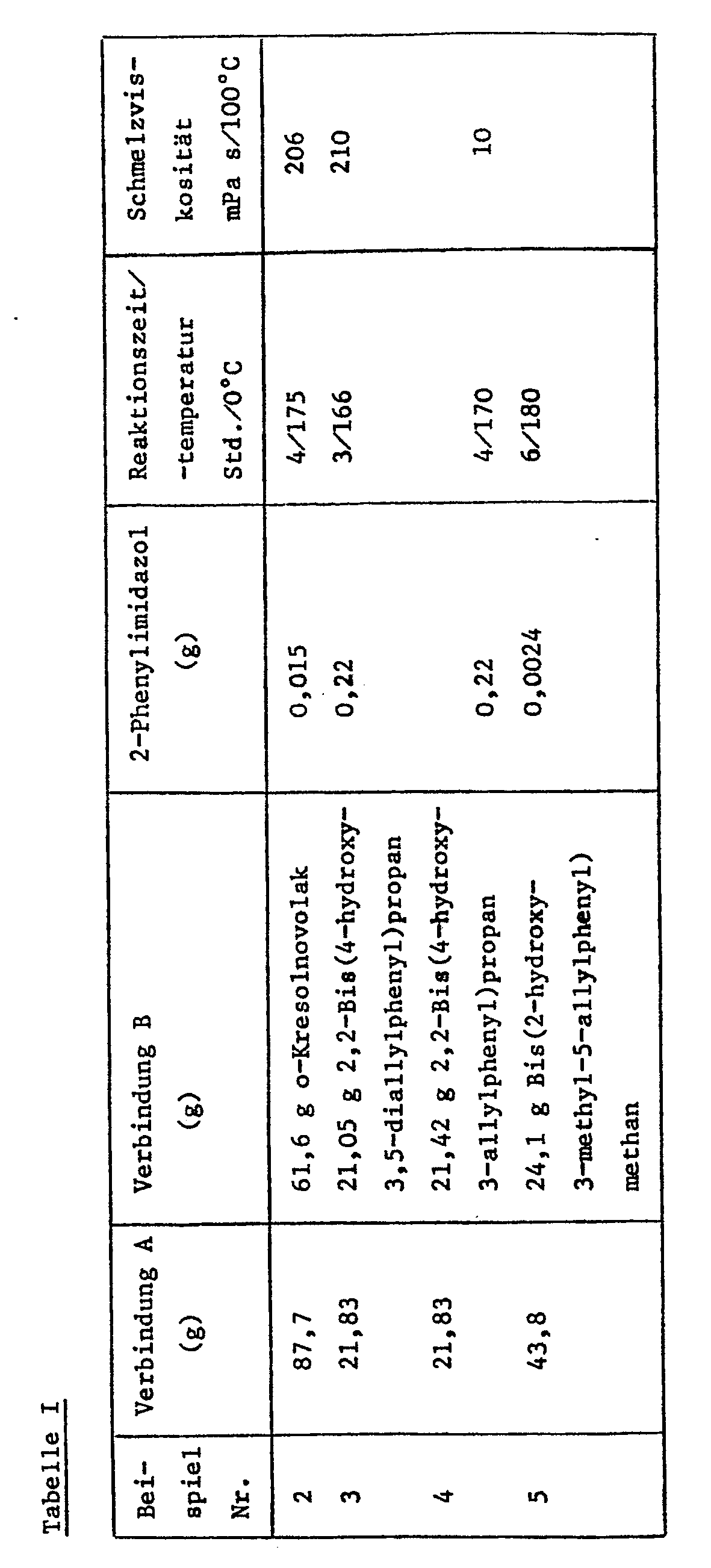
- Beispiel 6: 37,5 g (0,087 Mol) des gemäss Beispiel 1 hergestellten Addukts aus 4-Allyl-2,6-dimethylphenylglycidylether und 2,4,6-Triallylphenol in 50 ml Chloroform und 0,1 g Natriumacetat werden in einem 350 ml Sulfierkolben, der mit Rührer, Kühler, Tropftrichter und Thermometer ausgerüstet ist, vorgelegt. Innerhalb von etwa 2 Stunden werden bei 30-35°C 66,12 g (0,348 Mol) 40%ige Peressigsäure zugetropft. Das Reaktionsgemisch wird während 6 Std. weitergerührt, anschliessend in einen Scheidetrichter übergeführt, zuerst mit 3%iger NaOH und dann mit Wasser gewaschen, mit Na₂SO₃ peroxidfrei gestellt, über Natriumsulfat getrocknet und eingeengt. Nach dem Einengen erhält man 27,63 g (63,96 % d.Th.) eines hochviskosen Harzes mit einem Epoxidgehalt von 4,539 Aequivalenten/kg (etwa 56,3 % d.Th.). Aus dem Gelchromatogramm werden die folgenden Molekulargewichte ermittelt:
Mn (Zahlenmittel) = 570
Mw (Gewichtsmittel) = 814. - Beispiel 7: In einem 200 ml Sulfierkolben, der mit Rührer, Kühler, Tropftrichter und Thermometer ausgestattet ist, werden 62,0 g (182 mMol) des gemäss Beispiel 2 hergestellten Adduktes aus 4-Allyl-2,6-dimethylphenylglycidylether und o-Kresolnovolak in 50 ml Chloroform vorgelegt. Innerhalb von 90 Minuten werden bei 30-35°C 41,80 g (220 mMol) 40%ige Peressigsäure zugetropft. Nach Beendigung des Zutropfens wird das Reaktionsgemisch noch während 16 Std. gerührt. Zum Aufarbeiten wird das erhaltene Produkt mit 3%iger NaOH und dann mit wässriger Kochsalz-Lösung gewaschen, mit Na₂SO₃ peroxidfrei gestellt, über Natriumsulfat getrocknet und eingeengt. Nach dem Einengen erhält man 35,16 g eines festen Epoxidharzes mit einem Epoxidgehalt von 2,372 Aequivalenten/kg.
- Beispiel 8: In einem 200 ml Sulfierkolben, der mit Rührer, Kühler, Thermometer und Tropftrichter ausgestattet ist, werden 30,0 g (0,036 Mol) des gemäss Beispiel 3 hergestellten Addukts aus 4-Allyl-2,6-dimethylphenylglycidylether und 2,2-Bis(4-hydroxy-3,5-diallylphenyl)propan in 50 ml Chloroform und 1,0 g Natriumacetat vorgelegt. Innerhalb von 90 Minuten werden bei 30-35°C 41,80 g (0,22 Mol) 40%ige Peressigsäure zugetropft. Das Reaktionsgemisch wird noch während weiterer 6 Std. gerührt und dann in einen Scheidetrichter übergeführt. Das erhaltene Reaktionsprodukt wird mit 3%iger NaOH-Lösung und NaCl-Lösung gewaschen, mit Natriumsulfit peroxidfrei gestellt, über Natriumsulfat getrocknet und eingeengt. Nach dem Entfernen des Lösungsmittels erhält man 27,65 g (92,2 % d.Th.) eines hochviskosen Epoxidharzes mit einem Epoxidgehalt von 5,097 Aequivalenten/kg (70 % d.Th.).
- Beispiel 9: In einem 350 ml Sulfierkolben, der mit Rührer, Thermometer, Kühler und Tropftrichter ausgestattet ist, werden 50 g des gemäss Beispiel 4 hergestellten Addukts aus 4-Allyl-2,6-dimethylphenylglycidylether und 2,2-Bis(4-hydroxy-3-allylphenyl)propan in 50 ml Chloroform vorgelegt. Innerhalb von etwa 120 Minuten werden bei 30-35°C 54,96 g (0,29 Mol) 40%ige Peressigsäure zugetropft. Nach weiteren 4 Std. Rühren wird das Reaktionsgemisch in einen Scheidetrichter übergeführt, mit 3%iger NaOH und Wasser gewaschen, mit Natriumsulfit peroxidfrei gestellt, über Natriumsulfat getrocknet und eingeengt. Nach dem Einengen erhält man 43,12 g eines bräunlichen festen Epoxidharzes mit einem Epoxidgehalt von 3,46 Aequivalenten/kg.
- Beispiel 10: In einem 200 ml Sulfierkolben, der mit Tropftrichter, Rührer, Kühler und Thermometer ausgestattet ist, werden 40,0 g (0,054 Mol) des gemäss Beispiel 5 hergestellten Adduktes aus 4-Allyl-2,6-dimethylphenylglycidylether und Bis(2-hydroxy-3-methyl-5-allylphenyl)methan in 50 ml Chloroform und 1,0 g Natriumacetat vorgelegt. Innerhalb von etwa 2 Std. werden bei 30-35°C 66,12 g (0,348 Mol) 40%ige Peressigsäure zugetropft. Nach weiteren 5-6 Std. Rühren wird das Reaktionsprodukt nach dem in Beispiel 6 angegebenen Verfahren aufgearbeitet. Man erhält 43,2 g (98,64 % d.Th.) eines hochviskosen Epoxidharzes mit einem Epoxidgehalt von 3,65 Aequivalenten/kg (73,94 % d.Th.).
- Die gemäss den Beispielen 7, 8 und 10 erhaltenen Epoxidharze werden mit einem Härter und einem Härtungsbeschleuniger (2-Ethyl-4-methylimidazol) vermischt und zu gehärteten Formkörpern verarbeitet. In der folgenden Tabelle II sind Art und Menge der verwendeten Komponenten, die Härtungsbedingungen und die Eigenschaften der gehärteten Formkörper zusammengefasst.

Claims (16)
- Polypoxide, die dadurch erhältlich sind, dass man Verbindungen der Formel I


R₁ und R₃ unabhängig voneinander C₁₋₄-Alkyl, C₁₋₄-Alkoxy, Allyl, ein Halogenatom oder C₆₋₁₀-Aryl und R₂ Allyl oder 1-Propenyl oder bedeuten, mit Verbindungen mit phenolischen OH-Gruppen umsetzt und die erhaltenen Addukte anschliessend in Gegenwart einer Persäure epoxidiert. - Polyepoxide nach Anspruch 1, worin R₁ und R₃ unabhängig voneinander C₁₋₄-Alkyl, C₁₋₂-Alkoxy, ein Halogenatom, besonders ein Chloratom, oder Phenyl und R₂ Allyl bedeuten.
- Polyepoxide nach Anspruch 1, worin R₁ und R₃ dieselbe Bedeutung haben und R₂ Allyl darstellt.
- Polyepoxide nach Anspruch 1, worin n=1 ist.
- Polyepoxide nach Anspruch 3, worin n=1 ist, R₁ und R₃ je Methyl, tert.-Butyl, Methoxy, Chlor oder Phenyl und R₂ Allyl bedeuten.
- Polyepoxide nach Anspruch 5, worin n=1 ist, R₁ und R₃ je Methyl und R₂ Allyl bedeuten.
- Polyepoxide nach Anspruch 1, dadurch gekennzeichnet, dass man als Verbindungen mit phenolischen OH-Gruppen ein- oder mehrkernige Mono- oder Polyphenole verwendet.
- Polyepoxide nach Anspruch 7, dadurch gekennzeichnet, dass man als Mono- oder Polyphenol Bisphenol A, Bisphenol F, Tetrabrombisphenol A, Triallylphenol, 2,2-Bis(4-hydroxy-3-allylphenyl)propan, 2,2-Bis(4-hydroxy-3,5-diallylphenyl)propan, einen Phenolformaldehyd- oder Kresolformaldehyd-Novolak verwendet.
- Polyepoxide nach Anspruch 1, dadurch gekennzeichnet, dass man als Verbindungen mit phenolischen OH-Gruppen Umsetzungsprodukte aus einem Polyepoxid und einem Ueberschuss an Polyphenolen verwendet.
- Polyepoxide nach Anspruch 9, dadurch gekennzeichnet, dass man Umsetzungsprodukte aus Diglycidylethern von Bisphenol A, Bisphenol F oder Tetrabrombisphenol A oder aus Polyglyidylethern von Phenolformaldehyd- oder Kresolformaldehyd-Novolaken und überschüssigem Bisphenol A, Bisphenol F und/oder Tetrabrombisphenol A verwendet.
- Polyepoxide nach Anspruch 1, dadurch gekennzeichnet, dass man die Epoxidierung in Gegenwart von Perameisensäure oder Peressigsäure vornimmt.
- Addukte aus Verbindungen der Formel I


R₁ und R₃ unabhängig voneinander C₁₋₄-Alkyl, C₁₋₄-Alkoxy, Allyl, ein Halogenatom oder C₆₋₁₀-Aryl und
R₂ Allyl oder 1-Propenyl bedeuten, und Verbindungen mit phenolischen OH-Gruppen. - Härtbare Gemische enthaltend(a) ein erfindungsgemäss erhältliches Polyepoxid nach Anspruch 1 und(b) einen Härter für die Komponente (a).
- Härtbare Gemische nach Anspruch 13, die zusätzlich(c) einen Härtungsbeschleuniger enthalten.
- Härtbare Gemische nach Anspruch 13 oder 14, die zusätzlich(d) ein weiteres Epoxidharz enthalten.
- Verwendung von härtbaren Gemischen nach Anspruch 13 als Klebstoffe oder zur Herstellung von gehärteten Produkten, besonders zum Umhüllen elektronischer Bauteile.
Applications Claiming Priority (2)
| Application Number | Priority Date | Filing Date | Title |
|---|---|---|---|
| CH239985 | 1985-06-06 | ||
| CH2399/85 | 1985-06-06 |
Publications (3)
| Publication Number | Publication Date |
|---|---|
| EP0204659A2 EP0204659A2 (de) | 1986-12-10 |
| EP0204659A3 EP0204659A3 (en) | 1988-06-08 |
| EP0204659B1 true EP0204659B1 (de) | 1991-11-21 |
Family
ID=4232873
Family Applications (1)
| Application Number | Title | Priority Date | Filing Date |
|---|---|---|---|
| EP86810235A Expired - Lifetime EP0204659B1 (de) | 1985-06-06 | 1986-06-02 | Polyepoxide und deren Verwendung |
Country Status (8)
| Country | Link |
|---|---|
| US (1) | US4677170A (de) |
| EP (1) | EP0204659B1 (de) |
| JP (1) | JPS61282372A (de) |
| KR (1) | KR870000317A (de) |
| BR (1) | BR8602622A (de) |
| CA (1) | CA1258465A (de) |
| DE (1) | DE3682537D1 (de) |
| ES (1) | ES8801330A1 (de) |
Families Citing this family (23)
| Publication number | Priority date | Publication date | Assignee | Title |
|---|---|---|---|---|
| US4754003A (en) * | 1986-04-22 | 1988-06-28 | Ciba-Geigy Corporation | Phenol ethers containing epoxide groups |
| US4789711A (en) * | 1986-12-02 | 1988-12-06 | Ciba-Geigy Corporation | Multifunctional epoxide resins |
| US4900801A (en) * | 1987-05-29 | 1990-02-13 | Mitsui Petrochemical Industries, Ltd. | Epoxy compounds and epoxy resin compositions containing the same |
| ATE102931T1 (de) * | 1988-12-26 | 1994-04-15 | Kowa Co | Herstellung von glycidylaether. |
| EP0379468B1 (de) * | 1989-01-20 | 1995-03-01 | Ciba-Geigy Ag | Härtbare Epoxidharz-Stoffgemische enthaltend einen Thermoplast mit phenolischen Endgruppen |
| JPH0832695B2 (ja) * | 1990-02-02 | 1996-03-29 | 信越化学工業株式会社 | プロペニル基含有エポキシ樹脂 |
| US5212263A (en) * | 1991-01-10 | 1993-05-18 | Morton International, Inc. | Textured epoxy powder coating |
| US6353061B1 (en) | 1993-05-26 | 2002-03-05 | Dentsply Gmbh | α, ω-methacrylate terminated macromonomer compounds |
| US5624976A (en) * | 1994-03-25 | 1997-04-29 | Dentsply Gmbh | Dental filling composition and method |
| US5998499A (en) | 1994-03-25 | 1999-12-07 | Dentsply G.M.B.H. | Liquid crystalline (meth)acrylate compounds, composition and method |
| US6369164B1 (en) | 1993-05-26 | 2002-04-09 | Dentsply G.M.B.H. | Polymerizable compounds and compositions |
| CA2146816A1 (en) | 1994-04-22 | 1995-10-23 | Joachim E. Klee | Process and composition for preparing a dental polymer product |
| US5688878A (en) * | 1996-05-17 | 1997-11-18 | Morton International, Inc. | Epoxy powder coating with wrinkle finish |
| US5795927A (en) * | 1996-05-17 | 1998-08-18 | Morton International, Inc. | Color stable wrinkle finish epoxy powder coating |
| US5932288A (en) * | 1997-12-18 | 1999-08-03 | Morton International, Inc. | Wrinkle epoxy powder coating with acid and its homolog methylenedisalicylic |
| DE10257711B4 (de) * | 2001-12-27 | 2019-09-26 | Merck Patent Gmbh | Polymerisierbare monocyclische Verbindungen enthaltende Flüssigkristallmischungen |
| ATE346877T1 (de) * | 2003-04-16 | 2006-12-15 | Huntsman Adv Mat Switzerland | Härtungsbeschleuniger für epoxyharzzusammensetzungen härtend bei niedriger temperatur |
| EP1613604B1 (de) * | 2003-04-16 | 2006-07-05 | Huntsman Advanced Materials (Switzerland) GmbH | 1-imidazolylmethyl-substituirte-2-naphtol unh ihre verwendung als niedertemperatur-härtungsbeschleuniger |
| DK2678368T3 (en) | 2011-02-23 | 2015-08-10 | Alzchem Ag | NEW HARDENERS for epoxy resins |
| US9309381B2 (en) | 2011-06-24 | 2016-04-12 | Air Products And Chemicals, Inc. | Epoxy resin compositions using solvated solids |
| US20120328811A1 (en) * | 2011-06-24 | 2012-12-27 | Air Products And Chemicals, Inc. | Epoxy Resin Compositions |
| DK2880071T3 (da) | 2012-08-02 | 2017-01-02 | Alzchem Ag | Flydende hærdere til hærdning af epoxyharpikser |
| CN117820604A (zh) * | 2023-12-27 | 2024-04-05 | 江苏泰特尔新材料科技股份有限公司 | 一种脂环族二缩水甘油醚的制备方法 |
Family Cites Families (6)
| Publication number | Priority date | Publication date | Assignee | Title |
|---|---|---|---|---|
| US2965608A (en) * | 1956-04-12 | 1960-12-20 | Shell Oil Co | Ethers of epoxy-substituted polyhydric phenols and their polymers |
| NL216211A (de) * | 1956-04-12 | |||
| CH621810A5 (de) * | 1976-06-17 | 1981-02-27 | Ciba Geigy Ag | |
| DE2963311D1 (en) * | 1978-12-29 | 1982-08-26 | Ciba Geigy Ag | Propenyl-substituted phenolglycidyl ethers, process for their preparation and their use |
| US4282345A (en) * | 1980-04-16 | 1981-08-04 | General Electric Company | Method of preparing resinous condensation product of an allylated alkylol phenol and an ethoxyline resin |
| US4388451A (en) * | 1981-09-28 | 1983-06-14 | Ashland Oil, Inc. | Polymers derived from allylphenol or substituted allylphenol and maleic anhydride |
-
1986
- 1986-06-02 DE DE8686810235T patent/DE3682537D1/de not_active Expired - Lifetime
- 1986-06-02 EP EP86810235A patent/EP0204659B1/de not_active Expired - Lifetime
- 1986-06-04 US US06/870,608 patent/US4677170A/en not_active Expired - Fee Related
- 1986-06-04 ES ES555702A patent/ES8801330A1/es not_active Expired
- 1986-06-04 CA CA000510775A patent/CA1258465A/en not_active Expired
- 1986-06-05 KR KR1019860004476A patent/KR870000317A/ko not_active Ceased
- 1986-06-05 BR BR8602622A patent/BR8602622A/pt not_active IP Right Cessation
- 1986-06-06 JP JP61131680A patent/JPS61282372A/ja active Pending
Also Published As
| Publication number | Publication date |
|---|---|
| CA1258465A (en) | 1989-08-15 |
| US4677170A (en) | 1987-06-30 |
| EP0204659A2 (de) | 1986-12-10 |
| ES555702A0 (es) | 1987-12-16 |
| BR8602622A (pt) | 1987-02-03 |
| ES8801330A1 (es) | 1987-12-16 |
| JPS61282372A (ja) | 1986-12-12 |
| DE3682537D1 (de) | 1992-01-02 |
| KR870000317A (ko) | 1987-02-17 |
| EP0204659A3 (en) | 1988-06-08 |
Similar Documents
| Publication | Publication Date | Title |
|---|---|---|
| EP0204659A2 (de) | Polyepoxide und deren Verwendung | |
| EP0022073B1 (de) | Diglycidyläther von di-sekundären Alkoholen, ihre Herstellung und Verwendung | |
| EP0271442B1 (de) | Multifunktionelle Epoxidharze | |
| EP0252358B1 (de) | Flüssig-kristalline Diglycidylverbindungen, ihre Herstellung und Verwendung in härtbaren Epoxid-Gemischen | |
| EP0205402B1 (de) | 2,6-Disubstituierte 4-Epoxypropylphenylglycidylether und deren Verwendung | |
| EP0146498B1 (de) | Härtbare Gemische, enthaltend ein Epoxidharz, ein Imid und einen Härtungskatalysator | |
| EP0319472A2 (de) | Epoxysiloxane | |
| DE1966703C3 (de) | Langkettige, aliphatische oder cycloaliphatische Säurereste enthaltende Diglycidylester | |
| EP0148117B1 (de) | Triglycidylverbindungen von Aminophenolen | |
| DE2154624A1 (de) | Neue diglycidylderivate von zwei nheterocyclische ringe enthaltenen verbindungen, verfahren zu ihrer herstellung und anwendung | |
| DE69332815T2 (de) | Polyglyzidyl-Äthern und ihre Verwendung | |
| EP0243318B1 (de) | Epoxidgruppenhaltige Phenolether | |
| US4672101A (en) | Polyepoxy aromatic hydantoins | |
| DE3900682A1 (de) | Diglycidylverbindungen, ihre herstellung und ihre verwendung in haertbaren epoxid-gemischen | |
| EP0108720A1 (de) | Neue cycloaliphatische Diallyläther | |
| DE2319815C2 (de) | Propionsäureglycidylestergruppen enthaltende Cycloalkanone, Verfahren zu deren Herstellung und Verwendung derselben | |
| EP0278900A2 (de) | Vorverlängerte Epoxidharze auf Basis von Cyclohex-1-ylmethylen-diphenolderivaten oder Bicyclo[2.2.1]hept-1-ylmethylen-diphenolderivaten | |
| US4337367A (en) | Oligomer of m-isopropenylphenol | |
| US4461879A (en) | Curable saturated polyepoxide-triglycidyl cyanurate compositions | |
| US3920683A (en) | Diglycidyloxyalkyl compounds | |
| DE69709747T2 (de) | Polyglycidylether von sekundären alkoholen | |
| DE1816095A1 (de) | Neue heterocyclische N,N'-Diglycidylverbindungen,Verfahren zu ihrer Herstellung und ihre Anwendung | |
| EP0233843A2 (de) | Verfahren zur Verminderung des Chlorgehaltes in Glycidylverbindungen | |
| DE1670333A1 (de) | Neue Polyepoxydverbindungen,Verfahren zu deren Herstellung und Anwendung | |
| EP0370946A2 (de) | Verfahren zur Herstellung von Epoxidverbindungen |
Legal Events
| Date | Code | Title | Description |
|---|---|---|---|
| PUAI | Public reference made under article 153(3) epc to a published international application that has entered the european phase |
Free format text: ORIGINAL CODE: 0009012 |
|
| 17P | Request for examination filed |
Effective date: 19860604 |
|
| AK | Designated contracting states |
Kind code of ref document: A2 Designated state(s): CH DE FR GB IT LI NL |
|
| PUAL | Search report despatched |
Free format text: ORIGINAL CODE: 0009013 |
|
| AK | Designated contracting states |
Kind code of ref document: A3 Designated state(s): CH DE FR GB IT LI NL |
|
| 17Q | First examination report despatched |
Effective date: 19900925 |
|
| GRAA | (expected) grant |
Free format text: ORIGINAL CODE: 0009210 |
|
| AK | Designated contracting states |
Kind code of ref document: B1 Designated state(s): CH DE FR GB IT LI NL |
|
| ITF | It: translation for a ep patent filed | ||
| REF | Corresponds to: |
Ref document number: 3682537 Country of ref document: DE Date of ref document: 19920102 |
|
| GBT | Gb: translation of ep patent filed (gb section 77(6)(a)/1977) | ||
| ET | Fr: translation filed | ||
| PGFP | Annual fee paid to national office [announced via postgrant information from national office to epo] |
Ref country code: FR Payment date: 19920415 Year of fee payment: 7 |
|
| PGFP | Annual fee paid to national office [announced via postgrant information from national office to epo] |
Ref country code: GB Payment date: 19920430 Year of fee payment: 7 |
|
| PGFP | Annual fee paid to national office [announced via postgrant information from national office to epo] |
Ref country code: DE Payment date: 19920504 Year of fee payment: 7 |
|
| PGFP | Annual fee paid to national office [announced via postgrant information from national office to epo] |
Ref country code: NL Payment date: 19920630 Year of fee payment: 7 |
|
| PGFP | Annual fee paid to national office [announced via postgrant information from national office to epo] |
Ref country code: CH Payment date: 19920922 Year of fee payment: 7 |
|
| PLBE | No opposition filed within time limit |
Free format text: ORIGINAL CODE: 0009261 |
|
| STAA | Information on the status of an ep patent application or granted ep patent |
Free format text: STATUS: NO OPPOSITION FILED WITHIN TIME LIMIT |
|
| 26N | No opposition filed | ||
| PG25 | Lapsed in a contracting state [announced via postgrant information from national office to epo] |
Ref country code: GB Effective date: 19930602 |
|
| PG25 | Lapsed in a contracting state [announced via postgrant information from national office to epo] |
Ref country code: LI Effective date: 19930630 Ref country code: CH Effective date: 19930630 |
|
| PG25 | Lapsed in a contracting state [announced via postgrant information from national office to epo] |
Ref country code: NL Effective date: 19940101 |
|
| GBPC | Gb: european patent ceased through non-payment of renewal fee |
Effective date: 19930602 |
|
| NLV4 | Nl: lapsed or anulled due to non-payment of the annual fee | ||
| PG25 | Lapsed in a contracting state [announced via postgrant information from national office to epo] |
Ref country code: FR Effective date: 19940228 |
|
| REG | Reference to a national code |
Ref country code: CH Ref legal event code: PL |
|
| PG25 | Lapsed in a contracting state [announced via postgrant information from national office to epo] |
Ref country code: DE Effective date: 19940301 |
|
| REG | Reference to a national code |
Ref country code: FR Ref legal event code: ST |
|
| PG25 | Lapsed in a contracting state [announced via postgrant information from national office to epo] |
Ref country code: IT Free format text: LAPSE BECAUSE OF NON-PAYMENT OF DUE FEES;WARNING: LAPSES OF ITALIAN PATENTS WITH EFFECTIVE DATE BEFORE 2007 MAY HAVE OCCURRED AT ANY TIME BEFORE 2007. THE CORRECT EFFECTIVE DATE MAY BE DIFFERENT FROM THE ONE RECORDED. Effective date: 20050602 |