EP0205154B1 - Dispositif pour fabriquer des briquettes avec du vieux papier ou des produits similaires et procédé d'entraînement d'un dispositif de ce genre - Google Patents
Dispositif pour fabriquer des briquettes avec du vieux papier ou des produits similaires et procédé d'entraînement d'un dispositif de ce genre Download PDFInfo
- Publication number
- EP0205154B1 EP0205154B1 EP86107880A EP86107880A EP0205154B1 EP 0205154 B1 EP0205154 B1 EP 0205154B1 EP 86107880 A EP86107880 A EP 86107880A EP 86107880 A EP86107880 A EP 86107880A EP 0205154 B1 EP0205154 B1 EP 0205154B1
- Authority
- EP
- European Patent Office
- Prior art keywords
- mould
- webs
- waste paper
- pressing
- briquets
- Prior art date
- Legal status (The legal status is an assumption and is not a legal conclusion. Google has not performed a legal analysis and makes no representation as to the accuracy of the status listed.)
- Expired - Lifetime
Links
- 239000010893 paper waste Substances 0.000 title claims description 34
- 238000000034 method Methods 0.000 title claims description 20
- 238000003825 pressing Methods 0.000 claims description 26
- 239000000463 material Substances 0.000 claims description 17
- 230000001419 dependent effect Effects 0.000 claims description 7
- 238000007599 discharging Methods 0.000 claims 1
- 238000000465 moulding Methods 0.000 abstract description 9
- 238000006073 displacement reaction Methods 0.000 abstract description 3
- 230000006835 compression Effects 0.000 description 8
- 238000007906 compression Methods 0.000 description 8
- 238000010276 construction Methods 0.000 description 6
- 230000000295 complement effect Effects 0.000 description 5
- 150000001875 compounds Chemical class 0.000 description 3
- 239000007788 liquid Substances 0.000 description 3
- 238000000926 separation method Methods 0.000 description 2
- 239000004484 Briquette Substances 0.000 description 1
- VVQNEPGJFQJSBK-UHFFFAOYSA-N Methyl methacrylate Chemical compound COC(=O)C(C)=C VVQNEPGJFQJSBK-UHFFFAOYSA-N 0.000 description 1
- 229920005372 Plexiglas® Polymers 0.000 description 1
- 239000011111 cardboard Substances 0.000 description 1
- 238000005429 filling process Methods 0.000 description 1
- 230000009969 flowable effect Effects 0.000 description 1
- 230000005484 gravity Effects 0.000 description 1
- 229910052500 inorganic mineral Inorganic materials 0.000 description 1
- 239000011810 insulating material Substances 0.000 description 1
- 238000004519 manufacturing process Methods 0.000 description 1
- 239000011707 mineral Substances 0.000 description 1
- 239000000123 paper Substances 0.000 description 1
- 239000011087 paperboard Substances 0.000 description 1
- 239000013641 positive control Substances 0.000 description 1
- 239000012254 powdered material Substances 0.000 description 1
- 238000005549 size reduction Methods 0.000 description 1
- 239000000126 substance Substances 0.000 description 1
- XLYOFNOQVPJJNP-UHFFFAOYSA-N water Substances O XLYOFNOQVPJJNP-UHFFFAOYSA-N 0.000 description 1
Images

Classifications
-
- B—PERFORMING OPERATIONS; TRANSPORTING
- B30—PRESSES
- B30B—PRESSES IN GENERAL
- B30B9/00—Presses specially adapted for particular purposes
- B30B9/30—Presses specially adapted for particular purposes for baling; Compression boxes therefor
- B30B9/3092—Presses specially adapted for particular purposes for baling; Compression boxes therefor with two or more stationary press boxes co-operating alternately with a press ram or simultaneously with press rams
-
- B—PERFORMING OPERATIONS; TRANSPORTING
- B30—PRESSES
- B30B—PRESSES IN GENERAL
- B30B15/00—Details of, or accessories for, presses; Auxiliary measures in connection with pressing
- B30B15/02—Dies; Inserts therefor; Mounting thereof; Moulds
- B30B15/022—Moulds for compacting material in powder, granular of pasta form
-
- B—PERFORMING OPERATIONS; TRANSPORTING
- B30—PRESSES
- B30B—PRESSES IN GENERAL
- B30B15/00—Details of, or accessories for, presses; Auxiliary measures in connection with pressing
- B30B15/08—Accessory tools, e.g. knives; Mountings therefor
-
- B—PERFORMING OPERATIONS; TRANSPORTING
- B30—PRESSES
- B30B—PRESSES IN GENERAL
- B30B15/00—Details of, or accessories for, presses; Auxiliary measures in connection with pressing
- B30B15/30—Feeding material to presses
- B30B15/302—Feeding material in particulate or plastic state to moulding presses
-
- B—PERFORMING OPERATIONS; TRANSPORTING
- B30—PRESSES
- B30B—PRESSES IN GENERAL
- B30B9/00—Presses specially adapted for particular purposes
- B30B9/30—Presses specially adapted for particular purposes for baling; Compression boxes therefor
- B30B9/3003—Details
- B30B9/301—Feed means
-
- B—PERFORMING OPERATIONS; TRANSPORTING
- B30—PRESSES
- B30B—PRESSES IN GENERAL
- B30B9/00—Presses specially adapted for particular purposes
- B30B9/30—Presses specially adapted for particular purposes for baling; Compression boxes therefor
- B30B9/3003—Details
- B30B9/3035—Means for conditioning the material to be pressed, e.g. paper shredding means
Definitions
- the invention relates to a device for pressing a material with a mold consisting of a first and a second part, the two parts for filling being removable from one another from a feed device arranged above the mold, and wherein the first part is a stationary, flat lower mold part and the second part is a substantially flat upper part which can be pivoted about a horizontal axis to the lower part of the mold, between which a press ram can be displaced, and an ejection device acting transversely to the direction of displacement of the press ram is provided for the shaped press parts and a metered supply of molding compound to the latter via a sequence control Shape takes place.
- the invention further relates to a method for operating a device for pressing a material by filling the mold, closing the mold, performing the pressing process, releasing the pressed parts and ejecting them.
- Such a device and such a method are known from EP-A-0 142 438.
- the known device is intended to serve for further compression of already pre-compressed material, namely for pressing pre-formed rollers made of a mineral insulating material in cylindrical form into cylinders with a smaller diameter.
- rolls are conveyed via a longitudinal and cross conveyor to a compression chamber, into which they are fed from a single bar existing pushing device are pushed into it.
- the front door of the compression chamber is pivotable about a horizontal axis and, when a roll has been deposited on it in its approximately horizontal position, is pivoted to a vertical position, and then the compression chamber is closed and pre-compression is carried out in a substantially horizontal direction. Then a press ram is moved vertically downwards, whereby the final compression of the roll is carried out.
- This known device is not suitable for compressing a flowable material, such as waste paper, which consists of shredded waste paper soaked in a liquid.
- EP-A-0 054 005 discloses a method and a device for compacting organic substances with two press molds, in each of which a press ram is arranged in a stationary manner and the second press ram is pressed against the first press ram by means of a hydraulic cylinder.
- a vibration sensor is provided for compression, which acts on one of the two press rams.
- the known device is used to press powdered material into spherical briquettes, and for this purpose the inside of both press rams are provided with numerous hemispherical recesses, so that a number of spherical briquettes are pressed during each pressing process.
- a feed device is provided above the two molds and is opened for filling towards the opened molds.
- the known device is not suitable for producing larger and stackable briquettes which have the usual cuboid shape. Since the mold spaces must be relatively deep and angular, they would only fill unevenly, and the finished briquettes would remain in the mold spaces despite the shape being open. This is particularly true if briquettes are to be made from waste paper or similar material.
- the invention is based on the object of specifying a device for pressing a material and a method for operating this device, it being possible to produce a plurality of uniform, approximately cuboid-shaped pressed parts in a continuous, uninterrupted process.
- the object is achieved by a device for pressing a material with a mold consisting of a first and a second part, the two parts for filling being removable from one another from a feed device arranged above the mold, and the first part being a stationary part Arranged flat mold part is and the second part is a substantially flat mold upper part pivotable about a horizontal axis to the lower mold part, between which a press ram is displaceable, an ejection device acting transversely to the direction of displacement of the press ram is provided for the shaped press parts and a metered control via a sequence control Pressing compound is supplied to the mold, with at least one of the two parts being provided with molding spaces for a plurality of briquettes for pressing waste paper mass as a molding compound for briquetting waste paper, the molding spaces being provided by mutually parallel and perpendicular to the lower mold part extending webs are formed, between which the comb-shaped press ram is displaceable, and the lower mold part is arranged horizontally.
- the mold Since the mold is arranged horizontally and its upper part can be swung open fully, the lower part of the mold can be filled well and evenly.
- the molded part carrying the webs is removed after pressing, as long as the briquettes are still held by the press ram, so that they do not get caught between the webs.
- the parallel webs are attached to the underside of the upper mold part. This design is particularly simple.
- the mutually parallel webs are arranged on a plate parallel to the bottom of the lower mold part and can be inserted into the mold through slots complementary to the webs in the bottom of the lower mold part. This prevents the finished briquettes from sticking to the floor.
- recesses complementary to the webs are advantageously made in the molded part opposite the web-bearing part.
- the press ram can be stopped after the pressing in an intermediate position in which there is only a small distance from the finished briquettes, then a particularly gentle treatment of the briquettes is ensured, which reduces the reject rate.
- the sequential control prior to the removal of the ram after the pressing process, first causes the webs to be removed.
- the moving parts can be driven in numerous ways. It is particularly advantageous due to high transferable forces, combined with good control and regulation options, if, according to a further advantageous embodiment of the invention, the movement of the upper molded part and / or press ram and / or the ejection device takes place hydraulically.
- a load-dependent device is provided, which is attached to the lower end of the feeding device.
- the metering device has a closure base which can be loaded with waste paper mass via a transport and comminution device, and a load-dependent element is provided which, when a desired one is reached preset load releases the closure bottom.
- the transport and comminution device advantageously has two knife rollers which are parallel to one another. Knife rollers of this type can also be easily replaced if this should become necessary.
- a positive control which can operate electrically, electronically, mechanically or pneumatically, is advantageously provided, with the aid of which the transport and comminution device is stopped when the closure bottom is opened and is put into operation again when the closure bottom is closed.
- a particularly high throughput rate can be achieved while maintaining a relatively simple construction of the device according to the invention if it is constructed in a twin construction with a common sequential control system which controls the two twin units with processes staggered in time.
- triplet units are also possible, as is a shredding and transport device, from which two press devices in a twin construction are supplied alternately.
- the object is achieved by the following steps, some of which have already been described in the preceding explanations: filling the mold, closing the mold, carrying out the pressing process, releasing the pressed pressed parts and ejecting the same, waste paper mass being used as the material to be pressed, from which briquettes are produced as pressed parts, and the filling of the mold takes place in a weight-oriented manner, when the briquettes are released with the press ram pressed, the webs are first removed, and only then step by step The finished briquettes are released for ejection with gradual removal of the press ram.
- the webs are inserted into the mold only after the mold has been filled with waste paper material, during or after the mold has been closed. This already results in a first pre-compression and an expulsion of water from the waste paper mass, which is advantageously moistened for better size reduction.
- a form unit 14, 14a is arranged on a frame 12, which consists primarily of double-T beams, to which pre-soaked waste paper, wrapping paper or cardboard is fed in a controlled manner by feed devices 16, 16a.
- Each feed device 16, 16a has a downwardly conical container 18, 18a, to which waste paper or the like which has been pre-soaked from a soft paper container, not shown, is fed.
- Interlocking pairs of knife rollers 20, 20a arranged in the lower part of the containers 18, 18a serve to shred the waste paper mass and at the same time serve as a controlled feeding device for shredded waste paper to a primarily horizontally arranged closure base 22, 22a, which opens depending on a desired amount of waste paper accumulated on it. is pivoted down in particular.
- the closure base 22, 22a is preferably opened when a load-dependent element 24, 24a detects a desired, preset amount of waste paper. For this purpose, the closure base 22, 22a is released and can pivot downwards. Closing of the closure base 22, 22a and possibly also opening takes place via a hydraulic cylinder 26, 26a after the accumulated waste paper mass has been emptied toward the molding unit 14, 14a. The knife rollers 20, 20a are stopped at the time of opening of the closure base 22, 22a, so that no further waste paper is conveyed during the emptying of the closure base 22, 22a. When the closure base 22, 22a is closed, the knife rollers 20, 20a begin to rotate again.
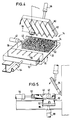
- the molding unit 14, 14a is shown in FIGS. 1, 2 and 4. It has a lower mold part 30 consisting of a substantially horizontally arranged bottom 32, a rear wall 34 and a side wall 36, which is continued in an ejection stamp 40. This can be moved by means of a hydraulic cylinder 42 parallel to the rear wall 34 on the bottom 32, so that finished briquettes 50 can be ejected to the right on the preferably open side of the lower mold part in FIG. 4.
- the lower mold part is completed by a press ram 52 arranged opposite the rear wall 34, which can be moved in the direction of the rear wall 34 via a further hydraulic cylinder 54.
- the press die 52 has parallel slots 56 running in this direction, which are complementary with correspondingly extending, mutually parallel webs 62 on the underside of an upper mold part 60.
- the upper mold part 60 can be pivoted about an axis 64 running parallel to the rear wall 34 by means of a hydraulic cylinder 66 into a position in which waste paper mass can get into the lower mold part from the feed device 16, 16a without hindrance.
- the base 32 is provided with depressions (not shown) which are complementary to the webs 62 and into which the webs 62 engage when the shape is closed. This ensures a complete separation of the waste paper mass in the mold rooms before pressing.
- a sequence control ensures the timely process of briquette production.
- the device according to the invention works as follows: Waste paper mass fed to the container 18 is shredded while the knife rollers 20 are running and accumulated on the bottom 22 until the load-dependent element 24 responds at a desired preset amount. This opens the bottom 22. At the same time, the rollers 20 are stopped.
- the lower mold part 30 is filled relatively uniformly with waste paper mass 70a.
- the sequence control device activates the hydraulic cylinder 66 and moves the previously swung-up mold upper part 60 downward into a horizontal orientation so that the mold closes, the webs 62 separating the waste paper mass into individual mold spaces.
- the sequence control device triggers a movement of the previously extended press punch 52 in the direction of the rear wall 34 via the hydraulic cylinder 54, as a result of which the briquettes 50 are pressed.
- the amount of movement of the ram 52 can be path or pressure dependent.
- the sequential control device closed the closure base 22 again (FIG. 1, left) and set the knife rollers 20 in rotation, so that again the closure base 22 is loaded with waste paper.
- the top control part 60 is first pivoted upward by the sequence control device, so that the briquettes are held on the bottom 32 by the still pressed pressing die 52 and do not get caught between the webs 62. Only after swiveling the upper part of the mold 60 takes place in an intermediate step a partial retraction of the press ram 52 by a few, preferably about 2 to 3 cm, before the briquettes 50 are ejected to the right in FIG. 4 via the ejection ram 40, so that they are placed in a collecting container or a suitable transport or Reach stacking device. Only then is the ram 52 fully extended and the next filling process can begin.
- Fig. 1 it can be seen that in the twin construction of the device 10, preferably an offset work on the left and right unit takes place, which brings about an equalization of the process sequence and the stress on the electrical and hydraulic devices.
- the liquid present in the waste paper mass is removed during pressing in that conical openings are preferably provided in the bottom 32 and / or the rear wall 34 of the molding unit 14.
- the escaping liquid can collect in a trough 72. The entire process takes, for example, 20 seconds.
- the containers 18, 18a can be provided with a lid, which has a closure contact, via which at least the operation of the knife rollers 20 is interrupted when the lid is opened.
- the entire device is preferably watertight, for example housed in a plexiglass housing, which enables the functioning of the device to be observed.
- FIG. 5 shows a modified embodiment of the device according to the invention with a slotted bottom 82 of the lower mold part and a smooth upper mold part 84, the webs 62 are placed on the top of a plate 86, which are moved upwards by means of a hydraulic cylinder 88 through the floor 82 after the waste paper mass has been filled in.
- depressions complementary to the web edges can be provided on the inside of the upper part 84, which ensure a secure separation of the mold spaces.
- the plate 86 is first moved down again. The webs 62 are thereby removed and the briquettes 50 can be ejected by means of the stamp 40.
Landscapes
- Engineering & Computer Science (AREA)
- Mechanical Engineering (AREA)
- Paper (AREA)
- Processing Of Solid Wastes (AREA)
- Advancing Webs (AREA)
- Processing And Handling Of Plastics And Other Materials For Molding In General (AREA)
Claims (14)
- Appareillage pour compression d'une matière comprenant un moule composée (14, 14a) d'un premier élément (30) et d'un second élément (60), lesdits deux éléments étant écartables l'un par rapport à l'autre pour le remplissage d'un dispositif d'aménage (16, 16a) disposé au-dessus dudit moule, et le premier élément constituant une partie de moule inférieure stationnaire plane (30) et le second élément étant un élément de moule supérieur (60) essentiellement plane et pivotant autour d'un axe horizontal (64) par rapport à la partie de moule inférieure (30), dans lequel un piston de vérin (52) est déplaçable latéralement entre ceux-ci, un dispositif d'éjection (40, 42) est prévu pour les pièces comprimées formées (50) qui agit transversalement à la direction de déplacement du piston de vérin (52), et dans lequel, par une commande à poursuite, s'ensuit un aménage dosé de la masse à comprimer audit moule,
caractérisé en ce
que pour comprimer la masse de vieux papiers en tant que matière à comprimer pour le briquetage de vieux papiers au moins un desdits deux éléments (30, 60) est muni de compartiments de moulage pour plusieurs briquettes (50), les compartiments de moulage sont formés par des entretoises (62) à tracé parallèle l'un par rapport à l'autre et perpendiculairement à la partie de moule inférieure (30), ledit piston de vérin (52) à configuration en forme de peigne étant déplaçable latéralement entre ceux-ci et ladite partie de moule inférieure (30) étant disposée horizontalement. - Appareillage selon la Revendication 1,
caractérisé en ce
que les entretoises (62) parallèles l'une par rapport à l'autre sont installées à la face inférieure de ladite partie de moule supérieure (60). - Appareillage selon la Revendication 1,
caractérisé en ce
que les entretoises (62) parallèles l'une par rapport à l'autre sont disposées sur un panneau (86) parallèle au fond (82) de ladite partie de moule inférieure (30) et adaptées à être insérées, par lesdites entretoises, dans ledit moule au moyen de rainures complémentaires dans le fond (82) de ladite partie de moule inférieure (30). - Appareillage selon la Revendication 2 ou 3,
caractérisé en ce
que dans ladite pièce de moule située en face de cette pièce de moule (60, 86) qui porte des entretoises (62), sont pourvus des creux complémentaires auxdites entretoises. - Appareillage selon une quelconque des Revendications 1 à 4,
caractérisé en ce
que le piston de vérin (52) est blocable, après la compression, dans une position intermédiaire, à laquelle il n'y a qu'un intervalle moindre desdites briquettes finies. - Appareillage selon une quelconque des Revendications 1 à 5,
caractérisé en ce
que la commande à poursuite avant l'écartement du piston de vérin (52) après le cycle de moulage a d'abord pour effet un écartement desdites entretoises (62). - Appareillage selon une quelconque des Revendications 1 à 6,
caractérisé en ce
que le mouvement de la pièce de moule supérieure (60) et/ou du dispositif éjecteur (40) se fait par commande hydraulique. - Appareillage selon une quelconque des Revendications 1 à 7,
caractérisé en ce
qu'à l'aménage dosé de la masse de vieux papiers audit moule est prévu un dispositif (20, 22, 24) à réponse en fonction de la charge, qui est installé à l'extrémité inférieure dudit dispositif d'aménage (16, 16a). - Appareillage selon la Revendication 8,
caractérisé en ce
que le mécanisme de dosage comprend un fond de fermeture (22), qui par un dispositif de manutention et de broyage (20) est chargeable avec la masse de vieux papiers, et en ce qu'un élément en fonction de la charge (24) est prévu, qui débloque ledit fond de fermeture (22) à l'obtention d'un niveau de charge pré-réglable désiré. - Appareillage selon la Revendication 9,
caractérisé en ce
que le mécanisme de manutention et de broyage comprend deux rouleaux de moulin à cylindre (20) parallèles l'un par rapport à l'autre. - Appareillage selon Revendication 9 ou 10,
caractérisé en ce
qu'à l'ouverture dudit fond de fermeture (22) ledit mécanisme de manutention et de broyage (20) est arrêté et que ledit fond de fermeture (22) est remis en marche lors de sa fermeture. - Appareillage selon une quelconque des Revendications 1 à 11,
caractérisé en ce
que celui-ci est réalisé en un type de construction symétrique double avec dispositif commun de commande à poursuite, qui commande lesdites deux unités jumelées à allures temporaires décalées l'une par rapport à l'autre. - Procédé pour exploitation d'un appareillage pour compression d'une matière, comprenant les opérations de remplissage d'un moule (30, 60), de fermeture dudit moule, d'exécution du cycle de compression, de déblocage des pièces comprimées (50), et de l'éjection de celles-ci,
caractérisé en ce
qu'un appareillage pour compression selon la Revendication 1 est utilisé et en ce que la masse de vieux papiers à comprimer est employée, de laquelle des briquettes (50) sont fabriquées comme pièces comprimées, en ce que le remplissage dudit moule (30, 60) a lieu à doses pondérées à la mise en circulation des briquettes (50), que d'abord les entretoises (62) sont éloignées lorsque le piston de vérin (52) est serré, et en ce qu'alors les briquettes finies (50) sont mises en circulation à opération intermittente pour une éjection en éloignant, pas à pas, ledit piston de vérin (52). - Appareillage selon la Revendication 13,
caractérisé en ce
que lesdites entretoises (62) ne sont insérées, pendant ou après la fermeture dudit moule, qu'après le remplissage dudit moule (30, 60) avec la masse de vieux papiers dans le moule.
Priority Applications (1)
| Application Number | Priority Date | Filing Date | Title |
|---|---|---|---|
| AT86107880T ATE73388T1 (de) | 1985-06-11 | 1986-06-10 | Einrichtung zum brikettieren von altpapier oder dergleichen und verfahren zum betrieb einer derartigen einrichtung. |
Applications Claiming Priority (2)
| Application Number | Priority Date | Filing Date | Title |
|---|---|---|---|
| DE19853520886 DE3520886A1 (de) | 1985-06-11 | 1985-06-11 | Einrichtung zum brikettieren von altpapier oder dergleichen und verfahren zum betrieb einer derartigen einrichtung |
| DE3520886 | 1985-06-11 |
Publications (3)
| Publication Number | Publication Date |
|---|---|
| EP0205154A2 EP0205154A2 (fr) | 1986-12-17 |
| EP0205154A3 EP0205154A3 (en) | 1987-12-16 |
| EP0205154B1 true EP0205154B1 (fr) | 1992-03-11 |
Family
ID=6272970
Family Applications (1)
| Application Number | Title | Priority Date | Filing Date |
|---|---|---|---|
| EP86107880A Expired - Lifetime EP0205154B1 (fr) | 1985-06-11 | 1986-06-10 | Dispositif pour fabriquer des briquettes avec du vieux papier ou des produits similaires et procédé d'entraînement d'un dispositif de ce genre |
Country Status (3)
| Country | Link |
|---|---|
| EP (1) | EP0205154B1 (fr) |
| AT (1) | ATE73388T1 (fr) |
| DE (2) | DE3520886A1 (fr) |
Cited By (1)
| Publication number | Priority date | Publication date | Assignee | Title |
|---|---|---|---|---|
| CN110947481A (zh) * | 2019-12-06 | 2020-04-03 | 李建辉 | 一种固定废物资源回收装置及其回收方法 |
Families Citing this family (4)
| Publication number | Priority date | Publication date | Assignee | Title |
|---|---|---|---|---|
| JP5384086B2 (ja) * | 2008-11-17 | 2014-01-08 | 富士車輌株式会社 | スクラップ圧縮装置 |
| IT1402090B1 (it) * | 2010-10-12 | 2013-08-28 | Essegi 2 S R L | Pressa per materiale destinato all'imballaggio e impianto di imballaggio con tale pressa. |
| DE102014116016A1 (de) * | 2014-11-04 | 2016-05-04 | Sib Strautmann Ingenieurbüro Gmbh | Ballenpresse |
| CN112606471A (zh) * | 2020-11-27 | 2021-04-06 | 洛阳伍鑫金属材料科技有限公司 | 一种安全性高的钛锭生产用油压机上料装置 |
Family Cites Families (10)
| Publication number | Priority date | Publication date | Assignee | Title |
|---|---|---|---|---|
| DE135519C (fr) * | ||||
| DE96256C (fr) * | ||||
| DE357574C (de) * | 1921-03-20 | 1922-08-28 | Heinrich Fahdt | Maschine zur Herstellung von Bausteinen, z. B. Schwemmsteinen, Schlackensteinen u. dgl. |
| DE698512C (de) * | 1937-04-21 | 1940-11-12 | Hans Blache | Tablettenpresse fuer faserstoffhaltige Kunstharzschnitzelmassen |
| US3759170A (en) * | 1960-08-27 | 1973-09-18 | Bettcher Industries | Food press |
| US3326120A (en) * | 1965-03-02 | 1967-06-20 | Swift & Co | Bacon pressing |
| AU410499B1 (en) * | 1966-12-29 | 1971-02-11 | Johns And Waygood Limited | Improvements in hydraulic presses |
| DE2612483A1 (de) * | 1976-03-24 | 1977-10-06 | Adolf Ehinger | Zerkleinerungsvorrichtung mit nachgeschalteter pressvorrichtung |
| DE8306669U1 (de) * | 1983-03-09 | 1983-08-04 | Moreth, Rainer, 6330 Wetzlar | Papierbrikettpresse |
| US4602472A (en) * | 1983-11-09 | 1986-07-29 | Certain-Teed Corporation | Method and apparaus for packaging fibrous material |
-
1985
- 1985-06-11 DE DE19853520886 patent/DE3520886A1/de not_active Withdrawn
-
1986
- 1986-06-10 EP EP86107880A patent/EP0205154B1/fr not_active Expired - Lifetime
- 1986-06-10 AT AT86107880T patent/ATE73388T1/de not_active IP Right Cessation
- 1986-06-10 DE DE8686107880T patent/DE3684178D1/de not_active Expired - Lifetime
Cited By (1)
| Publication number | Priority date | Publication date | Assignee | Title |
|---|---|---|---|---|
| CN110947481A (zh) * | 2019-12-06 | 2020-04-03 | 李建辉 | 一种固定废物资源回收装置及其回收方法 |
Also Published As
| Publication number | Publication date |
|---|---|
| EP0205154A3 (en) | 1987-12-16 |
| ATE73388T1 (de) | 1992-03-15 |
| EP0205154A2 (fr) | 1986-12-17 |
| DE3520886A1 (de) | 1986-12-11 |
| DE3684178D1 (de) | 1992-04-16 |
Similar Documents
| Publication | Publication Date | Title |
|---|---|---|
| DE69516640T2 (de) | Verfahren und Vorrichtung zur Herstellung von Getreideaggregaten auf industrieller Basis | |
| DE4408138C2 (de) | Kompaktierpresse | |
| DE2642691A1 (de) | Vorrichtung zum entformen einer spritzformeneinheit | |
| DE102007041316A1 (de) | Vorrichtung zum Herstellen von Pressballen | |
| DE69600765T2 (de) | Verfahren und vorrichtung zum formen von ballen aus losen materialien | |
| DE3331589A1 (de) | Herstellung von granulaten durch anwendung einer tablettiermaschine | |
| DE4105473C1 (fr) | ||
| DE2336835A1 (de) | Presse zur herstellung von bloecken, insbesondere blockelektroden | |
| DE1752695C3 (de) | Verfahren zum Herstellen von Tabletten aus einem Brei und Vorrichtung zur Durchführung des Verfahrens | |
| EP1709343A1 (fr) | Procede et dispositif de production de garnitures de friction | |
| DE69114879T2 (de) | Vorrichtung zum Dosieren in Formen. | |
| DE69402750T2 (de) | Vorrichtung und Verfahren zum Pressformen von Verpackungskissen unter Verwendung von Kreislaufpapier oder Pulpe | |
| DE60213425T2 (de) | Insbesondere für die herstellung von elektroden bestimmte giessanlage und in einer solchen anlage verwendetes verfahren | |
| EP0205154A2 (fr) | Dispositif pour fabriquer des briquettes avec du vieux papier ou des produits similaires et procédé d'entraînement d'un dispositif de ce genre | |
| DE2556168C2 (de) | Ballenpresse zum Pressen von Altmaterial | |
| EP3017939A1 (fr) | Presse a empaqueter | |
| DE60104434T2 (de) | Verfahren und vorrichtung zur herstellung von mehrlagigen pressgeformten produkten | |
| DE2504059A1 (de) | Herstellen verschnuerter ballen aus altmaterial | |
| DE2356029A1 (de) | Presse zum herstellen von formlingen aus abfallmaterial | |
| EP0054750A2 (fr) | Procédé et dispositif pour fabriquer des articles pressés de vieux matériaux | |
| DE1905985A1 (de) | Verfahren zum Pressen von feinzerteiltem Feststoffmaterial und Vorrichtung zur Durchfuehrung des Verfahrens | |
| DE602004009373T2 (de) | Vorrichtung zur Herstellung von Formlingen für die Ziegelindustrie | |
| DE60120229T2 (de) | Vorrichtung zum desintegrieren und kompaktieren von cellulosehaltigem material | |
| AT502387B1 (de) | Verfahren und vorrichtung zum pressen von zellstoffflocken zu ballen | |
| DE3327365C2 (fr) |
Legal Events
| Date | Code | Title | Description |
|---|---|---|---|
| PUAI | Public reference made under article 153(3) epc to a published international application that has entered the european phase |
Free format text: ORIGINAL CODE: 0009012 |
|
| AK | Designated contracting states |
Kind code of ref document: A2 Designated state(s): AT BE CH DE FR GB IT LI LU NL SE |
|
| PUAL | Search report despatched |
Free format text: ORIGINAL CODE: 0009013 |
|
| AK | Designated contracting states |
Kind code of ref document: A3 Designated state(s): AT BE CH DE FR GB IT LI LU NL SE |
|
| 17P | Request for examination filed |
Effective date: 19880616 |
|
| 17Q | First examination report despatched |
Effective date: 19890914 |
|
| GRAA | (expected) grant |
Free format text: ORIGINAL CODE: 0009210 |
|
| AK | Designated contracting states |
Kind code of ref document: B1 Designated state(s): AT BE CH DE FR GB IT LI LU NL SE |
|
| PG25 | Lapsed in a contracting state [announced via postgrant information from national office to epo] |
Ref country code: SE Effective date: 19920311 |
|
| REF | Corresponds to: |
Ref document number: 73388 Country of ref document: AT Date of ref document: 19920315 Kind code of ref document: T |
|
| REF | Corresponds to: |
Ref document number: 3684178 Country of ref document: DE Date of ref document: 19920416 |
|
| ITF | It: translation for a ep patent filed | ||
| PG25 | Lapsed in a contracting state [announced via postgrant information from national office to epo] |
Ref country code: LU Free format text: LAPSE BECAUSE OF NON-PAYMENT OF DUE FEES Effective date: 19920630 |
|
| PGFP | Annual fee paid to national office [announced via postgrant information from national office to epo] |
Ref country code: NL Payment date: 19920630 Year of fee payment: 7 Ref country code: AT Payment date: 19920630 Year of fee payment: 7 |
|
| PGFP | Annual fee paid to national office [announced via postgrant information from national office to epo] |
Ref country code: FR Payment date: 19920701 Year of fee payment: 7 |
|
| PGFP | Annual fee paid to national office [announced via postgrant information from national office to epo] |
Ref country code: GB Payment date: 19920702 Year of fee payment: 7 |
|
| PGFP | Annual fee paid to national office [announced via postgrant information from national office to epo] |
Ref country code: BE Payment date: 19920723 Year of fee payment: 7 |
|
| ET | Fr: translation filed | ||
| GBT | Gb: translation of ep patent filed (gb section 77(6)(a)/1977) | ||
| PGFP | Annual fee paid to national office [announced via postgrant information from national office to epo] |
Ref country code: CH Payment date: 19920923 Year of fee payment: 7 |
|
| PLBE | No opposition filed within time limit |
Free format text: ORIGINAL CODE: 0009261 |
|
| STAA | Information on the status of an ep patent application or granted ep patent |
Free format text: STATUS: NO OPPOSITION FILED WITHIN TIME LIMIT |
|
| 26N | No opposition filed | ||
| PG25 | Lapsed in a contracting state [announced via postgrant information from national office to epo] |
Ref country code: GB Effective date: 19930610 Ref country code: AT Effective date: 19930610 |
|
| PG25 | Lapsed in a contracting state [announced via postgrant information from national office to epo] |
Ref country code: LI Effective date: 19930630 Ref country code: CH Effective date: 19930630 Ref country code: BE Effective date: 19930630 |
|
| BERE | Be: lapsed |
Owner name: HERBOLD NORBERT Effective date: 19930630 |
|
| PG25 | Lapsed in a contracting state [announced via postgrant information from national office to epo] |
Ref country code: NL Effective date: 19940101 |
|
| GBPC | Gb: european patent ceased through non-payment of renewal fee |
Effective date: 19930610 |
|
| NLV4 | Nl: lapsed or anulled due to non-payment of the annual fee | ||
| PG25 | Lapsed in a contracting state [announced via postgrant information from national office to epo] |
Ref country code: FR Effective date: 19940228 |
|
| REG | Reference to a national code |
Ref country code: CH Ref legal event code: PL |
|
| REG | Reference to a national code |
Ref country code: FR Ref legal event code: ST |
|
| PG25 | Lapsed in a contracting state [announced via postgrant information from national office to epo] |
Ref country code: DE Free format text: LAPSE BECAUSE OF NON-PAYMENT OF DUE FEES Effective date: 20000630 |
|
| PGFP | Annual fee paid to national office [announced via postgrant information from national office to epo] |
Ref country code: DE Payment date: 20001002 Year of fee payment: 14 |
|
| PG25 | Lapsed in a contracting state [announced via postgrant information from national office to epo] |
Ref country code: IT Free format text: LAPSE BECAUSE OF NON-PAYMENT OF DUE FEES;WARNING: LAPSES OF ITALIAN PATENTS WITH EFFECTIVE DATE BEFORE 2007 MAY HAVE OCCURRED AT ANY TIME BEFORE 2007. THE CORRECT EFFECTIVE DATE MAY BE DIFFERENT FROM THE ONE RECORDED. Effective date: 20050610 |