EP0205402A2 - 2,6-Disubstituierte 4-Epoxypropylphenylglycidylether und deren Verwendung - Google Patents
2,6-Disubstituierte 4-Epoxypropylphenylglycidylether und deren Verwendung Download PDFInfo
- Publication number
- EP0205402A2 EP0205402A2 EP86810234A EP86810234A EP0205402A2 EP 0205402 A2 EP0205402 A2 EP 0205402A2 EP 86810234 A EP86810234 A EP 86810234A EP 86810234 A EP86810234 A EP 86810234A EP 0205402 A2 EP0205402 A2 EP 0205402A2
- Authority
- EP
- European Patent Office
- Prior art keywords
- formula
- compounds
- acid
- bis
- ether
- Prior art date
- Legal status (The legal status is an assumption and is not a legal conclusion. Google has not performed a legal analysis and makes no representation as to the accuracy of the status listed.)
- Granted
Links
Classifications
-
- C—CHEMISTRY; METALLURGY
- C07—ORGANIC CHEMISTRY
- C07D—HETEROCYCLIC COMPOUNDS
- C07D307/00—Heterocyclic compounds containing five-membered rings having one oxygen atom as the only ring hetero atom
- C07D307/02—Heterocyclic compounds containing five-membered rings having one oxygen atom as the only ring hetero atom not condensed with other rings
- C07D307/04—Heterocyclic compounds containing five-membered rings having one oxygen atom as the only ring hetero atom not condensed with other rings having no double bonds between ring members or between ring members and non-ring members
- C07D307/10—Heterocyclic compounds containing five-membered rings having one oxygen atom as the only ring hetero atom not condensed with other rings having no double bonds between ring members or between ring members and non-ring members with substituted hydrocarbon radicals attached to ring carbon atoms
- C07D307/12—Radicals substituted by oxygen atoms
-
- C—CHEMISTRY; METALLURGY
- C08—ORGANIC MACROMOLECULAR COMPOUNDS; THEIR PREPARATION OR CHEMICAL WORKING-UP; COMPOSITIONS BASED THEREON
- C08G—MACROMOLECULAR COMPOUNDS OBTAINED OTHERWISE THAN BY REACTIONS ONLY INVOLVING UNSATURATED CARBON-TO-CARBON BONDS
- C08G59/00—Polycondensates containing more than one epoxy group per molecule; Macromolecules obtained by polymerising compounds containing more than one epoxy group per molecule using curing agents or catalysts which react with the epoxy groups
- C08G59/18—Macromolecules obtained by polymerising compounds containing more than one epoxy group per molecule using curing agents or catalysts which react with the epoxy groups ; e.g. general methods of curing
- C08G59/20—Macromolecules obtained by polymerising compounds containing more than one epoxy group per molecule using curing agents or catalysts which react with the epoxy groups ; e.g. general methods of curing characterised by the epoxy compounds used
- C08G59/32—Epoxy compounds containing three or more epoxy groups
- C08G59/3218—Carbocyclic compounds
-
- C—CHEMISTRY; METALLURGY
- C07—ORGANIC CHEMISTRY
- C07D—HETEROCYCLIC COMPOUNDS
- C07D303/00—Compounds containing three-membered rings having one oxygen atom as the only ring hetero atom
- C07D303/02—Compounds containing oxirane rings
- C07D303/12—Compounds containing oxirane rings with hydrocarbon radicals, substituted by singly or doubly bound oxygen atoms
- C07D303/18—Compounds containing oxirane rings with hydrocarbon radicals, substituted by singly or doubly bound oxygen atoms by etherified hydroxyl radicals
- C07D303/28—Ethers with hydroxy compounds containing oxirane rings
Definitions
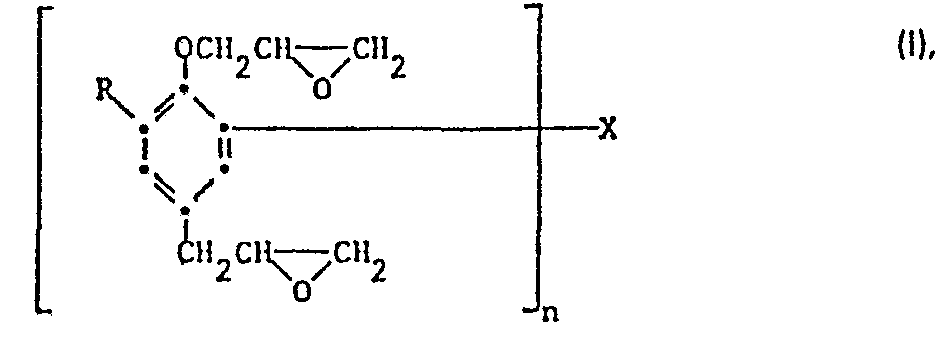
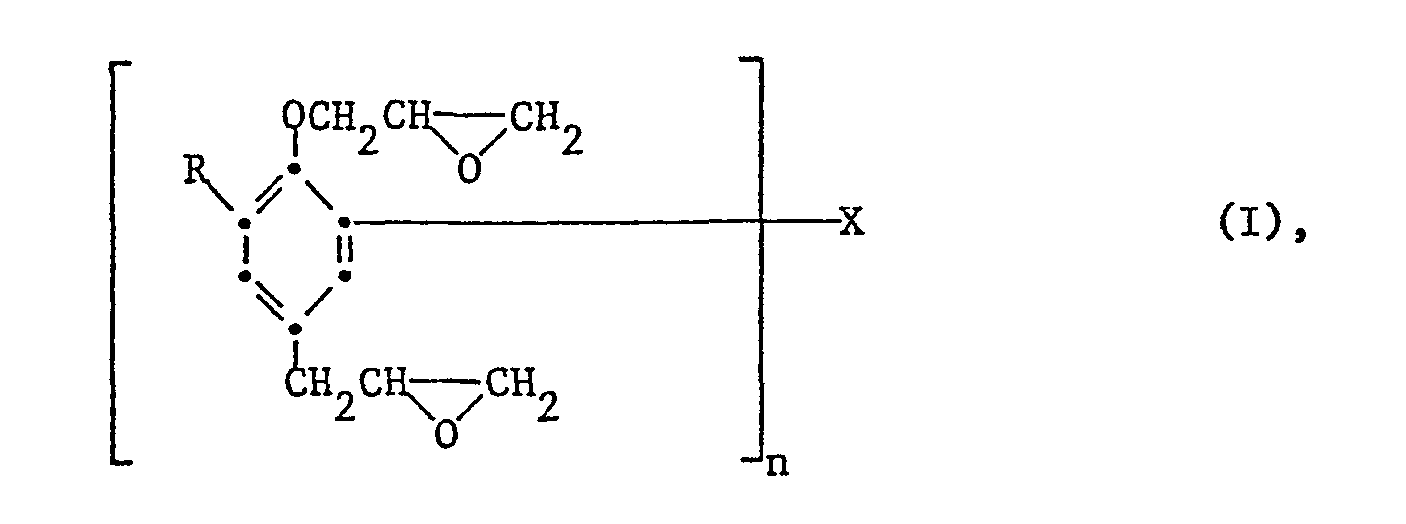
- the present invention relates to new 2,6-disubstituted 4-epoxypropylphenylglycidyl ether, such curable mixtures containing such 4-epoxypropylphenylglycidyl ether and their use, e.g. for the production of hardened products.
- Glycidyl ethers of mononuclear or polynuclear phenols are known from the literature which have 2,3-epoxypropyl groups in one or both ortho positions to the 2,3-epoxypropoxy group (see, for example, British Patent 828,364). These phenylglycidyl ethers are prepared by epoxidation of the corresponding o-allylphenols, which in turn are obtained by the Claisen rearrangement of the phenylallyl ethers. However, mixtures of isomers or mixtures of 2-allylphenol and 2,6-diallylphenols are formed.
- Alkyl and alkoxy substituents R and R ' can be straight-chain or branched. Examples of such groups are: methyl, ethyl, n-propyl, isopropyl, n-butyl, sec-butyl, tert-butyl, methoxy, ethoxy, n-propoxy, n-butoxy and sek-butoxy.
- aryl groups R and / or R 'come e.g. 1-naphthyl, 2-naphthyl and especially phenyl. If R and / or R 'represent halogen atoms, they are e.g. bromine or fluorine atoms and especially chlorine atoms.
- the compounds of the formula I can be prepared in a manner known per se, for example by using an allylphenylglycidyl ether of the formula wherein n and X have the meaning given under formula I and R and R 'independently of one another are C 1-4 alkyl, C 1-4 alkoxy, allyl, a halogen atom or C 6-10 aryl, in the presence of a peracid epoxy -, dated.
- Organic peracids such as e.g. Performic acid, peracetic acid, perbenzoic acid and monoperphthalic acid.
- the organic peracids can be used as such or formed in situ, for example from aliphatic or aromatic carboxylic acids, carboxylic acid anhydrides, carboxylic acid esters, acid chlorides or ketene and hydrogen peroxide.
- aliphatic or aromatic mono- or dicarboxylic acids or their anhydrides such as formic acid, acetic acid, propionic acid, succinic anhydride, benzoic acid or phthalic acid, and hydrogen peroxide, optionally with the addition of acidic catalysts, such as sulfuric acid or alkali metal salts.
- the epoxidation of the compounds of formula II is preferably carried out in the presence of preformed or in situ generated performic acid or peracetic acid.
- inorganic peracids such as permolybdic acid, pervanadic acid or per tungstic acid, can also be used.
- the epoxidation of the compounds of the formula II is advantageously carried out in the presence of inert organic solvents and, if appropriate, with the addition of buffer substances, such as sodium acetate or sodium hydrogen phosphate.
- Suitable solvents are, for example, optionally halogenated aliphatic or aromatic hydrocarbons, such as chloroform, dichloromethane, benzene, toluene and chlorobenzene, ethers such as diethyl ether, diisopropyl ether, dioxane and tetrahydrofuran, and carboxylic acid alkyl esters, such as ethyl acetate and n-butyl ester.
- Halogenated, especially chlorinated aliphatic hydrocarbons are preferred as solvents; chloroform is particularly preferred.
- the epoxidation temperatures are generally between -10 and + 100 ° C, preferably between 10 and 60 ° C.
- the starting products of the formula II are known or can be prepared by methods known per se by reacting the corresponding 2,6-disubstituted 4-allylphenols with epihalohydrins, especially epichlorohydrin, in the presence of catalysts.
- the compounds of formula I are high-purity substances which can be distilled and recrystallized and are free from chloride and alkali metal ions. They are obtained in very high yields.
- Mixtures of different compounds of the formula I and / or hardeners can also be used.
- any desired epoxy resin hardener is suitable as hardener (b), e.g. Cyanamide, dicyandiamide, polycarboxylic acids, polycarboxylic anhydrides, polyamines, polyaminoamides, adducts from amines and polyepoxides and polyols.
- hardener (b) e.g. Cyanamide, dicyandiamide, polycarboxylic acids, polycarboxylic anhydrides, polyamines, polyaminoamides, adducts from amines and polyepoxides and polyols.
- Suitable polycarboxylic acids and their anhydrides are, for example, phthalic anhydride, tetrahydro- and hexahydrophthalic anhydride, methyltetrahydrophthalic anhydride, endomethylene tetrahydrophthalic anhydride, hexachlorendomethylene tetrahydrophthalic anhydride, trimellitic anhydride, bianomide anhydride, bernomic anhydride, pyromellitic anhydride sebacic acid polyanhydride and polyazelaic acid polyanhydride and the acids belonging to the above-mentioned anhydrides.
- polyamines which are suitable as curing agents are aliphatic, cycloaliphatic, aromatic and heterocyclic polyamines, such as ethylenediamine, propane-1,2-diamine, propane-1,3-diamine, N, N-diethylethylene diamine, hexamethylene diamine, diethylene triamine, Triethylene tetramine, tetraethylene pentamine, N- (2-hydroxyethyl) -, N- (2-hydroxypropyl) - and N- (2-cyanoethyl) diethylenetriamine, 2,2,4- and 2,4,4-trimethyl-hexane-l, 6-diamine, m-xylylenediamine, N, N-dimethyl- and N, N-diethylpropane-1,3-diamine, bis (4-amino-cyclohexyl) methane, 2,2-bis (4-aminocyclohexyl) propane, 2,2-bis (4-amino-3-methylcyclohexy
- Adducts of amines and polyepoxides include, for example Adducts from aliphatic or cycloaliphatic diamines, such as 1,6-hexamethylene diamine, 2,2,4- and 2,4,4-trimethylhexane-1,6-diamine or isophorone diamine and known diglycidyl ethers.
- Possible polyol hardeners (b) are, in particular, mono- or polynuclear aromatic polyols, including novolaks, such as resorcinol, hydroquinone, 2,6-dihydroxytoluene, pyrogallol, l, l, 3 ⁇ tris (hydroxyphenyl) propane, bis (4- hydroxyphenyl) methane, 2,2-bis (4-hydroxyphenyl) propane, bis (4-hydroxyphenyl) sulfone and 4,4'-dihydroxybiphenyl as well as novolaks from formaldehyde or acetaldehyde and phenol, chlorophenol or alkylphenols with up to 9 carbon atoms in Alkyl, especially cresol and phenol novolaks.
- novolaks such as resorcinol, hydroquinone, 2,6-dihydroxytoluene, pyrogallol, l, l, 3 ⁇ tris (hydroxyphenyl) propane,
- Preferred curing agents are polycarboxylic acid anhydrides, such as tetrahydrophthalic, hexa-, h y Drugs and methyltetrahydrophthalic anhydride, and aromatic polyamines, especially bis (4-aminophenyl) methane, bis (4-aminophenyl) sulfone, and m- or p-phenylenediamine.
- polycarboxylic acid anhydrides such as tetrahydrophthalic, hexa-, h y Drugs and methyltetrahydrophthalic anhydride
- aromatic polyamines especially bis (4-aminophenyl) methane, bis (4-aminophenyl) sulfone, and m- or p-phenylenediamine.
- the hardeners (b) are used in the amounts customary in epoxy resin technology, expediently in amounts such that there are about 0.7 to 1.5 equivalents of functional groups of the hardener (b) for one epoxy equivalent.
- the mixtures according to the invention can also contain other customary additives, in particular (c) accelerators or curing catalysts, and / or (d) further epoxy resins.
- accelerators include: complexes of amines, aeration 'Sonders tertiary amines such as monoethylamine, trimethylamine and octyldimethylamine, with boron trifluoride or boron trichloride, tertiary amines such as benzyldimethylamine, tris (dimethylaminomethyl) phenol, hexamethylenetetramine or 1,6-bis (dimethylamino) hexane; Urea derivatives, such as N-4-chlorophenyl-N ', N'-dimethylurea (monuron), N-3-chloro-4-methylphenyl-N', N'-dimethylurea (chlorotoluron), N- (2-hydroxyphenyl) -N ', N'-dimethylurea and N- (2-hydroxy-4-nitrophenyl) -N'
- Tertiary amines especially benzyldimethylamine, and imidazoles, especially 2-phenylimidazole, 3-methylimidazole and 2-ethyl-4-methylimidazole, are preferred as accelerators (c).
- Further epoxy resins (d) are, above all, those with an average of more than one group of the formula III which is bonded to a hetero atom, for example to an S atom and preferably to a 0 or N atom into consideration, wherein Q and Q 2 each represent a hydrogen atom and Q 1 represent a hydrogen atom or a methyl group or Q and Q 2 together represent -CH 2 CH 2 - or -CH 2 CH 2 CH 2 - and Q represent a hydrogen atom.
- polyglycidyl and poly ( ⁇ -methylglycidyl) esters which are derived from aliphatic, cycloaliphatic or aromatic polycarboxylic acids.
- suitable polycarboxylic acids are succinic acid, glutaric acid, adipic acid, pimelic acid, suberic acid, azelaic acid, sebacic acid, dimerized or trimerized linoleic acid, tetrahydrophthalic acid, 4-methyltetrahydrophthalic acid, hexahydrophthalic acid, 4-methylhexahydrophthalic acid and phthalic acid, phthalic acid, phthalic acid.
- polyglycidyl and poly ( ⁇ -methylglycidyl) ethers which are obtained by reacting a compound containing at least two alcoholic and / or phenolic hydroxyl groups per molecule with epichlorohydrin or with allyl chloride and subsequent epoxidation with peracids.
- Suitable polyols are e.g. Ethylene glycol, diethylene glycol, poly (oxyethylene) glycols, propane-1,2-diol, poly (oxypropylene) glycols, propane-1,3-diol, butane-1,4-diol, poly (oxytetramethylene) glycols, pentane-1, 5-diol, hexane-2,4,6-triol, glycerin, 1,1,1-trimethylolpropane, pentaerythritol and sorbitol; 1,3- and 1,4-cyclohexanediol, bis (4-hydroxycyclohexyl) methane, 2,2-bis (4-hydroxycyclohexyl) propane and 1,1-bis (hydroxymethyl) cyclohex-3-ene; N, N-bis (2-hydroxyethyl) aniline and 4,4'-bis (2-hydroxyethylamino) diphenylmethane; Resor
- 2,2-bis (4-hydroxy-3,5-dibromophenyl) propane tetrabromobisphenol A
- 1,1,2,2-tetrakis (4-hydroxyphenyl) ethane 4,4'-dihydroxybiphenyl
- bis- (4th -hydroxyphenyl) sulfone and novolaks from formaldehyde or acetaldehyde and phenol
- Suitable poly (N-glycidyl) compounds are those obtained by dehydrochlorination of reaction products from epichlorohydrin and amines with at least two amine hydrogen atoms.
- Suitable amines are e.g. Aniline, n-butylamine, bis (4-aminophenyl) methane, 1,3- and 1,4-xylylenediamine, 1,3- and 1,4-bis (aminomethyl) cyclohexane and bis (4-methylaminophenyl) methane .
- Triglycidyl isocyanurate N, N'-diglycidyl derivatives of cyclic alkylene ureas, such as ethylene urea and 1,3-propylene urea, or hydantoins, such as 5,5-dimethylhydantoin, are further suitable compounds of this type.
- Poly (S-glycidyl) compounds are e.g. the di-S-glycidyl derivatives of dithiols, such as ethane-1,2-dithiol and bis (4-mercaptomethylphenyl) ether.
- Examples of epoxy resins with one or more groups of the formula III, in which Q and Q 2 together represent a group -CH 2 CH 2 - or -CH 2 CH 2 CH 2 -, are bis (2,3-epoxycyclopentyl) ether, 2 , 3-epoxycyclopentylglycidyl ether, 1,2-bis (2,3-epoxycyclopentyloxy) ethane, 3,4-epoxy-6-methylcyclohexylmethyl-3 ', 4'-epoxy-6'-methylcyclohexane carboxylate and 2- (3,4 -Epoxy) cyclohexyl-5,5-sp iro (3 ', 4'-epoxy) cyclohexane-dioxane.
- Epoxy resins in which the epoxy groups are bonded to heteroatoms of various types or in which some or all of the epoxy groups are medium-sized such as the N, N, 0-triglycidyl derivative of 4-aminophenol, N-glycidyl-N '(2- glycidyl-oxypropyl) -5,5-dimethylhydantoin, vinylcyclohexene dioxide, limonene dioxide, and dicyclopentadiene dioxide.
- component (d) optionally pre-extended diglycidyl ethers of dihydric phenols, especially 2,2-bis (4-hydroxyphenyl) propane, 2,2-bis (3,5-dibromo-4-hydroxyphenyl) propane, bis (4-hydroxyphenyl) methane, bis (4-hydroxycyclohexyl) methane or 2,2-bis (4-hydroxycyclohexyl) propane, polyglycidyl ether of novolaks, or tetraglycidylated 4,4'-diaminodiphenylmethane.
- 2,2-bis (4-hydroxyphenyl) propane 2,2-bis (3,5-dibromo-4-hydroxyphenyl) propane
- bis (4-hydroxyphenyl) methane bis (4-hydroxycyclohexyl) methane
- 2,2-bis (4-hydroxycyclohexyl) propane 2,2-bis (4-hydroxycyclohexyl) propane
- polyglycidyl ether of novolaks or tetragly
- Pre-extended diglycidyl ethers of bisphenol A, tetrabromo-bisphenol A or bisphenol F, polyglycidyl ethers of phenol-formaldehyde or cresol-formaldehyde novolaks, or mixtures thereof, are particularly preferred.
- the compounds of the formula I can also act as reactive diluents.
- Components (b) and (c) are used in the usual effective, i.e. sufficient amounts are used for curing the mixtures according to the invention.
- the ratio of components (a), (b), (c) and optionally (d) depends on the nature of the compounds used, the required curing rate and the properties desired in the end product and can be easily carried out by a person skilled in the art of epoxy resin curing be determined.
- the curing agent (b) is an amine
- 0.75 to 1.25 equivalents of hydrogen amine are normally used per 1 epoxy equivalent.
- polycarboxylic acid or polycarboxylic acid anhydride hardeners 0.4 to 1.1 equivalents of carboxyl or anhydride groups are usually used per 1 epoxy equivalent.
- Accelerators (c) are generally used in amounts of 0.1 to 5 percent by weight, based on the epoxy resins (a) and optionally (d).
- the curable mixtures can be used to reduce the viscosity (further) reactive thinners, e.g. Styrene oxide, butyl glycidyl ether, 2,2,4-trimethylpentyl glycidyl ether, phenyl glycidyl ether, cresyl glycidyl ether or glycidyl ester of synthetic, highly branched, mainly tertiary aliphatic monocarboxylic acids.
- the viscosity (further) reactive thinners e.g. Styrene oxide, butyl glycidyl ether, 2,2,4-trimethylpentyl glycidyl ether, phenyl glycidyl ether, cresyl glycidyl ether or glycidyl ester of synthetic, highly branched, mainly tertiary aliphatic monocarboxylic acids.
- the mixtures according to the invention can also contain plasticizers, extenders, fillers and reinforcing agents, such as, for example, coal tar, bitumen, textile fibers, glass fibers, asbestos fibers, boron fibers, carbon fibers, mineral silicates, mica, quartz powder, aluminum oxide hydrate, concrete, kaolin, Silica airgel or metal powder, e.g. Aluminum powder or iron powder, also pigments and dyes, such as carbon black, oxide paints and titanium dioxide, flame retardants, thixotropy agents, flow control agents, such as silicones, waxes and stearates, some of which are also used as mold release agents, adhesion promoters, antioxidants and light stabilizers contain.
- plasticizers such as, for example, coal tar, bitumen, textile fibers, glass fibers, asbestos fibers, boron fibers, carbon fibers, mineral silicates, mica, quartz powder, aluminum oxide hydrate, concrete, kaolin, Silica airgel or metal powder, e.g.
- the mixtures according to the invention find e.g. Use as adhesives or in surface protection, but especially for the production of hardened products for electrical and especially electronic applications. They can be used in a formulation adapted to the specific area of application, in the unfilled or filled state, e.g. can be used as paints, coating compositions, lacquers, molding compounds, immersion resins, casting resins, impregnating resins, laminating resins and adhesives.
- the mixtures according to the invention can be cured in one or two stages in a manner known per se.
- the mixtures according to the invention are generally cured by heating to temperatures between 80 and 200 ° C., in particular 100 and 180 ° C.
- the hardened products produced with the compounds of formula I according to the invention are notable for good mechanical, thermal and chemical properties, e.g. high tensile shear strength, good heat resistance and good chemical resistance.
- the water formed is distilled off with the boiling epichlorohydrin.
- the reaction mixture is stirred for a further 2 hours.
- the sodium chloride formed is filtered off, and the filtrate is neutralized with 1 liter of 10% Na 2 SO 4 solution.
- the organic phase is separated off and washed twice with 600 ml of distilled water, separated from the aqueous phase and dried with sodium sulfate.
- the excess epichlorohydrin is then distilled off using a rotary evaporator at 60 ° C./2660 Pa. Distillation of the residue at 110 ° C / 1.3 Pa gives 358 g (75.5% of theory) of 4-allyl-2,6-dimethylphenylglycidyl ether; Epoxy content 4.54 equivalents / kg.
- Example 1 In a 350 ml sulfonation flask equipped with a thermometer, stirrer, cooler and dropping funnel, 46.30 g (0.21 mol) of 4-allyl-2,6-dimethylphenylglycidyl ether, 1.93 g of sodium acetate and 160 ml Chloroform submitted and heated to 35 - 40 ° C. 52.3 g (0.28M 3 l) of 40% peracetic acid are then added dropwise at this temperature over the course of about 1 hour. The reaction mixture is kept at this temperature for a further 4 hours until no starting material can be determined in the gas chromatograph.
- reaction mixture is diluted in chloroform, washed neutral with 3% NaOH, made free of peroxide with sodium sulfite, dried over sodium sulfate, filtered and concentrated on a rotary evaporator.
- 47.6 g of 4- (2,3-epoxypropyl) -2,6-dimethylphenylglycidyl ether are obtained in the form of a low-viscosity oil; Epoxy content 8.1 equivalents / kg (95.13% of theory).
- Example 2 In a 350 ml sulfonation flask equipped with a thermometer, stirrer, cooler and dropping funnel, 21.8 g (0.10 mol) of 4-allyl-2,6-dimethylphenylglycidyl ether, 10.9 g (0.24 Mol) formic acid and 135 ml of chloroform. 23.2 g (0.47 mol) of hydrogen peroxide are then added at room temperature in the course of 4 hours dripped. The reaction mixture is kept at this temperature overnight. It is then taken up in chloroform, washed twice with 3% NaOH solution, made free of peroxide with sodium sulfite, dried over sodium sulfate, filtered and concentrated.
- the reaction mixture is diluted with 300 ml of toluene, the resulting aqueous phase is separated off, the organic phase is washed twice with 150 ml of NaHC0 3 (5%), washed with 150 ml of water, the organic phase is dried over sodium sulfate and sodium sulfite or Provided free of peroxide, filtered and concentrated.
- the result is 12.7 g (92.3%) of a light yellow resin with an epoxy content of 5.62 eq / kg (77.75%) and a viscosity of 280 mPas / 25 ° C.
- the result is 12.46 g (86.5%) of a yellow resin with an epoxy equivalent of 4.99 eq / kg (89.5%) and a viscosity of 6850 mPas / 40 ° C.
- curable mixtures A and B parts by weight: The reactivity of these mixtures is determined by means of the gelation times and the viscosities.
Landscapes
- Chemical & Material Sciences (AREA)
- Organic Chemistry (AREA)
- Health & Medical Sciences (AREA)
- Chemical Kinetics & Catalysis (AREA)
- Medicinal Chemistry (AREA)
- Polymers & Plastics (AREA)
- Epoxy Resins (AREA)
- Epoxy Compounds (AREA)
- Low-Molecular Organic Synthesis Reactions Using Catalysts (AREA)
Abstract


Description
- Die vorliegende Erfindung betrifft neue 2,6-disubstituierte 4-Epoxypropylphenylglycidylether, solche 4-Epoxypropylphenylglycidylether enthaltende härtbare Gemische und deren Verwendung, z.B. zur Herstellung von gehärteten Produkten.
- Aus der Literatur sind Glycidylether von ein- oder mehrkernigen Phenolen bekannt, die in einer oder beiden ortho-Stellungen zur 2,3-Epoxypropoxygruppe 2,3-Epoxypropylgruppen aufweisen (vgl. z.B. die britische Patentschrift 828.364). Diese Phenylglycidylether werden durch Epoxidierung der entsprechenden o-Allylphenole hergestellt, die ihrerseits durch Claisen-Umlagerung der Phenylallyläther erhalten werden. Dabei entstehen jedoch Isomerengemische bzw. Gemische aus 2-Allyl-und 2,6-Diallylphenolen.
- Gegenstand der Erfindung sind neue hochreine 4-(2,3-Epoxypropyl)-2,6- disubstituierte Phenylglycidylether der Formel I

- X bei n = 1 einer Gruppe R' und bei n = 2 einer Gruppe der Formel


- Alkyl- und Alkoxysubstituenten R und R' können geradkettig oder verzweigt sein. Beispiele solcher Gruppen sind: Methyl, Ethyl, n-Propyl, Isopropyl, n-Butyl, sek-Butyl, tert-Butyl, Methoxy, Ethoxy, n-Propoxy, n-Butoxy und sek-Butoxy. Als Arylgruppen R und/oder R' kommen z.B. 1-Naphthyl, 2-Naphthyl und besonders Phenyl in Betracht. Stellen R und/ oder R' Halogenatome dar, so handelt es sich z.B. um Brom- oder Fluoratome und besonders um Chloratome.
- Bevorzugt sind Verbindungen der Formel I, worin R und R' unabhängig voneinander C1-4-Alkyl, C1-2-Alkoxy, ein Halogenatom, besonders ein Chloratom, oder Phenyl bedeuten. Gemäss einer weiteren Bevorzugung haben R und R' dieselbe Bedeutung; n ist vorzugsweise 1. Besonders bevorzugt sind Verbindungen der Formel I, worin n = 1 ist und R und R! je Methyl, tert-Butyl, Methoxy, Chlor oder Phenyl bedeuten. Ganz besonders bevorzugt sind Verbindungen der Formel I, worin n = 1 ist und R und R' je Methyl darstellen.
- Die Verbindungen der Formel I können auf an sich bekannte Weise hergestellt werden, z.B. indem man einen Allylphenylglycidylether der Formel

- Als Persäuren eignen sich vor allem organische Persäuren, wie z.B. Perameisensäure, Peressigsäure, Perbenzoesäure und Monoperphthalsäure.
- Die organischen Persäuren können als solche eingesetzt oder in situ gebildet werden, beispielsweise aus alipatischen oder aromatischen Carbonsäuren, Carbonsäureanhydriden, Carbonsäureestern, Säurechloriden oder Keten und Wasserstoffperoxid. Zur in-situ-Bildung der Persäuren verwendet man vorzugsweise aliphatische oder aromatische Mono- oder Dicarbonsäuren oder deren Anhydride, wie Ameisensäure, Essigsäure, Propionsäure, Bernsteinsäureanhydrid, Benzoesäure oder Phthalsäure, und Wasserstoffperoxid, gegebenenfalls unter Zusatz von sauren Katalysatoren, wie Schwefelsäure oder Alkalimetallsalzen. Die Epoxidierung der Verbindungen der Formel II wird bevorzugt in Gegenwart von vorgebildeter oder in situ erzeugter Perameisensäure oder Peressigsäure durchgeführt. Gewünschtenfalls können auch anorganische Persäuren, wie Permolybdänsäure, Pervanadinsäure oder Perwolframsäureeingesetzt werden. Das Epoxidierungsmittel (Persäure) wird zweckmässig in einer Menge von mindestens 1·Mol pro vorhandene Allylgruppe und vorzugsweise im Ueberschuss, z.B. einem 20-200 %igen molaren Ueberschuss, verwendet. So werden bei R und/oder R' = Allyl auch diese Gruppen epoxidiert.
- Die Epoxidierung der Verbindungen der Formel II wird mit Vorteil in Gegenwart inerter organischer Lösungsmittel und gegebenenfalls unter Zusatz von Puffersubstanzen, wie Natriumacetat oder Natriumhydrogenphosphat, vorgenommen. Als Lösungsmittel eignen sich z.B. gegebenenfalls halogenierte aliphatische oder aromatische Kohlenwasserstoffe, wie Chloroform, Dichlormethan, Benzol, Toluol und Chlorbenzol, Ether wie Diethylether, Diisopropylether, Dioxan und Tetrahydrofuran, sowie Carbonsäurealkylester, wie Essigsäureethylester und -n-butyl-ester. Halogenierte, besonders chlorierte aliphatische Kohlenwasserstoffe sind als Lösungsmittel bevorzugt; besonders bevorzugt ist Chloroform. Die Epoxidierungstemperaturen liegen im allgemeinen zwischen -10 und +100°C, bevorzugt zwischen 10 und 60°C.
- Die Ausgangsprodukte der Formel II sind bekannt oder können nach an sich bekannten Methoden durch Umsetzung der entsprechenden 2,6-disubstituierten 4-Allylphenole mit Epihalogenhydrinen, besonders Epichlorhydrin, in Gegenwart von Katalysatoren hergestellt werden.
- Die Verbindungen der Formel I sind hochreine Substanzen, die destilliert und umkristallisiert werden können und frei von Chlorid- und Alkalimetallionen sind. Sie fallen in sehr hohen Ausbeuten an.
- Die Verbindungen der Formel I eignen sich zur Herstellung von gehärteten Produkten. Gegenstand der Erfindung sind daher auch härtbare Gemische enthaltend
- (a) eine Verbindung der Formel I und
- (b) einen Härter für die Komponente (a).
- Dabei können auch Gemische verschiedener Verbindungen der Formel I und/ oder Härter verwendet werden.
- Als Härter (b) eignen sich an sich beliebige Epoxidharzhärter, wie z.B. Cyanamid, Dicyandiamid, Polycarbonsäuren, Polycarbonsäureanhydride, Polyamine, Polyaminoamide, Addukte aus Aminen und Polyepoxiden und Polyole.
- Geeignete Polycarbonsäuren und ihre Anhydride sind z.B. Phthalsäureanhydrid, Tetrahydro- und Hexahydrophthalsäureanhydrid, Methyltetrahydrophthalsäureanhydrid, Endomethylentetrahydrophthalsäureanhydrid, Hexachlorendomethylentetrahydrophthalsäureanhydrid, Trimellitsäureanhydrid, Pyromellitsäuredianhydrid, Maleinsäureanhydrid, Bernsteinsäureanhydrid, Nonenylbernsteinsäureanhydrid, Dodecenylbernsteinsäureanhydrid, Polysebacinsäurepolyanhydrid und Polyazelainsäurepolyanhydrid sowie die zu den oben genannten Anhydriden gehörenden Säuren.
- Als Beispiele von Polyaminen, die sich als Härtungsmittel eignen, seien aliphatische, cycloaliphatische, aromatische und heterocyclische Polyamine, wie Ethylendiamin, Propan-1,2-diamin, Propan-1,3-diamin, N,N-Diethylethylendiamin, Hexamethylendiamin, Diethylentriamin, Triethylentetramin, Tetraethylenpentamin, N-(2-Hydroxyethyl)-, N-(2-Hydroxypropyl)- und N-(2-Cyanethyl)diethylentriamin, 2,2,4- und 2,4,4-Trimethyl- hexan-l,6-diamin, m-Xylylendiamin, N,N-Dimethyl- und N,N-Diethylpropan-1,3-diamin, Bis(4-amino-cyclohexyl)methan, 2,2-Bis(4-aminocyclohexyl)-propan, 2,2-Bis(4-amino-3-methylcyclohexyl)propan, 3-Aminomethyl-3,5, 5-trimethylcyclohexylamin(Isophorondiamin), m- und p-Phenylendiamin, Bis(4-aminophenyl)-methan, Bis(4-aminophenyl)sulfon, Anilin-Formaldehydharze und N-(2-Aminoethyl)piperazin genannt. Geeignete Polyaminoamide sind z.B. solche, die aus aliphatischen Polyaminen und dimerisierten oder trimerisierten ungesättigten Fettsäuren hergestellt sind.
- Als Addukte aus Aminen und Polyepoxiden kommen z.B. Addukte aus aliphatischen oder cycloaliphatischen Diaminen, wie 1,6-Hexamethylendiamin, 2,2,4- und 2,4,4-Trimethylhexan-1,6-diamin oder Isophorondiamin und bekannten Diglycidylethern in Betracht.
- Als Polyolhärter (b) kommen vor allem ein- oder mehrkernige aromatische Polyole, einschliesslich Novolake, in Betracht, wie Resorcin, Hydrochinon, 2,6-Dihydroxytoluol, Pyrogallol, l,l,3÷Tris(hydroxyphenyl) propan, Bis(4-hydroxyphenyl)methan, 2,2-Bis(4-hydroxyphenyl)propan, Bis(4-hydroxyphenyl)sulfon und 4,4'-Dihydroxybiphenyl sowie Novolake aus Formaldehyd oder Acetaldehyd und Phenol, Chlorphenol oder Alkylphenolen mit bis zu 9 C-Atomen im Alkyl, besonders Kresol- und Phenol-novolake.
- Bevorzugte Härter sind Polycarbonsäureanhydride, wie Tetrahydro-, Hexa- hydro- und Methyltetrahydrophthalsäureanhydrid, sowie aromatische Polyamine, besonders Bis(4-aminophenyl)methan, Bis(4-aminophenyl)sulfon und m- oder p-Phenylendiamin.
- Die Härter (b) werden in den in der Epoxidharztechnik üblichen Mengen eingesetzt, zweckmässig in solchen Mengen, dass auf ein Epoxidäquivalent etwa 0,7 bis 1,5 Aequivalente funktioneller Gruppen des Härters (b) kommen.
- Die erfindungsgemässen Gemische können auch weitere übliche Zusätze enthalten, vor allem (c) Beschleuniger bzw. Härtungskatalysatoren, und/ oder (d) weitere Epoxidharze.
- Als Beschleuniger (c) können ebenfalls an sich bekannte Verbindungen verwendet werden. Als Beispiele seien genannt: Komplexe von Aminen, be-' sonders tertiären Aminen, wie Monoethylamin, Trimethylamin und Octyldimethylamin, mit Bortrifluorid oder Bortrichlorid, tertiäre Amine, wie Benzyldimethylamin, Tris(dimethylaminomethyl)phenol, Hexamethylentetramin oder 1,6-Bis(dimethylamino)hexan; Harnstoffderivate, wie N-4-Chlorphenyl-N', N'-dimethylharnstoff (Monuron), N-3-Chlor-4-methylphenyl-N', N'-dimethylharnstoff (Chlortoluron), N-(2-Hydroxyphenyl)-N', N'- dimethylharnstoff und N-(2-Hydroxy-4-nitrophenyl)-N', N'-dimethylharnstoff, und gegebenenfalls substituierte Imidazole, wie Imidazol, Benzimidazol, 1-Methylimidazol, 3-Methylimidazol, 2-Ethyl-4-methylimidazol, 2-Vinylimidazol, 2-Phenylimidazol, 2-Phenyl-4-methylimidazol, 1-(2,6-Dichlorbenzoyl)-2-phenylimidazol und 1-(2,4,6-Trimethylbenzoyl)-2-phenylimidazol.
- Tertiäre Amine, besonders Benzyldimethylamin, und Imidazole, besonders 2-Phenylimidazol, 3-Methylimidazol und 2-Ethyl-4-methylimidazol, sind als Beschleuniger (c) bevorzugt.
- Als weitere Epoxidharze (d) kommen vor allem solche mit durchschnitt-lich mehr als einer an ein Heteroatom, z.B. an ein S- und vorzugsweise an ein 0- oder N-Atom, gebundenen Gruppe der Formel III

- Als Beispiele solcher Harze seien Polyglycidyl- und Poly(ß-methylgly- cidyl)ester genannt, die sich von aliphatischen, cycloaliphatischen oder aromatischen Polycarbonsäuren ableiten. Beispiele geeigneter Polycarbonsäuren sind Bernsteinsäure, Glutarsäure, Adipinsäure, Pimelinsäure, Korksäure, Azelainsäure, Sebacinsäure, dimerisierte oder trimerisierte Linolsäure, Tetrahydrophthalsäure, 4-Methyltetrahydrophthalsäure, Hexahydrophthalsäure, 4-Methylhexahydrophthalsäure, Phthalsäure, Iso- und Terephthalsäure.
- Weitere Beispiele sind Polyglycidyl- und Poly(ß-methylglycidyl)ether, die durch Umsetzung einer mindestens zwei alkoholische und/oder phenolische Hydroxylgruppen pro Molekül enthaltenden Verbindung mit Epichlorhydrin oder mit Allylchlorid und anschliessende Epoxidierung mit Persäuren erhalten werden.
- Geeeignete Polyole sind z.B. Ethylenglykol, Diethylenglykol, Poly(oxyethylen)glykole, Propan-1,2-diol, Poly(oxypropylen)glykole, Propan-1,3- diol, Butan-1,4-diol, Poly(oxytetramethylen)glykole, Pentan-1,5-diol, Hexan-2,4,6-triol, Glycerin, 1,1,1-Trimethylolpropan, Pentaerythrit und Sorbit; 1,3- und 1,4-Cyclohexandiol, Bis-(4-hydroxycyclohexyl)methan, 2,2-Bis-(4-hydroxycyclohexyl)propan und 1,1-Bis(hydroxymethyl)-cyclohex-3-en; N,N-Bis(2-hydroxyethyl)anilin und 4,4'-Bis(2-hydroxy- ethylamino)diphenylmethan; Resorcin, Hydrochinon, Bis-(4-hydroxyphenyl)-methan (Bisphenol F), 2,2-Bis(4-hydroxyphenyl)propan (Bisphenol A),.
- 2,2-Bis(4-hydroxy-3,5-dibromphenyl)propan (Tetrabrombisphenol A), 1,1,-2,2-Tetrakis(4-hydroxyphenyl)ethan, 4,4'-Dihydroxybiphenyl, Bis-(4-hydroxyphenyl)sulfon sowie Novolake aus Formaldehyd oder Acetaldehyd und Phenol, Chlorphenol oder Alkylphenolen mit bis zu 9 C-Atomen im Alkyl, besonders Kresol- und Phenol-Novolake.
- Als Poly(N-glycidyl)-Verbindungen kommen durch Dehydrochlorierung von Umsetzungsprodukten aus Epichlorhydrin und Aminen mit mindestens zwei Aminwasserstoffatcmen erhaltene Produkte in Betracht. Geeignete Amine sind z.B. Anilin, n-Butylamin, Bis-(4-aminophenyl)methan, 1,3- und 1,4-Xylylendiamin, 1,3- und 1,4-Bis(aminomethyl)cyclohexan und Bis(4-me- thylaminophenyl)methan. Triglycidylisocyanurat, N,N'-Diglycidylderivate von cyclischen Alkylenharnstoffen, wie Ethylenharnstoff und 1,3-Propylenharnstoff, oder Hydantoinen, wie 5,5-Dimethylhydantoin, sind weitere geeignete derartige Verbindungen.
- Poly(S-glycidyl)-Verbindungen sind z.B. die Di-S-Glycidylderivate von Dithiolen, wie Ethan-1,2-dithiol und Bis-(4-mercaptomethylphenyl)-ether.
- Beispiele für Epoxidharze mit einer oder mehreren Gruppen der Formel III, in welcher Q und Q2 zusammen eine Gruppe -CH2CH2- oder -CH2CH2CH2- bedeuten, sind Bis(2,3-epoxycyclopentyl)ether, 2,3-Epoxycyclopentylglycidylether, l,2-Bis(2,3-epoxycyclopentyloxy)ethan, 3,4-Epoxy-6-me- thylcyclohexylmethyl-3',4'-epoxy-6'-methylcyclohexancarboxylat und 2-(3,4-Epoxy)cyclohexyl-5,5-sp iro(3',4'-epoxy)cyclohexan-dioxan.
- Ebenfalls einsetzbar sind Epoxidharze, in welchen die Epoxidgruppen an Heteroatome verschiedener Art gebunden sind, oder in denen einige oder sämtliche Epoxidgruppen mittelständig sind, wie beispielsweise das N,N,0-Triglycidylderivat des 4-Aminophenols, N-Glycidyl-N'(2-glycidyl- oxypropyl)-5,5-dimethylhydantoin, Vinylcyclohexendioxid,Limonendioxid, und Dicyclopentadiendioxid.
- Besonders bevorzugt setzt man als Komponente (d) gegebenenfalls vorverlängerte Diglycidylether von zweiwertigen Phenolen, vor allem 2,2-Bis-(4-hydroxyphenyl)propan, 2,2-Bis(3,5-dibrom-4-hydroxyphenyl)propan, Bis(4-hydroxyphenyl)methan, Bis(4-hydroxycyclohexyl)methan oder 2,2-Bis(4-hydroxycyclohexyl)propan, Polyglycidylether von Novolaken, oder tetraglycidyliertes 4,4'-Diaminodiphenylmethan ein. Ganz besonders bevorzugt sind gegebenenfalls vorverlängerte Diglycidylether von Bisphenol A, Tetrabrom-Bisphenol A oder Bisphenol F, Polyglycidylether von Phenol-Formaldehyd- oder Kresol-Formaldehyd-Novolaken, oder Gemische davon.
- Bei Verwendung höherer Anteile an Epoxidharzen (d),. z.B; in Mengen von bis 90 Gew. %, bezogen auf die Komponenten (a) und (d), können die Verbindungen der Formel I auch als reaktive Verdünner wirken.
- Die Komponenten (b) und (c) werden in den üblichen wirksamen, d.h. für die Härtung der erfindungsgemässen Gemische ausreichenden Mengen eingesetzt. Das Verhältnis der Komponenten (a), (b), (c) und gegebenenfalls (d) hängt von der Art der verwendeten Verbindungen, der erforderlichen Härtungsgeschwindigkeit und den im Endprodukt gewünschten Eigenschaften ab und kann vom Fachmann auf dem Gebiet der Epoxidharz-Härtung leicht ermittelt werden. Wenn das Härtungsmittel (b) ein Amin ist, werden normalerweise 0,75 bis 1,25 Aequivalente Aminwasserstoff pro 1 Epoxidäquivalent eingesetzt. Bei Polycarbonsäure- oder Polycarbonsäureanhydrid-Härtern verwendet man gewöhnlich 0,4 bis 1,1 Aequivalente Carboxyl- bzw. Anhydridgruppen pro 1 Epoxidäquivalent. Bei der Verwendung von Polyphenolen als Härtungsmittel setzt man zweckmässig 0,75 bis 1,25 phenolische Hydroxylgruppen pro 1 Epoxidäquivalent ein. Beschleuniger (c) werden im allgemeinen in Mengen von 0,1 bis 5 Gewichtsprozent, bezogen die Epoxidharze (a) und gegebenenfalls (d), verwendet.
- Gewünschtenfalls kann man den härtbaren Gemischen zur Herabsetzung der Viskosität (weitere) reaktive Verdünner, wie z.B. Styroloxid, Butylglycidylether, 2,2,4-Trimethylpentylglycidylether, Phenylglycidylether, Kresylglycidylether oder Glycidylester von synthetischen, hochverzweigten, in der Hauptsache tertiären aliphatischen Monocarbonsäuren, zusetzen. Als weitere übliche Zusätze können die erfindungsgemässen Gemische ferner Weichmacher, Streck-, Füll- und Verstärkungsmittel, wie beispielsweise Steinkohlenteer, Bitumen, Textilfasern, Glasfasern, Asbestfasern, Borfasern, Kohlenstoff-Fasern, mineralische Silikate, Glimmer, Quarzmehl, Aluminiumoxidhydrat, Betonite, Kaolin, Kieselsäureaerogel oder Metallpulver, z.B. Aluminiumpulver oder Eisenpulver, ferner Pigmente und Farbstoffe, wie Russ, Oxidfarben und Titandioxid, Flammschutzmittel, Thixotropiemittel, Verlaufmittel ("flow control agents"), wie Silicone, Wachse und Stearate, die zum Teil auch als Formtrennmittel Anwendung finden, Haftvermittler, Antioxidantien und Lichtschutzmittel enthalten.
- Die erfindungsgemässen Gemische finden z.B. Anwendung als Klebstoffe oder im Oberflächenschutz, besonders jedoch zur Herstellung von gehärteten Produkten für elektrische und vor allem elektronische Anwendungen. Sie können in jeweils dem speziellen Anwendungsgebiet angepasster Formulierung, in ungefülltem oder gefülltem Zustand, z.B. als Anstrichmittel, Beschichtungsmassen, Lacke, Pressmassen, Tauchharze, Giessharze, Imprägnierharze, Laminierharze und Klebemittel verwendet werden.
- Die Härtung der erfindungsgemässen Gemische kann auf an sich bekannte Weise ein- oder zweistufig vorgenommen werden. Die Härtung der erfindungsgemässen Gemische erfolgt im allgemeinen durch Erhitzen auf Temperaturen zwischen 80 und 200°C, besonders 100 und 180°C.
- Die mit den erfindungsgemässen Verbindungen der Formel I hergestellten gehärteten Produkte zeichnen sich durch gute mechanische, thermische und chemische Eigenschaften aus, z.B. hohe Zugscherfestigkeit, gute Wärmeformbeständigkeit und gute chemische Beständigkeit.
- Die Erfindung wird durch die folgenden Beispiele näher erläutert.
- In einem Reaktionsgefäss aus Glas, versehen mit Dosiervorlage, Rührer, Thermometer und einem Azeotropdestillationsaufsatz mit Rückflusskühler und Vakuumanschluss werden 350 g (1 Mol) 4-Allyl-2,6-dimethylphenol, 1796 g (19,42 Mol) Epichlorhydrin und 16,20 g Tetramethylammoniumchlorid zusammengemischt, auf 60°C erwärmt und 2 Stunden bei 60°C gerührt. Durch Anlegen eines Vakuums von 6700 Pa wird das Epichlorhydrin bei der Reaktionstemperatur (ca. 60°C) zum Rückfluss gebracht. Im Verlaufe von 3,5 Std. werden tropfenweise 190 g einer 50 %igen wässrigen NaOH-Lösung zugegeben, wobei die Innentemperatur bei 60°C gehalten wird. Während der Reaktion wird das gebildete Wasser mit dem siedenden Epichlorhydrin abdestilliert. Nach der Zugabe der Natronlauge wird das Reaktionsgemisch noch etwa 2 Std. weitergerührt. Nach der Beendigung der Reaktion wird das gebildete Kochsalz abfiltriert, und das Filtrat wird mit 1 Liter 10 %iger Na2SO4-Lösung neutralisiert. Die organische Phase wird abgetrennt und zweimal mit je 600 ml destilliertem Wasser gewaschen, von der wässrigen Phase getrennt und mit Natriumsulfat getrocknet. Anschliessend wird das überschüssige Epichlorhydrin mit Hilfe eines Rotationsverdampfers bei 60°C/2660 Pa abdestilliert. Die Destillation des Rückstands bei 110°C/1,3 Pa ergibt 358 g (75,5 % d. Th.)4-Allyl-2,6-dimethylphenylglycidylether; Epoxidgehalt 4,54 Aequivalente/kg.
- 1H-NMR-Spektrum: 2,2 ppm (s) 6H (CH3), ca. 2,75 ppm (m) 2H


- Beispiel 1: In einem 350 ml Sulfierkolben, der mit Thermometer, Rührer, Kühler und Tropftrichter ausgestattet ist, werden 46,30 g (0,21 Mol) 4-Allyl-2,6-dimethylphenylglycidylether, 1,93 g Natriumacetat und 160 ml Chloroform vorgelegt und auf 35 - 40°C erwärmt. Anschliessend werden bei dieser Temperatur innerhalb von etwa 1 Stunde 52,3 g (0,28M3l) 40 %ige Peressigsäure zugetropft. Das Reaktionsgemisch wird während weiterer 4 Stunden bei dieser Temperatur gehalten, bis im Gaschromatograph kein Edukt mehr zu ermitteln ist. Nach Beendigung der Reaktion wird das Reaktionsgemisch in Chloroform verdünnt, mit 3 %iger NaOH neutral gewaschen, mit Natriumsulfit peroxidfrei gestellt, über Natriumsulfat getrocknet, filtriert und am Rotationsverdampfer eingeengt. Man erhält 47,6 g 4-(2,3-Epoxypropyl)-2,6-dimethylphenylglycidylether in Form eines niedrig viskosen Oels; Epoxidgehalt 8,1 Aequivalente/kg (95,13 % d.Th.).
- 1H-NMR-Spektrum: 2,25 ppm (s) 6H (CH3), 2,5-3,0 ppm (m) 6H


- Beispiel 2: In einem 350 ml Sulfierkolben, der mit Thermometer, Rührer, Kühler und Tropftrichter ausgestattet ist, werden 21,8 g (0,10 Mol) 4-Allyl-2,6-dimethylphenylglycidylether, 10,9 g (0,24 Mol) Ameisensäure und 135 ml Chloroform vorgelegt. Anschliessend werden bei Raumtemperatur innerhalb von 4 Std. 23,2 g (0,47 Mol) Wasserstoffperoxid zugetropft. Das Reaktionsgemisch wird über Nacht bei dieser Temperatur gehalten. Anschliessend wird es in Chloroform aufgenommen, zweimal mit 3 %iger NaOH-Lösung gewaschen, mit Natriumsulfit peroxidfrei gestellt, über Natriumsulfat getrocknet, filtriert und eingeengt. Man erhält 20,03 g (85,50 % d.Th.) 4-(2,3-Epoxypropyl)-2,6-dimethylphenylglycidyl- ether in Form eines niedrig viskosen Harzes; Epoxidgehalt 7,7 Aequivalente/kg (90,11 % d.Th.).
- In einem 100 ml Sulfierkolben mit Rührer, Kühler, Thermometer und Tropftrichter werden 13,0 g (0,05 Mol) 4-Allyl-2,6-Dichlorphenyl- glycidyläther in 40 ml Toluol und 0,5 g Natriumacetat vorgelegt. Innerhalb 2 Std. werden bei 30-50°C 14,0 g (0,07 Mol) 10%ige Peressigsäure zugetropft. Nach Zutropfen wird das Reaktionsgemisch mit 300 ml Toluol verdünnt, die entstandene wässrige Phase wird abgetrennt, die organische Phase wird 2x mit 150 ml NaHC03 (5 %) gewaschen, mit 150 ml Wasser nachgewaschen, die organische Phase wird über Natriumsulfat und Natriumsulfit getrocknet bzw. Peroxydfrei gestellt, filtriert und eingeengt. Es resultieren 12,7 g (92,3 %) eines hellgelben Harzes vom Epoxydgehalt 5,62 eq/kg (77,75 %) und einer Viskosität von 280 mPas/25°C.
- In einem 100 ml Sulfierkolben mit Rührer, Kühler, Thermometer und Tropftrichter werden 13,7 g (0,04 Möl) 4-Allyl-2,6-Diphenylphenyl- glycidyläther in 20 ml Toluol und 0,7 g Natriumacetat vorgelegt. Innerhalb von 2 Std. werden zwischen 30-50°C 9,13 g (0,048 Mol) 40%ige Peressigsäure zugetropft. Nach Beendigen des Zutropfens wird • das Reaktionsgemisch noch während 7 Std. gerührt. Nach Beendigen der Reaktion wird das Reaktionsgemisch mit 700 ml Toluol verdünnt, die entstandene wässerige Phase wird abgetrennt, die organische Phase wird 2x mit 150 ml NaHC03 (5 %) und 150 ml
- Wasser gewaschen, die organische Phase über Na2SO4 und Na2SO3 ge-trocknet und peroxydfrei gestellt, filtriert und eingeengt. Es resultieren 12,46 g (86,5 %) eines gelben Harzes vom Epoxydäquivalent 4,99 eq/kg (89,5 %) und einer Viskosität von 6850 mPas/40°C.
- Die folgenden Bestandteile werden zu härtbaren Gemischen A und B verarbeitet (Gewichtsteile):

- Die Resultate sind in der folgenden Tabelle I zusammengefasst.

- Die in den Beispielen I und II beschriebenen Gemische A und B werden zu Formkörpern bzw. Filmen verarbeitet und
- 1) während 4 Stunden bei 100°C und 8 Stunden bei 140°C bzw.
- 2) während 6 Stunden bei 180°C gehärtet.
- An den gehärteten Formkörpern bzw. Filmen werden die folgenden Eigenschaften bestimmt:
- - die Glasumwandlungstemperatur Tg: bestimmt mittels DSC (Differential Scanning Calorimetry) bestimmt mittels thermomethanischer Analyse (TMA)
- - die Zugscherfestigkeit nach DIN 53 283
- - die chemische Beständigkeit und die Reibfestigkeit nach DIN 53 230 (an Filmen).
- Die Resultate sind in der folgenden Tabelle II zusammengefasst.

Claims (12)


Applications Claiming Priority (2)
| Application Number | Priority Date | Filing Date | Title |
|---|---|---|---|
| CH2398/85 | 1985-06-06 | ||
| CH239885 | 1985-06-06 |
Publications (3)
| Publication Number | Publication Date |
|---|---|
| EP0205402A2 true EP0205402A2 (de) | 1986-12-17 |
| EP0205402A3 EP0205402A3 (en) | 1987-10-21 |
| EP0205402B1 EP0205402B1 (de) | 1990-05-23 |
Family
ID=4232845
Family Applications (1)
| Application Number | Title | Priority Date | Filing Date |
|---|---|---|---|
| EP86810234A Expired - Lifetime EP0205402B1 (de) | 1985-06-06 | 1986-06-02 | 2,6-Disubstituierte 4-Epoxypropylphenylglycidylether und deren Verwendung |
Country Status (8)
| Country | Link |
|---|---|
| US (1) | US4724031A (de) |
| EP (1) | EP0205402B1 (de) |
| JP (1) | JPH0832696B2 (de) |
| KR (1) | KR930006288B1 (de) |
| BR (1) | BR8602643A (de) |
| CA (1) | CA1296015C (de) |
| DE (1) | DE3671449D1 (de) |
| ES (1) | ES8706655A1 (de) |
Cited By (3)
| Publication number | Priority date | Publication date | Assignee | Title |
|---|---|---|---|---|
| EP0747371A1 (de) * | 1995-06-07 | 1996-12-11 | National Starch and Chemical Investment Holding Corporation | Epoxyharze mit biegsamen Ketten mit endständigen Glycidyloxyphenyl Gruppen und ihre Verwendung als Klebstoffe in der Mikroelektronik |
| US5646315A (en) * | 1995-06-07 | 1997-07-08 | National Starch And Chemical Investment Holding Corporation | Polyglydicylphenyl ethers of alkyloxy chains for use in microelectronics adhesives |
| EP0748831A3 (de) * | 1995-06-07 | 1998-05-20 | National Starch and Chemical Investment Holding Corporation | Sofort vernetzbare Epoxidharzklebstoffe |
Families Citing this family (12)
| Publication number | Priority date | Publication date | Assignee | Title |
|---|---|---|---|---|
| US5624976A (en) * | 1994-03-25 | 1997-04-29 | Dentsply Gmbh | Dental filling composition and method |
| US5998499A (en) | 1994-03-25 | 1999-12-07 | Dentsply G.M.B.H. | Liquid crystalline (meth)acrylate compounds, composition and method |
| US6369164B1 (en) | 1993-05-26 | 2002-04-09 | Dentsply G.M.B.H. | Polymerizable compounds and compositions |
| US6353061B1 (en) | 1993-05-26 | 2002-03-05 | Dentsply Gmbh | α, ω-methacrylate terminated macromonomer compounds |
| CA2146816A1 (en) | 1994-04-22 | 1995-10-23 | Joachim E. Klee | Process and composition for preparing a dental polymer product |
| DE10257711B4 (de) * | 2001-12-27 | 2019-09-26 | Merck Patent Gmbh | Polymerisierbare monocyclische Verbindungen enthaltende Flüssigkristallmischungen |
| US8975343B2 (en) * | 2009-12-08 | 2015-03-10 | Dow Global Technologies Llc | Hydroxyl-functional polyester resins |
| US10647810B2 (en) | 2015-08-11 | 2020-05-12 | Arizona Board Of Regents On Behalf Of The University Of Arizona | Method of forming of a robust network of epoxy material through Diels-Alder reaction |
| US10723921B2 (en) * | 2016-01-29 | 2020-07-28 | Arizona Board Of Regents On Behalf Of The University Of Arizona | Coumarin-modified epoxy adhesives |
| CN109312052B (zh) | 2016-07-28 | 2020-12-22 | 昭和电工株式会社 | 环氧(甲基)丙烯酸酯化合物及含有该环氧(甲基)丙烯酸酯化合物的固化性组合物 |
| JP2022008092A (ja) * | 2020-05-22 | 2022-01-13 | Jnc株式会社 | 重合性化合物、電子部品用組成物、電子部品用材料 |
| DE102024123608A1 (de) | 2024-08-19 | 2026-02-19 | Technische Hochschule Nürnberg Georg Simon Ohm, in Vertretung des Freistaates Bayern | Biobasiertes Epoxidharz-Monomer, biobasiertes Epoxidharz und Verfahren zur Synthese des Epoxidharz-Monomers auf Basis von Estragol |
Family Cites Families (7)
| Publication number | Priority date | Publication date | Assignee | Title |
|---|---|---|---|---|
| NL216211A (de) * | 1956-04-12 | |||
| US2965608A (en) * | 1956-04-12 | 1960-12-20 | Shell Oil Co | Ethers of epoxy-substituted polyhydric phenols and their polymers |
| GB841589A (en) * | 1956-10-31 | 1960-07-20 | Gen Mills Inc | Polyepoxy compounds |
| US3374203A (en) * | 1965-03-25 | 1968-03-19 | Gen Electric | Triglycidyl ethers and resins of trihydroxybiphenyls |
| US3773799A (en) * | 1971-07-06 | 1973-11-20 | Us Army | Diglycidyl ether of 4-methylol resorcinol |
| US3925315A (en) * | 1974-09-20 | 1975-12-09 | Us Army | Diglycidyl ether of 4-methylol resorcinol |
| DE2963311D1 (en) * | 1978-12-29 | 1982-08-26 | Ciba Geigy Ag | Propenyl-substituted phenolglycidyl ethers, process for their preparation and their use |
-
1986
- 1986-06-02 DE DE8686810234T patent/DE3671449D1/de not_active Expired - Lifetime
- 1986-06-02 EP EP86810234A patent/EP0205402B1/de not_active Expired - Lifetime
- 1986-06-04 US US06/870,607 patent/US4724031A/en not_active Expired - Fee Related
- 1986-06-04 ES ES555701A patent/ES8706655A1/es not_active Expired
- 1986-06-04 CA CA000510778A patent/CA1296015C/en not_active Expired - Lifetime
- 1986-06-05 KR KR1019860004475A patent/KR930006288B1/ko not_active Expired - Fee Related
- 1986-06-05 BR BR8602643A patent/BR8602643A/pt unknown
- 1986-06-06 JP JP61131679A patent/JPH0832696B2/ja not_active Expired - Lifetime
Cited By (9)
| Publication number | Priority date | Publication date | Assignee | Title |
|---|---|---|---|---|
| EP0747371A1 (de) * | 1995-06-07 | 1996-12-11 | National Starch and Chemical Investment Holding Corporation | Epoxyharze mit biegsamen Ketten mit endständigen Glycidyloxyphenyl Gruppen und ihre Verwendung als Klebstoffe in der Mikroelektronik |
| US5646315A (en) * | 1995-06-07 | 1997-07-08 | National Starch And Chemical Investment Holding Corporation | Polyglydicylphenyl ethers of alkyloxy chains for use in microelectronics adhesives |
| US5703195A (en) * | 1995-06-07 | 1997-12-30 | National Starch And Chemical Investment Holding Corporation | Polyglycidylphenyl ethers of alkylene or alkyleneoxy chains for use in microelectronics adhesives |
| US5717054A (en) * | 1995-06-07 | 1998-02-10 | National Starch & Chemical Investment Holding Corp. | Epoxy resins consisting of flexible chains terminated with glycidyloxyphenyl groups for use in microelectronics adhesives |
| EP0748831A3 (de) * | 1995-06-07 | 1998-05-20 | National Starch and Chemical Investment Holding Corporation | Sofort vernetzbare Epoxidharzklebstoffe |
| US5770706A (en) * | 1995-06-07 | 1998-06-23 | National Starch And Chemical Investment Holding Corporation | Snap-cure epoxy adhesives |
| US5783713A (en) * | 1995-06-07 | 1998-07-21 | National Starch And Chemical Investment Holding Corporation | Polyglycidylphenyl ethers of alkylene or alkyleneoxy chains for use in microelectronics adhesives |
| US5854315A (en) * | 1995-06-07 | 1998-12-29 | National Starch And Chemical Investment Holding Corporation | Snap-cure epoxy adhesives |
| US5856383A (en) * | 1995-06-07 | 1999-01-05 | National Starch And Chemical Investment Holding Corporation | Snap-cure epoxy adhesives |
Also Published As
| Publication number | Publication date |
|---|---|
| KR930006288B1 (ko) | 1993-07-12 |
| JPH0832696B2 (ja) | 1996-03-29 |
| EP0205402B1 (de) | 1990-05-23 |
| DE3671449D1 (de) | 1990-06-28 |
| CA1296015C (en) | 1992-02-18 |
| ES8706655A1 (es) | 1987-07-01 |
| ES555701A0 (es) | 1987-07-01 |
| JPS61289084A (ja) | 1986-12-19 |
| KR870000318A (ko) | 1987-02-17 |
| BR8602643A (pt) | 1987-02-03 |
| US4724031A (en) | 1988-02-09 |
| EP0205402A3 (en) | 1987-10-21 |
Similar Documents
| Publication | Publication Date | Title |
|---|---|---|
| EP0204659B1 (de) | Polyepoxide und deren Verwendung | |
| EP0022073B1 (de) | Diglycidyläther von di-sekundären Alkoholen, ihre Herstellung und Verwendung | |
| EP0271442B1 (de) | Multifunktionelle Epoxidharze | |
| EP0252358B1 (de) | Flüssig-kristalline Diglycidylverbindungen, ihre Herstellung und Verwendung in härtbaren Epoxid-Gemischen | |
| DE60108271T2 (de) | Mittel zur flammschutzausrüstung | |
| EP0205402B1 (de) | 2,6-Disubstituierte 4-Epoxypropylphenylglycidylether und deren Verwendung | |
| EP0146498B1 (de) | Härtbare Gemische, enthaltend ein Epoxidharz, ein Imid und einen Härtungskatalysator | |
| EP0319472A2 (de) | Epoxysiloxane | |
| DE1966703C3 (de) | Langkettige, aliphatische oder cycloaliphatische Säurereste enthaltende Diglycidylester | |
| EP0148117B1 (de) | Triglycidylverbindungen von Aminophenolen | |
| DE69332815T2 (de) | Polyglyzidyl-Äthern und ihre Verwendung | |
| DE1942836C3 (de) | Diglycidylester von aliphatischen Dicarbonsäuren, Verfahren zu ihrer Herstellung und ihre Verwendung | |
| DE2154624A1 (de) | Neue diglycidylderivate von zwei nheterocyclische ringe enthaltenen verbindungen, verfahren zu ihrer herstellung und anwendung | |
| EP0243318B1 (de) | Epoxidgruppenhaltige Phenolether | |
| DE2319815C2 (de) | Propionsäureglycidylestergruppen enthaltende Cycloalkanone, Verfahren zu deren Herstellung und Verwendung derselben | |
| EP0377909A1 (de) | Diglycidylverbindungen, ihre Herstellung und ihre Verwendung in härtbaren Epoxid-Gemischen | |
| JP2025087636A (ja) | 硬化剤組成物、硬化剤組成物の製造方法、硬化性組成物の製造方法、硬化性組成物、硬化物及び硬化物の製造方法 | |
| DE2147899A1 (de) | Neue Polyglycidylverbindungen, Verfahren zu ihrer Herstellung und Anwendung | |
| EP0108720A1 (de) | Neue cycloaliphatische Diallyläther | |
| EP0278900A2 (de) | Vorverlängerte Epoxidharze auf Basis von Cyclohex-1-ylmethylen-diphenolderivaten oder Bicyclo[2.2.1]hept-1-ylmethylen-diphenolderivaten | |
| EP0233843A2 (de) | Verfahren zur Verminderung des Chlorgehaltes in Glycidylverbindungen | |
| DE69709747T2 (de) | Polyglycidylether von sekundären alkoholen | |
| DE1816095A1 (de) | Neue heterocyclische N,N'-Diglycidylverbindungen,Verfahren zu ihrer Herstellung und ihre Anwendung | |
| CH456949A (de) | Flammhemmende härtbare Mischungen | |
| DE1670333A1 (de) | Neue Polyepoxydverbindungen,Verfahren zu deren Herstellung und Anwendung |
Legal Events
| Date | Code | Title | Description |
|---|---|---|---|
| PUAI | Public reference made under article 153(3) epc to a published international application that has entered the european phase |
Free format text: ORIGINAL CODE: 0009012 |
|
| 17P | Request for examination filed |
Effective date: 19860604 |
|
| AK | Designated contracting states |
Kind code of ref document: A2 Designated state(s): CH DE FR GB IT LI NL |
|
| PUAL | Search report despatched |
Free format text: ORIGINAL CODE: 0009013 |
|
| RHK1 | Main classification (correction) |
Ipc: C07D303/28 |
|
| AK | Designated contracting states |
Kind code of ref document: A3 Designated state(s): CH DE FR GB IT LI NL |
|
| 17Q | First examination report despatched |
Effective date: 19890112 |
|
| GRAA | (expected) grant |
Free format text: ORIGINAL CODE: 0009210 |
|
| AK | Designated contracting states |
Kind code of ref document: B1 Designated state(s): CH DE FR GB IT LI NL |
|
| ITF | It: translation for a ep patent filed | ||
| REF | Corresponds to: |
Ref document number: 3671449 Country of ref document: DE Date of ref document: 19900628 |
|
| GBT | Gb: translation of ep patent filed (gb section 77(6)(a)/1977) | ||
| ET | Fr: translation filed | ||
| PLBE | No opposition filed within time limit |
Free format text: ORIGINAL CODE: 0009261 |
|
| STAA | Information on the status of an ep patent application or granted ep patent |
Free format text: STATUS: NO OPPOSITION FILED WITHIN TIME LIMIT |
|
| 26N | No opposition filed | ||
| PGFP | Annual fee paid to national office [announced via postgrant information from national office to epo] |
Ref country code: CH Payment date: 19910529 Year of fee payment: 6 |
|
| ITTA | It: last paid annual fee | ||
| PG25 | Lapsed in a contracting state [announced via postgrant information from national office to epo] |
Ref country code: LI Effective date: 19920630 Ref country code: CH Effective date: 19920630 |
|
| REG | Reference to a national code |
Ref country code: CH Ref legal event code: PL |
|
| NLS | Nl: assignments of ep-patents |
Owner name: CIBA SC HOLDING AG |
|
| REG | Reference to a national code |
Ref country code: GB Ref legal event code: 732E |
|
| NLT1 | Nl: modifications of names registered in virtue of documents presented to the patent office pursuant to art. 16 a, paragraph 1 |
Owner name: CIBA SPECIALTY CHEMICALS HOLDING INC. |
|
| REG | Reference to a national code |
Ref country code: FR Ref legal event code: TP |
|
| PGFP | Annual fee paid to national office [announced via postgrant information from national office to epo] |
Ref country code: FR Payment date: 20000509 Year of fee payment: 15 |
|
| PGFP | Annual fee paid to national office [announced via postgrant information from national office to epo] |
Ref country code: NL Payment date: 20000516 Year of fee payment: 15 |
|
| PGFP | Annual fee paid to national office [announced via postgrant information from national office to epo] |
Ref country code: DE Payment date: 20000519 Year of fee payment: 15 |
|
| PGFP | Annual fee paid to national office [announced via postgrant information from national office to epo] |
Ref country code: GB Payment date: 20000530 Year of fee payment: 15 |
|
| REG | Reference to a national code |
Ref country code: GB Ref legal event code: 732E |
|
| NLS | Nl: assignments of ep-patents |
Owner name: VANTICO AG |
|
| PG25 | Lapsed in a contracting state [announced via postgrant information from national office to epo] |
Ref country code: GB Free format text: LAPSE BECAUSE OF NON-PAYMENT OF DUE FEES Effective date: 20010602 |
|
| PG25 | Lapsed in a contracting state [announced via postgrant information from national office to epo] |
Ref country code: NL Free format text: LAPSE BECAUSE OF NON-PAYMENT OF DUE FEES Effective date: 20020101 |
|
| GBPC | Gb: european patent ceased through non-payment of renewal fee |
Effective date: 20010602 |
|
| PG25 | Lapsed in a contracting state [announced via postgrant information from national office to epo] |
Ref country code: FR Free format text: LAPSE BECAUSE OF NON-PAYMENT OF DUE FEES Effective date: 20020228 |
|
| NLV4 | Nl: lapsed or anulled due to non-payment of the annual fee |
Effective date: 20020101 |
|
| PG25 | Lapsed in a contracting state [announced via postgrant information from national office to epo] |
Ref country code: DE Free format text: LAPSE BECAUSE OF NON-PAYMENT OF DUE FEES Effective date: 20020403 |
|
| PG25 | Lapsed in a contracting state [announced via postgrant information from national office to epo] |
Ref country code: IT Free format text: LAPSE BECAUSE OF NON-PAYMENT OF DUE FEES;WARNING: LAPSES OF ITALIAN PATENTS WITH EFFECTIVE DATE BEFORE 2007 MAY HAVE OCCURRED AT ANY TIME BEFORE 2007. THE CORRECT EFFECTIVE DATE MAY BE DIFFERENT FROM THE ONE RECORDED. Effective date: 20050602 |