EP0212227A2 - Verfahren zur Herstellung von Leiterplatten mit darin verlegten Drähten und damit hergestellte Artikel - Google Patents
Verfahren zur Herstellung von Leiterplatten mit darin verlegten Drähten und damit hergestellte Artikel Download PDFInfo
- Publication number
- EP0212227A2 EP0212227A2 EP86109558A EP86109558A EP0212227A2 EP 0212227 A2 EP0212227 A2 EP 0212227A2 EP 86109558 A EP86109558 A EP 86109558A EP 86109558 A EP86109558 A EP 86109558A EP 0212227 A2 EP0212227 A2 EP 0212227A2
- Authority
- EP
- European Patent Office
- Prior art keywords
- conductor
- adhesive
- scribing
- adhesive coating
- substrate
- Prior art date
- Legal status (The legal status is an assumption and is not a legal conclusion. Google has not performed a legal analysis and makes no representation as to the accuracy of the status listed.)
- Granted
Links
- 238000000034 method Methods 0.000 title claims abstract description 98
- 230000008569 process Effects 0.000 title claims abstract description 74
- 238000004519 manufacturing process Methods 0.000 title claims description 13
- 239000004020 conductor Substances 0.000 claims abstract description 232
- 239000000853 adhesive Substances 0.000 claims abstract description 166
- 230000001070 adhesive effect Effects 0.000 claims abstract description 166
- 238000000576 coating method Methods 0.000 claims abstract description 108
- 239000011248 coating agent Substances 0.000 claims abstract description 104
- 239000000758 substrate Substances 0.000 claims abstract description 62
- 230000004913 activation Effects 0.000 claims abstract description 15
- 239000007787 solid Substances 0.000 claims abstract description 14
- 230000005855 radiation Effects 0.000 claims abstract description 11
- 239000012530 fluid Substances 0.000 claims abstract description 7
- 238000005476 soldering Methods 0.000 claims description 22
- 238000009413 insulation Methods 0.000 claims description 21
- 230000004048 modification Effects 0.000 claims description 20
- 238000012986 modification Methods 0.000 claims description 20
- 229910000679 solder Inorganic materials 0.000 claims description 14
- 230000003213 activating effect Effects 0.000 claims description 10
- 239000000463 material Substances 0.000 claims description 9
- 229920002635 polyurethane Polymers 0.000 claims description 7
- 239000004814 polyurethane Substances 0.000 claims description 7
- 229920000647 polyepoxide Polymers 0.000 claims description 6
- 229920001187 thermosetting polymer Polymers 0.000 claims description 6
- 239000003822 epoxy resin Substances 0.000 claims description 5
- 229920000642 polymer Polymers 0.000 claims description 5
- 238000005520 cutting process Methods 0.000 claims description 3
- LNEPOXFFQSENCJ-UHFFFAOYSA-N haloperidol Chemical compound C1CC(O)(C=2C=CC(Cl)=CC=2)CCN1CCCC(=O)C1=CC=C(F)C=C1 LNEPOXFFQSENCJ-UHFFFAOYSA-N 0.000 claims description 2
- 239000013034 phenoxy resin Substances 0.000 claims description 2
- 229920006287 phenoxy resin Polymers 0.000 claims description 2
- 229920000098 polyolefin Polymers 0.000 claims description 2
- 239000000126 substance Substances 0.000 claims description 2
- 238000005538 encapsulation Methods 0.000 claims 1
- 238000001704 evaporation Methods 0.000 claims 1
- 230000000063 preceeding effect Effects 0.000 claims 1
- 239000000306 component Substances 0.000 description 49
- 239000000203 mixture Substances 0.000 description 20
- ZWEHNKRNPOVVGH-UHFFFAOYSA-N 2-Butanone Chemical compound CCC(C)=O ZWEHNKRNPOVVGH-UHFFFAOYSA-N 0.000 description 15
- 238000001723 curing Methods 0.000 description 10
- 239000003795 chemical substances by application Substances 0.000 description 9
- 230000000903 blocking effect Effects 0.000 description 7
- 238000003780 insertion Methods 0.000 description 7
- 230000037431 insertion Effects 0.000 description 7
- YMWUJEATGCHHMB-UHFFFAOYSA-N Dichloromethane Chemical compound ClCCl YMWUJEATGCHHMB-UHFFFAOYSA-N 0.000 description 6
- 239000008199 coating composition Substances 0.000 description 6
- 239000002952 polymeric resin Substances 0.000 description 6
- RYGMFSIKBFXOCR-UHFFFAOYSA-N Copper Chemical compound [Cu] RYGMFSIKBFXOCR-UHFFFAOYSA-N 0.000 description 5
- -1 diacrylate ester Chemical class 0.000 description 5
- 229910052751 metal Inorganic materials 0.000 description 5
- 239000002184 metal Substances 0.000 description 5
- 229920003002 synthetic resin Polymers 0.000 description 5
- 239000004593 Epoxy Substances 0.000 description 4
- 238000006243 chemical reaction Methods 0.000 description 4
- NWVVVBRKAWDGAB-UHFFFAOYSA-N p-methoxyphenol Chemical compound COC1=CC=C(O)C=C1 NWVVVBRKAWDGAB-UHFFFAOYSA-N 0.000 description 4
- 229920000728 polyester Polymers 0.000 description 4
- 229920000582 polyisocyanurate Polymers 0.000 description 4
- 239000011495 polyisocyanurate Substances 0.000 description 4
- 150000003254 radicals Chemical class 0.000 description 4
- 239000004065 semiconductor Substances 0.000 description 4
- 238000003860 storage Methods 0.000 description 4
- 238000003466 welding Methods 0.000 description 4
- YXFVVABEGXRONW-UHFFFAOYSA-N Toluene Chemical compound CC1=CC=CC=C1 YXFVVABEGXRONW-UHFFFAOYSA-N 0.000 description 3
- 238000003848 UV Light-Curing Methods 0.000 description 3
- 150000001875 compounds Chemical class 0.000 description 3
- 230000000254 damaging effect Effects 0.000 description 3
- KCTAWXVAICEBSD-UHFFFAOYSA-N prop-2-enoyloxy prop-2-eneperoxoate Chemical compound C=CC(=O)OOOC(=O)C=C KCTAWXVAICEBSD-UHFFFAOYSA-N 0.000 description 3
- 239000002904 solvent Substances 0.000 description 3
- XMNIXWIUMCBBBL-UHFFFAOYSA-N 2-(2-phenylpropan-2-ylperoxy)propan-2-ylbenzene Chemical compound C=1C=CC=CC=1C(C)(C)OOC(C)(C)C1=CC=CC=C1 XMNIXWIUMCBBBL-UHFFFAOYSA-N 0.000 description 2
- NIXOWILDQLNWCW-UHFFFAOYSA-M Acrylate Chemical compound [O-]C(=O)C=C NIXOWILDQLNWCW-UHFFFAOYSA-M 0.000 description 2
- 239000004721 Polyphenylene oxide Substances 0.000 description 2
- QQONPFPTGQHPMA-UHFFFAOYSA-N Propene Chemical compound CC=C QQONPFPTGQHPMA-UHFFFAOYSA-N 0.000 description 2
- VYPSYNLAJGMNEJ-UHFFFAOYSA-N Silicium dioxide Chemical compound O=[Si]=O VYPSYNLAJGMNEJ-UHFFFAOYSA-N 0.000 description 2
- 239000002313 adhesive film Substances 0.000 description 2
- 125000000746 allylic group Chemical group 0.000 description 2
- IISBACLAFKSPIT-UHFFFAOYSA-N bisphenol A Chemical compound C=1C=C(O)C=CC=1C(C)(C)C1=CC=C(O)C=C1 IISBACLAFKSPIT-UHFFFAOYSA-N 0.000 description 2
- 229920001940 conductive polymer Polymers 0.000 description 2
- 238000010276 construction Methods 0.000 description 2
- 229910052802 copper Inorganic materials 0.000 description 2
- 239000010949 copper Substances 0.000 description 2
- 238000013461 design Methods 0.000 description 2
- 229910003460 diamond Inorganic materials 0.000 description 2
- 239000010432 diamond Substances 0.000 description 2
- 238000005553 drilling Methods 0.000 description 2
- 238000005516 engineering process Methods 0.000 description 2
- 239000000945 filler Substances 0.000 description 2
- 238000009472 formulation Methods 0.000 description 2
- 229910021485 fumed silica Inorganic materials 0.000 description 2
- 238000010438 heat treatment Methods 0.000 description 2
- 125000002887 hydroxy group Chemical group [H]O* 0.000 description 2
- 239000012948 isocyanate Substances 0.000 description 2
- 150000002513 isocyanates Chemical class 0.000 description 2
- KCWDJXPPZHMEIK-UHFFFAOYSA-N isocyanic acid;toluene Chemical compound N=C=O.N=C=O.CC1=CC=CC=C1 KCWDJXPPZHMEIK-UHFFFAOYSA-N 0.000 description 2
- 239000001053 orange pigment Substances 0.000 description 2
- 229920000570 polyether Polymers 0.000 description 2
- 230000008439 repair process Effects 0.000 description 2
- 229920005989 resin Polymers 0.000 description 2
- 239000011347 resin Substances 0.000 description 2
- 238000007650 screen-printing Methods 0.000 description 2
- 238000012360 testing method Methods 0.000 description 2
- GFQYVLUOOAAOGM-UHFFFAOYSA-N zirconium(iv) silicate Chemical compound [Zr+4].[O-][Si]([O-])([O-])[O-] GFQYVLUOOAAOGM-UHFFFAOYSA-N 0.000 description 2
- KWVGIHKZDCUPEU-UHFFFAOYSA-N 2,2-dimethoxy-2-phenylacetophenone Chemical compound C=1C=CC=CC=1C(OC)(OC)C(=O)C1=CC=CC=C1 KWVGIHKZDCUPEU-UHFFFAOYSA-N 0.000 description 1
- 125000003903 2-propenyl group Chemical group [H]C([*])([H])C([H])=C([H])[H] 0.000 description 1
- QTBSBXVTEAMEQO-UHFFFAOYSA-M Acetate Chemical compound CC([O-])=O QTBSBXVTEAMEQO-UHFFFAOYSA-M 0.000 description 1
- JOYRKODLDBILNP-UHFFFAOYSA-N Ethyl urethane Chemical compound CCOC(N)=O JOYRKODLDBILNP-UHFFFAOYSA-N 0.000 description 1
- 239000004831 Hot glue Substances 0.000 description 1
- MWCLLHOVUTZFKS-UHFFFAOYSA-N Methyl cyanoacrylate Chemical compound COC(=O)C(=C)C#N MWCLLHOVUTZFKS-UHFFFAOYSA-N 0.000 description 1
- 239000004952 Polyamide Substances 0.000 description 1
- 230000001133 acceleration Effects 0.000 description 1
- NIXOWILDQLNWCW-UHFFFAOYSA-N acrylic acid group Chemical group C(C=C)(=O)O NIXOWILDQLNWCW-UHFFFAOYSA-N 0.000 description 1
- 229920006397 acrylic thermoplastic Polymers 0.000 description 1
- 230000009471 action Effects 0.000 description 1
- 230000015572 biosynthetic process Effects 0.000 description 1
- 125000003178 carboxy group Chemical group [H]OC(*)=O 0.000 description 1
- 230000008859 change Effects 0.000 description 1
- 238000004140 cleaning Methods 0.000 description 1
- 238000001816 cooling Methods 0.000 description 1
- 230000007547 defect Effects 0.000 description 1
- 230000001419 dependent effect Effects 0.000 description 1
- 238000012938 design process Methods 0.000 description 1
- 238000011161 development Methods 0.000 description 1
- 230000018109 developmental process Effects 0.000 description 1
- 230000003292 diminished effect Effects 0.000 description 1
- 238000009826 distribution Methods 0.000 description 1
- 150000002118 epoxides Chemical class 0.000 description 1
- 125000003700 epoxy group Chemical group 0.000 description 1
- 238000005530 etching Methods 0.000 description 1
- 150000002170 ethers Chemical class 0.000 description 1
- 230000004907 flux Effects 0.000 description 1
- 239000011888 foil Substances 0.000 description 1
- 125000000524 functional group Chemical group 0.000 description 1
- 239000003999 initiator Substances 0.000 description 1
- 230000000977 initiatory effect Effects 0.000 description 1
- 238000005304 joining Methods 0.000 description 1
- 230000007246 mechanism Effects 0.000 description 1
- 230000003287 optical effect Effects 0.000 description 1
- 239000002245 particle Substances 0.000 description 1
- 238000006303 photolysis reaction Methods 0.000 description 1
- 239000002985 plastic film Substances 0.000 description 1
- 238000007747 plating Methods 0.000 description 1
- 229920003229 poly(methyl methacrylate) Polymers 0.000 description 1
- 229920002647 polyamide Polymers 0.000 description 1
- 125000004402 polyphenol group Chemical group 0.000 description 1
- 239000000843 powder Substances 0.000 description 1
- 238000004321 preservation Methods 0.000 description 1
- 238000012545 processing Methods 0.000 description 1
- 229940095050 propylene Drugs 0.000 description 1
- 230000001681 protective effect Effects 0.000 description 1
- 239000013557 residual solvent Substances 0.000 description 1
- 229910052709 silver Inorganic materials 0.000 description 1
- 239000004332 silver Substances 0.000 description 1
- 230000002311 subsequent effect Effects 0.000 description 1
- ISXSCDLOGDJUNJ-UHFFFAOYSA-N tert-butyl prop-2-enoate Chemical compound CC(C)(C)OC(=O)C=C ISXSCDLOGDJUNJ-UHFFFAOYSA-N 0.000 description 1
- 238000001029 thermal curing Methods 0.000 description 1
- 229920001169 thermoplastic Polymers 0.000 description 1
- 239000004416 thermosoftening plastic Substances 0.000 description 1
- 238000012876 topography Methods 0.000 description 1
- 238000009834 vaporization Methods 0.000 description 1
- 230000008016 vaporization Effects 0.000 description 1
- 238000009736 wetting Methods 0.000 description 1
Images







Classifications
-
- H—ELECTRICITY
- H05—ELECTRIC TECHNIQUES NOT OTHERWISE PROVIDED FOR
- H05K—PRINTED CIRCUITS; CASINGS OR CONSTRUCTIONAL DETAILS OF ELECTRIC APPARATUS; MANUFACTURE OF ASSEMBLAGES OF ELECTRICAL COMPONENTS
- H05K3/00—Apparatus or processes for manufacturing printed circuits
- H05K3/10—Apparatus or processes for manufacturing printed circuits in which conductive material is applied to the insulating support in such a manner as to form the desired conductive pattern
- H05K3/103—Apparatus or processes for manufacturing printed circuits in which conductive material is applied to the insulating support in such a manner as to form the desired conductive pattern by bonding or embedding conductive wires or strips
-
- H—ELECTRICITY
- H05—ELECTRIC TECHNIQUES NOT OTHERWISE PROVIDED FOR
- H05K—PRINTED CIRCUITS; CASINGS OR CONSTRUCTIONAL DETAILS OF ELECTRIC APPARATUS; MANUFACTURE OF ASSEMBLAGES OF ELECTRICAL COMPONENTS
- H05K3/00—Apparatus or processes for manufacturing printed circuits
- H05K3/22—Secondary treatment of printed circuits
- H05K3/222—Completing of printed circuits by adding non-printed jumper connections
-
- H—ELECTRICITY
- H05—ELECTRIC TECHNIQUES NOT OTHERWISE PROVIDED FOR
- H05K—PRINTED CIRCUITS; CASINGS OR CONSTRUCTIONAL DETAILS OF ELECTRIC APPARATUS; MANUFACTURE OF ASSEMBLAGES OF ELECTRICAL COMPONENTS
- H05K7/00—Constructional details common to different types of electric apparatus
- H05K7/02—Arrangements of circuit components or wiring on supporting structure
- H05K7/06—Arrangements of circuit components or wiring on supporting structure on insulating boards, e.g. wiring harnesses
-
- H—ELECTRICITY
- H05—ELECTRIC TECHNIQUES NOT OTHERWISE PROVIDED FOR
- H05K—PRINTED CIRCUITS; CASINGS OR CONSTRUCTIONAL DETAILS OF ELECTRIC APPARATUS; MANUFACTURE OF ASSEMBLAGES OF ELECTRICAL COMPONENTS
- H05K2201/00—Indexing scheme relating to printed circuits covered by H05K1/00
- H05K2201/10—Details of components or other objects attached to or integrated in a printed circuit board
- H05K2201/10227—Other objects, e.g. metallic pieces
- H05K2201/10287—Metal wires as connectors or conductors
-
- H—ELECTRICITY
- H05—ELECTRIC TECHNIQUES NOT OTHERWISE PROVIDED FOR
- H05K—PRINTED CIRCUITS; CASINGS OR CONSTRUCTIONAL DETAILS OF ELECTRIC APPARATUS; MANUFACTURE OF ASSEMBLAGES OF ELECTRICAL COMPONENTS
- H05K2203/00—Indexing scheme relating to apparatus or processes for manufacturing printed circuits covered by H05K3/00
- H05K2203/07—Treatments involving liquids, e.g. plating, rinsing
- H05K2203/0736—Methods for applying liquids, e.g. spraying
- H05K2203/0746—Local treatment using a fluid jet, e.g. for removing or cleaning material; Providing mechanical pressure using a fluid jet
-
- H—ELECTRICITY
- H05—ELECTRIC TECHNIQUES NOT OTHERWISE PROVIDED FOR
- H05K—PRINTED CIRCUITS; CASINGS OR CONSTRUCTIONAL DETAILS OF ELECTRIC APPARATUS; MANUFACTURE OF ASSEMBLAGES OF ELECTRICAL COMPONENTS
- H05K2203/00—Indexing scheme relating to apparatus or processes for manufacturing printed circuits covered by H05K3/00
- H05K2203/07—Treatments involving liquids, e.g. plating, rinsing
- H05K2203/0756—Uses of liquids, e.g. rinsing, coating, dissolving
- H05K2203/0776—Uses of liquids not otherwise provided for in H05K2203/0759 - H05K2203/0773
-
- H—ELECTRICITY
- H05—ELECTRIC TECHNIQUES NOT OTHERWISE PROVIDED FOR
- H05K—PRINTED CIRCUITS; CASINGS OR CONSTRUCTIONAL DETAILS OF ELECTRIC APPARATUS; MANUFACTURE OF ASSEMBLAGES OF ELECTRICAL COMPONENTS
- H05K2203/00—Indexing scheme relating to apparatus or processes for manufacturing printed circuits covered by H05K3/00
- H05K2203/10—Using electric, magnetic and electromagnetic fields; Using laser light
- H05K2203/107—Using laser light
-
- H—ELECTRICITY
- H05—ELECTRIC TECHNIQUES NOT OTHERWISE PROVIDED FOR
- H05K—PRINTED CIRCUITS; CASINGS OR CONSTRUCTIONAL DETAILS OF ELECTRIC APPARATUS; MANUFACTURE OF ASSEMBLAGES OF ELECTRICAL COMPONENTS
- H05K2203/00—Indexing scheme relating to apparatus or processes for manufacturing printed circuits covered by H05K3/00
- H05K2203/11—Treatments characterised by their effect, e.g. heating, cooling, roughening
- H05K2203/1105—Heating or thermal processing not related to soldering, firing, curing or laminating, e.g. for shaping the substrate or during finish plating
-
- H—ELECTRICITY
- H05—ELECTRIC TECHNIQUES NOT OTHERWISE PROVIDED FOR
- H05K—PRINTED CIRCUITS; CASINGS OR CONSTRUCTIONAL DETAILS OF ELECTRIC APPARATUS; MANUFACTURE OF ASSEMBLAGES OF ELECTRICAL COMPONENTS
- H05K3/00—Apparatus or processes for manufacturing printed circuits
- H05K3/38—Improvement of the adhesion between the insulating substrate and the metal
- H05K3/386—Improvement of the adhesion between the insulating substrate and the metal by the use of an organic polymeric bonding layer, e.g. adhesive
-
- H—ELECTRICITY
- H05—ELECTRIC TECHNIQUES NOT OTHERWISE PROVIDED FOR
- H05K—PRINTED CIRCUITS; CASINGS OR CONSTRUCTIONAL DETAILS OF ELECTRIC APPARATUS; MANUFACTURE OF ASSEMBLAGES OF ELECTRICAL COMPONENTS
- H05K3/00—Apparatus or processes for manufacturing printed circuits
- H05K3/40—Forming printed elements for providing electric connections to or between printed circuits
- H05K3/42—Plated through-holes or plated via connections
- H05K3/429—Plated through-holes specially for multilayer circuits, e.g. having connections to inner circuit layers
-
- Y—GENERAL TAGGING OF NEW TECHNOLOGICAL DEVELOPMENTS; GENERAL TAGGING OF CROSS-SECTIONAL TECHNOLOGIES SPANNING OVER SEVERAL SECTIONS OF THE IPC; TECHNICAL SUBJECTS COVERED BY FORMER USPC CROSS-REFERENCE ART COLLECTIONS [XRACs] AND DIGESTS
- Y10—TECHNICAL SUBJECTS COVERED BY FORMER USPC
- Y10T—TECHNICAL SUBJECTS COVERED BY FORMER US CLASSIFICATION
- Y10T29/00—Metal working
- Y10T29/49—Method of mechanical manufacture
- Y10T29/49002—Electrical device making
- Y10T29/49117—Conductor or circuit manufacturing
- Y10T29/49124—On flat or curved insulated base, e.g., printed circuit, etc.
- Y10T29/49155—Manufacturing circuit on or in base
- Y10T29/49162—Manufacturing circuit on or in base by using wire as conductive path
Definitions
- This invention is related to discrete wire interconnections and processes for scribing conductors on a surface of a substrate to form or to modify point-to-point electrical connections.
- Stitch WeldTM process a standardized circuit board panel is utilized.
- the panel is comprised of pads and circuit holes representing various component sizes and pin densities of components. Interconnection is achieved by welding end points of each wire to pads on the panel. This allows wires to be looped across the board between end points. Wires typically cover the entire board thereby blocking the areas where components are to be placed. Component insertion in this process is, therefore, difficult, and automatic component insertion, in most cases, cannot be used.
- US Patents 3,674,914 and 3,674,602 describe a process and apparatus wherein wire is scribed onto a surface of an insulating base. A strand of preformed wire is fed continuously onto and simultaneously fixed to the surface. The wire is cut at a predetermined terminal point on the base, thereby producing a predetermined interconnection pattern.
- the wires are adhered to the surface of the base by applying adhesive to the base surface and activating the adhesive when the wires are scribed to the base.
- a difficulty of this process is, however, that when activated on the board, the soft adhesive may allow the wire to drift or swim before the wire becomes adhesively set.
- Japanese laid-open Application No. 57-136391 describes a process wherein wires are scribed in a predetermined pattern onto an adhesive coated surface of a substrate. Laser energy is used to soften the adhesive prior to scribing the wires.
- GB Patent 1,504,252 describes a method of bonding and soldering insulated wires in a predetermined pattern on an insulating base support to establish electric contacts between conductive zones on the support.
- Adhesive used for bonding the wires is deposited on the surface of the base support as a film layer in which heated wires may be embedded.
- a dry film coated wire is pro posed which can be made self-adhesive by heating or passing through a suitable solvent.
- a circuit interconnection sequence may have to be changed by the designer to accommodate newly designed functionality on the circuit board.
- a conductor may be omitted or a misconnection may be made during the design process.
- a circuit board modification also may be required to correct a defect on the board that occurred during manufacture.
- the boards are typically modified by cutting unneeded connections and using small insulated wires commonly called “jumper wires”. This process of wire addition requires manual soldering of the wire end points. Wires are usually looped away from the board and greater numbers of jumper wires are added to the board, the circuit board becomes and unwieldly mass of looped jumper wires, commonly called a "rat's nest". The rat's nest often impedes or prevents the use of automatic component insertion, automatic soldering equipment and automatic circuit board test equipment, thus requiring additional manual operations which are time-consuming, error-prone and costly.
- US Patent 4,327,124 describes a process for screen printing circuit modifications on an etched printed circuit board wherein a dry photoprintable film resist is laminated on the circuit board over the existing conductors, exposed, developed and cured.
- a metal-loaded, conductive polymer ink is applied in a screen printing operation to the film resist layer in the pattern of the conductor modifications.
- the circuit pattern is then covered with a copper metal powder while the conductive polymer ink is still wet.
- the powder is pressed into the ink and the composition is cured.
- solder is applied.
- the solder and copper are then fused together in an infrared reflow soldering machine. This process is rather complex and has not been widely adopted.
- a further object of the invention is to provide an automated process and apparatus for repairing or modifying interconnection circuit boards with repeatable precise geometric placement of conductors on the boards.
- a “conductor” is at least one preformed, elongated filament having at least one portion, a “conductive portion”, capable of conducting energy, such as electrical or light energy. Conductors may be coated with an insulation layer.
- a “substrate” is a base having a surface on which a circuit pattern may be produced. A substrate may already have a circuit pattern on its surface.
- “Wire or conductor scribing” is a process by which conductors are applied and affixed to a substrate in a predetermined pattern to form a circuit pattern.
- Tacky is the property of an adhesive which enables it to form a bond of measurable strength immediately after it is brought into contact with a substrate.
- Locking is undesired adhesion between touching layers of a material such as may occur under moderate pressure during storage or use.
- An “interconnection” is a process or system permitting the joining of discrete conductor connections.
- C-stage is the final stage in the reaction of certain thermosetting resins in which the material is relatively insoluble and infusible.
- a “thermoset” material is a material that will undergo or has undergone a chemical reaction by the action of heat, ultrasonic energy, ultraviolet light etc., leading to a relatively infusible state.
- a “conductor end point” is the point of a conductor which can be attached to a terminal point.
- a "heat activatable” adhesive is a dry adhesive film or coating that is rendered tacky or fluid by application of heat or heat and pressure.
- a "light activatable” adhesive is a dry adhesive film or coating that is rendered tacky or fluid by application of light energy.
- a “hot melt adhesive” is an adhesive which is applied in a molten state and forms a bond upon cooling to a solid state.
- a “terminal point” is at least one point at which an interconnection is made with a conductor. Terminal points can be surface pads, holes or apertures with or without metallized walls, conductive cavities, conductive leads conductive fingers, or the like.
- the invention discloses a process for scribing a conductor in a predetermined pattern onto a surface of a substrate comprising at least one conductor, a substrate and an adhesive for bonding said conductor to said surface in a fixed position, said adhesive being non-tacky prior to activation, activatable by application of energy thereto, and reverting to a solid, non-tacky condition after activation, scribing the conductor on said surface of said substrate following a predetermined path, which is characterized in that said energy for activating said adhesive is applied by means of a pulsed radiation or heated fluid beam.
- the adhesive is applied to the wire used in scribing the conductor pattern rather than to the board surface as has been the prior practice.
- the adhesive is activated to a tacky state during the wire scribing operation which forms the conductor pattern, and can thereafter be cured to permanently bond the conductors to the board surface.
- the technique of this invention can be used in the inital manufacture of circuit boards or in the modification of pre-existing boards.
- the conductor is precoated with an adhesive.
- the adhesive coating Prior to the scribing step, the adhesive coating is solid, non-tacky, non-blocking and flexible.
- the adhesive is activated to a tacky state by applying energy.
- the adhesive coating is capable of rapidly reverting to a solid, non-tacky condition after activation to form a bond.
- the adhesive coating on at least a portion of the conductor is activated prior to, or simultaneously with, scribing the conductor.
- the activated portion of the adhesive coating is placed in contact with and wets the substrate surface, reverts to a non-tacky state and forms a bond between the condutor and the surface.
- the adhesive may be cured to a C-stage or a thermoset condition subsequent to the scribing step.
- the adhesive coating preferably employed for the conductors is a heat activatable composition which comprises
- the preferred technique for activating the adhesive uses pulsed laser energy wherein the pulse repetition rate varies as a function of the rate at which the wire is being scribed.
- the pulse energy is adjusted to provide the correct quantum of energy to activate the adhesive.
- Successive pulses activate adjacent or partially overlapping sections along the conductor length with the number of pulses per uniform length being constant.
- the pulse repetition rate varies as a function of speed and the energy applied along the length of the conductor is of the correct uniform value regardless of scribing speed.
- the interconnection circuit board according to the invention includes at least one insulated conductor which is adhered to the surface of the substrate by means of a non-tacky, non-blocking adhesive coating at least partially encapsulating the conductor.
- a non-tacky, non-blocking adhesive coating at least partially encapsulating the conductor.
- the outline of the adhesive coating usually forms a characteristic bell-shaped configuration over the conductor.
- the adhesive coating is bonded to the substrate at the points of contact between the surface and the conductor. In the vicinity of conductor crossovers, the adhesive forms a bond between conductors.
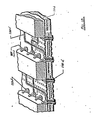
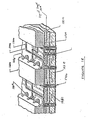
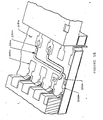
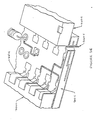
- Figures 1A through 1D show, sequentially, perspective views of circuit board modification.
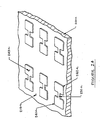
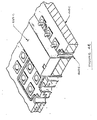
- Figures 2A through 2C show, sequentially, perspective views of the modification of an interconnection circuit board for surface mounted components.
- the invention is hereinafter described in detail with and adhesive coated conductor scribed in a predetermined pattern on a surface of a substrate.
- the adhesive is activated as the conductor is being scribed to form a bond holding the conductor in place.
- the circuit board is preferably thereafter cured to provide a permanent thermoset bond for the conductor pattern.
- the adhesive coating Prior to activation, is non-tacky, non-blocking and flexible, thus permitting handling and manipulation prior to and during scribing.
- the coated conductor may be stored on a spool for easy storage and access and does not adhere to or leave residue which will clog the apparatus used to scribe the conductors.
- the adhesive coating in its activated state, provides adhesion between the conductor and the surface of the substrate of sufficient strength to allow the formation and subsequent preservation of conductor inflections on the surface.
- adhesvie coatings used in the practice of the invention are able to adhere to a wide variety of materials which are used on or comprise the surfaces of substrates useful in the interconnection circuit board industry, including insulating and conductive surfaces.
- the substrate can be a blank circuit substrate or a circuit substrate having etched foil power and ground conductors or the like, an electronic interconnection board, including a discrete-wired circuit board, a standard printed circuit board, a multilayer circuit board, a circuit board with components thereon, or a circuit board at any other stage of construction.
- the adhesive coating Upon activation, the adhesive coating becomes tacky and can bond the conductor to the substrate surface. Once the adhesive coating is activated and the conductor applied and bonded to the surface, the adhesive coating rapidly reverts to a solid, non-tacky condition without any substantial change in the adhesive coating's conformation or volume. This reversion occurs in about 50 to 200 milliseconds which is sufficiently short to allow the conductor pattern to retain dimensional stability, thus limiting or substantially avoiding relative movement of the bonded conductors with respect to each other and the substrate surface.
- the adhesive coating and, if present, one or more underlying layer(s) of insulation should be removable at the endpoints of the conductor. When the insulation is removed, electrical connections can be made between the scribed conductor and the terminal points. The removal process is hereinafter referred to as "stripping".
- the bond formed by the adhesive coating employed in the practice of the invention can withstand any subsequent processing that is typically performed during the fabrication of a circuit board. It is resistant to chemicals used during manufacture, such as cleaning solutions, solder flux and the like.
- One suitable, non-tacky, non-blocking, flexible adhesive coating composition comprises:
- the adhesive coating may be thermoplastic or thermosetting.
- the coating may be composed of an adhesive comprising components selected from high molecular weight polyester, high molecular weight phenoxy resins, high molecular weight polyurethane, high molecular weight epoxy resins and polyolefins.
- compositions used in the adhesive coating of the invention are set forth in co-pending patent application No. ........ entitled "Heat activatable Adhesive For Wire Scribed Circuits”.
- the conductor coating may be made up of two or more layers.
- One layer may be an adhesive and the other layer(s) may serve other functions.
- an adhesive layer may be applied to the conductor and a protective outer layer may be applied over it which can be dissipated by exposure to an energy source.
- the outer dry coating allows handling and spooling.
- the inner coating may be tacky with surface wetting characteristics.
- the coating may contain micro-encapsulated regions of low viscosity, such as cyanoacrylate, that can be released on exposure to pressure. When the encapsulated regions open, the adhesive properties of the coating are activated.
- the conductor preferably is automatically placed on and bonded to the substrate surface along a predetermined path.
- the substrate surface preferably is mounted on a movable work table.
- the conductor is fed to the substrate surface from a scribing head assembly and laid on the substrate surface by moving the work table relative on the scribing head assembly and by rotating said scribing head assembly in the direction of table movement.
- the wire scribing head assembly and the table movement are preferably numerically controlled.
- the portions of the conductor's adhesive coating which is to be placed in contact with the surface is activated.
- the conductor is brought into close proximity with the substrate surface sebsequent to or simultaneously with activation.
- the activated portion of the adhesive coating contacts and adheres to the substrate surface, forming a bond between the conductor and the substrate surface.
- the energy used for activating the adhesive coating is applied by means of pulsed radiation or heated fluid beam.
- the level of the energy should be sufficient to activate the adhesive, but not to damage the conductor or the substrate surface.
- Radiant energy sources which can be used in the practice of the invention include laser and focussed infrared radiation.
- the activating sources may be used alone or in combination.
- the preferred activating energy source is one or more pulsed laser beam(s).
- the energy output and spot size of the laser beams is controllable.
- a laser beam may be directed at a selected portion of the adhesive coating on the surface of the conductor needed to form a bond with the substrate.
- a multiplicity of energy beams or beam splitting techniques can be provided. One energy beam may be used for activating the adhesive coating, while another energy beam may be used for other purposes such as stripping or soldering.
- an energy beam is directed to a point on the conductor at or before the projected point of contact between the conductor and the substrate surface.
- the adhesive coating is activated at or prior to contacting the substrate surface such that it is in a tacky state when the conductor contacts the surface.
- a pulsed laser beam is used for activating the adhesive coating; more preferably, a CO2 laser beam which emits infrared radiation is used.
- the laser energy is directed at the desired requisite area on the adhesive coating, i.e., the underneath portion adjacent the substrate contact point, and discharged in the form of a pulsed beam.
- the pulses can be created by interrupting the emission of a continuous wave laser beam by turning the power on and off, or by "Q-switching" using electrooptic or mechanical shutters or acousto-optic couplers.
- the laser beam pulses are substantially uniform pulses with an energy content adjusted for existing conditions (e.g.
- the product of the pulse amplitude (energy level) and pulse width (pulse duration) should be constant.
- the "spot size" should be chosen as the minimum diameter large enough to allow easy alignment with the conductor. Larger spot sizes diffuse energy due to the Gaussian energy distribution of the beam and, hence, are undesirable.
- the pulses are preferably discharged at such a rate that the spots partially overlap on the conductor so as to expose and activate the adhesive coating efficiently and evenly. A pulse is emitted each time a predetermined length of conductor is traversed.
- pulse amplitude and pulse width are adjusted to produce sufficient energy to activate the exposed area of adhesive coating without damaging surrounding surfaces.
- the adjustment of the pulse energy content also takes into account conditions such as laser efficiency, wire size, and the particular adhesive requirement. Since the number of pulses is constant per uniform length, the pulse repetition rate is a function of the speed at which the wire is being scribed.
- the pulse width selected should be 200 to 2000 microseconds, and the spot size selected should be from 0.5 to 2.5 mm in diameter. If wire handling equipment is fast enough, bonding speeds as high as, e.g., 25 m/min. can be achieved. In this context, reference is made to copending patent application No. ........ entitled "Method of Manufacturing Interconnection Circuit Boards". Scribing speed may vary often and considerably during the scribing process. When the scribing process starts, there is an acceleration to running speed, during which time the coating of the conductor would be inconsistent. Emission of a fixed number of constant energy pulses per uniform length of movement obviates these problems. Each unit area of the conductor receives the same amount of energy regardless of the scribing speed.
- the adhesive coating After contact of the conductor and the adhesive coating with the substrate surface, the adhesive coating loses energy and reverts to a solid, non-tacky state thus bonding the conductor or the subatrate.
- the conductor is scribed between terminal points in this fashion.
- a separate curing step may be performed by baking, exposure to heat, UV radiation and the like.
- the adhesive coating preferably includes a curing agent which is non-reactive under conditions that activiate the adhesive during the scribing operation, but which can be made reactive to provide a permanent thermoset bond at higher temperatures or by applying UV radiation.
- An elongated preformed wire conductor e.g., a copper wire of 0.1 mm diameter, plated with approximately 0.5 ⁇ m of silver is covered with a layer of polyurethane insulation, 38 ⁇ m thick.
- the conductor is further provided with an adhesive coating having the following dry weight composition: high molecular weight polyurethane acrylate 100 g epoxy acrylate 15 g Polyisocyanurate of toluene diisocyanate 9.8 g UV curing agent 3.5 g 4-methoxyphenol 0.5 g
- the corresponding net weight composition, ready for coating, is as follows: high molecular weight polyurethane acrylate (32% solution) 333.3 g epoxy acrylate 15.0 g polyisocyanurate (50% solution) 19.6 g UV curing agent 3.5 g 4-methoxyphenol 0.5 g and toluene in an amount of 7 weight percent of the total.
- the adhesive coating composition is applied to the insulated conductor by repeatedly passing the conductor through the wet adhesive coating composition and series of diamond dies of increasing diameter.
- the wire conductor is passed through the wet adhesive coating composition, then through a diamond die, then an oven to remove residual solvents from the applied adhesive coating. This process is repeated until the conductor diameter is 266.7 ⁇ 5.1 ⁇ m.
- the wire conductor is then spooled for storage. After the wire conductor is scribed in a predetermined pattern on the surface of a substrate, the adhesive coating can be cured by exposure to an UV light source of at least 15 joules/cm2.
- a wire conductor is coated in accordance with the method described in Example 1 with an adhesive coating having the following dry weight composition: polyester having a molecular weight of about 25.000 100 g blocked isocyanate 30 g fumed silica 7.5 g zirconium silicate 5.0 g orange pigment 1.5 g methylethyl ketone (MEK) solvent 20 g
- the corresponding wet weight composition is as follows: polyester (molecular weight of about 20.000) 192.3 g blocked isocyanate 40.0 g fumed silica 7.5 g zirconium silicate 5.0 g orange pigment 1.5 g methylethyl ketone 20.0
- the adhesive-coated wire conductor is fed through a wire scribing head.
- the substrate on which the wire conductor is to be scribed is a standard printed circuit board having on its surface a copper conductor pattern formed by etching and a solder mask.
- a stream of hot air having a temperature of about 120° to 150°C is aimed at the conductor in order to activate the adhesive coating, which remains melted and, therefore, activated for approximately 0.5 seconds.
- the scribing speed is 13 mm per second.
- the hot air stream is, therefore, aimed at a point on the conductor approximately 1.5 mm above the surface, allowing the adhesive coating to melt continuously as the conductor is continuously fed through the scribing head and through a roller.
- the roller serves to impress the conductor onto the surface.
- the adhesive coating is still fluid when the conductor contacts the surface and resolidifies and becomes non-tacky within about 1 second, thus bonding the conductor and maintaining its positional stability.
- the adhesive coating is fully cured by baking in an oven at a temperature of 150°C.
- a wire conductor coated with an adhesive coating as described in Example 1 is scribed onto a printed circuit board in accordance with the method of Example 2, employing a pulsed laser as the energy source.
- a Laakman Eelctro-Optics, Inc. model RF 165 sealed CO2 laser is used havig a radio frequency-excited waveguide, a power output of 20 watts CW (continuous wave), a Gaussian (TEM00) beam shape and a maximum modulation frequency of 10 KHz.
- the laser energy is discharged at the wire conductor in the form of a pulsed beam.
- the pulse width of the beam is 200 ⁇ sec. and the pulse amplitude 200 watts.
- the spot is approximately circular and has a diameter of 1 mm.
- the beam is pulsed when the conductor has been scribed 0.2mm.
- the scribing speed is 5 m/min.
- the spot size and pulse frequency are adjusted so that each section of conductor receives about five overlapping laser pulses.
- the activated adhesive coating is contacted with the surface of the substrate and,losing energy, becomes non-tacky thus forming a bond with the surface within about 200 milliseconds. When all conductors of the predetermined pattern have been scribed, the adhesive coating is fully cured by exposure to UV light.
- a wire conductor coated with an adhesive is scribed to the surface of a substrate according to the procedure of Example 3.
- the adhesive coating is a mixture of 100 g dry weight, or 166.67 g as wet weight, polyether having carboxyl groups adducted onto the polyether backbone and crosslinked with toluene di-isocyanate, 166.7 g propylene glycolmonomethylethyl acetate (PMA) and 25 g MEK.
- the wire conductor is coated in accordance with the procedure described in Example 1.
- a wire conductor is coated with the adhesive coating composition of Example 1 in accordance with the method described in the same Example.
- the adhesive coating is activated in accordance with the method described in Example 3.
- the conductor is scribed to the surface of a previously fabricated discrete wire interconnection board over existing wires and between two terminal points in order to modify the interconnections on the board.
- a heat activatable adhesive was prepared with a blend of a B-staged polymer of a high molecular weight, allylic urethane, and a B-staged epoxy acrylate.
- the B-stage mechanism is the reaction of polyisocyarunate with the hydroxyl groups of both polymers.
- An UV initiated, free radical curing agent was incorporated in the blend to enable complete curing to a C-stage composition through the allylic and acrylic groups on the polymers.
- the wire was coated and stored in areas where UV light was excluded and wound on a spool for storage until use.
- the wire coated with the heat activatable adhesive was scribed to printed wiring boards to modify the conductive pattern. During the scribing process, the wire was automatically placed on and bonded to the surface of the printed wiring board, the surface of which comprised solder mask areas, epoxy substrate areas and exposed metal areas.
- the portion of the heat activatable adhesive coating which would contact the surface was exposed to a pulsed CO2 laser beam.
- the pulse amplitude of the beam was 20 watts.
- the spot was approximately circular and had a diameter of 1 mm.
- the beam was pulsed when the wire had been scribed about 0.2 mm.
- the scribing speed was about 5 m/min. Spot size and pulse frequency were adjusted so that each section of heat activatable adhesive coated wire received about five overlapping laser pulses.
- the activated adhesive coating contacted the surface of the printed wiring board and the adhesive coating became non-tacky and formed a solid bond with the surface in about 200 milliseconds.
- the wire was thus securely bonded by the adhesive to the solder mask, epoxy substrate and exposed metal areas as well as to other scribed wires. After all the wires to modify the conductive pattern had been scribed, the board was exposed to 19.5 joules/cm2 of UV light to cure the heat activated adhesive to the C-stage.
- Printed wiring boards with the wire scribed conductors were soldered at 265°C for 10 seconds. There was no failure of the adhesive bond between the wires and the substrate, and no visible evidence of attack on or damage to the adhesive coating.
- the boards were placed in dichloromethane for 10 seconds, dried in air at ambient temperature for 10 minutes and examined with the aid of a microscope. They showed no failure of the adhesive bond between the wires and the substrate, and no pitting, crazing or other indication of attack on the adhesive coating.
- a heat activatable adhesive coating composition was prepared based on a diacrylate ester of a diepoxy bisphenol A resin combined with a solid epoxy resin.
- the solid epoxy resin had an epoxy equivalent weight of 1600.
- the molecular weight of the epoxy resin was increased from 3200 to over 35000 by reacting it with a polyamide curing agent.
- the molecular weight of the diacrylate ester was modified with 3 g of a polyisocyanurate per 100 g of epoxy acrylate ester to partially cure or B-stage the system and increase the molecular weight from 830 to 5500.
- the epoxy acrylate ester and the polyisocyanurate were refluxed at 80°C for 30 min. to B-stage the epoxy acrylate ester before adding the other components to the adhesive.
- a free radical initiator was also added to the heat activatable adhesive formulation to cure the adhesive to the C-stage after it has been used to bond scribed wires to a board.
- dicumyl peroxide was added. Dicumyl peroxide generated free radicals at temperatures in excess of 150°C.
- 2,2-dimethoxy-2-phenylacetophenone was used as a free radical generator.
- the adhesive was refluxed at 80°C for 30 min. to B-stage the adhesive before coating the wire.
- the resulting composition was dissolved in methyl ethyl ketone to make a solution with 20% solids.
- the solution was applied to an insulated wire with an outside diameter of 0.14 mm, and the adhesive coating was dried with forced air at 65°C.The overall diameter of the wire was increased to 0.23 mm (64%).
- the heat activatable adhesive coated wire was scribed to an FR-4 substrate with hot air jet activation, as in Example 2. The adhesive bond of wire to the substrate was much lower than in Example 2.
- the conductor is an insulated metallic wire
- electrical and mechanical terminations are made at each terminal point on the substrate.
- the metal core of the insulated wire is exposed in order to make the termination.
- the adhesive coating and insulation layers are stripped to expose the conductive portion.
- Selected portions of an insulated wire may be stripped of adhesive coating or insulation, or both, by mechanical stripping, using two opposing knife edges brought close enough together to penetrate the conductor coatings without damaging the conductive portion of the conductor. The knives then slide along the conductor to scrape off excess material.
- Another method used for mechanical stripping is an abrasive jet: abrasive particles are sprayed at high velocity in a concentrated stream on the conductor to remove the insulation layer and adhesive coating. Insulation layer and adhesive coating may be chemically stripped using a solvent.
- stripping methods depending on the composition of the wire insulation include low temperature and high temperature thermal stripping.
- adhesive coating-and insulation stripping is accomplished with a laser beam.
- the energy of the impinging laser beam vaporizes the coatings.
- a laser beam with a spot size large in comparison to the diameter of the conductor is aimed and pulsed at least once at the section of the adhesive coating to be removed.
- the large spot size results in a relatively large area for stripping, the laser energy may be so diffuse along the outer edges of the spot that it may not be sufficient to completely vaporize the adhesive coating and insulation layer.
- Increasing duration of the laser beam radiation for better vaporization may cause heat conduction along the conductor, causing the adhesive coating to bubble and boil beyond the irradiated area.
- This method may also entail damage to the environment surrounding the conductor.
- a small spot is scanned along a predetermined length of conductor by moving the laser beam along the stationary conductor or by moving the conductor, keeping the beam stationary, or moving both.
- This method removes the coatings more efficiently leaving a cleaner metal surface.
- the diameter of the spot is approximately five times the diameter of the conductor if a CO2 laser beam is used.
- the frequency of the scanning can be adjusted according to the different materials to be removed.
- a vacuum may be used to remove debris and a gas jet to blow off the residue left on the conductor.
- a reflector placed on the side of the conductor opposite the side from which the energy is discharged can be used to strip the far side of the conductor.
- multiple laser beams can be aimed at opposed sides of the conductor, or the conductor can be rotated to remove adhesive coating and insulation layer all around the conductor. Energy can be conducted through the conductor to remove the adhesive coating and/or insulation layer.
- An ExcimerTM laser emitting ultraviolet radiation is also suitable in the stripping process.
- a laser beam from an Excimer laser source vaporizes the organic materials coating the wire conductor by "photo-decomposition" and without affecting the conductor.
- Terminal points can be surface pads, holes or apertures with or without metallized walls, conductive cavities, component leads, conductive fingers, etc.
- Surface pad terminations may be used to interconnect surface attached components, or to modify circuit boards having circuit holes in which the holes are already filled with solder. Termination of a scribed conductor to a surface pad can be accomplished by solder reflow methods, heating, laser soldering, welding or the like.
- the stripped end of a scribed wire conductor can be inserted into a circuit hole and electrically and mechanically terminated by soldering, or the like.
- Termination may also be accomplished by mechanically drilling through wires to form holes in the substrate and then metallizing, or plating, the drilled holes. Leaded components may be inserted into circuit holes on the substrate after the wire conductors have been inserted in the holes and prior to termination.
- the adhesive coated conductor may be stripped before placement on a surface or just prior to termination.
- the wire is stripped and cut by an appropriate apparatus just prior to termination.
- a conductor may be scribed and stripped along the length sufficient to provide metallized wire for two end points: one to end a scribed length of conductor, and another to start a new length of conductor.
- the conductor is cut at a middle point along the stripped section for this purpose.
- Fig. 1A shows an interconnection circuit board 110a having etched power and ground planes 111a and 113a on which conductors 116a have been placed.
- a dielectric layer with surface 115a has been applied over the conductors.
- Circuit holes 120a have been drilled and the hole walls metallized in order to provide electrical access between the conductors 116a and the conductors on the opposite surface as well as the outside world. If it is desired to modify the circuit board depicted in Fig. 1A, such modification can be accomplished according to the process of this invention as described below.
- Figure 1B shows the interconnection circuit board 110b of Fig. 1A as modified in accordance with the process of this invention.
- Conductor 130b having an adhesive coating 140b is applied, for example, to surface 115b along the predetermined route from circuit hole 126b to circuit hole 128b.
- the adhesive coating 140b is removed by stripping, e.g., with a laser, from conductor 130b prior to the conductor's insertion into circuit hole 126b at segment 132b. Segment 132b is inserted into circuit hole 126b and the adhesive coating 140b activated, e.g., with a repeated laser beam pulse.
- the conductor 130b is then scribed onto surface 115b.
- the now tacky, activated adhesive coating provides continuous adhesion as it is scribed and contacts the surface 115b between the conductor 130b and the surface 115b.
- Conductor 130b is scribed in a predetermined pattern until it reaches circuit hole 128b, which is plated through.
- the adhesive coating 140b is again stripped from conductor 130b, leaving the conductor exposed at segment 134b, which is inserted into plated through hole 128b.
- circuit holes 122b and 124b have been severed by drilling a hole 150b into the board.
- An additional conductor path is similarly provided by applying adhesive coated conductor 135b in a defined, predetermined and repeatable location reaching from terminal point 122b to terminal point 129b. Both terminal points are metallized circuit holes. Connection to hole walls is made by known technologies and preferably by soldering, welding or the like.
- Fig. 1C shows modified interconnection circuit board 110c after modification conductor 130c has been placed as shown in Fig. 1B.
- components 160c may be placed in the circuit holes of the interconnection circuit board in the appropriate locations.
- a component lead 165c can occupy the same circuit hole barrel as conductor 130c.
- Fig. 1D shows the interconnection circuit board 110d after electrical and mechanical interconnection has been made by soldering.
- the component leads 165d and conductors 130d have been soldered in holes 120d, leaving a fillet of solder 170d providing electrical and mechanical interconnection.
- Fig. 1E shows a multiple layer interconnection circuit board 180e having an etched power layer 182e, an etched ground layer 184e and en etched signal layer 186e. Modification conductors 130e have been scribed to the surface of board 180e to provide a new signal interconnection pattern.
- Fig. 2A shows an interconnection circuit board 200a having surface pads 240a.
- a short conductor 231a is located on surface 215a and interconnects surface pads 241a and 242a.
- Fig. 2B shows the interconnection circuit board 200b of Fig. 2A as modified in accordance with the process of this invention to add conductors 232b and 234b.
- a conductor e.g., 232b
- a conductor is first stripped of thr adhesive coating and insulation layer at one end and attached to a surface pad 240b by soldering, welding or the like. This attachment provides electrical and mechanical interconnection at the surface pad terminal point.
- Conductor 232b is then scribed and bonded by the activated adhesive coating 233b along its path. The other end of conductor 232b is then stripped and attached to surface pad 243b.
- Conductor 234b is similarly scribed, bonded, and stripped to interconnect the appropriate surface pads.
- Fig. 2C shows the completed interconnection board of Figures 2A and 2B with surface component 210c attached.
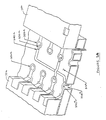
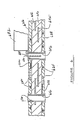
- FIG. 3A shows modification of an interconnection circuit board on which is located a surface-attached component 312a in a dual-in-line package 310a.
- Duplicate parallel repair holes 320a were provided in the board design to allow access to terminal points after component insertion.
- This type of interconnection circuit board can be modified even after components have been attached or iserted.
- the method for modifying is shown in Figures 1A - 1D.
- Conductor 330a having adhesive coating 340a is stripped at one end and the stripped portion inserted into circuit hole 335a.
- Conductor 330a is then routed and affixed to surface 315a. When conductor 330a reaches terminal point 336a, it is again stripped and inserted into the circuit hole barrel 338a. Electrical termination can be made as the conductors are inserted into the plated through holes at the terminal points, or at a later stage, e.g., by soldering.
- Fig. 3B shows another modification technique for an inter ⁇ connection circuit board on which are located surface-attached components and lead-inserted components.
- Duplicate parallel repair surface pads 335b are provided in the board design to allow access to terminal points after component insertion and attachment.
- This type of interconnection circuit board can be modified using the technique previously described and shown in Figures 2A - 2C.
- Conductor 330b having adhesive coating 340b and an in sulation layer is stripped at one end. The stripped portion is affixed to surface pad 335b. Conductor 330b is then routed and affixed to surface 315b by activated adhesive coating 340b.
- conductor 330b When conductor 330b reaches terminal point 336b, it is stripped at the other end and affixed to surface pad 338b at that terminal point. Electrical termination can be made as the conductors are affixed to the suface pads at the terminal points by soldering or the like.
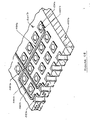
- Fig. 4A shows a standardized prefabricated panel of pads and holes suitable for various component sizes and pin densities.
- the components which are to be used are matched to the existing pads and holes on the panel.
- the locations and sizes of the circuit board holes are standardized to accommodate a variety of different circuit configurations utilizing the same basic panel.
- Basic panel 410a contains power and ground planes 420a and 430a.
- Circuit holes 450a are drilled and metallized prior to scribing conductors. Surrounding the holes are conductive pads 470a for eventual termination of conductors.
- Fig. 4B shows basic standardized panel 410b of Fig. 4A with adhesive coated conductors 482b and 484b providing an electrical interconnect.
- Adhesive coating 486b bonds conductors 482b and 484b to surface 400b.
- Fig. 4B further illustrates how the adhesive coating 486b provides adequate bond at crossover 480b of conductors. Adhesive coating 486b appears between conductors 482b and 484b at crossover 480b.
- Conductor 482b having an adhesive coating 486b is stripped at one end and the stripped portion is affixed to surface pad 472b. Conductor 482b is then routed and affixed to surface 400b. When conductor 482b reaches terminal point 422b, it is again stripped and affixed to surface pad 474b by soldering. Electrical connection can be made as described hereinbefore.
- Fig. 4C shows the completed circuit board 410c with lead inserted component 465c mounted thereon.
- the leads 460c of the component 465c are subsequently mechanically and electrically connected to the circuit board 410c, e.g., by soldering.
- FIG. 5A shows the starting circuit board panel with etched power and ground planes 520a and 530a. Circuit holes 540a and 542a are drilled and then metallized, and surface pads 544a and 545a formed around holes 540a and 542a. Surface pads 548a and 549a are placed on the surface 500a for surface attachment of components.
- Fig. 5B shows the prefabricated panel 510b as it appears after adhesive coated conductors 582b, 584b and 592b have been scribed on its surface.
- the adhesive coating is activated as the conductors are being scribed and serves to bond conductors 582b, 584b amd 592b to surface 500b.
- Adhesive coating 586b also provides adequate bonding at the crossover 580b of conductors 582b and 584b.
- conductor 582b can be first stripped at one end and the stripped portion attached to surface pad 572 b by soldering. Conductor 582b is then scribed to surface 500b and when it reaches terminal point 522b, its endpoint is stripped and soldered to surface pad 574b at that terminal point. Conductor 592b is stripped and soldered to surface pad 544b, then routed and affixed to surface 500b and when it reaches terminal point 524b, the other end is stripped and soldered to surface pad 546b. Electrical connection is made when the conductors are affixed to the surface pads at the terminal points by soldering or the like. Conductor 584 is similarly stripped, scribed and connected between terminal points. The completed circuit board with components mounted thereon appears as shown in Fig. 5C.
- Fig. 6 shows another embodiment of the invention wherein adhesive coated conductors are applied to both sides of the circuit board and thereafter encapsulated.
- the initial circuit board 610 is constructed including interior ground and power planes 612 and 614 as well as printed surface conductors 618 and 620 which can provide terminal pads and, if desired, a conductor interconnection pattern.
- Adhesive coated conductors 622 are then added to the upper surface of the board with stripped ends connected to terminal pads like terminal pad 620.
- adhesive coated conductors 624 are added to the lower surface with stripped ends connected to terminal pads like terminal pad 618.
- the surface conductors are encapsulated by encapsulating layers 626 and 628.
- the thus encapsulated board 610 is then drilled and the drilled holes metallized (616) to provide terminal holes 630 connected to the interior conductors and layers.
- Components 632 can thereafter be mounted with leads 634 inserted into the terminal holes and connected by solder (not shown).
Landscapes
- Engineering & Computer Science (AREA)
- Microelectronics & Electronic Packaging (AREA)
- Manufacturing & Machinery (AREA)
- Manufacturing Of Printed Wiring (AREA)
- Manufacturing Of Printed Circuit Boards (AREA)
- Production Of Multi-Layered Print Wiring Board (AREA)
- Adhesives Or Adhesive Processes (AREA)
- Emergency Protection Circuit Devices (AREA)
- Reinforced Plastic Materials (AREA)
- Laser Beam Processing (AREA)
Priority Applications (1)
| Application Number | Priority Date | Filing Date | Title |
|---|---|---|---|
| AT86109558T ATE59129T1 (de) | 1985-07-19 | 1986-07-12 | Verfahren zur herstellung von leiterplatten mit darin verlegten draehten und damit hergestellte artikel. |
Applications Claiming Priority (2)
| Application Number | Priority Date | Filing Date | Title |
|---|---|---|---|
| US756722 | 1985-07-19 | ||
| US06/756,722 US4711026A (en) | 1985-07-19 | 1985-07-19 | Method of making wires scribed circuit boards |
Publications (3)
| Publication Number | Publication Date |
|---|---|
| EP0212227A2 true EP0212227A2 (de) | 1987-03-04 |
| EP0212227A3 EP0212227A3 (en) | 1987-05-13 |
| EP0212227B1 EP0212227B1 (de) | 1990-12-12 |
Family
ID=25044766
Family Applications (1)
| Application Number | Title | Priority Date | Filing Date |
|---|---|---|---|
| EP86109558A Expired - Lifetime EP0212227B1 (de) | 1985-07-19 | 1986-07-12 | Verfahren zur Herstellung von Leiterplatten mit darin verlegten Drähten und damit hergestellte Artikel |
Country Status (9)
| Country | Link |
|---|---|
| US (1) | US4711026A (de) |
| EP (1) | EP0212227B1 (de) |
| JP (1) | JPS6284596A (de) |
| AT (1) | ATE59129T1 (de) |
| AU (1) | AU594352B2 (de) |
| CA (1) | CA1251576A (de) |
| DE (2) | DE3676128D1 (de) |
| FR (1) | FR2585209B1 (de) |
| GB (1) | GB2180696B (de) |
Cited By (2)
| Publication number | Priority date | Publication date | Assignee | Title |
|---|---|---|---|---|
| EP0212238A3 (en) * | 1985-07-19 | 1988-07-06 | Kollmorgen Technologies Corporation | Heat activatable adhesive for wire scribed circuits |
| GB2180696B (en) * | 1985-07-19 | 1989-07-19 | Kollmorgen Tech Corp | Process for the manufacture of wire scribed circuit boards and articles produced thereby |
Families Citing this family (63)
| Publication number | Priority date | Publication date | Assignee | Title |
|---|---|---|---|---|
| FR2585210B1 (fr) * | 1985-07-19 | 1994-05-06 | Kollmorgen Technologies Corp | Procede de fabrication de plaquettes a circuits d'interconnexion |
| US4859807A (en) * | 1985-07-19 | 1989-08-22 | Kollmorgen Technologies Corporation | Wire scribed circuit boards and method of manufacture |
| US4918260A (en) * | 1985-07-26 | 1990-04-17 | Preleg, Inc. | Adhesive-coated wire and method and printed circuit board using same |
| US4864723A (en) * | 1986-07-01 | 1989-09-12 | Preleg, Inc. | Electrical circuit modification method |
| US4908939A (en) * | 1985-10-18 | 1990-03-20 | Kollmorgen Corporation | Method of making coaxial interconnection boards |
| JPS63271996A (ja) * | 1987-04-28 | 1988-11-09 | Fanuc Ltd | 大電流用プリント基板 |
| NL8802249A (nl) * | 1988-09-13 | 1990-04-02 | Du Pont Nederland | Bevestigingsframe en filtereenheid voor connectoren. |
| DE3831394A1 (de) * | 1988-09-15 | 1990-03-22 | Prithwis Basu | Verfahren und vorrichtung zum kontaktieren eines elektrischen leitungsdrahtes mit kontaktstellen auf einer leiterplatte |
| US4972050A (en) * | 1989-06-30 | 1990-11-20 | Kollmorgen Corporation | Wire scribed circuit boards and methods of their manufacture |
| US5575932A (en) * | 1994-05-13 | 1996-11-19 | Performance Controls, Inc. | Method of making densely-packed electrical conductors |
| US20030062889A1 (en) * | 1996-12-12 | 2003-04-03 | Synaptics (Uk) Limited | Position detector |
| US6249234B1 (en) | 1994-05-14 | 2001-06-19 | Absolute Sensors Limited | Position detector |
| DE19512725C1 (de) * | 1995-04-05 | 1996-09-12 | Orga Kartensysteme Gmbh | Ausweiskarte o.dgl. in Form einer Chipkarte |
| JPH0955464A (ja) * | 1995-06-09 | 1997-02-25 | Mitsubishi Electric Corp | 表面実装型半導体装置、半導体実装部品、及びそれらの製造方法 |
| ES2146989T3 (es) * | 1996-02-12 | 2000-08-16 | David Finn | Procedimiento y dispositivo para el contacto de un conductor de hilo. |
| DE19618917C1 (de) * | 1996-05-12 | 1997-10-02 | Markus Woelfel | Verfahren und Vorrichtung zur Herstellung von drahtgeschriebenen Leiterplatten |
| US6788221B1 (en) | 1996-06-28 | 2004-09-07 | Synaptics (Uk) Limited | Signal processing apparatus and method |
| DE19705934C2 (de) * | 1997-02-15 | 2001-05-17 | Cubit Electronics Gmbh | Verfahren und Vorrichtung zum Einbringen von drahtförmigen Leiterdrähten in ein Substrat |
| WO1998054545A2 (en) | 1997-05-28 | 1998-12-03 | Absolute Sensors Limited | Position transducer and method of manufacture |
| GB9720954D0 (en) | 1997-10-02 | 1997-12-03 | Scient Generics Ltd | Commutators for motors |
| GB9721891D0 (en) | 1997-10-15 | 1997-12-17 | Scient Generics Ltd | Symmetrically connected spiral transducer |
| US6005991A (en) * | 1997-11-26 | 1999-12-21 | Us Conec Ltd | Printed circuit board assembly having a flexible optical circuit and associated fabrication method |
| US6245822B1 (en) * | 1998-04-27 | 2001-06-12 | Matsushita Electric Industrial Co. Ltd. | Method and apparatus for decomposition treating article having cured thermosetting resin |
| GB9811151D0 (en) | 1998-05-22 | 1998-07-22 | Scient Generics Ltd | Rotary encoder |
| JP2002531902A (ja) | 1998-11-27 | 2002-09-24 | シナプティックス (ユーケー)リミテッド | 位置センサ |
| US7019672B2 (en) * | 1998-12-24 | 2006-03-28 | Synaptics (Uk) Limited | Position sensor |
| US6073344A (en) * | 1999-01-28 | 2000-06-13 | International Business Machines Corporation | Laser segmentation of plated through-hole sidewalls to form multiple conductors |
| US6535535B1 (en) * | 1999-02-12 | 2003-03-18 | Semiconductor Energy Laboratory Co., Ltd. | Laser irradiation method, laser irradiation apparatus, and semiconductor device |
| US6640434B1 (en) * | 2000-04-11 | 2003-11-04 | Lear Corporation | Method of forming an electrical circuit on a substrate |
| US6486408B1 (en) * | 2000-10-31 | 2002-11-26 | Hewlett-Packard Company | Flexible circuit using discrete wiring |
| EP1412912B1 (de) | 2001-05-21 | 2008-06-18 | Synaptics (UK) Limited | Positionssensor |
| TW548816B (en) * | 2002-01-23 | 2003-08-21 | Via Tech Inc | Formation method of conductor pillar |
| GB2403017A (en) | 2002-03-05 | 2004-12-22 | Synaptics | Position sensor |
| AU2003232360A1 (en) | 2002-06-05 | 2003-12-22 | Synaptics (Uk) Limited | Signal transfer method and apparatus |
| GB0317370D0 (en) | 2003-07-24 | 2003-08-27 | Synaptics Uk Ltd | Magnetic calibration array |
| GB0319945D0 (en) | 2003-08-26 | 2003-09-24 | Synaptics Uk Ltd | Inductive sensing system |
| EP1807239A2 (de) * | 2004-11-02 | 2007-07-18 | Imasys AG | Verlegevorrichtung, kontaktiervorrichtung, zustellsystem, verlege- und kontaktiereinheit herstellungsanlage, verfahren zur herstellung und eine transpondereinheit |
| US8286332B2 (en) | 2006-09-26 | 2012-10-16 | Hid Global Gmbh | Method and apparatus for making a radio frequency inlay |
| US7971339B2 (en) * | 2006-09-26 | 2011-07-05 | Hid Global Gmbh | Method and apparatus for making a radio frequency inlay |
| DE102006050785A1 (de) * | 2006-10-27 | 2008-05-08 | Robert Bosch Gmbh | Leiterkarte |
| DE102006053697A1 (de) * | 2006-11-13 | 2008-05-29 | Häusermann GmbH | Leiterplatte mit additiven und integrierten und mittels Ultraschall kontaktierten Kupferelementen und Herstellverfahren und Anwendung |
| GB2461448B (en) | 2007-05-10 | 2011-08-31 | Cambridge Integrated Circuits Ltd | Transducer |
| KR100882261B1 (ko) * | 2007-07-25 | 2009-02-06 | 삼성전기주식회사 | 인쇄회로기판의 제조 방법 및 장치 |
| EP2040201B1 (de) * | 2007-09-18 | 2010-11-17 | HID Global Ireland Teoranta | Verfahren zur Kontaktierung eines Drahtleiters gelegt auf ein Substrat |
| KR101235617B1 (ko) * | 2007-10-16 | 2013-02-28 | 미쓰보시 다이야몬도 고교 가부시키가이샤 | 취성 재료 기판의 u자 형상 홈 가공 방법 및 이것을 사용한 제거 가공 방법 및 도려내기 가공 방법 및 모따기 방법 |
| US7708607B2 (en) * | 2008-08-28 | 2010-05-04 | Unitech Printed Circuit Board Corp. | Precision printed circuit board testing tool |
| GB2488389C (en) | 2010-12-24 | 2018-08-22 | Cambridge Integrated Circuits Ltd | Position sensing transducer |
| US8966747B2 (en) | 2011-05-11 | 2015-03-03 | Vlt, Inc. | Method of forming an electrical contact |
| US9414501B2 (en) * | 2012-01-04 | 2016-08-09 | Board Of Regents, The University Of Texas System | Method for connecting inter-layer conductors and components in 3D structures |
| GB2503006B (en) | 2012-06-13 | 2017-08-09 | Cambridge Integrated Circuits Ltd | Position sensing transducer |
| CN103144378B (zh) * | 2013-01-28 | 2015-03-25 | 广东生益科技股份有限公司 | 一种pn固化体系的覆铜板、pcb板及其制作方法 |
| JP2013219404A (ja) * | 2013-08-02 | 2013-10-24 | Sumida Corporation | アンテナ部品の製造方法 |
| US10099315B2 (en) * | 2014-06-27 | 2018-10-16 | Jabil Inc. | System, apparatus and method for hybrid function micro welding |
| US9736932B1 (en) * | 2015-01-20 | 2017-08-15 | Flextronics Ap, Llc. | Magnet wire for 3D electronic circuitry |
| US10264664B1 (en) | 2015-06-04 | 2019-04-16 | Vlt, Inc. | Method of electrically interconnecting circuit assemblies |
| US10321560B2 (en) | 2015-11-12 | 2019-06-11 | Multek Technologies Limited | Dummy core plus plating resist restrict resin process and structure |
| US9999134B2 (en) | 2016-03-14 | 2018-06-12 | Multek Technologies Limited | Self-decap cavity fabrication process and structure |
| US10064292B2 (en) * | 2016-03-21 | 2018-08-28 | Multek Technologies Limited | Recessed cavity in printed circuit board protected by LPI |
| US11336167B1 (en) | 2016-04-05 | 2022-05-17 | Vicor Corporation | Delivering power to semiconductor loads |
| US10785871B1 (en) * | 2018-12-12 | 2020-09-22 | Vlt, Inc. | Panel molded electronic assemblies with integral terminals |
| US11224117B1 (en) | 2018-07-05 | 2022-01-11 | Flex Ltd. | Heat transfer in the printed circuit board of an SMPS by an integrated heat exchanger |
| CN114379260B (zh) * | 2021-09-02 | 2023-09-26 | 苏州清听声学科技有限公司 | 一种定向发声屏绝缘凸点丝印制作方法 |
| CN117393226A (zh) * | 2023-11-29 | 2024-01-12 | 三元科技(深圳)有限公司 | 一种用于内窥镜的光电混合线缆 |
Family Cites Families (27)
| Publication number | Priority date | Publication date | Assignee | Title |
|---|---|---|---|---|
| US3353263A (en) * | 1964-08-17 | 1967-11-21 | Texas Instruments Inc | Successively stacking, and welding circuit conductors through insulation by using electrodes engaging one conductor |
| US3674914A (en) * | 1968-02-09 | 1972-07-04 | Photocircuits Corp | Wire scribed circuit boards and method of manufacture |
| US3674602A (en) * | 1969-10-09 | 1972-07-04 | Photocircuits Corp | Apparatus for making wire scribed circuit boards |
| JPS5550399B1 (de) * | 1970-03-05 | 1980-12-17 | ||
| JPS5025054B1 (de) * | 1970-10-30 | 1975-08-20 | ||
| JPS50100574A (de) * | 1974-01-09 | 1975-08-09 | ||
| US3981076A (en) * | 1974-11-27 | 1976-09-21 | Commissariat A L'energie Atomique | Method of connecting electronic microcomponents |
| FR2304247A1 (fr) * | 1975-03-12 | 1976-10-08 | Commissariat Energie Atomique | Procede et dispositif d'interconnexion de composants electroniques |
| US4031612A (en) * | 1976-03-02 | 1977-06-28 | Commissariat A L'energie Atomique | Method and a device for the interconnection of electronic components |
| ZA775455B (en) * | 1977-08-09 | 1978-07-26 | Kollmorgen Tech Corp | Improved methods and apparatus for making scribed circuit boards |
| JPS5439633A (en) * | 1977-09-02 | 1979-03-27 | Hitachi Chemical Co Ltd | Multiistylus head and method of making same |
| JPS5466464A (en) * | 1977-11-04 | 1979-05-29 | Oki Electric Ind Co Ltd | Simple preparation of circuit substrate |
| US4327124A (en) * | 1978-07-28 | 1982-04-27 | Desmarais Jr Raymond C | Method for manufacturing printed circuits comprising printing conductive ink on dielectric surface |
| JPS5536938A (en) * | 1978-09-04 | 1980-03-14 | Nippon Electric Co | Circuit board |
| FR2458978A2 (fr) * | 1979-06-07 | 1981-01-02 | Commissariat Energie Atomique | Procede et dispositif d'interconnexions de composants electronique |
| JPS5613013A (en) * | 1979-07-14 | 1981-02-07 | Kurita Water Ind Ltd | Removing method of scale |
| DE3035090C2 (de) * | 1979-09-28 | 1995-01-26 | Cii Honeywell Bull | Vorrichtung zur Verdrahtung von Substratoberflächen |
| JPS57136391A (en) * | 1981-02-17 | 1982-08-23 | Nippon Electric Co | Method and device for wiring circuit board |
| US4500389A (en) * | 1981-04-14 | 1985-02-19 | Kollmorgen Technologies Corporation | Process for the manufacture of substrates to interconnect electronic components |
| US4414741A (en) * | 1981-05-22 | 1983-11-15 | Augat Inc. | Process for interconnecting components on a PCB |
| US4450623A (en) * | 1981-12-18 | 1984-05-29 | Kollmorgen Technologies Corporation | Process for the manufacture of circuit boards |
| US4427478A (en) * | 1982-06-28 | 1984-01-24 | International Business Machines Corporation | Process for making an encapsulated circuit board and products made thereby |
| EP0113820B1 (de) * | 1982-12-22 | 1987-09-09 | International Business Machines Corporation | Verfahren und Vorrichtung zum Einbetten eines Drahtes in einem lichthärtbaren Klebstoff |
| DE3408338A1 (de) * | 1984-03-07 | 1985-09-12 | Siemens AG, 1000 Berlin und 8000 München | Verfahren und vorrichtung zum verlegen eines schaltdrahtes auf einer traegerplatte |
| US4711026A (en) * | 1985-07-19 | 1987-12-08 | Kollmorgen Technologies Corporation | Method of making wires scribed circuit boards |
| FR2585210B1 (fr) * | 1985-07-19 | 1994-05-06 | Kollmorgen Technologies Corp | Procede de fabrication de plaquettes a circuits d'interconnexion |
| US4693778A (en) * | 1985-07-19 | 1987-09-15 | Kollmorgen Technologies Corporation | Apparatus for making scribed circuit boards and circuit board modifications |
-
1985
- 1985-07-19 US US06/756,722 patent/US4711026A/en not_active Expired - Lifetime
-
1986
- 1986-07-04 FR FR8609789A patent/FR2585209B1/fr not_active Expired - Fee Related
- 1986-07-12 AT AT86109558T patent/ATE59129T1/de not_active IP Right Cessation
- 1986-07-12 DE DE8686109558T patent/DE3676128D1/de not_active Expired - Lifetime
- 1986-07-12 EP EP86109558A patent/EP0212227B1/de not_active Expired - Lifetime
- 1986-07-16 GB GB8617363A patent/GB2180696B/en not_active Expired
- 1986-07-18 DE DE19863624627 patent/DE3624627A1/de not_active Withdrawn
- 1986-07-18 CA CA000514114A patent/CA1251576A/en not_active Expired
- 1986-07-18 AU AU60353/86A patent/AU594352B2/en not_active Ceased
- 1986-07-19 JP JP61171467A patent/JPS6284596A/ja active Pending
Cited By (2)
| Publication number | Priority date | Publication date | Assignee | Title |
|---|---|---|---|---|
| EP0212238A3 (en) * | 1985-07-19 | 1988-07-06 | Kollmorgen Technologies Corporation | Heat activatable adhesive for wire scribed circuits |
| GB2180696B (en) * | 1985-07-19 | 1989-07-19 | Kollmorgen Tech Corp | Process for the manufacture of wire scribed circuit boards and articles produced thereby |
Also Published As
| Publication number | Publication date |
|---|---|
| GB8617363D0 (en) | 1986-08-20 |
| GB2180696B (en) | 1989-07-19 |
| CA1251576A (en) | 1989-03-21 |
| FR2585209A1 (fr) | 1987-01-23 |
| DE3624627A1 (de) | 1987-01-29 |
| DE3676128D1 (de) | 1991-01-24 |
| EP0212227B1 (de) | 1990-12-12 |
| EP0212227A3 (en) | 1987-05-13 |
| US4711026A (en) | 1987-12-08 |
| FR2585209B1 (fr) | 1994-03-11 |
| AU6035386A (en) | 1987-01-22 |
| GB2180696A (en) | 1987-04-01 |
| JPS6284596A (ja) | 1987-04-18 |
| AU594352B2 (en) | 1990-03-08 |
| ATE59129T1 (de) | 1990-12-15 |
Similar Documents
| Publication | Publication Date | Title |
|---|---|---|
| EP0212227B1 (de) | Verfahren zur Herstellung von Leiterplatten mit darin verlegten Drähten und damit hergestellte Artikel | |
| US4859807A (en) | Wire scribed circuit boards and method of manufacture | |
| US6228686B1 (en) | Method of fabricating a microelectronic assembly using sheets with gaps to define lead regions | |
| JPH11266084A (ja) | 多層印刷回路基板の製造方法 | |
| US4602318A (en) | Substrates to interconnect electronic components | |
| US4500389A (en) | Process for the manufacture of substrates to interconnect electronic components | |
| EP0836796B1 (de) | Verfahren zur elektronik-bestückung unter verwendung von mikrowellenbestrahlung | |
| US4544442A (en) | Process for the manufacture of substrates to interconnect electronic components | |
| US4541882A (en) | Process for the manufacture of substrates to interconnect electronic components and articles made by said process | |
| EP0217019A2 (de) | Verfahren zur Herstellung von miteinander verbundenen gedruckten Schaltungen | |
| EP0405482A1 (de) | Leiterplatte mit darin verlegten Drähten und Herstellungsverfahren | |
| US6956182B2 (en) | Method of forming an opening or cavity in a substrate for receiving an electronic component | |
| US6838372B2 (en) | Via interconnect forming process and electronic component product thereof | |
| JPS62158397A (ja) | 導電貫通孔の形成方法 | |
| CA1277429C (en) | Process for the manufacture of substrates to interconnect electronic components | |
| JP2004031710A (ja) | 配線基板の製造方法 | |
| JPH05275842A (ja) | 表面実装部品の接着仮止法 | |
| US7288739B2 (en) | Method of forming an opening or cavity in a substrate for receiving an electronic component | |
| JP2009239215A (ja) | 銅張積層板およびこれを用いた配線基板の製造方法ならびに銅張積層板の端面処理方法およびこれに用いる端面処理装置 | |
| GB2203290A (en) | Manufacture of printed circuit boards | |
| JPH11163533A (ja) | 多層印刷配線板の製造方法 | |
| JP2005169444A (ja) | 絶縁被覆導体の接合方法および絶縁被覆導体の接合装置 | |
| EP1340414A2 (de) | Methode zur formung einer kavität oder öffnung in einem elektronik-komponenten-substrat | |
| CA1209278A (en) | Process for removing insulating coatings from substrates | |
| JP2506816B2 (ja) | 線材挿入方法 |
Legal Events
| Date | Code | Title | Description |
|---|---|---|---|
| PUAI | Public reference made under article 153(3) epc to a published international application that has entered the european phase |
Free format text: ORIGINAL CODE: 0009012 |
|
| AK | Designated contracting states |
Kind code of ref document: A2 Designated state(s): AT CH DE FR GB IT LI SE |
|
| PUAL | Search report despatched |
Free format text: ORIGINAL CODE: 0009013 |
|
| AK | Designated contracting states |
Kind code of ref document: A3 Designated state(s): AT CH DE FR GB IT LI SE |
|
| 17P | Request for examination filed |
Effective date: 19870811 |
|
| 17Q | First examination report despatched |
Effective date: 19890602 |
|
| RAP1 | Party data changed (applicant data changed or rights of an application transferred) |
Owner name: KOLLMORGEN CORPORATION |
|
| GRAA | (expected) grant |
Free format text: ORIGINAL CODE: 0009210 |
|
| ITF | It: translation for a ep patent filed | ||
| AK | Designated contracting states |
Kind code of ref document: B1 Designated state(s): AT CH DE FR GB IT LI SE |
|
| PG25 | Lapsed in a contracting state [announced via postgrant information from national office to epo] |
Ref country code: AT Effective date: 19901212 |
|
| REF | Corresponds to: |
Ref document number: 59129 Country of ref document: AT Date of ref document: 19901215 Kind code of ref document: T |
|
| ET | Fr: translation filed | ||
| REF | Corresponds to: |
Ref document number: 3676128 Country of ref document: DE Date of ref document: 19910124 |
|
| ITPR | It: changes in ownership of a european patent |
Owner name: CESSIONE;ADVANCED INTERCONNECTION TECHNOLOGY INC. |
|
| RAP2 | Party data changed (patent owner data changed or rights of a patent transferred) |
Owner name: ADVANCED INTERCONNECTION TECHNOLOGY, INC. |
|
| REG | Reference to a national code |
Ref country code: CH Ref legal event code: PUE Owner name: ADVANCED INTERCONNECTION TECHNOLOGY, INC. |
|
| PGFP | Annual fee paid to national office [announced via postgrant information from national office to epo] |
Ref country code: GB Payment date: 19910710 Year of fee payment: 6 |
|
| REG | Reference to a national code |
Ref country code: FR Ref legal event code: TP |
|
| PLBE | No opposition filed within time limit |
Free format text: ORIGINAL CODE: 0009261 |
|
| STAA | Information on the status of an ep patent application or granted ep patent |
Free format text: STATUS: NO OPPOSITION FILED WITHIN TIME LIMIT |
|
| 26N | No opposition filed | ||
| PG25 | Lapsed in a contracting state [announced via postgrant information from national office to epo] |
Ref country code: GB Effective date: 19920712 |
|
| GBPC | Gb: european patent ceased through non-payment of renewal fee |
Effective date: 19920712 |
|
| PGFP | Annual fee paid to national office [announced via postgrant information from national office to epo] |
Ref country code: FR Payment date: 19930705 Year of fee payment: 8 |
|
| PGFP | Annual fee paid to national office [announced via postgrant information from national office to epo] |
Ref country code: SE Payment date: 19940620 Year of fee payment: 9 |
|
| PGFP | Annual fee paid to national office [announced via postgrant information from national office to epo] |
Ref country code: CH Payment date: 19940705 Year of fee payment: 9 |
|
| ITTA | It: last paid annual fee | ||
| PGFP | Annual fee paid to national office [announced via postgrant information from national office to epo] |
Ref country code: DE Payment date: 19940926 Year of fee payment: 9 |
|
| EAL | Se: european patent in force in sweden |
Ref document number: 86109558.6 |
|
| PG25 | Lapsed in a contracting state [announced via postgrant information from national office to epo] |
Ref country code: FR Effective date: 19950331 |
|
| REG | Reference to a national code |
Ref country code: FR Ref legal event code: ST |
|
| PG25 | Lapsed in a contracting state [announced via postgrant information from national office to epo] |
Ref country code: SE Effective date: 19950713 |
|
| PG25 | Lapsed in a contracting state [announced via postgrant information from national office to epo] |
Ref country code: LI Effective date: 19950731 Ref country code: CH Effective date: 19950731 |
|
| REG | Reference to a national code |
Ref country code: CH Ref legal event code: PL |
|
| PG25 | Lapsed in a contracting state [announced via postgrant information from national office to epo] |
Ref country code: DE Effective date: 19960402 |
|
| EUG | Se: european patent has lapsed |
Ref document number: 86109558.6 |
|
| PG25 | Lapsed in a contracting state [announced via postgrant information from national office to epo] |
Ref country code: IT Free format text: LAPSE BECAUSE OF NON-PAYMENT OF DUE FEES;WARNING: LAPSES OF ITALIAN PATENTS WITH EFFECTIVE DATE BEFORE 2007 MAY HAVE OCCURRED AT ANY TIME BEFORE 2007. THE CORRECT EFFECTIVE DATE MAY BE DIFFERENT FROM THE ONE RECORDED. Effective date: 20050712 |