EP0214908B1 - Verbindungen, enthaltend eine oligonukleotide Sequenz, gebunden an eine Interkalierungsverbindung und an eine aktivierbare chemische Verbindung, ihre Synthese und Verwendungen als artifizielle sequenzspezifische Nuklease - Google Patents
Verbindungen, enthaltend eine oligonukleotide Sequenz, gebunden an eine Interkalierungsverbindung und an eine aktivierbare chemische Verbindung, ihre Synthese und Verwendungen als artifizielle sequenzspezifische Nuklease Download PDFInfo
- Publication number
- EP0214908B1 EP0214908B1 EP86401927A EP86401927A EP0214908B1 EP 0214908 B1 EP0214908 B1 EP 0214908B1 EP 86401927 A EP86401927 A EP 86401927A EP 86401927 A EP86401927 A EP 86401927A EP 0214908 B1 EP0214908 B1 EP 0214908B1
- Authority
- EP
- European Patent Office
- Prior art keywords
- radical
- group
- compounds
- intercalating
- denote
- Prior art date
- Legal status (The legal status is an assumption and is not a legal conclusion. Google has not performed a legal analysis and makes no representation as to the accuracy of the status listed.)
- Expired - Lifetime
Links
- 0 C1*2C1CCC2 Chemical compound C1*2C1CCC2 0.000 description 3
- WODCHYRWVXJVFS-UHFFFAOYSA-N BC1OC(COI)C(C)C1[IH]I Chemical compound BC1OC(COI)C(C)C1[IH]I WODCHYRWVXJVFS-UHFFFAOYSA-N 0.000 description 1
Images
Classifications
-
- C—CHEMISTRY; METALLURGY
- C07—ORGANIC CHEMISTRY
- C07D—HETEROCYCLIC COMPOUNDS
- C07D487/00—Heterocyclic compounds containing nitrogen atoms as the only ring hetero atoms in the condensed system, not provided for by groups C07D451/00 - C07D477/00
- C07D487/22—Heterocyclic compounds containing nitrogen atoms as the only ring hetero atoms in the condensed system, not provided for by groups C07D451/00 - C07D477/00 in which the condensed system contains four or more hetero rings
-
- C—CHEMISTRY; METALLURGY
- C07—ORGANIC CHEMISTRY
- C07H—SUGARS; DERIVATIVES THEREOF; NUCLEOSIDES; NUCLEOTIDES; NUCLEIC ACIDS
- C07H19/00—Compounds containing a hetero ring sharing one ring hetero atom with a saccharide radical; Nucleosides; Mononucleotides; Anhydro-derivatives thereof
- C07H19/02—Compounds containing a hetero ring sharing one ring hetero atom with a saccharide radical; Nucleosides; Mononucleotides; Anhydro-derivatives thereof sharing nitrogen
- C07H19/04—Heterocyclic radicals containing only nitrogen atoms as ring hetero atom
- C07H19/06—Pyrimidine radicals
-
- C—CHEMISTRY; METALLURGY
- C07—ORGANIC CHEMISTRY
- C07H—SUGARS; DERIVATIVES THEREOF; NUCLEOSIDES; NUCLEOTIDES; NUCLEIC ACIDS
- C07H21/00—Compounds containing two or more mononucleotide units having separate phosphate or polyphosphate groups linked by saccharide radicals of nucleoside groups, e.g. nucleic acids
Definitions
- the present invention relates to new chemical compounds and their application, in particular, as sequence-specific artificial nucleases.
- the present invention also relates to the application of these compounds for the selective blocking of the expression of a gene.
- gene is meant not only the endogenous gene (oncogene for example) but also the exogenous gene (DNA or RNA of viruses, parasites or bacteria, for example).
- the chemical compounds according to the present invention consist of an oligonucleotide or an oligodeoxynucleotide comprising a sequence of natural or modified nucleotides and linked by a covalent bond to an intercalating radical and a chemical radical carrying at least one function reacting directly or indirectly with nucleotide chains (which will be called hereinafter "reactive chemical radical”), this reactive chemical radical can also constitute the intercalating radical.
- formula A represents a sequence of nucleotides which may be identical or different, n simply indicating the number of nucleotides included in the molecule; n is preferably a number between 1 and 50, and preferably between 1 and 25.
- intercalating radicals correspond to intercalating agents which are compounds known in the techniques relating to nucleic acids; they are compounds capable of "intercalating" in the structure of DNAs or RNAs.
- intercalating agents are, in general, constituted by polycyclic compounds having a plane configuration such as acridine, furocoumarin, daunomycin, 1,10-phenanthroline, phenanthridinium, porphyrins, derivatives of dipyrido ( 1,2-a: 3 ', 2'-d) imidazole, ellipticine or ellipticinium and their derivatives.
- the reactive chemical radicals are preferably the chemical cleavage radicals, that is to say that these radicals can directly or indirectly react to split a chain of nucleotides.
- these reactive chemical radicals will be activatable, for example chemically or photochemically.
- Chemically activatable groups in the presence of metal ions, oxygen and a reducing agent induce breaks in acid sequences nucleic acids located in their vicinity.
- the radical B preferably consists of a natural base of a nucleic acid, for example thymine, adenine, cytosine, guanine or uracil; however, it is also possible to use modified nucleic acid bases, such as 2-amino-adenine and its substituted derivatives, for example on N 6 by an aminoalkylene group or by an azidophenylalkylene group; or guanine substituted on 0 6 , for example by a (w-alkylene) -9-acridine group; or 8- (w-aminoalkyl) -aminoadenine and its derivatives substituted on NH 2 at w by an acridine group; or halogenated or azide derivatives, for example 5-bromo-uracil or 8-azidoadenine.
- photoactivatable derivatives of the bases for example thymine, adenine, cytosine, guanine or uracil
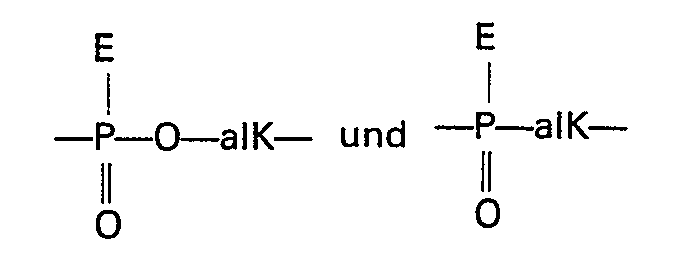
- the radical X although it preferably represents an oxoanion, can have other meanings; when the radical X represents an alkyl group, it is preferably a C 1 to C 7 lower alkyl group and, for example, the ethyl, methyl or propyl groups; when the radical X represents an alkoxy group, it is preferably a C 1 to C 7 lower alkoxy group, for example the methoxy or ethoxy group; when X represents an amino-alkyl or aminoalkoxy group, it may be a mono-substituted, disubstituted amino-alkyl group or else an amino radical in the form of a quaternary ammonium salt.
- the substituents are preferably lower alkyl radicals as defined above; as for the alkyl or alkoxy chain connecting the amino radical to the phosphorus, it is preferably a straight or branched chain containing from 1 to 10 carbon atoms.
- the alkyl or alkoxy radical is substituted by a nitrogenous heterocycle, it is in particular a saturated 5-6-membered ring comprising a nitrogen atom which may be quaternary.
- the radical X is a thioalkyl radical, it is preferably a lower thioalkyl radical, that is to say which contains between 1 and 7 carbon atoms.
- the compounds of the present invention can be prepared chemically by methods already known, in particular by the methods described in French patent applications No. 83,01223 of January 27, 1983 and 84 11795 of July 25, 1984.
- the compounds of the invention can also be prepared by semi-synthetic methods, in particular using DNA or RNA fragments prepared by genetic engineering methods to which are then attached an intercalating agent and a reactive chemical group. .
- the present invention also relates to the application of the above compounds in the form of a salt with bases or acids, and of the compounds in racemic form, or in the form of purified or mixed optical R or S isomers.
- the compounds according to the present invention consist of an oligonucleotide chain covalently linked to an intercalating agent and to a reactive chemical group, or to an intercalating agent which is also a reactive chemical group.
- the oligonucleotide ensures recognition of the complementary nucleic acid sequence
- the intercalating agent greatly increases the stability of the hybridization complex and the reactive group led by activation to hydrolysis of the nucleic acid chain complementary. This system therefore makes it possible to cut with great efficiency a chain of nucleic acids at a site previously chosen.
- the compounds of formula A of the invention by their high specific affinity for complementary nucleic sequences, are both superior to the oligonucleotides linked to an ethylene-diamine-tetraacetic group already known (FEBS Letters, 172 (1984), 43 ⁇ 46; Proc. Nat. Acad. Sci. USA, 82 (1985), 968-972; Proc. Nat. Acad. Sci USA, 82 (1985), 963-967) whose affinity for complementary sequences is much more weak (see Example VIII) and to compounds comprising an intercalating agent linked to an ethylene-diamine-tetraacetic group (Biochemistry, 23, (1984), 3934-3945) or to a porphyrin (J. Chem. Soc., Commun 1982) , 1298-1300; Tetrahydron Letters, 24 (1983), 1523-1526) which do not have specificity with respect to a given nucleic acid sequence.
- the compounds of the present invention by their property of binding strongly to the complementary nucleic sequence and then of inducing the cleavage of the nucleic acid chain at this site, can be used as sequence-specific artificial nucleases. They can be used as reagents in molecular biology or in genetic engineering. They can also be used to obtain fragments of nucleic acids, in particular fragments of RNAs for which there is no nuclease specific for sequences.
- the object of the present invention is also the application of the compounds of formula A to achieve the specific blocking of cellular genes or pathogens previously chosen (viruses, bacteria, parasites).
- the compounds according to the invention are therefore useful as a medicament in order to selectively destroy unwanted, exogenous (viruses, bacteria, parasites) or endogenous genes (oncogenic cellular genes for example).
- the expression of these genes can be blocked by acting either directly on DNA or RNA carrying genetic information, or on messenger RNA, a copy of the gene, then blocking any translation by cutting RNA messenger chosen as target.
- This blocking can be carried out using a compound of formula A, the sequence of which is complementary to that of an uncomplexed region of a DNA or of a RNA, and in particular of a messenger RNA. Hybridization and then cutting of messenger RNA by these substances prevents the synthesis of the corresponding protein.
- the compounds of formula A will act as antiviral substances or as antibiotics or as antiparasitic products.
- the compounds of formula A will act, for example, either as anti-tumor substances, when the targeted gene (or its messenger RNA) codes for a transforming protein, or as a substance which makes it possible to suppress the character of resistance to antibiotics, to antivirals and antiparasitics when the encoded protein is responsible for the inactivation of these antibiotics, antivirals and antiparasitics.
- Example 4 The fully protected hexanucleotide prepared according to Example 1-3 is treated for 24 hours with stirring and at room temperature with a molar solution of benzohydroxamic acid (ABH) and 1,8-diazabicycto- (5 ⁇ 4 ⁇ 0 undec-7-ene) (DBU) in anhydrous pyridine and using 10 equivalents of ABH-DBU per equivalent of arylated phosphoester to be deprotected; 2 volumes of 0.7 M sodium hydroxide solution are then added to this reaction mixture, followed by stirring for 4 hours at room temperature.
- ABS benzohydroxamic acid
- DBU 1,8-diazabicycto- (5 ⁇ 4 ⁇ 0 undec-7-ene)
- Example 1-3 The procedure is as in Example 1-3 and using 1 equivalent of DMTr (T ⁇ ) 6 T ⁇ AR (prepared according to French patent 83 01223), 1.5 equivalents of MPPoNH (CH 2 ) 6 OH and 3 equivalents of MST, the fully protected heptanucleotide is obtained which is then purified by chromatography on silica using the solvent system CH 2 Cl 2 , H 2 0, acetone (54: 1: 45 to 38: 2: 60 v / v) . Yield: 60%.
- Example 3 One equivalent of protected heptanucleotide prepared according to Example 11-2 is treated with 70 equivalents of ABH-DBU (molar solution) for 24 hours at room temperature; the reaction medium is neutralized with DOWEX 50 (pyridinium form) then evaporated in vacuo. The residue is taken up with 80% acetic acid and the solution is left for 2 hours at room temperature.
- ABH-DBU molar solution
- the acetic acid is removed in vacuo by evaporation several times with ethanol; the residue is taken up with water and then the aqueous phase is washed with ether.
- the deprotected product is purified by liquid chromatography by ion exchange and then in reverse phase; Table 1 gives the retention time of the product obtained.
- Example 11-5 The procedure is as in Example 11-3 using 60 equivalents of ABH-DBU solution, the deprotected oligonucleotide is obtained, the retention time of which is given in Table I.
- Example V-1 The compound of Example V-1 (1 equivalent) is treated for 2 hours at room temperature with a solution of pyridine-triethylamine (2: 1, v / v); the solvent is removed in vacuo and then the solid obtained is washed with ether. To this product is added 1 equivalent of T ⁇ (CH 2 ) 5 Acr (prepared according to French patent no. 83 01 223); after drying the mixture by evaporation with pyridine, 2.5 equivalents of MST are added to this solution and the preparation is terminated as in Example 1-3 by purifying the product by chromatography on silica gel (preparative plate, solvent CH 2 CI 2 , MeOH (85:15, v / v)).
- Lichrosorbe RP-18 column (Merck), flow rate 1.2 ml / min solvent CH 3 CN, triethylammonium acetate at 10% by weight in water, water (15.8: 9.47: 74.72, v / v) (pH 5.9), isocratic, retention time: 3 minutes 51 seconds.
- the poly (dA) is labeled at its 3 ′ end with the terminal transferase and the (a-32P) dATP. Unmarked polynucleotide is added so that its concentration is 10 to 50 times greater than that of the labeled polynucleotide. The concentrations indicated are those of the unlabeled polynucleotide.
- the cleavage reactions are stopped by adding 2 ⁇ l of ter-butanol which captures the hydroxyl radicals, which is the intermediate of the cleavage reaction.
- the samples are freeze-dried, resuspended in 3 ⁇ l of formamide and applied to an 8% sequence gel in acrylamide (1/20 crosslinking) and 50% in urea.
- the duration of the electrophoresis is 2 hours 30 minutes (at 1300 V).
- the gel is then autoradiographed at 20 ° C with a Kodak @ film .
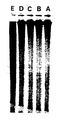
- FIG. 1 represents results of electrophoresis on polyacrylamide gel and shows the effect of an incubation of poly (dA) in the presence of various additives at 19 ° C for 140 minutes.
- concentrations used are indicated above (A: H 2 O 2 + Fe (II); B: H 2 O 2 + Fe (II) + DTT; C: H 2 O 2 + Fe (III) + DTT + EDTA (acid ethylenediaminetetraacetic); D: H 2 O 2 + Fe (II) + DTT + (TP) 7 (CH 2 ) 6 NH ⁇ EDTA; E: H 2 0 2 + Fe (II) + DTT + EDTA-NH (CH 2 ) 6 p (Tp) 6 (CH 2 ) 5 Acr).
- the oligonucleotide (Tp), (CH 2 ) 6 NH-EDTA has a much lower efficiency. Ethylenetetraacetic acid alone has practically no effect on poly (dA) under the same conditions.
- the labeled poly (dA) is prepared as indicated in Example VIII. It is incubated at 20 ° C (concentration 19 ⁇ M) in the presence of compound VI (5 ⁇ M), phenanthroline (5 ⁇ M), Cu (II) (5 ⁇ M) and dithiothreitol (1 mM) in a phosphate buffer ( 50 mM) containing 0.1 M NaCi. Poly (dA) is selectively degraded under these conditions. No effect is observed on the poly (dT) or the double helix poly (dA). poly (dT). No cut is observed in the absence of one of the constituents of the reaction mixture.
Landscapes
- Chemical & Material Sciences (AREA)
- Organic Chemistry (AREA)
- Molecular Biology (AREA)
- Life Sciences & Earth Sciences (AREA)
- Health & Medical Sciences (AREA)
- Biochemistry (AREA)
- Engineering & Computer Science (AREA)
- Genetics & Genomics (AREA)
- General Health & Medical Sciences (AREA)
- Biotechnology (AREA)
- Saccharide Compounds (AREA)
- Enzymes And Modification Thereof (AREA)
- Measuring Or Testing Involving Enzymes Or Micro-Organisms (AREA)
Claims (14)



Priority Applications (1)
| Application Number | Priority Date | Filing Date | Title |
|---|---|---|---|
| AT86401927T ATE58143T1 (de) | 1985-09-04 | 1986-09-02 | Verbindungen, enthaltend eine oligonukleotide sequenz, gebunden an eine interkalierungsverbindung und an eine aktivierbare chemische verbindung, ihre synthese und verwendungen als artifizielle sequenzspezifische nuklease. |
Applications Claiming Priority (2)
| Application Number | Priority Date | Filing Date | Title |
|---|---|---|---|
| FR8513132 | 1985-09-04 | ||
| FR8513132A FR2586704B1 (fr) | 1985-09-04 | 1985-09-04 | Nouveaux composes comportant une sequence d'oligonucleotide liee a un agent d'intercalation et a un groupe chimique activable, leur synthese et leurs applications a titre de nucleases artificielles specifiques de sequences. centre national de la recherche scientifique (cnrs) |
Publications (2)
| Publication Number | Publication Date |
|---|---|
| EP0214908A1 EP0214908A1 (de) | 1987-03-18 |
| EP0214908B1 true EP0214908B1 (de) | 1990-11-07 |
Family
ID=9322620
Family Applications (1)
| Application Number | Title | Priority Date | Filing Date |
|---|---|---|---|
| EP86401927A Expired - Lifetime EP0214908B1 (de) | 1985-09-04 | 1986-09-02 | Verbindungen, enthaltend eine oligonukleotide Sequenz, gebunden an eine Interkalierungsverbindung und an eine aktivierbare chemische Verbindung, ihre Synthese und Verwendungen als artifizielle sequenzspezifische Nuklease |
Country Status (6)
| Country | Link |
|---|---|
| EP (1) | EP0214908B1 (de) |
| JP (1) | JPS62277395A (de) |
| AT (1) | ATE58143T1 (de) |
| CA (1) | CA1279024C (de) |
| DE (1) | DE3675481D1 (de) |
| FR (1) | FR2586704B1 (de) |
Families Citing this family (26)
| Publication number | Priority date | Publication date | Assignee | Title |
|---|---|---|---|---|
| EP0266099A3 (de) * | 1986-10-28 | 1990-09-19 | The Johns Hopkins University | Alkyl- oder Arylphosphonat-Oligonukleosid, das sich mit Nukleinesäuren vernetzen kann oder das Nukleinsäure spalten kann |
| US5874555A (en) * | 1987-10-30 | 1999-02-23 | California Institute Of Technology | Triple helices and processes for making same |
| US5789155A (en) * | 1987-10-30 | 1998-08-04 | California Institute Of Technology | Process for identifying nucleic acids and triple helices formed thereby |
| DE3738460A1 (de) * | 1987-11-12 | 1989-05-24 | Max Planck Gesellschaft | Modifizierte oligonukleotide |
| US5034557A (en) * | 1988-04-16 | 1991-07-23 | Mitsui Petrochemical Industries, Ltd. | Process for production of aromatic carbonate compound |
| US5567687A (en) * | 1989-03-06 | 1996-10-22 | University Of Texas | Texaphyrins and uses thereof |
| US5514786A (en) * | 1990-01-11 | 1996-05-07 | Isis Pharmaceuticals, Inc. | Compositions for inhibiting RNA activity |
| US6358931B1 (en) | 1990-01-11 | 2002-03-19 | Isis Pharmaceuticals, Inc. | Compositions and methods for modulating RNA |
| US5210015A (en) | 1990-08-06 | 1993-05-11 | Hoffman-La Roche Inc. | Homogeneous assay system using the nuclease activity of a nucleic acid polymerase |
| US6136601A (en) * | 1991-08-21 | 2000-10-24 | Epoch Pharmaceuticals, Inc. | Targeted mutagenesis in living cells using modified oligonucleotides |
| US5607924A (en) * | 1992-01-21 | 1997-03-04 | Pharmacyclics, Inc. | DNA photocleavage using texaphyrins |
| US5565552A (en) * | 1992-01-21 | 1996-10-15 | Pharmacyclics, Inc. | Method of expanded porphyrin-oligonucleotide conjugate synthesis |
| US5595726A (en) * | 1992-01-21 | 1997-01-21 | Pharmacyclics, Inc. | Chromophore probe for detection of nucleic acid |
| US6403302B1 (en) | 1992-09-17 | 2002-06-11 | California Institute Of Technology | Methods and compositions for triple helix formation |
| FR2697254A1 (fr) * | 1992-10-22 | 1994-04-29 | Genset Sa | Conjugués constitués par un oligonucléotide lié à des dérivés de métalloporphyrine cationique, leur préparation et leur utilisation. |
| US5798491A (en) * | 1993-06-09 | 1998-08-25 | Board Of Regents, The University Of Texas System | Multi-mechanistic chemical cleavage using certain metal complexes |
| DE4418691A1 (de) * | 1994-05-28 | 1996-02-22 | Boehringer Mannheim Gmbh | 3'-(4'-) nicht-radioaktiv markierte Nukleoside und Nukleotide mit Aminocarbonsäure-, Peptid- oder Carbonsäure-Spacer |
| US5837866A (en) * | 1994-09-21 | 1998-11-17 | Board Of Regents, The University Of Texas | Phosphoramidite derivatives of macrocycles |
| US5633354A (en) * | 1994-09-21 | 1997-05-27 | Pharmacyclics, Inc. | Phosphoramidite derivatives of texaphyrins |
| US5714328A (en) * | 1995-06-07 | 1998-02-03 | Board Of Regents, The University Of Texas System | RNA photocleavage using texaphyrins |
| US6017700A (en) * | 1995-08-04 | 2000-01-25 | Bayer Corporation | Cationic oligonucleotides, and related methods of synthesis and use |
| US6022959A (en) * | 1996-08-20 | 2000-02-08 | Pharmacyclics, Inc. | Nucleic acids internally-derivatized with a texaphyrin metal complex and uses thereof |
| JP4207258B2 (ja) * | 1998-08-31 | 2009-01-14 | 東ソー株式会社 | 特定核酸配列の切断方法 |
| DE102004043155A1 (de) * | 2004-09-03 | 2006-03-23 | TransMIT Gesellschaft für Technologietransfer mbH | Hochspezifisch mit DNA interagierende Enzym-Konjugate mit programmierbarer Spezifität |
| WO2007094218A1 (ja) * | 2006-02-16 | 2007-08-23 | Gifu University | 修飾オリゴヌクレオチド |
| CN115397471B (zh) * | 2019-11-26 | 2026-01-23 | 诺华股份有限公司 | 包括核酸和半衰期延长基序的化合物 |
Family Cites Families (1)
| Publication number | Priority date | Publication date | Assignee | Title |
|---|---|---|---|---|
| FR2540122B1 (fr) * | 1983-01-27 | 1985-11-29 | Centre Nat Rech Scient | Nouveaux composes comportant une sequence d'oligonucleotide liee a un agent d'intercalation, leur procede de synthese et leur application |
-
1985
- 1985-09-04 FR FR8513132A patent/FR2586704B1/fr not_active Expired
-
1986
- 1986-09-02 EP EP86401927A patent/EP0214908B1/de not_active Expired - Lifetime
- 1986-09-02 DE DE8686401927T patent/DE3675481D1/de not_active Expired - Lifetime
- 1986-09-02 AT AT86401927T patent/ATE58143T1/de not_active IP Right Cessation
- 1986-09-03 CA CA000517347A patent/CA1279024C/fr not_active Expired - Lifetime
- 1986-09-03 JP JP61208814A patent/JPS62277395A/ja active Pending
Also Published As
| Publication number | Publication date |
|---|---|
| CA1279024C (fr) | 1991-01-15 |
| EP0214908A1 (de) | 1987-03-18 |
| FR2586704A1 (fr) | 1987-03-06 |
| ATE58143T1 (de) | 1990-11-15 |
| JPS62277395A (ja) | 1987-12-02 |
| DE3675481D1 (de) | 1990-12-13 |
| FR2586704B1 (fr) | 1987-12-18 |
Similar Documents
| Publication | Publication Date | Title |
|---|---|---|
| EP0214908A1 (de) | Verbindungen, enthaltend eine oligonukleotide Sequenz, gebunden an eine Interkalierungsverbindung und an eine aktivierbare chemische Verbindung, ihre Synthese und Verwendungen als artifizielle sequenzspezifische Nuklease | |
| EP0169787B1 (de) | Verwendung von an ein interkalatines Produkt gebundenen Oligonukleotiden für pharmazeutische Zusammensetzungen | |
| US5292873A (en) | Nucleic acids labeled with naphthoquinone probe | |
| FR2607507A1 (fr) | Nouveaux derives a-d-oligonucleotides, leur preparation et leur emploi | |
| Seela et al. | Modification of DNA with octadiynyl side chains: synthesis, base pairing, and formation of fluorescent coumarin dye conjugates of four nucleobases by the alkyne− azide “click” reaction | |
| EP0241363B1 (de) | Nukleosid-Derivate und ihre Verwendung in der Oligonukleosid-Synthese | |
| US5264564A (en) | Oligonucleotide analogs with novel linkages | |
| US5550111A (en) | Dual action 2',5'-oligoadenylate antiviral derivatives and uses thereof | |
| CA2071483C (en) | Oligonucleotide analogs with novel linkages | |
| EP0117777B1 (de) | Verbindungen,welche eine oligonucleotide Sequenz enthalten, die an einen Interkalationsstoff gebunden ist, Verfahren zu deren Synthese und deren Verwendung | |
| US5264562A (en) | Oligonucleotide analogs with novel linkages | |
| JP2899111B2 (ja) | オリゴヌクレオチドの5’末端へ官能基を提供するための修飾された亜リン酸中間体 | |
| EP0625986A1 (de) | Oligothionukleotide. | |
| EP0543889A1 (de) | Einführung selektiv spaltbarer und/oder abasischer stellen in oligonukleotidketten und reagenzien dafür | |
| EP0290583B1 (de) | Alpha-oligonukleotide | |
| EP0748331A1 (de) | Midifizierte oligonukleotide duplexe mit antikrebs wirkung | |
| Adinolfi et al. | Solid phase synthesis of oligonucleotides tethered to oligo-glucose phosphate tails | |
| JPH03155779A (ja) | オリゴヌクレオチドと酵素の結合物およびその製造方法 | |
| JP2000511933A (ja) | ホスホロチオエートオリゴヌクレオチド合成法 | |
| FR2697254A1 (fr) | Conjugués constitués par un oligonucléotide lié à des dérivés de métalloporphyrine cationique, leur préparation et leur utilisation. | |
| FR2636633A1 (fr) | Procede de synthese d'oligoribonucleotides alpha et composes utiles dans le procede | |
| EP0819134B1 (de) | Oligonukelotide mit transversalkovalenter bindung, verfahren zu ihrer herstellung und darin benutztes synthon | |
| US5650399A (en) | Reactive anthraquinone derivatives and conjugates thereof | |
| JPS5993099A (ja) | オリゴヌクレオチド誘導体およびその製造法 | |
| JPH0374239B2 (de) |
Legal Events
| Date | Code | Title | Description |
|---|---|---|---|
| PUAI | Public reference made under article 153(3) epc to a published international application that has entered the european phase |
Free format text: ORIGINAL CODE: 0009012 |
|
| AK | Designated contracting states |
Kind code of ref document: A1 Designated state(s): AT BE CH DE FR GB IT LI LU NL SE |
|
| 17P | Request for examination filed |
Effective date: 19870914 |
|
| 17Q | First examination report despatched |
Effective date: 19900108 |
|
| GRAA | (expected) grant |
Free format text: ORIGINAL CODE: 0009210 |
|
| ITF | It: translation for a ep patent filed | ||
| AK | Designated contracting states |
Kind code of ref document: B1 Designated state(s): AT BE CH DE FR GB IT LI LU NL SE |
|
| REF | Corresponds to: |
Ref document number: 58143 Country of ref document: AT Date of ref document: 19901115 Kind code of ref document: T |
|
| GBT | Gb: translation of ep patent filed (gb section 77(6)(a)/1977) | ||
| REF | Corresponds to: |
Ref document number: 3675481 Country of ref document: DE Date of ref document: 19901213 |
|
| PLBI | Opposition filed |
Free format text: ORIGINAL CODE: 0009260 |
|
| 26 | Opposition filed |
Opponent name: BOEHRINGER MANNHEIM GMBH Effective date: 19910807 |
|
| NLR1 | Nl: opposition has been filed with the epo |
Opponent name: BOEHRINGER MANNHEIM GMBH |
|
| ITTA | It: last paid annual fee | ||
| EPTA | Lu: last paid annual fee | ||
| PLBN | Opposition rejected |
Free format text: ORIGINAL CODE: 0009273 |
|
| STAA | Information on the status of an ep patent application or granted ep patent |
Free format text: STATUS: OPPOSITION REJECTED |
|
| 27O | Opposition rejected |
Effective date: 19940130 |
|
| REG | Reference to a national code |
Ref country code: FR Ref legal event code: CL |
|
| NLR2 | Nl: decision of opposition | ||
| EAL | Se: european patent in force in sweden |
Ref document number: 86401927.8 |
|
| PGFP | Annual fee paid to national office [announced via postgrant information from national office to epo] |
Ref country code: AT Payment date: 19950824 Year of fee payment: 10 |
|
| PGFP | Annual fee paid to national office [announced via postgrant information from national office to epo] |
Ref country code: LU Payment date: 19950901 Year of fee payment: 10 |
|
| PGFP | Annual fee paid to national office [announced via postgrant information from national office to epo] |
Ref country code: CH Payment date: 19950914 Year of fee payment: 10 |
|
| PGFP | Annual fee paid to national office [announced via postgrant information from national office to epo] |
Ref country code: SE Payment date: 19950927 Year of fee payment: 10 |
|
| PG25 | Lapsed in a contracting state [announced via postgrant information from national office to epo] |
Ref country code: LU Free format text: LAPSE BECAUSE OF NON-PAYMENT OF DUE FEES Effective date: 19960902 Ref country code: AT Effective date: 19960902 |
|
| PG25 | Lapsed in a contracting state [announced via postgrant information from national office to epo] |
Ref country code: SE Effective date: 19960903 |
|
| PG25 | Lapsed in a contracting state [announced via postgrant information from national office to epo] |
Ref country code: LI Effective date: 19960930 Ref country code: CH Effective date: 19960930 |
|
| REG | Reference to a national code |
Ref country code: CH Ref legal event code: PL |
|
| EUG | Se: european patent has lapsed |
Ref document number: 86401927.8 |
|
| PGFP | Annual fee paid to national office [announced via postgrant information from national office to epo] |
Ref country code: FR Payment date: 19980728 Year of fee payment: 13 |
|
| PGFP | Annual fee paid to national office [announced via postgrant information from national office to epo] |
Ref country code: NL Payment date: 19980825 Year of fee payment: 13 Ref country code: GB Payment date: 19980825 Year of fee payment: 13 |
|
| PGFP | Annual fee paid to national office [announced via postgrant information from national office to epo] |
Ref country code: DE Payment date: 19980917 Year of fee payment: 13 |
|
| PGFP | Annual fee paid to national office [announced via postgrant information from national office to epo] |
Ref country code: BE Payment date: 19981016 Year of fee payment: 13 |
|
| PG25 | Lapsed in a contracting state [announced via postgrant information from national office to epo] |
Ref country code: GB Free format text: LAPSE BECAUSE OF NON-PAYMENT OF DUE FEES Effective date: 19990902 |
|
| PG25 | Lapsed in a contracting state [announced via postgrant information from national office to epo] |
Ref country code: BE Free format text: LAPSE BECAUSE OF NON-PAYMENT OF DUE FEES Effective date: 19990930 |
|
| BERE | Be: lapsed |
Owner name: CENTRE NATIONAL DE LA RECHERCHE SCIENTIFIQUE CNRS Effective date: 19990930 |
|
| PG25 | Lapsed in a contracting state [announced via postgrant information from national office to epo] |
Ref country code: NL Free format text: LAPSE BECAUSE OF NON-PAYMENT OF DUE FEES Effective date: 20000401 |
|
| GBPC | Gb: european patent ceased through non-payment of renewal fee |
Effective date: 19990902 |
|
| PG25 | Lapsed in a contracting state [announced via postgrant information from national office to epo] |
Ref country code: FR Free format text: LAPSE BECAUSE OF NON-PAYMENT OF DUE FEES Effective date: 20000531 |
|
| NLV4 | Nl: lapsed or anulled due to non-payment of the annual fee |
Effective date: 20000401 |
|
| PG25 | Lapsed in a contracting state [announced via postgrant information from national office to epo] |
Ref country code: DE Free format text: LAPSE BECAUSE OF NON-PAYMENT OF DUE FEES Effective date: 20000701 |
|
| REG | Reference to a national code |
Ref country code: FR Ref legal event code: ST |
|
| PG25 | Lapsed in a contracting state [announced via postgrant information from national office to epo] |
Ref country code: IT Free format text: LAPSE BECAUSE OF NON-PAYMENT OF DUE FEES;WARNING: LAPSES OF ITALIAN PATENTS WITH EFFECTIVE DATE BEFORE 2007 MAY HAVE OCCURRED AT ANY TIME BEFORE 2007. THE CORRECT EFFECTIVE DATE MAY BE DIFFERENT FROM THE ONE RECORDED. Effective date: 20050902 |