EP0219089B1 - Hochfester hitzebeständiger ferritischer Stahl mit hohem Chromgehalt und Verfahren zu seiner Herstellung - Google Patents
Hochfester hitzebeständiger ferritischer Stahl mit hohem Chromgehalt und Verfahren zu seiner Herstellung Download PDFInfo
- Publication number
- EP0219089B1 EP0219089B1 EP86114164A EP86114164A EP0219089B1 EP 0219089 B1 EP0219089 B1 EP 0219089B1 EP 86114164 A EP86114164 A EP 86114164A EP 86114164 A EP86114164 A EP 86114164A EP 0219089 B1 EP0219089 B1 EP 0219089B1
- Authority
- EP
- European Patent Office
- Prior art keywords
- strength
- steel
- temperature
- present
- content
- Prior art date
- Legal status (The legal status is an assumption and is not a legal conclusion. Google has not performed a legal analysis and makes no representation as to the accuracy of the status listed.)
- Expired - Lifetime
Links
Images



Classifications
-
- C—CHEMISTRY; METALLURGY
- C22—METALLURGY; FERROUS OR NON-FERROUS ALLOYS; TREATMENT OF ALLOYS OR NON-FERROUS METALS
- C22C—ALLOYS
- C22C38/00—Ferrous alloys, e.g. steel alloys
- C22C38/18—Ferrous alloys, e.g. steel alloys containing chromium
- C22C38/26—Ferrous alloys, e.g. steel alloys containing chromium with niobium or tantalum
-
- C—CHEMISTRY; METALLURGY
- C22—METALLURGY; FERROUS OR NON-FERROUS ALLOYS; TREATMENT OF ALLOYS OR NON-FERROUS METALS
- C22C—ALLOYS
- C22C38/00—Ferrous alloys, e.g. steel alloys
- C22C38/18—Ferrous alloys, e.g. steel alloys containing chromium
- C22C38/22—Ferrous alloys, e.g. steel alloys containing chromium with molybdenum or tungsten
-
- C—CHEMISTRY; METALLURGY
- C22—METALLURGY; FERROUS OR NON-FERROUS ALLOYS; TREATMENT OF ALLOYS OR NON-FERROUS METALS
- C22C—ALLOYS
- C22C38/00—Ferrous alloys, e.g. steel alloys
- C22C38/18—Ferrous alloys, e.g. steel alloys containing chromium
- C22C38/24—Ferrous alloys, e.g. steel alloys containing chromium with vanadium
-
- F—MECHANICAL ENGINEERING; LIGHTING; HEATING; WEAPONS; BLASTING
- F28—HEAT EXCHANGE IN GENERAL
- F28F—DETAILS OF HEAT-EXCHANGE AND HEAT-TRANSFER APPARATUS, OF GENERAL APPLICATION
- F28F21/00—Constructions of heat-exchange apparatus characterised by the selection of particular materials
- F28F21/08—Constructions of heat-exchange apparatus characterised by the selection of particular materials of metal
- F28F21/081—Heat exchange elements made from metals or metal alloys
- F28F21/082—Heat exchange elements made from metals or metal alloys from steel or ferrous alloys
- F28F21/083—Heat exchange elements made from metals or metal alloys from steel or ferrous alloys from stainless steel
Definitions
- the present invention relates to a process for producing a high strength high-Cr ferritic, heat-resistant steel with improved high temperature properties, long-term creep strength, the steel being suitable for products such as steam generators, boilers, and the like which must resist high temperatures and pressures.
- the thus produced steel is advantageously used at a temperature of 600 ° C or higher.
- the process includes a special heat treatment which gives the steel improved creep strength at elevated temperatures for long periods of time.
- high-temperature, high-pressure boilers are designed taking into consideration an allowable stress calculated on the basis of creep strength at an elevated temperature after 10 5 hours.
- the below-mentioned steel of DIN X 20CrMo W V 121 exhibits 61 MPa (6.2 kgf/mm 2 ) at 600 ° C after 10 5 hours.
- the following steels are appropriate for such uses: (i) austenitic stainless steels, (ii) low-alloy steels such as 2 1/4Cr-1 Mo steel, and (iii) high-Cr ferritic steels such as 9Cr-1 Mo steel.
- high-Cr ferritic steels possess the advantages that they are much superior to low-alloy steels concerning the resistant to hot corrosion and oxidation and that they exhibit excellent thermal conductivity and stress- corrosion resistance in comparing with those of austenitic stainless steels.
- high-Cr ferritic steels are less expensive than austenitic stainless steels.
- this type of steel has a high Cr content so as to further improve the resistance to oxidation. It can be advantageously used as a heat-resistant structural member at a high temperature in place of low-alloy steels, which cannot be used at temperatures higher than 600°C.
- high-Cr ferritic steels exhibiting improved high-temperature strength are 9Cr-1 Mo steel (S TBA 26), a newly- developed 9Cr steel (ASTM A213 T91), and 12Cr-1 Mo steel (DIN X 20CrMo W V 121).
- high-Cr ferritic steels are of the precipitation hardenable type.
- high-Cr ferritic steels containing precipitation hardening elements such as V, and Nb exhibit a rapid decrease in creep strength at a temperature higher than 600°C.
- high strength ferritic steel is usually subjected to normalizing and tempering when it is heat treated.
- the tempering is carried out at a temperature which is at most 30 - 50°C lower than the A c1 point, but higher than the service temperature.
- This heat treatment is carried out for achieving a stable metallurgical structure of tempered martensite to further improve high-temperature, long-term creep strength.
- the tempering temperature is lower than the above-mentioned range, the creep strength increases for a short period, but after a certain length of time, the structure is recrystallized at high temperatures, and a rapid decrease in strength takes place.
- the tempering temperature be 800 ° C or higher.
- the ⁇ c1 point of a conventional steel is about 800 ° C, and in an actual production line the temperature of a heating furnace fluctuates to some extent. Therefore, it is practically impossible to carry out tempering at a temperature higher than 800 C.
- an austenitic former element such as C, Mn, Ni, and N decreases the A c1 point, but it is conventional to intentionally add such elements so as to suppress the formation of delta-ferrite.
- the formation of a large amount of delta-ferrite is not desirable with regards to strength and toughness, although the presence of a small amount of delta-ferrite is allowable.
- JP-A-55-110758 discloses preferable conditions for the heat treatment of Cr-steels for use at high temperatures. Further, it defines the amount of A1 as being not more than 0.02% by weight, but the A1 is referred to as an impurity.
- the creep strength of the resulting steel is rather low, i.e., under conditions of 650 ° C x 88.3 MPa (x 9 kgf/ mm 2 ) rupture takes place after only 1400 hours.
- Japanese Patent Publication No. 36341/1982 discloses a heat treatment of the same type of Cr-steels.
- JP-A -58 181849 teaches the combination of A1-deoxidation and Nb addition. However, this reference does not mention anything about the importance of the A c1 point in obtaining a steel which can resist conditions of 650 ° C x 78.5 MPa (x 8 kgf/mm 2 ) for 2600 hours or more.
- An object of the present invention is to provide a process for producing a high-Cr ferritic, heat-resistant steel which exhibits improved high-temperature, long-term creep strength, e.g., a ferritic steel which exhibits creep strength higher than that of the conventional steel, e.g., 61 MPa (6.2 kgf/mm 2 ) of DIN X 20CrMo W V 121 at a temperature of 600 °C or higher after 10 5 hours.
- 61 MPa 6.2 kgf/mm 2
- DIN X 20CrMo W V 121 e.g., 61 MPa (6.2 kgf/mm 2 ) of DIN X 20CrMo W V 121 at a temperature of 600 °C or higher after 10 5 hours.
- 61 MPa 6.2 kgf/mm 2
- DIN X 20CrMo W V 121 e.g., 61 MPa (6.2 kgf/mm 2 ) of DIN X 20CrMo W V 121 at a temperature
- the present invention is a process for producing a high-strength high-Cr ferritic, heat-resistant steel exhibiting improved high-temperature, long-term creep strength, which consists of, by weight %:
- the steel consists of, by weight %:
- One of the features of the present invention is a process for producing a steel composition which takes into account the A c1 point.
- the A c1 point is defined as being not lower than 820°C, and preferably not lower than 850 ° C so as to suppress the gamma transformation as well as to carry out high-temperature tempering at 800°C or higher, usually 810°C or higher. A fluctuation in temperature in the course of heat treatment is also taken into account.
- the Cr-equivalent mentioned before is defined so as to restrict the amount of delta-ferrite. Sometimes the amount of delta-ferrite increases even for a steel composition whose ⁇ c1 point is defined as being 850°C or higher. When the amount of delta-ferrite is moderate, the weldability as well as formability are improved substantially. However, when the amount of delta-ferrite is large, the strength and toughness are impaired. Therefore, the Cr-equivalent is preferably 17 or lower so as to provide a steel with high strength and toughness as well as good formability and weldability.
- the steel composition produced by the process of the present invention is preferably restricted to a particular one for the following reasons.
- Carbon combines with Cr, Mo, W, V, and Nb to form a carbide, resulting in improved high-temperature creep strength.
- the carbon content is less than 0.05%, the structure is ferritic, degrading toughness and strength to some extent.
- the carbon content is over 0.2%, and sometimes when it is over 0.15%, the ⁇ c1 point decreases markedly, and it is impossible to carry out tempering at a temperature of 810°C or higher.
- an increase in the amount of carbide renders the steel hard, degrading formability and weldability.
- the carbon content is defined as being not more than 0.2%, and preferably 0.05 - 0.15% by weight.
- Si is added as a deoxidizing agent, Si is also able to improve the resistance to steam oxidation. However, when the Si content is over 1 %, the toughness is impaired, and the creep strength is adversely affected. Thus, according to the present invention, the Si content is restricted to 1% or less.
- Mn Manganese
- Mn is effective not only to improve hot formability but also to stabilize impurities such as P and S.
- impurities such as P and S.
- Mn content is less than 0,1%, and usually when it is less than 0.2%, no substantial effect is obtained.
- Mn content is over 1.5%, and usually when it is over 1 %, a hardened phase is formed, impairing toughness.
- the manganese content is therefore defined as 0.1 - 1.5%, and preferably 0.2 - 1.0%.
- Nickel is an austenite former and is effective to stabilize martensite structure. However, when the Ni content is over 1.0%, and usually when it is over 0.8%, the creep strength is lowered. Thus, the Ni content is restricted to 1.0% or less, and preferably 0.8% or less.
- Chromium is an essential element for giving the steel a satisfactory level of hot corrosion and oxidation resistance.
- the chromium content is less than 5.0%, and usually when it is less than 8.0%, a satisfactory level of oxidation resistance cannot be obtained.
- the Cr content is over 15%, and usually when it is over 13%, the amount of delta-ferrite increases to impair strength and toughness.
- the chromium content is restricted to 5 - 15%, and preferably 8 - 13%.
- Mo Mo (Molybdenum):
- Molybedenum is an element effective for achieving solution strengthening which improves creep strength.
- Mo content is less than 0.02%, and sometimes when it is less than 0.5%, the intended effect cannot be expected.
- Mo content is over 3%, a large amount of an intermetallic compound will precipitate at an elevated temperature and not only toughness but also strength will deteriorate.
- the Mo content is defined as 0.02 - 3.0%, and preferably 0.5 - 3.0% by weight.
- tungsten is an effective solution strengthening element to improve creep strength.
- the W content is defined as being not more than 4.0%, and preferably 0.5 - 3.0%.
- the atomic size of W is larger than that of Mo, and the diffusion rate of W is slow. Therefore, the addition of W is effective to achieve solution hardening. Further, W is dissolved into a carbide to suppress coarsening of carbides and recrystallizing of tempered martensite during services at high temperatures.
- Aluminum is added as an deoxidizing agent.
- AI is added in an amount of over 0.04%, the high-temperature creep strength is deteriorated.
- the amount of sol. AI is less than 0.005%, the degree of deoxidation is insufficient to ensure the desired level of strength and toughness.
- strength and toughness can be maintained at a satisfactory level by restricting the amount of sol. AI to 0.005 - 0.040% by weight.
- Nitrogen combines with V and Nb to form carbo-, nitrides, the formation of which is effective to improve creep strength.
- the amount of added N is over 0.07%, the formability as well as weldability are degraded.
- N is added in an amount of less than 0,003%, the intended effect cannot be expected.
- the nitrogen content is restricted to not more than 0.07%, and preferably 0.003 - 0.07%.
- V combines with C and N to form finely dispersed precipitates such as V(C,N), which are stable at high temperatures for an extended period of time.
- the dispersed V(C,N) is significantly effective to improve long-term creep strength.
- the V content is defined as being 0.1 - 0.4%, and preferably 0.2 - 0.3%.
- niobium Like V, niobium combines with C, N to form fine precipitates such as Nb(C,N), which are effective to improve creep strength. Nb is effective to improve creep strength in a short period. When it is added excessively, the thus formed Nb(C,N) easily grows coarse and impairs creep strength. Furthermore, niobium which is present as precipitates is effective to prevent the fine crystal grains of austenite from coarsening during normalizing treatment, thus markedly
- the Nb content is defined as 0.01 - 0.3%, or 0.01 - 0.2%, and preferably 0.1 % or less. A more preferred Nb content is about 0.05%.
- these elements are added in a small amount so as to control the shape of inclusions.
- impurities such as oxygen, phosphorus, and sulfur are excluded to improve strength as well as toughness.
- it is added in an amount of more than 0.2%, the amount of inclusions increases, and the toughness is rather impaired. Therefore, according to the process of the present invention, the content of these elements, when added, is restricted to 0.01 - 0.2%.
- a steel having the composition defined above is successfully subjected to high-temperature tempering after normalizing to further improve the high-temperature, long-term creep strength.
- the martensite formed after normalizing is subjected to tempering, while fine carbo-, nitrides of V and/or Nb are precipitated, greatly suppressing recovery of dislocations. Therefore, the metallurgical structure becomes unstable at elevated temperatures if the tempering temperature is relatively low. Namely, a V- and/or Nb-containing steel is highly resistant to softening after tempering.
- the tempering is carried out at a temperature which is lower than 800°C, the martensite phase is recrystallized during high-temperature use at 600°C or higher, markedly decreasing the strength.
- the tempering is carried out at a high temperature of 810°C or higher, the martensite is well stabilized and the recrystallization during high-temperature use is successfully suppressed to achieve improved high-temperature properties, e.g. the steel can be used at 600°C or higher for 10 5 hours or more.
- the steels having the chemical compositions shown in Table 1 were melted in a vacuum induction furnace to prepare 50 Kg ingots. The ingots were then forged at 1150 - 950°C to form plates of steel 20 mm thick. The plates were subjected to the heat treatment indicated in Table 2. After heat treatment, a creep and tensile test was applied to the test pieces (6mm ⁇ x GL 30mm) were cut from the center portion of the plate thickness. The test results are summarized in Table 2.
- a comparative tempered steel exhibits a relatively high strength for up to 10 3 hours. However, after 10 4 hours the strength decreases rapidly for the comparative tempered steel. According to the process of the present invention, a stable level of strength can be obtained even after 10 4 hours.
- the strength of the steel produced by the process of the present invention exceeds that of the comparative tempered steel after 10 4 hours have elapsed.
- the steel produced by the process of present invention is superior to the comparative steel.
- the creep rupture strength at 600°C extrapolated to 10 5 hours is 60,00 MPa (6.2 kgf/mm 2 ), and that according to the heat treatment of the present invention the creep rupture strength reaches 89.3 MPa (9.1 kgf/mm 2 ). Furthermore at a temperature of 650°C the creep rupture strength extrapolated to 10 5 hours is 44.1 MPa (4.5 kgf/mm 2 ) for the process of the present invention, 28.4 MPa (2.9 kgf/mm 2 ) for the comparative one.
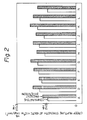
- Fig. 2 is a graph which illustrates the test results of Table 2.
- the hatched bars indicate creep rupture strength for the steel produced by the process of the present invention will the unhatched bars indicate the values for samples of steel having the same compositions but which were not heat treated in accordance with the process of the present invention.
- the heat treatment of the present invention resulted in a substantial improvement in creep strength at 650°C for 10 4 hours.
- Example 1 was repeated using steels having the chemical compositions shown in Table 3.
- Steels A and B of Table 3 were subjected to normalizing heat treatment by applying heat at 950°C for 1 hour followed by air cooling, and then tempering was carried out by heating at 750°C for 1 hour followed by air cooling.
- Fig. 3 is a graph showing creep rupture time under 650°C x 78.5 (x 8 kgf/mm 2 ), the data being taken from Table 4.
- Fig. 4 is also a graph summarizing the data given in Table 4 in a different way. The criticality of the ⁇ c1 point is apparent therefrom.
- the steels produced by the process of the present invention exceed the desired level for high-temperature, long-term creep strength.
- a high-Cr ferritic steel according to the process of the present invention can exhibit much improved high-temperature, long-term creep strength.
- the steel can exhibit satisfactory high-temperature strength under 650°C x 78.5 MPa (x 8 kgf/mm 2 ) for over 2600 hours.
- the A c1 point is 820°C or higher, and usually 850°C or higher according to the process of the present invention, the following advantages can be obtained:
Landscapes
- Chemical & Material Sciences (AREA)
- Engineering & Computer Science (AREA)
- Materials Engineering (AREA)
- Mechanical Engineering (AREA)
- Metallurgy (AREA)
- Organic Chemistry (AREA)
- Heat Treatment Of Steel (AREA)
Claims (4)
mindestens einem aus V: 0,01 - 0,4% und Nb: 0,01 - 0,3%, B: 0 - 0,02%,
mindestens einem aus Ca, Ti, Zr, Y, La und Ce: 0 - 0,2% und
dem Rest Fe sowie zufälligen Verunreinigungen,
wobei der Ac1-Punkt, wie durch die nachstehende Formel (1) definiert, 820 ° C oder mehr beträgt;

mindestens einem aus Ca, Ti, Zr, Y, La und Ce: 0 - 0,2% und
dem Rest Fe sowie zufälligen Verunreinigungen,
wobei der Ac1-Punkt, wie durch die Formel (1) definiert, 850°C oder mehre beträgt und das Cr- Äquivalent, wie durch die folgende Formel (2) definiert, 17 oder weniger beträgt:

mindestens eines aus Ca, Ti, Zr, Y, La und Ce: 0,01 - 0,2%.
Priority Applications (1)
| Application Number | Priority Date | Filing Date | Title |
|---|---|---|---|
| EP90125139A EP0427301B1 (de) | 1985-10-14 | 1986-10-13 | Hochfester hitzebeständiger ferritischer Stahl mit hohem Chromgehalt |
Applications Claiming Priority (4)
| Application Number | Priority Date | Filing Date | Title |
|---|---|---|---|
| JP226993/85 | 1985-10-14 | ||
| JP22699485A JPS6289811A (ja) | 1985-10-14 | 1985-10-14 | 高強度高Crフエライト鋼の熱処理法 |
| JP226994/85 | 1985-10-14 | ||
| JP22699385A JPS6289842A (ja) | 1985-10-14 | 1985-10-14 | 高温用高クロムフエライト鋼 |
Related Child Applications (2)
| Application Number | Title | Priority Date | Filing Date |
|---|---|---|---|
| EP90125139.7 Division-Into | 1986-10-13 | ||
| EP90125139A Division-Into EP0427301B1 (de) | 1985-10-14 | 1986-10-13 | Hochfester hitzebeständiger ferritischer Stahl mit hohem Chromgehalt |
Publications (3)
| Publication Number | Publication Date |
|---|---|
| EP0219089A2 EP0219089A2 (de) | 1987-04-22 |
| EP0219089A3 EP0219089A3 (en) | 1988-09-28 |
| EP0219089B1 true EP0219089B1 (de) | 1992-07-22 |
Family
ID=26527449
Family Applications (2)
| Application Number | Title | Priority Date | Filing Date |
|---|---|---|---|
| EP86114164A Expired - Lifetime EP0219089B1 (de) | 1985-10-14 | 1986-10-13 | Hochfester hitzebeständiger ferritischer Stahl mit hohem Chromgehalt und Verfahren zu seiner Herstellung |
| EP90125139A Expired - Lifetime EP0427301B1 (de) | 1985-10-14 | 1986-10-13 | Hochfester hitzebeständiger ferritischer Stahl mit hohem Chromgehalt |
Family Applications After (1)
| Application Number | Title | Priority Date | Filing Date |
|---|---|---|---|
| EP90125139A Expired - Lifetime EP0427301B1 (de) | 1985-10-14 | 1986-10-13 | Hochfester hitzebeständiger ferritischer Stahl mit hohem Chromgehalt |
Country Status (3)
| Country | Link |
|---|---|
| US (2) | US4799972A (de) |
| EP (2) | EP0219089B1 (de) |
| DE (2) | DE3650515T2 (de) |
Families Citing this family (34)
| Publication number | Priority date | Publication date | Assignee | Title |
|---|---|---|---|---|
| JPS61231139A (ja) * | 1985-04-06 | 1986-10-15 | Nippon Steel Corp | 高強度フエライト系耐熱鋼 |
| US4929288A (en) * | 1988-01-04 | 1990-05-29 | Borges Robert J | Corrosion and abrasion resistant alloy |
| JPH01268846A (ja) * | 1988-04-20 | 1989-10-26 | Kawasaki Steel Corp | 熱間プレス工具用鋼 |
| JPH0621323B2 (ja) * | 1989-03-06 | 1994-03-23 | 住友金属工業株式会社 | 耐食、耐酸化性に優れた高強度高クロム鋼 |
| JPH02305944A (ja) * | 1989-05-20 | 1990-12-19 | Tohoku Tokushuko Kk | 高耐食電磁ステンレス鋼 |
| JPH0826438B2 (ja) * | 1990-03-27 | 1996-03-13 | 日立金属株式会社 | 熱疲労寿命に優れたフェライト系耐熱鋳鋼 |
| JP3027012B2 (ja) * | 1990-12-28 | 2000-03-27 | 日新製鋼株式会社 | 耐食性および加工性に優れた高強度クロム含有鋼板 |
| JP3027011B2 (ja) * | 1990-12-28 | 2000-03-27 | 日新製鋼株式会社 | 耐食性および加工性に優れたクロム含有鋼板 |
| US5207843A (en) * | 1991-07-31 | 1993-05-04 | Latrobe Steel Company | Chromium hot work steel |
| EP0573343B1 (de) * | 1992-06-01 | 1998-02-25 | Sumitomo Metal Industries, Ltd. | Feinbleche und Folie aus ferritisches rostfreies Stahl und Verfahren zu ihrer Herstellung |
| US5310431A (en) * | 1992-10-07 | 1994-05-10 | Robert F. Buck | Creep resistant, precipitation-dispersion-strengthened, martensitic stainless steel and method thereof |
| NO303695B1 (no) * | 1994-03-09 | 1998-08-17 | Mannesmann Ag | Stål med høy varmefasthet for kjelebygging |
| CA2202259C (en) * | 1994-10-11 | 2002-04-16 | Theodore Kosa | Corrosion-resistant magnetic material |
| JPH08218154A (ja) * | 1995-02-14 | 1996-08-27 | Nippon Steel Corp | 耐金属間化合物析出脆化特性の優れた高強度フェライト系耐熱鋼 |
| JPH0959747A (ja) * | 1995-08-25 | 1997-03-04 | Hitachi Ltd | 高強度耐熱鋳鋼,蒸気タービンケーシング,蒸気タービン発電プラント及び蒸気タービン |
| JP3306572B2 (ja) * | 1995-08-25 | 2002-07-24 | 新日本製鐵株式会社 | 耐孔あき性およびさびの密着性に優れた煙突・煙道用鋼 |
| US6696016B1 (en) * | 1999-09-24 | 2004-02-24 | Japan As Represented By Director General Of National Research Institute For Metals | High-chromium containing ferrite based heat resistant steel |
| JP2002038242A (ja) * | 2000-07-27 | 2002-02-06 | Kawasaki Steel Corp | 二次加工性に優れた自動車構造部材用ステンレス鋼管 |
| JP4023106B2 (ja) * | 2001-05-09 | 2007-12-19 | 住友金属工業株式会社 | 溶接熱影響部軟化の小さいフェライト系耐熱鋼 |
| US6890393B2 (en) * | 2003-02-07 | 2005-05-10 | Advanced Steel Technology, Llc | Fine-grained martensitic stainless steel and method thereof |
| US6899773B2 (en) * | 2003-02-07 | 2005-05-31 | Advanced Steel Technology, Llc | Fine-grained martensitic stainless steel and method thereof |
| KR100580112B1 (ko) * | 2003-12-19 | 2006-05-12 | 한국원자력연구소 | 고 크롬 페라이트/마르텐사이트 내열합금의 제조방법 |
| CN100342052C (zh) * | 2004-01-20 | 2007-10-10 | 吉林大学 | 热作模具钢 |
| RU2352680C1 (ru) * | 2007-09-24 | 2009-04-20 | Государственное образовательное учреждение высшего профессионального образования "Уральский государственный технический университет - УПИ имени первого Президента России Б.Н.Ельцина" | Ферритная коррозионно-стойкая сталь |
| RU2566122C1 (ru) | 2011-11-22 | 2015-10-20 | Ниппон Стил Энд Сумитомо Метал Корпорейшн | Жаростойкая ферритная сталь и способ ее получения |
| US10179943B2 (en) | 2014-07-18 | 2019-01-15 | General Electric Company | Corrosion resistant article and methods of making |
| RU2664494C1 (ru) * | 2014-11-25 | 2018-08-17 | Ниппон Стил Энд Сумитомо Метал Корпорейшн | Способ изготовления ребристой трубы |
| CN105239536B (zh) * | 2015-10-01 | 2017-04-12 | 济源市蟒河口水库管理处 | 一种水利工程用城市拦河闸 |
| CN105063498B (zh) * | 2015-10-01 | 2017-01-18 | 河南省水利水电学校 | 水利工程用放水闸门 |
| WO2017074738A1 (en) | 2015-10-30 | 2017-05-04 | Northwestern University | High temperature steel for steam turbine and other applications |
| JP2019528375A (ja) * | 2016-07-28 | 2019-10-10 | ボーグワーナー インコーポレーテッド | ターボチャージャ用フェライト系鋼 |
| CN111349850B (zh) * | 2018-12-24 | 2022-03-18 | 宝山钢铁股份有限公司 | 一种高耐蚀耐候钢及其制造方法 |
| KR102324087B1 (ko) * | 2019-12-18 | 2021-11-10 | 한전원자력연료 주식회사 | 페라이트계 합금 및 이를 이용한 핵연료 피복관의 제조방법 |
| CN113774279B (zh) * | 2021-08-20 | 2022-07-01 | 中国原子能科学研究院 | 核反应堆合金材料,其制备方法、部件及焊接方法 |
Citations (3)
| Publication number | Priority date | Publication date | Assignee | Title |
|---|---|---|---|---|
| JPS55110758A (en) * | 1979-02-20 | 1980-08-26 | Sumitomo Metal Ind Ltd | High temperature use chromium steel |
| JPS5696056A (en) * | 1979-12-28 | 1981-08-03 | Mitsubishi Heavy Ind Ltd | High chromium steel for high temperature use |
| JPS58181049A (ja) * | 1982-04-17 | 1983-10-22 | Canon Inc | 電子写真感光体 |
Family Cites Families (9)
| Publication number | Priority date | Publication date | Assignee | Title |
|---|---|---|---|---|
| GB795471A (en) * | 1955-02-28 | 1958-05-21 | Birmingham Small Arms Co Ltd | Improvements in or relating to alloy steels |
| GB796733A (en) * | 1955-07-09 | 1958-06-18 | Birmingham Small Arms Co Ltd | Improvements in or relating to alloy steels |
| GB1108687A (en) * | 1966-03-29 | 1968-04-03 | Hitichi Ltd | Ferritic heat-resisting steel |
| AT340980B (de) * | 1974-10-23 | 1978-01-10 | Voest Ag | Verfahren zur herstellung oberflachenentkohlter stahlbleche |
| JPS5914098B2 (ja) * | 1980-06-24 | 1984-04-03 | 株式会社神戸製鋼所 | 高温純水環境における耐応力腐食割れ性に優れたフエライト系ステンレス鋼 |
| JPS5914097B2 (ja) * | 1980-07-30 | 1984-04-03 | 新日本製鐵株式会社 | 靭性を改良せるフェライト系耐熱鋼 |
| JPS5736341A (en) * | 1980-08-14 | 1982-02-27 | Tokyo Electric Co Ltd | Electronic cash register |
| JPS58181849A (ja) * | 1982-04-14 | 1983-10-24 | Sumitomo Metal Ind Ltd | 高温用高クロム鋼 |
| JPS60165359A (ja) * | 1984-02-09 | 1985-08-28 | Toshio Fujita | 蒸気タ−ビン高中圧ロ−タ用高強度高靭性鋼 |
-
1986
- 1986-10-10 US US06/917,502 patent/US4799972A/en not_active Expired - Lifetime
- 1986-10-13 DE DE3650515T patent/DE3650515T2/de not_active Expired - Lifetime
- 1986-10-13 EP EP86114164A patent/EP0219089B1/de not_active Expired - Lifetime
- 1986-10-13 EP EP90125139A patent/EP0427301B1/de not_active Expired - Lifetime
- 1986-10-13 DE DE8686114164T patent/DE3686121T2/de not_active Expired - Lifetime
-
1988
- 1988-08-15 US US07/232,227 patent/US4957701A/en not_active Expired - Lifetime
Patent Citations (3)
| Publication number | Priority date | Publication date | Assignee | Title |
|---|---|---|---|---|
| JPS55110758A (en) * | 1979-02-20 | 1980-08-26 | Sumitomo Metal Ind Ltd | High temperature use chromium steel |
| JPS5696056A (en) * | 1979-12-28 | 1981-08-03 | Mitsubishi Heavy Ind Ltd | High chromium steel for high temperature use |
| JPS58181049A (ja) * | 1982-04-17 | 1983-10-22 | Canon Inc | 電子写真感光体 |
Also Published As
| Publication number | Publication date |
|---|---|
| EP0219089A2 (de) | 1987-04-22 |
| DE3650515D1 (de) | 1996-05-23 |
| DE3650515T2 (de) | 1996-12-12 |
| DE3686121T2 (de) | 1993-03-11 |
| EP0219089A3 (en) | 1988-09-28 |
| DE3686121D1 (de) | 1992-08-27 |
| US4799972A (en) | 1989-01-24 |
| US4957701A (en) | 1990-09-18 |
| EP0427301B1 (de) | 1996-04-17 |
| EP0427301A1 (de) | 1991-05-15 |
Similar Documents
| Publication | Publication Date | Title |
|---|---|---|
| EP0219089B1 (de) | Hochfester hitzebeständiger ferritischer Stahl mit hohem Chromgehalt und Verfahren zu seiner Herstellung | |
| EP0386673B1 (de) | Hochfester Stahl mit hohem Chromgehalt und mit sehr guten Zähigkeits- und Oxidationsbeständigkeitseigenschaften | |
| JP3514182B2 (ja) | 高温強度と靱性に優れた低Crフェライト系耐熱鋼およびその製造方法 | |
| EP0505732B1 (de) | Niedrig legierter, hitzebeständiger Stahl mit verbesserter Dauerstandfestigkeit und Zähigkeit | |
| EP0787813B1 (de) | Hitzebeständiger, ferritischer Stahl mit niedrigem Cr- und Mn-Gehalt und mit ausgezeichneter Festigkeit bei hohen Temperaturen | |
| US5591391A (en) | High chromium ferritic heat-resistant steel | |
| US5798082A (en) | High-strength and high-toughness heat-resistant cast steel | |
| EP1873270B1 (de) | Niedrig legierter stahl | |
| EP0770696B1 (de) | Hochfester, hochzaher warmebestandiger stahl und verfahren zu seiner herstellung | |
| JP3534413B2 (ja) | 高温強度に優れたフェライト系耐熱鋼及びその製造方法 | |
| JP2000204434A (ja) | 高温強度に優れたフェライト系耐熱鋼およびその製造方法 | |
| JP3570379B2 (ja) | 低合金耐熱鋼 | |
| JP2003286543A (ja) | 長時間クリープ特性に優れた高強度低Crフェライト系ボイラ用鋼管およびその製造方法 | |
| JPH11350076A (ja) | 析出強化型フェライト系耐熱鋼 | |
| JPH0543986A (ja) | 溶接熱影響部の強度低下の小さい高クロムフエライト耐熱鋼 | |
| JP3775371B2 (ja) | 低合金鋼 | |
| JP3387145B2 (ja) | 高温延性および高温強度に優れた高Crフェライト鋼 | |
| JPH1161342A (ja) | 高Crフェライト鋼 | |
| JP3355711B2 (ja) | 高温強度と靱性の優れた高Crフェライト系耐熱鋼 | |
| JPS59211553A (ja) | 靭性及び高温強度の優れた高Cr鋼 | |
| JP2001152293A (ja) | 高Crフェライト系耐熱鋼 | |
| JPH0639659B2 (ja) | 耐酸化性と溶接性に優れた高強度高クロム鋼 | |
| JPH0959746A (ja) | 高温強度に優れた高Crフェライト鋼 | |
| JPH0674452B2 (ja) | 高Cr系耐熱鋼の強靭化熱処理法 | |
| JPH09118953A (ja) | 高温強度と溶接性に優れた低Crフェライト鋼 |
Legal Events
| Date | Code | Title | Description |
|---|---|---|---|
| PUAI | Public reference made under article 153(3) epc to a published international application that has entered the european phase |
Free format text: ORIGINAL CODE: 0009012 |
|
| 17P | Request for examination filed |
Effective date: 19861013 |
|
| AK | Designated contracting states |
Kind code of ref document: A2 Designated state(s): DE FR GB SE |
|
| PUAL | Search report despatched |
Free format text: ORIGINAL CODE: 0009013 |
|
| AK | Designated contracting states |
Kind code of ref document: A3 Designated state(s): DE FR GB SE |
|
| 17Q | First examination report despatched |
Effective date: 19900627 |
|
| GRAA | (expected) grant |
Free format text: ORIGINAL CODE: 0009210 |
|
| AK | Designated contracting states |
Kind code of ref document: B1 Designated state(s): DE FR GB SE |
|
| XX | Miscellaneous (additional remarks) |
Free format text: TEILANMELDUNG 90125139.7 EINGEREICHT AM 13/10/86. |
|
| REF | Corresponds to: |
Ref document number: 3686121 Country of ref document: DE Date of ref document: 19920827 |
|
| ET | Fr: translation filed | ||
| PLBI | Opposition filed |
Free format text: ORIGINAL CODE: 0009260 |
|
| 26 | Opposition filed |
Opponent name: THYSSEN STAHL AG Effective date: 19930422 |
|
| EAL | Se: european patent in force in sweden |
Ref document number: 86114164.6 |
|
| PLBN | Opposition rejected |
Free format text: ORIGINAL CODE: 0009273 |
|
| STAA | Information on the status of an ep patent application or granted ep patent |
Free format text: STATUS: OPPOSITION REJECTED |
|
| 27O | Opposition rejected |
Effective date: 19950226 |
|
| REG | Reference to a national code |
Ref country code: GB Ref legal event code: IF02 |
|
| PGFP | Annual fee paid to national office [announced via postgrant information from national office to epo] |
Ref country code: SE Payment date: 20051005 Year of fee payment: 20 |
|
| PGFP | Annual fee paid to national office [announced via postgrant information from national office to epo] |
Ref country code: DE Payment date: 20051006 Year of fee payment: 20 |
|
| PGFP | Annual fee paid to national office [announced via postgrant information from national office to epo] |
Ref country code: FR Payment date: 20051010 Year of fee payment: 20 |
|
| PGFP | Annual fee paid to national office [announced via postgrant information from national office to epo] |
Ref country code: GB Payment date: 20051012 Year of fee payment: 20 |
|
| PG25 | Lapsed in a contracting state [announced via postgrant information from national office to epo] |
Ref country code: GB Free format text: LAPSE BECAUSE OF EXPIRATION OF PROTECTION Effective date: 20061012 |
|
| REG | Reference to a national code |
Ref country code: GB Ref legal event code: PE20 |
|
| EUG | Se: european patent has lapsed |