EP0220112A2 - Dérivés aromatiques substitués par un groupement (oméga-amino) alcanol à activité antimicrobienne, leur préparation et les compositions les contenant - Google Patents
Dérivés aromatiques substitués par un groupement (oméga-amino) alcanol à activité antimicrobienne, leur préparation et les compositions les contenant Download PDFInfo
- Publication number
- EP0220112A2 EP0220112A2 EP86402236A EP86402236A EP0220112A2 EP 0220112 A2 EP0220112 A2 EP 0220112A2 EP 86402236 A EP86402236 A EP 86402236A EP 86402236 A EP86402236 A EP 86402236A EP 0220112 A2 EP0220112 A2 EP 0220112A2
- Authority
- EP
- European Patent Office
- Prior art keywords
- group
- naphthyl
- piperidino
- alk
- compound
- Prior art date
- Legal status (The legal status is an assumption and is not a legal conclusion. Google has not performed a legal analysis and makes no representation as to the accuracy of the status listed.)
- Granted
Links
Classifications
-
- C—CHEMISTRY; METALLURGY
- C07—ORGANIC CHEMISTRY
- C07C—ACYCLIC OR CARBOCYCLIC COMPOUNDS
- C07C215/00—Compounds containing amino and hydroxy groups bound to the same carbon skeleton
-
- A—HUMAN NECESSITIES
- A61—MEDICAL OR VETERINARY SCIENCE; HYGIENE
- A61K—PREPARATIONS FOR MEDICAL, DENTAL OR TOILETRY PURPOSES
- A61K8/00—Cosmetics or similar toiletry preparations
- A61K8/18—Cosmetics or similar toiletry preparations characterised by the composition
- A61K8/30—Cosmetics or similar toiletry preparations characterised by the composition containing organic compounds
- A61K8/49—Cosmetics or similar toiletry preparations characterised by the composition containing organic compounds containing heterocyclic compounds
- A61K8/4906—Cosmetics or similar toiletry preparations characterised by the composition containing organic compounds containing heterocyclic compounds with one nitrogen as the only hetero atom
- A61K8/4926—Cosmetics or similar toiletry preparations characterised by the composition containing organic compounds containing heterocyclic compounds with one nitrogen as the only hetero atom having six membered rings
-
- A—HUMAN NECESSITIES
- A01—AGRICULTURE; FORESTRY; ANIMAL HUSBANDRY; HUNTING; TRAPPING; FISHING
- A01N—PRESERVATION OF BODIES OF HUMANS OR ANIMALS OR PLANTS OR PARTS THEREOF; BIOCIDES, e.g. AS DISINFECTANTS, AS PESTICIDES OR AS HERBICIDES; PEST REPELLANTS OR ATTRACTANTS; PLANT GROWTH REGULATORS
- A01N33/00—Biocides, pest repellants or attractants, or plant growth regulators containing organic nitrogen compounds
- A01N33/02—Amines; Quaternary ammonium compounds
- A01N33/08—Amines; Quaternary ammonium compounds containing oxygen or sulfur
-
- A—HUMAN NECESSITIES
- A01—AGRICULTURE; FORESTRY; ANIMAL HUSBANDRY; HUNTING; TRAPPING; FISHING
- A01N—PRESERVATION OF BODIES OF HUMANS OR ANIMALS OR PLANTS OR PARTS THEREOF; BIOCIDES, e.g. AS DISINFECTANTS, AS PESTICIDES OR AS HERBICIDES; PEST REPELLANTS OR ATTRACTANTS; PLANT GROWTH REGULATORS
- A01N43/00—Biocides, pest repellants or attractants, or plant growth regulators containing heterocyclic compounds
- A01N43/34—Biocides, pest repellants or attractants, or plant growth regulators containing heterocyclic compounds having rings with one nitrogen atom as the only ring hetero atom
- A01N43/40—Biocides, pest repellants or attractants, or plant growth regulators containing heterocyclic compounds having rings with one nitrogen atom as the only ring hetero atom six-membered rings
-
- A—HUMAN NECESSITIES
- A61—MEDICAL OR VETERINARY SCIENCE; HYGIENE
- A61K—PREPARATIONS FOR MEDICAL, DENTAL OR TOILETRY PURPOSES
- A61K8/00—Cosmetics or similar toiletry preparations
- A61K8/18—Cosmetics or similar toiletry preparations characterised by the composition
- A61K8/30—Cosmetics or similar toiletry preparations characterised by the composition containing organic compounds
- A61K8/40—Cosmetics or similar toiletry preparations characterised by the composition containing organic compounds containing nitrogen
- A61K8/41—Amines
-
- A—HUMAN NECESSITIES
- A61—MEDICAL OR VETERINARY SCIENCE; HYGIENE
- A61K—PREPARATIONS FOR MEDICAL, DENTAL OR TOILETRY PURPOSES
- A61K8/00—Cosmetics or similar toiletry preparations
- A61K8/18—Cosmetics or similar toiletry preparations characterised by the composition
- A61K8/30—Cosmetics or similar toiletry preparations characterised by the composition containing organic compounds
- A61K8/49—Cosmetics or similar toiletry preparations characterised by the composition containing organic compounds containing heterocyclic compounds
- A61K8/4906—Cosmetics or similar toiletry preparations characterised by the composition containing organic compounds containing heterocyclic compounds with one nitrogen as the only hetero atom
- A61K8/4913—Cosmetics or similar toiletry preparations characterised by the composition containing organic compounds containing heterocyclic compounds with one nitrogen as the only hetero atom having five membered rings, e.g. pyrrolidone carboxylic acid
-
- A—HUMAN NECESSITIES
- A61—MEDICAL OR VETERINARY SCIENCE; HYGIENE
- A61K—PREPARATIONS FOR MEDICAL, DENTAL OR TOILETRY PURPOSES
- A61K8/00—Cosmetics or similar toiletry preparations
- A61K8/18—Cosmetics or similar toiletry preparations characterised by the composition
- A61K8/30—Cosmetics or similar toiletry preparations characterised by the composition containing organic compounds
- A61K8/49—Cosmetics or similar toiletry preparations characterised by the composition containing organic compounds containing heterocyclic compounds
- A61K8/494—Cosmetics or similar toiletry preparations characterised by the composition containing organic compounds containing heterocyclic compounds with more than one nitrogen as the only hetero atom
-
- A—HUMAN NECESSITIES
- A61—MEDICAL OR VETERINARY SCIENCE; HYGIENE
- A61Q—SPECIFIC USE OF COSMETICS OR SIMILAR TOILETRY PREPARATIONS
- A61Q17/00—Barrier preparations; Preparations brought into direct contact with the skin for affording protection against external influences, e.g. sunlight, X-rays or other harmful rays, corrosive materials, bacteria or insect stings
- A61Q17/005—Antimicrobial preparations
-
- C—CHEMISTRY; METALLURGY
- C07—ORGANIC CHEMISTRY
- C07D—HETEROCYCLIC COMPOUNDS
- C07D211/00—Heterocyclic compounds containing hydrogenated pyridine rings, not condensed with other rings
- C07D211/04—Heterocyclic compounds containing hydrogenated pyridine rings, not condensed with other rings with only hydrogen or carbon atoms directly attached to the ring nitrogen atom
- C07D211/06—Heterocyclic compounds containing hydrogenated pyridine rings, not condensed with other rings with only hydrogen or carbon atoms directly attached to the ring nitrogen atom having no double bonds between ring members or between ring members and non-ring members
- C07D211/08—Heterocyclic compounds containing hydrogenated pyridine rings, not condensed with other rings with only hydrogen or carbon atoms directly attached to the ring nitrogen atom having no double bonds between ring members or between ring members and non-ring members with hydrocarbon or substituted hydrocarbon radicals directly attached to ring carbon atoms
- C07D211/10—Heterocyclic compounds containing hydrogenated pyridine rings, not condensed with other rings with only hydrogen or carbon atoms directly attached to the ring nitrogen atom having no double bonds between ring members or between ring members and non-ring members with hydrocarbon or substituted hydrocarbon radicals directly attached to ring carbon atoms with radicals containing only carbon and hydrogen atoms attached to ring carbon atoms
- C07D211/14—Heterocyclic compounds containing hydrogenated pyridine rings, not condensed with other rings with only hydrogen or carbon atoms directly attached to the ring nitrogen atom having no double bonds between ring members or between ring members and non-ring members with hydrocarbon or substituted hydrocarbon radicals directly attached to ring carbon atoms with radicals containing only carbon and hydrogen atoms attached to ring carbon atoms with hydrocarbon or substituted hydrocarbon radicals attached to the ring nitrogen atom
-
- C—CHEMISTRY; METALLURGY
- C07—ORGANIC CHEMISTRY
- C07D—HETEROCYCLIC COMPOUNDS
- C07D217/00—Heterocyclic compounds containing isoquinoline or hydrogenated isoquinoline ring systems
- C07D217/02—Heterocyclic compounds containing isoquinoline or hydrogenated isoquinoline ring systems with only hydrogen atoms or radicals containing only carbon and hydrogen atoms, directly attached to carbon atoms of the nitrogen-containing ring; Alkylene-bis-isoquinolines
- C07D217/04—Heterocyclic compounds containing isoquinoline or hydrogenated isoquinoline ring systems with only hydrogen atoms or radicals containing only carbon and hydrogen atoms, directly attached to carbon atoms of the nitrogen-containing ring; Alkylene-bis-isoquinolines with hydrocarbon or substituted hydrocarbon radicals attached to the ring nitrogen atom
-
- C—CHEMISTRY; METALLURGY
- C07—ORGANIC CHEMISTRY
- C07D—HETEROCYCLIC COMPOUNDS
- C07D295/00—Heterocyclic compounds containing polymethylene-imine rings with at least five ring members, 3-azabicyclo [3.2.2] nonane, piperazine, morpholine or thiomorpholine rings, having only hydrogen atoms directly attached to the ring carbon atoms
- C07D295/04—Heterocyclic compounds containing polymethylene-imine rings with at least five ring members, 3-azabicyclo [3.2.2] nonane, piperazine, morpholine or thiomorpholine rings, having only hydrogen atoms directly attached to the ring carbon atoms with substituted hydrocarbon radicals attached to ring nitrogen atoms
- C07D295/08—Heterocyclic compounds containing polymethylene-imine rings with at least five ring members, 3-azabicyclo [3.2.2] nonane, piperazine, morpholine or thiomorpholine rings, having only hydrogen atoms directly attached to the ring carbon atoms with substituted hydrocarbon radicals attached to ring nitrogen atoms substituted by singly bound oxygen or sulfur atoms
- C07D295/084—Heterocyclic compounds containing polymethylene-imine rings with at least five ring members, 3-azabicyclo [3.2.2] nonane, piperazine, morpholine or thiomorpholine rings, having only hydrogen atoms directly attached to the ring carbon atoms with substituted hydrocarbon radicals attached to ring nitrogen atoms substituted by singly bound oxygen or sulfur atoms with the ring nitrogen atoms and the oxygen or sulfur atoms attached to the same carbon chain, which is not interrupted by carbocyclic rings
- C07D295/092—Heterocyclic compounds containing polymethylene-imine rings with at least five ring members, 3-azabicyclo [3.2.2] nonane, piperazine, morpholine or thiomorpholine rings, having only hydrogen atoms directly attached to the ring carbon atoms with substituted hydrocarbon radicals attached to ring nitrogen atoms substituted by singly bound oxygen or sulfur atoms with the ring nitrogen atoms and the oxygen or sulfur atoms attached to the same carbon chain, which is not interrupted by carbocyclic rings with aromatic radicals attached to the chain
-
- A—HUMAN NECESSITIES
- A61—MEDICAL OR VETERINARY SCIENCE; HYGIENE
- A61K—PREPARATIONS FOR MEDICAL, DENTAL OR TOILETRY PURPOSES
- A61K2800/00—Properties of cosmetic compositions or active ingredients thereof or formulation aids used therein and process related aspects
- A61K2800/40—Chemical, physico-chemical or functional or structural properties of particular ingredients
- A61K2800/52—Stabilizers
- A61K2800/524—Preservatives
Definitions
- the subject of the present invention is new aromatic derivatives substituted by an (omega-amino) alkanol group. These compounds have antimicrobial activity.
- the present invention also relates to the use of the compounds according to the invention in compositions for antiseptic or antimicrobial use, as disinfectants or preservatives, in particular in the fields of pharmacy, cosmetology or the food industry.
- the present invention refers to the process for the preparation of the compounds according to the invention.
- phenylalkanol derivatives of formula: are described in Belgian Patent No. 642 O84 for use in the treatment of neurological disorders.
- the compounds (I) according to the invention have a antimicrobial activity demonstrated by their bactericidal and fungicidal power.
- Alk represents an alkylene group of 1 to 10 carbon atoms
- R1 represents hydrogen or an alkyl having from 1 to 6 carbon atoms
- R2 and R3 are the same or different and represent a cycloalkyl of 3 to 6 carbon atoms or a straight or branched alkyl containing from 1 to 6 carbon atoms unsubstituted or substituted by a phenyl or methylphenyl group
- R2 and R3 form together with the nitrogen atom to which they are linked a monoazotated heterocycle not containing any other heteroatom, such as pyrrolidino, piperidino, azepino, hexamethyleneimino, 4-methyl piperidino, 4-benzyl piperidino, phenyl- 4 piperidino, 1,2,3,4-tetrahydro isoquinolyl-2
- R4 represents hydrogen, halogen, methyl or phenyl
- R5 represents hydrogen
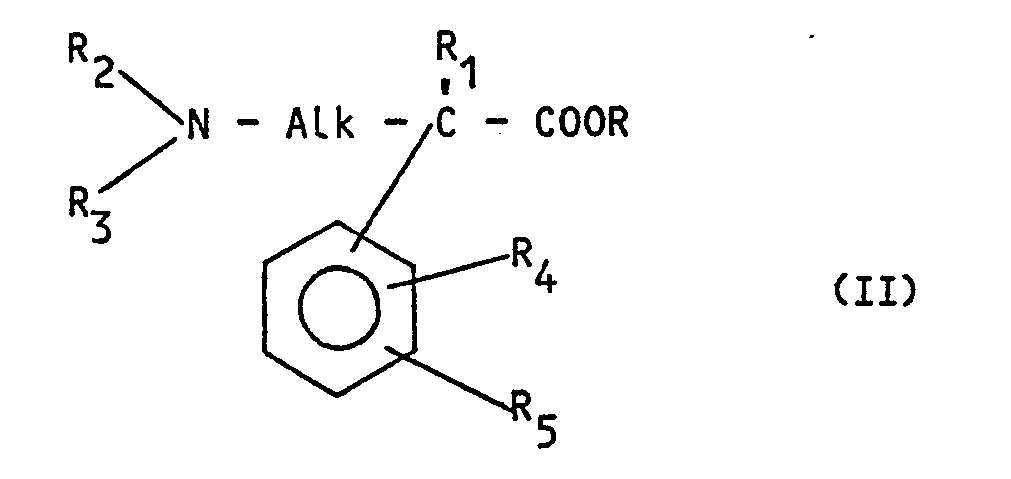
- the process for preparing the compounds according to the invention is characterized in that the acid of formula: in which Alk, R1, R2, R3, R4, R5 have the meanings indicated above and R represents hydrogen or an alkyl group.
- the reduction is carried out by known means such as the action of a reducing agent or an electrolysis reaction in an acid medium.
- a reducing agent a metal hydride is used, optionally in the presence of a catalyst.
- the reduction of the acid or of the ester (II) to obtain the compound according to the invention can be carried out by boron hydride, by aluminum hydride, by lithium borohydride, by aluminum borohydride, by sodium borohydride, by sodium and aluminum hydride, by lithium aluminum hydride or by another boron hydride such as borane dimethylsulfide, or benzodioxaborole -1.3.2.
- Vitride ® sodium hydride bis (2-methoxyethoxy) aluminum
- an inert solvent such as benzene or toluene
- the acids and their esters (II) are prepared by known methods.
- phenylacetonitrile substituted on the benzene ring with R4 and R5 or naphthyl-1 acetonitrile or naphthyl-2 acetonitrile depending on the expected compound, on which sodium amide is made to act in an inert solvent, is used at reflux and a choroalkylamine of formula: the mixture is heated at reflux of the solvent to form the compound: when the substituent R1 is an alkyl, the nitrile (IV) is alkylated by the action of sodium amide and a halide R1X to obtain the nitrile: the nitrile (IV or V) is hydrolyzed in a strong acid medium (pH less than 2) to obtain the corresponding acid, which is optionally esterified with an alkyl group R according to known methods.
- a strong acid medium pH less than 2
- the bactericidal activity of the products according to the invention was studied on different strains by the method described below:
- a bacterial inoculum is brought into contact with different dilutions of the product to be tested, for a limited time. At the end of the contact, an aliquot of the bacterial suspension / product mixture is deposited on the surface of an agar culture medium containing a neutralizer for the antibacterial activity of the product.
- the bactericidal concentration adopted is the minimum concentration of product from which the bacteria no longer grow. This concentration is expressed in ⁇ g / ml.
- the second strain is maintained on Worgel Fergusson medium, the others on Tryptic Soy Agar-Difco (TSA), marketed by Difco.
- TSA Tryptic Soy Agar-Difco
- the bacterial inoculum corresponds to a 1 / 2O dilution of this bacterial suspension.
- Plates comprising wells receive different dilutions of the product to be studied. These dilutions of the product to be studied are brought into contact with the various bacterial suspensions using a multiple site inoculator. After 20 min of contact, aliquots are transferred using this inoculator to the surface of an agar medium (ASD) placed in petri dishes, containing an activity neutralizer, namely 20 g of lubrol. W, 25 g of Tween 8O and 2.5 g of sodium thiosulfate in 1 OOO ml of TSA (Difco). A witness to the effectiveness of the neutralizer is produced for each product studied by depositing on the surface of the culture medium an aliquot of the dilution of the product to be studied. After drying, the corresponding inoculum is placed in the same place. An inoculum control is carried out on agar medium with and without neutralizer. The reading is done after 48 h of incubation at 37 ° C.
- CMB minimum bactericidal concentration
- the antifungal activity of the products according to the invention was also determined using the method described above.
- the tolerance of the products according to the invention has been studied in guinea pigs.
- the animals are mowed on either side of the midline of the back, the mowing is maintained every 2 days.
- Batches of 6 animals receive, on the mowed area O, 2 ml of an aqueous or alcoholic solution of the product according to the invention.
- a control batch of animals receives alcohol on one side.
- the treatment is applied once a day, 6 days a week, for 3 weeks.
- the observations on the skin level relate to the presence of erythema, rash or hyperkeratosis, the intensity of which is graduated according to a determined scale.
- the skin sensitization test is carried out on the same animals after two weeks of rest. The treatment lasts one week, it is identical to the previous one. The assessment is made on the same criteria and according to the same scale as that used for local tolerance.
- mice An acute oral toxicity assessment was performed in mice. This study was carried out on male CD1 strain mice from the Charles River farm. Each batch consisted of 5 animals with a body weight varying from 24 to 30 g maintained in the same cage. The animals were kept on an empty stomach for 6 h before treatment. For each study, the product, suspended in a 100% gum arabic solution, was administered by gavage using an esophageal probe. Food was again distributed to the animals 4 h after the gavage and the animals were kept under observation for a period of 14 days after the administration. During this period, the mortality is noted in each of the batches tested and, when possible, the lethal dose 5O (DL 5O) is determined using the method of J.T. LITCHFIELD and F. WILCOXON, J. Pharmacol. 1949, 95, 99-113.
- DL 5O lethal dose 5O
- Piperidino-8 (naphthyl-1) -2 octanol hydrochloride. SR 43 157 A.
- the first 3 steps make it possible to prepare chloro-1 piperidino-6 hexane.
- the products according to the invention were prepared, which are described in Tables IV and V below. They are characterized by their melting point (Fc) after recrystallization from a solvent.
- the recrystallization solvents are used pure or in an equivolumic mixture.
- the meaning of the abbreviations is as follows: - Methyl alcohol: MeOH; - Ethyl alcohol: EtOH; - Isopropyl alcohol: iPrOH; - Ethyl ether: Et2O - Isopropyl ether: (iPr) 2O - Dichloromethane: DCM.
- ** SR 43 727 A and SR 43 826 A are obtained in the form of an oil and characterized by their nuclear magnetic resonance (NMR) spectrum:
- Foaming detergent liquid antiseptic preparation Foaming detergent liquid antiseptic preparation.
- Foaming detergent liquid antiseptic preparation Foaming detergent liquid antiseptic preparation.
- a product according to the invention can be used as a preservative in a shampoo.
- a product according to the invention can be used as a preservative in an emulsion cream.
- the product according to the invention can be used as a preservative in a cream for cosmetic use.
- Disinfectant for inert surfaces Disinfectant for inert surfaces :
- Disinfectant for inert surfaces Disinfectant for inert surfaces :
- Such a biocide concentration protects the aqueous polymer or biopolymer solution from the risks of biodegradation in the tank during the hydrocarbon recovery phase.
Landscapes
- Life Sciences & Earth Sciences (AREA)
- Health & Medical Sciences (AREA)
- Organic Chemistry (AREA)
- Chemical & Material Sciences (AREA)
- General Health & Medical Sciences (AREA)
- Animal Behavior & Ethology (AREA)
- Public Health (AREA)
- Veterinary Medicine (AREA)
- Birds (AREA)
- Epidemiology (AREA)
- Dentistry (AREA)
- Agronomy & Crop Science (AREA)
- Plant Pathology (AREA)
- Wood Science & Technology (AREA)
- Zoology (AREA)
- Environmental Sciences (AREA)
- Pest Control & Pesticides (AREA)
- Engineering & Computer Science (AREA)
- Dermatology (AREA)
- Pharmaceuticals Containing Other Organic And Inorganic Compounds (AREA)
- Organic Low-Molecular-Weight Compounds And Preparation Thereof (AREA)
- Hydrogenated Pyridines (AREA)
- Agricultural Chemicals And Associated Chemicals (AREA)
- Cosmetics (AREA)
- Food Preservation Except Freezing, Refrigeration, And Drying (AREA)
- Acyclic And Carbocyclic Compounds In Medicinal Compositions (AREA)
Abstract
Description
- La présente invention a pour objet de nouveaux dérivés aromatiques substitués par un groupement (oméga-amino) alcanol. Ces composés ont une activité antimicrobienne.
- La présente invention concerne également l'utilisation des composés selon l'invention dans des compositions à usage antiseptique, antimicrobien, comme désinfectants ou conservateurs,notamment dans les domaines de la pharmacie, la cosmétologie ou l'agroalimentaire.
- Par un autre de ses aspects, la présente invention se référe au procédé de préparation des composés selon l'invention.
- L'activité pharmacologique de certains dérivés du naphtalène est connue dans la littérature. Ainsi dans J. Med. Chem., 1965, 8, 589, S. CASADIO, G. PALA et col. ont montré que le naphtyl-1 acétonitrile présente une activité analgésique, antiinflammatoire et antispasmodique. Plus tard, G. PALA et col., dans J. Med. Chem., 1966, 9, 6O3, ont étudié les dérivés alpha substitués de l'acide naphtyl-1 acétique et ils ont mis en évidence leurs propriétés cholérétiques et hypoglycémiantes et l'absence d'activité antibactérienne ou antifongique in vitro. R;i. K. ZAHN et col., ont décrit dans Nature, 1966 (212), 5O59, 298, que le naphtyl-2 éthanol inhibe la division cellulaire des cellules de lymphome de souris. Enfin, le (méthoxy-6 naphtyl-2)-2 méthyl-2 éthanol sous sa forme (-) est un anti-inflammatoire connu dénommé naproxol (brevet français 2 O68 539).
- Par ailleurs, des dérivés phénylalcanols de formule :

- De façon tout à fait surprenante, on a maintenant trouvé que les composés (I), selon l'invention, présentent une activité antimicrobienne mise en évidence par leur pouvoir bactéricide et fongicide.
- La présente invention a pour objet de nouveaux dérivés aromatiques de formule :

Alk représente un groupe alkylène de 1 à 1O atomes de carbone ;
R₁ représente l'hydrogène ou un alkyle comportant de 1 à 6 atomes de carbone ;
R₂ et R₃ sont semblables ou différents et représentent un cycloalkyle de 3 à 6 atomes de carbone ou un alkyle droit ou ramifié comportant de 1 à 6 atomes de carbone non substitué ou substitué par un groupement phényle ou méthylphényle ; ou R₂ et R₃ forment ensemble avec l'atome d'azote auquel ils sont liés un hétérocycle monoazoté ne contenant pas d'autre hétéroatome, tel que pyrrolidino, pipéridino, azépino, hexaméthylèneimino, méthyl-4 pipéridino, benzyl-4 pipéridino, phényl-4 pipéridino, tétrahydro-1,2,3,4 isoquinolyl-2 ;
R₄ représente un hydrogène, un halogène, un méthyle ou un phényle ;
R₅ représente un hydrogène, un halogène ou un méthyle ;
ou R₄ et R₅ pris ensemble avec le noyau benzénique auquel ils sont liés constituent un groupement naphtyl-1 ou naphtyl-2 ;
ainsi que les sels pharmaceutiquement acceptables avec des acides minéraux ou organiques. - Le procédé de préparation des composés selon l'invention est caractérisé en ce que l'on réduit l'acide de formule :

- Les acides et leurs esters (II) sont préparés par des méthodes connues. On utilise comme produit de départ du phénylacétonitrile substitué sur le noyau benzénique par R₄ et R₅ ou le naphtyl-1 acétonitrile ou le naphtyl-2 acétonitrile selon le composé attendu, sur lequel on fait agir de l'amidure de sodium dans un solvant inerte porté à reflux et on ajoute une choroalkylamine de formule :


- L'activité bactéricide des produits selon l'invention a été étudiée sur différentes souches par la méthode décrite ci-après :
- Un inoculum bactérien est mis en contact avec différentes dilutions du produit à tester et, ce, pendant un temps limité. A la fin du contact, une partie aliquote du mélange suspension bactérienne/produit est déposée à la surface d'un milieu de culture gélosé contenant un neutralisant de l'activité antibactérienne du produit. La concentration bactéricide retenue est la concentration minimale de produit à partir de laquelle les bactéries ne poussent plus. Cette concentration est exprimée en µg/ml.
- Les souches bactériennes choisies pour l'étude sont :
- 1 - Escherichia Coli CNCM 54125 ;
- 2 - Klebsiella pneumoniae capsulée RO3O ;
- 3 - Pseudomonas aeruginosa CNCM A22 ;
- 4 - Streptococcus faecalis CNCM 5855 ;
- 5 - Staphylococcus aureus CNCM 53154.
- La deuxième souche est entretenue sur milieu Worgel Fergusson, les autres sur Tryptic Soy Agar-Difco (TSA), commercialisé par Difco.
- Après 24 h de culture à 37°C, on récolte la pousse microbienne à l'aide de billes de verre et de 1O ml de diluant contenant 1 g de tryptone et 8,5 g de chlorure de sodium dans 1 OOO ml d'eau distillée. On agite la suspension formée et on mesure au spectrophotomètre le pourcentage de transmission de la lumière à 62O nm :
- - Souche 1 : 70 % ;
- - Souche 2 : 80 % ;
- - Souche 3 : 70 % ;
- - Souche 4 : 60 % ;
- - Souche 5 : 60 %.
- L'inoculum bactérien correspond à une dilution au 1/2O de cette suspension bactérienne.
- Des plaques comportant des cupules reçoivent différentes dilutions du produit à étudier. Ces dilutions du produit à étudier sont mises en contact avec les différentes suspensions bactériennes à l'aide d'un inoculateur à site multiple. Après 2O min de contact, des parties aliquotes sont transférées à l'aide de cet inoculateur à la surface d'un milieu gélosé (TSA) placé dans des boîtes de Petri, contenant un neutralisant de l'activité, à savoir 20 g de lubrol W, 25 g de Tween 8O et 2,5 g de thiosulfate de sodium dans 1 OOO ml de TSA (Difco). Un témoin de l'efficacité du neutralisant est réalisé pour chaque produit étudié en déposant à la surface du milieu de culture une partie aliquote de la dilution du produit à étudier. Après séchage, l'inoculum correspondant est déposé au même endroit. Un témoin inoculum est réalisé sur milieu gélosé avec et sans neutralisant. La lecture se fait après 48 h d'incubation à 37°C.
- Les résultats sont rassemblés dans le tableau I ci-dessous.

- Les résultats montrent que les produits selon l'invention présentent un large spectre d'activité sur les souches bactériennes testées. Cette activité bactéricide s'exprime dans un temps court (2O min).
- A titre de comparaison, on a mesuré dans les mêmes conditions la concentration minimale bactéricide (CMB) en µg/ml des composés suivants :

- Ces produits ont une activité bactéricide nettement inférieure aux composés selon l'invention.
- L'activité antifongique des produits selon l'invention a également été déterminée en utilisant la méthode décrite précédemment.
- Les souches fongiques choisies pour l'étude sont :
- 1 - Candica albicans CNCM 118O ;
- 2 - Candida tropicalis 3834 ;
- 3 - Candida parakruzeï 3918 ;
- 4 - Torulopsis glabrate O72O23.
- Les résultats sont rassemblés dans le tableau II ci-dessous.

- Ces résultats montrent que les produits selon l'invention possèdent une activité antifongique intéressante et rapide.
- La tolérance des produits selon l'invention a été étudiée chez le cobaye. Les animaux sont tondus de part et d'autre de la ligne médiane du dos, la tonte est entretenue tous les 2 jours. Des lots de 6 animaux reçoivent sur la zone tondue O,2 ml d'une solution aqueuse ou alcoolique du produit selon l'invention. Lorsque les produits sont en solution alcoolique, un lot témoin d'animaux reçoit l'alcool sur un côté.
- Pour l'étude de la tolérance cutanée préliminaire, le traitement est appliqué 1 fois par jour, 6 jours sur 7, durant 3 semaines. Les observations sur le plan cutané portent sur la présence d'érythème, d'éruption cutanée ou d'hyperkératose dont l'intensité est graduée selon un barème déterminé.
- L'essai de sensibilisation cutanée est réalisé sur les mêmes animaux après deux semaines de repos. Le traitement dure une semaine, il est identique au précédent. L'évaluation se fait sur les mêmes critères et d'après le même barème que celui utilisé pour la tolérance locale.
- On a également recherché si les produits selon l'invention présentent un effet phototoxique ou photoallergique chez le cobaye. La technique mise en oeuvre est celle de J. UNKOVIC, G. MAZUE et J. GIRARD, dans Sciences et Techniques de l'Animal de Laboratoire, 1983, 8 (3), 149-16O. C'est une adaptation des techniques décrites par L.C. HARBER et al., Arch. Dermatol., 1967, 96, 646-656 et L.J. VINSON et al., Arch. Dermatol., 1966, 17, 123-13O.
- Aucun des produits étudiés, à savoir SR 42 643 A, SR 43 O77 A, SR 43 157 A, SR 43 27O A, SR 43 292 A, SR 43 293 A, SR 43 383 A, SR 43 727 A, n'a montré de mauvaise tolérance, d'effet sensibilisant ni d'effet phototoxique ou photoallergique chez le cobaye.
- Une évaluation de la toxicité aiguë par Voie orale a été réalisée chez la souris. Cette étude a été effectuée sur des souris mâles de souche CD1 provenant de l'élevage Charles River. Chaque lot était composé de 5 animaux d'un poids corporel variant de 24 à 3O g entretenus dans une même cage. Les animaux étaient conservés à jeun pendant 6 h avant le traitement. Pour chaque étude, le produit, mis en suspension dans une solution de gomme arabique à 1O %, a été administré par gavage à l'aide d'une sonde oesophagienne. La nourriture était de nouveau distribuée aux animaux 4 h après le gavage et les animaux étaient gardés en observation pendant une période de 14 jours après l'administration. Pendant cette période, on note la mortalité dans chacun des lots mis en expérience et, lorsque cela est possible, on détermine la dose létale 5O (DL 5O) en utilisant la méthode de J.T. LITCHFIELD et F. WILCOXON, J. Pharmacol. 1949, 95, 99-113.
- Les résultats sont exprimés en mg de substance essayée par kg de poids corporel. Ils sont rassemblés dans le tableau III ci-dessous.

- Les exemples suivants illustrent l'invention sans toutefois la limiter.
- On ajoute par petites portions 7 g d'amidure de sodium à 27,11 g de naphtyl-1 acétonitrile dans 21O ml de benzène anhydre. On chauffe 2 h au reflux et on ajoute 22 g de chloro-2 diéthylaminoéthane puis on continue à chauffer au reflux pendant 2 h 3O min. On refroidit, ajoute 2OO ml d'eau. Après décantation, la phase organique est extraite par HCl à 1O %. La phase aqueuse est lavée à l'éther, neutralisée par NaOH à 1O %, puis extraite à l'éther. Après évaporation des solvants, on obtient une huile rouge qui est distillée sous vide.
Eb = 158-16O°C sous O,O4 mmHg soit O,O53 mbar ;
P = 27 g ;
Rendement = 63 %. - 16 g du produit obtenu précédemment sont chauffés au reflux pendant 2 h dans 66 ml d'un mélange équivolumique d'acide sulfurique, acide acétique et eau. On refroidit, dilue à l'eau et lave à l'éther. La phase aqueuse est neutralisée par de la soude à 3O % et lavée à l'éther. Puis la phase aqueuse est à nouveau acidifiée par l'acide chlorhydrique concentré puis évaporée à sec, on extrait le résidu à l'éthanol chaud. Après avoir évaporé l'éthanol, on reprend le résidu par 1OO ml d'éthanol auxquels on ajoute quelques gouttes d'acide sulfurique concentré, puis on chauffe une nuit à reflux. Après refroidissement, on évapore, reprend par de l'eau, neutralise par addition de bicarbonate de sodium puis on extrait à l'éther, lave à l'eau et sèche sur sulfate de magnésium. On obtient ainsi 1O g d'une huile orange.
Rendement brut = 63,85 %. - 10 g du produit obtenu précédemment sont ajoutés goutte à goutte à 15,5 g de Vitride®(hydrure de sodium bis(méthoxy-2 éthoxy) aluminium) à 7O % dans du toluène. Après 2 h à température ambiante, on verse sur l'eau et sèche sur sulfate de magnésium. Puis on évapore, reprend à l'éther éthylique sec et on ajoute goutte à goutte de l'éther éthylique chlorhydrique. On évapore à nouveau, reprend par de l'alcool isopropylique et ajoute goutte à goutte de l'éther éthylique anhydre. Le précipité formé est filtré, lavé à l'éther éthylique anhydre et séché. On obtient 6 g du produit attendu qui est recristallisé dans l'éther.
Rendement = 65 % ;
Fc = 98-100°C. - Les 3 premières étapes permettent de préparer le chloro-1 pipéridino-6 hexane.
- On chauffe au reflux pendant 1 h 3O min 52,2 g de monoester éthylique de l'acide adipique dans 3O ml de chlorure de thionyle puis on évapore sous vide l'excés de chlorure de thionyle et reprend par 1OO cm³ d'éther anhydre. On ajoute goutte à goutte à O°C, 58,8 g de pipéridine dans 1OO ml d'éther et laisse revenir à température ambiante en agitant pendant 1 h. On verse sur de l'eau, décante la phase organique, lave 2 fois à l'eau puis avec une solution de carbonate de sodium à 1O %, sèche sur sulfate de magnésium et évapore le solvant pour obtenir 4O g d'une huile brune que l'on distille sous vide.
Eb = 132-136°C sous O,O25 mmHg, soit O,O33 mbar ;
P = 35 g ;
Rendement = 48 %. - On ajoute goutte à goutte 35 g du produit obtenu précédemment à 72,8 g de Vitride à 7O % dans le toluène puis on laisse une nuit à température ordinaire. On verse ensuite sur de la glace, extrait à l'éther, lave à l'eau, sèche sur sulfate de magnésium et évapore sous vide.
On obtient 24 g de liquide incolore.
Rendement brut : 8O %. - On ajoute goutte à goutte 16 g de chlorure de thionyle à 24 g du produit obtenu précédemment dissous dans 75 ml de chloroforme. Après 4 h de chauffage à reflux, on évapore le solvant, reprend à l'eau et neutralise la solution par de la soude à 1O %, on extrait à l'éther, lave à l'eau, sèche sur sulfate de magnésium et évapore le solvant.
P = 22 g ;
Rendement brut = 91,6 %. - On ajoute par petites portions 3,9 g d'amidure de sodium à 16,7 g de naphtyl-1 acétonitrile dissous dans 2OO ml d'éther anhydre. Après 2 h de chauffage à reflux, on ajoute 2O,5 g de pipéridino-6 chloro-1 hexane et on chauffe à nouveau au reflux pendant 5 h. En utilisant les méthodes habituelles, on isole ensuite 3O g de produit.
Rendement = 89,7 %. - 30 g du produit obtenu précédemment sont chauffés à reflux pendant 2 h dans 15O ml d'un mélange équivolumique d'acide sulfurique, acide acétique et eau. Après refroidissement, on verse sur de l'eau et lave à l'éther, puis la phase aqueuse est rendue basique par addition de soude à 3O % et on décante l'huile formée. La phase organique est lavée à l'éther puis l'huile est acidifiéê à pH = 1 par addition d'acide chlorhydrique concentré, on reprend par de l'éthanol à 1OO %, ajoute quelques gouttes d'acide sulfurique concentré et chauffe une nuit au reflux. On évapore l'alcool sous vide, reprend par de l'eau, neutralise par addition de carbonate acide de sodium, extrait à l'éther puis on lave jusqu'à neutralité et évapore le solvant sous vide. On obtient 23 g d'un produit huileux.
Rendement = 67,6 %. - A partir de 7,5 g du produit obtenu à l'étape précédente et en utilisant la méthode décrite à l'exemple 1, étape 3, on obtient le produit attendu qui est recristallisé dans le mélange méthanol 1OO-éther (1/1 v/v).
P = 2,8 g.
Fc = 125-129°C.
Rendement = 38 %. - On ajoute par petites portions 8,2 g d'amidure de sodium sur une solution de 33,4 g de naphtyl-1 acétonitrile dans 45O ml d'éther anhydre. On chauffe 2 h au reflux et on ajoute 29,5 g de pipéridino-2 chloro-1 éthane puis on chauffe 5 h au reflux. On refroidit, verse dans l'eau, puis la phase organique est extraite 3 fois avec 6OO ml d'acide chlorhydrique à 1O %. La phase aqueuse est lavée à l'éther, neutralisée par de la soude à 3O %. On extrait l'huile qui décante, lave par de l'eau saturée en chlorure de sodium, sèche sur sulfate de magnésium. Après évaporation du solvant, l'huile obtenue est distillée sous pression réduite (pompe à palettes).
P = 41,5 g ;
Eb = 172-176°C sous O,O25 mmHg soit O,O33 mbar. - On ajoute par petites portions 6,5 g de NaNH₂ sur une solution de 41,5 g du produit obtenu précédemment dans 3OO ml d'éther anhydre. On chauffe 2 h au reflux, puis ajoute goutte à goutte 17,44 g de bromure d'éthyle. Après 5 h de chauffage au reflux, on verse sur l'eau, extrait la phase organique par de l'acide chlorhydrique à 1O %. La phase aqueuse est lavée à l'éther, neutralisée par de la soude à 3O %. On extrait l'huile qui décante par de l'éther, lave par de l'eau saturée en chlorure de sodium, sèche sur sulfate de magnésium et évapore à sec.
P = 44 g. - A 44 g du produit obtenu précédemment, on ajoute 12O ml d'un mélange équivolumique d'eau, acide sulfurique concentré et acide acétique. Après 24 h de chauffage à reflux, on verse sur de l'eau, neutralise par de la soude à 3O %. L'huile qui décante est extraite à l'éther, lavée à l'eau, séchée sur sulfate de magnésium et évaporée à sec. Le résidu est repris par de l'éther et on ajoute goutte à goutte de l'éther chlorhydrique. On évapore le solvant à froid, dissout le produit dans 2OO ml d'éthanol 1OO %, puis précipite à l'éther, filtre, lave à l'éther et sèche sous vide.
P = 40 g. - On fait buller de l'acide chlorhydrique gazeux pendant 1 h 3O min sur une solution de 2O g du produit obtenu précédemment dans 1O ml d'acide acétique, en maintenant la température inférieure à 1O°C. On ajoute en 1 h, à O°C, 2O ml de nitrite d'isopentyle. On chauffe 7 h à 1OO°C puis laisse réagir 2 jours à température ambiante. On évapore à sec, reprend à l'éther, évapore l'éther, dissout le précipité dans 1OO ml d'éthanol 1OO ; le produit précipite dans l'éther, on le dissout dans l'eau, neutralise à la soude, lave à l'éther et acidifie avec de l'acide chlorhydrique. On évapore à sec, reprend par de l'eau, le produit précipite à pH 1,3. On filtre, lave à l'eau froide et sèche sous vide avec de l'anhydride phosphorique.
P = 10 g ;
Rendement = 66 %. - On ajoute goutte à goutte 1O g du produit obtenu précédemment sur 25 ml de itride dans 1OO ml de toluène. On chauffe 24 h à 8O °C, verse dans l'eau, sèche sur sulfate de magnésium. On évapore à sec, reprend à l'éther et ajoute goutte à goutte de l'éther chlorhydrique. On évapore le solvant à froid, le précipité est dissous dans ml d'éthanol 1OO puis précipité dans l'éther ; on filtre, lave à l'éther et sèche sous vide. Après recristallisation dans le mélange éthanol 1OO-éther (1/1 v/v), on obtient le produit attendu.
P = 2,5 g.
Rendement = 25 %.
Fc = 162-165°C. - On ajoute, par petites portions, 1,95 g d'amidure de sodium à une solution éthérée de 9,3 g de dichloro-3,4 phénylacétonitrile. On chauffe 2 h au reflux, on ajoute 11,8 g de (benzyl-4 pipéridino)-2 chloro-1 éthane et on chauffe à nouveau 5 h au reflux. On refroidit, ajoute 2OO ml d'eau, décante la phase organique, lave à l'eau et extrait par une solution d'acide chlorhydrique à 1O%. La phase aqueuse est ensuite neutralisée par la soude, extraite à l'éther, lavée à l'eau, séchée sur sulfate de magnésium et évaporée. On obtient ainsi 13 g de produit huileux.
Rendement brut : 69 %. - On chauffe à reflux pendant 2 h, 13 g du produit obtenu à l'étape précédente dans 6O ml d'une solution acide sulfurique/eau/acide acétique (1/1/1 en volume). On refroidit, verse sur l'eau et lave à l'éther. La phase aqueuse est lavée par de la soude à 3O%, puis on décante l'huile formée et lave trois fois à l'éther. On acidifie l'huile à pH1 par de l'acide chlorhydrique à 35 % et évapore à sec. On reprend le résidu avec du méthanol additionné de quelques gouttes d'acide sulfurique et on chauffe au reflux pendant 4 h. On refroidit, évapore sous vide, reprend à l'eau, neutralise au bicarbonate de sodium, extrait à l'éther, lave à l'eau, sèche sur sulfate de magnésium, puis à l'évaporateur rotatif. On obtient 9 g de produit huileux.
Rendement brut : 63 %. - 9 g de produit obtenu à l'étape précédente sont ajoutés à 6,45 g de Vitride® en solution dans 5O ml de toluéne. On agite min à température ambiante. On verse sur l'eau, décante la phase organique, lave à l'eau, sèche sur sulfate de magnésium et évapore. Le résidu est repris à l'éther et on précipite par addition d'éther chlorhydrique. On évapore l'éther, reprend le résidu par un minimum d'éthanol 1OO, puis on additionne de l'éther éthylique jusqu'à formation d'un trouble, puis cristallisation. Après recristallisation dans un mélange éther-éthanol (1/1 v/v), on obtient 7 g du produit attendu.
Rendement : 81,7 % ;
Fc : 167,5%°C. - En utilisant les mêmes méthodes que précédemment, on a préparé les produits selon l'inVention, qui sont décrits dans les tableaux IV et V ci-dessous. Ils sont caractérisés par leur point de fusion (Fc) après recristallisation dans un solvant. Les solvants de recristallisation (solvant) sont utilisés purs ou en mélange équivolumique. La signification des abréviations est la suivante :
- Alcool méthylique : MeOH ;
- Alcool éthylique : EtOH ;
- Alcool isopropylique : iPrOH ;
- Ether éthylique : Et₂O
- Ether isopropylique : (iPr)₂O
- Dichlorométhane : DCM.
- * Les composés SR 43 154 A et SR 43 27O A sont substitués en 2 sur le naphtalène. Tous les autres composés de ce tableau sont substitués en 1 sur le naphtalène.
- ** LesSR 43 727 A et SR 43 826 A sont obtenus sous forme d'une huile et caractérisés par leur spectre de résonance magnétique nucléaire (RMN) :


- Différentes formulations galéniques des produits selon l'invention peuvent être préparées selon l'application choisie.
-

-

-

- Un produit selon l'invention peut être utilisé comme conservateur dans un shampooing.

- Un produit selon l'invention peut être utilisé comme conservateur dans une créme émulsion.

- Le produit selon l'invention peut être utilisé comme conservateur dans une crème pour utilisation cosmétologique.

-

-

-

- SR 43 383 A micronisé O,O2 %.
-

-

- - Solution aqueuse à 1OOO ppm de polymère synthétique (polyacrylamide) ou de biopolymère (xanthane)
- SR 43 727 A 1OOO ppm - Une telle concentration en biocide protège la solution aqueuse de polymère ou de biopolymère des risques de biodégradation dans le réservoir pendant la phase de récupération des hydrocarbures.
Claims (13)

Alk représente un groupe alkylène de 1 à 1O atomes de carbone ;
R₁ représente l'hydrogène ou un alkyle comportant de 1 à 6 atomes de carbone ;
R₂ et R₃ sont semblables ou différents et représentent un cyclo alkyle de 3 à 6 atomes de carbone ou un alkyle droit ou ramifié comportant de 1 à 6 atomes de carbone non substitué ou substitué par un groupement phényle ou méthylphényle ;
ou R₂ et R₃ forment ensemble avec l'atome d'azote auquel ils sont liés un hétérocycle monoazoté ne contenant pas d'autre hétéroatome, tel que pyrrolidino, pipéridino, azépino, hexaméthylèneimino, méthyl-4 pipéridino, benzyl-4 pipéridino, phényl-4 pipéridino, tétrahydro-1,2,3,4 isoquinolyl-2 ;
R₄ représente un hydrogène, un halogène, un méthyle ou un phényle ;
R₅ représente un hydrogène, un halogène ou un méthyle ;
ou R₄ et R₅ pris ensemble avec le noyau benzénique auquel ils sont liés constituent un groupe naphtyl-1 ou naphtyl-2 ;
ainsi que les sels pharmaceutiquement acceptables avec des acides minéraux ou organiques, caractérisé en ce qu'il consiste à réduire un composé de formule :
Priority Applications (1)
| Application Number | Priority Date | Filing Date | Title |
|---|---|---|---|
| AT86402236T ATE74589T1 (de) | 1985-10-11 | 1986-10-09 | Durch (omega-amino)-alkanolgruppen substituierte aromatische derivate mit antimikrobenwirkung und diese enthaltende zusammensetzungen. |
Applications Claiming Priority (2)
| Application Number | Priority Date | Filing Date | Title |
|---|---|---|---|
| FR8515102A FR2588556B1 (fr) | 1985-10-11 | 1985-10-11 | Derives du naphtalene substitues par un groupement (omega-amino) alcanol a activite antimicrobienne, leur preparation et les compositions les contenant |
| FR8515102 | 1985-10-11 |
Publications (3)
| Publication Number | Publication Date |
|---|---|
| EP0220112A2 true EP0220112A2 (fr) | 1987-04-29 |
| EP0220112A3 EP0220112A3 (en) | 1988-11-17 |
| EP0220112B1 EP0220112B1 (fr) | 1992-04-08 |
Family
ID=9323748
Family Applications (1)
| Application Number | Title | Priority Date | Filing Date |
|---|---|---|---|
| EP86402236A Expired - Lifetime EP0220112B1 (fr) | 1985-10-11 | 1986-10-09 | Dérivés aromatiques substitués par un groupement (oméga-amino) alcanol à activité antimicrobienne, leur préparation et les compositions les contenant |
Country Status (19)
| Country | Link |
|---|---|
| US (1) | US4820717A (fr) |
| EP (1) | EP0220112B1 (fr) |
| JP (1) | JPS62116545A (fr) |
| KR (1) | KR940008914B1 (fr) |
| AR (1) | AR243154A1 (fr) |
| AT (1) | ATE74589T1 (fr) |
| AU (1) | AU596998B2 (fr) |
| CA (1) | CA1312079C (fr) |
| DE (1) | DE3684756D1 (fr) |
| DK (1) | DK483286A (fr) |
| ES (1) | ES2036528T3 (fr) |
| FR (1) | FR2588556B1 (fr) |
| IL (1) | IL80246A0 (fr) |
| MA (1) | MA20788A1 (fr) |
| NZ (1) | NZ217882A (fr) |
| OA (1) | OA08426A (fr) |
| PT (1) | PT83512B (fr) |
| TN (1) | TNSN86139A1 (fr) |
| ZA (1) | ZA867608B (fr) |
Families Citing this family (5)
| Publication number | Priority date | Publication date | Assignee | Title |
|---|---|---|---|---|
| FI892341L (fi) * | 1988-06-10 | 1989-12-11 | Hoffmann La Roche | Propanolaminderivat. |
| AR245888A1 (es) * | 1989-01-23 | 1994-03-30 | Merrell Pharma Inc | Procedimiento para la preparacion de una composicion farmaceutica liquida de derivados de piperidinoalcanol. |
| DE4140473C2 (de) * | 1991-12-09 | 1995-12-21 | Schuelke & Mayr Gmbh | Hautantiseptikum und Händedesinfektionsmittel |
| FR2872416B1 (fr) * | 2004-07-01 | 2006-09-22 | Oreal | Utilisation de derives de piperidine pour lutter contre les rides |
| WO2015132733A1 (fr) | 2014-03-05 | 2015-09-11 | Universita' Degli Studi Di Pavia | Utilisation d'arylalkanolamines en tant qu'antagonistes du récepteur sigma-1 |
Family Cites Families (5)
| Publication number | Priority date | Publication date | Assignee | Title |
|---|---|---|---|---|
| BE642084A (fr) * | ||||
| BE580501A (fr) * | 1958-07-17 | |||
| US3852363A (en) * | 1969-04-09 | 1974-12-03 | Syntex Corp | Naphthyl acetaldehyde derivatives; method of use thereof; and processes for the preparation thereof |
| GB1434826A (en) * | 1973-11-14 | 1976-05-05 | Gallardo Antonio Sa | Esters and carbamates of aminoalkanols |
| US4482564A (en) * | 1983-06-03 | 1984-11-13 | Schering Corporation | Triazolyl-substituted propane derivatives |
-
1985
- 1985-10-11 FR FR8515102A patent/FR2588556B1/fr not_active Expired
-
1986
- 1986-09-30 US US06/913,361 patent/US4820717A/en not_active Expired - Fee Related
- 1986-10-02 AU AU63443/86A patent/AU596998B2/en not_active Ceased
- 1986-10-06 ZA ZA867608A patent/ZA867608B/xx unknown
- 1986-10-07 IL IL80246A patent/IL80246A0/xx not_active IP Right Cessation
- 1986-10-08 MA MA21018A patent/MA20788A1/fr unknown
- 1986-10-09 DK DK483286A patent/DK483286A/da not_active Application Discontinuation
- 1986-10-09 JP JP61241160A patent/JPS62116545A/ja active Pending
- 1986-10-09 OA OA58973A patent/OA08426A/fr unknown
- 1986-10-09 PT PT83512A patent/PT83512B/pt not_active IP Right Cessation
- 1986-10-09 DE DE8686402236T patent/DE3684756D1/de not_active Expired - Fee Related
- 1986-10-09 ES ES198686402236T patent/ES2036528T3/es not_active Expired - Lifetime
- 1986-10-09 EP EP86402236A patent/EP0220112B1/fr not_active Expired - Lifetime
- 1986-10-09 AT AT86402236T patent/ATE74589T1/de not_active IP Right Cessation
- 1986-10-10 AR AR86305531A patent/AR243154A1/es active
- 1986-10-10 CA CA000520312A patent/CA1312079C/fr not_active Expired - Fee Related
- 1986-10-10 NZ NZ217882A patent/NZ217882A/xx unknown
- 1986-10-10 TN TNTNSN86139A patent/TNSN86139A1/fr unknown
- 1986-10-11 KR KR1019860008548A patent/KR940008914B1/ko not_active Expired - Lifetime
Also Published As
| Publication number | Publication date |
|---|---|
| PT83512A (fr) | 1986-11-01 |
| KR870003999A (ko) | 1987-05-06 |
| AU596998B2 (en) | 1990-05-24 |
| CA1312079C (fr) | 1992-12-29 |
| AR243154A1 (es) | 1993-07-30 |
| MA20788A1 (fr) | 1987-07-01 |
| JPS62116545A (ja) | 1987-05-28 |
| OA08426A (fr) | 1988-06-30 |
| NZ217882A (en) | 1989-02-24 |
| EP0220112A3 (en) | 1988-11-17 |
| EP0220112B1 (fr) | 1992-04-08 |
| KR940008914B1 (ko) | 1994-09-28 |
| AU6344386A (en) | 1987-04-16 |
| US4820717A (en) | 1989-04-11 |
| TNSN86139A1 (fr) | 1990-01-01 |
| ATE74589T1 (de) | 1992-04-15 |
| DK483286A (da) | 1987-04-12 |
| FR2588556B1 (fr) | 1988-01-08 |
| IL80246A0 (en) | 1987-01-30 |
| ZA867608B (en) | 1987-06-24 |
| FR2588556A1 (fr) | 1987-04-17 |
| ES2036528T3 (es) | 1993-06-01 |
| DE3684756D1 (de) | 1992-05-14 |
| PT83512B (pt) | 1989-02-28 |
| DK483286D0 (da) | 1986-10-09 |
Similar Documents
| Publication | Publication Date | Title |
|---|---|---|
| FR2458545A1 (fr) | Procede de preparation de derives de benzylimidazole, nouveaux produits ainsi obtenus, et leur utilisation pour leurs activites antimycotique et fongicide | |
| CH644348A5 (fr) | Amino-ethers oxydes, leur procede de preparation et medicament les contenant. | |
| EP0288352B1 (fr) | Dérivés aromatiques, leur préparation et leur utilisation comme antimicrobiens | |
| EP0308328A1 (fr) | Dérivés de (benzyl pipéridino)-1 propanol-2, leur préparation, leur utilisation comme antimicrobiens et les produits les contenant | |
| EP0220112B1 (fr) | Dérivés aromatiques substitués par un groupement (oméga-amino) alcanol à activité antimicrobienne, leur préparation et les compositions les contenant | |
| EP0136195B1 (fr) | Dérivés de la benzamidine à activité antimicrobienne, procédé d'obtention et application à titre de médicaments désinfectants ou conservateurs | |
| EP0135432B1 (fr) | Dérivés de l'acide benzoique, procédé de préparation et application à titre de médicaments désinfectants ou de conservateurs | |
| EP0077427B1 (fr) | Dérivés de pipéridine, leur procédé de préparation et leur application en thérapeutique | |
| EP0173597B1 (fr) | Nouveaux éther-oxydes dérivés de cyclopropylphénols | |
| EP0117771A1 (fr) | Imino-2 pyrrolidines, leur procédé de préparation et leurs applications en thérapeutique | |
| CH407088A (fr) | Procédé de préparation de dérivés des acides 4-halo-3-sulfamoyl-benzoïques | |
| WO1990003972A1 (fr) | Derives de methyl-4 ((phenyl-4 piperazinyl-1)-2 ethyl)-5 thiazole | |
| Savini et al. | EVALUATION OF ANTIINFLAMMATORY AND ANALGESIC PROPERTIES. II. | |
| FR2470770A1 (fr) | Nouveaux ethers de b-imidazolylethyle de quinoleine-2 ou 4-methanols, utiles notamment comme antimicrobiens, et leur procede de preparation | |
| CH639075A5 (fr) | Ethers dibenzyliques substitues actifs sur le plan therapeutique. | |
| EP0061406B1 (fr) | Dérivés d'acide benzamido-alkyl-hydroxamique, procédé de préparation et composition thérapeutique | |
| FR2465733A1 (fr) | Nouveaux derives imidazolylethoxymethyliques de 1,3-dioxoloquinoleines utiles notamment comme medicaments antibacteriens et antifongiques, leur procede de preparation et compositions therapeutiques et formes pharmaceutiques les contenant | |
| FR2478094A1 (fr) | Derives de cinnamylmoranoline a substitution ammonio, a activite d'inhibition de l'augmentation de niveau de sucre dans le sang | |
| FR2475543A1 (fr) | Derives benzylideniques, leur preparation et leur application en therapeutique | |
| FR2507180A1 (fr) | Nouvelles phenylalkylamines, leur preparation et leur application comme medicaments | |
| CH629796A5 (en) | Therapeutically active compounds of 4-(2-thienylmethylamino)benzoic acid | |
| FR2678266A1 (fr) | Nouveaux derives de 2-hydroxy 4-amino 5-ethylsulfonyl benzamide utiles comme anxiolytiques. | |
| EP0647221A1 (fr) | Aryl-1 (o-alcoxyphenyl-4 piperazinyl-1)-2, -3 ou -4 alcanols, leur procede de preparation et leur utilisation pour la preparation de medicaments | |
| BE883665A (fr) | Nouveaux derives du benzymidazole | |
| FR2556592A1 (fr) | Compositions pharmaceutiques contenant des derives de l'acide campho-methylidene cinnamique |
Legal Events
| Date | Code | Title | Description |
|---|---|---|---|
| PUAI | Public reference made under article 153(3) epc to a published international application that has entered the european phase |
Free format text: ORIGINAL CODE: 0009012 |
|
| AK | Designated contracting states |
Kind code of ref document: A2 Designated state(s): AT BE CH DE ES FR GB GR IT LI LU NL SE |
|
| PUAL | Search report despatched |
Free format text: ORIGINAL CODE: 0009013 |
|
| AK | Designated contracting states |
Kind code of ref document: A3 Designated state(s): AT BE CH DE ES FR GB GR IT LI LU NL SE |
|
| 17P | Request for examination filed |
Effective date: 19890510 |
|
| 17Q | First examination report despatched |
Effective date: 19901019 |
|
| ITTA | It: last paid annual fee | ||
| GRAA | (expected) grant |
Free format text: ORIGINAL CODE: 0009210 |
|
| RBV | Designated contracting states (corrected) |
Designated state(s): AT BE CH DE ES FR GB IT LI LU NL SE |
|
| AK | Designated contracting states |
Kind code of ref document: B1 Designated state(s): AT BE CH DE ES FR GB IT LI LU NL SE |
|
| PG25 | Lapsed in a contracting state [announced via postgrant information from national office to epo] |
Ref country code: SE Effective date: 19920408 Ref country code: NL Effective date: 19920408 Ref country code: AT Effective date: 19920408 |
|
| REF | Corresponds to: |
Ref document number: 74589 Country of ref document: AT Date of ref document: 19920415 Kind code of ref document: T |
|
| RAP2 | Party data changed (patent owner data changed or rights of a patent transferred) |
Owner name: ELF SANOFI |
|
| REF | Corresponds to: |
Ref document number: 3684756 Country of ref document: DE Date of ref document: 19920514 |
|
| ITF | It: translation for a ep patent filed | ||
| GBT | Gb: translation of ep patent filed (gb section 77(6)(a)/1977) | ||
| NLV1 | Nl: lapsed or annulled due to failure to fulfill the requirements of art. 29p and 29m of the patents act | ||
| PGFP | Annual fee paid to national office [announced via postgrant information from national office to epo] |
Ref country code: GB Payment date: 19921002 Year of fee payment: 7 |
|
| PGFP | Annual fee paid to national office [announced via postgrant information from national office to epo] |
Ref country code: ES Payment date: 19921020 Year of fee payment: 7 |
|
| PGFP | Annual fee paid to national office [announced via postgrant information from national office to epo] |
Ref country code: CH Payment date: 19921021 Year of fee payment: 7 |
|
| PGFP | Annual fee paid to national office [announced via postgrant information from national office to epo] |
Ref country code: DE Payment date: 19921023 Year of fee payment: 7 |
|
| PGFP | Annual fee paid to national office [announced via postgrant information from national office to epo] |
Ref country code: FR Payment date: 19921028 Year of fee payment: 7 |
|
| PGFP | Annual fee paid to national office [announced via postgrant information from national office to epo] |
Ref country code: LU Payment date: 19921030 Year of fee payment: 7 |
|
| PGFP | Annual fee paid to national office [announced via postgrant information from national office to epo] |
Ref country code: BE Payment date: 19921116 Year of fee payment: 7 |
|
| BECN | Be: change of holder's name |
Effective date: 19920408 |
|
| PLBE | No opposition filed within time limit |
Free format text: ORIGINAL CODE: 0009261 |
|
| STAA | Information on the status of an ep patent application or granted ep patent |
Free format text: STATUS: NO OPPOSITION FILED WITHIN TIME LIMIT |
|
| EPTA | Lu: last paid annual fee | ||
| 26N | No opposition filed | ||
| REG | Reference to a national code |
Ref country code: ES Ref legal event code: FG2A Ref document number: 2036528 Country of ref document: ES Kind code of ref document: T3 |
|
| PG25 | Lapsed in a contracting state [announced via postgrant information from national office to epo] |
Ref country code: LU Free format text: LAPSE BECAUSE OF NON-PAYMENT OF DUE FEES Effective date: 19931009 Ref country code: GB Effective date: 19931009 |
|
| PG25 | Lapsed in a contracting state [announced via postgrant information from national office to epo] |
Ref country code: ES Free format text: LAPSE BECAUSE OF THE APPLICANT RENOUNCES Effective date: 19931011 |
|
| PG25 | Lapsed in a contracting state [announced via postgrant information from national office to epo] |
Ref country code: LI Effective date: 19931031 Ref country code: CH Effective date: 19931031 Ref country code: BE Effective date: 19931031 |
|
| BERE | Be: lapsed |
Owner name: ELF SANOFI Effective date: 19931031 |
|
| GBPC | Gb: european patent ceased through non-payment of renewal fee |
Effective date: 19931009 |
|
| PG25 | Lapsed in a contracting state [announced via postgrant information from national office to epo] |
Ref country code: FR Effective date: 19940630 |
|
| REG | Reference to a national code |
Ref country code: CH Ref legal event code: PL |
|
| PG25 | Lapsed in a contracting state [announced via postgrant information from national office to epo] |
Ref country code: DE Effective date: 19940701 |
|
| REG | Reference to a national code |
Ref country code: FR Ref legal event code: ST |
|
| REG | Reference to a national code |
Ref country code: ES Ref legal event code: FD2A Effective date: 19991007 |
|
| PG25 | Lapsed in a contracting state [announced via postgrant information from national office to epo] |
Ref country code: IT Free format text: LAPSE BECAUSE OF NON-PAYMENT OF DUE FEES;WARNING: LAPSES OF ITALIAN PATENTS WITH EFFECTIVE DATE BEFORE 2007 MAY HAVE OCCURRED AT ANY TIME BEFORE 2007. THE CORRECT EFFECTIVE DATE MAY BE DIFFERENT FROM THE ONE RECORDED. Effective date: 20051009 |