EP0226196A2 - Tricyclische Pyridonderivate - Google Patents
Tricyclische Pyridonderivate Download PDFInfo
- Publication number
- EP0226196A2 EP0226196A2 EP86117347A EP86117347A EP0226196A2 EP 0226196 A2 EP0226196 A2 EP 0226196A2 EP 86117347 A EP86117347 A EP 86117347A EP 86117347 A EP86117347 A EP 86117347A EP 0226196 A2 EP0226196 A2 EP 0226196A2
- Authority
- EP
- European Patent Office
- Prior art keywords
- phenyl
- oxo
- pyrido
- group
- formula
- Prior art date
- Legal status (The legal status is an assumption and is not a legal conclusion. Google has not performed a legal analysis and makes no representation as to the accuracy of the status listed.)
- Granted
Links
- 0 CC(CCC1)CC1C(C*)=C Chemical compound CC(CCC1)CC1C(C*)=C 0.000 description 7
- AXULSRYEKZPVER-GRQBKTHUSA-N CC(C1[C@H](C)CC1)N Chemical compound CC(C1[C@H](C)CC1)N AXULSRYEKZPVER-GRQBKTHUSA-N 0.000 description 1
Classifications
-
- C—CHEMISTRY; METALLURGY
- C07—ORGANIC CHEMISTRY
- C07D—HETEROCYCLIC COMPOUNDS
- C07D471/00—Heterocyclic compounds containing nitrogen atoms as the only ring hetero atoms in the condensed system, at least one ring being a six-membered ring with one nitrogen atom, not provided for by groups C07D451/00 - C07D463/00
- C07D471/02—Heterocyclic compounds containing nitrogen atoms as the only ring hetero atoms in the condensed system, at least one ring being a six-membered ring with one nitrogen atom, not provided for by groups C07D451/00 - C07D463/00 in which the condensed system contains two hetero rings
- C07D471/04—Ortho-condensed systems
-
- A—HUMAN NECESSITIES
- A61—MEDICAL OR VETERINARY SCIENCE; HYGIENE
- A61P—SPECIFIC THERAPEUTIC ACTIVITY OF CHEMICAL COMPOUNDS OR MEDICINAL PREPARATIONS
- A61P21/00—Drugs for disorders of the muscular or neuromuscular system
- A61P21/02—Muscle relaxants, e.g. for tetanus or cramps
-
- A—HUMAN NECESSITIES
- A61—MEDICAL OR VETERINARY SCIENCE; HYGIENE
- A61P—SPECIFIC THERAPEUTIC ACTIVITY OF CHEMICAL COMPOUNDS OR MEDICINAL PREPARATIONS
- A61P25/00—Drugs for disorders of the nervous system
- A61P25/08—Antiepileptics; Anticonvulsants
-
- A—HUMAN NECESSITIES
- A61—MEDICAL OR VETERINARY SCIENCE; HYGIENE
- A61P—SPECIFIC THERAPEUTIC ACTIVITY OF CHEMICAL COMPOUNDS OR MEDICINAL PREPARATIONS
- A61P25/00—Drugs for disorders of the nervous system
- A61P25/20—Hypnotics; Sedatives
-
- C—CHEMISTRY; METALLURGY
- C07—ORGANIC CHEMISTRY
- C07D—HETEROCYCLIC COMPOUNDS
- C07D495/00—Heterocyclic compounds containing in the condensed system at least one hetero ring having sulfur atoms as the only ring hetero atoms
- C07D495/12—Heterocyclic compounds containing in the condensed system at least one hetero ring having sulfur atoms as the only ring hetero atoms in which the condensed system contains three hetero rings
- C07D495/14—Ortho-condensed systems
-
- C—CHEMISTRY; METALLURGY
- C07—ORGANIC CHEMISTRY
- C07D—HETEROCYCLIC COMPOUNDS
- C07D513/00—Heterocyclic compounds containing in the condensed system at least one hetero ring having nitrogen and sulfur atoms as the only ring hetero atoms, not provided for in groups C07D463/00, C07D477/00 or C07D499/00 - C07D507/00
- C07D513/02—Heterocyclic compounds containing in the condensed system at least one hetero ring having nitrogen and sulfur atoms as the only ring hetero atoms, not provided for in groups C07D463/00, C07D477/00 or C07D499/00 - C07D507/00 in which the condensed system contains two hetero rings
- C07D513/04—Ortho-condensed systems
-
- C—CHEMISTRY; METALLURGY
- C07—ORGANIC CHEMISTRY
- C07D—HETEROCYCLIC COMPOUNDS
- C07D513/00—Heterocyclic compounds containing in the condensed system at least one hetero ring having nitrogen and sulfur atoms as the only ring hetero atoms, not provided for in groups C07D463/00, C07D477/00 or C07D499/00 - C07D507/00
- C07D513/12—Heterocyclic compounds containing in the condensed system at least one hetero ring having nitrogen and sulfur atoms as the only ring hetero atoms, not provided for in groups C07D463/00, C07D477/00 or C07D499/00 - C07D507/00 in which the condensed system contains three hetero rings
- C07D513/14—Ortho-condensed systems
Definitions
- Rd is the group of the formula - (A 1 ) m - (CO) n - (Q 1 A 2 ) q -R 1 , m, n and q each the number 0 or 1, A 1 lower alkylene, A 2 lower alkylene, a direct bond or the Group -CO-, Q an oxygen atom or the group -NR 2 -, R hydrogen, hydroxy, cyano, nitro, halogen, lower alkoxy, lower alkyl, lower alkoxycarbonyl.
- R is hydrogen, lower alkyl or aryl.
- R 3 and R 4 are each hydrogen. lower alkyl, lower alkoxyalkyl, lower dialkoxyalkyl, lower alkylenedioxyalkyl.
- tricyclic pyridone derivatives have valuable pharmacological properties and can be used to control or prevent diseases. They are particularly muscle-relaxing, sedative-hypnotic, anxiolytic and / or anticonvulsant and can therefore be used to combat or prevent muscle tension or tension. Insomnia, anxiety and / or convulsions can be used.
- the present invention relates to: The above compounds of formula I and the salts thereof as such: a process and intermediates for their preparation: the preparation of the intermediates and their use for the preparation of therapeutic agents: the above compounds of formula 1 and those mentioned Salts thereof for use as therapeutic agents: drugs based on these new agents and their manufacture; the use of these active ingredients in combating or preventing diseases: and their use in the production of muscle relaxant, sedative-hypnotic, anxiolytic and / or anticonvulsant effective means.
- alkanoyl taken on its own or in combinations, such as alkanoyl, alkanoyloxy and alkoxyalkyl, denotes straight-chain or branched, saturated hydrocarbon radicals, such as methyl. Ethyl, propyl, isopropyl and t-butyl.
- cycloalkyl denotes "cyclic, saturated hydrocarbon radicals, such as cyclohexyl.
- alkoxy denotes alkyl groups, such as methoxy and ethoxy, bonded via an oxygen atom.
- hydroxyalkyl denotes alkyl groups substituted by hydroxy, such as 2-hydroxyethyl.
- alkanoyl and alkanoyloxy denote fatty acid residues, such as acetyl and acetoxy.
- alkylene denotes straight-chain or branched, saturated hydrocarbon residues with two free valences, such as methylene, 1,2-ethylene and 1,3-propylene.
- Halogen means the four forms of fluorine, chlorine, bromine and iodine.
- aryl preferably denotes phenyl groups, which may be halogen, trifluoromethyl, lower alkyl, lower alkoxy. Nitro, amino or mono- or di (lower alkyl) amino are substituted.
- the 5-membered, saturated, partially unsaturated or aromatic heterocycles bonded via a carbon atom preferably contain, as hetero ring members, an oxygen or sulfur atom or an imino or lower alkylimino group and optionally one or two nitrogen atoms, the carbon atom via which the heterocycle is bonded , is preferably located next to or between two heteroatoms.
- heterocycles which can also be substituted as mentioned, are: 2-oxazolin-2-yl, 3-methyl-1,2,4-oxadiazol-5-yl. 3-cyclopropyl-1,2,4-oxadiazol-5-yl, 2-thiazolin-2-yl, 2-tetrahydrofuryl and 2-thiazolyl.
- N-heterocycle which can contain as a ring member or an oxygen or sulfur atom or the group> NR 5" edeu- as B tung possibility is -NR 3 R 4 on the one hand refers to heterocycles with only one Heteroatom, namely the nitrogen atom via which they are bound, and on the other hand heterocycles with two heteroatoms, namely the said nitrogen atom and one oxygen or sulfur atom or a second nitrogen atom.
- heterocycles which can also be substituted as mentioned, are: 2- (lower alkoxyalkyl) -1-azetidinyl, 3- (lower alkoxy) -1-azetidinyl, 3-hydroxy-l-azetidinyl, 2- (lower hydroxyalkyl) -1-azetidinyl, 2- (lower alkanoyloxyalkyl) -1-pyrrolidinyl.
- Ra preferably denotes a phenyl group optionally substituted by m-halogen or m-trifluoromethyl. the possibility of meaning phenyl especially is preferred.
- Q 1 is an oxygen atom
- a 2 is the group -CO-
- R 1 is the group - NR 3 R 4
- R is lower alkyl or lower alkoxyalkyl
- R 4 is hydrogen or lower alkyl or R 3 and R 4 together with the Nitrogen atom has a 4-, 5- or 6-membered, saturated N-heterocycle, optionally substituted by one or two lower alkyl groups and optionally substituted by a hydroxy, lower alkoxy, lower hydroxyalkyl or lower alkoxyalkyl group, which also contain an oxygen atom as a ring member can, and either m and q the number 0 and n the number 1 or m and q the number 1 and n the number 0.
- a 1 is methylene
- Q 1 is an oxygen atom
- a 2 is the group -CO-
- R 1 the group - NR 3 R 4 , R3 lower alkyl or lower alkoxyalkyl and R 4 hydrogen or lower alkyl or R 3 and R 4 together with the nitrogen atom, optionally by one or two lower alkyl groups and optionally 1-azetidinyl, 1-pyrrolidinyl, 1-piperidinyl or 4-morpholinyl group substituted by a hydroxyl, lower alkoxy, lower hydroxyalkyl or lower alkoxyalkyl group and either m and q are the number 0 and n the number 1 or m and q the number 1 and n 'the number 0.
- a 1 is methylene
- Q 1 is an oxygen atom
- a 2 is the group -CO-
- R is the group -NR 3 R 4
- R is lower alkyl or 2- (lower alkoxy) ethyl
- R 4 is hydrogen or lower alkyl or R 3 and R 4 together with the Nitrogen atom 3- (lower alkoxy) -1-azetidinyl, 3 - (lower alkoxy) -1-pyrrolidinyl, 2- (lower alkoxyalkyl) -1-pyrrolidinyl, 2- (lower hydroxyalkyl) -l-pyrrolidinyl.
- compounds of the formula I can be prepared in which Rd is hydrogen, cyano. Nitro or the group of the formula -CO- (Q 1 A 2 ) qR 1 and q, A 2 , Q and R have the above meaning.
- the reaction is expediently carried out in an inert solvent which boils at elevated temperature, preferably above 80.degree. Suitable solvents are, for example, aromatic hydrocarbons, such as benzene, toluene and xylene, the reaction preferably being carried out at the reflux temperature of the solvent.
- the reaction of a compound of formula V, in which R 'is hydrogen, with a compound of formula VI according to process variant b) can be carried out without a solvent or in the presence of a solvent boiling at elevated temperature.
- Suitable solvents are, for example, aromatic hydrocarbons, such as benzene, toluene and xylene.
- the cyclocondensation is preferably carried out without a solvent in a temperature range from about 80 ° C. to about 150 ° C.
- the cyclocondensation product thus obtained namely a compound of the general formula where Ra. Rb, Rc, Rd, and the dashed line have the above meaning. is then treated with a suitable oxidizing agent, like manganese dioxide, dehydrated.
- Suitable solvents are, for example, aromatic hydrocarbons, such as benzene, toluene and xylene.
- the dehydrogenation is preferably carried out in a temperature range from about room temperature to the boiling point of the chosen solvent, preferably at the boiling point.
- reaction of a compound of formula V, wherein R 'is lower alkoxy in the presence of a strong base such as sodium hydride and in an inert solvent, preferably in an ether such as tetrahydrofuran. with a compound of formula VI according to process variant b), the corresponding compound of formula I is obtained.
- the reaction temperature is in a range from room temperature to the boiling point of the reaction mixture.
- the hydrolysis can be carried out according to methods known per se.
- the hydrolysis is preferably carried out with an alkali metal hydroxide, such as sodium hydroxide and potassium hydroxide, in a lower alcohol, such as methanol and ethanol, or in a mixture of a lower alcohol and water.
- the reaction temperature is expediently in a range from room temperature to the boiling point of the reaction mixture, preferably at the boiling point of the reaction mixture.
- R d is the group of the formula - (A 1 ) m -CO-OA 21 -R 1 and A 1 , A 21 , R and m have the above meaning.
- the esterification can be carried out, for example, in the presence of an esterification reagent in an inert organic solvent.
- Suitable reagents include, for example, N-methyl-2-chloropyridinium iodide and the like, organic sulfonic acid halides such as methylsulfonyl chloride, p-toluenesulfonyl chloride and mesitylenesulfonic acid chloride, and the like.
- Suitable solvents are, for example, halogenated hydrocarbons, such as methylene chloride, chloroform and the like.
- Suitable bases are, for example, tertiary amines such as triethylamine, tri-n-butylamine and the like. The reaction is preferably carried out in a temperature range from room temperature to the reflux temperature of the solvent.
- the desired esterification can also be accomplished by first converting the carboxylic acid of the formula Ia into a reactive derivative and then reacting it with an alcohol of the formula VII in the presence of a base.
- the corresponding carboxylic acid chlorides are preferably used as reactive derivatives.
- Suitable bases are, for example, the tertiary amines already mentioned.
- the reaction is preferably carried out in a temperature range from about room temperature to the reflux temperature of the reaction mixture, the procedure advantageously being carried out at room temperature.
- the esterification with an alcohol of the formula VII, in which A 21 is lower alkylene and R 1 is hydrogen, ie with a lower alcohol, can also be carried out by reacting the carboxylic acid with a di (lower alkyl) acetal of N, N-dimethylformamide .
- the reaction with a di (lower alkyl) acetal of NN-dimethylformamide is preferably carried out in an inert solvent, for example in an aromatic hydrocarbon such as benzene, at the reflux temperature of the reaction mixture.
- R is a group of the formula -NR 3 R 4 and R and R 4 together with the nitrogen atom have a 3- to 7-membered group, optionally substituted by one or two lower alkyl groups and by a carbamoyl or mono- or di (lower alkyl) carbamoyl group.
- R 5 has the above meaning.
- the amidation reaction is preferably carried out in the presence of a condensing agent, such as N-methyl-2-chloropyridinium iodide, in an inert organic solvent and in the presence of a base.
- a condensing agent such as N-methyl-2-chloropyridinium iodide
- Suitable solvents are, for example, aromatic hydrocarbons such as benzene, toluene and xylene.
- Suitable bases are, for example, the tertiary amines mentioned above.
- Preferred reactive carboxylic acid derivatives. which can be reacted directly with the corresponding amine in the presence of a base are the corresponding carboxylic acid chlorides.
- Suitable bases are the previous ones mentioned tertiary amines.
- Suitable solvents are, for example, aromatic hydrocarbons, such as benzene. Toluene and xylene, and ethers such as dioxane. In both cases, the reaction is preferably carried out in a range from room temperature to the reflux temperature of the reaction mixture.
- compounds of the formula I can be prepared, in which Rd is a group of the formula - (A 1 ) m -OA 21 -R 1 , and A 1 , A 21 , R and m are as defined above, and on the other hand, compounds of the formula I which have a hydroxy group etherified in the form of a lower alkyl ether.
- reaction of a compound of the formula Ib 'with a compound of the formula XI or the reaction of a compound of the formula I which has a free hydroxyl group with a compound of the formula XII is advantageously carried out in an inert organic solvent, such as NN-dimethylformamide or the like , carried out, the base being expediently a strong base, for example an alkali metal hydride or hydroxide such as sodium hydride, potassium hydroxide and sodium hydroxide is used. It is convenient to work in a range from 0 ° C to room temperature.
- the leaving group denoted by X is preferably a halogen atom, in particular a chlorine, bromine or iodine atom, or an alkyl or arylsulfonyloxy group, for example a methanesulfonyloxy or p-toluenesulfonyloxy group.
- X can also mean a lower alkoxysulfonyloxy group, i.e. that the alkylating agent in this case is a di (lower alkyl) sulfate. such as dimethyl sulfate.
- compounds of the formula I can be prepared in which Rd is a group of the formula - (A 1 ) m -Q 1 -CO-R 1 , and A 1 , Q 1 , R and have the above meaning.
- the reaction of a compound of formula Ib with a reactive derivative of a carboxylic acid of formula XIII, for example a carboxylic acid chloride is advantageously carried out in an inert organic solvent in the presence of an acid-binding agent, for example a tertiary amine.
- an acid-binding agent for example a tertiary amine.
- suitable solvents are aromatic hydrocarbons, such as benzene, toluene and xylene, and halogenated hydrocarbons, such as methylene chloride. If R 1 is lower alkyl, corresponding carboxylic anhydrides can also be used. in which case pyridine is expediently used as solvent and as acid-binding agent.
- the reaction is preferably carried out in a temperature range from about 0 ° C. to the boiling point of the solvent.
- compounds of the formula I can be prepared in which Rd is a group of the formula - (A1) -CH 2 -NR 2 A 21 -R 1 or - (A 1 ) m -CH 2 - -NR R and A 1 , A 21 , R 1 , R 2 , R 3 , R and m have the above meaning.
- the reaction is preferably carried out in a lower alcohol as the solvent and with sodium cyanoborohydride as the reducing agent, the procedure advantageously being carried out at room temperature and the amine used in the form of its hydrochloride.
- compounds of the formula I can be prepared in which Rd is a group of the formula - (A 1 ) m -R 12 and R 12 amino. Aminomethyl. Hydroxy-methyl or methyl mean and A and m have the above meaning.
- the choice of the suitable reducing agent depends on the one hand on the starting material used and on the other hand on the desired product.
- a compound of the formula Id in which R 11 is cyano can be reduced, for example, to the corresponding aminomethyl compound using diborane in tetrahydrofuran.
- a connection of the Formula I d, in which R 11 is nitro can be reduced, for example, with sodium sulfide in a lower alcohol, such as methanol, to the corresponding amino compound.
- a compound of the formula Id in which R 11 is lower alkoxycarbonyl can be reduced with lithium borohydride and the acid chloride of a compound of the formula Ia with sodium borohydride in tetrahydrofuran and / or dimethylformamide to the corresponding hydroxymethyl compound.
- a carboxylic acid of the formula Ia can, for example, be reduced to the corresponding methyl compound with borane / tetrahydrofuran complex or borane / methyl sulfide complex in tetrahydrofuran.
- compounds of the formula I can be prepared in which Rd is a group of the formula - (A 1 ) -CHO or - (A 1 ) - ( CO ) n - (Q 1 A 2 ) q - -NR 34 R 44 and R 34 and R 44 together represent a 3- to 7-membered, optionally substituted by one or two lower alkyl groups and an oxo group, saturated N-heterocycle, which also contains an oxygen or sulfur atom or the group> NR 5 as a ring member can, and A 1 , A 2 , Q, R, m, n and q have the above meaning.
- the oxidation of alcohols of the formulas Ib 'and Ie can be carried out according to methods known per se and familiar to any person skilled in the art.
- the desired oxidation can be accomplished, for example, with manganese dioxide in a halogenated hydrocarbon, such as methylene chloride, at room temperature.
- the desired oxidation can also be accomplished with pyridinium chlorochromate in a halogenated hydrocarbon such as methylene chloride at room temperature, or with dimethyl sulfoxide / trifluoroacetic acid anhydride in a halogenated hydrocarbon such as methylene chloride at temperatures of about -70 ° C.
- process variant k by reacting an isocyanate of the formula VIIIb with a lower alcohol or an amine of the formula X, or by reacting one I socyanates of the formula XIV are prepared with a compound of the formula Ib compounds of the formula I in which Rd is a group of the formula - (A) -NHCO-R 13 - (A) --NHCO-NR 3 R 4 or - (A 1 ) m -Q 1 -CO-NH-R 33 and R 13 mean lower alkoxy, and A 1 , Q 1 , R 3 , R 33 , R and m have the above meaning.
- This reaction is conveniently carried out in an inert solvent, for example in an aromatic hydrocarbon such as benzene.
- Toluene or xylene in a halogenated hydrocarbon, such as methylene chloride, or in an ether, such as dioxane.
- a halogenated hydrocarbon such as methylene chloride
- an ether such as dioxane.
- the reaction is preferably carried out in a temperature range from about room temperature to the boiling temperature of the reaction mixture. If an isocyanate of the formula XIV in which R 33 is hydrogen is used as the starting material, this is expediently used in a protected form.
- a particularly suitable protective group is the trichloroacetyl group, which can be removed by hydrolysis after the reaction, for example with potassium carbonate in water.
- compounds of the formula I can be prepared in which Rd is a group of the formula - (A 1 ) m -CO-R 14 and R 14 is lower alkyl. and A 1 and m have the above meaning.
- the solvent used is preferably ether, such as tetrahydrofuran.
- the reaction is preferably carried out in a temperature range from -78 ° C to room temperature.
- Elemental halogen for example elemental bromine, is preferably used as the halogenating agent.
- Suitable solvents are, for example, halogenated hydrocarbons, such as chloroform. Man ar expediently works in a temperature range from 0 ° C to about room temperature.
- compounds of the formula I can be prepared in which Rd is a group of the formula - (A 1 ) m -R 15 and R is a bonded via a carbon atom.
- Rd is a group of the formula - (A 1 ) m -R 15 and R is a bonded via a carbon atom.
- reaction of a compound of formula VIIIc with a compound of formula XVI, XVII or XVIII is conveniently carried out in an inert solvent, for example in a halogenated hydrocarbon, such as methylene chloride, or in an aromatic hydrocarbon, such as benzene, toluene or xylene, and in a temperature range from about 0 ° C to the reflux temperature of the reaction mixture.
- a halogenated hydrocarbon such as methylene chloride
- aromatic hydrocarbon such as benzene, toluene or xylene
- Suitable bases are, for example, the tertiary amines mentioned earlier.
- the cyclization of the product thus obtained can be carried out according to methods known per se and familiar to any person skilled in the art.
- the cyclization can be accomplished, for example, in the presence of catalytic amounts of a strong acid such as p-toluenesulfonic acid, with removal of the water of reaction formed by means of a tug such as toluene.
- a strong acid such as p-toluenesulfonic acid
- the cyclization can also be accomplished by means of diethyl azodicarboxylate / triphenylphosphine in an ether, such as tetrahydrofuran.
- compounds of the formula I can be prepared in which Rd is a group of the formula - (A ') m-CH2-R16, A' C 1-6 -alkyl and R 16 is lower alkoxycarbonyl, and m has the above meaning.
- the reaction of a diazoketone of formula VIIId with a lower alcohol is preferably carried out in the presence of a silver catalyst such as silver oxide, the lower alcohol preferably being used as the solvent.
- the reaction is carried out at elevated temperature, preferably at carried out the boiling temperature of the reaction mixture.
- compounds of the formula I can be prepared in which Rd is hydrogen.
- the decarboxylation of a carboxylic acid of the formula Ia is preferably accomplished by dry heating, in particular by dry heating in vacuo to temperatures of about 200 ° to about 300 ° C.
- compounds of the formula I can be prepared in which Rd is halogen.
- Halogenating agents suitable for the present halogenation are N-haloimides and amides. such as N-chlorosuccinimide, N-bromosuccinimide, N-chloroacetamide and the like.
- a halogenated hydrocarbon such as methylene chloride, chloroform, carbon tetrachloride and the like is preferably used as the solvent.
- the reaction can be carried out in a temperature range from about 0 ° C. to the boiling temperature of the reaction mixture. It is preferable to work at room temperature.
- compounds of the formula I can be prepared in which Rd is the group --CHO.
- the cleavage is preferably accomplished by transacetalization in the presence of an acid such as p-toluenesulfonic acid and a ketone such as cyclohexanone, acetone and the like.
- the reaction can be carried out in a temperature range from room temperature to the boiling temperature of the reaction mixture.
- R is a group of the F or- mel - (A is 1) m -OCO-NR 3 R 4.
- Suitable solvents for the present purpose are, for example, ethers. such as tetrahydrofuran, dioxane and diethyl ether. NN-dimethylformamide and dimethyl sulfoxide. The reaction becomes useful moderately carried out at room temperature.
- acids of the formula I which have one or more basic substituents can be converted into pharmaceutically acceptable acid addition salts.
- acid addition salts can be prepared by methods known per se and familiar to any person skilled in the art. Both salts with inorganic and salts with organic acids are possible, for example hydrochlorides. Hydrobromides, sulfates, nitrates, citrates, acetates, maleates, succinates, methanesulfonates, p-toluenesulfonates and the like.
- the new compounds of formula II can be prepared, for example, by using a compound of the general formula where Rb, Rc and the dashed line have the above meaning, with a compound of the general formula in which X 1 and X 2 each represent halogen and R has the above meaning, implements.
- the reaction of a compound of formula XXI with a compound of formula XXII in which X is preferably chlorine and X 2 is preferably bromine is preferably carried out at room temperature in a halogenated hydrocarbon such as chloroform, followed by treatment with a basic amine such as triethylamine .
- the reaction of a compound of formula XXI with a compound of formula XXIII is preferably carried out in an inert solvent such as acetone, N, N-dimethylformamide, dimethyl sulfoxide and the like at room temperature.
- the carboxylic acids of the formula VIIIa can be prepared by hydrolysis of the corresponding lower alkyl esters of the formula 1. This hydrolysis can be carried out by methods known per se, for example in analogy to process variant c).
- the isocyanates of the formula VIIIb can be prepared by treating a compound of the formula Ib in which Q 1 is the group of the formula -NH- with phosgene in an inert solvent.
- suitable solvents are, for example, halogenated hydrocarbons, such as chloroform and 1,2-dichloroethane.
- the isocyanates of the formula VIIIb can also be prepared by converting a carboxylic acid halide of the formula VIIIc in an inert organic solvent with an azide, such as sodium azide or trimethylsilyl azide, into the corresponding carboxylic acid azide and rearranging it to the corresponding isocyanate by heating.
- Suitable solvents are, for example, ethers such as dioxane, ethylene glycol dimethyl ether, diethylene glycol dimethyl ether and the like, ketones such as ethyl methyl ketone and the like. The rearrangement is accomplished at temperatures of 80 ° C and above.
- the carboxylic acid halides of formula VIIIc can be prepared by treating a carboxylic acid of formula Ia with a halogenating agent.
- Suitable halogenating agents are, for example, thionyl chloride, oxalyl chloride, phosphorus pentachloride and the like. In a preferred embodiment, excess thionyl chloride is used and the process is carried out at room temperature without additional solvent.
- the diazoketones of the formula VIIId can be prepared by reacting a carboxylic acid halide of the formula VI I Ic in an inert organic solvent with diazomethane.
- Suitable solvents are, for example, ethers, such as tetrahydrofuran, dioxane and diethyl ether. The reaction is preferably carried out in a temperature range from about 0 ° to about 10 ° C.
- the compounds of the formula VIIIe can be prepared analogously to process variant a), a starting compound being a compound of the general formula HC ⁇ C-CH (OR 7 ) OR 8 , in which R 7 and R 8 are as defined above.
- the compounds of the formula VIIIf can be prepared by reacting a compound of the formula Ib 'in an inert solvent, for example in an ether, such as dioxane, and in the presence of a base, for example a basic amine such as pyridine, with phenyl chloroformate.
- an inert solvent for example in an ether, such as dioxane
- a base for example a basic amine such as pyridine
- the other compounds used as starting materials belong to known classes of substances.
- the compounds of formula 1 have valuable pharmacological properties. In particular, they develop pronounced muscle relaxants. Sedative-hypnotic, anticonvulsive and / or anxiolytic properties and have only low toxicity. This property For example, the antipentetrazole test described below and generally recognized for the detection of such properties can be detected.
- the compounds of formula I and the pharmaceutically acceptable acid addition salts of compounds of formula I with a basic substituent can be used as medicaments, e.g. in the form of pharmaceutical preparations.
- the pharmaceutical preparations can be administered orally, e.g. in the form of tablets, coated tablets, coated tablets, hard and soft gelatin capsules, solutions, emulsions or suspensions.
- administration can also be rectal, e.g. in the form of suppositories, or parenterally, e.g. in the form of injection solutions.
- the products according to the invention can be processed with pharmaceutically inert, inorganic or organic carriers.
- Lactose, corn starch or derivatives thereof, talc, stearic acid or its salts and the like can be used as such a carrier for tablets, coated tablets, coated tablets and hard gelatin capsules.
- Suitable carriers for soft gelatin capsules are, for example, vegetable oils, waxes, fats, semi-solid and liquid polyols and the like. Depending on the nature of the active ingredient, no carriers are required at all in the case of soft gelatin capsules.
- Suitable carriers for the preparation of solutions and syrups are, for example, water, polyols, sucrose, invert sugar, glucose and the like.
- Suitable carriers for injection solutions are, for example, water, alcohols, polyols. Glycerin, vegetable oils and the like.
- suppositories for example, are suitable as carriers natural or hardened oils, waxes. Fat, semi-liquid or liquid polyols and the like.
- the pharmaceutical preparations can also contain preservatives, solubilizers, stabilizers, wetting agents, emulsifiers, sweeteners, colorants, flavoring agents. Contain salts for changing the osmotic pressure, buffers, coating agents or antioxidants. They can also contain other therapeutically valuable substances.
- Medicaments containing a product according to the invention and a therapeutically inert carrier, and a process for their preparation, which is characterized in that a product according to the invention and optionally one or more other therapeutically valuable substances are brought into a pharmaceutical dosage form, are also the subject of the present invention.
- the products according to the invention can be used to combat or prevent diseases. in particular in the fight against convulsions and anxiety, and for the production of medicaments with muscle relaxant, sedative-hypnotic, anticonvulsive and / or anxiolytic properties.
- the dosage can vary within wide limits and must of course be adapted to the individual circumstances in each individual case. When administered orally, the daily dose ranges from about 1 mg to about 100 mg.
- the water phase is acidified to pH 1 with 2N aqueous hydrochloric acid, and the crystals formed are filtered off with suction. After washing several times with water and drying in vacuo, 4-oxo-3-phenyl-4H-pyrido [2,1-a] phthalazine-1-carboxylic acid is obtained as yellow crystals of mp. 236-237 ° (dec.).
- the pure carboxylic acid chloride thus obtained is taken up in 90 ml of dioxane, whereupon 6.52 ml of triethylamine and 1.4 g of 3-hydroxyazetidine hydrochloride are added in succession. The mixture is stirred at room temperature until the reaction has ended. After the solvent has been removed in vacuo, a mixture of 200 ml of water and 100 ml of saturated aqueous sodium chloride solution is added to the residue, and the mixture is then cooled to about 2 ° and stirred for 30 minutes. The crystals are filtered off and washed twice with 15 ml of water. The crystals thus obtained are dried in vacuo at 70 °.
- the acid chloride prepared from 2.58 g of 7-oxo-8-phenyl-7H-pyrido [1,2-b] thieno [2,3-d] pyridazine-10-carboxylic acid according to Example 3a) is mixed with 0.8 g Cyclopropanecarboxamide oxime in 50 ml of acetic acid is heated under reflux until conversion is complete. The solvent is removed in vacuo and the residue is chromatographed on silica gel.
- the compound A (3-methoxy-1 - [(4-oxo-3-phenyl -4H-pyrido [2,1-a] phthalazin-1-yl) carbonyl] azetidine) can be prepared as an active ingredient in a manner known per se of pharmaceutical preparations of the following composition are used:
Landscapes
- Chemical & Material Sciences (AREA)
- Organic Chemistry (AREA)
- Health & Medical Sciences (AREA)
- Life Sciences & Earth Sciences (AREA)
- General Health & Medical Sciences (AREA)
- Neurology (AREA)
- Veterinary Medicine (AREA)
- Bioinformatics & Cheminformatics (AREA)
- Chemical Kinetics & Catalysis (AREA)
- General Chemical & Material Sciences (AREA)
- Medicinal Chemistry (AREA)
- Nuclear Medicine, Radiotherapy & Molecular Imaging (AREA)
- Engineering & Computer Science (AREA)
- Pharmacology & Pharmacy (AREA)
- Public Health (AREA)
- Animal Behavior & Ethology (AREA)
- Biomedical Technology (AREA)
- Pain & Pain Management (AREA)
- Neurosurgery (AREA)
- Anesthesiology (AREA)
- Orthopedic Medicine & Surgery (AREA)
- Physical Education & Sports Medicine (AREA)
- Nitrogen Condensed Heterocyclic Rings (AREA)
- Pharmaceuticals Containing Other Organic And Inorganic Compounds (AREA)
- Nitrogen And Oxygen Or Sulfur-Condensed Heterocyclic Ring Systems (AREA)
- Heterocyclic Carbon Compounds Containing A Hetero Ring Having Oxygen Or Sulfur (AREA)
- Plural Heterocyclic Compounds (AREA)
- Pyridine Compounds (AREA)
Abstract

und pharmazeutisch annehmbare Säureadditionssalze von Verbindungen der Formel 1 mit einem oder mehreren basischen Substituenten besitzen wertvolle pharmakologische Eigenschaften und können zur Bekämpfung oder Verhütung von Krankheiten verwendet werden. Sie sind insbesondere muskelrelaxierend, sedativ-hypnotisch, anxiolytisch und/ oder antikonvulsiv wirksam und können demnach bei der Bekämpfung oder Verhütung von Muskelspannungen, Spannungszuständen, Schlaflosigkeit, Angstzuständen und/ oder Konvulsionen verwendet werden.
Description
- Die vorliegende Erfindung betrifft Verbindungen der allgemeinen Formel

und pharmazeutisch annehmbare Säureadditionssalze von Verbindungen der Formel I mit einem oder mehreren basischen Substituenten. - Diese tricyclischen Pyridonderivate besitzen wertvolle pharmakologische Eigenschaften und können zur Bekämpfung oder Verhütung von Krankheiten verwendet werden. Sie sind insbesondere muskelrelaxierend, sedativ-hypnotisch, anxiolytisch und/oder antikonvulsiv wirksam und können demnach bei der Bekämpfung oder Verhütung von Muskelspannungen, Spannungszuständen. Schlaflosigkeit, Angstzuständen und/oder Konvulsionen verwendet werden.
- Gegenstand der vorliegenden Erfindung sind: Die obigen Verbindungen der Formel I und die erwähnten Salze davon als solche: ein Verfahren und Zwischenprodukte zu deren Herstellung: die Herstellung der Zwischenprodukte und deren Verwendung zur Herstellung von therapeutischen Wirkstoffen: die obigen Verbindungen der Formel 1 und die erwähnten Salze davon zur Anwendung als therapeutische Wirkstoffe: Arzneimittel auf der Basis dieser neuen Wirkstoffe und deren Herstellung; die Verwendung dieser Wirkstoffe bei der Bekämpfung oder Verhütung von Krankheiten: sowie deren Verwendung zur Herstellung von muskelrelaxierend, sedativ-hypnotisch, anxiolytisch und/oder antikonvulsiv wirksamen Mitteln.
- Der Ausdruck "nieder" bezeichnet Reste und Verbindungen mit höchstens sieben, vorzugsweise höchstens vier Kohlenstoffatomen. Der Ausdruck "Alkyl" für sich allein genommen oder in Kombinationen, wie Alkanoyl, Alkanoyloxy und Alkoxy- alkyl, bezeichnet geradkettige oder verzweigte, gesättigte Kohlenwasserstoffreste, wie Methyl. Aethyl, Propyl, Isopropyl und t-Butyl. Der Ausdruck "Cycloalkyl" bezeichnet " cyclische, gesättigte Kohlenwasserstoffreste, wie Cyclohexyl. Der Ausdruck "Alkoxy" bezeichnet über ein Sauerstoffatom gebundene Alkylgruppen, wie Methoxy und Aethoxy. Der Ausdruck "Hydroxyalkyl" bezeichnet durch Hydroxy substituierte Alkylgruppen, wie 2-Hydroxyäthyl. Die Ausdrücke "Alkanoyl" und "Alkanoyloxy" bezeichnen Fettsäurereste, wie Acetyl und Acetoxy. Der Ausdruck "Alkylen" bezeichnet geradkettige oder verzweigte, gesättigte Kohlenwasserstoffreste mit zwei freien Valenzen, wie Methylen. 1,2-Aethylen und 1,3-Propylen. Der Ausdruck "Halogen" bezeichnet die vier Formen Fluor, Chlor, Brom und Jod.
- Der Ausdruck "Aryl" bezeichnet vorzugsweise Phenylgruppen, welche gegebenenfalls durch Halogen, Trifluormethyl, niederes Alkyl, niederes Alkoxy. Nitro, Amino oder mono-oder di(niederes Alkyl)amino substituiert sind.
- Die über ein Kohlenstoffatom gebundenen, 5-gliedrigen, gesättigten, partiell ungesättigten oder aromatischen Heterocyclen enthalten als Heteroringglieder vorzugsweise ein Sauerstoff- oder Schwefelatom oder eine Imino- oder niedere Alkyliminogruppe und gegebenenfalls ein oder zwei Stickstoffatome, wobei das Kohlenstoffatom, über das der Heterocyclus gebunden ist, sich vorzugsweise neben einem oder zwischen zwei Heteroatomen befindet. Beispiele solcher Heterocyclen, welche noch wie erwähnt substituiert sein können, sind: 2-Oxazolin-2-yl, 3-Methyl-1.2,4-oxadiazol-5--yl. 3-Cyclopropyl-1,2,4-oxadiazol-5-yl, 2-Thiazolin-2-yl, 2-Tetrahydrofuryl und 2-Thiazolyl.
- Der Ausdruck "3- bis 7-gliedriger, gesättigter N-Heterocyclus, der als Ringglied noch ein Sauerstoff- oder Schwefelatom oder die Gruppe >N-R5 enthalten kann" als Bedeu- tungsmöglichkeit für -NR3R4 bezeichnet einerseits Heterocyclen mit nur einem Heteroatom, nämlich dem Stickstoffatom, über das sie gebunden sind, und andererseits Heterocyclen mit zwei Heteroatomen, nämlich dem besagten Stickstoffatom und einem Sauerstoff- oder Schwefelatom oder einem zweiten Stickstoffatom. Beispiele derartiger Heterocyclen, welche noch wie erwähnt substituiert sein können, sind: 2-(niederes Alkoxyalkyl)-1-azetidinyl, 3-(niederes Alkoxy)-1-azetidinyl, 3-Hydroxy-l-azetidinyl, 2-(niederes Hydroxyalkyl)-1-azetidinyl, 2-(niederes Alkanoyloxyalkyl)--1-pyrrolidinyl. 3-Oxo-1-pyrrolidinyl, 2-(niederes Alkoxycarbonyl)-1-pyrrolidinyl, 3-(niederes Alkoxy)-1-pyrrolidinyl, 3-Hydroxy-1-pyrrolidinyl, 2-(niederes Alkoxyalkyl)--1-pyrrolidinyl, 2-(niederes Hydroxyalkyl)-1-pyrrolidinyl, 2-(niederes Hydroxyalkyl)-4-hydroxy-1-pyrrolidinyl, 2-(niederes Alkoxyalkyl)-4-(niederes Alkoxy)-1-pyrrolidinyl, 4-Morpholinyl, 2,6-Di(niederes Alkyl)-4-morpholinyl, 4-Thiomorpholinyl, 1-Piperazinyl, 1-(niederes Alkyl)-4--piperazinyl, 1-(niederes Alkoxylalkyl)-4-piperazinyl, 1-(niederes Alkanoyl)-4-piperazinyl, 4-(niederes Hydroxyalkyl)-1-piperidinyl, 4-Oxo-l-piperidinyl, 4-(niederes Alkoxy)-1-piperidinyl, 4-(niederes Alkoxycarbonyl)-1--piperidinyl, 4-Hydroxy-1-piperidinyl, 4-(niederes Alkyl- carbamoyl)-1-piperidinyl, 4-(niederes Alkanoyloxy)-1--piperidinyl. 2-(niederes Alkoxyalkyl)-1-piperidinyl, 2-(niederes Hydroxyalkyl)-1-piperidinyl, 3-(niederes Alkoxy)-1-piperidinyl, 4.4-(niederes Alkylendioxy)-1--piperidinyl und 3-Hydroxy-1-piperidinyl.
- Das Symbol Ra bedeutet vorzugsweise eine gegebenenfalls durch m-Halogen oder m-Trifluormethyl substituierte Phenylgruppe. wobei die Bedeutungsmöglichkeit Phenyl besonders bevorzugt ist.
- Die Symbole Rb und Rc bedeuten zusammen mit dem mit a bezeichneten Kohlenstoffatom vorzugsweise eine gegebenenfalls durch Halogen substituierte Gruppe der Formel >C α-S-CH=CH- (a) oder >C α-CH=CH-CH=CH- (c), insbesondere die Gruppe der Formel >Cα-S-CH=CH- oder >C α-CH=CCl-CH=CH-, wobei die gestrichelte Linie eine zusätzliche Bindung bedeutet.
- In einer bevorzugten Ausführungsform bedeuten Q 1 ein Sauerstoffatom, A2 die Gruppe -CO-, R1 die Gruppe -NR 3 R 4, R niederes Alkyl oder niederes Alkoxyalkyl und R4 Wasserstoff oder niederes Alkyl oder R3 und R4 zusammen mit dem Stickstoffatom einen 4-, 5- oder 6-gliedrigen, gegebenenfalls durch eine oder zwei niedere Alkylgruppen und gegebenenfalls durch eine Hydroxy-, niedere Alkoxy-, niedere Hydroxyalkyl- oder niedere Alkoxyalkylgruppe substituierten, gesättigten N-Heterocyclus, der als Ringglied noch ein Sauerstoffatom enthalten kann, und entweder m und q die Zahl 0 und n die Zahl 1 oder m und q die Zahl 1 und n die Zahl 0. In einer besonders bevorzugten Ausführungsform bedeuten A1 Methylen, Q1 ein Sauerstoffatom, A2 die Gruppe -CO-, R1 die Gruppe -NR 3 R 4, R3 niederes Alkyl oder niederes Alkoxyalkyl und R4 Wasserstoff oder niederes Alkyl oder R3 und R4 zusammen mit dem Stickstoffatom eine gegebenenfalls durch eine oder zwei niedere Alkylgruppen und gegebenenfalls durch eine Hydroxy-, niedere Alkoxy-, niedere Hydroxyalkyl- oder niedere Alkoxyalkylgruppe substituierten 1-Azetidinyl-, 1-Pyrrolidinyl-, 1-Piperidinyl- oder 4-Morpholinylgruppe und entweder m und q die Zahl 0 und n die Zahl 1 oder m und q die Zahl 1 und n ' die Zahl 0. In einer ganz besonders bevorzugten Ausführungsform bedeuten A1 Methylen, Q1 ein Sauerstoffatom, A2 die Gruppe -CO-, R die Gruppe -NR3R4, R niederes Alkyl oder 2-(niederes Alkoxy)äthyl und R4 Wasserstoff oder niederes Alkyl oder R3 und R4 zusammen mit dem Stickstoffatom 3-(niederes Alkoxy)-1-azetidinyl, 3-(niederes Alkoxy)-1-pyrrolidinyl, 2-(niederes Alkoxyalkyl)-1-pyrrolidinyl, 2-(niederes Hydroxyalkyl)-l-pyrrolidinyl. 4-Hydroxy--1-piperidinyl, 4-(niederes Alkoxy)-1-piperidinyl, 4-Morpholinyl oder 2,6-Di(niederes Alkyl)-4-morpholinyl und entweder m und q die Zahl 0 und n die Zahl 1 oder m und q die Zahl 1 und n die Zahl 0. In einer speziellen Ausführungsform bedeuten m und q die Zahl 0 und n die Zahl 1. In einer weiteren speziellen Ausführungsform bedeuten m und q die Zahl 0, n die Zahl 1 und R1 Hydroxy oder niederes Alkoxy.
- Die nachfolgend aufgeführten Verbindungen sind bevorzugte Vertreter der durch die Formel I definierten Stoffklasse:
- 3-Methoxy-1-[(4-oxo-3-phenyl-4H-pyrido[2,1-a]phthalazin--1-yl)carbonyl]azetidin,
- N,N-Diäthyl-4-oxo-3-phenyl-4H-pyrido[2,1-a]phthalazin-1-carboxamid,
- 4-[(4-Oxo-3-phenyl-4H-pyrido[2,1-a]phthalazin-1-yl)carbonyl]morpholin,
- (S)-2-(Methoxymethyl)-1-[(10-chlor-4-oxo-3-phenyl-4H-pyrido[2,1-a]phthalazin-1-yl)carbonyl]pyrrolidin,
- N-Aethyl-N-(2-methoxyäthyl)-10-chlor-4-oxo-3-phenyl-4H-pyrido[2,1-a]phthalazin-1-carboxamid,
- 1-[(10-Chlor-4-oxo-3-phenyl-4H-pyrido[2,1-a]phthalazin-1-yl)-carbonyl]-3-methoxyazetidin,
- N,N-Dimethyl-10-chlor-4-oxo-3-phenyl-4H-pyrido[2,1-a]-phthalazin-1-carboxamid.
- N,N-Diäthyl-10-chlor-4-oxo-3-phenyl-4H-pyrido[2,1-a]-phthalazin-1-carboxamid.
- 4-[(10-Chlor-4-oxo-3-phenyl-4H-pyrido[2,1-a]phthalazin-1-yl)carbonyl]morpholin.
- rac-3-Methoxy-1-[(10-chlor-4-oxo-3-phenyl-4H-pyrido-[2,1-a]pthalazin-1-yl)carbonyl]pyrrolidin,
- (R)-2-(Methoxymethyl)-1-[(10-chlor-4-oxo-3-phenyl-4H-pyrido[2,1-a]phthalazin-1-yl)carbonyl]pyrrolidin,
- N,N-Diäthyl-7-oxo-8-phenyl-7H-pyrido[1,2-b]thieno(2,3-d]-pyridazin-10-carboxamid,
- 3-Methoxy-1-[(7-oxo-8-phenyl-7H-pyrido[1,2-b]thieno[2,3-d] pyridazin-10-yl)carbonyl]azetidin,
- cis-2,6-Dimethyl-4-[(7-oxo-8-phenyl-7H-pyrido[1,2-b]- thieno[2,3-d]pyridazin-10-yl)carbonyl]morpholin,
- (R)-2-(Methoxymethyl)-1-[(7-oxo-8-phenyl-7H-pyrido[1.2-b]- thieno[2,3-d]pyridazin-10-yl)carbonyl]pyrrolidin,
- (S)-2-(Methoxymethyl)-1-[(7-oxo-8-phenyl-7H-pyrido[1.2-b]-thieno[2,3-d]pyridazin-10-yl)carbonyl]pyrrolidin,
- rac-3-Methoxy-1-[(7-oxo-8-phenyl-7H-pyrido[1,2-b]thieno-[2,3-d]pyridazin-10-yl)carbonyl]pyrrolidin,
- N-(2-Methoxyäthyl)-7-oxo-8-phenyl-7H-pyrido[1,2-b]thieno-[2,3-d]pyridazin-10-carboxamid,
- 4-[(7-Oxo-8-phenyl-7H-pyrido[1,2-b]thieno[2,3-d]pyridazin-10-yl)carbonyl]morpholin,
- N-Aethyl-N-(2-methoxyäthyl)-7-oxo-8-phenyl-7H-pyrido-[1,2-b]thieno[2,3-d]pyridazin-10-carboxamid,
- N-(3-Methoxypropyl)-7-oxo-8-phenyl-7H-pyrido[1,2-b]-thieno[2,3-d]pyridazin-10-carboxamid,
- N,N-Dimethyl-7-oxo-8-phenyl-7H-pyrido[1,2-b]thieno-[2.3-d]pyridazin-10-carboxamid und
- N-Methyl-7-oxo-8-phenyl-7H-pyrido[1,2-b]thieno[2,3-d]-pyridazin-10-carboxamid.
- Weitere Vertreter der erfindungsgemässen Stoffklasse sind:
- 4-Oxo-3-phenyl-4H-pyrido[2,1-a]phthalazin-1-carbonsäuremethylester,
- 7-Oxo-8-phenyl-7H-pyrido[1,2-b]thieno[2,3-d]pyridazin-10-carbonsäuremethylester,
- 10-Chlor-4-oxo-3-phenyl-4H-pyrido[2,1-a]phthalazin-1-carbonsäuremethylester,
- 4-Oxo-3-phenyl-4H-pyrido[2,1-a]ghthalazin-1-carbonsäure,
- 7-Oxo-8-phenyl-7H-pyrido[1,2-b]thieno[2,3-d]pyridazin-10-carbonsäure,
- 10-Chlor-4-oxo-3-phenyl-4H-pyrido[2,1-a]phthalazin-1-carbonsäure,
- 3-Hydroxy-1-[(4-oxo-3-phenyl-4H-pyrido[2,1-a]phthalazin-l-yl)carbonyl]azetidin,
- (R)-1-[(7-Oxo-8-phenyl-7H-pyrido[1,2-b]thieno[2,3-d]-pyridazin-10-yl)carbonyl]-2-pyrrolidinmethanol.
- (S)-1-[(7-Oxo-8-phenyl-7H-pyrido[1,2-b]thieno[2,3-d]-pyridazin-10-yl)carbonyl]-2-pyrrolidinmethanol und
- (R)-1-[(10-Chlor-4-oxo-3-phenyl-4H-pyrido[2.1-a]phthalazin-1-yl)carbonyl]-2-pyrrolidinmethanol.
- Die neuen Verbindungen der Formel I und die pharmazeutisch annehmbaren Säureadditionssalze derselben mit einem basischen Substituenten können erfindungsgemäss hergestellt werden, indem man
- a) eine Verbindung der allgemeinen Formel

bei erhöhter Temperatur mit einer Verbindung der allgemeinen Formel
worin Rd' Cyano, Nitro oder die Gruppe der Formel -CO-(Q1A2)q-R1 bedeutet, und q. A2, Q1 und R1 die obige Bedeutung besitzen,
oder mit Phenylvinylsulfoxid umsetzt und das erhaltene Cycloadditionsprodukt gegebenenfalls mit einer starken Base behandelt, oder - b) eine Verbindung der allgemeinen Formel

Alkoxy bedeuten, und Ra die obige Bedeutung besitzt, wenn R' Wasserstoff bedeutet, bei erhöhter Temperatur oder, wenn R' niederes Alkoxy bedeutet, in Gegenwart einer starken Base mit einer Verbindung der allgemeinen Formel
worin Rb, Rc, Rd und die gestrichelte Linie die obige Bedeutung besitzen,
umsetzt und das erhaltene Cyclokondensationsprodukt, wenn R' Wasserstoff bedeutet, dehydriert, oder - c) eine Verbindung der Formel I, welche eine veresterte Carboxygruppe besitzt, hydrolysiert, oder
- d) eine Carbonsäure der allgemeinen Formel

worin A 1, Ra. Rb. Rc, m und die gestrichelte Linie die obige Bedeutung besitzen,
mit einem Alkohol der allgemeinen Formel
worin A21 niederes Alkylen oder eine direkte Bindung bedeutet, und R die obige Bedeutung besitzt,
verestert, oder - e) eine Carbonsäure der obigen Formel Ia oder eine Carbonsäure der allgemeinen Formel

oder ein reaktives Derivat davon mit einem Amin der allgemeinen Formel
bzw. mit Ammoniak oder einem mono- oder di(niederen Alkyl)-amin in das entsprechende Amid überführt, oder - f) eine Verbindung der allgemeinen Formel
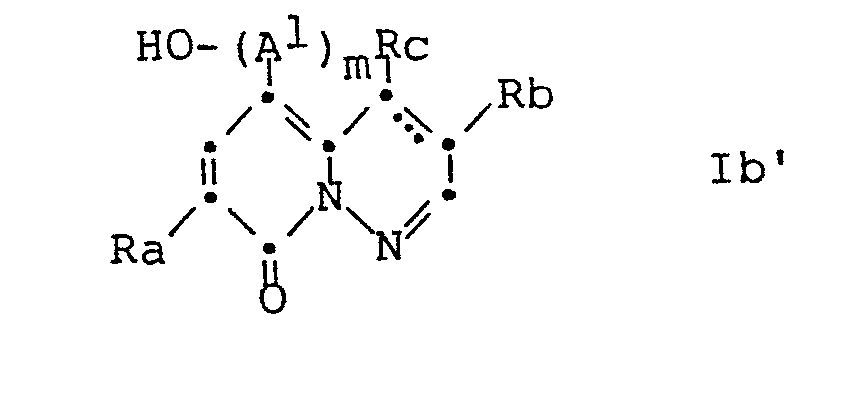
worin A1, Ra, Rb, Rc, m und die gestrichelte Linie die obige Bedeutung besitzen,
in Gegenwart einer Base mit einer Verbindung der allgemeinen Formel
worin X eine Abgangsgruppe bedeutet, und A 21 und R 1 die obige Bedeutung besitzen,
bzw. eine Verbindung der Formel I, welche eine freie Hydroxygruppe besitzt, mit einer Verbindung der allgemeinen Formel
worin R niederes Alkyl bedeutet, und X obige Bedeutung besitzt,
umsetzt, oder - g) eine Verbindung der allgemeinen Formel

worin A1, Q1, Ra, Rb. Rc, m und die gestrichelte Linie die obige Bedeutung besitzen,
in Gegenwart eines säurebindenden Mittels mit einem reaktiven Derivat einer Carbonsäure der allgemeinen Formel
- h) eine Verbindung der allgemeinen Formel

worin A1, Ra. Rb, Rc, m und die gestrichelte Linie die obige Bedeutung besitzen,
in Gegenwart eines Reduktionsmittels mit einem Amin der obigen Formel IX oder X umsetzt, oder - i) eine Verbindung der allgemeinen Formel

worin R 11 Nitro, Cyano oder niederes Alkoxycarbonyl bedeutet, und A1. Ra, Rb, Rc, m und die gestrichelte Linie die obige Bedeutung besitzen.
oder eine Verbindung der obigen Formel Ia oder ein reaktives Derivat davon reduziert, oder - j) einen Alkohol der obigen Formel Ib' oder einen Alkohol der allgemeinen Formel

worin A1, A2. Q1, Ra, Rb, Rc, m, n, q und die gestrichelte Linie die obige Bedeutung besitzen, und R 32 und R 42 zusammen mit dem Stickstoffatom einen 3- bis 7-gliedrigen, gegebenenfalls durch eine oder zwei niedere Alkylgruppen und durch eine Hydroxygruppe substituierten, gesättigten N-Heterocyclus bedeuten, der als Ringglied noch ein Sauerstoff- oder Schwefelatom oder die Gruppe >N-R5 enthalten kann, und R5 die obige Bedeutung besitzt,
oxidiert, oder - k) ein Isocyanat der allgemeinen Formel

worin A1, Ra. Rb, Rc, m und die gestrichelte Linie die obige Bedeutung besitzen, und R33 Wasserstoff, niederes Alkyl oder (C3-7)-Cycloalkyl bedeutet,
mit einem niederen Alkohol oder einem Amin der obigen Formel X bzw. mit einer Verbindung der obigen Formel Ib umsetzt, oder - 1) eine Verbindung der allgemeinen Formel

worin X ein Halogenatom bedeutet, und A1, Ra, Rb, Rc, m und die gestrichelte Linie die obige Bedeutung besitzen,
mit einem niederen Alkylmagnesiumhalogenid umsetzt, oder - m) eine Verbindung der allgemeinen Formel

worin Q4 die obige Gruppe (a) oder (b) bedeutet und Ra und Rd obige Bedeutung besitzen,
am Thiophenring halogeniert, oder - n) eine Verbindung der obigen Formel VIIIc in Gegenwart einer Base mit einer Verbindung der allgemeinen Formel


worin Y ein Sauerstoffatom oder die Gruppe -NR"'-, Y' ein Sauerstoffatom oder die Gruppe -NH-. Y" ein Sauerstoff- oder Schwefelatom und R" und R"' je Wasserstoff oder niederes Alkyl bedeuten,
umsetzt und das erhaltene Produkt cyclisiert, oder - o) eine Verbindung der allgemeinen Formel

worin A' C1-6-Alkylen bedeutet, und Ra. Rb. Rc, die gestrichelte Linie und m die obige Bedeutung besitzen, mit einem niederen Alkohol umsetzt, oder - p) eine Carbonsäure der Formel Ia, worin m die Zahl 0 bedeutet, decarboxyliert, oder
- q) eine Verbindung der Formel I, worin Rd Wasserstoff bedeutet, am Pyridonring halogeniert, oder
- r) in einer Verbindung der allgemeinen Formel

worin R7 und R8 je niederes Alkyl oder zusammen niederes Alkylen bedeuten, und Ra. Rb, Rc und die gestrichelte Linie die obige Bedeutung besitzen, die Acetalgruppe spaltet, oder - s) eine Verbindung der allgemeinen Formel

worin X2 Phenoxy bedeutet, und A1, Ra, Rb. Rc, die gestrichelte Linie und m die obige Bedeutung besitzen. mit einem Amin der obigen Formel X umsetzt, und - t) erwünschtenfalls eine erhaltene Verbindung der Formel 1 mit einem basischen Substituenten in ein pharmazeutisch annehmbares Säureadditionssalz überführt.
- Bei verschiedenen der obigen erfindungsgemässen Verfahren müssen die in den Ausgangsstoffen allfällig vorhandenen reaktionsfähigen Amino-, Carboxy- und/oder Hydroxylgruppen durch Schutzgruppen blockiert sein. Diese Fälle sind für den Fachmann ohne weiteres erkennbar, und auch die Auswahl der jeweils geeigneten Schutzgruppen bereitet ihm keine Schwierigkeiten.
- Gemäss Verfahrensvariante a) können Verbindungen der Formel I hergestellt werden, worin Rd Wasserstoff, Cyano. Nitro oder die Gruppe der Formel -CO-(Q1A2)q-R1 bedeutet und q, A2, Q und R obige Bedeutung besitzen. Die Umsetzung erfolgt zweckmässigerweise in einem inerten Lösungsmittel, das bei erhöhter Temperatur, vorzugsweise oberhalb 80°C siedet. Geeignete Lösungsmittel sind beispielsweise aromatische Kohlenwasserstoffe, wie Benzol, Toluol und Xylol, wobei die Reaktion vorzugsweise bei der Rückflusstemperatur des Lösungsmittels durchgeführt wird.
- Bei der Umsetzung einer Verbindung der Formel II mit einer Verbindung der Formel III oder mit Phenylvinylsulfoxid erhält man, wenn man bei erhöhter Temperatur arbeitet, direkt die entsprechende Verbindung der Formel I. Bei der Umsetzung einer Verbindung der Formel II mit einer Verbindung der Formel IV erhält man als Cycloadditionsprodukt zunächst die entsprechende Epithio-Verbindung der allgemeinen Formel

worin Ra, Rb. Rc, Rd', und die gestrichelte Linie obige Bedeutung besitzen,
welche anschliessend durch Behandeln mit einer starken Base in die entsprechende Verbindung der Formel I übergeführt wird. Geeignete Basen sind beispielsweise die niederen Alkalimetallalkoholate, wie Natriummethylat, wobei man als Lösungsmittel zweckmässigerweise den entsprechenden niederen Alkohol verwendet. Die Reaktion wird vorzugsweise bei der Rückflusstemperatur des Lösungsmittels durchgeführt. - Die Reaktion einer Verbindung der Formel V, worin R' Wasserstoff bedeutet, mit einer Verbindung der Formel VI gemäss Verfahrensvariante b) kann ohne Lösungsmittel oder in Gegenwart eines bei erhöhter Temperatur siedenden Lösungsmittels durchgeführt werden. Geeignete Lösungsmittel sind beispielsweise aromatische Kohlenwasserstoffe, wie Benzol, Toluol und Xylol. Die Cyclokondensation wird jedoch vorzugsweise ohne Lösungsmittel in einem Temperaturbereich von etwa 80°C bis etwa 150°C durchgeführt. Das so erhaltene Cyclokondensationsprodukt, nämlich eine Verbindung der allgemeinen Formel
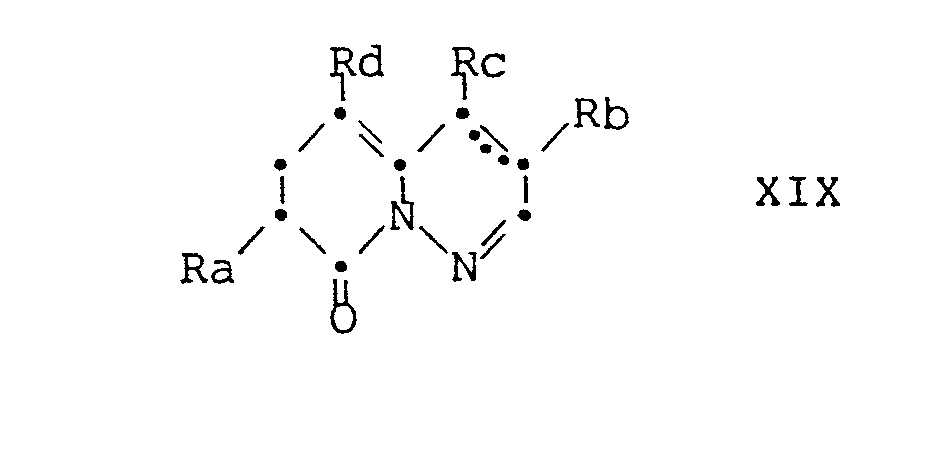
wird anschliessend mit einem geeigneten Oxidationsmittel, wie Mangandioxid, dehydriert. Geeignete Lösungsmittel sind beispielsweise aromatische Kohlenwasserstoffe, wie Benzol, Toluol und Xylol. Die Dehydrierung wird vorzugsweise in einem Temperaturbereich von etwa Raumtemperatur bis zur Siedetemperatur des gewählten Lösungsmittels, vorzugsweise bei der Siedetemperatur, durchgeführt. - Durch Reaktion einer Verbindung der Formel V, worin R' niederes Alkoxy bedeutet, in Gegenwart einer starken Base, wie Natriumhydrid, und in einem inerten Lösungsmittel, vorzugsweise in einem Aether, wie Tetrahydrofuran. mit einer Verbindung der Formel VI gemäss Verfahrensvariante b) erhält man die entsprechende Verbindung der Formel I. Die Reaktionstemperatur liegt in einem Bereich von Raumtemperatur bis zur Siedetemperatur der Reaktionsmischung.
- Die Verbindungen der Formeln XVIII, sofern Rd' eine von Acetyl und Aethoxycarbonyl verschiedene Bedeutung hat, wenn Ra Phenyl. Rb und Rc zusammen die Gruppe -CH=CH-CH=CH- und die gestrichelte Linie eine zusätzliche Bindung bedeuten, und XIX sind neu und ebenfalls Gegenstand der vorliegenden Erfindung.
- Verbindungen der Formel I, welche eine veresterte Carboxygruppe besitzen, können gemäss Verfahrensvariante c) hydrolysiert werden, wobei man die entsprechenden freien Carbonsäuren erhält. Die Hydrolyse kann nach an sich bekannten Methoden durchgeführt werden. Die Hydrolyse wird vorzugsweise mit einem Alkalimetallhydroxid, wie Natriumhydroxid und Kaliumhydroxid, in einem niederen Alkohol, wie Methanol und Aethanol, oder in einem Gemisch aus einem niederen Alkohol und Wasser durchgeführt. Die Reaktionstemperatur liegt zweckmässigerweise in einem Bereich von Raumtemperatur bis zur Siedetemperatur des Reaktionsgemisches, wobei man vorzugsweise bei der Siedetemperatur des Reaktionsgemisches arbeitet.
- Durch Veresterung einer Carbonsäure der Formel Ia mit einem Alkohol der Formel VII gemäss Verfahrensvariante d) können Verbindungen der Formel I hergestellt werden, worin Rd die Gruppe der Formel -(A1)m-CO-O-A21-R1 bedeu- tet und A1, A21, R und m obige Bedeutung besitzen. Die Veresterung kann beispielsweise in Gegenwart eines Veresterungsreagenzes in einem inerten organischen Lösungsmittel durchgeführt werden. Geeignete Reagenzien sind beispielsweise N-Methyl-2-chlorpyridiniumjodid und dergleichen, organische Sulfonsäurehalogenide, wie Methylsulfonylchlorid, p-Toluolsulfonylchlorid und Mesitylensulfonsäurechlorid, und dergleichen. Geeignete Lösungsmittel sind beispielsweise halogenierte Kohlenwasserstoffe, wie Methylenchlorid, Chloroform und dergleichen. Geeignete Basen sind beispielsweise tertiäre Amine, wie Triäthylamin, Tri-n-butylamin und dergleichen. Die Reaktion wird vorzugsweise in einem Temperaturbereich von Raumtemperatur bis zur Rückflusstemperatur des Lösungsmittels durchgeführt.
- Die gewünschte Veresterung kann auch dadurch bewerkstelligt werden, dass man die Carbonsäure der Formel Ia zunächst in ein reaktives Derivat überführt und dieses dann in Gegenwart einer Base mit einem Alkohol der Formel VII umsetzt. Als reaktive Derivate verwendet man vorzugsweise die entsprechenden Carbonsäurechloride. Als Basen eignen sich beispielsweise die bereits erwähnten tertiären Amine. Die Reaktion wird vorzugsweise in einem Temperaturbereich von etwa Raumtemperatur bis zur Rückflusstemperatur des Reaktionsgemisches durchgeführt, wobei man zweckmässigerweise bei Raumtemperatur arbeitet.
- Die Veresterung mit einem Alkohol der Formel VII, worin A 21 niederes Alkylen und R1 Wasserstoff bedeuten, d.h. mit einem niederen Alkohol, kann auch durch Umsetzen der Carbonsäure mit einem di(niederen Alkyl)acetal des N,N-Dime- thylformamids durchgeführt werden. Die Umsetzung mit einem di(niederen Alkyl)acetal des N.N-Dimethylformamids wird vorzugsweise in einem inerten Lösungsmittel, beispielsweise in einem aromatischen Kohlenwasserstoff, wie Benzol, bei der Rückflusstemperatur des Reaktionsgemisches durchgeführt.
- Durch Reaktion einer Carbonsäure der Formel Ia oder eines reaktiven Derivates davon mit einem Amin der Formel IX oder X gemäss Verfahrensvariante e) können Verbindungen der Formel I hergestellt werden, worin Rd die Gruppe -(A1)m--CO-NR2-A21-R1 oder -(A1)m-CO-NR3R4 bedeutet und A1, A21, R 1, R . R3, R und m obige Bedeutung besitzen.
- Durch Umsetzen einer Carbonsäure der Formel VIIIa oder eines reaktiven Derivates davon mit Ammoniak oder einem mono- oder di(niederen Alkyl)amin gemäss Verfahrensvariante e) können entsprechende Verbindungen der Formel I hergestellt werden, worin R eine Gruppe der Formel -NR3R4 und R und R4 zusammen mit dem Stickstoffatom einen 3- bis 7-gliedrigen, gegebenenfalls durch eine oder zwei niedere Alkylgruppen und durch eine Carbamoyl- oder mono- oder di(niedere Alkyl)carbamoylgruppe substituierten. gesättigten N-Heterocyclus bedeuten, der als Ringglied noch ein Sauerstoff- oder Schwefelatom oder die Gruppe >N-R5 enthalten kann, und R5 obige Bedeutung besitzt.
- Verwendet man als Ausgangsstoff die freie Carbonsäure der Formel Ia oder VIIIa, so wird die Amidierungsreaktion vorzugsweise in Gegenwart eines Kondensationsmittels, wie N-Methyl-2-chlorpyridiniumjodid, in einem inerten organischen Lösungsmittel und in Gegenwart einer Base durchgeführt. Geeignete Lösungsmittel sind beispielsweise aromatische Kohlenwasserstoffe wie Benzol, Toluol und Xylol. Geeignete Basen sind beispielsweise die weiter oben erwähnten tertiären Amine. Bevorzugte reaktive Carbonsäurederivate. welche in Gegenwart einer Base direkt mit dem entsprechenden Amin umgesetzt werden können, sind die entsprechenden Carbonsäurechloride. Geeignete Basen sind wiederum die vorerwähnten tertiären Amine. Geeignete Lösungsmittel sind beispielsweise aromatische Kohlenwasserstoffe, wie Benzol. Toluol und Xylol, und Aether, wie Dioxan. Die Reaktion wird in beiden Fällen vorzugsweise in einem Bereich von Raumtemperatur bis Rückflusstemperatur des Reaktionsgemisches durchgeführt.
- Gemäss Verfahrensvariante f) können einerseits Verbin- dungen der Formel I hergestellt werden, worin Rd eine Gruppe der Formel -(A1) m-O-A21-R1 bedeutet, und A1, A21, R und m obige Bedeutung besitzen, und andererseits Verbindungen der Formel I, welche eine in Form eines niederen Alkyläthers verätherte Hydroxygruppe besitzen.
- Die Umsetzung einer Verbindung der Formel Ib' mit einer Verbindung der Formel XI bzw. die Umsetzung einer Verbindung der Formel I, welche eine freie Hydroxygruppe besitzt, mit einer Verbindung der Formel XII wird zweckmässigerweise in einem inerten organischen Lösungsmittel, wie N.N-Dimethylformamid oder dergleichen, durchgeführt, wobei man als Base zweckmässigerweise eine starke Base, z.B. ein Alkalimetallhydrid oder -hydroxyd, wie Natriumhydrid, Kaliumhydroxyd und Natriumhydroxyd, verwendet. Man arbeitet zweckmässigerweise in einem Bereich von 0°C bis Raumtemperatur. Die mit X bezeichnete Abgangsgruppe ist vorzugsweise ein Halogenatom, insbesondere ein Chlor-, Brom- oder Jodatom, oder eine Alkyl- oder Arylsulfonyloxygruppe, beispielsweise eine Methansulfonyloxy- oder p-Toluolsulfonyloxygruppe. Im Falle der Herstellung von niederen Alkyläthern kann X auch eine niedere Alkoxysulfonyloxygruppe bedeuten, d.h. dass das Alkylierungsmittel in diesem Fall ein Di(niederes Alkyl)sulfat. wie Dimethylsulfat, ist.
- d Gemäss Verfahrensvariante g) können Verbindungen der Formel I hergestellt werden, worin Rd eine Gruppe der Formel -(A1) m-Q1-CO-R1 bedeutet, und A1, Q1, R und m obige Bedeutung besitzen.
- Die Umsetzung einer Verbindung der Formel Ib mit einem reaktiven Derivat einer Carbonsäure der Formel XIII, beispielsweise einem Carbonsäurechlorid, wird zweckmässigerweise in einem inerten organischen Lösungsmittel in Gegenwart eines säurebindenden Mittels, beispielsweise einem tertiären Amin, durchgeführt. Als Lösungsmittel eignen sich beispielsweise aromatische Kohlenwasserstoffe, wie Benzol, Toluol und Xylol, und halogenierte Kohlenwasserstoffe, wie Methylenchlorid. Wenn R1 niederes Alkyl bedeutet, können auch entsprechende Carbonsäureanhydride verwendet werden. wobei man in diesem Fall als Lösungsmittel und als säurebindendes Mittel zweckmässigerweise Pyridin verwendet. Die Reaktion wird vorzugsweise in einem Temperaturbereich von etwa 0°C bis Siedetemperatur des Lösungsmittels durchgeführt.
- Gemäss Verfahrensvariante h) können Verbindungen der Formel I hergestellt werden, worin Rd eine Gruppe der Formel -(A1) -CH2-NR2A21-R1 oder -(A1)m-CH2- -NR R bedeutet und A1, A21, R1, R2, R3, R und m obige Bedeutung besitzen. Die Reaktion wird vorzugsweise in einem niederen Alkohol als Lösungsmittel und mit Natriumcyanoborhydrid als Reduktionsmittel durchgeführt, wobei man zweckmässigerweise bei Raumtemperatur arbeitet und das Amin in Form seines Hydrochlorides einsetzt.
- Gemäss Verfahrensvariante i) können Verbindungen der Formel I hergestellt werden, worin Rd eine Gruppe der Formel -(A1)m-R12 und R12 Amino. Aminomethyl. Hydroxy- methyl oder Methyl bedeuten und A und m obige Bedeutung besitzen. Die Wahl des geeigneten Reduktionsmittels richtet sich einerseits nach dem verwendeten Ausgangsstoff und andererseits nach dem gewünschten Produkt. Eine Verbindung der Formel Id, worin R11 Cyano bedeutet kann beispielsweise mit Diboran in Tetrahydrofuran zur entsprechenden Aminomethylverbindung reduziert werden. Eine Verbindung der Formel Id, worin R11 Nitro bedeutet, kann beispielsweise mit Natriumsulfid in einem niederen Alkohol, wie Methanol, zur entsprechenden Aminoverbindung reduziert werden. Eine Verbindung der Formel Id worin R11 niederes Alkoxycarbonyl bedeutet, kann mit Lithiumborhydrid, und das Säurechlorid einer Verbindung der Formel Ia mit Natriumborhydrid in Tetrahydrofuran und/oder Dimethylformamid zur entsprechenden Hydroxymethylverbindung reduziert werden. Eine Carbonsäure der Formel Ia kann beispielsweise mit Boran/Tetrahydrofuran-Komplex oder Boran/Methylsulfid-Komplex in Tetrahydrofuran zur entsprechenden Methylverbindung reduziert werden.
- Gemäss Verfahrensvariante j) können Verbindungen der Formel I hergestellt werden, worin Rd eine Gruppe der Formel -(A1) -CHO oder -(A1) -(CO) n-(Q1A2)q- -NR34R44 und R 34 und R 44 zusammen einen 3- bis 7-gliedrigen, gegebenenfalls durch eine oder zwei niedere Alkylgruppen und durch eine Oxogruppe substituierten, gesättigten N-Heterocyclus bedeuten, der als Ringglied noch ein Sauerstoff- oder Schwefelatom oder die Gruppe >N-R5 enthalten kann, und A1, A2, Q , R , m, n und q obige Bedeutung besitzen. Die Oxidation von Alkoholen der Formeln Ib' und Ie kann nach an sich bekannten und jedem Fachmann geläufigen Methoden durchgeführt werden. Man kann die gewünschte Oxidation beispielsweise mit Mangandioxid in einem halogenierten Kohlenwasserstoff, wie Methylenchlorid bei Raumtemperatur bewerkstelligen. Die gewünschte Oxidation kann jedoch auch mit Pyridiniumchlorochromat in einem halogenierten Kohlenwasserstoff, wie Methylenchlorid, bei Raumtemperatur, oder mit Dimethylsulfoxid/Trifluoressigsäure--anhydrid in einem halogenierten Kohlenwasserstoff, wie Methylenchlorid, bei Temperaturen von etwa -70°C bewerkstelligt werden.
- Gemäss Verfahrensvariante k) können durch Umsetzung eines Isocyanates der Formel VIIIb mit einem niederen Alkohol oder einem Amin der Formel X, bzw. durch Umsetzen eines Isocyanates der Formel XIV mit einer Verbindung der Formel Ib Verbindungen der Formel I hergestellt werden, worin Rd eine Gruppe der Formel -(A ) -NHCO-R13 -(A ) --NHCO-NR3R4 oder -(A1)m-Q1-CO-NH-R33 und R13 niederes Alkoxy bedeuten, und A 1, Q 1, R3, R33, R und m obige Bedeutung besitzen. Diese Umsetzung wird zweckmässigerweise in einem inerten Lösungsmittel, beispielsweise in einem aromatischen Kohlenwasserstoff, wie Benzol. Toluol oder Xylol, in einem halogenierten Kohlenwasserstoff, wie Methylenchlorid, oder in einem Aether, wie Dioxan, durchgeführt. Die Reaktion wird vorzugsweise in einem Temperaturbereich von etwa Raumtemperatur bis zur Siedetemperatur des Reaktionsgemisches durchgeführt. Verwendet man ein Isocyanat der Formel XIV, worin R33 Wasserstoff bedeutet, als Ausgangsstoff, so wird dieses zweckmässigerweise in geschützter Form eingesetzt. Eine besonders geeignete Schutzgruppe ist dabei die Trichloracetylgruppe, welche nach erfolgter Umsetzung beispielsweise mit Kaliumcarbonat in Wasser durch Hydrolyse wieder entfernt werden kann.
- Gemäss Verfahrensvariante 1) können Verbindungen der Formel I hergestellt werden, worin Rd eine Gruppe der Formel -(A1)m-CO-R14 und R14 niederes Alkyl bedeuten. und A1 und m obige Bedeutung besitzen. Als Lösungsmittel verwendet man vorzugsweise Aether, wie Tetrahydrofuran. Die Reaktion wird vorzugsweise in einem Temperaturbereich von -78°C bis Raumtemperatur durchgeführt.
- Gemäss Verfahrensvariante m) können Verbindungen der Formel 1 hergestellt werden, worin Rb und Rc zusammen mit dem mit a bezeichneten Kohlenstoffatom eine durch Halogen substituierte Gruppe der Formel >Cα-S-CH=CH- (h) oder >Cα-CH=CH-S- (i) und die gestrichelte Linie eine zusätzliche Bindung bedeuten. Als Halogenierungsmittel verwendet man vorzugsweise elementares Halogen, beispielsweise elementares Brom. Geeignete Lösungsmittel sind beispielsweise halogenierte Kohlenwasserstoffe, wie Chloroform. Man arbeitet zweckmässigerweise in einem Temperaturbereich von 0°C bis etwa Raumtemperatur.
- Gemäss Verfahrensvariante n) können Verbindungen der Formel I hergestellt werden, worin Rd eine Gruppe der Formel -(A1)m-R15 und R einen über ein Kohlenstoffatom gebundenen. 5-gliedrigen, gegebenenfalls durch eine oder zwei niedere Alkylgruppen substituierten, partiell ungesättigten oder aromatischen Heterocyclus bedeuten, und A und m obige Bedeutung besitzen. Die Umsetzung einer Verbindung der Formel VIIIc mit einer Verbindung der Formel XVI, XVII oder XVIII wird zweckmässigerweise in einem inerten Lösungsmittel, beispielsweise in einem halogenierten Kohlenwasserstoff, wie Methylenchlorid, oder in einem aromatischen Kohlenwasserstoff, wie Benzol, Toluol oder Xylol, und in einem Temperaturbereich von etwa 0°C bis zur Rückflusstemperatur des Reaktionsgemisches durchgeführt. Geeignete Basen sind beispielsweise die bereits früher erwähnten tertiären Amine. Die Cyclisierung des so erhaltenen Produktes kann nach an sich bekannten und jedem Fachmann geläufigen Methoden durchgeführt werden. Die Cyclisierung kann beispielsweise in Gegenwart katalytischer Mengen einer starken Säure wie p-Toluolsulfonsäure, unter Entfernung des gebildeten Reaktionswassers mittels eines Schleppers, wie Toluol, bewerkstelligt werden. Die Cyclisierung kann aber auch mittels Azodicarbonsäurediäthylester/Triphenylphosphin in einem Aether, wie Tetrahydrofuran, bewerkstelligt werden.
- Gemäss Verfahrensvariante o) können Verbindungen der Formel I hergestellt werden, worin Rd eine Gruppe der Formel -(A')m-CH2-R16, A' C1-6-Alkyl und R16 niederes Alkoxycarbonyl bedeuten, und m obige Bedeutung besitzt. Die Reaktion eines Diazoketons der Formel VIIId mit einem niederen Alkohol wird vorzugsweise in Gegenwart eines Silberkatalysators, wie Silberoxid, durchgeführt, wobei man als Lösungsmittel vorzugsweise den niederen Alkohol verwendet. Die Reaktion wird bei erhöhter Temperatur, vorzugsweise bei der Siedetemperatur des Reaktionsgemisches durchgeführt.
- Gemäss Verfahrensvariante p) können Verbindungen der Formel I hergestellt werden, worin Rd Wasserstoff bedeutet. Die Decarboxylierung einer Carbonsäure der Formel Ia wird vorzugsweise durch trockenes Erhitzen, insbesondere durch trockenes Erhitzen im Vakuum auf Temperaturen von etwa 200° bis etwa 300°C bewerkstelligt.
- Gemäss Verfahrensvariante q) können Verbindungen der Formel I hergestellt werden, worin Rd Halogen bedeutet. Für die vorliegende Halogenierung geeignete Halogenierungsmittel sind N-Halogenimide und -amide. wie N-Chlorsuccinimid, N-Bromsuccinimid, N-Chloracetamid und dergleichen. Als Lösungsmittel verwendet man vorzugsweise einen halogenierten Kohlenwasserstoff, wie Methylenchlorid, Chloroform, Tetrachlorkohlenstoff und dergleichen. Die Reaktion kann in einem Temperaturbereich von etwa 0°C bis zur Siedetemperatur des Reaktionsgemisches durchgeführt werden. Vorzugsweise arbeitet man bei Raumtemperatur.
- Durch Spaltung der Acetalgruppe in einer Verbindung der Formel VIIIe gemäss Verfahrensvariante r) können Verbindungen der Formel I hergestellt werden, worin Rd die Gruppe -CHO bedeutet. Die Spaltung wird vorzugsweise durch Umacetalisieren in Gegenwart einer Säure, wie p-Toluolsulfonsäure, und eines Ketons, wie Cyclohexanon, Aceton und dergleichen bewerkstelligt. Die Reaktion kann in einem Temperaturbereich von Raumtemperatur bis zur Siedetemperatur des Reaktionsgemisches durchgeführt werden.
- Gemäss Verfahrensvariante s) können Verbindungen der Formel I hergestellt werden, worin R eine Gruppe der For- mel -(A1)m-OCO-NR3R4 bedeutet. Für den vorliegenden Zweck geeignete Lösungsmittel sind beispielsweise Aether. wie Tetrahydrofuran, Dioxan und Diäthyläther. N.N-Dimethylformamid und Dimethylsulfoxid. Die Reaktion wird zweckmässigerweise bei Raumtemperatur durchgeführt.
- Gemäss Verfahrensvariante t) können Verbindungen der Formel I, welche einen oder mehrere basische Substituenten besitzen, in pharmazeutisch annehmbare Säureadditionssalze übergeführt werden. Derartige Säureadditionssalze können nach an sich bekannten und jedem Fachmann geläufigen Methoden hergestellt werden. Es kommen dabei sowohl Salze mit anorganischen als auch Salze mit organischen Säuren in Betracht, beispielsweise Hydrochloride. Hydrobromide, Sulfate, Nitrate, Citrate, Acetate, Maleate, Succinate, Methansulfonate, p-Toluolsulfonate und dergleichen.
- Die als Ausgangsstoffe verwendeten Verbindungen der Formeln 11 (sofern Ra eine von Phenyl verschiedene Bedeutung hat, wenn Rb und Rc zusammen die Gruppe -CH=CH-CH=CH- und die gestrichelte Linie eine zusätzliche Bindung bedeuten) VIIIa. VIIIb. VIIIc, VIIId. VIIIe und VIIIf sind neu und ebenfalls Gegenstand der vorliegenden Erfindung. Diese Stoffe können wie nachfolgend beschrieben hergestellt werden.
- Die neuen Verbindungen der Formel II können beispielsweise dadurch hergestellt werden, dass man eine Verbindung der allgemeinen Formel

mit einer Verbindung der allgemeinen Formel
umsetzt. Die Reaktion einer Verbindung der Formel XXI mit einer Verbindung der Formel XXII, worin X vorzugsweise Chlor und X2 vorzugsweise Brom bedeuten, wird vorzugsweise bei Raumtemperatur in einem halogenierten Kohlenwasserstoff, wie Chloroform, durchgeführt, worauf man mit einem basischen Amin, wie Triäthylamin, behandelt. Die Reaktion einer Verbindung der Formel XXI mit einer Verbindung der Formel XXIII wird vorzugsweise in einem inerten Lösungsmittel, wie Aceton, N,N-Dimethylformamid, Dimethylsulfoxid und dergleichen, bei Raumtemperatur durchgeführt. - Die Carbonsäuren der Formel VIIIa können durch Hydrolyse der entsprechenden niederen Alkylester der Formel 1 hergestellt werden. Diese Hydrolyse kann nach an sich bekannten Methoden, beispielsweise in Analogie zu Verfahrensvariante c), durchgeführt werden.
- Die Isocyanate der Formel VIIIb können hergestellt werden, indem man eine Verbindung der Formel Ib, worin Q1 die Gruppe der Formel -NH- bedeutet, in einem inerten Lösungsmittel mit Phosgen behandelt. Geeignete Lösungsmittel sind beispielsweise halogenierte Kohlenwasserstoffe, wie Chloroform und 1,2-Dichloräthan. Die Isocyanate der Formel VIIIb können aber auch hergestellt werden, indem man ein Carbonsäurehalogenid der Formel VIIIc in einem inerten organischen Lösungsmittel mit einem Azid, wie Natriumazid oder Trimethylsilylazid, in das entsprechende Carbonsäureazid überführt und dieses durch Erwärmen zum entsprechenden Isocyanat umlagert. Geeignete Lösungsmittel sind beispielsweise Aether, wie Dioxan, Aethylenglykoldimethyläther, Diäthylenglykoldimethyläther und dergleichen, Ketone, wie Aethylmethylketon, und dergleichen. Die Umlagerung wird bei Temperaturen von 80°C und darüber bewerkstelligt.
- Die Carbonsäurehalogenide der Formel VIIIc können hergestellt werden, indem man eine Carbonsäure der Formel Ia mit einem Halogenierungsmittel behandelt. Geeignete Halogenierungsmittel sind beispielsweise Thionylchlorid, Oxalylchlorid, Phosphorpentachlorid und dergleichen. In einer bevorzugten Ausführungsform verwendet man überschüssiges Thionylchlorid und arbeitet ohne zusätzliches Lösungsmittel bei Raumtemperatur.
- Die Diazoketone der Formel VIIId können hergestellt werden, indem man ein Carbonsäurehalogenid der Formel VIIIc in einem inerten organischen Lösungsmittel mit Diazomethan umsetzt. Geeignete Lösungsmittel sind beispielsweise Aether, wie Tetrahydrofuran, Dioxan und Diäthyläther. Die Reaktion wird vorzugsweise in einem Temperaturbereich von etwa 0° bis etwa 10°C durchgeführt.
- Die Verbindungen der Formel VIIIe können in Analogie zur Verfahrensvariante a) hergestellt werden, wobei man als Ausgangsstoff eine Verbindung der allgemeinen Formel HC≡C-CH(OR7)OR8 verwendet, worin R7 und R8 obige Bedeutung besitzen.
- Die Verbindungen der Formel VIIIf können hergestellt werden, indem man eine Verbindung der Formel Ib' in einem inerten Lösungsmittel, beispielsweise in einem Aether, wie Dioxan, und in Gegenwart einer Base, beispielsweise eines basischen Amins, wie Pyridin, mit Chlorameisensäurephenylester umsetzt.
- Die übrigen als Ausgangsstoffe verwendeten Verbindungen gehören an sich bekannten Stoffklassen an. Wie bereits eingangs erwähnt besitzen die Verbindungen der Formel 1 wertvolle pharmakologische Eigenschaften. Sie entfalten insbesondere ausgeprägte muskelrelaxierende. sedativ-hypnotische, antikonvulsive und/oder anxiolytische Eigenschaften und weisen eine nur geringe Toxizität auf. Diese Eigenschaften können beispielsweise im nachfolgend beschriebenen und für die Erfassung derartiger Eigenschaften allgemein anerkannten Antipentetrazoltest nachgewiesen werden.
- In diesem Tierversuch verabreicht man Mäusen die zu testende Verbindung oral und 30 Minuten später 120 mg/kg Pentetrazol intraperitoneal, das in ungeschützten Versuchstieren 1-4 Minuten nach der Injektion Emprosthotonus und tonische Streckungen der vorderen und/oder hinteren Gliedmassen bewirkt. Man verwendet 10 Versuchstiere pro Dosis Testsubstanz. Nach Auszählen der geschützten Versuchstiere ermittelt man die ED50 nach der Probit-Methode. Die ED50 ist diejenige Dosis, welche 50% der Versuchstiere vor den durch Pentetrazol bewirkten krampfartigen Anfällen schützt. In der nachfolgenden Tabelle werden die Resultate zusammengestellt, welche mit repräsentativen Vertretern der durch die allgemeine Formel I definierten Verbindungsklasse in dem vorstehend geschilderten Versuch erhalten worden sind. Die Tabelle enthält ausserdem Angaben über die akute Toxizität (DL ) einiger dieser Verbindungen in mg/kg bei einmaliger oraler Verabreichung an Mäusen.

- A = 3-Methoxy-1-[(4-oxo-3-phenyl-4H-pyrido[2,1-a]phthalazin--l-yl)carbonyl]azetidin
- F = 1-[(10-Chlor-4-oxo-3-phenyl-4H-pyrido[2,1-a]phthalazin-1-yl)carbonyl]-3-methoxyazetidin
- G = N,N-Dimethyl-10-chlor-4-oxo-3-phenyl-4H-pyrido[2,1-a]-phthalazin-1-carboxamid
- H = N,N-Diäthyl-10-chlor-4-oxo-3-phenyl-4H-pyrido[2,1-a]] phthalazin-l-carboxamid
- M = 3-Methoxy-1-[(7-oxo-8-phenyl-7H-pyrido[1,2-b]thieno[2,3-d] pyridazin-10-yl)carbonyl]azetidin.
- Die Verbindungen der Formel I und die pharmazeutisch annehmbaren Säureadditionssalze von Verbindungen der Formel I mit einem basischen Substituenten können als Heilmittel, z.B. in Form von pharmazeutischen Präparaten, Verwendung finden. Die pharmazeutischen Präparate können oral, z.B. in Form von Tabletten, Lacktabletten, Dragees, Hart- und Weichgelatinekapseln, Lösungen, Emulsionen oder Suspensionen, verabreicht werden. Die Verabreichung kann aber auch rektal, z.B. in Form von Suppositorien, oder parenteral, z.B. in Form von Injektionslösungen, erfolgen.
- Zur Herstellung von pharmazeutischen Präparaten können die erfindungsgemässen Produkte mit pharmazeutisch inerten, anorganischen oder organischen Trägern verarbeitet werden. Als solche Träger kann man für Tabletten, Lacktabletten, Dragees und Hartgelatinekapseln beispielsweise Lactose, Maisstärke oder Derivate davon, Talk, Stearinsäure oder deren Salze und dergleichen verwenden. Für Weichgelatinekapseln eignen sich als Träger beispielsweise pflanzliche Oele, Wachse, Fette, halbfeste und flüssige Polyole und dergleichen. Je nach Beschaffenheit des Wirkstoffes sind jedoch bei Weichgelatinekapseln überhaupt keine Träger erforderlich. Zur Herstellung von Lösungen und Sirupen eignen sich als Träger beispielsweise Wasser, Polyole, Saccharose, Invertzucker, Glukose und dergleichen. Für Injektionslösungen eignen sich als Träger beispielsweise Wasser, Alkohole, Polyole. Glyzerin, pflanzliche Oele und dergleichen. Für Suppositorien eignen sich als Träger beispielsweise natürliche oder gehärtete Oele, Wachse. Fette, halbflüssige oder flüssige Polyole und dergleichen.
- Die pharmazeutischen Präparate können daneben noch Konservierungsmittel, Lösungsvermittler, Stabilisierungsmittel, Netzmittel, Emulgiermittel, Süssmittel, Färbemittel, Aromatisierungsmittel. Salze zur Veränderung des osmotischen Druckes, Puffer, Ueberzugsmittel oder Antioxidantien enthalten. Sie können auch noch andere therapeutisch wertvolle Stoffe enthalten. Arzneimittel enthaltend ein erfindungsgemässes Produkt und einen therapeutisch inerten Träger, sowie ein Verfahren zu deren Herstellung, das dadurch gekennzeichnet ist, dass man ein erfindungsgemässes Produkt und gegebenenfalls einen oder mehrere andere therapeutisch wertvolle Stoffe in eine galenische Darreichungsform bringt, sind ebenfalls Gegenstand der vorliegenden Erfindung.
- Die erfindungsgemässen Produkte können, wie bereits erwähnt, bei der Bekämpfung oder Verhütung von Krankheiten. insbesondere bei der Bekämpfung von Konvulsionen und Angstzuständen, sowie für die Herstellung von Arzneimitteln mit muskelrelaxierenden, sedativ-hypnotischen, antikonvulsiven und/oder anxiolytischen Eigenschaften verwendet werden. Die Dosierung kann dabei innerhalb weiter Grenzen variieren und ist natürlich in jedem einzelnen Fall den individuellen Gegebenheiten anzupassen. Bei oraler Verabreichung liegt die tägliche Dosis in einem Bereich von etwa 1 mg bis etwa 100 mg.
- Die nachfolgenden Beispiele dienen der näheren Erläuterung der vorliegenden Erfindung. Sie sollen deren Umfang jedoch in keiner Weise beschränken. Sämtliche Temperaturen sind in Celsiusgraden angegeben.
- 1) 66,95 g Thieno[2.3-d]pyridazin-7(6H)-thion werden unter Argon in 3200 ml Methylenchlorid suspendiert, worauf man 102,7 g a-Bromphenylessigsäurechlorid dazutropft. Man rührt ca. 30 Minuten bei Raumtemperatur und tropft dann 121 ml Triäthylamin dazu, wobei auf 25-30° gekühlt wird. Es wird etwa 40 Minuten gerührt. Nach Abdampfen des Lösungsmittels im Vakuum wird der Rückstand in 1000 ml Wasser und 200 ml Aether aufgenommen, worauf man ca. 30 Minuten rührt. Die ausgefallenen Kristalle werden abgesaugt, mit Wasser und Aether gewaschen und über Nacht getrocknet. Die getrockneten Kristalle werden erneut mit 1000 ml Wasser verrührt. Nach dem Absaugen werden die rotvioletten Kristalle mit Wasser gewaschen und im Vakuum getrocknet. Man erhält 3-Hydroxy-2--phenylthiazolo[3,2-b]thieno[2,3-d]pyridazin-4-ium-hydroxid (inneres Salz) vom Smp. 260-264° (Zersetzung).
- In analoger Weise erhält man:
- II) Aus 7-Chlor-1(2H)-phthalazin-thion und a-Bromphenylessigsäurechlorid nach Umkristallisieren das 9-Chlor-3--hydroxy-2-phenylthiazolo[2,3-a]phthalazin-4-ium-hydroxid (inneres Salz) vom Smp. 296-298° (Chloroform).
- a) 13,5 g 3-Hydroxy-2-phenylthiazolo[3,2-a]phthalazinium- hydroxid (inneres Salz) und 8,1 ml Propiolsäuremethylester werden in 200 ml Toluol unter Feuchtigkeitsausschluss während 24 Stunden unter Rückfluss erhitzt. Man lässt dann abkühlen und rührt während 1 Stunde im Eisbad. Die Kristalle werden abgesaugt, getrocknet und schliesslich aus Toluol umkristallisiert. Man erhält den 4-Oxo-3-phenyl-4H-pyrido-[2,l-a]phthalazin -1-carbonsäuremethylester als gelbe Kristalle vom Smp. 174-175°.
- In analoger Weise erhält man:
- b) Aus 3-Hydroxy-2-phenylthiazolo[3.2-b]thieno[2.3-d]-pyridazin-4-ium-hydroxid (inneres Salz) und Propiolsäuremethylester nach Umkristallisieren aus Acetonitril den 7-Oxo-8-phenyl-7H-pyrido[1,2-b]thieno[2,3-d]pyridazin-10--carbonsäuremethylester als gelbe Kristalle vom Smp. 198-199° und
- c) aus 9-Chlor-3-hydroxy-2-phenylthiazolo[2.3-a]phthalazin--4-ium-hydroxid (inneres Salz) und Propiolsäuremethylester nach Umkristallisieren aus Acetonitril den 10-Chlor-4-oxo-3--phenyl-4H-pyrido[2,1-a]phthalazin-1-carbonsäuremethylester als gelbe Kristalle vom Smp. 234-236°.
- a) 11 g 4-Oxo-3-phenyl-4H-pyrido[2,1-a]phthalazin -1-carbonsäuremethylester werden in 300 ml Aethanol aufgenommen. worauf man eine Lösung von 3,7 g Kaliumhydroxid in 30 ml Wasser hinzufügt und unter Rückfluss erhitzt, bis die Reaktion beendet ist. Dann wird das Reaktionsgemisch auf Zimmertemperatur abgekühlt und auf 2200 ml Wasser gegossen. Man stellt durch Zugabe von IN wässeriger Salzsäure auf pH 7 und entfernt Verunreinigungen durch zweimalige Extraktion mit je 300 ml Methylenchlorid. Die Wasserphase wird mit 2N wässeriger Salzsäure auf pH 1 angesäuert, und die gebildeten Kristalle werden abgesaugt. Nach mehrmaligem Waschen mit Wasser und Trocknen im Vakuum erhält man 4-Oxo-3-phenyl-4H--pyrido[2,1-a]phthalazin-1-carbonsäure als gelbe Kristalle vom Smp. 236-237° (Zers.).
- In analoger Weise erhält man:
- b) Aus 7-Oxo-8-phenyl-7H-pyrido[1,2-b]thieno[2,3-d]phthalazin-l-carbonsäuremethylester nach Umkristallisieren aus Dimethylformamid die 7-Oxo-8-phenyl-7H-pyrido[1.2-b]thieno-[2,3-d]pyridazin-10-carbonsäure als gelbe Kristalle vom Smp. 262-264° (Zersetzung) und
- c) aus 10-Chlor-4-oxo-3-phenyl-4H-pyrido[2.1-a]phthalazin--l-carbonsäuremethylester nach Umkristallisieren aus Acetonitril/Dimethylformamid die 10-Chlor-4-oxo-3-phenyl-4H--pyrido[2,1-a]phthalazin-1-carbonsäure als gelbe Kristalle vom Smp. 242° (Zersetzung).
- a) 3,68 g 4-Oxo-3-phenyl-4H-pyrido[2,1-a]phthalazin-1-carbonsäure werden unter Feuchtigkeitsausschluss in 80 ml Toluol suspendiert, worauf man 5,1 ml Thionylchlorid und 0,2 ml N.N-Dimethylformamid dazugibt und etwa während 2 Stunden bei Zimmertemperatur rührt. Die Reaktionsmischung wird im Vakuum eingedampft; der Rückstand wird in 50 ml Toluol aufgenommen, worauf man erneut im Vakuum eindampft. Das so erhaltene reine Carbonsäurechlorid wird in 90 ml Dioxan aufgenommen, worauf man nacheinander 6,52 ml Triäthylamin und 1,4 g 3-Hydroxyazetidin-hydrochlorid dazugibt. Es wird bis zur Beendigung der Reaktion bei Zimmertemperatur gerührt. Nach Entfernen des Lösungsmittels im Vakuum wird der Rückstand mit einem Gemisch aus 200 ml Wasser und 100 ml gesättigter wässeriger Kochsalzlösung versetzt, worauf man auf ca. 2° abkühlt und während 30 Minuten verrührt. Die Kristalle werden abgesaugt und zweimal mit 15 ml Wasser gewaschen. Die so erhaltenen Kristalle werden im Vakuum bei 70° getrocknet. Die Wasserphase wird dreimal mit Methylenchlorid extrahiert; die vereinigten organischen Phasen werden einmal mit 50 ml Wasser gewaschen, über Natriumsulfat getrocknet, filtriert und eingedampft. Die Kristalle werden mit dem oben erhaltenen Material vereinigt und in 150 ml Aether während 30 Minuten verrührt. Der Aether wird durch Filtration entfernt, und die gelben Kristalle werden getrocknet. Man erhält 3-Hydroxy-1-[(4-oxo-3-phenyl -4H-pyrido[2,1-a]phthalazin-1-yl)carbonyl]azetidin vom Smp. 260-264° (Zers.).
- In analoger Weise erhält man aus 4-Oxo-3-phenyl-4H--pyrido[2,1-a]phthalazin-1-carbonsäure und:
- b) Diäthylamin das N,N-Diäthyl-4-oxo-3-phenyl-4H-pyrido-[2,l-a]phthalazin-1-carboxamid vom Smp. 167° (Essigester);
- c) Morpholin das 4-[(4-Oxo-3-phenyl-4H-pyrido[2,1-a]phthalazin-l-yl)carbonyl]morpholin vom Smp. 246-248° (Acetonitril).
- In Analogie zu Beispiel 3a) erhält man aus 7-0xo-8--phenyl-7H-pyrido[1,2-b]thieno[2,3-d]pyridazin-10-carbonsäure und:
- a) Diäthylamin das N,N-Diäthyl-7-oxo-8-phenyl-7H-pyrido-[1,2-b]thieno[2,3-d]pyridazin-10-carboxamid vom Smp. 207--209° (Acetonitril):
- b) 3-Methoxyazetidin das 3-Methoxy-1-[(7-oxo-8-phenyl-7H--pyrido[1,2-b]thieno[2,3-d]pyridazin-10-yl)carbonyl]azetidin vom Smp. 209-210° (Aethanol):
- c) cis-2,6-Dimethylmorpholin das cis-2,6-Dimethyl-4-[(7--oxo-8-phenyl-7H-pyrido[1,2-b]thieno[2,3-d]pyridazin-10-yl)-carbonyl]morpholin vom Smp. 250-252° (Aethanol):
- d) (R)-Prolinol das (R)-1-[(7-Oxo-8-phenyl-7H-pyrido[1,2-b] thieno[2,3-d]pyridazin-10-yl)carbonyl]-2-pyrrolidinmethanol vom Smp. 252-254° (Acetonitril):
- e) (S)-Prolinol das (S)-1-[(7-Oxo-8-phenyl-7H-pyrido[1,2-b] thieno[2,3-d]pyridazin-10-yl)carbonyl]-2-pyrrolidinmethanol vom Smp. 250-253° (Acetonitril);
- f) (R)-2-(Methoxymethyl)pyrrolidin das (R)-2-(Methoxymethyl)-1-[(7-oxo-8-phenyl-7H-pyrido[1.2-b]thieno[2.3-d]-pyridazin-10-yl)carbonyl]pyrrolidin vom Smp. 195-201° (Aethanol):
- g) (S)-2-(Methoxymethyl)-pyrrolidin das (S)-2-(Methoxymethyl)-1-[(7-oxo-8-phenyl-7H-pyrido[1,2-b]thieno[2,3-d]-pyridazin-10-yl)carbonyl]pyrrolidin vom Smp. 194-197° (Aethanol);
- h) rac-3-Methoxy-pyrrolidin das rac-3-Methoxy-1-[(7-oxo-8--phenyl-7H-pyrido[1,2-b]thieno[2,3-d]pyridazin-10-yl)carbonyl]pyrrolidin vom Smp. 231-232° (Aethanol);
- i) 2-Methoxyäthylamin das N-(2-Methoxyäthyl)-7-oxo-8--phenyl-7H-pyrido[1,2-b]thieno[2,3-d]pyridazin-10-carboxamid vom Smp. 206-208° (Aethanol):
- j) Morpholin das 4-[(7-Oxo-8-phenyl-7H-pyrido[1,2-b]thieno-[2.3-d]pyridazin-10-yl)carbonyl]morpholin vom Smp. 246-247° (Aethanol):
- k) N-Aethyl-N-(2-methoxyäthyl)amin das N-Aethyl-N-(2--methoxyäthyl)-7-oxo-8-phenyl-7H-pyrido[1,2-b]thieno[2,3-d]-pyridazin-10-carboxamid vom Smp. 134-136° (Aethanol):
- 1) 3-Methoxypropylamin das N-(3-Methoxypropyl)-7-oxo-8--phenyl-7H-pyrido[1,2-b]thieno[2,3-d]pyridazin-10-carboxamid vom Smp. 226-228° (Aethanol);
- m) Methylamin das N-Methyl-7-oxo-8-phenyl-7H-pyrido[1,2-b]-thieno[2.3-d]pyridazin-10-carboxamid vom Smp. 304-308° (Zers.: Dimethylformamid):
- n) N,N-Dimethylamin das N.N-Dimethyl-7-oxo-8-phenyl-7H--pyrido[1,2-b]thieno[2,3-d]pyridazin-10-carboxamid vom Smp. 215-217° (Aethanol).
- In Analogie zu Beispiel 3a) erhält man aus 10-Chlor-4--oxo-3-phenyl-4H-pyrido[2,1-a]phthalazin-1-carbonsäure und:
- a) Diäthylamin das N.N-Diäthyl-10-chlor-4-oxo-3-phenyl-4H--pyrido[2,1-a]phthalazin-1-carboxamid vom Smp. 212-215° (Acetonitril):
- b) Morpholin das 4-[10-Chlor-4-oxo-3-phenyl-4H-pyrido-[2,l-a]phthalazin-1-yl)carbonyl]morpholin vom Smp. 254-257° (Dimethylformamid);
- c) rac-3-Methoxypyrrolidin das rac-3-Methoxy-1-[(10-chlor--4-oxo-3-phenyl-4H-pyrido[2,1-a]phthalazin-1-yl)carbonyl]-pyrrolidin vom Smp. 203-205° (Acetonitril);
- d) (R)-Prolinol das (R)-1-[(10-Chlor-4-oxo-3-phenyl-4H--pyrido[2,1-a]phthalazin-1-yl)carbonyl]-2-pyrrolidinmethanol vom Smp. 261-264° (Acetonitril);
- e) (R)-2-(Methoxymethyl)pyrrolidin das (R)-2-(Methoxymethyl)-1-[(10-chlor-4-oxo-3-phenyl-4H-pyrido[2,1-a]phthalazin-1-yl)carbonyl]pyrrolidin vom Smp. 160-163° (Aether/Aceton/n-Hexan):
- f) (S)-(2-Methoxymethyl)pyrrolidin das (S)-2-(Methoxymethyl)-1-[(10-chlor-4-oxo-3-phenyl-4H-pyrido[2.1-a]phthalazin-1-yl)carbonyl]pyrtolidin vom Smp. 107-110° (Aether/Aceton);
- g) N-Aethyl-N-(2-methoxyäthyl)amin das N-Aethyl-N-(2--methoxyäthyl)-10-chlor-4-oxo-3-phenyl-4H-pyrido[2,1-a]-phthalazin-1-carboxamid vom Smp. 167° (Essigester);
- h) 3-Methoxyazetidin das 1-[(10-Chlor-4-oxo-3-phenyl-4H--pyrido[2,1-a]phthalazin-1-yl)carbonyl]-3-methoxyazetidin vom Smp. 238-240° (Acetonitril);
- i) Dimethylamin das N,N-Dimethyl-10-chlor-4-oxo-3-phenyl--4H-pyrido[2,1-a]phthalazin-1-carboxamid vom Smp. 244-246° (Aethanol).
- Das aus 2,58 g 7-Oxo-8-phenyl-7H-pyrido[1,2-b]thieno-[2,3-d]pyridazin-10-carbonsäure gemäss Beispiel 3a) hergestellte Säurechlorid wird mit 0,8 g Cyclopropancarboxamidoxim in 50 ml Essigsäure bis zum vollständigen Umsatz unter Rückfluss erhitzt. Das Lösungsmittel wird im Vakuum entfernt, und der Rückstand wird an Kieselgel chromatographiert. Nach Umkristallisieren aus Essigsäureäthylester erhält man 10-(3-Cyclopropyl-1,2,4-oxadiazol-5-yl)-7--oxo-8-phenyl-7H-pyrido[1,2-b]thieno[2,3-d]pyridazin als gelbe Kristalle vom Smp. 201-202° und 7-Oxo-8-phenyl-7H--pyrido[1,2-b]thieno[2,3-d]pyridazin als gelbe Kristalle vom Smp. 242-244° (Acetonitril).
- 3,15 g 3-Hydroxy-1-[(4-oxo-3-phenyl -4H-pyrido[2,1-a]-phthalazin-1-yl)carbonyl]azetidin werden unter Argon in 30 ml N,N-Dimethylformamid suspendiert, worauf man im Eisbad auf 1-3° abkühlt und 0,81 ml Methyljodid und 0.81 g pulverisiertes Kaliumhydroxid (Gehalt etwa 89%) dazugibt. Man rührt während 20 Minuten im Eisbad, gibt nochmals die gleichen Mengen an Methyljodid und Kaliumhydroxid dazu und rührt noch während 20 Minuten. Die Reaktionsmischung wird auf 150 ml Eiswasser gegossen und mit 2N wässeriger Salzsäure auf pH 5 gestellt. Nach mehrmaligem Ausschütteln mit Methylenchlorid trocknet man die organische Phase über Natriumsulfat, filtriert sie und dampft ein. Der Rückstand wird an Kieselgel mit Methylenchlorid/Methanol (9:1) chromatographiert. Das so erhaltene Rohprodukt wird aus Aethanol umkristallisiert. Man erhält 3-Methoxy-1-[(4-oxo-3-phenyl) -4H-pyrido[2,1-a]phthalazin-1-yl)carbonyl]azetidin als gelbe Kristalle vom Smp. 136-138°.
- Die Verbindung A (3-Methoxy-1-[(4-oxo-3-phenyl -4H-pyrido[2,1-a]phthalazin-1-yl)carbonyl]azetidin) kann in an sich bekannter Weise als Wirkstoff zur Herstellung von pharmazeutischen Präparaten nachfolgender Zusammensetzung verwendet werden:

- Anstelle der Verbindung A kann auch eine der nachfolgend aufgeführten Verbindungen als Wirkstoff zur Herstellung von pharmazeutischen Präparaten obiger Zusammenetzung verwendet werden:
- Verbindung B: N.N-Diäthyl-4-oxo-3-phenyl-4H-pyrido[2,1-a]-phthalazin-l-carboxamid.
- Verbindung C: 4-[(4-Oxo-3-phenyl-4H-pyrido[2,1-a]phthalazin-1-yl)carbonyl]morpholin,
- Verbindung D: (S)-2-(Methoxymethyl)-1-[(10-chlor-4-oxo-3-phenyl-4H-pyrido[2,1-a]phthalazin-1-yl)carbonyl] pyrrolidin,
- Verbindung E: N-Aethyl-N-(2-methoxyäthyl)-10-chlor-4-oxo-3-phenyl-4H-pyrido[2,1-a]phthalazin-1-carboxamid,
- Verbindung F: 1-[(10-Chlor-4-oxo-3-phenyl-4H-pyrido[2,1-a]-phthalazin-1-yl)-carbonylJ-3-methoxyazetidin,
- Verbindung G: N.N-Dimethyl-10-chlor-4-oxo-3-phenyl-4H-pyrido-[2.1-a]phthalazin-1-carboxamid,
- Verbindung H: N.N-Diäthyl-10-chlor-4-oxo-3-phenyl-4H-pyrido-[2.1-a]phthalazin-1-carboxamid,
- Verbindung I: 4-[(10-Chlor-4-oxo-3-phenyl-4H-pyrido[2,1-a]-phthalazin-1-yl)carbonyl]morpholin,
- Verbindung J: rac-3-Methoxy-1-[(10-chlor-4-oxo-3-phenyl-4H- pyrido[2,1-a]pthalazin-1-yl)carbonyl]pyrrolidin,
- Verbindung K: (R)-2-(Methoxymethyl)-1-[(10-chlor-4-oxo-3-phenyl-4H-pyrido[2,1-a]phthalazin-1-yl)carbonyl] pyrrolidin,
- Verbindung L: N.N-Diäthyl-7-oxo-8-phenyl-7H-pyrido[1.2-b]-thieno[2.3-d]pyridazin-10-carboxamid,
- Verbindung M: 3-Methoxy-1-[(7-oxo-8-phenyl-7H-pyrido[1,2-b]-thieno[2,3-d]pyridazin-10-yl)carbonyl]azetidin,
- Verbindung N: cis-2,6-Dimethyl-4-[(7-oxo-8-phenyl-7H-pyrido-[1,2-b]thieno[2,3-d]pyridazin-10-yl)carbonyl]-morpholin.
- Verbindung O: (R)-2-(Methoxymethyl)-1-[(7-oxo-8-phenyl-7H-pyrido[1,2-b]thieno[2,3-d]pyridazin-10-yl)-carbonyl]pyrrolidin,
- Verbindung P: (S)-2-(Methoxymethyl)-1-[(7-oxo-8-phenyl-7H-pyrido[1,2-b]thieno[2,3-d]pyridazin-10-yl)-carbonyl]pyrrolidin,
- Verbindung Q: rac-3-Methoxy-1-[(7-oxo-8-phenyl-7H-pyrido-[1,2-b]thieno[2,3-d]pyridazin-10-yl)carbonyl]-pyrrolidin,
- Verbindung R: N-(2-Methoxyäthyl)-7-oxo-8-phenyl-7H-pyrido-[1.2-b]thieno[2.3-d]pyridazin-10-carboxamid.
- Verbindung S: 4-[(7-Oxo-8-phenyl-7H-pyrido[1,2-b]thieno[2,3-d] pyridazin-10-yl)carbonyl]morpholin,
- Verbindung T: N-Aethyl-N-(2-methoxyäthyl)-7-oxo-8-phenyl-7H-pyrido[1,2-b]thieno[2,3-d]pyridazin-10-carboxamid,
- Verbindung U: N-(3-Methoxypropyl)-7-oxo-8-phenyl-7H-pyrido-[1.2-b]thieno[2.3-d]pyridazin-10-carboxamid.
- Verbindung V: N,N-Dimethyl-7-oxo-8-phenyl-7H-pyrido[1.2-b]-thieno[2.3-d]pyridazin-10-carboxamid,
- Verbindung W: N-Methyl-7-oxo-8-phenyl-7H-pyrido[1,2-b]thieno-[2,3-d]pyridazin-10-carboxamid und
- Verbindung X: 4-Oxo-3-phenyl-4H-pyrido[2,1-a]phthalazin-1-carbonsäuremethylester.
Claims (49)


bedeutet, und A1, Q1, Ra. Rb, Rc, m, n, q und die gestrichelte Linie die in Anspruch 1 angegebene und A'. A22, R7. R8, R31, R41, X und X die in Anspruch 42 angegebene Bedeutung besitzen.


bei erhöhter Temperatur mit einer Verbindung der allgemeinen Formel

oder mit Phenylvinylsulfoxid umsetzt und das erhaltene Cycloadditionsprodukt gegebenenfalls mit einer starken Base behandelt, oder

wenn R' Wasserstoff bedeutet, bei erhöhter Temperatur oder, wenn R' niederes Alkoxy bedeutet, in Gegenwart einer starken Base mit einer Verbindung der allgemeinen Formel


mit einem Alkohol der allgemeinen Formel

verestert, oder

oder ein reaktives Derivat davon mit einem Amin der allgemeinen Formel

bzw. mit Ammoniak oder einem mono- oder di(niederen Alkyl)-amin in das entsprechende Amid überführt, oder

in Gegenwart einer Base mit einer Verbindung der allgemeinen Formel

bzw. eine Verbindung der Formel I, welche eine freie Hydroxygruppe besitzt, mit einer Verbindung der allgemeinen Formel

umsetzt, oder

in Gegenwart eines säurebindenden Mittels mit einem reaktiven Derivat einer Carbonsäure der allgemeinen Formel

umsetzt, oder

in Gegenwart eines Reduktionsmittels mit einem Amin der obigen Formel IX oder X umsetzt, oder

oder eine Verbindung der obigen Formel Ia oder ein reaktives Derivat davon reduziert, oder


mit einem niederen Alkohol oder einem Amin der obigen Formel X bzw. mit einer Verbindung der obigen Formel Ib umsetzt, oder

mit einem niederen Alkylmagnesiumhalogenid umsetzt, oder

am Thiophenring halogeniert, oder


umsetzt und das erhaltene Produkt cyclisiert, oder

mit einem niederen Alkohol umsetzt, oder

die Acetalgruppe spaltet, oder

mit einem Amin der obigen Formel X umsetzt, und
Applications Claiming Priority (4)
| Application Number | Priority Date | Filing Date | Title |
|---|---|---|---|
| CH5324/85 | 1985-12-13 | ||
| CH532485 | 1985-12-13 | ||
| CH3922/86 | 1986-10-01 | ||
| CH392286 | 1986-10-01 |
Publications (3)
| Publication Number | Publication Date |
|---|---|
| EP0226196A2 true EP0226196A2 (de) | 1987-06-24 |
| EP0226196A3 EP0226196A3 (en) | 1988-10-05 |
| EP0226196B1 EP0226196B1 (de) | 1990-08-22 |
Family
ID=25694178
Family Applications (1)
| Application Number | Title | Priority Date | Filing Date |
|---|---|---|---|
| EP86117347A Expired - Lifetime EP0226196B1 (de) | 1985-12-13 | 1986-12-12 | Tricyclische Pyridonderivate |
Country Status (25)
| Country | Link |
|---|---|
| US (2) | US4855297A (de) |
| EP (1) | EP0226196B1 (de) |
| JP (1) | JPH066587B2 (de) |
| CN (1) | CN1016692B (de) |
| AT (1) | ATE55771T1 (de) |
| AU (1) | AU597016B2 (de) |
| CA (1) | CA1317945C (de) |
| CS (1) | CS272769B2 (de) |
| DE (1) | DE3673619D1 (de) |
| DK (1) | DK599686A (de) |
| DO (1) | DOP1986004499A (de) |
| ES (1) | ES2031816T3 (de) |
| FI (1) | FI83320C (de) |
| GR (1) | GR3001073T3 (de) |
| HU (1) | HU198945B (de) |
| IE (1) | IE59440B1 (de) |
| IL (1) | IL80908A (de) |
| IS (1) | IS1514B (de) |
| MC (1) | MC1784A1 (de) |
| NO (1) | NO164027C (de) |
| NZ (1) | NZ218521A (de) |
| PH (1) | PH23845A (de) |
| PT (1) | PT83924B (de) |
| TN (1) | TNSN86158A1 (de) |
| ZW (1) | ZW23586A1 (de) |
Cited By (3)
| Publication number | Priority date | Publication date | Assignee | Title |
|---|---|---|---|---|
| EP0294599A3 (de) * | 1987-06-12 | 1990-05-09 | F. Hoffmann-La Roche Ag | Tricyclische Pyridonderivate |
| EP0472166A1 (de) * | 1990-08-21 | 1992-02-26 | F. Hoffmann-La Roche Ag | Tricyclische Pyridonderivate |
| WO1998050384A1 (en) * | 1997-05-01 | 1998-11-12 | Merck Sharp & Dohme Limited | Tricyclic pyridone analogues as gaba-a receptor ligands |
Families Citing this family (2)
| Publication number | Priority date | Publication date | Assignee | Title |
|---|---|---|---|---|
| GB8728314D0 (en) * | 1987-12-03 | 1988-01-06 | May & Baker Ltd | New compositions of matter |
| US5719147A (en) * | 1992-06-29 | 1998-02-17 | Merck & Co., Inc. | Morpholine and thiomorpholine tachykinin receptor antagonists |
Family Cites Families (4)
| Publication number | Priority date | Publication date | Assignee | Title |
|---|---|---|---|---|
| MC1289A1 (fr) * | 1978-10-13 | 1980-07-22 | Hoffmann La Roche | Phenyl quinolizidines |
| US4650804A (en) * | 1984-03-30 | 1987-03-17 | Fujisawa Pharmaceutical Co., Ltd. | Quinolizinone compounds and pharmaceutical composition comprising the same, useful as anti-ulcerative and anti-allergic agents |
| ZW17385A1 (en) * | 1984-11-06 | 1986-02-19 | Hoffmann La Roche | Tricyclic pyridine derivatives |
| EP0294599A3 (de) * | 1987-06-12 | 1990-05-09 | F. Hoffmann-La Roche Ag | Tricyclische Pyridonderivate |
-
1986
- 1986-11-21 CA CA000523535A patent/CA1317945C/en not_active Expired - Fee Related
- 1986-11-26 ZW ZW235/86A patent/ZW23586A1/xx unknown
- 1986-12-03 CS CS888386A patent/CS272769B2/cs unknown
- 1986-12-03 FI FI864941A patent/FI83320C/fi not_active IP Right Cessation
- 1986-12-04 US US06/937,934 patent/US4855297A/en not_active Expired - Fee Related
- 1986-12-05 NZ NZ218521A patent/NZ218521A/xx unknown
- 1986-12-08 IL IL80908A patent/IL80908A/xx not_active IP Right Cessation
- 1986-12-09 AU AU66326/86A patent/AU597016B2/en not_active Ceased
- 1986-12-10 HU HU865135A patent/HU198945B/hu unknown
- 1986-12-11 MC MC861862A patent/MC1784A1/fr unknown
- 1986-12-11 DO DO1986004499A patent/DOP1986004499A/es unknown
- 1986-12-12 JP JP61295055A patent/JPH066587B2/ja not_active Expired - Lifetime
- 1986-12-12 EP EP86117347A patent/EP0226196B1/de not_active Expired - Lifetime
- 1986-12-12 CN CN86108467A patent/CN1016692B/zh not_active Expired
- 1986-12-12 DE DE8686117347T patent/DE3673619D1/de not_active Expired - Lifetime
- 1986-12-12 IS IS3176A patent/IS1514B/is unknown
- 1986-12-12 NO NO865027A patent/NO164027C/no unknown
- 1986-12-12 ES ES86117347T patent/ES2031816T3/es not_active Expired - Lifetime
- 1986-12-12 PH PH34582A patent/PH23845A/en unknown
- 1986-12-12 AT AT86117347T patent/ATE55771T1/de not_active IP Right Cessation
- 1986-12-12 DK DK599686A patent/DK599686A/da not_active Application Discontinuation
- 1986-12-12 IE IE325686A patent/IE59440B1/en not_active IP Right Cessation
- 1986-12-12 PT PT83924A patent/PT83924B/pt not_active IP Right Cessation
- 1986-12-12 TN TNTNSN86158A patent/TNSN86158A1/fr unknown
-
1989
- 1989-06-01 US US07/359,616 patent/US5114934A/en not_active Expired - Fee Related
-
1990
- 1990-11-14 GR GR90400916T patent/GR3001073T3/el unknown
Cited By (3)
| Publication number | Priority date | Publication date | Assignee | Title |
|---|---|---|---|---|
| EP0294599A3 (de) * | 1987-06-12 | 1990-05-09 | F. Hoffmann-La Roche Ag | Tricyclische Pyridonderivate |
| EP0472166A1 (de) * | 1990-08-21 | 1992-02-26 | F. Hoffmann-La Roche Ag | Tricyclische Pyridonderivate |
| WO1998050384A1 (en) * | 1997-05-01 | 1998-11-12 | Merck Sharp & Dohme Limited | Tricyclic pyridone analogues as gaba-a receptor ligands |
Also Published As
Similar Documents
| Publication | Publication Date | Title |
|---|---|---|
| DE69011628T2 (de) | 1,2-Benzisoxazolderivate, Verfahren zu deren Herstellung, und sie enthaltende pharmazeutische Zusammensetzungen. | |
| EP0150040B1 (de) | Imidazodiazepin-Derivate | |
| WO1998016507A2 (de) | Neue heterocyclylmethyl-substituierte pyrazolederivate und ihre verwendung in des behandlung von herz-kreislauf-erkrankungen | |
| CH624395A5 (de) | ||
| EP0183994B1 (de) | Tricyclische Pyridonderivate | |
| US3966746A (en) | Amino derivatives of pyrazolopyridine carboxamides | |
| EP0294599A2 (de) | Tricyclische Pyridonderivate | |
| EP0305322B1 (de) | Isoxazol-Beta-carbolin-Derivate | |
| EP0220573B1 (de) | Heterocyclische Verbindungen | |
| EP0226196B1 (de) | Tricyclische Pyridonderivate | |
| EP0472166A1 (de) | Tricyclische Pyridonderivate | |
| DE3752373T2 (de) | Pyridin-derivate | |
| EP0232675B1 (de) | 5-Aminoalkyl-Beta-Carbolinderivate, ihre Herstellung und Verwendung als Arzneimittel | |
| EP0084155B1 (de) | (1,2)-anellierte 1,4-Benzodiazepin-Verbindungen sowie Verfahren zu ihrer Herstellung und diese Verbindungen enthaltende Arzneimittel | |
| CH654833A5 (de) | 4-aryl-2-methyl-1,2,3,4-tetrahydro-isochinolin-derivate. | |
| DE19901306A1 (de) | Neue Oxazolidinone | |
| DE102006031176A1 (de) | Substituierte Benzoxepino-isoxazole und ihre Verwendung | |
| HU188071B (en) | Process for producing pyrrolo-benzodiazepine derivatives | |
| CH676847A5 (de) | ||
| EP0820454B1 (de) | Anellierte beta-carboline | |
| KR950007178B1 (ko) | 트리사이클릭 피리다조피리돈 유도체 및 그의 제조방법 | |
| DD282227A5 (de) | Verfahren zur herstellung neuer beta-carbolin-derivate | |
| DE3624779A1 (de) | Verfahren zur herstellung von thieno-triazolo-1,4-diazepino-2- carbonsaeureamiden | |
| CH559746A5 (en) | Triheteocyclic derivs with psychotropic and - neurotropic activity | |
| DE3701737A1 (de) | 1h-pyrido-(2,3-b)(1,4)-thiazine zur therapeutischen behandlung |
Legal Events
| Date | Code | Title | Description |
|---|---|---|---|
| PUAI | Public reference made under article 153(3) epc to a published international application that has entered the european phase |
Free format text: ORIGINAL CODE: 0009012 |
|
| 17P | Request for examination filed |
Effective date: 19861212 |
|
| AK | Designated contracting states |
Kind code of ref document: A2 Designated state(s): AT BE CH DE ES FR GB GR IT LI LU NL SE |
|
| PUAL | Search report despatched |
Free format text: ORIGINAL CODE: 0009013 |
|
| AK | Designated contracting states |
Kind code of ref document: A3 Designated state(s): AT BE CH DE ES FR GB GR IT LI LU NL SE |
|
| 17Q | First examination report despatched |
Effective date: 19890511 |
|
| RAP1 | Party data changed (applicant data changed or rights of an application transferred) |
Owner name: F. HOFFMANN-LA ROCHE AG |
|
| GRAA | (expected) grant |
Free format text: ORIGINAL CODE: 0009210 |
|
| AK | Designated contracting states |
Kind code of ref document: B1 Designated state(s): AT BE CH DE ES FR GB GR IT LI LU NL SE |
|
| REF | Corresponds to: |
Ref document number: 55771 Country of ref document: AT Date of ref document: 19900915 Kind code of ref document: T |
|
| REF | Corresponds to: |
Ref document number: 3673619 Country of ref document: DE Date of ref document: 19900927 |
|
| ITF | It: translation for a ep patent filed | ||
| GBT | Gb: translation of ep patent filed (gb section 77(6)(a)/1977) | ||
| ET | Fr: translation filed | ||
| REG | Reference to a national code |
Ref country code: GR Ref legal event code: FG4A Free format text: 3001073 |
|
| PLBE | No opposition filed within time limit |
Free format text: ORIGINAL CODE: 0009261 |
|
| STAA | Information on the status of an ep patent application or granted ep patent |
Free format text: STATUS: NO OPPOSITION FILED WITHIN TIME LIMIT |
|
| 26N | No opposition filed | ||
| ITTA | It: last paid annual fee | ||
| REG | Reference to a national code |
Ref country code: ES Ref legal event code: FG2A Ref document number: 2031816 Country of ref document: ES Kind code of ref document: T3 |
|
| EPTA | Lu: last paid annual fee | ||
| PGFP | Annual fee paid to national office [announced via postgrant information from national office to epo] |
Ref country code: SE Payment date: 19941116 Year of fee payment: 9 |
|
| PGFP | Annual fee paid to national office [announced via postgrant information from national office to epo] |
Ref country code: GB Payment date: 19941117 Year of fee payment: 9 |
|
| PGFP | Annual fee paid to national office [announced via postgrant information from national office to epo] |
Ref country code: BE Payment date: 19941118 Year of fee payment: 9 |
|
| PGFP | Annual fee paid to national office [announced via postgrant information from national office to epo] |
Ref country code: LU Payment date: 19941201 Year of fee payment: 9 |
|
| PGFP | Annual fee paid to national office [announced via postgrant information from national office to epo] |
Ref country code: FR Payment date: 19941209 Year of fee payment: 9 |
|
| PGFP | Annual fee paid to national office [announced via postgrant information from national office to epo] |
Ref country code: ES Payment date: 19941214 Year of fee payment: 9 Ref country code: CH Payment date: 19941214 Year of fee payment: 9 |
|
| PGFP | Annual fee paid to national office [announced via postgrant information from national office to epo] |
Ref country code: DE Payment date: 19941216 Year of fee payment: 9 |
|
| PGFP | Annual fee paid to national office [announced via postgrant information from national office to epo] |
Ref country code: GR Payment date: 19941220 Year of fee payment: 9 |
|
| PGFP | Annual fee paid to national office [announced via postgrant information from national office to epo] |
Ref country code: AT Payment date: 19941230 Year of fee payment: 9 |
|
| PGFP | Annual fee paid to national office [announced via postgrant information from national office to epo] |
Ref country code: NL Payment date: 19941231 Year of fee payment: 9 |
|
| EAL | Se: european patent in force in sweden |
Ref document number: 86117347.4 |
|
| PG25 | Lapsed in a contracting state [announced via postgrant information from national office to epo] |
Ref country code: LU Free format text: LAPSE BECAUSE OF NON-PAYMENT OF DUE FEES Effective date: 19951212 Ref country code: GB Effective date: 19951212 Ref country code: AT Effective date: 19951212 |
|
| PG25 | Lapsed in a contracting state [announced via postgrant information from national office to epo] |
Ref country code: SE Effective date: 19951213 Ref country code: ES Free format text: LAPSE BECAUSE OF THE APPLICANT RENOUNCES Effective date: 19951213 |
|
| PG25 | Lapsed in a contracting state [announced via postgrant information from national office to epo] |
Ref country code: LI Effective date: 19951231 Ref country code: CH Effective date: 19951231 Ref country code: BE Effective date: 19951231 |
|
| BERE | Be: lapsed |
Owner name: F. HOFFMANN-LA ROCHE A.G. Effective date: 19951231 |
|
| PG25 | Lapsed in a contracting state [announced via postgrant information from national office to epo] |
Ref country code: GR Free format text: THE PATENT HAS BEEN ANNULLED BY A DECISION OF A NATIONAL AUTHORITY Effective date: 19960630 |
|
| PG25 | Lapsed in a contracting state [announced via postgrant information from national office to epo] |
Ref country code: NL Effective date: 19960701 |
|
| GBPC | Gb: european patent ceased through non-payment of renewal fee |
Effective date: 19951212 |
|
| REG | Reference to a national code |
Ref country code: CH Ref legal event code: PL |
|
| PG25 | Lapsed in a contracting state [announced via postgrant information from national office to epo] |
Ref country code: FR Effective date: 19960830 |
|
| REG | Reference to a national code |
Ref country code: GR Ref legal event code: MM2A Free format text: 3001073 |
|
| NLV4 | Nl: lapsed or anulled due to non-payment of the annual fee |
Effective date: 19960701 |
|
| PG25 | Lapsed in a contracting state [announced via postgrant information from national office to epo] |
Ref country code: DE Effective date: 19960903 |
|
| REG | Reference to a national code |
Ref country code: FR Ref legal event code: ST |
|
| REG | Reference to a national code |
Ref country code: ES Ref legal event code: FD2A Effective date: 20001009 |
|
| PG25 | Lapsed in a contracting state [announced via postgrant information from national office to epo] |
Ref country code: IT Free format text: LAPSE BECAUSE OF NON-PAYMENT OF DUE FEES;WARNING: LAPSES OF ITALIAN PATENTS WITH EFFECTIVE DATE BEFORE 2007 MAY HAVE OCCURRED AT ANY TIME BEFORE 2007. THE CORRECT EFFECTIVE DATE MAY BE DIFFERENT FROM THE ONE RECORDED. Effective date: 20051212 |