EP0228202A1 - Elektrophotographischer Photoleiter auf der Basis einer Phthalocyaninverbindung - Google Patents
Elektrophotographischer Photoleiter auf der Basis einer Phthalocyaninverbindung Download PDFInfo
- Publication number
- EP0228202A1 EP0228202A1 EP86309500A EP86309500A EP0228202A1 EP 0228202 A1 EP0228202 A1 EP 0228202A1 EP 86309500 A EP86309500 A EP 86309500A EP 86309500 A EP86309500 A EP 86309500A EP 0228202 A1 EP0228202 A1 EP 0228202A1
- Authority
- EP
- European Patent Office
- Prior art keywords
- weight
- degrees
- water
- photoconductor
- aluminum phthalocyanine
- Prior art date
- Legal status (The legal status is an assumption and is not a legal conclusion. Google has not performed a legal analysis and makes no representation as to the accuracy of the status listed.)
- Granted
Links
Images
Classifications
-
- G—PHYSICS
- G03—PHOTOGRAPHY; CINEMATOGRAPHY; ANALOGOUS TECHNIQUES USING WAVES OTHER THAN OPTICAL WAVES; ELECTROGRAPHY; HOLOGRAPHY
- G03G—ELECTROGRAPHY; ELECTROPHOTOGRAPHY; MAGNETOGRAPHY
- G03G5/00—Recording-members for original recording by exposure, e.g. to light, to heat or to electrons; Manufacture thereof; Selection of materials therefor
- G03G5/02—Charge-receiving layers
- G03G5/04—Photoconductive layers; Charge-generation layers or charge-transporting layers; Additives therefor; Binders therefor
- G03G5/06—Photoconductive layers; Charge-generation layers or charge-transporting layers; Additives therefor; Binders therefor characterised by the photoconductive material being organic
- G03G5/0664—Dyes
- G03G5/0696—Phthalocyanines
Definitions
- This invention relates to an electrophotographic photoconductor using a specific phthalocyanine as a charge generating agent.
- This invention aims to provide an electrophotographic material of excellent performance by using, as a charge generating agent, modified chlorinated aluminum phthalocyanine crystals excellent in the charge generating property and combining this charge generating agent with a charge transfer agent.
- inorganic and organic photoconductors As means of meeting this requirement, various inorganic and organic photoconductors have been proposed. As inorganic type photoconductors, amorphous silicon, selenium-tellurium compound, and selenium-arsenic compound have been known to the art. As organic type photoconductors, various materials using phthalocyanines, condensed polycyclic compounds, azo type pigments, and other coloring matters as charge generating agents and combining these charge generating agents with various charge transfer agents have been known to the art.
- photoconductors to suit for light sources of semiconductor lasers or light-emitting diodes, require to use a charge generating agent capable of efficiently absorbing the semiconductor laser beam or the light-emitting diode beam and excellent in the charge generating property.
- Phthalocyanines which are one species of organic photoconductors find utility in many applications because they have an absorption wavelength range extended to a long wavelength and possess a highly satisfactory charge generating ability as compared with other photoconductors.
- the same metal-free phthalocyanines are known to be used in varying crystal forms such as the X form which is described in British Patent 1,116,553, the ⁇ and ⁇ forms which are shown in U. S. Patent 4,507,374, and the a and ⁇ forms which are stated in J. Phys. Chem., 27, 3230 (1968).
- copper phthalocyanine is known to be used in various crystal forms such as, for example, the ⁇ form which is described in Japanese Patent Publication No. 1667/1977, and the ⁇ , ⁇ , ⁇ , X , and p forms. It has been known that this difference in crystal form brings about variations of photoconductivity.
- the specific phthalocyanine In selecting from among various phthalocyanines a specific phthalocyanine for use as a charge generating agent in a photoconductor, the specific phthalocyanine must contain a crystal structure which is exactly defined and established to be effective in generating a charge in the photoconductor.
- photoconductors using as charge generating agents the crystals of chlorinated aluminum phthalocyanines represented by chloroaluminum phthalocyanine and chloroaluminum phthalocyanine chloride among other phthalocyanines described above are particularly useful as electrophotographic photoconductors operating with various light sources because they exhibit high spectral sensitivity to long wavelengths in the visible range in the neighborhood of 500 nm through the near-infrared range of 900 nm.
- Ivanof Chemical Engineering Research Report (dated February 2, 1972) contains in pp.
- Patent 4,426,434 that the aluminum phthalocyanine which is obtained by treating with a solvent a film having chloroaluminum phthalocyanine or chloroaluminum phthalocyanine chloride vacuum deposited and which possesses specific X-ray diffraction spectrum and infrared absorption spectrum is useful as a charge generating layer in a layered photoconductor possessing high sensitivity in the near-infrared range.
- the inventors made a study on the electrophotographic photoconductor using chloroaluminum phthalocyanine chloride represented by the formula, AlClC 32 N 8 H( 15.6-14.4) Cl (0.4-1.6) , as a charge generating agent.
- the phthalocyanine in a form merely vacuum deposited on a film or applied by dispersion of fine particles on a film possesses an insufficient charge generating ability and that this phthalocyanine, when treated with a solvent such as toluene, xylene, or chloroform which possesses affinity for phthalocyanines, gives rise to a chloroaluminum phthalocyanine chloride possessing a specific X-ray diffraction and exhibiting an excellent charge generating ability in the visible range through the near-infrared range (U. S. Patent 4,444,861).
- the photoconductor actually obtained by the procedure just described suffers from heavy dispersion of performance and acquires constant characteristics only with difficulty. While it enjoys high half-value exposure sensitivity, it entails the disadvantage that it has high residual potential (E 1/5) and induces an unwanted phenomenon of fogging in actual printing.
- the present invention provides a layered photoconductor having a charge generating layer and a charge transfer layer superimposed on an electroconductive substrate, which electrophotographic photoconductor has as a main component of the charge generating layer an aluminum phthalocyanine derivative defined by the following requirements:
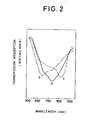
- Fig. 2 is a visible absorption spectrum of the same chlorinated aluminum phthalocyanine
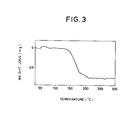
- Fig. 3 a graph showing the results of a thermobalance analysis of Example 1
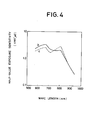
- Fig. 4 a graph showing the spectral sensitivity of the photoconductor.
- the curve (a) represents the data obtained of samples refined by sublimation and given no further treatment (Comparative experiment), the curve (b) the data obtained of samples treated with water only (this invention), and the curve (c) the data obtained of samples treated with organic solvents containing 2 molecules of water per molecule of chlorinated aluminum phthalocyanine (this invention).
- the chlorinated aluminum phthalocyanine obtained by this reaction is refined by being repeatedly washed with an organic solvent and water. It is further refined by sublimation to expel a slight amount of residual impurities which has survived the repeated washing. The product of this final refining is put to use.
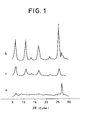
- the chlorinated aluminum phthalocyanine which has undergone the treatment with the water-containing organic solvent, without reference to the amount of water contained in the organic solvent shows strong diffraction peaks (2 0) at 6.7 degrees, 11.2 degrees, 16.7 degrees, and 25.6 degrees as found in the X-ray diffraction spectrum given in Fig. 1, indicating that this compound has a crystal form changed from that which existed immediately after the aforementioned refinement by sublimation.
- the phthalocyanine obtained by the treatment fails to permit the production of a sensitive material of sufficiently high performance because the loss of weight by heating on a thermobalance (produced by Seiko Electronic Industry Co., Ltd. and marketed under product code "TG/DTA 30") at a temperature increasing rate of 5°C/min. from 140° to 220°C is less than 6.0 ⁇ 0.5% of the charged weight.
- a thermobalance produced by Seiko Electronic Industry Co., Ltd. and marketed under product code "TG/DTA 30”
- this loss of weight on heating can be controlled by the amount of water contained in the organic solvent.
- the loss of weight of the phthalocyanine on heating falls in the range of 6.0 ⁇ 0.5% by weight and the visible absorption spectrum of the compound shows the maximum absorption in the range of 750 nm to 850 nm as shown in Fig. 2 and the produced sensitive material acquires a quality for high performance only when the organic solvent to be used for the treatment of the chlorinated aluminum phthalocyanine contains water in an amount of not less than 2 molecules per molecule of the chlorinated aluminum phthalocyanine.
- the organic solvent to be used in the water-containing organic solvent treatment is desired to possess affinity for chlorinated aluminum phthalocyanines and does not show very high solvent action.
- Examples of the organic solvent meeting this requirement include toluene, xylene, ethyl acetate, dichloromethane, chloroform, chlorobromomethane, and nitroethane.
- Such organic solvents as methanol, ethanol, and tetrahydrofuran are not desirable because they have so high degrees of solvent action that the chlorinated aluminum phthalocyanine is prevented from acquring an effective crystal form.
- the amount of water contained in the water-containing organic solvent is required to be not less than 2 molecules per molecule of the chlorinated aluminum phthalocyanine. If this amount is more than it is required for saturation of the organic solvent and, therefore, is suffered to exist in the form of water drops in the organic solvent, the excess water brings about no enhancement of the effect of the addition of water. Thus, it is important that the amount of the organic solvent and the amount of the chlorinated phthalocyanine to be treated should be adjusted so that the amount of water contained will not exceed the level for saturation of the solvent. When the treatment with the solvent is carried out under the conditions described above, the loss of weight of the chlorinated aluminum phthalocyanine on heating will not exceed 6.5X by weight.
- the treatment of the chlorinated aluminum phthalocyanine with the water-containing organic solvent contemplated by the present invention is effected by using, as the water-containing organic solvent, chloroform containing therein 2 molecules of water per molecule of chlorinated aluminum phthalocyanine and pulverizing the chlorinated aluminum phthalocyanine powder refined by sublimation together with the water-containing organic solvent for at least 10 hours in a ball mill.
- the chlorinated aluminum phthalocyanine obtained by the treatment using alone without any organic solvent shows strong diffraction peaks at 6.7 degrees, 11.2 degrees, 16.7 degrees, and 25.6 degrees in the X-ray diffraction spectrum thereof as given in Fig. 1, indicating that this treatment has given the chlorinated aluminum phthalocyanine a crystal form changed from that which existed immediately after the refinement by sublimation.
- the chlorinated aluminum phthalocyanine obtained by this treatment has a loss of weight on heating falling in the range of 6.0 ⁇ 0.5% by weight similarly to the chlorinated aluminum phthalocyanine obtained by the treatment with a water-containing organic solvent.
- the chlorinated aluminum phthalocyanine obtained by this treatment has the maximum absorption in the range of 640 to 660 nm in the visible absorption spectrum as given in Fig. 2.
- the curve (a) represents the data obtained of samples refined by sublimation and given no further treatment (comparative experiment), the curve (b) those of samples produced by treatment with water alone (this invention), and the curve (c) those of samples produced by treatment with a water-containing organic solvent (this invention).
- the treatment of the chlorinated aluminum phthalocyanine solely with water according to the present invention is effected by stirring this compound with pure water for at least 20 hours in a ball mill or by exposing the compound and water jointly to ultrasonic waves for at least 1 hour.
- the crystal form which the chlorinated aluminum phthalocyanine acquires as a result of the treatment with water remains stably even when the compound is treated with an organic solvent.
- the use of the chlorinated aluminum phthalocyanine in the charge generating layer of the photoconductor according to this invention is attained by superimposing the charge generating layer containing the compound on an electroconductive substrate.
- This electroconductive substrate can be formed of an electroconductive metal such as aluminum, copper, nickel, zinc, gold, or indium.
- a layer of zinc oxide or methanol-soluble polyamide using polyvinyl alcohol as a binder may be superimposed in a thickness of not more than 1 ⁇ m on the electroconductive substrate.
- the chlorinated aluminum phthalocyanine for use as the charge generating layer is obtained by pulverizing, in the aforementioned water-containing organic solvent or water held in a ball mill, the chlorinated aluminum phthalocyanine powder refined by sublimation.
- the obtained chlorinated aluminum phthalocyanine is applied as it is or in combination with a binding agent such as acrylic resin, styrene resin, alkyd resin, polyester resin, polyamide resin, or polycarbonate resin, on the aforementioned electroconductive substrate.
- a binding agent such as acrylic resin, styrene resin, alkyd resin, polyester resin, polyamide resin, or polycarbonate resin
- the amount of the binding agent to be used in this case is not specifically defined, the binding agent is generally used in an amount in the range of 20 to 200 parts by weight based on 100 parts by weight of the chlorinated aluminum phthalocyanine.
- the charge generating layer is desired to be applied in an amount calculated to decrease, on drying, to a thickness in the range of 0.02 to
- a charge transfer layer is superimposed on the above charge generating layer of chlorinated aluminum phthalocyanine to produce a photoconductor.
- the charge transfer layer thus superimposed on the charge generating layer is intended to transfer to the surface of the photoconductor the charge generated in the charge generating layer and, therefore, is required to be pervious to the light of the range of wavelength to which the charge generating layer is sensitive.
- the energy level (such as ionization potential and electron affinity) of the charge transfer layer and that of the charge generating layer must fit each other properly.
- the charge transfer layer can be formed using either a charge transfer agent alone or a charge transfer agent as dissolved or dispersed in a suitable resin as a binder.
- Examples of the charge transfer agent to be used independently include polyesters obtained from 2,6-dimethoxy-9,10-dihydroxy anthracene and dicarboxylic acids, polyethers obtained from 2,6-dimethoxy-9,10-dihydroxy anthracene and dihalogen compounds, and polyvinyl carbazoles.
- Examples of the charge transfer agent to be used as dispersed in the resin binder include anthracenes such as 2,6,9,10-tetraisopropoxy anthracene, oxadiazoles such as 2,5-bis(4-diethylaminophenyl)-1,3,4-oxadiazole, pyrazoline derivatives such as I-phenyl-3-(p-diethylaminostyryl)-5-(p-diethylaminophenyl)-pyrazoline, styryl compounds such as 4-(diethylamino)-styryl-2-anthracene, and hydrazone type compounds such as p-diethylaminobenzaldehyde-(diphenyl hydrazone).
- anthracenes such as 2,6,9,10-tetraisopropoxy anthracene
- oxadiazoles such as 2,5-bis(4-diethylaminophenyl)-1,3,4-ox
- the resin binder for the charge transfer agent examples include polyvinyl chloride, polycarbonate, polystyrene, polyester, styrene-butadiene copolymer, polyurethane, and epoxy resins.
- the binder resin is used in an amount falling in the range of 60 to 200 parts by weight based on 100 parts by weight of the charge transfer agent.
- the charge transfer layer desirably has a thickness in the range of 6 to 20 ⁇ m by reason of the relationship with the potential to be received.
- the quality of a given photoconductor was evaluated with a tester, Model SP 428, produced by Kawaguchi Electric, specifically corona charging a sample photoconductor at -5.5 KV, measuring the surface potential of the sample, then irradiating this sample with a monochromic light of a luminous energy of 3.84 ⁇ W/cm 2 , clocking the time required for the surface potential to decrease to 1/2 of the original magnitude and accordingly determining the half-value exposure energy, E(1/2)( ⁇ J/cm 2 ), and then clocking the time required for the surface potential to decrease to 1/5 of the original magnitude and accordingly determining the exposure energy, E(1/5)(wJ/cm2).
- the visible absorption spectrum was measured in the range of 500 to 900 nm with a recording spectrophotometer (produced by Hitachi Ltd. and marketed under product code "330").
- the loss of weight on heating from 140° to 220°C was determined with a thermobalance (a combination differential thermal analyzer and thermogravimeter produced by Seiko Electronic Industry Co., Ltd. and marketed under product code of "TG/DTA 30") under a current of argon gas at a temperature increasing rate of 5°C/min from 30° to 300°C as shown in Fig. 3.
- the results are shown in Table 1.
- Example 1 The procedure of Example 1 was repeated, except that 563 parts by weight of chloroform containing 0.56 part by weight of water was used in the place of the chloroform containing 0.5 part by weight of water. The results are shown in Table 1 and Table 2. Comparative Experiments 1-3:
- Example 2 The procedure of Example 1 was repeated, except that 563 parts by weight of chloroform containing 0.12 part by weight of water (the amount to contain 0.5 molecule of water per molecule of chlorinated aluminum phthalocyanine represented by AlClC 32 N 8 H 15.6 -Clo. 4 ) in Comparative Experiment 1, 0.24 part by weight of water (the amount to contain one molecule of water per molecule of the same phthalocyanine) in Comparative Experiment 2, or 0.35 part by weight of water (the amount to contain 1.5 molecules of water per molecule of the same phthalocyanine) in Comparative Experiment 3 was used in the place of the chloroform containing 0.5 part by weight of water. The results are shown in Table 1 and Table 2.
- Example 2 The procedure of Example 1 was repeated, except that 560 parts by weight of distilled water was used in the place of 563 parts by weight of chloroform containing 0.5 part by weight of water. The results are shown in Table 1 and Table 2.
- Example 1 The procedure of Example 1 was repeated, except that a film obtained by dissolving copolymer nylon (produced by Toray Industries, Inc. and marketed under product code "CM4001") in methanol thereby forming a methanol 1 wt% copolymer nylon solution, applying this solution on an aluminum sheet 100 ⁇ m in thickness by immersion in a thickness of 0.8 ⁇ m on a dry basis, and drying the applied layer was used as a substrate in the place of the aluminum sheet.
- CM4001 product code
- the properties of the produced photoconductor at 800 nm are shown below.
- a photoconductor was produced by following the procedure of Example 4, except that a film 12 ⁇ m in thickness obtained by preparing a solution consisting of 10 parts by weight of p-diethylaminobenzaldehyde (diphenyl hydrazone), 10 parts by weight of polycarbonate resin (produced by Teijin Chemical Co., Ltd. and marketed under trademark designation "Panlight L-1250"), and 400 parts by weight of 1,2-dichloroethane, applying this solution on the charge generating layer formed in advance, and vacuum drying the applied layer was used as a charge transfer layer in the place of the polyester obtained from 2,6-dimethoxy-9,10-dihydroxy anthracene and dodecanoic acid.
- the properties of the photoconductor at 800 nm are shown below.
- Example 5 The procedure of Example 5 was repeated, except that a chlorinate aluminum phthalocyanine of the formula, AlClC 32 N 8 H 16 , refined by sublimation was used in the place of the chlorinated phthalocyanine represented by the formula, AlClC 32 N 8 H 15.6 Cl 0.4 .
- This phthalocyanine showed the maximum absorption at 760 nm in the visible absorption spectrum.
- a sample 16.6 mg in charge weight, when heated on a thermobalance, showed a loss of 0.98 mg from 140 * to 220°C, indicating the ratio of loss of weight on heating to be 5.90%.
- the properties of the photoconductor at 800 nm are shown below.
- Example 5 The procedure of Example 5 was repeated, except that a chlorinated aluminum phthalocyanine of the formula, AlClC 32 N 8 H 14.2 -Cl 1.8 , refined by sublimation was used in the place of the chlorinated aluminum phthalocyanine of the formula, AlClC 32 N 8 H 15.6 -Clo. 4 .
- This phthalocyanine showed the maximum absorption at 840 nm in the visible absorption spectrum.
- a sample 18.8 mg in charge weight, when heated on a thermobalance, showed a loss of 1.04 mg from 140° to 220°C, indicating the ratio of loss of weight on heating to be 5.53%.
- the properties of the photoconductor at 800 nm are as follows.
- CM 4001 product code
- the coating liquid consequently obtained was applied by immersion in an amount calculated to decrease, on drying, to a thickness of 0.1 ⁇ m, to produce a charge generating layer.
- the same charge transfer layer as used in Example 5 was superimposed to complete a photoconductor.
- the properties of the photoconductor at 670 nm are as shown below.
- this photoconductor On this charge generating layer, a solution prepared by adding to 700 parts by weight of trichloropropane 100 parts by weight of a polyether obtained from 2,6-dimethoxy-9,10-dihydroxy anthracene and dibromodecane and homogenizing the resulting mixture by heating at 90°C was applied hot in an amount calculated to decrease, on drying, to 15 ⁇ m. The applied layer was dried at 100°C for 1 hour to form and charge transfer layer and complete a photoconductor. The properties of this photoconductor at 670 ⁇ m are as follows.
- Photoconductors were prepared by following the procedure of Example 5, except that 10 parts by weight of 2,6,9,10-tetraisopropoxy anthracene (Example 10), 10 parts by weight of 2,5-bis-(4-diethylaminophenyl)-1,3,4-oxadiazole (Example 11), 10 parts by weight of l-phenyl-3-(p-diethylaminostyryl)-5-(p-diethylaminophenyl)-pyrazoline (Example 12), and 10 parts by weight of 4-(diethylamino)-styryl-2-anthracene (Example 13) were used severally as a charge transfer agent in the place of 10 parts by weight of p-diethylaminobenzaldehyde-(diphenylhydrazone).
- the properties of photoconductors at 800 nm are as shown below.
Landscapes
- Physics & Mathematics (AREA)
- General Physics & Mathematics (AREA)
- Photoreceptors In Electrophotography (AREA)
Applications Claiming Priority (6)
| Application Number | Priority Date | Filing Date | Title |
|---|---|---|---|
| JP273360/85 | 1985-12-06 | ||
| JP27336085A JPS62133462A (ja) | 1985-12-06 | 1985-12-06 | フタロシアニン化合物を用いた電子写真用感光体 |
| JP18042/86 | 1986-01-31 | ||
| JP1804286A JPS62177069A (ja) | 1986-01-31 | 1986-01-31 | 新規なフタロシアニン結晶およびこれを用いた電子写真用感光体 |
| JP18696086A JPS6343155A (ja) | 1986-08-11 | 1986-08-11 | フタロシアニン化合物を用いた電子写真用感光体 |
| JP186960/86 | 1986-08-11 |
Publications (2)
| Publication Number | Publication Date |
|---|---|
| EP0228202A1 true EP0228202A1 (de) | 1987-07-08 |
| EP0228202B1 EP0228202B1 (de) | 1990-05-23 |
Family
ID=27282065
Family Applications (1)
| Application Number | Title | Priority Date | Filing Date |
|---|---|---|---|
| EP86309500A Expired EP0228202B1 (de) | 1985-12-06 | 1986-12-05 | Elektrophotographischer Photoleiter auf der Basis einer Phthalocyaninverbindung |
Country Status (5)
| Country | Link |
|---|---|
| US (1) | US4732832A (de) |
| EP (1) | EP0228202B1 (de) |
| AU (1) | AU584262B2 (de) |
| CA (1) | CA1279787C (de) |
| DE (1) | DE3671548D1 (de) |
Cited By (1)
| Publication number | Priority date | Publication date | Assignee | Title |
|---|---|---|---|---|
| EP0430630A3 (en) * | 1989-11-28 | 1991-07-10 | Konica Corporation | Electrophotographic photoreceptor and method of forming images |
Families Citing this family (5)
| Publication number | Priority date | Publication date | Assignee | Title |
|---|---|---|---|---|
| JPH0394813A (ja) | 1989-09-06 | 1991-04-19 | Japan Atom Energy Res Inst | ごみ燃焼排ガス中の有害ガス除去方法 |
| JP3967397B2 (ja) * | 1996-02-13 | 2007-08-29 | オリヱント化学工業株式会社 | 新規な結晶変態を有するμ−オキソ−アルミニウムフタロシアニンダイマー及びこれを用いた電子写真感光体 |
| DE69928896T2 (de) | 1998-10-28 | 2006-08-24 | Sharp K.K. | Elektrophotographischer Photorezeptor, der kristallines Oxotitanylphthalocyanin enthält |
| JP2000206710A (ja) | 1999-01-08 | 2000-07-28 | Sharp Corp | 電子写真感光体及び電子写真画像形成法 |
| US6291120B1 (en) | 1999-05-14 | 2001-09-18 | Sharp Kabushiki Kaisha | Electrophotographic photoreceptor and coating composition for charge generating layer |
Citations (3)
| Publication number | Priority date | Publication date | Assignee | Title |
|---|---|---|---|---|
| US4031109A (en) * | 1968-08-30 | 1977-06-21 | Xerox Corporation | Method for the preparation of X-form metal phthalocyanine and X-form metal free compounds |
| GB2103381A (en) * | 1981-06-23 | 1983-02-16 | Nippon Telegraph & Telephone | Electrophotographic photoreceptor |
| EP0082011A1 (de) * | 1981-12-15 | 1983-06-22 | Asahi Kasei Kogyo Kabushiki Kaisha | Empfindlicher Artikel für die Elektrophotographie |
Family Cites Families (1)
| Publication number | Priority date | Publication date | Assignee | Title |
|---|---|---|---|---|
| US4311775A (en) * | 1980-10-06 | 1982-01-19 | Eastman Kodak Company | Novel phthalocyanine pigments and electrophotographic uses thereof |
-
1986
- 1986-12-05 CA CA000524715A patent/CA1279787C/en not_active Expired - Lifetime
- 1986-12-05 US US06/938,482 patent/US4732832A/en not_active Expired - Fee Related
- 1986-12-05 AU AU66140/86A patent/AU584262B2/en not_active Ceased
- 1986-12-05 DE DE8686309500T patent/DE3671548D1/de not_active Expired - Lifetime
- 1986-12-05 EP EP86309500A patent/EP0228202B1/de not_active Expired
Patent Citations (3)
| Publication number | Priority date | Publication date | Assignee | Title |
|---|---|---|---|---|
| US4031109A (en) * | 1968-08-30 | 1977-06-21 | Xerox Corporation | Method for the preparation of X-form metal phthalocyanine and X-form metal free compounds |
| GB2103381A (en) * | 1981-06-23 | 1983-02-16 | Nippon Telegraph & Telephone | Electrophotographic photoreceptor |
| EP0082011A1 (de) * | 1981-12-15 | 1983-06-22 | Asahi Kasei Kogyo Kabushiki Kaisha | Empfindlicher Artikel für die Elektrophotographie |
Non-Patent Citations (1)
| Title |
|---|
| JOURNAL OF IMAGING SCIENCE, vol. 29, no. 3, May-June 1985, pages 116-121, Society of Photographic Scientists and Engineers, Springfield, Virginia, US; R.O. LOUTFY et al.: "Electrophotographic Photoreceptors Incorporating Aggregated Phthalocyanines" * |
Cited By (1)
| Publication number | Priority date | Publication date | Assignee | Title |
|---|---|---|---|---|
| EP0430630A3 (en) * | 1989-11-28 | 1991-07-10 | Konica Corporation | Electrophotographic photoreceptor and method of forming images |
Also Published As
| Publication number | Publication date |
|---|---|
| EP0228202B1 (de) | 1990-05-23 |
| US4732832A (en) | 1988-03-22 |
| DE3671548D1 (de) | 1990-06-28 |
| AU584262B2 (en) | 1989-05-18 |
| AU6614086A (en) | 1987-06-11 |
| CA1279787C (en) | 1991-02-05 |
Similar Documents
| Publication | Publication Date | Title |
|---|---|---|
| US5494767A (en) | Phthalocyanine composition, process for preparing the same and electrophotographic photoreceptor using the same | |
| EP0228202B1 (de) | Elektrophotographischer Photoleiter auf der Basis einer Phthalocyaninverbindung | |
| JPH09157540A (ja) | フタロシアニン組成物、その製造法、これを用いた電子写真感光体及び電荷発生層用塗液 | |
| JP3343275B2 (ja) | フタロシアニン組成物、その製造法、これを用いた電子写真感光体および電荷発生層用塗液 | |
| JP3343268B2 (ja) | フタロシアニン組成物、その製造法およびそれを用いた電子写真感光体ならびに電荷発生層用塗液 | |
| JP2867045B2 (ja) | 電子写真感光体 | |
| EP0449565A1 (de) | Lichtempfindliches Material für Elektrophotographie | |
| JP2756788B2 (ja) | 電子写真感光体 | |
| KR100484204B1 (ko) | 전하 발생 물질의 착물계 광도전체 물질 | |
| JPH0570709A (ja) | 塩素化インジウムフタロシアニン、その製造法およびそれを用いた電子写真感光体 | |
| JP2944717B2 (ja) | ジクロロスズフタロシアニンおよびそれを用いた電子写真用感光体 | |
| JP3343277B2 (ja) | フタロシアニン組成物中間体の製造法 | |
| JPH0469952B2 (de) | ||
| JP3284637B2 (ja) | フタロシアニン組成物の製造法およびそれを用いた電子写真感光体 | |
| JPH10142818A (ja) | 電子写真感光体 | |
| JP2591654B2 (ja) | 電子写真感光体 | |
| JPS60233656A (ja) | 電子写真感光体 | |
| JPH0598179A (ja) | 臭素化インジウムフタロシアニン、その製造方法およびこれを用いた電子写真感光体 | |
| JPS62177069A (ja) | 新規なフタロシアニン結晶およびこれを用いた電子写真用感光体 | |
| JPH0841373A (ja) | フタロシアニン組成物、その製造法及びそれを用いた電子写真感光体 | |
| JPS63305362A (ja) | 電子写真用感光体 | |
| JPS62103652A (ja) | 電子写真感光体 | |
| JPH08176455A (ja) | フタロシアニン組成物の製造法、これを用いた電子写真感光体及び電荷発生層用塗液 | |
| JPH0570710A (ja) | 塩素化インジウムフタロシアニン、その製造法およびこれを用いた電子写真感光体 | |
| JPH05297617A (ja) | 電子写真感光体 |
Legal Events
| Date | Code | Title | Description |
|---|---|---|---|
| PUAI | Public reference made under article 153(3) epc to a published international application that has entered the european phase |
Free format text: ORIGINAL CODE: 0009012 |
|
| AK | Designated contracting states |
Kind code of ref document: A1 Designated state(s): DE FR GB IT |
|
| 17P | Request for examination filed |
Effective date: 19870928 |
|
| 17Q | First examination report despatched |
Effective date: 19890119 |
|
| GRAA | (expected) grant |
Free format text: ORIGINAL CODE: 0009210 |
|
| AK | Designated contracting states |
Kind code of ref document: B1 Designated state(s): DE FR GB IT |
|
| REF | Corresponds to: |
Ref document number: 3671548 Country of ref document: DE Date of ref document: 19900628 |
|
| ET | Fr: translation filed | ||
| ITF | It: translation for a ep patent filed | ||
| ITTA | It: last paid annual fee | ||
| PLBE | No opposition filed within time limit |
Free format text: ORIGINAL CODE: 0009261 |
|
| STAA | Information on the status of an ep patent application or granted ep patent |
Free format text: STATUS: NO OPPOSITION FILED WITHIN TIME LIMIT |
|
| 26N | No opposition filed | ||
| PGFP | Annual fee paid to national office [announced via postgrant information from national office to epo] |
Ref country code: GB Payment date: 19961126 Year of fee payment: 11 |
|
| PGFP | Annual fee paid to national office [announced via postgrant information from national office to epo] |
Ref country code: FR Payment date: 19961211 Year of fee payment: 11 |
|
| PGFP | Annual fee paid to national office [announced via postgrant information from national office to epo] |
Ref country code: DE Payment date: 19961216 Year of fee payment: 11 |
|
| PG25 | Lapsed in a contracting state [announced via postgrant information from national office to epo] |
Ref country code: GB Free format text: LAPSE BECAUSE OF NON-PAYMENT OF DUE FEES Effective date: 19971205 |
|
| PG25 | Lapsed in a contracting state [announced via postgrant information from national office to epo] |
Ref country code: FR Free format text: THE PATENT HAS BEEN ANNULLED BY A DECISION OF A NATIONAL AUTHORITY Effective date: 19971231 |
|
| GBPC | Gb: european patent ceased through non-payment of renewal fee |
Effective date: 19971205 |
|
| PG25 | Lapsed in a contracting state [announced via postgrant information from national office to epo] |
Ref country code: DE Free format text: LAPSE BECAUSE OF NON-PAYMENT OF DUE FEES Effective date: 19980901 |
|
| REG | Reference to a national code |
Ref country code: FR Ref legal event code: ST |
|
| PG25 | Lapsed in a contracting state [announced via postgrant information from national office to epo] |
Ref country code: IT Free format text: LAPSE BECAUSE OF NON-PAYMENT OF DUE FEES;WARNING: LAPSES OF ITALIAN PATENTS WITH EFFECTIVE DATE BEFORE 2007 MAY HAVE OCCURRED AT ANY TIME BEFORE 2007. THE CORRECT EFFECTIVE DATE MAY BE DIFFERENT FROM THE ONE RECORDED. Effective date: 20051205 |