EP0237255A2 - Härtbare Harzzusammensetzungen und Halbleiterelemente, die damit überzogen oder abgedichtet sind - Google Patents
Härtbare Harzzusammensetzungen und Halbleiterelemente, die damit überzogen oder abgedichtet sind Download PDFInfo
- Publication number
- EP0237255A2 EP0237255A2 EP87301854A EP87301854A EP0237255A2 EP 0237255 A2 EP0237255 A2 EP 0237255A2 EP 87301854 A EP87301854 A EP 87301854A EP 87301854 A EP87301854 A EP 87301854A EP 0237255 A2 EP0237255 A2 EP 0237255A2
- Authority
- EP
- European Patent Office
- Prior art keywords
- resin composition
- general formula
- curable resin
- represented
- crosslinking agent
- Prior art date
- Legal status (The legal status is an assumption and is not a legal conclusion. Google has not performed a legal analysis and makes no representation as to the accuracy of the status listed.)
- Withdrawn
Links
- HMBJWZWYJJSCRC-UHFFFAOYSA-N C(C1)C1C1C2C(C3)=C3CCC2(C2)C2C1 Chemical compound C(C1)C1C1C2C(C3)=C3CCC2(C2)C2C1 HMBJWZWYJJSCRC-UHFFFAOYSA-N 0.000 description 1
- UZEKTDVGUQCDBI-UHFFFAOYSA-N CC(C)N=C(N)N Chemical compound CC(C)N=C(N)N UZEKTDVGUQCDBI-UHFFFAOYSA-N 0.000 description 1
Images
Classifications
-
- H—ELECTRICITY
- H10—SEMICONDUCTOR DEVICES; ELECTRIC SOLID-STATE DEVICES NOT OTHERWISE PROVIDED FOR
- H10W—GENERIC PACKAGES, INTERCONNECTIONS, CONNECTORS OR OTHER CONSTRUCTIONAL DETAILS OF DEVICES COVERED BY CLASS H10
- H10W74/00—Encapsulations, e.g. protective coatings
- H10W74/40—Encapsulations, e.g. protective coatings characterised by their materials
- H10W74/47—Encapsulations, e.g. protective coatings characterised by their materials comprising organic materials, e.g. plastics or resins
-
- C—CHEMISTRY; METALLURGY
- C08—ORGANIC MACROMOLECULAR COMPOUNDS; THEIR PREPARATION OR CHEMICAL WORKING-UP; COMPOSITIONS BASED THEREON
- C08G—MACROMOLECULAR COMPOUNDS OBTAINED OTHERWISE THAN BY REACTIONS ONLY INVOLVING UNSATURATED CARBON-TO-CARBON BONDS
- C08G59/00—Polycondensates containing more than one epoxy group per molecule; Macromolecules obtained by polymerising compounds containing more than one epoxy group per molecule using curing agents or catalysts which react with the epoxy groups
- C08G59/02—Polycondensates containing more than one epoxy group per molecule
-
- C—CHEMISTRY; METALLURGY
- C08—ORGANIC MACROMOLECULAR COMPOUNDS; THEIR PREPARATION OR CHEMICAL WORKING-UP; COMPOSITIONS BASED THEREON
- C08G—MACROMOLECULAR COMPOUNDS OBTAINED OTHERWISE THAN BY REACTIONS ONLY INVOLVING UNSATURATED CARBON-TO-CARBON BONDS
- C08G59/00—Polycondensates containing more than one epoxy group per molecule; Macromolecules obtained by polymerising compounds containing more than one epoxy group per molecule using curing agents or catalysts which react with the epoxy groups
- C08G59/18—Macromolecules obtained by polymerising compounds containing more than one epoxy group per molecule using curing agents or catalysts which react with the epoxy groups ; e.g. general methods of curing
- C08G59/20—Macromolecules obtained by polymerising compounds containing more than one epoxy group per molecule using curing agents or catalysts which react with the epoxy groups ; e.g. general methods of curing characterised by the epoxy compounds used
- C08G59/22—Di-epoxy compounds
- C08G59/24—Di-epoxy compounds carbocyclic
-
- C—CHEMISTRY; METALLURGY
- C08—ORGANIC MACROMOLECULAR COMPOUNDS; THEIR PREPARATION OR CHEMICAL WORKING-UP; COMPOSITIONS BASED THEREON
- C08G—MACROMOLECULAR COMPOUNDS OBTAINED OTHERWISE THAN BY REACTIONS ONLY INVOLVING UNSATURATED CARBON-TO-CARBON BONDS
- C08G59/00—Polycondensates containing more than one epoxy group per molecule; Macromolecules obtained by polymerising compounds containing more than one epoxy group per molecule using curing agents or catalysts which react with the epoxy groups
- C08G59/18—Macromolecules obtained by polymerising compounds containing more than one epoxy group per molecule using curing agents or catalysts which react with the epoxy groups ; e.g. general methods of curing
- C08G59/20—Macromolecules obtained by polymerising compounds containing more than one epoxy group per molecule using curing agents or catalysts which react with the epoxy groups ; e.g. general methods of curing characterised by the epoxy compounds used
- C08G59/32—Epoxy compounds containing three or more epoxy groups
- C08G59/3218—Carbocyclic compounds
-
- C—CHEMISTRY; METALLURGY
- C08—ORGANIC MACROMOLECULAR COMPOUNDS; THEIR PREPARATION OR CHEMICAL WORKING-UP; COMPOSITIONS BASED THEREON
- C08G—MACROMOLECULAR COMPOUNDS OBTAINED OTHERWISE THAN BY REACTIONS ONLY INVOLVING UNSATURATED CARBON-TO-CARBON BONDS
- C08G59/00—Polycondensates containing more than one epoxy group per molecule; Macromolecules obtained by polymerising compounds containing more than one epoxy group per molecule using curing agents or catalysts which react with the epoxy groups
- C08G59/18—Macromolecules obtained by polymerising compounds containing more than one epoxy group per molecule using curing agents or catalysts which react with the epoxy groups ; e.g. general methods of curing
- C08G59/40—Macromolecules obtained by polymerising compounds containing more than one epoxy group per molecule using curing agents or catalysts which react with the epoxy groups ; e.g. general methods of curing characterised by the curing agents used
- C08G59/4007—Curing agents not provided for by the groups C08G59/42 - C08G59/66
- C08G59/4014—Nitrogen containing compounds
- C08G59/4042—Imines; Imides
-
- C—CHEMISTRY; METALLURGY
- C08—ORGANIC MACROMOLECULAR COMPOUNDS; THEIR PREPARATION OR CHEMICAL WORKING-UP; COMPOSITIONS BASED THEREON
- C08G—MACROMOLECULAR COMPOUNDS OBTAINED OTHERWISE THAN BY REACTIONS ONLY INVOLVING UNSATURATED CARBON-TO-CARBON BONDS
- C08G59/00—Polycondensates containing more than one epoxy group per molecule; Macromolecules obtained by polymerising compounds containing more than one epoxy group per molecule using curing agents or catalysts which react with the epoxy groups
- C08G59/18—Macromolecules obtained by polymerising compounds containing more than one epoxy group per molecule using curing agents or catalysts which react with the epoxy groups ; e.g. general methods of curing
- C08G59/40—Macromolecules obtained by polymerising compounds containing more than one epoxy group per molecule using curing agents or catalysts which react with the epoxy groups ; e.g. general methods of curing characterised by the curing agents used
- C08G59/50—Amines
- C08G59/5046—Amines heterocyclic
- C08G59/5053—Amines heterocyclic containing only nitrogen as a heteroatom
- C08G59/508—Amines heterocyclic containing only nitrogen as a heteroatom having three nitrogen atoms in the ring
- C08G59/5086—Triazines; Melamines; Guanamines
-
- C—CHEMISTRY; METALLURGY
- C08—ORGANIC MACROMOLECULAR COMPOUNDS; THEIR PREPARATION OR CHEMICAL WORKING-UP; COMPOSITIONS BASED THEREON
- C08G—MACROMOLECULAR COMPOUNDS OBTAINED OTHERWISE THAN BY REACTIONS ONLY INVOLVING UNSATURATED CARBON-TO-CARBON BONDS
- C08G59/00—Polycondensates containing more than one epoxy group per molecule; Macromolecules obtained by polymerising compounds containing more than one epoxy group per molecule using curing agents or catalysts which react with the epoxy groups
- C08G59/18—Macromolecules obtained by polymerising compounds containing more than one epoxy group per molecule using curing agents or catalysts which react with the epoxy groups ; e.g. general methods of curing
- C08G59/40—Macromolecules obtained by polymerising compounds containing more than one epoxy group per molecule using curing agents or catalysts which react with the epoxy groups ; e.g. general methods of curing characterised by the curing agents used
- C08G59/62—Alcohols or phenols
- C08G59/621—Phenols
-
- C—CHEMISTRY; METALLURGY
- C08—ORGANIC MACROMOLECULAR COMPOUNDS; THEIR PREPARATION OR CHEMICAL WORKING-UP; COMPOSITIONS BASED THEREON
- C08L—COMPOSITIONS OF MACROMOLECULAR COMPOUNDS
- C08L63/00—Compositions of epoxy resins; Compositions of derivatives of epoxy resins
-
- H—ELECTRICITY
- H01—ELECTRIC ELEMENTS
- H01B—CABLES; CONDUCTORS; INSULATORS; SELECTION OF MATERIALS FOR THEIR CONDUCTIVE, INSULATING OR DIELECTRIC PROPERTIES
- H01B3/00—Insulators or insulating bodies characterised by the insulating materials; Selection of materials for their insulating or dielectric properties
- H01B3/18—Insulators or insulating bodies characterised by the insulating materials; Selection of materials for their insulating or dielectric properties mainly consisting of organic substances
- H01B3/30—Insulators or insulating bodies characterised by the insulating materials; Selection of materials for their insulating or dielectric properties mainly consisting of organic substances plastics; resins; waxes
- H01B3/40—Insulators or insulating bodies characterised by the insulating materials; Selection of materials for their insulating or dielectric properties mainly consisting of organic substances plastics; resins; waxes epoxy resins
-
- H—ELECTRICITY
- H01—ELECTRIC ELEMENTS
- H01B—CABLES; CONDUCTORS; INSULATORS; SELECTION OF MATERIALS FOR THEIR CONDUCTIVE, INSULATING OR DIELECTRIC PROPERTIES
- H01B3/00—Insulators or insulating bodies characterised by the insulating materials; Selection of materials for their insulating or dielectric properties
- H01B3/18—Insulators or insulating bodies characterised by the insulating materials; Selection of materials for their insulating or dielectric properties mainly consisting of organic substances
- H01B3/30—Insulators or insulating bodies characterised by the insulating materials; Selection of materials for their insulating or dielectric properties mainly consisting of organic substances plastics; resins; waxes
- H01B3/44—Insulators or insulating bodies characterised by the insulating materials; Selection of materials for their insulating or dielectric properties mainly consisting of organic substances plastics; resins; waxes vinyl resins; acrylic resins
Definitions
- the present invention relates to curable resin compositions.
- a preferred embodiment is a thermo and/or light curable resin composition which is excellent in heat resistance, humidity resistance and moldability and contains a reduced amount of ionic impurities.
- the invention also relates to a semiconductor device coated and sealed with the resin composition.
- an epoxy resin composition has been used as the insulating, laminating, coating or sealing material.
- An epoxy resin which is now generally used is prepared by the reaction of epichlorohydrin with bisphenol A or phenolic novolak.
- the former has problems in heat resistance and electrical characteristics, while the latter contains several tens of ppm of ionic chlorine, so that it has a problem that metallic wires on an LSI element tend to corrode, thus resulting in breakage.
- a cycloaliphatic epoxy resin is known as an epoxy resin which is excellent in heat resistance and electrical characteristics, free from ionic chlorine and is generally cured with a carboxylic acid anhydride under heating, it is highly toxic and exhibits a poor reactivity, so that it is applied only to ⁇ - limited field such as varnish.
- the above epoxy resin compositions of the prior art have each both advantages and disadvantages and do not sufficiently satisfy the above demand that heat resistance, humidity resistance, electrical insulation properties, adhesion properties, weathering resistance and moldability be all excellent and the content of ionic impurities be low.
- the present invention has been accomplished under these circumstances. It is desirable to provide a curable resin composition excellent in heat resistance, humidity resistance, electrical insulation properties, adhesion properties, weathering resistance, moldability and migration resistance, and containing a reduced amount of ionic impurities.
- the first aspect of the present invention resides in a curable resin composition
- a curable resin composition comprising at least a cycloaliphatic ether oligomer represented by the general formula (I): wherein m and n are each 0 to 30 and 2 ⁇ m+n ⁇ 30, and a crosslinking agent, wherein the crosslinking agent is selected front:
- the second aspect of the present invention resides in a semiconductor device obtained by coating and sealing at least a part of a semiconductor element and a lead wire with the curable resin composition explained above.
- the curable resin composition comprises at least a cycloaliphatic ether oligomer represented by the general formula (I): wherein m and n are each 0 to 30 and 2 ⁇ m+n ⁇ 30, and a crosslinking agent of 2,6-diamino-6-vinyl-s-triazine.
- the cycloaliphatic ether oligomer represented by the general formula (I) to be used in the present invention may be prepared by a process described in Japanese Patent Laid-Open Nos. 161939/1985, 166675/1985, 170620/1985 and US Patent No. 4,565,859.
- a cycloaliphatic ether oligomer represented by the general formula: is prepared by reacting 1 mol of methanol with 7 mol of vinylcyclohexane monoepoxide in the presence of BF 3 0(C 2 H S ) catalyst at 60°C for 12 hours.
- a cycloaliphatic allyl vinyl ether oligomer represented by the general formula: is prepared by reacting 1 mol of allyl alcohol with 3 mol of vinylcyclohexene monoxide under substantially the same condition as the one described above.
- the above cycloaliphatic ether oligomer, a cyclohexene oxide polymer having pendant vinyl groups, is converted to an epoxy resin through the peracetic acid process using peracid or hydroperoxide under the presence of an alkali or acid catalyst.
- oligomers are commercially available as a product of Daicel Chemical Industries Ltd. Examples thereof are as follows: EHPE-3156 m.p.;63°C, epoxy eq; 258
- the EHPE-3150 and EHPE-3156 group epoxy compounds are free from ionic chlorine and are more excellent in reactivity and heat resistance than the cycloaliphatic epoxy compounds of the prior art.
- phenolic resin crosslinking agents represented by the general formula (II): wherein X 1 and X 2 may be the same or different from each other and each stands for H, CH 3 , C(CH 3 ) 3 , OH, NH 2 , COOH, SH, S0 3 H, CH 2 0H, Br, Cl, (wherein R 1 and R 2 are H, CH 3 or CF 3 ) and p and q are 0 to 10 and 1 ⁇ p+q ⁇ 10, are condensates prepared by condensing phenol, o-cresol, biphenol, bisphenol F, bisphenol A or trifluoromethylbisphenol A with formaldehyde in the presence of an acid catalyst such as hydrochloric or oxalic acid.
- the above phenolic resin may be modified with melamine, urea, resorcinol, catechol or hydroquinone. Particularly, a condensate of biphenol with formaldehyde is effective in imparting heat resistance.
- p-hydroxylstyrene polymer or copolymer crosslinking agents represented by the general formula (III): wherein y is H, NH 2 , S0 3 H, Br or Cl and r is 5 to 300, are p-
- a mixture of two or more of these compounds may be also used. Further, a mixture of the above N,N'- substiuted bismaleimide with mono-, tri-or tetrasubstituted maleimide may be used. Furthermore, adducts of the above maleimide with cyclopentadiene, furan, amine, hydroxyl or thiocol compound may be used.
- Examples of compounds having at least one allyl or propenyl group and at least one hydroxyl group useful as crosslinking agents are and wherein -X- is an isopropylene or methylene group, -O- or none.
- a cycloaliphatic ether oligomer represented by the general formula (I): wherein m and n are each 0 to 30 and 2 ⁇ m+n ⁇ 30, is preferably 2z4-diamino-6-vinyl-s-triazine, because it is effective in controlling both the corrosion of an aluminum wire on an LSI element and the migration of Cu, Ag or Au to thereby enhance the reliability of a semiconductor device
- the curable resin composition according to the present invention may further contain a known epoxy resin.
- an epoxy resin include compounds having two functional groups, such as diglycidyl ether of bisphenol A, butadiene diepoxide, 3,4-epoxy cyclohexylmethyl-(3,4-epoxy) cyclohexanecarboxylate, vinylcyclohexane dioxide, 4,4'-di(l,2-epoxyethyl)diphenyl ether, 4,4'-(1,2-epoxyethyl)-biphenyl, 2,2'-bis(3,4-epoxycyclohexyl)propane, glycidyl ether of resorcinol, diglycidyl ether of phloroglucinol, diglycidyl ether of methylphloroglucinol, bis (2,3-epoxycyclopentyl) ether, 2-(3,4-epoxy)cyclohexane-5, 5-
- crosslinking agent examples include amines including aliphatic polyamines, aromatic polyamines, and secondary or tertiary amines; carboxylic acids and anhydrides thereof; oligomers and polymers of aliphatic or aromatic polyamides; complexes of boron trifluoride with amines; precondensates of synthetic resins such as phenolic, melamine, urea or urethane resin; dicyandiamide; b enzoganamine; carboxylic acid hydrazide and polyaminomaleimides.
- the above crosslinking agents may be used alone or as an admixture depending upon the use and the object.
- the curable resin composition of the present invention may further contain a known catalyst which promotes the reaction between the cycloaliphatic ether oligomer represented by the general gormula (I) and the crosslinking agents.
- the catalyst include tertiary amines such as triethanolamine, tetramethylbutanediamine, tetramethylpentanediamine, tetramethylhexanediamine, triethylenediamine and dimethylaniline; hydroxylalkylamines such as dimethylaminoethanol and dimethylaminopentanol and amines such as tris(dimethylaminomethyl)phenol and methylmorpholine; quaternary ammonium salts such as cetyltrimethylammonium bromide; cetyltrimethylammonium chloride, dodecyltrimethylammonium iodide, trimethyldodecylammonium chloride, benzyldimethyltetradecylammonium chloride, benzylmethyl
- the above catalyst may be used alone or as an admixture, while the amount thereof may be 0.01 to 20% by weight based on the amount of the cycloaliphatic ether oligomer represented by the general formula (I).
- the curable resin composition according to the present invention may further contain polymerizable monomer with ethylenical unsaturated bonds depending upon the use and the object thereof.
- the monomer include styrene, vinyltoluene, ⁇ -methylstyrene, divinylbenzene, diallyl phthalate, diallyl phthalate prepolymer, chlorostyrene, dichlorostyrene, bromostyrene, dibromostyrene, diallyl benzenephosphonate, diallyl arylphosphinate, acrylic acid, acrylate, methacrylate, epoxy acrylate, triallyl cyanurate, tribromophenol allyl ether, unsaturated polyester and polybutadiene.
- a catalyst which is effective in accomplishing the crosslinking of the above monomers may further contain in the curable resin composition.
- One or more organic peroxide may be used as such a catalyst.
- the organic peroxide include benzoyl peroxide, p-chlorobenzoyl peroxide, 2,4-dichlorobenzoyl peroxide, capryl peroxide, lauroyl peroxide, acetyl peroxide, methyl ethyl ketone peroxide, cyclohexanone peroxide, bis(l-hydroxycyclohexyl peroxide), hydroxyheptyl peroxide, t-butyl hydroperoxide, p-menthane hydroperoxide, cumene hydroperoxide, 2,5-dimethylhexyl-2,5-dihydroxide, di-t-butyl peroxide, dicumyl peroxide, 2,5-dimethyl-2,5-di(t-butylperoxy)he
- the curable resin composition according to the present invention may further contain a powdery or short- fibrous filler such as calcium stearate, silica, alumina, titania, aluminum hydroxide, aluminum silicate, zirconium silicate, zircon, glass, talc, mica, graphite, aluminum, copper or iron; a mold releasing agent such as fatty acid or wax; a coupling agent such as epoxysilane, vinylsilane, borane, alkyl titanate or metal chelate or a flame retarder such as antimony, phosphorus compound or halogen- containing compound.
- a powdery or short- fibrous filler such as calcium stearate, silica, alumina, titania, aluminum hydroxide, aluminum silicate, zirconium silicate, zircon, glass, talc, mica, graphite, aluminum, copper or iron
- a mold releasing agent such as fatty acid or wax
- a coupling agent such as epoxysilane, vinylsilane
- EHPE-3150 (a product of Daicel Chemical Industries Ltd., melting point: 71°C, epoxy equivalent: 179) represented by the formula: or a mixture thereof with 100 parts by weight of EHPE-3156 (a product of Daicel Chemical Industries Ltd., melting point: 63°C, epoxy equivalent: 258, iodine value: 72) represented by the formula: was used as a cycloaliphatic ether oligomer and a crosslinking agent and additives shown in Table 1 were added thereto.
- crosslinking agents and additives are indicated in parts by weight.
- the employed crosslinking agents are, condensate of bisphenol A with formalin represented by the formula: condensate of fluorinated bisphenol A with formalin (both are products of Dainippon Ink & Chemicals, Inc.); p-hydroxylstyrene polymer, Maruzen M Resin (molecular weight: 4800); compound having an N-substituted maleimide bonding, N,N-4,4'-diphenylmethane bismaleimide (a product of Mitsui Toatsu Chemicals, Inc.); and phenolic novolak HP-607N (a product of Hitachi Chemical Co., Ltd.). These crosslinking agents were each added to the above oligomer in a given amount as indicated in Table 1 to prepare six compositions.
- compositions were each kneaded by a twin roll having a diameter of 8 inch at 70 to 80°C for 8 minutes and powdered coarsely to obtain compositions for the sealing of LSI.
- compositions were examined for heat resistance (glass transition temperature), high- temperature strength (flexural strength (kgf/cm 2 ) at 180°C) and storage stability at room temperature.
- LSI's having a memory of 256 kbit were sealed with each of the compositions by transfer molding (180°C, 70 kgf/cm 2 and 2 minutes) to obtain resin-sealed semiconductor devices. The devices were examined for humidity resistance.
- the evaluation of the humidity resistance was carried out by placing the resin-sealed LSI in an atmosphere supersaturated with water vapor of 2 atm and 121°C for a given period and examining electrically the LSI for breakage of its aluminum wire.
- a mixture comprising 50 parts by weight of a polyfunctional epoxy compound derived from tris(hydroxyphenyl)-methane; XD-9053 (a product of Dow Chemical Co., epoxy equivalent: 225), 50 parts by weight of EHPE 3150, 18 parts by weight of 2,4-diamino-6-vinyls-triazine, a crosslinking agent, 2 parts by weight of triphenylphosphine, a curing'accelerator, 2 parts by weight of epoxysilane KBM303, a coupling agent (a product of The Shin-etsu Chemical Co., Ltd.), 4 parts by weight of red phosphorus coated with an imide of addition type, a flame retarder, a mold releasing agent comprising 1 part by weight of calcium stearate and 1 part by weight of Hoechst wax E (a product of Hoechst Japan Co., Ltd.), 75% by weight of a molten quartz glass powder, a filler and 2 parts by weight of carbon black, a coloring
- the obtained resin composition was fed in to a transfer molding machine fitted with a mold, in which LSI elements having a D-RAM, memory of 256 kbit were placed, at 180°Cwith 70 kgf/cm 2 for 1.5 minute.
- the obtained resin-sealed semiconductor device were placed in an atmosphere supersaturated with water vapor of 121°C and 2 atm (PCT) and checked electrically after every given period.
- EHPE3150 250 ml of methyl ethyl ketone was placed in a 500-ml conical flask, followed by the addition of 10 parts by weight of EHPE3150, EHPE3156 or HPE3150 (a product of Daicel Chemical Industries Ltd.) which were indicated previously.
- Kerimid K601 an adduct of bismaleimide with amine, a product of Rhone-Poulenc Corp.
- ALCH-TR an aluminum chelate coupling agent
- the obtained coating composition was dropwise applied to LSI elements (16 pin) having a D-RAM, memory of 256 kbit and lead wires (including a wire bonding), followed by heating at 100°C for 1 hour, at 200°C for 1 hour and at 250°C for 30 minutes, thus forming a coating film having a thickness of 30 to 60 ⁇ m on the elements and the like.
- a mixture comprising 100 parts by weight of a polyfunctional epoxy compound derived from tris(hydroxyphenyl)methane; XD-9053 (a product of Dow Chemical Co., epoxy equivalent: 225), 55 parts by weight of a phenolic novolak, a crosslinking agent (a product of Hitachi Chemical Co., Ltd., softening point: 83°C), 3 parts by weight of triethylamine tetraphenylborate TEA-K, a curing accelerator, 2 parts by weight of epoxysilane KBM303, a coupling agent (a product of The Shin-etsu Chemical Co., Ltd.), 5 parts by weight of red phosphorus coated with an imide of addition type, a flame retarder, a mold releasing agent comprising 1 part by weight of calcium stearate and 1 part by weight of Hoechst wax E (a product of Hoechst Japan Co., Ltd.), 490 parts by weight of a molten quartz glass powder, a filler and 2 parts by
- a cycloaliphatic ether epoxy compound EHPE3150 (a product of Daicel Chemical Industries Ltd., epoxy equivalent: 179) was mixed with crosslinking agents such as 2,4-diamino-6-vinyl-s-triazine (a product of Shikoku Chemical Corporation, trade name: VT); intermolecular compound of VT with isocyanuric acid (a product of Shikoku Chemical Corporation, trade name: VT.ICA); 2,4-dihydrazino-6-methylamino-s-triazine (a product of Nippon Hydrazine Industry Co., Ltd., trade name: 24-HT); 3,9-bis[2-(3,5-diamino-2,4,6-triazaphenyl)ethyl]-2,4,8,10-tetraoxaspiro[5,5]undecane (a product of Ajinomoto Co., Inc., trade name: CTU guanamine) represent by the formula: 1,3-bis(hydrazil)-2,
- tetrahydrophthalic anhydride THPA each in an amount given in Table 3 in parts by weight to obtain seven compositions.
- compositions were each kneaded by a twin roll heated at 75 to 85°C for 7 minute, cooled and powdered coarsely to obtain a resin composition for the sealing of a semiconductor.
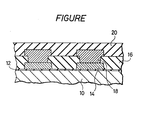
- Fig. shows a schematic sectional view of a part of the semiconductor device having multi wiring layers coated and sealed by the curable resin composition of the present invention.
- An Si0 2 insulating layer is 12 formed on a silicon semiconductor substrate 10.
- a first aluminum wiring layer 14 with a predetermined pattern is formed on the Si0 2 insulating layer 12.
- a first protective film 16 is formed on the first aluminum wiring layer 14 by applying the curable resin composition of the present invention through a spinner and baking at 250°C for 60 minutes.
- a second aluminum wiring layer 18 with a predetermined pattern is formed on the first protective film 16. Predetermined portions of the first and second aluminum wiring layers 14 and 18 are electrically connected through via holes to form a predetermined wiring circuit.
- the via holes are formed by applying a positive resist with a via hole patterning on the first protective layer 16, subjecting the positive resist to plasma etching with a reactive gas of CF 4 -0 2 and removing the positiive resist through plasma asher using a reactive gas of 0 2 .
- a second protective film 20 is formed on the second aluminum wiring layer 18 in the same manner as the first protective film 16.
Landscapes
- Chemical & Material Sciences (AREA)
- Health & Medical Sciences (AREA)
- Chemical Kinetics & Catalysis (AREA)
- Medicinal Chemistry (AREA)
- Polymers & Plastics (AREA)
- Organic Chemistry (AREA)
- Physics & Mathematics (AREA)
- Spectroscopy & Molecular Physics (AREA)
- Structures Or Materials For Encapsulating Or Coating Semiconductor Devices Or Solid State Devices (AREA)
- Epoxy Resins (AREA)
- Compositions Of Macromolecular Compounds (AREA)
- Macromolecular Compounds Obtained By Forming Nitrogen-Containing Linkages In General (AREA)
- Addition Polymer Or Copolymer, Post-Treatments, Or Chemical Modifications (AREA)
- Macromonomer-Based Addition Polymer (AREA)
Applications Claiming Priority (2)
| Application Number | Priority Date | Filing Date | Title |
|---|---|---|---|
| JP61048348A JPS62207320A (ja) | 1986-03-07 | 1986-03-07 | 熱硬化性樹脂組成物で封止してなる半導体装置 |
| JP48348/86 | 1986-03-07 |
Related Child Applications (2)
| Application Number | Title | Priority Date | Filing Date |
|---|---|---|---|
| EP92201125.9 Division-Into | 1987-03-03 | ||
| EP19920201125 Division EP0503744A3 (en) | 1986-03-07 | 1987-03-03 | Curable resin compositions and semiconductor devices coated and sealed with the same |
Publications (2)
| Publication Number | Publication Date |
|---|---|
| EP0237255A2 true EP0237255A2 (de) | 1987-09-16 |
| EP0237255A3 EP0237255A3 (de) | 1990-05-30 |
Family
ID=12800875
Family Applications (2)
| Application Number | Title | Priority Date | Filing Date |
|---|---|---|---|
| EP19920201125 Ceased EP0503744A3 (en) | 1986-03-07 | 1987-03-03 | Curable resin compositions and semiconductor devices coated and sealed with the same |
| EP87301854A Withdrawn EP0237255A3 (de) | 1986-03-07 | 1987-03-03 | Härtbare Harzzusammensetzungen und Halbleiterelemente, die damit überzogen oder abgedichtet sind |
Family Applications Before (1)
| Application Number | Title | Priority Date | Filing Date |
|---|---|---|---|
| EP19920201125 Ceased EP0503744A3 (en) | 1986-03-07 | 1987-03-03 | Curable resin compositions and semiconductor devices coated and sealed with the same |
Country Status (3)
| Country | Link |
|---|---|
| EP (2) | EP0503744A3 (de) |
| JP (1) | JPS62207320A (de) |
| KR (1) | KR940001716B1 (de) |
Cited By (7)
| Publication number | Priority date | Publication date | Assignee | Title |
|---|---|---|---|---|
| US5191027A (en) * | 1989-05-12 | 1993-03-02 | Daicel Chemical Industries, Ltd. | Composition comprising an epoxy compound |
| EP0643103A1 (de) * | 1993-09-10 | 1995-03-15 | Bakelite AG | Härtbare Bindemittel |
| US7474008B2 (en) | 2004-05-21 | 2009-01-06 | Sharp Kabushiki Kaisha | Semiconductor device with reduced electromigration |
| CN110330649A (zh) * | 2019-07-30 | 2019-10-15 | 苏州大学 | 可重塑双马来酰亚胺树脂及其应用 |
| CN110330648A (zh) * | 2019-07-30 | 2019-10-15 | 苏州大学 | 可重塑双马来酰亚胺树脂用预聚体及其应用 |
| CN110330647A (zh) * | 2019-07-30 | 2019-10-15 | 苏州大学 | 可重塑形状记忆双马来酰亚胺树脂及其应用 |
| CN110330650A (zh) * | 2019-07-30 | 2019-10-15 | 苏州大学 | 双马来酰亚胺树脂预聚体及其应用 |
Families Citing this family (8)
| Publication number | Priority date | Publication date | Assignee | Title |
|---|---|---|---|---|
| JPH064814B2 (ja) * | 1986-03-19 | 1994-01-19 | 東芝ケミカル株式会社 | 半導体ペレット搭載用ペースト |
| US5618891A (en) * | 1995-03-29 | 1997-04-08 | General Electric Co. | Solventless resin composition having minimal reactivity at room temperature |
| WO1998031750A1 (en) * | 1997-01-21 | 1998-07-23 | The Dow Chemical Company | Latent catalysts for epoxy curing systems |
| US6613839B1 (en) | 1997-01-21 | 2003-09-02 | The Dow Chemical Company | Polyepoxide, catalyst/cure inhibitor complex and anhydride |
| US6350840B1 (en) * | 1998-07-02 | 2002-02-26 | National Starch And Chemical Investment Holding Corporation | Underfill encapsulants prepared from allylated amide compounds |
| KR100557610B1 (ko) * | 1999-10-11 | 2006-03-10 | 주식회사 하이닉스반도체 | 신규한 포토레지스트 단량체, 그의 중합체 및 이를 함유하는 포토레지스트 조성물 |
| TW200303439A (en) | 2002-02-04 | 2003-09-01 | Mitsui Chemicals Inc | Method for producing liquid crystal display cell and sealing agent for liquid crystal display cell |
| JP6507506B2 (ja) * | 2014-07-16 | 2019-05-08 | 住友ベークライト株式会社 | 封止用樹脂組成物及び半導体装置 |
Family Cites Families (7)
| Publication number | Priority date | Publication date | Assignee | Title |
|---|---|---|---|---|
| GB904549A (en) * | 1959-05-06 | 1962-08-29 | British Celanese | Preparation of epoxy ethers and formation of cured resinous products therefrom |
| US4273916A (en) * | 1979-02-14 | 1981-06-16 | Trw Inc. | Curable cycloaliphatic epoxy-polyimide compositions |
| JPS5949225A (ja) * | 1982-09-16 | 1984-03-21 | Hitachi Ltd | 耐熱性難燃性樹脂組成物 |
| JPS60170620A (ja) * | 1984-02-16 | 1985-09-04 | Daicel Chem Ind Ltd | 新規なエポキシ樹脂組成物 |
| US4565859A (en) * | 1984-01-30 | 1986-01-21 | Daicel Chemical Industries, Ltd. | Polyether compounds, epoxy resins, epoxy resin compositions, and processes for production thereof |
| JPS61197621A (ja) * | 1985-02-27 | 1986-09-01 | Daicel Chem Ind Ltd | 封止剤 |
| JPS61233012A (ja) * | 1985-04-10 | 1986-10-17 | Daicel Chem Ind Ltd | 繊維強化プラスチツクス |
-
1986
- 1986-03-07 JP JP61048348A patent/JPS62207320A/ja active Granted
-
1987
- 1987-02-26 KR KR1019870001666A patent/KR940001716B1/ko not_active Expired - Fee Related
- 1987-03-03 EP EP19920201125 patent/EP0503744A3/en not_active Ceased
- 1987-03-03 EP EP87301854A patent/EP0237255A3/de not_active Withdrawn
Cited By (11)
| Publication number | Priority date | Publication date | Assignee | Title |
|---|---|---|---|---|
| US5191027A (en) * | 1989-05-12 | 1993-03-02 | Daicel Chemical Industries, Ltd. | Composition comprising an epoxy compound |
| EP0643103A1 (de) * | 1993-09-10 | 1995-03-15 | Bakelite AG | Härtbare Bindemittel |
| US7474008B2 (en) | 2004-05-21 | 2009-01-06 | Sharp Kabushiki Kaisha | Semiconductor device with reduced electromigration |
| CN110330649A (zh) * | 2019-07-30 | 2019-10-15 | 苏州大学 | 可重塑双马来酰亚胺树脂及其应用 |
| CN110330648A (zh) * | 2019-07-30 | 2019-10-15 | 苏州大学 | 可重塑双马来酰亚胺树脂用预聚体及其应用 |
| CN110330647A (zh) * | 2019-07-30 | 2019-10-15 | 苏州大学 | 可重塑形状记忆双马来酰亚胺树脂及其应用 |
| CN110330650A (zh) * | 2019-07-30 | 2019-10-15 | 苏州大学 | 双马来酰亚胺树脂预聚体及其应用 |
| CN110330649B (zh) * | 2019-07-30 | 2021-04-27 | 苏州大学 | 可重塑双马来酰亚胺树脂及其应用 |
| CN110330648B (zh) * | 2019-07-30 | 2021-06-18 | 苏州大学 | 可重塑双马来酰亚胺树脂用预聚体及其应用 |
| CN110330647B (zh) * | 2019-07-30 | 2021-06-18 | 苏州大学 | 可重塑形状记忆双马来酰亚胺树脂及其应用 |
| CN110330650B (zh) * | 2019-07-30 | 2021-07-09 | 苏州大学 | 双马来酰亚胺树脂预聚体及其应用 |
Also Published As
| Publication number | Publication date |
|---|---|
| KR870008949A (ko) | 1987-10-22 |
| KR940001716B1 (ko) | 1994-03-05 |
| EP0503744A2 (de) | 1992-09-16 |
| JPS62207320A (ja) | 1987-09-11 |
| EP0503744A3 (en) | 1992-12-09 |
| EP0237255A3 (de) | 1990-05-30 |
| JPH045041B2 (de) | 1992-01-30 |
Similar Documents
| Publication | Publication Date | Title |
|---|---|---|
| EP0237255A2 (de) | Härtbare Harzzusammensetzungen und Halbleiterelemente, die damit überzogen oder abgedichtet sind | |
| US5962139A (en) | Semiconductor sealant of epoxy resin and organic polymer-grafted silicone polymer | |
| US5494950A (en) | Epoxy resin composition containing alkylated hydroquinone epoxide | |
| JPH0397721A (ja) | 環含有アリルポリマーとエポキシ樹脂の相互侵入網状構造ポリマー組成物,並びにそれから作られたラミネート | |
| JP2769590B2 (ja) | エポキシ樹脂組成物 | |
| JPH05140265A (ja) | エポキシ樹脂組成物 | |
| JP3196141B2 (ja) | エポキシ樹脂組成物 | |
| US5646204A (en) | Epoxy resin composition and resin-encapsulated semiconductor device | |
| JP3482566B2 (ja) | 新規な共縮合樹脂、該共縮合樹脂をエポキシ化したエポキシ樹脂及び該エポキシ樹脂組成物 | |
| JPH08208812A (ja) | 樹脂の製造方法および樹脂組成物 | |
| JPH0224324A (ja) | 組成物及びこの組成物から得られる重合体 | |
| US5210115A (en) | Allyl magnesium halide modified epoxy resin composition | |
| JP3446165B2 (ja) | フェノ−ル・ジシクロペンタジエン共縮合樹脂及びこれを含有するエポキシ樹脂 | |
| JP3446164B2 (ja) | エポキシ樹脂及びその製造方法 | |
| JP2664213B2 (ja) | 含弗素フエノール樹脂、及びその組成物、及びその用途 | |
| JPH02279776A (ja) | ソルダーレジストインキ組成物 | |
| JPH01141942A (ja) | エポキシ樹脂組成物、および、このエポキシ樹脂組成物から成る積層板用材料 | |
| JPS61265847A (ja) | 樹脂封止型半導体装置 | |
| JPS63291919A (ja) | 熱硬化性樹脂組成物 | |
| Goosey et al. | Epoxide resins and their formulation | |
| JPH0359020A (ja) | エポキシ樹脂組成物 | |
| JPS6159328B2 (de) | ||
| US4147856A (en) | Epoxy resin compositions (Case A) containing cumene-maleic anhydride residue | |
| CA2094344A1 (en) | Epoxy resin composition and resin-encapsulated semiconductor device | |
| JPS62100520A (ja) | エポキシ樹脂組成物 |
Legal Events
| Date | Code | Title | Description |
|---|---|---|---|
| PUAI | Public reference made under article 153(3) epc to a published international application that has entered the european phase |
Free format text: ORIGINAL CODE: 0009012 |
|
| 17P | Request for examination filed |
Effective date: 19870424 |
|
| AK | Designated contracting states |
Kind code of ref document: A2 Designated state(s): DE FR GB |
|
| PUAL | Search report despatched |
Free format text: ORIGINAL CODE: 0009013 |
|
| AK | Designated contracting states |
Kind code of ref document: A3 Designated state(s): DE FR GB |
|
| 17Q | First examination report despatched |
Effective date: 19910808 |
|
| STAA | Information on the status of an ep patent application or granted ep patent |
Free format text: STATUS: THE APPLICATION IS DEEMED TO BE WITHDRAWN |
|
| 18D | Application deemed to be withdrawn |
Effective date: 19920422 |
|
| RIN1 | Information on inventor provided before grant (corrected) |
Inventor name: TADA, RITSURO Inventor name: NISHIKAWA, AKIO Inventor name: WAJIMA, MOTOYO Inventor name: SHIBATA, NOBUO Inventor name: KANNO, CHIKASHI Inventor name: NARAHARA, TOSHIKAZU Inventor name: KOYAMA, TORU |