EP0244577A1 - Integrierbares Hallelement - Google Patents
Integrierbares Hallelement Download PDFInfo
- Publication number
- EP0244577A1 EP0244577A1 EP87102488A EP87102488A EP0244577A1 EP 0244577 A1 EP0244577 A1 EP 0244577A1 EP 87102488 A EP87102488 A EP 87102488A EP 87102488 A EP87102488 A EP 87102488A EP 0244577 A1 EP0244577 A1 EP 0244577A1
- Authority
- EP
- European Patent Office
- Prior art keywords
- hall element
- semiconductor layer
- connections
- arrangements
- contact
- Prior art date
- Legal status (The legal status is an assumption and is not a legal conclusion. Google has not performed a legal analysis and makes no representation as to the accuracy of the status listed.)
- Granted
Links
Images



Classifications
-
- H—ELECTRICITY
- H10—SEMICONDUCTOR DEVICES; ELECTRIC SOLID-STATE DEVICES NOT OTHERWISE PROVIDED FOR
- H10N—ELECTRIC SOLID-STATE DEVICES NOT OTHERWISE PROVIDED FOR
- H10N52/00—Hall-effect devices
- H10N52/101—Semiconductor Hall-effect devices
-
- G—PHYSICS
- G01—MEASURING; TESTING
- G01R—MEASURING ELECTRIC VARIABLES; MEASURING MAGNETIC VARIABLES
- G01R33/00—Arrangements or instruments for measuring magnetic variables
- G01R33/02—Measuring direction or magnitude of magnetic fields or magnetic flux
- G01R33/06—Measuring direction or magnitude of magnetic fields or magnetic flux using galvano-magnetic devices
- G01R33/066—Measuring direction or magnitude of magnetic fields or magnetic flux using galvano-magnetic devices field-effect magnetic sensors, e.g. magnetic transistor
-
- G—PHYSICS
- G01—MEASURING; TESTING
- G01R—MEASURING ELECTRIC VARIABLES; MEASURING MAGNETIC VARIABLES
- G01R33/00—Arrangements or instruments for measuring magnetic variables
- G01R33/02—Measuring direction or magnitude of magnetic fields or magnetic flux
- G01R33/06—Measuring direction or magnitude of magnetic fields or magnetic flux using galvano-magnetic devices
- G01R33/07—Hall effect devices
-
- H—ELECTRICITY
- H10—SEMICONDUCTOR DEVICES; ELECTRIC SOLID-STATE DEVICES NOT OTHERWISE PROVIDED FOR
- H10B—ELECTRONIC MEMORY DEVICES
- H10B61/00—Magnetic memory devices, e.g. magnetoresistive RAM [MRAM] devices
-
- H—ELECTRICITY
- H10—SEMICONDUCTOR DEVICES; ELECTRIC SOLID-STATE DEVICES NOT OTHERWISE PROVIDED FOR
- H10N—ELECTRIC SOLID-STATE DEVICES NOT OTHERWISE PROVIDED FOR
- H10N59/00—Integrated devices, or assemblies of multiple devices, comprising at least one galvanomagnetic or Hall-effect element covered by groups H10N50/00 - H10N52/00
Definitions
- the invention relates to an integrable Hall element according to the preamble of claim 1.
- Hall elements of this type are advantageously used in electricity meters or power meters for measuring a magnetic field generated by an electrical current.
- An integrated Hall element of the type mentioned at the outset is e.g. known from EP 0 148 330 A2.
- This Hall element hereinafter referred to as vertical Hall element for short, measures a magnetic field which is effective parallel to its surface.
- the invention is based on the object, despite the presence of very thin semiconductor layers, of realizing an integrable, arbitrarily large Hall element with low non-linearity and low 1 / f noise.
- the effective length of a vertical Hall element is significantly greater than the thickness of the semiconductor layer.
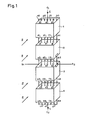
- the multi-divided Hall element shown in FIG. 1 consists of a known Hall element in the form of a right-angled parallelepiped made of semiconductor material, which has two current connections C, and C 2 and two sensor connections S, and S 2 , each on two opposite sides of the parallelepiped are arranged, the remaining two parallel sides of which are arranged perpendicular to a magnetic field H to be measured.
- This known Hall element is divided into several arrangements by at least one cut surface, the centers of the connection contacts of the sensor connections S. and S2 both lying together in a common cut surface. The cut surfaces need not be plane-parallel, nor flat and perpendicular to the current density in the Hall element.
- FIGS. 1, 2a and 2b it was assumed that there are three cut surfaces and thus four arrangements 1, 2, 3 and 4.
- FIGS. 3 to 8 the assumption applies that there is only one cutting surface and therefore two arrangements 2 and 3.
- Two points on each side of each cut surface are connected with a wire that is thought to be elastic and is electrically conductive. There are theoretically an infinite number of such points and such wires. For example, the points are all approximately on a straight line.
- Fig. 1 and in Figures 3 to 5 the presence of seven connections a to g per cut surface, in Figure 2a of five connections a to e per cut surface, in Figure 2b of three connections a to c per sectional area and in FIGS. 6 to 8 of four connections a to d per sectional area.
- the two equipotential points that must at least be present are those two points in the middle sectional area that have the same electrical potential as the sensor connections S, and S 2 . That is, each of the two external equipotential points
- the middle cut surface is to be connected to one of the two sensor connections S 1 and S 2 in such a way that it assumes its electrical potential.
- each upper and each lower surface of each arrangement 1 to 4 are each connected to an equipotential point of the opposite surface of an adjacent arrangement.
- the points of the outer surfaces of the two outer arrangements 1 and 4 selected as equipotential points are each electrically connected to one another and to the power connection C or C 2 respectively assigned to this surface, ie the eight connections a0 to g0 at the, in the illustration of the drawing , Upper surface of the upper arrangement 1 are all connected to the first power connection C, and those a4 to g4 on the lower surface of the lower arrangement 4 are all connected to the second power connection C 2 .
- a feed current I flows through the first power connection C, and the parallel connections a0 to g0 into the arrangement 1 and thus into the Hall element.
- the feed current I flows in the specified order through the arrangement 1, via the parallel connections a1 to g1, through the arrangement 2, via the parallel connections a2 to g2, through the arrangement 3, via the parallel connections a3 to g3, through the Arrangement 4 and via the parallel connections a4 to g4 to the second power connection C 2 and thus out of the Hall element.
- the through this feed current I and the magnetic field to be measured Hall voltage generated in the Hall element appears between the two sensor connections S, and S ,. It remains to be pointed out that each arrangement 1 to 4 does not represent a complete Hall element on its own.
- the arrangements 1 to 4 can be spaced apart from one another and even rotated relative to one another, on the condition that the vectorial directions of the magnetic field H, the current density in the Hall element and the electrical Hall field in the Hall element maintain their relative position (see FIGS. 2a, 3 and Fig. 5).
- the arrangements 1 to 4 are arranged approximately in a straight row next to one another, the arrangements 1 to 4 alternately not rotated (arrangements 1 and 3) or turned upside down (arrangements 2 and 4) displaced parallel so that at least the upper surfaces of the arrangements 1 to 4 finally all lie in a single common plane. All connections are parallel to each other. The relative position of the three vectorial directions mentioned has remained unchanged in relation to their original position.
- the connections a0 to e0, a2 to e2 and a4 to e4 are all arranged above and the connections a1 to e1 and a3 to e3 are all arranged below the arrangements 1 to 4.
- the integrated vertical Hall element shown in FIG. 2b represents a practical implementation of the schematic arrangement shown in FIG. 2a.
- the common plane in which the upper surfaces of the arrangements 1 to 4 lie is the surface plane of a semiconductor layer 5 in which all arrangements 1 to 4 are arranged together.
- the semiconductor layer 5 is, for. B. a thin epitaxial layer that has grown on a substrate 6.
- the connections a1 to c1 and a3 to c3 located below the arrangements 1 to 4 in the illustration of the drawing, ie part of the connections between equipotential points, each consist of a buried layer, each in the boundary layer are arranged between substrate 6 and semiconductor layer 5.
- the arrangements 1 and 2 each have the connections a1 to c1 as buried layers, which are only shown for the arrangement 2 in FIG. 2b, and the arrangements 3 and 4 each have the connections a3 to c3 as buried layers.
- each buried layer on the surface in the semiconductor layer 5 is opposite a contact diffusion.
- FIG. 2b for the arrangement 2 with 7 to 9, for the arrangement 3 with 10 to 12 and for the arrangement 4 with 13 to 15.
- a2 to c2 and a4 to c4 has one electrical contact each with one of the contact diffusions.
- These connections together form the so-called metallization of the integrated circuit and are applied to the surface of the semiconductor layer 5.
- the metallization consists of metal, for example aluminum, or of electrically conductive polysilicon.
- the metallization lies directly on this insulation layer 19, which in turn rests directly on the semiconductor layer 5.
- the connections a4 to c4 of the arrangement 4 are interconnected for the purpose of connection to their common power connection C2.
- each arrangement 1 to 4 is laterally surrounded by the neighboring arrangements with, for example, a rectangular insulation ring, two adjacent insulation rings each having a common web 16, 17 or 18.
- the insulation ring 16; 17 surrounds z. B. the arrangement 2 and the insulation ring 17; 18, for example the arrangement 3.
- the insulation rings extend from the surface of the semiconductor layer 5 to deep down, for example to spatial contact with the substrate 6.
- the substrate 6, the insulation rings and their webs 16, 17 and 18 all consist of a semiconductor material of the same material conductivity type, for example of P material. It could of course also be N-matter.
- the semiconductor layer 5, the buried layers and the contact diffusions 7 to 15 all consist of a semiconductor material of the other material conductivity type, that is to say in the example of N material.
- the buried layers and the contact diffusions 7 to 15 are all heavily doped with foreign atoms, ie they consist of N + material.
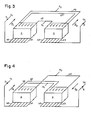
- FIG. 3 The schematic arrangement shown in FIG. 3 is similar to the arrangement shown in FIG. 2a, with the advantage that only two arrangements 2 and 3 are left, which leads to the connections to the two power connections C 1 and C 2 are located on the lower surfaces of arrangements 2 and 3 and not, as in FIG. 2a, on the upper surfaces of arrangements 1 and 4.
- the schematic arrangement shown in FIG. 4 corresponds to the arrangement shown in FIG. 3, with the difference that the connections on the surface of the arrangements 2 and 3 no longer run parallel, but crosswise.
- the magnetic field has practically rotated its relative position at the location of the arrangement 3 by 180 °. That is, the Hall element shown in FIG. 4 is no longer the sum like the Hall element shown in FIG. 3 H1 + H2 but the difference H1 H2 two magnetic fields H1 and H2 measures where H1 Magnetic field at the location of arrangement 2 and H2 .
- the magnetic field is at the location of the arrangement 3.
- a magnetic field gradient between two spatially distant points can be measured.
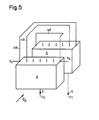
- the Hall element shown schematically in FIG. 5 corresponds approximately to that shown in FIG. 3, with the difference that the two arrangements 2 and 3 are not arranged approximately in a row next to one another, but rather approximately in a row one behind the other. However, the connections at the top in the illustration of the drawing run crosswise, this time to leave the relative position of the three vector directions unchanged.
- FIG. 6 shows the practical implementation of the Hall element shown schematically in FIG. 3 as an integrated circuit, again producing a vertical Hall element.
- the Hall element shown corresponds approximately to the integrated vertical Hall element shown in FIG. 2b with the difference that this time only two arrangements 2 and 3 are present.
- the points to be connected to a current connection C or C 2 on the lower surfaces of the two now outer arrangements 2 and 3 each form a single common buried layer a1; b1; c1; d1 or a3; b3; c3; d3 per arrangement 2 or 3, which each has a deep diffusion 20 or 21, which passes completely through the semiconductor layer 5, with the surface of the Hall element, ie the integrated circuit, and there with a current connection C 1 and C, respectively 2 of the Hall element are connected.
- the deep diffusions 20 and 21 consist of material which is of the same material conductivity type as the buried layers and which is heavily doped with foreign atoms, ie they consist of N + material.
- the integrated vertical Hall elements realized according to FIGS. 2b and 6 have the advantage that, in contrast to the known vertical Hall element, whose two power connections C, and C 2 are constructed very differently and have very different dimensions, they have exactly symmetrical properties in both current directions.
- the surface of the semiconductor layer 5 in FIG. 6 is covered with a thin surface layer 22.
- a thin surface layer 22 which consists of the same material P as the substrate 6. All contact diffusions 7 to 12. all webs 16 to 18 and the two deep diffusions 20 and 21 fully cross this thin Ob Surface layer 22.
- the vertical Hall element shown in FIG. 2b advantageously also has such a thin surface layer 22, which is not shown in FIG. 2b, however.
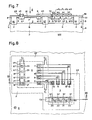
- FIGS. 7 and 8 represent the cross-section VII and the top view of the same horizontal Hall element. It also consists of two arrangements 2 and 3, which, however, are not in a row next to one another, but in plan view at an angle of approximately 90 ° to one another are arranged twisted in the semiconductor layer 5.
- the spatial arrangement and the material of the substrate 6, the semiconductor layer 5, the surface layer 22, the insulation layer 19, the metallization and the webs 16, 17 and 18 of the insulating rings, which are designated by 23 and 24 in FIG. 8, are the same as in FIG. 6. All connections a1 to d1, a2 to d2 and a3 to d3 are located as metallization on the surface of the integrated circuit. There are no buried layers this time.
- contact diffusions 25 to 32 have been replaced by contact diffusions 25 to 32, the contact diffusions 25 to 28 on the one hand and the contact diffusions 29 to 32 on the other hand advantageously being arranged approximately in a straight row.
- the contact diffusions 25 to 32 all consist of the same N + material as the contact diffusions 7 to 12.
- the connecting lines of the centers of the two contact diffusion rows 25; 26; 27; 28 and 29; 30; 31; 32 approximately form an angle of 90 ° with one another.
- Each arrangement 2 and 3 has two contact diffusion rows 25; 26; 27; 28 and 7; 8th; 9 or 10; 11; 12 and 29; 30; 31; 32, wherein in each case a contact diffusion of one row is opposite to a contact diffusion of the other row on the surface in the semiconductor layer 5.
- FIG. 8 In each of the two contact diffusion rows 7; 8th; 9 and 10; 11; 12, an unnumbered contact diffusion is drawn in FIG. 8, which lies opposite the contact diffusion 26 or 31.
- the contact diffusions 7 to 9 on the one hand and 10 to 12 on the other hand are also advantageously arranged approximately in a straight row, which is preferably parallel to the contact diffusion row 25; 26; 27; 28 and 29; 30; 31; 32.
- the connections a2 to d2 electrically connect the contact diffusions 7 to 9 to the contact diffusions 10 to 12, the connections a2 and d2 each having a sensor connection S or S 2 .
- the first current connection C, of the Hall element is connected via the connections a1 to d1 to the contact diffusions 25 to 28, which all four belong to the arrangement 2.
- the second current connection C z of the Hall element is connected to the contact diffusions 29 to 32 via the connections a3 to d3. which all four belong to arrangement 3.
- the horizontal Hall element shown in FIGS. 7 to 8 has the advantage that its zero voltage (“offset” voltage) is largely compensated for, which is explained in more detail below with reference to FIGS. 9a and 9b.
- FIG. 9a shows a bridge circuit consisting of four resistors, which represents the equivalent circuit diagram of a conventional Hall element.
- the bridge circuit contains two different resistance values R and R + AR, whereby two spatially parallel resistors, that is, two resistors diametrically opposite in the bridge circuit, are the same.
- the difference in resistance AR arises from piezoresistive effects, geometric tolerances, etc.
- the zero adjustment of the zero voltage Von can be realized in the vertical Hall element (see FIG. 3) by replacing the short-circuit connections a2 and b2 with two resistors (not shown) connected in series, the common pole of which is connected to one of the sensor connections S or S 2 is connected.
- These resistors can be implemented as adjustable trimming resistors.
- they preferably each consist of a junction field-effect transistor (JFET) or a MOS field-effect transistor, the source-drain channel resistance of which represents the resistance, the resistance value of which can be adjusted by means of the gate voltage of the field-effect transistor.
- All of the integrated Hall elements described can be produced using standard bipolar integrated circuit technology. Thanks to the use of multiple Hall elements, despite the presence of a thin epitaxial layer as the semiconductor layer 5, Hall elements of any size can be realized. This has the advantage. that the non-linearities of the Hall element are low and its 1ff noise is small.
Landscapes
- Physics & Mathematics (AREA)
- Condensed Matter Physics & Semiconductors (AREA)
- General Physics & Mathematics (AREA)
- Hall/Mr Elements (AREA)
- Measuring Magnetic Variables (AREA)
- Hard Magnetic Materials (AREA)
- Electrochromic Elements, Electrophoresis, Or Variable Reflection Or Absorption Elements (AREA)
- Pharmaceuticals Containing Other Organic And Inorganic Compounds (AREA)
- Macromolecular Compounds Obtained By Forming Nitrogen-Containing Linkages In General (AREA)
- Magnetic Record Carriers (AREA)
- Semiconductor Integrated Circuits (AREA)
- Cosmetics (AREA)
- Radiation-Therapy Devices (AREA)
Abstract
Description
- Die Erfindung bezieht sich auf ein integrierbares Hallelement gemäss dem Oberbegriff des Anspruchs 1.
- Derartige Hallelemente werden mit Vorteil in Elektrizitätszählern oder Leistungsmessern verwendet zur Messung eines von einem elektrischen Strom erzeugten Magnetfeldes.
- Ein integriertes Hallelement der eingangs genannten Art ist z.B. aus der EP 0 148 330 A2 bekannt. Dieses Hallelement, nachfolgend kurz vertikales Hallelement genannt, misst ein Magnetfeld, welches parallel zu seiner Oberfläche wirksam ist.
- Aus der US-PS 4,253,107 ist ein weiteres integriertes Hallelement der eingangs genannten Art bekannt, das ein Magnetfeld misst, welches senkrecht zu seiner Oberfläche wirksam ist, und daher nachfolgend kurz horizontales Halleiement genannt wird.
- Der Erfindung liegt die Aufgabe zugrunde, trotz dem Vorhandensein sehr dünner Halbleiterschichten, ein integrierbares, beliebig grosses Hallelement mit geringer Nichtlinearität und kleinem 1/f-Rauschen zu realisieren. Dabei ist die effektive Länge eines vertikalen Hallelementes bedeutend grösser als die Dicke der Halbleiterschicht.
- Die genannte Aufgabe wird erfindungsgemäss durch die im Kennzeichen des Anspruchs 1 angegebenen Merkmale gelöst.
- Ausführungsbeispiele der Erfindung sind in der Zeichnung dargestellt und werdem im folgenden näher beschrieben.
- Es zeigen:
- Fig. 1 eine schematische Darstellung eines mehrfach aufgeteilten Hallelementes,
- Fig. 2a eine schematische Darstellung eines mehrfach aufgeteilten vertikalen Hallelementes,
- Fig. 2b einen Querschnitt eines mehrfach aufgeteilten integrierten vertikalen Hallelementes,
- Fig. 3 eine schematische Darstellung eines zweifach aufgeteilten vertikalen Hallelementes in Summenschaltung,
- Fig. 4 eine schematische Darstellung eines zweifach aufgeteilten vertikalen Hallelementes in Differenzschaltung,
- Fig. 5 eine weitere Variante eines zweifach aufgeteilten vertikalen Hallelementes in Summenschaltung,
- Fig. 6 ein zweifach aufgeteiltes integriertes vertikales Haltelement,
- Fig. 7 einen Querschnitt eines zweifach aufgeteilten integrierten horizontalen Hallelementes,
- Fig. 8 eine Draufsicht des zweifach aufgeteilten integrierten horizontalen Hallelementes,
- Fig. 9a ein elektrisches Ersatzbild eines bekannten Hallelementes und
- Fig. 9b ein elektrisches Ersatzschaltbild des in den Figuren 7 und 8 dargestellten horizontalen Hallelementes.
- Gleiche Bezugszahlen bezeichnen in allen Figuren der Zeichnung gleiche Teile.
- Das in der Fig. 1 dargestellte, mehrfach aufgeteilte Hallelement besteht aus einem bekannten Hallelement in Gestalt eines rechtwinkligen Parallelepipeds aus Halbleitermaterial, welches zwei Stromanschlüsse C, und C2 sowie zwei Sensoranschlüsse S, and S2 besitzt, die jeweils an zwei gegenüberliegenden Seiten des Parallelepipeds angeordnet sind, dessen verbleibende zwei parallele Seiten senkrecht zu einem zu messenden Magnetfeld H angeordnet sind. Dieses bekannte Hallelement ist mindestens durch eine Schnittfläche in mehrere Anordnungen aufgeteilt, wobei die Zentren der Anschlusskontakte der Sensoranschlüsse S. und S2 beide zusammen in einer gemeinsamen Schnittflächen liegen. Die Schnittflächen brauchen weder plan-parallel, noch flach und senkrecht zur Stromdichte im Hallelement zu sein. In der Zeichnung wurde aus Gründen der zeichnerischen Einfachheit angenommen, dass alle Schnittflächen plan-parallel und senkrecht zur Stromdichte angeordnet sind, d.h. senkrecht zur Verbindungslinie der beiden Zentren der Anschlusskontakte der beiden Stromanschlüsse C, und Cz liegen.
- In den Figuren 1, 2a und 2b wurde angenommen, dass drei Schnittflächen und somit vier Anordnungen 1, 2, 3 und 4 vorhanden sind. In den Figuren 3 bis 8 gilt die Annahme, dass nur eine Schnittfläche und somit zwei Anordnungen 2 und 3 vorhanden sind. Je zwei Punkte an beiden Seiten einer jeden Schnittfläche sind mit einem in Gedanken als elastisch angenommenen und elektrisch leitenden Draht verbunden. Es gibt theoretisch unendlich viele solcher Punkte und solcher Drähte. Die Punkte liegen z.B. alle annähernd auf einer geraden Linie. In der Fig. 1 und in den Figuren 3 bis 5 wurde das Vorhandensein von je sieben Verbindungen a bis g pro Schnittfläche, in der Figur 2a von je fünf Verbindungen a bis e pro Schnittfläche, in der Figur 2b von je drei Verbindungen a bis c pro Schnittfläche und in den Figuren 6 bis 8 von je vier Verbindungen a bis d pro Schnittfläche angenommen. Es müssen auf jeden Fall jeweils mindestens zwei solcher Verbindungen a und b pro Schnittfläche vorhanden sein. Mit Vorteil werden als die beiden Aequipotentialpunkte, die mindestens vorhanden sein müssen, in der mittleren Schnittfläche diejenigen zwei Punkte gewählt, die das gleiche elektrische Potential besitzen wie die Sensoranschlüsse S, und S2. D. h.: Jeder der beiden äus seren Aequipotentialpunkte der mittleren Schnittfläche ist jeweils mit einem der beiden Sensorschlüsse S, und S2 derart zu verbinden, dass er dessen elektrisches Potential annimmt.
- Somit sind jeweils mindestens zwei von mehreren Punkten einer jeden oberen und einer jeden unteren Fläche einer jeden Anordnung 1 bis 4 mit je einem Aequipotentialpunkt der entgegengesetzt benannten Fläche einer benachbarten Anordnung verbunden.
- Bei räumlicher Trennung der vier Anordnungen 1 bis 4 durch Parallelverschiebung werden die als elastisch angenommenen Verbindungen zwar länger, das in der Fig. 1 dargestellte Hallelement arbeitet jedoch dank der Verbindungen und trotz der räumlichen Trennung der Anordnung 1 bis 4 genau so, als ob keine Schnittfläche vorhanden wären, da die Verbindungen äquipotentielle Punkte miteinander verbinden. In der Fig. 1 befinden sich zwischen den Anordnungen 1 und 2 die acht Verbindungen a1 bis g1, zwischen den Anordnungen 2 und 3 die acht Verbindungen a2 bis g2 und zwischen den Anordnungen 3 und 4 die acht Verbindungen a3 bis g3.
- Die als Aequipotentialpunkte gewählten Punkte der äusseren Flächen der beiden äusseren Anordnungen 1 und 4 sind jeweils untereinander und mit dem dieser Fläche jeweils zugeordneten Stromanschluss C, bzw. C2 elektrisch verbunden, d.h. die acht Verbindungen a0 bis g0 an der, in der Darstellung der Zeichnung, oberen Fläche der oberen Anordnung 1 sind alle mit dem ersten Stromanschluss C, und diejenigen a4 bis g4 an der unteren Fläche der unteren Anordnung 4 alle mit dem zweiten Stromanschluss C2 verbunden.
- Ein Speisestrom I fliesst über den ersten Stromanschluss C, und die parallelen Verbindungen a0 bis g0 in die Anordnung 1 und damit in das Hallelement hinein. Der Speisestrom I fliesst in der angegebenen Reihenfolge weiter durch die Anordnung 1, über die parallelen Verbindungen a1 bis g1, durch die Anordnung 2, über die parallelen Verbindungen a2 bis g2, durch die Anordnung 3, über die parallelen Verbindungen a3 bis g3, durch die Anordnung 4 und über die parallelen Verbindungen a4 bis g4 zu dem zweiten Stromanschluss C2 und damit aus dem Hallelement heraus. Die durch diesen Speisestrom I und dem zu messenden Magnetfeldim Hallelement erzeugte Hallspannung erscheint zwischen den beiden Sensoranschlüssen S, und S,. Es verbleibt daruf hinzuweisen, dass jede Anordnung 1 bis 4 für sich allein betrachtet kein vollständiges Hallelement darstellt.

- Die Anordnungen 1 bis 4 können beliebig voneinander entfernt und sogar gegeneinander verdreht werden, unter der Bedingung, dass die verktoriellen Richtungen des Magnetfeldes H , der Stromdichte im Hallelement und des elektrischen Hallfeldes im Hallelement ihre relative Lage beibehalten (siehe Fig. 2a, Fig. 3 und Fig. 5).
- In der Fig. 2a sind die Anordnungen 1 bis 4 annähernd in einer geraden Reihe nebeneinander angeordnet, wobei die Anordnungen 1 bis 4 abwechselnd nicht verdreht (Anordnungen 1 und 3) oder kopfstehend verdreht (Anordnungen 2 und 4) parallelverschoben derartig angeordnet sind, dass mindestens die oberen Flächen der Anordnungen 1 bis 4 schliesslich alle in eine einzige gemeinsame Ebene liegen. Alle Verbindungen sind parallel untereinander.Die relative Lage der drei erwähnten vektoriellen Richtungen ist unverändert geblieben in Bezug auf ihre ursprüngliche Lage. Die Verbindungen a0 bis e0, a2 bis e2 und a4 bis e4 sind alle oberhalb und die Verbindungen a1 bis e1 und a3 bis e3 alle unterhalb der Anordnungen 1 bis 4 angeordnet.
- Das in der Fig. 2b dargestellte integrierte vertikale Hallelement stellt eine praktische Realisation der in der Fig. 2a dargestellten schematischen Anordnung dar. Die gemeinsame Ebene, in der die oberen Flächen der Anordnungen 1 bis 4 liegen, ist die Oberflächenebene einer Halbleiterschicht 5, in der gemeinsam alle Anordnungen 1 bis 4 angeordnet sind. Die Halbleiterschicht 5 ist z. B. eine dünne Epitaxie-Schicht, die auf einem Substrat 6 aufgewachsen ist. In der Fig. 2b sind einfachshalber nur die drei Anordnungen 2 bis 4 dargestellt. Die in der Darstellung der Zeichnung unterhalb der Anordnungen 1 bis 4 gelegenen Verbindungen a1 bis c1 und a3 bis c3, d. h. ein Teil der Verbindungen zwischen Aequipotential-Punkten, bestehen aus je einer vergrabenen Schicht ("buried layer"), die jeweils in der Grenzschicht zwischen Substrat 6 und Halbleiterschicht 5 angeordnet sind. Die Anordnungen 1 und 2 besitzen je als vergrabene Schichten die Verbindungen a1 bis c1, die in der Fig. 2b nur für die Anordnung 2 dargestellt sind, und die Anordnungen 3 und 4 je als vergrabene Schichten die Verbindungen a3 bis c3. In dem in der Fig. 2b dargestellten Querschnitt liegt jeder vergrabenen Schicht an der Oberfläche in der Halbleiterschicht 5 je eine Kontaktdiffusion gegenüber. Diese sind in der Fig. 2b für die Anordnung 2 mit 7 bis 9, für die Anordnung 3 mit 10 bis 12 und für die Anordnung 4 mit 13 bis 15 bezeichnet. Der andere Teil der Verbindungen , d.h. die in der Dastellung der Zeichnung oberhalb der Anordnungen 1 bis 4 gelegenen Verbindungen a0 bis c0 (in der Fig. 2b nicht dargestellt, da nur bei der nicht dargestellten Anordnung 1 vorhanden), a2 bis c2 und a4 bis c4, hat je einen elektrischen Kontakt mit je einer der Kontaktdiffusionen. Diese Verbindungen bilden zusammen die sogenannte Metallisierung der integrierten Schaltung und sind auf der Oberfläche der Halbleiterschicht 5 aufgetragen. Die Metallisierung besteht aus Metall, z.B. Aluminium, oder aus elektrisch leitendem Polysilizium. Zwecks elektrischer Isolation befindet sich zwischen der Metallisierung und der Halbleiterschicht 5 eine Isolationsschicht 19, die z.B. aus Si02 besteht. Die Metallisierung liegt direkt auf dieser Isolationsschicht 19, die ihrerseits direkt auf der Halbleiterschicht 5 aufliegt. Die Verbindungen a4 bis c4 der Anordnung 4 sind untereinander verbunden zwecks Anschluss an ihrem gemeinsamen Stromanschluss C2. Jede Anordnung 1 bis 4 ist zwecks Inselbildung und Isolation von den benachbarten Anordnungen mit einem z.B. rechteckförmigen lsolationsring seitlich umgeben, wobei zwei benachbarte Isolationsringe je einen gemeinsamen Steg 16;17 oder 18 besitzen. Der Isolationsring 16;17 umgibt dabei z. B. die Anordnung 2 und der Isolationsring 17;18 z.B. die Anordnung 3. Die Isolationsringe reichen von der Oberfläche der Halbleiterschicht 5 bis tief hinunter, z.B. bis zum räumlichen Kontakt mit dem Substrat 6.
- Das Substrat 6, die Isolationsringe und ihre Stege 16, 17 und 18 bestehen alle aus einem Halbleitermaterial eines gleichen Materialleitfähigkeitstyps, z.B. aus P-Material. Es könnte natürlich auch N-Materiäi sein. Die Halbleiterschicht 5, die vergrabenen Schichten und die Kontaktdiffusionen 7 bis 15 bestehen alle aus einem Halbleitermaterial vom andern Materialleifähigkeitstyp, also im .Beispiel aus N-Material. Die vergrabenen Schichten und die Kontaktdiffusionen 7 bis 15 sind alle stark mit Fremdatomen dotiert, d. h. sie bestehen aus N+-Material.
- Die in der Fig. 3 dargestellte schematische Anordnung ähnelt der in der Fig. 2a dargestellten Anordnung, mit dem Vorteil, dass nur mehr zwei Anordnungen 2 und 3 vorhanden sind, was dazu führt, dass die Verbindungen zu den beiden Stromanschlüssen C, und C2 sich an den unteren Flächen der Anordnungen 2 und 3 befinden und nicht, wie in der Fig. 2a, an den oberen Flächen der Anordnungen 1 und 4.
- Die in der Fig. 4 dargestellte schematische Anordnung entspricht der in der Fig. 3 dargestellten Anordnung, mit dem Unterschied, dass die Verbindungen an der Oberfläche der Anordnungen 2 und 3 nicht mehr parallel, sondern über Kreuz verlaufen. Dadurch stimmt die relative Lage der drei erwähnten vektoriellen Richtungen nicht mehr mit der ursprünglichen Lage überein. Das Magnetfeld hat seine relative Lage am Ort der Anordnung 3 praktisch um 180° gedreht. D. h., dass das in der Fig. 4 dargestellte Hallelement nicht mehr wie das in der Fig. 3 dargestellte Hallelement die Summe
H1 +H2 , sondern die DifferenzH1 H2 zweier MagnetfelderH1 undH2 misst, wobeiH1 Magnetfeld am Ort der Anordnung 2 undH2 . das Magnetfeld am Ort der Anordnung 3 ist. Anders ausgedrückt: Mit dem in der Fig. 4 dargestellten Hallelement kann ein Magnetfeld-Gradient zwischen zwei räumlich entfernten Punkte gemessen werden. - Das in der Fig. 5 schematisch dargestellte Hallelement entspricht annähernd demjenigen, das in der Fig. 3 dargestellt ist, mit dem Unterschied, dass beide Anordnungen 2 und 3 nicht annähernd in einer Reihe nebeneinander, sondern annähernd in einer Reihe hintereinander angeordnet sind. Die in der Darstellung der Zeichnung oberen Verbindungen verlaufen allerdings über Kreuz, diesmal um die relative Lage der drei vektoriellen Richtungen unverändert zu lassen.
- In der Fig. 6 ist die praktische Realisation des in der Fig. 3 schematisch dargestellten Hallelementes als integrierte Schaltung dargestellt, wobei wiederum ein vertikales Hallelement entsteht. Das dargestellte Hallelement entspricht annähernd dem in der Fig. 2b dargestellten integrierten vertikalen Hallelement mit dem Unterschied, dass diesmal nur mehr zwei Anordnungen 2 und 3 vorhanden sind.
- Die mit einem Stromanschluss C, bzw. C2 zu verbindende Punkte an den unteren Flächen der beiden jetzt äusseren Anordnungen 2 und 3 bilden diesmal je eine einzige gemeinsame vergrabene Schicht a1; b1; c1; d1 bzw. a3; b3; c3; d3 pro Anordnung 2 bzw. 3, die durch je eine tiefe Diffusion 20 bzw. 21, die voll durch die Halbleiterschicht 5 hindurch geht, mit der Oberfläche des Hallelementes, d. h. der integrierten Schaltung, und dort mit je einem Stromanschluss C1 bzw. C2 des Hallelementes verbunden sind. Die tiefen Diffusionen 20 und 21 bestehen aus Material, das vom gleichen Materialleitfähigkeitstyp ist wie die vergrabenen Schichten und das wie diese stark mit Fremdatomen dotiert ist, d.h. sie bestehen aus N+-Material.
- Die gemäss den Figuren 2b und 6 realisierten integrierten vertikalen Hallelemente haben den Vorteil, dass sie im Gegensatz zum bekannten vertikalen Hallelement, dessen beide Stromanschlüsse C, und C2 sehr unterschiedlich aufgebaut sind und sehr unterschiedliche Abmessungen aufweisen, genau symmetrische Eigenschaften in beiden Stromrichtungen besitzen.
- Zur Gewährleistung der Langzeitstabilität ist die Oberfläche der Halbleiterschicht 5 in der Fig. 6 mit einer dünnen Oberflächenschicht 22 bedeckt. die aus dem gleichen Material P besteht wie das Substrat 6. Alle Kontaktdiffusionen 7 bis 12. alle Stege 16 bis 18 und die beiden tiefen Diffusionen 20 und 21 durchqueren voll diese dünne Oberflächenschicht 22. Das in der Fig. 2b dargestellte vertikale Hallelement besitzt mit Vorteil ebenso eine solche dünne Oberflächenschicht 22, die allerdings in der Fig. 2b nicht dargestellt ist.
- Die beiden Figuren 7 und 8 stellen den Querschnitt VII bzw. die Draufsicht eines gleichen horizontalen Hallelementes dar. Es besteht ebenfalls aus zwei Anordnungen 2 und 3, die jedoch nicht in einer Reihe nebeneinander, sondern in der Draufsicht um einen Winkel von annähernd 90° gegeneinander verdreht in der Halbleiterschicht 5 angeordnet sind. Die räumliche Anordnung und das Material des Substrats 6, der Halbleiterschicht 5, der Oberflächenschicht 22, der Isolationsschicht 19, der Metallisierung und der Stege 16, 17 und 18 der Isolierringe, die in der Fig. 8 mit 23 und 24 bezeichnet sind, sind gleich wie in der Fig. 6. Alle Verbindungen a1 bis d1, a2 bis d2 und a3 bis d3 befinden sich als Metallisierung an der Oberfläche der integrierten Schaltung. Es existieren somit diesmal keine vergrabenen Schichten. Diese sind durch Kontaktdiffusionen 25 bis 32 ersetzt worden, wobei die Kontaktdiffusionen 25 bis 28 einerseits und die Kontaktdiffusionen 29 bis 32 anderseits mit Vorteil annähernd in einer geraden Reihe angeordnet sind. Die Kontaktdiffusionen 25 bis 32 bestehen alle aus dem gleichen N+-Material wie die Kontaktdiffusionen 7 bis 12. Die Verbindungslinien der Zentren der beiden Kontaktdiffusionsreihen 25; 26; 27; 28 und 29; 30; 31; 32 bilden annähernd einen Winkel von 90° miteinander. Jede Anordnung 2 und 3 besitzt zwei Kontaktdiffusionsreihen 25; 26; 27; 28 und 7; 8; 9 bzw. 10; 11; 12 und 29; 30; 31; 32, wobei jeweils eine Kontaktdiffusion der einen Reihe einer Kontaktdiffusion der andern Reihe an der Oberfläche in der Halbleiterschicht 5 gegenüber liegt. In jeder der beiden Kontaktdiffusionsreihen 7; 8; 9 und 10; 11; 12 ist in der Fig. 8 eine nicht nummerierte Kontaktdiffusion gezeichnet, die der Kontaktdiffusion 26 bzw. 31 gegenüber liegt. Die Kontaktdiffusionen 7 bis 9 einerseits und 10 bis 12 anderseits sind ebenfalls mit Vorteil annähernd in je einer geraden Reihe angeordnet, die vorzugsweise jeweils parallel ist zu der Kontaktdiffusionsreihe 25; 26; 27; 28 bzw. 29; 30; 31; 32. Die Verbindungen a2 bis d2 verbinden die Kontaktdiffusionen 7 bis 9 elektrisch mit den Kontaktdiffusionen 10 bis 12, wobei die Verbindungen a2 und d2 je einen Sensoranschluss S, bzw. S2 besitzen. Der erste Stromanschluss C, des Hallelementes ist über die Verbindungen a1 bis d1 mit den Kontaktdiffusionen 25 bis 28 verbunden, die alle vier zur Anordnung 2 gehören. Der zweite Stromanschluss Cz des Hallelementes ist über die Verbindungen a3 bis d3 mit den Kontaktdiffusionen 29 bis 32 verbunden. die alle vier zur Anordnung 3 gehören.
- Das in den Figuren 7 bis 8 dargestellte horizontale Hallelement hat den Vorteil, dass seine Nullspannung ("Offset"-Spannung) weitgehend kompensiert wird, was nachfolgend anhand der Figuren 9a und 9b näher erläutert wird.
- Die Fig. 9a stellt eine aus vier Widerständen bestehende Brückenschaltung dar, die das Ersatzschaltbild eines üblichen Hallelementes darstellt. Die Brückenschaltung enthält zwei unterschiedliche Widerstandswerte R und R+AR, wobei jeweils zwei räumlich parallel angeordnete Widerstände, d.h., zwei in der Brückenschaltung diametral gegenüberliegende Widerstände, gleich sind. Die Widerstandsdifferenz AR entsteht durch piezoresistive Effekte, geometrische Toleranzen usw. Bei einem Magnetfeld
H =0, entsteht am Sensorausgang S,; S2 des Hallelementes eine Nullspannung Voff= (AR/R) V c1, cε, wobei Vc1, c2 eine am Speisestromeingang C,; C2 des Hallelementes anstehende Speisespannung darstellt. - In der Fig. 9b ist das Ersatzschaltbild des in den Figuren 7 bis 8 dargestellten horizontalen Hailelementes wiedergegeben, das sich von dem in der Fig. 9a dargestellten Ersatzschaltbild dadurch unterscheidet, dass eine Hälfte der Brückenschaltung um 90° gegenüber der anderen Hälfte verdreht angeordnet ist. Da zwei räumlich parallel angeordnete Widerstände wieder gleich R bzw: R+AR sind, liegen diesmal, in Flussrichtung des Speisestromes I betrachtet, zwei gleiche Widerstände elektrisch in Reihe, was dazu führt, dass Voff = 0 wird.
- Der Nullabgleich der Nullspannung Von kann im vertikalen Hallelement (siehe Fig. 3), dadurch realisiert werden, dass die Kurzschlussverbindun gen a2 und b2 je durch zwei in Reihe geschaltete nicht dargestellte Widerstände ersetzt werden, deren gemeinsamer Pol jeweils mit einem der Sensoranschlüsse S, bzw. S2 verbunden ist. Diese Widerstände sind als einstellbare Abgleichswiderstände zu realisieren. Sie bestehen z.B. vorzugsweise aus je einem Sperrschicht-Feldeffekttransistor (JFET) oder einem MOS-Feldeffekttransistor, dessen Source-Drain-Kanalwiderstand jeweils den Widerstand darstellt, dessen Widerstandswert mittels der Gate-Spannung des Feldeffekttransistors einstellbar ist.
- Alle beschriebenen integrierten Hallelemente können in Standard-Bipolar-Integrierte Schaltungs-Technologie hergestellt werden. Dank der Verwendung mehrfach aufgeteilter Hallelemente können, trotz dem Vorhandensein einer dünnen Epitaxie-Schicht als Halbleiterschicht 5, beliebig grosse Hallelemente realisiert werden. Dies hat den Vorteil. dass die Nichtlinearitäten des Hallelementes gering sind und sein 1ff-Rauschen klein ist.
Claims (6)
Priority Applications (1)
| Application Number | Priority Date | Filing Date | Title |
|---|---|---|---|
| AT87102488T ATE59734T1 (de) | 1986-04-29 | 1987-02-21 | Integrierbares hallelement. |
Applications Claiming Priority (2)
| Application Number | Priority Date | Filing Date | Title |
|---|---|---|---|
| CH1759/86 | 1986-04-29 | ||
| CH1759/86A CH669068A5 (de) | 1986-04-29 | 1986-04-29 | Integrierbares hallelement. |
Publications (2)
| Publication Number | Publication Date |
|---|---|
| EP0244577A1 true EP0244577A1 (de) | 1987-11-11 |
| EP0244577B1 EP0244577B1 (de) | 1991-01-02 |
Family
ID=4217907
Family Applications (1)
| Application Number | Title | Priority Date | Filing Date |
|---|---|---|---|
| EP87102488A Expired - Lifetime EP0244577B1 (de) | 1986-04-29 | 1987-02-21 | Integrierbares Hallelement |
Country Status (15)
| Country | Link |
|---|---|
| US (1) | US4829352A (de) |
| EP (1) | EP0244577B1 (de) |
| JP (1) | JPS6393178A (de) |
| KR (1) | KR870010391A (de) |
| CN (1) | CN1007683B (de) |
| AT (1) | ATE59734T1 (de) |
| AU (1) | AU600484B2 (de) |
| CA (1) | CA1263764A (de) |
| CH (1) | CH669068A5 (de) |
| DE (1) | DE3766875D1 (de) |
| DK (1) | DK216787A (de) |
| ES (1) | ES2019588B3 (de) |
| FI (1) | FI871526A7 (de) |
| NO (1) | NO871796L (de) |
| YU (1) | YU54487A (de) |
Cited By (8)
| Publication number | Priority date | Publication date | Assignee | Title |
|---|---|---|---|---|
| EP0503141A1 (de) * | 1991-03-15 | 1992-09-16 | Landis & Gyr Business Support AG | Anordnung zur Eigenschaftsverbesserung von mit P/N-Uebergängen versehenen Halbleiterstrukturen |
| DE19857275A1 (de) * | 1998-12-11 | 2000-06-15 | Johannes V Kluge | Integrierbarer Magnetfeldsensor aus Halbleitermaterial |
| FR2829582A1 (fr) * | 2001-09-08 | 2003-03-14 | Bosch Gmbh Robert | Dispositif pour mesurer l'intensite d'une composante vectorielle d'un champ magnetique et dispositif de mesure d'une intensite de courant ainsi qu'application d'un transistor a effet de champ |
| DE10150955C1 (de) * | 2001-10-16 | 2003-06-12 | Fraunhofer Ges Forschung | Vertikaler Hall-Sensor |
| DE10150950C1 (de) * | 2001-10-16 | 2003-06-18 | Fraunhofer Ges Forschung | Kompakter vertikaler Hall-Sensor |
| EP1746426A1 (de) * | 2005-07-22 | 2007-01-24 | Sentron Ag | Stromsensor |
| DE102006028520B4 (de) * | 2005-06-21 | 2009-04-30 | Denso Corp., Kariya-shi | Stromsensor mit einem Hall-Element |
| EP2584304A1 (de) * | 2011-10-21 | 2013-04-24 | Micronas GmbH | Verfahren zur Bestimmung eines Abstandes und eine integrierte Magnetfeldmessvorrichtung |
Families Citing this family (80)
| Publication number | Priority date | Publication date | Assignee | Title |
|---|---|---|---|---|
| ATE96248T1 (de) * | 1988-09-21 | 1993-11-15 | Landis & Gyr Business Support | Hallelement. |
| JPH02192781A (ja) * | 1989-01-20 | 1990-07-30 | Mitsubishi Electric Corp | ホール素子および磁気センサシステム |
| JPH0390872A (ja) * | 1989-09-01 | 1991-04-16 | Toshiba Corp | 半導体装置 |
| KR0127282B1 (ko) * | 1992-05-18 | 1998-04-02 | 도요다 요시또시 | 반도체 장치 |
| EP0590222A1 (de) * | 1992-09-30 | 1994-04-06 | STMicroelectronics S.r.l. | Magnetischer Lagegeber |
| US5323050A (en) * | 1993-06-01 | 1994-06-21 | Motorola, Inc. | Collector arrangement for magnetotransistor |
| JP3602611B2 (ja) * | 1995-03-30 | 2004-12-15 | 株式会社東芝 | 横型ホール素子 |
| US5572058A (en) * | 1995-07-17 | 1996-11-05 | Honeywell Inc. | Hall effect device formed in an epitaxial layer of silicon for sensing magnetic fields parallel to the epitaxial layer |
| US8397883B2 (en) * | 2001-10-25 | 2013-03-19 | Lord Corporation | Brake with field responsive material |
| US7872322B2 (en) * | 2002-09-10 | 2011-01-18 | Melexis Tessenderlo Nv | Magnetic field sensor with a hall element |
| JP2005333103A (ja) * | 2004-03-30 | 2005-12-02 | Denso Corp | 縦型ホール素子およびその製造方法 |
| US7205622B2 (en) * | 2005-01-20 | 2007-04-17 | Honeywell International Inc. | Vertical hall effect device |
| EP2006700B1 (de) * | 2006-04-13 | 2015-12-30 | Asahi Kasei EMD Corporation | Magnetsensor und verfahren zu seiner herstellung |
| WO2008080078A2 (en) * | 2006-12-22 | 2008-07-03 | Lord Corporation | Operator interface controllable brake with field responsive material |
| US20080234908A1 (en) * | 2007-03-07 | 2008-09-25 | St Clair Kenneth A | Operator input device for controlling a vehicle operation |
| CN101464479B (zh) * | 2007-12-20 | 2012-09-26 | 东光东芝测量仪器株式会社 | 电能表 |
| US7626377B2 (en) * | 2008-02-18 | 2009-12-01 | Honeywell International Inc. | Hall-effect device with merged and/or non-merged complementary structure |
| US7782050B2 (en) * | 2008-04-11 | 2010-08-24 | Infineon Technologies Ag | Hall effect device and method |
| CH699933A1 (de) * | 2008-11-28 | 2010-05-31 | Melexis Technologies Sa | Vertikaler Hallsensor. |
| US8093891B2 (en) * | 2009-03-02 | 2012-01-10 | Robert Bosch Gmbh | Vertical Hall Effect sensor |
| DE102009027338A1 (de) * | 2009-06-30 | 2011-01-05 | Robert Bosch Gmbh | Hall-Sensorelement und Verfahren zur Messung eines Magnetfelds |
| DE102009029528A1 (de) * | 2009-09-17 | 2011-03-24 | Robert Bosch Gmbh | Integrierter Schaltkreis zur Informationsübertragung |
| JP5679906B2 (ja) * | 2010-07-05 | 2015-03-04 | セイコーインスツル株式会社 | ホールセンサ |
| US8829900B2 (en) * | 2011-02-08 | 2014-09-09 | Infineon Technologies Ag | Low offset spinning current hall plate and method to operate it |
| US8896303B2 (en) | 2011-02-08 | 2014-11-25 | Infineon Technologies Ag | Low offset vertical Hall device and current spinning method |
| US9062990B2 (en) | 2011-02-25 | 2015-06-23 | Allegro Microsystems, Llc | Circular vertical hall magnetic field sensing element and method with a plurality of continuous output signals |
| US8786279B2 (en) | 2011-02-25 | 2014-07-22 | Allegro Microsystems, Llc | Circuit and method for processing signals generated by a plurality of sensors |
| US8729890B2 (en) | 2011-04-12 | 2014-05-20 | Allegro Microsystems, Llc | Magnetic angle and rotation speed sensor with continuous and discontinuous modes of operation based on rotation speed of a target object |
| US8860410B2 (en) | 2011-05-23 | 2014-10-14 | Allegro Microsystems, Llc | Circuits and methods for processing a signal generated by a plurality of measuring devices |
| US8890518B2 (en) | 2011-06-08 | 2014-11-18 | Allegro Microsystems, Llc | Arrangements for self-testing a circular vertical hall (CVH) sensing element and/or for self-testing a magnetic field sensor that uses a circular vertical hall (CVH) sensing element |
| DE102011107767A1 (de) | 2011-07-15 | 2013-01-17 | Micronas Gmbh | Hallsensor |
| US8988072B2 (en) | 2011-07-21 | 2015-03-24 | Infineon Technologies Ag | Vertical hall sensor with high electrical symmetry |
| US9007060B2 (en) | 2011-07-21 | 2015-04-14 | Infineon Technologies Ag | Electronic device with ring-connected hall effect regions |
| US8793085B2 (en) | 2011-08-19 | 2014-07-29 | Allegro Microsystems, Llc | Circuits and methods for automatically adjusting a magnetic field sensor in accordance with a speed of rotation sensed by the magnetic field sensor |
| US8922206B2 (en) * | 2011-09-07 | 2014-12-30 | Allegro Microsystems, Llc | Magnetic field sensing element combining a circular vertical hall magnetic field sensing element with a planar hall element |
| US9285438B2 (en) | 2011-09-28 | 2016-03-15 | Allegro Microsystems, Llc | Circuits and methods for processing signals generated by a plurality of magnetic field sensing elements |
| US8922207B2 (en) | 2011-11-17 | 2014-12-30 | Infineon Technologies Ag | Electronic device comprising hall effect region with three contacts |
| US9046383B2 (en) | 2012-01-09 | 2015-06-02 | Allegro Microsystems, Llc | Systems and methods that use magnetic field sensors to identify positions of a gear shift lever |
| US9312472B2 (en) | 2012-02-20 | 2016-04-12 | Infineon Technologies Ag | Vertical hall device with electrical 180 degree symmetry |
| US9182456B2 (en) | 2012-03-06 | 2015-11-10 | Allegro Microsystems, Llc | Magnetic field sensor for sensing rotation of an object |
| US10215550B2 (en) | 2012-05-01 | 2019-02-26 | Allegro Microsystems, Llc | Methods and apparatus for magnetic sensors having highly uniform magnetic fields |
| US9484525B2 (en) * | 2012-05-15 | 2016-11-01 | Infineon Technologies Ag | Hall effect device |
| CN103576101A (zh) * | 2012-07-31 | 2014-02-12 | 北京嘉岳同乐极电子有限公司 | 一种多通道集成式磁传感器 |
| US8749005B1 (en) | 2012-12-21 | 2014-06-10 | Allegro Microsystems, Llc | Magnetic field sensor and method of fabricating a magnetic field sensor having a plurality of vertical hall elements arranged in at least a portion of a polygonal shape |
| US9606190B2 (en) | 2012-12-21 | 2017-03-28 | Allegro Microsystems, Llc | Magnetic field sensor arrangements and associated methods |
| US9417295B2 (en) | 2012-12-21 | 2016-08-16 | Allegro Microsystems, Llc | Circuits and methods for processing signals generated by a circular vertical hall (CVH) sensing element in the presence of a multi-pole magnet |
| US9548443B2 (en) | 2013-01-29 | 2017-01-17 | Allegro Microsystems, Llc | Vertical Hall Effect element with improved sensitivity |
| US9377285B2 (en) | 2013-02-13 | 2016-06-28 | Allegro Microsystems, Llc | Magnetic field sensor and related techniques that provide varying current spinning phase sequences of a magnetic field sensing element |
| US9389060B2 (en) | 2013-02-13 | 2016-07-12 | Allegro Microsystems, Llc | Magnetic field sensor and related techniques that provide an angle error correction module |
| US9099638B2 (en) | 2013-03-15 | 2015-08-04 | Allegro Microsystems, Llc | Vertical hall effect element with structures to improve sensitivity |
| KR102019514B1 (ko) * | 2013-06-28 | 2019-11-15 | 매그나칩 반도체 유한회사 | 반도체 기반의 홀 센서 |
| US9400164B2 (en) | 2013-07-22 | 2016-07-26 | Allegro Microsystems, Llc | Magnetic field sensor and related techniques that provide an angle correction module |
| US9312473B2 (en) | 2013-09-30 | 2016-04-12 | Allegro Microsystems, Llc | Vertical hall effect sensor |
| US9574867B2 (en) | 2013-12-23 | 2017-02-21 | Allegro Microsystems, Llc | Magnetic field sensor and related techniques that inject an error correction signal into a signal channel to result in reduced error |
| US10120042B2 (en) | 2013-12-23 | 2018-11-06 | Allegro Microsystems, Llc | Magnetic field sensor and related techniques that inject a synthesized error correction signal into a signal channel to result in reduced error |
| US9547048B2 (en) | 2014-01-14 | 2017-01-17 | Allegro Micosystems, LLC | Circuit and method for reducing an offset component of a plurality of vertical hall elements arranged in a circle |
| US9753097B2 (en) | 2014-05-05 | 2017-09-05 | Allegro Microsystems, Llc | Magnetic field sensors and associated methods with reduced offset and improved accuracy |
| US9316705B2 (en) * | 2014-05-09 | 2016-04-19 | Infineon Technologies Ag | Vertical hall effect-device |
| US9425385B2 (en) | 2014-05-09 | 2016-08-23 | Infineon Technologies Ag | Vertical hall effect device |
| US9448288B2 (en) | 2014-05-20 | 2016-09-20 | Allegro Microsystems, Llc | Magnetic field sensor with improved accuracy resulting from a digital potentiometer |
| EP2963435B1 (de) | 2014-07-01 | 2017-01-25 | Nxp B.V. | Differenzielles seitliches Magnetfeldsensorsystem mit Versatzunterdrückung und unter Umsetzung mit Silicium-auf-Isolator-Technologie |
| EP2966462B1 (de) * | 2014-07-11 | 2022-04-20 | Senis AG | Vertikales Hallelement |
| GB2531536A (en) * | 2014-10-21 | 2016-04-27 | Melexis Technologies Nv | Vertical hall sensors with reduced offset error |
| US9823092B2 (en) | 2014-10-31 | 2017-11-21 | Allegro Microsystems, Llc | Magnetic field sensor providing a movement detector |
| US9638766B2 (en) | 2014-11-24 | 2017-05-02 | Allegro Microsystems, Llc | Magnetic field sensor with improved accuracy resulting from a variable potentiometer and a gain circuit |
| US9684042B2 (en) | 2015-02-27 | 2017-06-20 | Allegro Microsystems, Llc | Magnetic field sensor with improved accuracy and method of obtaining improved accuracy with a magnetic field sensor |
| US11163022B2 (en) | 2015-06-12 | 2021-11-02 | Allegro Microsystems, Llc | Magnetic field sensor for angle detection with a phase-locked loop |
| US10481220B2 (en) | 2016-02-01 | 2019-11-19 | Allegro Microsystems, Llc | Circular vertical hall (CVH) sensing element with signal processing and arctangent function |
| US9739848B1 (en) | 2016-02-01 | 2017-08-22 | Allegro Microsystems, Llc | Circular vertical hall (CVH) sensing element with sliding integration |
| US9739847B1 (en) | 2016-02-01 | 2017-08-22 | Allegro Microsystems, Llc | Circular vertical hall (CVH) sensing element with signal processing |
| US10385964B2 (en) | 2016-06-08 | 2019-08-20 | Allegro Microsystems, Llc | Enhanced neutral gear sensor |
| US10585147B2 (en) | 2016-06-14 | 2020-03-10 | Allegro Microsystems, Llc | Magnetic field sensor having error correction |
| US10739164B2 (en) | 2017-01-27 | 2020-08-11 | Allegro Microsystems, Llc | Circuit for detecting motion of an object |
| US10495701B2 (en) | 2017-03-02 | 2019-12-03 | Allegro Microsystems, Llc | Circular vertical hall (CVH) sensing element with DC offset removal |
| US10823586B2 (en) | 2018-12-26 | 2020-11-03 | Allegro Microsystems, Llc | Magnetic field sensor having unequally spaced magnetic field sensing elements |
| US11280637B2 (en) | 2019-11-14 | 2022-03-22 | Allegro Microsystems, Llc | High performance magnetic angle sensor |
| US11237020B2 (en) | 2019-11-14 | 2022-02-01 | Allegro Microsystems, Llc | Magnetic field sensor having two rows of magnetic field sensing elements for measuring an angle of rotation of a magnet |
| CN112038484B (zh) * | 2020-08-25 | 2021-06-01 | 深圳市金誉半导体股份有限公司 | 一种双霍尔传感器及其制备方法 |
| US11802922B2 (en) | 2021-01-13 | 2023-10-31 | Allegro Microsystems, Llc | Circuit for reducing an offset component of a plurality of vertical hall elements arranged in one or more circles |
| US11473935B1 (en) | 2021-04-16 | 2022-10-18 | Allegro Microsystems, Llc | System and related techniques that provide an angle sensor for sensing an angle of rotation of a ferromagnetic screw |
Citations (2)
| Publication number | Priority date | Publication date | Assignee | Title |
|---|---|---|---|---|
| EP0035103A1 (de) * | 1980-01-18 | 1981-09-09 | Siemens Aktiengesellschaft | Monolitisch integrierte Anordnung zweier Hallsonden |
| EP0148330A2 (de) * | 1983-12-19 | 1985-07-17 | LGZ LANDIS & GYR ZUG AG | Integrierbares Hallelement |
Family Cites Families (10)
| Publication number | Priority date | Publication date | Assignee | Title |
|---|---|---|---|---|
| NL173335C (nl) * | 1972-06-01 | 1984-01-02 | Philips Nv | Hall-element. |
| US4141026A (en) * | 1977-02-02 | 1979-02-20 | Texas Instruments Incorporated | Hall effect generator |
| US4253107A (en) * | 1978-10-06 | 1981-02-24 | Sprague Electric Company | Integrated circuit with ion implanted hall-cell |
| JPS5748264A (en) * | 1980-08-29 | 1982-03-19 | Rohm Co Ltd | Magnetic coupler |
| JPS582084A (ja) * | 1981-06-26 | 1983-01-07 | Toshiba Corp | ホ−ル素子装置 |
| JPS58154263A (ja) * | 1982-03-09 | 1983-09-13 | Seiko Instr & Electronics Ltd | ホ−ルic |
| JPS58155761A (ja) * | 1982-03-10 | 1983-09-16 | Sharp Corp | ホ−ル効果半導体集積回路 |
| DE3380004D1 (en) * | 1982-03-30 | 1989-07-06 | Fujitsu Ltd | Semiconductor memory device |
| CH668147A5 (de) * | 1985-05-22 | 1988-11-30 | Landis & Gyr Ag | Einrichtung mit einem hallelement in integrierter halbleitertechnologie. |
| JPS62206889A (ja) * | 1986-03-07 | 1987-09-11 | Seiko Instr & Electronics Ltd | 磁気センサ |
-
1986
- 1986-04-29 CH CH1759/86A patent/CH669068A5/de not_active IP Right Cessation
-
1987
- 1987-02-10 CA CA000529383A patent/CA1263764A/en not_active Expired
- 1987-02-21 DE DE8787102488T patent/DE3766875D1/de not_active Expired - Fee Related
- 1987-02-21 AT AT87102488T patent/ATE59734T1/de not_active IP Right Cessation
- 1987-02-21 ES ES87102488T patent/ES2019588B3/es not_active Expired - Lifetime
- 1987-02-21 EP EP87102488A patent/EP0244577B1/de not_active Expired - Lifetime
- 1987-03-10 JP JP62053222A patent/JPS6393178A/ja active Pending
- 1987-03-27 YU YU00544/87A patent/YU54487A/xx unknown
- 1987-04-07 FI FI871526A patent/FI871526A7/fi not_active Application Discontinuation
- 1987-04-21 US US07/040,854 patent/US4829352A/en not_active Expired - Fee Related
- 1987-04-25 CN CN87102998A patent/CN1007683B/zh not_active Expired
- 1987-04-27 AU AU72106/87A patent/AU600484B2/en not_active Ceased
- 1987-04-28 DK DK216787A patent/DK216787A/da not_active Application Discontinuation
- 1987-04-28 KR KR870004114A patent/KR870010391A/ko not_active Ceased
- 1987-04-29 NO NO871796A patent/NO871796L/no unknown
Patent Citations (2)
| Publication number | Priority date | Publication date | Assignee | Title |
|---|---|---|---|---|
| EP0035103A1 (de) * | 1980-01-18 | 1981-09-09 | Siemens Aktiengesellschaft | Monolitisch integrierte Anordnung zweier Hallsonden |
| EP0148330A2 (de) * | 1983-12-19 | 1985-07-17 | LGZ LANDIS & GYR ZUG AG | Integrierbares Hallelement |
Cited By (11)
| Publication number | Priority date | Publication date | Assignee | Title |
|---|---|---|---|---|
| EP0503141A1 (de) * | 1991-03-15 | 1992-09-16 | Landis & Gyr Business Support AG | Anordnung zur Eigenschaftsverbesserung von mit P/N-Uebergängen versehenen Halbleiterstrukturen |
| DE19857275A1 (de) * | 1998-12-11 | 2000-06-15 | Johannes V Kluge | Integrierbarer Magnetfeldsensor aus Halbleitermaterial |
| FR2829582A1 (fr) * | 2001-09-08 | 2003-03-14 | Bosch Gmbh Robert | Dispositif pour mesurer l'intensite d'une composante vectorielle d'un champ magnetique et dispositif de mesure d'une intensite de courant ainsi qu'application d'un transistor a effet de champ |
| DE10150955C1 (de) * | 2001-10-16 | 2003-06-12 | Fraunhofer Ges Forschung | Vertikaler Hall-Sensor |
| DE10150950C1 (de) * | 2001-10-16 | 2003-06-18 | Fraunhofer Ges Forschung | Kompakter vertikaler Hall-Sensor |
| WO2003036733A3 (de) * | 2001-10-16 | 2003-10-30 | Fraunhofer Ges Forschung | Vertikaler hall-sensor |
| WO2003036732A3 (de) * | 2001-10-16 | 2003-10-30 | Fraunhofer Ges Forschung | Kompakter vertikaler hall-sensor |
| DE102006028520B4 (de) * | 2005-06-21 | 2009-04-30 | Denso Corp., Kariya-shi | Stromsensor mit einem Hall-Element |
| EP1746426A1 (de) * | 2005-07-22 | 2007-01-24 | Sentron Ag | Stromsensor |
| EP2584304A1 (de) * | 2011-10-21 | 2013-04-24 | Micronas GmbH | Verfahren zur Bestimmung eines Abstandes und eine integrierte Magnetfeldmessvorrichtung |
| US8878524B2 (en) | 2011-10-21 | 2014-11-04 | Micronas Gmbh | Method for determining a distance and an integrated magnetic field measuring device |
Also Published As
| Publication number | Publication date |
|---|---|
| CH669068A5 (de) | 1989-02-15 |
| DE3766875D1 (de) | 1991-02-07 |
| FI871526A0 (fi) | 1987-04-07 |
| NO871796D0 (no) | 1987-04-29 |
| AU600484B2 (en) | 1990-08-16 |
| KR870010391A (ko) | 1987-11-30 |
| CN87102998A (zh) | 1987-11-11 |
| ES2019588B3 (es) | 1991-07-01 |
| NO871796L (no) | 1987-10-30 |
| DK216787D0 (da) | 1987-04-28 |
| YU54487A (en) | 1989-12-31 |
| US4829352A (en) | 1989-05-09 |
| ATE59734T1 (de) | 1991-01-15 |
| AU7210687A (en) | 1987-11-05 |
| DK216787A (da) | 1987-10-30 |
| CA1263764A (en) | 1989-12-05 |
| JPS6393178A (ja) | 1988-04-23 |
| CN1007683B (zh) | 1990-04-18 |
| FI871526A7 (fi) | 1987-10-30 |
| EP0244577B1 (de) | 1991-01-02 |
Similar Documents
| Publication | Publication Date | Title |
|---|---|---|
| EP0244577B1 (de) | Integrierbares Hallelement | |
| EP0148330B1 (de) | Integrierbares Hallelement | |
| EP1540748B2 (de) | Magnetfeldsensor mit einem hallelement | |
| EP0204135B1 (de) | Einrichtung mit einem in einer integrierten Schaltung integrierbaren Hallelement | |
| DE2326731C3 (de) | Halbleiteranordnung mit mehreren Hall-Elementen | |
| DE4037876C2 (de) | Laterale DMOS-FET-Vorrichtung mit reduziertem Betriebswiderstand | |
| EP0202508B1 (de) | Einrichtung mit einem in einer integrierten Schaltung integrierbaren Hallelement | |
| DE2426954C3 (de) | Halbleiteranordnung mit Hall-Elementen | |
| DE2334405B2 (de) | Hochintegrierte (LSI-) Halbleiterschaltung und Verfahren zur Herstellung einer Vielzahl derartiger Halbleiterschaltungen | |
| DE2852621C3 (de) | Isolierschicht-Feldeffekttransistor mit einer Drif tstrecke zwischen Gate-Elektrode und Drain-Zone | |
| DE102015208430B4 (de) | Vertikale Hall-Effekt-Vorrichtungen und System mit solchen | |
| DE102012212594A1 (de) | Elektronische vorrichtung mit ringverbundenen hall-effekt-regionen | |
| DE69602555T2 (de) | Pilot-Transistor für quasi-vertikale DMOS-Anordnung | |
| EP0362493B1 (de) | Hallelement | |
| DE69325994T2 (de) | Integrierte Struktur eines Strom-Fühlwiderstandes für Leistungs-MOSFET-Vorrichtungen, insbesondere für Leistungs-MOSFET-Vorrichtungen mit einer Überstrom-Selbst-Schutzschaltung | |
| DE2625989A1 (de) | Halbleiterelement | |
| DE2313196A1 (de) | Transistorppaaranordnung | |
| DE1297762B (de) | Sperrschicht-Feldeffekttransistor | |
| EP0106943B1 (de) | Hallelement | |
| EP0693672B1 (de) | Längen- oder Winkelmesseinrichtung | |
| DE102023133256B3 (de) | Halbleiter-die und entsprechendes verfahren | |
| CH683388A5 (de) | Anordnung zur Eigenschaftsverbesserung von mit P/N-Uebergängen versehenen Halbleiterstrukturen. | |
| DE3855930T2 (de) | Monolitisch integrierte Leistungsschaltung in Semibrückenkonfiguration, insbesondere für die Steuerung elektrischer Motoren | |
| DE102011086761A1 (de) | Halbleitervorrichtung | |
| EP0515815B1 (de) | Halbleiteranordnung mit p-n-Übergang und zugeordneter Elektrodenanordnung |
Legal Events
| Date | Code | Title | Description |
|---|---|---|---|
| PUAI | Public reference made under article 153(3) epc to a published international application that has entered the european phase |
Free format text: ORIGINAL CODE: 0009012 |
|
| AK | Designated contracting states |
Kind code of ref document: A1 Designated state(s): AT BE CH DE ES FR GB IT LI NL SE |
|
| 17P | Request for examination filed |
Effective date: 19871127 |
|
| 17Q | First examination report despatched |
Effective date: 19891221 |
|
| RAP1 | Party data changed (applicant data changed or rights of an application transferred) |
Owner name: LANDIS & GYR BETRIEBS AG |
|
| GRAA | (expected) grant |
Free format text: ORIGINAL CODE: 0009210 |
|
| AK | Designated contracting states |
Kind code of ref document: B1 Designated state(s): AT BE CH DE ES FR GB IT LI NL SE |
|
| REF | Corresponds to: |
Ref document number: 59734 Country of ref document: AT Date of ref document: 19910115 Kind code of ref document: T |
|
| REF | Corresponds to: |
Ref document number: 3766875 Country of ref document: DE Date of ref document: 19910207 |
|
| GBT | Gb: translation of ep patent filed (gb section 77(6)(a)/1977) | ||
| ET | Fr: translation filed | ||
| PLBE | No opposition filed within time limit |
Free format text: ORIGINAL CODE: 0009261 |
|
| STAA | Information on the status of an ep patent application or granted ep patent |
Free format text: STATUS: NO OPPOSITION FILED WITHIN TIME LIMIT |
|
| 26N | No opposition filed | ||
| PGFP | Annual fee paid to national office [announced via postgrant information from national office to epo] |
Ref country code: CH Payment date: 19920527 Year of fee payment: 6 |
|
| PGFP | Annual fee paid to national office [announced via postgrant information from national office to epo] |
Ref country code: GB Payment date: 19930125 Year of fee payment: 7 |
|
| PGFP | Annual fee paid to national office [announced via postgrant information from national office to epo] |
Ref country code: FR Payment date: 19930204 Year of fee payment: 7 |
|
| PGFP | Annual fee paid to national office [announced via postgrant information from national office to epo] |
Ref country code: BE Payment date: 19930209 Year of fee payment: 7 |
|
| PGFP | Annual fee paid to national office [announced via postgrant information from national office to epo] |
Ref country code: AT Payment date: 19930210 Year of fee payment: 7 |
|
| PGFP | Annual fee paid to national office [announced via postgrant information from national office to epo] |
Ref country code: SE Payment date: 19930211 Year of fee payment: 7 |
|
| PGFP | Annual fee paid to national office [announced via postgrant information from national office to epo] |
Ref country code: ES Payment date: 19930212 Year of fee payment: 7 |
|
| PG25 | Lapsed in a contracting state [announced via postgrant information from national office to epo] |
Ref country code: LI Effective date: 19930228 Ref country code: CH Effective date: 19930228 |
|
| PGFP | Annual fee paid to national office [announced via postgrant information from national office to epo] |
Ref country code: NL Payment date: 19930228 Year of fee payment: 7 |
|
| PGFP | Annual fee paid to national office [announced via postgrant information from national office to epo] |
Ref country code: DE Payment date: 19930331 Year of fee payment: 7 |
|
| REG | Reference to a national code |
Ref country code: CH Ref legal event code: PL |
|
| PG25 | Lapsed in a contracting state [announced via postgrant information from national office to epo] |
Ref country code: GB Effective date: 19940221 Ref country code: AT Effective date: 19940221 |
|
| PG25 | Lapsed in a contracting state [announced via postgrant information from national office to epo] |
Ref country code: SE Effective date: 19940222 Ref country code: ES Free format text: LAPSE BECAUSE OF NON-PAYMENT OF DUE FEES Effective date: 19940222 |
|
| PG25 | Lapsed in a contracting state [announced via postgrant information from national office to epo] |
Ref country code: BE Effective date: 19940228 |
|
| BERE | Be: lapsed |
Owner name: LANDIS & GYR BETRIEBS A.G. Effective date: 19940228 |
|
| PG25 | Lapsed in a contracting state [announced via postgrant information from national office to epo] |
Ref country code: NL Effective date: 19940901 |
|
| NLV4 | Nl: lapsed or anulled due to non-payment of the annual fee | ||
| GBPC | Gb: european patent ceased through non-payment of renewal fee |
Effective date: 19940221 |
|
| PG25 | Lapsed in a contracting state [announced via postgrant information from national office to epo] |
Ref country code: FR Effective date: 19941031 |
|
| PG25 | Lapsed in a contracting state [announced via postgrant information from national office to epo] |
Ref country code: DE Effective date: 19941101 |
|
| REG | Reference to a national code |
Ref country code: FR Ref legal event code: ST |
|
| EUG | Se: european patent has lapsed |
Ref document number: 87102488.1 Effective date: 19940910 |
|
| REG | Reference to a national code |
Ref country code: ES Ref legal event code: FD2A Effective date: 19990201 |
|
| PG25 | Lapsed in a contracting state [announced via postgrant information from national office to epo] |
Ref country code: IT Free format text: LAPSE BECAUSE OF NON-PAYMENT OF DUE FEES;WARNING: LAPSES OF ITALIAN PATENTS WITH EFFECTIVE DATE BEFORE 2007 MAY HAVE OCCURRED AT ANY TIME BEFORE 2007. THE CORRECT EFFECTIVE DATE MAY BE DIFFERENT FROM THE ONE RECORDED. Effective date: 20050221 |