EP0252725A2 - Matériau composite résistant à l'usure qui contient des particules infusibles - Google Patents
Matériau composite résistant à l'usure qui contient des particules infusibles Download PDFInfo
- Publication number
- EP0252725A2 EP0252725A2 EP87306010A EP87306010A EP0252725A2 EP 0252725 A2 EP0252725 A2 EP 0252725A2 EP 87306010 A EP87306010 A EP 87306010A EP 87306010 A EP87306010 A EP 87306010A EP 0252725 A2 EP0252725 A2 EP 0252725A2
- Authority
- EP
- European Patent Office
- Prior art keywords
- epoxy resin
- resin composition
- particles
- prepreg
- accordance
- Prior art date
- Legal status (The legal status is an assumption and is not a legal conclusion. Google has not performed a legal analysis and makes no representation as to the accuracy of the status listed.)
- Granted
Links
Images



Classifications
-
- C—CHEMISTRY; METALLURGY
- C08—ORGANIC MACROMOLECULAR COMPOUNDS; THEIR PREPARATION OR CHEMICAL WORKING-UP; COMPOSITIONS BASED THEREON
- C08G—MACROMOLECULAR COMPOUNDS OBTAINED OTHERWISE THAN BY REACTIONS ONLY INVOLVING UNSATURATED CARBON-TO-CARBON BONDS
- C08G59/00—Polycondensates containing more than one epoxy group per molecule; Macromolecules obtained by polymerising compounds containing more than one epoxy group per molecule using curing agents or catalysts which react with the epoxy groups
- C08G59/18—Macromolecules obtained by polymerising compounds containing more than one epoxy group per molecule using curing agents or catalysts which react with the epoxy groups ; e.g. general methods of curing
- C08G59/20—Macromolecules obtained by polymerising compounds containing more than one epoxy group per molecule using curing agents or catalysts which react with the epoxy groups ; e.g. general methods of curing characterised by the epoxy compounds used
- C08G59/22—Di-epoxy compounds
- C08G59/226—Mixtures of di-epoxy compounds
-
- C—CHEMISTRY; METALLURGY
- C08—ORGANIC MACROMOLECULAR COMPOUNDS; THEIR PREPARATION OR CHEMICAL WORKING-UP; COMPOSITIONS BASED THEREON
- C08G—MACROMOLECULAR COMPOUNDS OBTAINED OTHERWISE THAN BY REACTIONS ONLY INVOLVING UNSATURATED CARBON-TO-CARBON BONDS
- C08G59/00—Polycondensates containing more than one epoxy group per molecule; Macromolecules obtained by polymerising compounds containing more than one epoxy group per molecule using curing agents or catalysts which react with the epoxy groups
- C08G59/18—Macromolecules obtained by polymerising compounds containing more than one epoxy group per molecule using curing agents or catalysts which react with the epoxy groups ; e.g. general methods of curing
- C08G59/20—Macromolecules obtained by polymerising compounds containing more than one epoxy group per molecule using curing agents or catalysts which react with the epoxy groups ; e.g. general methods of curing characterised by the epoxy compounds used
- C08G59/32—Epoxy compounds containing three or more epoxy groups
- C08G59/38—Epoxy compounds containing three or more epoxy groups together with di-epoxy compounds
-
- C—CHEMISTRY; METALLURGY
- C08—ORGANIC MACROMOLECULAR COMPOUNDS; THEIR PREPARATION OR CHEMICAL WORKING-UP; COMPOSITIONS BASED THEREON
- C08G—MACROMOLECULAR COMPOUNDS OBTAINED OTHERWISE THAN BY REACTIONS ONLY INVOLVING UNSATURATED CARBON-TO-CARBON BONDS
- C08G59/00—Polycondensates containing more than one epoxy group per molecule; Macromolecules obtained by polymerising compounds containing more than one epoxy group per molecule using curing agents or catalysts which react with the epoxy groups
- C08G59/18—Macromolecules obtained by polymerising compounds containing more than one epoxy group per molecule using curing agents or catalysts which react with the epoxy groups ; e.g. general methods of curing
- C08G59/40—Macromolecules obtained by polymerising compounds containing more than one epoxy group per molecule using curing agents or catalysts which react with the epoxy groups ; e.g. general methods of curing characterised by the curing agents used
-
- C—CHEMISTRY; METALLURGY
- C08—ORGANIC MACROMOLECULAR COMPOUNDS; THEIR PREPARATION OR CHEMICAL WORKING-UP; COMPOSITIONS BASED THEREON
- C08G—MACROMOLECULAR COMPOUNDS OBTAINED OTHERWISE THAN BY REACTIONS ONLY INVOLVING UNSATURATED CARBON-TO-CARBON BONDS
- C08G59/00—Polycondensates containing more than one epoxy group per molecule; Macromolecules obtained by polymerising compounds containing more than one epoxy group per molecule using curing agents or catalysts which react with the epoxy groups
- C08G59/18—Macromolecules obtained by polymerising compounds containing more than one epoxy group per molecule using curing agents or catalysts which react with the epoxy groups ; e.g. general methods of curing
- C08G59/40—Macromolecules obtained by polymerising compounds containing more than one epoxy group per molecule using curing agents or catalysts which react with the epoxy groups ; e.g. general methods of curing characterised by the curing agents used
- C08G59/50—Amines
-
- C—CHEMISTRY; METALLURGY
- C08—ORGANIC MACROMOLECULAR COMPOUNDS; THEIR PREPARATION OR CHEMICAL WORKING-UP; COMPOSITIONS BASED THEREON
- C08G—MACROMOLECULAR COMPOUNDS OBTAINED OTHERWISE THAN BY REACTIONS ONLY INVOLVING UNSATURATED CARBON-TO-CARBON BONDS
- C08G65/00—Macromolecular compounds obtained by reactions forming an ether link in the main chain of the macromolecule
- C08G65/34—Macromolecular compounds obtained by reactions forming an ether link in the main chain of the macromolecule from hydroxy compounds or their metallic derivatives
- C08G65/48—Polymers modified by chemical after-treatment
-
- C—CHEMISTRY; METALLURGY
- C08—ORGANIC MACROMOLECULAR COMPOUNDS; THEIR PREPARATION OR CHEMICAL WORKING-UP; COMPOSITIONS BASED THEREON
- C08J—WORKING-UP; GENERAL PROCESSES OF COMPOUNDING; AFTER-TREATMENT NOT COVERED BY SUBCLASSES C08B, C08C, C08F, C08G or C08H
- C08J5/00—Manufacture of articles or shaped materials containing macromolecular substances
- C08J5/24—Impregnating materials with prepolymers which can be polymerised in situ, e.g. manufacture of prepregs
- C08J5/241—Impregnating materials with prepolymers which can be polymerised in situ, e.g. manufacture of prepregs using inorganic fibres
- C08J5/243—Impregnating materials with prepolymers which can be polymerised in situ, e.g. manufacture of prepregs using inorganic fibres using carbon fibres
-
- C—CHEMISTRY; METALLURGY
- C08—ORGANIC MACROMOLECULAR COMPOUNDS; THEIR PREPARATION OR CHEMICAL WORKING-UP; COMPOSITIONS BASED THEREON
- C08J—WORKING-UP; GENERAL PROCESSES OF COMPOUNDING; AFTER-TREATMENT NOT COVERED BY SUBCLASSES C08B, C08C, C08F, C08G or C08H
- C08J5/00—Manufacture of articles or shaped materials containing macromolecular substances
- C08J5/24—Impregnating materials with prepolymers which can be polymerised in situ, e.g. manufacture of prepregs
- C08J5/249—Impregnating materials with prepolymers which can be polymerised in situ, e.g. manufacture of prepregs characterised by the additives used in the prepolymer mixture
-
- C—CHEMISTRY; METALLURGY
- C08—ORGANIC MACROMOLECULAR COMPOUNDS; THEIR PREPARATION OR CHEMICAL WORKING-UP; COMPOSITIONS BASED THEREON
- C08L—COMPOSITIONS OF MACROMOLECULAR COMPOUNDS
- C08L63/00—Compositions of epoxy resins; Compositions of derivatives of epoxy resins
-
- C—CHEMISTRY; METALLURGY
- C08—ORGANIC MACROMOLECULAR COMPOUNDS; THEIR PREPARATION OR CHEMICAL WORKING-UP; COMPOSITIONS BASED THEREON
- C08L—COMPOSITIONS OF MACROMOLECULAR COMPOUNDS
- C08L65/00—Compositions of macromolecular compounds obtained by reactions forming a carbon-to-carbon link in the main chain; Compositions of derivatives of such polymers
-
- C—CHEMISTRY; METALLURGY
- C08—ORGANIC MACROMOLECULAR COMPOUNDS; THEIR PREPARATION OR CHEMICAL WORKING-UP; COMPOSITIONS BASED THEREON
- C08L—COMPOSITIONS OF MACROMOLECULAR COMPOUNDS
- C08L71/00—Compositions of polyethers obtained by reactions forming an ether link in the main chain; Compositions of derivatives of such polymers
-
- C—CHEMISTRY; METALLURGY
- C08—ORGANIC MACROMOLECULAR COMPOUNDS; THEIR PREPARATION OR CHEMICAL WORKING-UP; COMPOSITIONS BASED THEREON
- C08L—COMPOSITIONS OF MACROMOLECULAR COMPOUNDS
- C08L81/00—Compositions of macromolecular compounds obtained by reactions forming in the main chain of the macromolecule a linkage containing sulfur with or without nitrogen, oxygen or carbon only; Compositions of polysulfones; Compositions of derivatives of such polymers
- C08L81/06—Polysulfones; Polyethersulfones
-
- C—CHEMISTRY; METALLURGY
- C08—ORGANIC MACROMOLECULAR COMPOUNDS; THEIR PREPARATION OR CHEMICAL WORKING-UP; COMPOSITIONS BASED THEREON
- C08J—WORKING-UP; GENERAL PROCESSES OF COMPOUNDING; AFTER-TREATMENT NOT COVERED BY SUBCLASSES C08B, C08C, C08F, C08G or C08H
- C08J2363/00—Characterised by the use of epoxy resins; Derivatives of epoxy resins
-
- Y—GENERAL TAGGING OF NEW TECHNOLOGICAL DEVELOPMENTS; GENERAL TAGGING OF CROSS-SECTIONAL TECHNOLOGIES SPANNING OVER SEVERAL SECTIONS OF THE IPC; TECHNICAL SUBJECTS COVERED BY FORMER USPC CROSS-REFERENCE ART COLLECTIONS [XRACs] AND DIGESTS
- Y10—TECHNICAL SUBJECTS COVERED BY FORMER USPC
- Y10T—TECHNICAL SUBJECTS COVERED BY FORMER US CLASSIFICATION
- Y10T428/00—Stock material or miscellaneous articles
- Y10T428/29—Coated or structually defined flake, particle, cell, strand, strand portion, rod, filament, macroscopic fiber or mass thereof
-
- Y—GENERAL TAGGING OF NEW TECHNOLOGICAL DEVELOPMENTS; GENERAL TAGGING OF CROSS-SECTIONAL TECHNOLOGIES SPANNING OVER SEVERAL SECTIONS OF THE IPC; TECHNICAL SUBJECTS COVERED BY FORMER USPC CROSS-REFERENCE ART COLLECTIONS [XRACs] AND DIGESTS
- Y10—TECHNICAL SUBJECTS COVERED BY FORMER USPC
- Y10T—TECHNICAL SUBJECTS COVERED BY FORMER US CLASSIFICATION
- Y10T428/00—Stock material or miscellaneous articles
- Y10T428/31504—Composite [nonstructural laminate]
- Y10T428/31511—Of epoxy ether
-
- Y—GENERAL TAGGING OF NEW TECHNOLOGICAL DEVELOPMENTS; GENERAL TAGGING OF CROSS-SECTIONAL TECHNOLOGIES SPANNING OVER SEVERAL SECTIONS OF THE IPC; TECHNICAL SUBJECTS COVERED BY FORMER USPC CROSS-REFERENCE ART COLLECTIONS [XRACs] AND DIGESTS
- Y10—TECHNICAL SUBJECTS COVERED BY FORMER USPC
- Y10T—TECHNICAL SUBJECTS COVERED BY FORMER US CLASSIFICATION
- Y10T442/00—Fabric [woven, knitted, or nonwoven textile or cloth, etc.]
- Y10T442/20—Coated or impregnated woven, knit, or nonwoven fabric which is not [a] associated with another preformed layer or fiber layer or, [b] with respect to woven and knit, characterized, respectively, by a particular or differential weave or knit, wherein the coating or impregnation is neither a foamed material nor a free metal or alloy layer
- Y10T442/2926—Coated or impregnated inorganic fiber fabric
- Y10T442/2984—Coated or impregnated carbon or carbonaceous fiber fabric
Definitions
- This invention relates to damage tolerant structural composites comprising high strength filaments in a crosslinked epoxy resin matrix.
- This invention more particularly, relates to improvements in the crosslinked epoxy resin matrix (and methods of achieving such improvements) which provide the structural composites with high post impact compressive strength while maintaining such other desirable attributes of epoxy composites as good high temperature performance and processing characteristics.
- Composites comprising high strength filaments in a resin matrix are well known materials; they are being proposed for use in more and more weight sensitive applications such as aircraft structural components. Recently, there has been keen interest in increasing the "damage tolerance” of these composites.
- a criteria used for quantifying the "damage tolerance” is the measured compressive strength exhibited by the composite, iayed-up in certain fashion, after it has received an impact typically in the range of 1,500 inch - pounds per inch thickness of the composite, such criteria referred to herein as post impact compression or post impact compressive strength (both abbreviated as PIC) or residual compressive strength after impact (abbreviated as CAI).
- Thermoplastics have been proposed as matrix materials to increase damage tolerance of composites.
- Thermoplastics are extremely tough materials when they are free of fiber or other solid additives, i.e. as neat resins.
- Thermoplastics require high processing temperatures in providing prepregs (comprised filaments and the resin) and forming the prepregs into composites.
- Epoxy resins are thermosetting resins and may be processed into prepregs at low temperatures.
- composites made using epoxy resins traditionally have exhibited good high temperature properties.
- the damage tolerance of composites having a crosslinked epoxy resin matrix has been generally much less than that of the better thermoplastic materials.
- Rubber polymers are shown in this paper to enhance toughness of cured epoxy resins.
- the rubber polymer in the cured epoxy resins discussed by Diamant and Moultan is said to be dispersed in particles 0.5-1 microns in size, independent of the molecular weight of the polymer.
- Included among the rubber polymers examined by Diamant and Moultan for use in epoxy composites are butadiene acrylonitrile rubbers having carboxy functionality, e.g. Hycar 1472.
- the approach in this patent is to make a "discrete, integral resin interleaf layer" of an epoxy resin comprising a “rubbery vinyl addition polymer.”
- the interleaf layer is supported by a fibrous mat or carrier and is introduced between layers (plies) of high strength filament that comprise a different epoxy resin.
- This invention relates to the discovery that composites comprising high strength filaments and a tough, phase separated, crosslinked epoxy resin matrix are made exceptionally damage tolerant when infusible particles having a median particle size in excess of ten microns are incorporated as part of the epoxy resin composition used in forming the composite.
- the composition of the infusible particles preferably comprises a rubber polymer but other materials such as glass and ceramic are also useful as the infusible particles above or together with other such particulate.
- the epoxy resin compositions used in making the damage tolerant composites comprise a polyepoxide component, a reactive aromatic oligomer component, a curing agent and a component that either becomes incorporated in the infusible particles (preferably during manufacture of the resin) or otherwise constitutes the predominant material of infusible particles.
- the epoxy resin composition may be in the form of a film for impregnating bands of high strength filaments, a mass of material that can be rendered molten by heat and spread on bands of high strength filaments or a dissolution product that can impregnate high strength filaments in dipping operations.
- the epoxy resin compositions, when cured in neat form have a Kic (critical stress intensity factor) greater than I MPa .
- the polyepoxide component comprises an epoxide compound having a glass transition temperature preferably between -100 and 20°C and can assist in providing tack to the prepregs made with the resin composition.
- the polyepoxide component contains on average more than one epoxide group per molecule and preferably at least 2 epoxide groups per molecule.
- epoxide. group refers to the simplest epoxide group which is the three-membered ring, The terms of a-epoxy (or epoxide), 1,2-epoxy (or epoxide), vicinal epoxy (or epoxide) and oxirane group are also art recognized terms for this epoxide group.
- Polyepoxide compounds having between 2 and about 4 epoxide groups per molecule and a glass transition temperature below 5 0 C are particularly preferred.
- Suitable aromatic polyepoxide compounds are resorcinol diglycidyl ether (or 1,3-bis-(2,3- epoxypropoxy)benzene) marketed, for example, by Wilmington Chemical as HELOXYR 69; diglycidyl ether of bisphenol A (or 2,2-bis[p-(2,3-epoxypropoxy)phenyl] propane); triglycidyl p-aminophenol (or 4-(2,3-epoxypropoxy) -N,N-bis(2,3-epoxypropyl)aniline); diglycidyl ether of bromobisphe- nol A (or 2,2-bis[4-(2,3-epoxypropoxy)3-bromophenyi]propane; diglycidylether of bisphenol F (or 2,2 - bis[p-(2,3
- polyepoxide component-Preferred combinations include mixtures of diepoxides comprising diglycidyl ether of bisphenol F, resorcinol diglycidyl ether and the triglycidylaminophenols or tetraglycidyl methylene dianiline, and mixtures of the triglycidylaminophenols and the diglycidyl ether of butanediol (or 1,4-bis[2,3-epoxypropoxy]-butane) or the diglycidyl ethers of polypropylene glycol, particularly tri- or tetra-( ⁇ -propylene glycol) di-(2,3-epoxypropyl) ether.
- Particularly preferred are polypropylene glycol, particularly tri- or tetra-( ⁇ -propylene glycol) di-(2,3-epoxypropyl) ether.
- Particularly preferred are polys of polypropylene glycol, particularly tri- or te
- the reactive aromatic oligomer contains functional groups which are reactive with the polyepoxide component and/or the amine hardener of the composition.
- the oligomer is epoxy-reactive (i.e. reacts with epoxide groups) and has at least 1.4 epoxy-reactive groups per molecule.
- the oligomer is epoxy-functional, i.e. it contains epoxide groups.
- the reactive aromatic oligomer preferably contains divalent aromatic groups such as phenylene, diphenylene or naphthalene groups linked by the same or different divalent non-aromatic linking groups.
- linking groups are oxy(-O - ); sulfonyl(-SO 2 -); divalent sulfur (-S-); oxyalkylene or oxyalkyleneoxy(-OR- or -ORO- wherein R is lower alkylene preferably with 1-3 carbon atoms); lower alkylene or alkylidene (-R-or-R(R 1 )y wherein R and R 1 are independently lower alkylene and y is I or 2); ester groups such as -(R 1 ) x COO(R 2 ) y wherein R 1 andR2 are independently lower alkylene preferably with I to 3 carbons and x and y are independently zero or I; and oxaalkylene, i.e.
- R 1 and R 2 are independently lower alkylene or a valence bond.
- the aromatic units can be substituted with non-interfering substituents such as chlorine, lower alkyl, phenyl etc.
- non-interfering substituents such as chlorine, lower alkyl, phenyl etc.
- at least twenty-five percent of the total number of carbon atoms in the reactive aromatic oligomer will be in aromatic structures, and preferably at least about 50% of the total carbon atoms are in aromatic structures.
- the preferred reactive aromatic oligomers are preferably polyethers, polysulfones, polyethersulfones, polyethersulfone-polythioethersulfones and more preferably contain sulfone bridged diphenylene units or ketone bridged diphenylene units.
- Other types of units which can be present in these preferred oligomers are aromatic or cycloaliphatic units that are not bridged (e.g., naphthalene) or are bridged by groups which are essentially nonpolar, examples of which are alkylidene such as isopropylidene bridges.
- Particularly preferred reactive oligomers contain sulfone bridge diphenylene units and bisphenol units, a portion of the latter units optionally being replaced by divalent sulfur (-S-) to provide a reactive oligomer of the formula: wherein R" is 3,4-phenylene or 4,4'phenylene; R is the residuum of a dihalodiphenylsulfone such as 4,4'dichlorodiphenylsulfone or a dihalogendiphenyl ketone, R' is the residuum of a dihydroxy or dithiol aromatic compound such as bisphenol A, dihydroxy benzene biphenol and quinoline, O is divalent oxygen, S is divalent sulfur and m plus n averages between 8 and 25 and m is preferably at least 2.
- the reactive aromatic oligomers preferably have reactive groups that are terminal groups on the oligomer backbone and more preferably are reactive groups at the ends of oligomeric backbones which have little or no branching.
- the preferred reactive groups of the reactive aromatic oligomer are primary amine(-NH 2 ), hydroxyl(-OH), carboxyl(-COOA where A is hydrogen or an alkali metal), anhydride, thiol, secondary amine and epoxide groups.
- reactive aromatic oligomers having at least about 1.7 reactive groups per molecule and having at least about 70°/o of the total number of reactive groups present as primary amine, secondary amine, hydroxyl and/or epoxide groups.
- the preferred reactive aromatic oligomers are made, for example, by reacting a molar excess of a sulfone such as dichlorodiphenylsulfone with a dihydroxy aromatic compound or compounds such as bisphenol A or 2,7 naphthalenediol so as to yield a chloro-terminated oligomer and then reacting this chloro-terminated oligomer with an alkali metal salt of a hydroxy amine compound such as para or meta aminophenol to provide the reactive groups on the ends of the oligomer.
- Suitable sulfones for this procedure are meta, and para dichlorodiphenylsulfones.
- An advantageous route for making the preferred amine terminated aromatic oligomers comprises: (a) dehydrating a dihydroxy aromatic compound or a combination of dihydroxy compounds with an amount of alkali metal hydroxide that provides slightly less than one equivalent of alkali metal for each equivalent of hydroxyl in the dihydroxy compound or combination thereof, the dehydration being in the presence of an organic liquid and an alkali metal carbonate in an amount which is at least equivalent to the hydroxyl excess; (b) reacting a molar excess of dihalogen diphenylsulfone bearing about two replacable halogens per molecule with the dehydrated product of (a) in the presence of an organic solvent and an alkali metal carbonate; (c) dehydrating a phenol bearing epoxy-reactive functionality such as p-aminophenol, m-aminophenol or combinations thereof with alkali metal hydroxide in an amount that provides slightly less than one alkali metal equivalent for each hydroxy equivalent in the aminophenol and an amount of an alkali metal carbonate at least equal
- Epoxide terminated polysulfone oligomers made in this manner have at least about 70°/o of the end groups amine terminated and contain little or no organic chlorine substituents.
- Epoxide terminated aromatic oligomers can be prepared by the same route by reacting the condensed product of (d) with an amount of a polyepoxide compound sufficient to provide at least one epoxide per equivalent of active hydrogen of (b) or (d). Preferably an excess of epoxide groups will be present and more preferably the epoxide : hydrogen equivalence ratio will be between about 5:1 and about 30:1.
- the temperature of the reaction mixture will be maintained at about 50° C or above to ensure reaction in a reasonable period of time. The preferred temperature range is about 80° to 150° C.
- Epoxide terminated polysulfone oligomers made in this manner can contain up to 12 epoxide groups depending upon the epoxide functionality of the polyepoxide compound.
- the glass transition temperature of the reactive aromatic oligomer preferably ranges between 150 and 250°C. A more preferred range is between 160 and 190°C.
- the molecular weight (number average) of the reactive aromatic oligomer preferably ranges between 2500 and 5000.
- the reactive aromatic oligomer has a polydispersity (M w /M n ) of between about 2.0 and 4.0 where M n is number average molecular weight and M w is weight average molecular weight.
- the curing agent of the preferred epoxy resin compositions is preferably an amine hardener, more preferably an aromatic diamine having a molecular weight below 750 and still more preferably is a compound of the formula where R 1 , R 2 , R 3 and R 4 are independently hydrogen, halogen or an alkyl or alkoxy group with I to 12 carbon atoms and X is O, S, S0 2 , alkylene, alkylidene, and oxoalkylene and m is 0 or I, a phenylene diamine or a heterocyclic diamine.
- a particularly preferred aromatic diamine is 3,3'diaminodiphenylsulfone.
- aromatic diamines include a diaminodiphenyl sulfide; a methylenedianiline such as 4,4'-methylene-dianiline; a diaminodiphenylether; a diaminobenzophenone; benzidine; 4,4'thiodianiline; 4-methoxy-6-m-phenylenediamine; 2,6-diaminopyridine; 2,4-toluenediamine; and dianisidine. Still other aromatic diamines such as the di(aminophenoxy)diphenyl ethers or sulfones can be employed if desired. Alicylic amines such as menthane diamine may also be employed.
- aliphatic amines such as secondary alkylamines which are normally fast reacting hardeners can be used alone or in combination with other amine hardeners provided the concentration and/or curing temperature are sufficiently low to permit control of the curing rate.
- Other fast reacting hardeners which can be employed for making the epoxy resins of the invention are dicyandiamide, boron trifluoride/amine complexes and the like.
- the hardener is present in the composition in an amount sufficient to crosslink or cure the composition and preferably is present in an amount which provides (together with the reactive aromatic oligomer) from 0.6 to 1.5 equivalents and more preferably from 0.8 to 1.2 equivalents of active hydrogen atoms per one equivalent of epoxide groups in the composition.
- the epoxy resin compositions hereof in preferred embodiments contain a rubber polymer.
- the rubber polymer is insoluble in the polyepoxide compounds used in making the epoxy resin compositions. An amount of this polymer is contained in infusible particles that are dispersed throughout the epoxy resin composition.
- the rubber polymer preferably is crosslinkable having functionality such as carboxyl groups. Carboxy functional butadiene acrylonitrile polymers are preferred. An example of this latter polymer is Hycar 1472 marketed by B. F. Goodrich. A description of carboxy functional rubber polymers appears in the article "Crosslinking Reactions of Carboxylic Elastomers" by Harold P. Brown in Rubber Chemistry and Technology 36(4), 931- 62 (1963).
- a catalyst is preferably employed with carboxy or other functional polymer.
- An example of such a catalyst is an aryl phosphonium halide catalyst such as ethyltriphenylphosphonium iodide available from Morton-Thiokol.
- the infusible particle comprises glass, ceramic or ground rubber particles.
- glass beads or the like, ground rubber or ceramic are, dispersed in the epoxy resin composition during or after its formation.
- the rubber particles comprises natural or synthetic rubber and may be ground cryogenically to desired particle sizes.
- the infusible particles have a median particle size (i.e. half are bigger and half are smaller) ranging between 10 and 70 microns.
- the particles may be evenly distributed in the epoxy resin composition but are segregated according to size during prepreg manufacture; discussed below. As an alternative the particles may be dispensed directly on the prepreg during its manufacture.
- the infusible particles may take a variety of shapes including cylindrical, mostly round and spherical.
- the particles are infusible insofar as they resist deformation and agglomeration during manufacture of the epoxy resin composition and prepregs thereof.
- the infusible particles also preferably have a lower modulus than the remainder of the crosslinked epoxy resin matrix.
- a preferred route in making epoxy resin compositions of this invention which contain particles comprising a rubber polymer involves forming the infusible particles in situ.
- in situ is meant forming the particles during manufacture of the epoxy resin compositlon.
- the particles formed in this manner are stable and resist deformation, agglomeration and solubilization during manufacture of the epoxy resin composition.
- Manufacture of the epoxy resin compositions using the preferred in situ process comprises admixing a portion e.g., between 40 and 600/o by weight of the polyepoxide component, together with the reactive oligomer component at elevated temperature, e.g., between 30 and 90° C, to dissolve the oligomer component in the epoxy compounds.
- a crosslinkable rubber polymer preferably in the form of a solution which has between about 10 and 200/0 of the polymer and between 90 and 800/o of low boiling solvent is added.
- the solvent is then distilled under vacuum to provide a resin premix having less than 5% by weight solvent, more preferably 3% or less solvent.
- the catalyst and other ingredients such as antioxidant are added. Mixing continues at this temperature permitting continued reaction of the crosslinkable rubber polymer in completing the formation of the infusible particles.
- a crosslinkable rubber polymer may be dissolved in a portion of the polyepoxide component using a low-boiling solvent,the solvent driven off, and the polyepoxide compound(s) containing the dissolved rubber polymer added at elevated temperature to a mixture of the amine terminated polyarylene polyether sulfone and another portion of the polyepoxide component.
- the catalyst is added permitting an accelerated completion of the reaction forming the infusible particles, as desired.
- the polyepoxide component and the oligomer component are mixed in a sealed mixer and then the rubber polymer, dissolved in solvent, is added together with or followed by addition of the catalyst and antioxidant as desired.
- the sealed mixer is maintained at elevated temperature causing the infusible particles of appropriate size to form.
- the resulting epoxy resin composition may be used to form prepregs using a bath that is agitated to keep the infusible particles dispersed during impregnation of fiber passing through the bath.
- the curing agent of the epoxy resin composition is preferably added after formation or addition of the infusible particles. Dispersion of the curing agent in the intermediate epoxy resin composition may be accomplished without deformation of the infusible particles.
- thermosetting epoxy resin compositions of this invention Table A below provides the general and preferred ranges, as parts by weight, for the polyepoxide polymer component, reactive aromatic oligomer, hardener and infusible particles present in the thermosetting epoxy resin compositions of this invention:
- ingredients such as catalyst, antioxidant, processing aids and the like are included in the epoxy resin compositions in minor amounts.
- the preferred cured, i.e., crosslinked resins produced from the compositions of this invention have a multiphase morphology comprising glassy phases and a phase i.e. the infusible particle phase, that is distributed in certain fashion within the thermoset composite.
- the domains of the dispersed discontinuous glassy phase preferably are between about 0.05 and 10 microns and more preferably between 0.1 and 5 microns in largest dimension.
- the domains are generally spherical or ellipsoidal in shape but may take other shapes particularly around the filaments in the matrix.
- the particles containing rubber polymer are dispersed in the glassy phases and have a size and distribution as previously discussed.
- the particles containing the rubber polymer are preferably of lower modulus than the remainder of the crosslinked epoxy resin matrix comprising the glassy phases.
- the volume of the discontinuous glassy phases preferably constitutes at least about 15%, more usually between 30% and 65% of the total volume of the cured resin.
- the total volume of the cured resin (Vr) is defined as the volume of the continuous phase(s) (Vc) and the volume of the discontinuous phase(s) (Vd) combined.
- a micrograph of a microtomed section of the cured resin or composite is made and the area (or an area fraction) of the micrograph occupied by the continuous phase(s) (Ac), discontinuous phase(s) (Ad) and filament orfiber (Af) may be determined visually or instrumentally, using commercial' devices such as a digitizer or image analyzer.
- the disperse phase may be continuous in certain portions of the composite and vice-versa.
- the amine functional polyarylene polyether sulfone may exist in either of the glassy phases and has been shown in certain instances as residing as well in the infusible particles that comprise a crosslinkable rubber.
- the prepregs of this invention are made by combining the epoxy resin compositions and high strength filaments using conventional techniques.
- the epoxy resin composition can be made into a film on a sheet of release paper in a film process. Film carried by upper and lower release papers are pressed into bands or sheets of high strength filaments in making prepreg by this process.
- a "hot bead” process may be used wherein the epoxy resin composition is rendered molten and pressed into the bands or sheets of high strength filaments.
- Still another route is by dispersing the epoxy resin composition in solvent, passing the high strength filaments through a bath containing the solvent and then driving off the solvent to provide the prepreg.
- the bath is advantageously agitated to keep the infusible particles dispersed therein.
- the large infusible particles are trapped by the filament tows or bundles thereby providing in a prepreg that has these particles on its surface rather than between filaments in the bundle or tows of filaments.
- the prepregs may be simply layed on one another in making the damage tolerant components of this invention.
- Prepregs comprise resin and high strength filaments which are in the form of filamentary bundles (often called “rovings” or “tows") comprising a multitude of the filaments.
- rovings or “tows”
- Each tow of carbon fiber for example, typically bundles between about 500 and 20,000 filaments.
- a plurality of filamentary bundles are aligned or woven together in making a prepreg in sheet form, a preferred form according to this invention.
- the prepreg may be in the form of a single bundle of filaments impregnated with resin. This later prepreg form finds use in processes such as filament winding and pultrusion.
- the preferred high strength filaments are carbon fiber filaments made, for example, by carbonizing polyacrylonitrile, rayon or pitch.
- Carbon fiber is also called “graphite fiber” by some and the terms “carbon fiber” and “graphite fiber” are interchangeable as used herein.
- Examples of preferred high strength filaments are AS-4, IM-6 and IM-7 carbon fiber marketed by Hercules Incorporated.
- Other high strength filaments preferably having a diameter between 3 and 9 microns can also be employed.
- the prepregs hereof comprise epoxy resin composition that permit the prepreg to cure into damage tolerant composites.
- the epoxy resin compositions when cured without any high strength filaments have a K l c of greater than I MPavm. This high degree of toughness, coupled with the action of the infusible particles provides composites that include the infusible particles and high strength filaments with post impact compression values in excess of 45,000 psi at 1,500 inch pounds per Inch thickness of the composite.
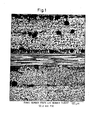
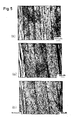
- Figures I - 5 are copies of photomicrographs of sections taken of damage tolerant composites of this invention.
- the distribution of infusible particles black or darker dots
- PIC measured post impact compression strength
- the damage tolerant composites of Figures I - 5 are made using epoxy resin compositions all having the same nominal formulation.
- the composites having the higher post impact compression values are made from epoxy resin compositions having infusible particles with a higher median particle size; and such larger particles can be seen as generally residing in that portion of the crosslinked epoxy resin matrix between the plies of filaments.
- the epoxy resin compositions used in making the composites illustrated in Figures I 5 5 comprise infusible particles of similar size and shape as appear in Figures I - 5. Compare, for example, the infusible particles in the neat resin of Figures 2(c) and 2(d) with the infusible particles of the damage tolerant composites in Figures 2(a) and 2(b). A number of these particles, preferably more than half, have a dimension that is greater than 10 microns.
- Composites with highest damage tolerability as measured in post impact compression tests generally comprise infusible particles having a mean dimension at least about 15 microns. More preferably, the median particle size of the infusible particles is between about 25 and 75 microns.
- the carboxy-functional butadiene acrylonitrile polymer in the form of a crumb is added to methylethylketone at a weight ratio of 15 parts crumb to eighty five parts methylethylketone.
- the mixture is stirred to form a homogeneous solution which is called "Rubber Solution” in this Example.
- a Meyer's vacuum mixer having a five gallon capacity is used in the preparation of the epoxy resin composition.
- the mixer is equipped with a thermometer and fast and slow mixing blades; it is heated by oil circulation and can be evacuated by a vacuum pump using a solvent trap.
- the vacuum mixer is cleaned with solvent and then first set to have a temperature between 60° C and 100°C to drive off the cleaning solvent.
- the triglycidyl p-aminophenol epoxy resin (13.12 parts) and diglycidyl ether of Bisphenol F epoxy resin (2.62 parts) are added together and mixed In the vacuum mixer while heated to about 60°C.
- mixed epoxy resins is added the amine functional polyarylene polyether sulfone (13.65 parts) in particulate form.
- Methylethylketone (6.658 parts) is used to wash the polysulfone ether powder from the sides of the mixer during the mixing operation.
- the lid on the mixer is then closed and the temperature of the mixture increased to about 60° C.
- the high speed mixer blades are set at about 1400 RPM. After the temperature of about 60°C is reached and the amine functional polyarylene polyether sulfone is dissolved, the mixer is opened and the Rubber Solution (13.91 parts) added. The mixer is closed and the temperature set for about 120°C. The mixer blades are set at low speed and mixing continued until the reflux temperature (80°) is reached. The vacuum pump is then started. The vacuum in the mixer is maintained at a level no higher than 13-15 centimeters Hg up to a temperature of 85° C. (Should the resin foam up, the vacuum is released slowly until foaming decreases to a position below the top of the mixing blades at a pressure of about 13 centimeters Hg.)
- Table 2 shows the relationship between temperature and maximum vacuum that can be employed in heating the resin mixture:
- the remainder of the diglycidyl ether of Bisphenol F (10.5 parts) is added to the vacuum mixer. Mixing is continued while the resin mixture is cooled. When the mixture reaches 98°C, the 3,3'-bis(aminophenol)sulfone (12.86 parts) is added through a port in the mixer. After the powdery 3,3-bis(aminophenol) sulfone is fully dispersed, the mixer is raised and the walls scraped down. The temperature is set to 77° C, the mixer closed with mixing continued at full vacuum for about 15 minutes. The mixer is opened and the contents are poured Into small containers which are stored at 0° C for further processing of the epoxy resin composition thereof into prepreg.
- the frozen epoxy resin composition of Part A is slowly brought to a temperature of about 50° C.
- the warmed epoxy resin composition comprises the uncured epoxy resin composition and distinct particles which contain the butadiene acrylonitrile polymer.
- the warmed epoxy resin composition containing the infusible particles is spread on a sheet of release paper.
- the sheet of release paper having the film of the epoxy resin composition is rolled up and stored at about 10° C or below for further processing.
- Tows of carbon fiber (IM-7 carbon fiber l available from Hercules Incorporated, Magna, Utah) are formed into a band. Two different bands are prepared.
- the first band has an areal weight (i.e. weight per unit area) of about
- the first band is impregnated with the epoxy resin composition of this Example by passing it between a pair of rollers which press the band and upper and lower filmed epoxy resin composition parts together as they pass between the rollers.
- the rollers are kept about 75°C and the resultant prepreg is between about 33 and 37% by weight resin.
- the second band is made into prepreg by pressing the second band of carbon fiber and a further amount of the filmed resin together between rollers kept at a temperature above 75°C.
- the resultant prepreg made from the 190 gm per square centimeters areal weight carbon fiber is between about 33 and 37% by weight resin.
- the epoxy resin is heated to about 750C and spread on a sheet of release paper.
- the tows of carbon fiber are then pressed into the molten resin carried on the release paper in making the prepreg.
- the resultant prepreg has between about 33 and 37% by weight resin.
- the prepreg prepared as above, is made into rolls of prepreg in which the prepreg in each of the rolls is separated by a sheet of release paper.
- a series of composite test panels are made from prepregs prepared following the foregoing procedures.
- the prepregs were layed up and cured and the cured composite panel tested to determine the post impact compression test values.
- the panels tested were 10 centimeters wide and 15 centimeters long.
- the panels were thirty two plies thick, each ply containing carbon fiber filaments extending in a single direction.
- the panels were quasi-isotropic according to the following scheme: (+45°/90°/-45°/0°) 4s .
- the 4S in the lay-up means the lay-up had a total of thirty two (32) plies layed up as follows: a set of four plies was layed at the recited angles four times (i.e. sixteen plies in all) starting each time with a +45° ply followed by laying a set of four plies four times in reverse order (i.e. sixteen plies in all) starting each time with a 0° ply.
- the lay-up was cured at 177° C for two hours.
- the cured panels were impacted with an impact energy of 1,500 inch - lbs/inch thickness while suspended over a 3 x 5 inch opening.
- the compressive strength of the impacted panels was determined using the test procedure of NASA publication 1092, modified as above.
- phase separation is meant that there exists distinct epoxy phases in addition to the rubbery or other particulate phase.
- This example describes a laboratory preparation of an epoxy resin composition of this invention which does not require solvent removal after addition of the polyarylene polyether sulfone.
- An initial step in this preparation was forming a solution of carboxy-functional butadiene acrylonitrile polymer 1 and methylethylketone at 20% by weight of the polymer.
- Four hundred parts of this solution were mixed with 500 parts of dicylcidyl ether of Bisphenol F 2 at room temperature. The mixture was stripped of methylethylketone until its volatile content was below 2% by weight.
- Another step in this procedure began with heating 500 parts of triglycidyl aminophenol3 to 60° C in a separate vessel.
- a prepreg was made from the epoxy resin composition prepared as shown above In Part A.
- the high strength filaments used in preparing this prepreg were tows of IM-7 carbon fibers of Hercules Incorporated.
- the prepreg had a fiber volume of 55%.
- the prepreg was made into panels using the lay-up procedures of Example I. The panels were tested also using the procedures of Example I, and determined to have the following compressive strengths at 1500 inch pounds per inch thickness impacts: 50.6 thousand pounds per square inch; 52.9 thousand pounds per square inch and 51.1 thousand pounds per square inch.
- This Example illustrates use of epoxy resin compositions in making single tows of carbon fiber impregnated with resin.
- the carbon fiber used in making the tow-preg was IM-7 carbon fiber available from Hercules Incorporated. Tows of this carbon fiber have approximately 12,000 filaments and no twist. The cross sectional area of the tow is about 0.25 millimeter with each filament having a diameter of 5 microns and a smooth, round cross-section.
- An epoxy resin composition prepared according to the procedures of Example is admixed with three levels of methylethylketone as shown in Table 4.
- the resin solutions were placed in resin coating baths which were agitated during passage of tows of the IM-7 carbon fiber through the bath.
- the tows were passed through the bath under a roller fixed in the bath and then out of the bath to an "S-bar" apparatus.
- the tow passed over a first bar and then under a second bar in traveling an S-shaped path. This path permitted wiping both sides of the tow-preg and was judged to give a uniform distribution of the particles of rubber polymer.
- a stirring motor was used for take up of the tow-preg.
- a tow speed of about 4 feet per minutes was used.
- the pulley was high enough that a four-foot length of wet tow-prep could pull and cut off.
- This section was dried in air for about 10 minutes at room temperature and then in an oven at 93° C for five minutes. This drying was determined to reduce volatiles to less than 3% by weight.
- Volatiles content was determined by weighing a length of tow, drying it at 350° F (133° C) for 15 minutes and reweighing. Resin content was determined by extracting a weighed length of tow with tetrahydrofuran (THF), drying the extracted tow and reweighing. Insoluble rubber content was determined by filtering the THF extract through a weighed filter paper, drying and reweighing the filter paper. Distribution of rubber particles on the tow was determined by visual examination.
- THF tetrahydrofuran
- Table 4 provides information for three preparations of tow-preg prepared and tested as discussed above.
- a concentrate of particles comprising rubber polymer in an epoxy resin admixture is made as follows: Ten parts of diglycidyl ether of Bisphenol F (Epicon 830 from Dainippon Ink and Chemicals) and 10 parts triglycidyl p-aminophenol (CG 0510 from Ciba Geigy) were heated to 70° C. Twenty parts of amine functional polyarylene polyether sulfone were added to the epoxy resins and a slurry was formed. The slurry was heated to 105° C and held for 40 minutes whereby the amine functional polyarylene polyether sulfone was dissolved. The product was then cooled to about 75°C and fifteen parts of methyl ethyl ketone added.
- the slurry was heated to 105°C and held at that temperature for 40 minutes to dissolve the polyether sulfone and form a resin solution.
- the concentrate (48 parts) at room temperature was combined with the resin solution held at I05°C. Then this combination was cooled to 70° C and antioxidant (0.4 parts, Agerite Resin D, polymerized 1,2-dihydro-2,2,4-trimethyl quinoline, from R. T.
- Table 6 shows melt flow rhelogy on eleven batches of resin compositions made according to Example I.
- Table 7 shows the initial viscosity at 60° C for these samples, the minimum viscosity, the temperature at which the minimum viscosity occurs, the dynamic get temperature (DGT) and heating rate. All scans reported in Table 6 were run at similar conditions of 50 mm diameter parallel plates, 0.5 mm gap, 10 radians/second frequency, 50% strain and cure mode. The temperatures at which minimum viscosity and DGT occur are fairly constant while the viscosities are scattered but not out of line with other resin systems.
- the DGT for the epoxy resin compositions was determined to be about 156° C when heating at 0.851° C/minute;176° C when heating at 1.857°C/minute; 186°C when heating at 2.897°C/minute and 199°C when heating at 4.273°C/minute.
- Table 7 shows the glass transitions of thirteen coupons made from an epoxy resin composition prepared as in Example I. The existence of more than one glass transition temperature in these samples as shown in Table 7 indicates the presence of more than one crosslinked epoxy phase.
- Example II particle sizes of uncured epoxy resin compositions (prepared according to Example I) compositions are compared with the particle size and post impact compression values obtained from prepregs layed-up and cured using the procedures of Example I.
- the uncured epoxy resin compositons were analyzed as follows: A one half gram (approximate) sample was taken from each batch of the epoxy resin compositions and placed on a glass slide. The slides were then each heated on a hot plate having a temperature setting of 118 0 C. The resin sample was then smeared into a thin film across the slide and allowed to further heat at 118 0 C for five (5) minutes. The sample slide was then cooled and examined on a polarizing microscope equipped with a transmitting light source and a Polaroid camera. A photomicrograph was taken of the sample at a magnification of 156 x.
- the photomicrograph was visually examined and those samples having at least about 75% of the particles which were round and non-agglomerated were selected for further processing.
- the photomicrographs were then further evaluated on an image analyzer set at 10 micron steps.
- a computerized "mouse” was used in measuring the long axis of each particle. When all particles in the sample were measured, the computer was used to generate a histogram and print out the number of particles counted, the median particle size, the range and the standard deviation.
- the size of the particles in the cured composites were determined similarly.
- the particles measured in the cured composites were those in the boundary (essentially fiber fill) of resin between the plies of cured resin.
- the lay-up was the same as in Example I except for sample D shown in Table 8 below. Sample D had the lay-up [45/0/-45/90] 3 swhich gives a 24 ply laminate. As can be seen from Table 8 the particles remain about the same size during processing of the epoxy resin compositions into cured composites.
- epoxy resin compositions are made on a larger than laboratory scale using the procedures of Example 2 except for the following.
- the dissolution product of amine functional polyether sulfone and triglycidyl aminophenol was cooled to 90° C and the mixture of carboxy functional butadiene nitrile polymer and diglycidyl ether of Bisphenol F was added at 55°C thereto.
- a series of prepregs were made from these epoxy resin compositions .
- the prepregs were made by first making a film of the resin. The highest temperature used in making the film was about 70° C.
- the prepregs were made by pressing either 145 grams per meter areal weight IM-7 carbon fiber or 190 grams per meter areal weight IM-7carbon fiber into the film.
- the resulting prepregs were about 350/0 (Grade 145) or 420/o (Grade 90) by weight resin.
- Portions of the prepreg on each spool were layed up, cured and tested according to the procedures of Example I.
- the particle size in the boundary resin layer (between plies) in the cured laminate was determined to the extent of determining dimensions of the largest and smallest particles therof.
- Table 9B illustrates that the particle size of the neat resin is generally associated with high toughness levels.
- An epoxy resin composition like that described in Example I is prepared using a different reactive aromatic oligomer.
- This different reactive aromatic Oligomer is made by replacing an amount of the bisphenol A used in manufacture of the oligomer with sodium sulfide to yield an amine functional polyarylene polyethersulfone polythioethersulfone (see formula I in the Specification).
- the level of the ingredients in the epoxy resin composition was the same as in Table I and the mixing procedure of Example I followed.
- Photomicrographs of the cured epoxy resin composition are taken and copies thereof are shown in Figure 6.
- the large, darker circles are the infusible particles of rubber polymer. (A portion of certain of the Infusible particles has been cut away during sample preparation.)
- the other portions of the crosslinked epoxy resin matrix exhibit phase separation yielding glassy crosslinked phases.
- an epoxy resin composition made using the procedures of Example I was made into a prepreg using IM-7 carbon fibers of Hercules Incorporated.
- the prepreg was layed up and cured into composite test samples.
- the samples were tested to determine various mechanical properties as compared to composites made using the thermoplastic resin APC-2 and AS-4 carbon fibers available from Hercules Incorporated (Column B).
- the results are reported in Table 10 below, the data in Table 10 being normalized to 57% fiber volume. '
- Table II shows exemplary properties of a composite of this invention (column A), a composite made from a standard commercially available epoxy resin (column B) and a composite made using the thermoplastic APC-2 (column C).
- the data in column A of Table II represents values obtained from the composites of this invention where the epoxy resin composition is made using procedures generally described in Example I.
- a number of epoxy resin compositions were made and various infusible particles mixed into the compositions.
- the SBR, EPDM, natural and silicone rubber particles were made by cryrogenicallyfreezing the rubber, grinding and then seiving to desired particle size.
- the epoxy resin compositions were formulated to provide an equal approximate volume of particles and then used to make prepregs containing carbon fiber in the form of a plurality of tows each comprising a multitude of filaments.
- the prepregs were layed up and cured in the manner described in Part C of Example I.
- the cured samples were then tested with the results shown in Table 12 below.
- the thermosets all exhibited phase separated behavior.
- the interlaminer fracture Gic energy is much higher for the thermoplastic resin as compared to the cured neat resin of this invention but that the damage tolerance of the composites of this invention are at least comparable to (if not higher than) the damage tolerance of the thermoplastic composite.
Landscapes
- Chemical & Material Sciences (AREA)
- Health & Medical Sciences (AREA)
- Chemical Kinetics & Catalysis (AREA)
- Medicinal Chemistry (AREA)
- Polymers & Plastics (AREA)
- Organic Chemistry (AREA)
- Materials Engineering (AREA)
- Engineering & Computer Science (AREA)
- Manufacturing & Machinery (AREA)
- General Chemical & Material Sciences (AREA)
- Inorganic Chemistry (AREA)
- Reinforced Plastic Materials (AREA)
- Compositions Of Macromolecular Compounds (AREA)
- Epoxy Resins (AREA)
- Detergent Compositions (AREA)
- Manufacturing Of Micro-Capsules (AREA)
- Containers Having Bodies Formed In One Piece (AREA)
- Laminated Bodies (AREA)
Priority Applications (1)
| Application Number | Priority Date | Filing Date | Title |
|---|---|---|---|
| AT87306010T ATE96817T1 (de) | 1986-07-09 | 1987-07-08 | Beschaedigungsbestaendige verbundwerkstoffe, die unschmelzbare teilchen enthalten. |
Applications Claiming Priority (2)
| Application Number | Priority Date | Filing Date | Title |
|---|---|---|---|
| US884139 | 1986-07-09 | ||
| US06/884,139 US4863787A (en) | 1986-07-09 | 1986-07-09 | Damage tolerant composites containing infusible particles |
Publications (3)
| Publication Number | Publication Date |
|---|---|
| EP0252725A2 true EP0252725A2 (fr) | 1988-01-13 |
| EP0252725A3 EP0252725A3 (en) | 1990-01-31 |
| EP0252725B1 EP0252725B1 (fr) | 1993-11-03 |
Family
ID=25384038
Family Applications (1)
| Application Number | Title | Priority Date | Filing Date |
|---|---|---|---|
| EP19870306010 Expired - Lifetime EP0252725B1 (fr) | 1986-07-09 | 1987-07-08 | Matériau composite résistant à l'usure qui contient des particules infusibles |
Country Status (10)
| Country | Link |
|---|---|
| US (1) | US4863787A (fr) |
| EP (1) | EP0252725B1 (fr) |
| AT (1) | ATE96817T1 (fr) |
| BR (1) | BR8703486A (fr) |
| CA (1) | CA1300783C (fr) |
| DE (1) | DE3788007T2 (fr) |
| DK (1) | DK356587A (fr) |
| ES (1) | ES2059379T3 (fr) |
| IL (1) | IL82916A (fr) |
| NO (1) | NO872667L (fr) |
Cited By (20)
| Publication number | Priority date | Publication date | Assignee | Title |
|---|---|---|---|---|
| US4977215A (en) * | 1988-09-26 | 1990-12-11 | Amoco Corporation | Carboxylated rubber particles as tougheners for fiber reinforced composites |
| US4977218A (en) * | 1988-09-26 | 1990-12-11 | Amoco Corporation | Carboxylated rubber particles as tougheners for fiber reinforced composites |
| US5037689A (en) * | 1989-02-17 | 1991-08-06 | Basf Aktiengesellschaft | Toughened thermosetting structural materials |
| EP0351025A3 (fr) * | 1988-07-15 | 1991-10-23 | Amoco Corporation | Composite renforçé par des fibres et rendu tenace à l'aide de particules de caoutchouc carboxylé |
| EP0351028A3 (fr) * | 1988-07-15 | 1991-10-23 | Amoco Corporation | Compositions renforcés de fibres et contenant des particules de résines comme charge |
| EP0351027A3 (fr) * | 1988-07-15 | 1991-10-23 | Amoco Corporation | Particules de caouchouc carboxylé comme agent résistant aux chocs pour des composites renforçés par des fibres |
| EP0392348A3 (fr) * | 1989-04-14 | 1991-12-27 | Cytec Technology Corp. | Matériaux de construction tenaces et thermodurcissables |
| US5087657A (en) * | 1989-02-23 | 1992-02-11 | Amoco Corporation | Fiber-reinforced composites toughened with resin particles |
| EP0353190A3 (fr) * | 1988-07-28 | 1992-03-04 | Ciba-Geigy Ag | Combinaisons de flexibilisateurs pour résines époxy |
| US5120823A (en) * | 1989-02-17 | 1992-06-09 | Basf Aktiengesellschaft | Toughened thermosetting structural materials |
| EP0486044A3 (en) * | 1990-11-16 | 1992-11-19 | Hercules Incorporated | Damage tolerant composites containing infusible particles |
| US5169710A (en) * | 1988-07-15 | 1992-12-08 | Amoco Corporation | Fiber-reinforced composites toughened with porous resin particles |
| EP0490230A3 (en) * | 1990-12-13 | 1993-02-10 | Basf Aktiengesellschaft | Epoxy resin mixtures for composite materials |
| EP0274899B1 (fr) * | 1986-12-25 | 1994-02-09 | Toray Industries, Inc. | Matériaux composites tenaces |
| EP0532893A3 (fr) * | 1991-08-09 | 1994-03-23 | Hercules Inc | |
| EP0625537A1 (fr) * | 1993-05-19 | 1994-11-23 | Ibiden Co, Ltd. | Adhésifs pour métallisation sans courant et plaquettes de circuits imprimés |
| US5532296A (en) * | 1991-07-30 | 1996-07-02 | Cytec Technology Corp. | Bismaleimide resin systems toughened by addition of preformed functionalized low Tg elastomer particles |
| US5627222A (en) * | 1991-07-30 | 1997-05-06 | Cytec Technology Corp. | Toughened, fiber-reinforced thermosetting resin matrix prepregs and composites made therefrom |
| US5932635A (en) * | 1991-07-30 | 1999-08-03 | Cytec Technology Corp. | Tackified prepreg systems |
| US6897267B2 (en) * | 1996-08-29 | 2005-05-24 | Xerox Corporation | High performance curable polymers and processes for the preparation thereof |
Families Citing this family (23)
| Publication number | Priority date | Publication date | Assignee | Title |
|---|---|---|---|---|
| US5202390A (en) * | 1988-07-28 | 1993-04-13 | Ciba-Geigy Corporation | Butadiene/polar comonomer copolymer and aromatic reactive end group-containing prepolymer |
| US5151471A (en) * | 1990-10-23 | 1992-09-29 | Amoco Corporation | Epoxy matrix resin formulations with improved storage stability containing powdered diamine dispersions |
| US5244719A (en) * | 1990-10-23 | 1993-09-14 | Amoco Corporation | Prepreg with improved room temperature storage stability |
| CA2044787A1 (fr) * | 1990-10-31 | 1992-05-01 | Shahid P. Qureshi | Materiaux composites renforces de fibres et composes de particules de resine poreuses |
| US5268223A (en) * | 1991-05-31 | 1993-12-07 | Amoco Corporation | Toughened fiber-reinforced composites |
| DE69322427T2 (de) * | 1992-03-30 | 1999-10-07 | Toray Industries, Inc. | Prepreg und Verbundwerkstoffe |
| CA2112146A1 (fr) * | 1992-12-23 | 1994-06-24 | Nitya P. Khasat | Polydicyclopentadiene a stabilite accrue et renforcee avec des particules polymeriques |
| US5360840A (en) * | 1992-12-29 | 1994-11-01 | Hercules Incorporated | Epoxy resin compositions with improved storage stability |
| JP3359037B2 (ja) * | 1994-12-02 | 2002-12-24 | 東レ株式会社 | 「プリプレグおよび繊維強化複合材料」 |
| JPH0925393A (ja) * | 1995-05-09 | 1997-01-28 | Toray Ind Inc | 繊維強化複合材料用エポキシ樹脂組成物、プリプレグおよび繊維強化複合材料 |
| ATE296851T1 (de) | 1996-02-21 | 2005-06-15 | Toray Industries | Verbundfaden und daraus hergestellte faserverstärkte verbundwerkstoffe |
| DE69610830T2 (de) * | 1996-07-22 | 2001-05-17 | Hexcel Corp., Pleasanton | Wabenförmige Kernmaterialien mit partikelförmiger Verstärkung |
| US6949289B1 (en) | 1998-03-03 | 2005-09-27 | Ppg Industries Ohio, Inc. | Impregnated glass fiber strands and products including the same |
| US6419981B1 (en) | 1998-03-03 | 2002-07-16 | Ppg Industries Ohio, Inc. | Impregnated glass fiber strands and products including the same |
| US6593255B1 (en) | 1998-03-03 | 2003-07-15 | Ppg Industries Ohio, Inc. | Impregnated glass fiber strands and products including the same |
| US8105690B2 (en) | 1998-03-03 | 2012-01-31 | Ppg Industries Ohio, Inc | Fiber product coated with particles to adjust the friction of the coating and the interfilament bonding |
| US8062746B2 (en) | 2003-03-10 | 2011-11-22 | Ppg Industries, Inc. | Resin compatible yarn binder and uses thereof |
| US7354641B2 (en) | 2004-10-12 | 2008-04-08 | Ppg Industries Ohio, Inc. | Resin compatible yarn binder and uses thereof |
| US20070104933A1 (en) * | 2005-11-04 | 2007-05-10 | Hamid Saadatmanesh | Reinforced structural member and method of forming |
| US8810908B2 (en) * | 2008-03-18 | 2014-08-19 | Stereo Display, Inc. | Binoculars with micromirror array lenses |
| DE102009001855A1 (de) | 2009-03-25 | 2010-09-30 | Henkel Ag & Co. Kgaa | Verfahren zur Herstellung eines faserhaltigen Verbundwerkstoffs |
| WO2015033998A1 (fr) * | 2013-09-06 | 2015-03-12 | ダイセル・エボニック株式会社 | Résine renforcée par des fibres et son procédé de production, et article moulé |
| WO2025132403A2 (fr) * | 2023-12-20 | 2025-06-26 | Solvay Specialty Polymers Usa, Llc | Valorisation de polyaryléthersulfone pour fabriquer un produit macromère réactif |
Family Cites Families (13)
| Publication number | Priority date | Publication date | Assignee | Title |
|---|---|---|---|---|
| US3174977A (en) * | 1959-09-28 | 1965-03-23 | Flintkote Co | Plastic compositions for flooring |
| US3837904A (en) * | 1970-03-09 | 1974-09-24 | Great Lakes Carbon Corp | A method of sizing carbon fibers |
| US3926904A (en) * | 1974-09-30 | 1975-12-16 | United Technologies Corp | Curable crack-resistant epoxy resin |
| US3926903A (en) * | 1974-09-30 | 1975-12-16 | United Technologies Corp | Curable crack-resistant epoxy resin |
| US4195113A (en) * | 1975-03-12 | 1980-03-25 | Desoto, Inc. | Encapsulated impregnated rovings |
| US4220686A (en) * | 1975-03-12 | 1980-09-02 | Desoto, Inc. | Encapsulated impregnated rovings |
| US4187347A (en) * | 1975-03-12 | 1980-02-05 | Desoto, Inc. | Encapsulated impregnated rovings |
| US4264655A (en) * | 1976-04-05 | 1981-04-28 | Desoto, Inc. | Encapsulated impregnated rovings |
| US4222918A (en) * | 1979-03-19 | 1980-09-16 | Desoto, Inc. | Aqueous emulsions, methods of making the same and impregnated rovings made from the emulsions |
| DK32084A (da) * | 1983-06-30 | 1984-12-31 | Union Carbide Corp | Epoxykompositioner med indhold af oligomere diaminhaerdere samt kompositter deraf med stor styrke |
| US4539253A (en) * | 1984-03-30 | 1985-09-03 | American Cyanamid Co. | High impact strength fiber resin matrix composites |
| US4656208A (en) * | 1985-02-19 | 1987-04-07 | Hercules Incorporated | Thermosetting epoxy resin compositions and thermosets therefrom |
| US4680076A (en) * | 1986-08-28 | 1987-07-14 | Hercules Incorporated | Multiphase epoxy thermosets having rubber within disperse phase |
-
1986
- 1986-07-09 US US06/884,139 patent/US4863787A/en not_active Expired - Lifetime
-
1987
- 1987-06-18 IL IL8291687A patent/IL82916A/xx not_active IP Right Cessation
- 1987-06-25 CA CA 540492 patent/CA1300783C/fr not_active Expired - Lifetime
- 1987-06-25 NO NO872667A patent/NO872667L/no unknown
- 1987-07-08 DE DE87306010T patent/DE3788007T2/de not_active Expired - Lifetime
- 1987-07-08 ES ES87306010T patent/ES2059379T3/es not_active Expired - Lifetime
- 1987-07-08 EP EP19870306010 patent/EP0252725B1/fr not_active Expired - Lifetime
- 1987-07-08 BR BR8703486A patent/BR8703486A/pt unknown
- 1987-07-08 AT AT87306010T patent/ATE96817T1/de not_active IP Right Cessation
- 1987-07-09 DK DK356587A patent/DK356587A/da not_active Application Discontinuation
Cited By (24)
| Publication number | Priority date | Publication date | Assignee | Title |
|---|---|---|---|---|
| EP0274899B1 (fr) * | 1986-12-25 | 1994-02-09 | Toray Industries, Inc. | Matériaux composites tenaces |
| US5169710A (en) * | 1988-07-15 | 1992-12-08 | Amoco Corporation | Fiber-reinforced composites toughened with porous resin particles |
| EP0351025A3 (fr) * | 1988-07-15 | 1991-10-23 | Amoco Corporation | Composite renforçé par des fibres et rendu tenace à l'aide de particules de caoutchouc carboxylé |
| EP0351028A3 (fr) * | 1988-07-15 | 1991-10-23 | Amoco Corporation | Compositions renforcés de fibres et contenant des particules de résines comme charge |
| EP0351027A3 (fr) * | 1988-07-15 | 1991-10-23 | Amoco Corporation | Particules de caouchouc carboxylé comme agent résistant aux chocs pour des composites renforçés par des fibres |
| EP0353190A3 (fr) * | 1988-07-28 | 1992-03-04 | Ciba-Geigy Ag | Combinaisons de flexibilisateurs pour résines époxy |
| US4977218A (en) * | 1988-09-26 | 1990-12-11 | Amoco Corporation | Carboxylated rubber particles as tougheners for fiber reinforced composites |
| US4977215A (en) * | 1988-09-26 | 1990-12-11 | Amoco Corporation | Carboxylated rubber particles as tougheners for fiber reinforced composites |
| US5037689A (en) * | 1989-02-17 | 1991-08-06 | Basf Aktiengesellschaft | Toughened thermosetting structural materials |
| US5120823A (en) * | 1989-02-17 | 1992-06-09 | Basf Aktiengesellschaft | Toughened thermosetting structural materials |
| US5087657A (en) * | 1989-02-23 | 1992-02-11 | Amoco Corporation | Fiber-reinforced composites toughened with resin particles |
| US5605745A (en) * | 1989-04-14 | 1997-02-25 | Cytec Technology Corp. | Toughened thermosetting structural materials |
| EP0392348A3 (fr) * | 1989-04-14 | 1991-12-27 | Cytec Technology Corp. | Matériaux de construction tenaces et thermodurcissables |
| EP0486044A3 (en) * | 1990-11-16 | 1992-11-19 | Hercules Incorporated | Damage tolerant composites containing infusible particles |
| EP0490230A3 (en) * | 1990-12-13 | 1993-02-10 | Basf Aktiengesellschaft | Epoxy resin mixtures for composite materials |
| US5532296A (en) * | 1991-07-30 | 1996-07-02 | Cytec Technology Corp. | Bismaleimide resin systems toughened by addition of preformed functionalized low Tg elastomer particles |
| US5627222A (en) * | 1991-07-30 | 1997-05-06 | Cytec Technology Corp. | Toughened, fiber-reinforced thermosetting resin matrix prepregs and composites made therefrom |
| US5932635A (en) * | 1991-07-30 | 1999-08-03 | Cytec Technology Corp. | Tackified prepreg systems |
| EP0532893A3 (fr) * | 1991-08-09 | 1994-03-23 | Hercules Inc | |
| EP0625537A1 (fr) * | 1993-05-19 | 1994-11-23 | Ibiden Co, Ltd. | Adhésifs pour métallisation sans courant et plaquettes de circuits imprimés |
| US5519177A (en) * | 1993-05-19 | 1996-05-21 | Ibiden Co., Ltd. | Adhesives, adhesive layers for electroless plating and printed circuit boards |
| US6897267B2 (en) * | 1996-08-29 | 2005-05-24 | Xerox Corporation | High performance curable polymers and processes for the preparation thereof |
| US7252927B2 (en) | 1996-08-29 | 2007-08-07 | Xerox Corporation | High performance curable polymers and processes for the preparation thereof |
| US7517641B2 (en) | 1996-08-29 | 2009-04-14 | Xerox Corporation | High performance curable polymers and processes for the preparation thereof |
Also Published As
| Publication number | Publication date |
|---|---|
| DE3788007D1 (de) | 1993-12-09 |
| IL82916A (en) | 1990-12-23 |
| EP0252725A3 (en) | 1990-01-31 |
| ES2059379T3 (es) | 1994-11-16 |
| DK356587A (da) | 1988-01-10 |
| BR8703486A (pt) | 1988-03-22 |
| EP0252725B1 (fr) | 1993-11-03 |
| NO872667L (no) | 1988-01-11 |
| NO872667D0 (no) | 1987-06-25 |
| CA1300783C (fr) | 1992-05-12 |
| IL82916A0 (en) | 1987-12-20 |
| US4863787A (en) | 1989-09-05 |
| ATE96817T1 (de) | 1993-11-15 |
| DK356587D0 (da) | 1987-07-09 |
| DE3788007T2 (de) | 1994-03-03 |
Similar Documents
| Publication | Publication Date | Title |
|---|---|---|
| EP0252725A2 (fr) | Matériau composite résistant à l'usure qui contient des particules infusibles | |
| US4783506A (en) | Damage tolerant composites containing infusible particles | |
| US4999238A (en) | Damage tolerant composites containing infusible particles | |
| US5025045A (en) | Damage tolerant composites containing infusible particles | |
| KR940010827B1 (ko) | 열경화성 에폭시 수지 조성물 및 그로부터 제조된 열경화재 | |
| JPS642609B2 (fr) | ||
| US4874661A (en) | Impact enhanced prepregs and formulations | |
| RU2621764C2 (ru) | Жидкая связующая композиция для соединения волокнистых материалов | |
| RU2611628C2 (ru) | Композиции термореактивных смол с увеличенной ударной вязкостью | |
| RU2703203C2 (ru) | Модифицированные смоляные системы, подходящие для инфузии жидкой смолы | |
| JPH0368650A (ja) | 強化熱硬化性構造材料 | |
| NO873026L (no) | Flerfase epoksy-termoherdende preparater inneholdende gummi i dispergert fase. | |
| CA1181891A (fr) | Durcissant a base d'amine modifiee | |
| EP0583224B1 (fr) | Résines thermodurcissables endurcies par des polymères sulfones | |
| EP0812340A1 (fr) | Resine epoxy comportant un agent durcisseur et un agent rigidifiant | |
| US4822832A (en) | Thermosetting epoxy resin compositions and thermosets therefrom | |
| EP3572452A1 (fr) | Préimprégné, procédé pour sa production et préimprégné de ruban fendu | |
| EP0486044A2 (fr) | Matériau composite résistant à l'usure contenant des particules infusibles | |
| US4183874A (en) | Silane end-capped polyarylene shaped articles and mixed resins | |
| US4992325A (en) | Inorganic whisker containing impact enhanced prepregs and formulations formulations | |
| CA1322948C (fr) | Composes resistants contenant des particules infusibles | |
| JP2584452B2 (ja) | 不融性粒子を含有する耐衝撃性のコンポジット | |
| NL9101121A (nl) | Epoxyharspreparaten met verbeterde opslagstabiliteit. | |
| GB2257144A (en) | Fibre-reinforced composites toughened with porous resin particles | |
| KR100194365B1 (ko) | 중합체 조성물 및 이들의 구성성분 |
Legal Events
| Date | Code | Title | Description |
|---|---|---|---|
| PUAI | Public reference made under article 153(3) epc to a published international application that has entered the european phase |
Free format text: ORIGINAL CODE: 0009012 |
|
| AK | Designated contracting states |
Kind code of ref document: A2 Designated state(s): AT BE CH DE ES FR GB IT LI NL SE |
|
| PUAL | Search report despatched |
Free format text: ORIGINAL CODE: 0009013 |
|
| AK | Designated contracting states |
Kind code of ref document: A3 Designated state(s): AT BE CH DE ES FR GB IT LI NL SE |
|
| 17P | Request for examination filed |
Effective date: 19900710 |
|
| 17Q | First examination report despatched |
Effective date: 19910916 |
|
| GRAA | (expected) grant |
Free format text: ORIGINAL CODE: 0009210 |
|
| ITF | It: translation for a ep patent filed | ||
| AK | Designated contracting states |
Kind code of ref document: B1 Designated state(s): AT BE CH DE ES FR GB IT LI NL SE |
|
| REF | Corresponds to: |
Ref document number: 96817 Country of ref document: AT Date of ref document: 19931115 Kind code of ref document: T |
|
| REF | Corresponds to: |
Ref document number: 3788007 Country of ref document: DE Date of ref document: 19931209 |
|
| ET | Fr: translation filed | ||
| PLBE | No opposition filed within time limit |
Free format text: ORIGINAL CODE: 0009261 |
|
| STAA | Information on the status of an ep patent application or granted ep patent |
Free format text: STATUS: NO OPPOSITION FILED WITHIN TIME LIMIT |
|
| 26N | No opposition filed | ||
| REG | Reference to a national code |
Ref country code: ES Ref legal event code: FG2A Ref document number: 2059379 Country of ref document: ES Kind code of ref document: T3 |
|
| EAL | Se: european patent in force in sweden |
Ref document number: 87306010.7 |
|
| PGFP | Annual fee paid to national office [announced via postgrant information from national office to epo] |
Ref country code: SE Payment date: 19980707 Year of fee payment: 12 |
|
| PGFP | Annual fee paid to national office [announced via postgrant information from national office to epo] |
Ref country code: AT Payment date: 19980713 Year of fee payment: 12 |
|
| PGFP | Annual fee paid to national office [announced via postgrant information from national office to epo] |
Ref country code: CH Payment date: 19980722 Year of fee payment: 12 |
|
| PGFP | Annual fee paid to national office [announced via postgrant information from national office to epo] |
Ref country code: NL Payment date: 19980728 Year of fee payment: 12 |
|
| PGFP | Annual fee paid to national office [announced via postgrant information from national office to epo] |
Ref country code: BE Payment date: 19980914 Year of fee payment: 12 |
|
| PG25 | Lapsed in a contracting state [announced via postgrant information from national office to epo] |
Ref country code: AT Free format text: LAPSE BECAUSE OF NON-PAYMENT OF DUE FEES Effective date: 19990708 |
|
| PG25 | Lapsed in a contracting state [announced via postgrant information from national office to epo] |
Ref country code: SE Free format text: THE PATENT HAS BEEN ANNULLED BY A DECISION OF A NATIONAL AUTHORITY Effective date: 19990709 |
|
| PG25 | Lapsed in a contracting state [announced via postgrant information from national office to epo] |
Ref country code: BE Free format text: LAPSE BECAUSE OF NON-PAYMENT OF DUE FEES Effective date: 19990731 Ref country code: LI Free format text: LAPSE BECAUSE OF NON-PAYMENT OF DUE FEES Effective date: 19990731 Ref country code: CH Free format text: LAPSE BECAUSE OF NON-PAYMENT OF DUE FEES Effective date: 19990731 |
|
| BERE | Be: lapsed |
Owner name: HERCULES INC. Effective date: 19990731 |
|
| PG25 | Lapsed in a contracting state [announced via postgrant information from national office to epo] |
Ref country code: NL Free format text: LAPSE BECAUSE OF NON-PAYMENT OF DUE FEES Effective date: 20000201 |
|
| REG | Reference to a national code |
Ref country code: CH Ref legal event code: PL |
|
| EUG | Se: european patent has lapsed |
Ref document number: 87306010.7 |
|
| NLV4 | Nl: lapsed or anulled due to non-payment of the annual fee |
Effective date: 20000201 |
|
| REG | Reference to a national code |
Ref country code: GB Ref legal event code: IF02 |
|
| PGFP | Annual fee paid to national office [announced via postgrant information from national office to epo] |
Ref country code: GB Payment date: 20060705 Year of fee payment: 20 |
|
| PGFP | Annual fee paid to national office [announced via postgrant information from national office to epo] |
Ref country code: DE Payment date: 20060706 Year of fee payment: 20 |
|
| PGFP | Annual fee paid to national office [announced via postgrant information from national office to epo] |
Ref country code: FR Payment date: 20060719 Year of fee payment: 20 |
|
| PGFP | Annual fee paid to national office [announced via postgrant information from national office to epo] |
Ref country code: IT Payment date: 20060731 Year of fee payment: 20 |
|
| PGFP | Annual fee paid to national office [announced via postgrant information from national office to epo] |
Ref country code: ES Payment date: 20060825 Year of fee payment: 20 |
|
| REG | Reference to a national code |
Ref country code: GB Ref legal event code: PE20 |
|
| REG | Reference to a national code |
Ref country code: ES Ref legal event code: FD2A Effective date: 20070709 |
|
| PG25 | Lapsed in a contracting state [announced via postgrant information from national office to epo] |
Ref country code: GB Free format text: LAPSE BECAUSE OF EXPIRATION OF PROTECTION Effective date: 20070707 |
|
| PG25 | Lapsed in a contracting state [announced via postgrant information from national office to epo] |
Ref country code: ES Free format text: LAPSE BECAUSE OF EXPIRATION OF PROTECTION Effective date: 20070709 |