EP0256331A1 - N1-Substituierte 1H-Benzo-triazol-hydroxyethyl-sulfon-Verbindungen, Verfahren zu ihrer Herstellung und ihre Verwendung zur Herstellung von Farbstoffen - Google Patents
N1-Substituierte 1H-Benzo-triazol-hydroxyethyl-sulfon-Verbindungen, Verfahren zu ihrer Herstellung und ihre Verwendung zur Herstellung von Farbstoffen Download PDFInfo
- Publication number
- EP0256331A1 EP0256331A1 EP87110514A EP87110514A EP0256331A1 EP 0256331 A1 EP0256331 A1 EP 0256331A1 EP 87110514 A EP87110514 A EP 87110514A EP 87110514 A EP87110514 A EP 87110514A EP 0256331 A1 EP0256331 A1 EP 0256331A1
- Authority
- EP
- European Patent Office
- Prior art keywords
- group
- compound
- ppm
- optionally substituted
- general formula
- Prior art date
- Legal status (The legal status is an assumption and is not a legal conclusion. Google has not performed a legal analysis and makes no representation as to the accuracy of the status listed.)
- Granted
Links
- 238000000034 method Methods 0.000 title claims abstract description 19
- 239000000975 dye Substances 0.000 title claims abstract description 17
- 238000002360 preparation method Methods 0.000 title claims abstract description 10
- YYSIKYAAUYFWPG-UHFFFAOYSA-N OCCS(=O)(=O)CCO.N1N=NC2=C1C=CC=C2 Chemical class OCCS(=O)(=O)CCO.N1N=NC2=C1C=CC=C2 YYSIKYAAUYFWPG-UHFFFAOYSA-N 0.000 title abstract description 3
- -1 hydroxy, sulfo , Carboxy, phosphono Chemical group 0.000 claims abstract description 65
- 150000001875 compounds Chemical class 0.000 claims abstract description 56
- 125000004432 carbon atom Chemical group C* 0.000 claims abstract description 26
- 125000000217 alkyl group Chemical group 0.000 claims abstract description 22
- 125000004435 hydrogen atom Chemical group [H]* 0.000 claims abstract description 19
- 125000005842 heteroatom Chemical group 0.000 claims abstract description 11
- 239000012964 benzotriazole Substances 0.000 claims abstract description 8
- 125000000020 sulfo group Chemical group O=S(=O)([*])O[H] 0.000 claims abstract description 8
- 125000003277 amino group Chemical class 0.000 claims abstract description 6
- 125000002252 acyl group Chemical group 0.000 claims abstract description 5
- 125000001931 aliphatic group Chemical group 0.000 claims abstract description 5
- 125000003178 carboxy group Chemical group [H]OC(*)=O 0.000 claims abstract description 5
- 125000004093 cyano group Chemical group *C#N 0.000 claims abstract description 5
- 125000000449 nitro group Chemical group [O-][N+](*)=O 0.000 claims abstract description 5
- 125000003545 alkoxy group Chemical group 0.000 claims abstract description 4
- 150000005840 aryl radicals Chemical class 0.000 claims abstract description 4
- 238000004519 manufacturing process Methods 0.000 claims description 5
- 230000015572 biosynthetic process Effects 0.000 claims description 4
- 125000005843 halogen group Chemical group 0.000 claims description 4
- 238000003786 synthesis reaction Methods 0.000 claims description 4
- 125000001424 substituent group Chemical group 0.000 claims description 3
- 125000002887 hydroxy group Chemical group [H]O* 0.000 claims description 2
- 239000001257 hydrogen Substances 0.000 abstract description 6
- 229910052739 hydrogen Inorganic materials 0.000 abstract description 6
- 239000000543 intermediate Substances 0.000 abstract description 5
- QRUDEWIWKLJBPS-UHFFFAOYSA-N benzotriazole Chemical compound C1=CC=C2N[N][N]C2=C1 QRUDEWIWKLJBPS-UHFFFAOYSA-N 0.000 abstract description 3
- 238000006798 ring closing metathesis reaction Methods 0.000 abstract description 3
- 229910052736 halogen Inorganic materials 0.000 abstract 1
- 150000002367 halogens Chemical class 0.000 abstract 1
- XLYOFNOQVPJJNP-UHFFFAOYSA-N water Substances O XLYOFNOQVPJJNP-UHFFFAOYSA-N 0.000 description 22
- 150000002828 nitro derivatives Chemical class 0.000 description 14
- OKKJLVBELUTLKV-UHFFFAOYSA-N Methanol Chemical compound OC OKKJLVBELUTLKV-UHFFFAOYSA-N 0.000 description 12
- 238000006243 chemical reaction Methods 0.000 description 12
- IAZDPXIOMUYVGZ-UHFFFAOYSA-N DMSO Substances CS(C)=O IAZDPXIOMUYVGZ-UHFFFAOYSA-N 0.000 description 10
- FAPWRFPIFSIZLT-UHFFFAOYSA-M Sodium chloride Chemical compound [Na+].[Cl-] FAPWRFPIFSIZLT-UHFFFAOYSA-M 0.000 description 10
- 238000004458 analytical method Methods 0.000 description 10
- 239000000243 solution Substances 0.000 description 10
- 238000005160 1H NMR spectroscopy Methods 0.000 description 9
- HEMHJVSKTPXQMS-UHFFFAOYSA-M Sodium hydroxide Chemical compound [OH-].[Na+] HEMHJVSKTPXQMS-UHFFFAOYSA-M 0.000 description 9
- 239000002253 acid Substances 0.000 description 9
- 239000000203 mixture Substances 0.000 description 9
- 239000002904 solvent Substances 0.000 description 9
- LFQSCWFLJHTTHZ-UHFFFAOYSA-N Ethanol Chemical compound CCO LFQSCWFLJHTTHZ-UHFFFAOYSA-N 0.000 description 8
- VEXZGXHMUGYJMC-UHFFFAOYSA-N Hydrochloric acid Chemical compound Cl VEXZGXHMUGYJMC-UHFFFAOYSA-N 0.000 description 8
- PAYRUJLWNCNPSJ-UHFFFAOYSA-N N-phenyl amine Natural products NC1=CC=CC=C1 PAYRUJLWNCNPSJ-UHFFFAOYSA-N 0.000 description 8
- 239000003054 catalyst Substances 0.000 description 7
- 235000002639 sodium chloride Nutrition 0.000 description 7
- XFNJVJPLKCPIBV-UHFFFAOYSA-N trimethylenediamine Chemical compound NCCCN XFNJVJPLKCPIBV-UHFFFAOYSA-N 0.000 description 7
- ZMANZCXQSJIPKH-UHFFFAOYSA-N Triethylamine Chemical compound CCN(CC)CC ZMANZCXQSJIPKH-UHFFFAOYSA-N 0.000 description 6
- MVPPADPHJFYWMZ-UHFFFAOYSA-N chlorobenzene Substances ClC1=CC=CC=C1 MVPPADPHJFYWMZ-UHFFFAOYSA-N 0.000 description 6
- 239000000985 reactive dye Substances 0.000 description 6
- LPXPTNMVRIOKMN-UHFFFAOYSA-M sodium nitrite Chemical compound [Na+].[O-]N=O LPXPTNMVRIOKMN-UHFFFAOYSA-M 0.000 description 6
- PIICEJLVQHRZGT-UHFFFAOYSA-N Ethylenediamine Chemical compound NCCN PIICEJLVQHRZGT-UHFFFAOYSA-N 0.000 description 5
- KDLHZDBZIXYQEI-UHFFFAOYSA-N Palladium Chemical compound [Pd] KDLHZDBZIXYQEI-UHFFFAOYSA-N 0.000 description 5
- 239000011230 binding agent Substances 0.000 description 5
- 238000001914 filtration Methods 0.000 description 5
- KIDHWZJUCRJVML-UHFFFAOYSA-N putrescine Chemical compound NCCCCN KIDHWZJUCRJVML-UHFFFAOYSA-N 0.000 description 5
- 239000011780 sodium chloride Substances 0.000 description 5
- 159000000000 sodium salts Chemical class 0.000 description 5
- CBCKQZAAMUWICA-UHFFFAOYSA-N 1,4-phenylenediamine Chemical compound NC1=CC=C(N)C=C1 CBCKQZAAMUWICA-UHFFFAOYSA-N 0.000 description 4
- GNTARUIZNIWBCN-UHFFFAOYSA-N 2-chloro-5-nitrobenzenesulfonic acid Chemical compound OS(=O)(=O)C1=CC([N+]([O-])=O)=CC=C1Cl GNTARUIZNIWBCN-UHFFFAOYSA-N 0.000 description 4
- QTBSBXVTEAMEQO-UHFFFAOYSA-N Acetic acid Chemical compound CC(O)=O QTBSBXVTEAMEQO-UHFFFAOYSA-N 0.000 description 4
- 0 C1*2C1CCC2 Chemical compound C1*2C1CCC2 0.000 description 4
- UFHFLCQGNIYNRP-UHFFFAOYSA-N Hydrogen Chemical compound [H][H] UFHFLCQGNIYNRP-UHFFFAOYSA-N 0.000 description 4
- XEEYBQQBJWHFJM-UHFFFAOYSA-N Iron Chemical compound [Fe] XEEYBQQBJWHFJM-UHFFFAOYSA-N 0.000 description 4
- CDBYLPFSWZWCQE-UHFFFAOYSA-L Sodium Carbonate Chemical compound [Na+].[Na+].[O-]C([O-])=O CDBYLPFSWZWCQE-UHFFFAOYSA-L 0.000 description 4
- GSEJCLTVZPLZKY-UHFFFAOYSA-N Triethanolamine Chemical compound OCCN(CCO)CCO GSEJCLTVZPLZKY-UHFFFAOYSA-N 0.000 description 4
- 230000002378 acidificating effect Effects 0.000 description 4
- 239000012736 aqueous medium Substances 0.000 description 4
- 229910052801 chlorine Inorganic materials 0.000 description 4
- 239000002609 medium Substances 0.000 description 4
- 238000002844 melting Methods 0.000 description 4
- 230000008018 melting Effects 0.000 description 4
- 239000000376 reactant Substances 0.000 description 4
- WZCQRUWWHSTZEM-UHFFFAOYSA-N 1,3-phenylenediamine Chemical compound NC1=CC=CC(N)=C1 WZCQRUWWHSTZEM-UHFFFAOYSA-N 0.000 description 3
- WFDIJRYMOXRFFG-UHFFFAOYSA-N Acetic anhydride Chemical compound CC(=O)OC(C)=O WFDIJRYMOXRFFG-UHFFFAOYSA-N 0.000 description 3
- WKBOTKDWSSQWDR-UHFFFAOYSA-N Bromine atom Chemical compound [Br] WKBOTKDWSSQWDR-UHFFFAOYSA-N 0.000 description 3
- ZAMOUSCENKQFHK-UHFFFAOYSA-N Chlorine atom Chemical compound [Cl] ZAMOUSCENKQFHK-UHFFFAOYSA-N 0.000 description 3
- PXGOKWXKJXAPGV-UHFFFAOYSA-N Fluorine Chemical compound FF PXGOKWXKJXAPGV-UHFFFAOYSA-N 0.000 description 3
- ZMXDDKWLCZADIW-UHFFFAOYSA-N N,N-Dimethylformamide Chemical compound CN(C)C=O ZMXDDKWLCZADIW-UHFFFAOYSA-N 0.000 description 3
- KWYUFKZDYYNOTN-UHFFFAOYSA-M Potassium hydroxide Chemical compound [OH-].[K+] KWYUFKZDYYNOTN-UHFFFAOYSA-M 0.000 description 3
- YXFVVABEGXRONW-UHFFFAOYSA-N Toluene Chemical compound CC1=CC=CC=C1 YXFVVABEGXRONW-UHFFFAOYSA-N 0.000 description 3
- 238000009903 catalytic hydrogenation reaction Methods 0.000 description 3
- 239000000460 chlorine Substances 0.000 description 3
- 238000001816 cooling Methods 0.000 description 3
- 238000006193 diazotization reaction Methods 0.000 description 3
- 125000001495 ethyl group Chemical group [H]C([H])([H])C([H])([H])* 0.000 description 3
- 239000000706 filtrate Substances 0.000 description 3
- 229910052500 inorganic mineral Inorganic materials 0.000 description 3
- 125000002496 methyl group Chemical group [H]C([H])([H])* 0.000 description 3
- 235000010755 mineral Nutrition 0.000 description 3
- 239000011707 mineral Substances 0.000 description 3
- 229910052757 nitrogen Inorganic materials 0.000 description 3
- AOHJOMMDDJHIJH-UHFFFAOYSA-N propylenediamine Chemical compound CC(N)CN AOHJOMMDDJHIJH-UHFFFAOYSA-N 0.000 description 3
- 239000011541 reaction mixture Substances 0.000 description 3
- 235000010288 sodium nitrite Nutrition 0.000 description 3
- 238000003756 stirring Methods 0.000 description 3
- RFFLAFLAYFXFSW-UHFFFAOYSA-N 1,2-dichlorobenzene Chemical compound ClC1=CC=CC=C1Cl RFFLAFLAYFXFSW-UHFFFAOYSA-N 0.000 description 2
- MLWQZRMOEGZBTE-UHFFFAOYSA-N 2-(4-chloro-3-nitrophenyl)sulfonylethanol Chemical compound OCCS(=O)(=O)C1=CC=C(Cl)C([N+]([O-])=O)=C1 MLWQZRMOEGZBTE-UHFFFAOYSA-N 0.000 description 2
- LNPMZQXEPNWCMG-UHFFFAOYSA-N 4-(2-aminoethyl)aniline Chemical compound NCCC1=CC=C(N)C=C1 LNPMZQXEPNWCMG-UHFFFAOYSA-N 0.000 description 2
- BFWYZZPDZZGSLJ-UHFFFAOYSA-N 4-(aminomethyl)aniline Chemical compound NCC1=CC=C(N)C=C1 BFWYZZPDZZGSLJ-UHFFFAOYSA-N 0.000 description 2
- DZIHTWJGPDVSGE-UHFFFAOYSA-N 4-[(4-aminocyclohexyl)methyl]cyclohexan-1-amine Chemical compound C1CC(N)CCC1CC1CCC(N)CC1 DZIHTWJGPDVSGE-UHFFFAOYSA-N 0.000 description 2
- VTYYLEPIZMXCLO-UHFFFAOYSA-L Calcium carbonate Chemical compound [Ca+2].[O-]C([O-])=O VTYYLEPIZMXCLO-UHFFFAOYSA-L 0.000 description 2
- 229920000742 Cotton Polymers 0.000 description 2
- QUSNBJAOOMFDIB-UHFFFAOYSA-N Ethylamine Chemical compound CCN QUSNBJAOOMFDIB-UHFFFAOYSA-N 0.000 description 2
- KFZMGEQAYNKOFK-UHFFFAOYSA-N Isopropanol Chemical compound CC(C)O KFZMGEQAYNKOFK-UHFFFAOYSA-N 0.000 description 2
- YNAVUWVOSKDBBP-UHFFFAOYSA-N Morpholine Chemical compound C1COCCN1 YNAVUWVOSKDBBP-UHFFFAOYSA-N 0.000 description 2
- WCUXLLCKKVVCTQ-UHFFFAOYSA-M Potassium chloride Chemical compound [Cl-].[K+] WCUXLLCKKVVCTQ-UHFFFAOYSA-M 0.000 description 2
- 239000005700 Putrescine Substances 0.000 description 2
- JUJWROOIHBZHMG-UHFFFAOYSA-N Pyridine Chemical compound C1=CC=NC=C1 JUJWROOIHBZHMG-UHFFFAOYSA-N 0.000 description 2
- SMWDFEZZVXVKRB-UHFFFAOYSA-N Quinoline Chemical compound N1=CC=CC2=CC=CC=C21 SMWDFEZZVXVKRB-UHFFFAOYSA-N 0.000 description 2
- VMHLLURERBWHNL-UHFFFAOYSA-M Sodium acetate Chemical compound [Na+].CC([O-])=O VMHLLURERBWHNL-UHFFFAOYSA-M 0.000 description 2
- UIIMBOGNXHQVGW-UHFFFAOYSA-M Sodium bicarbonate Chemical compound [Na+].OC([O-])=O UIIMBOGNXHQVGW-UHFFFAOYSA-M 0.000 description 2
- QAOWNCQODCNURD-UHFFFAOYSA-N Sulfuric acid Chemical compound OS(O)(=O)=O QAOWNCQODCNURD-UHFFFAOYSA-N 0.000 description 2
- FDLQZKYLHJJBHD-UHFFFAOYSA-N [3-(aminomethyl)phenyl]methanamine Chemical compound NCC1=CC=CC(CN)=C1 FDLQZKYLHJJBHD-UHFFFAOYSA-N 0.000 description 2
- ISKQADXMHQSTHK-UHFFFAOYSA-N [4-(aminomethyl)phenyl]methanamine Chemical compound NCC1=CC=C(CN)C=C1 ISKQADXMHQSTHK-UHFFFAOYSA-N 0.000 description 2
- RFNAIKVUUXWJGQ-UHFFFAOYSA-N [8-(aminomethyl)naphthalen-1-yl]methanamine Chemical compound C1=CC(CN)=C2C(CN)=CC=CC2=C1 RFNAIKVUUXWJGQ-UHFFFAOYSA-N 0.000 description 2
- 229960000583 acetic acid Drugs 0.000 description 2
- 229910052783 alkali metal Inorganic materials 0.000 description 2
- 150000001340 alkali metals Chemical class 0.000 description 2
- 239000007864 aqueous solution Substances 0.000 description 2
- VHRGRCVQAFMJIZ-UHFFFAOYSA-N cadaverine Chemical compound NCCCCCN VHRGRCVQAFMJIZ-UHFFFAOYSA-N 0.000 description 2
- 229910052799 carbon Inorganic materials 0.000 description 2
- 239000007795 chemical reaction product Substances 0.000 description 2
- 238000002425 crystallisation Methods 0.000 description 2
- 230000008025 crystallization Effects 0.000 description 2
- 238000004043 dyeing Methods 0.000 description 2
- 125000001301 ethoxy group Chemical group [H]C([H])([H])C([H])([H])O* 0.000 description 2
- 229910052731 fluorine Inorganic materials 0.000 description 2
- 239000011737 fluorine Substances 0.000 description 2
- 239000012362 glacial acetic acid Substances 0.000 description 2
- WQYVRQLZKVEZGA-UHFFFAOYSA-N hypochlorite Chemical compound Cl[O-] WQYVRQLZKVEZGA-UHFFFAOYSA-N 0.000 description 2
- 229910052742 iron Inorganic materials 0.000 description 2
- 125000000956 methoxy group Chemical group [H]C([H])([H])O* 0.000 description 2
- UHOVQNZJYSORNB-UHFFFAOYSA-N monobenzene Natural products C1=CC=CC=C1 UHOVQNZJYSORNB-UHFFFAOYSA-N 0.000 description 2
- LQNUZADURLCDLV-UHFFFAOYSA-N nitrobenzene Substances [O-][N+](=O)C1=CC=CC=C1 LQNUZADURLCDLV-UHFFFAOYSA-N 0.000 description 2
- 125000004430 oxygen atom Chemical group O* 0.000 description 2
- 230000020477 pH reduction Effects 0.000 description 2
- BASFCYQUMIYNBI-UHFFFAOYSA-N platinum Chemical compound [Pt] BASFCYQUMIYNBI-UHFFFAOYSA-N 0.000 description 2
- SCVFZCLFOSHCOH-UHFFFAOYSA-M potassium acetate Chemical compound [K+].CC([O-])=O SCVFZCLFOSHCOH-UHFFFAOYSA-M 0.000 description 2
- 125000002924 primary amino group Chemical group [H]N([H])* 0.000 description 2
- 239000000047 product Substances 0.000 description 2
- 150000003839 salts Chemical class 0.000 description 2
- 239000001632 sodium acetate Substances 0.000 description 2
- 235000017281 sodium acetate Nutrition 0.000 description 2
- 229910000029 sodium carbonate Inorganic materials 0.000 description 2
- CHQMHPLRPQMAMX-UHFFFAOYSA-L sodium persulfate Chemical compound [Na+].[Na+].[O-]S(=O)(=O)OOS([O-])(=O)=O CHQMHPLRPQMAMX-UHFFFAOYSA-L 0.000 description 2
- GEHJYWRUCIMESM-UHFFFAOYSA-L sodium sulfite Chemical compound [Na+].[Na+].[O-]S([O-])=O GEHJYWRUCIMESM-UHFFFAOYSA-L 0.000 description 2
- BUUPQKDIAURBJP-UHFFFAOYSA-N sulfinic acid Chemical compound OS=O BUUPQKDIAURBJP-UHFFFAOYSA-N 0.000 description 2
- AKEJUJNQAAGONA-UHFFFAOYSA-N sulfur trioxide Chemical compound O=S(=O)=O AKEJUJNQAAGONA-UHFFFAOYSA-N 0.000 description 2
- UGNWTBMOAKPKBL-UHFFFAOYSA-N tetrachloro-1,4-benzoquinone Chemical compound ClC1=C(Cl)C(=O)C(Cl)=C(Cl)C1=O UGNWTBMOAKPKBL-UHFFFAOYSA-N 0.000 description 2
- GETQZCLCWQTVFV-UHFFFAOYSA-N trimethylamine Chemical compound CN(C)C GETQZCLCWQTVFV-UHFFFAOYSA-N 0.000 description 2
- 125000004769 (C1-C4) alkylsulfonyl group Chemical group 0.000 description 1
- UYBWIEGTWASWSR-UHFFFAOYSA-N 1,3-diaminopropan-2-ol Chemical compound NCC(O)CN UYBWIEGTWASWSR-UHFFFAOYSA-N 0.000 description 1
- ZPQOPVIELGIULI-UHFFFAOYSA-N 1,3-dichlorobenzene Chemical compound ClC1=CC=CC(Cl)=C1 ZPQOPVIELGIULI-UHFFFAOYSA-N 0.000 description 1
- RYHBNJHYFVUHQT-UHFFFAOYSA-N 1,4-Dioxane Chemical compound C1COCCO1 RYHBNJHYFVUHQT-UHFFFAOYSA-N 0.000 description 1
- AZUYLZMQTIKGSC-UHFFFAOYSA-N 1-[6-[4-(5-chloro-6-methyl-1H-indazol-4-yl)-5-methyl-3-(1-methylindazol-5-yl)pyrazol-1-yl]-2-azaspiro[3.3]heptan-2-yl]prop-2-en-1-one Chemical compound ClC=1C(=C2C=NNC2=CC=1C)C=1C(=NN(C=1C)C1CC2(CN(C2)C(C=C)=O)C1)C=1C=C2C=NN(C2=CC=1)C AZUYLZMQTIKGSC-UHFFFAOYSA-N 0.000 description 1
- MEKOFIRRDATTAG-UHFFFAOYSA-N 2,2,5,8-tetramethyl-3,4-dihydrochromen-6-ol Chemical class C1CC(C)(C)OC2=C1C(C)=C(O)C=C2C MEKOFIRRDATTAG-UHFFFAOYSA-N 0.000 description 1
- PVTHCSOONJZAFT-UHFFFAOYSA-N 2-(2-chloro-5-nitrophenyl)sulfonylethanesulfonic acid Chemical compound OS(=O)(=O)CCS(=O)(=O)C1=CC([N+]([O-])=O)=CC=C1Cl PVTHCSOONJZAFT-UHFFFAOYSA-N 0.000 description 1
- NIBRDOKDTKLINO-UHFFFAOYSA-N 2-(2-chloro-5-nitrophenyl)sulfonylethanol Chemical compound OCCS(=O)(=O)C1=CC([N+]([O-])=O)=CC=C1Cl NIBRDOKDTKLINO-UHFFFAOYSA-N 0.000 description 1
- BDXGMDGYOIWKIF-UHFFFAOYSA-N 2-methylpropane-1,3-diamine Chemical compound NCC(C)CN BDXGMDGYOIWKIF-UHFFFAOYSA-N 0.000 description 1
- BSKHPKMHTQYZBB-UHFFFAOYSA-N 2-methylpyridine Chemical class CC1=CC=CC=N1 BSKHPKMHTQYZBB-UHFFFAOYSA-N 0.000 description 1
- JSDVLFNPSDTHGJ-UHFFFAOYSA-N 2-phenylpropane-1,3-diamine Chemical compound NCC(CN)C1=CC=CC=C1 JSDVLFNPSDTHGJ-UHFFFAOYSA-N 0.000 description 1
- CCOQPGVQAWPUPE-UHFFFAOYSA-N 4-tert-butylcyclohexan-1-ol Chemical compound CC(C)(C)C1CCC(O)CC1 CCOQPGVQAWPUPE-UHFFFAOYSA-N 0.000 description 1
- SXMMEMFZZWSWST-UHFFFAOYSA-N 5-amino-2-(aminomethyl)pentanoic acid Chemical compound NCCCC(CN)C(O)=O SXMMEMFZZWSWST-UHFFFAOYSA-N 0.000 description 1
- FUFZNHHSSMCXCZ-UHFFFAOYSA-N 5-piperidin-4-yl-3-[3-(trifluoromethyl)phenyl]-1,2,4-oxadiazole Chemical compound FC(F)(F)C1=CC=CC(C=2N=C(ON=2)C2CCNCC2)=C1 FUFZNHHSSMCXCZ-UHFFFAOYSA-N 0.000 description 1
- PCZDHQRDNZFBBL-UHFFFAOYSA-N C[n]1nnc2c1ccc(S(=O)=O)c2 Chemical compound C[n]1nnc2c1ccc(S(=O)=O)c2 PCZDHQRDNZFBBL-UHFFFAOYSA-N 0.000 description 1
- 229920003043 Cellulose fiber Polymers 0.000 description 1
- IAZDPXIOMUYVGZ-WFGJKAKNSA-N Dimethyl sulfoxide Chemical compound [2H]C([2H])([2H])S(=O)C([2H])([2H])[2H] IAZDPXIOMUYVGZ-WFGJKAKNSA-N 0.000 description 1
- VGGSQFUCUMXWEO-UHFFFAOYSA-N Ethene Chemical compound C=C VGGSQFUCUMXWEO-UHFFFAOYSA-N 0.000 description 1
- 239000005977 Ethylene Substances 0.000 description 1
- DGAQECJNVWCQMB-PUAWFVPOSA-M Ilexoside XXIX Chemical compound C[C@@H]1CC[C@@]2(CC[C@@]3(C(=CC[C@H]4[C@]3(CC[C@@H]5[C@@]4(CC[C@@H](C5(C)C)OS(=O)(=O)[O-])C)C)[C@@H]2[C@]1(C)O)C)C(=O)O[C@H]6[C@@H]([C@H]([C@@H]([C@H](O6)CO)O)O)O.[Na+] DGAQECJNVWCQMB-PUAWFVPOSA-M 0.000 description 1
- WHXSMMKQMYFTQS-UHFFFAOYSA-N Lithium Chemical compound [Li] WHXSMMKQMYFTQS-UHFFFAOYSA-N 0.000 description 1
- SECXISVLQFMRJM-UHFFFAOYSA-N N-Methylpyrrolidone Chemical compound CN1CCCC1=O SECXISVLQFMRJM-UHFFFAOYSA-N 0.000 description 1
- 125000003047 N-acetyl group Chemical group 0.000 description 1
- ZLMJMSJWJFRBEC-UHFFFAOYSA-N Potassium Chemical compound [K] ZLMJMSJWJFRBEC-UHFFFAOYSA-N 0.000 description 1
- 239000007868 Raney catalyst Substances 0.000 description 1
- 229910000564 Raney nickel Inorganic materials 0.000 description 1
- NPXOKRUENSOPAO-UHFFFAOYSA-N Raney nickel Chemical compound [Al].[Ni] NPXOKRUENSOPAO-UHFFFAOYSA-N 0.000 description 1
- PMZURENOXWZQFD-UHFFFAOYSA-L Sodium Sulfate Chemical compound [Na+].[Na+].[O-]S([O-])(=O)=O PMZURENOXWZQFD-UHFFFAOYSA-L 0.000 description 1
- 238000010521 absorption reaction Methods 0.000 description 1
- TUCNEACPLKLKNU-UHFFFAOYSA-N acetyl Chemical compound C[C]=O TUCNEACPLKLKNU-UHFFFAOYSA-N 0.000 description 1
- 125000002777 acetyl group Chemical group [H]C([H])([H])C(*)=O 0.000 description 1
- 238000006640 acetylation reaction Methods 0.000 description 1
- 239000003929 acidic solution Substances 0.000 description 1
- 125000003118 aryl group Chemical group 0.000 description 1
- 150000007514 bases Chemical class 0.000 description 1
- GDTBXPJZTBHREO-UHFFFAOYSA-N bromine Substances BrBr GDTBXPJZTBHREO-UHFFFAOYSA-N 0.000 description 1
- 229910052794 bromium Inorganic materials 0.000 description 1
- ULEAQRIQMIQDPJ-UHFFFAOYSA-N butane-1,2-diamine Chemical compound CCC(N)CN ULEAQRIQMIQDPJ-UHFFFAOYSA-N 0.000 description 1
- RGTXVXDNHPWPHH-UHFFFAOYSA-N butane-1,3-diamine Chemical compound CC(N)CCN RGTXVXDNHPWPHH-UHFFFAOYSA-N 0.000 description 1
- 229910000019 calcium carbonate Inorganic materials 0.000 description 1
- 239000003153 chemical reaction reagent Substances 0.000 description 1
- 125000001309 chloro group Chemical group Cl* 0.000 description 1
- 238000005352 clarification Methods 0.000 description 1
- 239000003086 colorant Substances 0.000 description 1
- VKIRRGRTJUUZHS-UHFFFAOYSA-N cyclohexane-1,4-diamine Chemical compound NC1CCC(N)CC1 VKIRRGRTJUUZHS-UHFFFAOYSA-N 0.000 description 1
- 230000020176 deacylation Effects 0.000 description 1
- 238000005947 deacylation reaction Methods 0.000 description 1
- IJGRMHOSHXDMSA-UHFFFAOYSA-O diazynium Chemical group [NH+]#N IJGRMHOSHXDMSA-UHFFFAOYSA-O 0.000 description 1
- 239000003651 drinking water Substances 0.000 description 1
- 235000020188 drinking water Nutrition 0.000 description 1
- 238000001035 drying Methods 0.000 description 1
- 239000003792 electrolyte Substances 0.000 description 1
- 125000000031 ethylamino group Chemical group [H]C([H])([H])C([H])([H])N([H])[*] 0.000 description 1
- 238000001704 evaporation Methods 0.000 description 1
- 230000008020 evaporation Effects 0.000 description 1
- 239000002657 fibrous material Substances 0.000 description 1
- NAQMVNRVTILPCV-UHFFFAOYSA-N hexane-1,6-diamine Chemical compound NCCCCCCN NAQMVNRVTILPCV-UHFFFAOYSA-N 0.000 description 1
- 239000012433 hydrogen halide Substances 0.000 description 1
- 229910000039 hydrogen halide Inorganic materials 0.000 description 1
- 238000005984 hydrogenation reaction Methods 0.000 description 1
- 239000005457 ice water Substances 0.000 description 1
- 150000002484 inorganic compounds Chemical class 0.000 description 1
- 229910010272 inorganic material Inorganic materials 0.000 description 1
- 238000002955 isolation Methods 0.000 description 1
- 229910052744 lithium Inorganic materials 0.000 description 1
- 239000000395 magnesium oxide Substances 0.000 description 1
- CPLXHLVBOLITMK-UHFFFAOYSA-N magnesium oxide Inorganic materials [Mg]=O CPLXHLVBOLITMK-UHFFFAOYSA-N 0.000 description 1
- AXZKOIWUVFPNLO-UHFFFAOYSA-N magnesium;oxygen(2-) Chemical compound [O-2].[Mg+2] AXZKOIWUVFPNLO-UHFFFAOYSA-N 0.000 description 1
- 239000000463 material Substances 0.000 description 1
- 150000007522 mineralic acids Chemical class 0.000 description 1
- PEMGGJDINLGTON-UHFFFAOYSA-N n-(3-aminophenyl)acetamide Chemical compound CC(=O)NC1=CC=CC(N)=C1 PEMGGJDINLGTON-UHFFFAOYSA-N 0.000 description 1
- CHMBIJAOCISYEW-UHFFFAOYSA-N n-(4-aminophenyl)acetamide Chemical compound CC(=O)NC1=CC=C(N)C=C1 CHMBIJAOCISYEW-UHFFFAOYSA-N 0.000 description 1
- 230000000802 nitrating effect Effects 0.000 description 1
- 239000012299 nitrogen atmosphere Substances 0.000 description 1
- 150000007524 organic acids Chemical class 0.000 description 1
- 239000003960 organic solvent Substances 0.000 description 1
- 230000001590 oxidative effect Effects 0.000 description 1
- 229910052763 palladium Inorganic materials 0.000 description 1
- LEVJVKGPFAQPOI-UHFFFAOYSA-N phenylmethanone Chemical compound O=[C]C1=CC=CC=C1 LEVJVKGPFAQPOI-UHFFFAOYSA-N 0.000 description 1
- 125000001476 phosphono group Chemical group [H]OP(*)(=O)O[H] 0.000 description 1
- 229910052697 platinum Inorganic materials 0.000 description 1
- 239000011591 potassium Substances 0.000 description 1
- 229910052700 potassium Inorganic materials 0.000 description 1
- 235000011056 potassium acetate Nutrition 0.000 description 1
- 239000001103 potassium chloride Substances 0.000 description 1
- 235000011164 potassium chloride Nutrition 0.000 description 1
- BDERNNFJNOPAEC-UHFFFAOYSA-N propan-1-ol Chemical compound CCCO BDERNNFJNOPAEC-UHFFFAOYSA-N 0.000 description 1
- 239000001294 propane Substances 0.000 description 1
- 125000006308 propyl amino group Chemical group 0.000 description 1
- UMJSCPRVCHMLSP-UHFFFAOYSA-N pyridine Natural products COC1=CC=CN=C1 UMJSCPRVCHMLSP-UHFFFAOYSA-N 0.000 description 1
- 239000012429 reaction media Substances 0.000 description 1
- 238000009938 salting Methods 0.000 description 1
- 238000000926 separation method Methods 0.000 description 1
- 238000001577 simple distillation Methods 0.000 description 1
- 239000011734 sodium Substances 0.000 description 1
- 229910052708 sodium Inorganic materials 0.000 description 1
- ORFSSYGWXNGVFB-UHFFFAOYSA-N sodium 4-amino-6-[[4-[4-[(8-amino-1-hydroxy-5,7-disulfonaphthalen-2-yl)diazenyl]-3-methoxyphenyl]-2-methoxyphenyl]diazenyl]-5-hydroxynaphthalene-1,3-disulfonic acid Chemical compound COC1=C(C=CC(=C1)C2=CC(=C(C=C2)N=NC3=C(C4=C(C=C3)C(=CC(=C4N)S(=O)(=O)O)S(=O)(=O)O)O)OC)N=NC5=C(C6=C(C=C5)C(=CC(=C6N)S(=O)(=O)O)S(=O)(=O)O)O.[Na+] ORFSSYGWXNGVFB-UHFFFAOYSA-N 0.000 description 1
- 235000017557 sodium bicarbonate Nutrition 0.000 description 1
- 229910000030 sodium bicarbonate Inorganic materials 0.000 description 1
- 229910052938 sodium sulfate Inorganic materials 0.000 description 1
- 235000011152 sodium sulphate Nutrition 0.000 description 1
- 235000010265 sodium sulphite Nutrition 0.000 description 1
- 238000001694 spray drying Methods 0.000 description 1
- 239000007858 starting material Substances 0.000 description 1
- 238000000967 suction filtration Methods 0.000 description 1
- 230000019635 sulfation Effects 0.000 description 1
- 238000005670 sulfation reaction Methods 0.000 description 1
- 125000000472 sulfonyl group Chemical group *S(*)(=O)=O 0.000 description 1
- 229910052717 sulfur Inorganic materials 0.000 description 1
- 125000004434 sulfur atom Chemical group 0.000 description 1
- 239000000725 suspension Substances 0.000 description 1
- 210000004243 sweat Anatomy 0.000 description 1
- 125000005270 trialkylamine group Chemical group 0.000 description 1
- 239000002351 wastewater Substances 0.000 description 1
- 239000008096 xylene Substances 0.000 description 1
- 150000003738 xylenes Chemical class 0.000 description 1
Classifications
-
- C—CHEMISTRY; METALLURGY
- C07—ORGANIC CHEMISTRY
- C07D—HETEROCYCLIC COMPOUNDS
- C07D249/00—Heterocyclic compounds containing five-membered rings having three nitrogen atoms as the only ring hetero atoms
- C07D249/16—Heterocyclic compounds containing five-membered rings having three nitrogen atoms as the only ring hetero atoms condensed with carbocyclic rings or ring systems
- C07D249/18—Benzotriazoles
- C07D249/20—Benzotriazoles with aryl radicals directly attached in position 2
-
- C—CHEMISTRY; METALLURGY
- C07—ORGANIC CHEMISTRY
- C07D—HETEROCYCLIC COMPOUNDS
- C07D249/00—Heterocyclic compounds containing five-membered rings having three nitrogen atoms as the only ring hetero atoms
- C07D249/16—Heterocyclic compounds containing five-membered rings having three nitrogen atoms as the only ring hetero atoms condensed with carbocyclic rings or ring systems
- C07D249/18—Benzotriazoles
-
- C—CHEMISTRY; METALLURGY
- C09—DYES; PAINTS; POLISHES; NATURAL RESINS; ADHESIVES; COMPOSITIONS NOT OTHERWISE PROVIDED FOR; APPLICATIONS OF MATERIALS NOT OTHERWISE PROVIDED FOR
- C09B—ORGANIC DYES OR CLOSELY-RELATED COMPOUNDS FOR PRODUCING DYES, e.g. PIGMENTS; MORDANTS; LAKES
- C09B62/00—Reactive dyes, i.e. dyes which form covalent bonds with the substrates or which polymerise with themselves
- C09B62/44—Reactive dyes, i.e. dyes which form covalent bonds with the substrates or which polymerise with themselves with the reactive group not directly attached to a heterocyclic ring
- C09B62/503—Reactive dyes, i.e. dyes which form covalent bonds with the substrates or which polymerise with themselves with the reactive group not directly attached to a heterocyclic ring the reactive group being an esterified or non-esterified hydroxyalkyl sulfonyl or mercaptoalkyl sulfonyl group, a quaternised or non-quaternised aminoalkyl sulfonyl group, a heterylmercapto alkyl sulfonyl group, a vinyl sulfonyl or a substituted vinyl sulfonyl group, or a thiophene-dioxide group
- C09B62/5033—Dioxazine dyes
Definitions
- N 1 -substituted 1H-benzotriazole-hydroxyethyl-sulfone compounds process for their preparation and their use for the preparation of dyes
- the invention is in the technical field of intermediates.
- a carboxy group means a group of the general formula -COOM, a sulfo group a group of the general formula -S0 3 M and a phosphono group a group of the general formula -PO 3 M 2 in which M is a hydrogen atom or an alkali metal, such as Sodium, potassium or lithium.
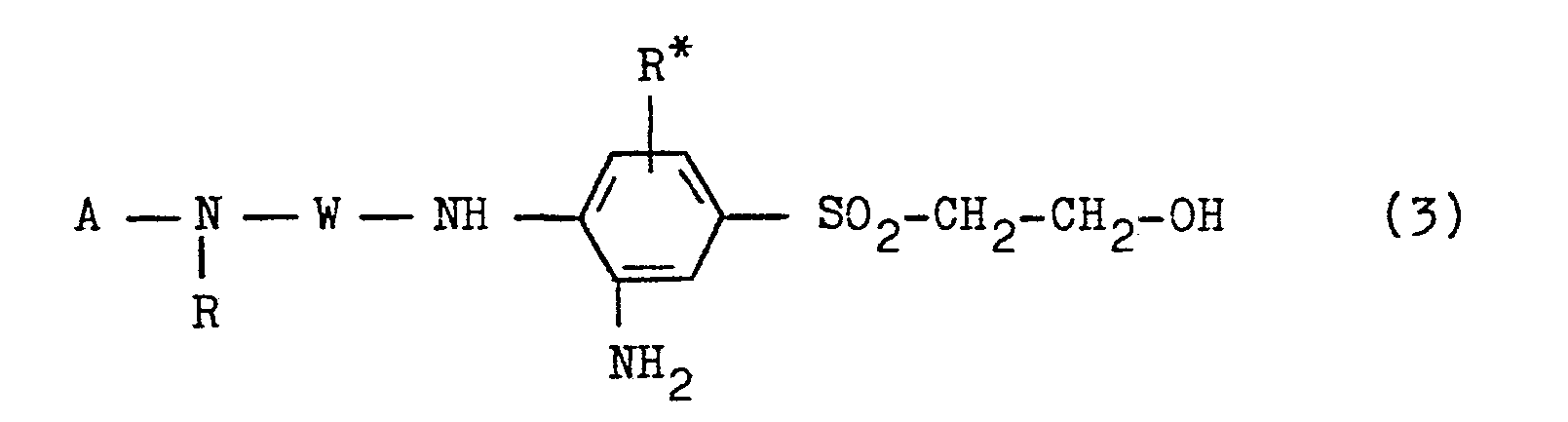
- the present invention further relates to a process for the preparation of the compounds of the general formula (1), which is characterized in that in a compound of the general formula (2) in which R, R * and W have the abovementioned meanings and A is a hydrogen atom or an acyl radical, such as an alkanoyl radical of 2 to 5 carbon atoms, such as the acetyl radical, or a benzoyl radical, where A in the case that W is an aromatic -carbocyclic radical, necessarily means one Represents an acyl radical, the nitro group of which is reduced to the amino group in a manner which is conventional per se and is analogous to known processes, and the compound of the general formula (3) obtained therefrom in which A, R, R * and W have the abovementioned meanings, diazotized in a per se customary procedure of diazotization, for example using sodium nitrite in aqueous-acidic, preferably hydrochloric acid, medium at a temperature between -10 ° C.
- the benzotriazole compound of the general formula (1) obtained as an acyl derivative was then deacylated to the benzotriazole compound of the general formula (1) analogously to known methods, for example. in an aqueous medium at a temperature between about 90 and 100 ° C and at a pH greater than 12, such as by means of a sodium hydroxide solution containing three to six times the amount of NaOH, but preferably in an acidic, for example. hydrochloric acid, aqueous medium at a pH -Value of less than 2. With the diazotization of the compounds of formula (3) there is ring closure of the diazonium group formed with the ortho-standing amino group.
- the compounds of the general formula (2) can also be prepared in a manner according to the invention by using a compound of the general formula (4) in which R * has the abovementioned meaning and Hal represents a fluorine or bromine atom or preferably a chlorine atom, with a compound of the general formula (5) in which A, R and W have the abovementioned meanings, in a solvent suitable for these reactants in the presence of an acid-binding agent at a temperature between 30 and 120 ° C., preferably between 70 and 90 ° C.
- the Ausqanqstagenenunqen of the general formula (4) are known per se (see, for example, German Patent 859 462, Example 5); Compounds corresponding to the general formula (4) which have not yet been described per se can be prepared analogously to the known compounds in the manner customary to the person skilled in the art, for example by nitrating an appropriate ( ⁇ -hydroxyethylsulfonyl) chlorobenzene compound or by reducing an appropriate 4-chlorine -3-nitrobenzenesulfochloride-Verbindunq means of sodium sulfite to the corresponding sulfinic acid and subsequent Oxethylierun of sulfinic acid to the ⁇ -HydroxyethylsulfonylVeritati q synthesize.
- an acid-binding agent for this purpose, both inorganic compounds, such as sodium hydroxide, Potassium hydroxide, sodium carbonate, calcium carbonate, magnesium oxide, sodium acetate or potassium acetate, as well as organic basic compounds, such as trialkylamines with alkyl radicals of 1 to 4 carbon atoms, such as trimethylamine and triethylamine, or pyridine, quinoline, the picolines and morpholine, in Fraqe.
- the acid-binding agent must in each case be present in at least an equivalent amount to the monohalo compound (4).
- amino compound (5) is a sufficiently basic reacting compound, such as, for example, ethylenediamine, and if this is used in sufficient excess, this compound acts as an acid acceptor, so that the addition of a separate inorganic or organic acid-binding agent is not necessary.
- Suitable solvents which can serve as the reaction medium in the reaction of (4) with (5) are, for example, water, alkanols of 1 to 4 carbon atoms, such as methanol, ethanol, propanol and isopropanol, dioxane, toluene, the xylenes, chlorobenzene , o-dichlorobenzene, m-dichlorobenzene, dimethylformamide or N-methyl-pyrrolidone. If one of the two reactants (4) and (5) or both is not completely soluble in the solvent used, the reaction takes place partly in suspension, which does not stop it. However, compound (5) can also be used as a solvent by application in a sufficient excess.
- the synthesized nitro compound of the general formula (2) can be isolated in a simple manner by crystallization from this reaction mixture and subsequent filtration, or else by partially removing the solvent or the excess reagent (5), which can advantageously be recovered for further reactions or distilled off completely and then the possibly concentrated reaction mixture with stirring with cold water, which optionally contains an electrolyte salt, such as sodium chloride, potassium chloride or sodium sulfate, dissolved together.
- the product which crystallizes out can be isolated by filtration, if appropriate after acidification with mineral acid.
- the subsequent reduction of the nitro compound (2) to the corresponding amino compound (3) can be carried out in a manner known per se by catalytic hydrogenation with hydrogen over known catalysts, such as palladium, platinum or Raney nickel, at a temperature between 20 and 150 ° C., preferably between 50 and 110 ° C, and at elevated pressure, for example between 30 and 100 bar, preferably between 40 and 55 bar, or by reduction according to Bechamp with iron in an acidic or alkaline medium, preferably in an acidic medium, for example with iron in ethanol / glacial acetic acid , be performed. It is particularly advantageous to subject the nitro compound (2) obtainable from the reaction of the compounds (4) and (5) directly to the catalytic hydrogenation without their intermediate isolation.
- catalysts such as palladium, platinum or Raney nickel
- the reduction from (2) to (3), be it catalytically or by Bechamp is characterized by a suitable solvent such as water, methanol or ethanol, or Jerusalemae Miningt in a mixture of water and methanol or water and ethanol, because in this case, the amino compounds (3) in a simple manner by Cooling, if appropriate after acidification with mineral acid, as free amino compounds or in the form of the mineral acid salts can be brought to crystallization; q They can also be salted out with sodium chloride.
- the subsequent separation is then carried out by filtration, and the mother liquors can be reused for subsequent hydrogenation batches and can also be recycled for this purpose.
- the organic solvent can also be recovered from the mother liquors by simple distillation at normal pressure.
- the procedures according to the invention make it possible to recover the new compounds of the general formula (1) in autogenous to very autogenous yields. They represent new, valuable intermediates for the production of fiber-reactive dyes, in particular of fiber-reactive triphendioxazine dyes, such as for the production of dyes of the general formula (A) in which W and R * have the abovementioned meanings, M is an alkali metal and E is a hydrogen atom or a sulfo, carboxy, C 1 -C 4 -alkylsulfonyl or sulfo-C 1 -C 4 -alkylsulfonyl group or a ⁇ - Sulfatoethylsulfonyl Group means.
- triphendioxazine dyes corresponding to the general formula (A) are, for example, those with E equal to a sulfo group and W an ethylene or an n-propylene group, which dyeings in pure blue and blue on cotton according to the dyeing methods customary in the art for fiber-reactive dyes deliver real tones.
- the use of the compounds (1) according to the invention as intermediates for the synthesis of fiber-reactive dyes is carried out, for example, in such a way that first the compound (1) with a chloronitro compound, for example with 2-sulfo-4-nitrochlorobenzene, 2- ( ⁇ -sulfoethylsulfonyl) -4 -nitrochlorobenzene or 2- (ß-hydroxyethylsulfonyl) -4-nitrochlorobenzene, to a compound of the general formula (6) in which W, R * and E have the abovementioned meanings or E is also a ⁇ -hydroxyethylsulfonyl group, (the reaction of the amino compound with the chlorobenzene compound can be carried out in a manner known per se in a manner analogous to the above) and in this Compound (6) the nitro group in a manner known per se, as described above, for example, for the amino group in the compounds of the general formula (7) in which W, R
- the amino compound of the general formula (7) can then be mixed with 2,3,5,6-tetrachloro-1,4-benzoquinone in a process known per se for the production of fiber-reactive triphendioxazin compounds (see, for example, the European patent application publication No. 0 168 751 Al) with oxidative closure and simultaneous or subsequent sulfation in sulfuric acid containing sulfur trioxide to give the dyes of the formula (A).
- nitro compound obtained under a) is reduced to the aniline compound by hydrogenating 303 parts of the nitro compound in 1200 parts of water in the presence of a Pd / C catalyst in an autoclave at a temperature of up to 100 ° C. and a hydrogen pressure of 50 bar. The catalyst is then filtered off; the amino compound obtained can be processed directly in the filtrate.
- the 4-amino-acetanilide can preferably also be used.
- the acid-binding agent used here is, for example, sodium acetate, triethylamine or triethanolamine; the subsequent N-acetylation is accordingly unnecessary.
- the nitro compound is then reduced by catalytic hydrogenation to the aniline compound by dissolving 236 parts of the nitro compound in 1000 parts of water and hydrogenating in the presence of a Pd / C catalyst in an autoclave at a temperature of up to 100 ° C. and a hydrogen pressure of 50 bar.
- the catalyst is then filtered off, the filtrate is cooled and acidified.
- the aniline compound of the formula crystallizes from it in good yield and high purity.
- the triphendioxazine compound according to the invention can also be in the form of its sodium salt by evaporation or Spray drying of the clarified synthesis solution can be obtained.
- Written q in the form of the free acid it has the putative formula (The respective sulfo group can also be bonded in the other ortho position to the benzotriazolylethylamino group, but is more likely to be in the position appropriate in the above formula).
- This compound according to the invention has good fiber-reactive dye properties. It colors the b in the descriptions unq qenannten materials, particularly cellulose fiber materials such as cotton, by the customary in the art and known methods of application and Fixierunq fiber-reactive dyes in strong, pure rotstichiq blue tones (according to the color code 13 of Color Index Hue Indication Chart) with good fastness properties, such as, in particular, good light fastness of the dry or moist dye, such as moistened with drinking water, good alkaline perspiration light fastness, chlorine bath water fastness, hypochlorite fastness, alkaline sweat fastness, wash fastness, also in the presence of perborates, wet fastness fastness and acidity fastness. In aqueous solution, it shows an absorption maximum at 612 nm in the visible range.
- the nitro compound thus obtained can then according to the information in Example 1a) to the aniline compound of the formula reduced and then converted to a valuable blue triphendioxazine dye according to the application examples 1b) and 1c).
Landscapes
- Chemical & Material Sciences (AREA)
- Organic Chemistry (AREA)
- Coloring (AREA)
- Nitrogen And Oxygen Or Sulfur-Condensed Heterocyclic Ring Systems (AREA)
- Pharmaceuticals Containing Other Organic And Inorganic Compounds (AREA)
- Plural Heterocyclic Compounds (AREA)
- Organic Low-Molecular-Weight Compounds And Preparation Thereof (AREA)
Abstract
Description
- N1-Substituierte 1H-Benzotriazol-hydroxyethyl-sulfon-Verbindungen, Verfahren zu ihrer Herstellung und ihre Verwendung zur Herstellung von Farbstoffen
- Die Erfindung liegt auf dem technischen Gebiet der Zwischenprodukte.
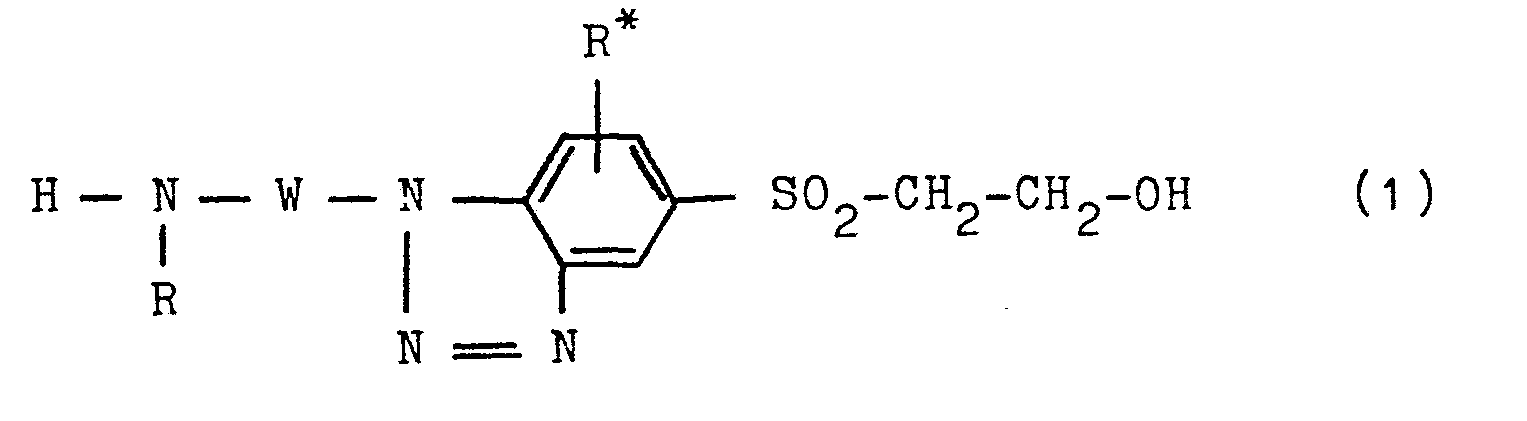
- Die vorliegende Erfindung betrifft Verbindungen der allgemeinen Formel (1)

- R ein Wasserstoffatom oder eine Alkylgruppe von 1 bis 6 C-Atomen ist, die durch einen oder zwei Substituenten, bevorzugt einen Substituenten, aus der Gruppe Hydroxy, Sulfo, Carboxy, Phosphono und Cyano substituiert sein kann,
- W einen bivalenten, gegebenenfalls substituierten aliphatischen, gegebenenfalls durch Alkyl substituierten (C5-C10)-cycloaliphatischen, gegebenenfalls durch Alkyl substituierten aliphatisch-(C5-C8)-cycloaliphatischen, gegebenenfalls substituierten araliphatischen oder gegebenenfalls substituierten aromatisch-carbocyclischen Rest bedeutet, wobei die aliphatischen Reste in Wdurch Heterogruppen, bevorzugt 1 oder 2 Heterogruppen, unterbrochen sein können, die aus den Gruppen der Formeln -0- , -S- , -S02- , -CO- , 1,4-Piperidino, -NH- und -N(R')- , in welcher R' eine Alkylgruppe von 1 bis 6 C-Atomen, bevorzugt von 1 bis 4 C-Atomen, wie insbesondere die Methyl- oder Ethylgruppe, ist, die substituiert sein kann, oder eine Alkanoylgruppe von. 2 bis 5 C-Atomen, wie die Acetylgruppe, ist, ausgewählt sind, und/oder wobei die aliphatischen Reste und Arylreste durch eine solche Heterogruppe miteinander verbunden sein können, und
- R* ein Wasserstoffatom oder eine Alkylgruppe von 1 bis 6 C-Atomen, bevorzugt von 1 bis 4 C-Atomen, wie insbesondere hiervon Methyl und Ethyl, eine Alkoxygruppe von 1 bis 5 C-Atomen, bevorzugt von 1 bis 4 C-Atomen, wie insbesondere hiervon Methoxy oder Ethoxy, ein Halogenatom, wie Fluor und Brom und insbesondere Chlor, oder eine Carboxy- oder Sulfogruppe bedeutet,
- Im vorstehenden wie nachstehenden bedeutet eine Carboxygruppe eine Gruppe der allgemeinen Formel -COOM , eine Sulfogruppe eine Gruppe der allgemeinen Formel -S03M und eine Phosphonogruppe eine Gruppe der allgemeinen Formel -PO3M2 , in welchen M ein Wasserstoffatom oder ein Alkalimetall, wie Natrium, Kalium oder Lithium, bedeutet.
- Die vorliegende Erfindung betrifft weiterhin ein Verfahren zur Herstellung der Verbindungen der allgemeinen Formel (1), das dadurch gekennzeichnet ist, daß man in einer Verbindung der allgemeinen Formel (2)


- Die Verbindungen der allgemeinen Formel (2) lassen sich ebenfalls in erfindungsgemäßer Weise herstellen, indem man eine Verbindung der allgemeinen Formel (4)


- Die Ausqanqsverbindunqen der allgemeinen Formel (4) sind an und für sich bekannt (s. beispielsweise Deutsche Patentschrift 859 462, Beispiel 5); noch nicht per se beschriebene Verbindungen entsprechend der allgemeinen Formel (4) lassen sich analoq zu den bekannten Verbindunqen in der dem Fachmann qeläufiqen Weise herstellen, so durch Nitrierung einer entsprechenden (ß-Hydroxyethylsulfonyl)-chlorbenzol-Verbindunq oder durch Reduktion einer entsprechenden 4-Chlor-3-nitrobenzolsulfochlorid-Verbindunq mittels Natriumsulfit zur entsprechenden Sulfinsäure und anschließender Oxethylierunq der Sulfinsäure zur β-HydroxyethylsulfonylVerbindung synthetisieren.
- Ausqanqsverbindunqen entsprechend der allgemeinen Formel (5) sind beispielsweise 1,2-Diamino-ethan, 1,3-Diamino-propan, 1,4-Diamino-butan, 1,5-Diamino-pentan, 1,6-Diamino-hexan, 1,2-Diamino-propan, 1,2-Diamino-butan, 1,3-Diamino-butan, die N-Acyl-, wie die N-Acetyl- und N-Benzoyl-Verbindungen, des l-Amino-3-methvlamino-propans, das 1,3-Diamino-2-methyl-propan, das 1,3-Diamino-2-hydroxy-propan, das 1,5-Diamino-2-carboxy-pentan, das 1,3-Diamino-2-phenyl- propan oder dessen im Benzolrest sulfosubstituiertes Derivat, des weiteren Verbindungen entsprechend einer allgemeinen Formel (a), (b), (c) und (d)


- X ein Sauerstoffatom, ein Schwefelatom, eine Sulfonylqruppe oder eine Gruppe der Formel -NH- , -N(CH3)- oder -N(COCH3)- bedeutet,
- R1 für ein Wasserstoffatom oder eine Sulfoqruppe steht,
- A die obenqenannte Bedeutung besitzt,
- n die Zahl 2, 3 oder 4 ist,
- X für die Gruppe -NH- oder für ein Sauerstoffatom steht und
- v die Zahl 2 oder 3 bedeutet,
- Da bei der Umsetzung der Verbindungen (4) mit den Verbindunqen (5) Halogenwasserstoff abgespalten wird, ist es erforderlich, in Geqenwart eines säurebindenden Mittels zu arbeiten. Hierfür kommen sowohl anorqanische Verbindunqen, wie beispielsweise Natriumhydroxid, Kaliumhydroxid, Natriumcarbonat, Calciumcarbonat, Magnesiumoxid, Natriumacetat oder Kaliumacetat, als auch organische basische Verbindunqen, wie beispielsweise Trialkylamine mit Alkylresten von 1 bis 4 C-Atomen, wie z.B. Trimethylamin und Triethylamin, oder Pyridin, Chinolin, die Picoline und Morpholin, in Fraqe. Das säurebindende Mittel muß jeweils in mindestens äquivalenter Menge zur Monohaloqenverbindung (4) vorhanden sein. Stellt die Aminoverbindunq (5) eine ausreichend basisch reaqierende Verbindung dar, wie beispielsweise Ethylendiamin, und setzt man diese in ausreichendem Überschuß ein, so wirkt diese Verbindung als Säureakzeptor, wodurch der Zusatz eines gesonderter anorganischen oder organischen säurebindenden Mittels entfällt.
- Geeiqnete Lösemittel, die als Reaktionsmedium bei der Umsetzung von (4) mit (5) dienen können, sind beispielsweise Wasser, Alkanole von 1 bis 4 C-Atomen, wie Methanol, Ethanol, Propanol und Isopropanol, Dioxan, Toluol, die Xylole, Chlorbenzol, o-Dichlorbenzol, m-Dichlorbenzol, Dimethylformamid oder N-Methyl-pyrrolidon. Ist eine der beiden Reaktanten (4) und (5) oder beide in dem angewandten Lösemittel nicht vollständig löslich, so findet die Reaktion teilweise in Suspension statt, was ihr keinen Abbruch tut. Es kann jedoch auch die Verbindung (5) durch Anwendung in einem ausreichenden Überschuß als Lösemittel eingesetzt werden.
- Bei der Anwendung eines Lösemittels, in welchem sich die beiden Reaktanten (4) und (5) jeweils vollständig lösen, ist es zweckmäßiq, die Verbindungen (4) und (5) im molaren Verhältnis 1:(1-2,5) zur Umsetzunq zu brinqen. Die Anwendunq eines größeren Überschusses an der Verbindung (5) ist zwar möqlich, bringt aber keinen Vorteil mehr und ist daher nicht zweckmäßig.
- Bei Anwendunq eines Lösemittels, in welchem sich einer oder beide Reaktanten (4) und (5) nicht vollständig lösen, oder bei Anwendung von überschüssigem (5) als Lösemittel, ist es zweckmäßig, die Verbindung (5) in der 1- bis 4-fachen Gewichtsmenge, bezogen auf die Verbindung (4), mit der Verbindung (4) zur Umsetzung zu bringen. Die Anwendung eines größeren Überschusses an (5) ist auch hier möglich, aber nicht zweckmäßig.
- Die synthetisierte Nitroverbindung der allgemeinen Formel (2) kann in einfacher Weise durch Kristallisation aus dieser Reaktionsmischung und anschließende Filtration isoliert werden oder auch, indem man das Lösemittel bzw. das überschüssige Reagenz (5), das vorteilhafterweise für weitere Umsetzungen wiedergewonnen werden kann, gegebenenfalls teilweise oder vollständig abdestilliert und anschließend das eventuell eingeengte Reaktionsgemisch unter Rühren mit kaltem Wasser, das gegebenenfalls ein Elektrolytsalz, wie Natriumchlorid, Kaliumchlorid oder Natriumsulfat, gelöst enthält, zusammengibt. Das hierbei auskristallisierende Produkt kann durch Filtration, gegebenenfalls nach Ansäuern mit Mineralsäure, isoliert werden.
- Die anschließende Reduktion der Nitroverbindung (2) zur entsprechenden Aminoverbindung (3) kann in an sich bekannter Weise durch katalytische Hydrierung mit Wasserstoff an bekannten Katalysatoren, wie Palladium, Platin oder Raney-Nickel, bei einer Temperatur zwischen 20 und 150°C, vorzugsweise zwischen 50 und 110°C, und bei erhöhtem Druck, beispielsweise zwischen 30 und 100 bar, vorzugsweise zwischen 40 und 55 bar, oder durch Reduktion nach Bechamp mit Eisen in saurem oder alkalischem Medium, vorzugsweise in saurem Medium, beispielsweise mit Eisen in Ethanol/Eisessig, durchgeführt werden. Besonders vorteilhaft ist es, die aus der Umsetzung der Verbindungen (4) und (5) erhältliche Nitroverbindung (2) ohne deren Zwischenisolierung direkt der katalytischen Hydrierung zu unterwerfen. Auf diese Weise können Engergie- und Abwasserkosten gesenkt werden. Die Reduktion von (2) zu (3), sei sie katalytisch oder nach Bechamp, wird zweckmäßiqerweise in einem geeigneten Lösemittel, wie Wasser, Methanol oder Ethanol, oder in einem Gemisch aus Wasser und Methanol bzw. Wasser und Ethanol durchaeführt, weil sich hierbei die Aminoverbindungen (3) in einfacher Weise durch Abkühlen, gegebenenfalls nach Ansäuern mit Mineralsäure, als freie Aminoverbindungen oder in Form der mineralsauren Salze zur Kristallisation bringen lassen können; qeqebenenfalls lassen sie sich auch durch Natriumchlorid aussalzen. Die anschließende Abtrennuna erfolgt sodann durch Filtration, und die Mutterlaugen können für nachfolaende Hydrieransätze wieder verwendet werden und hierfür qeqebenenfalls im Kreislauf qeführt werden. Ebenso läßt sich aus den Mutterlaugen das oraanische Lösemittel durch einfache Destillation bei Normaldruck zurückgewinnen.
- Die erfindungsgemäßen Verfahrensweisen machen es möglich, die neuen Verbindungen der allaemeinen Formel (1) in auten bis sehr auten Ausbeuten zu qewinnen. Sie stellen neue, wertvolle Zwischenprodukte zur Herstellung von faserreaktiven Farbstoffen, insbesondere von faserraktiven Triphendioxazinfarbstoffen, dar, wie beispielsweise zur Herstelluna von Farbstoffen der allgemeinen Formel (A)

- Die erfindungsgemäße Verwendung der Verbindungen (1) als Zwischenprodukte zur Synthese von faserreaktiven Farbstoffen erfolgt beispielsweise so, daß man zunächst die Verbindung (1) mit einer Chlornitroverbindung, beispielsweise mit 2-Sulfo-4-nitrochlorbenzol, 2-(ß-Sulfoethylsulfonyl)-4-nitrochlorbenzol oder 2-(ß-Hydroxyethylsulfonyl)-4-nitrochlorbenzol, zu einer Verbindung der allgemeinen Formel (6)


-
- a) 530 Teile 2-Nitro-4-(B-hydroxyethylsulfonyl)-chlorbenzol werden bei einer Temperatur zwischen 70 und 80°C lanqsam in 620 Teile Ethylendiamin eingetragen; der Ansatz wird einige Zeit bei dieser Temperatur gehalten und sodann, nach quantitativer Umsetzung, in Wasser eingerührt. Die ausqefallene Verbindunq der Formel

- δ = 2,83 ppm (t,2H); 3,44 ppm (m,2H); 3,7 ppm (m,2H); 7,27 ppm (d,lH); 7,9 ppm (dd,lH); 8,49 ppm (d,lH); bewegliche Protonen bei 1,7 ppm (NH2), 4,8 ppm (OH) und 8,8 ppm (NH).
- b) Die unter a) erhaltene Nitroverbindunq wird zur Anilinverbindunq reduziert, indem man 290 Teile der Nitroverbindunq in 1200 Teilen Wasser in Geqenwart eines Pd/C-Katalysators in einem Auoklaven bei einer Temperatur bis 100°C und einem Wasserstoffdruck von 50 bar hydriert. Der Katalysator wird anschließend abfiltriert; die erhaltene Aminoverbindunq kann im Filtrat direkt weiter verarbeitet werden.
- Eine isolierte Probe der erhaltenen Anilinverbindunq der Formel

- δ = 2,84 ppm (t,2H); 3,2 ppm (m,4H); 3,6 ppm (m,2H); 6,53 ppm (dd,1H); 6,96 ppm (d,1H); 7,0 ppm (dd,1H); mobile Protonen bei 4 - 5 ppm (NH2,OH) und 5,45 ppm (NH).
- c) 260 Teile B-[4-(B-Hydroxyethylsulfonyl)-2-amino-phenyl- amino]-ethylamin werden in etwa 1800 Teilen einer salzsauren wäßrigen Lösunq bei 0 bis 5°C mittels einer wäßriaen Natriumnitritlösunq in üblicher Weise diazotiert. Der Rinqschluß erfolgt sofort und quantitativ. Eine isolierte Probe der Verbindung der Formel

- δ = 3,06 ppm (t,2H); 3,54 ppm (m,2H); 3,7 ppm (m,2H); 4,72 ppm (t,2H); 8,0 ppm (dd,lH); 8,16 ppm (dd,1H); 8,6 ppm (m,lH); mobile Protonen (OH, NH2).
- a) 530 Teile 2-Nitro-4-(β-hydroxyethylsulfonyl)-chlorbenzol werden bei einer Temperatur zwischen 70 und 80°C langsam in 750 Teile 1,3-Propvlendiamin eingetragen; der Ansatz wird einiqe Zeit bei dieser Temperatur qehalten und sodann, nach quantitativer Umsetzung, in Wasser eingerührt. Die ausqefallene Verbindunq der Formel

- δ = 1,7 ppm (m,2H); 2,66 ppm (t,2H); 3,5 ppm (m,4H); 3,68 ppm (m,2H); 7,25 ppm (d,lH); 7,9 ppm (dd,lH); 8,5 ppm (d,lH); mobile Protonen (NH2, OH, NH) bei ca. 5 ppm.
- b) Die unter a) erhaltene Nitroverbindunq wird zur Anilinverbindunq reduziert, indem man 303 Teile der Nitroverbindunq in 1200 Teilen Wasser in Geqenwart eines Pd/C-Katalysators in einem Auoklaven bei einer Temperatur bis 100°C und einem Wasserstoffdruck von 50 bar hydriert. Der Katalysator wird anschließend abfiltriert; die erhaltene Aminoverbindunq kann im Filtrat direkt weiter verarbeitet werden.
- Eine isolierte Probe der erhaltenen Anilinverbindunq der Formel

- δ = 1,9 ppm (m,2H); 2,88 ppm (t,2H); 3,2 ppm (m, 4H); 3,58 ppm (m,2H); 6,51 ppm (dd,lH); 6,92 ppm (d,lH); 6,96 ppm (dd,lH); mobile Protonen bei 4,9 ppm (OH), 5,2 ppm (NH2), 5,74 ppm (NH) und 8,2 ppm (NH2).
- c) 260 Teile y-[4-(ß-Hydroxyethylsulfonyl)-2-amino-phenyl- amino]-n-propylamin werden in etwa 1800 Teilen einer salzsauren wäßrigen Lösung bei 0 bis 5°C mittels einer wäßrigen Natriumnitritlösung in üblicher Weise diazotiert. Der Ringschluß erfolgt sofort und quantitativ. Eine isolierte Probe der Verbindung der Formel

- = 2,24 ppm (m,2H); 2,85 ppm (m,2H); 3,6 ppm (m,4H); 4,92 ppm (t,2H); 8,04 ppm (dd,1H); 8,27 ppm (d,1H); 8,6 ppm (s,1H); mobile Protonen (OH, NH2).
- Zu einer Lösung von 118,8 Teilen 1,4-Phenylendiamin in 500 Volumenteilen Methanol werden bei 65°C unter Stickstoffatmosphäre 132,8 Teile 4-(ß-Hydroxyethylsulfonyl)-2-nitro-chlorbenzol innerhalb von 30 Minuten eingetragen. Man rührt noch 4 Stunden bei dieser Temperatur nach, läßt auf Raumtemperatur abkühlen und das Reaktionsprodukt durch Zugabe von 1000 Volumenteilen Eiswasser auskristallisieren. Nach Absaugen und Trocknen erhält man das 4-(ß-Hydroxyethylsulfonyl)-2-nitro-4'-amino-diphenylamin in hoher Ausbeute. Es wird mit der äquimolaren Menge an Essigsäureanhydrid, beispielsweise in Eisessig, bei einer Temperatur von 50°C N-acyliert; die Acetaminoverbindung, die einen Fp. von 193/194°C besitzt, wird anschließend zur Anilinoverbindung der Formel


- δ = 3,6 ppm (t,2H); 3,8 ppm (m,2H); 4,9 ppm (t,OH); 5,7 ppm (s,NH2); 6,8 ppm (d,2H); 7,5 ppm (d,2H); 8,0 ppm (d,1H); 8,1 ppm (d,1H); 8,7 ppm (s,1H).
- Anstelle von 1,4-Phenylendiamin als Ausgangsverbindung kann bevorzugt auch das 4-Amino-acetanilid eingesetzt werden. Hierbei verwendet man als säurebindendes Mittel beispielsweise Natriumacetat, Triethylamin oder Triethanolamin; die anschließende N-Acetylierung erübrigt sich demgemäß.
- Man verfährt zur Herstellung einer erfindungsgemäßen Verbindung gemäß der Verfahrensweise des Beispieles 3, setzt jedoch anstelle von 1,4-Phenylendiamin die gleiche Menge an 1,3-Phenylendiamin bzw. bevorzugt 3-Amino-acetanilid ein. Man erhält auf diese Weise die erfindungsgemäße Verbindung der Formel

- Die in Beispiel lc) beschriebene erfindunqsqemäße Verbindunq kann wie folqt zu einem Farbstoff weiterverarbeitet werden:
- a) Eine Mischung von 270 Teilen 5-(ß-Hydroxyethylsulfonyl)-1-(ß-aminoethyl)-benzotriazol in 1000 Teilen Wasser und 500 Teilen Triethanolamin werden zunächst bei einer Temperatur von 40°C mit 259 Teilen des Natriumsalzes der 5-Nitro-2-chlorbenzolsulfonsäure versetzt (die Benzotriazolverbindunq kann auch in Form der qemäß Beispiel lc) erhaltenen Lösunq direkt einqesetzt werden). Innerhalb von zwei Stunden wird die Mischung auf 100 bis 110°C aufgeheizt, wobei das Wasser teilweise abdestilliert. Man rührt weitere 10 Stunden bei 115 bis 120°C zur quantitativen Umsetzunq nach und qibt sodann bei 100°C 3000 Teile Wasser hinzu und klärt die Lösunq bei 80 bis 90°c. Aus dem wäßriqen Medium kristallisiert beim Abkühlen das Natriumsalz des 4-[β-(5'-β'-Hydroxvethylsulfonylbenzotriazol-1'-yl)-ethylamino]-3-sulfo-nitrobenzol in hoher Ausbeute und Reinheit aus. Die Nitroverbindunq zeiqt folqende Daten in der 1H-NMR-Analyse (in D6-DMSO mit TMS als innerem Standard):
- δ = 3,5 ppm (m,2H); 3,64 ppm (t,2H); 3,95 ppm (m,2H); 4,82 ppm (t,OH); 5,0 ppm (t,2H); 6,69 ppm (d,lH); 7,57 ppm (t,NH); 7,95 ppm (m,2H); 8,16 ppm (m,lH); 8,3 ppm (d, 1H); 8,57 ppm (d, 1H).
- Die Nitroverbindung wird anschließend durch katalytische Hydrierung zur Anilinverbindung reduziert, indem man 236 Teile der Nitroverbindung in 1000 Teilen Wasser löst und in Gegenwart eines Pd/C-Katalysators in einem Autoklaven bei einer Temperatur bis 100°C und einem Wasserstoffdruck von 50 bar hydriert. Der Katalysator wird anschließend abfiltriert, das Filtrat abqekühlt und anqesäuert. Aus ihm kristallisiert die Anilinverbindunq der Formel

- b) 441 Teile der unter a) erhaltenen Anilinverbindung werden in 2000 Teilen Wasser bei pH 6 und 60°C qelöst. 124 Teile Chloranil werden eingetragen, wobei mit etwa 90 Teilen Natriumbicarbonat ein pH-Wert von 6,5 und eine Reaktionstemperatur von etwa 65°C gehalten wird. Der Ansatz wird noch sechs Stunden nachgerührt, das Reaktionsprodukt sodann bei etwa 65°C geklärt, mit wenig Natriumchlorid ausgefällt, abqesaugt, mit 1000 Teilen einer 10%igen wäßrigen Natriumchloridlösung gewaschen und unter reduziertem Druck bei 70°C getrocknet.
- c) 105 Teile des unter b) erhaltenen Produktes werden bei einer Temperatur zwischen 20 und 25°C in 750 Teile 13%iqes Oleum eingetragen. Der Reaktionsansatz wird anschließend noch etwa drei Stunden bei dieser Temperatur nachgerührt; sodann werden 48 Teile Natrium-peroxodisulfat einqetragen, und zwar in der Weise, daß die Reaktionstemperatur bei 20 bis 25'C qehalten werden kann. Man rührt noch 10 Stunden bei dieser Temperatur nach, läßt den Ansatz sodann auf Eis laufen, filtriert die ausgefallene erfindunqsqemäße Verbindunq ab, löst sie wieder in etwa 1000 Teilen Wasser, stellt mit Natriumcarbonat einen pH-Wert von 5 ein und salzt sie, qeqebenenfalls nach vorheriger üblicher Klärunq der Lösung, mit Natriumchlorid aus.
- Die erfindunqsqemäße Triphendioxazin-Verbindung kann auch in Form ihres Natriumsalzes durch Eindampfen oder Sprühtrocknen der qeklärten Syntheselösunq erhalten werden. Sie besitzt, in Form der freien Säure qeschrieben, die mutmaßliche Formel

- Diese erfindunqsgemäße Verbindung besitzt gute faserreaktive Farbstoffeiqenschaften. Sie färbt die in der Beschrei- bunq qenannten Materialien, insbesondere Cellulosefasermaterialien, wie Baumwolle, nach den in der Technik üblichen und bekannten Verfahrensweisen der Applikation und Fixierunq von faserreaktiven Farbstoffen in farbstarken, reinen rotstichiq blauen Tönen (entsprechend der Farbkennzahl 13 von Colour Index Hue Indication Chart) mit quten Echtheiten, wie insbesondere quter Lichtechtheit der trockenen oder feuchten, wie mit Trinkwasser befeuchteten Färbunq, quter alkalischen Schweißlichtechtheit, Chlorbadewasserechtheit, Hypochloritechtheit, alkalischer Schweißechtheit, Waschechtheit, auch in Geqenwart von Perboraten, Naßlieqeechtheit und Säurelaqerbeständiqkeit. In wäßriqer Lösunq zeigt sie im sichtbaren Bereich ein Absorptionsmaximum bei 612 nm.
- Die in Beispiel 2c) beschriebene erfindungsgemäße Verbindung kann wie folgt zu einem Triphendioxazinfarbstoff weiterverarbeitet werden:
- Eine gemäß Beispiel 2c) erhaltene wäßrig-saure Lösung mit 285 Teilen 5-(ß-Hydroxyethylsulfonyl)-1-(y-aminopropyl)-benzotriazol und 500 Teilen Triethanolamin wird auf 40°C erwärmt und mit 259 Teilen des Natriumsalzes der 5-Nitro-2-chlorbenzolsulfonsäure versetzt. Innerhalb von zwei Stunden wird die Mischung auf 100 bis 110°C aufgeheizt, wobei das Wasser teilweise abdestilliert. Man rührt weitere 10 Stunden bei 115 bis 120°C zur quantitativen Umsetzung nach und gibt sodann bei 100°C 3000 Teile Wasser hinzu und klärt die Lösung bei 80 bis 90°C. Aus dem wäßrigen Medium kristallisiert beim Abkühlen das Natriumsalz des 4-(γ-(5'-β'-Hyäroxyethylsulfonylbenzotriazol-1'-yl)-propylamino]-3-sulfo-nitrobenzol inhoher Ausbeute und Reinheit aus. Die Nitroverbindung zeigt folgende Daten in der 1H-NMR-Analyse (in d6-DMSO mit TMS als innerem Standard):
- δ = 2,25 ppm (m,2H); 3,32 ppm (m,2H); 3,54 ppm (m,2H); 3,66 ppm (m,2H); 4,9 ppm (m,OH,2H); 6,9 ppm (d,1H); 7,47 ppm (t,NH); 8,0 ppm (m,2H); 8,20 ppm (m,1H); 8,37 ppm (d,1H); 8,62 ppm (d,1H).
- Die so erhaltene Nitroverbindung kann sodann gemäß den Angaben des Beispieles 1a) zur Anilinverbindung der Formel

sowie deren Verwendung zur Herstellung von faserreaktiven Farbstoffen.
des weiteren das 1,3- oder 1,4-Cyclohexylen-diamin, das Bis-(4-amino-cyclohex-l-vl)-methan, das 1,8-Di-(aminomethyl)-naphthalin, das 1,4-Di-(aminomethyl)-benzol, das 1,3-Di-(aminomethyl)-benzol, das N,N'-Bis-(ß-aminoethyl)-1,4-piperidin, das 1,4- oder 1,3-Phenylendiamin, das 4-Aminobenzylamin, das 4-Amino-phenethylamin sowie die entsprechenden N-Monoacyl-Derivate solcher Verbindungen. Bevorzuqt sind hiervon 1,2-Diamino-ethan, 1,3-Diamino-propan, 1,4-Diamino-butan und 1,2-Diamino-propan.
Claims (13)


Applications Claiming Priority (2)
| Application Number | Priority Date | Filing Date | Title |
|---|---|---|---|
| DE3625386 | 1986-07-26 | ||
| DE19863625386 DE3625386A1 (de) | 1986-07-26 | 1986-07-26 | N(pfeil abwaerts)1(pfeil abwaerts)-substituierte 1h-benzotriazol-hydroxyethyl-sulfon-verbindungen, verfahren zu ihrer herstellung und ihre verwendung zur herstellung von farbstoffen |
Publications (2)
| Publication Number | Publication Date |
|---|---|
| EP0256331A1 true EP0256331A1 (de) | 1988-02-24 |
| EP0256331B1 EP0256331B1 (de) | 1991-11-06 |
Family
ID=6306082
Family Applications (1)
| Application Number | Title | Priority Date | Filing Date |
|---|---|---|---|
| EP87110514A Expired - Lifetime EP0256331B1 (de) | 1986-07-26 | 1987-07-21 | N1-Substituierte 1H-Benzo-triazol-hydroxyethyl-sulfon-Verbindungen, Verfahren zu ihrer Herstellung und ihre Verwendung zur Herstellung von Farbstoffen |
Country Status (8)
| Country | Link |
|---|---|
| US (1) | US4851542A (de) |
| EP (1) | EP0256331B1 (de) |
| JP (1) | JPH07121920B2 (de) |
| KR (1) | KR950009753B1 (de) |
| BR (1) | BR8703850A (de) |
| DE (2) | DE3625386A1 (de) |
| ES (1) | ES2039216T3 (de) |
| MX (1) | MX173930B (de) |
Families Citing this family (1)
| Publication number | Priority date | Publication date | Assignee | Title |
|---|---|---|---|---|
| DE3708767A1 (de) * | 1987-03-18 | 1988-09-29 | Hoechst Ag | Wasserloesliche azoverbindungen, verfahren zu ihrer herstellung und ihre verwendung als farbstoffe |
Citations (2)
| Publication number | Priority date | Publication date | Assignee | Title |
|---|---|---|---|---|
| EP0141996A2 (de) * | 1983-10-11 | 1985-05-22 | Bayer Ag | Triphendioxazin-Reaktivfarbstoffe |
| EP0222098A2 (de) * | 1985-09-19 | 1987-05-20 | Hoechst Aktiengesellschaft | Wasserlösliche Triphendioxazin-Verbindungen, Verfahren zu ihrer Herstellung und ihre Verwendung als Farbstoffe |
Family Cites Families (3)
| Publication number | Priority date | Publication date | Assignee | Title |
|---|---|---|---|---|
| NL113851C (de) * | 1960-03-08 | |||
| DE2716503A1 (de) * | 1977-04-14 | 1978-10-19 | Bayer Ag | Azofarbstoff-zwischenprodukt |
| FR2487994A1 (fr) * | 1980-07-30 | 1982-02-05 | Rhone Poulenc Syst | Procede de reproduction diazoique utilisant comme agent de copulation des aryl-2, 2h-benzotriazoles porteurs de groupements oh et/ou nh2 et materiaux correspondants |
-
1986
- 1986-07-26 DE DE19863625386 patent/DE3625386A1/de not_active Withdrawn
-
1987
- 1987-07-21 ES ES198787110514T patent/ES2039216T3/es not_active Expired - Lifetime
- 1987-07-21 DE DE8787110514T patent/DE3774358D1/de not_active Expired - Fee Related
- 1987-07-21 EP EP87110514A patent/EP0256331B1/de not_active Expired - Lifetime
- 1987-07-23 US US07/076,749 patent/US4851542A/en not_active Expired - Fee Related
- 1987-07-24 BR BR8703850A patent/BR8703850A/pt unknown
- 1987-07-24 MX MX007481A patent/MX173930B/es unknown
- 1987-07-24 JP JP62183800A patent/JPH07121920B2/ja not_active Expired - Lifetime
- 1987-07-25 KR KR1019870008111A patent/KR950009753B1/ko not_active Expired - Fee Related
Patent Citations (2)
| Publication number | Priority date | Publication date | Assignee | Title |
|---|---|---|---|---|
| EP0141996A2 (de) * | 1983-10-11 | 1985-05-22 | Bayer Ag | Triphendioxazin-Reaktivfarbstoffe |
| EP0222098A2 (de) * | 1985-09-19 | 1987-05-20 | Hoechst Aktiengesellschaft | Wasserlösliche Triphendioxazin-Verbindungen, Verfahren zu ihrer Herstellung und ihre Verwendung als Farbstoffe |
Also Published As
| Publication number | Publication date |
|---|---|
| US4851542A (en) | 1989-07-25 |
| JPS6335566A (ja) | 1988-02-16 |
| MX173930B (es) | 1994-04-11 |
| DE3774358D1 (de) | 1991-12-12 |
| KR880001619A (ko) | 1988-04-25 |
| BR8703850A (pt) | 1988-03-29 |
| EP0256331B1 (de) | 1991-11-06 |
| JPH07121920B2 (ja) | 1995-12-25 |
| ES2039216T3 (es) | 1993-09-16 |
| DE3625386A1 (de) | 1988-02-04 |
| KR950009753B1 (ko) | 1995-08-28 |
| MX7481A (es) | 1993-05-01 |
Similar Documents
| Publication | Publication Date | Title |
|---|---|---|
| EP0053743B1 (de) | Dioxazin-Reaktivfarbstoffe, Verfahren zu ihrer Herstellung und ihre Verwendung zum Färben und Bedrucken von hydroxyl- oder amidgruppenhaltigen Fasermaterialien | |
| EP0245603B1 (de) | Aromatische Aminosulfonverbindungen und Verfahren zu deren Herstellung | |
| EP0171611B1 (de) | Substituierte Phenyloxethylsulfone und Verfahren zu ihrer Herstellung | |
| EP0222098B1 (de) | Wasserlösliche Triphendioxazin-Verbindungen, Verfahren zu ihrer Herstellung und ihre Verwendung als Farbstoffe | |
| DE1235466B (de) | Verfahren zur Herstellung von organischen Farbstoffen | |
| EP0175225A2 (de) | Faserreaktive Triazinverbindungen, Verfahren zu ihrer Herstellung und ihre Verwendung | |
| EP0256331B1 (de) | N1-Substituierte 1H-Benzo-triazol-hydroxyethyl-sulfon-Verbindungen, Verfahren zu ihrer Herstellung und ihre Verwendung zur Herstellung von Farbstoffen | |
| EP0258493B1 (de) | Wasserlösliche Triphendioxazin-Verbindungen und deren sulfonylgruppenhaltigen Vorprodukte, Verfahren zu deren Herstellung und Verwendung der Triphendioxazine als Farbstoffe | |
| EP0603116B1 (de) | Azoreaktivfarbstoffe | |
| EP0355735B1 (de) | Wasserlösliche Triphendioxazin-Verbindungen und deren sulfonyl-gruppenhaltigen Vorprodukte, Verfahren zu deren Herstellung und Verwendung der Triphendioxazine als Farbstoffe | |
| EP0431389B1 (de) | Azofarbstoffe und Verfahren zur Herstellung von [5-Amino-2-(2-hydroxyethylamino)phenyl](2-hydroxyethyl)-sulfon | |
| EP0255020B1 (de) | Wasserlösliche Triphendioxazin-Verbindungen, Verfahren zu ihrer Herstellung und ihre Verwendung als Farbstoffe | |
| DE2657218A1 (de) | Unsymmetrische xanthenfarbstoffe, verfahren zu ihrer herstellung und ihre verwendung | |
| EP0036555A1 (de) | Neue Zinkchloridkomplexverbindungen, Verfahren zu ihrer Herstellung sowie ihre Verwendung und Verfahren zur Herstellung von Phenoxazinverbindungen | |
| EP0258686B1 (de) | Wasserlösliche Triphendioxazin-Verbindungen, Verfahren zu ihrer Herstellung und ihre Verwendung als Farbstoffe | |
| EP0402318B1 (de) | Verfahren zur Herstellung von faserreaktiven Formazanverbindungen | |
| EP0184660B1 (de) | Monocyclische Bis-oxethylsulfonyl-benzole und Verfahren zu ihrer Herstellung | |
| DE2346047A1 (de) | Blaue anthrachinoide dispersionsfarbstoffe, deren herstellung und verwendung | |
| EP0026913B1 (de) | Kupferkomplex-Naphthylazonaphthyl-Verbindungen, Verfahren zu ihrer Herstellung und ihre Verwendung zum Färben und Bedrucken von Fasermaterialien und Leder | |
| DE4219421A1 (de) | Verfahren zur Herstellung von faserreaktiven Formazanfarbstoffen sowie Aminophenole | |
| EP0534314B1 (de) | Verfahren zur Herstellung von Nitrobenzophenonen sowie färbestabile Modifikation eines Benzophenonazopyridonfarbstoffs | |
| DE4131355A1 (de) | Verfahren zur herstellung von 2-phenylsulfanyl-propan- und 2-phenylsulfonyl-propan-verbindungen | |
| DE3906353A1 (de) | Wasserloesliche faserreaktive farbstoffe, verfahren zu ihrer herstellung und ihre verwendung | |
| EP0741130A1 (de) | Verfahren zur Herstellung von Sulfonen | |
| DE19739983A1 (de) | Neue Triphendioxazine |
Legal Events
| Date | Code | Title | Description |
|---|---|---|---|
| PUAI | Public reference made under article 153(3) epc to a published international application that has entered the european phase |
Free format text: ORIGINAL CODE: 0009012 |
|
| AK | Designated contracting states |
Kind code of ref document: A1 Designated state(s): BE CH DE ES FR GB IT LI |
|
| 17P | Request for examination filed |
Effective date: 19880629 |
|
| 17Q | First examination report despatched |
Effective date: 19891213 |
|
| GRAA | (expected) grant |
Free format text: ORIGINAL CODE: 0009210 |
|
| AK | Designated contracting states |
Kind code of ref document: B1 Designated state(s): BE CH DE ES FR GB IT LI |
|
| ITF | It: translation for a ep patent filed | ||
| REF | Corresponds to: |
Ref document number: 3774358 Country of ref document: DE Date of ref document: 19911212 |
|
| ET | Fr: translation filed | ||
| GBT | Gb: translation of ep patent filed (gb section 77(6)(a)/1977) | ||
| PGFP | Annual fee paid to national office [announced via postgrant information from national office to epo] |
Ref country code: ES Payment date: 19920706 Year of fee payment: 6 |
|
| PLBE | No opposition filed within time limit |
Free format text: ORIGINAL CODE: 0009261 |
|
| STAA | Information on the status of an ep patent application or granted ep patent |
Free format text: STATUS: NO OPPOSITION FILED WITHIN TIME LIMIT |
|
| 26N | No opposition filed | ||
| PG25 | Lapsed in a contracting state [announced via postgrant information from national office to epo] |
Ref country code: ES Free format text: LAPSE BECAUSE OF THE APPLICANT RENOUNCES Effective date: 19930722 |
|
| REG | Reference to a national code |
Ref country code: ES Ref legal event code: FG2A Ref document number: 2039216 Country of ref document: ES Kind code of ref document: T3 |
|
| PGFP | Annual fee paid to national office [announced via postgrant information from national office to epo] |
Ref country code: FR Payment date: 19950621 Year of fee payment: 9 |
|
| PGFP | Annual fee paid to national office [announced via postgrant information from national office to epo] |
Ref country code: GB Payment date: 19950626 Year of fee payment: 9 Ref country code: CH Payment date: 19950626 Year of fee payment: 9 |
|
| PGFP | Annual fee paid to national office [announced via postgrant information from national office to epo] |
Ref country code: BE Payment date: 19950710 Year of fee payment: 9 |
|
| PGFP | Annual fee paid to national office [announced via postgrant information from national office to epo] |
Ref country code: DE Payment date: 19950920 Year of fee payment: 9 |
|
| PG25 | Lapsed in a contracting state [announced via postgrant information from national office to epo] |
Ref country code: GB Effective date: 19960721 |
|
| PG25 | Lapsed in a contracting state [announced via postgrant information from national office to epo] |
Ref country code: LI Effective date: 19960731 Ref country code: CH Effective date: 19960731 Ref country code: BE Effective date: 19960731 |
|
| BERE | Be: lapsed |
Owner name: HOECHST A.G. Effective date: 19960731 |
|
| GBPC | Gb: european patent ceased through non-payment of renewal fee |
Effective date: 19960721 |
|
| REG | Reference to a national code |
Ref country code: CH Ref legal event code: PL |
|
| PG25 | Lapsed in a contracting state [announced via postgrant information from national office to epo] |
Ref country code: FR Effective date: 19970328 |
|
| PG25 | Lapsed in a contracting state [announced via postgrant information from national office to epo] |
Ref country code: DE Effective date: 19970402 |
|
| REG | Reference to a national code |
Ref country code: FR Ref legal event code: ST |
|
| REG | Reference to a national code |
Ref country code: ES Ref legal event code: FD2A Effective date: 19991007 |
|
| PG25 | Lapsed in a contracting state [announced via postgrant information from national office to epo] |
Ref country code: IT Free format text: LAPSE BECAUSE OF NON-PAYMENT OF DUE FEES;WARNING: LAPSES OF ITALIAN PATENTS WITH EFFECTIVE DATE BEFORE 2007 MAY HAVE OCCURRED AT ANY TIME BEFORE 2007. THE CORRECT EFFECTIVE DATE MAY BE DIFFERENT FROM THE ONE RECORDED. Effective date: 20050721 |