EP0264076A2 - Hyphes de champignon comprimés riches en protoplasme possédant une activité enzymatique élevée ainsi qu'un procédé pour leur fabrication pour une utilisation à grande échelle - Google Patents
Hyphes de champignon comprimés riches en protoplasme possédant une activité enzymatique élevée ainsi qu'un procédé pour leur fabrication pour une utilisation à grande échelle Download PDFInfo
- Publication number
- EP0264076A2 EP0264076A2 EP87114765A EP87114765A EP0264076A2 EP 0264076 A2 EP0264076 A2 EP 0264076A2 EP 87114765 A EP87114765 A EP 87114765A EP 87114765 A EP87114765 A EP 87114765A EP 0264076 A2 EP0264076 A2 EP 0264076A2
- Authority
- EP
- European Patent Office
- Prior art keywords
- protoplasts
- immobilized
- mycelium
- cells
- compressed
- Prior art date
- Legal status (The legal status is an assumption and is not a legal conclusion. Google has not performed a legal analysis and makes no representation as to the accuracy of the status listed.)
- Withdrawn
Links
Images



Classifications
-
- C—CHEMISTRY; METALLURGY
- C12—BIOCHEMISTRY; BEER; SPIRITS; WINE; VINEGAR; MICROBIOLOGY; ENZYMOLOGY; MUTATION OR GENETIC ENGINEERING
- C12N—MICROORGANISMS OR ENZYMES; COMPOSITIONS THEREOF; PROPAGATING, PRESERVING, OR MAINTAINING MICROORGANISMS; MUTATION OR GENETIC ENGINEERING; CULTURE MEDIA
- C12N1/00—Microorganisms; Compositions thereof; Processes of propagating, maintaining or preserving microorganisms or compositions thereof; Processes of preparing or isolating a composition containing a microorganism; Culture media therefor
- C12N1/14—Fungi; Culture media therefor
-
- C—CHEMISTRY; METALLURGY
- C12—BIOCHEMISTRY; BEER; SPIRITS; WINE; VINEGAR; MICROBIOLOGY; ENZYMOLOGY; MUTATION OR GENETIC ENGINEERING
- C12N—MICROORGANISMS OR ENZYMES; COMPOSITIONS THEREOF; PROPAGATING, PRESERVING, OR MAINTAINING MICROORGANISMS; MUTATION OR GENETIC ENGINEERING; CULTURE MEDIA
- C12N1/00—Microorganisms; Compositions thereof; Processes of propagating, maintaining or preserving microorganisms or compositions thereof; Processes of preparing or isolating a composition containing a microorganism; Culture media therefor
- C12N1/14—Fungi; Culture media therefor
- C12N1/145—Fungi isolates
-
- C—CHEMISTRY; METALLURGY
- C12—BIOCHEMISTRY; BEER; SPIRITS; WINE; VINEGAR; MICROBIOLOGY; ENZYMOLOGY; MUTATION OR GENETIC ENGINEERING
- C12N—MICROORGANISMS OR ENZYMES; COMPOSITIONS THEREOF; PROPAGATING, PRESERVING, OR MAINTAINING MICROORGANISMS; MUTATION OR GENETIC ENGINEERING; CULTURE MEDIA
- C12N11/00—Carrier-bound or immobilised enzymes; Carrier-bound or immobilised microbial cells; Preparation thereof
- C12N11/02—Enzymes or microbial cells immobilised on or in an organic carrier
- C12N11/04—Enzymes or microbial cells immobilised on or in an organic carrier entrapped within the carrier, e.g. gel or hollow fibres
-
- C—CHEMISTRY; METALLURGY
- C12—BIOCHEMISTRY; BEER; SPIRITS; WINE; VINEGAR; MICROBIOLOGY; ENZYMOLOGY; MUTATION OR GENETIC ENGINEERING
- C12R—INDEXING SCHEME ASSOCIATED WITH SUBCLASSES C12C - C12Q, RELATING TO MICROORGANISMS
- C12R2001/00—Microorganisms ; Processes using microorganisms
- C12R2001/645—Fungi ; Processes using fungi
Definitions
- the present invention relates to compressed protoplasmic fungal hyphae with high enzyme activity, which can be used on an industrial scale, and a process for their production.
- DE-PS 30 37 992 describes a process for the preparation of binders for wood-based materials.
- sulfite waste liquors are mixed with enzymes that come from lignolytic microorganisms.
- the lignolytic microorganisms include e.g. the white rot mushrooms.
- White rot fungi for example Coriolus versicolor
- One such method using calcium alginate is in Biotchnol. Letters 1981, Vol. 3, No. 12, 701-706.
- the immobilization has the advantage that there is no undesired increase in the biomass and that the immobilized product is easy to handle, for example can be easily separated from solutions.
- immobilized mycelia have a reduced activity.
- Protoplasts are cells without cell walls. Intact protoplasts are viable in isotonic media, they generally have a higher enzyme activity than corresponding cells with cell walls. However, protoplasts have the disadvantage that they are extremely sensitive osmotically. They burst in hypotonic media. Their large-scale application is therefore difficult.
- the object of the present invention is to create fungal cells with high enzyme activity, which combine the active stage of the protoplast with the osmotic resistance of intact cells with cell walls.
- This object is achieved in that the fungal mycelium cells are converted into protoplasts, the protoplasts are immobilized in a manner known per se and the protoplasts in the immobilized state are regenerated to fungal hyphae with compressed cells.
- the invention is based on the surprising observation that protoplasts, for example of white rot fungi, can regenerate the cell walls under defined conditions, but retain the active stage over a longer period of time.
- the protoplasts can be obtained by known methods, for example by the Trojanowski method, which is published in Microbios Letters 25 , pp. 63-65 (1984). Suspensions of the mycelia are treated with enzymes that break down the cell walls, for example with Novozym from Trichoderma harzianum or with the enzyme lysozyme discovered by A. Fleming in 1922. The cultures of the fungal mycelium are suspended in the enzyme solution. The solution must be kept isotonic. Protoplasts with large vacuoles with a diameter of approx. 20 to 40 ⁇ m are formed under the influence of the enzyme.
- the protoplasts formed are immobilized by an organic gel which is said to be permeable to proteins and carbohydrates.
- the matrix of the gel should not cause any interaction with the enzymatic ingredients of the protoplast, but only a complete mechanical coating of the protoplast with the organic carrier material of the gel matrix. If possible, the gel matrix should not be porous in order to prevent protoplast material from escaping.
- All of the organic carrier materials characterized above which do not have any toxic effects on the protoplast are suitable as the gel matrix.
- Such carrier materials are e.g. As alginates, agar, carrageenate, gelatin and the like. Alginates are preferably used, such as sodium alginate.
- the protoplasts are mixed with a solution of the matrix gel material as soon as possible after their production. It is expedient to meter the solution in small portions into a medium which initiates or accelerates gel formation. When using Na alginate, a solution of calcium chloride has proven to be very useful. When the matrix material is metered into the gel former, the gel is formed in small beads or granules.
- the protoplasts Due to the immobilization, the protoplasts are connected to the carrier to form a complex unit which, unlike free material, is easy to handle. In this way, the biomass can be easily separated from the substrate.
- the embedded protoplasts retain this spherical shape even when the cell walls are regenerated and do not return to the elongated shape. They therefore show a new type of morphology that was not previously known. They are morphologically new representatives of known strains that do not have the usual elongated shape, but a "compressed" shape.
- a various white rot fungi were found to have high lignolytic activity at the young stage of the onset of hyphae formation, which is due to the presence of many plasma-rich young hypha cells. The activity decreases with the aging of the cell.
- the protoplasts By regenerating the cell walls, the protoplasts become more resistant to osmotic effects, so they no longer have to be kept in an isotonic medium. Since the enzyme activity of the immobilized protoplasts is maintained for a period of several weeks, cells with high enzyme activity that can be used on an industrial scale are obtained by the production method according to the invention.
- An inoculum was prepared from a 7 day old mycelium of Heterobasidion annosum by filtering the mycelium over a nylon cloth and then washing it with sterile water.
- the isolated mycelium was washed twice with 0.5 M MgSO4 and the washed mycelium was suspended with a solution of 0.16% Novozym in 0.5 M MgSO4.
- the mixture was incubated in gently shaken Petri dishes for two days.
- the solution was filtered through a glass frit G1.
- the formation of the protoplasts was observed in the phase contrast microscope.
- the suspension was aseptic for 40 min. centrifuged at 2000 g.
- the sediment containing protoplasm was collected.
- the protoplasts obtained were spherical bodies with large vacuoles with a diameter of approximately 20 to 40 ⁇ m.
- the protoplasts were taken up immediately after their production by the Trojanowski method in 0.5 M NaCl solution with a pH of 4.5. 10 ml of this suspension were mixed with 10 ml of sodium alginate solution (3%), the previous Had been autoclaved at 121 ° C for 20 min. This mixture was then injected dropwise through a 0.8 mm diameter cannula into a 0.1 M CaCl2 solution. The gel formed instantly. After about 2 hours of rest, the now solid gel particles were washed several times with 0.5 M NaCl solution.
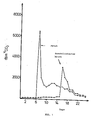
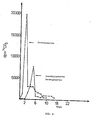
- a defined amount of a specific 14C-labeled phenol or dehydrogenation polymer (DHP) from coniferyl alcohol (according to Freudenberg) is added to the freshly prepared cultures described above after the activity determination (in dpm) under sterile conditions.
- DHP dehydrogenation polymer
- the determination of the 14CO2 release from the 14C-labeled substances by the organism in the course of the incubation is carried out using the radio-respiratory method according to Haider and Trojanowski.
- the cultures are incubated at 25 ° C and shaken at low speed.
- the reference quantity protein refers in each case to the amount of inoculum protein that was determined before the embedding or before the cultures were set up using a protein detection modified according to Lowry.
- the release rates achieved are higher than those of immobilized mycelium and are always of the same order of magnitude as that of free mycelium or above.
- Immobilized protoplasts of Heterobasidium annosum thus achieve an equal or even higher quantitative yield in half the time compared to the mycelium.
- the culture was gassed with air in a reactor shown in FIG. 3.
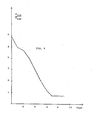
- a polymeric dye was dissolved in the medium (0.02% Poly Blue 411, J.K. Glenn and M.M. Gold, 1983). It is decolorized by the enzymes that are also responsible for lignin degradation and is therefore used as an indicator dye.
- the decolorization is based on the decrease in the quotient certainly. Complete decolorization was found within the first 7 days (see FIG. 4).
- the immobilized material can thus degrade phenolic polymers or monomers.
- the fungal mycelium was homogenized and 10 ml of mycelium suspension each was transferred to 50 ml of nutrient solution in Roux flasks. After 24 hours of incubation in the incubator, the mycelium was harvested using a Buchner funnel lined with nylon gauze. This was washed thoroughly with 0.5 M MgSO4 solution and incubated for two days with 50 50 ml novozym solution in a large petri dish (diameter 20 cm) on the shaker.
- the Novozym solution consisted of 1.6 mg Novozym 234 (extracellular enzyme complex from Trichoderma harzianum) per 1 ml 0.5 M MgSO4 solution (pH 4.5) and was used after sterile filtration with a 0.2 ⁇ m Milliporfilter from Sartorius, Goettingen.
- the lysed hyphae were then pressed through a glass frit using a syringe with a cannula diameter of 1.5 mm.
- the filtrate contained the purified protoplasts.
- the protoplast filtrate was first centrifuged off at 2500 rpm for 40 to 50 minutes.
- the pellet obtained was resuspended in 0.5 M NaCl solution (pH 4.5), centrifuged again (2500 rpm, 35 min) and taken up in 0.5 M NaCl solution.
- 10 ml (2-4 mg of protein) were removed from this suspension and 10 ml of a 3% strength aqueous Na-alginate solution, which had been autoclaved at 121 ° C. for 15 minutes, were added and mixed well.
- This mixture was dropped through a sterile 0.8 mm diameter cannula in 0.1 M CaCl2 solution (each provided about 70 ml).
- the gel balls formed immediately.
- One to two hours after production, the now solid gel particles were rinsed several times with 0.5 M NaCl solution and transferred to the substrate to be examined. The procedure was carried out under sterile conditions.
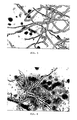
- FIGS. 5, 7 and 8 The cell shapes of the free mycelium are shown in FIGS. 5, 7 and 8, those of the immobilized mycelium in FIGS. 6, 9 and 10.
- a comparison of the figures shows the transition from the stretched to the compressed form.
- FIGS. 11 and 12 show the frequency distributions of the cell lengths and the hyphae width for hyphae from free mycelium and for mycelium from immobilized protoplasts. Immobilization reduces the cell length considerably. While in free mycelium the cell lengths can be up to more than 36 ⁇ m, in the case of compressed cells the maximum length is 8.5 to 10.5 ⁇ m.
- the statistical evaluation shows the following: 0.102 cell width free mycelium 0.12 cell width mycelium as immobilized protopoasts
Landscapes
- Life Sciences & Earth Sciences (AREA)
- Chemical & Material Sciences (AREA)
- Engineering & Computer Science (AREA)
- Health & Medical Sciences (AREA)
- Wood Science & Technology (AREA)
- Zoology (AREA)
- Organic Chemistry (AREA)
- Genetics & Genomics (AREA)
- Bioinformatics & Cheminformatics (AREA)
- Biotechnology (AREA)
- General Engineering & Computer Science (AREA)
- Biochemistry (AREA)
- Microbiology (AREA)
- General Health & Medical Sciences (AREA)
- Biomedical Technology (AREA)
- Botany (AREA)
- Mycology (AREA)
- Medicinal Chemistry (AREA)
- Tropical Medicine & Parasitology (AREA)
- Virology (AREA)
- Dispersion Chemistry (AREA)
- Micro-Organisms Or Cultivation Processes Thereof (AREA)
- Immobilizing And Processing Of Enzymes And Microorganisms (AREA)
Applications Claiming Priority (2)
| Application Number | Priority Date | Filing Date | Title |
|---|---|---|---|
| DE3634761A DE3634761C1 (de) | 1986-10-11 | 1986-10-11 | Protoplasmareiche,grosstechnisch einsetzbare Pilzhyphen mit hoher Enzymaktivitaet und Verfahren zu ihrer Herstellung |
| DE3634761 | 1986-10-11 |
Publications (2)
| Publication Number | Publication Date |
|---|---|
| EP0264076A2 true EP0264076A2 (fr) | 1988-04-20 |
| EP0264076A3 EP0264076A3 (fr) | 1989-05-17 |
Family
ID=6311586
Family Applications (1)
| Application Number | Title | Priority Date | Filing Date |
|---|---|---|---|
| EP87114765A Withdrawn EP0264076A3 (fr) | 1986-10-11 | 1987-10-09 | Hyphes de champignon comprimés riches en protoplasme possédant une activité enzymatique élevée ainsi qu'un procédé pour leur fabrication pour une utilisation à grande échelle |
Country Status (2)
| Country | Link |
|---|---|
| EP (1) | EP0264076A3 (fr) |
| DE (1) | DE3634761C1 (fr) |
Families Citing this family (3)
| Publication number | Priority date | Publication date | Assignee | Title |
|---|---|---|---|---|
| JP3510263B2 (ja) * | 1994-06-24 | 2004-03-22 | ノボザイムス バイオテック,インコーポレイティド | 精製ポリポルス・ラッカーゼ及びそれをコードする核酸 |
| US5770418A (en) * | 1994-06-24 | 1998-06-23 | Novo Nordisk A/S | Purified polyporus laccases and nucleic acids encoding same |
| CN108707598B (zh) * | 2018-05-29 | 2021-05-28 | 江南大学 | 一种以丝状真菌为载体强化反硝化细菌脱氮的方法 |
Family Cites Families (1)
| Publication number | Priority date | Publication date | Assignee | Title |
|---|---|---|---|---|
| DE3037992C2 (de) * | 1980-10-08 | 1983-04-21 | Gesellschaft für Biotechnologische Forschung mbH (GBF), 3300 Braunschweig | Verfahren zur Herstellung eines Bindemittels für Holzwerkstoffe |
-
1986
- 1986-10-11 DE DE3634761A patent/DE3634761C1/de not_active Expired
-
1987
- 1987-10-09 EP EP87114765A patent/EP0264076A3/fr not_active Withdrawn
Also Published As
| Publication number | Publication date |
|---|---|
| EP0264076A3 (fr) | 1989-05-17 |
| DE3634761C1 (de) | 1988-02-18 |
Similar Documents
| Publication | Publication Date | Title |
|---|---|---|
| DE3133123C2 (de) | Unbeweglich gemachte α-Glukosyltransferase, Verfahren zu ihrer Herstellung sowie Verwendung zur Herstellung von Palatinose | |
| DE2915135C2 (fr) | ||
| DE2112740A1 (de) | Enzym-Reaktoren,ihre Herstellung und Verwendung | |
| DE1915970A1 (de) | Verfahren zur Herstellung von Produkten auf der Basis aktiver Proteinsubstanzen | |
| CH651579A5 (de) | Verfahren zum selektiven zerstoeren einer permeablen membran. | |
| DE2339238B2 (de) | Enzyme und/oder mikroorganismen in loesung oder dispersion enthaltender hohlfaden und verfahren zu seiner herstellung | |
| DE3801053C2 (fr) | ||
| DE3132497C2 (fr) | ||
| DE3634761C1 (de) | Protoplasmareiche,grosstechnisch einsetzbare Pilzhyphen mit hoher Enzymaktivitaet und Verfahren zu ihrer Herstellung | |
| DE2457090A1 (de) | Vakzin und verfahren zu dessen herstellung | |
| DE3788352T2 (de) | Verfahren zur herstellung eines heterologen proteins in insektenzellen. | |
| DE2410693A1 (de) | Verfahren zum immobilisieren von enzymen | |
| DE3236157C2 (fr) | ||
| EP0129668B1 (fr) | Procédé de multiplication pour des aggrégats de cellules de plantes | |
| EP0313008A2 (fr) | Capsules magnétiques de membrane et son utilisation | |
| DE2413694B2 (de) | Wasserunlösliches, enzymatisch aktives, unbeweglich gemachtes Enzymmaterlal | |
| DE19756499C2 (de) | Mikrokapseln | |
| DE3787777T2 (de) | Verwendung von Zusammensetzungen auf Basis von Cellulase für die Kultivierung und Anwendung von Mikroorganismen, welche Zellulose herstellen. | |
| DE69112236T2 (de) | Verfahren zur mikrobiologischen Herstellung von Ironen. | |
| DE69322893T2 (de) | Verfahren zur Herstellung von Epsilon-poly-L-Lysin | |
| DE2714103C2 (de) | Gelierung von mikroskopisch kleinen Zellen | |
| DE4316646A1 (de) | Lävansucraseenzym, Verfahren zu dessen Herstellung, Mikroorganismen, die es produzieren und Zusammensetzungen, die es enthalten | |
| DE19547059C2 (de) | Verfahren zur Herstellung von Difructosedianhydrid III | |
| DD202891A5 (de) | Neue carcinostatische und immunostimulierende substanzen,verfahren zu ihrer herstellung und carcinostatische mittel mit einem gehalt derselben | |
| EP1090984B1 (fr) | Procédé pour la production, le transport et l'élimination de composés biochimiques à l'aide de cellules biologiques actives |
Legal Events
| Date | Code | Title | Description |
|---|---|---|---|
| PUAI | Public reference made under article 153(3) epc to a published international application that has entered the european phase |
Free format text: ORIGINAL CODE: 0009012 |
|
| AK | Designated contracting states |
Kind code of ref document: A2 Designated state(s): AT BE CH DE ES FR GB GR IT LI LU NL SE |
|
| PUAL | Search report despatched |
Free format text: ORIGINAL CODE: 0009013 |
|
| AK | Designated contracting states |
Kind code of ref document: A3 Designated state(s): AT BE CH DE ES FR GB GR IT LI LU NL SE |
|
| 17P | Request for examination filed |
Effective date: 19900119 |
|
| 17Q | First examination report despatched |
Effective date: 19910903 |
|
| STAA | Information on the status of an ep patent application or granted ep patent |
Free format text: STATUS: THE APPLICATION IS DEEMED TO BE WITHDRAWN |
|
| 18D | Application deemed to be withdrawn |
Effective date: 19920114 |