EP0276334B1 - Siliciumnitrid-Siliciumkarbidmaterial und Verfahren zu seiner Herstellung - Google Patents
Siliciumnitrid-Siliciumkarbidmaterial und Verfahren zu seiner Herstellung Download PDFInfo
- Publication number
- EP0276334B1 EP0276334B1 EP87100853A EP87100853A EP0276334B1 EP 0276334 B1 EP0276334 B1 EP 0276334B1 EP 87100853 A EP87100853 A EP 87100853A EP 87100853 A EP87100853 A EP 87100853A EP 0276334 B1 EP0276334 B1 EP 0276334B1
- Authority
- EP
- European Patent Office
- Prior art keywords
- silicon carbide
- silicon nitride
- sintered
- powder
- composite material
- Prior art date
- Legal status (The legal status is an assumption and is not a legal conclusion. Google has not performed a legal analysis and makes no representation as to the accuracy of the status listed.)
- Expired - Lifetime
Links
- 239000002131 composite material Substances 0.000 title claims description 65
- 229910010271 silicon carbide Inorganic materials 0.000 title claims description 44
- 229910052710 silicon Inorganic materials 0.000 title claims description 27
- XUIMIQQOPSSXEZ-UHFFFAOYSA-N Silicon Chemical compound [Si] XUIMIQQOPSSXEZ-UHFFFAOYSA-N 0.000 title claims description 25
- 239000010703 silicon Substances 0.000 title claims description 24
- 238000000034 method Methods 0.000 title claims description 20
- 238000004519 manufacturing process Methods 0.000 title description 4
- 239000000843 powder Substances 0.000 claims description 67
- 229910052581 Si3N4 Inorganic materials 0.000 claims description 40
- HQVNEWCFYHHQES-UHFFFAOYSA-N silicon nitride Chemical compound N12[Si]34N5[Si]62N3[Si]51N64 HQVNEWCFYHHQES-UHFFFAOYSA-N 0.000 claims description 40
- HBMJWWWQQXIZIP-UHFFFAOYSA-N silicon carbide Chemical compound [Si+]#[C-] HBMJWWWQQXIZIP-UHFFFAOYSA-N 0.000 claims description 30
- IJGRMHOSHXDMSA-UHFFFAOYSA-N Atomic nitrogen Chemical compound N#N IJGRMHOSHXDMSA-UHFFFAOYSA-N 0.000 claims description 28
- 239000000203 mixture Substances 0.000 claims description 26
- 239000002245 particle Substances 0.000 claims description 26
- XKRFYHLGVUSROY-UHFFFAOYSA-N Argon Chemical compound [Ar] XKRFYHLGVUSROY-UHFFFAOYSA-N 0.000 claims description 21
- 238000005245 sintering Methods 0.000 claims description 18
- 239000007789 gas Substances 0.000 claims description 16
- 229910052739 hydrogen Inorganic materials 0.000 claims description 16
- 229910052757 nitrogen Inorganic materials 0.000 claims description 16
- 239000001257 hydrogen Substances 0.000 claims description 15
- 239000012298 atmosphere Substances 0.000 claims description 14
- 229910052786 argon Inorganic materials 0.000 claims description 11
- PNEYBMLMFCGWSK-UHFFFAOYSA-N aluminium oxide Inorganic materials [O-2].[O-2].[O-2].[Al+3].[Al+3] PNEYBMLMFCGWSK-UHFFFAOYSA-N 0.000 claims description 10
- 230000001590 oxidative effect Effects 0.000 claims description 9
- 229910052799 carbon Inorganic materials 0.000 claims description 8
- 239000001307 helium Substances 0.000 claims description 8
- 229910052734 helium Inorganic materials 0.000 claims description 8
- SWQJXJOGLNCZEY-UHFFFAOYSA-N helium atom Chemical compound [He] SWQJXJOGLNCZEY-UHFFFAOYSA-N 0.000 claims description 8
- 229910052760 oxygen Inorganic materials 0.000 claims description 8
- RUDFQVOCFDJEEF-UHFFFAOYSA-N yttrium(III) oxide Inorganic materials [O-2].[O-2].[O-2].[Y+3].[Y+3] RUDFQVOCFDJEEF-UHFFFAOYSA-N 0.000 claims description 8
- QVGXLLKOCUKJST-UHFFFAOYSA-N atomic oxygen Chemical compound [O] QVGXLLKOCUKJST-UHFFFAOYSA-N 0.000 claims description 7
- 239000001301 oxygen Substances 0.000 claims description 7
- OKTJSMMVPCPJKN-UHFFFAOYSA-N Carbon Chemical compound [C] OKTJSMMVPCPJKN-UHFFFAOYSA-N 0.000 claims description 6
- 239000000126 substance Substances 0.000 claims description 5
- 229910004012 SiCx Inorganic materials 0.000 claims description 4
- MRELNEQAGSRDBK-UHFFFAOYSA-N lanthanum(3+);oxygen(2-) Chemical compound [O-2].[O-2].[O-2].[La+3].[La+3] MRELNEQAGSRDBK-UHFFFAOYSA-N 0.000 claims description 4
- 229910000422 cerium(IV) oxide Inorganic materials 0.000 claims description 3
- CPLXHLVBOLITMK-UHFFFAOYSA-N Magnesium oxide Chemical compound [Mg]=O CPLXHLVBOLITMK-UHFFFAOYSA-N 0.000 claims 1
- CETPSERCERDGAM-UHFFFAOYSA-N ceric oxide Chemical compound O=[Ce]=O CETPSERCERDGAM-UHFFFAOYSA-N 0.000 claims 1
- 125000004435 hydrogen atom Chemical class [H]* 0.000 claims 1
- 238000006243 chemical reaction Methods 0.000 description 20
- 238000010438 heat treatment Methods 0.000 description 17
- 239000000463 material Substances 0.000 description 16
- 239000000047 product Substances 0.000 description 14
- 150000003961 organosilicon compounds Chemical class 0.000 description 12
- 238000001878 scanning electron micrograph Methods 0.000 description 10
- 239000012808 vapor phase Substances 0.000 description 9
- QGZKDVFQNNGYKY-UHFFFAOYSA-N Ammonia Chemical compound N QGZKDVFQNNGYKY-UHFFFAOYSA-N 0.000 description 8
- 230000000052 comparative effect Effects 0.000 description 7
- 150000002431 hydrogen Chemical class 0.000 description 7
- UFHFLCQGNIYNRP-UHFFFAOYSA-N Hydrogen Chemical compound [H][H] UFHFLCQGNIYNRP-UHFFFAOYSA-N 0.000 description 6
- 150000001875 compounds Chemical class 0.000 description 6
- 125000001997 phenyl group Chemical group [H]C1=C([H])C([H])=C(*)C([H])=C1[H] 0.000 description 6
- 230000000704 physical effect Effects 0.000 description 6
- 125000003903 2-propenyl group Chemical group [H]C([*])([H])C([H])=C([H])[H] 0.000 description 5
- 238000002425 crystallisation Methods 0.000 description 5
- 230000008025 crystallization Effects 0.000 description 5
- 238000007731 hot pressing Methods 0.000 description 5
- 239000012071 phase Substances 0.000 description 5
- 239000007858 starting material Substances 0.000 description 5
- LFQSCWFLJHTTHZ-UHFFFAOYSA-N Ethanol Chemical compound CCO LFQSCWFLJHTTHZ-UHFFFAOYSA-N 0.000 description 4
- 238000002441 X-ray diffraction Methods 0.000 description 4
- 125000000217 alkyl group Chemical group 0.000 description 4
- 238000009826 distribution Methods 0.000 description 4
- 229910052736 halogen Inorganic materials 0.000 description 4
- 150000002367 halogens Chemical class 0.000 description 4
- FFUAGWLWBBFQJT-UHFFFAOYSA-N hexamethyldisilazane Chemical compound C[Si](C)(C)N[Si](C)(C)C FFUAGWLWBBFQJT-UHFFFAOYSA-N 0.000 description 4
- 239000011261 inert gas Substances 0.000 description 4
- 239000011812 mixed powder Substances 0.000 description 4
- 208000010392 Bone Fractures Diseases 0.000 description 3
- 206010017076 Fracture Diseases 0.000 description 3
- 229910021529 ammonia Inorganic materials 0.000 description 3
- 239000007795 chemical reaction product Substances 0.000 description 3
- -1 chlorine and Chemical class 0.000 description 3
- 230000007423 decrease Effects 0.000 description 3
- LELOWRISYMNNSU-UHFFFAOYSA-N hydrogen cyanide Chemical compound N#C LELOWRISYMNNSU-UHFFFAOYSA-N 0.000 description 3
- 239000000320 mechanical mixture Substances 0.000 description 3
- VNWKTOKETHGBQD-UHFFFAOYSA-N methane Chemical compound C VNWKTOKETHGBQD-UHFFFAOYSA-N 0.000 description 3
- 239000012299 nitrogen atmosphere Substances 0.000 description 3
- 229910000069 nitrogen hydride Inorganic materials 0.000 description 3
- 238000000879 optical micrograph Methods 0.000 description 3
- 238000013001 point bending Methods 0.000 description 3
- 238000009834 vaporization Methods 0.000 description 3
- 230000008016 vaporization Effects 0.000 description 3
- 229910003460 diamond Inorganic materials 0.000 description 2
- 239000010432 diamond Substances 0.000 description 2
- 230000000694 effects Effects 0.000 description 2
- 229930195733 hydrocarbon Natural products 0.000 description 2
- 150000002430 hydrocarbons Chemical class 0.000 description 2
- 239000012535 impurity Substances 0.000 description 2
- 238000007689 inspection Methods 0.000 description 2
- 238000005121 nitriding Methods 0.000 description 2
- 230000035939 shock Effects 0.000 description 2
- 239000012798 spherical particle Substances 0.000 description 2
- FRIQIFYGFSBKGX-UHFFFAOYSA-N 2-N,4-N,6-N,1,3,5-hexamethyl-1,3,5,2,4,6-triazatrisilinane-2,4,6-triamine Chemical compound CN[SiH]1N([SiH](N([SiH](N1C)NC)C)NC)C FRIQIFYGFSBKGX-UHFFFAOYSA-N 0.000 description 1
- 150000007578 6-membered cyclic compounds Chemical group 0.000 description 1
- 238000007088 Archimedes method Methods 0.000 description 1
- ZAMOUSCENKQFHK-UHFFFAOYSA-N Chlorine atom Chemical compound [Cl] ZAMOUSCENKQFHK-UHFFFAOYSA-N 0.000 description 1
- 230000018199 S phase Effects 0.000 description 1
- 229910007161 Si(CH3)3 Inorganic materials 0.000 description 1
- 208000013201 Stress fracture Diseases 0.000 description 1
- IYABWNGZIDDRAK-UHFFFAOYSA-N allene Chemical group C=C=C IYABWNGZIDDRAK-UHFFFAOYSA-N 0.000 description 1
- OBFQBDOLCADBTP-UHFFFAOYSA-N aminosilicon Chemical class [Si]N OBFQBDOLCADBTP-UHFFFAOYSA-N 0.000 description 1
- XZWVIKHJBNXWAT-UHFFFAOYSA-N argon;azane Chemical compound N.[Ar] XZWVIKHJBNXWAT-UHFFFAOYSA-N 0.000 description 1
- 230000015572 biosynthetic process Effects 0.000 description 1
- 239000000919 ceramic Substances 0.000 description 1
- 239000000460 chlorine Substances 0.000 description 1
- 229910052801 chlorine Inorganic materials 0.000 description 1
- 238000011109 contamination Methods 0.000 description 1
- 229910052593 corundum Inorganic materials 0.000 description 1
- HNQXCHVZYRDHJN-UHFFFAOYSA-N cyanosilicon Chemical class [Si]C#N HNQXCHVZYRDHJN-UHFFFAOYSA-N 0.000 description 1
- 230000008021 deposition Effects 0.000 description 1
- KZZFGAYUBYCTNX-UHFFFAOYSA-N diethylsilicon Chemical compound CC[Si]CC KZZFGAYUBYCTNX-UHFFFAOYSA-N 0.000 description 1
- 125000002147 dimethylamino group Chemical group [H]C([H])([H])N(*)C([H])([H])[H] 0.000 description 1
- 230000002349 favourable effect Effects 0.000 description 1
- 239000002657 fibrous material Substances 0.000 description 1
- 239000010419 fine particle Substances 0.000 description 1
- 239000008246 gaseous mixture Substances 0.000 description 1
- 229910002804 graphite Inorganic materials 0.000 description 1
- 239000010439 graphite Substances 0.000 description 1
- 238000007373 indentation Methods 0.000 description 1
- 239000007791 liquid phase Substances 0.000 description 1
- 230000014759 maintenance of location Effects 0.000 description 1
- 125000000250 methylamino group Chemical group [H]N(*)C([H])([H])[H] 0.000 description 1
- 238000003801 milling Methods 0.000 description 1
- 239000004570 mortar (masonry) Substances 0.000 description 1
- 229920001558 organosilicon polymer Polymers 0.000 description 1
- 230000003647 oxidation Effects 0.000 description 1
- 238000007254 oxidation reaction Methods 0.000 description 1
- KTUFCUMIWABKDW-UHFFFAOYSA-N oxo(oxolanthaniooxy)lanthanum Chemical compound O=[La]O[La]=O KTUFCUMIWABKDW-UHFFFAOYSA-N 0.000 description 1
- 125000000843 phenylene group Chemical group C1(=C(C=CC=C1)*)* 0.000 description 1
- 125000001424 substituent group Chemical group 0.000 description 1
- 238000003786 synthesis reaction Methods 0.000 description 1
- 238000010189 synthetic method Methods 0.000 description 1
- LEIMLDGFXIOXMT-UHFFFAOYSA-N trimethylsilyl cyanide Chemical compound C[Si](C)(C)C#N LEIMLDGFXIOXMT-UHFFFAOYSA-N 0.000 description 1
- 239000006200 vaporizer Substances 0.000 description 1
- XLYOFNOQVPJJNP-UHFFFAOYSA-N water Substances O XLYOFNOQVPJJNP-UHFFFAOYSA-N 0.000 description 1
- 230000004580 weight loss Effects 0.000 description 1
- 229910001845 yogo sapphire Inorganic materials 0.000 description 1
Images
Classifications
-
- C—CHEMISTRY; METALLURGY
- C04—CEMENTS; CONCRETE; ARTIFICIAL STONE; CERAMICS; REFRACTORIES
- C04B—LIME, MAGNESIA; SLAG; CEMENTS; COMPOSITIONS THEREOF, e.g. MORTARS, CONCRETE OR LIKE BUILDING MATERIALS; ARTIFICIAL STONE; CERAMICS; REFRACTORIES; TREATMENT OF NATURAL STONE
- C04B35/00—Shaped ceramic products characterised by their composition; Ceramics compositions; Processing powders of inorganic compounds preparatory to the manufacturing of ceramic products
- C04B35/515—Shaped ceramic products characterised by their composition; Ceramics compositions; Processing powders of inorganic compounds preparatory to the manufacturing of ceramic products based on non-oxide ceramics
- C04B35/58—Shaped ceramic products characterised by their composition; Ceramics compositions; Processing powders of inorganic compounds preparatory to the manufacturing of ceramic products based on non-oxide ceramics based on borides, nitrides, i.e. nitrides, oxynitrides, carbonitrides or oxycarbonitrides or silicides
- C04B35/584—Shaped ceramic products characterised by their composition; Ceramics compositions; Processing powders of inorganic compounds preparatory to the manufacturing of ceramic products based on non-oxide ceramics based on borides, nitrides, i.e. nitrides, oxynitrides, carbonitrides or oxycarbonitrides or silicides based on silicon nitride
- C04B35/589—Shaped ceramic products characterised by their composition; Ceramics compositions; Processing powders of inorganic compounds preparatory to the manufacturing of ceramic products based on non-oxide ceramics based on borides, nitrides, i.e. nitrides, oxynitrides, carbonitrides or oxycarbonitrides or silicides based on silicon nitride obtained from Si-containing polymer precursors or organosilicon monomers
-
- C—CHEMISTRY; METALLURGY
- C01—INORGANIC CHEMISTRY
- C01B—NON-METALLIC ELEMENTS; COMPOUNDS THEREOF; METALLOIDS OR COMPOUNDS THEREOF NOT COVERED BY SUBCLASS C01C
- C01B21/00—Nitrogen; Compounds thereof
- C01B21/06—Binary compounds of nitrogen with metals, with silicon, or with boron, or with carbon, i.e. nitrides; Compounds of nitrogen with more than one metal, silicon or boron
- C01B21/068—Binary compounds of nitrogen with metals, with silicon, or with boron, or with carbon, i.e. nitrides; Compounds of nitrogen with more than one metal, silicon or boron with silicon
-
- C—CHEMISTRY; METALLURGY
- C01—INORGANIC CHEMISTRY
- C01B—NON-METALLIC ELEMENTS; COMPOUNDS THEREOF; METALLOIDS OR COMPOUNDS THEREOF NOT COVERED BY SUBCLASS C01C
- C01B32/00—Carbon; Compounds thereof
- C01B32/90—Carbides
- C01B32/914—Carbides of single elements
- C01B32/956—Silicon carbide
-
- C—CHEMISTRY; METALLURGY
- C01—INORGANIC CHEMISTRY
- C01B—NON-METALLIC ELEMENTS; COMPOUNDS THEREOF; METALLOIDS OR COMPOUNDS THEREOF NOT COVERED BY SUBCLASS C01C
- C01B32/00—Carbon; Compounds thereof
- C01B32/90—Carbides
- C01B32/914—Carbides of single elements
- C01B32/956—Silicon carbide
- C01B32/963—Preparation from compounds containing silicon
- C01B32/977—Preparation from organic compounds containing silicon
-
- C—CHEMISTRY; METALLURGY
- C04—CEMENTS; CONCRETE; ARTIFICIAL STONE; CERAMICS; REFRACTORIES
- C04B—LIME, MAGNESIA; SLAG; CEMENTS; COMPOSITIONS THEREOF, e.g. MORTARS, CONCRETE OR LIKE BUILDING MATERIALS; ARTIFICIAL STONE; CERAMICS; REFRACTORIES; TREATMENT OF NATURAL STONE
- C04B35/00—Shaped ceramic products characterised by their composition; Ceramics compositions; Processing powders of inorganic compounds preparatory to the manufacturing of ceramic products
- C04B35/515—Shaped ceramic products characterised by their composition; Ceramics compositions; Processing powders of inorganic compounds preparatory to the manufacturing of ceramic products based on non-oxide ceramics
- C04B35/58—Shaped ceramic products characterised by their composition; Ceramics compositions; Processing powders of inorganic compounds preparatory to the manufacturing of ceramic products based on non-oxide ceramics based on borides, nitrides, i.e. nitrides, oxynitrides, carbonitrides or oxycarbonitrides or silicides
- C04B35/584—Shaped ceramic products characterised by their composition; Ceramics compositions; Processing powders of inorganic compounds preparatory to the manufacturing of ceramic products based on non-oxide ceramics based on borides, nitrides, i.e. nitrides, oxynitrides, carbonitrides or oxycarbonitrides or silicides based on silicon nitride
- C04B35/593—Shaped ceramic products characterised by their composition; Ceramics compositions; Processing powders of inorganic compounds preparatory to the manufacturing of ceramic products based on non-oxide ceramics based on borides, nitrides, i.e. nitrides, oxynitrides, carbonitrides or oxycarbonitrides or silicides based on silicon nitride obtained by pressure sintering
-
- C—CHEMISTRY; METALLURGY
- C04—CEMENTS; CONCRETE; ARTIFICIAL STONE; CERAMICS; REFRACTORIES
- C04B—LIME, MAGNESIA; SLAG; CEMENTS; COMPOSITIONS THEREOF, e.g. MORTARS, CONCRETE OR LIKE BUILDING MATERIALS; ARTIFICIAL STONE; CERAMICS; REFRACTORIES; TREATMENT OF NATURAL STONE
- C04B35/00—Shaped ceramic products characterised by their composition; Ceramics compositions; Processing powders of inorganic compounds preparatory to the manufacturing of ceramic products
- C04B35/515—Shaped ceramic products characterised by their composition; Ceramics compositions; Processing powders of inorganic compounds preparatory to the manufacturing of ceramic products based on non-oxide ceramics
- C04B35/58—Shaped ceramic products characterised by their composition; Ceramics compositions; Processing powders of inorganic compounds preparatory to the manufacturing of ceramic products based on non-oxide ceramics based on borides, nitrides, i.e. nitrides, oxynitrides, carbonitrides or oxycarbonitrides or silicides
- C04B35/584—Shaped ceramic products characterised by their composition; Ceramics compositions; Processing powders of inorganic compounds preparatory to the manufacturing of ceramic products based on non-oxide ceramics based on borides, nitrides, i.e. nitrides, oxynitrides, carbonitrides or oxycarbonitrides or silicides based on silicon nitride
- C04B35/593—Shaped ceramic products characterised by their composition; Ceramics compositions; Processing powders of inorganic compounds preparatory to the manufacturing of ceramic products based on non-oxide ceramics based on borides, nitrides, i.e. nitrides, oxynitrides, carbonitrides or oxycarbonitrides or silicides based on silicon nitride obtained by pressure sintering
- C04B35/5935—Shaped ceramic products characterised by their composition; Ceramics compositions; Processing powders of inorganic compounds preparatory to the manufacturing of ceramic products based on non-oxide ceramics based on borides, nitrides, i.e. nitrides, oxynitrides, carbonitrides or oxycarbonitrides or silicides based on silicon nitride obtained by pressure sintering obtained by gas pressure sintering
-
- C—CHEMISTRY; METALLURGY
- C01—INORGANIC CHEMISTRY
- C01P—INDEXING SCHEME RELATING TO STRUCTURAL AND PHYSICAL ASPECTS OF SOLID INORGANIC COMPOUNDS
- C01P2002/00—Crystal-structural characteristics
- C01P2002/02—Amorphous compounds
-
- C—CHEMISTRY; METALLURGY
- C01—INORGANIC CHEMISTRY
- C01P—INDEXING SCHEME RELATING TO STRUCTURAL AND PHYSICAL ASPECTS OF SOLID INORGANIC COMPOUNDS
- C01P2004/00—Particle morphology
- C01P2004/01—Particle morphology depicted by an image
- C01P2004/03—Particle morphology depicted by an image obtained by SEM
-
- C—CHEMISTRY; METALLURGY
- C01—INORGANIC CHEMISTRY
- C01P—INDEXING SCHEME RELATING TO STRUCTURAL AND PHYSICAL ASPECTS OF SOLID INORGANIC COMPOUNDS
- C01P2004/00—Particle morphology
- C01P2004/30—Particle morphology extending in three dimensions
- C01P2004/32—Spheres
-
- C—CHEMISTRY; METALLURGY
- C01—INORGANIC CHEMISTRY
- C01P—INDEXING SCHEME RELATING TO STRUCTURAL AND PHYSICAL ASPECTS OF SOLID INORGANIC COMPOUNDS
- C01P2004/00—Particle morphology
- C01P2004/60—Particles characterised by their size
- C01P2004/61—Micrometer sized, i.e. from 1-100 micrometer
-
- C—CHEMISTRY; METALLURGY
- C01—INORGANIC CHEMISTRY
- C01P—INDEXING SCHEME RELATING TO STRUCTURAL AND PHYSICAL ASPECTS OF SOLID INORGANIC COMPOUNDS
- C01P2004/00—Particle morphology
- C01P2004/60—Particles characterised by their size
- C01P2004/62—Submicrometer sized, i.e. from 0.1-1 micrometer
-
- C—CHEMISTRY; METALLURGY
- C01—INORGANIC CHEMISTRY
- C01P—INDEXING SCHEME RELATING TO STRUCTURAL AND PHYSICAL ASPECTS OF SOLID INORGANIC COMPOUNDS
- C01P2006/00—Physical properties of inorganic compounds
- C01P2006/10—Solid density
-
- C—CHEMISTRY; METALLURGY
- C01—INORGANIC CHEMISTRY
- C01P—INDEXING SCHEME RELATING TO STRUCTURAL AND PHYSICAL ASPECTS OF SOLID INORGANIC COMPOUNDS
- C01P2006/00—Physical properties of inorganic compounds
- C01P2006/80—Compositional purity
-
- C—CHEMISTRY; METALLURGY
- C01—INORGANIC CHEMISTRY
- C01P—INDEXING SCHEME RELATING TO STRUCTURAL AND PHYSICAL ASPECTS OF SOLID INORGANIC COMPOUNDS
- C01P2006/00—Physical properties of inorganic compounds
- C01P2006/90—Other properties not specified above
Definitions
- This invention relates to a sintered silicon nitride-silicon carbide composite material and a process for producing the same and, more particularly, to a sintered composite material excellent in toughness and strength, which is substantially formed of silicon nitride predominantly in ⁇ -phase and 5 to 35% by weight of silicon carbide predominantly in S-phase and which has a microstructure in which the silicon carbide grains of 1 um or less in average size are uniformly dispersed.
- This invention further relates to a process for producing an amorphous composite powder suitable for the fabrication of said sintered material.
- the silicon nitride has recently attracted increasing attention as an engineering ceramics for use in structural materials which are exposed to high temperature. Especially, the silicon nitride is excellent in both the heat shock resistance and the fracture toughness, while the silicon carbide is distinguished in both the oxidation resistance and the strength at high temperature. For these reasons, both the silicon nitride and the silicon carbide are now under development in the fields where the advantages of each material might be fully manifested. For instance, in Japanese Patent Application "Kokai" (Laid-open) No.
- the methods (2) and (3) produce the materials generally having advantages a good dimensional precision and excellent moldability but difficulties are encountered in producing high density products which are excellent in toughness and strength because of the tendency of the resulting sintered products to be porous.
- Si 3 N 4 -SiC composite materials improved in thermal conductivity and high-temperature strength, as compared with that obtained from silicon nitride (Si 3 N 4 ), can be obtained by adding silicon carbide (SiC) powder of 5 to 32 u.m in particle size to silicon nitride (Si 3 N 4 ) powder.
- a sintered composite material excellent in high-temperature strength and heat shock resistance which is formed from a silicon nitride (SÎ3N4)-silicon carbide (SiC) mixed powder obtained by the vapor phase reaction.
- This mixed powder contains a halogen such as chlorine and, accordingly, it is impossible to obtain from such a mixed powder a high-performance composite material.
- the conventional composite materials are unable to produce those sintered composite materials higher in strength and toughness which are the object of the present invention.
- this amorphous powder is a fine powder of submicron order in particle size.
- this amorphous powder is a spherical fine powder of 0.2 to 0.05 ⁇ m in particle size and has a narrow particle size distribution.
- the powder Under the temperature conditions of the synthesis, the powder is thermally stable and change of the composition is also very small. It was found, however, that this powder as such had a disadvantage of requiring a high temperature of 1,600° C or above for sintering and, accordingly, it tends to liberate gases during sintering, thereby leaving behind a porous product in place of a high density product, a high strength, and a high toughness. In addition, it was found that it had another disadvantage of tending to react chemically with water (H 2 0) or oxygen (0 2 ).
- the present inventors conducted an extensive study on the subject of finding a sintered silicon nitride (Si a N 4 )-silicon carbide (SiC) composite material which has a high-density, and is excellent in both the strength and the fracture toughness and on the subject of finding a method for producing such a composite material. As a result, they found a high density sintered silicon nitride-silicon carbide composite material which is high in both the strength and the toughness in compliance with the requirements and established a process for producing such a composite material.
- the present invention relates to a sintered silicon nitride-silicon carbide composite material which is substantially formed of silicon nitride predominantly in ⁇ -phase and about 5 to 35% by weight of silicon carbide predominantly in ⁇ -phase and which is characterized by having a microstructure in which the silicon nitride is in the form of fine grains comprising elongated grains, 0.2 to 1.0 ⁇ m in length of minor axis and 1 to 10 ⁇ m in length of major axis, and equiaxed grains, 1 ⁇ m or below in average size, and the silicon carbide is in the form of equiaxed grains, 1 ⁇ m or below in average size, said silicon carbide particles being uniformly dispersed.
- the present invention relates also to a process for producing the above sintered composite material.
- Such a sintered silicon nitride-silicon carbide composite material has a flexural strength of at least 95 kg/mm 2 , as measured by the three-point bending test, and a fracture toughness (K ic ) of at least 5.4 MN/m 3/2 , indicating the superiority in both the flexural strength and the fracture toughness.
- Such a silicon nitride-silicon carbide composite material is formed not from a conventional mechanical mixture of a silicon nitride powder and a silicon carbide powder but from an amorphous composite powder of the composition represented by the general formula SiC a N b H ° , wherein 0.1 ⁇ a ⁇ 2.0, 0.1 ⁇ b ⁇ 1.5 and 0 ⁇ c ⁇ 4.0, by heat treating said amorphous composite powder at a temperature of 1,000 to 1,300°C under an atmosphere of one non-oxidizing gas selected from nitrogen, argon, helium, and hydrogen or, alternatively, at a temperature of 1,300 to 1,400 C under a stream, of a linear velocity of at least 0.05 cm/sec, of one non-oxidizing gas selected from nitrogen, argon and helium to obtain an amorphous spherical composite powder having a composition represented by the general formula SiC x N y O z , wherein 0 ⁇ x ⁇ 1.5, 0 ⁇
- a preferred amorphous spherical composite powder of the composition represented by the general formula SiC x NyO z has a carbon content of 1.5 to 10.5% by weight and an oxygen content of 5% by weight and an average particle size of 1 ⁇ m or less.
- the production of such an amorphous spherical composite powder is known from DE-A-3510264.
- the amorphous composite powder of this invention represented by the general formula SiC a N b H c , wherein 0.1 ⁇ a ⁇ 2.0, 0.1 ⁇ b ⁇ 1.5 and 0 ⁇ c ⁇ 4.0, can be prepared by the synthetic methods such as, for example, the method of vaper phase reaction (prior US Patent 4,594,330 of the present inventors and collaborators). For instance, it is formed from an organosilicon compound containing substantially no halogen by the vapor phase reaction.
- organosilicon compounds containing substantially no halogen mention may be made of the following compounds:
- one of the above organosilicon compounds is subjected to vapor phase reaction under an inert gas atmosphere at 600 to 1,600°C, preferably 800 to 1,400° C, most preferably 900 to 1,200 ° C.
- an inert gas atmosphere at 600 to 1,600°C, preferably 800 to 1,400° C, most preferably 900 to 1,200 ° C.
- the reaction temperature is below 600 C, the reaction will not proceed sufficiently, whereas if the temperature exceeds 1,600 C, the deposition of metallic silicon or carbon becomes predominant.
- the type of inert gas atmosphere is important for the composition of the resulting composite powder.
- the atomic proportion of Si, C and N of the initial organosilicon compound used as starting material is similar to that of the intended amorphous powder, it is desirable to use an inert gas such as nitrogen, argon or helium.
- an inert gas such as nitrogen, argon or helium.
- gaseous ammonia or hydrogen is added to the inert atmosphere, depending upon the composition of the initial organosilicon compound.
- the fine amorphous composite powder prepared by the known vapor phase reaction described above has a composition represented by the general formula SiC a N b H c , wherein 0.1 ⁇ a ⁇ 2.0, 0.1 ⁇ b ⁇ 1 0 ⁇ c ⁇ 4.0.
- the particle size is on the order of submicrons, that is, 0.2 to 0.05 ⁇ m in size. The particle size distribution is very narrow. When used as such powders, the resulting sintered material tends to be porous and it is difficult to obtain a high density sintered material having high strength and high toughness.
- the present inventors therefore, conducted an extensive study on the high density sintered silicon nitride-silicon carbide composite material having high strength and high toughness and, as a result, found that such an intended high density sintered composite material can be obtained by first heat-treating under specific conditions the fine amorphous composite powder obtained by the vapor phase reaction, thereby to remove the volatile matters, and then sintering the resulting material.
- This invention has been accomplished on the basis of the above finding. It is important to perform the above heat treatment under a non-oxidizing atmosphere or in vacuum and at a temperature in the range of from 1,000 to 1,400 ° C in which no crystallization takes place.
- the above composite powder exhibits the following change when heated at a high temperature.
- the powder liberates volatilized matters and the active linkage Si-H or N-H disappears. During this period, CH 4 , H 2 , N 2 , HCN and hydrocarbons are released, resulting in a weight loss of 10 to 20%.
- the powder particles in this stage are spherical in shape and amorphous.
- crystallization begins to take place and the X-ray diffraction pattern shows crystalline structure. The powder in this stage changes in shape from sphere to an equiaxed particle or the particle size increased.
- the heat treatment should be performed under the conditions adjusted to those of the first stage. More particularly, when the heat treatment is performed at a comparatively low temperature in the range of 1,000° to 1,300 C below, the atmosphere can. be a non-oxidizing gas such as argon, helium, nitrogen or hydrogen.
- the time of heat treatment is selected depending upon the temperature conditions and the quantity of material being heat treated. For instance, when about 200 g of the material is treated, the heat treatment can be completed in 8 hours at 1,100° C or in about 6 hours at 1,250° C.
- the resulting amorphous spherical composite powder is mixed with a sintering aid and sintered at atmospheric pressure or under application of pressure by the method of hot-pressing, gas pressure sintering, or HIP to yield a sintered silicon nitride-silicon carbide composite material.
- a sintering aid for example, in a typical hot press method, the condition are as follows: 1.750 ⁇ - 1,850 ° C, 200 - 400 kg/cm 2 , and 0.5 - 3 hours.
- any substance which forms liquid phase at the sintering temperature and accelerates to make elongated grains of silicon nitride are especially effective.
- MgO, A1 2 0 3 , Y 2 0 3 , Ce0 2 and La 2 O 3 are especially effective. These substances are used each alone or in mixtures.
- the amount used of a sintering aid is generally in the range of from 1 to 15% by weight.
- the high strength of the present sintered composite material seems to be originated from its microstructure which comprises silicon nitride in the form of elongated grains fine particles, 0.2 to 1.0 ⁇ m in the length of minor axis and 1 to 10 ⁇ m in the length of major axis, and in the form of fine equiaxed grains, 1 ⁇ m or less in average size, and silicon carbide in the form of equiaxed grains, 1 ⁇ m or less in average size, said silicon carbide particles being dispersed uniformly.
- the fracture toughness of the present sintered composite material is also higher than that of the sintered silicon nitride and shows a maximum value when the silicon carbide content is about 10%; the fracture toughness tends to decline with the increase of silicon carbide content beyond 10%, owing probably to the decrease of the number of silicon nitride grains.
- the higher fracture toughness of the present sintered composite material than that of silicon nitride seems to be due to the structure of silicon nitride, the elongated grains keeping the crack from propagation.
- the hardness of the present sintered material tends to increase with the increase in silicon carbide content.
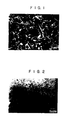
- microstructure of the present sintered composite material is illustrated below with reference to accompanying SEM and optical micrograph.
- the present sintered material comprises fine elongated grains and fine equiaxed grains, most of the former grains being 0.2 to 1.0 u.m in minor axis and 1 to 10 ⁇ m in major axis. Since the elongated grains decrease in number with the increase in silicon carbide content, the elongated grains may be assumed to be silicon nitride grains. The equiaxed grains are 1 ⁇ m or less in average size and may be assumed to be silicon carbide grains and silicon nitride grains.
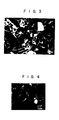
- the gray grains are those of silicon nitride and the white grains are those of silicon carbide. It is seen from Fig. 2 that silicon carbide grains are 1 ⁇ m or less in size and uniformly dispersed.
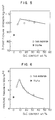
- Fig. 4 shows SEM of a composite powder obtained by the heat treatment at 1200° C, for 4 hours, under nitrogen atmosphere, of an amorphous composite powder formed by the vapor phase reaction of CH 3 Si-(NHCH 3 ) 3 . It is seen that the composite powder is a spherical powder of 0.1 to 0.3 ⁇ m in particle size and its size distribution is very narrow.
- Fig. 5 shows that the three-point flexural strength is 95 kg/mm 2 or above in the range of silicon carbide content of 3 to 35% by weight. These values are higher than those of sintered silicon nitride.
- the invention is illustrated below in detail with reference to Examples and Comparative Examples which are presented as mere examples and not to be construed as limiting the invention.
- the 3-point flexural strength was tested at a span of 20 mm and a cross-head speed of 0.5 mm/minute.
- the fracture toughness was tested by the method of indentation microfracture and evaluated by using the formula described in J. Mater. Sci. Lett., 1, 13 (1982).
- the bulk density was tested by Archimedes method and the hardness was evaluated in terms of Vickers hardness number by using a microhardness tester (19.6 N load; 20-second retention).
- the gaseous mixture, used as starting material, was fed to an alumina reactor, 50 mm in internal diameter and 80 mm in length, which had been held at 1,000 ⁇ C to carry out the reaction and to obtain the reaction product.
- the composition of the resulting amorphous composite powder was as shown in Table 1.
- a 50-g portion of the amorphous composite powder was heat-treated at 1,200°C for 4 hours under a nitrogen atmosphere. The heat treatment caused a loss of 13.8% by weight. The resulting powder was amorphous, because the X-ray diffraction pattern showed no peak. Inspection of SEM showed that the powder was spherical, the particle size being distributed in a narrow range of from 0.1 to 0.3 ⁇ m. SEM was as shown in Fig. 4 and the composition of the composite powder was as shown in Table 1.
- Example 1 Using a reactor similar to that in Example 1, the vapor phase reaction was conducted with various starting materials and reaction conditions. The resulting powder was heat treated. The type of starting material, reaction conditions and the composition of resulting powder were as shown in Table 1.
- the resulting powder was amorphous, because no peak was detected in the X-ray diffraction pattern. Inspection of SEM showed that the amorphous powder was spherical particles and the particle size was distributed in a narrow range of from 0.1 to 0.5 ⁇ m.
- the composition of each composite powder was as shown in Table 2.
- hexamethyldisilazane [Si(CH 3 ) 3]2 NH used as starting material, was fed to a vaporizer to effect complete vaporization.
- the resulting vapor was thoroughly mixed with a gaseous ammonia-argon mixture of the composition shown in Table 3 and fed to an alumina reactor, 90 mm in diameter and 1,300 mm in length, which was held in a vertical resistance furnace and maintained at 1,000 C, thereby to allow the reaction to proceed.
- the resulting powder was filled in an alumina vessel and heat treated at 1,350° C for 4 hours under an argon stream of a linear velocity of 12.0 mm/sec, thereby to yield a powder for forming a sintered product.
- the resulting powder was amorphous as confirmed by the X-ray diffraction pattern and the particles were spherical particles of 0.5 ⁇ m or below in size.
- the above powder was mixed with 6% by weight of yttria (Y 2 0 3 ) and 2% by weight of alumina (A1 2 0 3 ) in an alumina mortar for 2 hours under a nitrogen stream.
- the resulting mixed powder was filled in a graphite die of 30 mm in diameter and sintered by hot-pressing at 1,800 ° C for 2 hours under pressure of 350 kg/cm 2 in the presence of nitrogen.
- the resulting sintered product was cut, then ground with diamond grinder #100 and #600, and polished with diamond paste of 3 ⁇ m and 1 ⁇ m to obtain a test piece, 2 x 3 x 25 mm.
- the results of test for physical properties were as shown in Table 3.
- SEM and the optical micrograph of the section of fracture surface of the sintered product containing 10% by weight of silicon carbide prepared in Example 15 were as shown in Fig. 1 and Fig. 2, respectively.
- the 3-point flexural strength and the fracture toughness were as shown in Fig. 5 and Fig. 6, respectively.
- a vapor phase reaction product was obtained in the same manner as in Example 14, except that ammonia-to-argon ratio (NH 3 : Ar) was 75:25 and 50:50.
- the reaction product was heat-treated at 1,100°C for 10 hours or at 1,200°C for 7 hours both under a nitrogen atmosphere. Physical properties of the sintered product were found to be as shown in Table 4.
- Silicon nitride powder of Comparative Example 3 and ⁇ -silicon carbide (0.7 ⁇ m in average particle size; impurities contents: Fe, Al, Ca and O were 0.02, 0.1, 0.04 and 0.04% by weight, respectively were mixed in proportions shown in Table 5.
- To each mixture were added 6% by weight of yttria and 2% by weight of alumina.
- the resulting mixture and ethanol were wet mixed by milling with silicon nitride balls for 5 hours.
- the resulting mixture was sintered by hot pressing under the same conditions as in Example 14. Each sintered product was tested for physical properties. The results obtained were as shown in Table 5.
Landscapes
- Chemical & Material Sciences (AREA)
- Organic Chemistry (AREA)
- Engineering & Computer Science (AREA)
- Ceramic Engineering (AREA)
- Inorganic Chemistry (AREA)
- Manufacturing & Machinery (AREA)
- Materials Engineering (AREA)
- Structural Engineering (AREA)
- Health & Medical Sciences (AREA)
- General Health & Medical Sciences (AREA)
- Ceramic Products (AREA)
Claims (5)
Priority Applications (3)
| Application Number | Priority Date | Filing Date | Title |
|---|---|---|---|
| US07/004,476 US4800182A (en) | 1987-01-22 | 1987-01-20 | Silicon nitride-silicon carbide composite material and process for production thereof |
| DE8787100853T DE3772371D1 (de) | 1987-01-22 | 1987-01-22 | Siliciumnitrid-siliciumkarbidmaterial und verfahren zu seiner herstellung. |
| EP87100853A EP0276334B1 (de) | 1987-01-22 | 1987-01-22 | Siliciumnitrid-Siliciumkarbidmaterial und Verfahren zu seiner Herstellung |
Applications Claiming Priority (1)
| Application Number | Priority Date | Filing Date | Title |
|---|---|---|---|
| EP87100853A EP0276334B1 (de) | 1987-01-22 | 1987-01-22 | Siliciumnitrid-Siliciumkarbidmaterial und Verfahren zu seiner Herstellung |
Publications (2)
| Publication Number | Publication Date |
|---|---|
| EP0276334A1 EP0276334A1 (de) | 1988-08-03 |
| EP0276334B1 true EP0276334B1 (de) | 1991-08-21 |
Family
ID=8196693
Family Applications (1)
| Application Number | Title | Priority Date | Filing Date |
|---|---|---|---|
| EP87100853A Expired - Lifetime EP0276334B1 (de) | 1987-01-22 | 1987-01-22 | Siliciumnitrid-Siliciumkarbidmaterial und Verfahren zu seiner Herstellung |
Country Status (3)
| Country | Link |
|---|---|
| US (1) | US4800182A (de) |
| EP (1) | EP0276334B1 (de) |
| DE (1) | DE3772371D1 (de) |
Families Citing this family (29)
| Publication number | Priority date | Publication date | Assignee | Title |
|---|---|---|---|---|
| WO1987005597A1 (en) * | 1986-03-14 | 1987-09-24 | Commonwealth Scientific And Industrial Research Or | Method of forming a ceramic product |
| US5080844A (en) * | 1987-08-31 | 1992-01-14 | Gte Laboratories Incorporated | SI3N4 process using polysilane or polysilazane as a binder |
| DE3742862A1 (de) * | 1987-11-23 | 1989-06-01 | Norton Gmbh | Feuerfestmaterial und verfahren zur herstellung desselben |
| DE3824614A1 (de) * | 1988-07-20 | 1990-01-25 | Hoechst Ag | Verfahren zur herstellung von siliziumnitrid enthaltendem keramischem material aus polymeren hydridochlorsilazanen |
| JP2764589B2 (ja) * | 1988-11-21 | 1998-06-11 | 日本特殊陶業株式会社 | ベアリング用窒化珪素基焼結体 |
| DE3840773A1 (de) * | 1988-12-03 | 1990-06-07 | Hoechst Ag | Sinterfaehiges keramikpulver, verfahren zu seiner herstellung, daraus hergestellte siliziumnitridkeramik, verfahren zu deren herstellung sowie deren verwendung |
| JP2697759B2 (ja) * | 1989-03-17 | 1998-01-14 | 日本碍子株式会社 | 窒化珪素焼結体およびその製造法 |
| JPH035374A (ja) * | 1989-06-01 | 1991-01-11 | Mitsubishi Gas Chem Co Inc | 窒化ケイ素―炭化ケイ素複合焼結体およびその製造法 |
| US5244621A (en) * | 1989-12-26 | 1993-09-14 | Mitsubishi Gas Chemical Company, Inc. | Process for shaping ceramic composites |
| JP2730245B2 (ja) * | 1990-01-29 | 1998-03-25 | 日産自動車株式会社 | 炭化珪素・窒化珪素質複合焼結体の製造方法 |
| CA2058075C (en) * | 1990-12-26 | 1996-07-02 | Akira Yamakawa | Composite ceramic powder and production process thereof |
| EP0493802B1 (de) * | 1990-12-27 | 1996-08-28 | Kyocera Corporation | Siliciumnitrid-Siliciumcarbid gesinterter Verbundwerkstoff |
| US5759933A (en) * | 1991-04-09 | 1998-06-02 | Alliedsignal Inc. | Gas pressure sintered silicon nitride having high strength and stress rupture resistance |
| US5637540A (en) * | 1991-06-17 | 1997-06-10 | Alliedsignal Inc. | Sintered silicon nitride of high toughness, strength and reliability |
| EP0589997B1 (de) * | 1991-06-17 | 1995-07-19 | AlliedSignal Inc. | Gesintertes silicumnitrid von hoher zähigkeit und festigkeit |
| US5358912A (en) * | 1991-08-08 | 1994-10-25 | Loral Vought Systems Corporation | BAS reinforced in-situ with silicon nitride |
| WO1993004012A1 (en) * | 1991-08-13 | 1993-03-04 | Sumitomo Electric Industries Ltd. | Composite silicon nitride sinter and production thereof |
| DE4303106C2 (de) * | 1993-02-04 | 1997-01-16 | Fraunhofer Ges Forschung | Verfahren zur Herstellung von feinteiligen chloridfreien Siliciumcarbonitridpulvern |
| FR2703040B1 (fr) * | 1993-03-23 | 1995-05-12 | Atochem Elf Sa | Procédé de préparation de poudre pour céramique en nitrure et/ou carbure métallique et/ou métalloïdique par pyrolyse-flash et la poudre ainsi obtenue. |
| US5523268A (en) * | 1993-12-22 | 1996-06-04 | Kabushiki Kaisha Toyota Chuo Kenkyusho | Silicon nitride sintered body |
| US5648028A (en) * | 1994-03-30 | 1997-07-15 | Honda Giken Kogyo Kabushiki Kaisha | Method of manufacturing a sintered composite body of silicon nitride and silicon carbide |
| US5767025A (en) * | 1994-03-30 | 1998-06-16 | Honda Giken Kogyo Kabushiki Kaisha | Composite powder comprising silicon nitride and silicon carbide |
| JP3317421B2 (ja) * | 1994-08-30 | 2002-08-26 | 日産自動車株式会社 | 炭化ケイ素/窒化ケイ素複合材料およびその製造方法 |
| EP0712819B1 (de) * | 1994-11-21 | 1999-09-22 | Honda Giken Kogyo Kabushiki Kaisha | Verfahren zur Herstellung von Kompositsinterkörpern aus Siliciumkarbid und Siliciumnitrid |
| US5908796A (en) * | 1998-05-01 | 1999-06-01 | Saint-Gobain Industrial Ceramics, Inc. | Dense silicon nitride ceramic having fine grained titanium carbide |
| US20040043888A1 (en) * | 2002-08-28 | 2004-03-04 | Noritake Co., Limited | Compositions and methods for making microporous ceramic materials |
| US7029613B2 (en) * | 2003-01-21 | 2006-04-18 | The Regents Of The University Of California | Method of forming silicon carbide and silicon nitride composite |
| JP6041527B2 (ja) * | 2012-05-16 | 2016-12-07 | キヤノン株式会社 | 液体吐出ヘッド |
| CN107353025B (zh) * | 2017-06-27 | 2020-10-20 | 中航复合材料有限责任公司 | 一种耐1200℃抗氧化的陶瓷基复合材料的制备方法 |
Family Cites Families (9)
| Publication number | Priority date | Publication date | Assignee | Title |
|---|---|---|---|---|
| US3890250A (en) * | 1973-03-14 | 1975-06-17 | Norton Co | Hot pressed silicon nitride containing finely dispersed silicon carbide or silicon aluminum oxynitride |
| US4073845A (en) * | 1976-01-29 | 1978-02-14 | Gte Sylvania Incorporated | High density high strength S13 N4 ceramics prepared by pressureless sintering of partly crystalline, partly amorphous S13 N4 powder |
| US4187116A (en) * | 1976-03-25 | 1980-02-05 | Westinghouse Electric Corp. | Silicon nitride-silicon carbide composite material |
| US4184882A (en) * | 1976-03-25 | 1980-01-22 | Westinghouse Electric Corp. | Silicon nitride-silicon carbide composite material |
| DE3141726C2 (de) * | 1981-10-21 | 1984-02-23 | Gkss - Forschungszentrum Geesthacht Gmbh, 2054 Geesthacht | Verfahren zur Vermeidung bzw. Reduzierung der Wechselwirkungen und deren Folgen bei einem Kontakt von heißem, flüssigem, metallischem Natrium mit Beton |
| DE3142058A1 (de) * | 1981-10-23 | 1983-05-05 | Elektroschmelzwerk Kempten GmbH, 8000 München | Praktisch porenfreie formkoerper aus polykristallinem siliciumnitrid und siliciumcarbid und verfahren zu ihrer herstellung durch isostatisches heisspressen |
| US4594330A (en) * | 1984-03-22 | 1986-06-10 | Mitsubishi Gas Chemical Company, Inc. | Fine amorphous powder and process for preparing fine powdery mixture of silicon nitride and silicon carbide |
| US4613490A (en) * | 1984-05-08 | 1986-09-23 | Mitsubishi Gas Chemical Company, Inc. | Process for preparing silicon nitride, silicon carbide or fine powdery mixture thereof |
| JPS61201663A (ja) * | 1985-02-28 | 1986-09-06 | 工業技術院長 | 繊維組織窒化ケイ素系焼結体の製造方法 |
-
1987
- 1987-01-20 US US07/004,476 patent/US4800182A/en not_active Expired - Fee Related
- 1987-01-22 EP EP87100853A patent/EP0276334B1/de not_active Expired - Lifetime
- 1987-01-22 DE DE8787100853T patent/DE3772371D1/de not_active Expired - Fee Related
Also Published As
| Publication number | Publication date |
|---|---|
| DE3772371D1 (de) | 1991-09-26 |
| EP0276334A1 (de) | 1988-08-03 |
| US4800182A (en) | 1989-01-24 |
Similar Documents
| Publication | Publication Date | Title |
|---|---|---|
| EP0276334B1 (de) | Siliciumnitrid-Siliciumkarbidmaterial und Verfahren zu seiner Herstellung | |
| EP2165990B1 (de) | Dichte borcarbidkeramik und verfahren zu deren herstellung | |
| EP0385509A1 (de) | Verfahren zur Erzeugung keramischer Verbundwerkstoffe | |
| US5134097A (en) | Silicon nitride-silicon carbide composite material and process for production thereof | |
| JP2001511106A (ja) | 312三元セラミック材料の表面処理およびその製品 | |
| JPS59107908A (ja) | 焼結性に優れた窒化珪素粉末の製造法 | |
| JPH055782B2 (de) | ||
| JPH0476924B2 (de) | ||
| Lee | Fabrication of Si3N4/SiC composite by reaction‐bonding and gas‐pressure sintering | |
| EP0311289B1 (de) | SiC-A12O3-Sinterverbundkörper und Verfahren zu ihrer Herstellung | |
| Yoshimura et al. | Sintering of 6H (α)-SiC and 3C (β)-SiC powders with B4C and C additives | |
| EKSTRÖM et al. | α‐β sialon ceramics made from different silicon nitride powders | |
| KR20010018143A (ko) | 강도와 인성이 우수한 질화규소 세라믹 제조방법 | |
| JPH01275470A (ja) | 窒化ケイ素−炭化ケイ素複合焼結体の製造法 | |
| JPH07315937A (ja) | 窒化ホウ素常圧焼結体及びその製造方法 | |
| EP0250592A1 (de) | Alpha-sialon enthaltende keramik | |
| JP2910359B2 (ja) | 窒化ケイ素質焼結体の製造方法 | |
| JPH0455996B2 (de) | ||
| JP3472802B2 (ja) | サイアロン焼結体の製造法 | |
| JPS63252967A (ja) | 窒化珪素質焼結体の製造方法 | |
| JPH0535694B2 (de) | ||
| JPH07115928B2 (ja) | 繊維強化酸窒化珪素焼結体の製造方法 | |
| JP2610156B2 (ja) | 窒化ケイ素粉末の製造方法 | |
| Rakshit et al. | Optimization of time-temperature schedule for nitridation of silicon compact on the basis of silicon and nitrogen reaction kinetics | |
| JPS63159204A (ja) | 非晶質球状複合粉末およびその製造法 |
Legal Events
| Date | Code | Title | Description |
|---|---|---|---|
| PUAI | Public reference made under article 153(3) epc to a published international application that has entered the european phase |
Free format text: ORIGINAL CODE: 0009012 |
|
| AK | Designated contracting states |
Kind code of ref document: A1 Designated state(s): DE FR GB |
|
| 17P | Request for examination filed |
Effective date: 19880916 |
|
| 17Q | First examination report despatched |
Effective date: 19900912 |
|
| GRAA | (expected) grant |
Free format text: ORIGINAL CODE: 0009210 |
|
| AK | Designated contracting states |
Kind code of ref document: B1 Designated state(s): DE FR GB |
|
| REF | Corresponds to: |
Ref document number: 3772371 Country of ref document: DE Date of ref document: 19910926 |
|
| ET | Fr: translation filed | ||
| PLBE | No opposition filed within time limit |
Free format text: ORIGINAL CODE: 0009261 |
|
| STAA | Information on the status of an ep patent application or granted ep patent |
Free format text: STATUS: NO OPPOSITION FILED WITHIN TIME LIMIT |
|
| 26N | No opposition filed | ||
| PGFP | Annual fee paid to national office [announced via postgrant information from national office to epo] |
Ref country code: FR Payment date: 19940111 Year of fee payment: 8 |
|
| PGFP | Annual fee paid to national office [announced via postgrant information from national office to epo] |
Ref country code: GB Payment date: 19940112 Year of fee payment: 8 |
|
| PGFP | Annual fee paid to national office [announced via postgrant information from national office to epo] |
Ref country code: DE Payment date: 19940121 Year of fee payment: 8 |
|
| PG25 | Lapsed in a contracting state [announced via postgrant information from national office to epo] |
Ref country code: GB Effective date: 19950122 |
|
| GBPC | Gb: european patent ceased through non-payment of renewal fee |
Effective date: 19950122 |
|
| PG25 | Lapsed in a contracting state [announced via postgrant information from national office to epo] |
Ref country code: FR Effective date: 19950929 |
|
| PG25 | Lapsed in a contracting state [announced via postgrant information from national office to epo] |
Ref country code: DE Effective date: 19951003 |
|
| REG | Reference to a national code |
Ref country code: FR Ref legal event code: ST |