EP0276992A2 - Automatische Wahleinrichtung mit entweder direktem Zugang zum Fernsprechnetz oder indirektem Zugang über ein lokales Netz - Google Patents
Automatische Wahleinrichtung mit entweder direktem Zugang zum Fernsprechnetz oder indirektem Zugang über ein lokales Netz Download PDFInfo
- Publication number
- EP0276992A2 EP0276992A2 EP88300663A EP88300663A EP0276992A2 EP 0276992 A2 EP0276992 A2 EP 0276992A2 EP 88300663 A EP88300663 A EP 88300663A EP 88300663 A EP88300663 A EP 88300663A EP 0276992 A2 EP0276992 A2 EP 0276992A2
- Authority
- EP
- European Patent Office
- Prior art keywords
- recalled
- call identifier
- destination terminal
- status indication
- terminal number
- Prior art date
- Legal status (The legal status is an assumption and is not a legal conclusion. Google has not performed a legal analysis and makes no representation as to the accuracy of the status listed.)
- Withdrawn
Links
Images



Classifications
-
- H—ELECTRICITY
- H04—ELECTRIC COMMUNICATION TECHNIQUE
- H04M—TELEPHONIC COMMUNICATION
- H04M1/00—Substation equipment, e.g. for use by subscribers
- H04M1/26—Devices for calling a subscriber
- H04M1/27—Devices whereby a plurality of signals may be stored simultaneously
- H04M1/274—Devices whereby a plurality of signals may be stored simultaneously with provision for storing more than one subscriber number at a time, e.g. using toothed disc
- H04M1/2745—Devices whereby a plurality of signals may be stored simultaneously with provision for storing more than one subscriber number at a time, e.g. using toothed disc using static electronic memories, e.g. chips
- H04M1/27485—Appending a prefix to or inserting a pause into a dialling sequence
Definitions
- the present invention relates to an automatic dialer, and more particularly to a dialer for a communications terminal which is accessable to a public telecommunication network via a direct route or via a local network such as private branch exchanges.
- the present invention is particularly advantageous for portable communications terminals whose mode of connection is frequently switched between the public network and the local network.
- PBX private branch exchange
- a network access digit and a pause are registered in a memory before a telephone number of the network is registered to allow establishment of a dial-tone connection to the network during call setup mode, while extension telephone numbers of the PBX are registered with no additional information. If the mode of terminal connection is switched from the PBX to the public network, all the registered information becomes useless for automatic dialing. Thus, the contents of the memory must be altered with an effort which is time consuming and annoying. This is problematic if the dialer is attached to a portable communications terminal whose mode of connection is frequently switched between the public network and PBX.
- an automatic dialer provides a first status indication when the associated communications terminal is connected to a local network or a second status indication when the terminal is connected to the public network.
- a read/write memory and a numeric keypad are provided.
- a controller is responsive to a unique keystroke input to the keypad to store a first set of data including a first call identifier and a destination terminal number of the public network into a first storage location of the memory or a second set of data including a second call identifier and a destination terminal number of the local network into a second storage location of the memory.
- the controller is responsive to a replica of the unique keystroke input to recall data from the first or second storage location.
- the controller dials a network access digit and the recalled destination terminal number with a pause therebetween if the recalled data contains the first call identifier and dials the recalled destination terminal number if the recalled data contains the second call identifier.
- the controller dials the recalled destination terminal number if the recalled data contains the first call identifier or discards the recalled data if it contains the second call identifier.
- Fig. 1 there is shown an automatic dialer illustrating the present invention.
- the dialer includes a microprocessor 1 to which input devices such as a numeric keypad 3, a mode select switch 4 and an array of command switches are connected through a keyboard interface 10.
- Numeric keypad 3 is used to enter numeric data for registration of a two-digit abbreviated dialing number, a network access digit and a multidigit telephone number.
- the command switches are designated by legends ABB, TEL, ID, EOR, AUD and ST.
- Switch ABB is used for registration of two-digit abbreviated dialing numbers, TEL for registration of telephone numbers, ID for registration of call identifier bits, EOR for entry of a command indicating the end of registration, AUD for establishing a call in an automatic dialing mode using a two-digit abbreviated dialing number, and ST for entry of a proceed-to-send command for starting a dialing procedure.
- a read/write memory 2 and an address generator 5 are connected to the microprocessor to save data from a buffer 7 into memory 2 during registration mode and recall data from memory 2 during call set-up mode. Buffer 7 is divided into areas for storing a two-digit abbreviated dialing number, a call identifier bit and multidigit telephone number of either network or PBX, respectively.
- Microprocessor 1 is associated with a program memory 6 to operate in accordance with number registration and call setup programs stored therein.
- output devices including a display controller 8, a liquid crystal display 9, and dialing relays DS and DI having contacts "ds" and "di", respectively. These relay contacts are connected in a line circuit 11 which is selectively connected to a PBX (private branch exchange) equipment or the public telephone network. Line circuit 11 is terminated through a coupling transformer 12 to a modem 13 and thence to a facsimile apparatus, not shown.
- PBX private branch exchange
- FIG. 2A the program starts with decision block 20 which checks to see if the ABB (abbreviated number registration) switch is operated. If the answer is affirmative, exit is to decision block 21 which checks for the presence of a keystroke on the keypad 3. If there is one, control exits to operations block 22 which directs the writing of a digit entered through keypad 3 into an abbreviated number area of the buffer 7.
- the abbreviated dialing number is typically a two-digit code and so two keystrokes are detected in sequence before control exits to decision block 23 which checks to see if the EOR (end-of-registration) switch is operated or not.
- control returns to block 21 to repeat the write operation once again to store the subsequently entered numeric data into the abbreviated number area of buffer 7 as a second digit of the abbreviated dialing number.
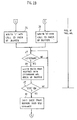
- decision block 24 tests for the operation of the TEL (telephone number registration) switch. If the answer is affirmative, exit is to decision block 25 which checks for the operation of the ID (call identifier registration) switch. If one wishes to register a telephone number of the public telephone network, the ID switch is operated and the answer is thus affirmative in block 25. Exit is to operations block 26 which directs the writing of a binary 1 into the call identifier area of the buffer 7. Binary 1 in the call identifier area indicates that a network access digit (usually decimal "0") must be dialed first followed by the introduction of a pause to allow time to establish a dial-tone connection to the public telephone network.
- decision block 27 Fig. 2B, which checks for the presence of a keystroke on numeric keypad 3. If there is one, exit is to operations block 28 which directs the writing of a digit entered by keypad 3 into the telephone number area of buffer 7. Exit then is to decision block 29 which checks to see if the end-of-registration switch EOR is operated. If the answer is negative, control repeats the blocks 27 and 28. When all digits of a desired telephone number are stored into the buffer's telephone number storage area, the EOR switch is operated and control proceeds to operations block 30 which directs the saving of all data now stored in buffer 7 by transfer to read/write memory 2.
- decision block 25 If one wishes to register a PBX extension number, the ID switch is not operated. Thus, the answer is negative in decision block 25 and control exits to decision block 31 which directs the writing of a binary 0 into the call identifier area of buffer 7. This binary 0 indicates that a call is destined to a PBX extension. Exit then is to blocks 27 to 30 to store multidigits of a desired PBX extension number into the read/write memory 2.
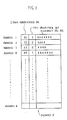
- read/write memory 2 is partitioned into a plurality of storage locations each being subdivided into areas for storing a two-digit abbreviated number, a call identifying bit and multidigit telephone number, respectively.
- Each storage location is accessed by an address generated by the address generator 5 corresponding to a two-digit abbreviated number entered through keypad 3 during call setup mode.
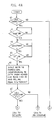
- the call setup program starts with decision block 40 which checks to see if switch 4 is in the left-side position or right-side position which indicates respectively that the apparatus is connected to the PBX or public telephone network. If the mode switch 4 is in the left-side position, control exits to decision block 41 which checks to see if the AUD (automatic dialing) switch is operated. If the answer is affirmative, exit is to decision block 42 which tests for the presence of a keystroke on the numeric keypad 3, and if there is one, control moves to block 43 to see if the start switch ST is operated. If keystrokes have been entered twice corresponding to a two-digit abbreviated dialing number and the user operates the start switch ST.
- decision block 40 checks to see if switch 4 is in the left-side position or right-side position which indicates respectively that the apparatus is connected to the PBX or public telephone network. If the mode switch 4 is in the left-side position, control exits to decision block 41 which checks to see if the AUD (automatic dialing) switch is operated. If the
- Address generator 5 supplies an address code to the read/write memory 2 to read a call identifier bit and a telephone number from a storage location identified by the address code.
- decision block 45 which checks to see whether the call identifier is binary 1 or binary 0. If the answer is affirmative, the call is destined to a network subscriber and exit is to operations block 46, Fig. 4B, which directs the operating of the DI and DS relays to provide a DC loop to the line teminal of the PBX. Control then proceeds to operations block 47 which directs the interrupting of the DS relay to dial a network access digit.
- control proceeds to operations block 49 which directs the interrupting of the DS relay according to each digit of the telephone number recalled from the read/write memory 2.
- operations block 51 which directs the releasing of the DI relay to remove the DC loop from the line circuit, establishing a connection between the source terminal and the network destination terminal.
- the call is interpreted as being destined to a PBX extension and control exits to operations block 52 which directs the operating of the DI and DS relays to provide a DC loop to the PBX, and then proceeds to blocks 49 to 51 to interrupt the DS relay according to each digit of a PBX extension number recalled from the memory 2 and release the DI relay to establish a connection between the source terminal and the PBX destination terminal.
- decision block 53 checks to see if the AUD relay is operated. If it is, control advances to decision block 54 to check for the presence of a keystroke on numeric keypad 3. If the answer is affirmative, control goes to decision block 55 to check to see if the start switch ST is operated. If it is not, control repeats the blocks 54 and 55 to ascertain that keystrokes are twice entered corresponding to a two-digit abbreviated dialing number. If the answer is affirmative in block 55, control moves to operations block 56 which directs the reading of a call identifier bit and a telephone number from the read/write memory 2 as a function of the keystroke input to the keypad.
- decision block 57 which checks the call identifier for the presence of binary 1 or 0, and if there is one indicating that the call is interpreted as being destined to a network terminal, exit is to operations block 52 to execute a dialing process for calling the network destination. If there is none indicating that the call is destined to a PBX terminal, control exits to operations block 58 which directs the displaying of an error mark on the liquid crystal display 9.
Landscapes
- Engineering & Computer Science (AREA)
- Signal Processing (AREA)
- Telephonic Communication Services (AREA)
- Sub-Exchange Stations And Push- Button Telephones (AREA)
- Facsimile Transmission Control (AREA)
- Facsimiles In General (AREA)
Applications Claiming Priority (2)
| Application Number | Priority Date | Filing Date | Title |
|---|---|---|---|
| JP62020928A JPS63187954A (ja) | 1987-01-30 | 1987-01-30 | フアクシミリ装置 |
| JP20928/87 | 1987-01-30 |
Publications (2)
| Publication Number | Publication Date |
|---|---|
| EP0276992A2 true EP0276992A2 (de) | 1988-08-03 |
| EP0276992A3 EP0276992A3 (de) | 1988-12-07 |
Family
ID=12040877
Family Applications (1)
| Application Number | Title | Priority Date | Filing Date |
|---|---|---|---|
| EP88300663A Withdrawn EP0276992A3 (de) | 1987-01-30 | 1988-01-27 | Automatische Wahleinrichtung mit entweder direktem Zugang zum Fernsprechnetz oder indirektem Zugang über ein lokales Netz |
Country Status (6)
| Country | Link |
|---|---|
| US (1) | US4825463A (de) |
| EP (1) | EP0276992A3 (de) |
| JP (1) | JPS63187954A (de) |
| DK (1) | DK48588A (de) |
| FI (1) | FI90170C (de) |
| NO (1) | NO880362L (de) |
Cited By (4)
| Publication number | Priority date | Publication date | Assignee | Title |
|---|---|---|---|---|
| NL9500339A (nl) * | 1995-02-22 | 1996-10-01 | Nederland Ptt | Inrichting voor het op afstand deelnemen aan een virtueel privaat netwerk. |
| DE29802170U1 (de) * | 1998-02-09 | 1999-06-02 | Meckelburg, Karl-Heinz, 44879 Bochum | Telefon mit Hintereinanderschaltung von verschiedenen Rufnummern |
| EP1085729A1 (de) * | 1999-09-16 | 2001-03-21 | Sagem Sa | Verfahren zur automatischen Konfigurierung eines Fernsprechgeräts zur Bestimmung einer Ortsnetzkennzahl |
| WO2003049410A3 (en) * | 2001-12-03 | 2003-09-04 | Matsushita Electric Industrial Co Ltd | Telephone and private branch exchange |
Families Citing this family (10)
| Publication number | Priority date | Publication date | Assignee | Title |
|---|---|---|---|---|
| JPH0728763Y2 (ja) * | 1988-12-09 | 1995-06-28 | 三洋電機株式会社 | 電話機の発信規制回路 |
| JPH0314355A (ja) * | 1989-06-13 | 1991-01-23 | Oki Electric Ind Co Ltd | 非電話系端末の局線発信方法及びその端末 |
| JPH03187658A (ja) * | 1989-12-18 | 1991-08-15 | Matsushita Graphic Commun Syst Inc | 電話帳機能付電話機 |
| JPH0736589B2 (ja) * | 1990-10-24 | 1995-04-19 | 富士ゼロックス株式会社 | ファクシミリ装置 |
| JPH05160894A (ja) * | 1991-12-09 | 1993-06-25 | Canon Inc | 自動ダイヤル装置 |
| US5550915A (en) * | 1993-07-02 | 1996-08-27 | Lucent Technologies, Inc. | Apparatus for use in completing telephone calls |
| US5949873A (en) * | 1997-04-07 | 1999-09-07 | Mitel Corporation | Method of providing centrex type operation using a PBX and a central switching office |
| US6137877A (en) * | 1997-07-09 | 2000-10-24 | Robin; Bruce | Method and apparatus for routing a dialed telephone number |
| US20030200195A1 (en) * | 1999-08-06 | 2003-10-23 | Muhlenhaupt Ronald P. | Method and apparatus for providing access to information |
| JP4140676B2 (ja) * | 2000-02-21 | 2008-08-27 | 株式会社日立コミュニケーションテクノロジー | 構内交換機 |
Family Cites Families (5)
| Publication number | Priority date | Publication date | Assignee | Title |
|---|---|---|---|---|
| DE2940490A1 (de) * | 1979-10-03 | 1981-04-09 | Hagenuk Vormals Neufeldt & Kuhnke Gmbh, 2300 Kiel | Automatischer pausengenerator fuer waehleinrichtungen |
| CH649182A5 (fr) * | 1981-09-23 | 1985-04-30 | Lupa Finances | Composeur automatique de numeros de telephone. |
| DE3326827A1 (de) * | 1983-07-26 | 1985-02-14 | Standard Elektrik Lorenz Ag, 7000 Stuttgart | Telefonapparat mit leseeinrichtung fuer speicherkarten |
| US4571463A (en) * | 1984-06-01 | 1986-02-18 | Code-A-Phone Corporation | Method and system for automatically inserting at least one pause into means for memorizing a dialing sequence |
| JPS612462A (ja) * | 1984-06-15 | 1986-01-08 | Oki Electric Ind Co Ltd | オ−トダイアル方式 |
-
1987
- 1987-01-30 JP JP62020928A patent/JPS63187954A/ja active Pending
-
1988
- 1988-01-25 US US07/147,648 patent/US4825463A/en not_active Expired - Fee Related
- 1988-01-27 EP EP88300663A patent/EP0276992A3/de not_active Withdrawn
- 1988-01-28 FI FI880393A patent/FI90170C/fi not_active IP Right Cessation
- 1988-01-28 NO NO880362A patent/NO880362L/no unknown
- 1988-01-29 DK DK048588A patent/DK48588A/da not_active Application Discontinuation
Cited By (6)
| Publication number | Priority date | Publication date | Assignee | Title |
|---|---|---|---|---|
| NL9500339A (nl) * | 1995-02-22 | 1996-10-01 | Nederland Ptt | Inrichting voor het op afstand deelnemen aan een virtueel privaat netwerk. |
| DE29802170U1 (de) * | 1998-02-09 | 1999-06-02 | Meckelburg, Karl-Heinz, 44879 Bochum | Telefon mit Hintereinanderschaltung von verschiedenen Rufnummern |
| EP1085729A1 (de) * | 1999-09-16 | 2001-03-21 | Sagem Sa | Verfahren zur automatischen Konfigurierung eines Fernsprechgeräts zur Bestimmung einer Ortsnetzkennzahl |
| FR2798800A1 (fr) * | 1999-09-16 | 2001-03-23 | Sagem | Procede de configuration automatique d'un equipement telephonique pour definir un prefixe de numerotation et equipement telephonique associe |
| WO2003049410A3 (en) * | 2001-12-03 | 2003-09-04 | Matsushita Electric Industrial Co Ltd | Telephone and private branch exchange |
| US7113583B2 (en) | 2001-12-03 | 2006-09-26 | Matsushita Electric Industrial Co., Ltd. | Telephone and private branch exchange |
Also Published As
| Publication number | Publication date |
|---|---|
| FI90170B (fi) | 1993-09-15 |
| FI880393A7 (fi) | 1988-07-31 |
| FI880393A0 (fi) | 1988-01-28 |
| FI90170C (fi) | 1993-12-27 |
| DK48588D0 (da) | 1988-01-29 |
| EP0276992A3 (de) | 1988-12-07 |
| JPS63187954A (ja) | 1988-08-03 |
| US4825463A (en) | 1989-04-25 |
| NO880362L (no) | 1988-08-01 |
| DK48588A (da) | 1988-07-31 |
| NO880362D0 (no) | 1988-01-28 |
Similar Documents
| Publication | Publication Date | Title |
|---|---|---|
| US4825463A (en) | Automatic dialer for accessing public network directly of via local network | |
| WO1995006379A1 (en) | Circuit and method for automatic memory dialing | |
| KR100360226B1 (ko) | 사설간이전자교환장치를이용한발신자전화번호의저장,조회및호출방법 | |
| KR100298153B1 (ko) | 통신기기의지역번호자동선택/송출방법 | |
| JPH0720746U (ja) | 多重回線電話機用自動再ダイアリング装置 | |
| JPS63104555A (ja) | 通信装置 | |
| JP3013854B2 (ja) | 通信装置 | |
| KR100269766B1 (ko) | 전화기에서의 단축 다이얼 방법 | |
| JPS6354049A (ja) | 構内交換システム | |
| JPS61144951A (ja) | 電話装置 | |
| JP3147362B2 (ja) | 電子電話帳付き端末装置 | |
| KR0122588B1 (ko) | 무선전화기의 전화번호 다이얼링 방법 | |
| JPH0771158B2 (ja) | 構内交換装置 | |
| JP2914238B2 (ja) | 交換機 | |
| KR100247082B1 (ko) | 전화번호 자동다이얼링장치의 사업자 식별번호보호방법 | |
| JP2000092215A (ja) | 呼転送システムとその交換装置 | |
| JPH0231548A (ja) | 通信装置 | |
| JPH01321755A (ja) | 通信端末装置 | |
| JPH11239205A (ja) | 通信端末及び通信端末に内蔵された電話帳データの登録方法 | |
| JPH06291850A (ja) | ボタン電話装置 | |
| JPH1065827A (ja) | 構内交換機および発信者情報送信方法 | |
| JPH07135529A (ja) | 電話交換システムの短縮ダイヤル番号又はワンタッチダイヤル番号の登録方法および抹消・発信方法 | |
| JPH057243A (ja) | 電子交換機システム | |
| JPH04354235A (ja) | 自動ダイアル装置 | |
| JPH0490255A (ja) | ファクシミリ装置 |
Legal Events
| Date | Code | Title | Description |
|---|---|---|---|
| PUAI | Public reference made under article 153(3) epc to a published international application that has entered the european phase |
Free format text: ORIGINAL CODE: 0009012 |
|
| 17P | Request for examination filed |
Effective date: 19880223 |
|
| AK | Designated contracting states |
Kind code of ref document: A2 Designated state(s): DE GB SE |
|
| PUAL | Search report despatched |
Free format text: ORIGINAL CODE: 0009013 |
|
| AK | Designated contracting states |
Kind code of ref document: A3 Designated state(s): DE GB SE |
|
| 17Q | First examination report despatched |
Effective date: 19910306 |
|
| STAA | Information on the status of an ep patent application or granted ep patent |
Free format text: STATUS: THE APPLICATION IS DEEMED TO BE WITHDRAWN |
|
| 18D | Application deemed to be withdrawn |
Effective date: 19910717 |