EP0278741A2 - Parties de composants électroniques et procédé pour leur fabrication - Google Patents
Parties de composants électroniques et procédé pour leur fabrication Download PDFInfo
- Publication number
- EP0278741A2 EP0278741A2 EP88301099A EP88301099A EP0278741A2 EP 0278741 A2 EP0278741 A2 EP 0278741A2 EP 88301099 A EP88301099 A EP 88301099A EP 88301099 A EP88301099 A EP 88301099A EP 0278741 A2 EP0278741 A2 EP 0278741A2
- Authority
- EP
- European Patent Office
- Prior art keywords
- circuit board
- electronic component
- ceramics
- component part
- bonded
- Prior art date
- Legal status (The legal status is an assumption and is not a legal conclusion. Google has not performed a legal analysis and makes no representation as to the accuracy of the status listed.)
- Granted
Links
Images



Classifications
-
- H—ELECTRICITY
- H10—SEMICONDUCTOR DEVICES; ELECTRIC SOLID-STATE DEVICES NOT OTHERWISE PROVIDED FOR
- H10W—GENERIC PACKAGES, INTERCONNECTIONS, CONNECTORS OR OTHER CONSTRUCTIONAL DETAILS OF DEVICES COVERED BY CLASS H10
- H10W70/00—Package substrates; Interposers; Redistribution layers [RDL]
- H10W70/60—Insulating or insulated package substrates; Interposers; Redistribution layers
- H10W70/62—Insulating or insulated package substrates; Interposers; Redistribution layers characterised by their interconnections
- H10W70/63—Vias, e.g. via plugs
- H10W70/635—Through-vias
-
- H—ELECTRICITY
- H10—SEMICONDUCTOR DEVICES; ELECTRIC SOLID-STATE DEVICES NOT OTHERWISE PROVIDED FOR
- H10W—GENERIC PACKAGES, INTERCONNECTIONS, CONNECTORS OR OTHER CONSTRUCTIONAL DETAILS OF DEVICES COVERED BY CLASS H10
- H10W70/00—Package substrates; Interposers; Redistribution layers [RDL]
- H10W70/01—Manufacture or treatment
- H10W70/05—Manufacture or treatment of insulating or insulated package substrates, or of interposers, or of redistribution layers
- H10W70/093—Connecting or disconnecting other interconnections thereto or therefrom, e.g. connecting bond wires or bumps
-
- Y—GENERAL TAGGING OF NEW TECHNOLOGICAL DEVELOPMENTS; GENERAL TAGGING OF CROSS-SECTIONAL TECHNOLOGIES SPANNING OVER SEVERAL SECTIONS OF THE IPC; TECHNICAL SUBJECTS COVERED BY FORMER USPC CROSS-REFERENCE ART COLLECTIONS [XRACs] AND DIGESTS
- Y10—TECHNICAL SUBJECTS COVERED BY FORMER USPC
- Y10T—TECHNICAL SUBJECTS COVERED BY FORMER US CLASSIFICATION
- Y10T29/00—Metal working
- Y10T29/49—Method of mechanical manufacture
- Y10T29/49002—Electrical device making
- Y10T29/49117—Conductor or circuit manufacturing
- Y10T29/49124—On flat or curved insulated base, e.g., printed circuit, etc.
- Y10T29/49147—Assembling terminal to base
- Y10T29/49149—Assembling terminal to base by metal fusion bonding
Definitions
- This invention relates to an electronic component part with high attaching strength between ceramics substrate and terminal pin and with high operability, and the method of manufacturing the same.
- substrates such as a resin substrate, metal substrate and ceramics substrate, on which a semiconductor device is formed.
- the ceramics substrate is excellent, in a general aspect, over other substrates in terms of its heat dissipation and insulating characteristics and its strength and is extensively employed in the art. Ceramics substrate excellent in their heat conductivity and heat dissipation has recently been developed and there are more and more demands for ceramics substrates.
- the pins In order to maintain the conventional package size it will be necessary to arrange the pins in a high density with their size as small as possible in which case the pins have to be strong enough to be detachably connected to an external associated parts. It is also necessary to place the terminal pins in ohmic contact with the conductive layers of the ceramics substrate.
- the thermal resistance should be made lower than 5°C/W.
- the ceramics substrate thus employed has 5 to 10 times as great a thermal conductivity as that of the conventional Al2O3 (about 20 W/k ⁇ m) and is useful in view of its freedom from any toxicity as in BeO.
- the wettability to the molten metal for connection to the pins is poorer than that of the conventional Al2O3, thus making it difficult to obtain a strong bond to metal terminal pins.
- the present invention provides an electronic component part with terminal pins very closely and very strongly bonded to a high thermal conductivity ceramics circuit board and a method for simply and continuously manufacturing electronic component parts, with a high operability, each with terminal pins bonded to a high thermal conductivity ceramics circuit board.
- an electronic component part in which terminal pins are bonded to a high thermal conductivity ceramics circuit board by a brazing metal, containing at least one kind of Group IVa elements.
- a method for manufacturing electronic component parts which comprises the step of attaching terminal pins to a high thermal conductivity ceramics circuit board by a brazing paste layer comprised of brazing metal powder containing at least one kind of Group IVa elements, an acrylic binder with a carboxylic group as a substituent group and organic solvent, and heating the resultant structure in an atmosphere containing nitrogen as a principal element so that terminal pins are firmly bonded to a circuit board.
- the high thermal conductivity ceramics circuit board as used in the present invention, use is made, of, for example, (i) a single-layered ceramics circuit board obtained by printing the surface of a green sheet of a high thermal conductivity ceramics with the use of a metallized paste and sintering a resultant structure in a reducing atmosphere or a multi-layered circuit board obtained by printing wirings as a multi-layer structure with an insulating paste formed therebetween, and (ii) a multi-layered ceramics circuit obtained by forming a throughhole in a green sheet of a high thermal conductivity ceramics, printing a metallized paste in the surface of that green sheet to allow the paste to be filled into the throughhole, forming wirings with an intervening insulating paste therebetween, and compression-bonding and sintering the resultant structure in a reducing atmosphere.
- AlN, SiC, etc. are employed as a high thermal conductivity ceramics of which the green sheet is principally made.
- the AlN green sheet use may be made of AlN singly or one containing, as a sintering additive a rare earth element, such as Y, or an alkaline earth element, such as Ca.
- the ceramics circuit board may be formed with a recess provided at an area of its bond with the terminal pin in which case the recess may be formed at the step of preparing the aforementioned green sheet.
- Group IVa elements contained in the brazing metal are Ti, Zr and Hf. In particular, a high activation Ti, Zr, or a combination of them is preferred. It is preferred that the weight percent of Group IVa element contained in the brazing metal be 2 to 15 %. For less than 2 % by weight of Group IVa element, poor wettability occurs at a bond between the ceramics and the brazing metal and, due to the agglomeration of the brazing metal, it is not possible to obtain a better bond of the terminal pins to the circuit board. For the weight percent of Group IVa element exceeding 15 %, on the other hand, there is possibility that resistance will be increased at the bond as set out above or that an ohmic contact with the terminal pins will fall. More preferable weight percent of Group IVa element is in a range from less than 2 % to 10 %.
- a Cu, Ni, Ag or other brazing metals are known, but a brazing metal containing Ag, Cu or Ag and Cu may be preferable in view of its low melting point and its better wettability with metal terminal pins.
- the brazing metal layer may be formed between the ceramics circuit board and the terminal pins by virtue of vapor deposition, sputtering, powder coating, paste coating, etc.
- an acrylic binder employed in a brazing paste use may be made of, for example, a polyacrylic ester, and polymethacrylic ester, with a carboxylic group as a substituent group or a combination of part of each of these materials with styrene.
- the weight percent of the carboxylic group to be introduced as the substituent group into the binder is preferably in a range of from less than 1 % to 5 %. For less than 1 % of the carboxylic group, the brazing metal powder is agglomerated in the binder, resulting in a poor bond with the ceramics board.
- the binder For the weight percent of the carboxyl group exceeding 5 %, the binder is liable to change into a gel and it becomes difficult to form a paste layer. It is preferable that the molecular weight of the acrylic binder be within a range of from 5000 to 15000. For the molecular weight of less than 5000, the paste shows a low bondability while, for the molecular weight exceeding 15000, more carbon remains at the bonded area after the structure has been heated at the bonding step so that a weak bond occurs between the brazing metal and the ceramics structure.
- the amount of binder mixed is preferably within a range from less than 3 to 15 parts by weight relative to 100 parts by weight of the brazing metal powder. For the amount of the binder being less than 3 parts by weight, the paste is difficult to form. For the amount of the binder exceeding 15 parts by weight, a greater amount of carbon remains at the bonded area after the structure has been heated at the bonding step and a lower bondability is revealed at the area between the brazing metal and the ceramics structure.
- the amount of binder mixed is more preferably within a range of 5 to 10 parts by weight.
- organic solvent employed for the brazing paste there are terepineol, diethyleneglycol, mono-n-butylether, etc.
- the brazing paste layer may be formed on the side of the circuit board or the terminal pin or on the both sides of each of them.
- the brazing paste layer may be formed, for example, through the utilization of a screen printing.
- the heating atmosphere is non-oxidizing atmosphere such as nitrogen, vacuum etc. Practically the atmosphere containing nitrogen as a principal element is preferred.
- the content of impurity oxygen is preferably 20 ppm at most.
- Such an atmosphere can be obtained, for example, within a tunnel furnace.
- the heating step may be performed within the atmosphere, during the bonding process, at a temperature higher than the melting point of the brazing metal in the brazing paste. For example, 800 to 850°C may be used as such in the case of the brazing Ag.
- the terminal pins can be attached to the circuit board by the brazing metal containing Group IVa element and the brazing metal is heated into a molten one so that, under the action of Group IVa element in the molten metal, the brazing metal is better wettable with the ceramics insulating layer of the circuit board.
- the molten brazing metal is penetrated in the throughholes so that the conductive layer deep down the throughholes is very strongly and ohmically bonded to the terminal pins by the brazing metal. It is therefore possible to obtain electronic component parts, such as ceramics packages (pin grid array packages), which are high in strength reliability and excellent in heat dissipation.
- a coating means such as a screen printing. If subsequent to attaching the terminal pins to the circuit board by the brazing paste the resultant structure is heated within the atmosphere containing nitrogen as a principal element, then the brazing metal of the paste becomes molten and the brazing metal is better wettable with the ceramics insulating layer of the circuit board under the action of Group IVa element in the molten metal. Because of the nitrogen-rich atmosphere it is possible to suppress the formation of an oxide film on the molten surface of the brazing metal so that the molten layer is formed with the terminal pins better attached to the circuit board.
- the acrylic binder in the paste is heated in the atmosphere containing the nitrogen as a main element and readily decomposed, thereby preventing the remaining of carbon which inhibits the wetting of the bonded area. It is possible to readily manufacture electronic component parts, such as ceramics packages, which are higher than the conventional counterparts in terms of their strength. Since the structure is not heated, under a vacuum atmosphere, at the time of bonding, the electronic component parts can be fabricated not only by a batch process but also by a continuous process, thereby enhancing high operability.
- a brazing metal layer 3 of 1 mm in diameter ⁇ 0.5 mm thick consisting of 5 % of Ti, 68 % of Ag and 27 % of Cu was formed as shown in Fig. 1A, noting that the percent used here and below is all by weight. Then Ni 42 %-F terminal pin 4 of 0.5 mm in diameter ⁇ 3 mm long was held, by a carbon jig (not shown), in contact with metal brazing layer 3 on substrate without being displaced.
- the unit (board 1 and terminal pin 4) was placed within a vacuum furnace, not shown, and heated under a pressure of 5 ⁇ 10 ⁇ 5 Torrs at 850°C for three minutes.
- ceramics package 9 was manufactured with terminal pin 4 bonded by brazing metal layer 3 to board 1.
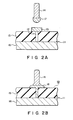
- paste layer 13 of 1 mm in diameter ⁇ 0.01 cm thick was formed which was comprised of powdered Ti of below 10 ⁇ m in particle size, organic binder (ethyl cellulose and ethanol mixture) and terpineol.
- 72 % Ag/28 % Cu brazing metal layer 17 was formed on the lower surface of Ni 42 %-Fe terminal pin 14 of 0.5 mm in diameter ⁇ 3 cm long.
- metal brazing layer 17 of terminal pin 14 was held, by a carbon jig (not shown), in contact with paste layer 13 of board 11 without being displaced.
- the unit substrate 11 and terminal pin 14
- the unit was placed within a vacuum furnace, not shown, and heated under a pressure of 5 ⁇ 10 ⁇ 5 Torrs at 850°C for 3 minutes.
- ceramics package 19 was manufactured, as shown in Fig. 2B, with terminal pin 14 bonded to board 11 by brazing metal/paste layer 18.
- ceramics package 19 thus obtained manifests a high bonding strength, ohmic contact and heat dissipation as mentioned in Example 1.
- a ceramics package was manufactured in the same way as in Example 2, except that a brazing paste obtained by kneading 5 % Ti/68 % Ag/27 % Cu alloy powder with an organic binder (acryl-based) and terepineol was coated at a rate of 1 mg/cm2 on the lower end face of 42 % Ni-Fe terminal pin of 0.5 mm in diameter ⁇ 3 mm long.
- the terminal pin was held, by a carbon jig, in contact with the brazing paste layer on the lower end face of the pin without being displaced.
- the resultant circuit board was placed within a vacuum furnace and heated under a pressure of 5 ⁇ 10 ⁇ 5 Torrs at 850°C for three minutes.
- a ceramics package was manufactured with the terminal pin bonded to board by an activated brazing metal layer.
- the ceramics package has a high bonding strength, ohmic contact and heat dissipation as mentioned in Examples 1 and 2.
- the respective ceramics package with the NH3 or OH substituent group-containing acrylic-based resin paste thus bonded reveals a bad wettability between the circuit board and the terminal pin.
- the metal powder was found agglomerated or granulated with the terminal pin loosely attached to the circuit board, failing to obtain any adequate bond strength. It has been observed that the carbon was partially deposited.
- the ceramics package having a bonded paste containing the acrylic-based resin with the COOH group as a substituent group revealed a better wettability between the circuit board and the terminal pin.
- Instron tension tester Upon measuring the strength of a bond of the pin to the circuit board by a tension tester of Instron Co., Ltd. Product (hereinafter called "Instron tension tester") it has been found that it was 6 Kgf/pin at min. and 9 Kgf/pin on the average, a very strong bond strength with a slight variation. In this case, the amount of carbon deposited on the surface of the brazing layer was less than one half that using the acrylic-based resin with the NH3 or OH group as the substituent group.
- the ceramics package bonded by the paste containing the acrylic-based resin with the COOH group as the substituent group revealed a temperature rise of 5 to 6°C, that is, an excellent heat dissipation.
- Three kinds of ceramics packages were manufactured with 42 % Ni-Fe terminal pins bonded to an AlN multi-layered circuit board, in the same way as in Example 4, except that use was made of three kinds of brazing pastes prepared by mixing 100 parts by weight of brazing metal powder consisting of 7 % Ti, 67 % Ag and 26 % Cu and 7 parts by weight of an acrylic-based resin with a portion of a copolymer of acrylic ester and methacrylic ester polymerized with styrene with a NH3, OH or COOH group as a substituent group, dissolving the mixture with terpineol and kneading it within a mortar for 1 hour.
- the terminal pins and circuit board of the respective package were examined for their wettability, bond strength and heat dissipation as in Example 4 to obtain the same result for the ceramics package with each substituent as in Example 4.
- brazing metal powder consisting of 1, 2, 3, 5, 10 or 17 % of Ti and a balance of Ag and Cu and, after being dissolved with terpineol, the mixture was kneaded within a mortar for 1 hour to prepare a brazing paste.
- Example 4 the same process as in Example 4 was performed to manufacture 6 kinds of ceramics packages.
- a package having a bonded paste containing the brazing metal powder with 1 % of Ti revealed poor wettability between the terminal pins and the circuit board and, due to the agglomeration of the brazing metal powder, a weak bond strength of 0 to 1 Kgf/pin.
- a package having a bonded paste containing brazing metal powder with 17 % of Ti manifests a strong bond of the brazing mass to the circuit board.
- the terminal pin and a tungsten conductive layer defined deep down on the throughhole showed an increase of 50 to 200 m ⁇ with a larger variation.
- a package having a bonded brazing paste containing 2 to 10 % of Ti showed better wettability between the circuit board and the terminal pin and, in this case, the strength of a bond of the terminal pins to the circuit board was 6 Kgf/pin at min. and 9 Kgf/pin (very strong) on the average with a small variation.
- the terminal pins and tungsten conductive layer defined deep down the center portion of the terminal pin attaching area were measured by a tester for their resistance and revealed a small increase of below 20 M ⁇ as compared with the case where after nickel has been plated on the board the terminal pins are Ag-brazed to the resultant structure.
- Another green sheet was manufactured in the same way as set out above and superimposed on, and compression-bonded to, said another green sheet with their paste layers placed one over the other to provide a laminated sheet.
- a plurality of inverted frustoconical recesses are formed by 1 mm-dia. drill on the pin attaching area of the green sheet laminated sheet.
- Circuit board 31 comprises laminated AlN layers 32, first and second tungsten conductive layers 33a and 33b, first throughholes 34a filled with the tungsten conductive material for connection between conductive layers 33a and 33b, second throughholes 34b filled with the tungsten conductive material for connection between second conductive layer 33b and a "recess" side, and recesses 35.
- brazing metal powder consisting of 7 % Ti, 67 % Ag and 26 % Cu was mixed with 7 parts by weight of acrylic ester with a COOH group as a substituent group and, after being dissolved with terpineol, kneaded within a mortar for 1 hour to prepare a brazing paste. Then a printing was made, by a 200 ⁇ m-thick stainless screen, not shown, with the use of a brazing paste and dried to form brazing paste layer 37 within recess 35. The resultant structure was placed within a tunnel furnace with the lower end portion of 42 % Ni-F terminal pin 36 embedded with paste layer 37 by a carbon jig, not shown.
- the package obtained produced less carbon deposit and better wettability was obtained at the bond of the terminal pin to the circuit board.
- the strength of the bond of the terminal pin to the circuit board upon being measured by the Instron tension tester, showed 6 Kgf/pin at min. and a very great value of the order of 9 Kgf/pin on the average with a smaller variation.
- the terminal pin and tungsten conductive layer portion defined down the throughhole upon being measured for their resistance, showed a small increase of below 20 m ⁇ as compared with the conventional Ni-plated circuit board with the terminal pin Ag-brazed thereto. It has been confirmed that there was no bad effect by the acrylic-based resin upon the interior of the brazing layer and that each terminal pin was in ohmic contact with the conductive layer of the throughhole.
- the ceramics package of this Example showed a low temperature rise of 5 to 6°C as compared with that of the conventional package using Al2O3 and excellent heat dissipation.
- Circuit board 41 is comprised of laminated AlN sheets 42, first and second tungsten conductive layers 43a and 43b formed on the surface and interior portion of one of sheets 42, first throughhole 44a filled with a tungsten conductive material for connection between conductive layers 43a and 43b, second throughhole 44b filled with the tungsten conduction material for connection between second conductive layer 43b and a "recess" side of AlN laminated sheet 42, and recess 45.
- Recess 45 is larger than the counterpart of the previous Example and is flat-bottomed.
- the side surface of the end portion of terminal pin 46 is bonded to board 41 by brazing layer 47.
- the package obtained produced less carbon deposit and showed better wettability between the terminal pin and the circuit board.
- the strength of a bond of the terminal pin to the circuit board upon being measured by the Instron tension tester, showed 6 Kgf/pin at min. and a very great value of the order of 9 Kgf/pin on the average with a slight variation.
- the ceramics package of this Example showed a temperature rise of 5 to 6°C, as well as an excellent heat dissipation, over the conventional Al2O3 package.
Landscapes
- Ceramic Products (AREA)
- Lead Frames For Integrated Circuits (AREA)
- Manufacturing Of Electrical Connectors (AREA)
- Multi-Conductor Connections (AREA)
- Coupling Device And Connection With Printed Circuit (AREA)
- Production Of Multi-Layered Print Wiring Board (AREA)
- Parts Printed On Printed Circuit Boards (AREA)
Applications Claiming Priority (8)
| Application Number | Priority Date | Filing Date | Title |
|---|---|---|---|
| JP2712287 | 1987-02-10 | ||
| JP27122/87 | 1987-02-10 | ||
| JP100051/87 | 1987-04-24 | ||
| JP10005187 | 1987-04-24 | ||
| JP10005087 | 1987-04-24 | ||
| JP100050/87 | 1987-04-24 | ||
| JP62136265A JP2573225B2 (ja) | 1987-02-10 | 1987-05-30 | 電子部品の製造方法 |
| JP136265/87 | 1987-05-30 |
Publications (3)
| Publication Number | Publication Date |
|---|---|
| EP0278741A2 true EP0278741A2 (fr) | 1988-08-17 |
| EP0278741A3 EP0278741A3 (fr) | 1989-03-15 |
| EP0278741B1 EP0278741B1 (fr) | 1997-06-04 |
Family
ID=27458626
Family Applications (1)
| Application Number | Title | Priority Date | Filing Date |
|---|---|---|---|
| EP88301099A Expired - Lifetime EP0278741B1 (fr) | 1987-02-10 | 1988-02-10 | Parties de composants électroniques et procédé pour leur fabrication |
Country Status (4)
| Country | Link |
|---|---|
| US (2) | US4835344A (fr) |
| EP (1) | EP0278741B1 (fr) |
| JP (1) | JP2573225B2 (fr) |
| DE (1) | DE3855929T2 (fr) |
Cited By (3)
| Publication number | Priority date | Publication date | Assignee | Title |
|---|---|---|---|---|
| WO1994003923A1 (fr) * | 1992-08-04 | 1994-02-17 | The Morgan Crucible Company Plc | Traversees etanches en alliage actif conducteur |
| US5600530A (en) * | 1992-08-04 | 1997-02-04 | The Morgan Crucible Company Plc | Electrostatic chuck |
| WO1997033311A1 (fr) * | 1996-03-05 | 1997-09-12 | Bird Electronic Corporation | Procede de fabrication de connexions electriques |
Families Citing this family (32)
| Publication number | Priority date | Publication date | Assignee | Title |
|---|---|---|---|---|
| JP2894979B2 (ja) * | 1987-02-10 | 1999-05-24 | 株式会社東芝 | 電子部品 |
| EP0331500B1 (fr) * | 1988-03-04 | 1993-01-07 | Kabushiki Kaisha Toshiba | Pâte de brasage pour lier des métaux et des matériaux céramiques |
| JP2503099B2 (ja) * | 1989-08-08 | 1996-06-05 | 日本電装株式会社 | はんだ付け用フラックス |
| US4972989A (en) * | 1989-10-30 | 1990-11-27 | Motorola, Inc. | Through the lead soldering |
| US5152449A (en) * | 1990-07-05 | 1992-10-06 | Morgan Crucible Company Plc | Edge braze of metal end cap to ceramic cylinder |
| JPH084953B2 (ja) * | 1991-04-17 | 1996-01-24 | ユーホーケミカル株式会社 | フラックス又ははんだペースト用腐食防止剤 |
| US5186380A (en) * | 1991-08-15 | 1993-02-16 | Handy & Harman | Titanium hydride coated brazing product |
| US5208729A (en) * | 1992-02-14 | 1993-05-04 | International Business Machines Corporation | Multi-chip module |
| US5334804A (en) * | 1992-11-17 | 1994-08-02 | Fujitsu Limited | Wire interconnect structures for connecting an integrated circuit to a substrate |
| US5305186A (en) * | 1993-01-27 | 1994-04-19 | International Business Machines Corporation | Power carrier with selective thermal performance |
| JP3146768B2 (ja) * | 1993-06-23 | 2001-03-19 | 松下電器産業株式会社 | 電子部品の実装方法 |
| US5705261A (en) * | 1993-10-28 | 1998-01-06 | Saint-Gobain/Norton Industrial Ceramics Corporation | Active metal metallization of mini-igniters by silk screening |
| US5397598A (en) * | 1993-11-12 | 1995-03-14 | International Business Machines Corporation | Method for selectively coating a member having a shank by masking a portion of the shank with a washer |
| US5569958A (en) * | 1994-05-26 | 1996-10-29 | Cts Corporation | Electrically conductive, hermetic vias and their use in high temperature chip packages |
| US5654204A (en) * | 1994-07-20 | 1997-08-05 | Anderson; James C. | Die sorter |
| US5665989A (en) * | 1995-01-03 | 1997-09-09 | Lsi Logic | Programmable microsystems in silicon |
| JP3245329B2 (ja) * | 1995-06-19 | 2002-01-15 | 京セラ株式会社 | 半導体素子収納用パッケージ |
| JP4077888B2 (ja) * | 1995-07-21 | 2008-04-23 | 株式会社東芝 | セラミックス回路基板 |
| US5695861A (en) * | 1995-10-18 | 1997-12-09 | Cts Corporation | Solder active braze |
| US6200134B1 (en) | 1998-01-20 | 2001-03-13 | Kerr Corporation | Apparatus and method for curing materials with radiation |
| US6206272B1 (en) * | 1999-04-08 | 2001-03-27 | Intel Corporation | Alignment weight for floating field pin design |
| US6469394B1 (en) | 2000-01-31 | 2002-10-22 | Fujitsu Limited | Conductive interconnect structures and methods for forming conductive interconnect structures |
| EP1202390B1 (fr) * | 2000-10-25 | 2008-05-21 | Japan Aviation Electronics Industry, Limited | Un composant électronique et sa méthode de fabrication |
| US6974765B2 (en) * | 2001-09-27 | 2005-12-13 | Intel Corporation | Encapsulation of pin solder for maintaining accuracy in pin position |
| US7182597B2 (en) * | 2002-08-08 | 2007-02-27 | Kerr Corporation | Curing light instrument |
| US6918762B2 (en) * | 2003-03-21 | 2005-07-19 | Kerr Corporation | Light-generating instrument |
| US8113830B2 (en) * | 2005-05-27 | 2012-02-14 | Kerr Corporation | Curing light instrument |
| US8158909B2 (en) * | 2008-06-12 | 2012-04-17 | Delphi Technologies, Inc. | Hot zone igniter |
| US9072572B2 (en) | 2009-04-02 | 2015-07-07 | Kerr Corporation | Dental light device |
| US9066777B2 (en) | 2009-04-02 | 2015-06-30 | Kerr Corporation | Curing light device |
| CN106068251B (zh) * | 2014-03-07 | 2019-12-27 | 日本碍子株式会社 | 接合体的制造方法 |
| JP7834987B2 (ja) * | 2021-11-09 | 2026-03-25 | 新東工業株式会社 | 加工対象物の加工方法及び加工装置 |
Family Cites Families (16)
| Publication number | Priority date | Publication date | Assignee | Title |
|---|---|---|---|---|
| US2158984A (en) * | 1938-05-13 | 1939-05-16 | Oxweld Acetylene Co | Welding rod |
| SE8008669L (sv) * | 1979-12-14 | 1981-06-15 | Atomic Energy Authority Uk | Alster omfattande ett keramiskt material bundet till ett annat material |
| DE3165502D1 (en) * | 1980-04-21 | 1984-09-20 | Bbc Brown Boveri & Cie | Multi-layered-solder and method of producing such solder |
| US4325754A (en) * | 1980-12-15 | 1982-04-20 | Gte Products Corporation | Flexible brazing alloy tape and method of making same |
| US4518112A (en) * | 1982-12-30 | 1985-05-21 | International Business Machines Corporation | Process for controlled braze joining of electronic packaging elements |
| DE3316807A1 (de) * | 1983-05-07 | 1984-11-08 | Robert Bosch Gmbh, 7000 Stuttgart | Hartlot-legierung zum verbinden von oxidkeramiken unter sich oder mit metallen |
| GB2141370B (en) * | 1983-06-17 | 1987-02-04 | Standard Telephones Cables Ltd | Bonding metal to ceramic |
| JPS6032343A (ja) * | 1983-08-02 | 1985-02-19 | Toshiba Corp | パワ−半導体モジユ−ル基板 |
| FR2567684B1 (fr) * | 1984-07-10 | 1988-11-04 | Nec Corp | Module ayant un substrat ceramique multicouche et un circuit multicouche sur ce substrat et procede pour sa fabrication |
| US4621761A (en) * | 1984-12-04 | 1986-11-11 | The United States Of America As Represented By The United States Department Of Energy | Process for forming unusually strong joints between metals and ceramics by brazing at temperatures that do no exceed 750 degree C. |
| US4602731A (en) * | 1984-12-24 | 1986-07-29 | Borg-Warner Corporation | Direct liquid phase bonding of ceramics to metals |
| US4679960A (en) * | 1985-01-25 | 1987-07-14 | Gte Products Corporation | Ceramic and metal brazed articles |
| US4672739A (en) * | 1985-04-11 | 1987-06-16 | International Business Machines Corporation | Method for use in brazing an interconnect pin to a metallization pattern situated on a brittle dielectric substrate |
| US4729504A (en) * | 1985-06-01 | 1988-03-08 | Mizuo Edamura | Method of bonding ceramics and metal, or bonding similar ceramics among themselves; or bonding dissimilar ceramics |
| US4667871A (en) * | 1985-07-24 | 1987-05-26 | Gte Products Corporation | Tin based ductile brazing alloys |
| US4735866A (en) * | 1985-12-30 | 1988-04-05 | The United States Of America As Represented By The United States Department Of Energy | Copper-silver-titanium-tin filler metal for direct brazing of structural ceramics |
-
1987
- 1987-05-30 JP JP62136265A patent/JP2573225B2/ja not_active Expired - Lifetime
-
1988
- 1988-02-10 DE DE3855929T patent/DE3855929T2/de not_active Expired - Fee Related
- 1988-02-10 US US07/154,273 patent/US4835344A/en not_active Expired - Lifetime
- 1988-02-10 EP EP88301099A patent/EP0278741B1/fr not_active Expired - Lifetime
-
1989
- 1989-02-10 US US07/308,450 patent/US4919731A/en not_active Expired - Lifetime
Cited By (5)
| Publication number | Priority date | Publication date | Assignee | Title |
|---|---|---|---|---|
| WO1994003923A1 (fr) * | 1992-08-04 | 1994-02-17 | The Morgan Crucible Company Plc | Traversees etanches en alliage actif conducteur |
| US5368220A (en) * | 1992-08-04 | 1994-11-29 | Morgan Crucible Company Plc | Sealed conductive active alloy feedthroughs |
| US5600530A (en) * | 1992-08-04 | 1997-02-04 | The Morgan Crucible Company Plc | Electrostatic chuck |
| WO1997033311A1 (fr) * | 1996-03-05 | 1997-09-12 | Bird Electronic Corporation | Procede de fabrication de connexions electriques |
| US5794327A (en) * | 1996-03-05 | 1998-08-18 | Bird Electronic Corporation | Method for making copper electrical connections |
Also Published As
| Publication number | Publication date |
|---|---|
| EP0278741B1 (fr) | 1997-06-04 |
| US4919731A (en) | 1990-04-24 |
| JP2573225B2 (ja) | 1997-01-22 |
| DE3855929T2 (de) | 1997-11-06 |
| EP0278741A3 (fr) | 1989-03-15 |
| JPS6427168A (en) | 1989-01-30 |
| DE3855929D1 (de) | 1997-07-10 |
| US4835344A (en) | 1989-05-30 |
Similar Documents
| Publication | Publication Date | Title |
|---|---|---|
| EP0278741A2 (fr) | Parties de composants électroniques et procédé pour leur fabrication | |
| EP0331500B1 (fr) | Pâte de brasage pour lier des métaux et des matériaux céramiques | |
| US5627344A (en) | Multilayer ceramic circuit substrate, process for producing the same, and electrically conductive material for use in multilayer ceramic circuit substrate | |
| JP3237258B2 (ja) | セラミック多層配線基板 | |
| EP1837119B1 (fr) | Pate a braser et dispositif electronique | |
| EP0069510A1 (fr) | Procédé de métallisation de matériaux céramiques frittés | |
| US6329065B1 (en) | Wire board and method of producing the same | |
| JPH04169002A (ja) | 導電性ペーストとそれを用いた多層セラミック配線基板の製造方法 | |
| EP0247617A2 (fr) | Substrat multi-couche en céramique ayant une configuration de circuits | |
| KR100227412B1 (ko) | 도전성 페이스트의 제조방법 및 이를 사용한 도전체 | |
| US5928568A (en) | Thick film circuit having conductor composition with coated metallic particles | |
| JP3538549B2 (ja) | 配線基板およびその製造方法 | |
| JP3167796B2 (ja) | セラミックス回路基板 | |
| JP3470789B2 (ja) | 配線基板及びその製造方法 | |
| JP2627509B2 (ja) | 導電層を有する電子部品 | |
| US5167913A (en) | Method of forming an adherent layer of metallurgy on a ceramic substrate | |
| JPH0737420A (ja) | 導体ペースト組成物及びそれを用いた回路基板 | |
| JP2001185838A (ja) | セラミック配線基板 | |
| JP2002084051A (ja) | 銅メタライズ組成物、低温焼結セラミック配線基板、及びその製造方法 | |
| JPH01201090A (ja) | セラミック用メタライズ組成物 | |
| JP3450119B2 (ja) | メタライズ組成物及びそれを用いた配線基板 | |
| JPH10256730A (ja) | 多層セラミック基板 | |
| JP2738600B2 (ja) | 回路基板 | |
| JP2894979B2 (ja) | 電子部品 | |
| JPH11103169A (ja) | ガラスセラミック配線基板 |
Legal Events
| Date | Code | Title | Description |
|---|---|---|---|
| PUAI | Public reference made under article 153(3) epc to a published international application that has entered the european phase |
Free format text: ORIGINAL CODE: 0009012 |
|
| 17P | Request for examination filed |
Effective date: 19880218 |
|
| AK | Designated contracting states |
Kind code of ref document: A2 Designated state(s): DE FR GB |
|
| PUAL | Search report despatched |
Free format text: ORIGINAL CODE: 0009013 |
|
| AK | Designated contracting states |
Kind code of ref document: A3 Designated state(s): DE FR GB |
|
| 17Q | First examination report despatched |
Effective date: 19911018 |
|
| GRAG | Despatch of communication of intention to grant |
Free format text: ORIGINAL CODE: EPIDOS AGRA |
|
| GRAH | Despatch of communication of intention to grant a patent |
Free format text: ORIGINAL CODE: EPIDOS IGRA |
|
| GRAH | Despatch of communication of intention to grant a patent |
Free format text: ORIGINAL CODE: EPIDOS IGRA |
|
| RBV | Designated contracting states (corrected) |
Designated state(s): DE FR |
|
| GRAA | (expected) grant |
Free format text: ORIGINAL CODE: 0009210 |
|
| RAP1 | Party data changed (applicant data changed or rights of an application transferred) |
Owner name: KABUSHIKI KAISHA TOSHIBA |
|
| AK | Designated contracting states |
Kind code of ref document: B1 Designated state(s): DE FR |
|
| REF | Corresponds to: |
Ref document number: 3855929 Country of ref document: DE Date of ref document: 19970710 |
|
| ET | Fr: translation filed | ||
| PLBE | No opposition filed within time limit |
Free format text: ORIGINAL CODE: 0009261 |
|
| STAA | Information on the status of an ep patent application or granted ep patent |
Free format text: STATUS: NO OPPOSITION FILED WITHIN TIME LIMIT |
|
| 26N | No opposition filed | ||
| REG | Reference to a national code |
Ref country code: FR Ref legal event code: D6 |
|
| PGFP | Annual fee paid to national office [announced via postgrant information from national office to epo] |
Ref country code: FR Payment date: 20030210 Year of fee payment: 16 |
|
| PGFP | Annual fee paid to national office [announced via postgrant information from national office to epo] |
Ref country code: DE Payment date: 20030220 Year of fee payment: 16 |
|
| PG25 | Lapsed in a contracting state [announced via postgrant information from national office to epo] |
Ref country code: DE Free format text: LAPSE BECAUSE OF NON-PAYMENT OF DUE FEES Effective date: 20040901 |
|
| PG25 | Lapsed in a contracting state [announced via postgrant information from national office to epo] |
Ref country code: FR Free format text: LAPSE BECAUSE OF NON-PAYMENT OF DUE FEES Effective date: 20041029 |
|
| REG | Reference to a national code |
Ref country code: FR Ref legal event code: ST |