EP0280033B1 - Verfahren zur Herstellung von Perovskit und ABO3-Typ-Oxyden - Google Patents
Verfahren zur Herstellung von Perovskit und ABO3-Typ-Oxyden Download PDFInfo
- Publication number
- EP0280033B1 EP0280033B1 EP88100776A EP88100776A EP0280033B1 EP 0280033 B1 EP0280033 B1 EP 0280033B1 EP 88100776 A EP88100776 A EP 88100776A EP 88100776 A EP88100776 A EP 88100776A EP 0280033 B1 EP0280033 B1 EP 0280033B1
- Authority
- EP
- European Patent Office
- Prior art keywords
- aqueous solution
- solution
- oxalic acid
- precursor
- precipitate
- Prior art date
- Legal status (The legal status is an assumption and is not a legal conclusion. Google has not performed a legal analysis and makes no representation as to the accuracy of the status listed.)
- Expired
Links
Images


Classifications
-
- H—ELECTRICITY
- H10—SEMICONDUCTOR DEVICES; ELECTRIC SOLID-STATE DEVICES NOT OTHERWISE PROVIDED FOR
- H10N—ELECTRIC SOLID-STATE DEVICES NOT OTHERWISE PROVIDED FOR
- H10N30/00—Piezoelectric or electrostrictive devices
- H10N30/01—Manufacture or treatment
- H10N30/09—Forming piezoelectric or electrostrictive materials
- H10N30/093—Forming inorganic materials
-
- C—CHEMISTRY; METALLURGY
- C01—INORGANIC CHEMISTRY
- C01G—COMPOUNDS CONTAINING METALS NOT COVERED BY SUBCLASSES C01D OR C01F
- C01G23/00—Compounds of titanium
- C01G23/003—Titanates
-
- C—CHEMISTRY; METALLURGY
- C01—INORGANIC CHEMISTRY
- C01G—COMPOUNDS CONTAINING METALS NOT COVERED BY SUBCLASSES C01D OR C01F
- C01G23/00—Compounds of titanium
- C01G23/003—Titanates
- C01G23/006—Alkaline earth titanates
-
- C—CHEMISTRY; METALLURGY
- C01—INORGANIC CHEMISTRY
- C01G—COMPOUNDS CONTAINING METALS NOT COVERED BY SUBCLASSES C01D OR C01F
- C01G25/00—Compounds of zirconium
-
- C—CHEMISTRY; METALLURGY
- C01—INORGANIC CHEMISTRY
- C01P—INDEXING SCHEME RELATING TO STRUCTURAL AND PHYSICAL ASPECTS OF SOLID INORGANIC COMPOUNDS
- C01P2002/00—Crystal-structural characteristics
- C01P2002/30—Three-dimensional structures
- C01P2002/34—Three-dimensional structures perovskite-type (ABO3)
-
- C—CHEMISTRY; METALLURGY
- C01—INORGANIC CHEMISTRY
- C01P—INDEXING SCHEME RELATING TO STRUCTURAL AND PHYSICAL ASPECTS OF SOLID INORGANIC COMPOUNDS
- C01P2002/00—Crystal-structural characteristics
- C01P2002/70—Crystal-structural characteristics defined by measured X-ray, neutron or electron diffraction data
- C01P2002/72—Crystal-structural characteristics defined by measured X-ray, neutron or electron diffraction data by d-values or two theta-values, e.g. as X-ray diagram
-
- C—CHEMISTRY; METALLURGY
- C01—INORGANIC CHEMISTRY
- C01P—INDEXING SCHEME RELATING TO STRUCTURAL AND PHYSICAL ASPECTS OF SOLID INORGANIC COMPOUNDS
- C01P2002/00—Crystal-structural characteristics
- C01P2002/70—Crystal-structural characteristics defined by measured X-ray, neutron or electron diffraction data
- C01P2002/77—Crystal-structural characteristics defined by measured X-ray, neutron or electron diffraction data by unit-cell parameters, atom positions or structure diagrams
-
- C—CHEMISTRY; METALLURGY
- C01—INORGANIC CHEMISTRY
- C01P—INDEXING SCHEME RELATING TO STRUCTURAL AND PHYSICAL ASPECTS OF SOLID INORGANIC COMPOUNDS
- C01P2004/00—Particle morphology
- C01P2004/51—Particles with a specific particle size distribution
- C01P2004/52—Particles with a specific particle size distribution highly monodisperse size distribution
-
- C—CHEMISTRY; METALLURGY
- C01—INORGANIC CHEMISTRY
- C01P—INDEXING SCHEME RELATING TO STRUCTURAL AND PHYSICAL ASPECTS OF SOLID INORGANIC COMPOUNDS
- C01P2004/00—Particle morphology
- C01P2004/60—Particles characterised by their size
- C01P2004/62—Submicrometer sized, i.e. from 0.1-1 micrometer
-
- C—CHEMISTRY; METALLURGY
- C01—INORGANIC CHEMISTRY
- C01P—INDEXING SCHEME RELATING TO STRUCTURAL AND PHYSICAL ASPECTS OF SOLID INORGANIC COMPOUNDS
- C01P2006/00—Physical properties of inorganic compounds
- C01P2006/12—Surface area
Definitions
- the present invention relates to a process for producing a perovskite-type oxide that is useful as a piezoelectric, pyroelectric or ferroelectric material either in itself or in the form of a composite with a rubber, plastics, or other polymeric materials.
- Perovskite-type oxides of the ABO3 type (where the element A is Pb, Ca, Sr or La; and the element B is Ti or Zr) are conventionally produced by the following methods:
- the major problem of the first method concerns a manufacturing process in that the solid-phase reaction involved requires high temperatures and prolonged periods.
- the powder produced by this method is defective in that it is difficult to sinter unless elevated temperatures or a sintering accelerator is employed.
- the oxalic acid salts of the ingredients have different solubilities in water which is used as a coprecipitation medium and hence it is difficult to exactly control the proportion in which the respective ingredients are to be coprecipitated in such a way that a single-phase composition will be produced.
- the third method has the advantage that a homogeneous product of high purity is produced but its production is not easy to achieve since the respective ingredients are used in the form of alkoxides.
- the fourth method which relies upon a multi-stage wet process can be performed using inexpensive materials but the calcined product must be crushed before sintering.
- the ion of element A and Zr ion or (Zr+Ti) ion are coprecipitated as oxalic acid salts (Japanese Laid-Open Patent Application No. 131505/84).
- a precipitate of a desired composition that has high purity and a uniform grain size i.e., a precursor of the desired perovskite-type oxide
- This precipitate is subjected to thermolysis so as to produce a fine powder of ATiO3, AZrO3 or A(Zr,Ti)O3 that is active and is easily sinterable.
- the ion of element A is used as a solution of a nitric acid salt of element A in water or ethanol-containing water.
- Ti and Zr ions are preferably used as a solution of titanium oxynitrate or zirconium oxynitrate in water or ethanol-containing water. It has been pointed out that if chlorides are used as sources of the supply of these ions, chloride ions tend to remain in the coprecipitate; even if this coprecipitate is calcined at elevated temperatures, the residual chloride compounds still remain in the calcined product (namely, the desired oxide) and cause adverse effects mainly on its sinterability. It has also been pointed out that if Pb 2+ is used as the ion of an element A, undesirable insoluble lead chloride will be formed in an aqueous solution of mixed ions.
- the reason for the need to crush the calcined product into particles and to mix them together is that the fine grains of perovskite-type oxide have fused together to form agglomerates during calcination.
- the step of recrushing and remixing not only increases the manufacturing cost but also reduces the reliability of the final product by letting impurities get into the calcined product. This step causes another problem associated with the characteristics of the powder perovskite-type oxide.
- the present inventors previously conducted extensive studies in order to unravel the mechanism by which the fine particles of calcined product would fuse together to form agglomerates. As a results, the present inventors found that chloride ions remaining in small amounts in an aqueous solution of the mixed ions from starting materials were responsible for the agglomeration of fine particles during calcination and that this phenomenon could be retarded by reducing the concentration of chloride ions below a certain level. Based on these findings, the present inventors and Yamamura filed a patent application which was later published as Japanese Laid-Open Patent Application No. 174116/86.
- Japanese Laid-Open Patent Application No. 211516/86 if the precipitate of a precursor is synthesized under such conditions that the concentration of the ions of element A in the aqueous solution is in the range of 0.2 to 1 mol/l, with ethanol being used in 0.5 to 4 volumes per volume of the aqueous solution, a powder having the same characteristics as those of the product shown in Japanese Laid-Open Patent Application No. 174116/86 is synthesized and with the cost of its production being significantly reduced in account of the dramatic decrease in the amount of the ethanol used.
- the present inventors made another proposal in Japanese Laid-Open Patent Application No. 211519/86 by showing that ethanol may be replaced by isopropanol or normal propanol to obtain a perovskite-type oxide powder having comparable performance.
- This proposal offered the potential to realize a further reduction in the manufacturing cost of a perovskite-type oxide powder.
- the present inventors also proposed in Japanese Patent Laid-Open Application No. 251517/86 that the ions of element B that partly dissolve in the aqueous solution containing ethanol or isopropanol be precipitated again by blowing dry ammonia into that solution which has been thoroughly agitated to disperse the precipitate after completion of the reaction of precipitate formation. According to this method, the loss of the ion of element B can be reduced while the proportions of the ions of elements A and B in the precipitate are precisely controlled.
- the present inventors continued their research on how to control the proportions of constituent elements in oxides of the ABO3 type in oxalic salts coprecipitation method.
- the present inventors showed that the fine particles of an oxide of the ABO3 type could be consistently produced by applying an unconventional stoichiometric ratio to the precipitate of oxalic acid salts formed from titanium oxynitrate and zirconium oxynitrate.
- an unconventional stoichiometric ratio to the precipitate of oxalic acid salts formed from titanium oxynitrate and zirconium oxynitrate.
- Pb is mentioned as element A, Ca, Sr, Ba, La, etc. are unsuitable for use as element A since their oxalates will partly dissolve into the mother liquor under the conditions employed in these two prior inventions and are incapable of yielding an intended oxide of the ABO3 type in a quantitative manner.
- alcohols were used in order to prevent the ions of elements A and B from dissolving in an aqueous solution. This method was effective in completely inhibiting the dissolution of Pb, Zr and Ti oxalates in a range rendered acidic with nitric acid.
- conversion of nitrates to oxalates involves the formation of nitric acid in a large amount: Pb(NO3)2 + H2C2O4 ⁇ PbC2O4 + 2HNO3 Ca(NO3)2 + H2C2O4 ⁇ CaC2O4 + 2HNO3 2TiO(NO3)2 + H2C2O4 ⁇ (TiO)2C2O4(NO3)2 + 2HNO3.
- Oxalates other than PbC2O4 such as CaC2O4, SrC2O4, BaC2O4 and La2(C2O4)3 that were used to form the precipitate of a precursor containing element A were exposed to a strongly acidic atmosphere created by the presence of a large amount of nitric acid in mother liquor. Since the dissolution inhibiting action of ethanol and other alcohols was not fully exhibited under the strongly acidic condition, Ca ions could not be completely prevented from dissolving into the mother liquor. The results were the same with other non-Pb ions (i.e., Sr, Ba and La) and it was impossible to control exactly the ratio of existence of element A to element B in the finally obtained oxide of the ABO3 type.
- non-Pb ions i.e., Sr, Ba and La
- Ca, Sr and Ba are elements that are indispensable to the synthesis of ceramics such as CaTiO3, SrTiO3, BaTiO3, (PbCa)TiO3, (PbSr)TiO3 and (PbBa)TiO3, and La is important as an element to be used in the synthesis of light-transmitting piezoelectric ceramics generally referred to as PLZT.
- the present inventors continued their studies in order to develop a process by which not only perovskite-type oxides of the ABO3 type containing Pb as element A but also those having Pb substituent at site A with varying proportions of other metal ions such as Ca, Sr, Ba and La can be synthesized by a chemical synthesis reaction using the novel stoichiometric ratio disclosed in Japanese Laid-Open Patent Application Nos. 72523/87 and 72524/87. Special emphasis was placed on the efforts to seek a method for producing a fine-grained oxide of the ABO3 type by means of quantitatively precipitating not only Pb but also Ca, Sr or La as element A.
- An object, therefore, of the present invention is to provide a process for synthesizing a perovskite-type oxide of the ABO3 type by precipitation from an aqueous solution, in which the proportions of constituent elements in various combinations thereof can be strictly controlled by quantitative precipitation of not only Pb but also Ca, Sr or La that have been considered unsuitable for use as element A in the prior art.
- a more specific object of the present invention is to provide a process for producing a perovskite-type oxide of the ABO3 type (where A is at least one element selected from the group consisting of Pb, Ca, Sr and La; and B is at least one element selected from the group consisting of Ti and Zr) which comprises allowing an acidic aqueous solution containing the ions of the necessary constituent elements to contact oxalic acid in the presence of at least one alcohol selected from the group consisting of ethanol, propanol, butanol, pentanol and hexanol, thereby forming the precipitate of oxalic acid salts that serves as a precursor of said oxide, and subsequently performing calcination of said precursor precipitate, wherein oxalic acid is added in an amount that is equal to the sum of 0.98 to 1.02 moles per mol of element A present in said acidic aqueous solution and 0.49 to 0.51 mole per mole of element B also present in said acidic aqueous
- the perovskite-type oxide to be produced by the process of the present invention is of the ABO3 type in which A is at least one element selected from the group consisting of Pb, Sr, Ca and La, and B is at least one element selected from the group consisting of Ti and Zr.
- perovskite-type oxide examples include PbTiO3, PbZrO3, Pb(Zr ⁇ Ti)O3, CaTiO3, CaZrO3, (Pb ⁇ Ca)TiO3, (Pb ⁇ Ca)ZrO3, (Pb ⁇ Ca) (Zr ⁇ Ti)O3, SrTiO3, SrZrO3, (CaSr)TiO3, (CaSr)ZrO3, (PbSr)TiO3, (PbSr) (Zr ⁇ Ti)O3, and (Pb 1-x La x ) (Ti ⁇ Zr)O3.
- Element A necessary for preparing a precursor for perovskite-type oxide is used in the form of a water-soluble compound of Pb, Ca, Sr and/or La. Soluble compounds of these elements are generally used and acetic acid salts and nitric acid salts are preferably used. Nitric acid salts are particularly preferred.
- Particularly preferred water-soluble compounds of element A are metal nitrates having such a chlorine content that the maximum ratio of chlorine to element A is up to 0.02, with a value of substantially zero being more preferable.
- Element B which is another essential component for preparing the precursor of perovskite-type oxide is used in the form of a water-soluble compound of Ti and/or Zr.
- Soluble salts such as oxynitrates are generally used.
- titanium oxynitrate can be synthesized as a substantially chlorine-free compound by reacting concentrated nitric acid with titanium hydroxide prepared by hydrolyzing an alkoxide such as titanium tetraisopropoxide.
- titanium hydroxide precipitate formed with aqueous ammonia is subjected to repeated thorough washing so as to remove residual chloride ions until the atomic ratio of Cl to Ti in the aqueous solution of titanium oxynitrate is reduced to up to 0.02, preferably up to 0.01.
- zirconium oxynitrate is used as a soluble salt of Zr, it suffices that this compound has a purity comparable to that of commercially available reagents.
- an acidic solution containing compounds, preferably nitric acid salts, of at least one element A selected from among Pb, Sr, Ca and La and at least one element B selected from among Ti and Zr is brought into contact with oxalic acid in the presence of an alcohol.
- the proportions of elements A and B to be added are strictly controlled in such a way that they will conform to their proportions in the perovskite-type oxide to be produced.
- Elements A and B are added in the form of a solution, generally in the form of aqueous solution.
- Solution of elements A and B is rendered acidic, generally by means of nitric acid.
- the acidity of the aqueous solution containing metal nitrates can be varied by changing the amount of nitric acid added.
- the ratio of nitric acid to element B (mol/mol) to be within the range of 0 to 5, preferably in the range of 0.01 to 4, the perovskite-type oxide to be obtained as the final product can be controlled to have the smaller particle size and the narrower size distribution.
- the ions of elements in the acidic aqueous solution can be adjusted to have the highest possible concentrations to such an extent that the ions of elements selected from groups A and B can be completely dissolved under given conditions.
- the ions of element A may have a concentration in the range of 0.05 to 1 mole/l, preferable in the range of 0.1 to 0.5 mole/l.
- the alcohol which is to be present when the acidic aqueous solution of elements A and B is contacted with oxalic acid is at least one alcohol selected from the group consisting of ethanol, propanol, butanol, pentanol and hexyl alcohol, and preferably at least one alcohol selected from the group consisting of ethanol and propanol.
- oxalic acid and an alcohol may be added simultaneously by adding a solution of oxalic acid in alcohol (an alcoholic solution of oxalic adid) to a homogeneous aqueous solution of elements A and B.
- a solution of oxalic acid in alcohol an alcoholic solution of oxalic adid
- the homogeneous aqueous solution of elements A and B may be poured into the solution of oxalic acid in alcohol.
- the amount of alcohol added is adjusted to be such that 1 to 10 volumes, preferably 2 to 4 volumes, of alcohol are present in the solution containing the precursor precipitate with respect to one volume of water also present in this solution.
- oxalic acid One mole of oxalic acid must be added per mole of the ions of element A in the aqueous solution in order to achieve quantitative precipitation of a precursor in the form of an oxalate of element A.
- Half a mole of oxalic acid must be added per mole of the ions of element B (Ti 4+ , Zr 4+ )
- the amount of oxalic acid to be added may have a tolerance of ⁇ 2%, preferably ⁇ 1%, of the theoretically required value with respect to the ions of element A.
- a tolerance of ⁇ 2%, preferably ⁇ 1%, of the theoretically required value may be allowed with respect to the ions of element B.
- oxalic acid and element B are not used at the stoichiometric ratio of 1/1 (mole/mole) as heretofore been considered reasonable, but at an oxalic acid to element B ratio of 1/2 (mole/mole). Therefore, the presence of any excess oxalic acid is essentially undesirable since it will participate in a reaction for redissolving the precipitate of an oxalic acid salt of element B and cancel the principal feature of the present invention.
- the smaller the deviation of the oxalic acid to element B ratio from the above-specified 1/2 (mole/mole) the better the results that can be attained.
- Oxalic acid is added in an amount that is equal to the sum of 0.98 to 1.02 moles per mole of element A present in an acidic aqueous solution of elements A and B and 0.49 to 0.51 mole per mole of element B also present in the acidic aqueous solution, preferably in an amount that is equal to the sum of 0.99 to 1.01 moles per mole of element A present in the acidic aqueous solution and 0.495 to 0.505 mole per mole of element B also present in the acidic aqueous solution.
- the constituent elements for preparing an oxide of the ABO3 type that are present in the aqueous acidic solution may be precipitated as oxalates by adding the acidic aqueous solution of elements A and B dropwise to a vigorously agitated alcoholic solution containing oxalic acid.
- a vigorously agitated alcoholic solution containing oxalic acid may be added dropwise to the acidic aqueous solution of elements A and B under vigorous agitation.
- the rate of the formation of oxalates may be selected from a certain range that will not cause a rapid increase in the temperature of the reaction system.
- the reaction temperature can be selected from a broad range, preferably from the range of near 0°C up to 50°C, more preferably from the range of near 0°C up to 30°C. Temperatures low enough to cause freezing of the acidic aqueous solution should be avoided. In view of the thermallability of titanium oxynitrate in the acidic aqueous solution, increasing the temperature of the acidic aqueous solution above 50°C after titanium oxynitrate has been incorporated should be avoided as much as possible since an unwanted precipitate can form during the reaction for the synthesis of precipitate on account of the selfdecomposition of titanium oxynitrate.
- any acid radicals in the precipitate containing solution are neutralized with ammonia or an amine.
- Illustrative ammonia and amines that can be used to neutralize the acid radicals present in the solution containing the precursor precipitate include (slurry-containing solution): ammonia; hydrazine; alkylamines such as methylamine, dimethylamine, trimethylamine, ethylamine, diethylamine and triethylamine; alkylenediamines such as ethylenediamine and 1,3-propanediamine; alkanolamines such as ethanolamine, 1-amino-2-oxypropane, and 2-amino-1-hydroxypropane; hydroxylamine; and mixtures thereof.
- ammonia is used in the form of a gas and/or concentrated aqueous ammonia.
- Ammonia must be added in an amount commensurate with the acid (preferably nitric acid) that has formed as a by-product in the reaction for the formation of oxalates and with the nitric acid preliminarily added to the acidic aqueous solution of elements A and B.
- Ammonia may be added in the form of a dry gaseous and/or concentrated aqueous ammonia. If two or more volumes of the alcoholic solution containing oxalic acid are to be used per volume of the acidic aqueous solution of elements A and B, the use of concentrated aqueous ammonia is more preferred since water additionally supplied from the concentrated aqueous ammonia will not accelerate the dissolution of the precursor precipitates.
- the rate of addition of ammonia can be selected as appropriate and may be increased within a range that will not cause a rapid increase in the temperature of the reaction system on account of the heat of formation of ammonium nitrate.
- the pH of the slurry-containing solution that has been subjected to neutralization with ammonia or an amine can be measured with pH test paper that provides for a limited range of measurements.
- the final pH to be attained as a result of neutralization may be adjusted to lie within the range of 6 to 8, preferably from 6.2 to 7.5, and this is effective for the purpose of closely controlling the proportions of the constituent elements that are required of the oxide of the ABO3 type to be produced by the present invention.
- a completion of the reactions may be performed by continuing the agitation for a sufficient time to complete the reaction.
- the precipitate is recovered as a white cake by filtration.
- the recovered white cake is desirably washed with the alcohol specified above so as to remove the ammonium nitrate that has been formed as a result of the reaction, thereby replacing the greater part of the residual mother liquor in the precipitate with the alcohol.
- the slurry-containing washings are filtered to recover a white cake.
- the recovered white cake is dried and crushed into particles to obtain a powder of the precursor of perovskite-type oxide. Crushing performed at this stage is important for ensuring that an adequate amount of oxygen will flow in a subsequent step of calcination.
- the dried cake can be readily reduced to fine particles by a weak milling force and the particles need not be rendered in a completely dispersed state at this stage, so there is no likelihood that the crushing means will become a source of impurities.
- the precursor powder prepared by the procedures described above is then calcined at a suitable temperature, say, between 500°C and 1,200°C, preferably between 600°C and 1,100°C.
- a suitable temperature say, between 500°C and 1,200°C, preferably between 600°C and 1,100°C.
- the calcination is desirably performed at low temperatures and must be carried out at such a temperature that no more change in weight will occur.
- the precursor powder is maintained at that temperature for a period of from 10 minutes to 50 hours, preferably from 30 minutes to 30 hours.
- the precursor undergoes thermolysis to produce a ferroelectric oxide of the perovskite type.
- the precursor powder may be heated at a rate of 0.01 to 50°C/min. In consideration of such factors as the amount and the thickness of precursor powder to be charged, a value of 0.1 to 5°C/min may be selected as a heating rate that will not cause rapid thermolysis of the precursor powder.
- Pure oxygen or air may be selected as a calcination atmosphere.
- a reducing atmosphere is not suitable since it will cause undesired side-reactions such as formation of lead metal.
- the so prepared perovskite-type oxide may be shaped and sintered for immediate use as a ferroelectric material.
- the shaped product may be polarized in a high electric field for use as a piezoelectric material.
- the perovskite-type oxide powder of the present invention may be blended with a polymeric material such as a rubber or a synthetic resin to make a dielectric or piezoelectric composite material.
- a polymeric material such as a rubber or a synthetic resin to make a dielectric or piezoelectric composite material.
- a rubbery polymer and/or a resinous polymer may be used as the polymer component of the dielectric or piezoelectric composite material. Either at least one rubbery polymer or at least one resinous polymer or a mixture of both may be used as the polymer component.
- Useful rubbery polymers include natural rubber, SBR (styrene-butadiene rubber), ethylene-propylene rubber, silicone rubber, acrylonitrile-butadiene rubber, epichlorohydrin rubber, fluororubber and urethane rubber. Among these compounds, the acrylonitrile-butadiene rubber, epichlorohydrin rubber, fluororubber and urethane rubber are preferred.
- These rubbery polymers may be independently blended with the fine oxide particles to make dielectric composite materials. Alternatively, they may be vulcanized by addition of an appropriate curing agent or some other suitable curing method, so as to make dielectric composite materials. If desired, the rubbery polymers may be used in combination with suitable amounts of resinous polymers.
- the resinous polymers that can be used are in no way limited to any particular types but those which have high crystallinity and dielectric constant, such as polyacetal resins, poly(vinylidene fluoride) resins, polyacrylonitrile resins and polyamide resins, are preferably used.
- Other usable examples include polypropylene resins, polyethylene resins, chlorinated polyethylene resins and polyester resins. These resinous polymers may be blended, either singularly or in combination, with the fine particles of the ferroelectric oxide so as to make dielectric composite materials.
- the fine particles of the ferroelectric oxide may be incorporated in amounts of 1 to 200, preferably 2 to 150, parts by weight per 10 parts by weight of the rubbery polymer and/or resinous polymer.
- Any standard mixing device may be employed, such as a kneader, a mixing roll mill, an extruder, a Plastograph, a variety of mixers, and a ball mill. Shaping may be performed by any known method such as extrusion molding or calendering.
- the blend may be shaped into any desired form such as a plate, a cylinder or a sheet.
- a dielectric composite material can also be fabricated by filming a dispersion of the fine particles of ferroelectric oxide in a solution having a resinous polymer dissolved in a suitable solvent. If desired, a solvent-soluble rubbery polymer may be incorporated in the dispersion.
- the dielectric composite material thus produced may be furnished with electrically conductive electrodes that are formed in close contact with both surfaces of the shaped product either by applying metal foils, conductive resins or pastes or by depositing metal coatings by vacuum deposition or chemical plating.
- the perovskite-type oxide of the present invention preferably has a composition represented by (Pb 1-x ,Ca x )TiO3 (0.35 ⁇ x ⁇ 0.95).
- a piezoelectric composite material can also be produced in accordance with the present invention by the following procedures: the necessary ingredients are mixed by the methods described above and the blend is shaped into a desired form; the shaped product is heated at a predetermined temperature with a d.c. electric field (or an a.c. electric field superposed on a d.c. electric field) being applied to both sides of the shaped product for a predetermined period of time; thereafter, the shaped product is cooled to room temperature and the applied electric field is removed to leave thermoelectret states behind.
- a d.c. electric field or an a.c. electric field superposed on a d.c. electric field
- the shaped product is heated at a temperature not higher than the level at which the polymer(s) will start to flow, generally between 0°C and 200°C, preferably between 20°C and 180°C.
- a metal foil, a conductive resin or a conductive paste that is attached closely to both sides of the shaped product, or a metal coating formed either by vacuum deposition or chemical plating may be used as electrodes.
- the strength of the electric field to be applied generally ranges from 10 kV/cm to a value that will not cause dielectric breakdown, preferably in the range of 20 to 300 kV/cm.
- the poling time is in no way limited but a period of at least 10 minutes is preferred.
- the oxide to be used to fabricate a piezoelectric composite material preferably has a composition that is represented by the formula (Pb 1-x Ca x )TiO3 (0 ⁇ x ⁇ 0.35).
- titanium tetraisopropoxides 500 ml was added dropwise to distilled water (7,000 ml) to form a hydroxide, which was filtered and washed three times with pure water (1,000 ml) so as to obtain titanium hydroxide.
- the titanium hydroxide was added to 200 ml of ice-cooled, commercially available concentrated nitric acid of guaranteed quality. The mixture was left to stand for one whole day and night and filtered to obtain a solution of titanium oxynitrate.
- the concentration of Ti ions measured in terms of TiO2 by gravimetric analysis was found to be 0.1173 g Ti/ml.
- Oxalic acid dihydrate of guaranteed quality (65.1856 g: purity, 99.5%) was dissolved in 5145 ml of ethanol of guaranteed quality and the resulting solution was held at room temperature. This solution was such that when mixed with the previously prepared acidic aqueous solution, the molar ratio of (COOH)2 to (Pb+Ca+Ti) would be 0.75 and the volume ratio of ethanol to the acidic aqueous solution being 3/1.
- the acidic aqueous solution was added to the vigorously agitated ethanolic solution of oxalic acid at a rate of about 224 ml/min to form a white slurry solution. After the addition was completed, the slurry solution was agitated for an additional 5 minutes. Thereafter, aqueous ammonia of guaranteed quality (216.18 ml) was poured into the agitated slurry solution over a period of about 1 minute, followed by continued stirring for 5 more minutes. The pH of the slurry solution as measured with BTB test paper was 7.2.
- a mother liquor in the slurry solution was separated from a white precipitated cake by means of a pressurized filter machine.
- the separated white cake was charged into 3470 ml of ethanol and subjected to crushing and washing operations for 30 minutes. Subsequently, the washings were separated from a white cake by means of a pressurized filter machine. The white cake obtained by performing another cycle of these operations was dried for one hour in a pressurized filter machine under a nitrogen stream. The resulting semi-dry cake was spread thinly over a stainless steel plate the surface of which was held at 150°C so as to evaporate ethanol. The cake was further dried in an oven with internal air circulation at 110°C for 6 hours so as to obtain a precursor powder.
- the precursor powder was lightly crushed in an agate mortar and thereafter calcined in a muffle furnace at 1,000°C for 2 hours to obtain the desired oxide powder at a yield of 96.9%.
- compositional formula of the oxide powder as determined by X-ray fluoroscopy was (Pb 0.70 Ca 0.30 )Ti 0.99 O3. This powder had a BET surface area of 1.85 m2/g. The mean primary grain size as determined from this BET value was 0.26 ⁇ m.
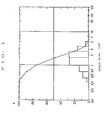
- the grain size distribution of the powder as measured with a Microtrac granulometer is shown in Fig. 1.
- An X-ray diffraction scan of the powder is shown in Fig. 2. Crystal lattice analysis showed a c/a axis ratio of 1.037.
- Oxalic acid dihydrate of guaranteed quality (12.1265 g; purity, 99.5%) was dissolved in 957 ml of ethanol of guaranteed quality and the resulting solution was held at room temperature. This solution was such that when mixed with the previously prepared aqueous solution, the molar ratio of (COOH)2/(Pb+Sr+Ti) would be 0.75 and the volume ratio of ethanol to the acidic aqueous solution being 3/1.
- the ethanolic solution of oxalic acid was added to the vigorously agitated acidic aqueous solution (pH ⁇ 0.4) over a period of 1 minute and 26 seconds. Then, 40.2 ml of concentrated aqueous ammonia of guaranteed quality was added dropwise over a period of about 1 minute. After completion of the neutralizing reaction, the slurry solution had a temperature of 30.3°C and a pH of 7.4.
- a mother liquor in the slurry solution was separated from a white precipitate by means of a pressurized filter machine.
- the separated white precipitate was charged into 682 ml of ethanol and subjected to crushing and washing operations for 30 minutes. Subsequently, the washings were separated from a white precipitate by means of a pressurized filter machine.
- the white precipitate obtained by performing another cycle of these operations was dried for an hour in a pressurized filter machine under N2 stream to obtain a semi-dry white cake.
- the cake was dried, crushed and calcined (800°C ⁇ 2 hours) as in Example 1 to obtain an oxide powder at a yield of 96.63%.
- Oxalic acid dihydrate of guaranteed quality 23.8561 g; purity, 99.5%) was dissolved in 1883 ml of ethanol of guaranteed quality and the resulting solution was held at room temperature. This solution was such that when mixed with the previously prepared aqueous solution, the molar ratio of (COOH)2/(Pb+Zr+Ti) would be 0.75 and the volume ratio of ethanol to the acidic aqueous solution being 3/1.
- the ethanolic solution of oxalic acid was added to the vigorously agitated acidic aqueous solution over a period of 3 minutes. Then, 39.6 ml of concentrated aqueous ammonia was added over a period of 1 minute. After completion of the neutralizing reaction, the slurry solution had a temperature of 27.6°C and a pH of 6.8.
- a mother liquor in the slurry solution was separated from a white precipitate by means of a pressurized filter machine.
- the separated white precipitate was charged into 1731 ml of ethanol and subjected to crushing and washing operations for 30 minutes. Subsequently, the washings were separated from a white precipitate by means of a pressurized filter machine.
- the white precipitate obtained by performing another cycle of these crushing and washing operations was subsequently treated as in Example 1; it was dried with N2 gas, freed of the solvent on a stainless steel plate, dried in an oven, crushed in an agate mortar and calcined in a muffle furnace at 700°C for 2 hours. As a result, an oxide powder was obtained at a yield of 96.2%.
- An X-ray diffraction scan of the powder is shown in Fig. 4.
- the results of grain size distribution measurement with a Microtrac granulometer are shown in Fig. 5.
- titanium tetraisopropoxides 500 ml was dropwise added to distilled water (7,000 ml) to form a hydroxide, which was filtered and washed three times with pure water (1,000 ml) so as to obtain titanium hydroxide.
- the titanium hydroxide was added to 200 ml of ice-cooled, commercially available concentrated nitric acid of guaranteed quality. The mixture was left to stand for one whole day and night and filtered to obtain a solution of titanium oxynitrate.
- the concentration of Ti ions measured in terms of TiO2 by gravimetric analysis was found to be 0.1173 g Ti/ml.
- Oxalic acid dihydrate of guaranteed quality (65.1856 g; purity, 99.5%) was dissolved in 5145 ml of ethanol of guaranteed quality and the resulting solution was held at room temperature. This solution was such that when mixed with the previously prepared aqueous solution, the molar ratio of (COOH)2/(Pb+Ca+Ti) would be 0.75 and the volume ratio of ethanol to the acidic aqueous solution being 3/1.
- the acidic aqueous solution was added to the vigorously agitated ethanolic solution of oxalic acid at a rate of about 225 ml/min to form a white slurry solution. After the addition was completed, the slurry solution was agitated for an additional 5 minutes. Thereafter, aqueous ammonia of guaranteed quality (216.2 ml) was poured into the agitated slurry solution over a period of about 1 minute, followed by continued stirring for 5 more minutes. The pH of the slurry solution as measured with BTB test paper was 7.2.
- a mother liquor in the slurry solution was separated from a white precipitated cake by means of a pressurized filter machine.
- the separated white cake was charged into 3241 ml of ethanol and subjected to crushing and washing operations for 30 minutes. Subsequently, the washings were separated from a white cake by means of a pressurized filter machine. The white cake obtained by performing another cycle of these operations was dried for one hour in a pressurized filter machine under a nitrogen stream. The resulting semi-dry cake was spread thinly over a stainless steel plate the surface of which was held at 150°C so as to evaporate ethanol. The cake was further dried in an oven with internal air circulation at 100°C for 6 hours so as to obtain a precursor powder.
- the precursor powder was slightly crushed in an agate motar and thereafter calcined in a muffle furnace at 1,000°C for 8 hours to obtain the desired oxide powder at a yield of 98.3%.
- compositional formula of the oxide powder as measured by X-ray fluoroscopy was (Pb 0.60 Ca 0.39 Ti 0.98 O3. This powder had a BET surface area of 1.95 m2/g. The mean primary particle size as determined from this BET value was 0.53 ⁇ m.
- a sheet having a diameter of 8 cm and a thickness of 121 ⁇ m was molded from the composite with a press heated at 185°C. Disks having a diameter of 2 cm were punched from this sheet and an electrode having a diameter of 1 cm and a conductor path with a width of 1 mm were formed on both sides of each disk by gold deposition.
- the frequency dependencies of the dielectric constants and losses of the samples of dielectric composite material prepared in (2) were measured at room temperature with LCR meters (YHP-4274A and YHP-4275A). The results are shown in Fig. 6.
- the temperature dependencies of the two parameters were also measured with an impedance analyzer (YHP-4274A) and the results are shown in Fig. 7 ( ⁇ vs. temperature) and Fig. 8 (tan ⁇ vs. temperature).
- titanium tetraisopropoxides 500 ml was dropwise added to distilled water (7,000 ml) to form a hydroxide, which was filtered and washed three times with pure water (1,000 ml) so as to obtain titanium hydroxide.
- the titanium hydroxide was added to 200 ml of ice-cooled, commercially available concentrated nitric acid of guaranteed quality. The mixture was left to stand for one whole day and night and filtered to obtain a solution of titanium oxynitrate.
- the concentration of Ti ions measured in terms of TiO2 by gravimetric analysis was found to be 0.1204 g Ti/ml.
- Oxalic acid dihydrate of guaranteed quality (62.129 g; purity, 99.5%) was dissolved in 4095 ml of ethanol of guaranteed quality and the resulting solution was held at room temperature. This solution was such that when mixed with the previously prepared aqueous solution, the molar ratio of (COOH)2/(Pb+Ca+Ti) would be 0.75 and the volume ratio of ethanol to the acidic aqueous solution being 3/1.
- the acidic aqueous solution was added to the vigorously agitated ethanolic solution of oxalic acid at a rate of about 219 ml/min to form a white slurry solution. After the addition was completed, the slurry solution was agitated for an additional 5 minutes. Thereafter, aqueous ammonia of guaranteed quality (206.3 ml) was poured into the agitated slurry solution over a period of about 1 minute, followed by continued stirring for 5 more minutes. The pH of the slurry solution as measured with BTB test paper was 7.2.
- a mother liquor in the slurry solution was separated from a white precipitated cake by means of a pressurized filter machine.
- the separated white cake was charged into 3417 ml of ethanol and subjected to crushing and washing operations for 30 minutes. Subsequently, the washings were separated from a white cake by means of a pressurized filter machine. The white cake obtained by performing another cycle of these operations was dried for one hour in a pressurized filter machine under a nitrogen stream. The resulting semi-dry cake was spread thinly over a stainless steel plate the surface of which was held at 150°C so as to evaporate ethanol. The cake was further dried in an oven with internal air circulation at 100°C for 6 hours so as to obtain a precursor powder.
- the precursor powder was slightly crushed in an agate motar and thereafter calcined in a muffle furnace at 1,000°C for 2 hours to obtain the desired oxide powder at a yield of 96.2%.
- compositional formula of the oxide powder as measured by X-ray fluoroscopy was (Pb 0.75 Ca 0.25 )Ti 0.99 O3.
- a sheet having a diameter of 8 cm and a thickness of 198 ⁇ m was molded from the composite with a press heated at 185°C. Disks having a diameter of 2 cm were punched from this sheet and an electrode having a diameter of 1 cm and a conductor path with a width of 1 mm were formed on both sides of each disk by aluminum deposition.
- the disks furnished with electrodes were placed in an oven heated at 80°C and a d.c. electric field of 200 kV/cm was applied to these disks for 1 hours. After the electric field was removed, the disks were cooled to room temperature to make piezoelectric composite materials having thermoelectret states.
- the electromechanical coupling factor (Kt) of a sample was 33.4%.
- the sample had a dielectric constant ( ⁇ ) of 79 at 10 kHz.
- Kt measurement was as follows: electric impedance (1Z1) and phase angle ( ⁇ ) were measured with an impedance analyzer (YHP 4191A) over the frequency range that was set with a personal computer (PC 9800 VM2); the resulting impedance curves were processed with a mainframe computer to calculate best fitting values of Kt, sound velocity, dielectric constant, tan ⁇ M and tan ⁇ E .
- Dielectric constant measurements were also conducted for composite films that were furnished with gold-deposited electrodes but which did not receive any treatment for creating thermoelectret states.
- the measuring instruments were LCR meters (YHP-4274A and YHP-4275A).
Landscapes
- Chemical & Material Sciences (AREA)
- Organic Chemistry (AREA)
- Inorganic Chemistry (AREA)
- Life Sciences & Earth Sciences (AREA)
- Environmental & Geological Engineering (AREA)
- General Life Sciences & Earth Sciences (AREA)
- Geology (AREA)
- Engineering & Computer Science (AREA)
- Manufacturing & Machinery (AREA)
- Inorganic Compounds Of Heavy Metals (AREA)
- Compositions Of Oxide Ceramics (AREA)
Claims (10)
- Verfahren zum Herstellen eines perovskitartigen Oxids des ABO₃-Typs, wobei A mindestens ein Element aus der Gruppe Pb, Ca, Sr und La ist; und B mindestens ein Element aus der Gruppe Ti und Zr ist, umfassend das Inberührungbringen einer sauren wässrigen Lösung, die die Ionen der notwendigen Bestandteilselemente enthält, mit Oxalsäure in Anwesenheit mindestens eines Alkohols aus der Gruppe Ethanol, Propanol, Butanol, Pentanol und Hexanol, wobei ein Niederschlag aus Oxalsäuresalzen gebildet wird, der als Vorläufer des Oxids dient, und anschliessendes Brennen des Vorläuferniederschlages, bei dem Oxalsäure in einer Menge hinzugegeben wird, die gleich der Summe aus 0,98 bis 1,02 Molen pro Mol des in der sauren wässrigen Lösung vorhandenen Elementes A und 0,49 bis 0,51 Molen pro Mol des ebenfalls in der sauren wässrigen Lösung vorhandenen Elementes B ist, und bei dem jeder Säurerest, der in der den Vorläuferniederschlag enthaltenden Lösung vorhanden ist, mit Ammoniak oder einem Amin neutralisiert wird.
- Verfahren nach Anspruch 1, wobei Oxalsäure in einer Menge hinzugegeben wird, die gleich der Summe aus 0,99 bis 1,01 Molen pro Mol des in der wässrigen Lösung enthaltenen Elementes A und 0,495 bis 0,505 Molen pro Mol des ebenfalls in der wässrigen Lösung vorhandenen Elementes B ist.
- Verfahren nach Anspruch 1, bei dem eine wässrige Lösung der Elemente A und B mit einer alkoholischen Oxalsäurelösung gemischt wird.
- Verfahren nach Anspruch 1, bei dem die wässrige Lösung der Elemente A und B eine mit Salpetersäure angesäuert ist, wässrige Lösung ist.
- Verfahren nach Anspruch 4, bei dem Salpetersäure in einer Menge im Bereich von 0,01 bis 4 Mole pro Mol Element B hinzugegeben wird.
- Verfahren nach Anspruch 1, bei dem die Lösung der Elemente A und B eine Lösung von Nitraten des Elementes A und Oxynitraten des Elementes B ist, die mit Salpetersäure angesäuert worden ist.
- Verfahren nach Anspruch 1, bei dem der Alkohol in einer solchen Menge hinzugegeben wird, dass 1 bis 10 Volumenteile des Alkohols in der den Vorläuferniederschlag enthaltenden Lösung, bezogen auf 1 Volumenteil des ebenfalls in der Lösung vorhandenen Wassers, vorhanden sind.
- Verfahren nach Anspruch 1, bei dem die Neutralisation mit Ammoniak oder einem Amin durchgeführt wird, bis die den Vorläuferniederschlag enthaltende, neutralisierte Lösung einen pH-Wert im Bereich von 6,2 bis 7,5 hat.
- Verfahren nach Anspruch 1, bei dem die Neutralisation durch Zugabe von gasförmigem oder wässrigem Ammoniak durchgeführt wird.
- Verfahren nach Anspruch 1, bei dem der Vorläuferniederschlag als weisser Kuchen mittels Filtration gewonnen wird, der gewonnene weisse Kuchen getrocknet und zu Teilchen zerstossen wird, wodurch ein Vorläuferpulver erhalten wird, und das Vorläuferpulver bei 600 bis 1100°C gebrannt wird.
Applications Claiming Priority (6)
| Application Number | Priority Date | Filing Date | Title |
|---|---|---|---|
| JP908087A JPS63182217A (ja) | 1987-01-20 | 1987-01-20 | Abo↓3型ペロブスカイト型酸化物の製造方法 |
| JP9080/87 | 1987-01-20 | ||
| JP44970/87 | 1987-02-27 | ||
| JP62044971A JPS63213564A (ja) | 1987-02-27 | 1987-02-27 | 高分子複合圧電体 |
| JP44971/87 | 1987-02-27 | ||
| JP62044970A JPS63213563A (ja) | 1987-02-27 | 1987-02-27 | 高分子複合誘電体 |
Publications (2)
| Publication Number | Publication Date |
|---|---|
| EP0280033A1 EP0280033A1 (de) | 1988-08-31 |
| EP0280033B1 true EP0280033B1 (de) | 1992-05-20 |
Family
ID=27278319
Family Applications (1)
| Application Number | Title | Priority Date | Filing Date |
|---|---|---|---|
| EP88100776A Expired EP0280033B1 (de) | 1987-01-20 | 1988-01-20 | Verfahren zur Herstellung von Perovskit und ABO3-Typ-Oxyden |
Country Status (3)
| Country | Link |
|---|---|
| US (1) | US4874598A (de) |
| EP (1) | EP0280033B1 (de) |
| DE (1) | DE3871175D1 (de) |
Cited By (1)
| Publication number | Priority date | Publication date | Assignee | Title |
|---|---|---|---|---|
| DE10059280A1 (de) * | 2000-11-29 | 2002-06-20 | Forschungszentrum Juelich Gmbh | Keramischer Werkstoff sowie dessen Herstellung |
Families Citing this family (21)
| Publication number | Priority date | Publication date | Assignee | Title |
|---|---|---|---|---|
| JPS63156057A (ja) * | 1986-12-19 | 1988-06-29 | 科学技術庁無機材質研究所長 | 高密度ペロブスカイトセラミックスの製造法 |
| FR2620865B1 (fr) * | 1987-09-18 | 1990-04-20 | Rhone Poulenc Chimie | Procede de preparation de supraconducteurs et produits ainsi obtenus |
| US5011822A (en) * | 1989-01-10 | 1991-04-30 | Allied-Signal Inc. | Preparation of a uniform mixed metal oxide and superconductive oxides |
| US5505865A (en) * | 1989-07-11 | 1996-04-09 | Charles Stark Draper Laboratory, Inc. | Synthesis process for advanced ceramics |
| US5204031A (en) * | 1989-09-30 | 1993-04-20 | Osaka Titanium Co., Ltd. | Powder of oxide for dielectric ceramics and a process for producing dielectric ceramics |
| JPH0798680B2 (ja) * | 1989-11-13 | 1995-10-25 | 堺化学工業株式会社 | 鉛系ペロブスカイト型セラミックスの原料粉末の製造方法 |
| US5244753A (en) * | 1990-05-29 | 1993-09-14 | Matsushita Electric Industrial Co., Ltd. | Solid electrolyte fuel cell and method for manufacture of same |
| US5219809A (en) * | 1990-07-03 | 1993-06-15 | Matsushita Electric Industrial Co., Ltd. | Dielectric ceramic composition and dielectric resonator |
| DE4127829C2 (de) * | 1991-08-22 | 1994-05-19 | Renate Prof Dr Ing Gesemann | PZT - Werkstoffe und deren Verwendung |
| JPH0555514A (ja) * | 1991-08-28 | 1993-03-05 | Hitachi Ltd | 半導体装置およびその製造方法 |
| DE4130441A1 (de) * | 1991-09-13 | 1993-03-18 | Philips Patentverwaltung | Verfahren zur herstellung waesseriger keramischer suspensionen und verwendung dieser suspensionen |
| DE4208811A1 (de) * | 1992-03-19 | 1993-09-23 | Merck Patent Gmbh | Aufdampfmaterial zur herstellung hochbrechender optischer schichten |
| DE4217818C1 (de) * | 1992-05-29 | 1993-09-16 | H.C. Starck Gmbh & Co Kg, 3380 Goslar, De | |
| IT1270828B (it) * | 1993-09-03 | 1997-05-13 | Chon Int Co Ltd | Processo per la sintesi di polveri ceramiche cristalline di composti di perovskite |
| DE4416246C2 (de) * | 1994-05-07 | 1997-02-27 | Fraunhofer Ges Forschung | Piezoelektrische PZT-Keramik mit einer Sintertemperatur 950 DEG C und Verfahren zu ihrer Herstellung |
| US5908802A (en) * | 1997-10-30 | 1999-06-01 | Sandia Corporation | Nonaqueous solution synthesis process for preparing oxide powders of lead zirconate titanate and related materials |
| SG75850A1 (en) * | 1998-06-11 | 2000-10-24 | Univ Singapore | Method for producing sintered electroceramic materials from hydroxide and oxalate precursors |
| US6153317A (en) * | 1998-08-04 | 2000-11-28 | Sandia Corporation | Perovskite phase thin films and method of making |
| JP4141298B2 (ja) * | 2003-03-24 | 2008-08-27 | 太陽誘電株式会社 | ペロブスカイト構造を有する誘電体セラミック粉末の製造方法と、セラミック電子部品の製造方法と、積層セラミックコンデンサの製造方法 |
| EP1624468A1 (de) * | 2003-04-30 | 2006-02-08 | Asahi Glass Company Ltd. | Flüssige zusammensetzung zur bildung eines ferroelektrischen dünnfilms und verfahren zur bildung eines ferroelektrischen dünnfilms |
| WO2009041207A1 (ja) * | 2007-09-26 | 2009-04-02 | Aruze Corp. | 金属複合酸化物粉末の製造方法 |
Family Cites Families (10)
| Publication number | Priority date | Publication date | Assignee | Title |
|---|---|---|---|---|
| DE2449698A1 (de) * | 1973-10-19 | 1975-04-30 | Hitachi Ltd | Verfahren zur herstellung einer optisch transparenten abo tief 3 -keramik |
| JPS5939722A (ja) * | 1982-08-25 | 1984-03-05 | Natl Inst For Res In Inorg Mater | ペロブスカイト型酸化物粉末の製造法 |
| JPS59131505A (ja) * | 1983-01-18 | 1984-07-28 | Natl Inst For Res In Inorg Mater | ジルコニウムを含むペロブスカイト型酸化物粉末の製造法 |
| JPS6011229A (ja) * | 1983-06-27 | 1985-01-21 | Sony Corp | SrZrO↓3微粒子の製造方法 |
| US4696810A (en) * | 1984-08-16 | 1987-09-29 | National Institute For Researches In Inorganic Materials | Wet process for the production of a readily sinterable powder material of perovskite or its solid solution |
| JPS61174116A (ja) * | 1985-01-28 | 1986-08-05 | Natl Inst For Res In Inorg Mater | ペロブスカイト型酸化物の製造法 |
| JPS61251517A (ja) * | 1985-04-11 | 1986-11-08 | Mitsubishi Petrochem Co Ltd | ペロブスカイト型酸化物の製法 |
| JPS61251518A (ja) * | 1985-04-11 | 1986-11-08 | Mitsubishi Petrochem Co Ltd | ペロブスカイト型酸化物を製造する方法 |
| JPS6272523A (ja) * | 1985-09-25 | 1987-04-03 | Mitsubishi Petrochem Co Ltd | Abo↓3型ペロブスカイト型酸化物の製造方法 |
| JPS6272524A (ja) * | 1985-09-25 | 1987-04-03 | Mitsubishi Petrochem Co Ltd | Abo↓3型ペロブスカイト型酸化物の製法 |
-
1988
- 1988-01-15 US US07/144,172 patent/US4874598A/en not_active Expired - Fee Related
- 1988-01-20 DE DE8888100776T patent/DE3871175D1/de not_active Expired - Lifetime
- 1988-01-20 EP EP88100776A patent/EP0280033B1/de not_active Expired
Cited By (1)
| Publication number | Priority date | Publication date | Assignee | Title |
|---|---|---|---|---|
| DE10059280A1 (de) * | 2000-11-29 | 2002-06-20 | Forschungszentrum Juelich Gmbh | Keramischer Werkstoff sowie dessen Herstellung |
Also Published As
| Publication number | Publication date |
|---|---|
| DE3871175D1 (de) | 1992-06-25 |
| US4874598A (en) | 1989-10-17 |
| EP0280033A1 (de) | 1988-08-31 |
Similar Documents
| Publication | Publication Date | Title |
|---|---|---|
| EP0280033B1 (de) | Verfahren zur Herstellung von Perovskit und ABO3-Typ-Oxyden | |
| US4832939A (en) | Barium titanate based dielectric compositions | |
| EP0641740B1 (de) | Verfahren zur Herstellung von kristallinen keramischen Pulvern aus Perowskitverbindungen | |
| US3577487A (en) | Preparation of submicron sized alkaline earth titanate and zirconate powders | |
| US5783165A (en) | Method of making barium titanate | |
| JP2709222B2 (ja) | チタン酸塩からなる球形微粉末の製造方法及びそれにより得られた球形微粉末 | |
| JPS6214489B2 (de) | ||
| KR100360118B1 (ko) | 옥살레이트법에 의한 티탄산바륨계 산화물 분말 제조방법 | |
| US20050019248A1 (en) | High-gravity reactive precipitation process for the preparation of barium titanate powders | |
| JPS6153115A (ja) | 多重湿式法による易焼結性ペロブスカイト固溶体の原料粉末の製造方法 | |
| JP2764111B2 (ja) | ペロブスカイト系セラミック粉末の製造方法 | |
| JPS6153113A (ja) | 湿式法による易焼結性ペロブスカイト及びその固溶体の原料粉末の製造方法 | |
| JPH0321487B2 (de) | ||
| JPH0210089B2 (de) | ||
| Ando et al. | Preparation of Pb (Mg1/3Nb2/3) O3-PbTiO3 powder by a wet chemical process | |
| JPH01294527A (ja) | Abo↓3型ペロブスカイト型金属酸化物の製造方法 | |
| JPH0524089B2 (de) | ||
| KR100395218B1 (ko) | BaTiO3계 분말 제조 방법 | |
| JPS61251516A (ja) | ペロブスカイト型酸化物の製造法 | |
| JPH0249251B2 (de) | ||
| KR101249585B1 (ko) | 복합금속산화물 분말의 제조방법 | |
| JPH01294528A (ja) | Abo↓3型ペロブスカイト型酸化物の製法 | |
| JPS61251517A (ja) | ペロブスカイト型酸化物の製法 | |
| JPH0527570B2 (de) | ||
| JPS6259529A (ja) | チタン含有易焼結性ペロブスカイトおよびその固溶体の原料粉末の製造方法 |
Legal Events
| Date | Code | Title | Description |
|---|---|---|---|
| PUAI | Public reference made under article 153(3) epc to a published international application that has entered the european phase |
Free format text: ORIGINAL CODE: 0009012 |
|
| AK | Designated contracting states |
Kind code of ref document: A1 Designated state(s): DE FR GB |
|
| 17P | Request for examination filed |
Effective date: 19880902 |
|
| 17Q | First examination report despatched |
Effective date: 19900726 |
|
| GRAA | (expected) grant |
Free format text: ORIGINAL CODE: 0009210 |
|
| AK | Designated contracting states |
Kind code of ref document: B1 Designated state(s): DE FR GB |
|
| REF | Corresponds to: |
Ref document number: 3871175 Country of ref document: DE Date of ref document: 19920625 |
|
| ET | Fr: translation filed | ||
| PLBE | No opposition filed within time limit |
Free format text: ORIGINAL CODE: 0009261 |
|
| STAA | Information on the status of an ep patent application or granted ep patent |
Free format text: STATUS: NO OPPOSITION FILED WITHIN TIME LIMIT |
|
| 26N | No opposition filed | ||
| PGFP | Annual fee paid to national office [announced via postgrant information from national office to epo] |
Ref country code: FR Payment date: 19980109 Year of fee payment: 11 |
|
| PGFP | Annual fee paid to national office [announced via postgrant information from national office to epo] |
Ref country code: GB Payment date: 19980112 Year of fee payment: 11 |
|
| PGFP | Annual fee paid to national office [announced via postgrant information from national office to epo] |
Ref country code: DE Payment date: 19980123 Year of fee payment: 11 |
|
| PG25 | Lapsed in a contracting state [announced via postgrant information from national office to epo] |
Ref country code: GB Free format text: LAPSE BECAUSE OF NON-PAYMENT OF DUE FEES Effective date: 19990120 |
|
| GBPC | Gb: european patent ceased through non-payment of renewal fee |
Effective date: 19990120 |
|
| PG25 | Lapsed in a contracting state [announced via postgrant information from national office to epo] |
Ref country code: FR Free format text: LAPSE BECAUSE OF NON-PAYMENT OF DUE FEES Effective date: 19990930 |
|
| PG25 | Lapsed in a contracting state [announced via postgrant information from national office to epo] |
Ref country code: DE Free format text: LAPSE BECAUSE OF NON-PAYMENT OF DUE FEES Effective date: 19991103 |
|
| REG | Reference to a national code |
Ref country code: FR Ref legal event code: ST |