EP0280636A2 - Verfahren und Vorrichtung zur Herstellung von Mustern und Webmustern und erhaltenes Gewebe - Google Patents
Verfahren und Vorrichtung zur Herstellung von Mustern und Webmustern und erhaltenes Gewebe Download PDFInfo
- Publication number
- EP0280636A2 EP0280636A2 EP88450006A EP88450006A EP0280636A2 EP 0280636 A2 EP0280636 A2 EP 0280636A2 EP 88450006 A EP88450006 A EP 88450006A EP 88450006 A EP88450006 A EP 88450006A EP 0280636 A2 EP0280636 A2 EP 0280636A2
- Authority
- EP
- European Patent Office
- Prior art keywords
- pick
- blades
- crowd
- picks
- machine
- Prior art date
- Legal status (The legal status is an assumption and is not a legal conclusion. Google has not performed a legal analysis and makes no representation as to the accuracy of the status listed.)
- Granted
Links
Images

Classifications
-
- D—TEXTILES; PAPER
- D03—WEAVING
- D03C—SHEDDING MECHANISMS; PATTERN CARDS OR CHAINS; PUNCHING OF CARDS; DESIGNING PATTERNS
- D03C19/00—Methods or devices concerned with designing or making patterns, not provided for in other groups of this subclass
- D03C19/005—Electronic
Definitions
- the present invention relates to a method and an installation for establishing woven designs using a computer means and a crowd forming machine. It also relates to woven designs, that is to say fabrics obtained using designs drawn up according to the method.
- a design to be used to make a woven design must describe in order the picks constituting said fabric.
- Each pick is defined by a crowd and a frame.
- Each crowd is formed by the lifting or lowering of certain threads of the chain chosen from the threads constituting this chain.
- the warp threads are lifted or lowered selectively, using several organs such as blades or frames.
- the weft threads to be used to make a woven design that is to say, a fabric, can have the same color or several colors and the same quality or several qualities.
- the quality of a weft thread is understood to mean its material, its size, its softness, its elasticity and all other characteristics or adjunct effects specific to said thread.
- the weft threads react differently according to their quality, during and after weaving: during weaving with respect to the mechanical stresses exerted on each weft by all the threads in the warp and by the other threads in the wefts and after weaving with live primers.
- the selected drawings can be sent directly for execution to a crowd forming machine (see FR 2 523 602).
- the present invention provides a method and an installation for drawing up woven drawings and drawings in which the design of the drawing itself is guided by weaving, on order, different parts or the whole of said drawing, this in the design phase to be able to immediately assess the result obtained and modify, add or possibly delete certain picks in order to obtain satisfactory results.
- This is contrary to the current technique which consists in first designing the drawing and then, once a drawing is selected, to proceed to the execution stage.
- - constitute an assembly comprising a programmable computer means and a crowd forming machine provided with motor organs for actuating its blades and capable of generating, on order, a single pick and more, permanently connected by an interface for transmitting, to departure of said computer means, orders to the machine to form the crowd and vice versa.
- the fabric forming part thereof is characterized in that it is designed according to the method and produced by the installation, each forming part of the present invention, or in that it is woven in from information from the said installation and saved on any medium.
- the design of a weaving pattern is guided by the production in fabric, during this design, of some or all of the parts constituting the pattern to be designed, this in order to appreciate as and measures the real effect of the fabric which is often different and sometimes very different from the design viewed, for example on a screen.
- this design which is woven, is finished, we are sure that the design will eventually produce fabric whose characteristics are already verified.
- a visualization device such as a screen or a printer.
- a computer means (1) for programming is permanently linked to a machine (2) for forming the crowd.
- This computer means receives the information from the means (3) and sends it visual signals.
- This means (3) can be composed for example of a keyboard provided with validation indicators, keys and also a screen.
- the computer means (1) can be composed for example of a microprocessor (4) associated with a permanent memory (5) loaded with suitable software and with a storage memory (6) for storing the instructions introduced by the operator (7) using the means (3).
- the crowd forming machine (2) can receive information from the means (1) or send it. According to the invention, the machine (2) for forming the crowd must be capable of generating on order, a single pick and more.
- the method according to the invention consists first of all in constituting an assembly as just described and which is shown diagrammatically in FIG. 1, then in introducing the signal lines representing the picks using the means (3), to be executed , simultaneously with their programming, some or all of these picks, this by making these picks communicate to the crowd forming machine (2), assessing the result obtained and acting, if necessary, via the means ( 3) to modify, eliminate or add certain picks.
- the operator (7) sends his instructions using the means (3) and acts to have them executed.
- This operator receives validation signals and also an image of these instructions in the form of graphics on for example a screen, as a response to the introduction of these instructions, he also receives the actual appearance of the fabric, as a response to the 'execution.
- the operator can act, during or after programming, on the crowd forming machine which then requests the information by means (1) or acts on the means (3) which transmits the order directly by means (1).
- the method according to the invention proposes a particular mode for constituting the design.
- This mode consists of: - define, in a desired order, the picks to be used to form the design, each pick being defined by a crowd determined by the lifting of certain warp threads and by a weft chosen from a number of wefts of different colors or not and / or different qualities or not.
- - define from these picks pick sequences each sequence is identified by a start pick (Da) and a pick end te (Db), this sequence of picks is repeated (r) times, (r) being greater than or equal to unity.
- - define, from these pick sequences, a drawing consisting of any combination of them.
- the end pick (Db) has a sequence number greater than the start pick (Da) and the number of repetitions (r) is equal to unity, this sequence will be made up of a series of picks in ascending order starting with pick (Da) and ending with pick (Db). If the number (r) is greater than one, the corresponding sequence will be constituted subsequently by the lines (Da) and (Db) repeated (r) times.
- this sequence will be made up of a sequence of picks in descending order, repeated or not depending on the value of the number ( r), this allows symmetries.
- this sequence will consist of a single pick repeated or not depending on the value of the number (r).
- the signal lines to be introduced by the operator using computer means, each correspond to a pick defined by a crowd and a frame.
- Each crowd corresponds to the "lifting or lowering" actuation of certain blades.
- the programmed blades, that is to say inscribed in the said signal lines each correspond: - either to an effective blade of the crowd forming machine, taken in the same order or not, that is to say, the programmed blades 1, 2 ... correspond, in order, to the effective blades 1 , 2 ... or not. - or more than one effective blade of said machine.
- each simulated blade corresponds either to a single effective blade of the so-called crowd forming machine but taken in a gold dre different, or more than one effective blade of said machine. This is very useful because it allows you to simulate a desired take-in different from the real take-in of the crowd machine.
- the utility of simulating a desired reentry different from the actual reentry of the crowd formulator can: - facilitate programming in the case where the number of effective blades of the shedding machine is greater than the number of blades necessary to perform certain drawings.
- simulated blades of a lower number than those of the shedding machine will be programmed beforehand to be introduced, during the definition of picks, in place of these effective blades. This of course provided that the actual return allows. - help to find other drawings from already defined drawings, this by simply changing the order of effective blades by simulation. It should be noted that the simulation of the blades, by prior programming, is a simpler operation than a new definition of drawing.
- a satisfactory drawing can be transmitted on any support such as for example an endless perforated strip, "cardboard”, magnetic or electric support, this can be used later for the control of a crowd forming machine. in order to reproduce the tissue.
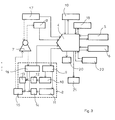
- the installation for implementing the method according to the invention in figure (2) comprises: - a computer programming means (4) provided with a permanent memory (5) and a storage memory (6).
- the memory (5) contains the software allowing programming according to the process, while the memory (6) receives and transmits the instructions programmed by the operator (7).
- a keyboard (8) provided with key validation indicators such as for example light-emitting diodes.
- a machine (2) for forming the crowd provided with a power interface (9) which activates, on order, motor members (10) to actuate the blades (12) in order to form the crowd (13) and other driving members (11) for sending the weft (14) corresponding to the pick to be generated in the fabric (15).
- control device (16) such as for example a switch connected on one side to the mechanical members for lifting the blades and sending the weft of the crowd forming machine, which generates a signal authorizing the transmission of data d 'a pick from the IT means to the power interface and a signal requesting the preparation of the next pick.
- the memory (6) comprises a correspondence table into which are previously introduced, in the case where it is desired to simulate a reentry different from the actual reentry of the shedding machine, the numbers of simulated blades and also the (s) number (s) of the effective blade (s) corresponding to each of these simulated blades.
- the operator activates, after having chosen certain lines to be executed, the device (16) which emits a signal requesting the first line to be executed, the information corresponding to this line arrives at the interface (9) which activates the motor members (10 ) and (11) to lift the blades (12) and send the frame (14) which passes through the crowd (13) formed by this lifting of the blades.
- the mechanical movement of the blades actuates the device (16) to request the next line.
- the information medium can be equipped with a screen (17) for viewing a set of picks or sequences, in programming or called from the memory (6).
- the keyboard associated with the computer means and cooperating with the software stored in the memory (5) comprises: - a pick button with a validation indicator, to be activated before programming, executing or calling one or more "pick mode" lines. - a sequence key, provided with a validation indicator, to be activated before programming or calling one or more sequences "sequence mode”. - blade keys, each provided with a validation indicator, these keys are used to enter either the actual or simulated blade numbers to define, or the simulated blade numbers and the blade number (s) ) effective corresponding (s) in a preliminary programming. - a blade simulation key, provided with a validation indicator to activate before simulating, if desired, blades, other ment said, simulate a new return.
- a weft key provided with a validation indicator, to choose the weft thread, associated with a digital display.
- - an increment key to go to the next line either in pick mode or in sequence mode and to enter the parameters of a sequence: start line, end line and the number of repetitions either to call it or to program it.
- decrement key to go to the previous line either in the frame mode or in the sequence mode.
- - an erase key to erase either a line or a sequence depending on the operating mode or an entire drawing.
- - a key for inserting either a line or a sequence, depending on the mode, - a continuous execution key to put, by choosing the start line, either a series of lines or a series of sequences, ready to go to the crowd forming machine, - backup keys for calling or saving, from memory (6) to a cassette, to a floppy disk or to a cartridge or vice versa.
- the keyboard (8) can also include: - an exit key to send information to another system. - an enter key to take information on another system.
- the validation indicators associated with certain keys light up when these keys are activated; for example when certain blade keys are activated to define a pick, the validation indicators corresponding to these keys light up, this which allows you to control the crowd of this pick in programming.
- the operator during the design can execute the pick or picks that he has just programmed by acting on the control member (16).
- Using the execute key allows you to continuously execute either a series of picks or a series of sequences. In this mode, you can choose the pick or the starting sequence, this avoids the execution of certain picks at the start of weaving, the series will be completely repeated later.
- the validation indicators associated with certain keys light up when these keys are activated; for example when certain blade keys are activated to define a pick, the validation indicators corresponding to these keys light up, which allows the crowd of this pick to be controlled in programming.
- the computer programming means is provided with a saving means (18) for recording or calling up the retained drawings or any other information from or to the memory (6), this for example using a floppy disk, 'a cartridge or others.
- the computer programming means is provided with an input for receiving information from other computer systems and outputs for sending information to other devices such as for example other computer systems (19), a printer (20 ), a machine for drilling cartons (21) or others. This obviously using the appropriate interfaces and observing, if necessary the compatibility, between the device tif concerned and said IT means.
- the computer programming means is provided with an emergency power source (22) which takes over in the event of a power cut, either during programming or during execution.
- an emergency power source (22) which takes over in the event of a power cut, either during programming or during execution.
- the execution mode at the return of the current, it is the line which should be executed before the break which will be executed, which avoids the search for this line.
- a selected design can be used to produce fabric continuously, that is to say by repeating said design selected several times: this is directly through the crowd forming machine, part of the installation , either indirectly through any medium, on which the said drawing is recorded and using another crowd forming machine cooperating with suitable material in order to translate the said drawing into commands for the machine.
- a fabric produced either directly or indirectly according to the process forming part of the present invention can benefit from a low design cost for the following reasons: - programming error eliminated progressively, given the intermittent sampling during the design. - saving of design time, since the design is guided by sampling, whereas according to the current technique sampling is a step which comes after that of the design. Depending on the process, the designer can more quickly reach his goal guided by intermittent sampling, especially when testing a new yarn. - the power to introduce a large number of lines in a drawing, without the need to redefine their constituent lines, this thanks to the sequential process. Furthermore, the process allows much larger designs (up to several million picks) than those provided by other current processes: this can allow new designs for furnishing fabrics or fabrics with a high density of threads.
Landscapes
- Engineering & Computer Science (AREA)
- Textile Engineering (AREA)
- Looms (AREA)
- Adornments (AREA)
- Toilet Supplies (AREA)
- Sanitary Device For Flush Toilet (AREA)
- Treatment Of Fiber Materials (AREA)
- Woven Fabrics (AREA)
- Treatments For Attaching Organic Compounds To Fibrous Goods (AREA)
Priority Applications (1)
| Application Number | Priority Date | Filing Date | Title |
|---|---|---|---|
| AT88450006T ATE77419T1 (de) | 1987-02-09 | 1988-02-03 | Verfahren und vorrichtung zur herstellung von mustern und webmustern und erhaltenes gewebe. |
Applications Claiming Priority (2)
| Application Number | Priority Date | Filing Date | Title |
|---|---|---|---|
| FR8701959 | 1987-02-09 | ||
| FR8701959A FR2610645B1 (fr) | 1987-02-09 | 1987-02-09 | Procede et installation pour etablir des dessins et des dessins tisses et tissu obtenu |
Publications (3)
| Publication Number | Publication Date |
|---|---|
| EP0280636A2 true EP0280636A2 (de) | 1988-08-31 |
| EP0280636A3 EP0280636A3 (en) | 1988-09-21 |
| EP0280636B1 EP0280636B1 (de) | 1992-06-17 |
Family
ID=9347970
Family Applications (1)
| Application Number | Title | Priority Date | Filing Date |
|---|---|---|---|
| EP88450006A Expired - Lifetime EP0280636B1 (de) | 1987-02-09 | 1988-02-03 | Verfahren und Vorrichtung zur Herstellung von Mustern und Webmustern und erhaltenes Gewebe |
Country Status (5)
| Country | Link |
|---|---|
| EP (1) | EP0280636B1 (de) |
| AT (1) | ATE77419T1 (de) |
| DE (1) | DE3871984T2 (de) |
| ES (1) | ES2034348T3 (de) |
| FR (1) | FR2610645B1 (de) |
Cited By (6)
| Publication number | Priority date | Publication date | Assignee | Title |
|---|---|---|---|---|
| EP0461514A3 (en) * | 1990-06-11 | 1992-01-22 | Uwe Piegeler | Computer assisted fabric design |
| EP0719880A1 (de) * | 1994-12-29 | 1996-07-03 | EAT Elektronische Ateliertechnik Textil GmbH | Verfahren zur Bestimmung der Anordnung und Trittfolge von Schäften einer Schaftmaschine |
| EP1849897A1 (de) * | 2006-04-28 | 2007-10-31 | Tsudakoma Kogyo Kabushiki Kaisha | Vorrichtung fürs Einstellen von Fachbildungsmuster für eine Webmaschine |
| EP1811067A3 (de) * | 2006-01-19 | 2009-06-03 | Tsudakoma Kogyo Kabushiki Kaisha | Vorrichtung zum Einstellen des Bindungsrapports in einer Webmaschine |
| BE1017843A3 (fr) * | 2006-04-18 | 2009-09-01 | Kabushiki Kaishi Toyota Jidoshokki | Procede et dispositif pour former un tissu via une armure envers dans un metier a tisser. |
| EP1808517A3 (de) * | 2006-01-16 | 2009-12-16 | Tsudakoma Kogyo Kabushiki Kaisha | Anzeigeeinstellvorrichtung zum Einstellen von selektiven Betriebsmodi für Webelemente einer Webmaschine |
Family Cites Families (2)
| Publication number | Priority date | Publication date | Assignee | Title |
|---|---|---|---|---|
| BE754494A (fr) * | 1969-08-28 | 1971-01-18 | Era Elektron Rechenanlage | Procede et dispositif pour l'elaboration de motifs textiles ou similaires et pour mise en memoire sur bandes perforees ou autres supports d'informations |
| DE3309829A1 (de) * | 1982-03-22 | 1983-09-29 | Stäubli AG, 8810 Horgen, Zürich | Verfahren und vorrichtung zur herstellung neuer webmuster und datentraeger |
-
1987
- 1987-02-09 FR FR8701959A patent/FR2610645B1/fr not_active Expired
-
1988
- 1988-02-03 EP EP88450006A patent/EP0280636B1/de not_active Expired - Lifetime
- 1988-02-03 ES ES198888450006T patent/ES2034348T3/es not_active Expired - Lifetime
- 1988-02-03 DE DE8888450006T patent/DE3871984T2/de not_active Expired - Fee Related
- 1988-02-03 AT AT88450006T patent/ATE77419T1/de not_active IP Right Cessation
Cited By (7)
| Publication number | Priority date | Publication date | Assignee | Title |
|---|---|---|---|---|
| EP0461514A3 (en) * | 1990-06-11 | 1992-01-22 | Uwe Piegeler | Computer assisted fabric design |
| EP0719880A1 (de) * | 1994-12-29 | 1996-07-03 | EAT Elektronische Ateliertechnik Textil GmbH | Verfahren zur Bestimmung der Anordnung und Trittfolge von Schäften einer Schaftmaschine |
| US5791381A (en) * | 1994-12-29 | 1998-08-11 | Eat Elektronische Ateliertechnik Textil Gmbh | Process for determining the arrangement and the step sequence of heald shafts of a heald loom |
| EP1808517A3 (de) * | 2006-01-16 | 2009-12-16 | Tsudakoma Kogyo Kabushiki Kaisha | Anzeigeeinstellvorrichtung zum Einstellen von selektiven Betriebsmodi für Webelemente einer Webmaschine |
| EP1811067A3 (de) * | 2006-01-19 | 2009-06-03 | Tsudakoma Kogyo Kabushiki Kaisha | Vorrichtung zum Einstellen des Bindungsrapports in einer Webmaschine |
| BE1017843A3 (fr) * | 2006-04-18 | 2009-09-01 | Kabushiki Kaishi Toyota Jidoshokki | Procede et dispositif pour former un tissu via une armure envers dans un metier a tisser. |
| EP1849897A1 (de) * | 2006-04-28 | 2007-10-31 | Tsudakoma Kogyo Kabushiki Kaisha | Vorrichtung fürs Einstellen von Fachbildungsmuster für eine Webmaschine |
Also Published As
| Publication number | Publication date |
|---|---|
| ES2034348T3 (es) | 1993-04-01 |
| DE3871984D1 (de) | 1992-07-23 |
| EP0280636A3 (en) | 1988-09-21 |
| DE3871984T2 (de) | 1993-02-18 |
| FR2610645B1 (fr) | 1989-06-16 |
| EP0280636B1 (de) | 1992-06-17 |
| ATE77419T1 (de) | 1992-07-15 |
| FR2610645A1 (fr) | 1988-08-12 |
Similar Documents
| Publication | Publication Date | Title |
|---|---|---|
| FR2552566A1 (fr) | Appareil pour l'enregistrement de donnees relatives a des motifs de tricotage en vue de la commande d'un metier a tricoter rectiligne | |
| CA1323708C (fr) | Procede pour la generation de fenetres de dialogue visualisables sur l'ecran d'un systeme informatique et dispositif pour mettre en oeuvre ce procede | |
| US8782553B2 (en) | Human-machine-interface and method for manipulating data in a machine vision system | |
| US8402434B2 (en) | Graphical user interface (GUI) script generation and documentation | |
| US20080049015A1 (en) | System for development of 3D content used in embedded devices | |
| CA3041791A1 (en) | Process for defining, capturing, assembling, and displaying customized video content | |
| KR20170078651A (ko) | 하이브리드 슬라이드-캔버스 프리젠테이션을 합성하기 위한 저작 도구 | |
| WO1999006959A1 (en) | Method and system for editing or modifying 3d animations in a non-linear editing environment | |
| EP0280636B1 (de) | Verfahren und Vorrichtung zur Herstellung von Mustern und Webmustern und erhaltenes Gewebe | |
| FR2523602A1 (fr) | Procede et dispositif pour etablir de nouveaux dessins de tissu et supports de donnees | |
| EP0108674B1 (de) | Graphisches Terminal mit Punktspeicher, ausgerüstet mit einem System zum Schreiben von Bildgewebesignalen in einen Bildspeicher | |
| WO2021058307A1 (fr) | Procede d'enregistrement de sequences de commande et de controle d'un robot de test, logiciel pour mise en oeuvre de ce procede | |
| AU2009202142A1 (en) | Creation of user interface interactions | |
| JPS5841932A (ja) | 織機の経糸開口監視装置 | |
| CH309148A (fr) | Procédé automatique de lisage d'une mise en carte d'un dessin en vue de l'obtention de tissus façonnés, et installation pour sa mise en oeuvre. | |
| JP5953622B1 (ja) | 遊技機用コンテンツ作成支援装置及び遊技機用コンテンツ作成支援プログラム | |
| Sasso et al. | A tool for the procedural generation of shaders using interactive evolutionary algorithms | |
| Stark | Film as Fabric: Connecting textile practice and experimental filmmaking through expanded cinema performance | |
| EP1033035B1 (de) | Einheit und verfahren zum transformieren und sichtbarmachen von akustischen signalen | |
| JP3592045B2 (ja) | 表示ユニットの動作試験方法、動作試験装置及び表示ユニットの動作試験プログラムを記録したコンピュータ読み取り可能な記録媒体 | |
| Ritscher | HLSL and Pixel Shaders for XAML Developers | |
| Yasumoto | Resonant Something: Glitch Art Method Using Generative AI | |
| Siraj | Procedural Look Development Turntable in Houdini: A System for Asset Evaluation and Showcasing in The Magnum Opal Animation Production | |
| WO2025139877A1 (zh) | 视频编辑方法及装置、电子设备及存储介质 | |
| Hultberg Tolv | Time as a Design Material |
Legal Events
| Date | Code | Title | Description |
|---|---|---|---|
| PUAI | Public reference made under article 153(3) epc to a published international application that has entered the european phase |
Free format text: ORIGINAL CODE: 0009012 |
|
| PUAL | Search report despatched |
Free format text: ORIGINAL CODE: 0009013 |
|
| AK | Designated contracting states |
Kind code of ref document: A2 Designated state(s): AT BE CH DE ES FR GB GR IT LI LU NL SE |
|
| AK | Designated contracting states |
Kind code of ref document: A3 Designated state(s): AT BE CH DE ES FR GB GR IT LI LU NL SE |
|
| 17P | Request for examination filed |
Effective date: 19881116 |
|
| 17Q | First examination report despatched |
Effective date: 19910910 |
|
| GRAA | (expected) grant |
Free format text: ORIGINAL CODE: 0009210 |
|
| AK | Designated contracting states |
Kind code of ref document: B1 Designated state(s): AT BE CH DE ES FR GB GR IT LI LU NL SE |
|
| PG25 | Lapsed in a contracting state [announced via postgrant information from national office to epo] |
Ref country code: SE Effective date: 19920617 Ref country code: NL Effective date: 19920617 Ref country code: GR Free format text: LAPSE BECAUSE OF FAILURE TO SUBMIT A TRANSLATION OF THE DESCRIPTION OR TO PAY THE FEE WITHIN THE PRESCRIBED TIME-LIMIT Effective date: 19920617 Ref country code: AT Effective date: 19920617 |
|
| REF | Corresponds to: |
Ref document number: 77419 Country of ref document: AT Date of ref document: 19920715 Kind code of ref document: T |
|
| REF | Corresponds to: |
Ref document number: 3871984 Country of ref document: DE Date of ref document: 19920723 |
|
| ITF | It: translation for a ep patent filed | ||
| GBT | Gb: translation of ep patent filed (gb section 77(6)(a)/1977) | ||
| NLV1 | Nl: lapsed or annulled due to failure to fulfill the requirements of art. 29p and 29m of the patents act | ||
| PG25 | Lapsed in a contracting state [announced via postgrant information from national office to epo] |
Ref country code: LU Free format text: LAPSE BECAUSE OF NON-PAYMENT OF DUE FEES Effective date: 19930228 |
|
| REG | Reference to a national code |
Ref country code: ES Ref legal event code: FG2A Ref document number: 2034348 Country of ref document: ES Kind code of ref document: T3 |
|
| PLBE | No opposition filed within time limit |
Free format text: ORIGINAL CODE: 0009261 |
|
| STAA | Information on the status of an ep patent application or granted ep patent |
Free format text: STATUS: NO OPPOSITION FILED WITHIN TIME LIMIT |
|
| 26N | No opposition filed | ||
| REG | Reference to a national code |
Ref country code: CH Ref legal event code: PL |
|
| REG | Reference to a national code |
Ref country code: CH Ref legal event code: AEN |
|
| PGFP | Annual fee paid to national office [announced via postgrant information from national office to epo] |
Ref country code: FR Payment date: 19950523 Year of fee payment: 8 |
|
| PGFP | Annual fee paid to national office [announced via postgrant information from national office to epo] |
Ref country code: CH Payment date: 19950713 Year of fee payment: 8 |
|
| PGFP | Annual fee paid to national office [announced via postgrant information from national office to epo] |
Ref country code: ES Payment date: 19950717 Year of fee payment: 8 |
|
| PGFP | Annual fee paid to national office [announced via postgrant information from national office to epo] |
Ref country code: GB Payment date: 19950721 Year of fee payment: 8 |
|
| PGFP | Annual fee paid to national office [announced via postgrant information from national office to epo] |
Ref country code: BE Payment date: 19950731 Year of fee payment: 8 |
|
| PGFP | Annual fee paid to national office [announced via postgrant information from national office to epo] |
Ref country code: DE Payment date: 19951024 Year of fee payment: 8 |
|
| PG25 | Lapsed in a contracting state [announced via postgrant information from national office to epo] |
Ref country code: GB Effective date: 19960203 |
|
| PG25 | Lapsed in a contracting state [announced via postgrant information from national office to epo] |
Ref country code: ES Free format text: LAPSE BECAUSE OF NON-PAYMENT OF DUE FEES Effective date: 19960205 |
|
| PG25 | Lapsed in a contracting state [announced via postgrant information from national office to epo] |
Ref country code: BE Effective date: 19960228 |
|
| PG25 | Lapsed in a contracting state [announced via postgrant information from national office to epo] |
Ref country code: LI Effective date: 19960229 Ref country code: CH Effective date: 19960229 |
|
| BERE | Be: lapsed |
Owner name: SOC. TEXEL S.A.R.L. Effective date: 19960228 |
|
| GBPC | Gb: european patent ceased through non-payment of renewal fee |
Effective date: 19960203 |
|
| REG | Reference to a national code |
Ref country code: CH Ref legal event code: PL |
|
| PG25 | Lapsed in a contracting state [announced via postgrant information from national office to epo] |
Ref country code: FR Effective date: 19961031 |
|
| PG25 | Lapsed in a contracting state [announced via postgrant information from national office to epo] |
Ref country code: DE Effective date: 19961101 |
|
| REG | Reference to a national code |
Ref country code: FR Ref legal event code: ST |
|
| REG | Reference to a national code |
Ref country code: ES Ref legal event code: FD2A Effective date: 19990301 |
|
| PG25 | Lapsed in a contracting state [announced via postgrant information from national office to epo] |
Ref country code: IT Free format text: LAPSE BECAUSE OF NON-PAYMENT OF DUE FEES;WARNING: LAPSES OF ITALIAN PATENTS WITH EFFECTIVE DATE BEFORE 2007 MAY HAVE OCCURRED AT ANY TIME BEFORE 2007. THE CORRECT EFFECTIVE DATE MAY BE DIFFERENT FROM THE ONE RECORDED. Effective date: 20050203 |