EP0281947A2 - Technique de compensation de température pour une transmission continue de vitesse - Google Patents
Technique de compensation de température pour une transmission continue de vitesse Download PDFInfo
- Publication number
- EP0281947A2 EP0281947A2 EP88103282A EP88103282A EP0281947A2 EP 0281947 A2 EP0281947 A2 EP 0281947A2 EP 88103282 A EP88103282 A EP 88103282A EP 88103282 A EP88103282 A EP 88103282A EP 0281947 A2 EP0281947 A2 EP 0281947A2
- Authority
- EP
- European Patent Office
- Prior art keywords
- temperature
- control
- clutch
- line
- continuously variable
- Prior art date
- Legal status (The legal status is an assumption and is not a legal conclusion. Google has not performed a legal analysis and makes no representation as to the accuracy of the status listed.)
- Granted
Links
Images





Classifications
-
- F—MECHANICAL ENGINEERING; LIGHTING; HEATING; WEAPONS; BLASTING
- F16—ENGINEERING ELEMENTS AND UNITS; GENERAL MEASURES FOR PRODUCING AND MAINTAINING EFFECTIVE FUNCTIONING OF MACHINES OR INSTALLATIONS; THERMAL INSULATION IN GENERAL
- F16H—GEARING
- F16H59/00—Control inputs to control units of change-speed- or reversing-gearings for conveying rotary motion
- F16H59/68—Inputs being a function of gearing status
- F16H59/72—Inputs being a function of gearing status dependent on oil characteristics, e.g. temperature, viscosity
-
- F—MECHANICAL ENGINEERING; LIGHTING; HEATING; WEAPONS; BLASTING
- F16—ENGINEERING ELEMENTS AND UNITS; GENERAL MEASURES FOR PRODUCING AND MAINTAINING EFFECTIVE FUNCTIONING OF MACHINES OR INSTALLATIONS; THERMAL INSULATION IN GENERAL
- F16H—GEARING
- F16H61/00—Control functions within control units of change-speed- or reversing-gearings for conveying rotary motion ; Control of exclusively fluid gearing, friction gearing, gearings with endless flexible members or other particular types of gearing
- F16H61/66—Control functions within control units of change-speed- or reversing-gearings for conveying rotary motion ; Control of exclusively fluid gearing, friction gearing, gearings with endless flexible members or other particular types of gearing specially adapted for continuously variable gearings
- F16H61/662—Control functions within control units of change-speed- or reversing-gearings for conveying rotary motion ; Control of exclusively fluid gearing, friction gearing, gearings with endless flexible members or other particular types of gearing specially adapted for continuously variable gearings with endless flexible members
- F16H61/66254—Control functions within control units of change-speed- or reversing-gearings for conveying rotary motion ; Control of exclusively fluid gearing, friction gearing, gearings with endless flexible members or other particular types of gearing specially adapted for continuously variable gearings with endless flexible members controlling of shifting being influenced by a signal derived from the engine and the main coupling
-
- F—MECHANICAL ENGINEERING; LIGHTING; HEATING; WEAPONS; BLASTING
- F16—ENGINEERING ELEMENTS AND UNITS; GENERAL MEASURES FOR PRODUCING AND MAINTAINING EFFECTIVE FUNCTIONING OF MACHINES OR INSTALLATIONS; THERMAL INSULATION IN GENERAL
- F16H—GEARING
- F16H61/00—Control functions within control units of change-speed- or reversing-gearings for conveying rotary motion ; Control of exclusively fluid gearing, friction gearing, gearings with endless flexible members or other particular types of gearing
- F16H2061/0075—Control functions within control units of change-speed- or reversing-gearings for conveying rotary motion ; Control of exclusively fluid gearing, friction gearing, gearings with endless flexible members or other particular types of gearing characterised by a particular control method
- F16H2061/0078—Linear control, e.g. PID, state feedback or Kalman
Definitions
- the present invention generally relates to the continuously variable transmission art. More particularly, the resent invention relates to temperature compensation in continuously variable transmissions and to providing temperature compensation to maintain desired system response characteristics for regulating fluid control, clutch control and belt ratio control.
- CVT'S continuously variable transmissions
- U. S. Patent No. 4,522,086 and U. S. Patent No. 4,458,318, entitled Control System for Continuously Variable Transmission, and Control Arrangement for a Variable Pulley Transmission respectively.
- These patents generally describe the mechanics and controls for a CVT system utilizing two adjustable pulleys, each pulley having at least one sheave which is axially fixed and another sheave which is axially movable relative to the first sheave.
- a flexible belt of metal or elastomeric material intercouples the pulleys.
- the interior faces of the pulley sheaves are beveled or chamfered.
- the displaceable sheave includes a a fluid constraining chamber for receiving fluid to move the sheave and thus change the effective pulley diameter; as fluid is exhausted from the chamber, the pulley diameter changes in the opposite sense.
- the effective diameter of one pulley is adjusted in one direction as the effective diameter of the second pulley is varied in the opposite direction, thereby effecting a change in the drive ratio between the input shaft coupled to an input pulley and an output shaft coupled to an output pulley.
- the ratio changes continuously as the pulley diameters vary.
- Such transmissions frequently are referred to in the art as a continuously variable transmission, CVT.
- a related, co-pending application entitled “Continuously Variable Transmission Clutch Control System,” Serial No. 25,391, filed March 13, 1987, assigned to the assignee of present application discloses an improved clutch controller for use in CVT applications.
- a second, related, co-pending application entitled “Special Start Technique For Continuously Variable Transmission Clutch Control,” Serial No. 25,476, filed March 13, 1987, assigned to the assignee of the present application discloses a unique technique for regulating the clutch pressure control signal in a CVT system during selected driving conditions, e.g. skidding on ice.
- CVT systems typically rely upon hydraulic fluid to implement various control functions, such as belt ratio control, line pressure control and clutch control.
- the viscosity and hence the responsiveness of the hydraulic fluid to flow vary substantially over the range of system operating temperatures which may be expected for a typical application of a continuously variable transmission. Variation in the viscosity of the hydraulic fluid results in an undesirable variation in the system response which creates a negative impact on the system operation, reliability and, ultimately, stability.
- a principal object of the present invention lies in providing a temperature compensation technique which generally overcomes the deficiencies of the prior art.
- a more specific object of the present invention lies in the provision of temperature compensation for individual fluid actuated controls in continuously variable transmission driven vehicles during expected driving temperatures.
- the present invention provides a technique for providing temperature compensation in a continuously variable transmission system.
- a system having a controller for providing signals to regulate the fluid transfer which accomplishes the belt ratio control, line pressure control, and the clutch control
- the present invention envisions an independent determination of the variation in the transfer function associated with each such fluid control over the range of expected system operating temperatures. These variations may be determined empirically, analytically or by model simulation and stored, or the system conceivably may track the variations as they occur.
- the system then senses operating temperature and recalls the previously determined expected variation in the responsiveness indicated by the stored or measured variation in the transfer function. The system then adjusts the controller to compensate for the expected variation based on the sensed temperature.
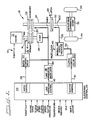
- a throttle signal 10 controls the operation of an engine 12 which transmits torque via a shaft 14 to a primary pulley 16 in a CVT 18.
- a flywheel and damping arrangement may be included on the shaft 14 between the engine 12 and the primary pulley 16.
- a metal or elastomeric belt 20 connects the primary pulley 16 to a secondary pulley 22 to transmit torque to a second shaft 24.
- a pump 26 may also be driven by the first shaft 14 to provide line pressure for the hydraulic system and the controls of the CVT 18.
- the second shaft 24 drives the input to a clutch 28 which in turn provides a torque to a third shaft 30.
- the third shaft 30 drives a reduction differential gear arrangement 32 as a drive line to provide power to the vehicle wheels 34.
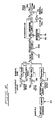
- an electronic controller 36 receives a multiplicity of inputs including throttle, engine speed, clutch input speed, clutch output speed, clutch pressure, temperature, driver demand, idle, shift lever and other information input signals as shown at the left of FIG. 1.
- the electronic controller 36 operates in a logical fashion to provide a ratio control signal on a line 38, a line pressure control signal on a line 40 and a clutch control signal on a line 42.
- the signal on the line 38 to a ratio control valve 44 controls the hydraulic pressure on a line 46 to the primary pulley 16 of the CVT 18 to control the ratio between the primary pulley 16 and the secondary pulley 22, i.e. , the belt ratio.
- the signal on the line 40 communicates with a line pressure regulator 48 which via a line 50 provides line pressure from fluid flow delivered by the pump 26 to the ratio control valve 44, a clutch control valve 52 and the secondary pulley 22.
- the output of the line pressure regulator on the line 50 also controls the pressure at the secondary pulley 22 to ensure that the belt 20 does not slip.
- the output signal on the line 42 to the clutch control valve 52 controls the output of the clutch control valve 52 on a line 54 to the manual and servo valves 56 which controls the fluid flow on the line 58 to the clutch 28. This is the signal which controls or which provides the pressure at the clutch 28 and hence regulates the torque transfer between the second shaft 24 and the third shaft 30.
- a shift lever signal on a line 60 provides an additional control of the manual and servo valves 56.
- the shift lever signal on the line 60 indicates that the vehicle is in a neutral or park mode
- the manual control within the valve arrangement 56 is closed. This prevents fluid from flowing to the clutch 28 and thus prevents any torque transfer through the clutch 28 when the vehicle is in the neutral or park mode.
- the ratio of NE to NCI will correspond to and provide a measure of the transmission belt ratio.
- the difference between NCI and NCO correspondingly provides a measure of the slippage at the clutch 28.
- NCI equals NCO, the clutch 28 locked-up with no slippage.
- the lines 46, 50 and 54 shown in Fig. 1 represent lines for fluid flow in the preferred embodiment.
- the variation in system fluid viscosity over the range of expected system operating conditions can render unsatisfactory the response of the CVT system.
- the system then may become unusable in some normal operating conditions, unless the response of the system can be made to compensate for the variations, such as fluid viscosity, which are induced by the temperature variations.
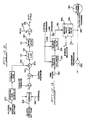
- Fig. 2 therein is shown a block diagram of a pressure loop control for operation of a clutch in a continuously variable transmission system.
- the system of Fig. 2 responds to a filtered line pressure setpoint at a line 100 ultimately to provide a proportional gain factor at a line 102 to a multiplying junction 104.
- the system also responds to the clutch pressure setpoint at a line 106 or an external setpoint at a line 108 to provide a closed loop error signal at a line 110.
- the system of Fig. 2 responds to a filtered line pressure setpoint at a line 100 ultimately to provide a proportional gain factor at a line 102 to a multiplying junction 104.
- the system also responds to the clutch pressure setpoint at a line 106 or an external setpoint at a line 108 to provide a closed loop error signal at a line 110.
- the signal at the line 102 of Fig. 2 represents a proportional gain factor, KAPC, which is a function of line pressure.
- the signal at the line 118 is a pulse width modulation control signal having a specified duty cycle which is provided to the clutch control valve to create the desired clutch pressure.
- temperature compensation may be introduced into the clutch pressure control system of Fig. 2 through modification of the proportional gain factor KAPC and the function of the lead/lag compensation network 112 and the integrator/lead compensation network 114.
- FIG. 3 therein is shown a block diagram representation of the valve, clutch and associated hydraulics for the clutch pressure control.
- the pulse width modulation signal is received at a line 120 and the actual clutch pressure is fed back from a pressure transducer 122.
- a clutch control solenoid 124 operates in conjunction with a clutch control valve 126 in response to control pressure from a line 128 and line pressure from a line 130 to provide fluid flow via a line 132 to the manual and servo valves 134 and 136, respectively.
- the output of the manual and servo valves 134 and 136 provides a clutch apply pressure at a line 138 to a clutch chamber 140.
- the system operation may be monitored by conventional techniques, such as a frequency analyzer, to provide the Bode plot of Fig. 4.
- This represents a measurement of magnitude and phase responses as a function of frequency.
- the plot of Fig. 4 indicates that the system has an effective bandwidth of nearly sixteen hertz and generally represents a two pole system as indicated by the decay of the phase to -180° at the higher frequencies.
- the plot of Fig. 4 was generated at a line pressure of 200 psig and a clutch pressure of 100 psig.
- the oil temperature was approximately 71°F.
- Fig. 5 therein is shown a Bode plot for the same system with the same parameters but generated at an oil temperature of approximately 14°F.
- the effective bandwidth of the system has diminished to less than four hertz. This was in response to the sole variable change measured by the decrease in temperature from 70°F to 14°F.
- the time constants ⁇ 1 and ⁇ 2 may be determined as functions of temperature.
- the integrator lead compensation network 114 may functionally be described by the following formula (3):
- the first pole indicated by the equation (1) may be thought of as representing the hydraulic response variation in the system plant.
- the second pole may be correspondingly thought of as the variation in the control valve dynamics in the physical plant.
- the lead compensation in the controller embodied in the lead/lag function 112 and the integrator/lead function 114 may be adjusted as the temperature decreases to compensate for the hydraulic and the control valve dynamic poles generally by equation (1).
- the lead/lag function 112 may be made to compensate for the hydraulic pole
- the integrator/lead function 114 may be made to compensate for the second, control valve dynamics, pole.
- the time constant ⁇ 4 is not made a function of temperature, but remains constant throughout the operation of the system. As explained in conjunction with the previous applications, this time constant ⁇ 4 may be chosen to have a sufficient value so as not to produce any practical impact on the operation of the system.
- the controller proportional gain, KAPC also must be adjusted as a function of temperature to maintain a constant, open loop gain in the clutch pressure loop. As the integrator/lead pole is pushed out to compensate for temperature variations, a need is created for a correction in the system response. This may be achieved through modification of the proportional gain factor. Accordingly, KAPC increases in the system of the preferred embodiment as the temperature decreases.
- the lead/lag compensation network 112 and the integrator/lead compensation network 114 are implemented in the digital controller by means of difference equations.
- the operation of the lead/lag compensation network may be implemented by the following equations (4) and (5):
- E3PC(n) CPDC(E2PC(n)-X1PCD(n)) + X1PDC(n) (4) X1PDC(n + 1) -BPDC(E2PC(n)-X1PDC(n)) + E2PC(n) (5)
- the parameter BPDC of equation (5) in the lead/lag difference equations determines the time constant ⁇ 4. As mentioned, this remains constant with the temperature.
- the lead/lag parameter CPDC of difference equation (4) determines the time constant ⁇ 3, and the integrator/lead parameter DPIC establishes a time constant ⁇ 5. Scheduling the values of these parameters as a function of temperature provides one method for compensating for the variation in the plant response created by variations in the operating temperature.
- a frequency analyzer may be used to obtain a transfer function through cross correlation to provide a Bode plot of magnitude and phase for system operation at the entire range of expected operating temperatures.
- the necessary increase in the lead/lag parameter CPDC as temperature decreases and the decrease in the integrator/lead parameter DPIC as temperature decreases may be scheduled as a function of temperature.
- Fig. 7 illustrates a temperature schedule for the lead/lag parameter CPDC. Accordingly, in operation the system senses the operating temperature and retrieves the corresponding CPDC value for use in the lead/lag compensation calculations.
- Fig. 8 represents a corresponding temperature schedule for the integrator/lead parameter DPIC. Accordingly, after the system senses the operating temperature, it retrieves the corresponding DPIC value for use in the integrator/lead compensation calculations.
- the necessary increase in the proportional gain factor KAPC may be scheduled as a function of temperature. This is illustrated in the graph of Fig. 9. Thus, after the operating temperature is sensed, the system obtains the proportional gain factor from the illustrated schedule.
- schedules illustrated in Figs. 7, 8 and 9 are determined from system measurements for a selected embodiment of a continuously variable transmission system over a chosen set of expected operating temperatures. These values must be viewed as qualitative in terms of the particular embodiment. Modifications and variations in actual quantitative values should be expected for use in actual CVT systems over the expected range of temperature variation.
- the above provides a technique for temperature compensation in a clutch pressure control system.
- the variations in system response are measured as a function of temperature and an associated approximate transfer function generated. Variations in the poles associated with the transfer function at particular temperatures may then be compensated for through corresponding empirical measurements or analytical determinations and implemented through the lead/lag compensation network 112 and the integrator/lead compensation network 114.
- the proportional gain factor may also be adjusted to maintain a constant overall system gain for the desired response.
- a line pressure regulator 150 receives fluid from a pump 26 and provides a fluid pressure to a secondary sheave 22, a ratio control valve 44 and a clutch control valve 52 for operations explained above.
- the line pressure regulator 150 is controlled by a pulse width modulation signal from a PWM generator 152.
- the PWM generator 152 is controlled by a line pressure controller 154, which is a logical subpart of the electronic controller 36 of Fig. 1.
- the line pressure controller 154 receives mode information from a line 156, temperature information from a line 158, line pressure setpoint information from a line 160 and clutch pressure information from a line 162 by means of a pressure transducer 164 connected to the output of the clutch control valve.
- a pressure transducer 164 connected to the output of the clutch control valve.
- the output of the pressure transducer 164 will provide a signal representative of the same pressure as that in the line 50, i.e. , line pressure, which connects the line pressure regulator 150 to the ratio control valve 44 in the clutch control valve 52 as long as the clutch is in a full locked-up mode and the clutch control valve is fully open to line pressure.
- the pump 26 provides a fluid flow, Q, at a line 166.
- a load representative of system flow demands 168 is provided also.
- the line 166 communicates the line pressure P3 which results from the pump flow minus the load flow and regulator dump flow, Q3, to the interstage valve 170 and to the high pressure regulator 172.
- a PWM valve 174 receives the pulse width modulation duty cycle signal via the lines 176 and 176 ⁇ .
- the PWM valve 174 supplies fluid in response to the control duty cycle signal via a line 178. This fluid flow, develops pressure P1, which drives the interstage valve 170 to provide a controlled pressure, P2, to the high pressure regulator 172.
- This pressure, P2 generally drives the high pressure regulator 172 to permit flow from the line 166 to an output line 180 as a regulator dump flow Q3 which is subtracted from the pump and load flow to provide and control line pressure P3.
- the interstage valve and the PWM valve 174 are ignored since the main regulator is the source of the slower dynamics. Accordingly, temperature compensation for the line pressure regulation in the system of the present invention focuses upon the high pressure regulator 172.
- the regulator and associated hydraulics may be approximated by a third order system.
- the mechanical poles of the regulator spool 182 comprise a second order system, while the hydraulics represent a first order flow-to-pressure relationship.
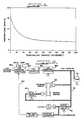
- Fig. 12 represents a linearized model for the high pressure regulator 172 of Fig. 11.
- the values illustrated in Fig. 11 represent various parameters for the physical system given by the following table:
- P2 Pilot Pressure from Interstage Valve 170
- V3 Nominal Volume of Hydraulic Load 168
- P3 Line Pressure
- A3 P3 Area at Regulator Spool 182
- the linearized model of the Fig. 12 operates as indicated therein upon the values given by Table I.
- the major temperature dependent parameter in the system is the flow gain of the valve given by the term Kqx. This parameter relates to the physical position of the valve spool 182 to flow. As the temperature of the hydraulic fluid decreases, the resistance of the fluid to flow increases. Thus, the flow gain has an inverse relationship to temperature.
- Fig. 13 represents the hydraulic pole location associated with the flow gain factor as a function of temperature.
- Fig. 14 represents a block diagram of a system for line pressure control as generally described more fully in a previous application entitled “Continuously Variable Transmission Line Pressure Control,” Serial No. 25,391, filed March 13, 1987, and incorporated herein by reference.
- K 1i and K 1p may be derived to yield the desired response at a particular operating temperature.
- the proportional term may then be used to adjust ⁇ lead to cancel approximately the effect of the hydraulic pole.
- varying the proportional gain term Kp maintains the desired system response as the temperature varies.
- the integrator gain, K 1i remains constant as a function of temperature.
- the graph of Fig. 15 represents a schedule for the proportional gain as a function of temperature. This is then utilized at the K 1p block for the closed loop control of Fig. 14. By adjusting ⁇ lead through adjustment of proportional gain, the hydraulic pole of the system is tracked as a function of temperature. Also, the open loop gain of the system remains constant throughout the modification of the lead compensation factor. Accordingly, the line pressure regulator may be compensated for variations of temperature as desired in accordance with the present invention.
- Fig. 16 therein is shown a block diagram for performing a ratio control technique.
- the operation of the system illustrated in Fig. 16 is described more fully in relating co-pending application entitled, "Ratio Control Technique for Continuously Variable Transmission Systems," Serial No. 25,389.
- a variable gain function 200 and a lead/lag compensation function 202 have been added to the system of Fig. 16 to provide for desired temperature compensation in accordance with the present invention.
- the temperature compensation is designed to counteract the loss of response in the hydraulics of the system corresponding to a decrease in temperature.
- the ratio controller outputs a pulse width modulated control signal to the ratio control valve.
- the valve consists of a first stage solenoid valve and a second stage closed center spool valve.
- the control valve regulates the flow to the primary sheave actuator, where the resultant fluid pressure determining the CVT belt ratio.
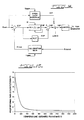
- the simplified dynamics of the ratio control plant are shown by the block diagram of Fig. 17.
- the plant consists of the hydraulic response of the ratio control valve and sheave actuator in response to the duty cycle signal from a line 204, the valve characteristics are given at the block 206.
- the hydraulics function is based on spool position X from a line 208 as given at a block 210.
- the belt/sheave transfer function at a block 212 is based on the primary sheave position Y at a line 214.
- the primary sheave function controls the belt ratio at a line 216 which through a drive line system 218 provides the engine speed at a line 220.
- Fig. 17 represents a linear model of the ratio control plant.
- the parameters of the linear model illustrated in Fig. 17 which are most affected by temperature are the valve constant ⁇ V and the hydraulic gain K H illustrated at blocks 206 and 210, respectively.
- the time constant ⁇ V is inversely proportional to the flow gain of the solenoid valve.
- the flow gain of the solenoid valve decreases as the temperature decreases.
- the time constant ⁇ V increases as the temperature decreases.
- the hydraulic gain factor KH is directly proportional to the flow gain of the second stage spool valve. Accordingly, the hydraulic gain KH decreases as temperature decreases.
- the pole of the lead/lag function 202 remains at a fixed frequency chosen to be sufficient so as not to have a practical impact on the operation of the system.
- the xero of the lead/lag compensation network 202 tracks the control valve time constant ⁇ V. As explained, ⁇ V increases as the temperature decreases. Accordingly, the zero of the lead lag compensation network 202 shifts to lower frequencies as the temperature decreases.
- the gain multiplier network 200 maintains a constant open loop gain while compensating for changes in the hydraulic gain KH. Accordingly, the gain multiplier at block 200 must increase as the temperature decreases.
- Frequency response measurements in a conventional fashion for an actual CVT system may be utilized to derive schedules for the temperature compensation parameters discussed above.
- the gain multiplier at block 200 may be implemented as a normalized function of temperature. This is shown generally by the graph of Fig. 18, in which the gain multiplier has a unity value at some reference temperature. As the temperature decreases, the gain multiplier increases accordingly to the empirically or analytically determined values necessary to maintain overall system gain.
- Fig. 19 generally illustrates the frequency location of the lead/lag compensation network 202 as a function of temperature.
- the lead/lag zero is set to the same frequency as the lead/lag pole. Again, this frequency is chosen to have a sufficient magnitude so as not to have a practical impact upon operation of the system. However, as temperature decreases, lead compensation becomes a significant factor in system operation as the lead/lag zero tracks the valve pole.
- the present invention has been implemented for clutch control, line pressure control and ratio control in a continuously variable transmission system.
- Three separate approaches have been utilized to achieve the desired temperature compensation in these three systems, and each has achieved the same result.
- actual system response measurements were utilized to provide the desired schedule for variation of the integrator/lead, lead/lag and proportional gain parameters.
- simulation techniques were utilized to provide the corresponding gain schedule as a function of anticipated operating temperature.
- analytical techniques were utilized to provide a linearized model which may be operated as taught by the previously discussed techniques to generate the appropriate gain multiplier and lead/lag zero schedules as a function of expected operating temperature. Accordingly, the operation of the present invention is deemed to be equally applicable to any of the three methods to provide the overall compensation technique generally performed by tracking variations in system transfer function based on variations in system operating temperature.
Landscapes
- Engineering & Computer Science (AREA)
- General Engineering & Computer Science (AREA)
- Mechanical Engineering (AREA)
- Oil, Petroleum & Natural Gas (AREA)
- Control Of Transmission Device (AREA)
- Control Of Driving Devices And Active Controlling Of Vehicle (AREA)
Applications Claiming Priority (2)
| Application Number | Priority Date | Filing Date | Title |
|---|---|---|---|
| US2539287A | 1987-03-13 | 1987-03-13 | |
| US25392 | 1987-03-13 |
Publications (3)
| Publication Number | Publication Date |
|---|---|
| EP0281947A2 true EP0281947A2 (fr) | 1988-09-14 |
| EP0281947A3 EP0281947A3 (en) | 1989-12-06 |
| EP0281947B1 EP0281947B1 (fr) | 1993-07-28 |
Family
ID=21825783
Family Applications (1)
| Application Number | Title | Priority Date | Filing Date |
|---|---|---|---|
| EP88103282A Expired - Lifetime EP0281947B1 (fr) | 1987-03-13 | 1988-03-03 | Technique de compensation de température pour une transmission continue de vitesse |
Country Status (3)
| Country | Link |
|---|---|
| EP (1) | EP0281947B1 (fr) |
| JP (1) | JPS63242741A (fr) |
| DE (1) | DE3882554T2 (fr) |
Cited By (8)
| Publication number | Priority date | Publication date | Assignee | Title |
|---|---|---|---|---|
| EP0424005A3 (en) * | 1989-10-17 | 1991-11-21 | Borg-Warner Automotive, Inc. | Continuously variable transmission line presssure control |
| EP0421142B1 (fr) * | 1989-09-30 | 1995-02-08 | Suzuki Motor Corporation | Méthode pour commander la vitesse de rotation d'une transmission à variation continue |
| GB2318843A (en) * | 1996-10-31 | 1998-05-06 | Nissan Motor | Compensating for thermal expansion in a continuously-variable transmission |
| EP0870954A1 (fr) * | 1997-04-08 | 1998-10-14 | Nissan Motor Company Limited | Dispositif pour régler le rapport de vitesse pour une transmission à variation de vitesse continue |
| EP0916876A3 (fr) * | 1997-11-13 | 1999-06-16 | Nissan Motor Co., Ltd. | Dispositif et méthode de commande d'une transmission à variation continue |
| WO2002086632A3 (fr) * | 2001-04-24 | 2003-04-10 | Unit Instr Inc | Systeme et procede destines a un controleur a debit massique |
| US7073392B2 (en) | 2002-07-19 | 2006-07-11 | Celerity, Inc. | Methods and apparatus for pressure compensation in a mass flow controller |
| US7905139B2 (en) | 2008-08-25 | 2011-03-15 | Brooks Instrument, Llc | Mass flow controller with improved dynamic |
Families Citing this family (2)
| Publication number | Priority date | Publication date | Assignee | Title |
|---|---|---|---|---|
| JP2688679B2 (ja) * | 1987-07-08 | 1997-12-10 | 三菱電機株式会社 | 自動車の油圧クラッチ制御装置 |
| US7216019B2 (en) | 2004-07-08 | 2007-05-08 | Celerity, Inc. | Method and system for a mass flow controller with reduced pressure sensitivity |
Family Cites Families (6)
| Publication number | Priority date | Publication date | Assignee | Title |
|---|---|---|---|---|
| GB2076060A (en) * | 1980-05-14 | 1981-11-25 | Rockwell International Corp | Liquid propellant rocket |
| DE3375561D1 (en) * | 1982-04-19 | 1988-03-10 | Nissan Motor | Method for controlling reduction ratio of continuously variable transmission with engine coolant temperature compensation |
| JPS6088264A (ja) * | 1983-10-18 | 1985-05-18 | Nissan Motor Co Ltd | 無段変速機の制御装置 |
| JPS6188065A (ja) * | 1984-10-04 | 1986-05-06 | Toyota Motor Corp | 車両用無段変速機の速度比制御方法 |
| JPS61127955A (ja) * | 1984-11-27 | 1986-06-16 | Nissan Motor Co Ltd | 自動変速機のライン圧制御装置 |
| US4648496A (en) * | 1985-04-12 | 1987-03-10 | Borg-Warner Automotive, Inc. | Clutch control system for a continuously variable transmission |
-
1988
- 1988-03-03 EP EP88103282A patent/EP0281947B1/fr not_active Expired - Lifetime
- 1988-03-03 DE DE88103282T patent/DE3882554T2/de not_active Expired - Fee Related
- 1988-03-14 JP JP63060192A patent/JPS63242741A/ja active Pending
Cited By (16)
| Publication number | Priority date | Publication date | Assignee | Title |
|---|---|---|---|---|
| EP0421142B1 (fr) * | 1989-09-30 | 1995-02-08 | Suzuki Motor Corporation | Méthode pour commander la vitesse de rotation d'une transmission à variation continue |
| EP0424005A3 (en) * | 1989-10-17 | 1991-11-21 | Borg-Warner Automotive, Inc. | Continuously variable transmission line presssure control |
| GB2318843A (en) * | 1996-10-31 | 1998-05-06 | Nissan Motor | Compensating for thermal expansion in a continuously-variable transmission |
| GB2318843B (en) * | 1996-10-31 | 1998-09-16 | Nissan Motor | Speed change controller for continuously variable transmission |
| EP0870954A1 (fr) * | 1997-04-08 | 1998-10-14 | Nissan Motor Company Limited | Dispositif pour régler le rapport de vitesse pour une transmission à variation de vitesse continue |
| US6049750A (en) * | 1997-04-08 | 2000-04-11 | Nissan Motor Co., Ltd. | Speed change ratio controller for continuously variable transmission |
| EP0916876A3 (fr) * | 1997-11-13 | 1999-06-16 | Nissan Motor Co., Ltd. | Dispositif et méthode de commande d'une transmission à variation continue |
| US6036617A (en) * | 1997-11-13 | 2000-03-14 | Nissan Motor Co., Ltd. | Continuously variable transmission, and controller and control method thereof |
| WO2002086632A3 (fr) * | 2001-04-24 | 2003-04-10 | Unit Instr Inc | Systeme et procede destines a un controleur a debit massique |
| US6962164B2 (en) | 2001-04-24 | 2005-11-08 | Celerity Group, Inc. | System and method for a mass flow controller |
| US7380564B2 (en) | 2001-04-24 | 2008-06-03 | Celerity, Inc. | System and method for a mass flow controller |
| US7073392B2 (en) | 2002-07-19 | 2006-07-11 | Celerity, Inc. | Methods and apparatus for pressure compensation in a mass flow controller |
| US7273063B2 (en) | 2002-07-19 | 2007-09-25 | Celerity, Inc. | Methods and apparatus for pressure compensation in a mass flow controller |
| US7434477B2 (en) | 2002-07-19 | 2008-10-14 | Celerity, Inc. | Methods and apparatus for pressure compensation in a mass flow controller |
| US8751180B2 (en) | 2002-07-19 | 2014-06-10 | Brooks Instrument Llc | Methods and apparatus for pressure compensation in a mass flow controller |
| US7905139B2 (en) | 2008-08-25 | 2011-03-15 | Brooks Instrument, Llc | Mass flow controller with improved dynamic |
Also Published As
| Publication number | Publication date |
|---|---|
| JPS63242741A (ja) | 1988-10-07 |
| EP0281947B1 (fr) | 1993-07-28 |
| EP0281947A3 (en) | 1989-12-06 |
| DE3882554D1 (de) | 1993-09-02 |
| DE3882554T2 (de) | 1994-03-31 |
Similar Documents
| Publication | Publication Date | Title |
|---|---|---|
| US4811225A (en) | Ratio control technique for continuously variable transmission | |
| US4793454A (en) | Continuously variable transmission clutch control system | |
| EP0275463B1 (fr) | Régulateur de patinage en boucle fermée d'un embrayage de transmission | |
| US4509125A (en) | Continuously variable transmission ratio control system | |
| EP0111854B1 (fr) | Procédé de commande d'une transmission continûment variable ou similaire | |
| US5189611A (en) | Temperature compensation technique for a continuously variable transmission control system | |
| JPS63151545A (ja) | ライン圧力制御装置 | |
| US4702128A (en) | Ratio control system for continuously variable transmission | |
| US5168778A (en) | CVT downshift control strategy to minimize slip at the drive pulley | |
| US5957260A (en) | Hydraulic pressure-control valve for automatic vehicle transmission | |
| KR100512223B1 (ko) | 벨트식 무단 변속기 | |
| JPH03134365A (ja) | ライン圧制御システム | |
| EP0385438B1 (fr) | Réglage de la pression pour la transmission automatique d'un véhicule à moteur | |
| EP0231059A1 (fr) | Système de commande pour un variateur continu de vitesse | |
| US5820514A (en) | Continuously variable transmission controller and control method | |
| US6132336A (en) | Slip control apparatus for torque converter | |
| EP0588417A1 (fr) | Commande à logique floue de changement de vitesses pour transmission automatique | |
| EP0281947B1 (fr) | Technique de compensation de température pour une transmission continue de vitesse | |
| US5752210A (en) | Method and apparatus for controlling speed-change transient mode of automatic transmissions | |
| EP0415523B1 (fr) | Système de transmission à variation continue avec système de commande d'embrayage | |
| US5925086A (en) | Vehicular automatic transmission and apparatus and method for controlling gear shift thereof | |
| JP3395561B2 (ja) | 自動変速機の変速制御装置 | |
| US5115695A (en) | Hydraulic control system for automatic transmission | |
| EP0281944B1 (fr) | Technique de modulation par largeur d'impulsion pour une soupape de réglage d'une transmission à variateur | |
| EP0283787A1 (fr) | Technique de démarrage particulière pour la commande d'embrayage d'une transmission variable sans palier |
Legal Events
| Date | Code | Title | Description |
|---|---|---|---|
| PUAI | Public reference made under article 153(3) epc to a published international application that has entered the european phase |
Free format text: ORIGINAL CODE: 0009012 |
|
| AK | Designated contracting states |
Kind code of ref document: A2 Designated state(s): DE FR GB IT SE |
|
| PUAL | Search report despatched |
Free format text: ORIGINAL CODE: 0009013 |
|
| AK | Designated contracting states |
Kind code of ref document: A3 Designated state(s): DE FR GB IT SE |
|
| RHK1 | Main classification (correction) |
Ipc: F16H 11/00 |
|
| 17P | Request for examination filed |
Effective date: 19900110 |
|
| 17Q | First examination report despatched |
Effective date: 19910611 |
|
| GRAA | (expected) grant |
Free format text: ORIGINAL CODE: 0009210 |
|
| AK | Designated contracting states |
Kind code of ref document: B1 Designated state(s): DE FR GB IT SE |
|
| PG25 | Lapsed in a contracting state [announced via postgrant information from national office to epo] |
Ref country code: IT Free format text: LAPSE BECAUSE OF FAILURE TO SUBMIT A TRANSLATION OF THE DESCRIPTION OR TO PAY THE FEE WITHIN THE PRE;WARNING: LAPSES OF ITALIAN PATENTS WITH EFFECTIVE DATE BEFORE 2007 MAY HAVE OCCURRED AT ANY TIME BEFORE 2007. THE CORRECT EFFECTIVE DATE MAY BE DIFFERENT FROM THE ONE RECORDED.SCRIBED TIME-LIMIT Effective date: 19930728 Ref country code: SE Effective date: 19930728 |
|
| REF | Corresponds to: |
Ref document number: 3882554 Country of ref document: DE Date of ref document: 19930902 |
|
| ET | Fr: translation filed | ||
| PG25 | Lapsed in a contracting state [announced via postgrant information from national office to epo] |
Ref country code: GB Effective date: 19940303 |
|
| PLBE | No opposition filed within time limit |
Free format text: ORIGINAL CODE: 0009261 |
|
| STAA | Information on the status of an ep patent application or granted ep patent |
Free format text: STATUS: NO OPPOSITION FILED WITHIN TIME LIMIT |
|
| 26N | No opposition filed | ||
| GBPC | Gb: european patent ceased through non-payment of renewal fee |
Effective date: 19940303 |
|
| PGFP | Annual fee paid to national office [announced via postgrant information from national office to epo] |
Ref country code: FR Payment date: 20030303 Year of fee payment: 16 |
|
| PGFP | Annual fee paid to national office [announced via postgrant information from national office to epo] |
Ref country code: DE Payment date: 20030331 Year of fee payment: 16 |
|
| PG25 | Lapsed in a contracting state [announced via postgrant information from national office to epo] |
Ref country code: DE Free format text: LAPSE BECAUSE OF NON-PAYMENT OF DUE FEES Effective date: 20041001 |
|
| PG25 | Lapsed in a contracting state [announced via postgrant information from national office to epo] |
Ref country code: FR Free format text: LAPSE BECAUSE OF NON-PAYMENT OF DUE FEES Effective date: 20041130 |
|
| REG | Reference to a national code |
Ref country code: FR Ref legal event code: ST |