EP0283044A2 - Laservorrichtung - Google Patents
Laservorrichtung Download PDFInfo
- Publication number
- EP0283044A2 EP0283044A2 EP88104387A EP88104387A EP0283044A2 EP 0283044 A2 EP0283044 A2 EP 0283044A2 EP 88104387 A EP88104387 A EP 88104387A EP 88104387 A EP88104387 A EP 88104387A EP 0283044 A2 EP0283044 A2 EP 0283044A2
- Authority
- EP
- European Patent Office
- Prior art keywords
- laser
- discharge
- accordance
- optical axis
- laser apparatus
- Prior art date
- Legal status (The legal status is an assumption and is not a legal conclusion. Google has not performed a legal analysis and makes no representation as to the accuracy of the status listed.)
- Granted
Links
Images



Classifications
-
- H—ELECTRICITY
- H01—ELECTRIC ELEMENTS
- H01S—DEVICES USING THE PROCESS OF LIGHT AMPLIFICATION BY STIMULATED EMISSION OF RADIATION [LASER] TO AMPLIFY OR GENERATE LIGHT; DEVICES USING STIMULATED EMISSION OF ELECTROMAGNETIC RADIATION IN WAVE RANGES OTHER THAN OPTICAL
- H01S3/00—Lasers, i.e. devices using stimulated emission of electromagnetic radiation in the infrared, visible or ultraviolet wave range
- H01S3/05—Construction or shape of optical resonators; Accommodation of active medium therein; Shape of active medium
- H01S3/06—Construction or shape of active medium
- H01S3/07—Construction or shape of active medium consisting of a plurality of parts, e.g. segments
- H01S3/073—Gas lasers comprising separate discharge sections in one cavity, e.g. hybrid lasers
- H01S3/076—Folded-path lasers
-
- H—ELECTRICITY
- H01—ELECTRIC ELEMENTS
- H01S—DEVICES USING THE PROCESS OF LIGHT AMPLIFICATION BY STIMULATED EMISSION OF RADIATION [LASER] TO AMPLIFY OR GENERATE LIGHT; DEVICES USING STIMULATED EMISSION OF ELECTROMAGNETIC RADIATION IN WAVE RANGES OTHER THAN OPTICAL
- H01S3/00—Lasers, i.e. devices using stimulated emission of electromagnetic radiation in the infrared, visible or ultraviolet wave range
- H01S3/02—Constructional details
- H01S3/03—Constructional details of gas laser discharge tubes
- H01S3/038—Electrodes, e.g. special shape, configuration or composition
-
- H—ELECTRICITY
- H01—ELECTRIC ELEMENTS
- H01S—DEVICES USING THE PROCESS OF LIGHT AMPLIFICATION BY STIMULATED EMISSION OF RADIATION [LASER] TO AMPLIFY OR GENERATE LIGHT; DEVICES USING STIMULATED EMISSION OF ELECTROMAGNETIC RADIATION IN WAVE RANGES OTHER THAN OPTICAL
- H01S3/00—Lasers, i.e. devices using stimulated emission of electromagnetic radiation in the infrared, visible or ultraviolet wave range
- H01S3/02—Constructional details
- H01S3/04—Arrangements for thermal management
- H01S3/041—Arrangements for thermal management for gas lasers
-
- H—ELECTRICITY
- H01—ELECTRIC ELEMENTS
- H01S—DEVICES USING THE PROCESS OF LIGHT AMPLIFICATION BY STIMULATED EMISSION OF RADIATION [LASER] TO AMPLIFY OR GENERATE LIGHT; DEVICES USING STIMULATED EMISSION OF ELECTROMAGNETIC RADIATION IN WAVE RANGES OTHER THAN OPTICAL
- H01S3/00—Lasers, i.e. devices using stimulated emission of electromagnetic radiation in the infrared, visible or ultraviolet wave range
- H01S3/05—Construction or shape of optical resonators; Accommodation of active medium therein; Shape of active medium
- H01S3/08—Construction or shape of optical resonators or components thereof
- H01S3/08059—Constructional details of the reflector, e.g. shape
-
- H—ELECTRICITY
- H01—ELECTRIC ELEMENTS
- H01S—DEVICES USING THE PROCESS OF LIGHT AMPLIFICATION BY STIMULATED EMISSION OF RADIATION [LASER] TO AMPLIFY OR GENERATE LIGHT; DEVICES USING STIMULATED EMISSION OF ELECTROMAGNETIC RADIATION IN WAVE RANGES OTHER THAN OPTICAL
- H01S3/00—Lasers, i.e. devices using stimulated emission of electromagnetic radiation in the infrared, visible or ultraviolet wave range
- H01S3/05—Construction or shape of optical resonators; Accommodation of active medium therein; Shape of active medium
- H01S3/08—Construction or shape of optical resonators or components thereof
- H01S3/081—Construction or shape of optical resonators or components thereof comprising three or more reflectors
-
- H—ELECTRICITY
- H01—ELECTRIC ELEMENTS
- H01S—DEVICES USING THE PROCESS OF LIGHT AMPLIFICATION BY STIMULATED EMISSION OF RADIATION [LASER] TO AMPLIFY OR GENERATE LIGHT; DEVICES USING STIMULATED EMISSION OF ELECTROMAGNETIC RADIATION IN WAVE RANGES OTHER THAN OPTICAL
- H01S3/00—Lasers, i.e. devices using stimulated emission of electromagnetic radiation in the infrared, visible or ultraviolet wave range
- H01S3/09—Processes or apparatus for excitation, e.g. pumping
- H01S3/097—Processes or apparatus for excitation, e.g. pumping by gas discharge of a gas laser
- H01S3/0971—Processes or apparatus for excitation, e.g. pumping by gas discharge of a gas laser transversely excited
- H01S3/09713—Processes or apparatus for excitation, e.g. pumping by gas discharge of a gas laser transversely excited with auxiliary ionisation, e.g. double discharge excitation
Definitions
- the present invention relates generally to a laser apparatus, and more particularly to a laser apparatus which has an effective utilization of laser beam generated in a discharge chamber and is operable in low atmospheric pressure laser medium.
- An excimer laser generates a laser light having high power and high repeat frequency in ultraviolet range by discharge excitation of a rare gas and a halogen gas.
- the laser apparatus is expected to be applied to various technical research and further to a semiconductor fabricating process, chemical industry, pharmaceutical industry and energy generating field.
- Typical excimer lasers are that of ArF of 193nm wave length, KrF of 248nm wave length and XeCl of 308nm wave length, and the laser light in generated by discharge excitation of a laser medium of a mixture of a rare gas and a halogen gas enclosed in a discharge chamber.
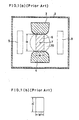
- FIG.1(a) is a cross-sectional view on a sectional plane perpendicular to an optical axis 7 of a main portion of an excimer laser apparatus in the prior art.
- a known power source and other known electronic circuits for operating the excimer laser apparatus are omitted for simplicities in FIG. 1(a).
- the discharge chamber 2 is filled with a laser medium.
- Two main electrodes 3 and 4 which are long in a direction of the optical axis 7 and are faced each other are provided in the discharge chamber 2.
- the main electrodes 3 and 4 are wired to the power source through a capacitor (not shown).
- Ultraviolet light is radiated from pre-discharge means 5 prior to application of a high voltage pulse across the main electrodes 3 and 4, and the laser medium between the main electrodes 3 and 4 are ionized.
- a voltage of the high voltage pulse which is applied across the main electrodes 3 and 4 reaches a break down voltage of the laser medium, glow discharge 6 is generated between the main electrodes 3 and 4, and the laser medium is excited. Consequently, laser light is emitted between an output coupler 10 which is mounted perpendicularly to the optical axis 7 and a total reflector (not shown).
- the atmospheric pressure of the laser medium is generally 2--4 Kg/cm2.
- a cross section of the output laser beam in the above mentioned example is generally 20mm in height and 15mm in width.
- Increase of an average output by mean of increase of a repeat frequency of the laser oscillation is required rather than a higher output per one pulse for a light source of photolithography in the semiconductor fabricating process, in which the high output per one pulse is not required for exposing process of a photosensitive material such as photoresist.
- a material of polymetamethyl alkylate (acrylate) for example, if a laser light having over 300 mJ/cm2 per pulse is applied, a troublesome "ablation" arises. Therefore, a plurality of exposures by a low output light are preferable.
- a repeat frequency of at least 200 Hz is required for the light source of photolithography.
- a flow rate of the laser medium passing between the two main electrodes must be increased.
- W width of the discharge region of the main electrodes
- N repeat frequency
- the value of C R is 1 in an ideal condition, but the value of C R is valid by a structure of the discharge chamber and the shape of the electrodes, and is generally 2--3.
- a repeat frequency N of 500/sec and a value C R of 2 a flow rate of the laser medium of 20m/sec is required.
- a ratio of beam width(W ⁇ ), which is almost equal of the width of the discharge region W, to the beam height (H ⁇ ), which is almost equal to the interval of the electrodes 3 and 4 of the cross section of the output laser beam of the excimer laser increases.
- an adequate interval H of the electrodes is about 3cm
- a cross section of the excimer laser radiated from the laser apparatus is rectangle of about 3cm in height(H ⁇ ) and about 1.5cm in width (W ⁇ )
- the ratio H ⁇ /W ⁇ becomes about 2.
- the large ratio H ⁇ /W ⁇ is not preferable for application of the excimer laser.
- an expensive optical system of large diameter is required to utilize the output of the laser light effectively.
- the output beam of the laser is shielded by an aperture which is almost equal to the effective diameter the optical system. And thereby, effective utilization of the output beam cannot be attained.
- the defect commonly exist not only in the excimer laser but also in gas laser such as CO2 laser or He-Ne laser.
- An object of the present invention is to provide a laser apparatus which is operated in a low atmospheric pressure of a laser medium and are attainable effective utilization of an oscillated laser beam by a simple structure of the apparatus.
- the laser apparatus in accordance with the present invention comprises: a discharge chamber enclosing a laser medium therein, at least two main electrodes, provided in said discharge chamber facing each other with main optical axis therebetween, holding a predetertmined gap therebetween, to define a discharge region therein, pre-discharge means for preliminary excitation of said laser medium prior to initiation of main discharge across said main electrodes, a total reflector which is provided at one end of said discharge chamber with its reflection plane perpendicular to said main optical axis for reflecting laser light beam by 180° , output coupler means provided at vicinity of said total reflector at said one end of said discharge chamber to allow laser light to go out therethrough, and at least one light folding means provided at least on the other end of said discharge chamber for folding laser light beam incident thereto in a manner to travel on a path which is parallel to path of said incident laser light beam, thereby to constitute folded lasing path which consists of plural each other parallel lasing regions having respective optical axes in each other parallel relation and connected by
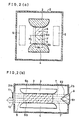
- FIG.2(a) is a cross-sectional view on a plane of perpendicular to opticals axes 7 and 7 ⁇ of an excimer laser apparatus of a first embodiment in accordance with the present invention
- FIG.(2b) is a cross-sectional view along the optical axes 7 and 7 ⁇ of the first embodiment.
- a discharge chamber 2 is filled with a laser medium gas which is a mixture of a rare gas and a halogen gas of a predetermined atmospheric pressure under 3 Kg/cm2 (2280torr.).
- the laser medium is circulated with a flow rate of 20--30m/sec in a direction perpendicular to the optical axes 7 and 7 ⁇ in a discharge region 6 defined between main electrodes 3 and 4.
- the main electrodes 3 and 4 are made to be a cross section of generally known Logosky or Chang type so that a uniform glow discharge is attainable.
- the main electrodes 3 and 4, as shown in FIG.3, are coupled to an exciting circuit of high voltage resonant charge transfer type.
- the uniform glow discharge is generated in the gap between the main electrodes 3 and 4 with a short time period by a charge and discharge energy of a peaking capacitor 37, and the discharge region 6 for generating the laser beam is formed.
- a spark gap 36, a peaking capacitor 37 and the main electrodes 3 and 4 are mounted in the discharge chamber 2.
- a high voltage from a high voltage power source (not shown) is applied across terminals 31 and 32, and a storage capacitor 33 is charged through a charge coil 34.
- the electric charge in the storage capacitor 33 is transferred to a peaking capacitor 37 by closing a switch 35 such as spark gap or thyratron switch through the spark gap 36.
- discharge occurs between the spark gap 36 during charge of the peaking capacitor 37.
- the laser medium between the spark gap 36 is ionized by the discharge, and ultraviolet light is emitted.
- the laser medium between the main electrodes 3 and 4 which are irradiated by the ultraviolet light are ionized.
- the ionization is called "pre-ionization".
- a large electric power must be inputted in a closed loop which is composed of the peaking capacitor 37, the spark gap 36, the main electrodes 3 and 4 are the stray inductance 3B during a short time period (several 10 nsec in excimer laser).
- the respective elements included in the closed loop must be miniaturized, and the stray inductance 38 due to wiring between the respective elements must be reduced to the minimum.
- the pre-ionizing devices 5 composed of the spark gap 36 and the peaking capacitor 37 ionize the laser medium prior to the main discharge of the discharge region 6, and makes a function for uniforming the glow discharge between the main electrodes 3 and 4.
- ultraviolet light is automatically radiated by the pre-ionizing devices 5.
- a total reflector 11 for the discharge region 6a and an output coupler 10 are provided on a left side wall 2a of the discharge chamber 2 perpendicularly to the respective optical axes 7 and 7 ⁇ .
- a folding optical element 9 is provided on a right side wall 2d of the discharge chamber 2.
- An optical resonator in the embodiment is composed of the output coupler 10, total reflector 11 and the folding optical element 9.
- the folding optical element 9 is consists of a total reflector 91 which is perpendicular to the axes 7 and 7 ⁇ and an optical member having two transparent plane 92 which is positioned in the respective optical axes 7 and 7 ⁇ with a Brewster angle, and mad to be minimum in a surface reflecting rate to P-polarization.
- a path from the total reflector 11 to the output coupler 10 via the folding optical element 9 becomes an actual length of the discharge region, and the length of the discharge region becomes twice of the optical axis length of the discharge chamber 2. Consequently, the whole cross sectional area which is perpendicular to the axes 7 and 7 ⁇ of the discharge region 6 effectively serves to generate the laser light, and the laser beam is output from the output coupler 10 via the discharge region 6b which is an lower half of the discharge region 6.
- a ratio (H1/W1) of height H1 to width W1 of the discharge region as shown in FIG.2(a) can be made almost 1, in case that the discharge electrode has a structure of a large H/W ratio for the low atmospheric pressure gas.
- the diameter of the external optical system is sufficient to be a diagonal line of the cross section of the discharge pat 6b.
- the output laser light is made to be a vertical polarizing oscillation (P polarization) by an effect of the folding optical element 9. Therefore, when the output laser light is divided by an optical system which is incident with a predetermined angle, stable division is realized, and the feature is one of advantages of the present invention.
- P polarization vertical polarizing oscillation
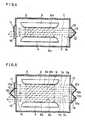
- FIG.4 is a cross-sectional view along the optical axis of a second embodiment of the present invention.
- elements similar to the elements of FIG.2(b) are identified by like numerals.
- only a folding optical element 12 is different from that of the first embodiment.
- the folding optical element 12 is composed of two reflectors 13 and 13 ⁇ which are mounted in the respective optical axes 7 and 7 ⁇ at 45° and a transparent optical member having a transparent plane 14 which is perpendicular to the axes 7 and 7 ⁇ .
- the transparent plane 14 is perpendicular to the optical axes 7 and 7 ⁇ , and the folding optical elements 12 are mounted in the respective optical axes 7 and 7 ⁇ at 45° (not Brewster angle) a laser light which is reflected by the folding optical element 12 does not deviate from the optical axes 7 and 7 ⁇ of the incident light in various wavelengthes of the laser.
- reflectance of the reflectors 13 and 13 ⁇ has a wide band covering the wavelength range of the excimer laser, for example, a laser light from XeCl laser (308 nm) to ArF (193 nm) can be oscillated by only change of the laser medium.
- Other effect of the second embodiment are identical with that of the first embodiment.
- FIG. 5 is a cross-sectional view along the optical axis of a third embodiment of the present invention.
- the discharge region 6 is divided into four discharge regions 6a, 6b, 6c and 6d, and the respective optical axes 7a, 7b, 7c and 7d are set in the central portions of the respective discharge regions 6a, 6b, 6c and 6d, respectively.
- a total reflector 11 which is perpendicular to the optical axis 7a is mounted on a left end portion of the discharge region 6a, and a total reflector 13a is mounted in the optical axis 7a at 45° at a right end of the discharge region 6a.
- Total reflectors 13b are mounted in the optical axis 7b at 45° on the both end portions of the discharge region 6b, and total reflector 13c are mounted in the optical axis 7c at 45° on both the end portions of the discharge region 6b.
- a total reflector 13d is mounted in the optical axis 7d at 45° on the right end portion of the discharge region 6d, and an output coupler 10 which is perpendicular to the optical axis 7d is mounted on the left end portion of the discharge region 6d.
- a length of the total discharge region becomes about four times of the length of the discharge chamber.
- the interval of the main electrodes 3 and 4 can be widened in order to improve efficiency of laser oscillation in low atmospheric pressure of the laser medium.
- the discharge region 6 which is enlarged in height direction can be divided by using a necessary number of the folding optical element.
- the folding optical element 9 which is shown in FIG.2(b) is applicable to the third embodiment.
- FIG.6(a) is a cross-sectional view of along an optical axis of a fourth embodiment which is applied to a CO2 laser.
- a mixed gas of CO2 , He , N2 or the like is filled in the discharge chamber 2 as a laser medium.
- Two short tube-shaped discharge electrodes 22 and 23 are arranged with a predetermined distance in a common optical axis 8 in the discharge chamber 2.
- a discharge region 6 between the discharge electrodes 22 and 23 is divided into two discharge upper region 6a and lower region 6b, between which the optical axis 8 lies, and optical axes 7a and 7b are in the respective discharge regions 6a and 6b, respectively, as shown in FIG.6(b).
- elements similar to the elements of FIG.2(b) are designated by like numerals.
- a high output CO2 laser is obtainable.
- the laser is oscillated in a low atmospheric pressure of the laser medium.
- gap between two electrodes is made to wide in order to improve efficiency, and the cross section of the discharge region becomes inevitably rectangle.
- the discharge region is divided into a predetermined number with the optical axis therebetween.
- the cross section of the output laser light is formed substantially in a square shape by mounting several reflectors at both end portions of the respective discharge regions, thereby to form permit one optical path to work as an optical resonator by means of the reflectors. Consequently, a diameter of the external optical system coupled thereto for receiving the output laser light can be reduced, and cost is saved.
- the output coupler is not essential to be formed integral with the total reflector.
- the folding optical element can be formed by combination of discrete reflectors. The above-mentioned embodiment of the present invention can be applied to a laser apparatus which is operated in high atmospheric pressure.
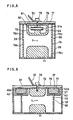
- FIG.7 is a cross-sectional view at a plane perpendicular to the optical axis, of the discharge chamber showing detailed constitution of the main electrodes and spark gaps serving as pre-discharge device of a fifth embodiment.
- Axially oblong electrodes 71 and 72 as main electrodes are provided in a discharge chamber 2, and they are disposed to face each other along an optical axis 7.
- the electrode 72 has an U-shaped cross section on a perpendicular plane to the optical axis, and a peaking capacitor 37 is mounted in a gutter of square section of the electrode 72.
- a lower surface of the peaking capacitor 37 is fixed on the gutter, and the upper surface 37a thereof is coupled with high voltage connecting plate 77 by screws 78 penetrating an insulating member 76a.
- a cooling chamber 74 is formed between side walls of the peaking capacitor 37 and the gutter, and a known coolant is filled therein.
- a plurality of spark pins 79 arrayed in the axial direction (perpendicular to the paper of FIG.7) are arranged along both sides of the main electrodes.
- the upper arrayed spark pins 79a are connected to the high voltage connecting plate 77, and the lower arraied spark pins 79b are connected to the electrode 71.
- Each upper arrayed spark pin 79a faces to a corresponding lower arrayed spark pin (79b), each with predetermined gap.
- the coolant which is cooled by an external refrigerating apparatus (not shown) is circulated in the cooling chamber 74.
- FIG.8 is a cross-sectional view at a plane perpendicular to the optical axis of a sixth embodiment in the main electrodes portion.
- at least two flat board-shaped electrodes 81 and 82 are placed facing each other in a gutter 94 of an upper electrode 72 having an U-shaped perpendicular cross section of the optical axis 7, and thereby a capacitor 37a is formed.
- the electrode 81 of the capacitor 37a is connected to a high voltage connecting plate 32 by a screw 78.
- Another electrode 82 is coupled to the outer electrode 72.
- the gutter 94 is covered by insulating member 76, non-conductive and high dielectric material such as pure water or oil which is chilled by an external refrigerating apparatus (not shown) is circulared in the gutter 94.
- the dielectric material of the capacitor 37a serves as a coolant, and high power laser apparatus is miniaturized, and reliability of the apparatus is improved.
- FIG.9 is a cross-sectional view of a seventh embodiment of a constitution of the main electrodes.
- two capacitors 37, 37 are mounted on both sides of the electrode 72.
- Respective capacitors 37 are covered by non-conductive plates 40 so as to prevent them from direct touch with the laser medium, and thereby corrosion of the surfaces of the capacitors 37 by the laser medium can be prevented.
- the capacitors 37 can be cooled by flowing the coolant in gaps 40a between the capacitors 37 and the non-conductive plates 40.
- Constitution and operation of the other part of the embodiment are identical with that of the embodiments as shown in FIG.7 and FIG.8.
- the present invention is most suitable for the excimer laser, but is applicable to other laser apparatus.
Landscapes
- Physics & Mathematics (AREA)
- Electromagnetism (AREA)
- Engineering & Computer Science (AREA)
- Plasma & Fusion (AREA)
- Optics & Photonics (AREA)
- Lasers (AREA)
Priority Applications (1)
| Application Number | Priority Date | Filing Date | Title |
|---|---|---|---|
| EP92105632A EP0495535B1 (de) | 1987-03-19 | 1988-03-18 | Laser-Apparat |
Applications Claiming Priority (4)
| Application Number | Priority Date | Filing Date | Title |
|---|---|---|---|
| JP6458087A JPH0714086B2 (ja) | 1987-03-19 | 1987-03-19 | エキシマレ−ザ装置 |
| JP64580/87 | 1987-03-19 | ||
| JP62064581A JPS63229869A (ja) | 1987-03-19 | 1987-03-19 | レ−ザ−発振器 |
| JP64581/87 | 1987-03-19 |
Related Child Applications (1)
| Application Number | Title | Priority Date | Filing Date |
|---|---|---|---|
| EP92105632.1 Division-Into | 1988-03-18 |
Publications (3)
| Publication Number | Publication Date |
|---|---|
| EP0283044A2 true EP0283044A2 (de) | 1988-09-21 |
| EP0283044A3 EP0283044A3 (en) | 1988-10-26 |
| EP0283044B1 EP0283044B1 (de) | 1993-10-13 |
Family
ID=26405668
Family Applications (2)
| Application Number | Title | Priority Date | Filing Date |
|---|---|---|---|
| EP92105632A Expired - Lifetime EP0495535B1 (de) | 1987-03-19 | 1988-03-18 | Laser-Apparat |
| EP88104387A Expired - Lifetime EP0283044B1 (de) | 1987-03-19 | 1988-03-18 | Laservorrichtung |
Family Applications Before (1)
| Application Number | Title | Priority Date | Filing Date |
|---|---|---|---|
| EP92105632A Expired - Lifetime EP0495535B1 (de) | 1987-03-19 | 1988-03-18 | Laser-Apparat |
Country Status (3)
| Country | Link |
|---|---|
| US (1) | US5042047A (de) |
| EP (2) | EP0495535B1 (de) |
| DE (2) | DE3854236T2 (de) |
Cited By (3)
| Publication number | Priority date | Publication date | Assignee | Title |
|---|---|---|---|---|
| FR2695262A1 (fr) * | 1992-09-01 | 1994-03-04 | Deutsche Forsch Luft Raumfahrt | Laser pulsé de grande puissance. |
| FR2696284A1 (fr) * | 1992-09-01 | 1994-04-01 | Deutsche Forsch Luft Raumfahrt | Système laser pulsé de grande puissance. |
| US5327415A (en) * | 1992-01-14 | 1994-07-05 | International Business Machines Corporation | Integrated light deflector and method of fabrication therefor |
Families Citing this family (11)
| Publication number | Priority date | Publication date | Assignee | Title |
|---|---|---|---|---|
| US5305339A (en) * | 1991-02-08 | 1994-04-19 | Mitsubishi Denki Kabushiki Kaisha | Pulse laser apparatus |
| DE4112311A1 (de) * | 1991-04-15 | 1992-10-22 | Max Planck Gesellschaft | Transversal elektrisch gepumpter gaslaser mit schraeg ausgefuehrtem strahldurchgang |
| TW228618B (de) * | 1992-03-31 | 1994-08-21 | Toshiba Co Ltd | |
| US5557629A (en) * | 1992-08-28 | 1996-09-17 | Kabushiki Kaisha Komatsu Seisakusho | Laser device having an electrode with auxiliary conductor members |
| US5315614A (en) * | 1993-05-03 | 1994-05-24 | The Spectranetics Corporation | Apparatus and method for soft focusing energy into an optical fiber array |
| DE4426723A1 (de) * | 1994-07-22 | 1996-01-25 | Atl Lasertechnik & Accessoires | Gleitentladungsvorionisation für Gaslaser |
| US6456643B1 (en) | 1999-03-31 | 2002-09-24 | Lambda Physik Ag | Surface preionization for gas lasers |
| US6650679B1 (en) | 1999-02-10 | 2003-11-18 | Lambda Physik Ag | Preionization arrangement for gas laser |
| US6757315B1 (en) | 1999-02-10 | 2004-06-29 | Lambda Physik Ag | Corona preionization assembly for a gas laser |
| US6671302B2 (en) | 2000-08-11 | 2003-12-30 | Lambda Physik Ag | Device for self-initiated UV pre-ionization of a repetitively pulsed gas laser |
| US7471708B2 (en) * | 2005-03-31 | 2008-12-30 | Cymer, Inc. | Gas discharge laser output light beam parameter control |
Family Cites Families (10)
| Publication number | Priority date | Publication date | Assignee | Title |
|---|---|---|---|---|
| US3500240A (en) * | 1964-11-30 | 1970-03-10 | Us Navy | Simple traveling wave laser using total - internal - reflection resonator |
| US3581229A (en) * | 1968-08-27 | 1971-05-25 | Gen Electric | Face-pumped laser device with optical path folding |
| FR2144141A6 (de) * | 1971-07-01 | 1973-02-09 | Comp Generale Electricite | |
| DE2850521C2 (de) * | 1978-11-22 | 1986-05-22 | Eltro GmbH, Gesellschaft für Strahlungstechnik, 6900 Heidelberg | Transversal angeregter, bei Atmosphärendruck arbeitender Gaslaser |
| US4423510A (en) * | 1979-08-17 | 1983-12-27 | Westinghouse Electric Corp. | Laser tube design incorporating low inductance capacitor |
| JPS56131985A (en) * | 1980-03-19 | 1981-10-15 | Mitsubishi Electric Corp | Amplifying device for laser beam |
| DE3013302A1 (de) * | 1980-04-05 | 1981-10-08 | Eltro GmbH, Gesellschaft für Strahlungstechnik, 6900 Heidelberg | Wellenleiterlaser mit frustrationselement |
| US4417342A (en) * | 1981-03-03 | 1983-11-22 | Lumonics Inc. | Laser |
| DE3403841A1 (de) * | 1984-02-03 | 1985-08-08 | Siemens AG, 1000 Berlin und 8000 München | Gaslaser, insbesondere te-laser |
| NO853264L (no) * | 1984-10-15 | 1986-04-16 | Siemens Ag | Transversalt eksitert gasslaser og fremgangsm¨te til dens drift. |
-
1988
- 1988-03-18 DE DE3854236T patent/DE3854236T2/de not_active Expired - Fee Related
- 1988-03-18 EP EP92105632A patent/EP0495535B1/de not_active Expired - Lifetime
- 1988-03-18 US US07/169,784 patent/US5042047A/en not_active Expired - Lifetime
- 1988-03-18 EP EP88104387A patent/EP0283044B1/de not_active Expired - Lifetime
- 1988-03-18 DE DE3884832T patent/DE3884832T2/de not_active Expired - Fee Related
Cited By (4)
| Publication number | Priority date | Publication date | Assignee | Title |
|---|---|---|---|---|
| US5327415A (en) * | 1992-01-14 | 1994-07-05 | International Business Machines Corporation | Integrated light deflector and method of fabrication therefor |
| US5344746A (en) * | 1992-01-14 | 1994-09-06 | International Business Machines Corporation | Integrated light deflector and method of fabrication therefor |
| FR2695262A1 (fr) * | 1992-09-01 | 1994-03-04 | Deutsche Forsch Luft Raumfahrt | Laser pulsé de grande puissance. |
| FR2696284A1 (fr) * | 1992-09-01 | 1994-04-01 | Deutsche Forsch Luft Raumfahrt | Système laser pulsé de grande puissance. |
Also Published As
| Publication number | Publication date |
|---|---|
| EP0495535A1 (de) | 1992-07-22 |
| EP0283044B1 (de) | 1993-10-13 |
| DE3884832D1 (de) | 1993-11-18 |
| EP0495535B1 (de) | 1995-07-26 |
| EP0283044A3 (en) | 1988-10-26 |
| DE3854236D1 (de) | 1995-08-31 |
| DE3854236T2 (de) | 1996-04-04 |
| US5042047A (en) | 1991-08-20 |
| DE3884832T2 (de) | 1994-05-19 |
Similar Documents
| Publication | Publication Date | Title |
|---|---|---|
| EP0283044B1 (de) | Laservorrichtung | |
| US7885309B2 (en) | Laser system | |
| US4719641A (en) | Multiple chamber laser containment system | |
| US6847670B1 (en) | Gas laser apparatus emitting ultraviolet radiation | |
| US6999492B2 (en) | Reduced-maintenance excimer laser with oil-free solid state pulser | |
| JP3427889B2 (ja) | ArFエキシマレーザ装置及びフッ素レーザ装置 | |
| US20240405497A1 (en) | Chamber of gas laser apparatus and electronic device manufacturing method | |
| US6671302B2 (en) | Device for self-initiated UV pre-ionization of a repetitively pulsed gas laser | |
| US6636546B2 (en) | ArF and KrF excimer laser apparatus and fluorine laser apparatus for lithography | |
| US6570901B2 (en) | Excimer or molecular fluorine laser having lengthened electrodes | |
| JP2718379B2 (ja) | エキシマレーザ装置 | |
| US6546036B1 (en) | Roof configuration for laser discharge electrodes | |
| JPH0846275A (ja) | ガスレ−ザ装置 | |
| US20250233378A1 (en) | Chamber of gas laser apparatus, gas laser apparatus, and electronic device manufacturing method | |
| US20250337210A1 (en) | Chamber device of gas laser apparatus, gas laser apparatus, and electronic device manufacturing method | |
| JPH0535585B2 (de) | ||
| JP2614231B2 (ja) | ガスレーザ装置 | |
| WO2023127286A1 (ja) | ガスレーザ装置及び電子デバイスの製造方法 | |
| JP2025149472A (ja) | チャンバ装置、ガスレーザ装置、及び電子デバイスの製造方法 | |
| JP3159528B2 (ja) | 放電励起エキシマレーザ装置 | |
| JP2000077754A (ja) | レーザ装置 | |
| JPS63229880A (ja) | エキシマレ−ザ装置 | |
| JP2002151768A (ja) | 露光用フッ素レーザ装置 | |
| KR20010031030A (ko) | 협대역 엑시머 레이저 | |
| JPH0528514B2 (de) |
Legal Events
| Date | Code | Title | Description |
|---|---|---|---|
| PUAI | Public reference made under article 153(3) epc to a published international application that has entered the european phase |
Free format text: ORIGINAL CODE: 0009012 |
|
| PUAL | Search report despatched |
Free format text: ORIGINAL CODE: 0009013 |
|
| 17P | Request for examination filed |
Effective date: 19880318 |
|
| AK | Designated contracting states |
Kind code of ref document: A2 Designated state(s): DE FR GB |
|
| RHK1 | Main classification (correction) |
Ipc: H01S 3/081 |
|
| AK | Designated contracting states |
Kind code of ref document: A3 Designated state(s): DE FR GB |
|
| 17Q | First examination report despatched |
Effective date: 19910926 |
|
| GRAA | (expected) grant |
Free format text: ORIGINAL CODE: 0009210 |
|
| AK | Designated contracting states |
Kind code of ref document: B1 Designated state(s): DE FR GB |
|
| PG25 | Lapsed in a contracting state [announced via postgrant information from national office to epo] |
Ref country code: FR Effective date: 19931013 |
|
| REF | Corresponds to: |
Ref document number: 3884832 Country of ref document: DE Date of ref document: 19931118 |
|
| EN | Fr: translation not filed | ||
| PG25 | Lapsed in a contracting state [announced via postgrant information from national office to epo] |
Ref country code: GB Effective date: 19940318 |
|
| PLBE | No opposition filed within time limit |
Free format text: ORIGINAL CODE: 0009261 |
|
| STAA | Information on the status of an ep patent application or granted ep patent |
Free format text: STATUS: NO OPPOSITION FILED WITHIN TIME LIMIT |
|
| 26N | No opposition filed | ||
| GBPC | Gb: european patent ceased through non-payment of renewal fee |
Effective date: 19940318 |
|
| PGFP | Annual fee paid to national office [announced via postgrant information from national office to epo] |
Ref country code: DE Payment date: 19960328 Year of fee payment: 9 |
|
| PG25 | Lapsed in a contracting state [announced via postgrant information from national office to epo] |
Ref country code: DE Effective date: 19971202 |