EP0284401A2 - Equipement téléphonique à fonctions multiples - Google Patents
Equipement téléphonique à fonctions multiples Download PDFInfo
- Publication number
- EP0284401A2 EP0284401A2 EP88302634A EP88302634A EP0284401A2 EP 0284401 A2 EP0284401 A2 EP 0284401A2 EP 88302634 A EP88302634 A EP 88302634A EP 88302634 A EP88302634 A EP 88302634A EP 0284401 A2 EP0284401 A2 EP 0284401A2
- Authority
- EP
- European Patent Office
- Prior art keywords
- telephone
- hook
- telephone set
- key
- telephone equipment
- Prior art date
- Legal status (The legal status is an assumption and is not a legal conclusion. Google has not performed a legal analysis and makes no representation as to the accuracy of the status listed.)
- Granted
Links
- 230000006870 function Effects 0.000 description 16
- 239000007787 solid Substances 0.000 description 10
- 239000000872 buffer Substances 0.000 description 6
- 238000010586 diagram Methods 0.000 description 6
- 238000004904 shortening Methods 0.000 description 6
- 230000004044 response Effects 0.000 description 5
- 230000005540 biological transmission Effects 0.000 description 1
- 238000009792 diffusion process Methods 0.000 description 1
- 230000010354 integration Effects 0.000 description 1
Images




Classifications
-
- H—ELECTRICITY
- H04—ELECTRIC COMMUNICATION TECHNIQUE
- H04M—TELEPHONIC COMMUNICATION
- H04M1/00—Substation equipment, e.g. for use by subscribers
- H04M1/64—Automatic arrangements for answering calls; Automatic arrangements for recording messages for absent subscribers; Arrangements for recording conversations
- H04M1/65—Recording arrangements for recording a message from the calling party
- H04M1/656—Recording arrangements for recording a message from the calling party for recording conversations
-
- H—ELECTRICITY
- H04—ELECTRIC COMMUNICATION TECHNIQUE
- H04M—TELEPHONIC COMMUNICATION
- H04M1/00—Substation equipment, e.g. for use by subscribers
- H04M1/64—Automatic arrangements for answering calls; Automatic arrangements for recording messages for absent subscribers; Arrangements for recording conversations
- H04M1/65—Recording arrangements for recording a message from the calling party
-
- H—ELECTRICITY
- H04—ELECTRIC COMMUNICATION TECHNIQUE
- H04M—TELEPHONIC COMMUNICATION
- H04M1/00—Substation equipment, e.g. for use by subscribers
- H04M1/72—Mobile telephones; Cordless telephones, i.e. devices for establishing wireless links to base stations without route selection
- H04M1/725—Cordless telephones
-
- Y—GENERAL TAGGING OF NEW TECHNOLOGICAL DEVELOPMENTS; GENERAL TAGGING OF CROSS-SECTIONAL TECHNOLOGIES SPANNING OVER SEVERAL SECTIONS OF THE IPC; TECHNICAL SUBJECTS COVERED BY FORMER USPC CROSS-REFERENCE ART COLLECTIONS [XRACs] AND DIGESTS
- Y10—TECHNICAL SUBJECTS COVERED BY FORMER USPC
- Y10S—TECHNICAL SUBJECTS COVERED BY FORMER USPC CROSS-REFERENCE ART COLLECTIONS [XRACs] AND DIGESTS
- Y10S379/00—Telephonic communications
- Y10S379/909—Alternatives
Definitions
- the present invention relates to a telephone set with multiple function.
- a conventional telephone set with multiple function is capable of off-hook dialing by picking up a handset, and also includes an on-hook dialing switch, speed dialing switch, repeat dialing switch, mute button, flash button etc. Said functions usually use DTMF (dual-tone multifrequency) tone to send to a telephone line.
- DTMF dual-tone multifrequency
- reference numeral 1 denotes a dialing (ten-key) keypad
- 2 denotes a dialer which generates a corresponding dial pulse or DTMF tone to lines L1 and L2 when a dialing key on said dialing keypad is turned on by a switch (not shown).
- Reference numeral 3 denotes a speech network which enables establishing voice circuit through a handset 4. It is also possible to speak with the handset on hook by a switch (not shown).
- Reference numeral 5 denotes a ringer for amplifying a tone ringer through a compressed terminal speaker 6 which receives a ringing signal.
- Reference symbols HS1 and HS2 denote hook switches.
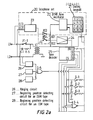
- reference numeral 20 denotes a telephone set wherein only main part in connection with the present invention is shown in the figure.
- Reference symbols HS3 and HS4 denote hook switches added to the conventional telephone set, which switch the mode to off-hook or on-hook according to an off-hook button (monitor button) not shown or the handset.
- Reference numeral 21 denotes a dialing keypad of said telephone set; 22 denotes a DTMF oscillator of said telephone set; 24 denotes an amplifier for amplifying an output from said DTMF oscillator 22 or a DTMF tone from the outside push phone by the calling party; and 25 denotes a tone decoder for decoding said DTMF tone, wherein an output terminal (1) generates H level output while a "1" tone of the DTMF tone is being inputted, and similarly output terminals (2) and (3) generate H level output respectively while each of "2" and "3" tones is being inputted.
- Said output of (1), (2) and (3) supplies the interrupt to an one chip microcomputer through an OR gate G-4.
- said output is applied to input terminals DB0, DB1 and DB2 of the microcomputer through buffers G-1, G-2 and G-3 and the code at the time of interrupt is discriminated.
- CPU denotes an one chip microcomputer (microprocessor), wherein DB0 to DB3 are input terminals, P10 to P17 and P20 to P27 are output terminals (output ports), INT is an interrupt terminal and TEST1 is an input terminal connected to a counter incorporated in the CPU.
- Reference symbols G-6 to G-12 denote drivers; FWD.SD1 and RW.SD1 denote solenoids for forwarding and rewinding an outgoing message (hereinafter called as OGM) recording medium (not shown), respectively; and M1 denotes a motor.
- OGM outgoing message
- reference symbols FWD.SD2 and RW.SD2 denote solenoids for an incoming message (hereinafter called as ICM) recording medium (not shown) and M2 denotes a motor for the ICM recording medium.
- Reference symbol Y-1 denotes a relay for engaging telephone lines.
- Reference numeral 26 denotes a ringing circuit for detecting a ringing signal; and 27 and 28 denote beginning position detecting circuits for an OGM and an ICM tapes. The output of said circuits is inputted to the terminal TEST1 of the CPU through an OR gate G-5.
- Reference numeral 29 denotes a recording/playback switching circuit of said OGM and said ICM tapes, comprising an analog switch and a relay.
- heads(RPH-1 and EH-1) of the OGM tape are selected and when said terminal 1/2 is L level, heads (RPH-2 and EH-2) of the ICM tape are selected.
- said circuit 29 switches the mode to playback when a terminal P/R is H level, and to recording when said terminal P/R is L level.
- SW1 denotes a switch for selecting whether the device in the telephone set is controlled by the DTMF tone from the push phone or a voice recognition
- SW2 denotes a switch for selecting whether or not a security code is used in the same way as in case of remote control operation when the device in the telephone set is manually controlled at home (hereinafter said switch is called as a security code switch).
- the tape is used in the present embodiment.
- the tape is not always used and it is possible to use a solid-state recording/playback circuit with RAM (random access memory).
- RAM random access memory
- components such as said solenoid or motor which require electric power are not necessary, so it is possible to control the device by small amount of electric power.
- a telephone answering device is included in the telephone set as shown in FIG. 1.
- the basic circuit thereof is disclosed in JAPAN S60-230754 A by the present applicant.
- operation buttons (t-1), (AUTO), and (t-2) are connected to input side of the buffers G-1, G-2 and G-3 shown in FIG. 2 of the present invention.
- the operation button (t-1) is pushed once, the OGM tape is forwarded at normal speed.
- the OGM tape is rewinded.
- said button is pushed successively three times during the predetermined period of time, the OGM tape is fast forwarded.
- the ICM tape is forwarded at normal speed, rewinded and fast forwarded by pushing the operation button (t-2) in the same way as the button (t-1) in case of the OGM tape described above.
- the operation button (AUTO) is pushed once, and then during a predetermined period of time, for instance, within 1.5 seconds the button (t-1) or (t-2) is pushed once.
- the operation button (AUTO) is only pushed once without pushing any button any more, then after said 1.5 seconds the device is set to the standby mode ready for an incoming call.
- the operation button (AUTO) When the operation button (AUTO) is pushed once and then during said predetermined period of time the operation button (t-1) or (t-2) is pushed successively twice or three times, the OGM or ICM tape is erased in the rewind or fast forward mode.
- the button for said operation is pushed once.
- buttons (t-1), (AUTO) and (t-2) are used for the operation described above; whereas in the present invention, said operation buttons (t-1), (AUTO) and (t-2) are omitted and push phone buttons on the telephone set are used commonly for dialing and for operating.
- a key “1" on the dialing keypad 21 shown in FIG. 2 corresponds to said operation button (t-1), a key “2" to said button (AUTO), and key “3" to said button (t-2).
- Said security code is same as a security code for remote control operation described later, which is known only to an owner of the present device. Even if a third party operates the present telephone set erroneously for dialing when the security code switch SW2 is turned on, it is possible to prevent the telephone answering device in the telephone set from erroneously operating and leaking the message.
- the security code is entered as described above, then the key "1" on the dialing keypad 21 is pushed once.
- the universal DTMF oscillator generates two frequencies, 697 Hz and 1209 Hz in response to pushing of said key. Said frequencies are turned into a suitable level by a resistor R21 and then amplified by the amplifier 24. The output thereof is applied to the tone decoder 25.
- the tone decoder 25 comprises an IC for tone decoder, a gate IC and a three-state buffer for preventing the confusion of output from a voice recognition section 33 described above. The output of the tone decoder is activated when the switch SW1 slides to the left side as shown in the figure.
- a H level signal is output form an output terminal (1) of the tone decoder 25 and the interrupt is supplied to the CPU through the OR gate G-4. At the same time, the output thereof turns the input terminal DB0 into H level through the buffer G-1.
- the program not shown checks how many times the input terminal DB0 is turned into H level in a predertermined period of time, for instance, within 1 second (described later). If the input terminal DB0 is turned into H level once, the output ports P20 and P22 are turned into H level, the solenoid PWD. SD1 and the motor M1 is energized and the OGM tape is forwarded at normal speed.
- the OGM tape is rewinded. If said terminal is turned into H level three times or more, the OGM tape is fast forwarded.
- the DTMF oscillator 22 When the key "3" on the dialing keypad 21 is pushed, the DTMF oscillator 22 generates two frequencies, 697 Hz and 1477 Hz. Said frequencies are amplified by the amplifier 24 and an output terminal (3) of the tone decoder 25 is turned into H level.
- the input terminal DB2 of the CPU is turned into H level by the output thereof through the buffer G-3.
- Said predetermined period of time for 1 second is initialized to newly set a period of 1 second each time the key on the dialing key 21 is pushed, so that it is possible to easily operate, also in the remote control operation described later.
- the DTMF oscillator 22 When the key "2" on the dialing keypad 21 is pushed, the DTMF oscillator 22 generates two frequencies, 697 Hz and 1336 Hz. An output terminal (2) of the tone decoder 25 is turned into H level through the amplifier 24.
- the program flickers an light-emitting diode 32 (AUTO), for instance, for 1.5 seconds. Or intermittent signal is generated by the output port P27 and amplified by a speaker SP through an analog switch G-14 and amplifiers 30 and 31.
- the device is set to the standby mode for automatic answering and recording in the same way as in the prior art. From this time the light-emitting diode 32 is lighting up continuously to indicate that the device is in the standby mode. Similarly, when the OGM tape is rewinded and reached to the beginning position thereof, a light-emitting diode 33 (READY) is lit up.
- AUTO light-emitting diode 32
- the entering of security code is cleared. So the security code should be entered again by pushing keys on the dialing keypad 21 for next operation.
- the ringing signal is detected by the ringing circuit 26 and inputted into the input terminal TEST1 of the CPU through an OR gate G-5.
- the input terminal TEST1 which is connected to a counter in the CPU counts the number of AC waves of the ringing signal. If it is decided to be ringing signal, the output port P26 is turned into H level and the relay Y-1 is kept energized. The telephone line is engaged through a contact y1-1 of the relay Y-1.
- the ringing signal stops and the off-hook mode is established.
- the output ports P20 and P22 are turned into H level and the solenoid FWD.SD1 and the motor M1 are energized to forward the OGM tape (not shown) at normal speed.
- the OGM is played back by the recording/playback head RPH-1 and reached to a line transformer LT through the switching circuit 29, a pre-amplifier 30 and an analog switch G-13 (energized by the program) to be sent out to the calling party.
- the DTMF tone of the key "1" is recorded for a short period of time at the end of the OGM because the key "1" is pushed at the stop of the recording.
- said DTMF tone is detected by the CPU through the line transformer LT, a resistor R22, the amplifier 24 and the tone decoder 25, the OGM tape stops and the ICM tape is driven in the recording mode.
- the ICM from the calling party reaches to the recording/playback head RPH-2 through the line transformer LT, the analog switch G-14 turned on by the program, the pre-amplifier 30 and the switching circuit 29 switched to the recording mode by the program. Then the ICM is recorded on the ICM tape.
- the line voltage changes.
- the line voltage change is detected by the CPU through the ringing circuit 26 and the OR gate G-5, and then the relay Y-1 is de-energized to disengage the telephone line.
- the ICM tape stops and then the OGM tape is rewinded to the beginning position, so that the device returns to the standby mode.
- the present device is called by the owner from the outside push phone.
- Three-digit security code predetermined by the digital switch 32 is sent out to the device by push phone button operation during the OGM or after the ICM tape is switched to the recording mode.
- the device If the security code sent by the owner doesn't coincide with the presetermined security code, the device returns to the standby mode. If said two security codes coincide, the OGM or ICM tape stops and the device is ready for receiving the remote control signal for next operation.
- Remote control operation thereafter is same as above manual operation at home, also with same keys on the keypad. More particularly, in order to play back the ICM recorded on the ICM tape, the key "3" of the outside push phone is pushed successively twice to rewind the ICM tape. In response to said pushing, the ICM tape is rewinded to and stops at the beginning position of the tape or of the ICM which is not played back yet. In order to stop the ICM tape during rewinding, the key "3" is pushed once.
- the key "3" on the push phone is pushed once after the ICM tape stops as described above.
- the key "3" is pushed once. Or it is possible to automatically stop the ICM tpae at the end position of the ICM if said end position is memorized into a memory of the CPU.
- the key "2" on the push phone is pushed once.
- the light-emitting diode 32 flickers; whereas in the remote control operation the intermittent signal is output for 1.5 seconds from the output port P27 of the CPU. While said intermittent signal is being heard, if the key "1" on the push phone is pushed once, the OGM tape is switched to the recording mode and if the key "3" is pushed once, the ICM tape is switched to the recording mode.
- the OGM In the OGM tape recording mode, the OGM can be recorded again.
- the index message of date, time or the like can be recorded by the owner after all the ICMs are played back.
- the present embodiment uses the same operation as in the prior art Japan S60-230754 A. However, it is not necessary to always use said operation. It is possible to use any key on the dialing keypad for each operation to easily operate, for instance, the key “1" for the ICM tape playback and stop thereof, the key “3” for the ICM tape back space, the key “7” for the OGM recording and stop thereof and the key “9” for the OGM playback and stop thereof. Of course, the keys are used commonly for the remote control operation and the manual operation at home according to the purpose of the present invention.
- This device controls the device in the telephone set by the tone of the push phone as above.
- this invention considers how to cope with the above problem. Namely, in the Figure 2, when the hand set (not shown) of the telephone set 20 is picked up to operate the dial, the hook switch HS3, HS4 are closed.
- the output from the DTMF circuit 22 which oscillates by operation of the dial key 21 by the hook switch HS3, is input to the output circuit 23, and is output to the telephone line, after this output is amplified by the output circuit 23.
- the input side of the amplifier 24 is grounded by the hook switch 4, as a result, the output from the DTMF circuit is not input to the tone decoder section 25.
- the device in the telephone set in this example, the telephone answering device is not missoperated. But, in the above example, for example when the conversation of each other is recorded on the receiving tape, after the other party is called and the talking over the telephone is set, the DTMF tone is not input in the tone decoder 25. Accordingly, it is impossible to control the ICM tape.
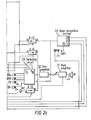
- the Figure 4 is a circuit example which solves the above problem.
- the device in the telephone set is operated by the dial operation to call the other party from the device.
- the device in the telephone set can be controlled by key operation of push phone by the party.
- 34 is a line polarity inversion detective circuit.
- the output OUT changes from H level to L level, and the output OUT returns to H level by the on-hook by the other party.
- This circuit is made of various circuits which use an ope-amplifier or a photo-coupler etc.
- TR-1 means a transistor.
- the transistor TR-1 keeps a condition of ON by an output from the line polarity inversion detective circuit 34, except in condition of talking over the telephone. Accordingly, when the handset (not shown) is picked up from the device to call the other party, the hook switch HS3, HS4 are closed, and the transistor TR-1 keeps a condition of ON by the output from the line polarity inversion detective circuit 34 while dialing operation. As a result, the input side of the amplifier 24 is grounded through the closed hook switch HS4. As a result, the DTMF tone by dialing operation does not reach the tone decoder 25, and the device in the telephone set is not miss-operated.
- the transistor TR-1 In condition of talking over the telephone where the output from the line polarity inversion detective circuit 34 changes from H level to L level, the transistor TR-1 is changed to the condition of OFF. As a result, the amplifier 24 becomes active, the DTMF tone by key operation of the push phone by the party, reaches CPU (central processing unit) through the tone decoder 25. As a result, the DTMF tone can control the device in the telephone set. In the same principle as described above, it is possible to arrange that even if the incoming call is received and the off-hook mode is established, said reception of incoming call can be memorized and device in the telephone set can be controlled in response to the operation of either the calling party or the called party while the called party hangs on, more particularly during the conversation between the parties.
- a special recording button as a substitute of above push phone (ten-key_ buttons, which is operated only during above two-way conversation, so as to stop the two-way conversation recording when the off-hook mode is released.
- the device has a shortening dial section.
- a code which controls a dial number or the device in the telephone set can be memorized in a memory in the CPU.
- the code means, for example a secret code when a remote controlling operation starts.
- the answering tape and the receiving tape are controlled by pushing times of buttons "1", "3", but a specific code, for example the specific code of eight figures which resembles the secret number, is assigned to various controls, and it is possible to do various tests or various remote controlling operations by the above specific code.
- the special code for playing back or recording specific message.
- the special code is memorized int he shortening dial section, as a result, it is possible to put to practical use or to test of remote control by touching once or twice the push phone (dial key).
- the button in the dial button section 21 is pushed in order of "X*YYY".
- "X” means number which shows order of registration by key 0 - 9.
- "YYY” means, for example the secret number or the special code of eight figures of 0 - 9.
- buttons are set at the input port (not shown) in the CPU, read out of the shortening dial is done by touching once.
- this invention is available for a cordless phone.
- a base device and a separate device are set separately.
- a calling is received by the base device, a bell in the base device or the separate device is acted.
- a caller can talk over the telephone through the base device by the on-hook. Accordingly,in receiving or transmitting callings, an electric wave from the separate device by the on-hook operation of the separate device, is received by the base device, and the telephone line L1, L2 are closed.
- the device in the base device for example only telephone answering device could not be controlled by the separate device when tit is not concerned with the telephone line.
- This invention offers two ideas to solve the above problem.
- First idea is that an electric wave which is modulated by the DTMF tone is output, when the key "1". "2". "3" are pushed, and the power switch (not shown) becomes ON in condition of the on-hook where the separate device shown int he Figure 5a opens.
- the key "1" was pushed, two frequencies of 697Hz and 1209Hz were usually output.
- an oscillator "A" is connected by a switching circuit (not shown) connected with the above hook-switch.
- the device is programmed so that the remote control operation is done by the DTMF tone of "1" - "3".
- this device has a voice recognize section as shown in the Figure 2.
- a specific voice or other designation or a secret number of a shortening dial is set previously to be registered substituting for the DTMF tone of "1" - "3" by changing the switch SW 1 to right side.
- the OGM tape and the ICM tape can be controlled like controlling by the DTMF tone.
- the second idea is that, for example when "#" on the separate device in the codeless telephone is pushed twice, sending an electric wave between the base deice and the separate device is kept, and communication between the base device and the telephone line is cut.
- the hook-switch HS2 contacts with a ringer circuit in condition of the oh-hook of the telephone set.
- the telephone set is in the condition which receives a calling signal. If the other party hopes to talk over the telephone, after the telephone answering device is stopped, a receiver (not shown) is set at the off-hook. It is possible to talk over the telephone.
- the other party If the other party does not hope to talk over the telephone, the other party lets the telephone answering device alone, or the other party changes the telephone answering device to the condition of automatic answering/recording. It is possible to let the telephone device respond to the received calling, after head of the OGM tape or the ICM tape is picked up. And in the code-less phone, when the device int he base device is controlled by the separate device, a receiving signal must be received at least. ANd the tape is used in this example as above,but in a solid recording/play back device, an action corresponding to rewinding etc. is acted in a moment. Accordingly,when operation of the key is done continuously twice by using the solid recording/playback device.
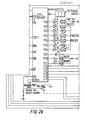
- the Figure 5 shows definite circuit of solid recording/play back device.
- 60 is the solid recording/play back device.
- the solid recording/play back device 60 is made of LSI (large scale integration) for control 61, and DRAM (Dynamic random access memory) 62.
- T6668 made by TOSHIBA is used as the above LSI for control, and T6668 has been already on the market.
- Main terminal is explained.
- "REC/PLAY" is a changing terminal for recording, play back. The changing terminal is set at a recording mode by H level and a play back mode of L level.
- the program sets the output port "P23, P24, P25, P26" to "1000", and first phrase is assigned as the answering message.
- a recording mode is selected.
- the output port P16 is set at H level, an analog switch G-15 is set at "ON" and the microphone MIC is set.
- the answering message which is talked to the microphone MIC is input to the LSI for control 61 through the input terminal IN and digital voice which is changed by A/D converter set in the LSI for control, is stored int he DRAM 62.
- the key "1" is pushed once as setting by the tape.
- a stop pulse from the output port P22 is output, and solves the said recording operation.
- the LSI for control 61 memorized the start address, the atop address of each phrase is the memory set in the LSI for control, and when full of the stop address or of the DRAM is detected,the output terminal EOS (end of speech) is set at H level. Accordingly, as the above, key '1" is pushed once to confirm the answering message recorded as the above. As a result, the output port P20 is set at L level, and changes to play back mode.
- the answering message is played back from the head of message, and the answering message is spoken by the speaker SP through the output terminal OUT, the pre-amplifier 30 and the main amplifier 31. And when the answering message gets to the end, the LSI for control sets the output terminal EOS at H level, and stops the said play back operation automatically.
- automatic answering recording mode in order to send the answering message, the output played back as the above is sent to telephone line through the analog switch G-13. And in order to record the message from the other party,next phrase is selected by the output port P23 - P26 and the analog switch G-14 is set at ON. It is possible to record by same way as the said recording of the answering message.
- the stop pulse is output.
- the start pulse is output in play back mode.
- the output terminal EOS is set at H level (the output terminal EOS is returns to L level by the start pulse).
- the program changes the phrase to the next phrase, and plays back all receiving message automatically.
- the telephone answering device as the device int he telephone set is explained, but this application does not limit the telephone answering device, for example it is possible to use in the transmission of information which is shown in "THE SYSTEM OF RECEIVING INFORMATION BY USING PUSH PHONE" (Japanese Patent Application No. 58-188732, Publication No. 60-80354) by the same applicant. Namely, the following explanation is not shown in the figure, but in the condition of the on-hook of the telephone set, an easy sentence made of the number or the alphabet is made by key operation of the dial key, and is memorized in a memory. And the telephone set is set at the on-hook and the other party is called by dial operation.
- buttons on the surface of the telephone having various functions must have various functions, for example a function of re-dial, a function of loudening voice, a function of shortening dial.
- This invention presents means for reducing t the minimum a number of the button in general by using an operating button of the device in common. Scope of practical application is wide.
Landscapes
- Engineering & Computer Science (AREA)
- Signal Processing (AREA)
- Computer Networks & Wireless Communication (AREA)
- Telephone Function (AREA)
- Mobile Radio Communication Systems (AREA)
Applications Claiming Priority (2)
| Application Number | Priority Date | Filing Date | Title |
|---|---|---|---|
| JP7000987 | 1987-03-24 | ||
| JP70009/87 | 1987-03-24 |
Publications (3)
| Publication Number | Publication Date |
|---|---|
| EP0284401A2 true EP0284401A2 (fr) | 1988-09-28 |
| EP0284401A3 EP0284401A3 (en) | 1989-06-14 |
| EP0284401B1 EP0284401B1 (fr) | 1993-06-02 |
Family
ID=13419173
Family Applications (1)
| Application Number | Title | Priority Date | Filing Date |
|---|---|---|---|
| EP88302634A Expired - Lifetime EP0284401B1 (fr) | 1987-03-24 | 1988-03-24 | Equipement téléphonique à fonctions multiples |
Country Status (3)
| Country | Link |
|---|---|
| US (1) | US4903289A (fr) |
| EP (1) | EP0284401B1 (fr) |
| DE (1) | DE3881422T2 (fr) |
Cited By (2)
| Publication number | Priority date | Publication date | Assignee | Title |
|---|---|---|---|---|
| FR2647992A1 (fr) * | 1989-05-31 | 1990-12-07 | Samsung Electronics Co Ltd | Systeme de telecopie a reponse automatique |
| EP0374949A3 (fr) * | 1988-12-22 | 1992-10-14 | Sanyo Electric Co., Ltd. | Dispositif de communication relié à une ligne téléphonique |
Families Citing this family (20)
| Publication number | Priority date | Publication date | Assignee | Title |
|---|---|---|---|---|
| JPH02244856A (ja) * | 1989-03-16 | 1990-09-28 | Toshiba Corp | 無線電話装置 |
| JP2523945B2 (ja) * | 1990-05-30 | 1996-08-14 | 松下電器産業株式会社 | 留守番電話装置 |
| US5313516A (en) * | 1990-05-31 | 1994-05-17 | Phonemate Inc. | Telephone answering device with automatic function |
| US5442685A (en) * | 1990-06-13 | 1995-08-15 | Matsushita Electric Industrial Co., Ltd. | Automatic telephone answering apparatus including conversion recording mode |
| US5243643A (en) * | 1990-11-01 | 1993-09-07 | Voiceples Corporation | Voice processing system with configurable caller interfaces |
| US5533104A (en) * | 1991-06-24 | 1996-07-02 | Weiss; Mark H. | Telephone answering device and method |
| AU3613593A (en) * | 1992-02-06 | 1993-09-03 | Amnon Abiri | Message recording machine |
| CA2100397C (fr) * | 1992-08-04 | 1998-07-14 | Matthew D. Mottier | Interrupteur a double fonction |
| US5495528A (en) * | 1992-08-25 | 1996-02-27 | Rolm Systems | Digital telephone control interface system |
| KR960002355B1 (ko) * | 1993-05-31 | 1996-02-16 | 삼성전자주식회사 | 키폰시스템의 통화내용 녹음 및 재생방법 |
| US5422937A (en) * | 1993-08-03 | 1995-06-06 | Ferrara; George | Remotely controlled telephone operator simulator |
| US5719925A (en) * | 1994-03-02 | 1998-02-17 | Peoples; John T. | Method for remotely controlling a telephone loop/channel from another telephone loop/channel |
| IL111634A0 (en) | 1994-11-14 | 1995-01-24 | Mohr Asaf | Computerized telephone apparatus |
| US6775264B1 (en) * | 1997-03-03 | 2004-08-10 | Webley Systems, Inc. | Computer, internet and telecommunications based network |
| US20040081291A1 (en) * | 1999-12-03 | 2004-04-29 | Peter Tavernese | Telephony system with subliminally keyed speech recording |
| US6721705B2 (en) * | 2000-02-04 | 2004-04-13 | Webley Systems, Inc. | Robust voice browser system and voice activated device controller |
| US7516190B2 (en) | 2000-02-04 | 2009-04-07 | Parus Holdings, Inc. | Personal voice-based information retrieval system |
| US6888926B2 (en) * | 2001-03-16 | 2005-05-03 | Agere Systems Inc. | Extension telephone answering device and system employing same |
| US20030046705A1 (en) * | 2001-08-28 | 2003-03-06 | Sears Michael E. | System and method for enabling communication between video-enabled and non-video-enabled communication devices |
| US8948353B2 (en) * | 2007-06-12 | 2015-02-03 | International Business Machines Corporation | Call connection system and method |
Family Cites Families (13)
| Publication number | Priority date | Publication date | Assignee | Title |
|---|---|---|---|---|
| US3822364A (en) * | 1973-02-05 | 1974-07-02 | Bell Northern Research Ltd | Mode selector for telephone station sets |
| US4625079A (en) * | 1981-07-31 | 1986-11-25 | Horacio Castro | Method and apparatus for activating through phone telecommand an announcer-recorder, and for selectively activating through the sending of codes consisting of signals at least another automatic call attention phone device |
| CA1169597A (fr) * | 1981-09-11 | 1984-06-19 | Gordon D. Benning | Systeme de communication et de controle domestique |
| US4517410A (en) * | 1982-04-02 | 1985-05-14 | Data Acquisition Services | Automatic user selected variable telephone message record and playback system |
| JPS5923950A (ja) * | 1982-07-30 | 1984-02-07 | Toshiba Corp | 電話自動応対装置 |
| US4571458A (en) * | 1983-10-31 | 1986-02-18 | T.A.D. Avanti, Inc. | Telephone answering system with additional message storage capabilities |
| JPS60256236A (ja) * | 1984-06-01 | 1985-12-17 | Hashimoto Corp | 不在応答録音機能を有するコ−ドレスホ−ン |
| US4731814A (en) * | 1986-02-21 | 1988-03-15 | AT&T Information Systems Inc. American Telephone & Telegraph Company | Computer-controlled cordless telephone |
| US4682957A (en) * | 1986-02-24 | 1987-07-28 | Young Gordon W | Teleconferencing and teaching method and apparatus |
| JPH0738744B2 (ja) * | 1987-03-23 | 1995-04-26 | 株式会社東芝 | 無線電話装置 |
| JP2688009B2 (ja) * | 1992-11-26 | 1997-12-08 | 多摩化学工業株式会社 | 廃液から水酸化有機第四アンモニウムを回収する方法 |
| JP3015213B2 (ja) * | 1992-12-01 | 2000-03-06 | キヤノン株式会社 | 照明装置及び観察装置 |
| JPH06218859A (ja) * | 1993-01-22 | 1994-08-09 | Sekisui Chem Co Ltd | 積層体およびその製造方法 |
-
1988
- 1988-03-24 EP EP88302634A patent/EP0284401B1/fr not_active Expired - Lifetime
- 1988-03-24 US US07/172,393 patent/US4903289A/en not_active Expired - Lifetime
- 1988-03-24 DE DE88302634T patent/DE3881422T2/de not_active Expired - Lifetime
Cited By (2)
| Publication number | Priority date | Publication date | Assignee | Title |
|---|---|---|---|---|
| EP0374949A3 (fr) * | 1988-12-22 | 1992-10-14 | Sanyo Electric Co., Ltd. | Dispositif de communication relié à une ligne téléphonique |
| FR2647992A1 (fr) * | 1989-05-31 | 1990-12-07 | Samsung Electronics Co Ltd | Systeme de telecopie a reponse automatique |
Also Published As
| Publication number | Publication date |
|---|---|
| HK1000361A1 (en) | 1998-03-06 |
| DE3881422D1 (de) | 1993-07-08 |
| EP0284401B1 (fr) | 1993-06-02 |
| EP0284401A3 (en) | 1989-06-14 |
| US4903289A (en) | 1990-02-20 |
| DE3881422T2 (de) | 1994-01-20 |
Similar Documents
| Publication | Publication Date | Title |
|---|---|---|
| US4903289A (en) | Telephone equipment with multiple function | |
| US4873713A (en) | Automatic telephone answering apparatus and method | |
| US5121422A (en) | Voice message storage device including at least two analog recording mediums | |
| US5075894A (en) | Telephone message forwarding apparatus | |
| GB2195865A (en) | A telephone apparatus and method for operating same | |
| USRE34968E (en) | Handset or speaker message retrieval system | |
| US5533104A (en) | Telephone answering device and method | |
| US5982855A (en) | Automatic telephone answering apparatus | |
| JP2528345B2 (ja) | 多機能電話装置 | |
| EP0554180A2 (fr) | Méthode et appareil de transmission de messages | |
| JPH01848A (ja) | 多機能電話装置 | |
| JPS6382156A (ja) | 回線端末装置 | |
| US4908849A (en) | Telephone answering device capable of repeatedly playing back outgoing message | |
| HK1000361B (en) | Telephone equipment with multiple function | |
| JPS6154748A (ja) | 留守番電話装置 | |
| JP3239221B2 (ja) | 留守番電話装置 | |
| JP3306080B2 (ja) | 留守番電話装置 | |
| JP2614480B2 (ja) | 電話装置 | |
| JP2993387B2 (ja) | 留守番電話装置 | |
| JP2835968B2 (ja) | 電話機回路 | |
| JPH05268323A (ja) | 留守番電話装置 | |
| JPH0234076A (ja) | 留守番電話装置 | |
| JPS63142749A (ja) | 留守番電話装置 | |
| JPH04334158A (ja) | 音声応答付ファクシミリ装置 | |
| JPS62180646A (ja) | 留守番電話装置 |
Legal Events
| Date | Code | Title | Description |
|---|---|---|---|
| PUAI | Public reference made under article 153(3) epc to a published international application that has entered the european phase |
Free format text: ORIGINAL CODE: 0009012 |
|
| AK | Designated contracting states |
Kind code of ref document: A2 Designated state(s): DE GB |
|
| PUAL | Search report despatched |
Free format text: ORIGINAL CODE: 0009013 |
|
| AK | Designated contracting states |
Kind code of ref document: A3 Designated state(s): DE GB |
|
| 17P | Request for examination filed |
Effective date: 19890817 |
|
| 17Q | First examination report despatched |
Effective date: 19910107 |
|
| GRAA | (expected) grant |
Free format text: ORIGINAL CODE: 0009210 |
|
| AK | Designated contracting states |
Kind code of ref document: B1 Designated state(s): DE GB |
|
| REF | Corresponds to: |
Ref document number: 3881422 Country of ref document: DE Date of ref document: 19930708 |
|
| PLBE | No opposition filed within time limit |
Free format text: ORIGINAL CODE: 0009261 |
|
| STAA | Information on the status of an ep patent application or granted ep patent |
Free format text: STATUS: NO OPPOSITION FILED WITHIN TIME LIMIT |
|
| 26N | No opposition filed | ||
| REG | Reference to a national code |
Ref country code: GB Ref legal event code: IF02 |
|
| PGFP | Annual fee paid to national office [announced via postgrant information from national office to epo] |
Ref country code: DE Payment date: 20070316 Year of fee payment: 20 |
|
| PGFP | Annual fee paid to national office [announced via postgrant information from national office to epo] |
Ref country code: GB Payment date: 20070322 Year of fee payment: 20 |
|
| PG25 | Lapsed in a contracting state [announced via postgrant information from national office to epo] |
Ref country code: GB Free format text: LAPSE BECAUSE OF EXPIRATION OF PROTECTION Effective date: 20080323 |