EP0284504B1 - Verfahren zum flüssig-flüssig Extrahieren von seltenen Erden - Google Patents
Verfahren zum flüssig-flüssig Extrahieren von seltenen Erden Download PDFInfo
- Publication number
- EP0284504B1 EP0284504B1 EP88400646A EP88400646A EP0284504B1 EP 0284504 B1 EP0284504 B1 EP 0284504B1 EP 88400646 A EP88400646 A EP 88400646A EP 88400646 A EP88400646 A EP 88400646A EP 0284504 B1 EP0284504 B1 EP 0284504B1
- Authority
- EP
- European Patent Office
- Prior art keywords
- fact
- process according
- rare
- extraction
- organic phase
- Prior art date
- Legal status (The legal status is an assumption and is not a legal conclusion. Google has not performed a legal analysis and makes no representation as to the accuracy of the status listed.)
- Expired - Lifetime
Links
Images

Classifications
-
- C—CHEMISTRY; METALLURGY
- C22—METALLURGY; FERROUS OR NON-FERROUS ALLOYS; TREATMENT OF ALLOYS OR NON-FERROUS METALS
- C22B—PRODUCTION AND REFINING OF METALS; PRETREATMENT OF RAW MATERIALS
- C22B3/00—Extraction of metal compounds from ores or concentrates by wet processes
- C22B3/20—Treatment or purification of solutions, e.g. obtained by leaching
- C22B3/26—Treatment or purification of solutions, e.g. obtained by leaching by liquid-liquid extraction using organic compounds
- C22B3/38—Treatment or purification of solutions, e.g. obtained by leaching by liquid-liquid extraction using organic compounds containing phosphorus
- C22B3/382—Phosphine chalcogenides, e.g. compounds of the formula R3P=X with X = O, S, Se or Te
-
- C—CHEMISTRY; METALLURGY
- C22—METALLURGY; FERROUS OR NON-FERROUS ALLOYS; TREATMENT OF ALLOYS OR NON-FERROUS METALS
- C22B—PRODUCTION AND REFINING OF METALS; PRETREATMENT OF RAW MATERIALS
- C22B59/00—Obtaining rare earth metals
-
- B—PERFORMING OPERATIONS; TRANSPORTING
- B01—PHYSICAL OR CHEMICAL PROCESSES OR APPARATUS IN GENERAL
- B01D—SEPARATION
- B01D11/00—Solvent extraction
- B01D11/02—Solvent extraction of solids
-
- C—CHEMISTRY; METALLURGY
- C01—INORGANIC CHEMISTRY
- C01F—COMPOUNDS OF THE METALS BERYLLIUM, MAGNESIUM, ALUMINIUM, CALCIUM, STRONTIUM, BARIUM, RADIUM, THORIUM, OR OF THE RARE-EARTH METALS
- C01F17/00—Compounds of rare earth metals
- C01F17/10—Preparation or treatment, e.g. separation or purification
- C01F17/17—Preparation or treatment, e.g. separation or purification involving a liquid-liquid extraction
-
- C—CHEMISTRY; METALLURGY
- C22—METALLURGY; FERROUS OR NON-FERROUS ALLOYS; TREATMENT OF ALLOYS OR NON-FERROUS METALS
- C22B—PRODUCTION AND REFINING OF METALS; PRETREATMENT OF RAW MATERIALS
- C22B3/00—Extraction of metal compounds from ores or concentrates by wet processes
- C22B3/20—Treatment or purification of solutions, e.g. obtained by leaching
- C22B3/26—Treatment or purification of solutions, e.g. obtained by leaching by liquid-liquid extraction using organic compounds
- C22B3/38—Treatment or purification of solutions, e.g. obtained by leaching by liquid-liquid extraction using organic compounds containing phosphorus
- C22B3/387—Cyclic or polycyclic compounds
-
- C—CHEMISTRY; METALLURGY
- C22—METALLURGY; FERROUS OR NON-FERROUS ALLOYS; TREATMENT OF ALLOYS OR NON-FERROUS METALS
- C22B—PRODUCTION AND REFINING OF METALS; PRETREATMENT OF RAW MATERIALS
- C22B3/00—Extraction of metal compounds from ores or concentrates by wet processes
- C22B3/20—Treatment or purification of solutions, e.g. obtained by leaching
- C22B3/26—Treatment or purification of solutions, e.g. obtained by leaching by liquid-liquid extraction using organic compounds
- C22B3/40—Mixtures
- C22B3/408—Mixtures using a mixture of phosphorus-based acid derivatives of different types
-
- Y—GENERAL TAGGING OF NEW TECHNOLOGICAL DEVELOPMENTS; GENERAL TAGGING OF CROSS-SECTIONAL TECHNOLOGIES SPANNING OVER SEVERAL SECTIONS OF THE IPC; TECHNICAL SUBJECTS COVERED BY FORMER USPC CROSS-REFERENCE ART COLLECTIONS [XRACs] AND DIGESTS
- Y02—TECHNOLOGIES OR APPLICATIONS FOR MITIGATION OR ADAPTATION AGAINST CLIMATE CHANGE
- Y02P—CLIMATE CHANGE MITIGATION TECHNOLOGIES IN THE PRODUCTION OR PROCESSING OF GOODS
- Y02P10/00—Technologies related to metal processing
- Y02P10/20—Recycling
Definitions
- the subject of the present invention is a process for the separation by solvent of the rare earth elements contained in aqueous solutions.
- the invention relates to a method of separation by liquid-liquid extraction of the rare earths contained in aqueous solutions of nitrates of these elements.
- rare earths used in accordance with the invention includes the rare earth elements called lanthanides having atomic numbers from 57 to 71 inclusive and the yttrium with atomic number equal to 39.
- ceric rare earths means the lightest elements of the rare earths starting with lanthanum and extending to the neodymium in accordance with the atomic number and are designated by "yttrique rare earths", the heaviest elements of rare earths, starting with the samarium and ending with the lutetium and including the yttrium.
- TOPO tri-n-octylphosphine oxide
- radicals R1, R2, R3, R4, R5, R6 can carry substituent groups, such as, for example, hydroxy or nitro groups: halogen atoms, in particular chlorine and fluorine; lower alkoxy radicals having low carbon condensation, for example 1 to 4 atoms; cyano groups, etc ...
- the radicals R1, R2, R3, R4, R5, R6 have a number of carbon atoms which generally varies between 1 and 18 carbon atoms and preferably between 2 and 8 carbon atoms.
- radicals R1, R2, R3, R4, R depression, R5, R may be made, as examples of radicals R1, R2, R3, R4, R depression, R5, R proceduret, methyl, ethyl, n-propyl, isopropyl, butyl, isobutyl, sec-butyl, tert-butyl, n-pentyl, 1-methyl-butyl, isopentyl, tert-pentyl, neo-pentyl, the following normal alkyl radicals: n-hexyl, n-heptyl, n-octyl, n-nonyl, n-decyle, n-undecyl, n-dodecyl, n -tridecyl, n-tetradecyl, n-pentadecyl, n-hexadecyl, n-heptadecyl, n-o
- a mixture of two extracting agents one of the extracting agents corresponding to formula (I) in which R1, R2, R3 are identical linear alkyl radicals , that is to say that the radicals R1, R2, R3 are linear alkyl radicals having the same carbon condensation, the other corresponding to the formula (I ⁇ ) in which R4, R5, R6 are linear alkyl radicals identical, i.e. that the radicals R4, R5, R6 are linear alkyl radicals having the same carbon condensation, but these having a carbon condensation different from the radicals R1, R2, R3.
- the proportion of the two organophosphorus compounds of formula (I) and (I ⁇ ) is determined so that there is a mixture of phosphine oxides which is liquid at room temperature.
- the mixture obtained is miscible with conventional diluents in all proportions.
- a mixture of preferred phosphine oxides use is made of a mixture of tri (n-hexyl) phosphine oxide and tri (n-octyl) phosphine oxide, in particular CYANEX 923 marketed by the AMERICAN CYANAMID Company.
- CYANEX 925 is a mixture consisting of 85% of bis (trimethyl-2,4,4 pentyl) n-octylphosphine oxide and 15% of tri (2,4-trimethyl, 4 pentyl) phosphine.
- said extraction agents exhibit very good selectivity with respect to all of the rare earths and in particular of yttrium and yttric rare earths, in particular gadolinium to lutetium, unlike agents of more conventional neutral organophosphorus extraction such as, for example, tributyl phosphate.
- yttrium can represent from 5 to 80% of the total weight of yttrique rare earths: the percentage being expressed by weight of yttrium oxide relative to the weight of yttric rare earth oxides, including yttrium.
- Another advantage of said extraction agents is that they make it possible to operate in the presence of aqueous phases very concentrated in rare earth nitrates (more than 300 g / l) and to obtain very concentrated organic phases, more than 50 g up to 100 g / l and more of rare earths expressed as oxides.
- the aqueous phase which is brought into contact with the extracting agent can consist of an aqueous solution originating from redissolution with nitric acid, of the hydroxides obtained following the sodium attack on minerals containing rare earths such as monazite, bastnaesite and xenotime. It is also possible to use any other rare earth salt solution after changing the anion present into a nitrate anion.
- the method of the invention applies to solutions as such or after having subjected them to a prior concentration.
- the liquid-liquid extraction process is carried out on aqueous solutions of rare earth nitrates having a concentration expressed as rare earth oxides varying between 20 g / l and 500 g / l: the given limits having no criticality. Preferably, they have a concentration of between 100 g / l and 500 g / l.
- the organic phase according to the process of the invention optionally contains, in addition to the extraction agent, an organic diluent.
- organic diluents capable of being used it is possible to use those usually used to carry out liquid-liquid extraction operations.
- aliphatic or cycloaliphatic hydrocarbons such as, for example, hexane, heptane, dodecane, cyclohexane, isoparaffin and petroleum fractions of the kerosene or isoparaffin type
- aromatic hydrocarbons such as, for example, benzene, toluene, ethylbenzene, xylene, petroleum fractions consisting of a mixture of alkylbenzenes, in particular fractions of the SOLVESSO type (brand filed by the company EXXON) and halogenated hydrocarbons such as chloroform, carbon tetrachloride, 1,2-dichloro ethylene, monochlorobenzene.
- a mixture of these diluents can also be used.
- an aliphatic hydrocarbon is chosen.
- the extraction power of the organic solution with respect to rare earths increases when the concentration of the extraction agent in the organic phase is increased; however, the separation factors of the elements from each other are not significantly changed by the concentration of the extractant.
- the concentration of the extractant in the organic phase is not a critical factor according to the invention and can vary within wide limits. It can vary from 5% of the volume of the organic phase when the extracting agent is in solution in a diluent up to about 100% when the extracting agent is used pure.
- the concentration is chosen between 50 and 100% of the volume of the organic phase.
- the organic phase according to the process of the invention can also contain various modifying agents, one of the essential aims of which is to improve the hydrodynamic properties of the system without altering the extracting properties of the organophosphorus compounds.
- various modifying agents one of the essential aims of which is to improve the hydrodynamic properties of the system without altering the extracting properties of the organophosphorus compounds.
- compounds which are very suitable there may be mentioned in particular, compounds with an alcohol function and, in particular, heavy alcohols whose number of carbon atoms is between 4 and 15 and heavy phenols, as well as various other compounds such as certain phosphoric esters such as tri-butylphosphate.
- a proportion of between 3 and 20% by volume based on the organic phase is generally favorable.
- the concentration of nitrate ions is important since it can facilitate the extraction of the rare earth (s) to be extracted in the organic phase.
- the concentration of nitrate ions can vary between 1 and 10 moles / liter and is preferably chosen between 2 and 9 moles / liter.
- the concentration of nitrate ions can be increased by adding them, for example, using an aqueous solution of nitric acid, an aqueous solution of a salt in the nitrate form, in particular the ammonium nitrate.
- the organic phase and the aqueous phase are brought into contact at a temperature which has no critical character: it is generally chosen between 10 ° C. and 80 ° C. and is most often included between 30 ° C and 60 ° C.
- the flow rate ratio of the organic phase and the aqueous phase is correlated with the concentration of the extracting agent and it is chosen in accordance with the concentration of the rare earths to be extracted in the aqueous phase and in accordance with the apparatus used. usually for the implementation of a liquid-liquid extraction process.
- the organic phase is washed with water, preferably deionized water or with the aid of an aqueous solution containing nitrate ions such as an aqueous solution of dilute nitric acid. or an aqueous solution of rare earth nitrates of the same nature as the rare earths to be extracted and which may be contained in the part of the aqueous phase obtained in the following operation of regeneration of the extraction solvent.
- water preferably deionized water or with the aid of an aqueous solution containing nitrate ions such as an aqueous solution of dilute nitric acid. or an aqueous solution of rare earth nitrates of the same nature as the rare earths to be extracted and which may be contained in the part of the aqueous phase obtained in the following operation of regeneration of the extraction solvent.
- its concentration is chosen to be less than 1N and, preferably, between 10 ⁇ 3 and 10 ⁇ 1N.
- its concentration expressed as rare earth oxides can be between 5 and 500 g / l, preferably between 100 and 500 g / l.
- nitric acid is used.
- the concentration of the acid solution is chosen to be less than 1N and preferably between 10 ⁇ 3 and 10 ⁇ 1N.
- the rare earth (s) extracted are collected in the aqueous phase while the extraction solvent can be recycled to the extraction step. This recycling is not essential in the present invention but it is desirable for economic reasons.
- the separation factor between these rare earths is defined as being a relationship between the partition coefficients of TR1 and TR2
- the partition coefficient is equal to the ratio between the concentration of TR1 (or TR2) in the organic phase and the concentration of TR1 (or TR2) in the aqueous phase.
- F For the separation between TR1 and TR2 to be possible, F must be different from 1.
- TR1 is the rare earth which has the highest partition coefficient, in this case, F is greater than 1.
- a mixture of n rare earths can be separated into two subgroups by assimilating each subgroup to TR1 and TR2.
- the various stages of contacting can be carried out in particular in conventional liquid-liquid extraction devices operating against the current.
- Such devices generally comprise several stages of mixer-settler systems or of packed and / or agitated columns, arranged to carry out operations of extraction, selective washing and recovery of the rare earth elements in the aqueous phase and regeneration of the solvent. extraction.
- the rare earth mixture is a solution of rare earth nitrates having a concentration expressed as rare earth oxides of 500 g / l distributed as follows:
- Said extraction agent is dissolved in an aromatic hydrocarbon, petroleum cut SOLVESSO 150, composed of a mixture of alkylbenzene in particular of dimethylethylbenzene and tetramethylbenzene at the rate of 1 mole / liter and the mixture obtained is the solvent for extraction.
- the aqueous phase constituted by the solution of rare earth nitrates is brought into contact with the organic phase constituted by the extraction solvent: the ratio of the volumes of the phases being equal to unity.
- the extraction is carried out at room temperature.
- Example 2 The same extraction agent as that mentioned in Example 1 is dissolved in kerosene, at a rate of 75% by volume and the mixture obtained is the extraction solvent.
- the aqueous phase consisting of the solution of rare earth nitrates defined in Example 1 and the organic phase consisting of the extraction solvent are brought into contact at 50 ° C.
- the ratio of the volumes of phases being equal to unity .
- mixture of phosphine oxides defined according to the invention is well suited to a separation of yttrium / yttric rare earths, the heaviest.
- This example is carried out by following the mode of implementation illustrated in FIG. 1.
- the extraction agent used is the mixture of trialkylphosphine oxides (CYANEX 923) of Example 1.
- extraction solvent Said extraction agent is dissolved in kerosene, at a rate of 75% by volume and the mixture obtained will be called extraction solvent.
- the process as described makes it possible to obtain yttrium from a mixture of rare earths with an excellent extraction yield since it is 99.8% and of very high purity since it is 99.9999%.
Landscapes
- Chemical & Material Sciences (AREA)
- Engineering & Computer Science (AREA)
- Organic Chemistry (AREA)
- Life Sciences & Earth Sciences (AREA)
- Geology (AREA)
- Metallurgy (AREA)
- Environmental & Geological Engineering (AREA)
- General Life Sciences & Earth Sciences (AREA)
- Manufacturing & Machinery (AREA)
- Materials Engineering (AREA)
- Mechanical Engineering (AREA)
- Geochemistry & Mineralogy (AREA)
- Analytical Chemistry (AREA)
- Inorganic Chemistry (AREA)
- Chemical Kinetics & Catalysis (AREA)
- Manufacture And Refinement Of Metals (AREA)
- Compounds Of Alkaline-Earth Elements, Aluminum Or Rare-Earth Metals (AREA)
- Extraction Or Liquid Replacement (AREA)
- Solid-Sorbent Or Filter-Aiding Compositions (AREA)
- Ultra Sonic Daignosis Equipment (AREA)
- Medicines Containing Material From Animals Or Micro-Organisms (AREA)
Claims (32)
- Verfahren zum Auftrennen von Seltenen Erden, die in einer wäßrigen Lösung enthalten sind, welche mindestens zwei dieser Seltenen Erden enthält, mittels flüssig/flüssig-Extraktion zwischen einer wäßrigen Phase, die die Nitrate der Seltenen Erden, die getrennt werden sollen, enthält und einer organischen Phase, die ein Extraktionsmittel enthält, welches aus einer Organophosphor-Verbindung besteht, dadurch gekennzeichnet, daß das Extraktionsmittel aus mindestens zwei verschiedenen Organophosphor-Verbindungen besteht, die der Formel (I) bzw. (I')
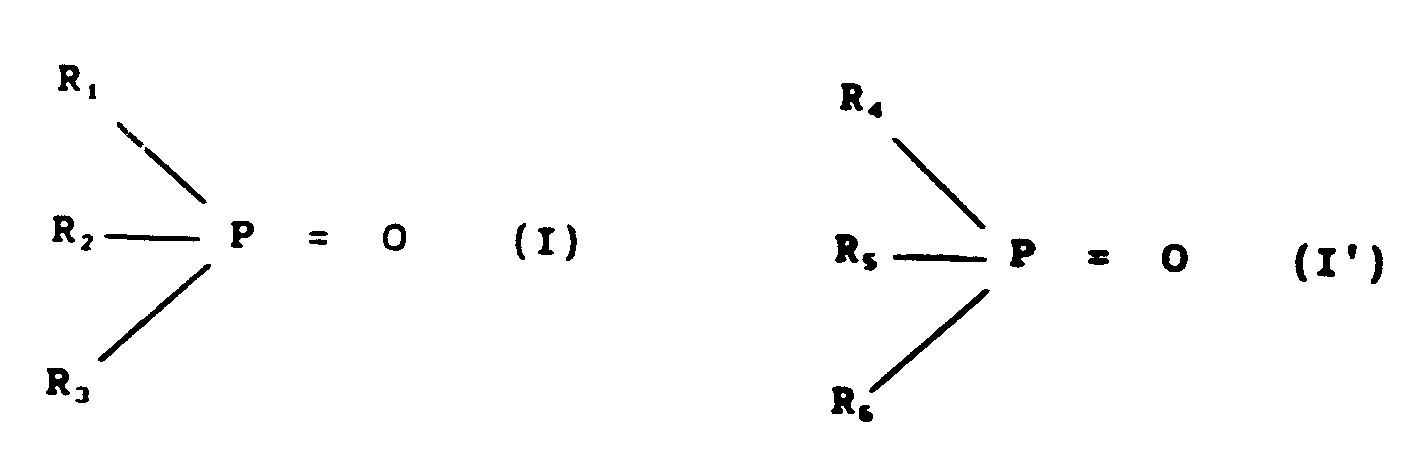 - in der Formel (I):. R₁, R₂ und R₃ gleich oder verschieden und gegebenenfalls substituiert sind und jeweils für ein Wasserstoffatom oder für eine lineare oder verzweigte, gesättigte oder ungesättigte Kohlenwasserstoffgruppe oder eine gesättigte oder ungesättigte cyclische Kohlenwasserstoffgruppe stehen;. die Summe der Anzahl Kohlenstoffatome in den Gruppen R₁, R₂ und R₃ mindestens 12 Kohlenstoffatome ausmacht;- in der Formel (I'):. R₄, R₅ und R₆ gleich oder verschieden und gegebenenfalls substituiert sind und jeweils für ein Wasserstoffatom oder für eine lineare oder verzweigte, gesättigte oder ungesättigte Kohlenasserstoffgruppe oder eine gesättigte oder ungesättigte cyclische Kohlenwasserstoffgruppe stehen;. die Summe der Anzahl Kohlenstoffatome in den Gruppen R₄, R₅ und R₆ mindestens 12 Kohlenstoffatome ausmacht.
 - Verfahren nach Anspruch 1, dadurch gekennzeichnet, daß die Organophosphor-Verbindungen den Formeln (I) und (I') entsprechen, in denen R₁, R₂, R₃, R₄, R₅ und R₆ (jeweils) 1 bis 18 Kohlenstoffatome enthalten.
- Verfahren nach Anspruch 2, dadurch gekennzeichnet, daß R₁, R₂, R₃, R₄, R₅ und R₆ (jeweils) 2 bis 8 Kohlenstoffatome enthalten.
- Verfahren nach einem der Ansprüche 1 bis 3, dadurch gekennzeichnet, daß die Organophosphor-Verbindung der Formel (I) entspricht, in der die Summe der Anzahl Kohlenstoffatome der Gruppen R₁, R₂ und R₃ mindestens 18 Kohlenstoffatome ausmacht.
- Verfahren nach einem der Ansprüche 1 bis 4, dadurch gekennzeichnet, daß die Organophosphor-Verbindung der Formel (I') entspricht, in der die Summe der Anzahl Kohlenstoffatome der Gruppen R₄, R₅ und R₆ mindestens 18 Kohlenstoffatome ausmacht.
- Verfahren nach einem der Ansprüche 1 bis 5, dadurch gekennzeichnet, daß das Extraktionsmittel aus einer Organophosphor-Verbindung der Formel (I) besteht, in der R₁, R₂ und R₃ gleiche lineare Alkylgruppen sind, sowie aus einer Organophosphor-Verbindung der Formel (I'), in der R₄, R₅ und R₆ gleiche lineare Alkylgruppen mit einer von R₁, R₂ und R₃ unterschiedlichen Anzahl Kohlenstoffatome sind.
- Verfahren nach einem der Ansprüche 1 bis 5, dadurch gekennzeichnet, daß das Extraktionsmittel aus einer Organophosphor-Verbindung der Formel (I) besteht, in der R₁, R₂ und R₃ gleiche lineare Alkylgruppen sind, sowie aus einer Organophosphor-Verbindung der Formel (I'), in der R₄, R₅ und R₆ gleiche verzweigte Alkylgruppen oder unterschiedliche verzweigte Alkylgruppen oder lineare und verzweigte alkylgruppen sind.
- Verfahren nach einem der Ansprüche 1 bis 7, dadurch gekennzeichnet, daß das Extraktionsmittel ein Gemisch aus Tri(n-hexyl)phosphinoxid und Tri(n-octyl)phosphinoxid oder ein Gemisch aus Bis(2,4,4-trimethylpentyl)n-octylphosphinoxid und Tri(2,4,4-trimethylpentyl)phosphin ist.
- Verfahren nach einem der Ansprüche 1 bis 8, dadurch gekennzeichnet, daß die wäßrige Lösung der SE-nitrate eine Konzentration, angegeben als SE-oxide, von 20 bis 500 g/l aufweist.
- Verfahren nach Anspruch 9, dadurch gekennzeichnet, daß die Konzentration an SE-nitraten 100 bis 500 g/l ausmacht.
- Verfahren nach einem der Ansprüche 9 und 10, dadurch gekennzeichnet, daß die wäßrige Lösung der SE-nitrate eine Acidität im Bereich von 0,01n bis 3,0n aufweist.
- Verfahren nach einem der Ansprüche 1 bis 11, dadurch gekennzeichnet, daß die organische Phase zusätzlich mindestens ein organisches Verdünnungsmittel enthält, das aus der Gruppe, bestehend aus den aliphatischen oder cycloaliphatischen Kohlenwasserstoffen, den Erdölfraktionen vom Typ Kerosin oder Isoparaffin, den aromatischen Kohlenwasserstoffen, den Erdölfraktionen, bestehend aus einem Gemisch von Alkylbenzolen, und den Halogenkohlenwasserstoffen, ausgewählt ist.
- Verfahren nach Anspruch 1, dadurch gekennzeichnet, daß die Konzentration des Extraktionsmittels in der organischen Phase 5 bis 100 Vol.-% der organischen Phase ausmacht.
- Verfahren nach Anspruch 13, dadurch gekennzeichnet, daß die Konzentration des Extraktionsmittels 50 bis 100% ausmacht.
- Verfahren nach einem der Ansprüche 1 bis 14, dadurch gekennzeichnet, daß die organische Phase zusätzlich mindestens ein Modifiziermittel enthält, ausgewählt aus der Gruppe, bestehend aus den Verbindungen mit Alkoholfunktion und den Phosphorsäureestern.
- Verfahren nach Anspruch 15, dadurch gekennzeichnet, daß die Konzentration des Modifiziermittels in der organischen Phase im Bereich von 3 bis 20 Vol.-% der organischen Phase liegt.
- Verfahren nach einem der Ansprüche 1 bis 16, dadurch gekennzeichnet, daß die Konzentration an Nitrationen der wäßrigen Phase im verlauf der Extraktion zwischen 1 und 10 mol/l schwanken kann.
- Verfahren nach Anspruch 17, dadurch gekennzeichnet, daß die Konzentration an Nitrationen im Bereich von 2 bis 9 mol/l liegt.
- Verfahren nach einem der Ansprüche 1 bis 18, dadurch gekennzeichnet, daß die Extraktionstemperatur im Bereich von 10 bis 80°C liegt.
- Verfahren nach einem der Ansprüche 1 bis 19, dadurch gekennzeichnet, daß man nach der Extraktionsstufe die organische Phase mit Wasser oder mit einer wäßrigen, Nitrationen enthaltenden Lösung wäscht.
- Verfahren nach Anspruch 20, dadurch gekennzeichnet, daß die Waschlösung eine wäßrige Salpetersäurelösung mit einer Konzentration unterhalb 1n ist.
- Verfahren nach Anspruch 21, dadurch gekennzeichnet, daß die Konzentration der wäßrigen Salpetersäurelösung zwischen 10⁻³ und 10⁻¹n liegt.
- Verfahren nach Anspruch 20, dadurch gekennzeichnet, daß die Waschlösung eine wäßrige Lösung von SE-nitraten ist, deren Konzentration, angegeben in SE-oxiden, 5 bis 500 g/l beträgt.
- Verfahren nach Anspruch 23, dadurch gekennzeichnet, daß die Konzentration der wäßrigen Lösung von SE-nitraten 100 bis 500 g/l ausmacht.
- Verfahren nach einem der Ansprüche 1 bis 24, dadurch gekennzeichnet, daß man nach den aufeinanderfolgenden Extraktions- und Waschstufen und anschließender Trennung der wäßrigen Phase von der organischen Phase in einer weiteren Stufe das Extraktionslösungsmittel regeneriert, indem man die organische Phase mit Wasser oder mit einer wäßrig-sauren Lösung zusammenbringt.
- Verfahren nach Anspruch 25, dadurch gekennzeichnet, daß die wäßrig-saure Lösung eine wäßrige Lösung von Salpetersäure, Schwefelsäure, Chlorwasserstoffsäure oder Perchlorsäure ist.
- Verfahren nach Anspruch 26, dadurch gekennzeichnet, daß die wäßrig-saure Lösung eine Salpetersäurelösung ist.
- Verfahren nach einem der Ansprüche 26 und 27, dadurch gekennzeichnet, daß die Konzentration der wäßrig-sauren Lösung unterhalb 1n liegt.
- Verfahren nach Anspruch 28, dadurch gekennzeichnet, daß die Konzentration der wäßrig-sauren Lösung zwischen 10⁻³ und 10⁻¹n liegt.
- Verfahren nach einem der Ansprüche 1 bis 29, dadurch gekennzeichnet, daß man in einer ersten Stufe, um mindestens zwei Seltene Erden oder zwei Untergruppen von Seltenen Erden zu trennen, die wäßrige Lösung von SE-nitraten mit einer organischen Phase zusammenbringt, die aus einem Verdünnungsmittel und dem Extraktionsmittel besteht, so, daß in die organische Phase die Seltene Erde oder die Untergruppe von Seltenen Erden extrahiert wird, die den höchsten Verteilungskoeffizienten besitzt, während die andere Seltene Erde oder Untergruppe von Seltenen Erden im wesentlichen in der wäßrigen Phase verbleibt, daß man in einer zweiten Stufe die organische Phase selektiv mit einer wäßrigen Lösung, die Nitrationen enthält, wäscht, um die geringe Menge an Seltener Erde oder Untergruppe von Seltenen Erden, die am wenigsten in die organische Phase extrahiert worden sind, durch Übergang in die wäßrige Phase zu entfernen, daß man anschließend die organische Phase von der wäßrigen Phase trennt und daß man in einer dritten Stufe das Extraktionslösungsmittel regeneriert, indem man die organische Phase mit Wasser oder mit einer wäßrig-sauren Lösung zusammenbringt.
- Verfahren nach Anspruch 30, dadurch gekennzeichnet, daß man Yttrium von Yttererden trennt.
- Verfahren nach Anspruch 31, dadurch gekennzeichnet, daß das Yttrium, angegeben als Oxid, 5 bis 80% des Gesamtgewichtes der Yttererden, die getrennt werden sollen, angegeben als Oxide, ausmacht.
Priority Applications (1)
| Application Number | Priority Date | Filing Date | Title |
|---|---|---|---|
| AT88400646T ATE77414T1 (de) | 1987-03-23 | 1988-03-18 | Verfahren zum fluessig-fluessig extrahieren von seltenen erden. |
Applications Claiming Priority (2)
| Application Number | Priority Date | Filing Date | Title |
|---|---|---|---|
| FR8703959 | 1987-03-23 | ||
| FR8703959A FR2612911B1 (fr) | 1987-03-23 | 1987-03-23 | Procede de separation des terres rares par extraction liquide-liquide |
Publications (2)
| Publication Number | Publication Date |
|---|---|
| EP0284504A1 EP0284504A1 (de) | 1988-09-28 |
| EP0284504B1 true EP0284504B1 (de) | 1992-06-17 |
Family
ID=9349288
Family Applications (2)
| Application Number | Title | Priority Date | Filing Date |
|---|---|---|---|
| EP88400646A Expired - Lifetime EP0284504B1 (de) | 1987-03-23 | 1988-03-18 | Verfahren zum flüssig-flüssig Extrahieren von seltenen Erden |
| EP88400645A Expired - Lifetime EP0284503B1 (de) | 1987-03-23 | 1988-03-18 | Verfahren zum flüssig-flüssig Extrahieren von seltenen Erden |
Family Applications After (1)
| Application Number | Title | Priority Date | Filing Date |
|---|---|---|---|
| EP88400645A Expired - Lifetime EP0284503B1 (de) | 1987-03-23 | 1988-03-18 | Verfahren zum flüssig-flüssig Extrahieren von seltenen Erden |
Country Status (14)
| Country | Link |
|---|---|
| EP (2) | EP0284504B1 (de) |
| JP (2) | JPH0761865B2 (de) |
| KR (1) | KR920000536B1 (de) |
| CN (2) | CN88101566A (de) |
| AT (2) | ATE77413T1 (de) |
| AU (2) | AU609100B2 (de) |
| BR (2) | BR8801283A (de) |
| CA (2) | CA1309596C (de) |
| DE (2) | DE3872013T2 (de) |
| FI (1) | FI881367L (de) |
| FR (1) | FR2612911B1 (de) |
| MY (2) | MY103242A (de) |
| NO (2) | NO881236L (de) |
| ZA (2) | ZA882060B (de) |
Cited By (1)
| Publication number | Priority date | Publication date | Assignee | Title |
|---|---|---|---|---|
| RU2762074C2 (ru) * | 2016-09-15 | 2021-12-15 | Коммиссариат А Л' Энержи Атомик Э Оз Энержи Альтернатив | Новый экстрагент, используемый для экстракции редкоземельных металлов из водного раствора фосфорной кислоты, и его применение |
Families Citing this family (11)
| Publication number | Priority date | Publication date | Assignee | Title |
|---|---|---|---|---|
| FR2627478B1 (fr) * | 1988-02-19 | 1991-02-15 | Rhone Poulenc Chimie | Procede de traitement de residus contenant des terres rares et du cobalt |
| FR2643911B1 (fr) * | 1989-03-03 | 1992-06-12 | Rhone Poulenc Chimie | Procede de traitement de minerais de terres rares |
| CN1045626C (zh) * | 1994-11-30 | 1999-10-13 | 中国科学院上海有机化学研究所 | 用中性磷型萃取剂萃取分离钇的方法 |
| CN103441330A (zh) * | 2013-08-06 | 2013-12-11 | 华为终端有限公司 | 无线通信设备 |
| JP5684885B1 (ja) * | 2013-08-12 | 2015-03-18 | 国立大学法人九州大学 | 希土類抽出剤及び希土類抽出方法 |
| FR3035880B1 (fr) * | 2015-05-07 | 2017-06-02 | Commissariat Energie Atomique | Utilisation de nouveaux composes pour l'extraction selective de terres rares de solutions aqueuses comprenant de l'acide phosphorique et procede d'extraction associe |
| US9968887B2 (en) * | 2015-05-29 | 2018-05-15 | Ut-Battelle, Llc | Membrane assisted solvent extraction for rare earth element recovery |
| JP6576817B2 (ja) * | 2015-12-21 | 2019-09-18 | 三菱マテリアルテクノ株式会社 | 希土類元素の分離方法 |
| JP6775966B2 (ja) * | 2016-02-24 | 2020-10-28 | 持田 裕美 | 希土類元素の分離方法 |
| CN114737056B (zh) * | 2021-01-08 | 2023-11-03 | 厦门稀土材料研究所 | 一种有机萃取剂及其回收金属元素的方法和应用 |
| CN113584327B (zh) * | 2021-06-28 | 2022-10-28 | 中国恩菲工程技术有限公司 | 氧化钪的提纯方法 |
Family Cites Families (3)
| Publication number | Priority date | Publication date | Assignee | Title |
|---|---|---|---|---|
| FR2515630B1 (fr) * | 1981-10-30 | 1985-10-04 | Rhone Poulenc Spec Chim | Procede d'extraction et de separation de l'uranium, du thorium et des terres rares par traitement de solutions aqueuses de chlorures de ces elements |
| FR2562059B1 (fr) * | 1984-04-02 | 1989-12-01 | Rhone Poulenc Spec Chim | Procede de separation des terres rares par extraction liquide-liquide |
| JPS61281833A (ja) * | 1985-06-08 | 1986-12-12 | Seitetsu Kagaku Co Ltd | セリウムの精製方法 |
-
1987
- 1987-03-23 FR FR8703959A patent/FR2612911B1/fr not_active Expired - Lifetime
-
1988
- 1988-03-18 DE DE8888400645T patent/DE3872013T2/de not_active Expired - Fee Related
- 1988-03-18 EP EP88400646A patent/EP0284504B1/de not_active Expired - Lifetime
- 1988-03-18 EP EP88400645A patent/EP0284503B1/de not_active Expired - Lifetime
- 1988-03-18 DE DE8888400646T patent/DE3872014T2/de not_active Expired - Fee Related
- 1988-03-18 AT AT88400645T patent/ATE77413T1/de not_active IP Right Cessation
- 1988-03-18 AT AT88400646T patent/ATE77414T1/de not_active IP Right Cessation
- 1988-03-21 NO NO881236A patent/NO881236L/no unknown
- 1988-03-21 NO NO881237A patent/NO881237L/no unknown
- 1988-03-22 BR BR8801283A patent/BR8801283A/pt unknown
- 1988-03-22 AU AU13388/88A patent/AU609100B2/en not_active Ceased
- 1988-03-22 FI FI881367A patent/FI881367L/fi not_active IP Right Cessation
- 1988-03-22 AU AU13387/88A patent/AU601270B2/en not_active Ceased
- 1988-03-22 CA CA000562128A patent/CA1309596C/fr not_active Expired - Lifetime
- 1988-03-22 CA CA000562127A patent/CA1309595C/fr not_active Expired - Lifetime
- 1988-03-22 MY MYPI88000293A patent/MY103242A/en unknown
- 1988-03-22 JP JP63065970A patent/JPH0761865B2/ja not_active Expired - Lifetime
- 1988-03-22 BR BR8801284A patent/BR8801284A/pt unknown
- 1988-03-22 MY MYPI88000294A patent/MY103243A/en unknown
- 1988-03-22 JP JP63065971A patent/JPH0755825B2/ja not_active Expired - Lifetime
- 1988-03-23 CN CN198888101566A patent/CN88101566A/zh active Pending
- 1988-03-23 CN CN198888101564A patent/CN88101564A/zh active Pending
- 1988-03-23 ZA ZA882060A patent/ZA882060B/xx unknown
- 1988-03-23 KR KR1019880003135A patent/KR920000536B1/ko not_active Expired
- 1988-03-23 ZA ZA882063A patent/ZA882063B/xx unknown
Cited By (1)
| Publication number | Priority date | Publication date | Assignee | Title |
|---|---|---|---|---|
| RU2762074C2 (ru) * | 2016-09-15 | 2021-12-15 | Коммиссариат А Л' Энержи Атомик Э Оз Энержи Альтернатив | Новый экстрагент, используемый для экстракции редкоземельных металлов из водного раствора фосфорной кислоты, и его применение |
Also Published As
Similar Documents
| Publication | Publication Date | Title |
|---|---|---|
| EP0156735B1 (de) | Verfahren zur Trennung von seltenen Erden durch Flüssig-Flüssig-Extraktion | |
| EP0079258B1 (de) | Verfahren zur Extraktion und Trennung von Uran, Thor und seltenen Erden durch Behandeln wässriger Lösungen der Chloride dieser Elemente | |
| EP0284504B1 (de) | Verfahren zum flüssig-flüssig Extrahieren von seltenen Erden | |
| US5192443A (en) | Separation of rare earth values by liquid/liquid extraction | |
| EP0102882B1 (de) | Verfahren zur Extraktion von Gallium mittels substituierter Hydroxychinoline und Organophosphorverbindungen | |
| EP0004226B1 (de) | Verfahren zur Trennung der Lanthaniden sowie Yttrium | |
| EP0110789A1 (de) | Verfahren zur Rückgewinnung von dreiwertigen Aktiniden und/oder Lanthaniden aus einer wässerigen Säurelösung | |
| WO2017001494A1 (fr) | Procede de separation du fer d'une phase organique contenant de l'uranium et procede d'extraction de l'uranium d'une solution aqueuse d'acide mineral contenant de l'uranium et du fer | |
| WO2014118288A1 (fr) | Procede d'extraction selective du scandium | |
| EP1646597A2 (de) | Verfahren zur abtrennung und rückgewinnung von 3-hydroxypropionsäure und acrylsäure | |
| EP0116483A1 (de) | Verfahren zur Gewinnung von Uran, Yttrium, Thorium und seltenen Erdmetallen aus einer organischen Phase | |
| WO2019002788A1 (fr) | Carbamides pour la séparation de l'uranium(vi) et du plutonium(iv) sans réduction du plutonium(iv) | |
| EP0233121B1 (de) | Verfahren zum Entfernen von Blei aus Seltenerdmetallen | |
| WO2022117948A1 (fr) | Procédé de récupération sélective des terres rares et de l'uranium(vi) d'une solution aqueuse d'acide phosphorique | |
| CA2039647C (fr) | Procede de separation de l'yttrium | |
| EP0298843A1 (de) | Verfahren zur Trennung von seltenen Erden durch Flüssig-Flüssig-Extraktion mittels Halogene oder Carboxylsäuren enthaltenden Lösemitteln | |
| FR2617828A1 (fr) | Procede de separation des terres rares par extraction liquide-liquide mettant en oeuvre des diluants du type fluores | |
| FR2465687A1 (fr) | Procede de recuperation globale de l'uranium, des terres rares, du thorium et de l'yttrium contenus dans une solution acide | |
| FR2678644A1 (fr) | Procede de recuperation globale du thorium et des terres rares en milieu nitrate. | |
| EP0239501A1 (de) | Verfahren zur Trennung von Eisen aus organischen Uranlösungen | |
| FR3154392A1 (fr) | Procede d’elimination de l’actinium contenu dans une solution de terres rares par un solvant organique | |
| FR2545076A1 (fr) | Procede de purification de l'acide phosphorique par extraction par solvant | |
| BE653130A (de) | ||
| OA17451A (fr) | Procédé d'extraction sélective du scandium. |
Legal Events
| Date | Code | Title | Description |
|---|---|---|---|
| PUAI | Public reference made under article 153(3) epc to a published international application that has entered the european phase |
Free format text: ORIGINAL CODE: 0009012 |
|
| AK | Designated contracting states |
Kind code of ref document: A1 Designated state(s): AT BE CH DE FR GB IT LI LU NL SE |
|
| 17P | Request for examination filed |
Effective date: 19881011 |
|
| 17Q | First examination report despatched |
Effective date: 19901030 |
|
| ITF | It: translation for a ep patent filed | ||
| GRAA | (expected) grant |
Free format text: ORIGINAL CODE: 0009210 |
|
| AK | Designated contracting states |
Kind code of ref document: B1 Designated state(s): AT BE CH DE FR GB IT LI LU NL SE |
|
| PG25 | Lapsed in a contracting state [announced via postgrant information from national office to epo] |
Ref country code: SE Effective date: 19920617 |
|
| REF | Corresponds to: |
Ref document number: 77414 Country of ref document: AT Date of ref document: 19920715 Kind code of ref document: T |
|
| REF | Corresponds to: |
Ref document number: 3872014 Country of ref document: DE Date of ref document: 19920723 |
|
| GBT | Gb: translation of ep patent filed (gb section 77(6)(a)/1977) | ||
| PG25 | Lapsed in a contracting state [announced via postgrant information from national office to epo] |
Ref country code: GB Effective date: 19930318 Ref country code: AT Effective date: 19930318 |
|
| PG25 | Lapsed in a contracting state [announced via postgrant information from national office to epo] |
Ref country code: LU Free format text: LAPSE BECAUSE OF NON-PAYMENT OF DUE FEES Effective date: 19930331 Ref country code: LI Effective date: 19930331 Ref country code: CH Effective date: 19930331 Ref country code: BE Effective date: 19930331 |
|
| PLBE | No opposition filed within time limit |
Free format text: ORIGINAL CODE: 0009261 |
|
| STAA | Information on the status of an ep patent application or granted ep patent |
Free format text: STATUS: NO OPPOSITION FILED WITHIN TIME LIMIT |
|
| 26N | No opposition filed | ||
| BERE | Be: lapsed |
Owner name: RHONE-POULENC CHIMIE Effective date: 19930331 |
|
| PG25 | Lapsed in a contracting state [announced via postgrant information from national office to epo] |
Ref country code: NL Effective date: 19931001 |
|
| NLV4 | Nl: lapsed or anulled due to non-payment of the annual fee | ||
| GBPC | Gb: european patent ceased through non-payment of renewal fee |
Effective date: 19930318 |
|
| PG25 | Lapsed in a contracting state [announced via postgrant information from national office to epo] |
Ref country code: FR Effective date: 19931130 |
|
| REG | Reference to a national code |
Ref country code: CH Ref legal event code: PL |
|
| PG25 | Lapsed in a contracting state [announced via postgrant information from national office to epo] |
Ref country code: DE Effective date: 19931201 |
|
| REG | Reference to a national code |
Ref country code: FR Ref legal event code: ST |
|
| PG25 | Lapsed in a contracting state [announced via postgrant information from national office to epo] |
Ref country code: IT Free format text: LAPSE BECAUSE OF NON-PAYMENT OF DUE FEES;WARNING: LAPSES OF ITALIAN PATENTS WITH EFFECTIVE DATE BEFORE 2007 MAY HAVE OCCURRED AT ANY TIME BEFORE 2007. THE CORRECT EFFECTIVE DATE MAY BE DIFFERENT FROM THE ONE RECORDED. Effective date: 20050318 |