EP0285234B1 - Photographisches lichtempfindliches Silberhalogenidmaterial - Google Patents
Photographisches lichtempfindliches Silberhalogenidmaterial Download PDFInfo
- Publication number
- EP0285234B1 EP0285234B1 EP88300656A EP88300656A EP0285234B1 EP 0285234 B1 EP0285234 B1 EP 0285234B1 EP 88300656 A EP88300656 A EP 88300656A EP 88300656 A EP88300656 A EP 88300656A EP 0285234 B1 EP0285234 B1 EP 0285234B1
- Authority
- EP
- European Patent Office
- Prior art keywords
- silver halide
- sensitive material
- photographic light
- mol
- material according
- Prior art date
- Legal status (The legal status is an assumption and is not a legal conclusion. Google has not performed a legal analysis and makes no representation as to the accuracy of the status listed.)
- Expired - Lifetime
Links
- -1 Silver halide Chemical class 0.000 title claims description 211
- 229910052709 silver Inorganic materials 0.000 title claims description 159
- 239000004332 silver Substances 0.000 title claims description 159
- 239000000463 material Substances 0.000 title claims description 61
- 239000000839 emulsion Substances 0.000 claims description 79
- 238000000034 method Methods 0.000 claims description 70
- 125000000217 alkyl group Chemical group 0.000 claims description 36
- 239000011248 coating agent Substances 0.000 claims description 36
- 238000000576 coating method Methods 0.000 claims description 36
- 230000001235 sensitizing effect Effects 0.000 claims description 34
- 239000007788 liquid Substances 0.000 claims description 33
- 239000003960 organic solvent Substances 0.000 claims description 26
- 125000003118 aryl group Chemical group 0.000 claims description 23
- 238000009835 boiling Methods 0.000 claims description 22
- 230000008569 process Effects 0.000 claims description 20
- 239000000126 substance Substances 0.000 claims description 19
- 229910021607 Silver chloride Inorganic materials 0.000 claims description 17
- 125000001997 phenyl group Chemical group [H]C1=C([H])C([H])=C(*)C([H])=C1[H] 0.000 claims description 17
- HKZLPVFGJNLROG-UHFFFAOYSA-M silver monochloride Chemical compound [Cl-].[Ag+] HKZLPVFGJNLROG-UHFFFAOYSA-M 0.000 claims description 17
- 125000003342 alkenyl group Chemical group 0.000 claims description 15
- CPELXLSAUQHCOX-UHFFFAOYSA-M Bromide Chemical compound [Br-] CPELXLSAUQHCOX-UHFFFAOYSA-M 0.000 claims description 13
- 229910052739 hydrogen Inorganic materials 0.000 claims description 13
- 239000001257 hydrogen Substances 0.000 claims description 13
- 125000001495 ethyl group Chemical group [H]C([H])([H])C([H])([H])* 0.000 claims description 11
- WVDDGKGOMKODPV-UHFFFAOYSA-N Benzyl alcohol Chemical compound OCC1=CC=CC=C1 WVDDGKGOMKODPV-UHFFFAOYSA-N 0.000 claims description 9
- 125000004429 atom Chemical group 0.000 claims description 9
- 125000004432 carbon atom Chemical group C* 0.000 claims description 9
- 125000000623 heterocyclic group Chemical group 0.000 claims description 9
- 125000004435 hydrogen atom Chemical group [H]* 0.000 claims description 9
- 125000001624 naphthyl group Chemical group 0.000 claims description 8
- 230000005070 ripening Effects 0.000 claims description 8
- 150000001450 anions Chemical class 0.000 claims description 7
- 150000002148 esters Chemical class 0.000 claims description 7
- 125000002496 methyl group Chemical group [H]C([H])([H])* 0.000 claims description 7
- XLYOFNOQVPJJNP-UHFFFAOYSA-N water Substances O XLYOFNOQVPJJNP-UHFFFAOYSA-N 0.000 claims description 7
- UFHFLCQGNIYNRP-UHFFFAOYSA-N Hydrogen Chemical compound [H][H] UFHFLCQGNIYNRP-UHFFFAOYSA-N 0.000 claims description 5
- 238000009826 distribution Methods 0.000 claims description 5
- 125000002971 oxazolyl group Chemical group 0.000 claims description 4
- AIGNCQCMONAWOL-UHFFFAOYSA-N 1,3-benzoselenazole Chemical class C1=CC=C2[se]C=NC2=C1 AIGNCQCMONAWOL-UHFFFAOYSA-N 0.000 claims description 3
- HYZJCKYKOHLVJF-UHFFFAOYSA-N 1H-benzimidazole Chemical class C1=CC=C2NC=NC2=C1 HYZJCKYKOHLVJF-UHFFFAOYSA-N 0.000 claims description 3
- HCCNHYWZYYIOFM-UHFFFAOYSA-N 3h-benzo[e]benzimidazole Chemical class C1=CC=C2C(N=CN3)=C3C=CC2=C1 HCCNHYWZYYIOFM-UHFFFAOYSA-N 0.000 claims description 3
- KXNQKOAQSGJCQU-UHFFFAOYSA-N benzo[e][1,3]benzothiazole Chemical class C1=CC=C2C(N=CS3)=C3C=CC2=C1 KXNQKOAQSGJCQU-UHFFFAOYSA-N 0.000 claims description 3
- IOJUPLGTWVMSFF-UHFFFAOYSA-N benzothiazole Chemical class C1=CC=C2SC=NC2=C1 IOJUPLGTWVMSFF-UHFFFAOYSA-N 0.000 claims description 3
- 235000019445 benzyl alcohol Nutrition 0.000 claims description 3
- 150000001768 cations Chemical class 0.000 claims description 3
- 150000002430 hydrocarbons Chemical class 0.000 claims description 3
- BCMCBBGGLRIHSE-UHFFFAOYSA-N 1,3-benzoxazole Chemical class C1=CC=C2OC=NC2=C1 BCMCBBGGLRIHSE-UHFFFAOYSA-N 0.000 claims description 2
- AMTXUWGBSGZXCJ-UHFFFAOYSA-N benzo[e][1,3]benzoselenazole Chemical class C1=CC=C2C(N=C[se]3)=C3C=CC2=C1 AMTXUWGBSGZXCJ-UHFFFAOYSA-N 0.000 claims description 2
- WMUIZUWOEIQJEH-UHFFFAOYSA-N benzo[e][1,3]benzoxazole Chemical class C1=CC=C2C(N=CO3)=C3C=CC2=C1 WMUIZUWOEIQJEH-UHFFFAOYSA-N 0.000 claims description 2
- 150000002576 ketones Chemical class 0.000 claims description 2
- 238000004519 manufacturing process Methods 0.000 claims description 2
- 150000007524 organic acids Chemical class 0.000 claims description 2
- 150000003222 pyridines Chemical class 0.000 claims description 2
- 125000002943 quinolinyl group Chemical class N1=C(C=CC2=CC=CC=C12)* 0.000 claims description 2
- 239000004215 Carbon black (E152) Substances 0.000 claims 1
- 229930195733 hydrocarbon Natural products 0.000 claims 1
- 239000000975 dye Substances 0.000 description 43
- 230000035945 sensitivity Effects 0.000 description 27
- 150000001875 compounds Chemical class 0.000 description 26
- 239000010410 layer Substances 0.000 description 25
- 230000003595 spectral effect Effects 0.000 description 19
- 238000012545 processing Methods 0.000 description 16
- IOLCXVTUBQKXJR-UHFFFAOYSA-M potassium bromide Chemical compound [K+].[Br-] IOLCXVTUBQKXJR-UHFFFAOYSA-M 0.000 description 14
- 150000003839 salts Chemical class 0.000 description 13
- UHOVQNZJYSORNB-UHFFFAOYSA-N Benzene Chemical compound C1=CC=CC=C1 UHOVQNZJYSORNB-UHFFFAOYSA-N 0.000 description 12
- 239000003795 chemical substances by application Substances 0.000 description 12
- 206010070834 Sensitisation Diseases 0.000 description 11
- 230000008313 sensitization Effects 0.000 description 11
- 238000011161 development Methods 0.000 description 10
- 230000018109 developmental process Effects 0.000 description 10
- 125000001424 substituent group Chemical group 0.000 description 10
- 108010010803 Gelatin Proteins 0.000 description 9
- 229920000159 gelatin Polymers 0.000 description 9
- 239000008273 gelatin Substances 0.000 description 9
- 235000019322 gelatine Nutrition 0.000 description 9
- 235000011852 gelatine desserts Nutrition 0.000 description 9
- 229910052736 halogen Inorganic materials 0.000 description 9
- 150000002367 halogens Chemical class 0.000 description 9
- 238000002360 preparation method Methods 0.000 description 9
- DOIRQSBPFJWKBE-UHFFFAOYSA-N dibutyl phthalate Chemical compound CCCCOC(=O)C1=CC=CC=C1C(=O)OCCCC DOIRQSBPFJWKBE-UHFFFAOYSA-N 0.000 description 8
- 239000006185 dispersion Substances 0.000 description 8
- 229910052717 sulfur Inorganic materials 0.000 description 8
- NINIDFKCEFEMDL-UHFFFAOYSA-N Sulfur Chemical compound [S] NINIDFKCEFEMDL-UHFFFAOYSA-N 0.000 description 7
- 239000011593 sulfur Substances 0.000 description 7
- OKKJLVBELUTLKV-UHFFFAOYSA-N Methanol Chemical compound OC OKKJLVBELUTLKV-UHFFFAOYSA-N 0.000 description 6
- SJOOOZPMQAWAOP-UHFFFAOYSA-N [Ag].BrCl Chemical compound [Ag].BrCl SJOOOZPMQAWAOP-UHFFFAOYSA-N 0.000 description 6
- 230000032683 aging Effects 0.000 description 6
- 125000003545 alkoxy group Chemical group 0.000 description 6
- 230000000694 effects Effects 0.000 description 6
- 238000001556 precipitation Methods 0.000 description 6
- 239000003381 stabilizer Substances 0.000 description 6
- LFQSCWFLJHTTHZ-UHFFFAOYSA-N Ethanol Chemical compound CCO LFQSCWFLJHTTHZ-UHFFFAOYSA-N 0.000 description 5
- 150000001649 bromium compounds Chemical class 0.000 description 5
- 125000003178 carboxy group Chemical group [H]OC(*)=O 0.000 description 5
- 150000002344 gold compounds Chemical class 0.000 description 5
- 125000000956 methoxy group Chemical group [H]C([H])([H])O* 0.000 description 5
- 239000000203 mixture Substances 0.000 description 5
- 239000000243 solution Substances 0.000 description 5
- 239000002904 solvent Substances 0.000 description 5
- 125000000020 sulfo group Chemical group O=S(=O)([*])O[H] 0.000 description 5
- 125000002373 5 membered heterocyclic group Chemical group 0.000 description 4
- 125000004070 6 membered heterocyclic group Chemical group 0.000 description 4
- FAPWRFPIFSIZLT-UHFFFAOYSA-M Sodium chloride Chemical compound [Na+].[Cl-] FAPWRFPIFSIZLT-UHFFFAOYSA-M 0.000 description 4
- 125000000753 cycloalkyl group Chemical group 0.000 description 4
- SQGYOTSLMSWVJD-UHFFFAOYSA-N silver(1+) nitrate Chemical compound [Ag+].[O-]N(=O)=O SQGYOTSLMSWVJD-UHFFFAOYSA-N 0.000 description 4
- AKHNMLFCWUSKQB-UHFFFAOYSA-L sodium thiosulfate Chemical compound [Na+].[Na+].[O-]S([O-])(=O)=S AKHNMLFCWUSKQB-UHFFFAOYSA-L 0.000 description 4
- 235000019345 sodium thiosulphate Nutrition 0.000 description 4
- 229910019142 PO4 Inorganic materials 0.000 description 3
- 230000001133 acceleration Effects 0.000 description 3
- 239000002253 acid Substances 0.000 description 3
- 125000004442 acylamino group Chemical group 0.000 description 3
- 239000000654 additive Substances 0.000 description 3
- 125000000484 butyl group Chemical group [H]C([*])([H])C([H])([H])C([H])([H])C([H])([H])[H] 0.000 description 3
- 125000003917 carbamoyl group Chemical group [H]N([H])C(*)=O 0.000 description 3
- 239000000460 chlorine Substances 0.000 description 3
- 229910052801 chlorine Inorganic materials 0.000 description 3
- 239000000084 colloidal system Substances 0.000 description 3
- 238000007796 conventional method Methods 0.000 description 3
- 125000001301 ethoxy group Chemical group [H]C([H])([H])C([H])([H])O* 0.000 description 3
- PCHJSUWPFVWCPO-UHFFFAOYSA-N gold Chemical compound [Au] PCHJSUWPFVWCPO-UHFFFAOYSA-N 0.000 description 3
- 229910052737 gold Inorganic materials 0.000 description 3
- 239000010931 gold Substances 0.000 description 3
- 239000011229 interlayer Substances 0.000 description 3
- 235000021317 phosphate Nutrition 0.000 description 3
- 239000004848 polyfunctional curative Substances 0.000 description 3
- 125000002924 primary amino group Chemical group [H]N([H])* 0.000 description 3
- 125000001436 propyl group Chemical group [H]C([*])([H])C([H])([H])C([H])([H])[H] 0.000 description 3
- 239000011734 sodium Substances 0.000 description 3
- 125000005420 sulfonamido group Chemical group S(=O)(=O)(N*)* 0.000 description 3
- ODIRBFFBCSTPTO-UHFFFAOYSA-N 1,3-selenazole Chemical group C1=C[se]C=N1 ODIRBFFBCSTPTO-UHFFFAOYSA-N 0.000 description 2
- JKFYKCYQEWQPTM-UHFFFAOYSA-N 2-azaniumyl-2-(4-fluorophenyl)acetate Chemical compound OC(=O)C(N)C1=CC=C(F)C=C1 JKFYKCYQEWQPTM-UHFFFAOYSA-N 0.000 description 2
- CSCPPACGZOOCGX-UHFFFAOYSA-N Acetone Chemical compound CC(C)=O CSCPPACGZOOCGX-UHFFFAOYSA-N 0.000 description 2
- KWOLFJPFCHCOCG-UHFFFAOYSA-N Acetophenone Natural products CC(=O)C1=CC=CC=C1 KWOLFJPFCHCOCG-UHFFFAOYSA-N 0.000 description 2
- VEXZGXHMUGYJMC-UHFFFAOYSA-M Chloride anion Chemical compound [Cl-] VEXZGXHMUGYJMC-UHFFFAOYSA-M 0.000 description 2
- ZAMOUSCENKQFHK-UHFFFAOYSA-N Chlorine atom Chemical compound [Cl] ZAMOUSCENKQFHK-UHFFFAOYSA-N 0.000 description 2
- SNRUBQQJIBEYMU-UHFFFAOYSA-N Dodecane Chemical group CCCCCCCCCCCC SNRUBQQJIBEYMU-UHFFFAOYSA-N 0.000 description 2
- QIGBRXMKCJKVMJ-UHFFFAOYSA-N Hydroquinone Chemical compound OC1=CC=C(O)C=C1 QIGBRXMKCJKVMJ-UHFFFAOYSA-N 0.000 description 2
- DGAQECJNVWCQMB-PUAWFVPOSA-M Ilexoside XXIX Chemical compound C[C@@H]1CC[C@@]2(CC[C@@]3(C(=CC[C@H]4[C@]3(CC[C@@H]5[C@@]4(CC[C@@H](C5(C)C)OS(=O)(=O)[O-])C)C)[C@@H]2[C@]1(C)O)C)C(=O)O[C@H]6[C@@H]([C@H]([C@@H]([C@H](O6)CO)O)O)O.[Na+] DGAQECJNVWCQMB-PUAWFVPOSA-M 0.000 description 2
- JUJWROOIHBZHMG-UHFFFAOYSA-N Pyridine Chemical compound C1=CC=NC=C1 JUJWROOIHBZHMG-UHFFFAOYSA-N 0.000 description 2
- KAESVJOAVNADME-UHFFFAOYSA-N Pyrrole Chemical compound C=1C=CNC=1 KAESVJOAVNADME-UHFFFAOYSA-N 0.000 description 2
- 229910021612 Silver iodide Inorganic materials 0.000 description 2
- YSMRWXYRXBRSND-UHFFFAOYSA-N TOTP Chemical compound CC1=CC=CC=C1OP(=O)(OC=1C(=CC=CC=1)C)OC1=CC=CC=C1C YSMRWXYRXBRSND-UHFFFAOYSA-N 0.000 description 2
- FZWLAAWBMGSTSO-UHFFFAOYSA-N Thiazole Chemical group C1=CSC=N1 FZWLAAWBMGSTSO-UHFFFAOYSA-N 0.000 description 2
- 239000002250 absorbent Substances 0.000 description 2
- 230000002745 absorbent Effects 0.000 description 2
- 230000002378 acidificating effect Effects 0.000 description 2
- 239000007864 aqueous solution Substances 0.000 description 2
- 125000001797 benzyl group Chemical group [H]C1=C([H])C([H])=C(C([H])=C1[H])C([H])([H])* 0.000 description 2
- 239000011230 binding agent Substances 0.000 description 2
- 238000004061 bleaching Methods 0.000 description 2
- 229910052794 bromium Inorganic materials 0.000 description 2
- 230000008859 change Effects 0.000 description 2
- 230000000052 comparative effect Effects 0.000 description 2
- 229920001577 copolymer Polymers 0.000 description 2
- 239000013078 crystal Substances 0.000 description 2
- 238000000586 desensitisation Methods 0.000 description 2
- 125000003438 dodecyl group Chemical group [H]C([H])([H])C([H])([H])C([H])([H])C([H])([H])C([H])([H])C([H])([H])C([H])([H])C([H])([H])C([H])([H])C([H])([H])C([H])([H])C([H])([H])* 0.000 description 2
- 235000019441 ethanol Nutrition 0.000 description 2
- 238000011156 evaluation Methods 0.000 description 2
- 230000006870 function Effects 0.000 description 2
- 150000004820 halides Chemical class 0.000 description 2
- 125000004051 hexyl group Chemical group [H]C([H])([H])C([H])([H])C([H])([H])C([H])([H])C([H])([H])C([H])([H])* 0.000 description 2
- 239000003112 inhibitor Substances 0.000 description 2
- AMXOYNBUYSYVKV-UHFFFAOYSA-M lithium bromide Chemical compound [Li+].[Br-] AMXOYNBUYSYVKV-UHFFFAOYSA-M 0.000 description 2
- 229920002521 macromolecule Polymers 0.000 description 2
- 229910021645 metal ion Inorganic materials 0.000 description 2
- JZMJDSHXVKJFKW-UHFFFAOYSA-M methyl sulfate(1-) Chemical compound COS([O-])(=O)=O JZMJDSHXVKJFKW-UHFFFAOYSA-M 0.000 description 2
- 238000002156 mixing Methods 0.000 description 2
- AJDUTMFFZHIJEM-UHFFFAOYSA-N n-(9,10-dioxoanthracen-1-yl)-4-[4-[[4-[4-[(9,10-dioxoanthracen-1-yl)carbamoyl]phenyl]phenyl]diazenyl]phenyl]benzamide Chemical compound O=C1C2=CC=CC=C2C(=O)C2=C1C=CC=C2NC(=O)C(C=C1)=CC=C1C(C=C1)=CC=C1N=NC(C=C1)=CC=C1C(C=C1)=CC=C1C(=O)NC1=CC=CC2=C1C(=O)C1=CC=CC=C1C2=O AJDUTMFFZHIJEM-UHFFFAOYSA-N 0.000 description 2
- 125000001400 nonyl group Chemical group [H]C([*])([H])C([H])([H])C([H])([H])C([H])([H])C([H])([H])C([H])([H])C([H])([H])C([H])([H])C([H])([H])[H] 0.000 description 2
- 125000002347 octyl group Chemical group [H]C([*])([H])C([H])([H])C([H])([H])C([H])([H])C([H])([H])C([H])([H])C([H])([H])C([H])([H])[H] 0.000 description 2
- 230000003287 optical effect Effects 0.000 description 2
- 230000003647 oxidation Effects 0.000 description 2
- 238000007254 oxidation reaction Methods 0.000 description 2
- 125000000913 palmityl group Chemical group [H]C([*])([H])C([H])([H])C([H])([H])C([H])([H])C([H])([H])C([H])([H])C([H])([H])C([H])([H])C([H])([H])C([H])([H])C([H])([H])C([H])([H])C([H])([H])C([H])([H])C([H])([H])C([H])([H])[H] 0.000 description 2
- 150000003013 phosphoric acid derivatives Chemical class 0.000 description 2
- 125000005498 phthalate group Chemical class 0.000 description 2
- 230000009467 reduction Effects 0.000 description 2
- 238000011160 research Methods 0.000 description 2
- 229940045105 silver iodide Drugs 0.000 description 2
- 229910001961 silver nitrate Inorganic materials 0.000 description 2
- 229910052708 sodium Inorganic materials 0.000 description 2
- JHJLBTNAGRQEKS-UHFFFAOYSA-M sodium bromide Chemical compound [Na+].[Br-] JHJLBTNAGRQEKS-UHFFFAOYSA-M 0.000 description 2
- 239000011780 sodium chloride Substances 0.000 description 2
- 125000004079 stearyl group Chemical group [H]C([*])([H])C([H])([H])C([H])([H])C([H])([H])C([H])([H])C([H])([H])C([H])([H])C([H])([H])C([H])([H])C([H])([H])C([H])([H])C([H])([H])C([H])([H])C([H])([H])C([H])([H])C([H])([H])C([H])([H])C([H])([H])[H] 0.000 description 2
- 238000003860 storage Methods 0.000 description 2
- 125000004964 sulfoalkyl group Chemical group 0.000 description 2
- 238000005406 washing Methods 0.000 description 2
- 239000003021 water soluble solvent Substances 0.000 description 2
- 239000001043 yellow dye Substances 0.000 description 2
- 125000000355 1,3-benzoxazolyl group Chemical group O1C(=NC2=C1C=CC=C2)* 0.000 description 1
- ZRHUHDUEXWHZMA-UHFFFAOYSA-N 1,4-dihydropyrazol-5-one Chemical compound O=C1CC=NN1 ZRHUHDUEXWHZMA-UHFFFAOYSA-N 0.000 description 1
- CBCKQZAAMUWICA-UHFFFAOYSA-N 1,4-phenylenediamine Chemical compound NC1=CC=C(N)C=C1 CBCKQZAAMUWICA-UHFFFAOYSA-N 0.000 description 1
- GGZHVNZHFYCSEV-UHFFFAOYSA-N 1-Phenyl-5-mercaptotetrazole Chemical compound SC1=NN=NN1C1=CC=CC=C1 GGZHVNZHFYCSEV-UHFFFAOYSA-N 0.000 description 1
- XNWFRZJHXBZDAG-UHFFFAOYSA-N 2-METHOXYETHANOL Chemical compound COCCO XNWFRZJHXBZDAG-UHFFFAOYSA-N 0.000 description 1
- CDAWCLOXVUBKRW-UHFFFAOYSA-N 2-aminophenol Chemical compound NC1=CC=CC=C1O CDAWCLOXVUBKRW-UHFFFAOYSA-N 0.000 description 1
- 125000003903 2-propenyl group Chemical group [H]C([*])([H])C([H])=C([H])[H] 0.000 description 1
- PXDAXYDMZCYZNH-UHFFFAOYSA-N 3-methyl-2h-1,3-benzothiazole Chemical compound C1=CC=C2N(C)CSC2=C1 PXDAXYDMZCYZNH-UHFFFAOYSA-N 0.000 description 1
- INVVMIXYILXINW-UHFFFAOYSA-N 5-methyl-1h-[1,2,4]triazolo[1,5-a]pyrimidin-7-one Chemical compound CC1=CC(=O)N2NC=NC2=N1 INVVMIXYILXINW-UHFFFAOYSA-N 0.000 description 1
- WKBOTKDWSSQWDR-UHFFFAOYSA-N Bromine atom Chemical compound [Br] WKBOTKDWSSQWDR-UHFFFAOYSA-N 0.000 description 1
- GAWIXWVDTYZWAW-UHFFFAOYSA-N C[CH]O Chemical group C[CH]O GAWIXWVDTYZWAW-UHFFFAOYSA-N 0.000 description 1
- FCSHMCFRCYZTRQ-UHFFFAOYSA-N N,N'-diphenylthiourea Chemical compound C=1C=CC=CC=1NC(=S)NC1=CC=CC=C1 FCSHMCFRCYZTRQ-UHFFFAOYSA-N 0.000 description 1
- GRYLNZFGIOXLOG-UHFFFAOYSA-N Nitric acid Chemical compound O[N+]([O-])=O GRYLNZFGIOXLOG-UHFFFAOYSA-N 0.000 description 1
- ISWSIDIOOBJBQZ-UHFFFAOYSA-N Phenol Chemical compound OC1=CC=CC=C1 ISWSIDIOOBJBQZ-UHFFFAOYSA-N 0.000 description 1
- ZLMJMSJWJFRBEC-UHFFFAOYSA-N Potassium Chemical compound [K] ZLMJMSJWJFRBEC-UHFFFAOYSA-N 0.000 description 1
- 239000002262 Schiff base Substances 0.000 description 1
- 150000004753 Schiff bases Chemical class 0.000 description 1
- BUGBHKTXTAQXES-UHFFFAOYSA-N Selenium Chemical compound [Se] BUGBHKTXTAQXES-UHFFFAOYSA-N 0.000 description 1
- XCFIVNQHHFZRNR-UHFFFAOYSA-N [Ag].Cl[IH]Br Chemical compound [Ag].Cl[IH]Br XCFIVNQHHFZRNR-UHFFFAOYSA-N 0.000 description 1
- HOLVRJRSWZOAJU-UHFFFAOYSA-N [Ag].ICl Chemical compound [Ag].ICl HOLVRJRSWZOAJU-UHFFFAOYSA-N 0.000 description 1
- 239000006096 absorbing agent Substances 0.000 description 1
- 239000013543 active substance Substances 0.000 description 1
- 230000000996 additive effect Effects 0.000 description 1
- 229910052783 alkali metal Inorganic materials 0.000 description 1
- 150000001340 alkali metals Chemical class 0.000 description 1
- HTKFORQRBXIQHD-UHFFFAOYSA-N allylthiourea Chemical compound NC(=S)NCC=C HTKFORQRBXIQHD-UHFFFAOYSA-N 0.000 description 1
- 229960001748 allylthiourea Drugs 0.000 description 1
- 150000001412 amines Chemical class 0.000 description 1
- SWLVFNYSXGMGBS-UHFFFAOYSA-N ammonium bromide Chemical compound [NH4+].[Br-] SWLVFNYSXGMGBS-UHFFFAOYSA-N 0.000 description 1
- QGZKDVFQNNGYKY-UHFFFAOYSA-O ammonium group Chemical group [NH4+] QGZKDVFQNNGYKY-UHFFFAOYSA-O 0.000 description 1
- 150000003863 ammonium salts Chemical class 0.000 description 1
- 239000002216 antistatic agent Substances 0.000 description 1
- 239000012298 atmosphere Substances 0.000 description 1
- QVGXLLKOCUKJST-UHFFFAOYSA-N atomic oxygen Chemical compound [O] QVGXLLKOCUKJST-UHFFFAOYSA-N 0.000 description 1
- 125000000043 benzamido group Chemical group [H]N([*])C(=O)C1=C([H])C([H])=C([H])C([H])=C1[H] 0.000 description 1
- 230000015572 biosynthetic process Effects 0.000 description 1
- 238000005282 brightening Methods 0.000 description 1
- GDTBXPJZTBHREO-UHFFFAOYSA-N bromine Substances BrBr GDTBXPJZTBHREO-UHFFFAOYSA-N 0.000 description 1
- 150000001661 cadmium Chemical class 0.000 description 1
- 125000002057 carboxymethyl group Chemical group [H]OC(=O)C([H])([H])[*] 0.000 description 1
- 239000001913 cellulose Substances 0.000 description 1
- 229920002678 cellulose Polymers 0.000 description 1
- 239000003638 chemical reducing agent Substances 0.000 description 1
- 125000002603 chloroethyl group Chemical group [H]C([*])([H])C([H])([H])Cl 0.000 description 1
- 238000011109 contamination Methods 0.000 description 1
- 125000000113 cyclohexyl group Chemical group [H]C1([H])C([H])([H])C([H])([H])C([H])(*)C([H])([H])C1([H])[H] 0.000 description 1
- 230000003247 decreasing effect Effects 0.000 description 1
- 230000007547 defect Effects 0.000 description 1
- 230000003111 delayed effect Effects 0.000 description 1
- 239000000539 dimer Substances 0.000 description 1
- FGRVOLIFQGXPCT-UHFFFAOYSA-L dipotassium;dioxido-oxo-sulfanylidene-$l^{6}-sulfane Chemical compound [K+].[K+].[O-]S([O-])(=O)=S FGRVOLIFQGXPCT-UHFFFAOYSA-L 0.000 description 1
- 238000004090 dissolution Methods 0.000 description 1
- 238000001035 drying Methods 0.000 description 1
- 230000002708 enhancing effect Effects 0.000 description 1
- 238000003912 environmental pollution Methods 0.000 description 1
- 125000002541 furyl group Chemical group 0.000 description 1
- 229920000578 graft copolymer Polymers 0.000 description 1
- 150000002391 heterocyclic compounds Chemical class 0.000 description 1
- 125000006038 hexenyl group Chemical group 0.000 description 1
- XMBWDFGMSWQBCA-UHFFFAOYSA-N hydrogen iodide Chemical compound I XMBWDFGMSWQBCA-UHFFFAOYSA-N 0.000 description 1
- 230000007062 hydrolysis Effects 0.000 description 1
- 238000006460 hydrolysis reaction Methods 0.000 description 1
- 125000002887 hydroxy group Chemical group [H]O* 0.000 description 1
- 125000002883 imidazolyl group Chemical group 0.000 description 1
- 230000006872 improvement Effects 0.000 description 1
- LOCAIGRSOJUCTB-UHFFFAOYSA-N indazol-3-one Chemical compound C1=CC=C2C(=O)N=NC2=C1 LOCAIGRSOJUCTB-UHFFFAOYSA-N 0.000 description 1
- 238000007689 inspection Methods 0.000 description 1
- 229910052740 iodine Inorganic materials 0.000 description 1
- 150000002503 iridium Chemical class 0.000 description 1
- 159000000014 iron salts Chemical class 0.000 description 1
- 230000001788 irregular Effects 0.000 description 1
- 239000000314 lubricant Substances 0.000 description 1
- 125000002960 margaryl group Chemical group [H]C([*])([H])C([H])([H])C([H])([H])C([H])([H])C([H])([H])C([H])([H])C([H])([H])C([H])([H])C([H])([H])C([H])([H])C([H])([H])C([H])([H])C([H])([H])C([H])([H])C([H])([H])C([H])([H])C([H])([H])[H] 0.000 description 1
- 239000006224 matting agent Substances 0.000 description 1
- 238000005259 measurement Methods 0.000 description 1
- 238000000386 microscopy Methods 0.000 description 1
- 239000011259 mixed solution Substances 0.000 description 1
- 239000000178 monomer Substances 0.000 description 1
- 125000001421 myristyl group Chemical group [H]C([*])([H])C([H])([H])C([H])([H])C([H])([H])C([H])([H])C([H])([H])C([H])([H])C([H])([H])C([H])([H])C([H])([H])C([H])([H])C([H])([H])C([H])([H])C([H])([H])[H] 0.000 description 1
- 230000007935 neutral effect Effects 0.000 description 1
- 229910017604 nitric acid Inorganic materials 0.000 description 1
- 229910000510 noble metal Inorganic materials 0.000 description 1
- 125000001196 nonadecyl group Chemical group [H]C([*])([H])C([H])([H])C([H])([H])C([H])([H])C([H])([H])C([H])([H])C([H])([H])C([H])([H])C([H])([H])C([H])([H])C([H])([H])C([H])([H])C([H])([H])C([H])([H])C([H])([H])C([H])([H])C([H])([H])C([H])([H])C([H])([H])[H] 0.000 description 1
- 125000005064 octadecenyl group Chemical group C(=CCCCCCCCCCCCCCCCC)* 0.000 description 1
- 230000010355 oscillation Effects 0.000 description 1
- 229910052760 oxygen Inorganic materials 0.000 description 1
- 239000001301 oxygen Substances 0.000 description 1
- 239000002245 particle Substances 0.000 description 1
- 125000002958 pentadecyl group Chemical group [H]C([*])([H])C([H])([H])C([H])([H])C([H])([H])C([H])([H])C([H])([H])C([H])([H])C([H])([H])C([H])([H])C([H])([H])C([H])([H])C([H])([H])C([H])([H])C([H])([H])C([H])([H])[H] 0.000 description 1
- 125000001147 pentyl group Chemical group C(CCCC)* 0.000 description 1
- 230000000737 periodic effect Effects 0.000 description 1
- NBIIXXVUZAFLBC-UHFFFAOYSA-K phosphate Chemical compound [O-]P([O-])([O-])=O NBIIXXVUZAFLBC-UHFFFAOYSA-K 0.000 description 1
- 239000010452 phosphate Substances 0.000 description 1
- XNGIFLGASWRNHJ-UHFFFAOYSA-L phthalate(2-) Chemical compound [O-]C(=O)C1=CC=CC=C1C([O-])=O XNGIFLGASWRNHJ-UHFFFAOYSA-L 0.000 description 1
- 239000004014 plasticizer Substances 0.000 description 1
- 229920013716 polyethylene resin Polymers 0.000 description 1
- 229910052700 potassium Inorganic materials 0.000 description 1
- 239000011591 potassium Substances 0.000 description 1
- 125000004368 propenyl group Chemical group C(=CC)* 0.000 description 1
- 230000001681 protective effect Effects 0.000 description 1
- 239000011241 protective layer Substances 0.000 description 1
- 108090000623 proteins and genes Proteins 0.000 description 1
- 102000004169 proteins and genes Human genes 0.000 description 1
- MCSKRVKAXABJLX-UHFFFAOYSA-N pyrazolo[3,4-d]triazole Chemical compound N1=NN=C2N=NC=C21 MCSKRVKAXABJLX-UHFFFAOYSA-N 0.000 description 1
- UMJSCPRVCHMLSP-UHFFFAOYSA-N pyridine Natural products COC1=CC=CN=C1 UMJSCPRVCHMLSP-UHFFFAOYSA-N 0.000 description 1
- 125000004076 pyridyl group Chemical group 0.000 description 1
- 230000002441 reversible effect Effects 0.000 description 1
- 150000003283 rhodium Chemical class 0.000 description 1
- 229910052711 selenium Inorganic materials 0.000 description 1
- 239000011669 selenium Substances 0.000 description 1
- ADZWSOLPGZMUMY-UHFFFAOYSA-M silver bromide Chemical compound [Ag]Br ADZWSOLPGZMUMY-UHFFFAOYSA-M 0.000 description 1
- 159000000000 sodium salts Chemical class 0.000 description 1
- GGCZERPQGJTIQP-UHFFFAOYSA-N sodium;9,10-dioxoanthracene-2-sulfonic acid Chemical compound [Na+].C1=CC=C2C(=O)C3=CC(S(=O)(=O)O)=CC=C3C(=O)C2=C1 GGCZERPQGJTIQP-UHFFFAOYSA-N 0.000 description 1
- 230000000087 stabilizing effect Effects 0.000 description 1
- 125000003107 substituted aryl group Chemical group 0.000 description 1
- BUUPQKDIAURBJP-UHFFFAOYSA-N sulfinic acid Chemical compound OS=O BUUPQKDIAURBJP-UHFFFAOYSA-N 0.000 description 1
- 239000006228 supernatant Substances 0.000 description 1
- 239000004094 surface-active agent Substances 0.000 description 1
- 230000002195 synergetic effect Effects 0.000 description 1
- 238000012360 testing method Methods 0.000 description 1
- 150000003536 tetrazoles Chemical group 0.000 description 1
- 150000003568 thioethers Chemical class 0.000 description 1
- 125000003396 thiol group Chemical group [H]S* 0.000 description 1
- 150000003585 thioureas Chemical class 0.000 description 1
- 150000003751 zinc Chemical class 0.000 description 1
Classifications
-
- G—PHYSICS
- G03—PHOTOGRAPHY; CINEMATOGRAPHY; ANALOGOUS TECHNIQUES USING WAVES OTHER THAN OPTICAL WAVES; ELECTROGRAPHY; HOLOGRAPHY
- G03C—PHOTOSENSITIVE MATERIALS FOR PHOTOGRAPHIC PURPOSES; PHOTOGRAPHIC PROCESSES, e.g. CINE, X-RAY, COLOUR, STEREO-PHOTOGRAPHIC PROCESSES; AUXILIARY PROCESSES IN PHOTOGRAPHY
- G03C1/00—Photosensitive materials
- G03C1/005—Silver halide emulsions; Preparation thereof; Physical treatment thereof; Incorporation of additives therein
- G03C1/035—Silver halide emulsions; Preparation thereof; Physical treatment thereof; Incorporation of additives therein characterised by the crystal form or composition, e.g. mixed grain
-
- G—PHYSICS
- G03—PHOTOGRAPHY; CINEMATOGRAPHY; ANALOGOUS TECHNIQUES USING WAVES OTHER THAN OPTICAL WAVES; ELECTROGRAPHY; HOLOGRAPHY
- G03C—PHOTOSENSITIVE MATERIALS FOR PHOTOGRAPHIC PURPOSES; PHOTOGRAPHIC PROCESSES, e.g. CINE, X-RAY, COLOUR, STEREO-PHOTOGRAPHIC PROCESSES; AUXILIARY PROCESSES IN PHOTOGRAPHY
- G03C1/00—Photosensitive materials
- G03C1/005—Silver halide emulsions; Preparation thereof; Physical treatment thereof; Incorporation of additives therein
- G03C1/06—Silver halide emulsions; Preparation thereof; Physical treatment thereof; Incorporation of additives therein with non-macromolecular additives
- G03C1/08—Sensitivity-increasing substances
-
- G—PHYSICS
- G03—PHOTOGRAPHY; CINEMATOGRAPHY; ANALOGOUS TECHNIQUES USING WAVES OTHER THAN OPTICAL WAVES; ELECTROGRAPHY; HOLOGRAPHY
- G03C—PHOTOSENSITIVE MATERIALS FOR PHOTOGRAPHIC PURPOSES; PHOTOGRAPHIC PROCESSES, e.g. CINE, X-RAY, COLOUR, STEREO-PHOTOGRAPHIC PROCESSES; AUXILIARY PROCESSES IN PHOTOGRAPHY
- G03C7/00—Multicolour photographic processes or agents therefor; Regeneration of such processing agents; Photosensitive materials for multicolour processes
- G03C7/30—Colour processes using colour-coupling substances; Materials therefor; Preparing or processing such materials
- G03C7/392—Additives
- G03C7/39296—Combination of additives
-
- G—PHYSICS
- G03—PHOTOGRAPHY; CINEMATOGRAPHY; ANALOGOUS TECHNIQUES USING WAVES OTHER THAN OPTICAL WAVES; ELECTROGRAPHY; HOLOGRAPHY
- G03C—PHOTOSENSITIVE MATERIALS FOR PHOTOGRAPHIC PURPOSES; PHOTOGRAPHIC PROCESSES, e.g. CINE, X-RAY, COLOUR, STEREO-PHOTOGRAPHIC PROCESSES; AUXILIARY PROCESSES IN PHOTOGRAPHY
- G03C1/00—Photosensitive materials
- G03C1/005—Silver halide emulsions; Preparation thereof; Physical treatment thereof; Incorporation of additives therein
- G03C1/06—Silver halide emulsions; Preparation thereof; Physical treatment thereof; Incorporation of additives therein with non-macromolecular additives
- G03C1/08—Sensitivity-increasing substances
- G03C1/10—Organic substances
- G03C1/12—Methine and polymethine dyes
- G03C1/14—Methine and polymethine dyes with an odd number of CH groups
- G03C1/18—Methine and polymethine dyes with an odd number of CH groups with three CH groups
-
- G—PHYSICS
- G03—PHOTOGRAPHY; CINEMATOGRAPHY; ANALOGOUS TECHNIQUES USING WAVES OTHER THAN OPTICAL WAVES; ELECTROGRAPHY; HOLOGRAPHY
- G03C—PHOTOSENSITIVE MATERIALS FOR PHOTOGRAPHIC PURPOSES; PHOTOGRAPHIC PROCESSES, e.g. CINE, X-RAY, COLOUR, STEREO-PHOTOGRAPHIC PROCESSES; AUXILIARY PROCESSES IN PHOTOGRAPHY
- G03C1/00—Photosensitive materials
- G03C1/005—Silver halide emulsions; Preparation thereof; Physical treatment thereof; Incorporation of additives therein
- G03C1/035—Silver halide emulsions; Preparation thereof; Physical treatment thereof; Incorporation of additives therein characterised by the crystal form or composition, e.g. mixed grain
- G03C2001/03511—Bromide content
-
- G—PHYSICS
- G03—PHOTOGRAPHY; CINEMATOGRAPHY; ANALOGOUS TECHNIQUES USING WAVES OTHER THAN OPTICAL WAVES; ELECTROGRAPHY; HOLOGRAPHY
- G03C—PHOTOSENSITIVE MATERIALS FOR PHOTOGRAPHIC PURPOSES; PHOTOGRAPHIC PROCESSES, e.g. CINE, X-RAY, COLOUR, STEREO-PHOTOGRAPHIC PROCESSES; AUXILIARY PROCESSES IN PHOTOGRAPHY
- G03C1/00—Photosensitive materials
- G03C1/005—Silver halide emulsions; Preparation thereof; Physical treatment thereof; Incorporation of additives therein
- G03C1/035—Silver halide emulsions; Preparation thereof; Physical treatment thereof; Incorporation of additives therein characterised by the crystal form or composition, e.g. mixed grain
- G03C2001/03517—Chloride content
-
- G—PHYSICS
- G03—PHOTOGRAPHY; CINEMATOGRAPHY; ANALOGOUS TECHNIQUES USING WAVES OTHER THAN OPTICAL WAVES; ELECTROGRAPHY; HOLOGRAPHY
- G03C—PHOTOSENSITIVE MATERIALS FOR PHOTOGRAPHIC PURPOSES; PHOTOGRAPHIC PROCESSES, e.g. CINE, X-RAY, COLOUR, STEREO-PHOTOGRAPHIC PROCESSES; AUXILIARY PROCESSES IN PHOTOGRAPHY
- G03C2200/00—Details
- G03C2200/33—Heterocyclic
-
- G—PHYSICS
- G03—PHOTOGRAPHY; CINEMATOGRAPHY; ANALOGOUS TECHNIQUES USING WAVES OTHER THAN OPTICAL WAVES; ELECTROGRAPHY; HOLOGRAPHY
- G03C—PHOTOSENSITIVE MATERIALS FOR PHOTOGRAPHIC PURPOSES; PHOTOGRAPHIC PROCESSES, e.g. CINE, X-RAY, COLOUR, STEREO-PHOTOGRAPHIC PROCESSES; AUXILIARY PROCESSES IN PHOTOGRAPHY
- G03C2200/00—Details
- G03C2200/40—Mercapto compound
-
- G—PHYSICS
- G03—PHOTOGRAPHY; CINEMATOGRAPHY; ANALOGOUS TECHNIQUES USING WAVES OTHER THAN OPTICAL WAVES; ELECTROGRAPHY; HOLOGRAPHY
- G03C—PHOTOSENSITIVE MATERIALS FOR PHOTOGRAPHIC PURPOSES; PHOTOGRAPHIC PROCESSES, e.g. CINE, X-RAY, COLOUR, STEREO-PHOTOGRAPHIC PROCESSES; AUXILIARY PROCESSES IN PHOTOGRAPHY
- G03C7/00—Multicolour photographic processes or agents therefor; Regeneration of such processing agents; Photosensitive materials for multicolour processes
- G03C7/30—Colour processes using colour-coupling substances; Materials therefor; Preparing or processing such materials
- G03C7/388—Processes for the incorporation in the emulsion of substances liberating photographically active agents or colour-coupling substances; Solvents therefor
- G03C7/3885—Processes for the incorporation in the emulsion of substances liberating photographically active agents or colour-coupling substances; Solvents therefor characterised by the use of a specific solvent
Definitions
- This invention relates to a silver halide photographic light-sensitive material which has exceptional rapid processability and has little sensitivity variation caused by a change on storage of the preparation of the light-sensitive material, and to the preparation process thereof.
- Japanese Patent O.P.I. Publication No. 64339-1981 discloses a method of adding a 1-aryl-3-pyrazolidone having a specific structure into a silver halide color photographic light-sensitive material; and Japanese Patent O.P.I. Publication Nos. 144547-1982, 50532-1983, 50533-1983, 50534-1983, 50535-1983 and 50536-1983 each disclose the methods of adding, in advance, 1-arylpyrazolidones into a silver halide color photographic light-sensitive material and processing the light-sensitive material within a very short developing time.
- a coating liquid for a silver halide emulsion (hereinafter called a coating liquid) is ordinarily prepared so that silver halide grains which have been spectrally sensitized and chemically ripened are mixed together with various additives such as a binder, a surafce active agent, a hardener, a coupler or a mordant. It is well-known that a silver halide photographic light-sensitive material is completed by coating the coating liquid over a support in various ways and then by drying it.
- the above-mentioned coating liquid is coated at a certain temperature after a lapse of from several hours to some tens of hours. During that period of time, the quality of the resulting silver halide photographic light-sensitive material should be stable.
- silver halide emulsions having a high silver chloride content have a serious practical limitation, because the sensitivity thereof varies considerably with the lapse in aging time of the prepared coating liquid, as compared to conventional silver halide emulsions having a high silver bromide content.
- JP-A-595 238 describes a mesocyanine dye for use as a silver chlorobromide particle sensitizer in a blue-sensitive emulsion with improved stability over time. It has now been unexpectedly found that when a coating liquid is prepared using a specific high silver chloride containing emulsion which is chemically ripened and a specific amount of a water-soluble bromide is then added thereto and further a coupler is dispersed therein by making use of a specific high boiling organic solvent, the resulting coating liquid may be used to prepare a silver halide photographic light-sensitive material which is high in sensitivity, has excellent rapid processability and decreased sensitivity variation to changes on standing in the course of preparing the light-sensitive material.
- the invention seeks to provide a silver halide photographic light-sensitive material having excellent rapid processability, high sensitivity and less sensitivity variation to changes on standing in the course of preparing the light-sensitive material.
- the invention provides a silver halide photographic light-sensitive material comprising a support bearing at least one silver halide emulsion layer thereon, wherein at least one silver halide emulsion layer comprises silver halide grains having a silver chloride content of not less than 90 mol%, a water-soluble bromide in an amount of from 0.05 mol% to 2 mol% per mol of silver halide and a coupler dispersed in a high boiling organic solvent having a dielectric constant of not higher than 6.0 (measured at 30*C), and a process for preparing a silver halide photographic light-sensitive material comprising a support bearing at least one silver halide emulsion layer thereon, comprising incorporating silver halide grains having a silver chloride content of not less than 90 mol%, into at least one of silver halide emulsion layer, incorporating a water-soluble bromide in an amount from 0.05 to 2 mol% per mol of silver halide into the emulsion layer
- the sensitivity variation caused by changes in the coating liquid on standing can be improved by using a silver halide emulsion containing silver halide grains with a high chloride content is, added together with a specific amount of a water-soluble bromide and a coupler dispersed in a high boiling organic solvent having a dielectric constant of not higher than 6.0, by virtue of a synergistic effect.
- the word, 'water-soluble', of the above-mentioned 'water-soluble bromide' means that not less than 0.1 g of the bromide dissolves in 100 g of water at 25 C. Any bromide compound may be used, provided that it satisfies the above-mentioned requirement. Typically, salts such as ammonium bromide, potassium bromide, sodium bromide or lithium bromide may be used.
- the water-soluble bromides used in the invention may be added at any point of time from the completion of the chemical ripening of a silver halide emulsion to the coating of the emulsion.
- the bromide may be added together with or separately from a compound such as a stabilizer which is to be added at completion of chemical ripening, or it may be added when the coating liquid is prepared. The latter is preferable to the former.
- Water-soluble bromides relating to the invention are added in an amount within the range of from 0.05 mole% to two mole% per mole of silver halide used. A better result may be obtained when they are added in an amount of 0.1 mole% to 1.5 mole% and, more preferably, from 0.15 mole% to one mole%.
- the high boiling organic solvents having a dielectric constant of not higher than 6.0 are added as a dispersion assistant usually for a photographic additive such as a coupler, a UV absorbent or an oxidation inhibitor.
- a photographic additive such as a coupler, a UV absorbent or an oxidation inhibitor.
- the organic solvents may also be added independently.
- the high boiling organic solvents having a dielectric constant of not higher than 6.0 include, for example, esters such as a phthalate or a phosphate, organic acid amides, ketones or hydrocarbon compounds, each having a dielectric constant of not higher than 6.0.
- Preferable high boiling organic solvents have a dielectric constant not higher than 6.0 and not lower than 1.9 and a vapor pressure of not higher than 0.5 mmHg at 100°C.
- the more preferable solvents are phthalates or phosphates.
- the organic solvent may be a mixture of two or more such solvents, provided that the dielectric constant of the mixture is not higher than 6.0. In the invention, the dielectric constant values are those obtained at 30 C.
- the phthalates advantageously used in the invention include those represented by Formula HA; wherein R H1 and R H2 each independently represent alkyl, alkenyl or aryl, provided that the total number of carbon atoms is the groups represented by R H1 and R H2 , taken together, is from 9 to 32 and, more preferably, from 16 to 24.
- the alkyl groups represented by R H1 and R H2 are straight-chained or branched, including, for example, butyl, hexyl, octyl, nonyl, dodecyl, tetradecyl, hexadecyl, heptadecyl and octadecyl group.
- the aryl groups represented by R H1 and R H2 include, for example, phenyl and naphthyl, and the alkenyl groups include, for example, hexenyl, heptenyl and octadecenyl. These alkyl, alkenyl and aryl groups may have at least one substituent.
- R H1 and R H2 preferably represent alkyl including, for example, 2-ethylhexyl, 3,5,5-trimethylhexyl, n-octyl and n-nonyl.
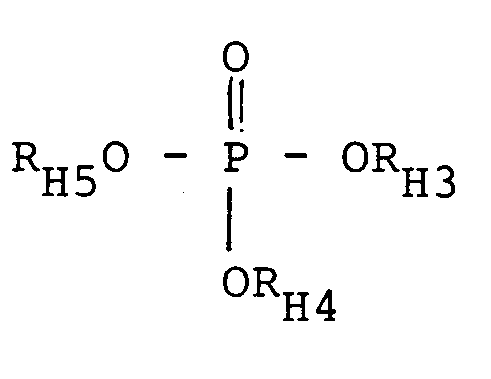
- Suitable phosphates include these represented by Formula HB; wherein R H3 , R H4 and R H5 y each independently represent alkyl, alkenyl or aryl, respectively, provided that the total number of carbon atoms in the groups represented by R H3 , R H4 and R H5 , taken together, is from 24 to 54.
- the alkyl groups represented by R H3 , R H4 and R H5 are straight-chained or branched, including, for example, butyl, pentyl, hexyl, octyl, nonyl, dodecyl, pentadecyl, hexadecyl, octadecyl and nonadecyl.
- alkyl groups, alkenyl groups and aryl groups may have at least one substituent.
- the preferable alkyl groups represented by R H3 , R H4 and R H5 include, for example, 2-ethylhexyl, n-octyl, 3,5,5-trimethylhexyl, n-nonyl, n-decyl, sec-decyl, sec-dodecyl and t-octyl.
- the high boiling organic solvents may be used in an amount within the range of from 0.01 mole to 10 moles per mole of silver halide used and, more preferably, from 0.05 mole to 5 moles.
- the amount of high boiling organic solvent added to a coupler is preferably from 25 to 150% by weight to the coupler and, more preferably, from 50 to 100% by weight.
- silver halide grains are contained in at least one silver halide emulsion layer in order to achieve rapid processability.
- the silver halide grains have a silver chloride content of not less than 90 mole%.
- the silver chloride content preferable for the effects of the invention is not less than 95 mole% and, more preferably, not less than 99.0 mole%.
- the silver halide grains may be silver chlorobromide, silver iodochloride, silver chloroiodobromide or silver chloride; while they may contain silver iodide, the content thereof is preferably not more than one mole% and, more preferably, not more than 0.5 mole%. It is most preferable that no silver iodide should be present.
- the most suitable silver halide grains are silver chlorobromide and silver chloride.
- the silver halide grains relating to the invention may be mixed with silver halide grains other than those of the invention.
- the ratio of the projective area occupied by the silver halide grains of the invention to the projective area occupied by the total number of silver halide grains contained in the emulsion layer is preferably not less than 50% and more preferably not less than 75%.
- the silver halide grains of the invention can be prepared in accordance with the methods described in, for example, Japanese Patent O.P.I. Publication Nos. 162540-1984, 48755-1984, 222844-1985, 222845-1985 and 136735-1985.
- the grain sizes are preferably within the range of from 0.2 to 1.6 ⁇ m and more preferably from 0.25 to 1.2u.m.
- the above-mentioned grain sizes may be measured by various methods which have conventionally been used in the art. Typical methods are described in R.P. Loveland, 'Particle-Size Measurement', ASTM Symposium on Light Microscopy, 1955, pp. 94-122; or C.E.K. Mees and T.H. James, 'The Theory of the Photographic Process', 3rd Ed., Chapter 2, The Macmillan Co., 1966.
- the above-mentioned grain sizes may be measured in terms of the projective area of grains or the approximate value of grain diameter. When grains are substantially uniform in shape, the grain size distribution may be fairly accurately expressed in terms of either a diameter or projective area.
- the distribution of grain sizes of the silver halide grains may be either polydispersed or monodispersed.
- grains are monodispersed having a variation coefficient of preferably not more than 0.22 and more preferably not more than 0.15.
- a variation coefficient means the coefficient indicating the broadness of grain size distribution and is defined by the following equations; wherein ri represents a grain size of individual grains and ni is the number thereof.
- the term 'grain size' stated herein means the diameter of silver halide grains when they are in the globular form or, when such grains are in the cubic form or the other forms than the cubic form, the diameter of the circular image having the same areas as the projective image areas of the grains.
- the silver halide grains relating to the invention may be prepared by, e.g., an acidic process, a neutral process or an ammoniacal process. These grains may be grown either directly or after preparation of seed grains. Methods of preparing seed grains and methods of growing grains may be the same or different.
- Methods of reacting a soluble silver salt with a soluble halide include normal precipitation methods, reverse precipitation methods and double-jet precipitation methods and combinations thereof. Among the grains, those prepared in double-jet precipitation methods are preferred.
- a pAg-controlled double-jet method may be used as a double-jet precipitation method, as described in, for example, Japanese Patent O.P.I. Publication No. 48521-1979.
- silver halide solvents may be used such as thioether or crystal-habit controllers such as a mercapto group-containing compounds and spectral sensitizing dyes.
- Silver halide grains having any configurations may be used.
- a preferable example is grains in the form of a cube having a ⁇ 100 ⁇ crystal face.
- grains having a form such as an octahedron, tetradecahedron or dodecahedron may be used, as prepared in the methods described in, for example, U.S. Patent Nos. 4,183,756 and 4,225,666; Japanese Patent O.P.I. Publication No. 26589-1980; Japanese Patent Publication No. 42737-1980; and The Journal of Photographic Science, 21, p. 39, (1973).
- Grains having twin-crystal faces or irregular forms may also be used.
- Silver halide grains used in relation to the invention may either have a single form or various forms. However, grains of a single form are rather preferable.
- metal ions are generally added into the grains; these may be cadmium salts, zinc salts, lead salts, thalium salts, iridium salts or complexes thereof, rhodium salts or complexes thereof, iron salts or complexes thereof, so that the metal ions are contained inside the grains and/or in the surfaces thereof.
- a reduction sensitization nucleus may be provided inside the grains and/or to the surfaces thereof by putting the grains in a suitably reducting atmosphere.
- Unnecessary soluble salts may be removed from the emulsions of the invention after completing the growth of silver halide grains, or may be contained as they are. If the salts are removed, this may be carried out according to the method described in, for example Research Disclosure, No. 17643.
- the silver halide grains relating to the invention may be capable of forming a latent image mainly either inside or on the surface thereof.
- Preferable grains are those capable of forming a latent image mainly on the surface thereof.
- the silver halide emulsions used in the invention may be chemically sensitized in accordance with conventional methods. Suitable methods include a gold sensitizing method using gold complex salts, a reduction sensitizing method using a reducible substance, a sulfur sensitizing method using a compound containing sulfur capable of reacting with silver ions or using the so-called active gelatin or a method using a noble metal salt belonging to the VIII Group of the Periodic Table.
- the silver halide emulsion layer of the invention contains a gold sensitizer.
- Suitable gold compounds include, for example, chloroauric acid, sodium chloroaurate and auric potassium thiosulfate.
- the amount of gold compound added is generally from 5x10- 7 to 5x10- 3 mole per mole of silver halide used, preferably from 2x10- 6 to 1x10- 4 mole, more preferably from 2.6x10- 6 to 4x10- 5 mole, and most preferably from 2.6x10- 6 to 9x10- 6 mole per mole of the silver halide used.
- the gold compound may be added at any stage during the preparation of the silver halide emulsion. It is, however, preferably added between completion of silver halide formation and completion of chemical sensitization.
- the gold compound may also be added into the silver halide emulsion before the emulsion is coated, upon completion of chemical sensitization and after adding a compound known as an antifoggant or a stabilizer in the photographic industry. Addition of the gold compound may be made at a time when a sensitization effect may be derived, but also at any time other than the above.
- the silver halide emulsion layers of the invention contain a sulfur sensitizer.
- Suitable sulfur sensitizers include, for example, sodium thiosulfate or a thiourea derivative such as diphenyl thiourea and allyl thiourea.
- a sulfur sensitizer may be added in an amount sufficient to sensitize silver halides and no special limitations apply.
- sodium thiosulfate for example, may be added in an amount of preferably from 1x10 -7 to 1 x1 0-5 and more preferably from 2x10- 6 to 8x10- 6 mole, per mole of silver halide used.
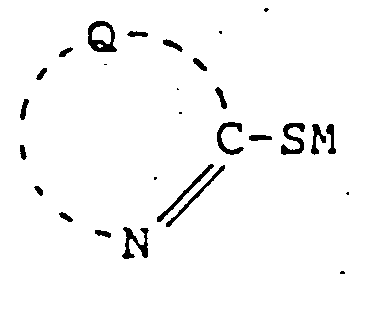
- mercapto compounds which may advantageously be used in the invention are of Formula S; Formula S wherein Q represents a group of atoms which completes a 5- or 6-membered heterocyclic ring or a 5-or 6-membered heterocyclic ring condensed with a benzene ring; and M represents hydrogen or a cation.
- Q represents a group of atoms which completes a 5- or 6-membered heterocyclic ring or a 5- or 6-membered heterocyclic ring condensed with a benzene ring.
- the heterocyclic rings completed by Q include, for example, an imidazole ring, a tetrazole ring, a thiazole ring, an oxazole ring, a selenazole ring, a benzoimidazole ring, a naphthoimidazole ring, a benzothiazole ring, a naphthothiaazole ring, a benzoselenazole ring, a naphthoselenazole ring and a benzoxazole ring.
- the cations represented by M include, for example, alkali metals such as sodium or potassium; or an ammonium group.
- the mercapto compounds of Formula S include, preferably, those represented by the following Formulae SA, SB, SC and SD, respectively;
- Formula SA wherein R A represents hydrogen, alkyl, alkoxy, aryl, halogen, carboxyl or salts thereof, sulfo or salts thereof, or amino;
- Z represents -NH-, -O- or -S-; and M is as defined for M in Formula S above.
- Formula SB wherein Ar represents R B represents alkyl, alkoxy, carboxyl or salts thereof, sulfo or salts thereof, hydroxyl, amino, acylamino, carbamoyl or sulfonamido; n is 0, 1 or 2; and M is as defined for M in Formula S above.
- the alkyl groups represented by R A and R B include, for example, methyl, ethyl and butyl; alkoxy includes, for example, methoxy and ethoxy; and salts of the carboxyl or sulfo groups include, for example, a sodium salt and an ammonium salt.
- the aryl groups represented by R A include, for example, phenyl and naphthyl; and halogen includes, for example, chlorine and bromine.
- the acylamino groups represented by R B include, for example, methylcarbonylamino and benzoylamino; carbamoyl includes, for example, ethylcarbamoyl and phenylcarbamoyl; and sulfonamido includes, for example, methylsulfonamido and phenylsulfonamido.
- alkyl, alkoxy, aryl, amino, acylamino, carbamoyl, sulfonamido and the like groups include those having further substituents.
- Formula SC wherein Z represents oxygen or sulfur; R A represents hydrogen, alkyl, aryl, alkenyl, cycloalkyl, -SR A1 , -NHCOR A4 , -NHSO 2 R A5 , or a heterocyclic group; R A1 represents hydrogen, alkyl, alkenyl, cycloalkyl, aryl, -COR A4 or -S0 2 R A5 ; R A2 and R A3 independently represent hydrogen, alkyl, or aryl; R A4 and R A5 independently represents alkyl or aryl; and M is as defined for M in Formula S above.
- Alkyl groups represented by R A , R A1 , R A2 , R A3 , R A4 and R A5 in Formula SC include, for example, methyl, ethyl and propyl; and the aryl groups include, for example, phenyl, benzyl or naphthyl.
- Alkenyl groups represented by R A and R A1 include, for example, propenyl; the cycloalkyl groups include, for example, cyclohexyl.
- Heterocyclic groups represented by R A include, for example, furyl and pyridinyl.
- R A alkyl and aryl groups represented by R A , R A1 , R A2 , R A3 , R A4 and R A5 ; the alkenyl and cycloalkyl groups represented by R A and R A1 ; and the heterocyclic groups represented by R A ; each further includes those having substituents.
- Formula SD wherein R A and M each are as defined for R A and M in Formula SC; and R B1 and R B2 each are as defined for R A1 and R A2 in Formula SC.
- Compounds of Formula S may include the compounds described in, for example, Japanese Patent Publication No. 28496-1965; Japanese Patent O.P.I. Publication No. 89034-1975; Journal of Chemical Society, 49, 1748 (1927) and 4237 (1952); Journal of Organic Chemistry, 39, 2469 (1965); U.S. Patent No. 2,824,001; Journal of Chemical Society, 1723 (1951); Japanese Patent O.P.I. Publication No. 111846-1981; British Patent No. 1,275,701; and U.S. Patent Nos. 3,266,897 and 2,403,927. These compounds may be synthesized according to methods described in the above-given literature.
- Compounds of Formula S may be contained in the silver halide emulsion layer containing silver halide grains, in such a manner that the Compound S is dissolved in water or an organic solvent such as methanol or ethanol which is capable of being freely mixed with water.
- Compounds S may be used independently, jointly with two or more compounds of formula S, or in combination with a stabilizer or an antifoggant other than compounds of Formula S.
- Compound S is usually added when the chemical sensitization of the silver halide is completed, and may also be added after silver halide grains are formed or when starting or during chemical sensitization. It is, however, preferable that Compounds S should be added in stages when starting and completing chemical sensitization.
- the amount of compound S to be added is not especially limitative. However, it is usually within the range of from 1 x1 0-6 mole to 1x10 -1 mole and preferably from 1x10 -5 mole to 1x10 -2 mole per mole of silver halides used.
- the emulsions relating to the invention may be spectrally sensitized to a desired wavelength region by making use of a dye which is known as a spectral sensitizing dye in the photographic industry. Such a spectral sensitizing dye may be used independently or two or more in combination.
- the emulsion may also contain a dye not having any spectral sensitizing function itself or a compound which does not substantially absorb any visible rays of light, i.e., a supersensitizer capable of enhancing the sensitizing function of a spectral sensitizing dye, as well as the spectral sensitizing dye.
- Z 11 and Z 12 independently represent a group of atoms which completes a benzoxazole nucleus, a naphthoxazole nucleus, a benzoselenazole nucleus, a napthoselenazole nucleus, a benzothiazole nucleus, a naphthothiazole nucleus, a benzoimidazole nucleus, a naphthoimidazole nucleus, a pyridine nucleus or a quinoline nucleus, and these heterocyclic rings include those having substituents.
- the substituents of the heterocyclic rings completed by Z 11 and Z 12 include, for example, halogen, cyano, methyl, ethyl, methoxy or ethoxy.
- R 2 , and R 22 each, independently, represent alkyl, alkenyl or aryl, preferably alkyl and preferably alkyl substituted by carboxyl or sulfo, and most preferably one sulfoalkyl having 1 to 4 carbon atoms.
- R 23 represents hydrogen, methyl or ethyl.
- X e represents an anion and l is 0 or 1.
- the particularly useful dyes are of Formula A'; Formula A' wherein Y 1 and Y 2 each, independently, represent a group of atoms which completes a substitutable benzene or naphthalene ring.
- Y 1 and Y 2 each, independently, represent a group of atoms which completes a substitutable benzene or naphthalene ring.
- the benzene or naphthalene ring completed by Y 1 and Y 2 may be substituted.
- Suitable substituents include, preferably, halogen, cyano, methyl, ethyl, methoxy or ethoxy.
- R 21 , R 22 , R 23 , X ⁇ and l are as defined in Formula A above, respectively.
- spectral sensitizing dyes of Formula B When using a green-sensitive emulsion as a silver halide emulsion, it is preferred to use spectral sensitizing dyes of Formula B; Formula B wherein Z 11 and Z 12 each, independently, represent a group of atoms which completes a benzene or naphthalene ring each condensed with an oxazole ring.
- spectral sensitizing dyes of Formula B Formula B wherein Z 11 and Z 12 each, independently, represent a group of atoms which completes a benzene or naphthalene ring each condensed with an oxazole ring.
- substituents include, for example, halogen, aryl, alkyl and alkoxy. More preferable substituents include halogen, phenyl and methoxy. The most preferable substituent is phenyl.
- Z 11 and Z 12 each, independently, represent a benzene ring condensed with an oxazole ring and at least one of these benzene rings is substituted with a phenyl group at the 5-position, or one benzene ring is substituted by phenyl at the 5-position and the other benzene ring is substituted by halogen at the 5- position.
- R 2 , and R 22 each, independently, represent alkyl, alkenyl or aryl; preferably alkyl, more preferably alkyl substituted by carboxyl or sulfo, most preferably sulfoalkyl having 1 to 4 carbon atoms and further most preferably a sulfoethyl.
- R 23 represents hydrogen or alkyl having 1 to 3 carbon atoms and preferably hydrogen or ethyl.
- X 1 represents an anion such as a halide, for example chloride, bromide or iodide; and an anion of CH 3 SO 4 or C 2 H 5 SO 4 ; n is one or zero, and n is 0 when the compound forms an intramolecular salt.
- spectral sensitizing dyes of Formulae C or D When using a red-sensitive emulsion as the silver halide emulsion, it is preferred to use spectral sensitizing dyes of Formulae C or D, respectively;
- Formula C Formula D wherein R represents hydrogen or alkyl; R 1 to R 4 each, independently, represent alkyl or aryl; Z 1 , Z 2 , Z 4 and Z 5 each, independently, represent a group of atoms which completes a benzene or naphthalene ring condensed with a thiazole or selenazole ring; Z 3 represents a group of hydrocarbon atoms which completes a 6-membered ring; l is one or two; Z represents sulfur or selenium; and X e represents an anion.
- alkyl groups represented by R include, for example, methyl, ethyl and propyl; and R is preferably hydrogen, methyl or ethyl and, more preferably, hydrogen or ethyl.
- Ri, R 2 , R 3 and R 4 each, independently, represent an optionally substituted straight-chained or branched alkyl group, such as methyl, ethyl, propyl, chloroethyl, hydroxyethyl, methoxyethyl, acetoxyethyl, carboxymethyl, carboxyethyl, ethoxycarbonylmethyl, sulfoethyl, sulfopropyl, sulfobutyl, ⁇ -hydroxy- ⁇ -sulfopropyl, sulfate-propyl, allyl or benzyl; or an optionally substituted aryl group, such as phenyl, carboxyphenyl or sulfophenyl.
- aryl group such as phenyl, carboxyphenyl or sulfophenyl.
- the heterocyclic rings completed by Z 1 , Z 2 , Z 4 and Z 5 may be substituted by, for example, halogen, aryl, alkyl or alkoxy and, more preferably, halogen such as chlorine, phenyl and methoxy group.
- X ⁇ represents an anion such as Cl, Br, I, CH 3 SO 4 or C 2 H 5 SO 4 ; and l is 1 or 2.
- the amount of the spectral sensitising dyes represented by the above-given Formula A, B, C or D added is not specially limited, but is generally within the range of preferably about 1x10 -7 to 1x10 -3 mole and, more preferably 5x10- 6 to 5x10- 4 mole, per mole of silver halide used.
- Any conventional method known in the art may be used to add the spectral sensitizing dyes.
- the spectral sensitizing dyes may be added by being dissolved in a water-soluble solvent such as pyridine, methyl alcohol, ethyl alcohol, methyl cellosolve or acetone or mixtures thereof, they may be diluted or dissolved with water, so that they may be added in the form of a solution.
- a supersonic oscillation may advantageously be used during dissolution.
- sensitizing dyes When adding the sensitizing dyes to be used in the invention, a method as described in, for example, U.S. Patent No. 3,469,987 may be applied, in which the dye is dissolved in a volatile organic solvent and the resultant solution is dispersed in a hydrophilic colloid and the resulted dispersion is then added; or such a method as described in, for example, Japanese Patent Publication No. 24185-1971 in which a water- insoluble dye is dispersed without being dissolved in a water-soluble solvent and the resultant dispersion is then added.
- the sensitizing dyes which may be used in the invention may be added in the form of a dispersion into an emulsion in an acidic dissolution-dispersion method.
- a method of adding the sensitizing dyes the methods described in, for example, U.S. Patent Nos. 2,912,345, 3,342,605, 2,996,287 and 3,425,835 may be used.
- the sensitizing dyes which are to be contained in a silver halide emulsion of the invention may be added in such a manner that they are dissolved in the same or different solvents and the resultant solutions are mixed up together before addition into the silver halide emulsion, or they may be added separately. When adding them separately, the order of addition, time of addition and intervals of addition may be freely determined according to the purposes of use.
- the sensitizing dyes may be added into an emulsion at any point during the course of preparation of the emulsion; however, preferably, addition occurs during or after chemical ripening and, more preferably, during chemical ripening.For the purpose of further improving the effects of the invention, it is preferable to add the sensitizing dyes at intervals during chemical ripening and in a coating liquid.
- the silver halide photographic light-sensitive materials of the invention may be in the form of, for example, a color negative or positive film, or a color print paper.
- the effects of the invention are particularly apparent when using a color print paper.
- the silver halide photographic light-sensitive materials including the above-mentioned color print paper may be either monochromic or multicolor.
- Multicolor silver halide photographic light-sensitive materials usually have a constitution such that silver halide emulsion layers containing respectively magenta, yellow and cyan couplers each for photographic couplers and non-sensitive layers coated with an appropriate number and arrangement of layers onto a support, so as to perform color reproduction in a subtractive color process.
- the number and coating order of the layers may suitably be altered according to the desired characteristics and purposes of the light-sensitive materials to be prepared.
- a particularly preferable layer arrangement is as follows: on and from a support in order, a yellow dye image forming layer, an interlayer, a magenta dye image forming layer, an interlayer, a cyan dye image forming layer, an interlayer, and a protective layer.
- Yellow dye image forming couplers include four-equivalent or two-equivalent acylacetamide or benzoyl- methane couplers. These couplers are described in, for example, U.S. Patent Nos. 2,778,658, 2,875,057, 2,908,573, 2,908,513, 3,227,155, 3,227,550, 3,253,924, 3,265,506, 3,277,155, 3,341,331, 3,369,895, 3,384,657, 3,408,194, 3,415,652, 3,447,928, 3,551,155, 3,582,322 and 3,725,072; West German Patent Nos.
- Magenta dye image forming couplers include tetramer or dimer magenta dye image forming couplers of the 5-pyrazolone type, pyrazolotriazole type, pyrazolinobenzimidazole type, indazolone type and cyanoacetyl type. These are described in, for example, U.S. Patent Nos.
- Cyan dye image forming couplers include, typically four-equivalent or two-equivalent cyan dye image forming couplers of the phenol type and the napthol type. They are described in, for example, U.S. Patent Nos. 2,306,410, 2,356,475, 2,362,598, 2,367,531, 2,369,929, 2,423,730, 2,474,293, 2,476,008, 2,498,466, 2,545,687, 2,728,660, 2,772,162, 2,985,826, 2,976,146, 3,002,836, 3,419,390, 3,446,622, 3,476,563, 3,737,316, 3,758,308 and 3,839,044; British Patent Nos.
- the above-mentioned dye forming couplers contain in their molecules a so-called ballast group which is a group having not less than eight carbon atoms such that the coupler is not capable dispersing into another layer.
- These dye forming couplers may be either of the four-equivalent type which require four silver ions to form one molecule of dye, or those of the two-equivalent type which require two silver ions.
- Suitable binders include gelatin or a protective colloid; hydrophilic colloids may also be used including, for example gelatin derivatives, graft polymers of gelatin and other macromolecules, proteins, sugar derivatives, cellulose derivatives, and synthetic hydrophilic macromolecular substances such as monomers or copolymers.
- the silver halide photographic light-sensitive materials of the invention may also contain additives such as hardeners, color contamination inhibitors, image stabilizers, UV absorbers, plasticizers, a latexes, surfactants, matting agents, lubricants, and antistatic agents.
- additives such as hardeners, color contamination inhibitors, image stabilizers, UV absorbers, plasticizers, a latexes, surfactants, matting agents, lubricants, and antistatic agents.
- Images may be formed from silver halide photographic light-sensitive materials of the invention by conventional color development processes.
- the color developing agents applicable to the color developers used in the invention include those of the aminophenol type and p-phenylenediamine type, each of which have been widely used in a variety of color photographic processes.
- the color developers applicable for processing the silver halide photographic light-sensitive materials of the invention may be added together with compounds already known as developer components, in addition to the above-mentioned aromatic primary amine type color developing agents. It is, however, more preferable not to use benzyl alcohol which causes environmental pollution problems.
- the pH value of such color developers is normally not less than 7 and most generally from about 10 to 13.
- the processing temperature of suitable color developers is normally not lower than 15°C and generally within the range of from 20 to 50 C.
- a temperature of 30 ° C or higher would be preferable.
- the conventional processing time is from 3 to 4 minutes
- a color processing time used in the invention with the purpose of rapidly processing is generally within the range of preferably from 20 to 60 seconds and more preferably from 30 to 50 seconds.
- the silver halide photographic light-sensitive materials of the invention are then treated in a bleaching process and a fixing process. Such bleaching and fixing processes may be carried out at the same time.
- washing process is normally carried out.
- the washing process may be substituted by a stabilizing process, or both processes may be carried out in combination.
- the silver halide photographic light-sensitive materials of the invention were rapidly processable, had high sensitivity and less sensitivity variation to the change on standing in the course of preparing the light-sensitive materials.
- a monodispersed silver chlorobromide emulsion having a silver chloride content of 99.5 mole% was prepared, according to the method described in Japanese Patent O.P.I. Publication No. 48521-1979, in such a manner that, in the presence of inert gelatin and under the conditions of a temperature of 40 C, a pAg of 6.8 and a pH of 2.0, an aqueous silver nitrate solution and an aqueous solution of potassium bromide and sodium chloride were added and mixed.
- the resultant silver halide emulsion contained cubic grains having an average grain size of 0.15 /1.m in terms of sphericity.
- a phthalated gelatin was added to the silver halide emulsion and the pH was lowered with nitric acid and precipitation of silver halide grains occurred. The resulting supernatant liquid was removed. The remaining matter was washed with water repeatedly and the pAg thereof was adjusted to 7.5. Additional inert gelatin was added so as to prepare a seed emulsion.
- Another monodispersed silver chlorobromide emulsion having a silver chloride content of 99.6 mole% was prepared in such a manner that, under the conditions of a temperature of 40 C, a pH of 5.8 and a pAg of 7.5, a mixed solution of a part of the above-mentioned seed emulsion and gelatin was added and mixed up with an aqueous silver nitrate solution and an aqueous solution of potassium bromide and sodium chloride in an amount so as not to produce any new nuclei.
- the resulting silver halide emulsion comprised cubic grains having an average grain size of 0.80 ⁇ m. In the course of mixing, these grains were added with Na 2 lrCRl 6 .6H 2 O in an amount of 3x10 -7 mole per mole of AgX.
- the pAg was adjusted and an additional gelating was added.
- the resulting mixture was spectrally sensitized and chemically sensitized, and the exemplified mercapto compound, SB-2, was added in an amount of 1x10 -2 mole per mole of AgX to serve as a stabilizer when the ripening process had been completed, so that a ripened emulsion was prepared.
- dispersions were prepared in such a manner that the yellow coupler Y-1 was dispersed respectively with the exemplified high boiling organic solvents having dielectric constants shown in Table-1, namely, H-2, H-6 and H-16, dibutyl phthalate (DBP) and tricresyl phosphate (TCP), and the coating liquids were prepared by mixing the resulting dispersions with the foregoing silver halide emulsions.
- Table-1 namely, H-2, H-6 and H-16, dibutyl phthalate (DBP) and tricresyl phosphate (TCP)
- the blue-sensitive sensitizing dye i.e., Exemplification No. A-12, which was used in the spectral sensitization, was further added in an amount of 7.5x10 -3 mole per mole of AgX.
- the blue reflection densities of the resulting samples were measured by making use of a densitometer, Model PDA-65 manufactured by Konishiroku Photo Industry Co., Ltd.
- the sensitivity of each of the samples was expressed by the reciprocal of an exposure necessary to obtain a density of 0.8.
- Sample-1 was used as a standard and the immediately coated sample out of the respective samples was taken as standard, the sensitivities thereof being regarded as 100, and the sensitivities of other samples were expressed as the relative values to 100. The results thereof are shown in Table-3.
- samples prepared in accordance with the invention are capable of displaying high sensitivity and, even if the coating liquids were allowed to stand for a long time, they still have constant and stable sensitivity.
- Samples No. 16 and No. 17 each coated with a sensitizing dye-containing coating liquid produce exceptional results.
- Example-1 a monodispersed cubic-crystallized emulsion having a silver chloride content of 99.3 moles and an average grains size of 0.35 ⁇ m was prepared.
- the emulsion was chemically sensitized with sodium thiosulfate in an amount of 1x10- 5 mole per mole of AgX, chloroauric acid of 5x10- 6 mole per mole of AgX, the exemplified mercapto compound, i.e., SB-5, in an amount of 5x10- 3 mole per mole of AgX, the exemplified green-sensitive sensitizing dye, B-5 and, after completion of chemical sensitization, the exemplified mercapto compound, SB-1, was added in an amount of 1x10- 2 mole per mole of AgX, so that a ripened emulsion was prepared.
- Example-4 By making use of the resulted ripened emulsion and in the same manner as in Example-1, the water-soluble bromides shown in Table-4 were mixed in a dispersion in which the following magenta coupler, M-1, was dispersed with the exemplified high boiling organic solvents, H-2, H-7 of which the dielectric constant is shown below, and DBP, so that the coating liquids shown in Table-4 were prepared.
- M-1 magenta coupler
- a silver halide color photographic light-sensitive material was prepared in such a manner that the following eight layers were coated in order over a paper support which had been coated on both sides with polyethylene resin and treated by a corona discharge.
- the amounts given hereinafter are in terms of the amount per sq. meter, unless otherwise stated.
- HD-1 was further added as a hardener in an amount of 0.017 g per g of the gelatin, respectively.
- Example-6 the times at which the water-soluble substances and high boiling organic solvents were added to the emulsion layers were the same as in Example-1.
- the coated samples were prepared by coating the resulted coating liquid immediately after the liquid was prepared, three hours thereafter and six hours thereafter, respectively.
- the sensitometries were then carried out. The results thereof are shown in Table-6, below.
Landscapes
- Chemical & Material Sciences (AREA)
- Physics & Mathematics (AREA)
- General Physics & Mathematics (AREA)
- Chemical Kinetics & Catalysis (AREA)
- Engineering & Computer Science (AREA)
- Materials Engineering (AREA)
- Spectroscopy & Molecular Physics (AREA)
- Crystallography & Structural Chemistry (AREA)
- Silver Salt Photography Or Processing Solution Therefor (AREA)
Claims (25)

besteht.
besteht.

sensibilisiert ist.

sensibilisiert ist.
Applications Claiming Priority (2)
| Application Number | Priority Date | Filing Date | Title |
|---|---|---|---|
| JP62021504A JPS63188129A (ja) | 1987-01-30 | 1987-01-30 | 迅速処理性に優れ、かつ感光材料の製造時の経時変化に対し、感度変動の少ないハロゲン化銀写真感光材料およびその製造方法 |
| JP21504/87 | 1987-01-30 |
Publications (3)
| Publication Number | Publication Date |
|---|---|
| EP0285234A2 EP0285234A2 (de) | 1988-10-05 |
| EP0285234A3 EP0285234A3 (en) | 1989-07-26 |
| EP0285234B1 true EP0285234B1 (de) | 1993-03-24 |
Family
ID=12056799
Family Applications (1)
| Application Number | Title | Priority Date | Filing Date |
|---|---|---|---|
| EP88300656A Expired - Lifetime EP0285234B1 (de) | 1987-01-30 | 1988-01-27 | Photographisches lichtempfindliches Silberhalogenidmaterial |
Country Status (4)
| Country | Link |
|---|---|
| US (1) | US4830958A (de) |
| EP (1) | EP0285234B1 (de) |
| JP (1) | JPS63188129A (de) |
| DE (1) | DE3879532D1 (de) |
Families Citing this family (9)
| Publication number | Priority date | Publication date | Assignee | Title |
|---|---|---|---|---|
| JPH087415B2 (ja) * | 1988-10-03 | 1996-01-29 | 富士写真フイルム株式会社 | ハロゲン化銀カラー写真の画像形成方法 |
| JPH04330434A (ja) * | 1990-12-17 | 1992-11-18 | Fuji Photo Film Co Ltd | ハロゲン化銀写真感光材料及びその現像処理方法 |
| JP2929511B2 (ja) * | 1991-09-25 | 1999-08-03 | コニカ株式会社 | ハロゲン化銀カラー写真感光材料 |
| JP2879489B2 (ja) * | 1992-04-15 | 1999-04-05 | 富士写真フイルム株式会社 | カラー写真感光材料およびカラー画像形成方法 |
| JP3133874B2 (ja) * | 1993-09-16 | 2001-02-13 | 富士写真フイルム株式会社 | ハロゲン化銀写真感光材料 |
| US5593820A (en) * | 1993-12-20 | 1997-01-14 | Fuji Photo Film Co., Ltd. | Silver halide emulsion and silver halide photographic material using the same |
| IT1271047B (it) * | 1994-10-26 | 1997-05-26 | Minnesota Mining & Mfg | Elemento fotografico agli alogenuri d'argento e metodo per stabilizzare un'emulsione agli alogenuri d'argento sensibile alla luce |
| US5516628A (en) * | 1995-04-26 | 1996-05-14 | Eastman Kodak Company | Silver halide photographic elements with particular blue sensitization |
| US5723280A (en) * | 1995-11-13 | 1998-03-03 | Eastman Kodak Company | Photographic element comprising a red sensitive silver halide emulsion layer |
Family Cites Families (15)
| Publication number | Priority date | Publication date | Assignee | Title |
|---|---|---|---|---|
| JPS54118246A (en) * | 1978-03-06 | 1979-09-13 | Oriental Photo Ind Co Ltd | Color photographic lightsensitive material |
| US4225666A (en) * | 1979-02-02 | 1980-09-30 | Eastman Kodak Company | Silver halide precipitation and methine dye spectral sensitization process and products thereof |
| JPS5828738A (ja) * | 1981-07-14 | 1983-02-19 | Konishiroku Photo Ind Co Ltd | ハロゲン化銀写真感光材料 |
| JPS58108533A (ja) * | 1981-12-02 | 1983-06-28 | Konishiroku Photo Ind Co Ltd | ハロゲン化銀カラ−写真感光材料 |
| JPS58107532A (ja) * | 1981-12-21 | 1983-06-27 | Konishiroku Photo Ind Co Ltd | ハロゲン化銀カラ−写真感光材料 |
| DE3274159D1 (en) * | 1981-12-19 | 1986-12-11 | Konishiroku Photo Ind | Light-sensitive silver halide color photographic material |
| JPS58125612A (ja) * | 1982-01-14 | 1983-07-26 | Konishiroku Photo Ind Co Ltd | ハロゲン化銀乳剤の製造方法 |
| JPS599653A (ja) * | 1982-07-08 | 1984-01-19 | Konishiroku Photo Ind Co Ltd | ハロゲン化銀写真感光材料 |
| JPS59210437A (ja) * | 1983-05-16 | 1984-11-29 | Konishiroku Photo Ind Co Ltd | ハロゲン化銀写真感光材料 |
| JPS6019141A (ja) * | 1983-07-14 | 1985-01-31 | Mitsubishi Paper Mills Ltd | 平版印刷版 |
| JPS6051834A (ja) * | 1983-08-31 | 1985-03-23 | Konishiroku Photo Ind Co Ltd | 色素画像の光堅牢化方法 |
| JPS60162247A (ja) * | 1984-02-01 | 1985-08-24 | Fuji Photo Film Co Ltd | ハロゲン化銀写真感光材料 |
| US4666827A (en) * | 1984-07-16 | 1987-05-19 | Mitsubishi Paper Mills, Ltd. | Silver halide photographic emulsion |
| JPS6139043A (ja) * | 1984-07-31 | 1986-02-25 | Fuji Photo Film Co Ltd | カラ−写真感光材料 |
| JP2519026B2 (ja) * | 1984-10-11 | 1996-07-31 | コニカ株式会社 | ハロゲン化銀写真感光材料 |
-
1987
- 1987-01-30 JP JP62021504A patent/JPS63188129A/ja active Pending
-
1988
- 1988-01-25 US US07/147,691 patent/US4830958A/en not_active Expired - Lifetime
- 1988-01-27 DE DE8888300656T patent/DE3879532D1/de not_active Expired - Lifetime
- 1988-01-27 EP EP88300656A patent/EP0285234B1/de not_active Expired - Lifetime
Also Published As
| Publication number | Publication date |
|---|---|
| US4830958A (en) | 1989-05-16 |
| DE3879532D1 (de) | 1993-04-29 |
| JPS63188129A (ja) | 1988-08-03 |
| EP0285234A3 (en) | 1989-07-26 |
| EP0285234A2 (de) | 1988-10-05 |
Similar Documents
| Publication | Publication Date | Title |
|---|---|---|
| US4469785A (en) | Light-sensitive silver halide color photographic material | |
| EP0348934B1 (de) | Silberhalogenidemulsion und farbfotografisches Material, das diese verwendet | |
| EP0369424B1 (de) | Lichtempfindliches photographisches Silberhalogenidmaterial | |
| US4791053A (en) | Silver halide photographic material | |
| EP0285234B1 (de) | Photographisches lichtempfindliches Silberhalogenidmaterial | |
| US3832189A (en) | Silver halide photographic supersensitized emulsions | |
| US4839270A (en) | Rapidly processable silver halide photographic light-sensitive material | |
| EP0297804A2 (de) | Photographisches lichtempfindliches Silberhalogenidmaterial | |
| EP0112161B1 (de) | Lichtempfindliches photographisches Silberhalogenidmaterial | |
| US4888272A (en) | Method for preparing silver halide photographic emulsions | |
| US4962016A (en) | Silver halide photographic light-sensitive material | |
| EP0367540A2 (de) | Photographisches Silberhalogenidmaterial | |
| EP0371338A1 (de) | Lichtempfindliches photographisches Silberhalogenidmaterial | |
| US5260183A (en) | Silver halide photographic material | |
| US3573920A (en) | Fine grain silver halide emulsions containing novel dye combinations | |
| US2158882A (en) | Photographic emulsion | |
| EP0287100B1 (de) | Photographisches Silberhalogenidmaterial | |
| EP0269404B1 (de) | Lichtempfindliches, photographisches Silberhalogenidmaterial | |
| US3873324A (en) | Spectrally sensitized silver halide photographic emulsion | |
| EP0301508B1 (de) | Methode zur Herstellung einer photographischen Silberhalogenidemulsion | |
| US4097284A (en) | Method for supersensitizing silver halide photographic emulsions | |
| US4039335A (en) | Photographic silver halide emulsions | |
| US2159565A (en) | Photographic emulsion | |
| US5348850A (en) | Silver halide photographic material and method of processing the same | |
| US4977075A (en) | Silver halide photographic emulsion |
Legal Events
| Date | Code | Title | Description |
|---|---|---|---|
| PUAI | Public reference made under article 153(3) epc to a published international application that has entered the european phase |
Free format text: ORIGINAL CODE: 0009012 |
|
| AK | Designated contracting states |
Kind code of ref document: A2 Designated state(s): DE FR GB IT NL |
|
| PUAL | Search report despatched |
Free format text: ORIGINAL CODE: 0009013 |
|
| AK | Designated contracting states |
Kind code of ref document: A3 Designated state(s): DE FR GB IT NL |
|
| 17P | Request for examination filed |
Effective date: 19891215 |
|
| 17Q | First examination report despatched |
Effective date: 19911119 |
|
| GRAA | (expected) grant |
Free format text: ORIGINAL CODE: 0009210 |
|
| AK | Designated contracting states |
Kind code of ref document: B1 Designated state(s): DE FR GB IT NL |
|
| PG25 | Lapsed in a contracting state [announced via postgrant information from national office to epo] |
Ref country code: IT Free format text: LAPSE BECAUSE OF FAILURE TO SUBMIT A TRANSLATION OF THE DESCRIPTION OR TO PAY THE FEE WITHIN THE PRE;WARNING: LAPSES OF ITALIAN PATENTS WITH EFFECTIVE DATE BEFORE 2007 MAY HAVE OCCURRED AT ANY TIME BEFORE 2007. THE CORRECT EFFECTIVE DATE MAY BE DIFFERENT FROM THE ONE RECORDED.SCRIBED TIME-LIMIT Effective date: 19930324 Ref country code: FR Effective date: 19930324 Ref country code: DE Effective date: 19930324 Ref country code: NL Effective date: 19930324 |
|
| REF | Corresponds to: |
Ref document number: 3879532 Country of ref document: DE Date of ref document: 19930429 |
|
| EN | Fr: translation not filed | ||
| NLV1 | Nl: lapsed or annulled due to failure to fulfill the requirements of art. 29p and 29m of the patents act | ||
| PLBE | No opposition filed within time limit |
Free format text: ORIGINAL CODE: 0009261 |
|
| STAA | Information on the status of an ep patent application or granted ep patent |
Free format text: STATUS: NO OPPOSITION FILED WITHIN TIME LIMIT |
|
| 26N | No opposition filed | ||
| PGFP | Annual fee paid to national office [announced via postgrant information from national office to epo] |
Ref country code: GB Payment date: 19960118 Year of fee payment: 9 |
|
| PG25 | Lapsed in a contracting state [announced via postgrant information from national office to epo] |
Ref country code: GB Effective date: 19970127 |
|
| GBPC | Gb: european patent ceased through non-payment of renewal fee |
Effective date: 19970127 |