EP0286360B1 - Electrode autoportante présentant un conduit d'admission de gaz intégré - Google Patents
Electrode autoportante présentant un conduit d'admission de gaz intégré Download PDFInfo
- Publication number
- EP0286360B1 EP0286360B1 EP88303028A EP88303028A EP0286360B1 EP 0286360 B1 EP0286360 B1 EP 0286360B1 EP 88303028 A EP88303028 A EP 88303028A EP 88303028 A EP88303028 A EP 88303028A EP 0286360 B1 EP0286360 B1 EP 0286360B1
- Authority
- EP
- European Patent Office
- Prior art keywords
- electrode
- wall
- air
- fuel
- conduit
- Prior art date
- Legal status (The legal status is an assumption and is not a legal conclusion. Google has not performed a legal analysis and makes no representation as to the accuracy of the status listed.)
- Expired - Lifetime
Links
Images



Classifications
-
- H—ELECTRICITY
- H01—ELECTRIC ELEMENTS
- H01M—PROCESSES OR MEANS, e.g. BATTERIES, FOR THE DIRECT CONVERSION OF CHEMICAL ENERGY INTO ELECTRICAL ENERGY
- H01M4/00—Electrodes
- H01M4/86—Inert electrodes with catalytic activity, e.g. for fuel cells
- H01M4/8605—Porous electrodes
- H01M4/8626—Porous electrodes characterised by the form
-
- H—ELECTRICITY
- H01—ELECTRIC ELEMENTS
- H01M—PROCESSES OR MEANS, e.g. BATTERIES, FOR THE DIRECT CONVERSION OF CHEMICAL ENERGY INTO ELECTRICAL ENERGY
- H01M8/00—Fuel cells; Manufacture thereof
- H01M8/10—Fuel cells with solid electrolytes
- H01M8/12—Fuel cells with solid electrolytes operating at high temperature, e.g. with stabilised ZrO2 electrolyte
- H01M8/1231—Fuel cells with solid electrolytes operating at high temperature, e.g. with stabilised ZrO2 electrolyte with both reactants being gaseous or vaporised
-
- H—ELECTRICITY
- H01—ELECTRIC ELEMENTS
- H01M—PROCESSES OR MEANS, e.g. BATTERIES, FOR THE DIRECT CONVERSION OF CHEMICAL ENERGY INTO ELECTRICAL ENERGY
- H01M8/00—Fuel cells; Manufacture thereof
- H01M8/24—Grouping of fuel cells, e.g. stacking of fuel cells
- H01M8/241—Grouping of fuel cells, e.g. stacking of fuel cells with solid or matrix-supported electrolytes
- H01M8/2425—High-temperature cells with solid electrolytes
- H01M8/243—Grouping of unit cells of tubular or cylindrical configuration
-
- H—ELECTRICITY
- H01—ELECTRIC ELEMENTS
- H01M—PROCESSES OR MEANS, e.g. BATTERIES, FOR THE DIRECT CONVERSION OF CHEMICAL ENERGY INTO ELECTRICAL ENERGY
- H01M8/00—Fuel cells; Manufacture thereof
- H01M8/10—Fuel cells with solid electrolytes
- H01M8/12—Fuel cells with solid electrolytes operating at high temperature, e.g. with stabilised ZrO2 electrolyte
- H01M2008/1293—Fuel cells with solid oxide electrolytes
-
- H—ELECTRICITY
- H01—ELECTRIC ELEMENTS
- H01M—PROCESSES OR MEANS, e.g. BATTERIES, FOR THE DIRECT CONVERSION OF CHEMICAL ENERGY INTO ELECTRICAL ENERGY
- H01M2300/00—Electrolytes
- H01M2300/0017—Non-aqueous electrolytes
- H01M2300/0065—Solid electrolytes
- H01M2300/0068—Solid electrolytes inorganic
- H01M2300/0071—Oxides
- H01M2300/0074—Ion conductive at high temperature
-
- Y—GENERAL TAGGING OF NEW TECHNOLOGICAL DEVELOPMENTS; GENERAL TAGGING OF CROSS-SECTIONAL TECHNOLOGIES SPANNING OVER SEVERAL SECTIONS OF THE IPC; TECHNICAL SUBJECTS COVERED BY FORMER USPC CROSS-REFERENCE ART COLLECTIONS [XRACs] AND DIGESTS
- Y02—TECHNOLOGIES OR APPLICATIONS FOR MITIGATION OR ADAPTATION AGAINST CLIMATE CHANGE
- Y02E—REDUCTION OF GREENHOUSE GAS [GHG] EMISSIONS, RELATED TO ENERGY GENERATION, TRANSMISSION OR DISTRIBUTION
- Y02E60/00—Enabling technologies; Technologies with a potential or indirect contribution to GHG emissions mitigation
- Y02E60/30—Hydrogen technology
- Y02E60/50—Fuel cells
Definitions
- This invention relates to self-supporting electrodes with integral gas feed conduits.
- High temperature, solid oxide electrolyte fuel cell configurations, and fuel cell generators are disclosed in U.S. Patent Specification Nos. 4,395,468 and 4,490,444 (Isenberg).
- These fuel cell configurations comprise a plurality of individual, series and parallel electronically connected, axially elongated, generally tubular, annular cells. Each cell is electronically connected in series to an adjacent cell in a column, through cell interconnections extending the full axial length of each cell. This series interconnection contacts the air electrode of one cell and the fuel electrode of an adjacent cell, through a metallic coating and a fiber metal felt.
- Each fuel cell is formed on a long, electronically insulating, porous support tube, generally made of calcia stabilized zirconia, which provides structural integrity for the fuel cell.
- a thin, porous air electrode Surrounding, and deposited on this support tube, is a thin, porous air electrode, generally from 20 microns ( ⁇ m) to 200 microns ( ⁇ m), thick, deposited by well known techniques.
- the air electrode can be comprised of doped or undoped oxides or mixtures of oxides in the pervoskite family, such as LaMnO3, CaMnO3, LaNiO3, LaCoO3, LaCoO3, and the like.
- Generally surrounding the outer periphery of the air electrode is a gas tight, solid electrolyte, usually of yttria stabilized zirconia.
- Substantially surrounding the solid electrolyte is an outer, porous, fuel electrode, usually of nickel-zirconia cermet. Both the solid electrolyte and outer electrode are discontinuous to allow inclusion of an electrical interconnection material for series connection between cells.
- a separate, single, open end, thin, oxidant injector tube is used in the interior of each fuel cell, to flow gaseous oxidant into the cell. The oxidant contacts the support and diffuses through it to the air electrode.
- U.S. Patent Specification No. 4,596,750 (Ruka et al.), provided a fluorite type support tube material which would be better able to resist cracking due to migration of lanthanum or manganese materials contained in the contacting air electrode, at fuel cell operating temperatures of 1000°C.
- U.S. Patent Specification No. 4,598,028 (Rossing et al.), provided lighter weight, thinner, higher strength support tubes, which utilized a ceramic powder and ceramic fiber combination, allowing reduction of the oxygen path length to the air electrode through the support. Improvements have also been made to the air electrode, for example, U.S. Patent Specification No. 4,562,124 (Ruka), taught introduction of small amounts of cerium into the air electrode material, to provide a better match of coefficient of thermal expansion with the support tube.
- the invention consists in a self-supporting, unitary, one piece, elongated air electrode comprised of doped or undoped oxides or mixtures of oxides in the perovskite family, characterized in that said electrode comprises an electronically conductive self-supporting structure having an inner and outer wall and having an open end and a completely closed end, where the inner wall defines a central conduit equidistant from the outer wall through the length of the electrode structure, where the area between the walls contains at least one additional conduit through the length of the electrode structure, and where the conduits communicate with each other near the closed end of the structure, said air electrode being appropriate to be used in a high temperature fuel cell upon having a superimposed electrolyte and then fuel electrode deposited thereon.
- the present invention provides a self-supporting, axially elongated, unitary electrode structure having an open end and a closed end, and having at least two conduits through its length connected near the closed end.
- a plurality of conduits are near its outer side wall with at least one additional conduit disposed inwardly from the conduits near the side wall.
- the electrode has an inner and outer wall, where the inner wall defines a conduit, preferably a central gas feed conduit parallel to the structure's longitudinal axis, through the length of the electrode structure, and where the area between the walls contains at least one other conduit, preferably a gas exit conduit through the length of the electrode structure.
- the end of the elongated electrode structure will be hollow, and capped or otherwise closed by a variety of designs.
- the conduits will communicate, i.e., connect with each other near the closed end, so that gas entering by way of the gas feed conduit will reverse direction and flow through the exit conduit in a direction countercurrent to the feed gas.
- a single gas feed conduit portion of an air electrode will be centrally located and will feed oxidant, there will be at least four gas exit conduits, and the electrode structure will be more dense near the central gas feed conduit than near the outer wall, so that gas will flow rather than diffuse to the gas exit conduits from the gas feed conduits.
- the central gas feed conduit can be longer than the rest of the electrode structure, extending outward along the axial length of the electrode, so that exiting, depleted oxidant gas can be used to react with depleted fuel near the extended feed conduit to heat incoming gas.
- openings can be machined in the outer wall past the active length of the cell, with the openings connecting to the gas exit conduits, to allow depleted gas to flow out of the openings after being used to heat incoming gas, and to combine with depleted fuel.
- the gas exit conduits are spaced near the outer side wall rather than in the center so that they can contact depleted fuel in the generator to preheat incoming air.
- Electrolyte and fuel electrode layers can be deposited over the air electrode to form annular cells, which can be electrically connected in series and also in parallel to similar adjacent cells.
- the term ⁇ annular ⁇ is used to describe a variety of layered cross-sections, for example, circular or square cross-sections.
- the fuel cell configuration provides a one piece high bulk electrode that incorporates a feed gas tube into the structure, and permits ease of electron travel, helping to eliminate circumferential current flow and circumferential voltage gradients.
- the elimination of the separate support tube reduces overall cell costs, eliminates one deposition step in manufacturing, and eliminates thermal mismatch and material migration problems. Elimination of the oxidant injector tubes makes for simple, strong, inexpensive, problem free generator design.
- a fuel cell generator 10 including a gas-tight housing 12.
- the housing 12 surrounds a plurality of chambers, including a generating chamber 14 and a combustion product or preheating chamber 16.
- An oxidant inlet chamber 18 can also be contained within the housing 12.
- the housing 12 is preferably comprised of steel, and lined throughout with a thermal insulation 22, shown as a thin layer for the sake of simplicity, such as low density alumina insulation. Penetrating the housing 12 and insulation 22 is a fuel inlet port 24, shown best in Figure 2, an air inlet port 26, and a combustion product outlet port 28, as well as ports for electrical leads.
- the generating chamber 14 extends between an end wall 30 of the housing 12 and a porous barrier 32, such as fibrous alumina felt.
- the preheating chamber 16 extends between the porous barrier 32 and a support structure for the gas inlet tube portion 20 of the fuel cells 40, such as a tube sheet 34.
- the oxidant inlet chamber 18 extends between the tube sheet 34 and another end wall 36 of the housing 12.
- the dividing barriers can include other structural types, and additional support and flow baffles can be incorporated.
- the shown barriers, the porous barrier 32 and the tube sheet 34 need not be sealed structures.
- the porous barrier 32 in particular, is designed to allow flow between the generating chamber 14, operating at an approximate pressure slightly above atmospheric, and the preheating chamber 16, operating at a slightly lower pressure. Gas flow is indicated by arrows 38 and 63. While the generator 10 is shown in a horizontal orientation in Figure 1, it can be operated in a vertical or other position.
- High temperature, elongated, solid oxide electrolyte, annular electrochemical cells such as fuel cells 40 extend between the preheating chamber 16 and the generating chamber 14.
- the cells in one design, have completely open ends 42 in the preheating chamber 16, and closed end 44 in the generating chamber 14.
- the fuel cells are preferably tubular, including a solid oxide electrolyte sandwiched between two electrodes.
- Each cell includes an electrochemically active length 46 and an inactive length 48. The active length is contained within the generating chamber 14.
- Each individual cell generates approximately one volt, and a plurality are electronically interconnected, preferably in a series-parallel rectangular array.
- the arrangement can be described as including rows 50 and columns 52.
- Each cell in a row 50 is electronically connected along its active length 46 to the next adjacent cell, preferably through an interconnection felt 54 contacting their outer peripheries.
- an oxidant such as air
- the anode is the outer periphery of each cell and the cathode is on the inside.
- cell-to-cell contact within a row is in parallel, among adjacent anodes.
- Each cell in a column 52 is electronically interconnected in series to the next adjacent cell 40.
- this interconnection is made from the inner cathode of one cell to the outer anode of the next consecutive cell, through an interconnection felt 54.
- cells in the first row 50′ operate, for example, at approximately one volt, in the second row 50 ⁇ at approximately two volts, in the third row 50′′′ at approximately three volts, and so forth. Hundreds of cells can be so connected to achieve the desired voltage and current output.
- the direct current electrical energy thus generated is collected by a single current collector, preferably a conductive metal plate 56 or felt pad, positioned in electronic contact with each cell 40 in the first row 50′, and a similar second collector (not shown), positioned in contact with the last row. Electrical leads 58, shown in Figure 2, are accordingly provided to the current collectors.
- a supported, prior art fuel cell 40′ having a thick support tube 2, which provides structural integrity to the cell, is shown.
- the support tube was typically comprised of calcia stabilized zirconia, forming a wall porous to gas permeation, approximately 1 mm to 2 mm thick.
- Surrounding the outer periphery of the support tube 2 was a thin porous air electrode or cathode 3.
- the cathode 3 was typically a composite oxide structure from 20 microns ( ⁇ m) to 200 microns ( ⁇ m) thick which was deposited onto the support tube through well-known techniques such as plasma spraying, or spraying or dipping in a slurry followed by sintering.
- Electrolyte 4, fuel electrode 7, interconnect 6 and nickel or cobalt layer 8 are also shown.
- a gas injector tube not shown in this Figure, was disposed in the open portion of the support tube.
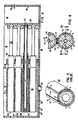
- the prior art support tube is eliminated in the fuel cell design of this invention, one embodiment of which is shown in Figure 4, which utilizes a high bulk air electrode or cathode 3′, having a central, integral gas feed conduit 41 which extends through the length of the air electrode.
- This air electrode may be made from doped or undoped oxide or mixture of oxides including but not limited to LaMnO3, CaMnO3, LaNiO3, LaCoO3 and LaCrO3.
- a preferred air electrode material is LaMnO3 doped with Sr.
- a gas-tight solid electrolyte 4 typically yttria stabilized zirconia, from 1 micron ( ⁇ m) to 100 microns ( ⁇ m) thick.
- a selected longitudinal segment 5, shown best in Figure 3, along the electrode axial length, is masked during deposition of the electrolyte, to provide a discontinuity, into which, an electronically conductive interconnect material 6′ is deposited.
- the interconnect material 6′ must be electronically conductive in both an oxygen and fuel environment.
- the interconnect is from 5 microns ( ⁇ m) to 100 microns ( ⁇ m) thick and is typically made of lanthanum chromite doped with calcium, strontium, or magnesium.
- a fuel electrode 7′ Surrounding the remainder of the cell except for the interconnect area is a fuel electrode 7′ which functions as the anode.
- a typical anode is 30 microns to 200 microns thick and is typically a nickel zirconia or cobalt zirconia cermet.
- a material 8′, which is composed of porous nickel or cobalt metal is also deposited over the interconnect 6′. This material is typically from 30 microns to 200 microns thick.
- a gaseous fuel such as hydrogen or carbon monoxide
- a source of oxygen passes through the inside of the cell to contact the air electrodes.
- the oxygen source forms oxygen ions at the electrode-electrolyte interface, which ions migrate through the electrolyte material to the anode, while electrons are collected at the cathode, thus generating a flow of electrical current in an external load circuit.
- a number of cells can be connected in series by electronic contact between the interconnect of one cell and the fuel electrode anode of another cell.
- one of the self-supporting, axially elongated, unitary designs of the electronically conducting air electrode 3′ of this invention is shown, with an integral, central gas feed conduit 41 and four surrounding gas exit conduits 43 disposed near the outer side walls of the electrode, and without the thick, tubular support 2, shown in the prior art Figure 3.
- the area 45 around the central oxidant feed conduit 41 is preferably more dense than the rest of the air electrode structure 3′, so that oxidant gas will flow to the end of the cell, as shown in the cut away portion of Figure 2, rather than diffuse through the air electrode structure from conduit 41 to gas exit conduits 43.
- Density near conduit 41 can range from 75% to 90% while density near the outer wall can range from 20% to 50%. This density gradient can be accomplished during molding or extruding the air electrode, by using a finer particle size of the electrode material in the portion near the gas feed conduit, or by slip casting prior to or after sintering of the electrode.
- the particles used near the gas conduit will range from 0.1 micron ( ⁇ m) to 10 microns, while the rest of the electrode will be made from particles ranging from 10 microns ( ⁇ m) to 100 microns ( ⁇ m).
- Other possible air electrode designs are shown in Figures 5 and 6, all of which designs should be considered illustrative, and not in any way limiting. In these cases the plurality of conduits 43 are shown near the outer side wall 50, with at least one additional conduit 41, defined by inner wall 47, where conduit 41 is disposed inwardly from conduits 43 near the sidewall.
- the feed conduit 41 will be central to the air electrode cross section, and at least four, most preferably six to eight, exit conduits, as shown in Figures 4 and 6, will surround the cental feed conduit.
- Figure 7 shows an enlargement of the cross-section air electrode design, along line VII-VII of Figure 4.
- the closed end 44 of the cell is a simple end plug 65
- the air electrode is machined or otherwise cut in the green state at the entrance end where gas 63 flows in, to provide an extending air feed inlet conduit tube 20.
- the portion of the electrode structure containing the inner wall, i.e., tube 20, extends outwardly beyond the active length 46 of the cell. Dotted lines show the cut away portions 67 at the entrance end. Cut away portions at the plug end are shown as the hollow portion 67′.
- the air enters the integral feed conduit tube 20, flowing down the gas feed conduit 41 until it reaches the closed end at plug 65, where it flows through the passage shown, and then reverse flows countercurrent to the inlet direction through gas exit conduits 43, and into combustion product chamber 16, when the cell is placed in a generator.
- the depleted oxidant contacts depleted fuel, and both combust to heat incoming oxidant 63.
- the gas exit conduits 43 are placed near the outer wall, rather than in the center of the electrode, so that this contact with depleted fuel and combustion to preheat incoming air is possible.
- Figure 7 can be modified, as shown in Figure 8, where a pre-formed end plug 65 is used.
- An advantage of this design is that the plug 65 cannot be pushed in so far as to cut off incoming oxidant gas, as is possible with the design of Figure 7.
- the air electrode can be made shorter than in Figure 7, and a separate, very dense inlet tube 20 can be cemented to the electrode, 3′ at joint 68.
- Figure 9 shows an end plug design somewhat similar to that of Figure 7, except that the hollow portion 67′ is made by machining the walls near the end of the oxidant feed conduit, such as at 69.
- holes or other openings are made by machining the walls near the entrance end of the electrode structure where the oxidant 63 enters. This would still allow flow of depleted oxidant into combustion product chamber 16. All of these embodiments are to be considered illustrative and not limiting, and show means disposed near the closed end of the electrode structure to allow reverse flow of oxidant feed gas.
- the self-supporting air electrode of the invention can be extruded, or it can be molded in a suitable die. After it is formed, and while in the green stage, all of the various heretofore described machining operations can take place. Then it can be sintered at from 1400°C to 1600°C, to provide a strong, unitary body upon which superimposed electrolyte and then fuel electrode can be deposited by well known techniques.
Landscapes
- Chemical & Material Sciences (AREA)
- Chemical Kinetics & Catalysis (AREA)
- Electrochemistry (AREA)
- General Chemical & Material Sciences (AREA)
- Life Sciences & Earth Sciences (AREA)
- Engineering & Computer Science (AREA)
- Manufacturing & Machinery (AREA)
- Sustainable Development (AREA)
- Sustainable Energy (AREA)
- Fuel Cell (AREA)
- Inert Electrodes (AREA)
Claims (10)
Applications Claiming Priority (2)
| Application Number | Priority Date | Filing Date | Title |
|---|---|---|---|
| US34454 | 1987-04-06 | ||
| US07/034,454 US4751152A (en) | 1987-04-06 | 1987-04-06 | High bulk self-supporting electrode with integral gas feed conduit for solid oxide fuel cells |
Publications (3)
| Publication Number | Publication Date |
|---|---|
| EP0286360A2 EP0286360A2 (fr) | 1988-10-12 |
| EP0286360A3 EP0286360A3 (en) | 1988-12-14 |
| EP0286360B1 true EP0286360B1 (fr) | 1991-12-18 |
Family
ID=21876527
Family Applications (1)
| Application Number | Title | Priority Date | Filing Date |
|---|---|---|---|
| EP88303028A Expired - Lifetime EP0286360B1 (fr) | 1987-04-06 | 1988-04-05 | Electrode autoportante présentant un conduit d'admission de gaz intégré |
Country Status (5)
| Country | Link |
|---|---|
| US (1) | US4751152A (fr) |
| EP (1) | EP0286360B1 (fr) |
| JP (1) | JPS63261679A (fr) |
| CA (1) | CA1301243C (fr) |
| DE (1) | DE3866921D1 (fr) |
Families Citing this family (43)
| Publication number | Priority date | Publication date | Assignee | Title |
|---|---|---|---|---|
| US4874678A (en) * | 1987-12-10 | 1989-10-17 | Westinghouse Electric Corp. | Elongated solid electrolyte cell configurations and flexible connections therefor |
| EP0376579B1 (fr) * | 1988-12-22 | 1993-08-04 | Ngk Insulators, Ltd. | Tube à paroi double en matière céramique fermé à une extrémité et procédé de fabrication |
| JPH02170360A (ja) * | 1988-12-22 | 1990-07-02 | Ngk Insulators Ltd | 有底セラミック2重管およびその製造法 |
| JPH0793144B2 (ja) * | 1988-12-22 | 1995-10-09 | 日本碍子株式会社 | 燃料電池用支持管の製造法 |
| JPH0793145B2 (ja) * | 1988-12-22 | 1995-10-09 | 日本碍子株式会社 | 燃料電池用支持管 |
| JPH02170361A (ja) * | 1988-12-22 | 1990-07-02 | Ngk Insulators Ltd | 有底セラミック2重管 |
| US5227102A (en) * | 1989-04-28 | 1993-07-13 | Ngk Insulators, Ltd. | Method of manufacturing conductive porous ceramic tube |
| JPH0669907B2 (ja) * | 1989-04-28 | 1994-09-07 | 日本碍子株式会社 | 電子伝導性多孔質セラミックス管の製造方法 |
| US5159238A (en) * | 1989-08-17 | 1992-10-27 | Oki Electric Industry Co., Ltd. | Gas discharge panel |
| JP2528989B2 (ja) * | 1990-02-15 | 1996-08-28 | 日本碍子株式会社 | 固体電解質型燃料電池 |
| JP2528987B2 (ja) * | 1990-02-15 | 1996-08-28 | 日本碍子株式会社 | 固体電解質型燃料電池 |
| US5158837A (en) * | 1990-02-15 | 1992-10-27 | Ngk Insulators, Ltd. | Solid oxide fuel cells |
| US5185219A (en) * | 1990-02-15 | 1993-02-09 | Ngk Insulators, Ltd. | Solid oxide fuel cells |
| JP2528988B2 (ja) * | 1990-02-15 | 1996-08-28 | 日本碍子株式会社 | 固体電解質型燃料電池 |
| JPH03274672A (ja) * | 1990-03-26 | 1991-12-05 | Ngk Insulators Ltd | 固体電解質型燃料電池 |
| JPH07118327B2 (ja) * | 1990-07-07 | 1995-12-18 | 日本碍子株式会社 | 固体電解質型燃料電池及びこれに用いる多孔質電極体 |
| JPH0697613B2 (ja) * | 1990-07-12 | 1994-11-30 | 日本碍子株式会社 | 固体電解質型燃料電池用空気電極材の製造方法 |
| US5108850A (en) * | 1990-08-01 | 1992-04-28 | Westinghouse Electric Corp. | Thin tubular self-supporting electrode for solid oxide electrolyte electrochemical cells |
| US5244752A (en) * | 1991-12-06 | 1993-09-14 | Westinghouse Electric Corp. | Apparatus tube configuration and mounting for solid oxide fuel cells |
| TW269058B (fr) * | 1992-04-29 | 1996-01-21 | Westinghouse Electric Corp | |
| TW299345B (fr) * | 1994-02-18 | 1997-03-01 | Westinghouse Electric Corp | |
| US5492777A (en) * | 1995-01-25 | 1996-02-20 | Westinghouse Electric Corporation | Electrochemical energy conversion and storage system |
| US5601937A (en) * | 1995-01-25 | 1997-02-11 | Westinghouse Electric Corporation | Hydrocarbon reformer for electrochemical cells |
| US5733675A (en) * | 1995-08-23 | 1998-03-31 | Westinghouse Electric Corporation | Electrochemical fuel cell generator having an internal and leak tight hydrocarbon fuel reformer |
| EP0781735B1 (fr) * | 1995-12-28 | 2000-04-19 | Ngk Insulators, Ltd. | Pâte extrudable à base de manganite de lanthane, article extrudé à base de manganite de lanthane et procédé de fabrication d'un corps poreux fritté à base de manganite de lanthane |
| US5686198A (en) * | 1996-02-29 | 1997-11-11 | Westinghouse Electric Corporation | Low cost stable air electrode material for high temperature solid oxide electrolyte electrochemical cells |
| US5932146A (en) * | 1996-02-29 | 1999-08-03 | Siemens Westinghouse Power Corporation | Air electrode composition for solid oxide fuel cell |
| US5741605A (en) * | 1996-03-08 | 1998-04-21 | Westinghouse Electric Corporation | Solid oxide fuel cell generator with removable modular fuel cell stack configurations |
| US5916700A (en) * | 1998-01-23 | 1999-06-29 | Siemens Westinghouse Power Corporation | Lanthanum manganite-based air electrode for solid oxide fuel cells |
| US6379485B1 (en) | 1998-04-09 | 2002-04-30 | Siemens Westinghouse Power Corporation | Method of making closed end ceramic fuel cell tubes |
| US5993985A (en) * | 1998-04-09 | 1999-11-30 | Siemens Westinghouse Power Corporation | Fuel cell tubes and method of making same |
| US6114058A (en) * | 1998-05-26 | 2000-09-05 | Siemens Westinghouse Power Corporation | Iron aluminide alloy container for solid oxide fuel cells |
| CA2447855C (fr) * | 2000-05-22 | 2011-04-12 | Acumentrics Corporation | Pile electrochimique solide supportee par des electrodes |
| DE10130783A1 (de) * | 2001-06-26 | 2003-01-02 | Basf Ag | Brennstoffzelle |
| DE10136710A1 (de) * | 2001-07-27 | 2003-02-13 | Siemens Ag | Hochtemperatur-Brennstoffzellen-Reaktor mit HPD-Zellen |
| CA2759750C (fr) | 2002-02-20 | 2014-02-04 | Acumentrics Corporation | Empilement et etanchement de piles a combustible |
| US7285347B2 (en) * | 2003-11-03 | 2007-10-23 | Korea Institute Of Energy Research | Anode-supported flat-tubular solid oxide fuel cell stack and fabrication method of the same |
| DE102005011669A1 (de) * | 2004-05-28 | 2006-09-21 | Siemens Ag | Hochtemperatur-Festelektrolyt-Brennstoffzelle und damit aufgebaute Brennstoffzellenanlage |
| CN100568597C (zh) * | 2004-09-13 | 2009-12-09 | 京瓷株式会社 | 燃料电池 |
| EP2000000A1 (fr) * | 2007-06-07 | 2008-12-10 | Danmarks Tekniske Universitet | Pile à combustible microbienne |
| WO2008110176A1 (fr) * | 2007-03-12 | 2008-09-18 | Danmarks Tekniske Universitet (Technical University Of Denmark) | Cellule électrochimique microbienne |
| JP5655502B2 (ja) * | 2010-10-28 | 2015-01-21 | 住友電気工業株式会社 | ガス分解素子、発電装置及びガス分解方法 |
| JP5655508B2 (ja) | 2010-11-02 | 2015-01-21 | 住友電気工業株式会社 | ガス分解素子、発電装置及びガス分解方法 |
Citations (1)
| Publication number | Priority date | Publication date | Assignee | Title |
|---|---|---|---|---|
| EP0285727A1 (fr) * | 1987-04-06 | 1988-10-12 | Westinghouse Electric Corporation | Electrodes autoportantes pour cellules à combustible à oxydes solides |
Family Cites Families (13)
| Publication number | Priority date | Publication date | Assignee | Title |
|---|---|---|---|---|
| DE212991C (fr) * | ||||
| DE1935973A1 (de) * | 1968-09-03 | 1970-03-12 | Raffinage Cie Francaise | Festelektrolyt-Brennstoffelementenbatterie |
| US3676324A (en) * | 1969-11-07 | 1972-07-11 | Phillips Petroleum Co | Composite carbon electrode structure having improved electrical conductivity |
| FR2304183A1 (fr) * | 1975-03-11 | 1976-10-08 | Accumulateurs Fixes | Pile a depolarisation par l'air |
| AU545997B2 (en) * | 1980-12-22 | 1985-08-08 | Westinghouse Electric Corporation | High temp solid electrolyte fuel cell |
| US4490444A (en) * | 1980-12-22 | 1984-12-25 | Westinghouse Electric Corp. | High temperature solid electrolyte fuel cell configurations and interconnections |
| US4395468A (en) * | 1980-12-22 | 1983-07-26 | Westinghouse Electric Corp. | Fuel cell generator |
| ZA814990B (en) * | 1980-12-22 | 1982-11-24 | Westinghouse Electric Corp | Fuel cell generator |
| JPS57138782A (en) * | 1981-02-20 | 1982-08-27 | Hitachi Ltd | Fuel cell |
| US4598028A (en) * | 1985-02-13 | 1986-07-01 | Westinghouse Electric Corp. | High strength porous support tubes for high temperature solid electrolyte electrochemical cells |
| US4562124A (en) * | 1985-01-22 | 1985-12-31 | Westinghouse Electric Corp. | Air electrode material for high temperature electrochemical cells |
| US4640875A (en) * | 1985-02-07 | 1987-02-03 | Westinghouse Electric Corp. | Fuel cell generator containing a gas sealing means |
| US4596750A (en) * | 1985-03-15 | 1986-06-24 | Westinghouse Electric Corp. | Support tube for high temperature solid electrolyte electrochemical cell |
-
1987
- 1987-04-06 US US07/034,454 patent/US4751152A/en not_active Expired - Fee Related
-
1988
- 1988-03-30 CA CA000562987A patent/CA1301243C/fr not_active Expired - Lifetime
- 1988-04-01 JP JP63082112A patent/JPS63261679A/ja active Pending
- 1988-04-05 EP EP88303028A patent/EP0286360B1/fr not_active Expired - Lifetime
- 1988-04-05 DE DE8888303028T patent/DE3866921D1/de not_active Expired - Lifetime
Patent Citations (1)
| Publication number | Priority date | Publication date | Assignee | Title |
|---|---|---|---|---|
| EP0285727A1 (fr) * | 1987-04-06 | 1988-10-12 | Westinghouse Electric Corporation | Electrodes autoportantes pour cellules à combustible à oxydes solides |
Also Published As
| Publication number | Publication date |
|---|---|
| EP0286360A2 (fr) | 1988-10-12 |
| DE3866921D1 (de) | 1992-01-30 |
| US4751152A (en) | 1988-06-14 |
| EP0286360A3 (en) | 1988-12-14 |
| JPS63261679A (ja) | 1988-10-28 |
| CA1301243C (fr) | 1992-05-19 |
Similar Documents
| Publication | Publication Date | Title |
|---|---|---|
| EP0286360B1 (fr) | Electrode autoportante présentant un conduit d'admission de gaz intégré | |
| US4888254A (en) | Low circumferential voltage gradient self supporting electrode for solid oxide fuel cells | |
| EP0320087B1 (fr) | Combinaison de cellules électrochimiques à forme allongée | |
| US4476197A (en) | Integral manifolding structure for fuel cell core having parallel gas flow | |
| EP0264688B1 (fr) | Générateur de piles à combustible comportant des cellules à combustible autoportentes à électrolyte d'oxydes solides présentant un écoulement de gaz élevé | |
| CA1231127A (fr) | Cellule a combustible avec noyau monolithique a circulations croisees et collecteur | |
| US4490444A (en) | High temperature solid electrolyte fuel cell configurations and interconnections | |
| EP1122806B1 (fr) | Pile à combustible à oxydes solides | |
| US4791035A (en) | Cell and current collector felt arrangement for solid oxide electrochemical cell combinations | |
| EP0055016B1 (fr) | Arrangements de piles à combustible à électrolyte solide fonctionnant à haute température | |
| US4476198A (en) | Solid oxide fuel cell having monolithic core | |
| US4510212A (en) | Solid oxide fuel cell having compound cross flow gas patterns | |
| US4499663A (en) | Method of fabricating a monolithic core for a solid oxide fuel cell | |
| US4598028A (en) | High strength porous support tubes for high temperature solid electrolyte electrochemical cells | |
| US5273838A (en) | Double interconnection fuel cell array | |
| EP0285727B1 (fr) | Electrodes autoportantes pour cellules à combustible à oxydes solides | |
| US5063122A (en) | Fuel cell assembly comprising permanently combined fuel cells | |
| GB2175736A (en) | Serially connected solid oxide fuel cells having a monolithic cores | |
| US6677069B1 (en) | Sealless radial solid oxide fuel cell stack design | |
| EP0505184A1 (fr) | Dispositif générateur de courant électrique comportant des piles à combustible à oxydes solides | |
| US5244752A (en) | Apparatus tube configuration and mounting for solid oxide fuel cells | |
| JPH1167244A (ja) | 中空構造の固体電解質型燃料電池及びその製造方法 | |
| US8709675B2 (en) | Fuel cell module, manufacturing method thereof and unit containing several of the latter | |
| Herceg | Integral manifolding structure for fuel cell core having parallel gas flow | |
| JPH077673B2 (ja) | 固体電解質燃料電池単体 |
Legal Events
| Date | Code | Title | Description |
|---|---|---|---|
| PUAI | Public reference made under article 153(3) epc to a published international application that has entered the european phase |
Free format text: ORIGINAL CODE: 0009012 |
|
| AK | Designated contracting states |
Kind code of ref document: A2 Designated state(s): BE DE FR GB IT NL SE |
|
| PUAL | Search report despatched |
Free format text: ORIGINAL CODE: 0009013 |
|
| AK | Designated contracting states |
Kind code of ref document: A3 Designated state(s): BE DE FR GB IT NL SE |
|
| 17P | Request for examination filed |
Effective date: 19890606 |
|
| 17Q | First examination report despatched |
Effective date: 19901122 |
|
| GRAA | (expected) grant |
Free format text: ORIGINAL CODE: 0009210 |
|
| AK | Designated contracting states |
Kind code of ref document: B1 Designated state(s): BE DE FR GB IT NL SE |
|
| ET | Fr: translation filed | ||
| REF | Corresponds to: |
Ref document number: 3866921 Country of ref document: DE Date of ref document: 19920130 |
|
| ITF | It: translation for a ep patent filed | ||
| PLBE | No opposition filed within time limit |
Free format text: ORIGINAL CODE: 0009261 |
|
| STAA | Information on the status of an ep patent application or granted ep patent |
Free format text: STATUS: NO OPPOSITION FILED WITHIN TIME LIMIT |
|
| 26N | No opposition filed | ||
| PGFP | Annual fee paid to national office [announced via postgrant information from national office to epo] |
Ref country code: FR Payment date: 19930316 Year of fee payment: 6 |
|
| PGFP | Annual fee paid to national office [announced via postgrant information from national office to epo] |
Ref country code: SE Payment date: 19930318 Year of fee payment: 6 |
|
| PGFP | Annual fee paid to national office [announced via postgrant information from national office to epo] |
Ref country code: GB Payment date: 19930322 Year of fee payment: 6 |
|
| PGFP | Annual fee paid to national office [announced via postgrant information from national office to epo] |
Ref country code: BE Payment date: 19930326 Year of fee payment: 6 |
|
| PGFP | Annual fee paid to national office [announced via postgrant information from national office to epo] |
Ref country code: NL Payment date: 19930430 Year of fee payment: 6 |
|
| PGFP | Annual fee paid to national office [announced via postgrant information from national office to epo] |
Ref country code: DE Payment date: 19930630 Year of fee payment: 6 |
|
| PG25 | Lapsed in a contracting state [announced via postgrant information from national office to epo] |
Ref country code: GB Effective date: 19940405 |
|
| PG25 | Lapsed in a contracting state [announced via postgrant information from national office to epo] |
Ref country code: SE Effective date: 19940406 |
|
| PG25 | Lapsed in a contracting state [announced via postgrant information from national office to epo] |
Ref country code: BE Effective date: 19940430 |
|
| BERE | Be: lapsed |
Owner name: WESTINGHOUSE ELECTRIC CORP. Effective date: 19940430 |
|
| PG25 | Lapsed in a contracting state [announced via postgrant information from national office to epo] |
Ref country code: NL Effective date: 19941101 |
|
| GBPC | Gb: european patent ceased through non-payment of renewal fee |
Effective date: 19940405 |
|
| NLV4 | Nl: lapsed or anulled due to non-payment of the annual fee | ||
| PG25 | Lapsed in a contracting state [announced via postgrant information from national office to epo] |
Ref country code: FR Effective date: 19941229 |
|
| PG25 | Lapsed in a contracting state [announced via postgrant information from national office to epo] |
Ref country code: DE Effective date: 19950103 |
|
| EUG | Se: european patent has lapsed |
Ref document number: 88303028.0 Effective date: 19941110 |
|
| REG | Reference to a national code |
Ref country code: FR Ref legal event code: ST |
|
| PG25 | Lapsed in a contracting state [announced via postgrant information from national office to epo] |
Ref country code: IT Free format text: LAPSE BECAUSE OF NON-PAYMENT OF DUE FEES;WARNING: LAPSES OF ITALIAN PATENTS WITH EFFECTIVE DATE BEFORE 2007 MAY HAVE OCCURRED AT ANY TIME BEFORE 2007. THE CORRECT EFFECTIVE DATE MAY BE DIFFERENT FROM THE ONE RECORDED. Effective date: 20050405 |