EP0286741B1 - Polyamidgarn, versehen mit antibacteriellen Eigenschaften und Verfahren zu seiner Herstellung - Google Patents
Polyamidgarn, versehen mit antibacteriellen Eigenschaften und Verfahren zu seiner Herstellung Download PDFInfo
- Publication number
- EP0286741B1 EP0286741B1 EP87303242A EP87303242A EP0286741B1 EP 0286741 B1 EP0286741 B1 EP 0286741B1 EP 87303242 A EP87303242 A EP 87303242A EP 87303242 A EP87303242 A EP 87303242A EP 0286741 B1 EP0286741 B1 EP 0286741B1
- Authority
- EP
- European Patent Office
- Prior art keywords
- built
- polyamide yarn
- antimicrobial
- yarn provided
- antimicrobial capacity
- Prior art date
- Legal status (The legal status is an assumption and is not a legal conclusion. Google has not performed a legal analysis and makes no representation as to the accuracy of the status listed.)
- Expired - Lifetime
Links
- 238000000034 method Methods 0.000 title claims description 52
- 239000004952 Polyamide Substances 0.000 title claims description 46
- 229920002647 polyamide Polymers 0.000 title claims description 46
- 238000004519 manufacturing process Methods 0.000 title claims description 22
- 230000000844 anti-bacterial effect Effects 0.000 title description 2
- 230000000845 anti-microbial effect Effects 0.000 claims description 60
- 238000004043 dyeing Methods 0.000 claims description 40
- 239000004094 surface-active agent Substances 0.000 claims description 38
- 239000004599 antimicrobial Substances 0.000 claims description 35
- 230000008569 process Effects 0.000 claims description 28
- 150000003242 quaternary ammonium salts Chemical class 0.000 claims description 28
- 125000000217 alkyl group Chemical group 0.000 claims description 18
- 238000009987 spinning Methods 0.000 claims description 16
- -1 alkaline earth metal salt Chemical class 0.000 claims description 14
- 239000000835 fiber Substances 0.000 claims description 14
- 238000010438 heat treatment Methods 0.000 claims description 13
- 239000002253 acid Substances 0.000 claims description 10
- 239000012530 fluid Substances 0.000 claims description 10
- 150000003839 salts Chemical class 0.000 claims description 10
- 125000003118 aryl group Chemical group 0.000 claims description 8
- 229920003171 Poly (ethylene oxide) Polymers 0.000 claims description 7
- RTZKZFJDLAIYFH-UHFFFAOYSA-N Diethyl ether Chemical compound CCOCC RTZKZFJDLAIYFH-UHFFFAOYSA-N 0.000 claims description 6
- 229910052783 alkali metal Inorganic materials 0.000 claims description 6
- 150000001340 alkali metals Chemical class 0.000 claims description 6
- 229910052784 alkaline earth metal Inorganic materials 0.000 claims description 6
- IAYPIBMASNFSPL-UHFFFAOYSA-N Ethylene oxide Chemical compound C1CO1 IAYPIBMASNFSPL-UHFFFAOYSA-N 0.000 claims description 5
- GOOHAUXETOMSMM-UHFFFAOYSA-N Propylene oxide Chemical compound CC1CO1 GOOHAUXETOMSMM-UHFFFAOYSA-N 0.000 claims description 5
- 125000002091 cationic group Chemical group 0.000 claims description 5
- LPMBTLLQQJBUOO-KTKRTIGZSA-N (z)-n,n-bis(2-hydroxyethyl)octadec-9-enamide Chemical compound CCCCCCCC\C=C/CCCCCCCC(=O)N(CCO)CCO LPMBTLLQQJBUOO-KTKRTIGZSA-N 0.000 claims description 4
- USIUVYZYUHIAEV-UHFFFAOYSA-N diphenyl ether Chemical compound C=1C=CC=CC=1OC1=CC=CC=C1 USIUVYZYUHIAEV-UHFFFAOYSA-N 0.000 claims description 4
- 150000003863 ammonium salts Chemical class 0.000 claims description 3
- WSFMFXQNYPNYGG-UHFFFAOYSA-M dimethyl-octadecyl-(3-trimethoxysilylpropyl)azanium;chloride Chemical group [Cl-].CCCCCCCCCCCCCCCCCC[N+](C)(C)CCC[Si](OC)(OC)OC WSFMFXQNYPNYGG-UHFFFAOYSA-M 0.000 claims description 3
- QGZKDVFQNNGYKY-UHFFFAOYSA-O Ammonium Chemical compound [NH4+] QGZKDVFQNNGYKY-UHFFFAOYSA-O 0.000 claims 2
- 229910052739 hydrogen Inorganic materials 0.000 claims 2
- 239000001257 hydrogen Substances 0.000 claims 2
- 125000004435 hydrogen atom Chemical group [H]* 0.000 claims 2
- 239000002736 nonionic surfactant Substances 0.000 claims 2
- 238000013019 agitation Methods 0.000 claims 1
- 238000001816 cooling Methods 0.000 claims 1
- BDHFUVZGWQCTTF-UHFFFAOYSA-M sulfonate Chemical compound [O-]S(=O)=O BDHFUVZGWQCTTF-UHFFFAOYSA-M 0.000 claims 1
- 239000000975 dye Substances 0.000 description 17
- 239000000314 lubricant Substances 0.000 description 14
- 238000011282 treatment Methods 0.000 description 13
- 239000003795 chemical substances by application Substances 0.000 description 12
- 239000000243 solution Substances 0.000 description 12
- 230000002093 peripheral effect Effects 0.000 description 9
- 150000001875 compounds Chemical class 0.000 description 7
- 239000004744 fabric Substances 0.000 description 7
- 230000001954 sterilising effect Effects 0.000 description 7
- 238000004659 sterilization and disinfection Methods 0.000 description 7
- ROSDSFDQCJNGOL-UHFFFAOYSA-N Dimethylamine Chemical compound CNC ROSDSFDQCJNGOL-UHFFFAOYSA-N 0.000 description 6
- 230000003641 microbiacidal effect Effects 0.000 description 6
- 239000004753 textile Substances 0.000 description 6
- 244000005700 microbiome Species 0.000 description 5
- 125000000129 anionic group Chemical group 0.000 description 4
- 239000003945 anionic surfactant Substances 0.000 description 4
- OKKJLVBELUTLKV-UHFFFAOYSA-N Methanol Chemical compound OC OKKJLVBELUTLKV-UHFFFAOYSA-N 0.000 description 3
- 229920002292 Nylon 6 Polymers 0.000 description 3
- 239000000980 acid dye Substances 0.000 description 3
- 150000007513 acids Chemical class 0.000 description 3
- 230000007423 decrease Effects 0.000 description 3
- 239000000203 mixture Substances 0.000 description 3
- 230000009467 reduction Effects 0.000 description 3
- 238000005096 rolling process Methods 0.000 description 3
- RPACBEVZENYWOL-XFULWGLBSA-M sodium;(2r)-2-[6-(4-chlorophenoxy)hexyl]oxirane-2-carboxylate Chemical compound [Na+].C=1C=C(Cl)C=CC=1OCCCCCC[C@]1(C(=O)[O-])CO1 RPACBEVZENYWOL-XFULWGLBSA-M 0.000 description 3
- 238000010998 test method Methods 0.000 description 3
- 238000012360 testing method Methods 0.000 description 3
- WBIQQQGBSDOWNP-UHFFFAOYSA-N 2-dodecylbenzenesulfonic acid Chemical compound CCCCCCCCCCCCC1=CC=CC=C1S(O)(=O)=O WBIQQQGBSDOWNP-UHFFFAOYSA-N 0.000 description 2
- SJEYSFABYSGQBG-UHFFFAOYSA-M Patent blue Chemical compound [Na+].C1=CC(N(CC)CC)=CC=C1C(C=1C(=CC(=CC=1)S([O-])(=O)=O)S([O-])(=O)=O)=C1C=CC(=[N+](CC)CC)C=C1 SJEYSFABYSGQBG-UHFFFAOYSA-M 0.000 description 2
- 150000001450 anions Chemical class 0.000 description 2
- 239000003242 anti bacterial agent Substances 0.000 description 2
- 230000001580 bacterial effect Effects 0.000 description 2
- 230000001332 colony forming effect Effects 0.000 description 2
- 229920001577 copolymer Polymers 0.000 description 2
- 238000003113 dilution method Methods 0.000 description 2
- 125000003438 dodecyl group Chemical group [H]C([H])([H])C([H])([H])C([H])([H])C([H])([H])C([H])([H])C([H])([H])C([H])([H])C([H])([H])C([H])([H])C([H])([H])C([H])([H])C([H])([H])* 0.000 description 2
- 230000000694 effects Effects 0.000 description 2
- 239000000839 emulsion Substances 0.000 description 2
- 238000011156 evaluation Methods 0.000 description 2
- 238000002474 experimental method Methods 0.000 description 2
- 238000007730 finishing process Methods 0.000 description 2
- 229920001519 homopolymer Polymers 0.000 description 2
- 239000000463 material Substances 0.000 description 2
- 239000008363 phosphate buffer Substances 0.000 description 2
- 229920000642 polymer Polymers 0.000 description 2
- 238000004445 quantitative analysis Methods 0.000 description 2
- 150000008054 sulfonate salts Chemical class 0.000 description 2
- LDMOEFOXLIZJOW-UHFFFAOYSA-N 1-dodecanesulfonic acid Chemical compound CCCCCCCCCCCCS(O)(=O)=O LDMOEFOXLIZJOW-UHFFFAOYSA-N 0.000 description 1
- IVMUPSZAZLJPIM-UHFFFAOYSA-N 2-nonylbenzenesulfonic acid Chemical compound CCCCCCCCCC1=CC=CC=C1S(O)(=O)=O IVMUPSZAZLJPIM-UHFFFAOYSA-N 0.000 description 1
- 241000894006 Bacteria Species 0.000 description 1
- 238000009631 Broth culture Methods 0.000 description 1
- LFQSCWFLJHTTHZ-UHFFFAOYSA-N Ethanol Chemical compound CCO LFQSCWFLJHTTHZ-UHFFFAOYSA-N 0.000 description 1
- 241000588747 Klebsiella pneumoniae Species 0.000 description 1
- 239000004677 Nylon Substances 0.000 description 1
- 229920002302 Nylon 6,6 Polymers 0.000 description 1
- 239000004902 Softening Agent Substances 0.000 description 1
- 125000002947 alkylene group Chemical group 0.000 description 1
- 150000001449 anionic compounds Chemical class 0.000 description 1
- 230000001098 anti-algal effect Effects 0.000 description 1
- 238000013459 approach Methods 0.000 description 1
- 238000004166 bioassay Methods 0.000 description 1
- 150000001768 cations Chemical group 0.000 description 1
- 230000008859 change Effects 0.000 description 1
- 235000013351 cheese Nutrition 0.000 description 1
- 238000013329 compounding Methods 0.000 description 1
- 238000002788 crimping Methods 0.000 description 1
- ZBCBWPMODOFKDW-UHFFFAOYSA-N diethanolamine Chemical compound OCCNCCO ZBCBWPMODOFKDW-UHFFFAOYSA-N 0.000 description 1
- 229940060296 dodecylbenzenesulfonic acid Drugs 0.000 description 1
- 239000003792 electrolyte Substances 0.000 description 1
- 150000002170 ethers Chemical class 0.000 description 1
- 238000000605 extraction Methods 0.000 description 1
- 230000002349 favourable effect Effects 0.000 description 1
- 238000007380 fibre production Methods 0.000 description 1
- 239000001963 growth medium Substances 0.000 description 1
- GPRLSGONYQIRFK-UHFFFAOYSA-N hydron Chemical compound [H+] GPRLSGONYQIRFK-UHFFFAOYSA-N 0.000 description 1
- 238000011081 inoculation Methods 0.000 description 1
- 230000003993 interaction Effects 0.000 description 1
- 150000002500 ions Chemical class 0.000 description 1
- 230000014759 maintenance of location Effects 0.000 description 1
- 230000007246 mechanism Effects 0.000 description 1
- 229910052751 metal Inorganic materials 0.000 description 1
- 239000002184 metal Substances 0.000 description 1
- 230000004048 modification Effects 0.000 description 1
- 238000012986 modification Methods 0.000 description 1
- 125000001421 myristyl group Chemical group [H]C([*])([H])C([H])([H])C([H])([H])C([H])([H])C([H])([H])C([H])([H])C([H])([H])C([H])([H])C([H])([H])C([H])([H])C([H])([H])C([H])([H])C([H])([H])C([H])([H])[H] 0.000 description 1
- 125000004433 nitrogen atom Chemical group N* 0.000 description 1
- 229920001778 nylon Polymers 0.000 description 1
- 125000000913 palmityl group Chemical group [H]C([*])([H])C([H])([H])C([H])([H])C([H])([H])C([H])([H])C([H])([H])C([H])([H])C([H])([H])C([H])([H])C([H])([H])C([H])([H])C([H])([H])C([H])([H])C([H])([H])C([H])([H])C([H])([H])[H] 0.000 description 1
- ISWSIDIOOBJBQZ-UHFFFAOYSA-N phenol group Chemical group C1(=CC=CC=C1)O ISWSIDIOOBJBQZ-UHFFFAOYSA-N 0.000 description 1
- 229920002635 polyurethane Polymers 0.000 description 1
- 239000004814 polyurethane Substances 0.000 description 1
- 230000002265 prevention Effects 0.000 description 1
- PYNUOAIJIQGACY-UHFFFAOYSA-N propylazanium;chloride Chemical compound Cl.CCCN PYNUOAIJIQGACY-UHFFFAOYSA-N 0.000 description 1
- 125000001453 quaternary ammonium group Chemical group 0.000 description 1
- 239000003340 retarding agent Substances 0.000 description 1
- 238000009991 scouring Methods 0.000 description 1
- 239000002904 solvent Substances 0.000 description 1
- 241000894007 species Species 0.000 description 1
- 239000007921 spray Substances 0.000 description 1
- 239000000126 substance Substances 0.000 description 1
- 239000000758 substrate Substances 0.000 description 1
- 150000003871 sulfonates Chemical class 0.000 description 1
- 230000002195 synergetic effect Effects 0.000 description 1
- 150000003512 tertiary amines Chemical class 0.000 description 1
- MYOWBHNETUSQPA-UHFFFAOYSA-N tetradecane-1-sulfonic acid Chemical compound CCCCCCCCCCCCCCS(O)(=O)=O MYOWBHNETUSQPA-UHFFFAOYSA-N 0.000 description 1
- 235000021122 unsaturated fatty acids Nutrition 0.000 description 1
- 150000004670 unsaturated fatty acids Chemical class 0.000 description 1
- XLYOFNOQVPJJNP-UHFFFAOYSA-N water Substances O XLYOFNOQVPJJNP-UHFFFAOYSA-N 0.000 description 1
Images

Classifications
-
- D—TEXTILES; PAPER
- D02—YARNS; MECHANICAL FINISHING OF YARNS OR ROPES; WARPING OR BEAMING
- D02G—CRIMPING OR CURLING FIBRES, FILAMENTS, THREADS, OR YARNS; YARNS OR THREADS
- D02G3/00—Yarns or threads, e.g. fancy yarns; Processes or apparatus for the production thereof, not otherwise provided for
- D02G3/44—Yarns or threads characterised by the purpose for which they are designed
- D02G3/449—Yarns or threads with antibacterial properties
-
- D—TEXTILES; PAPER
- D06—TREATMENT OF TEXTILES OR THE LIKE; LAUNDERING; FLEXIBLE MATERIALS NOT OTHERWISE PROVIDED FOR
- D06M—TREATMENT, NOT PROVIDED FOR ELSEWHERE IN CLASS D06, OF FIBRES, THREADS, YARNS, FABRICS, FEATHERS OR FIBROUS GOODS MADE FROM SUCH MATERIALS
- D06M13/00—Treating fibres, threads, yarns, fabrics or fibrous goods made from such materials, with non-macromolecular organic compounds; Such treatment combined with mechanical treatment
- D06M13/50—Treating fibres, threads, yarns, fabrics or fibrous goods made from such materials, with non-macromolecular organic compounds; Such treatment combined with mechanical treatment with organometallic compounds; with organic compounds containing boron, silicon, selenium or tellurium atoms
- D06M13/51—Compounds with at least one carbon-metal or carbon-boron, carbon-silicon, carbon-selenium, or carbon-tellurium bond
- D06M13/513—Compounds with at least one carbon-metal or carbon-boron, carbon-silicon, carbon-selenium, or carbon-tellurium bond with at least one carbon-silicon bond
-
- D—TEXTILES; PAPER
- D06—TREATMENT OF TEXTILES OR THE LIKE; LAUNDERING; FLEXIBLE MATERIALS NOT OTHERWISE PROVIDED FOR
- D06M—TREATMENT, NOT PROVIDED FOR ELSEWHERE IN CLASS D06, OF FIBRES, THREADS, YARNS, FABRICS, FEATHERS OR FIBROUS GOODS MADE FROM SUCH MATERIALS
- D06M16/00—Biochemical treatment of fibres, threads, yarns, fabrics, or fibrous goods made from such materials, e.g. enzymatic
-
- Y—GENERAL TAGGING OF NEW TECHNOLOGICAL DEVELOPMENTS; GENERAL TAGGING OF CROSS-SECTIONAL TECHNOLOGIES SPANNING OVER SEVERAL SECTIONS OF THE IPC; TECHNICAL SUBJECTS COVERED BY FORMER USPC CROSS-REFERENCE ART COLLECTIONS [XRACs] AND DIGESTS
- Y10—TECHNICAL SUBJECTS COVERED BY FORMER USPC
- Y10S—TECHNICAL SUBJECTS COVERED BY FORMER USPC CROSS-REFERENCE ART COLLECTIONS [XRACs] AND DIGESTS
- Y10S428/00—Stock material or miscellaneous articles
- Y10S428/907—Resistant against plant or animal attack
-
- Y—GENERAL TAGGING OF NEW TECHNOLOGICAL DEVELOPMENTS; GENERAL TAGGING OF CROSS-SECTIONAL TECHNOLOGIES SPANNING OVER SEVERAL SECTIONS OF THE IPC; TECHNICAL SUBJECTS COVERED BY FORMER USPC CROSS-REFERENCE ART COLLECTIONS [XRACs] AND DIGESTS
- Y10—TECHNICAL SUBJECTS COVERED BY FORMER USPC
- Y10S—TECHNICAL SUBJECTS COVERED BY FORMER USPC CROSS-REFERENCE ART COLLECTIONS [XRACs] AND DIGESTS
- Y10S8/00—Bleaching and dyeing; fluid treatment and chemical modification of textiles and fibers
- Y10S8/21—Nylon
-
- Y—GENERAL TAGGING OF NEW TECHNOLOGICAL DEVELOPMENTS; GENERAL TAGGING OF CROSS-SECTIONAL TECHNOLOGIES SPANNING OVER SEVERAL SECTIONS OF THE IPC; TECHNICAL SUBJECTS COVERED BY FORMER USPC CROSS-REFERENCE ART COLLECTIONS [XRACs] AND DIGESTS
- Y10—TECHNICAL SUBJECTS COVERED BY FORMER USPC
- Y10T—TECHNICAL SUBJECTS COVERED BY FORMER US CLASSIFICATION
- Y10T428/00—Stock material or miscellaneous articles
- Y10T428/29—Coated or structually defined flake, particle, cell, strand, strand portion, rod, filament, macroscopic fiber or mass thereof
- Y10T428/2913—Rod, strand, filament or fiber
- Y10T428/2933—Coated or with bond, impregnation or core
-
- Y—GENERAL TAGGING OF NEW TECHNOLOGICAL DEVELOPMENTS; GENERAL TAGGING OF CROSS-SECTIONAL TECHNOLOGIES SPANNING OVER SEVERAL SECTIONS OF THE IPC; TECHNICAL SUBJECTS COVERED BY FORMER USPC CROSS-REFERENCE ART COLLECTIONS [XRACs] AND DIGESTS
- Y10—TECHNICAL SUBJECTS COVERED BY FORMER USPC
- Y10T—TECHNICAL SUBJECTS COVERED BY FORMER US CLASSIFICATION
- Y10T428/00—Stock material or miscellaneous articles
- Y10T428/29—Coated or structually defined flake, particle, cell, strand, strand portion, rod, filament, macroscopic fiber or mass thereof
- Y10T428/2913—Rod, strand, filament or fiber
- Y10T428/2933—Coated or with bond, impregnation or core
- Y10T428/2938—Coating on discrete and individual rods, strands or filaments
-
- Y—GENERAL TAGGING OF NEW TECHNOLOGICAL DEVELOPMENTS; GENERAL TAGGING OF CROSS-SECTIONAL TECHNOLOGIES SPANNING OVER SEVERAL SECTIONS OF THE IPC; TECHNICAL SUBJECTS COVERED BY FORMER USPC CROSS-REFERENCE ART COLLECTIONS [XRACs] AND DIGESTS
- Y10—TECHNICAL SUBJECTS COVERED BY FORMER USPC
- Y10T—TECHNICAL SUBJECTS COVERED BY FORMER US CLASSIFICATION
- Y10T428/00—Stock material or miscellaneous articles
- Y10T428/29—Coated or structually defined flake, particle, cell, strand, strand portion, rod, filament, macroscopic fiber or mass thereof
- Y10T428/2913—Rod, strand, filament or fiber
- Y10T428/2933—Coated or with bond, impregnation or core
- Y10T428/2964—Artificial fiber or filament
- Y10T428/2967—Synthetic resin or polymer
-
- Y—GENERAL TAGGING OF NEW TECHNOLOGICAL DEVELOPMENTS; GENERAL TAGGING OF CROSS-SECTIONAL TECHNOLOGIES SPANNING OVER SEVERAL SECTIONS OF THE IPC; TECHNICAL SUBJECTS COVERED BY FORMER USPC CROSS-REFERENCE ART COLLECTIONS [XRACs] AND DIGESTS
- Y10—TECHNICAL SUBJECTS COVERED BY FORMER USPC
- Y10T—TECHNICAL SUBJECTS COVERED BY FORMER US CLASSIFICATION
- Y10T428/00—Stock material or miscellaneous articles
- Y10T428/29—Coated or structually defined flake, particle, cell, strand, strand portion, rod, filament, macroscopic fiber or mass thereof
- Y10T428/2913—Rod, strand, filament or fiber
- Y10T428/2933—Coated or with bond, impregnation or core
- Y10T428/2964—Artificial fiber or filament
- Y10T428/2967—Synthetic resin or polymer
- Y10T428/2969—Polyamide, polyimide or polyester
-
- Y—GENERAL TAGGING OF NEW TECHNOLOGICAL DEVELOPMENTS; GENERAL TAGGING OF CROSS-SECTIONAL TECHNOLOGIES SPANNING OVER SEVERAL SECTIONS OF THE IPC; TECHNICAL SUBJECTS COVERED BY FORMER USPC CROSS-REFERENCE ART COLLECTIONS [XRACs] AND DIGESTS
- Y10—TECHNICAL SUBJECTS COVERED BY FORMER USPC
- Y10T—TECHNICAL SUBJECTS COVERED BY FORMER US CLASSIFICATION
- Y10T428/00—Stock material or miscellaneous articles
- Y10T428/31504—Composite [nonstructural laminate]
- Y10T428/31652—Of asbestos
- Y10T428/31663—As siloxane, silicone or silane
Definitions
- the present invention describes a polyamide yarn treated so as to possess built-in antimicrobial capacity, as well as a method for producing such a yarn. More specifically, the present invention describes improvements to the attachment to polyamide yarns of organosilicon quaternary ammonium salt antimicrobial agents. In particular, the present invention describes a polyamide yarn with improved durability; it will not pose the risk of uneven dyeing in any downstream dyeing finishing process while at the same time the antimicrobial effect will not be reduced. Also described is a method for producing such a polyamide yarn.
- built-in means that the spun filament from the spinneret is provided with the treatment agent by any process before the first wind-up process.
- organosilicon quaternary ammonium salt with the formula given below is known as an antimicrobial agent, antimold and antialgal agent which satisfies these three requirements in each role.
- JP-A-82 51874 describes the uptake of this compound by a textile good such as dyed BCF nylon yarn.
- the forms of textile goods which serve as the substrate for these treatments are raw fiber, yarn (reel, cheese, etc.), cloth goods such as woven and knitted materials and piece goods of textile products (for example, refer to the lower right column on page 2 of JP-A-85 181 364).
- the present inventors recognized a flaw in the aforementioned treatments with the antimicrobial agent, which was absolutely neglected in the above proposals. That is, when a polyamide fiber adhered beforehand with the aforementioned antimicrobial agent is dyed, the antimicrobial effect after dyeing is significantly less than the antimicrobial effect before dyeing. This means that dyeing fibers or textile products which have been adhered beforehand with the antimicrobial agent is extremely risky, and the originally sought antimicrobial effect cannot be secured. This significantly affects production planning as well as the supply of antibacterially treated product to the customer.
- the object of the present invention is to provide a polyamide yarn which carries an organosilicon quaternary ammonium salt and for which the antimicrobial effect after dyeing is essentially equivalent to the antimicrobial effect before dyeing.
- Another object of the present invention is to provide a method for producing said yarn.
- a further object of the present invention is to provide a polyamide yarn which carries an organosilicon quaternary ammonium salt, which does not require countermeasures in the dyeing process to prevent a reduction in antimicrobial effect and which essentially does not undergo a variation in antimicrobial effect before and after dyeing.
- Another object of the present invention is to provide a polyamide yarn which carries an organosilicon quaternary ammonium salt and for which nonuniform dyeing, as well as a reduction in antimicrobial capacity do not occur in dyeing finishing.
- the present inventors discovered that the above objects can be simultaneously accomplished by the built-in adhesion of both an organosilicon quaternary ammonium salt and a specific anionic surfactant to the spun yarn and that these objects could be more favourably simultaneously accomplished by using a so-called built-in approach: the surface of the polyamide fiber is tightly adhered with an organosilicon quaternary ammonium salt and preferably then overcoated with a specific anionic surfactant and these treatments are conducted during the yarn spinning process.
- the present invention provides (1) a polyamide yarn provided with a built-in antimicrobial capacity, with the characteristic that the fiber surface is adhered with both an antimicrobial agent comprising an organosilicon quaternary ammonium salt and a surfactant comprising an alkyl-, aryl-, alkenyl- or aralkylsulfonate salt, possibly with the presence of a level-dyeing promoter, (2) a method for producing a polyamide yarn provided with a built-in antimicrobial capacity, with the characteristic that spun polyamide yarn is adhered with both an antimicrobial agent comprising an organosilicon quaternary ammonium slat and a surfactant comprising an alkyl-, aryl-, alkenyl- or aralkyl-sulfonate salt, possibly in the presence of a level-dyeing promoter, and said yarn is then wound up, and (3) a method for producing a polyamide yarn provided with a built-in antimicrobial capacity
- Figure 1 is a schematic of a process in which organosilicon quaternary ammonium salt antimicrobial agent and the specific anionic surfactant (denoted simply as “surfactant” hereafter) are both adhered in the coupled spinning-drawing/heating of polyamide.
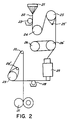
- Figure 2 is a schematic of a process in which a texturing step has been inserted into the process of Figure 1 after drawing/heating.
- polyamide filament 2 spun from spinneret 1 is cooled and solidified, treated with an antimicrobial agent containing spinning lubricant by oiling roll 3, passed over godet rolls 4 and 5 (5 ⁇ is a separate roll) and then wound between heating roll 6 and separate roll 6 ⁇ in order to conduct drawing and heating simultaneously.
- Surfactant-containing treatment solution is then adhered to stretched yarn 7 by oiling roll 8 and this is then would up at winder 9.
- the surfactant may be adhered to the spun yarn together with the antimicrobial agent (in such a case, added to the spinning lubricant) or, alternatively, the surfactant may be adhered as an afteroil. It is generally preferred that the antimicrobial agent and the surfactant be applied to the spun yarn before the godet roll 4 using the same or different baths. The process discussed below with reference to Figure 2 remains the same as the instant process.
- Figure 2 gives on embodiment of the direct application of the process shown in Figure 1 to spinning-drawing-texturing (SDTY). That is, in the apparatus of Figure 2, filament 22 spun from spinneret 21 is passed over oiling roll 23, godet roll 24 and feed rolls 25 and 25 ⁇ , passed several times around hot rolls 26 and 26 ⁇ (which rotate at a constant peripheral speed several times faster than the peripheral speed of rolls 25 and 25 ⁇ ), stretched between rolls 25 and 25 ⁇ and rolls 26 and 26 ⁇ , introduced into and crimped in hot fluid-treatment nozzle 27, coated with surfactant by oiling roll 28, drafted by rolls 29 and 29 ⁇ , passed over guide 30 and then wound up at winder 31.
- IPTY spinning-drawing-texturing
- the distinguishing features are that the antimicrobial agent is applied to a spun yarn whose molecular structure has not been completely stabilized and it is then heat-fixed on the filament surface in the following heating process, while the surfactant is overcoated under these conditions, and that these agents are all applied during the filament spinning process, so that a favorable yarn package is produced by a so-called built-in process.
- Figure 1 shows a coupled spinning-drawing process, but, in its place, a method may be used in high-speed spinning ( ⁇ 3,000 m/min.) in which the antimicrobial agent is heat-fixed by means of a stretch of several tenths of percent between heated godet rolls and the surfactant is applied before wind up.
- an interlacing nozzle may be installed between oiling roll 3 (23) and first godet roll 4 (24) in order to impart a slight interlace to the yarn and so improve the uniformity of adhesion of the antimicrobial agent and improve the workability in drawing (prevention of napping and lapping).
- the usual degree of interlacing (5 to 40 per meter) may be imparted to the yarn after drawing or texturing and before the winder in order to secure handling of the yarn after this.
- the interlacing process and the interlace number are discussed in detail in the specifications of US-A-2,985,995 and US-A-3,110,151.
- a hot-fluid finishing method with its high speed capacity, is advantageously used as the texturing method because it may be assembled into a high-speed process such as coupled spinning-drawing.
- Examples of such methods which may be used include methods in which the yarn is plastified with a hot fluid in a nozzle and crimped by stuffing in a pad or wad (the specifications of US-A-4,188,691 and US-A-4,268,940); methods in which the yarn is plastified with a hot fluid in a nozzle and is taken up as a loop yarn, cooled and then drafted and opened (the specifications of US-A-3,186,155 and US-A-3,543,353); and methods in which the yarn is plastified with a hot fluid in a nozzle, impinged and buckled against an air-permeable collision surface, cooled under these conditions and then taken up (the specification of US-A-3,255,508 and the specification of GB-A-1,273,797).
- the polyamide flat yarn of Figure 1 which has been wound up as a high-speed spun yarn, may later be finished in a crimping process (typified by the false-twisting process) or by a texturing process such as compounding with a polyurethane.
- the antimicrobial agent used by the present invention is an organosilicon quaternary ammonium salt with the following general formula (where R1 is a C8 ⁇ 22 long-chain alkyl group; R2, R3 and R4 are all alkyl groups and X is C1, Br, I or CH3COO).
- Such compounds can be produced by heating and reacting gamma-halopropyltrialkoxysilane with a tertiary amine such as alkyldimethylamine, aryldimethylamine, alkenyldimethylamine or aralkyldimethylamine, for example, lauryl(C12)dimethylamine, myristyl(C14)dimethylamine and cetyl(C16)dimethylamine.
- dimethyloctadecyl(3-trimethoxysilyl)propylammonium chloride is commercially available from the Dow Corning Corporation (brand name, DOW CORNING®5700 antimicrobial treatment agent), Shin-etsu Chemical Co., Ltd. and Petrarch System Inc. of the United States. It is generally supplied as a methanol solution containing approximately 50% effective component.
- the quantity of uptake of said antimicrobial agent is 0.05 to 1.0% and preferably 0.1 to 0.8% based on the fiber weight.
- the desired antimicrobial effect cannot be generated when this quantity is less than 0.05%.
- exceeding 1.0% is uneconomical from a cost standpoint.
- the quantity of antimicrobial agent in the spinning lubricant is generally 5 to 80 wt% in an advantageous practical embodiment of the process.
- the method of application of spinning lubricant or antimicrobial agent is not limited to oiling roll methods and any method commonly used in the art may be used, for example, metered oiling and spray methods.
- the surfactant to be employed by the present invention is exemplified as follows.
- a C5 ⁇ 18 alkyl group may be substituted on one or both of the phenol groups in the above compound.
- the above compound may be used as the mixture of the monoalkylsubstituted and dialkyl-substituted products.
- surfactants may be adhered to the filament simultaneous with application of the antimicrobial agent or, alternatively, they may be overcoated before wind up on the filament on which the antimicrobial agent has been heat-fixed.
- the specification for the uptake of surfactant at this time is the same as for the antimicrobial agent.
- the method for applying the surfactant may be the same as for the above-mentioned oiling or application of the antimicrobial agent.
- the surfactant is added at 5-80 wt% to the spinning lubricant or afteroil and is then applied to the yarn or, alternatively, it is dissolved by itself in a solvent such as water or alcohol and the resulting treatment solution with a concentration of 5-80% is applied to the yarn.
- the stability of the spinning lubricant emulsion will sometimes change. Due to this, the emulsion stability of the surfactant containing spinning lubricant system must be re-adjusted.
- the surfactant be applied as an afteroiling agent separately from the spinning lubricant containing the organosilicon quaternary ammonium salt.
- the organosilicon quaternary ammonium salt is preferably applied to the undrawn yarn before heat treatment.
- level dyeing is improved, while the antimicrobial effect is further improved via a synergistic effect with the sulfonate salt surfactant.
- a nitrogen-containing alkylene oxide adduct will exhibit a cationicity which, however, is relaxed by the presence of the alkylene oxide groups. As the hydrogen ion concentration is increased in the acid region, the nitrogen atoms are quarternized in part and the adduct exhibits cationicity.
- the polyamide specified by the present invention generally refers to nylon-6 and nylon-66; however, obviously both homopolymers, and copolymers which contain ⁇ 10 mol% other copolymerizable components, are included.
- the preceding homopolymers and copolymers may contain fiber-function improvers (for example, an antistatic spinning agent).
- Polyamide yarn is invariably dyed with acid dyes or metallized dyes; however, as is generally known, an anionic compound is added to the dye bath as a dye moderator or retarding agent. Due to this, the anions and the organosilicon quaternary ammonium salt cations are presumably attracted to each other by ionic interaction and the quaternary ammonium salt cation, which exhibits the antimicrobial effect, is masked and the microbiocidal activity is lost.
- organosilicon quaternary ammonium salt cannot exhibit any special microbiocidal activity due to the presence of ions of the dye or dye auxiliaries. Accordingly, this cannot be thought of as a built-in type antimicrobial fiber in the true sense.
- agent protects the microbiocidal effect from anionic dye-leveling agents (for example, Migregal 2N R from Nippon Senka Kogyo Co., Ltd.) is not completely understood; however, it may be conjectured that said agent preferentially coordinates with the cation group of the quaternary ammonium salt and its coordination for some reason does not inhibit the microbiocidal property.
- anionic dye-leveling agents for example, Migregal 2N R from Nippon Senka Kogyo Co., Ltd.
- the antimicrobial agent must be applied before stretching and heating for the following reason.
- the organosilicon quaternary ammonium salt is applied after stretching and heating, the fiber will not be heat-fixed and will not be durable, with the result that the agent is subject to removal by a vigorous wash such as scouring, etc. Accordingly, antimicrobial effect is reduced.
- the built-in yarn of the present invention has a durable antimicrobial capacity which is unaffected by dyeing and this yarn also has good level-dyeing properties. Due to this, dyeing of the yarn does not engender any particular risks and, the yarn may be dyed using standard dyeing conditions without any modification, without a reduction in antimicrobial properties. In other words, the yarn produced by the built-in regime absolutely will not require any antimicrobial treatment in a downstream finishing process subsequent to fiber production and before carpet production.
- the process of manufacturing antimicrobial products is significantly rationalized. Due to this, the present invention provides, with greater economic efficiency, an excellent antimicrobial product which can be used for clothing articles such as socks, stockings and underwear, et., or for carpet, or for mats serving as covering for building floors.
- the sterilization ratio is determined by the shake flask method, which is an improved version of the AATCC Test Method 100 bioassay method.
- This method is a quantitative method for the evaluation of antimicrobial activity.
- AATCC broth culture medium containing a specified number of microorganisms (1 -2 x 10⁵ colony-forming units/mL) is infiltrated into untreated cloth and treated cloth, both of which have been sterilized in an autoclave. This is followed by cultivation at 37°C for 18 hours. The number of viable microorganisms is measured by the plate dilution method, both before and after cultivation, on the solution obtained by extraction with phosphate buffer with vigorous shaking for one minute. The number of microorganisms on the textile is reported as the percentage decline relative to the viable count immediately after inoculation.
- This method is a quantitative method for the evaluation of antimicrobial activity.
- the sample is placed in diluted phosphate buffer which has been inoculated with the test bacterial solution (1.5 - 3.0 x 10⁵ colony-forming units/mL) and this is then shaken at room temperature or 25-30°C for a specified period of time (1 hour) in order to bring the sample forcibly into contact with the bacterial solution.
- the viable count is measured by the plate dilution method before (A) and after (B) contact by the treated fabric with the test organism. The percentage decline relative to the viable count before contact is reported.
- Sterilization ratio (%) [(A-B)/A] x 100
- polycaproamide (nylon-6) polymer is melt-spun from a spinneret with 24 holes 0.4 mm in diameter. It is cooled and solidified, treated with a spinning lubricant which contains antimicrobial agent A using oiling roll 3, and then taken up with godet roll 4 rotating at a peripheral speed of 1,000 m/min.
- the yarn, now treated with lubricant is drawn 3X and heated between feed roll 5, which is rotating at a peripheral speed of 1,050 m/min. and is heated to 50°C, and drawing roll 6 which is rotating at a peripheral speed of 3,150 m/min. and is heated to 180°C. It is then applied with the following surfactant treatment solution B using oiling roll 8.
- the resulting built-in antimicrobial yarn is wound up on winder 9.
- the following materials are used:
- a tubular knit of the stretched yarn is immersed in dye bath C and dyed at 98°C for 30 minutes.
- the antimicrobial capacity of the dyed fabric is then measured.
- the Dye Bath Conditions were:
- a polycaproamide (nylon-6) polymer is melt-spun in a trilobar cross section from a spinneret having 68 holes (slit width, 0.2 mm; slit length, 1.3 mm) and then cooled and solidified. It is then treated with the same lubricant containing antimicrobial agent A as in Example 1 using oiling roll 23, and then taken up by godet roll 24 which is rotating at a peripheral speed of 800 m/min. The yarn, now treated with lubricant, is drawn 3.2X and heated between feed roll 25, which is rotating at a peripheral speed of 820 m/min and is heated to 50°C, and drawing roll 26, which is rotating at a peripheral speed of 2,600 cm/min.
- Surfactant Solution B-1 Na sulfonate salts (mixture) of diphenyl oxide
- the BCF (bulky continuous filament) produced as above is made into carpet which is then immersed in the following dye bath C and then steamed at 98°C for 5 minutes in order to fix the dye.
- the antimicrobial capacity (sterilization ratio) of the dyed carpet is measured and the results are reported in Table 2.
- Table 3 demonstrates the relationship between the quantity of uptake of antimicrobial agent and surfactant and the sterilization ratio.
- Table 4 shows the difference in effects obtained for the addition of antimicrobial agent and surfactant, respectively, before and after drawing/heating.
- Figures 1 and 2 are both schematics of processes by which the antimicrobial polyamide yarn of the present invention is produced by a built-in regime.
Landscapes
- Engineering & Computer Science (AREA)
- Textile Engineering (AREA)
- Chemical & Material Sciences (AREA)
- Life Sciences & Earth Sciences (AREA)
- Inorganic Chemistry (AREA)
- Organic Chemistry (AREA)
- Mechanical Engineering (AREA)
- Biochemistry (AREA)
- Chemical Kinetics & Catalysis (AREA)
- General Chemical & Material Sciences (AREA)
- Microbiology (AREA)
- Treatments For Attaching Organic Compounds To Fibrous Goods (AREA)
- Chemical Treatment Of Fibers During Manufacturing Processes (AREA)
- Chemical Or Physical Treatment Of Fibers (AREA)
Claims (25)
- Polyamidgarn mit einer eingebauten antimikrobischen Kapazität,
dadurch gekennzeichnet,
daß ein antimikrobisches Mittel, enthaltend ein organosiliziumquaternäres Ammoniumsalz und ein oberflächenaktives Mittel, enthaltend ein Alkyl-, Aryl-, Alkenyl- oder Aralkylsulfonatsalz, gegebenenfalls in Gegenwart eines gleichmäßige Färbung fördernden Mittels, auf der Faseroberfläche haften. - Polyamidgarn mit einer eingebauten antimikrobischen Kapazität nach Anspruch 1,
dadurch gekennzeichnet,
daß das organosiliziumquaternäre Ammoniumsalz auf der Faseroberfläche durch Wärme fixiert ist und das Alkyl-, Aryl-, Alkenyl- oder Aralkylsulfonatsalz enthaltende oberflächenaktive Mittel dann darüber aufgebracht wird, gegebenenfalls in Gegenwart eines gleichmäßige Färbung fördernden Mittels. - Polyamidgarn mit einer eingebauten antimikrobischen Kapazität nach Anspruch 1 oder 2,
dadurch gekennzeichnet,
daß das organosiliziumquaternäre Ammoniumsalz die allgemeine Formel aufweist
- Polyamidgarn mit einer eingebauten antimikrobischen Kapazität nach Anspruch 3,
dadurch gekennzeichnet,
daß das organosiliziumquaternäre Ammoniumsalz 3-(Trimethoxysilyl)propyldimethyloctadecylammoniumchlorid der folgenden Formel ist
- Polyamidgarn mit einer eingebauten antimikrobischen Kapazität nach jedem der Ansprüche 1-4,
dadurch gekennzeichnet,
daß die Aufnahme des organosiliziumquaternären Ammoniumsalzes von 0,1-1,0%, bezogen auf Fasergewicht, beträgt. - Polyamidgarn mit einer eingebauten antimikrobischen Kapazität nach jedem der Ansprüche 1-5,
dadurch gekennzeichnet,
daß das verwendete oberflächenaktive Mittel Sulfonatdiphenyloxid ist mit der folgenden Formel
- Polyamidgarn mit einer eingebauten antimikrobischen Kapazität nach jedem der Ansprüche 1-6,
dadurch gekennzeichnet,
daß die Aufnahme des oberflächenaktiven Mittels 0,1-1,0%, bezogen auf Fasergewicht, beträgt. - Polyamidgarn mit einer eingebauten antimikrobischen Kapazität nach jedem der Ansprüche 1-7,
dadurch gekennzeichnet,
daß das gleichmäßige Färbung fördernde Mittel ein nicht ionisches oberflächenaktives Mittel ist, das leicht kationisch in saurem Bereich ist. - Polyamidgarn mit einer eingebauten antimikrobischen Kapazität nach Anspruch 8,
dadurch gekennzeichnet,
daß das gleichmäßige Färbung fördernde Mittel ein POE(polyoxyethylen)laurylaminoether ist. - Polyamidgarn mit einer eingebauten antimikrobischen Kapazität nach Anspruch 8,
dadurch gekennzeichnet,
daß das gleichmäßige Färbung fördernde Mittel das Ethylenoxid + Propylenoxidaddukt von Ölsäurediethanolamid ist. - Verfahren zum Herstellen eines Polyamidgarnes mit einer eingebauten antimikrobischen Kapazität,
dadurch gekennzeichnet,
daß auf das gesponnene Polyamidgarn in allen Stufen der Verfahren des Ziehens/Wärmebehandelns, Texturierens und Aufwickelns beides haftend aufgebracht wird, ein antimikrobisches Mittel, enthaltend ein organosiliziumquaternäres Ammoniumsalz, und ein oberflächenaktives Mittel, enthaltend ein Alkyl-, Aryl-, Alkenyl- oder Aralkylsulfonatsalz, gegebenenfalls in Gegenwart eines gleichmäßige Färbung fördernden Mittels, und das Garn dann aufgewikkelt wird. - Verfahren zum Herstellen eines Polyamidgarnes mit einer eingebauten antimikrobischen Kapazität nach Anspruch 11,
dadurch gekennzeichnet,
daß das gesponnene Polyamidgarn, während es mit dem ein organosiliziumquaternäres Ammoniumsalz enthaltenden antimikorobischen Mittel behaftet wird, gezogen/erwärmt wird und dann texturiert wird und behandelt wird mit oberflächenaktivem Mittel, enthaltend Alkyl-, Aryl-, Alkenyl- oder Aralkylsulfonatsalz, gegebenenfalls in Gegenwart eines gleichmäßige Färbung fördernden Mittels, während aller Stufen, vom Aufbringen des Ammoniumsalzes bis zum Aufwickeln. - Verfahren zum Herstellen von Polyamidgarn mit einer eingebauten antimikrobischen Kapazität nach Ansprüchen 11 oder 12,
dadurch gekennzeichnet,
daß das Spinnen bis Aufwickeln Spinnen/Ziehen/Texturieren/Aufwickeln in direktem Zusammenhang umfaßt. - Verfahren zum Herstellen von Polyamidgarn mit einer eingebauten antimikrobischen Kapazität nach jedem der Ansprüche 11-13,
dadurch gekennzeichnet,
daß das Texturieren ein Verfahren mit heißem fluiden Medium umfaßt. - Verfahren zum Herstellen von Polyamidgarn mit einer eingebauten antimikrobischen Kapazität nach jedem der Ansprüche 11-13,
dadurch gekennzeichnet,
daß das Texturieren ein Stauchkräuselverfahren mit heißem fluiden Medium umfaßt. - Verfahren zum Herstellen von Polyamidgarn mit einer eingebauten antimikrobischen Kapazität nach jedem der Ansprüche 11-13,
dadurch gekennzeichnet,
daß das Texturieren durch Prall-Kräuseln erfolgt mittels Knicken des in heißem fluiden Medium enthaltenen Garnes an einer luftdurchlässigen Membrane. - Verfahren zum Herstellen von Polyamidgarn mit einer eingebauten antimikrobischen Kapazität nach jedem der Ansprüche 11-13,
dadurch gekennzeichnet,
daß das Texturieren mittels Blastexturieren durch Kühlen und Ziehen des Garnes in Schlaufen durch Beaufschlagen mit einem das Garn heizenden fluiden Medium umfaßt. - Verfahren zum Herstellen von Polyamidgarn mit einer eingebauten antimikrobischen Kapazität nach jedem der Ansprüche 11-17,
dadurch gekennzeichnet,
daß das organosiliziumquaternäre Ammoniumsalz die folgende allgemeine Formel aufweist
- Verfahren zum Herstellen von Polyamidgarn mit einer eingebauten antimikrobischen Kapazität nach jedem der Ansprüche 1-18,
dadurch gekennzeichnet,
daß das organosiliziumquaternäre Ammoniumsalz 3-(Trimethoxysilyl)propyldimethyloctadecylammoniumchlorid der nachfolgenden Formel ist
- Verfahren zum Herstellen von Polyamidgarn mit einer eingebauten antimikrobischen Kapazität nach jedem der Ansprüche 1-19,
dadurch gekennzeichnet,
daß die Aufnahme des organosiliziumquaternären Ammoniumsalzes von 0,1-1,0%, bezogen auf Fasergewicht, beträgt. - Verfahren zum Herstellen von Polyamidgarn mit einer eingebauten antimikrobischen Kapazität nach jedem der Ansprüche 11-20,
dadurch gekennzeichnet,
daß das oberflächenaktive Mittel eine Sulfonatverbindung von Diphenyloxid mit der nachfolgenden Formel ist
- Verfahren zum Herstellen von Polyamidgarn mit einer eingebauten antimikrobischen Kapazität nach jedem der Ansprüche 11-21,
dadurch gekennzeichnet,
daß die Aufnahme des oberflächenaktiven Mittels 0,1-1,0%, bezogen auf Fasergewicht, beträgt. - Verfahren nach jedem der Ansprüche 11-22,
dadurch gekennzeichnet,
daß das gleichmäßige Färbung fördernde Mittel ein nicht ionogenes oberflächenaktives Mittel ist, das leicht kationisch in saurem Bereich ist. - Verfahren nach jedem der Ansprüche 11-23,
dadurch gekennzeichnet,
daß das gleichmäßige Färbung fördernde Mittel ein POE(polyoxyethylen)laurylaminoether ist. - Verfahren nach Anspruch 23,
dadurch gekennzeichnet,
daß das gleichmäßige Färbung fördernde Mittel das Ethylenoxid + Propylenoxidaddukt von Ölsäurediethanolamid ist.
Priority Applications (1)
| Application Number | Priority Date | Filing Date | Title |
|---|---|---|---|
| DE8787303242T DE3776138D1 (de) | 1986-02-04 | 1987-04-14 | Polyamidgarn, versehen mit antibacteriellen eigenschaften und verfahren zu seiner herstellung. |
Applications Claiming Priority (1)
| Application Number | Priority Date | Filing Date | Title |
|---|---|---|---|
| JP61021222A JPS62184126A (ja) | 1986-02-04 | 1986-02-04 | ビルト・インで抗菌性を付与されたポリアミドヤ−ン及びその製造法 |
Publications (2)
| Publication Number | Publication Date |
|---|---|
| EP0286741A1 EP0286741A1 (de) | 1988-10-19 |
| EP0286741B1 true EP0286741B1 (de) | 1992-01-15 |
Family
ID=12048989
Family Applications (1)
| Application Number | Title | Priority Date | Filing Date |
|---|---|---|---|
| EP87303242A Expired - Lifetime EP0286741B1 (de) | 1986-02-04 | 1987-04-14 | Polyamidgarn, versehen mit antibacteriellen Eigenschaften und Verfahren zu seiner Herstellung |
Country Status (4)
| Country | Link |
|---|---|
| US (2) | US5135811A (de) |
| EP (1) | EP0286741B1 (de) |
| JP (1) | JPS62184126A (de) |
| DE (1) | DE3776138D1 (de) |
Families Citing this family (53)
| Publication number | Priority date | Publication date | Assignee | Title |
|---|---|---|---|---|
| US4898957A (en) * | 1988-04-18 | 1990-02-06 | Dow Corning Corporation | Organosilicon diamine antimicrobial compound |
| US5073298A (en) * | 1988-07-20 | 1991-12-17 | Dow Corning Corporation | Antimicrobial antifoam compositions and methods |
| JP2819417B2 (ja) * | 1989-04-17 | 1998-10-30 | 東レ・ダウコーニング・シリコーン株式会社 | 抗菌性シリコーンゴム粒状物の製造方法 |
| US5145596A (en) * | 1989-08-07 | 1992-09-08 | Dow Corning Corporation | Antimicrobial rinse cycle additive |
| US5064613A (en) * | 1989-11-03 | 1991-11-12 | Dow Corning Corporation | Solid antimicrobial |
| US5013459A (en) * | 1989-11-09 | 1991-05-07 | Dow Corning Corporation | Opthalmic fluid dispensing method |
| US5234720A (en) * | 1990-01-18 | 1993-08-10 | Eastman Kodak Company | Process of preparing lubricant-impregnated fibers |
| DE4130355C1 (de) * | 1991-09-12 | 1992-09-10 | Schroff Gmbh, 7541 Straubenhardt, De | |
| US5300167A (en) * | 1992-01-03 | 1994-04-05 | Kimberly-Clark | Method of preparing a nonwoven web having delayed antimicrobial activity |
| JP3201023B2 (ja) * | 1992-11-17 | 2001-08-20 | 東亞合成株式会社 | 抗菌性合成繊維の製造方法 |
| DE4335717A1 (de) * | 1993-10-20 | 1995-04-27 | Degussa | Verfahren zum Färben von aromatischen Polyamiden |
| US5565265A (en) * | 1994-03-21 | 1996-10-15 | Craig A. Rubin | Treated polyester fabric |
| DE4410708C1 (de) * | 1994-03-28 | 1995-07-13 | Hoechst Ag | Präparationshaltige Aramidfasern und deren Verwendung |
| US6207250B1 (en) | 1995-03-21 | 2001-03-27 | Hi-Tex, Inc. | Treated textile fabric |
| US6492001B1 (en) | 1996-08-07 | 2002-12-10 | Hi-Tex, Inc. | Treated textile fabric |
| US6632805B1 (en) | 1996-05-07 | 2003-10-14 | Emory University | Methods for using water-stabilized organosilanes |
| US5959014A (en) | 1996-05-07 | 1999-09-28 | Emory University | Water-stabilized organosilane compounds and methods for using the same |
| US6251210B1 (en) | 1996-08-07 | 2001-06-26 | Hi-Tex, Inc. | Treated textile fabric |
| US5871816A (en) * | 1996-08-09 | 1999-02-16 | Mtc Ltd. | Metallized textile |
| FR2754279B1 (fr) * | 1996-10-09 | 1998-12-04 | Jean Michel Alavoine | Procede de teinture a la continue de fils et files de fibres |
| US5954869A (en) | 1997-05-07 | 1999-09-21 | Bioshield Technologies, Inc. | Water-stabilized organosilane compounds and methods for using the same |
| US6762172B1 (en) | 1997-07-17 | 2004-07-13 | Nova Biogenetics, Inc. | Water-stabilized organosilane compounds and methods for using the same |
| US6113815A (en) * | 1997-07-18 | 2000-09-05 | Bioshield Technologies, Inc. | Ether-stabilized organosilane compositions and methods for using the same |
| US6260344B1 (en) * | 1998-01-08 | 2001-07-17 | Whizard Protective Wear Corp. | Cut resistant antimicrobial yarn and apparel |
| AU2030599A (en) * | 1998-01-09 | 1999-07-26 | Whizard Protective Wear Corp. | Cut resistant yarn and apparel |
| US6351932B1 (en) * | 1999-07-02 | 2002-03-05 | Wells Lamont Industry Group | Cut-resistant antimicrobial yarn and article of wearing apparel made therefrom |
| BR0016354B1 (pt) | 1999-12-28 | 2012-09-18 | método de formação de um pano de limpeza antimicrobiano e pano de limpeza. | |
| DE60034368T2 (de) | 1999-12-28 | 2008-01-03 | Kimberly-Clark Worldwide, Inc., Neenah | Verwendungs-abhängiges indikatorsystem für absorbierende artikel |
| US6734157B2 (en) | 1999-12-28 | 2004-05-11 | Kimberly-Clark Worldwide, Inc. | Controlled release anti-microbial hard surface wiper |
| IL135487A (en) | 2000-04-05 | 2005-07-25 | Cupron Corp | Antimicrobial and antiviral polymeric materials and a process for preparing the same |
| DE10141599B4 (de) * | 2000-08-31 | 2004-08-05 | Arteva Technologies S.A.R.L. | Permanente, antimikrobielle Beschichtung für Kunststoffasern und entsprechendes Beschichtungsverfahren |
| US20050043506A1 (en) * | 2000-09-27 | 2005-02-24 | Michigan Biotechnology Institute | Polyamide materials based on unsaturated carboxylic acids and amines |
| JP3936143B2 (ja) * | 2001-02-06 | 2007-06-27 | 憲司 中村 | 抗菌防臭性の化粧用ブラシとその製造方法 |
| US6939554B2 (en) * | 2002-02-05 | 2005-09-06 | Michigan Biotechnology Institute | Antimicrobial polymer |
| US20040009210A1 (en) * | 2002-07-09 | 2004-01-15 | Kimberly-Clark Worldwide, Inc. | Wound management products incorporating cationic compounds |
| US20040009141A1 (en) * | 2002-07-09 | 2004-01-15 | Kimberly-Clark Worldwide, Inc. | Skin cleansing products incorporating cationic compounds |
| US6994890B2 (en) * | 2003-10-31 | 2006-02-07 | Resource Development L.L.C. | Cleaning and multifunctional coating composition containing an organosilane quaternary compound and hydrogen peroxide |
| US8257780B2 (en) | 2003-10-31 | 2012-09-04 | Resource Development L.L.C. | Therapeutic composition containing an organosilane quaternary compound and hydrogen peroxide for treating skin disorders and methods of using |
| CN1960948A (zh) * | 2004-03-24 | 2007-05-09 | 3M创新有限公司 | 抗微生物过滤介质及其制造和使用方法 |
| US7754004B2 (en) * | 2005-07-06 | 2010-07-13 | Resource Development, L.L.C. | Thickened surfactant-free cleansing and multifunctional liquid coating compositions containing nonreactive abrasive solid particles and an organosilane quaternary compound and methods of using |
| US7531219B2 (en) * | 2005-07-21 | 2009-05-12 | Hi-Tex, Inc. | Treated textile fabric |
| CN1314320C (zh) * | 2005-11-30 | 2007-05-09 | 山东大学 | 一种有机硅季铵盐杀菌剂的制备方法 |
| US8778386B2 (en) * | 2005-12-13 | 2014-07-15 | Kimberly-Clark Worldwide, Inc. | Anti-microbial substrates with peroxide treatment |
| US20070134302A1 (en) * | 2005-12-13 | 2007-06-14 | Koenig David W | Antimicrobial substrates with peroxide treatment |
| US7589054B2 (en) * | 2007-01-02 | 2009-09-15 | Resource Development L.L.C. | Clathrates of an organosilane quaternary ammonium compound and urea and methods of use |
| TW201113409A (en) * | 2009-10-06 | 2011-04-16 | Ruentex Ind Ltd | A yarn manufacturing method and a mixing yarn |
| US20110233810A1 (en) * | 2010-03-25 | 2011-09-29 | W. M. Barr & Company | Antimicrobial plastic compositions and methods for preparing same |
| US8735618B2 (en) | 2010-05-07 | 2014-05-27 | Resource Development L.L.C. | Solvent-free organosilane quaternary ammonium compositions, method of making and use |
| JP5808315B2 (ja) * | 2012-12-29 | 2015-11-10 | ユニ・チャーム株式会社 | 清掃部材を製造する方法及び装置 |
| US20160374518A1 (en) | 2015-06-29 | 2016-12-29 | Maytex Mills, Inc. | Laminated shower curtains |
| CN107334653A (zh) * | 2017-07-12 | 2017-11-10 | 南雄鼎成新材料科技有限公司 | 一种含有机硅季铵盐的抗菌去屑止痒调理洗发水 |
| CN110627828B (zh) * | 2019-09-29 | 2020-06-16 | 清远市宏图助剂有限公司 | 用于改善抗菌性能的有机硅季铵盐及其制备方法和应用 |
| CN115209738A (zh) | 2020-03-04 | 2022-10-18 | 奥升德功能材料运营有限公司 | 抗病毒制品 |
Family Cites Families (30)
| Publication number | Priority date | Publication date | Assignee | Title |
|---|---|---|---|---|
| US3186155A (en) * | 1957-11-22 | 1965-06-01 | Du Pont | Textile product of synthetic organic filaments having randomly varying twist along each filament |
| US3255508A (en) * | 1959-06-02 | 1966-06-14 | Du Pont | Apparatus for crimping textile yarn |
| US2985995A (en) * | 1960-11-08 | 1961-05-30 | Du Pont | Compact interlaced yarn |
| US3110151A (en) * | 1961-05-26 | 1963-11-12 | Du Pont | Process for producing compact interlaced yarn |
| US3543353A (en) * | 1966-08-16 | 1970-12-01 | Illinois Tool Works | Wire tie |
| NL6912008A (de) * | 1968-08-06 | 1970-02-10 | ||
| JPS4843564B1 (de) * | 1970-12-17 | 1973-12-19 | ||
| CA1010782A (en) * | 1973-02-20 | 1977-05-24 | Charles A. Roth | Articles exhibiting antimicrobial properties |
| DE2343418C2 (de) * | 1973-08-29 | 1975-09-18 | Basf Ag, 6700 Ludwigshafen | Egalisiermittel für Säurefarbstoffe |
| US4766113A (en) * | 1975-10-24 | 1988-08-23 | Chapman Chemical Company | Antimicrobial compositions and methods of using same |
| US4106901A (en) * | 1976-08-31 | 1978-08-15 | Star Chemical, Inc. | Emulsifier-solvent scour composition and method of treating textiles therewith |
| JPS5345420A (en) * | 1976-10-05 | 1978-04-24 | Teijin Ltd | Crimping of filament yarns and its apparatus |
| CH638362GA3 (de) * | 1977-06-10 | 1983-09-30 | ||
| JPS54151653A (en) * | 1978-05-16 | 1979-11-29 | Teijin Ltd | Crimping method and apparatus of yarn |
| US4377608A (en) * | 1979-09-24 | 1983-03-22 | Dow Corning Corporation | Method of modifying a substrate |
| US4500339A (en) * | 1980-09-03 | 1985-02-19 | Young Robert W | Adherent controlled release microbiocides containing hydrolyzable silanes |
| JPS5751874A (en) * | 1980-09-08 | 1982-03-26 | Mitsubishi Burlington | Anti-bacterial carpet and method |
| JPS57193573A (en) * | 1981-05-22 | 1982-11-27 | Mitsubishi Burlington | Anti-bacterial carpet and method |
| US4394378A (en) * | 1981-07-08 | 1983-07-19 | Klein Stewart E | 3-(Trimethoxysilyl) propyldidecylmethyl ammonium salts and method of inhibiting growth of microorganisms therewith |
| JPS5911711A (ja) * | 1982-07-12 | 1984-01-21 | 昭和電線電纜株式会社 | ガス充填装置 |
| US4699627A (en) * | 1983-03-09 | 1987-10-13 | Akzona Incorporated | Indigo-dyeable polyester fibers and pretreatment of polyester to produce same |
| JPS59179817A (ja) * | 1983-03-26 | 1984-10-12 | Unitika Ltd | 抗菌性繊維の製造法 |
| US4504541A (en) * | 1984-01-25 | 1985-03-12 | Toyo Boseki Kabushiki Kaisha | Antimicrobial fabrics having improved susceptibility to discoloration and process for production thereof |
| JPS60181364A (ja) * | 1984-02-21 | 1985-09-17 | 日本エクスラン工業株式会社 | 繊維製品の抗菌加工方法 |
| JPS60185866A (ja) * | 1984-02-29 | 1985-09-21 | 日本エクスラン工業株式会社 | 抗菌性繊維製品の製造法 |
| US4672005A (en) * | 1984-03-01 | 1987-06-09 | Intera Corporation | Process for improving polymer substrate properties, and modified polymers produced thereby |
| JPS60259680A (ja) * | 1984-06-06 | 1985-12-21 | 信越化学工業株式会社 | 繊維処理剤 |
| US4685932A (en) * | 1984-10-03 | 1987-08-11 | Morton Thiokol, Inc. | Method for controlling isothiazolone antimicrobial content of fibers |
| JPS61148285A (ja) * | 1984-12-21 | 1986-07-05 | Toray Silicone Co Ltd | 固体材料処理剤組成物 |
| US4615937A (en) * | 1985-09-05 | 1986-10-07 | The James River Corporation | Antimicrobially active, non-woven web used in a wet wiper |
-
1986
- 1986-02-04 JP JP61021222A patent/JPS62184126A/ja active Pending
-
1987
- 1987-02-04 US US07/010,890 patent/US5135811A/en not_active Expired - Fee Related
- 1987-04-14 EP EP87303242A patent/EP0286741B1/de not_active Expired - Lifetime
- 1987-04-14 DE DE8787303242T patent/DE3776138D1/de not_active Expired - Lifetime
-
1988
- 1988-04-20 US US07/184,464 patent/US4835019A/en not_active Expired - Lifetime
Also Published As
| Publication number | Publication date |
|---|---|
| US4835019A (en) | 1989-05-30 |
| US5135811A (en) | 1992-08-04 |
| EP0286741A1 (de) | 1988-10-19 |
| DE3776138D1 (de) | 1992-02-27 |
| JPS62184126A (ja) | 1987-08-12 |
Similar Documents
| Publication | Publication Date | Title |
|---|---|---|
| EP0286741B1 (de) | Polyamidgarn, versehen mit antibacteriellen Eigenschaften und Verfahren zu seiner Herstellung | |
| EP1269848B1 (de) | Antibakterielle wirkstoff für fasern und antibakterielles textilgut | |
| CN115404581B (zh) | 一种超高分子量聚乙烯羊绒混纺纱半精纺生产工艺 | |
| US2998296A (en) | Alkaline treatment of polyethylene terephthalate filaments or staple fibers to improve processing in textile machines and filaments produced thereby | |
| EP0235989B1 (de) | Verfahren zum Herstellen von faulabweisenden Polyamidfasern | |
| EP0110067B1 (de) | Schmutzabweisende Appretur für synthetisches organisches Polymergarn | |
| EP1045065B1 (de) | Cellulosefasern enthaltendes Flächengebilde | |
| JPH11189975A (ja) | 繊維材料を抗菌剤で処理するための方法 | |
| US6730130B2 (en) | Agents for treating synthetic fibers | |
| US4294576A (en) | Removal of oligomer deposits from textile materials | |
| JP2000034675A (ja) | 抗菌性ポリエステル繊維 | |
| JPS6350575A (ja) | ビルト・インで抗菌性を付与されたポリアミドヤ−ンの処理方法 | |
| JPH03241071A (ja) | 抗菌性を有する防汚布帛およびその製造方法 | |
| JPH11189978A (ja) | ポリエステル繊維構造物およびその製造方法 | |
| US4670336A (en) | Laundry-stable, antimicrobially-active fibers and filaments and the production thereof | |
| JP4038034B2 (ja) | カチオン性抗菌加工用併用剤及び抗菌加工方法 | |
| JPH04241171A (ja) | 抗菌防臭性繊維の製造方法 | |
| JPH05106165A (ja) | 繊維の抗菌処理方法 | |
| JPS62250277A (ja) | 繊維の抗菌処理方法 | |
| US3411945A (en) | Process for providing a durable antistatic finish for synthetic textile materials | |
| JP2008514827A (ja) | 銀含有抗菌性布地 | |
| CN116676780B (zh) | 一种耐磨抗菌的超柔纱及其制备方法 | |
| JPH08311766A (ja) | ポリエステル系繊維構造物およびその製造方法 | |
| JPH0782663A (ja) | 抗菌性繊維の製造方法 | |
| JP3420975B2 (ja) | 繊維材料用黄変防止加工剤及び加工方法 |
Legal Events
| Date | Code | Title | Description |
|---|---|---|---|
| PUAI | Public reference made under article 153(3) epc to a published international application that has entered the european phase |
Free format text: ORIGINAL CODE: 0009012 |
|
| AK | Designated contracting states |
Kind code of ref document: A1 Designated state(s): DE FR GB IT |
|
| 17P | Request for examination filed |
Effective date: 19881122 |
|
| 17Q | First examination report despatched |
Effective date: 19900904 |
|
| GRAA | (expected) grant |
Free format text: ORIGINAL CODE: 0009210 |
|
| AK | Designated contracting states |
Kind code of ref document: B1 Designated state(s): DE FR GB IT |
|
| PG25 | Lapsed in a contracting state [announced via postgrant information from national office to epo] |
Ref country code: IT Free format text: LAPSE BECAUSE OF FAILURE TO SUBMIT A TRANSLATION OF THE DESCRIPTION OR TO PAY THE FEE WITHIN THE PRESCRIBED TIME-LIMIT;WARNING: LAPSES OF ITALIAN PATENTS WITH EFFECTIVE DATE BEFORE 2007 MAY HAVE OCCURRED AT ANY TIME BEFORE 2007. THE CORRECT EFFECTIVE DATE MAY BE DIFFERENT FROM THE ONE RECORDED. Effective date: 19920115 |
|
| REF | Corresponds to: |
Ref document number: 3776138 Country of ref document: DE Date of ref document: 19920227 |
|
| PG25 | Lapsed in a contracting state [announced via postgrant information from national office to epo] |
Ref country code: GB Effective date: 19920415 |
|
| PG25 | Lapsed in a contracting state [announced via postgrant information from national office to epo] |
Ref country code: FR Effective date: 19920605 |
|
| EN | Fr: translation not filed | ||
| PLBE | No opposition filed within time limit |
Free format text: ORIGINAL CODE: 0009261 |
|
| STAA | Information on the status of an ep patent application or granted ep patent |
Free format text: STATUS: NO OPPOSITION FILED WITHIN TIME LIMIT |
|
| GBPC | Gb: european patent ceased through non-payment of renewal fee | ||
| PG25 | Lapsed in a contracting state [announced via postgrant information from national office to epo] |
Ref country code: DE Effective date: 19930101 |
|
| 26N | No opposition filed | ||
| REG | Reference to a national code |
Ref country code: FR Ref legal event code: ST |