EP0287041A2 - Papier peint gaufré, ainsi que procédé pour sa fabrication - Google Patents
Papier peint gaufré, ainsi que procédé pour sa fabrication Download PDFInfo
- Publication number
- EP0287041A2 EP0287041A2 EP88105829A EP88105829A EP0287041A2 EP 0287041 A2 EP0287041 A2 EP 0287041A2 EP 88105829 A EP88105829 A EP 88105829A EP 88105829 A EP88105829 A EP 88105829A EP 0287041 A2 EP0287041 A2 EP 0287041A2
- Authority
- EP
- European Patent Office
- Prior art keywords
- filling compound
- carrier layer
- embossed wallpaper
- wallpaper according
- embossed
- Prior art date
- Legal status (The legal status is an assumption and is not a legal conclusion. Google has not performed a legal analysis and makes no representation as to the accuracy of the status listed.)
- Withdrawn
Links
- 238000004519 manufacturing process Methods 0.000 title claims description 7
- 238000000034 method Methods 0.000 title claims description 7
- 238000011049 filling Methods 0.000 claims abstract description 61
- 150000001875 compounds Chemical class 0.000 claims abstract description 59
- 239000011230 binding agent Substances 0.000 claims description 26
- 239000000945 filler Substances 0.000 claims description 24
- 238000001035 drying Methods 0.000 claims description 15
- 239000000463 material Substances 0.000 claims description 10
- 239000011347 resin Substances 0.000 claims description 6
- 229920005989 resin Polymers 0.000 claims description 6
- 238000004049 embossing Methods 0.000 claims description 5
- RSWGJHLUYNHPMX-UHFFFAOYSA-N Abietic-Saeure Natural products C12CCC(C(C)C)=CC2=CCC2C1(C)CCCC2(C)C(O)=O RSWGJHLUYNHPMX-UHFFFAOYSA-N 0.000 claims description 3
- 239000005995 Aluminium silicate Substances 0.000 claims description 3
- 239000004859 Copal Substances 0.000 claims description 3
- 241000782205 Guibourtia conjugata Species 0.000 claims description 3
- 244000043261 Hevea brasiliensis Species 0.000 claims description 3
- KHPCPRHQVVSZAH-HUOMCSJISA-N Rosin Natural products O(C/C=C/c1ccccc1)[C@H]1[C@H](O)[C@@H](O)[C@@H](O)[C@@H](CO)O1 KHPCPRHQVVSZAH-HUOMCSJISA-N 0.000 claims description 3
- 229920002472 Starch Polymers 0.000 claims description 3
- 235000012211 aluminium silicate Nutrition 0.000 claims description 3
- 235000013871 bee wax Nutrition 0.000 claims description 3
- 239000012166 beeswax Substances 0.000 claims description 3
- 239000005018 casein Substances 0.000 claims description 3
- BECPQYXYKAMYBN-UHFFFAOYSA-N casein, tech. Chemical compound NCCCCC(C(O)=O)N=C(O)C(CC(O)=O)N=C(O)C(CCC(O)=N)N=C(O)C(CC(C)C)N=C(O)C(CCC(O)=O)N=C(O)C(CC(O)=O)N=C(O)C(CCC(O)=O)N=C(O)C(C(C)O)N=C(O)C(CCC(O)=N)N=C(O)C(CCC(O)=N)N=C(O)C(CCC(O)=N)N=C(O)C(CCC(O)=O)N=C(O)C(CCC(O)=O)N=C(O)C(COP(O)(O)=O)N=C(O)C(CCC(O)=N)N=C(O)C(N)CC1=CC=CC=C1 BECPQYXYKAMYBN-UHFFFAOYSA-N 0.000 claims description 3
- 235000021240 caseins Nutrition 0.000 claims description 3
- 235000013312 flour Nutrition 0.000 claims description 3
- 239000006260 foam Substances 0.000 claims description 3
- 239000010440 gypsum Substances 0.000 claims description 3
- 229910052602 gypsum Inorganic materials 0.000 claims description 3
- 230000002209 hydrophobic effect Effects 0.000 claims description 3
- NLYAJNPCOHFWQQ-UHFFFAOYSA-N kaolin Chemical compound O.O.O=[Al]O[Si](=O)O[Si](=O)O[Al]=O NLYAJNPCOHFWQQ-UHFFFAOYSA-N 0.000 claims description 3
- 229920003052 natural elastomer Polymers 0.000 claims description 3
- 239000000025 natural resin Substances 0.000 claims description 3
- 229920001194 natural rubber Polymers 0.000 claims description 3
- 239000008107 starch Substances 0.000 claims description 3
- 235000019698 starch Nutrition 0.000 claims description 3
- 239000000454 talc Substances 0.000 claims description 3
- 229910052623 talc Inorganic materials 0.000 claims description 3
- KHPCPRHQVVSZAH-UHFFFAOYSA-N trans-cinnamyl beta-D-glucopyranoside Natural products OC1C(O)C(O)C(CO)OC1OCC=CC1=CC=CC=C1 KHPCPRHQVVSZAH-UHFFFAOYSA-N 0.000 claims description 3
- 239000002023 wood Substances 0.000 claims description 3
- NIXOWILDQLNWCW-UHFFFAOYSA-N acrylic acid group Chemical group C(C=C)(=O)O NIXOWILDQLNWCW-UHFFFAOYSA-N 0.000 claims description 2
- CJZGTCYPCWQAJB-UHFFFAOYSA-L calcium stearate Chemical class [Ca+2].CCCCCCCCCCCCCCCCCC([O-])=O.CCCCCCCCCCCCCCCCCC([O-])=O CJZGTCYPCWQAJB-UHFFFAOYSA-L 0.000 claims description 2
- 239000003795 chemical substances by application Substances 0.000 claims description 2
- 239000011248 coating agent Substances 0.000 claims description 2
- 238000000576 coating method Methods 0.000 claims description 2
- 229920000126 latex Polymers 0.000 claims description 2
- 239000004816 latex Substances 0.000 claims description 2
- 239000011148 porous material Substances 0.000 claims description 2
- 239000001993 wax Substances 0.000 claims description 2
- 230000015572 biosynthetic process Effects 0.000 claims 1
- 230000009969 flowable effect Effects 0.000 claims 1
- 230000014509 gene expression Effects 0.000 abstract description 5
- 239000010410 layer Substances 0.000 description 36
- 239000000123 paper Substances 0.000 description 15
- 230000000717 retained effect Effects 0.000 description 4
- 239000000126 substance Substances 0.000 description 4
- 239000000853 adhesive Substances 0.000 description 3
- 230000001070 adhesive effect Effects 0.000 description 3
- 238000002791 soaking Methods 0.000 description 3
- VEXZGXHMUGYJMC-UHFFFAOYSA-N Hydrochloric acid Chemical compound Cl VEXZGXHMUGYJMC-UHFFFAOYSA-N 0.000 description 2
- 229910000831 Steel Inorganic materials 0.000 description 2
- 230000000694 effects Effects 0.000 description 2
- 230000002349 favourable effect Effects 0.000 description 2
- 230000009931 harmful effect Effects 0.000 description 2
- 229910052500 inorganic mineral Inorganic materials 0.000 description 2
- 239000011707 mineral Substances 0.000 description 2
- 239000000203 mixture Substances 0.000 description 2
- 239000004033 plastic Substances 0.000 description 2
- 239000010959 steel Substances 0.000 description 2
- SZUVGFMDDVSKSI-WIFOCOSTSA-N (1s,2s,3s,5r)-1-(carboxymethyl)-3,5-bis[(4-phenoxyphenyl)methyl-propylcarbamoyl]cyclopentane-1,2-dicarboxylic acid Chemical compound O=C([C@@H]1[C@@H]([C@](CC(O)=O)([C@H](C(=O)N(CCC)CC=2C=CC(OC=3C=CC=CC=3)=CC=2)C1)C(O)=O)C(O)=O)N(CCC)CC(C=C1)=CC=C1OC1=CC=CC=C1 SZUVGFMDDVSKSI-WIFOCOSTSA-N 0.000 description 1
- 238000010521 absorption reaction Methods 0.000 description 1
- 239000012790 adhesive layer Substances 0.000 description 1
- 230000001680 brushing effect Effects 0.000 description 1
- 229940126543 compound 14 Drugs 0.000 description 1
- 238000004132 cross linking Methods 0.000 description 1
- 239000003292 glue Substances 0.000 description 1
- 238000009434 installation Methods 0.000 description 1
- 238000010030 laminating Methods 0.000 description 1
- 238000011068 loading method Methods 0.000 description 1
- 239000002557 mineral fiber Substances 0.000 description 1
- 239000000178 monomer Substances 0.000 description 1
- 238000004826 seaming Methods 0.000 description 1
- 229920002994 synthetic fiber Polymers 0.000 description 1
- 238000004073 vulcanization Methods 0.000 description 1
- 239000002699 waste material Substances 0.000 description 1
Images

Classifications
-
- B—PERFORMING OPERATIONS; TRANSPORTING
- B44—DECORATIVE ARTS
- B44C—PRODUCING DECORATIVE EFFECTS; MOSAICS; TARSIA WORK; PAPERHANGING
- B44C1/00—Processes, not specifically provided for elsewhere, for producing decorative surface effects
- B44C1/24—Pressing or stamping ornamental designs on surfaces
-
- D—TEXTILES; PAPER
- D21—PAPER-MAKING; PRODUCTION OF CELLULOSE
- D21H—PULP COMPOSITIONS; PREPARATION THEREOF NOT COVERED BY SUBCLASSES D21C OR D21D; IMPREGNATING OR COATING OF PAPER; TREATMENT OF FINISHED PAPER NOT COVERED BY CLASS B31 OR SUBCLASS D21G; PAPER NOT OTHERWISE PROVIDED FOR
- D21H27/00—Special paper not otherwise provided for, e.g. made by multi-step processes
- D21H27/18—Paper- or board-based structures for surface covering
- D21H27/20—Flexible structures being applied by the user, e.g. wallpaper
Definitions
- the invention initially relates to an embossed wallpaper with a single carrier layer, from the front of which protrusions protrude.
- the backing layer consists either of a layer (simplex paper) or of top and bottom paper (duplex paper), which are articulated together.
- Such wallpapers are still difficult to attach because only the webs lying between the forms can be provided with an adhesive layer with which the wallpaper can then be attached to a wall.
- some of these wallpapers are made of plastic (PVC).
- PVC plastic
- such wallpapers form hydrochloric acid in the event of a fire, which can lead to health damage, so they must not be burned as waste, but must be disposed of in landfills.
- the PVC wallpaper in the living area can release residual monomers that are absorbed by the human body with harmful effects.
- the object of the invention is to design an embossed wallpaper of the type mentioned at the outset in such a way that it is relatively light in structure, and the characteristics are retained even when wallpapering, nevertheless inexpensive production of the wallpaper should be possible.
- the back of the backing layer should have a good affinity for wallpaper paste and the backing layer should later be smoothly removable from a wall without remnants of the embossed wallpaper remaining on the wall.
- the shape stability is maintained when the embossed wallpaper is soaked during installation, so that such wallpapers are easier to install.
- the smooth back enables the embossed wallpaper to be laid safely. Thereby. that the cavities are now filled, the density of the wallpaper paper or a mineral fiber fleece serving as a carrier can be reduced.
- the elastic filling compound also ensures that embossed wallpaper webs can be rolled up without a so-called corrugated cardboard effect occurring.
- the special design of the binding forces means that if the embossed wallpaper is to be removed, the embossed wallpaper can be pulled off the wall as a unit without any residues remaining on the wall.
- the filler contains binding agents. through which an intimate connection is established during curing within the filling compound and between the carrier layer and the filling compound, in order to ensure secure cohesion of the embossed wallpaper even when torn off a wall.
- the binding agents are constructed as hydrophobic agents. This ensures that there is an intimate connection between the backing and the filler before the curing process, while less moisture can penetrate into the filler and the backing after the wallpaper paste has hardened and applied, so that the binding forces between the embossed wallpaper and the wall to be wallpapered are reduced. It is particularly favorable here if the binding agents contain waxes and / or stearates.
- the filling compound advantageously extends as a continuous layer on the back. This ensures in a simple manner. that a smooth back of the embossed wallpaper is achieved. It is also advisable to design the filling compound as a small-pore, in particular mechanical, foam. since it is further possible to reduce the specific weight of the embossed wallpaper, the elasticity of the filling compound is also increased.
- the filling compound is composed of a binder and a filler, so as to meet the different conditions that are placed on the filling compound.
- the binder securely attaches the filling compound to the embossed wallpaper, while the filler itself enables inexpensive production.
- the binder is the same as the binding agent or at least partially contains it.
- the proportion of the filler is advantageously greater than the proportion of the binder, it being shown that in a favorable embodiment the proportion of the fillers is approximately 60 percent and the proportion of the binder is 40 percent.
- the filler consists of an environmentally friendly material, in particular kaolin, gypsum, talc, wood flour, chalk.
- an environmentally friendly material in particular kaolin, gypsum, talc, wood flour, chalk.
- the binder is also advantageously made from an environmentally friendly material, in particular from acrylic latex, natural rubber, natural resin, tree resin, rosin, beeswax, casein, copal resin and, or starch.
- the filling material arranged in the cavity is provided with capillaries so as to be able to increase the breathability of the wallpaper, while at the same time ensuring that any moisture that may occur on the walls equipped with the wallpaper is safely drained away and does not soften the Wallpaper leads.
- the invention also relates to a method for producing a carrier wallpaper with a single carrier layer, from the front of which protrusions protrude, in which the carrier layer softens, is provided with protrusions and is then dried.
- the production was relatively complex, since the wallpapers easily deformed during the manufacture of the embossments in the carrier layer.
- the task is. to produce cheaply the embossed wallpaper according to the invention.
- the expressions should certainly be able to be produced without the expressions partially regressing.
- firm cohesion between the carrier layer and the filling compound should be ensured.
- a filling compound in particular a foam-like filling compound which has just been foamed up shortly before, is poured into the cavities immediately after the forms have been formed, and the drying process then takes place.
- the filling compound ensures that the characteristics are retained even when the embossed wallpaper is processed further. This also results in a safe filling of the cavities, since the cavities are filled to the brim with the filling compound by brushing into the wet carrier layer and slight shrinking of the carrier layer during the drying process.
- the carrier layer is first dried and then the filler is applied to the back and then completely dried.
- the filler is applied to the back and then completely dried.
- the carrier layer it is possible to make the carrier layer relatively light in weight, since the forms obtain a certain stability as a result of the drying, and can thus absorb the filling compound without deformation. It is particularly cheap.
- the filler compound sets in order to securely connect the filler compound to the carrier layer.
- the embossed wallpaper 10 is constructed from a single carrier layer 11, which consists of either duplex or simplex paper. On its front there are features 12 which form cavities 13 on the back.
- cavities are filled with a filling compound 14 in such a way that either a layer of the filling compound extends over the entire rear side of the carrier layer 11, or else. that the webs 15 provided between the features 12 can still be seen on the back of the carrier layer.
- the imprint wallpaper consists of either embossed paper or an embossed mineral nonwoven.
- the filling compound is made up of a binder and a filler, each consisting of environmentally friendly substances.
- the binder is made of natural rubber. It can also be natural resin. Tree resin, rosin, beeswax, casein, copal resin or starch can be used, mixtures of these substances can also be put together as binders.
- the binder is provided with hydrophobic binding agents in order to ensure an intimate connection between the carrier layer and the filling compound as long as the binder has not yet hardened. While later, when wallpapering with the embossed wallpaper, the binding forces between the embossed wallpaper and the wall to be wallpapered, due to the lower absorption of the water-soluble wallpaper paste. are smaller than between the filling compound and the carrier layer.
- Kaolin, gypsum, talc, wood flour, chalk are provided as fillers. Various mixtures of these substances can also be used here.
- the filler in the filler is used in a higher proportion than the binder.
- a proportion of 60% filler and 40% binder is preferably used for the filling compound.
- the filling compound is introduced into the cavities 13 as a natural mechanical foam. This measure creates capillaries in the filling compound, through which the natural breathability of the paper embossed wallpaper is maintained.
- a carrier layer 11 made of simplex paper is guided between two guide rollers 17 to a soaking device 18 and from there is guided via guide rollers 19 to the actual steel embossing rollers 20.
- the wallpaper web is passed via a first drying stage 21 to a station 22, in which the foam-like filling compound from a container 23 is fed into the cavities 13 on the back via an applicator 24.
- a further drying stage 25 is provided behind the station 22. In this drying stage, the filling compound located in the cavities is also set, so that after the drying stage the embossed wallpaper can be packed and shipped.
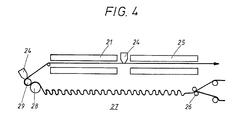
- the embossed wallpaper 16 is produced from a carrier layer 11 consisting of top and bottom paper.
- the top and bottom paper is put together in a soaking and laminating station. Then, via a soaking section 27, in which the carrier layer is arranged in folds, to the paper embossing roller 28 and the steel embossing roller 29.
- An applicator 24 is provided directly behind the roller 29 for applying the filling compound to the back of the carrier layer.
- the carrier layer provided with the filling compound then passes into a first drying stage 21. After this stage, if desired, a second application device 24 is provided in order to apply a supplementary layer of the filling compound to the carrier layer. Finally, the final drying takes place in the second drying stage 25.
- the filling compound also sets in the carrier layer.
- the illustrated embodiment is only one example of realizing the invention. This is not limited to this. Rather, various changes and applications are still possible.
- the filling compound can also be made of synthetic materials, and the carrier layer itself could also be made of plastic. It should also be mentioned that the carrier layer and the embossing can be introduced into the cavities directly after the stampings have been produced. only then does the drying and possibly also vulcanization of the filling compound, including the wallpaper, take place.
Landscapes
- Synthetic Leather, Interior Materials Or Flexible Sheet Materials (AREA)
- Paper (AREA)
- Laminated Bodies (AREA)
Applications Claiming Priority (2)
| Application Number | Priority Date | Filing Date | Title |
|---|---|---|---|
| DE3712653 | 1987-04-14 | ||
| DE3712653 | 1987-04-14 |
Publications (2)
| Publication Number | Publication Date |
|---|---|
| EP0287041A2 true EP0287041A2 (fr) | 1988-10-19 |
| EP0287041A3 EP0287041A3 (fr) | 1989-01-04 |
Family
ID=6325604
Family Applications (1)
| Application Number | Title | Priority Date | Filing Date |
|---|---|---|---|
| EP88105829A Withdrawn EP0287041A3 (fr) | 1987-04-14 | 1988-04-13 | Papier peint gaufré, ainsi que procédé pour sa fabrication |
Country Status (2)
| Country | Link |
|---|---|
| EP (1) | EP0287041A3 (fr) |
| DD (1) | DD276894A5 (fr) |
Cited By (1)
| Publication number | Priority date | Publication date | Assignee | Title |
|---|---|---|---|---|
| US5322722A (en) * | 1992-09-04 | 1994-06-21 | Foamade Industries, Inc. | System for adhesively mounting panel liners |
Family Cites Families (6)
| Publication number | Priority date | Publication date | Assignee | Title |
|---|---|---|---|---|
| US1900294A (en) * | 1929-11-04 | 1933-03-07 | George N Lovatt | Waxed paper and process of making the same |
| US1936355A (en) * | 1931-06-23 | 1933-11-21 | Paper Patents Co | Wall covering material and method of making the same |
| US2298592A (en) * | 1937-02-08 | 1942-10-13 | Cincinnati Ind Inc | Decorative product |
| CH264379A (de) * | 1945-04-16 | 1949-10-15 | Milton Prestwich Frank | Verfahren zur Herstellung einer gemusterten Kunststoffbahn. |
| GB1108549A (en) * | 1966-12-13 | 1968-04-03 | Herberts & Co Gmbh Dr Kurt | A process for the production of synthetic-resin-impregnated decorative sheets from papers |
| DE1635595A1 (de) * | 1967-02-01 | 1971-05-06 | Pickhardt & Siebert | Verfahren und Vorrichtung zur Herstellung von gepraegten und kaschierten Tapeten |
-
1988
- 1988-04-13 EP EP88105829A patent/EP0287041A3/fr not_active Withdrawn
- 1988-04-14 DD DD31474188A patent/DD276894A5/de not_active IP Right Cessation
Cited By (1)
| Publication number | Priority date | Publication date | Assignee | Title |
|---|---|---|---|---|
| US5322722A (en) * | 1992-09-04 | 1994-06-21 | Foamade Industries, Inc. | System for adhesively mounting panel liners |
Also Published As
| Publication number | Publication date |
|---|---|
| DD276894A5 (de) | 1990-03-14 |
| EP0287041A3 (fr) | 1989-01-04 |
Similar Documents
| Publication | Publication Date | Title |
|---|---|---|
| DE69931631T2 (de) | Dreilagiges saugfähiges papierprodukt und verfahren zu seiner herstellung | |
| DE2753559C2 (de) | Schichtkörper aus zwei Schichten aus Grundmaterialien mit Poren oder Zwischenräumen | |
| DE60118322T2 (de) | Verfahren zur Herstellung von geprägtem Papier und Prägezylinder | |
| DE1965716A1 (de) | Saugfaehige Bahn aus Zellulosefasern und Verfahren zu deren Herstellung | |
| EP0016398A1 (fr) | Procédé pour l'application d'une couche décorative sur une plaque support | |
| DE3886456T2 (de) | Tapeten vom Typ "die Wand leimen" und Verfahren zu ihrer Herstellung. | |
| CH617329A5 (fr) | ||
| DE60000977T2 (de) | Zwei- oder dreilagiges saugfähiges papierprodukt | |
| DE1794235C3 (de) | Praegeeinlage und Verfahren zu deren Herstellung | |
| DE1807842A1 (de) | Tuchmaterial und Herstellung desselben | |
| DE2911076A1 (de) | Verfahren zur herstellung von wasseraufnahmefaehigen, festen, stoff- bzw. tuchartigen gegenstaenden | |
| DE1635701A1 (de) | Verfahren zum Herstellen eines textilahnlichen Materials mit großer Starke und Weichheit sowie gemäß dem Verfahren hergestelltes Erzeugnis | |
| DE2549247C2 (de) | Verfahren und Vorrichtung zur Herstellung von Platten | |
| EP0287041A2 (fr) | Papier peint gaufré, ainsi que procédé pour sa fabrication | |
| DE2903359A1 (de) | Wandfliese | |
| EP1073796A1 (fr) | Papier peint gaufre multicouche a envers lisse, et son procede de production | |
| DE3515756C2 (fr) | ||
| DE3422874C2 (fr) | ||
| DE712573C (de) | Verfahren zur Herstellung von einseitig pergamentiertem Papier | |
| DE7907295U1 (de) | Traegerplatte mit einer darauf befindlichen dekorschicht | |
| DE2339207C3 (de) | Verfahren zur Herstellung einer luftgelegten Faserbahn | |
| DE3806154A1 (de) | Trennmittel und verfahren zu seiner herstellung | |
| DE2149103A1 (de) | Mehrlagiges verbundmaterial fuer saugfaehige papiertuecher | |
| DE2801228A1 (de) | Boden- oder wandbelag und verfahren zu seiner herstellung | |
| DE3200123C2 (de) | Verfahren zur Herstellung eines Verpackungsbehälters aus verstärkter Wellpappe |
Legal Events
| Date | Code | Title | Description |
|---|---|---|---|
| PUAI | Public reference made under article 153(3) epc to a published international application that has entered the european phase |
Free format text: ORIGINAL CODE: 0009012 |
|
| AK | Designated contracting states |
Kind code of ref document: A2 Designated state(s): BE DE FR GB IT NL |
|
| PUAL | Search report despatched |
Free format text: ORIGINAL CODE: 0009013 |
|
| AK | Designated contracting states |
Kind code of ref document: A3 Designated state(s): BE DE FR GB IT NL |
|
| 17P | Request for examination filed |
Effective date: 19890623 |
|
| 17Q | First examination report despatched |
Effective date: 19910419 |
|
| STAA | Information on the status of an ep patent application or granted ep patent |
Free format text: STATUS: THE APPLICATION IS DEEMED TO BE WITHDRAWN |
|
| 18D | Application deemed to be withdrawn |
Effective date: 19911030 |