EP0292174A2 - Ultrareine geschmolzene Kieselsäure enthaltende Einkapselungsmischungen - Google Patents
Ultrareine geschmolzene Kieselsäure enthaltende Einkapselungsmischungen Download PDFInfo
- Publication number
- EP0292174A2 EP0292174A2 EP88304192A EP88304192A EP0292174A2 EP 0292174 A2 EP0292174 A2 EP 0292174A2 EP 88304192 A EP88304192 A EP 88304192A EP 88304192 A EP88304192 A EP 88304192A EP 0292174 A2 EP0292174 A2 EP 0292174A2
- Authority
- EP
- European Patent Office
- Prior art keywords
- granules
- gel
- silicon
- resin
- containing organic
- Prior art date
- Legal status (The legal status is an assumption and is not a legal conclusion. Google has not performed a legal analysis and makes no representation as to the accuracy of the status listed.)
- Ceased
Links
Images

Classifications
-
- C—CHEMISTRY; METALLURGY
- C08—ORGANIC MACROMOLECULAR COMPOUNDS; THEIR PREPARATION OR CHEMICAL WORKING-UP; COMPOSITIONS BASED THEREON
- C08L—COMPOSITIONS OF MACROMOLECULAR COMPOUNDS
- C08L101/00—Compositions of unspecified macromolecular compounds
-
- H—ELECTRICITY
- H10—SEMICONDUCTOR DEVICES; ELECTRIC SOLID-STATE DEVICES NOT OTHERWISE PROVIDED FOR
- H10W—GENERIC PACKAGES, INTERCONNECTIONS, CONNECTORS OR OTHER CONSTRUCTIONAL DETAILS OF DEVICES COVERED BY CLASS H10
- H10W74/00—Encapsulations, e.g. protective coatings
- H10W74/40—Encapsulations, e.g. protective coatings characterised by their materials
- H10W74/47—Encapsulations, e.g. protective coatings characterised by their materials comprising organic materials, e.g. plastics or resins
- H10W74/473—Encapsulations, e.g. protective coatings characterised by their materials comprising organic materials, e.g. plastics or resins containing a filler
-
- C—CHEMISTRY; METALLURGY
- C08—ORGANIC MACROMOLECULAR COMPOUNDS; THEIR PREPARATION OR CHEMICAL WORKING-UP; COMPOSITIONS BASED THEREON
- C08K—Use of inorganic or non-macromolecular organic substances as compounding ingredients
- C08K3/00—Use of inorganic substances as compounding ingredients
- C08K3/34—Silicon-containing compounds
- C08K3/36—Silica
-
- C—CHEMISTRY; METALLURGY
- C09—DYES; PAINTS; POLISHES; NATURAL RESINS; ADHESIVES; COMPOSITIONS NOT OTHERWISE PROVIDED FOR; APPLICATIONS OF MATERIALS NOT OTHERWISE PROVIDED FOR
- C09C—TREATMENT OF INORGANIC MATERIALS, OTHER THAN FIBROUS FILLERS, TO ENHANCE THEIR PIGMENTING OR FILLING PROPERTIES ; PREPARATION OF CARBON BLACK ; PREPARATION OF INORGANIC MATERIALS WHICH ARE NO SINGLE CHEMICAL COMPOUNDS AND WHICH ARE MAINLY USED AS PIGMENTS OR FILLERS
- C09C1/00—Treatment of specific inorganic materials other than fibrous fillers; Preparation of carbon black
- C09C1/28—Compounds of silicon
- C09C1/30—Silicic acid
- C09C1/3009—Physical treatment, e.g. grinding; treatment with ultrasonic vibrations
- C09C1/3036—Agglomeration, granulation, pelleting
-
- C—CHEMISTRY; METALLURGY
- C01—INORGANIC CHEMISTRY
- C01P—INDEXING SCHEME RELATING TO STRUCTURAL AND PHYSICAL ASPECTS OF SOLID INORGANIC COMPOUNDS
- C01P2004/00—Particle morphology
- C01P2004/51—Particles with a specific particle size distribution
-
- C—CHEMISTRY; METALLURGY
- C01—INORGANIC CHEMISTRY
- C01P—INDEXING SCHEME RELATING TO STRUCTURAL AND PHYSICAL ASPECTS OF SOLID INORGANIC COMPOUNDS
- C01P2004/00—Particle morphology
- C01P2004/60—Particles characterised by their size
- C01P2004/61—Micrometer sized, i.e. from 1-100 micrometer
-
- C—CHEMISTRY; METALLURGY
- C01—INORGANIC CHEMISTRY
- C01P—INDEXING SCHEME RELATING TO STRUCTURAL AND PHYSICAL ASPECTS OF SOLID INORGANIC COMPOUNDS
- C01P2006/00—Physical properties of inorganic compounds
- C01P2006/10—Solid density
-
- C—CHEMISTRY; METALLURGY
- C01—INORGANIC CHEMISTRY
- C01P—INDEXING SCHEME RELATING TO STRUCTURAL AND PHYSICAL ASPECTS OF SOLID INORGANIC COMPOUNDS
- C01P2006/00—Physical properties of inorganic compounds
- C01P2006/12—Surface area
-
- Y—GENERAL TAGGING OF NEW TECHNOLOGICAL DEVELOPMENTS; GENERAL TAGGING OF CROSS-SECTIONAL TECHNOLOGIES SPANNING OVER SEVERAL SECTIONS OF THE IPC; TECHNICAL SUBJECTS COVERED BY FORMER USPC CROSS-REFERENCE ART COLLECTIONS [XRACs] AND DIGESTS
- Y10—TECHNICAL SUBJECTS COVERED BY FORMER USPC
- Y10S—TECHNICAL SUBJECTS COVERED BY FORMER USPC CROSS-REFERENCE ART COLLECTIONS [XRACs] AND DIGESTS
- Y10S65/00—Glass manufacturing
- Y10S65/901—Liquid phase reaction process
Definitions
- This invention relates to compositions for encapsulating electronic components and, in particular, to compositions which contain ultra-pure, fused silica fillers having low concentrations of radioactive contaminants.
- Quartz, silica, and fused silica in powder form have been used for many years as fillers for encapsulating electronic components, such as, semiconductor memory devices. See, for example, Tuller et al., U.S. Patent No. 4,042,550, and Rosler et al., U.S. Patent No. 4,287,105. These fillers provide strength and low thermal expansion to the component package and are chemically inert.
- the passage of an alpha particle through the component can cause "soft" errors by changing the state of individual memory cells.
- the presence of radioactive elements in the filler materials used in encapsulating compositions for electronic components has been identified as a major source of such alpha particles.
- the uranium and thorium levels in existing silica fillers have been identified as significant sources of alpha particles.
- the Bihuniak et al. process is more difficult to perform than the process of the present invention. For example, it is relatively difficult to form gels from fumed silica, and as acknowledged in the Bihuniak et al. patents, once formed, gels made from fumed silica tend to break up into large chunks, rather than small particles. Further, extensive pollution abatement equipment is required to produce fumed silica since such production involves the creation of hydrochloric acid.
- densified silica particles made from fumed silica generally have higher impurity levels than densified silica particles prepared in accordance with the present invention. These higher impurity levels are due in part to the fact that impurities, including radioactive impurities, are introduced into the silica during the fuming process.
- densification of particles made from fumed silica gels requires higher temperatures than densification of particles formed from gels made from silicon-containing organic compounds, i.e., densification of particles made from fumed silica gels require temperatures above, rather than below, 1150°C.
- densification of particles made from fumed silica gels require temperatures above, rather than below, 1150°C.
- Such higher temperatures generally mean that metal-containing furnaces must be used to perform the densification.
- the use of such furnaces means that the silica particles will be exposed to and thus will pick up contaminants released from the walls of the hot furnace.
- the need to generate higher temperatures to achieve densification is in general undesirable.
- compositions for encapsulating electronic components In particular, it is an object of the invention to provide encapsulating compositions which include a silica filler which (a) can be produced in commercial quantities at reasonable costs and (b) whose uranium and thorium concentrations are below those of existing commercially-available silica fillers.
- the invention provides encapsulating compositions which comprise a blend of a curable resin and a silica filler, the filler being composed of fused silica granules which: (a) are prepared from a silicon-containing organic compound using a sol-gel process, and (b) have a uranium content of less than about 0.1 parts per billion and a thorium content of less than about 0.5 parts per billion.
- the silicon-containing organic compound is tetraethylorthosilicate (TEOS) having the formula Si(OC2H5)4, and the granules are dry milled so that they have a mean particle size between about 1 and about 100 microns.
- TEOS tetraethylorthosilicate
- the present invention involves the production of ultra-pure silica fillers using a sol-gel process.
- the sol-gel process employs at least one silicon-containing organic compound having the formula Si(OR4) or SiR(OR)3, where R is an alkyl group.
- Tetraethylorthosilicate having the formula Si(OC2H5)4 is the preferred silicon-containing organic compound, although other organosilicon compounds, including, for example, tetramethylorthosilicate having the formula Si(OCH3)4, and methyltrimethoxysilane, having the formula (SiCH3(OCH3)3, can be used.
- the silicon-containing organic compound can be partially hydrolyzed.
- partially hydrolyzed TEOS sold by the Stauffer Chemical Company under the trademark SILBOND 40 is a suitable starting material for preparing the gels of the present invention.
- the use of a single silicon-containing organic compound is preferred, although mixtures of such compounds can be used, if desired.
- a solution of the silicon-containing organic compound is prepared and then gelled.
- the solution is an aqueous solution which includes an acid, such as, hydrochloric acid, as a gelation catalyst.
- an acid such as, hydrochloric acid
- Other solvents e.g., organic solvents such as ethanol, can be added to improve miscibility, and other gelation catalysts, e.g., acids such as formic and nitric acid, can be used.
- TEOS water to TEOS mole ratios in the range of 4:1 to 15:1 have been found to work successfully. Theoretically, ratios as low as 2:1 can be employed. Higher ratios produce gels having larger surface areas and pore sizes which are easier to dry. In some cases, for higher ratio gels, drying alone has been found to sufficiently reduce the level of organic material within the gel, so that oxygen treatment of the gel can be omitted. The higher ratio gels, however, mean that less product is produced for the same size reaction vessel. In general, a mole ratio of 6:1 has been found to produce a reasonable amount of product which can be readily dried.
- the solution of the organosilicon compound is preferably gelled in a quartz reactor or similar vessel. Gelation results in 1) polymerization of the silicon, and 2) the production of an alcohol, such as, ethanol in the case of TEOS.
- Typical gelation times for a solution pH in the range of 1-2 are in the range of 1-4 hours at a temperature of from 60°C to 75°C. Gelation times can be reduced by heating the organosilicon solution. Also, if desired, high speed gelation can be achieved by neutralizing the pH of the TEOS solution through the addition of a basic solution, such as, a 1.2% ammonium carbonate solution. Gelation times in the range of seconds can be achieved in this way.
- the gel is dried to 1) remove residual water and alcohol (carbon), and 2) fragment the gel into granules having a mean particle size less than about 1 millimeter.
- the drying can be conveniently performed in the same reactor used to prepare the gel, or the gel can be removed and dried in specialized drying equipment, e.g., in a rotary dryer or rotary vacuum dryer.
- the drying is performed in the reactor used to prepare the gel, drying temperatures above about 250°C are preferred. At such temperatures, drying times on the order of 30 hours are typical.
- the gel is either purged with an inert atmosphere, e.g., an argon atmosphere, or subjected to a vacuum. Purging and vacuum treatments can be used sequentially, if desired.
- drying can be accomplished by forming the gel in thin sheets and allowing the sheets to dry at room temperature.
- the thin sheet approach is not preferred for commercial production.
- drying alone may reduce the level of organics associated with the granules to a point where charred carbon particles do not form upon sintering of the granules.
- the organics can be removed by purging the gel granules with an oxygen-containing atmosphere at an elevated temperature. To avoid the production of charred carbon particles during this process, the rate of oxygen purging must be controlled so that the exothermic reaction between oxygen and organics does not cause the temperature of the drying chamber to rise above about 340°C.
- the dried gel granules will typically have a density of approximately 1.29 - 1.59 grams/cc, a pore size of approximately 20-100 angstroms, and a surface area to mass ratio of between about 150 and about 700 meter2/gram.
- the resulting dried gel will have a lower density of approximately 0.31-0.88 grams/cc and a larger pore size of approximately 700-1000 angstroms. Moreover, the drying of such a fumed silica gel will generally not produce granules having a mean particle size less than one millimeter, but rather, will produce larger particles and chunks which are not well-suited for further processing.
- the gel granules are fully sintered, i.e., they are sintered to a density which is approximately equal to their maximum theoretical density.
- the sintering process causes various changes in the character of the gel granules. Specifically, during sintering, the polymeric structure of the gel granules relaxes, water is given off (condensation reaction) which, in turn, affects the granules' apparent viscosity, and the pores of the granules collapse. Overall, the sintering process results in a dramatic decrease in surface area to mass ratio of the granules, i.e., from the 150-700 meter2/gram range to a value less than 0.5 meter2/gram.
- the sintering of the gel granules is conducted at a temperature of less than about 1150°C. This low sintering temperature allows the sintering to be conducted in the same quartz reactor used for gelation and drying. The use of such reactor, as opposed to a metal furnace, helps maintain the purity of the granules through the sintering procedure. Alternatively, if the gel has been removed from the original quartz reactor for drying, it can be returned to a silica-based reactor for sintering.
- sintering temperature generally decreases with decreasing pore size. See Scherer et al., "Glasses from Colloids", Journal of Non-Crystalline Solids , 63 :163-172 (1984).
- the sintering can be performed in a variety of atmospheres.
- atmospheres for example, helium, helium/oxygen, and argon/oxygen atmospheres can be used. In some cases, a helium atmosphere has been found preferable to an argon/oxygen atmosphere.
- the sintering can also be performed in air.
- a sintering period of approximately one hour at temperatures in 900-1000°C range is generally sufficient to achieve full densification of the granules.
- the specific temperature needed will depend on pore size of the gel.
- the pore size will depend on the H2O:TEOS ratio used to produce the gel. As illustrated in Table I, higher mole ratios result in gels having larger surface areas but lower densities. Accordingly, the pore sizes for these gels are greater and thus higher sintering temperatures are required to achieve full densification.
- Sintering temperature is also affected by the amount of chemically bound water associated with the granules. For example, it has been found that if the water level in a gel has been reduced by means of a chlorine gas treatment, high sintering temperatures, e.g., temperatures 100-150°C higher, are required to obtain full densification of the granules.
- the fully sintered gel granules will be suitable for use in preparing the encapsulating compositions of the present invention without any further processing. In other cases, it may be desirable to reduce the size of the granules prior to use.
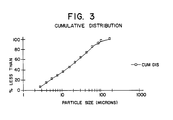
- particles having a mean particle size in the range of from about 1 micron to about 100 microns are preferred. More particularly, particles which will pass through a 325 mesh screen, but will not pass through a 600 mesh screen, are particularly well-suited for use as a filler material.
- the reduction in size of the gel granules can be readily accomplished by a variety of milling techniques, including vibra-milling, ball milling, jet impingement or fluid energy milling, triter milling, and the like. Combinations of these milling techniques can also be used. In general, dry milling is preferred to wet milling, although milling in a solvent, such as, an alcohol, can be employed. If desired, the milling can be performed prior to sintering of the granules.
- the encapsulating compositions of the present invention are prepared by blending the consolidated and sized gel granules with a curable resin suitable for encapsulating electronic components.
- a curable resin suitable for encapsulating electronic components Various resins, known in the art, can be used, the preferred resins being epoxy resins which are used in combination with a hardener and a catalyst.
- the blend can optionally include flame retardants, lubricants, colorants, coupling agents, and the like.
- suitable resins, additives, and formulation techniques can be found in the Rosler et al. and Tuller et al. patents referred to above, the pertinent portions of which are incorporated herein by reference.
- the fused silica granules of the present invention will comprise between about 10 and about 80 percent by weight of the final composition.
- the filler of the invention can be used in combination with other fillers, e.g., fumed silica, provided such other fillers are not used in large amounts and do not contain excessively high concentrations of radioactive materials.
- the encapsulating composition will typically be densified on a hot differential roll mill or similar apparatus and then granulated. The resulting powder is then ready for use in accordance with conventional molding techniques.
- This example illustrates the preparation of the ultra-pure, fused silica filler of the present invention.
- Drying and sintering of the gel was performed as follows. First, the reactor was placed in a furnace and the temperature of the furnace was raised to 100°C at a rate of 100°C/hour. During this initial heating, the reactor was purged with argon at a rate of 200 cc/minute. The argon, as well as all other gases used in the process, was filtered through a 0.6 micron Pall filter before being introduced into the reactor.
- the furnace was held at 100°C for a half an hour, and then raised to 300°C at a rate of 50°C/hour.
- the argon purging rate was increased to 800 cc/minute during this second heating phase.
- the temperature of the gel reached 290°C, the furnace was cooled to 250°C. At this point, the gel had completely fragmented into fine granules having a mean size of less than about 1 millimeter and a surface area to mass ratio of approximately 200 meter2/gram.
- oxygen was then introduced into the reactor at a rate such that the temperature of the reactor did not exceed 340°C as a result of the exothermic reaction between the oxygen and the residual organics associated with the gel.
- oxygen was introduced into the reactor in accordance with a 10 cc/minute/hour ramp up to a maximum of 200 cc/minute. This rate of oxygen introduction was also found to control the oxygen-organic reaction so as to avoid the formation of charred carbon particles.
- the temperature of the furnace was raised to 925°C at a rate of 75°C/hour to fully sinter the granules.
- the granules had 1) a smaller mean size than before sintering, e.g., a mean size on the order of 0.6 millimeters, and 2) a reduced surface area to mass ratio on the order of 0.08 meter2/gram.
- Figure 2 shows the typical appearance of the fully sintered granules.
- Neutron activation analysis was performed on a sample of milled granules prepared essentially in accordance with the foregoing procedure. The results of this analysis is shown in Table II. As shown therein, only trace amounts of the listed elements were detected in the sample. In particular, the concentrations of uranium and thorium were found to be below 0.1 ppb and 0.5 ppb, respectively.
Landscapes
- Chemical & Material Sciences (AREA)
- Organic Chemistry (AREA)
- Health & Medical Sciences (AREA)
- Chemical Kinetics & Catalysis (AREA)
- Medicinal Chemistry (AREA)
- Polymers & Plastics (AREA)
- Silicon Compounds (AREA)
- Compositions Of Macromolecular Compounds (AREA)
- Structures Or Materials For Encapsulating Or Coating Semiconductor Devices Or Solid State Devices (AREA)
- Epoxy Resins (AREA)
Applications Claiming Priority (2)
| Application Number | Priority Date | Filing Date | Title |
|---|---|---|---|
| US07/052,655 US4816299A (en) | 1987-05-20 | 1987-05-20 | Encapsulating compositions containing ultra-pure, fused-silica fillers |
| US52655 | 2005-02-07 |
Publications (2)
| Publication Number | Publication Date |
|---|---|
| EP0292174A2 true EP0292174A2 (de) | 1988-11-23 |
| EP0292174A3 EP0292174A3 (de) | 1989-08-30 |
Family
ID=21979031
Family Applications (1)
| Application Number | Title | Priority Date | Filing Date |
|---|---|---|---|
| EP88304192A Ceased EP0292174A3 (de) | 1987-05-20 | 1988-05-09 | Ultrareine geschmolzene Kieselsäure enthaltende Einkapselungsmischungen |
Country Status (5)
| Country | Link |
|---|---|
| US (1) | US4816299A (de) |
| EP (1) | EP0292174A3 (de) |
| JP (1) | JPH01319567A (de) |
| KR (1) | KR960006117B1 (de) |
| CA (1) | CA1317696C (de) |
Cited By (3)
| Publication number | Priority date | Publication date | Assignee | Title |
|---|---|---|---|---|
| EP0372983A3 (de) * | 1988-12-08 | 1991-11-27 | Sumitomo Bakelite Company Limited | Epoxydharzzusammensetzung für die Versiegelung von Halbleitern |
| EP1000984A1 (de) * | 1998-11-12 | 2000-05-17 | Dow Corning Corporation | Verfahren zur Verdichtung von teilchenförmigem Siliziumoxid |
| EP1420035A1 (de) * | 2002-11-12 | 2004-05-19 | Nitto Denko Corporation | Gefüllte Epoxidharz-Zusammensetzung zur Einkapselung von Halbleitern sowie ein damit eingekapselter Halbleiterbauteil |
Families Citing this family (7)
| Publication number | Priority date | Publication date | Assignee | Title |
|---|---|---|---|---|
| US5637507A (en) * | 1989-01-05 | 1997-06-10 | The United States Of America As Represented By The United States Department Of Energy | Tetraethyl orthosilicate-based glass composition and method |
| JPH02307830A (ja) * | 1989-05-18 | 1990-12-21 | Chisso Corp | 石英ガラス粉末の製造方法 |
| DE69109026T2 (de) * | 1990-09-07 | 1995-12-07 | Mitsubishi Chem Corp | Silica-Glas Pulver und Verfahren seiner Herstellung und daraus hergestellter Silica-Glasgegenstand. |
| JP3445707B2 (ja) * | 1996-09-18 | 2003-09-08 | 電気化学工業株式会社 | シリカ質フィラー及びその製法 |
| JP3996802B2 (ja) * | 2002-05-15 | 2007-10-24 | 太陽インキ製造株式会社 | 低放射線性の光硬化性・熱硬化性樹脂組成物及びその硬化被膜 |
| AU2003272790A1 (en) * | 2002-10-08 | 2004-05-04 | Honeywell International Inc. | Semiconductor packages, lead-containing solders and anodes and methods of removing alpha-emitters from materials |
| US7994646B2 (en) * | 2008-12-17 | 2011-08-09 | Infineon Technologies Ag | Semiconductor device |
Family Cites Families (18)
| Publication number | Priority date | Publication date | Assignee | Title |
|---|---|---|---|---|
| US3535890A (en) * | 1967-10-26 | 1970-10-27 | Corning Glass Works | Method of making fused silica |
| US3678144A (en) * | 1970-06-12 | 1972-07-18 | Corning Glass Works | Silicate bodies containing coprecipitated oxides |
| US4042550A (en) * | 1975-11-28 | 1977-08-16 | Allied Chemical Corporation | Encapsulant compositions based on anhydride-hardened epoxy resins |
| DE2557932A1 (de) * | 1975-12-22 | 1977-06-30 | Dynamit Nobel Ag | Verfahren zur herstellung von koernigem quarzglas |
| US4112032A (en) * | 1976-04-21 | 1978-09-05 | Corning Glass Works | Silica-containing porous bodies of controlled pore size |
| US4042361A (en) * | 1976-04-26 | 1977-08-16 | Corning Glass Works | Method of densifying metal oxides |
| US4200445A (en) * | 1977-04-28 | 1980-04-29 | Corning Glass Works | Method of densifying metal oxides |
| JPS55100231A (en) * | 1979-01-19 | 1980-07-31 | Hitachi Ltd | Production of optical fiber base material |
| US4287105A (en) * | 1980-01-14 | 1981-09-01 | Plaskon Products, Inc. | Flash resistant epoxy encapsulating composition and process for preparing same |
| US4419115A (en) * | 1981-07-31 | 1983-12-06 | Bell Telephone Laboratories, Incorporated | Fabrication of sintered high-silica glasses |
| US4426216A (en) * | 1982-01-06 | 1984-01-17 | Hitachi, Ltd. | Process for producing optical glass |
| ATE25960T1 (de) * | 1982-01-15 | 1987-04-15 | Corning Glass Works | Verfahren zur herstellung von glas oder keramik. |
| US4681615A (en) * | 1982-12-23 | 1987-07-21 | Seiko Epson Kabushiki Kaisha | Silica glass formation process |
| US4574063A (en) * | 1983-05-09 | 1986-03-04 | Corning Glass Works | Method of forming glass or ceramic article |
| JPS60210643A (ja) * | 1983-11-30 | 1985-10-23 | Denki Kagaku Kogyo Kk | 充填剤及びその組成物 |
| US4608215A (en) * | 1983-12-23 | 1986-08-26 | Allied Corporation | Preparation of ceramics |
| US4622056A (en) * | 1985-02-13 | 1986-11-11 | Seiko Epson Corporation | Method of preparing silica glass |
| CA1257434A (en) * | 1985-08-26 | 1989-07-11 | Gary W. Bogan | Encapsulating compositions |
-
1987
- 1987-05-20 US US07/052,655 patent/US4816299A/en not_active Expired - Fee Related
-
1988
- 1988-05-09 CA CA000566320A patent/CA1317696C/en not_active Expired - Fee Related
- 1988-05-09 EP EP88304192A patent/EP0292174A3/de not_active Ceased
- 1988-05-20 JP JP63123752A patent/JPH01319567A/ja active Pending
- 1988-05-20 KR KR1019880005935A patent/KR960006117B1/ko not_active Expired - Lifetime
Cited By (4)
| Publication number | Priority date | Publication date | Assignee | Title |
|---|---|---|---|---|
| EP0372983A3 (de) * | 1988-12-08 | 1991-11-27 | Sumitomo Bakelite Company Limited | Epoxydharzzusammensetzung für die Versiegelung von Halbleitern |
| EP1000984A1 (de) * | 1998-11-12 | 2000-05-17 | Dow Corning Corporation | Verfahren zur Verdichtung von teilchenförmigem Siliziumoxid |
| EP1420035A1 (de) * | 2002-11-12 | 2004-05-19 | Nitto Denko Corporation | Gefüllte Epoxidharz-Zusammensetzung zur Einkapselung von Halbleitern sowie ein damit eingekapselter Halbleiterbauteil |
| US7265167B2 (en) | 2002-11-12 | 2007-09-04 | Nitto Denko Corporation | Epoxy resin composition for semiconductor encapsulation, and semiconductor device using the same |
Also Published As
| Publication number | Publication date |
|---|---|
| KR880014672A (ko) | 1988-12-24 |
| KR960006117B1 (ko) | 1996-05-09 |
| JPH01319567A (ja) | 1989-12-25 |
| US4816299A (en) | 1989-03-28 |
| CA1317696C (en) | 1993-05-11 |
| EP0292174A3 (de) | 1989-08-30 |
Similar Documents
| Publication | Publication Date | Title |
|---|---|---|
| KR950014100B1 (ko) | 초고순도를 갖는 광학적 양질의 유리 제품 제조방법 | |
| EP0517841B1 (de) | Verfahren zur herstellung von dichtem hochreinem siliciumdioxid mit partikelgrössen im mikrometerbereich | |
| US4816299A (en) | Encapsulating compositions containing ultra-pure, fused-silica fillers | |
| EP0665189B1 (de) | Behandlung von chemischen Stoffen | |
| WO2010010036A2 (de) | Verfahren zur herstellung von mit stickstoff dotiertem quarzglas sowie zur durchführung des verfahrens geeignete quarzglaskörnung | |
| EP1074513A2 (de) | Sinterwerkstoffe und deren Herstellungsverfahren und Verwendungen, Dispersionen von Siliciumdioxid-Granulaten und deren Verwendungen, sowie Verwendungen von Siliciumdioxid-Granulaten | |
| WO1998040318A1 (en) | High-purity silica glass fabricating method using sol-gel process | |
| RU2141928C1 (ru) | Способ производства монолитного кварцевого стекла с использованием золь-гель процесса | |
| EP0331187B1 (de) | Verfahren zur Herstellung eines keramischen Vorformlings | |
| EP0322480B1 (de) | Verfahren zu Regulierung der Kristallkorngrösse in Urandioxid-Pellets | |
| JPS63171644A (ja) | 無機イオン交換物質 | |
| US3326910A (en) | Amorphous amine silicates substantially free of alkali metal oxide and process for their preparation | |
| JPH03275527A (ja) | 多孔質シリカガラス粉末 | |
| CN1017041B (zh) | 控制二氧化铀颗粒的晶粒尺寸的方法 | |
| US4744973A (en) | Inorganic polymeric cationic ion exchange matrix | |
| JPH0465311A (ja) | 金属珪素から放射性元素を除去する方法 | |
| US5390218A (en) | Process for preparing a fuel pellet for nuclear reactor | |
| KR100722377B1 (ko) | 투명 실리카 글래스의 제조 방법 | |
| JPH0450132A (ja) | 天然石英粉末の精製方法 | |
| KR100722378B1 (ko) | 투명 실리카 글래스의 제조 방법 | |
| McBride et al. | The CUSP Process for Preparing Concentrated, Crystalline Urania Sols by Solvent Extraction | |
| JPH04132610A (ja) | 二酸化珪素粉末の製造方法 | |
| KR100722379B1 (ko) | 투명 실리카 글래스의 제조 방법 | |
| KR100824985B1 (ko) | 투명 실리카 글래스 제조용 조성물 및 이를 이용한 실리카글래스의 제조 방법 | |
| Toda et al. | Method for producing highly pure sintered polycrystalline yttrium oxide body having high transparency |
Legal Events
| Date | Code | Title | Description |
|---|---|---|---|
| PUAI | Public reference made under article 153(3) epc to a published international application that has entered the european phase |
Free format text: ORIGINAL CODE: 0009012 |
|
| AK | Designated contracting states |
Kind code of ref document: A2 Designated state(s): DE FR GB |
|
| PUAL | Search report despatched |
Free format text: ORIGINAL CODE: 0009013 |
|
| AK | Designated contracting states |
Kind code of ref document: A3 Designated state(s): DE FR GB |
|
| 17P | Request for examination filed |
Effective date: 19900201 |
|
| 17Q | First examination report despatched |
Effective date: 19911218 |
|
| STAA | Information on the status of an ep patent application or granted ep patent |
Free format text: STATUS: THE APPLICATION HAS BEEN REFUSED |
|
| 18R | Application refused |
Effective date: 19930802 |