EP0294204A2 - Verfahren zur Herstellung eines Katalysators zur Denitrierung durch katalytische Reduktion mit Ammoniak - Google Patents
Verfahren zur Herstellung eines Katalysators zur Denitrierung durch katalytische Reduktion mit Ammoniak Download PDFInfo
- Publication number
- EP0294204A2 EP0294204A2 EP88305054A EP88305054A EP0294204A2 EP 0294204 A2 EP0294204 A2 EP 0294204A2 EP 88305054 A EP88305054 A EP 88305054A EP 88305054 A EP88305054 A EP 88305054A EP 0294204 A2 EP0294204 A2 EP 0294204A2
- Authority
- EP
- European Patent Office
- Prior art keywords
- catalyst
- oxide
- denitration
- element selected
- catalytic reduction
- Prior art date
- Legal status (The legal status is an assumption and is not a legal conclusion. Google has not performed a legal analysis and makes no representation as to the accuracy of the status listed.)
- Granted
Links
- 239000003054 catalyst Substances 0.000 title claims abstract description 156
- 238000000034 method Methods 0.000 title claims abstract description 43
- QGZKDVFQNNGYKY-UHFFFAOYSA-N Ammonia Chemical compound N QGZKDVFQNNGYKY-UHFFFAOYSA-N 0.000 title claims abstract description 31
- 229910021529 ammonia Inorganic materials 0.000 title claims abstract description 15
- 238000010531 catalytic reduction reaction Methods 0.000 title claims abstract description 14
- GWEVSGVZZGPLCZ-UHFFFAOYSA-N Titan oxide Chemical compound O=[Ti]=O GWEVSGVZZGPLCZ-UHFFFAOYSA-N 0.000 claims abstract description 31
- 229910052750 molybdenum Inorganic materials 0.000 claims abstract description 26
- 239000000203 mixture Substances 0.000 claims abstract description 25
- 229910052721 tungsten Inorganic materials 0.000 claims abstract description 25
- 229910052718 tin Inorganic materials 0.000 claims abstract description 24
- 229910052742 iron Inorganic materials 0.000 claims abstract description 13
- 229910052748 manganese Inorganic materials 0.000 claims abstract description 13
- 229910052802 copper Inorganic materials 0.000 claims abstract description 12
- 229910052720 vanadium Inorganic materials 0.000 claims abstract description 12
- JKQOBWVOAYFWKG-UHFFFAOYSA-N molybdenum trioxide Chemical compound O=[Mo](=O)=O JKQOBWVOAYFWKG-UHFFFAOYSA-N 0.000 claims description 110
- 238000001354 calcination Methods 0.000 claims description 35
- 239000000463 material Substances 0.000 claims description 20
- 239000011135 tin Substances 0.000 claims description 20
- XEEYBQQBJWHFJM-UHFFFAOYSA-N Iron Chemical compound [Fe] XEEYBQQBJWHFJM-UHFFFAOYSA-N 0.000 claims description 18
- 150000001875 compounds Chemical class 0.000 claims description 17
- ZOKXTWBITQBERF-UHFFFAOYSA-N Molybdenum Chemical compound [Mo] ZOKXTWBITQBERF-UHFFFAOYSA-N 0.000 claims description 15
- 239000011733 molybdenum Substances 0.000 claims description 15
- 235000016768 molybdenum Nutrition 0.000 claims description 15
- 238000001035 drying Methods 0.000 claims description 13
- 238000004898 kneading Methods 0.000 claims description 13
- OGIDPMRJRNCKJF-UHFFFAOYSA-N titanium oxide Inorganic materials [Ti]=O OGIDPMRJRNCKJF-UHFFFAOYSA-N 0.000 claims description 13
- WFKWXMTUELFFGS-UHFFFAOYSA-N tungsten Chemical compound [W] WFKWXMTUELFFGS-UHFFFAOYSA-N 0.000 claims description 13
- 239000010937 tungsten Substances 0.000 claims description 13
- ATJFFYVFTNAWJD-UHFFFAOYSA-N Tin Chemical compound [Sn] ATJFFYVFTNAWJD-UHFFFAOYSA-N 0.000 claims description 12
- 239000011572 manganese Substances 0.000 claims description 12
- 238000000465 moulding Methods 0.000 claims description 12
- 239000002253 acid Substances 0.000 claims description 10
- 239000010949 copper Substances 0.000 claims description 10
- 239000002994 raw material Substances 0.000 claims description 8
- PWHULOQIROXLJO-UHFFFAOYSA-N Manganese Chemical compound [Mn] PWHULOQIROXLJO-UHFFFAOYSA-N 0.000 claims description 7
- GPPXJZIENCGNKB-UHFFFAOYSA-N vanadium Chemical compound [V]#[V] GPPXJZIENCGNKB-UHFFFAOYSA-N 0.000 claims description 7
- RYGMFSIKBFXOCR-UHFFFAOYSA-N Copper Chemical compound [Cu] RYGMFSIKBFXOCR-UHFFFAOYSA-N 0.000 claims description 6
- LLZRNZOLAXHGLL-UHFFFAOYSA-J titanic acid Chemical compound O[Ti](O)(O)O LLZRNZOLAXHGLL-UHFFFAOYSA-J 0.000 claims description 4
- 239000007789 gas Substances 0.000 abstract description 17
- 229910001385 heavy metal Inorganic materials 0.000 abstract description 11
- 150000002736 metal compounds Chemical class 0.000 abstract description 6
- 239000002574 poison Substances 0.000 abstract description 6
- 231100000614 poison Toxicity 0.000 abstract description 6
- 230000000052 comparative effect Effects 0.000 description 19
- 230000000694 effects Effects 0.000 description 17
- 230000006866 deterioration Effects 0.000 description 13
- 238000005299 abrasion Methods 0.000 description 12
- 229910052751 metal Inorganic materials 0.000 description 11
- 239000002184 metal Substances 0.000 description 11
- MWUXSHHQAYIFBG-UHFFFAOYSA-N nitrogen oxide Inorganic materials O=[N] MWUXSHHQAYIFBG-UHFFFAOYSA-N 0.000 description 11
- 238000002485 combustion reaction Methods 0.000 description 9
- 239000010936 titanium Substances 0.000 description 9
- 239000003245 coal Substances 0.000 description 8
- 239000002245 particle Substances 0.000 description 8
- 238000006722 reduction reaction Methods 0.000 description 8
- XLYOFNOQVPJJNP-UHFFFAOYSA-N water Substances O XLYOFNOQVPJJNP-UHFFFAOYSA-N 0.000 description 8
- 239000000306 component Substances 0.000 description 7
- 239000000843 powder Substances 0.000 description 7
- UNTBPXHCXVWYOI-UHFFFAOYSA-O azanium;oxido(dioxo)vanadium Chemical compound [NH4+].[O-][V](=O)=O UNTBPXHCXVWYOI-UHFFFAOYSA-O 0.000 description 6
- 238000000227 grinding Methods 0.000 description 6
- 239000002002 slurry Substances 0.000 description 6
- APUPEJJSWDHEBO-UHFFFAOYSA-P ammonium molybdate Chemical compound [NH4+].[NH4+].[O-][Mo]([O-])(=O)=O APUPEJJSWDHEBO-UHFFFAOYSA-P 0.000 description 5
- 239000011609 ammonium molybdate Substances 0.000 description 5
- 229940010552 ammonium molybdate Drugs 0.000 description 5
- 235000018660 ammonium molybdate Nutrition 0.000 description 5
- 239000002956 ash Substances 0.000 description 5
- 238000010438 heat treatment Methods 0.000 description 5
- QAOWNCQODCNURD-UHFFFAOYSA-L sulfate group Chemical group S(=O)(=O)([O-])[O-] QAOWNCQODCNURD-UHFFFAOYSA-L 0.000 description 5
- QAOWNCQODCNURD-UHFFFAOYSA-N Sulfuric acid Chemical compound OS(O)(=O)=O QAOWNCQODCNURD-UHFFFAOYSA-N 0.000 description 4
- 238000002156 mixing Methods 0.000 description 4
- 238000002360 preparation method Methods 0.000 description 4
- 238000001179 sorption measurement Methods 0.000 description 4
- 239000000126 substance Substances 0.000 description 4
- 238000000151 deposition Methods 0.000 description 3
- 230000008021 deposition Effects 0.000 description 3
- 238000001125 extrusion Methods 0.000 description 3
- 239000008187 granular material Substances 0.000 description 3
- MIVBAHRSNUNMPP-UHFFFAOYSA-N manganese(2+);dinitrate Chemical compound [Mn+2].[O-][N+]([O-])=O.[O-][N+]([O-])=O MIVBAHRSNUNMPP-UHFFFAOYSA-N 0.000 description 3
- 238000004519 manufacturing process Methods 0.000 description 3
- -1 petroleam Substances 0.000 description 3
- 229910052815 sulfur oxide Inorganic materials 0.000 description 3
- 229910052719 titanium Inorganic materials 0.000 description 3
- ZNOKGRXACCSDPY-UHFFFAOYSA-N tungsten trioxide Chemical compound O=[W](=O)=O ZNOKGRXACCSDPY-UHFFFAOYSA-N 0.000 description 3
- GOLCXWYRSKYTSP-UHFFFAOYSA-N Arsenious Acid Chemical compound O1[As]2O[As]1O2 GOLCXWYRSKYTSP-UHFFFAOYSA-N 0.000 description 2
- 235000002918 Fraxinus excelsior Nutrition 0.000 description 2
- MHAJPDPJQMAIIY-UHFFFAOYSA-N Hydrogen peroxide Chemical compound OO MHAJPDPJQMAIIY-UHFFFAOYSA-N 0.000 description 2
- 238000002441 X-ray diffraction Methods 0.000 description 2
- 238000007605 air drying Methods 0.000 description 2
- 229910052782 aluminium Inorganic materials 0.000 description 2
- 239000004411 aluminium Substances 0.000 description 2
- 235000010210 aluminium Nutrition 0.000 description 2
- XAGFODPZIPBFFR-UHFFFAOYSA-N aluminium Chemical compound [Al] XAGFODPZIPBFFR-UHFFFAOYSA-N 0.000 description 2
- DIZPMCHEQGEION-UHFFFAOYSA-H aluminium sulfate (anhydrous) Chemical compound [Al+3].[Al+3].[O-]S([O-])(=O)=O.[O-]S([O-])(=O)=O.[O-]S([O-])(=O)=O DIZPMCHEQGEION-UHFFFAOYSA-H 0.000 description 2
- 229940010048 aluminum sulfate Drugs 0.000 description 2
- 239000007864 aqueous solution Substances 0.000 description 2
- 229910052785 arsenic Inorganic materials 0.000 description 2
- RQNWIZPPADIBDY-UHFFFAOYSA-N arsenic atom Chemical compound [As] RQNWIZPPADIBDY-UHFFFAOYSA-N 0.000 description 2
- 239000012298 atmosphere Substances 0.000 description 2
- 239000011230 binding agent Substances 0.000 description 2
- 238000010285 flame spraying Methods 0.000 description 2
- 238000005470 impregnation Methods 0.000 description 2
- 239000012784 inorganic fiber Substances 0.000 description 2
- MVFCKEFYUDZOCX-UHFFFAOYSA-N iron(2+);dinitrate Chemical compound [Fe+2].[O-][N+]([O-])=O.[O-][N+]([O-])=O MVFCKEFYUDZOCX-UHFFFAOYSA-N 0.000 description 2
- 150000002739 metals Chemical class 0.000 description 2
- 239000011669 selenium Substances 0.000 description 2
- 239000000758 substrate Substances 0.000 description 2
- 239000005995 Aluminium silicate Substances 0.000 description 1
- VYZAMTAEIAYCRO-UHFFFAOYSA-N Chromium Chemical compound [Cr] VYZAMTAEIAYCRO-UHFFFAOYSA-N 0.000 description 1
- 229910002554 Fe(NO3)3·9H2O Inorganic materials 0.000 description 1
- 229910003562 H2MoO4 Inorganic materials 0.000 description 1
- BUGBHKTXTAQXES-UHFFFAOYSA-N Selenium Chemical compound [Se] BUGBHKTXTAQXES-UHFFFAOYSA-N 0.000 description 1
- 229910000831 Steel Inorganic materials 0.000 description 1
- 229910011011 Ti(OH)4 Inorganic materials 0.000 description 1
- 229910010416 TiO(OH)2 Inorganic materials 0.000 description 1
- RTAQQCXQSZGOHL-UHFFFAOYSA-N Titanium Chemical compound [Ti] RTAQQCXQSZGOHL-UHFFFAOYSA-N 0.000 description 1
- FJGGPXPDPROTSH-UHFFFAOYSA-N [Cu].[Fe].[V] Chemical compound [Cu].[Fe].[V] FJGGPXPDPROTSH-UHFFFAOYSA-N 0.000 description 1
- 230000003213 activating effect Effects 0.000 description 1
- 239000000809 air pollutant Substances 0.000 description 1
- 231100001243 air pollutant Toxicity 0.000 description 1
- 150000004703 alkoxides Chemical class 0.000 description 1
- PNEYBMLMFCGWSK-UHFFFAOYSA-N aluminium oxide Inorganic materials [O-2].[O-2].[O-2].[Al+3].[Al+3] PNEYBMLMFCGWSK-UHFFFAOYSA-N 0.000 description 1
- 235000012211 aluminium silicate Nutrition 0.000 description 1
- 238000004458 analytical method Methods 0.000 description 1
- 229910052793 cadmium Inorganic materials 0.000 description 1
- BDOSMKKIYDKNTQ-UHFFFAOYSA-N cadmium atom Chemical compound [Cd] BDOSMKKIYDKNTQ-UHFFFAOYSA-N 0.000 description 1
- 239000000919 ceramic Substances 0.000 description 1
- 239000003153 chemical reaction reagent Substances 0.000 description 1
- 239000003795 chemical substances by application Substances 0.000 description 1
- 229910052804 chromium Inorganic materials 0.000 description 1
- 239000011651 chromium Substances 0.000 description 1
- 239000011248 coating agent Substances 0.000 description 1
- 238000000576 coating method Methods 0.000 description 1
- 238000001816 cooling Methods 0.000 description 1
- XTVVROIMIGLXTD-UHFFFAOYSA-N copper(II) nitrate Chemical compound [Cu+2].[O-][N+]([O-])=O.[O-][N+]([O-])=O XTVVROIMIGLXTD-UHFFFAOYSA-N 0.000 description 1
- XAYGUHUYDMLJJV-UHFFFAOYSA-Z decaazanium;dioxido(dioxo)tungsten;hydron;trioxotungsten Chemical compound [H+].[H+].[NH4+].[NH4+].[NH4+].[NH4+].[NH4+].[NH4+].[NH4+].[NH4+].[NH4+].[NH4+].O=[W](=O)=O.O=[W](=O)=O.O=[W](=O)=O.O=[W](=O)=O.O=[W](=O)=O.O=[W](=O)=O.[O-][W]([O-])(=O)=O.[O-][W]([O-])(=O)=O.[O-][W]([O-])(=O)=O.[O-][W]([O-])(=O)=O.[O-][W]([O-])(=O)=O.[O-][W]([O-])(=O)=O XAYGUHUYDMLJJV-UHFFFAOYSA-Z 0.000 description 1
- 230000018044 dehydration Effects 0.000 description 1
- 238000006297 dehydration reaction Methods 0.000 description 1
- 238000005516 engineering process Methods 0.000 description 1
- 239000012850 fabricated material Substances 0.000 description 1
- 239000000835 fiber Substances 0.000 description 1
- 239000002657 fibrous material Substances 0.000 description 1
- 239000000446 fuel Substances 0.000 description 1
- 238000005469 granulation Methods 0.000 description 1
- 229910003439 heavy metal oxide Inorganic materials 0.000 description 1
- 238000003837 high-temperature calcination Methods 0.000 description 1
- 229910052500 inorganic mineral Inorganic materials 0.000 description 1
- NLYAJNPCOHFWQQ-UHFFFAOYSA-N kaolin Chemical compound O.O.O=[Al]O[Si](=O)O[Si](=O)O[Al]=O NLYAJNPCOHFWQQ-UHFFFAOYSA-N 0.000 description 1
- 229910044991 metal oxide Inorganic materials 0.000 description 1
- 150000004706 metal oxides Chemical class 0.000 description 1
- 235000010755 mineral Nutrition 0.000 description 1
- 239000011707 mineral Substances 0.000 description 1
- 239000002052 molecular layer Substances 0.000 description 1
- 239000005078 molybdenum compound Substances 0.000 description 1
- 150000002752 molybdenum compounds Chemical class 0.000 description 1
- 229910000476 molybdenum oxide Inorganic materials 0.000 description 1
- VLAPMBHFAWRUQP-UHFFFAOYSA-L molybdic acid Chemical compound O[Mo](O)(=O)=O VLAPMBHFAWRUQP-UHFFFAOYSA-L 0.000 description 1
- 150000002823 nitrates Chemical class 0.000 description 1
- 238000007254 oxidation reaction Methods 0.000 description 1
- PQQKPALAQIIWST-UHFFFAOYSA-N oxomolybdenum Chemical compound [Mo]=O PQQKPALAQIIWST-UHFFFAOYSA-N 0.000 description 1
- 235000011837 pasties Nutrition 0.000 description 1
- 239000003208 petroleum Substances 0.000 description 1
- 238000001953 recrystallisation Methods 0.000 description 1
- 239000012744 reinforcing agent Substances 0.000 description 1
- 239000004576 sand Substances 0.000 description 1
- 229910052711 selenium Inorganic materials 0.000 description 1
- 238000007086 side reaction Methods 0.000 description 1
- 238000005245 sintering Methods 0.000 description 1
- 239000010959 steel Substances 0.000 description 1
- XTQHKBHJIVJGKJ-UHFFFAOYSA-N sulfur monoxide Chemical class S=O XTQHKBHJIVJGKJ-UHFFFAOYSA-N 0.000 description 1
- 150000003467 sulfuric acid derivatives Chemical class 0.000 description 1
- 239000004094 surface-active agent Substances 0.000 description 1
- JBQYATWDVHIOAR-UHFFFAOYSA-N tellanylidenegermanium Chemical compound [Te]=[Ge] JBQYATWDVHIOAR-UHFFFAOYSA-N 0.000 description 1
- XOLBLPGZBRYERU-UHFFFAOYSA-N tin dioxide Chemical compound O=[Sn]=O XOLBLPGZBRYERU-UHFFFAOYSA-N 0.000 description 1
- 229910001887 tin oxide Inorganic materials 0.000 description 1
- 229910052723 transition metal Inorganic materials 0.000 description 1
- 238000011144 upstream manufacturing Methods 0.000 description 1
- 230000008016 vaporization Effects 0.000 description 1
- 210000002268 wool Anatomy 0.000 description 1
Images


Classifications
-
- B—PERFORMING OPERATIONS; TRANSPORTING
- B01—PHYSICAL OR CHEMICAL PROCESSES OR APPARATUS IN GENERAL
- B01D—SEPARATION
- B01D53/00—Separation of gases or vapours; Recovering vapours of volatile solvents from gases; Chemical or biological purification of waste gases, e.g. engine exhaust gases, smoke, fumes, flue gases, aerosols
- B01D53/34—Chemical or biological purification of waste gases
- B01D53/74—General processes for purification of waste gases; Apparatus or devices specially adapted therefor
- B01D53/86—Catalytic processes
- B01D53/8621—Removing nitrogen compounds
- B01D53/8625—Nitrogen oxides
- B01D53/8628—Processes characterised by a specific catalyst
-
- B—PERFORMING OPERATIONS; TRANSPORTING
- B01—PHYSICAL OR CHEMICAL PROCESSES OR APPARATUS IN GENERAL
- B01J—CHEMICAL OR PHYSICAL PROCESSES, e.g. CATALYSIS OR COLLOID CHEMISTRY; THEIR RELEVANT APPARATUS
- B01J23/00—Catalysts comprising metals or metal oxides or hydroxides, not provided for in group B01J21/00
- B01J23/16—Catalysts comprising metals or metal oxides or hydroxides, not provided for in group B01J21/00 of arsenic, antimony, bismuth, vanadium, niobium, tantalum, polonium, chromium, molybdenum, tungsten, manganese, technetium or rhenium
- B01J23/24—Chromium, molybdenum or tungsten
Definitions
- This invention relates to a catalyst for denitration by catalytic reduction using ammonia and a process for producing the catalyst. More particularly, it relates to a denitration catalyst suitable for denitrating exhaust gases containing a large quantity of heavy metal oxdes.
- Nitrogen oxides (NOx) exhausted from various fixed NOx - generating sources are a main air pollutant together with sulfur oxides (SOx).
- SOx sulfur oxides
- a process of selectively reducing NOx with ammonia added to exhaust gases in the presence of a catalyst has been constituting the main current of the processes. It is required for this catalyst for denitration by catalytic reduction using ammonia to be not degenerated by SOx and ashes contained in exhaust gases generated by combustion of fossile fuel such as petroleam, coal, etc., and for satisfying this requi rement, various catalysts based on titanium oxide have been invented and now broadly practically used (Japanese patent application liquid-open Nos. Sho 50-128681/1975, Sho 53-28148/1978, etc.).
- These catalysts are prepared by adding oxides of transition metal elements such as vanadium, molybdenum, tungsten, iron, chromium, etc. to metatitanic acid or titanium oxide by means of kneading, impregnation or the like, followed by calcination, and have superior activity and life to usual catalysts for denitration of exhaust gases from a combustion apparatus of petroleum, coal, etc.
- transition metal elements such as vanadium, molybdenum, tungsten, iron, chromium, etc.
- the present invention provides a catalyst for denitration by catalytic reduction using ammonia, which catalyst comprises titanium oxide, an oxide or oxides of at least one element selected from vanadium copper iron and manganese and an oxide or oxides of at least one element selected from molybdenum, tungsten and tin, the total of the mol number(s) of said oxide or oxides of at least one element selected from molybdenum, tungsten and tin falling within a range of 2 x 10 ⁇ 6 to 20 x 10 ⁇ 6 mol/m2 of the specific surface area of said catalyst.
- the present invention further provides a process for producing a catalyst for denitration by catalytic reduction using ammonia, which process comprises having an oxide or oxides of at least one element selected from molybdenum, tungsten and tin adsorbed and supported onto a composition comprising titanium oxide prepared in advance and an oxide or oxides of at least one element selected from vanadium, iron, copper and manganese so that the total of the mol number(s) of said oxide or oxides at least one element selected from molybdenum, tungsten and tin can fall within a range of 2 x 10 ⁇ 6 to 20 x 10 ⁇ 6 mol/m2 of the specific surface area of said catalyst.
- a compound or compounds of at least one element selected from molybdenum, tungsten and tin are added to said composition, followed by calcining the resulting mixture at 400° to 750°C.
- the present invention further provides a process for producing a catalyst for denitration by catalytic reduction using ammonia, which process comprises adding a compound or compounds of at least one element selected from vanadium, iron, copper and manganese to titanic acid, kneading and drying the mixture, thereafter calcining it at 300° to 600°C, adding molybdenum trioxide (MoO3) to the calcined material, wet-kneading the resulting mixture, molding the resulting kneaded material into a definite shape, drying the resulting molded material and calcining it at 400° to 600°C.
- MoO3 molybdenum trioxide
- the quantity of MoO3 added is in the range of 2% to 20% by atom based on the catalyst component elements.
- the oxide(s) of at least one of Mo, W and Sn on the catalyst play a role of activating the catalyst in place of sulfate group, and even when the oxide(s) are contacted with vapors of heavy metal compounds, the adsorbed molecules of the oxide(s) of at least one of Mo, W and Sn are not replaced by vapors of heavy metal compounds unlike sulfate group; hence no activity reduction occurs.
- the catalyst of the present invention is produced basically by having the oxide(s) of at least one of Mo, W and Sn adsorbed and supported onto a catalyst composed of titanium oxide and oxide(s) of at least one element selected from among V, Fe, Mn and Cu, concretely, the catalyst is produced by adding compound(s) of at least one of V, Cu Fe and Mn to titanic acid or titanium oxide in a conventional manner such as kneading, impregnation or the like, followed by making up the resulting material into a catalyst through steps such as drying, calcination, molding, etc., and then contacting the catalyst with a gas containing vapor(s) of the oxide(s) of at least one of molybdenum trioxide (MoO3), molybdenic acid (H2MoO4), tungsten trioxide (WO3) and tin oxide to thereby have the metal oxide(s) adsorbed thereonto.
- MoO3 molybdenum trioxide
- the atomic ratio of at least one of vanadium, copper, iron and manganese to at least one of molybdenum, tungsten and tin in the catalyst of the present invention is preferably in the range of 1/10 to 4/10.
- the above-mentioned adsorption process of the oxide(s) of at least one of Mo, W and Sn by using the vapor(s) of these metal may be replaced by contacting the above-mentioned catalyst with vapor(s) of alkyl compound(s), alkoxide(s) or the like containing at least one of these metals and forming the oxide(s) thereof during the preporation of the catalyst. Further, a process of adding the compound(s) of at least one of Mo, W and Sn to the catalyst.
- the above-mentioned catalyst may be impregnated with the compound(s) of at least one of Mo, W and Sn, followd by treating the resulting material at a high temperature as described above.
- the treating temperature in this case, for example, a range of 450° to 650°C particularly 500° to 600°C is preferred in the case of the compound of Mo, and a range of 500° to 750°C is preferred in the case of the compound of W, in order to obtain an adequate vapor pressure of the oxide thereof.
- the content of at least one of Wo, W and Sn is in the range of 0.2 to 2.0% in terms of the percentage coating assuming that these metal components are adsorbed on the catalyst to form a mono molecular layer, i.e. in the range of 2.0 x 10 ⁇ 6 mol/m2 to 20 x 10 ⁇ 6 mol/m2 in terms of the mol number per the specific surface area, then the effectiveness of preventing the catalyst deterioration due to heavy metal vapors and the denitration activity are both enhanced. If the above-mentioned mol number is less than 2.0 x 10 ⁇ 6, the catalyst performance is notably reduced, while if it is larger than 20 x 10 ⁇ 6, the initial catalyst performance if inferior.
- the preferred range of the mol number per the specific surface area of the catalyst is 5 x 10 ⁇ 6 to 15 x 10 ⁇ 6 mol/m2.
- the catalyst of the present invention after subjected to the above-mentioned treatment, may be molded into a predetermined shape, for example a honeycomb or a tablet, or coated onto a metal plate to form a catalyst plate.
- the above-mentioned treatment may be a applied after molding of the catalyst.
- various auxiliaries, reinforcing agents such as inorganic fibers or binders may be added to the catalyst.
- an active element of V, etc. is adsorbed onto metatitanic acid in the first step and then calcined, whereby it is highly dispersed on TiO2 to form highly active sites. Further, since dehydration and sintering at low temperatures are completed by the calcination, occurrence of cracks and reduction in the strength due to shrinkage of the resulting molded products by the calcination are prevented.
- a raw material is prepared in advance under conditions capable of increasing the catalyst activity and the strength, in the first step, and the resulting material is kneaded at the second step, whereby contact points of TiO2-TiO2 particles indispensable for improving the strength are formed to thereby obtain a catalyst having a very high strength.
- MoO3 is still in a physically mixed state at the time of molding, but it coats the catalyst surface for the first time at the third step.
- MoO3 coats the catalyst particle surface to hinder contact of TiO2-TiO2 particles and thereby reduce the catalyst strength. In the present invention, such a problem does not occur.
- MoO3 has been physically uniformly mixed at the second step, it is possible to obtain a uniform and superior molded product of the catalyst as compared with that obtained according to a process of treating a once molded product of catalyst with MoO3 vapor to enhance to its resistance to poison.
- Ammonium metavanadate (NH4VO3)(25.8g) was added to a slurry (1kg) of metatitanic acid having a titanium oxide contant of 30% by weight, followed by kneading the mixture on heating by means of a kneader while vaporizing water to obtain a catalyst paste, thereafter drying this paste at 180°C for 12 hours, grinding the dried material by means of a hammer mill, calcining the resulting material at 550°C for 2 hours, press-molding the resulting powder into a material of 13mm in diameter and 5mm in length, grinding this material to a particle size of 10 to 20 meshes to obtain Ti/V catalyst, introducing this granular catalyst (50g) together with molybdenum trioxide (MoO3) (50g) into a crucible equipped with a lid, keeping the contents at 550°C for 3 hours to subject the catalyst to deposition treatment with MoO3 vapor, cooling the resulting material down to room temperature and
- Example 1 was repeated except that MoO3 was not introduced into the crucible.
- a Ti/V catalyst powder was first obtained in the same manner as in Example 1, followed by mixing therewith MoO3 powder in proportions of 2, 5, 10, 15 and 20% by weight by means of a dry mixer, press-molding the resulting respective powders into a material of of 13mm in diameter and 5mm in length, grinding it to a particle size of 10 to 20 meshes, introducing the resulting granules into a crucible equipped with a lid and heat-treating the contents at 550°C for 3 hours.
- Example 4 the same mol of copper nitrate, iron nitrate or manganese nitrate was added in place of ammonium metavanadate, followed by the same process as in Example 4 to obtain Ti/Cu, Ti/Fe and Ti/Mn catalysts.
- Example 1 In place of MoO3 deposition in Example 1, the catalyst was impregnated with a 30% by weight hydrogen peroxide aqueous solution of ammonium paratungstate so as to give the same mol as that of MoO3, followed by drying the resulting material at 180°C for 2 hours and then calcining at 700°C for 2 hours.
- Example 14 was repeated except that no molybdenum was added, to obtain a catalyst.
- the catalyst was impregnated with an aqueous solution of aluminum sulfate (concentration: 350g/l), followed by drying and then calcination at 500°C for 2 hours.
- the respective catalysts of the above-mentioned Examples and Comparative examples were subjected to a duration life test under conditions indicated in Table 1.
- the conditions are those which simulate denitration conditions directed to coal combustion exhaust gases having arsenic suboxide generally known as one of volatile heavy metals in coal.
- Table 2 shows the results of life test, the specific surface areas and the contents of sulfate group in the catalysts of Example 1 and Comporative example 1.
- Fig. 1 shows a chart obtained by plotting the denitration performances after the life tests of Examples 2 to 6 and Comparative examples 1 to 6, relative to the mol numbers of MoO3 per the catalyst surface area. It is seen from the results of Fig. 1 that the catalysts of the Examples obtained by adding MoO3 and then treating the resulting material at a high temperature of 550°C have a high denitration activity even after the life test and also a high durability. Further it is also seen that the quantity thereof added is effective within 2 x 10 ⁇ 6 to 20 x 10 ⁇ 6 mol/m2, particularly 5 x 10 ⁇ 6 to 15 x 10 ⁇ 6 mol/m2 per the specific surface area.
- Table 3 shows the results of life tests of the catalysts of Examples 7 to 10 and Comparative examples 1 and 7 to 9.
- Table 4 shows the test results of Examples 11 to 15 and Comparative example 10, and this Table also shows that the catalyst of the pesent invention has a superior durability.
- hydrated titaniums such as metatitanic acid (TiO(OH)2), orthotitanic acid (Ti(OH)4), etc. may be used as the. titanium oxide raw material.
- a slurry of metatitanic acid according to sulfuric acid process may be used.
- V, Cu, Fe and Mn as active components may be in any compound from, but oxo acid salts of ammonium metavanadate (NH4VO3), etc. and besides, nitrates, sulfates, etc. thereof afford good results.
- the quantity of these catalyst raw materials added to TiO2 is preferred to be 0 to 20%, and in the aspect of catalyst activity and activity for SO2 oxidation reaction as a side reaction, it is preferred to be 0.1 to 5% by atom.
- the means for mixing the both usually a means of kneading the both on heating in the presence of water is preferably employed, but any means may be employed as far as the both can be uniformly mixed.
- the resulting pasty substance obtained by the mixing is molded according to extrusion-granulation process, followed by drying, calcining at 300° to 600°C and if necessary, grinding.
- MoO3 used at the second step is added in 3 to 20% by weight to the catalyst raw material and the mixture is wet-kneaded by means of a kneader or the like. In this case, besides such mixing, it is preferred to vigorously mix them in a state of a low water content, in order to physically coat the catalyst particle surface with MoO3.
- any means may be employed. Further, when fibrous materials such as ceramics wool are added and the mixture is kneaded, the catalyst strength is further improved, and when a surfactant is added, dispersibility is improved to thereby improve moldability; hence good results are .obtained.
- any process may be employed such as a process of applying the paste onto a metal substrate by means of roll to prepare a plate catalyst, a process of subjecting the paste to extrusion molding to prepare an honeycomb like catalyst, etc.
- calcination is carried out usually at 400° to 600°C in the atmosphere. If the temperature is low, dispersing of MoO3 is insufficient, while if it is high, recrystallization of thermally dispersed MoO3 occurs. It is preferred to choose a range of 450° to 550°C. Since the vapor pressure of MoO3 is high at such calcination temperatures, scattering of MoO3 occurs somewhat, but if the calcination is carried out in a closed vessel, it is possible to prevent such scattering to thereby improve the catalyst properties.
- Ammonium metavanadate (NH4VO3)(O.41kg) was added to a slurry.(20kg) containing 30% by weight of metatitanic acid as TiO2 and 2.7% by weight of sulfuric acid, followed by kneading the mixture on heating by means of a kneader to obtain a paste having a water content of 38%, granulating this paste into a granular shape of 3mm ⁇ , drying the granules while feeding hot air at 150°C, preliminarily calcining the resulting granular catalyst in the atmosphere at 500°C for 2 hours, and further grinding it into fine powder of 100 meshes or smaller by means of a hammer mill.
- molybdenum trioxide MoO3, industrial grade reagent
- water 3.0kg
- silica-alumina fibers l.0kg
- This paste was applied onto a metal lath of SUS 304 of 0.8mm thick and 500mm wide subjected to flame-spraying with metal aluminium, by means of a roll press so as to embed the holes of the lath, followed by air-drying it in air at 550°C for 12 hours and calcining the resulting catalyst molded product for 2 hours.
- the ratio of Ti/Mo/V in Example 16 was replaced by 94/2/4, 86/10/4 or 76/20/4 to prepare similar catalysts.
- MoO3 in Example 16 was replaced by ammonium molybdate (3(NH4)2O ⁇ 7MoO3 ⁇ 4H2O)(0.77kg) and this was directly added to a slurry of metatitanic acid, to prepare a catalyst.
- Example 16 was repeated except that ammonium metavanadate was replaced by iron nitrate (Fe(NO3)3 ⁇ 9H2O)(1.41kg) or manganese nitrate (Mn(NO3)2 ⁇ 6H2O) (1.00kg), to prepare catalysts.
- iron nitrate Fe(NO3)3 ⁇ 9H2O
- Mn(NO3)2 ⁇ 6H2O manganese nitrate
- Example 16 was repeated except that MoO3 was replaced by water-soluble ammonium molybdate (0.77kg) to prepare a catalyst.
- the denitration performances referred to herein mean those at the intial period and after the deterioration test in the case where a forced deterioration test was carried out for 50 hours under conditions of Table 6 wherein As2O3 vapor was contained in 1.4 ppm.
- the percentage abrasion refers to the percentage reduction in the catalyst weight in the case where the catalyst was exposed into an air current (flow rate: 12m/sec) containing a coal combustion ash (350g/Nm2 for 100 hours.
- any of the catalysts of the present invention have a low percentage abrasion and also exhibit a high percentage denitration after deterioration.
- activity reduction at the time of deterioration test is notable; hence this evidences that addition of MoO3 of the present invention is effective for preventing the deterioration.
- Example 16 and Comparative example 12 are same in the composition, and neverthe less, the percentage abrasion of the former is low; this evidences that the preparation process of the present invention is a superior process in the aspect of improving the abrasion strength.
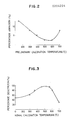
- Fig. 2 shows results obtained when the catalysts obtained in Example 16 where the preliminary calcination temperature was varied were subjected to the above abrasion test. It is apparent from this Fig. 2 that the percentage abrasion is low at a preliminary calcination temperature of 300° to 600°C and catalyst having a high strength is obtained. Thus it is indispensable for improving the abrasion strength to add MoO3 after the catalyst has been subjected to preliminary calcination in advance.
- Fig. 3 shows the percentages denitration before and after the catalyst deterioration test in the case where the catalyst calcination temperature in Example 16 was varied.
- calcination of catalyst after addition of MoO3 has a function of reducing the catalyst deterioration.
- a peak attributing to MoO3 is not observed after calcination; hence the above function is an effect accompanying the thermal dispersing of MoO3.
- Example 16 when the results of Example 16 are compared with those of Comparative example 15 in Table 5, it is seen that in the case of Comparative example 15 using ammonium molybdate as molybdenum raw material, the percentage abrasion of catalyst notably increased.
- the present invention is achieved by adding MoO3 to a titanium oxide catalyst prepared in advance and preliminarily calcining the mixture, followed by molding and calcining the mixture.
- Example 16 and Comparative example 12 The catalyst-molding process in Example 16 and Comparative example 12 was replaced by an extrusion-molding process by means of a molding machine provided with a die having a hole diameter of 10mm ⁇ to obtain a columnar catalyst of 10 ⁇ .
- the crushing strength of the resulting catalysts in the radial direction thereof was measured by Kiya type tablet strength meter.
- the strength of the former catalyst was 13kg, whereas that of the latter was 5.4kg.
- the surface of the molded product of the latter caused fine split, whereas the latter did not cause such a phenomenon. This is considered due to the effect of MoO3 upon improving the fluidability of paste.
- the process of the present invention is also suitable to extrusion-molding into honeycomb, cylindrical or columnar catalyst.
- the present invention since it is possible to retain a high denitration performance for a long time even in exhaust gases containing vapors of heavy metal compounds, it is possible to realize a denitration apparatus by the use of which the quantity of catalyst used is small. Particularly in the case of an ash-circulating boiler, since the concentration of heavy metal vapors is very high, the quantity of conventional catalysts used is calculated to be twice to three times the quantity in the case of conventional demitration apparatus, whereas in the case of the catalyst of the present invention, there are an effect that it is almost unnecessary to increase the quantity of the catalyst used, and the like effect.
- the process of the present invention is a process having enhanced the strength and resistance to poison of catalyst according to a preparation based on the specific features of the catalyst components so that it is possible to obtain a catalyst having a superior performance through far simpler steps than those of binder addition process or the like.
- the preferred embodiment of the present invention can provide a catalyst which is prevented from its deterioration due to vapors of heavy metal compounds contained in exhaust gases.
- the present invention can further provide a process for producing a catalyst having overcome the drawbacks of the above-mentioned prior art and having a high strength and a superior resistance to poisons with a simple process.
Landscapes
- Chemical & Material Sciences (AREA)
- Engineering & Computer Science (AREA)
- Chemical Kinetics & Catalysis (AREA)
- Environmental & Geological Engineering (AREA)
- Health & Medical Sciences (AREA)
- Organic Chemistry (AREA)
- Materials Engineering (AREA)
- Biomedical Technology (AREA)
- Analytical Chemistry (AREA)
- General Chemical & Material Sciences (AREA)
- Oil, Petroleum & Natural Gas (AREA)
- Catalysts (AREA)
- Exhaust Gas Treatment By Means Of Catalyst (AREA)
Priority Applications (1)
| Application Number | Priority Date | Filing Date | Title |
|---|---|---|---|
| AT88305054T ATE97015T1 (de) | 1987-06-05 | 1988-06-03 | Verfahren zur herstellung eines katalysators zur denitrierung durch katalytische reduktion mit ammoniak. |
Applications Claiming Priority (2)
| Application Number | Priority Date | Filing Date | Title |
|---|---|---|---|
| JP14117687 | 1987-06-05 | ||
| JP141176/87 | 1987-06-05 |
Publications (3)
| Publication Number | Publication Date |
|---|---|
| EP0294204A2 true EP0294204A2 (de) | 1988-12-07 |
| EP0294204A3 EP0294204A3 (en) | 1989-09-20 |
| EP0294204B1 EP0294204B1 (de) | 1993-11-10 |
Family
ID=15285910
Family Applications (1)
| Application Number | Title | Priority Date | Filing Date |
|---|---|---|---|
| EP88305054A Expired - Lifetime EP0294204B1 (de) | 1987-06-05 | 1988-06-03 | Verfahren zur Herstellung eines Katalysators zur Denitrierung durch katalytische Reduktion mit Ammoniak |
Country Status (4)
| Country | Link |
|---|---|
| US (1) | US4966882A (de) |
| EP (1) | EP0294204B1 (de) |
| AT (1) | ATE97015T1 (de) |
| DE (1) | DE3885512T2 (de) |
Cited By (3)
| Publication number | Priority date | Publication date | Assignee | Title |
|---|---|---|---|---|
| EP0375391A1 (de) * | 1988-12-21 | 1990-06-27 | Babcock-Hitachi Kabushiki Kaisha | Katalysator zur Entfernung von Stickoxiden und sein Herstellungsverfahren |
| WO1996011740A1 (fr) * | 1994-10-13 | 1996-04-25 | Rhone-Poulenc Chimie | Compositions catalytiques pour la reduction des oxydes d'azote a base de tantale, de vanadium, de niobium, de cuivre ou d'antimoine |
| CN104707593A (zh) * | 2013-12-16 | 2015-06-17 | 中国科学院大连化学物理研究所 | 以偏钛酸为原料制备整体挤出式蜂窝状脱硝催化剂的方法 |
Families Citing this family (11)
| Publication number | Priority date | Publication date | Assignee | Title |
|---|---|---|---|---|
| US5198403A (en) * | 1989-02-28 | 1993-03-30 | Degussa Ag | Process for producing a catalyst for selective reduction of nitrous oxides with ammonia |
| JPH06509273A (ja) * | 1991-07-29 | 1994-10-20 | ビーティージー・インターナショナル・リミテッド | 触媒および接触還元 |
| DE19844758C1 (de) * | 1998-09-29 | 2000-07-06 | Siemens Ag | Verfahren zur Herstellung eines Katalysatorkörpers |
| US20030166972A1 (en) * | 2002-02-20 | 2003-09-04 | Regents Of The University Of California Office Of Technology Licensing | Process for production of formaldehyde from dimethyl ether |
| US7939842B2 (en) * | 2005-01-27 | 2011-05-10 | Cree, Inc. | Light emitting device packages, light emitting diode (LED) packages and related methods |
| US7803201B2 (en) * | 2005-02-09 | 2010-09-28 | Headwaters Technology Innovation, Llc | Organically complexed nanocatalysts for improving combustion properties of fuels and fuel compositions incorporating such catalysts |
| US7856992B2 (en) * | 2005-02-09 | 2010-12-28 | Headwaters Technology Innovation, Llc | Tobacco catalyst and methods for reducing the amount of undesirable small molecules in tobacco smoke |
| US7357903B2 (en) * | 2005-04-12 | 2008-04-15 | Headwaters Heavy Oil, Llc | Method for reducing NOx during combustion of coal in a burner |
| US7758660B2 (en) * | 2006-02-09 | 2010-07-20 | Headwaters Technology Innovation, Llc | Crystalline nanocatalysts for improving combustion properties of fuels and fuel compositions incorporating such catalysts |
| EP3322520A1 (de) * | 2015-07-14 | 2018-05-23 | Bp P.L.C. | Extrudierte materialien auf der basis von titanoxid mit einer oder mehreren säuren oder hergestellt mit einer oder mehreren säuren |
| CN111495174A (zh) * | 2019-01-30 | 2020-08-07 | 国家能源投资集团有限责任公司 | 脱硝催化剂及其制备方法和应用 |
Family Cites Families (9)
| Publication number | Priority date | Publication date | Assignee | Title |
|---|---|---|---|---|
| US4085193A (en) * | 1973-12-12 | 1978-04-18 | Mitsubishi Petrochemical Co. Ltd. | Catalytic process for reducing nitrogen oxides to nitrogen |
| JPS5820303B2 (ja) * | 1975-04-24 | 1983-04-22 | 三菱油化株式会社 | チツソサンカブツノカンゲンヨウシヨクバイソセイブツ |
| JPS5548007A (en) * | 1978-06-23 | 1980-04-05 | Glacier Industries | Automatic cake case packing machine |
| JPS56168835A (en) * | 1980-05-31 | 1981-12-25 | Mitsubishi Petrochem Co Ltd | Denitrating catalyst and denitrating method |
| JPS58183946A (ja) * | 1982-04-20 | 1983-10-27 | Mitsubishi Heavy Ind Ltd | 脱硝触媒及びその調製法 |
| DE3531810A1 (de) * | 1985-09-06 | 1987-03-19 | Kraftwerk Union Ag | Katalysatormaterial zur reduktion von stickoxiden |
| DE3634335A1 (de) * | 1986-03-06 | 1988-04-21 | Siemens Ag | Katalysatormaterial zur minderung der stickoxide in rauchgasen |
| JPH0817939B2 (ja) * | 1986-11-19 | 1996-02-28 | 三菱化学株式会社 | 排煙脱硝触媒 |
| JPH03147548A (ja) * | 1989-11-02 | 1991-06-24 | Canon Inc | 光学的記録装置 |
-
1988
- 1988-06-02 US US07/201,536 patent/US4966882A/en not_active Expired - Lifetime
- 1988-06-03 DE DE88305054T patent/DE3885512T2/de not_active Expired - Fee Related
- 1988-06-03 EP EP88305054A patent/EP0294204B1/de not_active Expired - Lifetime
- 1988-06-03 AT AT88305054T patent/ATE97015T1/de not_active IP Right Cessation
Cited By (4)
| Publication number | Priority date | Publication date | Assignee | Title |
|---|---|---|---|---|
| EP0375391A1 (de) * | 1988-12-21 | 1990-06-27 | Babcock-Hitachi Kabushiki Kaisha | Katalysator zur Entfernung von Stickoxiden und sein Herstellungsverfahren |
| WO1996011740A1 (fr) * | 1994-10-13 | 1996-04-25 | Rhone-Poulenc Chimie | Compositions catalytiques pour la reduction des oxydes d'azote a base de tantale, de vanadium, de niobium, de cuivre ou d'antimoine |
| CN104707593A (zh) * | 2013-12-16 | 2015-06-17 | 中国科学院大连化学物理研究所 | 以偏钛酸为原料制备整体挤出式蜂窝状脱硝催化剂的方法 |
| CN104707593B (zh) * | 2013-12-16 | 2017-08-29 | 中国科学院大连化学物理研究所 | 以偏钛酸为原料制备整体挤出式蜂窝状脱硝催化剂的方法 |
Also Published As
| Publication number | Publication date |
|---|---|
| EP0294204B1 (de) | 1993-11-10 |
| US4966882A (en) | 1990-10-30 |
| DE3885512D1 (de) | 1993-12-16 |
| EP0294204A3 (en) | 1989-09-20 |
| DE3885512T2 (de) | 1994-04-28 |
| ATE97015T1 (de) | 1993-11-15 |
Similar Documents
| Publication | Publication Date | Title |
|---|---|---|
| EP0314392B1 (de) | Katalysator zur Entfernung von Stickstoffoxyden | |
| US5087600A (en) | Process for producing a catalyst for denitration by catalytic reduction using ammonia | |
| EP0323195B1 (de) | Verfahren zur Entfernung von Stickstoffoxiden | |
| EP0294204B1 (de) | Verfahren zur Herstellung eines Katalysators zur Denitrierung durch katalytische Reduktion mit Ammoniak | |
| CN1091637C (zh) | 降低流动介质中氮氧化物的催化剂和其制备方法 | |
| DE112007000814B4 (de) | Verfahren zur Herstellung eines selektiv reduzierenden Katalysators für die Rauchgas-Entstickung und Verfahren zur Entfernung von Stickoxiden aus Rauchgas mit diesem Katalysator | |
| GB2193655A (en) | Catalyst for removing nitrogen oxides from exhaust gases | |
| US4891348A (en) | Catalyst for removing nitrogen oxides in exhaust gases | |
| CA2005412A1 (en) | Process for reducing nitric oxides contained in flue gases | |
| EP0365308B1 (de) | Katalysator zur Reinigung von Abgasen, Verfahren zur Herstellung und Verwendung des Katalysators | |
| JP4098703B2 (ja) | 窒素酸化物除去用触媒および窒素酸化物除去方法 | |
| EP0317293B1 (de) | Verfahren zur Entfernung von Stickoxiden und Katalysator zur Anwendung in diesem Verfahren | |
| EP0292310A2 (de) | Verfahren zum Entfernen von Stickoxyden | |
| GB2079172A (en) | Catalyst for removing nitrogen oxides | |
| JP2020515384A (ja) | 排ガスを処理するための触媒、排気システム及び方法 | |
| US5166122A (en) | Process for producing a denitration catalyst | |
| JP2991431B2 (ja) | アンモニア接触還元脱硝用触媒およびその製法 | |
| JP3496964B2 (ja) | 排ガス中の窒素酸化物のアンモニア還元用触媒およびその製造方法 | |
| JP2583912B2 (ja) | 窒素酸化物除去用触媒 | |
| EP0360548B2 (de) | Verfahren für die Herstellung eines Katalysators zur Entfernung von Stickoxiden | |
| JPH01317545A (ja) | 脱硝触媒の製造方法 | |
| JPS629368B2 (de) | ||
| JPS63147546A (ja) | 排ガス中の窒素酸化物の除去方法 | |
| JPH09187652A (ja) | 排煙脱硝触媒の製造方法 | |
| JPH0596165A (ja) | 二酸化硫黄の酸化を抑制した脱硝触媒およびその製造方法 |
Legal Events
| Date | Code | Title | Description |
|---|---|---|---|
| PUAI | Public reference made under article 153(3) epc to a published international application that has entered the european phase |
Free format text: ORIGINAL CODE: 0009012 |
|
| AK | Designated contracting states |
Kind code of ref document: A2 Designated state(s): AT DE FR GB IT |
|
| PUAL | Search report despatched |
Free format text: ORIGINAL CODE: 0009013 |
|
| AK | Designated contracting states |
Kind code of ref document: A3 Designated state(s): AT DE FR GB IT |
|
| 17P | Request for examination filed |
Effective date: 19900102 |
|
| 17Q | First examination report despatched |
Effective date: 19910619 |
|
| GRAA | (expected) grant |
Free format text: ORIGINAL CODE: 0009210 |
|
| AK | Designated contracting states |
Kind code of ref document: B1 Designated state(s): AT DE FR GB IT |
|
| REF | Corresponds to: |
Ref document number: 97015 Country of ref document: AT Date of ref document: 19931115 Kind code of ref document: T |
|
| ITF | It: translation for a ep patent filed | ||
| REF | Corresponds to: |
Ref document number: 3885512 Country of ref document: DE Date of ref document: 19931216 |
|
| ET | Fr: translation filed | ||
| PLBE | No opposition filed within time limit |
Free format text: ORIGINAL CODE: 0009261 |
|
| STAA | Information on the status of an ep patent application or granted ep patent |
Free format text: STATUS: NO OPPOSITION FILED WITHIN TIME LIMIT |
|
| 26N | No opposition filed | ||
| REG | Reference to a national code |
Ref country code: GB Ref legal event code: IF02 |
|
| PGFP | Annual fee paid to national office [announced via postgrant information from national office to epo] |
Ref country code: GB Payment date: 20060516 Year of fee payment: 19 |
|
| PGFP | Annual fee paid to national office [announced via postgrant information from national office to epo] |
Ref country code: FR Payment date: 20060522 Year of fee payment: 19 |
|
| PGFP | Annual fee paid to national office [announced via postgrant information from national office to epo] |
Ref country code: AT Payment date: 20060613 Year of fee payment: 19 |
|
| PGFP | Annual fee paid to national office [announced via postgrant information from national office to epo] |
Ref country code: IT Payment date: 20060630 Year of fee payment: 19 |
|
| PGFP | Annual fee paid to national office [announced via postgrant information from national office to epo] |
Ref country code: DE Payment date: 20060726 Year of fee payment: 19 |
|
| GBPC | Gb: european patent ceased through non-payment of renewal fee |
Effective date: 20070603 |
|
| PG25 | Lapsed in a contracting state [announced via postgrant information from national office to epo] |
Ref country code: AT Free format text: LAPSE BECAUSE OF NON-PAYMENT OF DUE FEES Effective date: 20070603 |
|
| REG | Reference to a national code |
Ref country code: FR Ref legal event code: ST Effective date: 20080229 |
|
| PG25 | Lapsed in a contracting state [announced via postgrant information from national office to epo] |
Ref country code: DE Free format text: LAPSE BECAUSE OF NON-PAYMENT OF DUE FEES Effective date: 20080101 |
|
| PG25 | Lapsed in a contracting state [announced via postgrant information from national office to epo] |
Ref country code: GB Free format text: LAPSE BECAUSE OF NON-PAYMENT OF DUE FEES Effective date: 20070603 |
|
| PG25 | Lapsed in a contracting state [announced via postgrant information from national office to epo] |
Ref country code: FR Free format text: LAPSE BECAUSE OF NON-PAYMENT OF DUE FEES Effective date: 20070702 |
|
| PG25 | Lapsed in a contracting state [announced via postgrant information from national office to epo] |
Ref country code: IT Free format text: LAPSE BECAUSE OF NON-PAYMENT OF DUE FEES Effective date: 20070603 |