EP0294687A1 - Verwendung von Salzen von Sulfonamidocarbonsäuren als Korrosionsinhibitoren in wässrigen Systemen - Google Patents
Verwendung von Salzen von Sulfonamidocarbonsäuren als Korrosionsinhibitoren in wässrigen Systemen Download PDFInfo
- Publication number
- EP0294687A1 EP0294687A1 EP88108665A EP88108665A EP0294687A1 EP 0294687 A1 EP0294687 A1 EP 0294687A1 EP 88108665 A EP88108665 A EP 88108665A EP 88108665 A EP88108665 A EP 88108665A EP 0294687 A1 EP0294687 A1 EP 0294687A1
- Authority
- EP
- European Patent Office
- Prior art keywords
- formula
- compound
- corrosion
- aqueous systems
- corrosion inhibitors
- Prior art date
- Legal status (The legal status is an assumption and is not a legal conclusion. Google has not performed a legal analysis and makes no representation as to the accuracy of the status listed.)
- Granted
Links
- 230000007797 corrosion Effects 0.000 title claims abstract description 30
- 238000005260 corrosion Methods 0.000 title claims abstract description 30
- 239000003112 inhibitor Substances 0.000 title claims abstract description 15
- 150000003839 salts Chemical class 0.000 title claims abstract description 14
- 239000002253 acid Substances 0.000 title abstract description 5
- 150000001875 compounds Chemical class 0.000 claims description 17
- 238000000034 method Methods 0.000 claims description 11
- XEEYBQQBJWHFJM-UHFFFAOYSA-N Iron Chemical compound [Fe] XEEYBQQBJWHFJM-UHFFFAOYSA-N 0.000 claims description 8
- 125000004432 carbon atom Chemical group C* 0.000 claims description 8
- 229910045601 alloy Inorganic materials 0.000 claims description 6
- 239000000956 alloy Substances 0.000 claims description 6
- RYGMFSIKBFXOCR-UHFFFAOYSA-N Copper Chemical compound [Cu] RYGMFSIKBFXOCR-UHFFFAOYSA-N 0.000 claims description 4
- 239000003513 alkali Substances 0.000 claims description 4
- 229910052782 aluminium Inorganic materials 0.000 claims description 4
- XAGFODPZIPBFFR-UHFFFAOYSA-N aluminium Chemical compound [Al] XAGFODPZIPBFFR-UHFFFAOYSA-N 0.000 claims description 4
- 229910052802 copper Inorganic materials 0.000 claims description 4
- 239000010949 copper Substances 0.000 claims description 4
- 229910052742 iron Inorganic materials 0.000 claims description 4
- HCHKCACWOHOZIP-UHFFFAOYSA-N Zinc Chemical compound [Zn] HCHKCACWOHOZIP-UHFFFAOYSA-N 0.000 claims description 3
- CIUQDSCDWFSTQR-UHFFFAOYSA-N [C]1=CC=CC=C1 Chemical compound [C]1=CC=CC=C1 CIUQDSCDWFSTQR-UHFFFAOYSA-N 0.000 claims description 3
- 125000001997 phenyl group Chemical group [H]C1=C([H])C([H])=C(*)C([H])=C1[H] 0.000 claims description 3
- 125000003944 tolyl group Chemical group 0.000 claims description 3
- 239000011701 zinc Substances 0.000 claims description 3
- 229910052725 zinc Inorganic materials 0.000 claims description 3
- -1 alkali metal salts Chemical class 0.000 abstract description 7
- 150000007513 acids Chemical class 0.000 abstract description 4
- 229910052783 alkali metal Inorganic materials 0.000 abstract description 3
- XLYOFNOQVPJJNP-UHFFFAOYSA-N water Substances O XLYOFNOQVPJJNP-UHFFFAOYSA-N 0.000 description 7
- GSEJCLTVZPLZKY-UHFFFAOYSA-N Triethanolamine Chemical class OCCN(CCO)CCO GSEJCLTVZPLZKY-UHFFFAOYSA-N 0.000 description 4
- 239000000203 mixture Substances 0.000 description 4
- 230000000694 effects Effects 0.000 description 3
- DHMQDGOQFOQNFH-UHFFFAOYSA-N Glycine Chemical compound NCC(O)=O DHMQDGOQFOQNFH-UHFFFAOYSA-N 0.000 description 2
- 239000000654 additive Substances 0.000 description 2
- 239000007795 chemical reaction product Substances 0.000 description 2
- 238000005187 foaming Methods 0.000 description 2
- 230000005764 inhibitory process Effects 0.000 description 2
- 229910052751 metal Inorganic materials 0.000 description 2
- 239000002184 metal Substances 0.000 description 2
- 150000002739 metals Chemical class 0.000 description 2
- 125000002496 methyl group Chemical group [H]C([H])([H])* 0.000 description 2
- 229910052757 nitrogen Inorganic materials 0.000 description 2
- 230000035945 sensitivity Effects 0.000 description 2
- 239000000243 solution Substances 0.000 description 2
- 239000000126 substance Substances 0.000 description 2
- GGHHDNPWIMLRBX-UHFFFAOYSA-N 2-[benzenesulfonyl(methyl)amino]hexanoic acid Chemical compound CCCCC(C(O)=O)N(C)S(=O)(=O)C1=CC=CC=C1 GGHHDNPWIMLRBX-UHFFFAOYSA-N 0.000 description 1
- MUVSERCYUMDSPN-UHFFFAOYSA-N 2-aminopropane-1,1,2-triol Chemical compound CC(N)(O)C(O)O MUVSERCYUMDSPN-UHFFFAOYSA-N 0.000 description 1
- 239000004471 Glycine Substances 0.000 description 1
- DGAQECJNVWCQMB-PUAWFVPOSA-M Ilexoside XXIX Chemical compound C[C@@H]1CC[C@@]2(CC[C@@]3(C(=CC[C@H]4[C@]3(CC[C@@H]5[C@@]4(CC[C@@H](C5(C)C)OS(=O)(=O)[O-])C)C)[C@@H]2[C@]1(C)O)C)C(=O)O[C@H]6[C@@H]([C@H]([C@@H]([C@H](O6)CO)O)O)O.[Na+] DGAQECJNVWCQMB-PUAWFVPOSA-M 0.000 description 1
- UEEJHVSXFDXPFK-UHFFFAOYSA-N N-dimethylaminoethanol Chemical compound CN(C)CCO UEEJHVSXFDXPFK-UHFFFAOYSA-N 0.000 description 1
- 108010077895 Sarcosine Proteins 0.000 description 1
- 229910000831 Steel Inorganic materials 0.000 description 1
- 125000002252 acyl group Chemical group 0.000 description 1
- 125000001931 aliphatic group Chemical group 0.000 description 1
- 150000001340 alkali metals Chemical class 0.000 description 1
- 150000003973 alkyl amines Chemical class 0.000 description 1
- 150000001408 amides Chemical class 0.000 description 1
- 150000001412 amines Chemical class 0.000 description 1
- 239000012736 aqueous medium Substances 0.000 description 1
- 239000007864 aqueous solution Substances 0.000 description 1
- 230000033228 biological regulation Effects 0.000 description 1
- 230000005540 biological transmission Effects 0.000 description 1
- 125000000484 butyl group Chemical group [H]C([*])([H])C([H])([H])C([H])([H])C([H])([H])[H] 0.000 description 1
- 125000003178 carboxy group Chemical group [H]OC(*)=O 0.000 description 1
- 150000003841 chloride salts Chemical class 0.000 description 1
- 238000004140 cleaning Methods 0.000 description 1
- 239000002826 coolant Substances 0.000 description 1
- 238000001816 cooling Methods 0.000 description 1
- 239000005068 cooling lubricant Substances 0.000 description 1
- 239000000498 cooling water Substances 0.000 description 1
- 125000001495 ethyl group Chemical group [H]C([H])([H])C([H])([H])* 0.000 description 1
- 239000003925 fat Substances 0.000 description 1
- 239000012530 fluid Substances 0.000 description 1
- 239000006260 foam Substances 0.000 description 1
- 238000009472 formulation Methods 0.000 description 1
- 125000004051 hexyl group Chemical group [H]C([H])([H])C([H])([H])C([H])([H])C([H])([H])C([H])([H])C([H])([H])* 0.000 description 1
- 125000004435 hydrogen atom Chemical group [H]* 0.000 description 1
- 238000009776 industrial production Methods 0.000 description 1
- 125000001449 isopropyl group Chemical group [H]C([H])([H])C([H])(*)C([H])([H])[H] 0.000 description 1
- 150000004668 long chain fatty acids Chemical class 0.000 description 1
- 231100000053 low toxicity Toxicity 0.000 description 1
- 238000004519 manufacturing process Methods 0.000 description 1
- CRVGTESFCCXCTH-UHFFFAOYSA-N methyl diethanolamine Chemical compound OCCN(C)CCO CRVGTESFCCXCTH-UHFFFAOYSA-N 0.000 description 1
- 238000005065 mining Methods 0.000 description 1
- 230000007935 neutral effect Effects 0.000 description 1
- 125000004433 nitrogen atom Chemical group N* 0.000 description 1
- 125000003261 o-tolyl group Chemical group [H]C1=C([H])C(*)=C(C([H])=C1[H])C([H])([H])[H] 0.000 description 1
- 239000003921 oil Substances 0.000 description 1
- 150000002894 organic compounds Chemical class 0.000 description 1
- 125000001147 pentyl group Chemical group C(CCCC)* 0.000 description 1
- 159000000001 potassium salts Chemical class 0.000 description 1
- 125000001436 propyl group Chemical group [H]C([*])([H])C([H])([H])C([H])([H])[H] 0.000 description 1
- 230000001681 protective effect Effects 0.000 description 1
- FSYKKLYZXJSNPZ-UHFFFAOYSA-N sarcosine Chemical compound C[NH2+]CC([O-])=O FSYKKLYZXJSNPZ-UHFFFAOYSA-N 0.000 description 1
- 239000000344 soap Substances 0.000 description 1
- 229910052708 sodium Inorganic materials 0.000 description 1
- 239000011734 sodium Substances 0.000 description 1
- 229910000679 solder Inorganic materials 0.000 description 1
- 239000010959 steel Substances 0.000 description 1
- 125000001424 substituent group Chemical group 0.000 description 1
- 238000006467 substitution reaction Methods 0.000 description 1
- MMNTZXRQPVRSSO-UHFFFAOYSA-N sulfamoylformic acid Chemical compound NS(=O)(=O)C(O)=O MMNTZXRQPVRSSO-UHFFFAOYSA-N 0.000 description 1
- 229940124530 sulfonamide Drugs 0.000 description 1
- 231100000419 toxicity Toxicity 0.000 description 1
- 230000001988 toxicity Effects 0.000 description 1
- 239000001993 wax Substances 0.000 description 1
Classifications
-
- C—CHEMISTRY; METALLURGY
- C23—COATING METALLIC MATERIAL; COATING MATERIAL WITH METALLIC MATERIAL; CHEMICAL SURFACE TREATMENT; DIFFUSION TREATMENT OF METALLIC MATERIAL; COATING BY VACUUM EVAPORATION, BY SPUTTERING, BY ION IMPLANTATION OR BY CHEMICAL VAPOUR DEPOSITION, IN GENERAL; INHIBITING CORROSION OF METALLIC MATERIAL OR INCRUSTATION IN GENERAL
- C23F—NON-MECHANICAL REMOVAL OF METALLIC MATERIAL FROM SURFACE; INHIBITING CORROSION OF METALLIC MATERIAL OR INCRUSTATION IN GENERAL; MULTI-STEP PROCESSES FOR SURFACE TREATMENT OF METALLIC MATERIAL INVOLVING AT LEAST ONE PROCESS PROVIDED FOR IN CLASS C23 AND AT LEAST ONE PROCESS COVERED BY SUBCLASS C21D OR C22F OR CLASS C25
- C23F11/00—Inhibiting corrosion of metallic material by applying inhibitors to the surface in danger of corrosion or adding them to the corrosive agent
- C23F11/08—Inhibiting corrosion of metallic material by applying inhibitors to the surface in danger of corrosion or adding them to the corrosive agent in other liquids
- C23F11/10—Inhibiting corrosion of metallic material by applying inhibitors to the surface in danger of corrosion or adding them to the corrosive agent in other liquids using organic inhibitors
- C23F11/16—Sulfur-containing compounds
- C23F11/164—Sulfur-containing compounds containing a -SO2-N group
Definitions
- the invention relates to the use of special sulfonamidocarboxylic acids in the form of the alkali or alkanolamine salts as corrosion inhibitors in aqueous systems.
- DE-A1-33 30 223 describes the salts of the reaction products of alkylbenzenesulfonyl chlorides with glycine or methylglycine as corrosion inhibitors in aqueous systems.
- the properties of the sulfonamido carboxylic acids described above as corrosion inhibitors are not always optimal.
- the actual corrosion protection effect is often too low, so that relatively large amounts have to be used.
- the foaming is too high and the water solubility and water hardness sensitivity, which are of considerable importance, may leave something to be desired.
- the toxicity of the substances used can also play an important role.
- the aim of the present invention is, in particular, to show substances which, in addition to low toxicity in aqueous systems, in addition to good corrosion protection, ensure low foam and low sensitivity to water hardness.
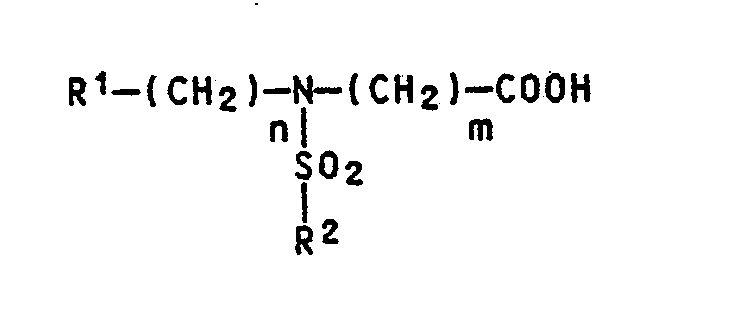
- R1 and R2 represent a phenyl radical which may be mono- or disubstituted by an alkyl radical having 1 to 6 carbon atoms and represent n 0, 1 or 2 and m 1 or 2, in the form of an alkali or an alkanolamine salt.
- the invention also relates to a method for preventing corrosion in aqueous systems by adding a compound of the formula I in the form of an alkali metal or alkanolamine salt to the aqueous system as a corrosion inhibitor.
- the salts of the formula I can also be used in the form of their mixtures.
- Alkyl radicals with 1 to 6 carbon atoms, through which the phenyl radicals can be mono- or disubstituted, are, for example, methyl, ethyl, propyl, i-propyl, butyl, pentyl, hexyl.
- the higher alkyl radicals with 3 to 6 carbon atoms are particularly suitable for simple substitution.
- R 1 and R 2 are phenyl or tolyl and n is 0 and m is 1 or 2.
- Preferred tolyl radicals are the o- and p-tolyl radicals.
- the alkali metal salts are the sodium and potassium salts and the alkanolammonium salts are the salts of mono-, di- or tri-hydroxyalkylamines having 2 to 4 carbon atoms in the hydroxyalkyl radical and mono- (C2-C4) - hydroxyalkyl-mono- or -dialkylamines having 1 to 4 carbon atoms in the alkyl radical and di- (C2-C4) -hydroxyalkyl-mono- (C1-C4) alkylamines.
- Preferred alkanolamines are mono-, di- and triethanolamine, mono-, di- and trihydroxyisopropylamine as well as N-methyldiethanolamine and dimethyl-monoethanolamine.
- they are also their mixtures, as are obtained in industrial production.
- the acids of the formula I are known in principle from the literature and can be prepared by processes known per se.
- the use of their alkanolamine salts as corrosion inhibitors is by no means apparent from the literature.
- the acids of formula I are conveniently with the above.
- the sulfonamide nitrogen atom has a hydrogen atom or an alkyl radical, preferably methyl, as a substituent.
- the compounds of the formula I to be used according to the invention have an aromatic radical or aromatic substituted alkyl radical on the nitrogen atom corresponding to the meanings of R 1 and n.
- the present invention makes the sulfonamido carboxylic acids substituted by aromatic radicals technically usable for the first time. Since corrosion inhibition and foaming behavior are very sensitive and unpredictable properties, the superior effects are not obvious, despite the relatively small structural differences.
- the corrosion inhibitors according to the invention can be used in all aqueous systems which come into contact with iron, its alloys (steels), aluminum, its alloys, zinc or copper and their alloys.
- aqueous systems which come into contact with iron, its alloys (steels), aluminum, its alloys, zinc or copper and their alloys.
- Examples include Hydraulic fluids, cooling lubricants, neutral to alkaline technical cleaners, cooling water additives, coolant or pit water, which are particularly hard and salt-rich and which are used directly in mining as mixing water e.g. are used for hydraulic processes and are particularly corrosive.
- the aqueous systems have a suitable pH range from 8.0 to 8.8.
- concentrations in practical use fluctuate depending on the area of application and the type of aqueous medium and the metals to be protected. In general, based on the aqueous system, 0.01 to 5% by weight is used. Falling below this limit generally reduces the protective effect, exceeding this does not result in any additional advantages.
- the concentration is preferably 0.1 to 2% by weight.
- the corrosion protection effect is determined in accordance with DIN Test 51360, Part 2.
- the sulfonamidocarboxylic acid to be investigated is mixed with such an amount of triethanolamine (TEA) that a 1% by weight aqueous solution has a pH of 8.2 ⁇ 0.1.
- TAA triethanolamine
- Table 2 shows the results obtained, which contain a comparison with N-methyl-benzenesulfonamidocaproic acid (commercially available).
Landscapes
- Chemical & Material Sciences (AREA)
- Engineering & Computer Science (AREA)
- Materials Engineering (AREA)
- Mechanical Engineering (AREA)
- Metallurgy (AREA)
- Organic Chemistry (AREA)
- Preventing Corrosion Or Incrustation Of Metals (AREA)
- Lubricants (AREA)
- Detergent Compositions (AREA)
- Organic Low-Molecular-Weight Compounds And Preparation Thereof (AREA)
Abstract
Description
- Die Erfindung betrifft die Verwendung spezieller Sulfonamidocarbonsäuren in Form der Alkali- oder Alkanolaminsalze als Korrosionsinhibitoren in wäßrigen Systemen.
- In technischen Prozessen, beispielsweise Reinigungs-, Druckübertragungs- und Kühlprozessen, die sich in Gegenwart von Wasser abspielen, stellt sich immer das Problem des Korrosionsschutzes, wenn korrosionsgefährdete Metalle, wie Kupfer, Eisen, Aluminium oder deren Legierungen oder z.B. Weichlot, durch diese Prozesse betroffen werden. Für die Zwecke des Korrosionsschutzes wurden in letzter Zeit zahlreiche Inhibitoren vorgeschlagen, vor allem organische Verbindungen, wie Acylsarkoside, Amine, Alkanolamine, Amide langkettiger Fettsäuren und auch bestimmte Sulfonamidocarbonsäuren [vgl. z.B. Seifen, Öle, Fette, Wachse, 130, Heft 6, 167 bis 168, 1979].
- Weiterhin ist beispielsweise aus der DE-PS 12 98 672 bekannt, daß die Umsetzungsprodukte von aliphatischen ω-Aminosäuren mit mehr als 3 C-Atomen in der Carboxylseitenkette mit aromatischen Sulfonsäurechloriden, insbesondere in Form der Triethanolaminsalze, als Korrosionsschutzmittel verwendet werden können.
- Ebenso werden in der DE-A1-33 30 223 die Salze der Umsetzungsprodukte von Alkylbenzolsulfonsäurechloriden mit Glycin oder Methylglycin als Korrosionsinhibitoren in wäßrigen Systemen beschrieben.
- Die Eigenschaften der oben beschriebenen Sulfonamidocarbonsäuren als Korrosionsinhibitoren sind nicht immer optimal. Häufig ist die eigentliche Korrosionsschutzwirkung zu niedrig, so daß reltive große Mengen verwendet werden müssen. Teilweise ist die Schaumbildung zu hoch und die Wasserlöslichkeit und Wasserhärteempfindlichkeit, die von erheblicher Bedeutung sind, können unter Umständen zu wünschen übrig lassen. Auch die Toxizität der verwendeten Substanzen kann eine wesentliche Rolle spielen.
- Das Ziel der vorliegenden Erfindung besteht insbesondere darin, Stoffe aufzuzeigen, die neben geringer Toxizität in wäßrigen Systemen neben einem guten Korrosionsschutz Schaumarmut und niedrige Wasserhärteempfindlichkeit optimal gewährleisten.
- Es wurde nun gefunden, daß man überraschenderweise zu ausgezeichneten Ergebnissen gelangt, wenn man als Korrosionsinhibitoren in wäßrigen Systemen eine Verbindung der Formel I
- Gegenstand der Erfindung ist auch ein Verfahren zur Verhinderung von Korrosion in wäßrigen Systemen, indem man dem wäßrigen System als Korrosionsinhibitor eine Verbindung der Formel I in Form eines Alkali- oder Alkanolaminsalzes zusetzt.
- Dabei können die Salze der Formel I auch in Form ihrer Mischungen verwendet werden.
- Alkylreste mit 1 bis 6 C-Atomen, durch die die Phenylreste ein- oder zweifach substituiert sein können, sind beispielsweise Methyl, Ethyl, Propyl, i-Propyl, Butyl, Pentyl, Hexyl. Die höheren Alkylreste mit 3 bis 6 C-Atomen kommen insbesondere bei einer einfachen Substitution in Betracht.
- Von den Verbindungen der Formel I sind solche hervorzuheben, bei denen für R¹ und R² Phenyl oder Tolyl steht und n 0 und m 1 oder 2 bedeuten. Als Tolylreste kommen dabei bevorzugt der o- und p-Tolylrest in Betracht.
- Für die erfindungsgemäß in wäßrigen Systemen zu verwendenden Verbindungen kommen als Alkalisalze die Natrium- und Kaliumsalze und als Alkanolammoniumsalze die Salze von Mono-, Di- oder Tri-hydroxyalkylaminen mit 2 bis 4 C-Atomen im Hydroxyalkylrest sowie Mono-(C₂-C₄)-hydroxyalkyl-mono- oder -dialkylamine mit 1 bis 4 C-Atomen im Alkylrest und Di-(C₂-C₄)-hydroxyalkyl-mono-(C₁-C₄)-alkylamine in Betracht.
- Bevorzugte Alkanolamine sind Mono-, Di- und Triethanolamin, Mono-, Di- und Trihydroxyisopropylamin sowie N-Methyldiethanolamin und Dimethyl-monoethanolamin. In der Praxis handelt es sich neben den reinen Alkanolaminen auch um ihre Gemische, wie sie bei der technischen Herstellung anfallen.
- Die Säuren der Formel I sind grundsätzlich aus der Literatur bekannt und können nach an sich bekannten Verfahren hergestellt werden. Eine Verwendung ihrer Alkanolaminsalze als Korrosionsschutzmittel geht keinesfalls aus der Literatur hervor.
- Die Säuren der Formel I werden zweckmäßigerweise mit den o.g. Alkanolaminen im Molverhältnis 1:1 bis 1:4 in das entsprechende Salz überführt. Aus praktischen Gründen, um bei der Anwendung zweckmäßige pH-Bereiche von 8,0 bis 8,8 zu erhalten, werden meist überschüssige Mengen Alkanolamin verwendet.
- Bei den im Stand der Technik beschriebenen Verbindungen weist das Sulfonamidstickstoffatom ein Wasserstoffatom oder einen Alkylrest, bevorzugt Methyl, als Substituenten auf. Die erfindungsgemäß zu verwendenden Verbindungen der Formel I tragen entsprechend den Bedeutungen von R¹ und n einen aromatischen Rest oder aromatischen substituierten Alkylrest am Stickstoffatom. Durch die vorliegende Erfindung werden die durch aromatische Reste substituierte Sulfonamidocarbonsäuren erstmals technisch nutzbar gemacht. Da Korrosionsinhibierung und Schaumverhalten sehr sensible und nicht voraussagbare Eigenschaften sind, haben trotz relativ geringer struktureller Unterschiede die überlegenen Wirkungen nicht nahegelegen.
- Die erfindungsgemäßen Korrosionsinhibitoren können in allen wäßrigen Systemen eingesetzt werden, die mit Eisen, dessen Legierungen (Stählen), Aluminium, dessen Legierungen, Zink oder Kupfer und deren Legierungen in Berührung kommen. Zu nennen sind z.B. Hydraulikflüssigkeiten, Kühlschmierstoffe, neutrale bis alkalische technische Reiniger, Kühlwasserzusätze, Kühlerschutzmittel oder auch Grubenwässer, die besonders hart und salzreich sind und die im Bergbau direkt als Anmischwasser z.B. für hydraulische Prozesse verwendet werden und die besonders stark korrosiv wirken. Die wäßrigen Systeme weisen einen zweckmäßigen pH-Bereich von 8,0 bis 8,8 auf.
- Die Konzentrationen bei der praktischen Anwendung schwanken je nach Anwendungsbereich und Art des wäßrigen Mediums sowie der zu schützenden Metalle. Im allgemeinen setzt man - bezogen auf das wäßrige System - 0,01 bis 5 Gew.% ein. Eine Unterschreitung dieser Grenze setzt in der Regel die Schutzwirkung herab, eine Überschreitung bewirkt keine zusätzlichen Vorteile. Vorzugsweise beträgt die Konzentration 0,1 bis 2 Gew.%.
- Im übrigen können bei der Herstellung der üblichen Formulierungen die üblichen Zusätze verwendet werden.
- Die nun folgenden Beispiele (Tab 1) erläutern die Erfindung, ohne daß der Anmeldungsgegenstand hierauf beschränkt wäre.

- Die Bestimmung der Korrosionsschutzwirkung wird nach dem DIN Test 51360, Teil 2, vorgenommen. Die zu untersuchende Sulfonamidocarbonsäure wird mit einer solchen Menge Triethanolamin (TEA) gemischt, daß eine 1 gew.%ige wäßrige Lösung einen pH-Wert von 8,2 ± 0,1 aufweist.
- Von dieser Mischung werden 2 und 3 gew.%ige Lösungen mit einer bestimmten Wasserhärte gemäß der DIN-Vorschrift verwendet.
- In Tabelle 2 werden die erhaltenen Ergebnisse, die einen Vergleich mit N-Methyl-benzolsulfonamidocapronsäure (handelsüblich) enthalten, angegeben.
- Die Bewertungsskala lautet folgendermaßen:
4 = sehr starke Korrosion
3 = starke Korrosion
2 = mäßige Korrosion
1 = geringe Korrosion
0 = keine Korrosion
- Die Ergebnisse zeigen, daß bereits mit 2 gew.%igen Lösungen eine überlegene Korrosionsinhibierung gegenüber der im Handel befindlichen Verbindung erreicht wird.
Claims (10)


Applications Claiming Priority (2)
| Application Number | Priority Date | Filing Date | Title |
|---|---|---|---|
| DE19873719046 DE3719046A1 (de) | 1987-06-06 | 1987-06-06 | Verwendung von salzen von sulfonamidcarbonsaeuren als korrosionsinhibitoren in waessrigen systemen |
| DE3719046 | 1987-06-06 |
Publications (2)
| Publication Number | Publication Date |
|---|---|
| EP0294687A1 true EP0294687A1 (de) | 1988-12-14 |
| EP0294687B1 EP0294687B1 (de) | 1993-09-22 |
Family
ID=6329231
Family Applications (1)
| Application Number | Title | Priority Date | Filing Date |
|---|---|---|---|
| EP88108665A Expired - Lifetime EP0294687B1 (de) | 1987-06-06 | 1988-05-31 | Verwendung von Salzen von Sulfonamidocarbonsäuren als Korrosionsinhibitoren in wässrigen Systemen |
Country Status (4)
| Country | Link |
|---|---|
| US (1) | US4911888A (de) |
| EP (1) | EP0294687B1 (de) |
| JP (1) | JPS6415385A (de) |
| DE (2) | DE3719046A1 (de) |
Families Citing this family (6)
| Publication number | Priority date | Publication date | Assignee | Title |
|---|---|---|---|---|
| TW517067B (en) * | 1996-05-31 | 2003-01-11 | Hoffmann La Roche | Interferon conjugates |
| UA59384C2 (uk) * | 1996-12-20 | 2003-09-15 | Пфайзер, Інк. | Похідні сульфонамідів та амідів як агоністи простагландину, фармацевтична композиція та способи лікування на їх основі |
| UA67754C2 (uk) * | 1997-10-10 | 2004-07-15 | Пфайзер, Інк. | Агоністи простагландину, фармацевтична композиція на їх основі (варіанти), спосіб нарощення та збереження кісткової маси у хребетних та спосіб лікування (варіанти) |
| JP3839667B2 (ja) * | 1998-06-08 | 2006-11-01 | エフ.ホフマン−ラ ロシュ アーゲー | 慢性C型肝炎の処置のためのPeg−INF−アルファ及びリバビリンの使用 |
| DE102008064004B4 (de) | 2008-12-19 | 2011-11-24 | Clariant International Limited | Wasserbasierende Hydraulikflüssigkeiten enthaltend Dithiodi(arylcarbonsäuren) oder deren Alkalimetall-, Erdalkalimetall- oder Ammoniumsalze |
| JP7797514B2 (ja) | 2021-01-25 | 2026-01-13 | オムヤ インターナショナル アクチェンゲゼルシャフト | 食品の保存可能期間を改善するための表面反応炭酸カルシウムと酸素捕捉剤とを含むコーティング |
Citations (6)
| Publication number | Priority date | Publication date | Assignee | Title |
|---|---|---|---|---|
| DE895122C (de) * | 1939-10-21 | 1953-10-29 | Hydrierwerke A G Deutsche | Verfahren zur Verminderung des korrodierenden Einflusses von Wasser und waessrigen Loesungen auf Eisen |
| GB810560A (en) * | 1954-10-21 | 1959-03-18 | Geigy Ag J R | Improvements relating to alkylarylsulphonyl derivatives of amino acids, to corrosion and rust inhibiting compositions thereof and their use |
| FR1576681A (de) * | 1967-07-15 | 1969-08-01 | ||
| FR2249181A1 (en) * | 1973-10-30 | 1975-05-23 | Betz Laboratories | Corrosion inhibition of metallic pieces - by pretreating with aqs. medium contg. glycine cpd with long chain gp. |
| FR2479844A1 (fr) * | 1980-04-04 | 1981-10-09 | Martin Philippe | Agent anticorrosion des metaux ferreux et non ferreux, utilisable notamment pour la protection des vehicules automobiles |
| EP0142627A1 (de) * | 1983-08-22 | 1985-05-29 | Henkel Kommanditgesellschaft auf Aktien | Korrosionsinhibitoren |
Family Cites Families (2)
| Publication number | Priority date | Publication date | Assignee | Title |
|---|---|---|---|---|
| CH629540A5 (de) * | 1977-09-19 | 1982-04-30 | Hoechst Ag | Wassermischbare korrosionsschutzmittel. |
| DE2947418A1 (de) * | 1979-11-24 | 1981-06-04 | BASF Corp., New York, N.Y. | Umsetzprodukte aus sulfon- oder carbonamidocarbonsaeuren mit alkanolaminen und ihre verwendung als schaumarme korrosionsinhibitoren |
-
1987
- 1987-06-06 DE DE19873719046 patent/DE3719046A1/de not_active Withdrawn
-
1988
- 1988-05-31 EP EP88108665A patent/EP0294687B1/de not_active Expired - Lifetime
- 1988-05-31 DE DE88108665T patent/DE3884277D1/de not_active Expired - Lifetime
- 1988-06-06 JP JP63137612A patent/JPS6415385A/ja active Pending
- 1988-06-06 US US07/202,244 patent/US4911888A/en not_active Expired - Fee Related
Patent Citations (6)
| Publication number | Priority date | Publication date | Assignee | Title |
|---|---|---|---|---|
| DE895122C (de) * | 1939-10-21 | 1953-10-29 | Hydrierwerke A G Deutsche | Verfahren zur Verminderung des korrodierenden Einflusses von Wasser und waessrigen Loesungen auf Eisen |
| GB810560A (en) * | 1954-10-21 | 1959-03-18 | Geigy Ag J R | Improvements relating to alkylarylsulphonyl derivatives of amino acids, to corrosion and rust inhibiting compositions thereof and their use |
| FR1576681A (de) * | 1967-07-15 | 1969-08-01 | ||
| FR2249181A1 (en) * | 1973-10-30 | 1975-05-23 | Betz Laboratories | Corrosion inhibition of metallic pieces - by pretreating with aqs. medium contg. glycine cpd with long chain gp. |
| FR2479844A1 (fr) * | 1980-04-04 | 1981-10-09 | Martin Philippe | Agent anticorrosion des metaux ferreux et non ferreux, utilisable notamment pour la protection des vehicules automobiles |
| EP0142627A1 (de) * | 1983-08-22 | 1985-05-29 | Henkel Kommanditgesellschaft auf Aktien | Korrosionsinhibitoren |
Also Published As
| Publication number | Publication date |
|---|---|
| DE3719046A1 (de) | 1988-12-15 |
| EP0294687B1 (de) | 1993-09-22 |
| JPS6415385A (en) | 1989-01-19 |
| US4911888A (en) | 1990-03-27 |
| DE3884277D1 (de) | 1993-10-28 |
Similar Documents
| Publication | Publication Date | Title |
|---|---|---|
| DE3886626T2 (de) | Verfahren und Zusammenstellung zur Darstellung von Pyrithionen mit reduzierter Dekoloration. | |
| EP0222311B1 (de) | Verwendung von Alkoxyhydroxyfettsäuren als Korrosionsinhibitoren in Ölen und Ölhaltigen Emulsionen | |
| DE69300678T2 (de) | Gefrierschutzmittel. | |
| EP2031092A2 (de) | Amphotere Tenside enthaltende Korrosionsinhibitoren | |
| DE3000687A1 (de) | Kuehlerschutzmittel fuer wasserhaltige kuehlfluessigkeiten | |
| EP0144663B1 (de) | Verwendung von Korrosionsinhibitoren in wässrigen Systemen | |
| DE60011717T2 (de) | Phosphorarme Kühlmittelzusammensetzung | |
| DE2330340A1 (de) | Korrosionsinhibierende zubereitung | |
| EP2031095A2 (de) | Kationische Tenside enthaltende Korrosionsinhibitoren | |
| DE2722819A1 (de) | Korrosionsinhibierendes kuehl- und metallbearbeitungsmittel | |
| EP0294687B1 (de) | Verwendung von Salzen von Sulfonamidocarbonsäuren als Korrosionsinhibitoren in wässrigen Systemen | |
| CH503100A (de) | Verfahren zur Verhinderung der Korrosion durch flüssige Brennstoffe | |
| DE2840112C2 (de) | Wassermischbare Korrosionsschutzmittel und Verfahren zur Verhinderung der Korrosion von Eisenmetallen | |
| EP0163107B1 (de) | Verwendung von Benzoylalaninen als Korrosionsinhibitoren für wässrige Systeme | |
| DE19648843C2 (de) | Melamin-polycarbonsäureamide und ihre Verwendung als Korrosionsschutzmittel | |
| EP0216280B1 (de) | Verwendung von Alkenylbernsteinsäurehalbamiden als Korrosionsschutzmittel | |
| DE10043040A1 (de) | Verwendung von N-Alkyl-beta-alanin-Derivaten zur Herstellung von reinigenden Korrosionsschutzmitteln | |
| DE3300874A1 (de) | Bernsteinsaeurederivate als korrosionsschutzmittel | |
| EP0142627B1 (de) | Korrosionsinhibitoren | |
| EP0726335B1 (de) | Lactobionsäureamid enthaltende Korrosionsschutzmittel | |
| DE895122C (de) | Verfahren zur Verminderung des korrodierenden Einflusses von Wasser und waessrigen Loesungen auf Eisen | |
| DE3701719A1 (de) | Korrosionsschutzmittel, enthaltend mischungen mit amidsaeuren | |
| EP0192132A2 (de) | Wässrige Korrosionsschutzmittel enthaltend ein 2-Benzthia-zolylthiocarbonsäure-Ammonium-Salz | |
| EP0205114B1 (de) | Spezielle Benzoylalanine und ihre Verwendung als Korrosionsinhibitoren für wässrige Systeme | |
| EP0464473B1 (de) | Salze von Alkenylbernsteinsäurehalbamiden und deren Verwendung als Korrosionsschutzmittel und Emulgatoren für Metallbearbeitungsöle |
Legal Events
| Date | Code | Title | Description |
|---|---|---|---|
| PUAI | Public reference made under article 153(3) epc to a published international application that has entered the european phase |
Free format text: ORIGINAL CODE: 0009012 |
|
| 17P | Request for examination filed |
Effective date: 19881018 |
|
| AK | Designated contracting states |
Kind code of ref document: A1 Designated state(s): CH DE FR GB IT LI |
|
| 17Q | First examination report despatched |
Effective date: 19910903 |
|
| GRAA | (expected) grant |
Free format text: ORIGINAL CODE: 0009210 |
|
| AK | Designated contracting states |
Kind code of ref document: B1 Designated state(s): CH DE FR GB IT LI |
|
| PG25 | Lapsed in a contracting state [announced via postgrant information from national office to epo] |
Ref country code: IT Free format text: LAPSE BECAUSE OF FAILURE TO SUBMIT A TRANSLATION OF THE DESCRIPTION OR TO PAY THE FEE WITHIN THE PRE;WARNING: LAPSES OF ITALIAN PATENTS WITH EFFECTIVE DATE BEFORE 2007 MAY HAVE OCCURRED AT ANY TIME BEFORE 2007. THE CORRECT EFFECTIVE DATE MAY BE DIFFERENT FROM THE ONE RECORDED.SCRIBED TIME-LIMIT Effective date: 19930922 Ref country code: FR Effective date: 19930922 Ref country code: GB Effective date: 19930922 |
|
| REF | Corresponds to: |
Ref document number: 3884277 Country of ref document: DE Date of ref document: 19931028 |
|
| EN | Fr: translation not filed | ||
| GBV | Gb: ep patent (uk) treated as always having been void in accordance with gb section 77(7)/1977 [no translation filed] |
Effective date: 19930922 |
|
| PG25 | Lapsed in a contracting state [announced via postgrant information from national office to epo] |
Ref country code: LI Effective date: 19940531 Ref country code: CH Effective date: 19940531 |
|
| PLBE | No opposition filed within time limit |
Free format text: ORIGINAL CODE: 0009261 |
|
| STAA | Information on the status of an ep patent application or granted ep patent |
Free format text: STATUS: NO OPPOSITION FILED WITHIN TIME LIMIT |
|
| 26N | No opposition filed | ||
| REG | Reference to a national code |
Ref country code: CH Ref legal event code: PL |
|
| PGFP | Annual fee paid to national office [announced via postgrant information from national office to epo] |
Ref country code: DE Payment date: 19960528 Year of fee payment: 9 |
|
| PG25 | Lapsed in a contracting state [announced via postgrant information from national office to epo] |
Ref country code: DE Effective date: 19970516 |