EP0300865A1 - Dérivés de N-aminobutyl N-phényl arylamides, leur préparation et leur application en thérapeutique - Google Patents
Dérivés de N-aminobutyl N-phényl arylamides, leur préparation et leur application en thérapeutique Download PDFInfo
- Publication number
- EP0300865A1 EP0300865A1 EP88401741A EP88401741A EP0300865A1 EP 0300865 A1 EP0300865 A1 EP 0300865A1 EP 88401741 A EP88401741 A EP 88401741A EP 88401741 A EP88401741 A EP 88401741A EP 0300865 A1 EP0300865 A1 EP 0300865A1
- Authority
- EP
- European Patent Office
- Prior art keywords
- group
- formula
- alkyl
- trifluoromethyl
- taken
- Prior art date
- Legal status (The legal status is an assumption and is not a legal conclusion. Google has not performed a legal analysis and makes no representation as to the accuracy of the status listed.)
- Granted
Links
- 0 **(*)C1=C=N1 Chemical compound **(*)C1=C=N1 0.000 description 1
Classifications
-
- C—CHEMISTRY; METALLURGY
- C07—ORGANIC CHEMISTRY
- C07C—ACYCLIC OR CARBOCYCLIC COMPOUNDS
- C07C233/00—Carboxylic acid amides
- C07C233/64—Carboxylic acid amides having carbon atoms of carboxamide groups bound to carbon atoms of six-membered aromatic rings
- C07C233/67—Carboxylic acid amides having carbon atoms of carboxamide groups bound to carbon atoms of six-membered aromatic rings having the nitrogen atom of at least one of the carboxamide groups bound to a carbon atom of a hydrocarbon radical substituted by singly-bound oxygen atoms
- C07C233/75—Carboxylic acid amides having carbon atoms of carboxamide groups bound to carbon atoms of six-membered aromatic rings having the nitrogen atom of at least one of the carboxamide groups bound to a carbon atom of a hydrocarbon radical substituted by singly-bound oxygen atoms with the substituted hydrocarbon radical bound to the nitrogen atom of the carboxamide group by a carbon atom of a six-membered aromatic ring
-
- C—CHEMISTRY; METALLURGY
- C07—ORGANIC CHEMISTRY
- C07D—HETEROCYCLIC COMPOUNDS
- C07D213/00—Heterocyclic compounds containing six-membered rings, not condensed with other rings, with one nitrogen atom as the only ring hetero atom and three or more double bonds between ring members or between ring members and non-ring members
- C07D213/02—Heterocyclic compounds containing six-membered rings, not condensed with other rings, with one nitrogen atom as the only ring hetero atom and three or more double bonds between ring members or between ring members and non-ring members having three double bonds between ring members or between ring members and non-ring members
- C07D213/04—Heterocyclic compounds containing six-membered rings, not condensed with other rings, with one nitrogen atom as the only ring hetero atom and three or more double bonds between ring members or between ring members and non-ring members having three double bonds between ring members or between ring members and non-ring members having no bond between the ring nitrogen atom and a non-ring member or having only hydrogen or carbon atoms directly attached to the ring nitrogen atom
- C07D213/60—Heterocyclic compounds containing six-membered rings, not condensed with other rings, with one nitrogen atom as the only ring hetero atom and three or more double bonds between ring members or between ring members and non-ring members having three double bonds between ring members or between ring members and non-ring members having no bond between the ring nitrogen atom and a non-ring member or having only hydrogen or carbon atoms directly attached to the ring nitrogen atom with hetero atoms or with carbon atoms having three bonds to hetero atoms with at the most one bond to halogen, e.g. ester or nitrile radicals, directly attached to ring carbon atoms
- C07D213/72—Nitrogen atoms
- C07D213/74—Amino or imino radicals substituted by hydrocarbon or substituted hydrocarbon radicals
-
- A—HUMAN NECESSITIES
- A61—MEDICAL OR VETERINARY SCIENCE; HYGIENE
- A61P—SPECIFIC THERAPEUTIC ACTIVITY OF CHEMICAL COMPOUNDS OR MEDICINAL PREPARATIONS
- A61P1/00—Drugs for disorders of the alimentary tract or the digestive system
- A61P1/04—Drugs for disorders of the alimentary tract or the digestive system for ulcers, gastritis or reflux esophagitis, e.g. antacids, inhibitors of acid secretion, mucosal protectants
-
- A—HUMAN NECESSITIES
- A61—MEDICAL OR VETERINARY SCIENCE; HYGIENE
- A61P—SPECIFIC THERAPEUTIC ACTIVITY OF CHEMICAL COMPOUNDS OR MEDICINAL PREPARATIONS
- A61P11/00—Drugs for disorders of the respiratory system
- A61P11/08—Bronchodilators
-
- A—HUMAN NECESSITIES
- A61—MEDICAL OR VETERINARY SCIENCE; HYGIENE
- A61P—SPECIFIC THERAPEUTIC ACTIVITY OF CHEMICAL COMPOUNDS OR MEDICINAL PREPARATIONS
- A61P25/00—Drugs for disorders of the nervous system
- A61P25/08—Antiepileptics; Anticonvulsants
-
- A—HUMAN NECESSITIES
- A61—MEDICAL OR VETERINARY SCIENCE; HYGIENE
- A61P—SPECIFIC THERAPEUTIC ACTIVITY OF CHEMICAL COMPOUNDS OR MEDICINAL PREPARATIONS
- A61P9/00—Drugs for disorders of the cardiovascular system
-
- C—CHEMISTRY; METALLURGY
- C07—ORGANIC CHEMISTRY
- C07D—HETEROCYCLIC COMPOUNDS
- C07D211/00—Heterocyclic compounds containing hydrogenated pyridine rings, not condensed with other rings
- C07D211/04—Heterocyclic compounds containing hydrogenated pyridine rings, not condensed with other rings with only hydrogen or carbon atoms directly attached to the ring nitrogen atom
- C07D211/06—Heterocyclic compounds containing hydrogenated pyridine rings, not condensed with other rings with only hydrogen or carbon atoms directly attached to the ring nitrogen atom having no double bonds between ring members or between ring members and non-ring members
- C07D211/08—Heterocyclic compounds containing hydrogenated pyridine rings, not condensed with other rings with only hydrogen or carbon atoms directly attached to the ring nitrogen atom having no double bonds between ring members or between ring members and non-ring members with hydrocarbon or substituted hydrocarbon radicals directly attached to ring carbon atoms
- C07D211/10—Heterocyclic compounds containing hydrogenated pyridine rings, not condensed with other rings with only hydrogen or carbon atoms directly attached to the ring nitrogen atom having no double bonds between ring members or between ring members and non-ring members with hydrocarbon or substituted hydrocarbon radicals directly attached to ring carbon atoms with radicals containing only carbon and hydrogen atoms attached to ring carbon atoms
- C07D211/14—Heterocyclic compounds containing hydrogenated pyridine rings, not condensed with other rings with only hydrogen or carbon atoms directly attached to the ring nitrogen atom having no double bonds between ring members or between ring members and non-ring members with hydrocarbon or substituted hydrocarbon radicals directly attached to ring carbon atoms with radicals containing only carbon and hydrogen atoms attached to ring carbon atoms with hydrocarbon or substituted hydrocarbon radicals attached to the ring nitrogen atom
-
- C—CHEMISTRY; METALLURGY
- C07—ORGANIC CHEMISTRY
- C07D—HETEROCYCLIC COMPOUNDS
- C07D213/00—Heterocyclic compounds containing six-membered rings, not condensed with other rings, with one nitrogen atom as the only ring hetero atom and three or more double bonds between ring members or between ring members and non-ring members
- C07D213/02—Heterocyclic compounds containing six-membered rings, not condensed with other rings, with one nitrogen atom as the only ring hetero atom and three or more double bonds between ring members or between ring members and non-ring members having three double bonds between ring members or between ring members and non-ring members
- C07D213/04—Heterocyclic compounds containing six-membered rings, not condensed with other rings, with one nitrogen atom as the only ring hetero atom and three or more double bonds between ring members or between ring members and non-ring members having three double bonds between ring members or between ring members and non-ring members having no bond between the ring nitrogen atom and a non-ring member or having only hydrogen or carbon atoms directly attached to the ring nitrogen atom
- C07D213/60—Heterocyclic compounds containing six-membered rings, not condensed with other rings, with one nitrogen atom as the only ring hetero atom and three or more double bonds between ring members or between ring members and non-ring members having three double bonds between ring members or between ring members and non-ring members having no bond between the ring nitrogen atom and a non-ring member or having only hydrogen or carbon atoms directly attached to the ring nitrogen atom with hetero atoms or with carbon atoms having three bonds to hetero atoms with at the most one bond to halogen, e.g. ester or nitrile radicals, directly attached to ring carbon atoms
- C07D213/78—Carbon atoms having three bonds to hetero atoms, with at the most one bond to halogen, e.g. ester or nitrile radicals
- C07D213/81—Amides; Imides
- C07D213/82—Amides; Imides in position 3
-
- C—CHEMISTRY; METALLURGY
- C07—ORGANIC CHEMISTRY
- C07D—HETEROCYCLIC COMPOUNDS
- C07D215/00—Heterocyclic compounds containing quinoline or hydrogenated quinoline ring systems
- C07D215/02—Heterocyclic compounds containing quinoline or hydrogenated quinoline ring systems having no bond between the ring nitrogen atom and a non-ring member or having only hydrogen atoms or carbon atoms directly attached to the ring nitrogen atom
- C07D215/16—Heterocyclic compounds containing quinoline or hydrogenated quinoline ring systems having no bond between the ring nitrogen atom and a non-ring member or having only hydrogen atoms or carbon atoms directly attached to the ring nitrogen atom with hetero atoms or with carbon atoms having three bonds to hetero atoms with at the most one bond to halogen, e.g. ester or nitrile radicals, directly attached to ring carbon atoms
- C07D215/48—Carbon atoms having three bonds to hetero atoms with at the most one bond to halogen
- C07D215/50—Carbon atoms having three bonds to hetero atoms with at the most one bond to halogen attached in position 4
-
- C—CHEMISTRY; METALLURGY
- C07—ORGANIC CHEMISTRY
- C07D—HETEROCYCLIC COMPOUNDS
- C07D217/00—Heterocyclic compounds containing isoquinoline or hydrogenated isoquinoline ring systems
- C07D217/02—Heterocyclic compounds containing isoquinoline or hydrogenated isoquinoline ring systems with only hydrogen atoms or radicals containing only carbon and hydrogen atoms, directly attached to carbon atoms of the nitrogen-containing ring; Alkylene-bis-isoquinolines
- C07D217/04—Heterocyclic compounds containing isoquinoline or hydrogenated isoquinoline ring systems with only hydrogen atoms or radicals containing only carbon and hydrogen atoms, directly attached to carbon atoms of the nitrogen-containing ring; Alkylene-bis-isoquinolines with hydrocarbon or substituted hydrocarbon radicals attached to the ring nitrogen atom
-
- C—CHEMISTRY; METALLURGY
- C07—ORGANIC CHEMISTRY
- C07D—HETEROCYCLIC COMPOUNDS
- C07D217/00—Heterocyclic compounds containing isoquinoline or hydrogenated isoquinoline ring systems
- C07D217/22—Heterocyclic compounds containing isoquinoline or hydrogenated isoquinoline ring systems with hetero atoms or with carbon atoms having three bonds to hetero atoms with at the most one bond to halogen, e.g. ester or nitrile radicals, directly attached to carbon atoms of the nitrogen-containing ring
- C07D217/26—Carbon atoms having three bonds to hetero atoms with at the most one bond to halogen
-
- C—CHEMISTRY; METALLURGY
- C07—ORGANIC CHEMISTRY
- C07D—HETEROCYCLIC COMPOUNDS
- C07D295/00—Heterocyclic compounds containing polymethylene-imine rings with at least five ring members, 3-azabicyclo [3.2.2] nonane, piperazine, morpholine or thiomorpholine rings, having only hydrogen atoms directly attached to the ring carbon atoms
- C07D295/04—Heterocyclic compounds containing polymethylene-imine rings with at least five ring members, 3-azabicyclo [3.2.2] nonane, piperazine, morpholine or thiomorpholine rings, having only hydrogen atoms directly attached to the ring carbon atoms with substituted hydrocarbon radicals attached to ring nitrogen atoms
- C07D295/12—Heterocyclic compounds containing polymethylene-imine rings with at least five ring members, 3-azabicyclo [3.2.2] nonane, piperazine, morpholine or thiomorpholine rings, having only hydrogen atoms directly attached to the ring carbon atoms with substituted hydrocarbon radicals attached to ring nitrogen atoms substituted by singly or doubly bound nitrogen atoms
- C07D295/125—Heterocyclic compounds containing polymethylene-imine rings with at least five ring members, 3-azabicyclo [3.2.2] nonane, piperazine, morpholine or thiomorpholine rings, having only hydrogen atoms directly attached to the ring carbon atoms with substituted hydrocarbon radicals attached to ring nitrogen atoms substituted by singly or doubly bound nitrogen atoms with the ring nitrogen atoms and the substituent nitrogen atoms attached to the same carbon chain, which is not interrupted by carbocyclic rings
- C07D295/13—Heterocyclic compounds containing polymethylene-imine rings with at least five ring members, 3-azabicyclo [3.2.2] nonane, piperazine, morpholine or thiomorpholine rings, having only hydrogen atoms directly attached to the ring carbon atoms with substituted hydrocarbon radicals attached to ring nitrogen atoms substituted by singly or doubly bound nitrogen atoms with the ring nitrogen atoms and the substituent nitrogen atoms attached to the same carbon chain, which is not interrupted by carbocyclic rings to an acyclic saturated chain
Definitions
- the present invention relates to derivatives of N-aminobutyl N-phenyl arylamides, their preparation and their therapeutic use.
- the preferred compounds are those in formula (I) in which R 1 represents an isobutyl group and Ar represents a substituted phenyl group, in particular when X represents a hydrogen atom and R 2 represents a methyl group.
- R 3 represents a methyl group
- Ar represents a 2,3-dimethylphenyl, 3-trifluoromethyl-phenyl, 3-nitro-phenyl or 2-methoxy-3-nitro-phenyl group
- R 3 represents a (3,4-dimethoxyphenyl) -2 ethyl group and Ar represents a 2-methyl-3-nitrophenyl group
- the compounds of formula (I) can be prepared by an acylation according to scheme 1 below.
- the diamine of formula (II) can also be prepared from the acetamide of formula (IX), in which X and R i are as defined above.
- the acetamide of formula (IX) itself can be prepared in a known manner from the benzene of formula (IV).
- acetamide of formula (IX) is reacted with 1-bromo-4-chloro-butane of formula (X), cold and in a polar aprotic solvent such as dimethylformamide, dimethylsulfoxide or acetone, in the presence of a base such as sodium hydride, potash or potassium carbonate.
- a polar aprotic solvent such as dimethylformamide, dimethylsulfoxide or acetone
- a compound of formula (XII) is thus obtained which can be transformed into diamine of formula (II) for example in the presence of water and a base such as potassium tert-butoxide or potassium hydroxide, hot and in a solvent such as tetrahydrofuran or dioxane.
- the starting compound is a benzene of formula (IV), in which X and R i are as defined above. It is subjected to an acylation with an acid chloride of formula (III), in which Ar is as defined above, between -10 and + 30 ° C, in a solvent such as dichloromethane, ether or tetrahydrofuran, and in the presence of a base such as potassium carbonate, triethylamine or (dimethylamino) -4 pyridine.
- a solvent such as dichloromethane, ether or tetrahydrofuran
- the benzene of formula (IV), which is at the origin of all the variants of the processes of the invention, can be obtained according to various known methods.
- a solution of 44 ml of 4-chloro-butyryl chloride in 350 ml of ether is added dropwise to a suspension of 60 g of (2-methylpropoxy) -2 benzene and 199 g of potassium carbonate in 500 ml of ether, cooled by an ice bath, and the mixture is stirred overnight at room temperature.
- the mixture is filtered, and the filtrate is washed successively with 200 ml of 1N sodium hydroxide, three times 100 ml of water and 100 ml of saturated sodium chloride solution.
- the ethereal solution is dried over magnesium sulfate and the solvent is evaporated. 85.8 g of syrupy product are collected and used as such in the next step.
- Boiling point 106-110 ° C at 13 Pa (0.1 mmHg).
- the tension imposed on the aortas is reduced to 2 g then, after a waiting period of 30 minutes, the preparations are incubated for ten minutes in a Krebs bicarbonate solution without calcium in the presence of EDTA (200 ⁇ M) and propranolol (1 ⁇ M). This solution is then replaced by a depolarizing Krebs medium (rich in potassium) without calcium and containing propranolol (1 ⁇ M). After 5 minutes, a single concentration of 1 mM calcium is added to this solution and a stabilization period of 30 minutes is observed, which allows the preparations to reach a stable contraction.
- the absolute values (in grams) of the initial contraction (after 1 mM of calcium chloride) and of the contraction after the various cumulative concentrations of vasodilator compounds are obtained, for each preparation, by difference with the minimum contraction observed 30 minutes after l final addition of 300 ⁇ M papaverine.
- the percentage decrease in the contraction, compared to the contraction caused by 1 mM of calcium, is calculated for each dose of compound and each preparation, and the mean X ⁇ E.S.M. individual percentages are calculated.
- the averages obtained (weighted by the inverse of the Standard Error to the Average), are analyzed using a mathematical model of sigmoid curve, and the molar concentration causing 500 / o of relaxation of the calcium response ( CEso) is calculated.
- the compounds of the invention were also the subject of a binding test of [ 3 H] nitrendipine on the total rat cortex.
- the specific binding of [ 3 H] nitrendipine is defined as the reduction in the quantity of radioligand retained on the filter, due to the introduction of 1 ⁇ M of nifedipine during incubation.
- the specific binding represents 80 to 90% of the total amount of radioactivity collected on the filter.
- the Clso concentration is determined graphically, concentration of the compound studied which inhibits 50% of the specific binding of [ 3 H] nitrendipine.
- the Cl 50 concentrations of the compounds of the invention are between 0.005 and 0.1 ⁇ M.
- the systolic pressure is measured using a catheter placed in the caudal artery, according to the method of Gerold and Tschirky (Arzneim.-Forsch., 1968, 18, 1285-1287), and the variations in pressure are recorded as a function of time. elapsed, for each compound studied and for each dose administered.
- the compounds of the invention cause a reduction in blood pressure of 15 to 30% after 30 minutes and from 20 to 25% after 3 hours, at doses of 5 to 30 mg / kg administered by the intraperitoneal route. .
- the results of the pharmacological tests show that the compounds of the invention are calcium antagonists and can, as such, be used for the treatment of various conditions for which this type of agent is indicated.
- agents intended to potentiate their effects or to decrease their toxicity can also be indicated for the treatment of cancer or in transplants.
- the compounds of the invention can be presented in any form suitable for oral or parenteral administration, in association with known excipients, for example in the form of tablets, capsules, dragees, capsules, solutions or suspensions which are drinkable or injectable.
- the daily dosage can range, for example, from 5 to 200 mg by the oral route and from 0.1 to 10 mg by the parenteral route.
Landscapes
- Chemical & Material Sciences (AREA)
- Organic Chemistry (AREA)
- Health & Medical Sciences (AREA)
- General Health & Medical Sciences (AREA)
- Veterinary Medicine (AREA)
- Public Health (AREA)
- Chemical Kinetics & Catalysis (AREA)
- General Chemical & Material Sciences (AREA)
- Medicinal Chemistry (AREA)
- Nuclear Medicine, Radiotherapy & Molecular Imaging (AREA)
- Bioinformatics & Cheminformatics (AREA)
- Pharmacology & Pharmacy (AREA)
- Life Sciences & Earth Sciences (AREA)
- Animal Behavior & Ethology (AREA)
- Engineering & Computer Science (AREA)
- Pulmonology (AREA)
- Cardiology (AREA)
- Pain & Pain Management (AREA)
- Biomedical Technology (AREA)
- Neurology (AREA)
- Neurosurgery (AREA)
- Heart & Thoracic Surgery (AREA)
- Acyclic And Carbocyclic Compounds In Medicinal Compositions (AREA)
- Organic Low-Molecular-Weight Compounds And Preparation Thereof (AREA)
- Pharmaceuticals Containing Other Organic And Inorganic Compounds (AREA)
- Pyridine Compounds (AREA)
- Other In-Based Heterocyclic Compounds (AREA)
- Hydrogenated Pyridines (AREA)
- Heterocyclic Compounds That Contain Two Or More Ring Oxygen Atoms (AREA)
Abstract

Description
- La présente invention a pour objet des dérivés de N-aminobutyl N-phényl arylamides, leur préparation et leur application en thérapeutique.
- Les composés de l'invention répondent à la formule générale (I) donnée dans le schéma 1 ci-après, formule dans laquelle
- X représente un atome d'hydrogène ou d'halogène ou un groupe trifluorométhyle, alkyle en C1-C4 ou alcoxy en Ci-C4,
- Ri représente un groupe alkyle droit ou ramifié en C2-Ca, un groupe cycloalkyle en C3-C5 ou un groupe cycloalkylméthyle dont le cycle est en C3-C5,
- R2, pris isolément, représente un atome d'hydrogène ou un groupe alkyle en C1-C4,
- R3, pris isolément, représente un atome d'hydrogène ou un groupe alkyle en C1-C4, un groupe phénylalkyle éventuellement substitué ou un groupe pyridinylalkyle, ou bien,
- R2 et R3, pris ensemble, représentent avec l'atome d'azote qui les porte un cycle pyrrolidinyle, pipéridinyle, morpholinyle, perhydrothiazinyle, pipérazinyle ou méthyl-4 pipérazinyle, et
- Ar représente
- - soit un groupe phényle portant éventuellement de un à trois substituants choisis parmi les atomes d'halogène, les groupes alkyle en C1-C4, alcoxy en C1-C4, trifluorométhyle, nitro et cyano,
- - soit un groupe naphtyle, pyridinyle, quinoléinyle ou isoquinoléinyle.
- Les composés préférés sont ceux dans la formule (I) desquels R1 représente un groupe isobutyle et Ar représente un groupe phényle substitué, en particulier lorsque X représente un atome d'hydrogène et R2 représente un groupe méthyle. Parmi ces derniers on distingue spécialement les composés dans la formule desquels R3 représente un groupe méthyle et Ar représente un groupe diméthyl-2,3 phényle, trifluorométhyl-3 phényle, nitro-3 phényle ou méthoxy-2 nitro-3 phényle ; ceux dans la formule desquels R3 représente un groupe (méthoxy-3 phényl)-2 éthyle, (diméthoxy-3,4 phényl)-2 éthyle ou (pyridinyl-3)-2 éthyle et Ar représente un groupe trifluorométhyl-3 phényle ; et celui dans la formule duquel R3 représente un groupe (diméthoxy-3,4 phényl)-2 éthyle et Ar représente un groupe méthyl-2 nitro-3 phényle.
- Les composés de l'invention peuvent se présenter à l'état de bases libres ou de sels d'addition à des acides acceptables en pharmacologie.
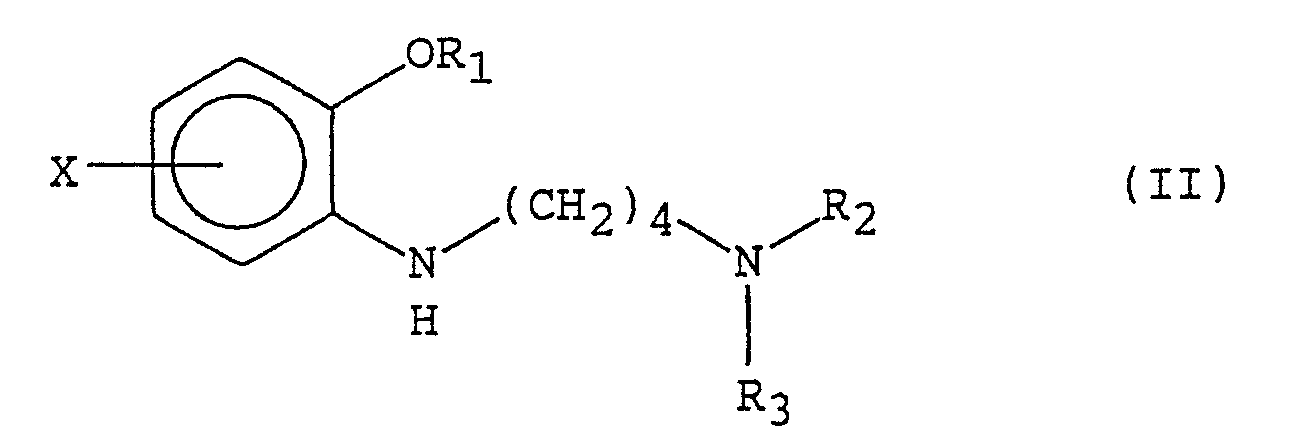
- Conformément à l'invention, on peut préparer les composés de formule (I) par une acylation selon le schéma 1 ci-après. On fait réagir une diamine de formule (II), dans laquelle X, Ri, R2 et R3 sont tels que définis ci-dessus, avec un chlorure d'acide de formule (III) dans laquelle Ar est tel que défini ci-dessus, à froid, dans un solvant et en présence d'une base telle que le carbonate de potassium.
- La diamine de formule (II) peut être obtenue par exemple selon l'un des deux procédés illustrés par les schémas la et 1 b ci-après. Selon le schéma la, le composé de départ est une benzènamine primaire de formule (IV), dans laquelle X et R1 sont tels que définis ci-dessus. On effectue d'abord une acylation au moyen d'un chlorure de chloro-4 butanoyle de formule (V), à froid et en présence d'une base. On fait ensuite réagir l'amide de formule (VI) ainsi obtenu avec une amine de formule (VIII, dans laquelle R2 et R3 sont tels que définis ci-dessus, dans un solvant tel que l'acétonitrile, le diméthylformamide, l'éthanol ou le tétrahydrofuranne, à chaud, en présence d'iodure de potassium, d'un agent de transfert de phase tel que l'iodure de tétrabutylammonium, et d'une base telle que le carbonate de potassium.
- Enfin ou soumet l'amide de formule (VIII) ainsi obtenu à une réduction, par exemple au moyen d'hydrure d'aluminium et lithium, ou de diborane, ou de borohydrure de métal alcalin, dans un solvant à chaud.
- Selon le schéma 1b, la diamine de formule (II) peut également être préparée à partir de l'acétamide de formule (IX), dans laquelle X et Ri sont tels que définis ci-dessus. L'acétamide de formule (IX) lui-même peut être préparé de manière connue à partir de la benzènamine de formule (IV).
- On fait réagir l'acétamide de formule (IX) avec le bromo-1 chloro-4 butane de formule (X), à froid et dans un solvant polaire aprotique tel que le diméthylformamide, le diméthylsulfoxyde ou l'acétone, en présence d'une base telle que l'hydrure de sodium, la potasse ou le carbonate de potassium.
- On traite ensuite le composé de formule (XI) ainsi obtenu avec une amine de formule (VII), de la manière indiquée ci-dessus à propos de l'amide de formule (VI).
- On obtient ainsi un composé de formule (XII) que l'on peut transformer en diamine de formule (II) par exemple en présence d'eau et d'une base telle que le tert-butylate de potassium ou la potasse, à chaud et dans un solvant tel que le tétrahydrofuranne ou le dioxanne.
- Un autre procédé de préparation des composés de formule (1) est illustré par le schéma 2 ci-après.
- Le composé de départ est une benzènamine de formule (IV), dans laquelle X et Ri sont tels définis ci-dessus. On le soumet à une acylation par un chlorure d'acide de formule (III), dans laquelle Ar est telle que défini ci-dessus, entre -10 et +30°C, dans un solvant tel que le dichlorométhane, l'éther ou le tétrahydrofuranne, et en présence d'une base telle que le carbonate de potassium, la triéthylamine ou la (diméthylamino)-4 pyridine.
- On obtient ainsi un amide de formule (XIII) que l'on fait réagir avec le bromo-1 chloro-4 butane de formule (X), de la manière indiquée ci-dessus à propos de l'amide de formule (IX).
- Enfin on traite le composé de formule (XIV) ainsi obtenu avec une amine de formule (VIII), de la manière indiquée ci-dessus à propos de l'amide de formule (VI).
- La benzènamine de formule (IV), qui est à l'origine de toutes les variantes des procédés de l'invention, peut être obtenue selon diverses méthodes connues.
- On peut par exemple alkyler un N-(hydroxy-2 phényl)acétamide portant le substituant X pour obtenir le N-(alcoxy-2 phényl)acétamide correspondant, puis le dégrader en benzènamine de formule (IV) par hydrolyse. On peut aussi partir d'un halogéno-2 nitrobenzène portant le substituant X, et le faire réagir avec un alcool de formule R10H, pour obtenir l'alcoxy-2 nitrobenzène correspondant, puis réduire ce dernier en benzènamine de formule (IV). Enfin on peut partir d'un nitro-2 phénol portant le substituant X, l'alkyler pour obtenir l'alcoxy-2 nitrobenzène correspondant, et réduire ce dernier en benzènamine de formule (IV).


- Les exemples qui vont suivre illustrent en détail la préparation de quelques composés selon l'invention. Les microanalyses et les spectres IR et RMN ont confirmé les structures des produits obtenus.
- Les numéros indiqués entre parenthèses dans les titres des exemples correspondent à ceux du tableau donné plus loin.
- On ajoute goutte à goutte une solution de 44 ml de chlorure de chloro-4 butyryle dans 350 ml d'éther à une suspension de 60 g de (méthyl-2 propoxy)-2 benzènamine et 199 g de carbonate de potassium dans 500 ml d'éther, refroidie par un bain de glace, et on agite le mélange pendant une nuit à température ambiante. On filtre le mélange, et on lave le filtrat successivement avec 200 ml de soude 1 N, trois fois 100 ml d'eau et 100 ml de solution saturée de chlorure de sodium. On sèche la solution éthérée sur sulfate de magnésium et on évapore le solvant. On recueille 85,8 g de produit sirupeux qu'on utilise tel quel dans l'étape suivante.
- On dissout le produit précédent dans 620 ml d'acétonitrile et on ajoute 126 g de chlorhydrate de diméthylamine, 51,5 g d'iodure de potassium, 107 g de carbonate de potassium et 5,7 g d'iodure de tétra-n-butylammonium. On chauffe le mélange au reflux pendant 7 h, on le filtre en lavant le solide avec de l'acétonitrile, et on évapore le filtrat.
- On reprend le résidu avec 1000 ml d'éther et 500 ml de soude 1N. On sépare la phase organique, on la lave avec une solution saturée de chlorure de sodium, on la sèche sur sulfate de magnésium et on l'évapore sous vide. On obtient 45 g de produit brut.
- En extrayant les phases aqueuses trois fois avec 200 ml de dichlorométhane on obtient, après séchage et évaporation, encore 19 g de produit qu'on ajoute aux 45 g déjà isolés. On purifie le tout par formation du chlorhydrate correspondant et recristallisation. Après libération de la base par traitement basique, on recueille 52 g de produit sirupeux qu'on utilise tel quel dans l'étape suivante.
- On dissout 52 g du produit précédent dans 300 ml de tétrahydrofuranne et on ajoute la solution obtenue, goutte à goutte, à une suspension de 14 g d'hydrure d'aluminium et lithium dans 600 ml de tétrahydrofuranne refroidie par un bain de glace.
- Puis on chauffe le mélange au reflux pendant 3h, on laisse refroidir et on le traite avec une solution de 19 g de soude dans 25 ml d'au.
- On dilue le mélange avec 500 mi d'acétate d'éthyle et on le filtre sur sulfate de magnésium. On évapore le filtrat et on distille le résidu sous vide, ce qui donne 31,3 g de produit. Point d'ébullition : 118-124°C à 20 Pa (0,15 mmHg).
- On ajoute goutte à goutte une solution de 2,3 g de chlorure de dichloro-2,5 benzoyle dans 30 ml d'éther à un mélange de 2,4 g du composé précédent, 4 g de carbonate de potassium et 30 ml d'éther.
- On agite le mélange pendant une nuit, puis on ajoute 100 ml d'eau et 40 ml d'éther. On sépare la phase organique, on la lave trois fois avec 50 ml d'eau puis avec 50 ml d'une solution saturée de chlorure de sodium, on la sèche sur sulfate de magnésium et on l'évapore sous vide. Après purification par chromatographie sur colonne de silice on obtient 3,2 g de produit sirupeux.
- On en dissout 3 g dans du méthanol, on ajoute 0,8 g d'acide fumarique, on chasse le solvant sous vide et on recristallise le résidu dans l'acétate d'éthyle. On obtient 2,9 g de fumarate sous forme de poudre blanche. Point de fusion : 130°C.
- A une suspension de 10,3 g d'hydrure de lithium (à 50 % dans l'huile) dans 100 ml de diméthylformamide, refroidie par un bain de glace, on ajoute goutte à goutte 35,6 g de N-[(méthyl-2 propoxy)-2 phényl]acétamide en solution dans 70 ml de diméthylformamide, puis 21,5 ml de bromo-1 chloro-4 butane.
- On agite le mélange pendant 5 h à température ambiante ; on ajoute 400 ml d'eau et 400 ml d'éther, on sépare la phase organique, on la lave trois fois avec 50 ml d'eau puis avec 25 ml d'une solution saturée de chlorure de sodium, on la sèche sur sulfate de magnésium et on l'évapore sous vide. On obtient 54,5 g de produit sirupeux qu'on utilise tel quel dans l'étape suivante.
- On dissout le produit précédent dans 120 ml de diméthylformamide on ajoute 117 g de carbonate de potassium, 20 g d'iodure de potassium, 3 g d'iodure de tétra-n-butylammonium et 69 g de chlorhydrate de diméthylamine.
- On agite le mélange pendant 13 h à 70° C, on le filtre, en lavant le solide trois fois avec 200 ml d'éther ; on traite le filtrat avec 400 ml de soude 0,1N, on sépare la phase organique, on la lave trois fois avec 100 ml d'eau puis avec 50 ml d'une solution saturée de chlorure de sodium, on la sèche sur sulfate de magnésium et on l'évapore sous vide. On obtient 42,1 g de produit sirupeux qu'on utilise tel quel dans l'étape suivante.
- On dissout le produit précédent dans 280 ml de tétrahydrofuranne, on ajoute 4,9 ml d'eau et 92,4 g de tert-butylate de potassium, et on chauffe le mélange au reflux pendant 12 h. On ajoute 200 ml d'eau glacée et 600 ml d'éther, on sépare la phase organique, on la lave quatre fois avec 100 ml d'eau puis avec 50 ml d'une solution saturée de chlorure de sodium, on la sèche sur sulfate de magnésium et on l'évapore sous vide. Après distillation sous vide du résidu on obtient 27,1 g de produit.
- Point d'ébullition : 106-110°C à 13 Pa (0,1 mmHg).
- On prépare une suspension de 5,0 g du produit précédent et 10,1 g de carbonate de potassium dans 60 ml de dichlorométhane, on la refroidit par un bain de glace, et on ajoute une solution de 3,4 ml de chlorure de (trifluorométhyl)-3 benzoyle dans 60 ml de dichlorométhane.
- On agite le mélange pendant une nuit à température ambiante, on évapore le solvant, on reprend le résidu avec 200 ml d'éther et 100 ml d'eau, on sépare la phase organique, on la lave trois fois avec 100 ml d'eau puis avec 100 ml de solution saturée de chlorure de sodium, on la sèche sur sulfate de magnésium et on l'évapore. On purifie le résidu par chromatographie sur colonne de silice et on obtient 6,4 g de produit sirupeux.
- On en dissout 6,3 g dans 145 ml d'alcool isopropylique chlorhydrique 0,1N, on évapore la solution sous vide et on recristallise le résidu dans un mélange éthanol/diisopropyléther. On obtient 5,2 g de chlorhydrate sous forme de poudre blanche. Point de fusion : 146-148°C.
- A une suspension de 9,9 g de (méthyl-2 propoxy)-2 benzènamine et de 33 g de carbonate de potassium dans 90 ml de dichloro méthane, refroidie par un bain de glace, on ajoute goutte à goutte une solution de 12,5 g de chlorure de (trifluorométhyl)-3 benzoyle dans 60 ml de dichlorométhane.
- On agite le mélange pendant une nuit à température ambiante, puis on évapore le solvant. On reprend le résidu avec un mélange de 200 ml d'eau et 300 ml d'éther, on sépare la phase organique, on la lave successivement avec deux fois 50 ml d'eau, deux fois 50 ml d'acide chlorhydrique aqueux 1 N, trois fois 50 ml d'eau, et 25 ml de solution saturée de chlorure de sodium. On la sèche sur sulfate de magnésium, et on l'évapore sous vide. On obtient 19,7 g de produit sirupeux qu'on utilise tel quel dans l'étape suivante.
- A une suspension de 4 g d'hydrure de lithium (à 50 % dans l'huile) dans 80 ml de diméthylformamide, refroidie par un bain de glace, on ajoute goutte à goutte les 19,7 g du produit précédent dissous dans 30 mi de diméthylformamide, puis 7,95 ml de bromo-1 chloro-4 butane.
- On agite le mélange à température ambiante pendant une nuit, puis on ajoute 250 ml d'eau et 250 ml d'éther, on sépare la phase organique, on extrait la phase aqueuse une seconde fois avec 250 ml d'éther, on réunit les phases organiques en une seule, on lave cette dernière avec 100 ml d'eau, puis deux fois avec 100 ml d'acide chlorhydrique aqueux 0,5N, puis trois fois avec 50 ml d'eau, et enfin avec 50 ml de solution saturée de chlorure de sodium. On la sèche sur sulfate de magnésium et on l'évapore sous vide. On obtient 24,2 g de produit sirupeux qu'on utilise tel quel dans l'étape suivante.
- On agite à 80°C, pendant 12 h, un mélange de 2,14 g du produit précédent, 1,46 g de N-[(diméthoxy-3,4 phényl)-2 éthyl]méthylamine, 2,07 g de carbonate de potassium, 0,8 g d'iodure de potassium, 0,09 g d'iodure de tétra-n-butylammonium dans 25 ml de diméthylformamide.
- Puis on ajoute 250 ml d'éther et 50 ml de soude O,5N, on sépare la phase organique, on la lave trois fois avec 50 ml d'eau puis avec 25 ml de solution saturée de chlorure de sodium, on la sèche sur sulfate de magnésium et on l'évapore. On purifie le résidu par chromatographie sur colonne de silice et on obtient 2,4 g de produit sirupeux. On en dissout 2,15 g dans 150 ml d'éther et on ajoute goutte à goutte une solution de 0,33 g d'acide oxalique dans 50 ml d'éther.
- On laisse reposer une nuit à température ambiante, on sépare le préciité par filtration, on le lave à l'éther et on le recristallise dans un mélange de 40 ml d'alcool isopropylique et 260 ml de diisopropyléther.
- On obtient 1,6 g d'oxalate sous forme de poudre blanche. Point de fusion : 80-82°C.
- Le tableau ci-après illustre les structures et propriétés physiques de quelques composés selon l'invention.


- Colonne "Ri" : cC3H5 et cC5H9 désignent les groupes cyclopropyle et cyclopentyle, respectivement. Colonne "Ar" : CsHs, C6H4, C6H3 et C6H2 désignent des groupes phényle non substitué, monosubstitué, disubstitué et trisubstitué, respectivement. Les formules des substituants sont indiquées, précédées du numéro de leur(s) position(s).
-
- 08 désigne le fumarate
- ½08 désigne l'hémifumarate
- 10 désigne le chlorhydrate
- 2 10 désigne le dichlorhydrate
- 15 désigne le méthanesulfonate
- 46 désigne l'oxalate
- 2.46 désigne le dioxalate
- Les composés de l'invention ont fait l'objet de divers essais pharmacologiques qui ont mis en évidence leur intérêt comme susbstances à activités thérapeutiques.
- Ainsi par exemple leur action antagoniste des effets du calcium a été étudiée sur l'aorte isolée du lapin. Le protocole expérimental utilisé est une variante de celui de Godfraind et Kaba (Blockade or reversal of the contraction induced by calcium and adrenaline in depolarized arterial smooth muscle, Br. J. Pharmac., (1969), 36, 549-560). Les expériences sont réalisées sur des tronçons d'aorte thoracique de lapin. Les animaux, des "Fauves de Bourgogne" d'un poids moyen de 1,5 kg, sont sacrifiés par dislocation cervicale et exsanguination. L'aorte thoracique est rapidement prélevée et placée dans un milieu de Krebs bicarbonaté et oxygéné (95% 02 + 5% C02).
- Des tronçons d'aorte de 1 cm de long environ sont préparés et installés dans des cuves à organes de 20 ml contenant de la solution de Krebs bicarbonatée et oxygénée à pH 7,4 à 37°C. Deux crochets métalliques en "U" de la longueur des tronçons sont introduits dans la lumière de ceux-ci. L'un des crochets est fixé à la base de la cuve et l'autre, relié à une jauge de contrainte isométrique (Grass FT03), permet l'enregistrement, par l'intermédiaire d'un préamplificateur continu (Grass 7P1), des réponses contractiles des tron.ons d'aorte sur un oscillographe à encre (Grass 79B). Cette méthode présente, par rapport aux préparations en spirale ou en anneaux, l'avantage de mieux respecter l'intégrité structurale des vaisseaux et de n'enregistrer que la composante radiale des réponses contractiles, qui représente le phénomène intéressant du point de vue fonctionnel (régulation de la pression artérielle). Une tension initiale de 4 g est imposée aux préparations. De la phénoxybenzamine (1 µM) et du propranolol (1 µM) sont ajoutés aux différents milieux de Krebs afin de supprimer les réponses contractiles liées à l'activation des récepteurs a- et β-adrénergiques vasculaires. Après une heure de stabilisation dans le milieu de Krebs, la tension imposée aux aortes est ramenée à 2 g puis, après une période d'attente de 30 minutes, les préparations sont incubées pendant une dizaine de minutes dans une solution de Krebs bicarbonatée sans calcium en présence d'EDTA (200 µM) et de propranolol (1 µM). Cette solution est alors remplacée par un milieu de Krebs dépolarisant (riche en potassium) sans calcium et contenant du propranolol (1 µM). Après 5 minutes, une concentration unique de 1 mM de calcium est ajoutée à cette solution et une période de stabilisation de 30 minutes est respectée, qui permet aux préparations d'atteindre une contraction stable.
- Ensuite des doses cumulatives des composés à étudier sont administrées toutes les 30 minutes (temps généralement nécessaire pour l'obtention d'un plateau) jusqu'à disparition totale de la contraction provoquée par 1 mM de calcium ou bien jusqu'à la concentration (30 µM) de produit à étudier. En fin d'expérience une concentration supramaximale de papavérine (300 µM) est administrée afin de déterminer la décontraction maximale possible de chaque préparation.
- Les valeurs absolues (en grammes) de la contraction initiale (après 1 mM de chlorure de calcium) et de la contraction après les différentes concentrations cumulatives de composés vasodilatateurs sont obtenues, pour chaque préparation, par différence avec la contraction minimale observée 30 minutes après l'addition finale de 300 µM de papavérine. Le pourcentage de diminution de la contraction, par rapport à la contraction provoquée par 1 mM de calcium, est calculé pour chaque dose de composé et chaque préparation, et la moyenne X ± E.S.M. des pourcentages individuels est calculée. Les moyennes obtenues (pondérées par l'inverse de l'Erreur Standard à la Moyenne), sont analysées à l'aide d'un modèle mathématique de courbe sigmoïde, et la concentration molaire provoquant 500/o de décontraction de la réponse au calcium (CEso) est calculée.
- Pour les composés de l'invention les CE50 vont de 0,2 à 10 µM.
- Les composés de l'invention ont également fait l'objet d'un essai de liaison (binding) de [3H]nitrendipine sur le cortex total de rat.
- On utilise des rats mâles Sprague-Dawley de 150 à 200 g. Après dislocation cervicale on excise le cerveau et on dissèque le cortex cérébral sur une boîte de culture refroidie par de la glace. On le place dans 20 volumes d'une solution tampon à 50 mM de tris(hydroxyméthyle)aminométhane, glacée, dont le pH a été ajusté à 7,4 au moyen d'acide chlorhydrique (tampon "Tris-Hcl"). On homogénéise le tissu à l'aide d'un appareil Polytron Ultra-Turrax pendant 30 secondes à la moitié de la vitesse maximale, et on lave les préparations trois fois avec la solution tampon glacée, en les essorant chaque fois par centrifugation à 49000xg pendant 10 minutes. Finalement on prépare des suspensions à 100 mg de tissu pour 1 ml de tampon Tris-Hcl à 50 mM (pH=7,4 à 37°C).
- On fait ensuite incuber des portions aliquotes de 100 µl de suspension de membranes lavées avec de la [3H]nitrendipine (New England Nuclear, d'une activité spécifique de 70,0 Ci/mmole) dans un volume final de 1 ml de tampon Tris-HCI. Après 30 minutes d'incubation à 37°C on récupère les membranes par filtration sur fibres de verre Whatman GF/F, on les lave trois fois avec 5 ml de tampon Tris-Hcl glacé. On mesure la quantité de radioactivité liée au tissu et retenue sur les filtres par spectrométrie de scintillation. La liaison spécifique de la [3H]nitrendipine est définie comme la diminution de la quantité de radioligand retenue sur le filtre, due à l'introduction de 1 µM de nifedipine pendant l'incubation. La liaison spécifique représente 80 à 90% de la quantité totale de la radioactivité recueillie sur le filtre. A l'aide de différentes concentrations de composés à étudier, on détermine graphiquement la concentration Clso, concentration du composé étudié qui inhibe 50 % de la liaison spécifique de la [3H]nitrendipine.
- Les concentrations Cl50 des composés de l'invention se situent entre 0,005 et 0,1 µM.
- Enfin les composés de l'invention ont été étudiés quant à leur effet antihypertenseur chez le rat spontanément hypertendu.
- On mesure la pression systolique grâce à un cathéter placé dans l'artère caudale, selon la méthode de Gerold et Tschirky (Arzneim.-Forsch., 1968, 18, 1285-1287), et on enregistre les variations de pression en fonction du temps écoulé, pour chaque composé étudié et pour chaque dose administrée. Les composés de l'invention provoquent une diminution de la pression sanguine de 15 à 30% au bout de 30 minutes et de 20 à 25% au bout de 3 heures, à des doses de 5 à 30 mg/kg administrées par la voie intrapéritonéale. Les résultats des essais pharmacologiques montrent que les composés de l'invention sont des antagonistes du calcium et peuvent, à ce titre, être utilisés pour le traitement de diverses affections pour lesquelles ce type d'agents est indiqué.
- C'est ainsi qu'en particulier ils peuvent être utilisés en médecine cardiovasculaire pour le traitement d'affections nécessitant des modulateurs des mouvements transmembranaires et intracellulaires du calcium, tout spécialement l'hypertension, l'angor et l'arythmie cardiaque.
- Ils sont en outre susceptibles de présenter des effets antiathérogénes, antiagrégants plaquettaires, anti-ischémiques cardiaques, anti-ischémiques cérébraux, antimigraineux, antiépileptiques, antiasthmatiques et antiulcéreux. Dans le domaine cardiovasculaire ils peuvent être utilisés seuls ou associés à d'autres substances actives connues telles que les diurétiques, les β-bloquants, les inhibiteurs de l'enzyme de conversion de l'angiotensine, les antagonistes des récepteurs ai.
- Combinés avec des agents destinés à potentialiser leurs effets ou à diminuer leur toxicité, ils peuvent être également indiqués pour le traitement du cancer ou dans les transplantations.
- Les composés de l'invention peuvent être présentés sous toutes formes appropriées à l'administration orale ou parentérale, en association avec des excipients connus, par exemple sous forme de comprimés, gélules, dragées, capsules, solutions ou suspensions buvables ou injectables.
- La posologie journalière peut aller par exemple de 5 à 200 mg par la voie orale et de 0,1 à 10 mg par voie parentérale.
Claims (14)

procédé caractérisé en ce qu'on soumet une diamine de formule (II)


procédé caractérisé en ce qu'on soumet une benzènamine de formule (IV)


HNR2R3 (VII)
dans laquelle R2 et R3 sont tels que définis ci-dessus.
Priority Applications (1)
| Application Number | Priority Date | Filing Date | Title |
|---|---|---|---|
| AT88401741T ATE73762T1 (de) | 1987-07-16 | 1988-07-05 | N-aminobutyl-n-phenylarylamid-derivate, ihre herstellung und ihre verwendung in der heilkunde. |
Applications Claiming Priority (2)
| Application Number | Priority Date | Filing Date | Title |
|---|---|---|---|
| FR8710026A FR2618149B1 (fr) | 1987-07-16 | 1987-07-16 | Derives de n-aminoalkyl n-phenyl arylamides, leur preparation et leur application en therapeutique |
| FR8710026 | 1987-07-16 |
Publications (2)
| Publication Number | Publication Date |
|---|---|
| EP0300865A1 true EP0300865A1 (fr) | 1989-01-25 |
| EP0300865B1 EP0300865B1 (fr) | 1992-03-18 |
Family
ID=9353186
Family Applications (1)
| Application Number | Title | Priority Date | Filing Date |
|---|---|---|---|
| EP88401741A Expired - Lifetime EP0300865B1 (fr) | 1987-07-16 | 1988-07-05 | Dérivés de N-aminobutyl N-phényl arylamides, leur préparation et leur application en thérapeutique |
Country Status (21)
| Country | Link |
|---|---|
| US (2) | US5001159A (fr) |
| EP (1) | EP0300865B1 (fr) |
| JP (1) | JPH0794417B2 (fr) |
| KR (1) | KR890001957A (fr) |
| AR (1) | AR247380A1 (fr) |
| AT (1) | ATE73762T1 (fr) |
| AU (1) | AU600376B2 (fr) |
| CA (1) | CA1306748C (fr) |
| CS (1) | CS405391A3 (fr) |
| DE (1) | DE3869257D1 (fr) |
| DK (1) | DK397388A (fr) |
| ES (1) | ES2037257T3 (fr) |
| FI (1) | FI883377A7 (fr) |
| FR (1) | FR2618149B1 (fr) |
| GR (1) | GR3004458T3 (fr) |
| HU (1) | HU198903B (fr) |
| IE (1) | IE61843B1 (fr) |
| IL (1) | IL87089A (fr) |
| NO (1) | NO174959C (fr) |
| NZ (1) | NZ225430A (fr) |
| ZA (1) | ZA885150B (fr) |
Cited By (14)
| Publication number | Priority date | Publication date | Assignee | Title |
|---|---|---|---|---|
| US5116851A (en) * | 1990-01-26 | 1992-05-26 | E. R. Squibb & Sons, Inc. | Pharmaceutical composition and method for treating cardiovascular diseases using substituted anilides and sulfonamides |
| FR2705675A1 (fr) * | 1993-05-27 | 1994-12-02 | Smithkline Beecham Labo Pharma | Nouveaux composés, leur procédé de préparation et leur utilisation en tant que médicaments. |
| WO1994027971A1 (fr) * | 1993-05-27 | 1994-12-08 | Smithkline Beecham Laboratoires Pharmaceutiques | 3-benzazepines ou isoquinolines n-substituees a action antiarythmique |
| FR2706894A1 (en) * | 1993-06-22 | 1994-12-30 | Synthelabo | N-Phenyl-N-(piperidinoalkyl)arylamide derivatives, their preparation and their application in therapeutics |
| FR2706895A1 (en) * | 1993-06-22 | 1994-12-30 | Synthelabo | Tetrahydroisoquinoline derivatives, their preparation and their application in therapeutics |
| FR2715652A1 (fr) * | 1994-02-03 | 1995-08-04 | Synthelabo | Dérivés de N-[3-[(2,3-dihydro-1H-inden-2-yl)alkyl-amino]propyl]-N-phényl-5,6,7,8-tétrahydronaphtalène-2-carboxamide leur préparation et leur application en thérapeutique. |
| FR2715654A1 (fr) * | 1994-02-03 | 1995-08-04 | Synthelabo | Dérivé de N-[3-(1,2,3,4-tétrahydroisoquinoléin-2-yl)-propyl]-N-phényl-5,6,7,8-tétrahydronaphtalène-2-carboxamide, leur préparation et leur application en thérapeutique. |
| EP0666250A1 (fr) * | 1994-02-03 | 1995-08-09 | Synthelabo | Dérivés de N-(3-aminopropyl)-N-phényl-5,6,7,8-tétrahydronaphtalène-2-carboxamideayant des propriétés neuroprotectrices et anti-ischémiques, leur préparation et leur application en thérapeutique |
| WO1995024390A1 (fr) * | 1994-03-11 | 1995-09-14 | Smithkline Beecham Plc | Nouvelles piperidines substituees par phenyl(-alkyl/alkoxy)-1-aminoalkyle et pyrolidines utilisees comme antagonistes des canaux calciques |
| WO1996027595A1 (fr) * | 1995-03-08 | 1996-09-12 | Smithkline Beecham Laboratoires Pharmaceutiques | Heterocyclylcarboxamides et autres composes utilises pour le traitement des arythmies cardiaques |
| WO1998049145A1 (fr) * | 1997-04-30 | 1998-11-05 | Smithkline Beecham Plc | Derives de tetrahydro-isoquinoline substituee, utiles en tant que modulateurs des recepteurs d3 de la dopamine |
| WO1998050363A1 (fr) * | 1997-05-01 | 1998-11-12 | Smithkline Beecham Plc | Tetrahydro isoquinolines substitues utilises comme modulateurs des recepteurs d3 de la dopamine |
| US6414154B1 (en) | 1998-05-20 | 2002-07-02 | Smithkline Beecham P.L.C. | Tetraisoquinoline derivatives as modulators of dopamine D3 receptors |
| US6605607B1 (en) | 1998-10-08 | 2003-08-12 | Smithkline Beecham P.L.C. | Tetrahydrobenzazepine derivatives useful as modulators of dopamine D3 receptors (antipsychotic agents) |
Families Citing this family (3)
| Publication number | Priority date | Publication date | Assignee | Title |
|---|---|---|---|---|
| FR2694557B1 (fr) * | 1992-08-05 | 1994-09-23 | Synthelabo | Dérivés de tétrahydronaphtalène, leur préparation, et leur application en thérapeutique. |
| OA11941A (en) | 1999-05-10 | 2006-04-12 | Warner Lambert Co | Aromatic amides. |
| US7955170B2 (en) * | 2004-07-30 | 2011-06-07 | Igt | Providing non-bingo outcomes for a bingo game |
Citations (2)
| Publication number | Priority date | Publication date | Assignee | Title |
|---|---|---|---|---|
| GB1232787A (fr) * | 1967-08-08 | 1971-05-19 | ||
| GB1282600A (en) * | 1968-12-26 | 1972-07-19 | Ct Europ De Rech S Pharmacolog | Basic aryloxyacetamides |
Family Cites Families (1)
| Publication number | Priority date | Publication date | Assignee | Title |
|---|---|---|---|---|
| US4808624A (en) * | 1984-06-28 | 1989-02-28 | Bristol-Myers Company | Pharmacologically active substituted benzamides |
-
1987
- 1987-07-16 FR FR8710026A patent/FR2618149B1/fr not_active Expired
-
1988
- 1988-06-15 AR AR88311432A patent/AR247380A1/es active
- 1988-07-05 EP EP88401741A patent/EP0300865B1/fr not_active Expired - Lifetime
- 1988-07-05 DE DE8888401741T patent/DE3869257D1/de not_active Expired - Fee Related
- 1988-07-05 ES ES198888401741T patent/ES2037257T3/es not_active Expired - Lifetime
- 1988-07-05 AT AT88401741T patent/ATE73762T1/de not_active IP Right Cessation
- 1988-07-12 IL IL87089A patent/IL87089A/xx not_active IP Right Cessation
- 1988-07-13 NO NO883122A patent/NO174959C/no unknown
- 1988-07-15 DK DK397388A patent/DK397388A/da not_active Application Discontinuation
- 1988-07-15 AU AU19077/88A patent/AU600376B2/en not_active Ceased
- 1988-07-15 KR KR1019880008807A patent/KR890001957A/ko not_active Ceased
- 1988-07-15 NZ NZ225430A patent/NZ225430A/en unknown
- 1988-07-15 ZA ZA885150A patent/ZA885150B/xx unknown
- 1988-07-15 IE IE217988A patent/IE61843B1/en not_active IP Right Cessation
- 1988-07-15 FI FI883377A patent/FI883377A7/fi not_active Application Discontinuation
- 1988-07-15 JP JP63177962A patent/JPH0794417B2/ja not_active Expired - Lifetime
- 1988-07-15 CA CA000572175A patent/CA1306748C/fr not_active Expired - Fee Related
- 1988-07-15 HU HU883698A patent/HU198903B/hu not_active IP Right Cessation
-
1990
- 1990-05-02 US US07/517,419 patent/US5001159A/en not_active Expired - Fee Related
- 1990-06-19 US US07/540,229 patent/US5075325A/en not_active Expired - Fee Related
-
1991
- 1991-12-23 CS CS914053A patent/CS405391A3/cs unknown
-
1992
- 1992-04-29 GR GR920400824T patent/GR3004458T3/el unknown
Patent Citations (2)
| Publication number | Priority date | Publication date | Assignee | Title |
|---|---|---|---|---|
| GB1232787A (fr) * | 1967-08-08 | 1971-05-19 | ||
| GB1282600A (en) * | 1968-12-26 | 1972-07-19 | Ct Europ De Rech S Pharmacolog | Basic aryloxyacetamides |
Non-Patent Citations (2)
| Title |
|---|
| CHEMICAL ABSTRACTS, vol. 103, no. 1, 8 juillet 1985, page 538, résumé no. 5978e, Columbus, Ohio, US; X. ZHOU et al.: "Synthesis of benzanilide derivatives and their antiarrhythmic effects", & SHANGHAI DIYI YIXUEYUAN XUEBAO 1984, 11(6), 413-417 * |
| CHEMICAL ABSTRACTS, vol. 82, no. 1, 6 janvier 1975, pages 366-367, résumé no. 4223r, Columbus, Ohio, US; K. NAGARAJAN et al.: "Condensed heterotricycles. Amino and aminoalkydibenz[b,f][1,4]oxazepin-11(10H)-ones", & INDIAN J. CHEM. 1974, 12(3), 236-46 * |
Cited By (15)
| Publication number | Priority date | Publication date | Assignee | Title |
|---|---|---|---|---|
| US5116851A (en) * | 1990-01-26 | 1992-05-26 | E. R. Squibb & Sons, Inc. | Pharmaceutical composition and method for treating cardiovascular diseases using substituted anilides and sulfonamides |
| FR2705675A1 (fr) * | 1993-05-27 | 1994-12-02 | Smithkline Beecham Labo Pharma | Nouveaux composés, leur procédé de préparation et leur utilisation en tant que médicaments. |
| WO1994027971A1 (fr) * | 1993-05-27 | 1994-12-08 | Smithkline Beecham Laboratoires Pharmaceutiques | 3-benzazepines ou isoquinolines n-substituees a action antiarythmique |
| FR2706894A1 (en) * | 1993-06-22 | 1994-12-30 | Synthelabo | N-Phenyl-N-(piperidinoalkyl)arylamide derivatives, their preparation and their application in therapeutics |
| FR2706895A1 (en) * | 1993-06-22 | 1994-12-30 | Synthelabo | Tetrahydroisoquinoline derivatives, their preparation and their application in therapeutics |
| FR2715652A1 (fr) * | 1994-02-03 | 1995-08-04 | Synthelabo | Dérivés de N-[3-[(2,3-dihydro-1H-inden-2-yl)alkyl-amino]propyl]-N-phényl-5,6,7,8-tétrahydronaphtalène-2-carboxamide leur préparation et leur application en thérapeutique. |
| FR2715654A1 (fr) * | 1994-02-03 | 1995-08-04 | Synthelabo | Dérivé de N-[3-(1,2,3,4-tétrahydroisoquinoléin-2-yl)-propyl]-N-phényl-5,6,7,8-tétrahydronaphtalène-2-carboxamide, leur préparation et leur application en thérapeutique. |
| EP0666250A1 (fr) * | 1994-02-03 | 1995-08-09 | Synthelabo | Dérivés de N-(3-aminopropyl)-N-phényl-5,6,7,8-tétrahydronaphtalène-2-carboxamideayant des propriétés neuroprotectrices et anti-ischémiques, leur préparation et leur application en thérapeutique |
| WO1995024390A1 (fr) * | 1994-03-11 | 1995-09-14 | Smithkline Beecham Plc | Nouvelles piperidines substituees par phenyl(-alkyl/alkoxy)-1-aminoalkyle et pyrolidines utilisees comme antagonistes des canaux calciques |
| WO1996027595A1 (fr) * | 1995-03-08 | 1996-09-12 | Smithkline Beecham Laboratoires Pharmaceutiques | Heterocyclylcarboxamides et autres composes utilises pour le traitement des arythmies cardiaques |
| WO1998049145A1 (fr) * | 1997-04-30 | 1998-11-05 | Smithkline Beecham Plc | Derives de tetrahydro-isoquinoline substituee, utiles en tant que modulateurs des recepteurs d3 de la dopamine |
| WO1998050363A1 (fr) * | 1997-05-01 | 1998-11-12 | Smithkline Beecham Plc | Tetrahydro isoquinolines substitues utilises comme modulateurs des recepteurs d3 de la dopamine |
| US6274593B1 (en) | 1997-05-01 | 2001-08-14 | Smithkline Beecham P.L.C. | Substituted tetrahydro isoquinolines as modulators of dopamine D3 receptors |
| US6414154B1 (en) | 1998-05-20 | 2002-07-02 | Smithkline Beecham P.L.C. | Tetraisoquinoline derivatives as modulators of dopamine D3 receptors |
| US6605607B1 (en) | 1998-10-08 | 2003-08-12 | Smithkline Beecham P.L.C. | Tetrahydrobenzazepine derivatives useful as modulators of dopamine D3 receptors (antipsychotic agents) |
Also Published As
| Publication number | Publication date |
|---|---|
| IE882179L (en) | 1989-01-16 |
| JPS6434950A (en) | 1989-02-06 |
| US5075325A (en) | 1991-12-24 |
| HUT47079A (en) | 1989-01-30 |
| JPH0794417B2 (ja) | 1995-10-11 |
| KR890001957A (ko) | 1989-04-06 |
| NO883122D0 (no) | 1988-07-13 |
| ATE73762T1 (de) | 1992-04-15 |
| NZ225430A (en) | 1990-01-29 |
| AU1907788A (en) | 1989-01-19 |
| FR2618149A1 (fr) | 1989-01-20 |
| GR3004458T3 (fr) | 1993-03-31 |
| NO883122L (no) | 1989-01-17 |
| US5001159A (en) | 1991-03-19 |
| NO174959B (no) | 1994-05-02 |
| FI883377A7 (fi) | 1989-01-17 |
| EP0300865B1 (fr) | 1992-03-18 |
| AU600376B2 (en) | 1990-08-09 |
| DK397388A (da) | 1989-02-09 |
| IL87089A0 (en) | 1988-12-30 |
| CS405391A3 (en) | 1992-09-16 |
| ES2037257T3 (es) | 1993-06-16 |
| DK397388D0 (da) | 1988-07-15 |
| FR2618149B1 (fr) | 1989-09-22 |
| NO174959C (no) | 1994-08-10 |
| FI883377A0 (fi) | 1988-07-15 |
| HU198903B (en) | 1989-12-28 |
| DE3869257D1 (de) | 1992-04-23 |
| AR247380A1 (es) | 1994-12-29 |
| IE61843B1 (en) | 1994-11-30 |
| ZA885150B (en) | 1989-03-29 |
| IL87089A (en) | 1993-02-21 |
| CA1306748C (fr) | 1992-08-25 |
Similar Documents
| Publication | Publication Date | Title |
|---|---|---|
| EP0300865B1 (fr) | Dérivés de N-aminobutyl N-phényl arylamides, leur préparation et leur application en thérapeutique | |
| EP0202164B1 (fr) | Dérivés de (benzoyl-4 pipéridino)-2 phenyl-1 alcanols, leur préparation et leur application en thérapeutique | |
| EP0373998B1 (fr) | Ethers d'oxime de propénone, procédé pour leur préparation et compositions pharmaceutiques les contenant | |
| MC1706A1 (fr) | Dérivés de tétrahydronaphtalène | |
| EP0025727B1 (fr) | Dérivés de l'indole, procédé pour leur préparation et médicaments les contenant | |
| EP0351255B1 (fr) | Dérivés de [(pipéridinyl-4)méthyl]-2 tétrahydro-1,2,3,4 isoquinoléine, leur préparation et leur application en thérapeutique | |
| EP1753725B1 (fr) | Derives de tetrahydroisoquinolilsulfonamides, leur preparation et leur utilisation en therapeutique | |
| FR2626175A1 (fr) | Composes nouveaux de 1,2-ethylenediamine et composition pharmaceutique les contenant | |
| EP0252810B1 (fr) | [Diméthylamino)-2 éthyl] [[[(méthylthio)-2-phényl] (phénylméthyl)amino]-2 oxo-2 éthyl] carbamates ou urées, leur préparation et leur application en thérapeutique | |
| EP0269599A2 (fr) | 1H-Imidazoles substitués | |
| JPS6322049A (ja) | 不可逆的ド−パミン−β−ヒドロキシラ−ゼ抑制剤 | |
| EP0320362A1 (fr) | Utilisation de dérivés de hydroxy-3 (méthoxy-4 phényl)-2 (méthylamino-2 éthyl)-5 dihydro-2,3 5H-benzothiazépine-1,5 one-4 pour la préparation de médicaments inhibiteurs du facteur d'activation des plaquettes | |
| EP0338892A1 (fr) | Dérivés de [[N-[amino-2 oxo-2 éthyl] méthylamino]-2 éthyl]-5 hydroxy-3 (méthoxy-4 phényl)-2 dihydro-2,3 5H-benzothiazépine-1,5 one-4, leur préparation et leur application en thérapeutique | |
| JPH02275846A (ja) | カルボン酸誘導体 | |
| EP0406502B1 (fr) | Procédé de préparation de la (-) [[(amino-2 éthoxy)-2 éthoxy]méthyl]-2 (dichloro-2,3 phényl)-4 éthoxycarbonyl-3 méthoxycarbonyl-5 méthyl-6 dihydro-1,4 pyridine, et intermédiaire pour sa préparation | |
| EP0103500B1 (fr) | Dérivés de phénéthyl-1alpha-phényl-pipéridine-3-propanenitrile, leur préparation et leur application en thérapeutique | |
| EP0220104B1 (fr) | Dérivés d'amino-5 pentanenitrile, leurs procédés de préparation et les compositions pharmaceutiques qui les contiennent | |
| EP0061379B1 (fr) | Dérivés de pyridine, leur préparation et leur application en thérapeutique | |
| EP0106860B1 (fr) | Nouvelles carboxamidoguanidines, leur procede d'obtention et les compositions pharmaceutiques en renfermant | |
| EP0105881A1 (fr) | Nouvelles cyanoguanidines, leur procede d'obtention et les compositions pharmaceutiques en renfermant. | |
| FR2638745A1 (fr) | Derives de ((n-alkylthioalkyl-methylamino)-2 ethyl)-5 benzothiazepine-1,5 one-4, leur preparation et leur application en therapeutique | |
| JPH0587503B2 (fr) | ||
| FR2553772A1 (fr) | Derives de 2h-azeto(2,1-a)-isoquinoleine, procede pour les preparer et compositions pharmaceutiques les contenant | |
| FR2568249A1 (fr) | Amino-1 aryloxy-3 propanols-2, procedes de preparation et medicaments les contenant | |
| EP0210828A2 (fr) | Dérivés de tétrahydroisoquinoléine, procédé et intermédiaires pour leur préparation et compositions pharmaceutiques les contenant |
Legal Events
| Date | Code | Title | Description |
|---|---|---|---|
| PUAI | Public reference made under article 153(3) epc to a published international application that has entered the european phase |
Free format text: ORIGINAL CODE: 0009012 |
|
| AK | Designated contracting states |
Kind code of ref document: A1 Designated state(s): AT BE CH DE ES FR GB GR IT LI LU NL SE |
|
| 17P | Request for examination filed |
Effective date: 19890624 |
|
| 17Q | First examination report despatched |
Effective date: 19910212 |
|
| GRAA | (expected) grant |
Free format text: ORIGINAL CODE: 0009210 |
|
| AK | Designated contracting states |
Kind code of ref document: B1 Designated state(s): AT BE CH DE ES FR GB GR IT LI LU NL SE |
|
| REF | Corresponds to: |
Ref document number: 73762 Country of ref document: AT Date of ref document: 19920415 Kind code of ref document: T |
|
| ITF | It: translation for a ep patent filed | ||
| REF | Corresponds to: |
Ref document number: 3869257 Country of ref document: DE Date of ref document: 19920423 |
|
| GBT | Gb: translation of ep patent filed (gb section 77(6)(a)/1977) | ||
| REG | Reference to a national code |
Ref country code: GR Ref legal event code: FG4A Free format text: 3004458 |
|
| PLBE | No opposition filed within time limit |
Free format text: ORIGINAL CODE: 0009261 |
|
| STAA | Information on the status of an ep patent application or granted ep patent |
Free format text: STATUS: NO OPPOSITION FILED WITHIN TIME LIMIT |
|
| 26N | No opposition filed | ||
| REG | Reference to a national code |
Ref country code: ES Ref legal event code: FG2A Ref document number: 2037257 Country of ref document: ES Kind code of ref document: T3 |
|
| REG | Reference to a national code |
Ref country code: CH Ref legal event code: PFA Free format text: SYNTHELABO |
|
| EPTA | Lu: last paid annual fee | ||
| EAL | Se: european patent in force in sweden |
Ref document number: 88401741.9 |
|
| PGFP | Annual fee paid to national office [announced via postgrant information from national office to epo] |
Ref country code: AT Payment date: 19970623 Year of fee payment: 10 |
|
| PGFP | Annual fee paid to national office [announced via postgrant information from national office to epo] |
Ref country code: GB Payment date: 19970625 Year of fee payment: 10 |
|
| PGFP | Annual fee paid to national office [announced via postgrant information from national office to epo] |
Ref country code: SE Payment date: 19970626 Year of fee payment: 10 |
|
| PGFP | Annual fee paid to national office [announced via postgrant information from national office to epo] |
Ref country code: GR Payment date: 19970627 Year of fee payment: 10 Ref country code: CH Payment date: 19970627 Year of fee payment: 10 |
|
| PGFP | Annual fee paid to national office [announced via postgrant information from national office to epo] |
Ref country code: NL Payment date: 19970630 Year of fee payment: 10 |
|
| PGFP | Annual fee paid to national office [announced via postgrant information from national office to epo] |
Ref country code: DE Payment date: 19970702 Year of fee payment: 10 |
|
| PGFP | Annual fee paid to national office [announced via postgrant information from national office to epo] |
Ref country code: BE Payment date: 19970711 Year of fee payment: 10 |
|
| PGFP | Annual fee paid to national office [announced via postgrant information from national office to epo] |
Ref country code: ES Payment date: 19970718 Year of fee payment: 10 |
|
| PGFP | Annual fee paid to national office [announced via postgrant information from national office to epo] |
Ref country code: FR Payment date: 19970731 Year of fee payment: 10 |
|
| PGFP | Annual fee paid to national office [announced via postgrant information from national office to epo] |
Ref country code: LU Payment date: 19970819 Year of fee payment: 10 |
|
| PG25 | Lapsed in a contracting state [announced via postgrant information from national office to epo] |
Ref country code: LU Free format text: LAPSE BECAUSE OF NON-PAYMENT OF DUE FEES Effective date: 19980705 Ref country code: GB Free format text: LAPSE BECAUSE OF NON-PAYMENT OF DUE FEES Effective date: 19980705 Ref country code: AT Free format text: LAPSE BECAUSE OF NON-PAYMENT OF DUE FEES Effective date: 19980705 |
|
| PG25 | Lapsed in a contracting state [announced via postgrant information from national office to epo] |
Ref country code: SE Free format text: LAPSE BECAUSE OF NON-PAYMENT OF DUE FEES Effective date: 19980706 Ref country code: ES Free format text: LAPSE BECAUSE OF EXPIRATION OF PROTECTION Effective date: 19980706 |
|
| PG25 | Lapsed in a contracting state [announced via postgrant information from national office to epo] |
Ref country code: LI Free format text: LAPSE BECAUSE OF NON-PAYMENT OF DUE FEES Effective date: 19980731 Ref country code: GR Free format text: LAPSE BECAUSE OF NON-PAYMENT OF DUE FEES Effective date: 19980731 Ref country code: CH Free format text: LAPSE BECAUSE OF NON-PAYMENT OF DUE FEES Effective date: 19980731 Ref country code: BE Free format text: LAPSE BECAUSE OF NON-PAYMENT OF DUE FEES Effective date: 19980731 |
|
| BERE | Be: lapsed |
Owner name: SYNTHELABO Effective date: 19980731 |
|
| PG25 | Lapsed in a contracting state [announced via postgrant information from national office to epo] |
Ref country code: NL Free format text: LAPSE BECAUSE OF NON-PAYMENT OF DUE FEES Effective date: 19990201 |
|
| GBPC | Gb: european patent ceased through non-payment of renewal fee |
Effective date: 19980705 |
|
| REG | Reference to a national code |
Ref country code: CH Ref legal event code: PL |
|
| EUG | Se: european patent has lapsed |
Ref document number: 88401741.9 |
|
| PG25 | Lapsed in a contracting state [announced via postgrant information from national office to epo] |
Ref country code: FR Free format text: LAPSE BECAUSE OF NON-PAYMENT OF DUE FEES Effective date: 19990331 |
|
| NLV4 | Nl: lapsed or anulled due to non-payment of the annual fee |
Effective date: 19990201 |
|
| PG25 | Lapsed in a contracting state [announced via postgrant information from national office to epo] |
Ref country code: DE Free format text: LAPSE BECAUSE OF NON-PAYMENT OF DUE FEES Effective date: 19990501 |
|
| REG | Reference to a national code |
Ref country code: FR Ref legal event code: ST |
|
| REG | Reference to a national code |
Ref country code: ES Ref legal event code: FD2A Effective date: 20010301 |
|
| PG25 | Lapsed in a contracting state [announced via postgrant information from national office to epo] |
Ref country code: IT Free format text: LAPSE BECAUSE OF NON-PAYMENT OF DUE FEES;WARNING: LAPSES OF ITALIAN PATENTS WITH EFFECTIVE DATE BEFORE 2007 MAY HAVE OCCURRED AT ANY TIME BEFORE 2007. THE CORRECT EFFECTIVE DATE MAY BE DIFFERENT FROM THE ONE RECORDED. Effective date: 20050705 |