EP0301616A2 - Taktextrahierer mit digitaler phasenverriegelter Schleife für bipolare Signale - Google Patents
Taktextrahierer mit digitaler phasenverriegelter Schleife für bipolare Signale Download PDFInfo
- Publication number
- EP0301616A2 EP0301616A2 EP88201377A EP88201377A EP0301616A2 EP 0301616 A2 EP0301616 A2 EP 0301616A2 EP 88201377 A EP88201377 A EP 88201377A EP 88201377 A EP88201377 A EP 88201377A EP 0301616 A2 EP0301616 A2 EP 0301616A2
- Authority
- EP
- European Patent Office
- Prior art keywords
- signal
- logic
- counter
- frequency
- clock signal
- Prior art date
- Legal status (The legal status is an assumption and is not a legal conclusion. Google has not performed a legal analysis and makes no representation as to the accuracy of the status listed.)
- Granted
Links
Images


Classifications
-
- H—ELECTRICITY
- H04—ELECTRIC COMMUNICATION TECHNIQUE
- H04L—TRANSMISSION OF DIGITAL INFORMATION, e.g. TELEGRAPHIC COMMUNICATION
- H04L7/00—Arrangements for synchronising receiver with transmitter
- H04L7/02—Speed or phase control by the received code signals, the signals containing no special synchronisation information
- H04L7/033—Speed or phase control by the received code signals, the signals containing no special synchronisation information using the transitions of the received signal to control the phase of the synchronising-signal-generating means, e.g. using a phase-locked loop
- H04L7/0331—Speed or phase control by the received code signals, the signals containing no special synchronisation information using the transitions of the received signal to control the phase of the synchronising-signal-generating means, e.g. using a phase-locked loop with a digital phase-locked loop [PLL] processing binary samples, e.g. add/subtract logic for correction of receiver clock
Definitions
- the present invention relates to a digital phase-locked-loop clock extractor for bipolar signals.
- the extractor in accordance with the invention consists of a circuit designed to allow taking from a PCM (pulse code modulation) input signal a clock signal phase locked to the input signal so as to allow sampling of the latter with said clock signal without loss of information even in the presence of jitter (phase distorsion) and frequency tolerance.
- PCM pulse code modulation
- the analog solution uses a tuned circuit or a frequency-controlled oscillator. Maintenance of an appropriate phase between the input signal and the clock signal takes place continuously and the clock signal extracted does not display phase jumps.
- These circuits have been developed by some manufacturers of integrated circuits and can be made as well with discrete components. They display however criticality of operation, the need for calibration and poor reliability.
- the object of the present invention is to develop a clock signal extractor of the digital type which would allow having in normal conditions a low phase jump capable of compensating for the frequency difference between the local clock and the line clock in the presence of low input jitter and at the same time in the presence of high jitter permit sampling of the data signal received without loss of information, producing a higher instantaneous phase correction of the generated clock signal.
- a digital clock extractor for bipolar signals characterized in that it comprises at least one sliding register supplied with a bipolar signal received and sampled with a sampling signal having a frequency which is a multiple of that of said received signal, a transition detector logic associated with a combination of outputs of said register to generate a transition detection signal of the signal received upon reaching a certain sequence of logic states at said register outputs, a frequency divider consisting of a counter fed with said multiple-frequency sampling signal and programmed in such a manner as to give at the output a clock signal extracted at the same frequency as said received signal, said divider having a correction logic which compares said transition detection signal with the momentary logic stage of the outputs of said counter to evaluate the phase error existing between the extracted clock signal and the received signal and command a phase correction of said clock signal the size of which is a progressively increasing function of said error signal.
- the progressively increasing function which is essentially logarithmic, assured between the phase error and the phase correction, acts in such a manner that with a very small phase error, i.e. with the counter essentially in phase with the transition detection signal, no correction is effected. This permits avoiding continuous phase jumps of the clock signal phase locked to the input signal.
- the correction effected permits meeting of the CCITT recommendations without loss of information and to have under normal conditions (with low jitter) an extremely small phase jump.
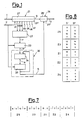
- the digital clock extractor illustrated as an example in FIG. 1 comprises a shift register 21 which receives at its input a 2.948 2Mbit/s bipolar PCM (Pulse Code Modulation) signal sampled with a sampling signal C at 32.768 MHz, i.e. at a frequency 16 times that of the input signal or received data signal I.
- a shift register 21 which receives at its input a 2.948 2Mbit/s bipolar PCM (Pulse Code Modulation) signal sampled with a sampling signal C at 32.768 MHz, i.e. at a frequency 16 times that of the input signal or received data signal I.
- a bipolar PCM signal is known to consist of a sucession of negative and positive return-to-zero pulses.
- Appropriate means are therefore provided but not shown in the figure and placed upstream of the register 21 to subdivide the bipolar signal I on two lines in such a manner as to bring the positive pulses I′ onto one of the lines and the negative pulses I ⁇ onto the other with the logic convention that level '0' indicates absence of signal and level "1" indicates presence of the pulse. Said shape of the two signals thus obtained is shown as an example in FIG. 2.
- the shift register 21 is thus made up of a pair of registers 21′-21 ⁇ in parallel, each of which receives the signal (I′, I ⁇ ) present on one of the two lines.
- the shift register 21 has 7 pairs of parallel outputs U1-U7 corresponding to the same number of successive stages of the registers 21′ and 21 ⁇ and of another pair of serial outputs U, one for each register.
- each register 21′, 22 ⁇ comprises auccession of bistable multivibrators 31′, 31 ⁇ which receives at its input a respective signal I′, I ⁇ and supplies a respective serial output U′, U ⁇ corresponding to the output of FIG. 1 and respective parallel outputs U1′-U7′, U1 ⁇ -U7 ⁇ (only the U1′-U3′ and the U1 ⁇ -U3 ⁇ illustrated in FIG. 3) corresponding to the outputs U1-U7 of FIG. 1.
- the input data signal is delayed by 7.5 periods of the sampling signal C, said delay being selected on the basis of the pulse duration of the data signal I received, as an example equal to 244 ns, characteristic of the return-to-zero 2.948 Mbit/s signals.
- this has the purpose of permitting the extracted clock signal to sample the data at the output U of the register 21 during the pulse of said data, preferably in the central part thereof.
- the first three parallel outputs U1, U2 and U3 of the register 21 (i.e. U1′, U2′, U3′; U1 ⁇ , U2 ⁇ , U3 ⁇ of the registers 21′, 21 ⁇ ) are combined in a transition detector logic 22 which through the combination of their logic states obtained through logic gates OR 32 and NAND 33 shown in FIG. 4 detects the presence or absence of a transition of the data received frm 0 to 1 on either one of the two inputs.
- the detector 22 detects the presence of the transition 0--1, which indicates the instant of beginning of the data received by decodification of the 011 sequence at the outputs U3, U2, U1 of the register 21′ o 21 ⁇ . This allows filtering of any spikes present in the input signal I which with the sequence 010 do not produce recognition of the beginning of the data.
- the output of the detector 22 then consists of the logic OR function, carried out by NAND gate 33, of the two decoding logics related to the registers 21′ and 21 ⁇ .
- the transition detection signal T generated by the detector 22 is applied, as a delayed transition detector signal T′, to an input of a combinatory logic 24 which fulfills the functions of phase correction and frequency division of a programmable frequency divider 30.
- the output of the combinatory logic 24 is applied to the input of a register 25 clocked with the sampling signal C, said register constituting the sequential part of the divider 30. All the outputs of the register 25 are brought back to other inputs of the combinatory logic 24 while the most significant output of the register constitutes the extracted clock signal S having the same frequency as the received signal I.
- Said clock signal is used for example for sampling of the data signal U (U′+U ⁇ ) present at the output of the register 21 through a bistable multivibrator 26 (in reality a multivibrator 26′, 26 ⁇ for every register 21′, 21 ⁇ ) at the output of which the sampled data D is made available.
- the frequency divider 30 is in reality a 4-bit counter with 16 logic states which normally performs the division by 16 of the frequency of 32.768MHz of the sampling signal C.
- This comprises four bistable multivibrators or flip-flops 27 constituting the register 25 and having at one data input the output signal of the combinatory logic 24, at the clock input the sampling signal C and at the output a binary signal B0-B3 and an inverted binary signal B0-B3.
- the embodiment of the correction logic 24 does not constitute a problem for those skilled in the art once the following mode of operation of the described circuit is known.
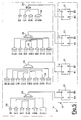
- the mode of operation of the circuit of FIB. 1 can be understood by observing the diagrams of FIG. 6 and taking into account the tables shown in FIGS 7 and 8.
- the high-frequency sampling signal C periodially samples, with its leading edge (indicated by an arrow in diagram C of FIG. 6) the signal I incoming in the shift register 21.
- the first output U1 of the register changes to logic level 1, and also at the following leading edge the second output U2 and then the third output U3 and so on change to logic level 1 until they reproduce with a delay of 7.5 periods the same signal at the output U.
- the transition detector 22 When at the outputs U1, U2 and U3 the combination 110 occurs, indicative of a 0--1 transistion in the input signal I, the transition detector 22 generates the transition detection signal T which, through the flip-flop 23, is applied as signal T′ (signal B4 in FIG. 5) delayed by one step at the input of the correction logic 24 where it combines with the present logic state available at the output of the register 25.
- the 4-bit register 25 gives at its outputs the 16 logic states of a 4-bit counter at the counting frequency determined by the sampling signal C.
- the divider 30 performs a simple division by 16.
- the new logic state at the output 25 depends on the coincidence of the pulse of signal T′ with one of the 16 logic states of the counter.
- the possible states of the outputs of the divider 30 can be grouped in five zones Z1-Z5, in which the central zone Z1 comprises the states 15 and 0, the two adjacent zones Z2 and Z3 comprise the states 1-2-3 and 12-13-14 respectively and the two end zones Z4 and Z5 comprise the states 4-5-6-7 and 8-9-10-11 as shown in FIG. 7.
- the pulse of signal T′ coincides with the zone Z5, for example with the logic state 10 as shown by diagram S5 in FIG. 6, meaning that the leading edge of the extracted clock signal (shown in dot and dash lines) is too delayed relative to the data at output of the register 21, a correction is made in advance by two steps, i.e. the counter passes directly from logic state 10 to logic state 13 and the leading edge of the clock signal is consequently advanced by two steps (in unbroken lines) to fall again within the pulse of the data to be sampled.
- coincidence of the pulse T′ with the zones Z3 and Z4 of the counter causes advance of one step and delay of two steps respectively of the leading edge of the extracted clock signal.
- the correction made is essentially a logarithmic function of the phase error detected.
- the only exception is the central zone of the counter which was modified to have less arbitrariness of phase between the input data and the extracted clock in the absence of jitter and frequency drift.
- the digital clock extractor shown in the drawings was assumed for use with 2 Mbit/s bipolar PCM input signals.
Landscapes
- Engineering & Computer Science (AREA)
- Computer Networks & Wireless Communication (AREA)
- Signal Processing (AREA)
- Stabilization Of Oscillater, Synchronisation, Frequency Synthesizers (AREA)
- Synchronisation In Digital Transmission Systems (AREA)
- Transforming Light Signals Into Electric Signals (AREA)
- Compression, Expansion, Code Conversion, And Decoders (AREA)
- Signal Processing For Digital Recording And Reproducing (AREA)
Priority Applications (1)
| Application Number | Priority Date | Filing Date | Title |
|---|---|---|---|
| AT88201377T ATE104490T1 (de) | 1987-07-30 | 1988-07-01 | Taktextrahierer mit digitaler phasenverriegelter schleife fuer bipolare signale. |
Applications Claiming Priority (2)
| Application Number | Priority Date | Filing Date | Title |
|---|---|---|---|
| IT21527/87A IT1222405B (it) | 1987-07-30 | 1987-07-30 | Estrattore digitale di segnale orologio con aggancio e correzione di fase per segnali bipolari |
| IT2152787 | 1987-07-30 |
Publications (3)
| Publication Number | Publication Date |
|---|---|
| EP0301616A2 true EP0301616A2 (de) | 1989-02-01 |
| EP0301616A3 EP0301616A3 (en) | 1990-01-31 |
| EP0301616B1 EP0301616B1 (de) | 1994-04-13 |
Family
ID=11183130
Family Applications (1)
| Application Number | Title | Priority Date | Filing Date |
|---|---|---|---|
| EP88201377A Expired - Lifetime EP0301616B1 (de) | 1987-07-30 | 1988-07-01 | Taktextrahierer mit digitaler phasenverriegelter Schleife für bipolare Signale |
Country Status (9)
| Country | Link |
|---|---|
| US (1) | US4852124A (de) |
| EP (1) | EP0301616B1 (de) |
| AT (1) | ATE104490T1 (de) |
| AU (1) | AU606963B2 (de) |
| DE (1) | DE3889028T2 (de) |
| ES (1) | ES2051293T3 (de) |
| IT (1) | IT1222405B (de) |
| NO (1) | NO173529C (de) |
| YU (1) | YU137588A (de) |
Cited By (2)
| Publication number | Priority date | Publication date | Assignee | Title |
|---|---|---|---|---|
| EP0345564A3 (de) * | 1988-06-03 | 1991-04-10 | Alcatel SEL Aktiengesellschaft | Verfahren und Schaltungsanordnung zur Rückgewinnung eines Bittaktes aus einem empfangenen digitalen Nachrichtensignal |
| EP0579778A4 (de) * | 1991-04-08 | 1994-04-27 | Motorola, Inc. |
Families Citing this family (10)
| Publication number | Priority date | Publication date | Assignee | Title |
|---|---|---|---|---|
| US5086435A (en) * | 1988-10-17 | 1992-02-04 | Rockwell International Corporation | Method and apparatus for detecting signals on digital data systems |
| US5016259A (en) * | 1989-03-03 | 1991-05-14 | The Grass Valley Group, Inc. | Low jitter DDFS FSK modulator |
| US5193087A (en) * | 1990-05-16 | 1993-03-09 | Tadiran, Ltd. | Electronic digital cross-connect system having bipolar violation transparency |
| US5197086A (en) * | 1990-12-28 | 1993-03-23 | International Business Machines Corporation | High speed digital clock synchronizer |
| JP3347848B2 (ja) * | 1993-11-08 | 2002-11-20 | 株式会社ゼネラル リサーチ オブ エレクトロニックス | 多値信号復号回路 |
| US5541967A (en) * | 1994-03-09 | 1996-07-30 | National Semiconductor Corporation | Fast symbol synchronization for use in conditioning a receiving modem |
| US6182237B1 (en) * | 1998-08-31 | 2001-01-30 | International Business Machines Corporation | System and method for detecting phase errors in asics with multiple clock frequencies |
| US6421785B1 (en) * | 1998-11-03 | 2002-07-16 | Intel Corporation | Clock selection for processing audio data |
| SE516280C2 (sv) | 2000-04-06 | 2001-12-10 | Ericsson Telefon Ab L M | Förfarande och anordning för signalövervakning som baseras på ett glidande fönster |
| US6343364B1 (en) * | 2000-07-13 | 2002-01-29 | Schlumberger Malco Inc. | Method and device for local clock generation using universal serial bus downstream received signals DP and DM |
Family Cites Families (7)
| Publication number | Priority date | Publication date | Assignee | Title |
|---|---|---|---|---|
| US4216544A (en) * | 1978-09-19 | 1980-08-05 | Northern Telecom Limited | Digital clock recovery circuit |
| US4280099A (en) * | 1979-11-09 | 1981-07-21 | Sperry Corporation | Digital timing recovery system |
| US4456890A (en) * | 1982-04-05 | 1984-06-26 | Computer Peripherals Inc. | Data tracking clock recovery system using digitally controlled oscillator |
| US4667333A (en) * | 1983-12-22 | 1987-05-19 | Motorola, Inc. | Automatic clock recovery circuit |
| US4628519A (en) * | 1984-04-06 | 1986-12-09 | Advanced Micro Devices, Inc. | Digital phase-locked loop circuit |
| IT1214377B (it) * | 1984-06-13 | 1990-01-18 | Torino Sip Societa Italiana Pe | Circuito numerico per l estrazione di segnali di sincronismo da un flusso seriale di dati codificati |
| US4694196A (en) * | 1984-12-07 | 1987-09-15 | American Telephone And Telegraph Company And At&T Information Systems | Clock recovery circuit |
-
1987
- 1987-07-30 IT IT21527/87A patent/IT1222405B/it active
-
1988
- 1988-06-01 US US07/201,517 patent/US4852124A/en not_active Expired - Fee Related
- 1988-07-01 ES ES88201377T patent/ES2051293T3/es not_active Expired - Lifetime
- 1988-07-01 AT AT88201377T patent/ATE104490T1/de not_active IP Right Cessation
- 1988-07-01 AU AU18618/88A patent/AU606963B2/en not_active Ceased
- 1988-07-01 EP EP88201377A patent/EP0301616B1/de not_active Expired - Lifetime
- 1988-07-01 DE DE3889028T patent/DE3889028T2/de not_active Expired - Fee Related
- 1988-07-15 YU YU01375/88A patent/YU137588A/xx unknown
- 1988-07-27 NO NO883325A patent/NO173529C/no unknown
Cited By (3)
| Publication number | Priority date | Publication date | Assignee | Title |
|---|---|---|---|---|
| EP0345564A3 (de) * | 1988-06-03 | 1991-04-10 | Alcatel SEL Aktiengesellschaft | Verfahren und Schaltungsanordnung zur Rückgewinnung eines Bittaktes aus einem empfangenen digitalen Nachrichtensignal |
| AU614138B2 (en) * | 1988-06-03 | 1991-08-22 | Alcatel N.V. | A bit clock recovery method |
| EP0579778A4 (de) * | 1991-04-08 | 1994-04-27 | Motorola, Inc. |
Also Published As
| Publication number | Publication date |
|---|---|
| IT8721527A0 (it) | 1987-07-30 |
| US4852124A (en) | 1989-07-25 |
| DE3889028T2 (de) | 1994-09-08 |
| AU1861888A (en) | 1989-02-02 |
| NO173529B (no) | 1993-09-13 |
| NO883325D0 (no) | 1988-07-27 |
| AU606963B2 (en) | 1991-02-21 |
| EP0301616A3 (en) | 1990-01-31 |
| NO173529C (no) | 1993-12-22 |
| ES2051293T3 (es) | 1994-06-16 |
| ATE104490T1 (de) | 1994-04-15 |
| IT1222405B (it) | 1990-09-05 |
| YU137588A (en) | 1991-02-28 |
| EP0301616B1 (de) | 1994-04-13 |
| DE3889028D1 (de) | 1994-05-19 |
| NO883325L (no) | 1989-01-31 |
Similar Documents
| Publication | Publication Date | Title |
|---|---|---|
| EP0346896B1 (de) | Parallel/Serienumsetzer | |
| EP0301616B1 (de) | Taktextrahierer mit digitaler phasenverriegelter Schleife für bipolare Signale | |
| US4777542A (en) | Data recording method | |
| GB2026796A (en) | Clock synchronization circuit | |
| US3440548A (en) | Timing recovery circuit using time derivative of data signals | |
| CA1308448C (en) | Method of and circuit arrangement for recovering a bit clock from a received digital communication signal | |
| EP0412234A2 (de) | Erkennungs- und Entscheidungseinrichtung für demodulierte Daten | |
| US4876699A (en) | High speed sampled data digital phase detector apparatus | |
| US3636454A (en) | Digital circuit discriminator for frequency-shift data signals | |
| US5063576A (en) | Coding and decoding method for asynchronous data signals and an apparatus therefor | |
| US5012138A (en) | Interface circuit for asychronous data transfer | |
| US5831683A (en) | Clock signal generating apparatus and clock signal generating method | |
| KR910000624B1 (ko) | 비트 동기 회로 및 방법 | |
| US4317080A (en) | Signal monitor system | |
| US4535295A (en) | Method and device for controlling the phase of timing signal | |
| US6115548A (en) | Method and apparatus for interfacing data signal and associated clock signal to circuit controlled by local clock signal | |
| CA1296072C (en) | Method and arrangement for generating a correction signal for a digital timing recovery device | |
| US4263672A (en) | Apparatus for synchronization on the basis of a received digital signal | |
| AU670345B2 (en) | Reset and synchronizing device | |
| US4809304A (en) | Method of extracting a synchronous clock signal from a single- or double-density coded signal, and apparatus for performing the method | |
| JP2001094608A (ja) | 不連続流をなす信号の受信機と対応する受信プロセス | |
| JPS59202751A (ja) | クロツク同期方法 | |
| JPS6239756B2 (de) | ||
| JPS62136942A (ja) | タイミング信号抽出回路 | |
| JPH0661993A (ja) | クロック抽出回路とクロック抽出方法 |
Legal Events
| Date | Code | Title | Description |
|---|---|---|---|
| PUAI | Public reference made under article 153(3) epc to a published international application that has entered the european phase |
Free format text: ORIGINAL CODE: 0009012 |
|
| AK | Designated contracting states |
Kind code of ref document: A2 Designated state(s): AT BE CH DE ES FR GB GR IT LI NL SE |
|
| PUAL | Search report despatched |
Free format text: ORIGINAL CODE: 0009013 |
|
| AK | Designated contracting states |
Kind code of ref document: A3 Designated state(s): AT BE CH DE ES FR GB GR IT LI NL SE |
|
| 17P | Request for examination filed |
Effective date: 19900614 |
|
| 17Q | First examination report despatched |
Effective date: 19920702 |
|
| GRAA | (expected) grant |
Free format text: ORIGINAL CODE: 0009210 |
|
| AK | Designated contracting states |
Kind code of ref document: B1 Designated state(s): AT BE CH DE ES FR GB GR IT LI NL SE |
|
| REF | Corresponds to: |
Ref document number: 104490 Country of ref document: AT Date of ref document: 19940415 Kind code of ref document: T |
|
| ITF | It: translation for a ep patent filed | ||
| REF | Corresponds to: |
Ref document number: 3889028 Country of ref document: DE Date of ref document: 19940519 |
|
| ET | Fr: translation filed | ||
| REG | Reference to a national code |
Ref country code: ES Ref legal event code: FG2A Ref document number: 2051293 Country of ref document: ES Kind code of ref document: T3 |
|
| REG | Reference to a national code |
Ref country code: GR Ref legal event code: FG4A Free format text: 3011781 |
|
| EAL | Se: european patent in force in sweden |
Ref document number: 88201377.4 |
|
| PLBE | No opposition filed within time limit |
Free format text: ORIGINAL CODE: 0009261 |
|
| STAA | Information on the status of an ep patent application or granted ep patent |
Free format text: STATUS: NO OPPOSITION FILED WITHIN TIME LIMIT |
|
| 26N | No opposition filed | ||
| PGFP | Annual fee paid to national office [announced via postgrant information from national office to epo] |
Ref country code: GB Payment date: 19970620 Year of fee payment: 10 Ref country code: AT Payment date: 19970620 Year of fee payment: 10 |
|
| PGFP | Annual fee paid to national office [announced via postgrant information from national office to epo] |
Ref country code: GR Payment date: 19970630 Year of fee payment: 10 |
|
| PGFP | Annual fee paid to national office [announced via postgrant information from national office to epo] |
Ref country code: ES Payment date: 19970710 Year of fee payment: 10 Ref country code: BE Payment date: 19970710 Year of fee payment: 10 |
|
| PGFP | Annual fee paid to national office [announced via postgrant information from national office to epo] |
Ref country code: SE Payment date: 19970711 Year of fee payment: 10 |
|
| PGFP | Annual fee paid to national office [announced via postgrant information from national office to epo] |
Ref country code: NL Payment date: 19970714 Year of fee payment: 10 |
|
| PGFP | Annual fee paid to national office [announced via postgrant information from national office to epo] |
Ref country code: FR Payment date: 19970718 Year of fee payment: 10 |
|
| PGFP | Annual fee paid to national office [announced via postgrant information from national office to epo] |
Ref country code: DE Payment date: 19970918 Year of fee payment: 10 |
|
| PGFP | Annual fee paid to national office [announced via postgrant information from national office to epo] |
Ref country code: CH Payment date: 19971028 Year of fee payment: 10 |
|
| PG25 | Lapsed in a contracting state [announced via postgrant information from national office to epo] |
Ref country code: GB Free format text: LAPSE BECAUSE OF NON-PAYMENT OF DUE FEES Effective date: 19980701 Ref country code: AT Free format text: LAPSE BECAUSE OF NON-PAYMENT OF DUE FEES Effective date: 19980701 |
|
| PG25 | Lapsed in a contracting state [announced via postgrant information from national office to epo] |
Ref country code: SE Free format text: LAPSE BECAUSE OF NON-PAYMENT OF DUE FEES Effective date: 19980702 Ref country code: ES Free format text: LAPSE BECAUSE OF EXPIRATION OF PROTECTION Effective date: 19980702 |
|
| PG25 | Lapsed in a contracting state [announced via postgrant information from national office to epo] |
Ref country code: LI Free format text: LAPSE BECAUSE OF NON-PAYMENT OF DUE FEES Effective date: 19980731 Ref country code: GR Free format text: LAPSE BECAUSE OF NON-PAYMENT OF DUE FEES Effective date: 19980731 Ref country code: CH Free format text: LAPSE BECAUSE OF NON-PAYMENT OF DUE FEES Effective date: 19980731 Ref country code: BE Free format text: LAPSE BECAUSE OF NON-PAYMENT OF DUE FEES Effective date: 19980731 |
|
| BERE | Be: lapsed |
Owner name: SIEMENS TELECOMUNICAZIONI S.P.A. Effective date: 19980731 |
|
| PG25 | Lapsed in a contracting state [announced via postgrant information from national office to epo] |
Ref country code: NL Free format text: LAPSE BECAUSE OF NON-PAYMENT OF DUE FEES Effective date: 19990201 |
|
| GBPC | Gb: european patent ceased through non-payment of renewal fee |
Effective date: 19980701 |
|
| REG | Reference to a national code |
Ref country code: CH Ref legal event code: PL |
|
| EUG | Se: european patent has lapsed |
Ref document number: 88201377.4 |
|
| PG25 | Lapsed in a contracting state [announced via postgrant information from national office to epo] |
Ref country code: FR Free format text: LAPSE BECAUSE OF NON-PAYMENT OF DUE FEES Effective date: 19990331 |
|
| NLV4 | Nl: lapsed or anulled due to non-payment of the annual fee |
Effective date: 19990201 |
|
| PG25 | Lapsed in a contracting state [announced via postgrant information from national office to epo] |
Ref country code: DE Free format text: LAPSE BECAUSE OF NON-PAYMENT OF DUE FEES Effective date: 19990501 |
|
| REG | Reference to a national code |
Ref country code: FR Ref legal event code: ST |
|
| REG | Reference to a national code |
Ref country code: ES Ref legal event code: FD2A Effective date: 20010201 |
|
| PG25 | Lapsed in a contracting state [announced via postgrant information from national office to epo] |
Ref country code: IT Free format text: LAPSE BECAUSE OF NON-PAYMENT OF DUE FEES Effective date: 20050701 |