EP0302875B1 - Composes de naphtalene optiquement actifs et compositions de cristaux liquides contenant lesdits composes - Google Patents
Composes de naphtalene optiquement actifs et compositions de cristaux liquides contenant lesdits composes Download PDFInfo
- Publication number
- EP0302875B1 EP0302875B1 EP87902632A EP87902632A EP0302875B1 EP 0302875 B1 EP0302875 B1 EP 0302875B1 EP 87902632 A EP87902632 A EP 87902632A EP 87902632 A EP87902632 A EP 87902632A EP 0302875 B1 EP0302875 B1 EP 0302875B1
- Authority
- EP
- European Patent Office
- Prior art keywords
- alkyl
- coo
- optically active
- compound
- liquid crystal
- Prior art date
- Legal status (The legal status is an assumption and is not a legal conclusion. Google has not performed a legal analysis and makes no representation as to the accuracy of the status listed.)
- Expired
Links
- 239000000203 mixture Substances 0.000 title claims abstract description 68
- 239000004973 liquid crystal related substance Substances 0.000 title claims abstract description 26
- 150000002790 naphthalenes Chemical class 0.000 title abstract description 5
- 150000001875 compounds Chemical class 0.000 claims abstract description 63
- 125000000217 alkyl group Chemical group 0.000 claims abstract description 39
- -1 2-methylheptyl Chemical group 0.000 claims abstract description 16
- 229910052736 halogen Inorganic materials 0.000 claims abstract description 10
- 125000005010 perfluoroalkyl group Chemical group 0.000 claims abstract description 3
- 239000004990 Smectic liquid crystal Substances 0.000 claims description 41
- 125000004432 carbon atom Chemical group C* 0.000 claims description 12
- 125000003545 alkoxy group Chemical group 0.000 claims description 11
- 229910052799 carbon Inorganic materials 0.000 claims description 7
- 125000001997 phenyl group Chemical group [H]C1=C([H])C([H])=C(*)C([H])=C1[H] 0.000 claims description 7
- 125000004430 oxygen atom Chemical group O* 0.000 claims description 4
- 229910052801 chlorine Inorganic materials 0.000 claims description 3
- 239000000460 chlorine Substances 0.000 claims description 3
- 125000001624 naphthyl group Chemical group 0.000 claims description 3
- 229910052760 oxygen Inorganic materials 0.000 claims description 3
- 229920001774 Perfluoroether Polymers 0.000 claims description 2
- 229940000425 combination drug Drugs 0.000 claims description 2
- 125000005842 heteroatom Chemical group 0.000 claims description 2
- 125000004076 pyridyl group Chemical group 0.000 claims description 2
- 125000000714 pyrimidinyl group Chemical group 0.000 claims description 2
- 125000005843 halogen group Chemical group 0.000 claims 3
- WSNMPAVSZJSIMT-UHFFFAOYSA-N COc1c(C)c2COC(=O)c2c(O)c1CC(O)C1(C)CCC(=O)O1 Chemical compound COc1c(C)c2COC(=O)c2c(O)c1CC(O)C1(C)CCC(=O)O1 WSNMPAVSZJSIMT-UHFFFAOYSA-N 0.000 claims 1
- 125000001309 chloro group Chemical group Cl* 0.000 claims 1
- DDTJFSPKEIAZAM-UHFFFAOYSA-N 2-chloro-3-methylbutanoic acid Chemical compound CC(C)C(Cl)C(O)=O DDTJFSPKEIAZAM-UHFFFAOYSA-N 0.000 abstract description 2
- 125000004122 cyclic group Chemical group 0.000 abstract 1
- YMWUJEATGCHHMB-UHFFFAOYSA-N Dichloromethane Chemical compound ClCCl YMWUJEATGCHHMB-UHFFFAOYSA-N 0.000 description 36
- 239000000463 material Substances 0.000 description 32
- 239000012071 phase Substances 0.000 description 26
- 239000000047 product Substances 0.000 description 18
- JUJWROOIHBZHMG-UHFFFAOYSA-N Pyridine Chemical compound C1=CC=NC=C1 JUJWROOIHBZHMG-UHFFFAOYSA-N 0.000 description 16
- YXFVVABEGXRONW-UHFFFAOYSA-N Toluene Chemical compound CC1=CC=CC=C1 YXFVVABEGXRONW-UHFFFAOYSA-N 0.000 description 15
- 0 CC(*)Oc1ccc(cc(C)cc2)c2c1 Chemical compound CC(*)Oc1ccc(cc(C)cc2)c2c1 0.000 description 14
- 239000002019 doping agent Substances 0.000 description 14
- XLYOFNOQVPJJNP-UHFFFAOYSA-N water Substances O XLYOFNOQVPJJNP-UHFFFAOYSA-N 0.000 description 14
- LFQSCWFLJHTTHZ-UHFFFAOYSA-N Ethanol Chemical compound CCO LFQSCWFLJHTTHZ-UHFFFAOYSA-N 0.000 description 12
- FYSNRJHAOHDILO-UHFFFAOYSA-N thionyl chloride Chemical compound ClS(Cl)=O FYSNRJHAOHDILO-UHFFFAOYSA-N 0.000 description 12
- 239000007787 solid Substances 0.000 description 10
- KWYUFKZDYYNOTN-UHFFFAOYSA-M Potassium hydroxide Chemical compound [OH-].[K+] KWYUFKZDYYNOTN-UHFFFAOYSA-M 0.000 description 9
- RTZKZFJDLAIYFH-UHFFFAOYSA-N Diethyl ether Chemical compound CCOCC RTZKZFJDLAIYFH-UHFFFAOYSA-N 0.000 description 8
- 150000002148 esters Chemical class 0.000 description 8
- UMJSCPRVCHMLSP-UHFFFAOYSA-N pyridine Natural products COC1=CC=CN=C1 UMJSCPRVCHMLSP-UHFFFAOYSA-N 0.000 description 8
- 230000002269 spontaneous effect Effects 0.000 description 8
- 230000007704 transition Effects 0.000 description 8
- VEXZGXHMUGYJMC-UHFFFAOYSA-N Hydrochloric acid Chemical compound Cl VEXZGXHMUGYJMC-UHFFFAOYSA-N 0.000 description 7
- 150000002367 halogens Chemical group 0.000 description 7
- 239000002904 solvent Substances 0.000 description 7
- ZWEHNKRNPOVVGH-UHFFFAOYSA-N 2-Butanone Chemical compound CCC(C)=O ZWEHNKRNPOVVGH-UHFFFAOYSA-N 0.000 description 6
- XFGMYSLABITTOU-UHFFFAOYSA-N 6-octoxynaphthalene-2-carboxylic acid Chemical compound C1=C(C(O)=O)C=CC2=CC(OCCCCCCCC)=CC=C21 XFGMYSLABITTOU-UHFFFAOYSA-N 0.000 description 6
- XEKOWRVHYACXOJ-UHFFFAOYSA-N Ethyl acetate Chemical compound CCOC(C)=O XEKOWRVHYACXOJ-UHFFFAOYSA-N 0.000 description 6
- OKKJLVBELUTLKV-UHFFFAOYSA-N Methanol Chemical compound OC OKKJLVBELUTLKV-UHFFFAOYSA-N 0.000 description 6
- VYPSYNLAJGMNEJ-UHFFFAOYSA-N Silicium dioxide Chemical compound O=[Si]=O VYPSYNLAJGMNEJ-UHFFFAOYSA-N 0.000 description 6
- PNEYBMLMFCGWSK-UHFFFAOYSA-N aluminium oxide Inorganic materials [O-2].[O-2].[O-2].[Al+3].[Al+3] PNEYBMLMFCGWSK-UHFFFAOYSA-N 0.000 description 6
- 210000004027 cell Anatomy 0.000 description 6
- 239000003208 petroleum Substances 0.000 description 6
- 239000000741 silica gel Substances 0.000 description 6
- 229910002027 silica gel Inorganic materials 0.000 description 6
- NGNBDVOYPDDBFK-UHFFFAOYSA-N 2-[2,4-di(pentan-2-yl)phenoxy]acetyl chloride Chemical compound CCCC(C)C1=CC=C(OCC(Cl)=O)C(C(C)CCC)=C1 NGNBDVOYPDDBFK-UHFFFAOYSA-N 0.000 description 5
- 239000000654 additive Substances 0.000 description 5
- 239000000758 substrate Substances 0.000 description 5
- SJWFXCIHNDVPSH-QMMMGPOBSA-N (2S)-octan-2-ol Chemical compound CCCCCC[C@H](C)O SJWFXCIHNDVPSH-QMMMGPOBSA-N 0.000 description 4
- 239000002253 acid Substances 0.000 description 4
- 239000012043 crude product Substances 0.000 description 4
- 238000004821 distillation Methods 0.000 description 4
- 238000001704 evaporation Methods 0.000 description 4
- 230000008020 evaporation Effects 0.000 description 4
- BWHMMNNQKKPAPP-UHFFFAOYSA-L potassium carbonate Chemical compound [K+].[K+].[O-]C([O-])=O BWHMMNNQKKPAPP-UHFFFAOYSA-L 0.000 description 4
- 238000010992 reflux Methods 0.000 description 4
- FOJNDDVNZRFFOO-UHFFFAOYSA-N 4-(6-octoxynaphthalene-2-carbonyl)oxybenzoic acid Chemical compound C1=CC2=CC(OCCCCCCCC)=CC=C2C=C1C(=O)OC1=CC=C(C(O)=O)C=C1 FOJNDDVNZRFFOO-UHFFFAOYSA-N 0.000 description 3
- ZAMRNNPFCAMROT-UHFFFAOYSA-N 6-phenylmethoxynaphthalene-2-carboxylic acid Chemical compound C1=CC2=CC(C(=O)O)=CC=C2C=C1OCC1=CC=CC=C1 ZAMRNNPFCAMROT-UHFFFAOYSA-N 0.000 description 3
- QTBSBXVTEAMEQO-UHFFFAOYSA-N Acetic acid Chemical compound CC(O)=O QTBSBXVTEAMEQO-UHFFFAOYSA-N 0.000 description 3
- QOSSAOTZNIDXMA-UHFFFAOYSA-N Dicylcohexylcarbodiimide Chemical compound C1CCCCC1N=C=NC1CCCCC1 QOSSAOTZNIDXMA-UHFFFAOYSA-N 0.000 description 3
- UFHFLCQGNIYNRP-UHFFFAOYSA-N Hydrogen Chemical compound [H][H] UFHFLCQGNIYNRP-UHFFFAOYSA-N 0.000 description 3
- KDLHZDBZIXYQEI-UHFFFAOYSA-N Palladium Chemical compound [Pd] KDLHZDBZIXYQEI-UHFFFAOYSA-N 0.000 description 3
- HEMHJVSKTPXQMS-UHFFFAOYSA-M Sodium hydroxide Chemical compound [OH-].[Na+] HEMHJVSKTPXQMS-UHFFFAOYSA-M 0.000 description 3
- ZMANZCXQSJIPKH-UHFFFAOYSA-N Triethylamine Chemical compound CCN(CC)CC ZMANZCXQSJIPKH-UHFFFAOYSA-N 0.000 description 3
- 150000001721 carbon Chemical group 0.000 description 3
- 238000004587 chromatography analysis Methods 0.000 description 3
- 238000010276 construction Methods 0.000 description 3
- HPXRVTGHNJAIIH-UHFFFAOYSA-N cyclohexanol Chemical class OC1CCCCC1 HPXRVTGHNJAIIH-UHFFFAOYSA-N 0.000 description 3
- 229910052731 fluorine Inorganic materials 0.000 description 3
- 238000010438 heat treatment Methods 0.000 description 3
- 229910052739 hydrogen Inorganic materials 0.000 description 3
- 239000001257 hydrogen Substances 0.000 description 3
- 238000000034 method Methods 0.000 description 3
- MNZMMCVIXORAQL-UHFFFAOYSA-N naphthalene-2,6-diol Chemical group C1=C(O)C=CC2=CC(O)=CC=C21 MNZMMCVIXORAQL-UHFFFAOYSA-N 0.000 description 3
- 150000002989 phenols Chemical class 0.000 description 3
- 125000006850 spacer group Chemical group 0.000 description 3
- CXJIQZCLXHQRAG-GOSISDBHSA-N 1-[(2r)-octan-2-yl]oxy-4-phenylmethoxybenzene Chemical compound C1=CC(O[C@H](C)CCCCCC)=CC=C1OCC1=CC=CC=C1 CXJIQZCLXHQRAG-GOSISDBHSA-N 0.000 description 2
- KJCVRFUGPWSIIH-UHFFFAOYSA-N 1-naphthol Chemical class C1=CC=C2C(O)=CC=CC2=C1 KJCVRFUGPWSIIH-UHFFFAOYSA-N 0.000 description 2
- PHOPJCVXOIUJFX-GFCCVEGCSA-N 2-[(2r)-octan-2-yl]oxyphenol Chemical compound CCCCCC[C@@H](C)OC1=CC=CC=C1O PHOPJCVXOIUJFX-GFCCVEGCSA-N 0.000 description 2
- 125000004493 2-methylbut-1-yl group Chemical group CC(C*)CC 0.000 description 2
- OXPDQFOKSZYEMJ-UHFFFAOYSA-N 2-phenylpyrimidine Chemical class C1=CC=CC=C1C1=NC=CC=N1 OXPDQFOKSZYEMJ-UHFFFAOYSA-N 0.000 description 2
- JVVRCYWZTJLJSG-UHFFFAOYSA-N 4-dimethylaminophenol Chemical compound CN(C)C1=CC=C(O)C=C1 JVVRCYWZTJLJSG-UHFFFAOYSA-N 0.000 description 2
- 229960000549 4-dimethylaminophenol Drugs 0.000 description 2
- VHYFNPMBLIVWCW-UHFFFAOYSA-N 4-dimethylaminopyridine Substances CN(C)C1=CC=NC=C1 VHYFNPMBLIVWCW-UHFFFAOYSA-N 0.000 description 2
- LTPOSIZJPSDSIL-UHFFFAOYSA-N 5,6-diphenylmorpholin-2-one Chemical compound O1C(=O)CNC(C=2C=CC=CC=2)C1C1=CC=CC=C1 LTPOSIZJPSDSIL-UHFFFAOYSA-N 0.000 description 2
- WJTPNVWACFMNHB-UHFFFAOYSA-N 6-(4-octoxybenzoyl)oxynaphthalene-2-carboxylic acid Chemical compound C1=CC(OCCCCCCCC)=CC=C1C(=O)OC1=CC=C(C=C(C=C2)C(O)=O)C2=C1 WJTPNVWACFMNHB-UHFFFAOYSA-N 0.000 description 2
- KAUQJMHLAFIZDU-UHFFFAOYSA-N 6-Hydroxy-2-naphthoic acid Chemical compound C1=C(O)C=CC2=CC(C(=O)O)=CC=C21 KAUQJMHLAFIZDU-UHFFFAOYSA-N 0.000 description 2
- ZAMOUSCENKQFHK-UHFFFAOYSA-N Chlorine atom Chemical compound [Cl] ZAMOUSCENKQFHK-UHFFFAOYSA-N 0.000 description 2
- HEDRZPFGACZZDS-UHFFFAOYSA-N Chloroform Chemical compound ClC(Cl)Cl HEDRZPFGACZZDS-UHFFFAOYSA-N 0.000 description 2
- PXGOKWXKJXAPGV-UHFFFAOYSA-N Fluorine Chemical compound FF PXGOKWXKJXAPGV-UHFFFAOYSA-N 0.000 description 2
- PEDCQBHIVMGVHV-UHFFFAOYSA-N Glycerine Chemical compound OCC(O)CO PEDCQBHIVMGVHV-UHFFFAOYSA-N 0.000 description 2
- PMZURENOXWZQFD-UHFFFAOYSA-L Sodium Sulfate Chemical compound [Na+].[Na+].[O-]S([O-])(=O)=O PMZURENOXWZQFD-UHFFFAOYSA-L 0.000 description 2
- 230000000996 additive effect Effects 0.000 description 2
- KCXMKQUNVWSEMD-UHFFFAOYSA-N benzyl chloride Chemical compound ClCC1=CC=CC=C1 KCXMKQUNVWSEMD-UHFFFAOYSA-N 0.000 description 2
- 229940073608 benzyl chloride Drugs 0.000 description 2
- KBPLFHHGFOOTCA-UHFFFAOYSA-N caprylic alcohol Natural products CCCCCCCCO KBPLFHHGFOOTCA-UHFFFAOYSA-N 0.000 description 2
- 238000006266 etherification reaction Methods 0.000 description 2
- 239000000284 extract Substances 0.000 description 2
- 238000001914 filtration Methods 0.000 description 2
- 239000011737 fluorine Substances 0.000 description 2
- 239000011521 glass Substances 0.000 description 2
- 230000003993 interaction Effects 0.000 description 2
- 230000003287 optical effect Effects 0.000 description 2
- 230000010287 polarization Effects 0.000 description 2
- 229910000027 potassium carbonate Inorganic materials 0.000 description 2
- 238000001953 recrystallisation Methods 0.000 description 2
- VMKOFRJSULQZRM-UHFFFAOYSA-N 1-bromooctane Chemical compound CCCCCCCCBr VMKOFRJSULQZRM-UHFFFAOYSA-N 0.000 description 1
- LNETULKMXZVUST-UHFFFAOYSA-N 1-naphthoic acid Chemical compound C1=CC=C2C(C(=O)O)=CC=CC2=C1 LNETULKMXZVUST-UHFFFAOYSA-N 0.000 description 1
- QSOVSKMNRYAVJR-UHFFFAOYSA-N 2-benzoyloxybenzoic acid Chemical compound OC(=O)C1=CC=CC=C1OC(=O)C1=CC=CC=C1 QSOVSKMNRYAVJR-UHFFFAOYSA-N 0.000 description 1
- GAWAYYRQGQZKCR-UHFFFAOYSA-N 2-chloropropionic acid Chemical compound CC(Cl)C(O)=O GAWAYYRQGQZKCR-UHFFFAOYSA-N 0.000 description 1
- 125000005917 3-methylpentyl group Chemical group 0.000 description 1
- IALWCYFULVHLEC-UHFFFAOYSA-N 4-(octyloxy)benzoic acid Chemical compound CCCCCCCCOC1=CC=C(C(O)=O)C=C1 IALWCYFULVHLEC-UHFFFAOYSA-N 0.000 description 1
- AQSCHALQLXXKKC-UHFFFAOYSA-N 4-phenylmethoxybenzoic acid Chemical compound C1=CC(C(=O)O)=CC=C1OCC1=CC=CC=C1 AQSCHALQLXXKKC-UHFFFAOYSA-N 0.000 description 1
- YYROPELSRYBVMQ-UHFFFAOYSA-N 4-toluenesulfonyl chloride Chemical compound CC1=CC=C(S(Cl)(=O)=O)C=C1 YYROPELSRYBVMQ-UHFFFAOYSA-N 0.000 description 1
- KGJLIEYNQBMVPV-UHFFFAOYSA-N 6-octoxynaphthalen-2-ol Chemical compound C1=C(O)C=CC2=CC(OCCCCCCCC)=CC=C21 KGJLIEYNQBMVPV-UHFFFAOYSA-N 0.000 description 1
- GJPRSUURHPVTIS-UHFFFAOYSA-N 6-octoxynaphthalene-2-carbonyl chloride Chemical compound C1=C(C(Cl)=O)C=CC2=CC(OCCCCCCCC)=CC=C21 GJPRSUURHPVTIS-UHFFFAOYSA-N 0.000 description 1
- OKTJSMMVPCPJKN-UHFFFAOYSA-N Carbon Chemical compound [C] OKTJSMMVPCPJKN-UHFFFAOYSA-N 0.000 description 1
- KFZMGEQAYNKOFK-UHFFFAOYSA-N Isopropanol Chemical compound CC(C)O KFZMGEQAYNKOFK-UHFFFAOYSA-N 0.000 description 1
- 239000004988 Nematic liquid crystal Substances 0.000 description 1
- 239000004642 Polyimide Substances 0.000 description 1
- QAOWNCQODCNURD-UHFFFAOYSA-N Sulfuric acid Chemical compound OS(O)(=O)=O QAOWNCQODCNURD-UHFFFAOYSA-N 0.000 description 1
- GUYDRRZDHZMMMX-AREMUKBSSA-N [2-[(2r)-octan-2-yl]oxyphenyl] 6-octoxynaphthalene-2-carboxylate Chemical compound C1=CC2=CC(OCCCCCCCC)=CC=C2C=C1C(=O)OC1=CC=CC=C1O[C@H](C)CCCCCC GUYDRRZDHZMMMX-AREMUKBSSA-N 0.000 description 1
- 238000010521 absorption reaction Methods 0.000 description 1
- 125000004453 alkoxycarbonyl group Chemical group 0.000 description 1
- 125000005194 alkoxycarbonyloxy group Chemical group 0.000 description 1
- 125000005196 alkyl carbonyloxy group Chemical group 0.000 description 1
- 150000001732 carboxylic acid derivatives Chemical class 0.000 description 1
- 150000001735 carboxylic acids Chemical class 0.000 description 1
- 239000003054 catalyst Substances 0.000 description 1
- 230000005492 condensed matter physics Effects 0.000 description 1
- 210000002858 crystal cell Anatomy 0.000 description 1
- 239000011928 denatured alcohol Substances 0.000 description 1
- 230000008021 deposition Effects 0.000 description 1
- 230000000994 depressogenic effect Effects 0.000 description 1
- 238000011161 development Methods 0.000 description 1
- 230000018109 developmental process Effects 0.000 description 1
- MHDVGSVTJDSBDK-UHFFFAOYSA-N dibenzyl ether Chemical compound C=1C=CC=CC=1COCC1=CC=CC=C1 MHDVGSVTJDSBDK-UHFFFAOYSA-N 0.000 description 1
- 150000005690 diesters Chemical class 0.000 description 1
- 230000000694 effects Effects 0.000 description 1
- 230000005684 electric field Effects 0.000 description 1
- 238000005886 esterification reaction Methods 0.000 description 1
- 150000002170 ethers Chemical class 0.000 description 1
- 230000001747 exhibiting effect Effects 0.000 description 1
- 238000011049 filling Methods 0.000 description 1
- 239000012530 fluid Substances 0.000 description 1
- 229910003437 indium oxide Inorganic materials 0.000 description 1
- PJXISJQVUVHSOJ-UHFFFAOYSA-N indium(iii) oxide Chemical compound [O-2].[O-2].[O-2].[In+3].[In+3] PJXISJQVUVHSOJ-UHFFFAOYSA-N 0.000 description 1
- 238000002329 infrared spectrum Methods 0.000 description 1
- 229910052740 iodine Inorganic materials 0.000 description 1
- 239000007788 liquid Substances 0.000 description 1
- 239000007791 liquid phase Substances 0.000 description 1
- 239000012263 liquid product Substances 0.000 description 1
- JDLLBUYSOOMRRG-UHFFFAOYSA-N methyl 6-phenylmethoxynaphthalene-2-carboxylate Chemical compound C1=CC2=CC(C(=O)OC)=CC=C2C=C1OCC1=CC=CC=C1 JDLLBUYSOOMRRG-UHFFFAOYSA-N 0.000 description 1
- VYQNWZOUAUKGHI-UHFFFAOYSA-N monobenzone Chemical compound C1=CC(O)=CC=C1OCC1=CC=CC=C1 VYQNWZOUAUKGHI-UHFFFAOYSA-N 0.000 description 1
- TVMXDCGIABBOFY-UHFFFAOYSA-N n-Octanol Natural products CCCCCCCC TVMXDCGIABBOFY-UHFFFAOYSA-N 0.000 description 1
- 125000000740 n-pentyl group Chemical group [H]C([H])([H])C([H])([H])C([H])([H])C([H])([H])C([H])([H])* 0.000 description 1
- NSNPSJGHTQIXDO-UHFFFAOYSA-N naphthalene-1-carbonyl chloride Chemical compound C1=CC=C2C(C(=O)Cl)=CC=CC2=C1 NSNPSJGHTQIXDO-UHFFFAOYSA-N 0.000 description 1
- 150000004780 naphthols Chemical class 0.000 description 1
- OORMKKNDWIKBLX-UHFFFAOYSA-N octan-2-yl 6-hydroxynaphthalene-2-carboxylate Chemical compound C1=C(O)C=CC2=CC(C(=O)OC(C)CCCCCC)=CC=C21 OORMKKNDWIKBLX-UHFFFAOYSA-N 0.000 description 1
- 239000012074 organic phase Substances 0.000 description 1
- 230000020477 pH reduction Effects 0.000 description 1
- 238000001259 photo etching Methods 0.000 description 1
- 229920003229 poly(methyl methacrylate) Polymers 0.000 description 1
- 229920001721 polyimide Polymers 0.000 description 1
- 229920000642 polymer Polymers 0.000 description 1
- 239000004926 polymethyl methacrylate Substances 0.000 description 1
- 229910052700 potassium Inorganic materials 0.000 description 1
- 238000002360 preparation method Methods 0.000 description 1
- 238000000746 purification Methods 0.000 description 1
- 239000012264 purified product Substances 0.000 description 1
- 238000007789 sealing Methods 0.000 description 1
- 229910052938 sodium sulfate Inorganic materials 0.000 description 1
- 235000011152 sodium sulphate Nutrition 0.000 description 1
- 210000004872 soft tissue Anatomy 0.000 description 1
- 239000007858 starting material Substances 0.000 description 1
- 239000000126 substance Substances 0.000 description 1
- 125000001424 substituent group Chemical group 0.000 description 1
- 239000001117 sulphuric acid Substances 0.000 description 1
- 235000011149 sulphuric acid Nutrition 0.000 description 1
- 230000001629 suppression Effects 0.000 description 1
- XOLBLPGZBRYERU-UHFFFAOYSA-N tin dioxide Chemical compound O=[Sn]=O XOLBLPGZBRYERU-UHFFFAOYSA-N 0.000 description 1
- 229910001887 tin oxide Inorganic materials 0.000 description 1
Images

Classifications
-
- C—CHEMISTRY; METALLURGY
- C09—DYES; PAINTS; POLISHES; NATURAL RESINS; ADHESIVES; COMPOSITIONS NOT OTHERWISE PROVIDED FOR; APPLICATIONS OF MATERIALS NOT OTHERWISE PROVIDED FOR
- C09K—MATERIALS FOR MISCELLANEOUS APPLICATIONS, NOT PROVIDED FOR ELSEWHERE
- C09K19/00—Liquid crystal materials
- C09K19/04—Liquid crystal materials characterised by the chemical structure of the liquid crystal components, e.g. by a specific unit
- C09K19/06—Non-steroidal liquid crystal compounds
- C09K19/32—Non-steroidal liquid crystal compounds containing condensed ring systems, i.e. fused, bridged or spiro ring systems
- C09K19/322—Compounds containing a naphthalene ring or a completely or partially hydrogenated naphthalene ring
Definitions
- This invention relates to novel optically active naphthalene derivatives and to liquid crystal materials and devices incorporating them.
- naphthalene derivatives are suitable for use in ferroelectric smectic liquid crystal materials and devices.
- Optically active naphthalene compounds are known for use in liquid crystal materials, for example GB1603075 describes compounds of formula: where R * is optically active 2-methylbutyl. Other homologues of these described therein have liquid crystal characteristics, but are described only for use in nematic liquid crystal materials.
- Mol. Cryst. Liq. Cryst. Letters 4 (3-4) p87-92 discloses the use of optically active naphthalene derivatives in ferroelectric smectic liquid crystals, but that publication is later than the priority date hereof. This article is based on a presentation at the 6 th Liquid Cristal Conference of Sociatist countries, Halle (GDR) August 26-30 (1985).
- Ferroeletric smectic liquid crystal materials use the ferroelectric properties of the chiral tilted smectic C, F, G, H, I and K phases (designated S * C etc, the asterisk denoting chirality).
- the S C phase is generally the most useful, as it is the most fluid, and it is particularly desirable that the material shows an S A or nematic (denoted N) phase at temperatures above the chiral smectic phase, to assist surface alignment in a liquid crystal device.
- Ferroelectric smectic liquid crystal materials desirably have low viscosity, S C phases that persist over a broad temperature range which includes ambient temperature, chemical and photochemical stability, and in particular have a high spontaneous polarisation coefficient, Ps, measured in nC cm _2 . Such materials offer the possibility of very fast swiched liquid crystal display devices.
- ferroelectric smectic liquid crystal materials in use today generally consist of a mixture of two major components, each of which may itself by a single compound or a mixture of compounds, one component being termed a ⁇ host ⁇ , and the other being termed a ⁇ dopant ⁇ .
- the host is generally a material that shows a smectic phase (preferably tilted smectic, especially S C ) without being chiral.
- the dopant is or contains at least one optically active compound, without necessarily showing a smectic phase, although it is preferred if the dopant does itself show a smectic phase.
- the dopant when mixed with the host induces tilted smectic phases shown by the mixture to be chiral.
- the dopant induces the mixture to show a high Ps, together with the other desirable properties mentioned above.
- the dopant induces a high Ps in the mixture, other desirable properties are to some extent sacrificed, for example the temperature at which the S * C phase disappaears may be depressed.
- ferroelectric smectic liquid crystal contains at least one compound of Formula 1, the material being a mixture of at least two compounds.
- one of R1 and R2 is optically active.
- R1 and/or R2 When R1 and/or R2 are alkyl they may contain 1 to 16 carbon atoms especially 6 to 10.
- R1 and/or R2 may be n -alkyl especially -octyl, or a branched (iso) or optically active (Chiral) alkyl especially 2-methylheptyl.
- Other suitable optically active alkyl groups include 2-methylbutyl, 3-methylpentyl and 4-methylhexyl.
- R1 and/or R2 are alkyl having a CH2 group replaced by _O_ or _COO_, eg to form a group _O_R or _COOR
- R is alkyl
- R preferably contains 6 to 10 carbon atoms and may be n -alkyl especially -octyl, or a branched (iso), or optically active alkyl especially 2-methylheptyl or one of the other optically active alkyl groups referred to above.
- R1 and/or R2 are alkyl having a CH2 group replaced by CH-Halogen and/or _O_, OOC or COO the presence of the halogen may create an assymetric carbon in R1 and/or R2.
- the halogen is preferably chlorine.
- the alkyl chain itself may be n -alkyl, branched (iso) or optically active alkyl.
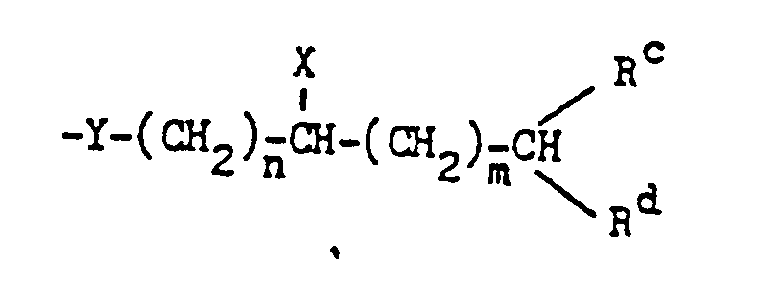
- R1 and/or R2 may have a structure where n is 0 to 5, X is halogen Y is a single bond, COO or OOC, m is 0 to 5 and R c and R d may be the same or different and are C 1_5 n -alkyl groups. If R c and R d are different then the carbon atom to which they are attached will be assymmetric.
- n is 0.
- a and B are independently either a single bond or a single unsubstituted 1,4-phenyl ring. It is particularly preferred for at least one of A and B to be a single bond.
- Preferred halogens from which the substituents on the phenyl rings may be selected are fluorine and chlorine, especially fluorine.
- the compound of Formula 1 contains no more than 4, or better, 3, rings (the central naphthyl system being counted as 2).
- R a denotes n -alkyl
- _(O)_ indicates that an oxygen atom may be present ie in an alkoxy group R a _O_
- R b denotes optically active alkyl
- R c and R d denote the same or different C 1_5 n- alkyl groups.
- Z1 and/or Z2 are _COO_ or _OOC_ respectively are simply esters of hydroxy-naphthalene compounds and may be prepared by well known esterification reactions.
- Z1 and/or Z2 are _O_ are simply ethers and may be prepared via well known etherification reactions.
- a suitable starting point is 2,6-dihydroxynaphthalene.
- any of the combinations _B_R2 may be introduced into the molecule.
- Suitable phenols and cyclohexanols are listed below: where (X) indicates that one or more halogen substituents, which may be the same or different, may be present on the ring.
- step C(iv) by using in step C(iv) appropriately substituted phenols, cyclohexanols or naphthols in a manner analogous to that discussed in relation to Route A, the various combinations of _B_R2 may be introduced into the molecule.
- an appropriate carboxylic acid in step C(vi) the various combinations of R1_A_ in which n is 1 may be introduced into the molecule.
- suitable carboxylic acids are listed below:
- the compound of Formula I may have a chiral centre in either or both of R1 and R2.
- the chiral centre When present in only one of R1 or R2 the chiral centre may have the S or R configuration and may confer (+) or (_) senses of optical rotation on the molecule (configurations and senses of rotation need not correspond).
- both R1 and R2 contain a chiral centre the configurations of the chiral senses and the senses of optical rotation may be the same or different. If it is preferred that the sense of Ps induced in a mixture by each chiral centre, if two are present in the molecule is the same so that a high Ps is induced.
- the two chiral centres may induce opposing senses of helical twist in the chiral smectic phase, but the same sense of Ps, so that a material with a long, preferably infinite pitch may be obtained, with a high Ps.
- the invention also provides a ferroelectric smectic liquid crystal composition containing at least two compounds, at least one of which is an optically active compound which contains at least one asymmetrically substituted carbon atom and has a formula IA: where R a is n-alkyl, (O) indicates that an oxygen atom may be present and R b represents optically active alkyl.
- esters for use as or in a tilted smectic host are the series of esters described in copending patent application PCT/GB86/0040, the contents of which are included herein by reference. These esters have the general formula where repesents 1,4- phenyl or trans - 1,4- cyclohexyl, R3 represents C 3_12 alkyl, alkoxy, alkylcarbonyloxy, alkoxycarbonyl, or alkoxycarbonyloxy, j is 0 or 1, R4 represents C 3_12 alkyl or alkoxy, one of Q1 or Q2 is H and the other F.
- esters of Formula II for use in or as a host together with a compound of Formula I as dopant are those below, where R5 is C 3_12 alkyl or alkoxy:
- Another preferred class of smectic hosts are the phenyl-pyrimidines of general formula III below where R6 and R7 are independently n-alkyl or n-alkoxy containing 1-12 carbon atoms, especially where R6 is n-alkoxy containing 5-10 carbon atoms and R7 is n-alkoxy containing 5-10 carbon atom.
- Some compounds of Formula I have the unexpected property that although they do not show smectic phases themselves, they are com-patible with a wide range of smectic hosts, and do not depress (ie lower the temperature at which the smectic phase disappears) the smectic phase of the mixture to a significant extent.
- Ferroelectric smectic liquid crystal mixtures containing a compound of Formula I may also contain one or more other optically active compounds, and such other compounds may induce the same or the opposite sense of helical pitch on the chiral smectic phase of the mixture. If the latter, then a mixture may be obtained in some cases which has an infinite pitch, and if the senses of Ps induced by the compound of Formula I and such other compound(s) are additive, ie the same, then the mixture may also have a large Ps.
- Some examples of other known types of optically active compounds which can be used in this way with a compound of Formula I are listed in Table 4 below.
- R C may be n-alkyl or n-alkoxy
- R D may be n-alkyl, or n-alkoxy if not present as _COOR D
- R E is optically active alkyl.
- R C , R D and R E independently contain 1 to 12 carbon atoms.
- a preferred form of structure 4.5 is 4.6 below: When the mixture contains compounds of Formula II, the constituion of one or more optically active compounds of Formula IV.6 is preferred.
- a ferroelectric smectic liquid crystal material may also contain other known additives to modify or improve its properties if this is considered necessary, such as viscosity, liquid crystal transition temperatures, birefringence etc, or to suppress undesirable smectic phases.
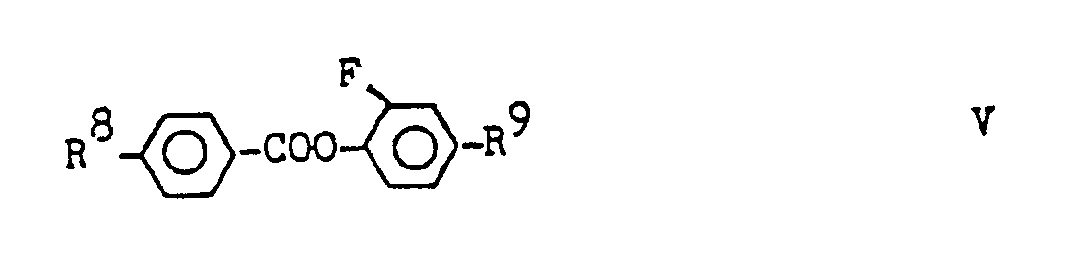
- Some examples of compounds which may be used as additives in this way are compounds of general structure V below where R8 and R9 are independently n -alkyl or alkoxy containing 1 to 12 carbon atoms, especially 5 to 9. Additives of this structure are useful when the mixture contains compounds of Formula II.
- r-1-cyano- cis -4-(4 ⁇ -alkyl or alkoxy biphenyl-4-yl)-1-alkylcyclohexanes ie compounds of structure VI below: where R ⁇ and R ⁇ are the same or different alkyl groups especially containing 3 to 10 carbon atoms are useful additives.
- a typical ferroelectric smetic liquid crystal mixture which incorporates one or more compounds of Formula I has the following composition:
- composition selected will depend upon the properties required. Ps is generally proportional to the amount of chiral dopants present in the mixture, and it is desirable to achieve as high a Ps as possible without compromise of other desirable properties.
- Ferroelectric smectic liquid crystal materials incorporating a compound of Formula I may be used in any of the known types of electro-optic device which use such materials, for example as generally described in Appl. Phys. Lett. 36 , (1980) p 899. (Reference 1).
- Such a device is the "Clark Lagerwall Device",described in Reference 1, and also in “Recent Developments in Condensed Matter Physics” 4 , p309, (1981) (Reference 3).
- the physics of this device, and methods of constructing one are well known.
- such a device usually consists of two substrates, at least one of which is optically transparent, electrodes on the inner surfaces of the substrates and a layer of the liquid crystal material sandwiched between the substrates.
- the Clark Lagerwall device uses a layer of liquid crystal material between the substrates of a thickness comparable to or less than the helical pitch of the S * configuration, which causes the helix to be unwound by surface interactions.
- the material In its unwound state the material has two surface stabilised states with director orientations (ie molecular tilt direction) at twice the tilt angle to one another, and also permanent dipole orientations perpendicular to the substrates but in opposite directions.
- An alternative approach to providing cells for a Clark-Lagerwall device having a thicker layer of liquid crystal material is to use an applied electric field to induce homogeneous alignment through interaction with the dielectric anistropy of the liquid crystal material.
- liquid crystal electro-optic display device wherein the liquid crystal material incorporates a compound of formula I, and may be a material as described herein.
- the device may be a Clark Lagerwall device as described above.
- Figs 1, 2 and 3 show preparative routes A, B and C
- Fig 4 shows a cross section through a liquid crystal device.
- DCC is dicyclohexylcarbodiimide
- DMAP is 4-N,N ⁇ -dimethylaminopyridine.
- 6-Hydroxynaphthalene-2-carboxylic acid 39.8 g
- 1-bromooctane 61.3 g
- potassium hydroxide 23.7 g
- ethanol 900 ml
- water 120 ml
- 10% Aqueous potassium hydroxide 200 ml was added and refluxing was continued for a further 2 hours, when the solution was poured into water (5 litre) and acidified to ph 1.
- the solid was filtered, washed with water, dried and recrystallised from acetic acid to give the product (49.0 g, 77.2% theory) as a white crystalline solid, mpt 150-153°C (98.2% pure by hplc).
- step B(i) s(+)-1-methylheptyl 4-benzyloxybenzoate
- step B(ii) s(+)-1-methylheptyl 4-hydroxybenzoate
- step B(iii) s(+)-1-methylheptyl 4-(6-n-octyloxy-2-naphthoyloxy)-benzoate
- 6- n -Octyloxy-2-naphthoic acid 24 g was reacted with thionyl chloride (60 ml) as described previously and the crude acid chloride in toluene (100 ml) was added to a solution of s(+)-2-octanol (20 g) in pyridine (80 ml) dropwise over 10 minutes. After heating at 90°C for 3 hours, the diester was isolated by acidification etc.
- 6-Benzyloxy-2-naphthoic acid (34.7 g) was converted to the acid chloride with thionyl chloride (150 ml) and the crude product (37.0 g) was reacted with s(+)-2-octanol (16.2 g) in toluene (120 ml) and pyridine (65 ml).
- the crude product was chromatographed over alumina (150 g) and silica gel (150 g) in a 2: 1 - mixture of petroleum spirit (60-80°) and dichloromethane and eluted with dichloromethane.
- the naphthoate was obtained as a white solid (38.0 g, 76% theory) mpt 71-73°, 99.6% pure by glc.
- step C(vi) s(+)-1-methylheptyl 6-(4-n-octyloxybenzoyloxy)-2-naphthoate
- Step 4 R-1-Methylheptyloxyphenyl 6-n-octyloxynaphthalene-2-carboxylate
- 6-n-Octyloxynaphthalene-2-carbonylchloride was prepared from the acid (8 g) by the method described in Example 1, and added to a mixture of R-1-methylheptyloxyphenol (5.9 g), triethylamine (11.6 mls) and dichloromethane (116 mls). The mixture was boiled under reflux for 1 hour, cooled, and washed with water (100 mls), dilute hydrochloric acid (20%, 100 mls) and water (100 mls). Removal of the solvent by distillation gave the product as a yellow semi-solid.
- Examples 5, 6, 7 and 8 all describe ferroelectric smectic liquid crystal mixtures containing the products of Examples 1, 2, 3 and 4 in hosts which are mixtures of esters of Formula II above. All the mixtures described show room temperature ferroelectric smectic liquid crystal phases.
- a mixture was made up of 45% w/w 2-fluoro-4- n -pentylphenyl 4 ⁇ -n-octylbiphenyl-4-carboxylate 45% w/w 2-fluoro-4- n -pentylphenyl 4 ⁇ -n-octyloxybiphenyl-4-carboxylate 10% w/w S-(+)-1-methylheptyl 6- n -octyloxynaphthalene-2-carboxylate
- a mixture was made up comprising: 30% 2-fluoro-4- n -pentylphenyl 4 ⁇ - n -octylbiphenyl-4-carboxylate 30% 2-fluoro-4- n -pentylphenyl 4 ⁇ - n -octyloxybiphenyl-4-carboxylate 30% 2-fluoro-4- n -heptylphenyl 4 ⁇ - n -heptyloxybiphenyl-4-carboxylate 10% S-(+)-1-Methylheptyl 4-(6- n -octyloxy-2-naphthoyloxy)-benzoate
- the ferroelectric spontaneous polarisation was measured as a function of temperature:
- the ferroelectric spontaneous polarisation of the mixture was measured as follows as a function of temperature:
- the ferroelectric spontaneous polarisation of the mixture was measured as a function of temperature as follows:
- the product of example 9 was made up into a mixture consisting of: 3 % 2-p-hexyloxyphenyl-5-heptylpyrimidine 3 % 2-p-heptyloxyphenyl-5-heptylpyrimidine 3 % 2-p-octyloxyphenyl-5-heptylpyrimidine 3 % 2-p-nonyloxyphenyl-5-heptylpyrimidine 9 % 2-p-hexyloxyphenyl-5-nonylpyrimidine 23% 2-p-nonyloxyphenyl-5-nonylpyrimidine 10% r-1-cyano-cis-4-(4 ⁇ -octyloxybiphenyl-4-yl)-1-butylcyclohexane 20% r-1-cyano-cis-4-(4 ⁇ -octyloxybiphenyl-4-yl)-1-octylcyclohexane 16% r-1-cyano-cis-4
- phase transition temperatures were measured on the above mixture: S C -S A 57°C; S A -N * 8°C; N * -I 122-124°
- a liquid crystal cell comprises a layer 1 of liquid crystal material exhibiting a chiral smectic phase sandwiched between a glass slide 2 having a transparent conducting layer 3 on its surface, eg of tin oxide or indium oxide, and a glass slide 4 having a transparent conducting layer 5 on its surface.
- the slides 2,4 bearing the layers 3,5 are respectively coated by films 6,7 of a polyimide polymer. Prior to construction of the cell the films 6 and 7 are rubbed with a soft tissue in a given direction the rubbing directions being arranged parallel upon construction of the cell.
- a spacer 8 eg of polymethyl methacrylate, separates the slides 2,4 to the required distance, eg 5 microns.
- the liquid crystal material 1 is introduced between the slides 2,4 to the required distance, eg 5 microns.
- the liquid crystal material 1 is introduced between the slides 2,4 by filling the space between the slides 2, 4 and spacer 8 and sealing the spacer 8 in a vacuum in a known way.
- the liquid crystal material is in the smectic A, nematic or isotropic liquid phase (obtained by heating the material) when it is introduced beteen the slides 2,4 to facilitate alignment of the liquid crystal molecules with the rubbing directions on the slides 2,4.
- a polarizer 9 is arranged with its polarization axis parallel to the rubbing direction on the films 6,7 and an analyzer (crossed polarizer)10 is arranged with its polarization axis perpendicular to that rubbing direction.
- the layers 3 and 5 may be selectively shaped in a known way, eg by photoetching or deposition through a mask, eg to provide one or more display symbols, eg letters, numerals, words or graphics and the like as conventionally seen on displays.
- the electrode portions formed thereby may be addressed in a variety of ways which include multiplexed operation.
- the layer of liquid crystal material 1 in Fig 4 may for example be the mixture of examples 5, 6, 7, 8, 10, 11 or 12.
Landscapes
- Chemical & Material Sciences (AREA)
- Crystallography & Structural Chemistry (AREA)
- Engineering & Computer Science (AREA)
- Materials Engineering (AREA)
- Organic Chemistry (AREA)
- Organic Low-Molecular-Weight Compounds And Preparation Thereof (AREA)
- Liquid Crystal Substances (AREA)
Abstract
Claims (16)

Z1 et Z² sont choisis chacun, indépendamment, parmi une liaison simple, un groupe _COO_, _OOC_ et _O_;
A et B sont choisis chacun, indépendamment, parmi (i) une liaison simple, ou (ii) un groupe phényle, transcyclohexyle, pyridyle ou pyrimidyle, le groupe phényle pouvant porter des substituants halogéno ou halogénés latéraux, ou (iii) B peut être un groupe chiral _CH(CH₃)COO_ lorsque R² représente un groupe alkyle, à la condition que, si l'un des groupes ou symboles _A_Z¹_ ou _Z²_B_ représente un groupe phényle relié au système naphtyle par l'intermédiaire d'un groupe OOC ou COO et si l'autre représente une liaison simple, les groupes R¹ et R² ne peuvent pas être choisis tous les deux parmi un groupe alkyle ou,alcoxy et, également, si l'un des groupes R¹_A_Z¹_ ou Z²_B_R² représente un groupe alcoxy-phényl _COO_ l'autre ne peut représenter un groupe COO_CH₂CH(CH₃)C₂H₅.



Priority Applications (1)
| Application Number | Priority Date | Filing Date | Title |
|---|---|---|---|
| AT87902632T ATE61039T1 (de) | 1986-04-28 | 1987-04-27 | Optisch aktive naphthalen-verbindungen und sie enthaltende fluessigkristalline zusammensetzungen. |
Applications Claiming Priority (2)
| Application Number | Priority Date | Filing Date | Title |
|---|---|---|---|
| GB868610349A GB8610349D0 (en) | 1986-04-28 | 1986-04-28 | 6-hydroxy-2-naphthoic acid derivatives |
| GB8610349 | 1986-04-28 |
Publications (2)
| Publication Number | Publication Date |
|---|---|
| EP0302875A1 EP0302875A1 (fr) | 1989-02-15 |
| EP0302875B1 true EP0302875B1 (fr) | 1991-02-27 |
Family
ID=10596975
Family Applications (1)
| Application Number | Title | Priority Date | Filing Date |
|---|---|---|---|
| EP87902632A Expired EP0302875B1 (fr) | 1986-04-28 | 1987-04-27 | Composes de naphtalene optiquement actifs et compositions de cristaux liquides contenant lesdits composes |
Country Status (4)
| Country | Link |
|---|---|
| US (1) | US5061399A (fr) |
| EP (1) | EP0302875B1 (fr) |
| GB (1) | GB8610349D0 (fr) |
| WO (1) | WO1987006577A2 (fr) |
Families Citing this family (21)
| Publication number | Priority date | Publication date | Assignee | Title |
|---|---|---|---|---|
| CA1294954C (fr) * | 1986-12-26 | 1992-01-28 | Masakatsu Nakatsuka | Derives naphtalene optiquement actifs |
| US4943651A (en) * | 1988-03-07 | 1990-07-24 | Mitsui Petrochemical Industries, Ltd. | Novel substitued naphthalene compounds and liquid crystal compositions containing same |
| ATE109127T1 (de) * | 1988-05-12 | 1994-08-15 | Mitsui Petrochemical Ind | Naphthalen-verbindung und dieselbe enthaltende flüssigkristalline zusammensetzung. |
| US5194665A (en) * | 1988-06-30 | 1993-03-16 | Hoechst Ag | Surfactants based on hydroxynaphthoic esters and preparation and use thereof |
| US4937373A (en) * | 1988-12-08 | 1990-06-26 | Hoffmann-La Roche Inc. | Substituted naphthalene carboxylic acids |
| JP2768365B2 (ja) * | 1989-06-24 | 1998-06-25 | 富士通株式会社 | 液晶組成物 |
| MY106839A (en) * | 1989-08-18 | 1995-08-30 | Mitsui Petrochemical Ind | Carboxylate compounds, liquid crystal compositions containing said compounds and liquid crystal elements. |
| JP2890759B2 (ja) * | 1989-09-08 | 1999-05-17 | 住友化学工業株式会社 | 光学活性なナフタレン誘導体、その製造法、それを有効成分とする液晶組成物およびこれを用いてなる液晶素子 |
| DE59104009D1 (de) * | 1990-03-27 | 1995-02-09 | Hoffmann La Roche | Naphthalindicarbonsäureester. |
| US5212027A (en) * | 1990-05-18 | 1993-05-18 | Basf Aktiengesellschaft | Monomers and their use for the production of a laser-optical recording element which can be repeatedly erased and recorded on |
| TW207529B (fr) * | 1990-06-25 | 1993-06-11 | Mitsui Petroleum Chemicals Ind | |
| DE69107359T2 (de) * | 1990-07-19 | 1995-06-14 | Mitsui Petrochemical Ind | Flüssigkristall-Racematmischung, Flüssigkristallzusammensetzung und Flüssigkristallelement, Verfahren zur Herstellung und Verwendung. |
| JPH04139295A (ja) * | 1990-09-28 | 1992-05-13 | Sharp Corp | 強誘電性液晶組成物およびその用途 |
| US5496500A (en) | 1991-03-13 | 1996-03-05 | The Secretary Of State For Defence In Her Britannic Majesty's Government Of The United Kingdom Of Great Britain & Northern Ireland | Naphthyl organic compounds |
| GB9105359D0 (en) | 1991-03-13 | 1991-04-24 | Secr Defence | Naphthyl organic compounds |
| JPH0665154A (ja) * | 1992-08-19 | 1994-03-08 | Showa Shell Sekiyu Kk | 液晶化合物 |
| JP2996268B2 (ja) * | 1992-10-09 | 1999-12-27 | 富士通株式会社 | 強誘電性液晶組成物 |
| US6720039B1 (en) | 1997-02-19 | 2004-04-13 | Dai Nippon Printing Co., Ltd. | Liquid crystalline compounds and process for producing the same |
| JP4116109B2 (ja) | 1997-02-19 | 2008-07-09 | 大日本印刷株式会社 | エレクトロルミネッセンス素子用組成物 |
| US8590479B2 (en) * | 2011-07-25 | 2013-11-26 | Transform Pack Inc. | Preserving seasoning flavour profiles during the manufacturing of food-seasoning sheets |
| TWI688587B (zh) * | 2018-05-17 | 2020-03-21 | 臻鼎科技股份有限公司 | 改性的液晶高分子聚合物、高分子膜及相應的製備方法 |
Family Cites Families (22)
| Publication number | Priority date | Publication date | Assignee | Title |
|---|---|---|---|---|
| US4113647A (en) * | 1976-08-13 | 1978-09-12 | The Secretary Of State For Defence In Her Britannic Majesty's Government Of The United Kingdom Of Great Britain And Northern Ireland | Liquid crystalline materials |
| GB1603075A (en) * | 1977-10-24 | 1981-11-18 | Secr Defence | Liquid crystal esters containing naphthyl groups |
| GB2063250B (en) * | 1979-10-02 | 1984-05-31 | Bdh Chemicals Ltd | Liquid crystal esters |
| DE2949080A1 (de) * | 1979-12-06 | 1981-06-11 | Merck Patent Gmbh, 6100 Darmstadt | Naphthalinderivate, diese enthaltende dielektrika und elektrooptisches anzeigeelement |
| US4613209A (en) * | 1982-03-23 | 1986-09-23 | At&T Bell Laboratories | Smectic liquid crystals |
| JPS60146877A (ja) * | 1984-01-11 | 1985-08-02 | Chisso Corp | 2―置換―6―(5―置換―2―ピリミジニル)ナフタリン |
| DD245895A1 (de) * | 1984-02-16 | 1987-05-20 | Univ Halle Wittenberg | Anwendung nematischer kristallin-fluessiger gemische |
| EP0178647B1 (fr) * | 1984-10-18 | 1993-09-29 | Chisso Corporation | Composition liquide cristalline ferroélectrique chirale smectique |
| GB8428653D0 (en) * | 1984-11-13 | 1984-12-19 | Secr Defence | Diesters |
| GB8501509D0 (en) * | 1985-01-22 | 1985-02-20 | Secr Defence | Esters |
| DE3515373A1 (de) * | 1985-04-27 | 1986-11-06 | Merck Patent Gmbh, 6100 Darmstadt | Stickstoffhaltige heterocyclen |
| JPH0645573B2 (ja) * | 1985-07-04 | 1994-06-15 | 三井東圧化学株式会社 | 液晶化合物および液晶組成物 |
| JPS6317848A (ja) * | 1986-07-10 | 1988-01-25 | Toray Ind Inc | 光学活性6−置換ナフタレン−2−カルボン酸エステル化合物および液晶 |
| JPS6317847A (ja) * | 1986-07-10 | 1988-01-25 | Toray Ind Inc | 光学活性6−アルコキシナフタレン−2−カルボン酸エステル化合物および液晶 |
| JPH0737420B2 (ja) * | 1986-12-27 | 1995-04-26 | 日産化学工業株式会社 | 新規な液晶性化合物 |
| US4921632A (en) * | 1987-08-26 | 1990-05-01 | Nec Corporation | Liquid crystal compounds and compositions |
| US4943651A (en) * | 1988-03-07 | 1990-07-24 | Mitsui Petrochemical Industries, Ltd. | Novel substitued naphthalene compounds and liquid crystal compositions containing same |
| ATE111944T1 (de) * | 1988-06-24 | 1994-10-15 | Canon Kk | Ferroelektrische chirale smektische flüssigkristallzusammensetzung und vorrichtung mit dieser zusammensetzung. |
| JPH028292A (ja) * | 1988-06-28 | 1990-01-11 | Fujitsu Ltd | 強誘電性液晶表示素子 |
| ES2040936T3 (es) * | 1988-07-13 | 1993-11-01 | Canon Kabushiki Kaisha | Composicion de cristal liquido ferroelectrico quiral esmetico y un dispositivo de cristal liquido que utiliza la composicion de cristal liquido. |
| ATE116674T1 (de) * | 1988-07-15 | 1995-01-15 | Canon Kk | Ferroelektrische, chirale, smektische flüssigkristallzusammensetzung und deren verwendung in einer flüssigkristallanordnung. |
| JPH02191240A (ja) * | 1989-01-18 | 1990-07-27 | Adeka Argus Chem Co Ltd | 光学活性なナフチルエステル化合物 |
-
1986
- 1986-04-28 GB GB868610349A patent/GB8610349D0/en active Pending
-
1987
- 1987-04-27 WO PCT/GB1987/000280 patent/WO1987006577A2/fr not_active Ceased
- 1987-04-27 EP EP87902632A patent/EP0302875B1/fr not_active Expired
- 1987-04-27 US US07/285,963 patent/US5061399A/en not_active Expired - Lifetime
Also Published As
| Publication number | Publication date |
|---|---|
| WO1987006577A2 (fr) | 1987-11-05 |
| WO1987006577A3 (fr) | 1987-12-03 |
| US5061399A (en) | 1991-10-29 |
| EP0302875A1 (fr) | 1989-02-15 |
| GB8610349D0 (en) | 1986-06-04 |
Similar Documents
| Publication | Publication Date | Title |
|---|---|---|
| US5061399A (en) | Optically active naphthalene compounds and liquid crystal materials and devices incorporating them | |
| EP0263843B1 (fr) | Composes et melanges pour cristaux liquides, et dispositifs les contenant | |
| EP0211030B1 (fr) | Matériaux ferroélectriques smectiques à cristaux liquides basés sur des dérives de terpenoides | |
| US4880560A (en) | Lactic acid derivative, liquid crystal composition containing same and liquid crystal device | |
| EP0174816A2 (fr) | Composés diesters biphényliques et composition de cristaux liquides les contenant | |
| US4876027A (en) | Optically active composition, mesomorphic compound and liquid crystal device | |
| EP0301511B1 (fr) | Composé optiquement actif et composition nématique le contenant | |
| EP0197677A2 (fr) | Composé liquide cristallin optiquement actif contenant des halogènes et composition liquide cristalline le contenant | |
| US5049308A (en) | Ferroelectric smectic liquid crystal compound and composition containing the same | |
| KR960000076B1 (ko) | 키랄성 에스테르의 제조방법 | |
| US5126071A (en) | Optically active compound, process for producing same and liquid crystal composition containing same | |
| US5723069A (en) | Anti-ferroelectric liquid crystal compound and anti-ferroelectric liquid crystal composition | |
| US4623477A (en) | Ester compounds having a pyrimidine ring | |
| EP0439190B1 (fr) | Composé pour composition liquide cristalline et composition le contenant | |
| EP0453503B1 (fr) | Naphtalenes de phenyle ayant des proprietes cristallines liquides | |
| GB2200912A (en) | Terphenyl derivatives and liquid crystal materials containing them | |
| EP0333760B1 (fr) | Esters cyano-alicycliques et des compositions de cristaux liquides | |
| US4943385A (en) | Thioether compound and liquid crystal composition | |
| US4697015A (en) | Liquid crystalline pyrimidinyl phenyl carboxylic acid ester derivatives | |
| US5037576A (en) | Liquid crystal compounds, mixtures and devices | |
| Chin et al. | The Liquid-Crystalline Properties of Some Chiral Derivatives of the 4-n-Alkanoyloxbiphenyl-4′-Carboxylic Acids | |
| EP0259423B1 (fr) | Composes de cristaux liquides, melanges et dispositifs | |
| US5232625A (en) | Cyano-alicyclic esters in liquid crystal compositions | |
| JPH0717579B2 (ja) | 光学活性化合物および液晶組成物と光学活性化合物合成用中間体 | |
| JP2005516063A (ja) | 液晶化合物 |
Legal Events
| Date | Code | Title | Description |
|---|---|---|---|
| PUAI | Public reference made under article 153(3) epc to a published international application that has entered the european phase |
Free format text: ORIGINAL CODE: 0009012 |
|
| 17P | Request for examination filed |
Effective date: 19881103 |
|
| AK | Designated contracting states |
Kind code of ref document: A1 Designated state(s): AT BE CH DE FR GB IT LI LU NL SE |
|
| 17Q | First examination report despatched |
Effective date: 19900326 |
|
| GRAA | (expected) grant |
Free format text: ORIGINAL CODE: 0009210 |
|
| AK | Designated contracting states |
Kind code of ref document: B1 Designated state(s): AT BE CH DE FR GB IT LI LU NL SE |
|
| REF | Corresponds to: |
Ref document number: 61039 Country of ref document: AT Date of ref document: 19910315 Kind code of ref document: T |
|
| ITF | It: translation for a ep patent filed | ||
| ET | Fr: translation filed | ||
| REF | Corresponds to: |
Ref document number: 3768273 Country of ref document: DE Date of ref document: 19910404 |
|
| PLBE | No opposition filed within time limit |
Free format text: ORIGINAL CODE: 0009261 |
|
| STAA | Information on the status of an ep patent application or granted ep patent |
Free format text: STATUS: NO OPPOSITION FILED WITHIN TIME LIMIT |
|
| 26N | No opposition filed | ||
| EPTA | Lu: last paid annual fee | ||
| EAL | Se: european patent in force in sweden |
Ref document number: 87902632.6 |
|
| REG | Reference to a national code |
Ref country code: GB Ref legal event code: 732E |
|
| BECA | Be: change of holder's address |
Free format text: 20011123 *QINETIQ LTD:85 BUCKINGHAM GATE, LONDON SW14 0LX |
|
| REG | Reference to a national code |
Ref country code: GB Ref legal event code: IF02 |
|
| PGFP | Annual fee paid to national office [announced via postgrant information from national office to epo] |
Ref country code: AT Payment date: 20020307 Year of fee payment: 16 |
|
| PGFP | Annual fee paid to national office [announced via postgrant information from national office to epo] |
Ref country code: CH Payment date: 20020314 Year of fee payment: 16 |
|
| PGFP | Annual fee paid to national office [announced via postgrant information from national office to epo] |
Ref country code: SE Payment date: 20020319 Year of fee payment: 16 Ref country code: LU Payment date: 20020319 Year of fee payment: 16 |
|
| PGFP | Annual fee paid to national office [announced via postgrant information from national office to epo] |
Ref country code: BE Payment date: 20020417 Year of fee payment: 16 |
|
| REG | Reference to a national code |
Ref country code: FR Ref legal event code: TP |
|
| NLS | Nl: assignments of ep-patents |
Owner name: QINETIQ LIMITED |
|
| PG25 | Lapsed in a contracting state [announced via postgrant information from national office to epo] |
Ref country code: LU Free format text: LAPSE BECAUSE OF NON-PAYMENT OF DUE FEES Effective date: 20030427 Ref country code: AT Free format text: LAPSE BECAUSE OF NON-PAYMENT OF DUE FEES Effective date: 20030427 |
|
| PG25 | Lapsed in a contracting state [announced via postgrant information from national office to epo] |
Ref country code: SE Free format text: LAPSE BECAUSE OF NON-PAYMENT OF DUE FEES Effective date: 20030428 |
|
| PG25 | Lapsed in a contracting state [announced via postgrant information from national office to epo] |
Ref country code: LI Free format text: LAPSE BECAUSE OF NON-PAYMENT OF DUE FEES Effective date: 20030430 Ref country code: CH Free format text: LAPSE BECAUSE OF NON-PAYMENT OF DUE FEES Effective date: 20030430 Ref country code: BE Free format text: LAPSE BECAUSE OF NON-PAYMENT OF DUE FEES Effective date: 20030430 |
|
| BERE | Be: lapsed |
Owner name: *QINETIQ LTD Effective date: 20030430 |
|
| EUG | Se: european patent has lapsed | ||
| REG | Reference to a national code |
Ref country code: CH Ref legal event code: PL |
|
| REG | Reference to a national code |
Ref country code: GB Ref legal event code: 732E |
|
| PGFP | Annual fee paid to national office [announced via postgrant information from national office to epo] |
Ref country code: FR Payment date: 20050310 Year of fee payment: 19 |
|
| PGFP | Annual fee paid to national office [announced via postgrant information from national office to epo] |
Ref country code: NL Payment date: 20050316 Year of fee payment: 19 |
|
| PG25 | Lapsed in a contracting state [announced via postgrant information from national office to epo] |
Ref country code: IT Free format text: LAPSE BECAUSE OF NON-PAYMENT OF DUE FEES;WARNING: LAPSES OF ITALIAN PATENTS WITH EFFECTIVE DATE BEFORE 2007 MAY HAVE OCCURRED AT ANY TIME BEFORE 2007. THE CORRECT EFFECTIVE DATE MAY BE DIFFERENT FROM THE ONE RECORDED. Effective date: 20050427 |
|
| PGFP | Annual fee paid to national office [announced via postgrant information from national office to epo] |
Ref country code: GB Payment date: 20060728 Year of fee payment: 20 |
|
| PGFP | Annual fee paid to national office [announced via postgrant information from national office to epo] |
Ref country code: DE Payment date: 20060803 Year of fee payment: 20 |
|
| PG25 | Lapsed in a contracting state [announced via postgrant information from national office to epo] |
Ref country code: NL Free format text: LAPSE BECAUSE OF NON-PAYMENT OF DUE FEES Effective date: 20061101 |
|
| NLV4 | Nl: lapsed or anulled due to non-payment of the annual fee |
Effective date: 20061101 |
|
| REG | Reference to a national code |
Ref country code: FR Ref legal event code: ST Effective date: 20061230 |
|
| REG | Reference to a national code |
Ref country code: GB Ref legal event code: PE20 |
|
| PG25 | Lapsed in a contracting state [announced via postgrant information from national office to epo] |
Ref country code: GB Free format text: LAPSE BECAUSE OF EXPIRATION OF PROTECTION Effective date: 20070426 |
|
| PG25 | Lapsed in a contracting state [announced via postgrant information from national office to epo] |
Ref country code: FR Free format text: LAPSE BECAUSE OF NON-PAYMENT OF DUE FEES Effective date: 20060502 |