EP0308061A2 - Maskenerzeugungsschaltung - Google Patents
Maskenerzeugungsschaltung Download PDFInfo
- Publication number
- EP0308061A2 EP0308061A2 EP88307365A EP88307365A EP0308061A2 EP 0308061 A2 EP0308061 A2 EP 0308061A2 EP 88307365 A EP88307365 A EP 88307365A EP 88307365 A EP88307365 A EP 88307365A EP 0308061 A2 EP0308061 A2 EP 0308061A2
- Authority
- EP
- European Patent Office
- Prior art keywords
- logic
- bit
- sequence
- bit mask
- circuit
- Prior art date
- Legal status (The legal status is an assumption and is not a legal conclusion. Google has not performed a legal analysis and makes no representation as to the accuracy of the status listed.)
- Withdrawn
Links
Images

Classifications
-
- G—PHYSICS
- G06—COMPUTING OR CALCULATING; COUNTING
- G06F—ELECTRIC DIGITAL DATA PROCESSING
- G06F7/00—Methods or arrangements for processing data by operating upon the order or content of the data handled
- G06F7/76—Arrangements for rearranging, permuting or selecting data according to predetermined rules, independently of the content of the data
- G06F7/764—Masking
-
- G—PHYSICS
- G06—COMPUTING OR CALCULATING; COUNTING
- G06F—ELECTRIC DIGITAL DATA PROCESSING
- G06F9/00—Arrangements for program control, e.g. control units
- G06F9/06—Arrangements for program control, e.g. control units using stored programs, i.e. using an internal store of processing equipment to receive or retain programs
- G06F9/30—Arrangements for executing machine instructions, e.g. instruction decode
- G06F9/30003—Arrangements for executing specific machine instructions
- G06F9/30007—Arrangements for executing specific machine instructions to perform operations on data operands
- G06F9/30018—Bit or string instructions
-
- G—PHYSICS
- G06—COMPUTING OR CALCULATING; COUNTING
- G06F—ELECTRIC DIGITAL DATA PROCESSING
- G06F9/00—Arrangements for program control, e.g. control units
- G06F9/06—Arrangements for program control, e.g. control units using stored programs, i.e. using an internal store of processing equipment to receive or retain programs
- G06F9/30—Arrangements for executing machine instructions, e.g. instruction decode
- G06F9/30003—Arrangements for executing specific machine instructions
- G06F9/30007—Arrangements for executing specific machine instructions to perform operations on data operands
- G06F9/30036—Instructions to perform operations on packed data, e.g. vector, tile or matrix operations
- G06F9/30038—Instructions to perform operations on packed data, e.g. vector, tile or matrix operations using a mask
Definitions
- This invention relates to circuitry for a digital data processing system and more particularly to a circuit for providing a specified binary sequence termed a mask.
- a mask is a predefined binary sequence.
- a mask is used to extract specific bits from a data word or another data sequence while suppressing other bits in the word or sequence.
- An example of a mask would be a binary sequence containing a series of 1's surrounded by 0's. When this mask is ANDed with some other data word, the data in this other data word at the bit locations of the 1's in the mask word will be exposed. The bits and the data word at the locations corresponding to the 0 bit locations in the mask word will be suppressed.
- This invention provides a mask generation unit that specifies a mask of 1's surrounded by 0's or 0's surrounded by 1's.
- U.S. Patent 4,087,811 entitled “Threshold Decoder” discloses a type of mask generator designed with the purpose of minimising the total number of gates. However, using the technique of this patent, a considerable amount of wiring is required.
- Patent 4,569,016 entitled “Mechanism For Implementing One Machine Cycle Executable Mask and Rotate Instructions In A Primitive Instruction Set Computing System” discloses a circuit for performing full shift, merge, insert and bit alignment functions within a single machine operating cycle. However, this patent does not disclose the specific circuitry embodiment of the mask generation unit. This patent does, however, discuss the importance of the execution of an instruction in a single machine operating cycle. The present invention is intended to perform the mask generation function within a single machine cycle operation.
- IBM Technical Disclosure Bulletin Vol. 23, No. 1, June 1980, pages 149-150, entitled “Mask Generator” discloses a mask generating circuit using a bit shifter.
- a bit mask generator circuit that generates a bit mask sequence having a binary digital sequence of 2 N bits.
- This circuit includes a first edge generator that receives a first N bit indication designating a first binary digital sequence having a bit value transition at a specified location.
- a second logic circuit consisting of 2 p identical logical units, each not more than two levels of combinational logic, connected in parallel and including 2 q - 1 repeating circuit sets, and are connected to receive the 2 q plus 2 p signals from the first logical circuit and provides a first edge bit mask sequence.
- the bit mask generator circuit further includes a second edge generator that is similar to the first edge generator including a first logic circuit that receives an N bit indication of a binary sequence designating a digital sequence bit value transition location.
- the first logic circuit is connected to a second logic circuit having 2 p identical logical units of not more than two levels of combinational logic each of the units connected in parallel and including 2 q - 1 repeating circuit sets, for receiving the 2 q plus 2 p signals from the second edge generator circuit first logic circuit for providing the second edge mask sequence.
- the bit mask generator circuit further includes a combinational logic circuitry connected to both the first edge generator circuit and second edge generator circuit to combine the first edge bit mask sequence and the second edge bit mask sequence to provide the bit mask sequence output.
- a mask generator provides a sequence pattern of binary digits, i.e., 1's and 0's as an output.
- an edge mask sequence is described as including a sequence of 1's followed by a sequence of 0's or vice versa. It should be apparent that a single edge mask circuit is a mask generator in the broadest terms. However, another type of sequence may be required having a sequence of 1's surrounded by a sequence of zero's or vice versa.
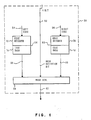
- Figure 1 is a block diagram of a mask generation circuit 50.
- This mask generation circuit will provide a sequence of 1's surrounded by a sequence of 0's or alternatively a sequence of 0's surrounded by a sequence of 1's.
- the polarity of the mask is provided by a single bit signal on line 52.
- the location of the sequence transition for the left edge is provided by a multi-bit signal on lines 54.
- a multi-bit signal on lines 56 provides the location of this right edge bit sequence transition.
- the left edge mask generation circuit 64 consists of two components: an edge decoder circuit 72 and a left edge mask circuit 74.
- the right edge mask generation circuit 66 consists of an edge decoder circuit 76 and a right edge mask circuit 78.
- the left edge mask bit sequence is provided on multi-bit lines 58 to the mask generator 80.
- the right edge mask sequence is provided on the multi-bit lines 60 to the mask generator 80.
- the mask generator 80 includes combinational logic that combines the left edge mask on lines 58 with the right edge mask on lines 60 to provide the mask sequence on lines 62.
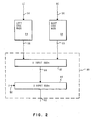
- Figure 2 illustrates a block diagram of the mask generation circuit including the left edge mask generation 64 and the right edge mask generation 66 connected to the mask generation circuit 80 that includes a series of two input AND gates 82 that are connected via multi-bit lines 84 to a set of two input EXCLUSIVE OR gates 86 to provide the mask sequence on line 62.
- the two input EXCLUSIVE OR gates 86 include one input connected to the AND gates in stage 82 and the other inputs of each of the two way EXCLUSIVE OR gates collectively connected to line 52.
- Line 52 specifies the polarity of the mask bit sequence (i.e., 1's surrounded by 0's or 0's surrounded by 1's).
- Fig. 3 illustrates the left edge mask generation circuit for a 16 bit sequence.
- the four-bit sequence a, b, c, d designates the left edge mask sequence LM0 - LM15.
- the edge decoder circuit 72 consists of a single level of logic. This logic includes AND gates 100 and 106 and OR gates 102 and 104.
- the left edge mask circuit 74 consists of four identical logic units 110, 114, 118, and 122. These logic units include two levels of combinational logic.
- logical unit 110 consists of AND gates 130, 134 and 138 and NOR gates 132, 136 and 140.
- Logical unit 110 illustrates the logical circuit sets 110a, 110b, 110c.
- Inverters 112, 116, 120 and 124 are interleaved between the logical units 110, 114, 118 and 122.
- the inverter units 112, 116, and 120 are single level combinational logics such as the NAND gate 142.
- the left edge mask bit position LM15 is provided by inverter 124 which is connected to a logical 0.
- input 108 to the logical unit 110 is tied to a logical 1.
- any edge mask bit sequence consisting of a number that is a power of 2 may be produced by a repeating combination of the illustrated logical units such as 110 including repeating circuit sets such as 110a, 110b and 110c, and the inverter units such as 112.
- the edge mask generation logic By arranging the edge mask generation logic in this manner, the complexity of the combinational circuitry and the wiring of the edge mask generator itself is greatly simplified.
- N 4 so the circuit 64 provides a sequence of 2 N or 16 bits as an output on lines 58.
- the q and the p parameters may be varied by the design.
- p relates to the number of logical units such as 110, 114, 118, and 122.
- q relates to the number of repeating circuit sets (such as 110a, 110b and 110c) within each logical unit. Actually 2 q - 1 repeating circuit sets are included in the 2 p logical units. This design minimises the wiring and simplifies circuit layout on a semiconductor device.
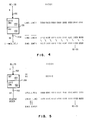
- Figure 4 illustrates a further embodiment to provide a right edge mask sequence from the same circuitry as for the left edge mask generation circuit.
- a 32 bit mask is being generated.
- a 5 bit indication of the bit transition is input on line 152 to the left edge mask generation circuit 154.
- the output of the left edge mask generation circuit 154 is provided to a series of inverters 156 to provide the 32 bit output on line 158.
- the actual connection of the inverters 156 would include a single inverter per line LM0 through LM30 on the output of the left edge mask generator 154 to produce RM1 through RM31.
- RM0 is coupled to a logical 1.
- the binary output sequence is illustrated in Fig. 4.
- FIG. 5 An additional embodiment to provide a right edge mask sequence is illustrated in Fig. 5.
- the right edge mask circuit 160 consists of a set of inverters 164 that receive the 5 bit mask bit sequence transition indication on line 162.
- the output of the inverters 164 are connected to the left edge mask generation circuit 166 to provide a 32 bit output on line 168.
- the actual binary sequence is illustrated in Fig. 5.
- the inverters 164 would be included on the input of the 5 bit indication of the edge transition (see Fig. 3).
- the number of inverters for Fig. 5 would be less than the number of inverters required for Fig. 4.
- the right edge mask requires the signals to be in reverse order to that of a left edge mask, therefore, the circuit 166 should be a mirror image of the circuit used for generating the left edge mask.
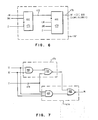
- the mask generation circuit can either include a stage of two-input AND gates 82 (Fig. 2) connected to a stage of two-input EXCLUSIVE OR gates 84 (Fig. 2) or alternatively a combination of two stages of combinational logic as shown in Fig. 6.
- the first stage 170 consist of AND/OR and inverter logic connected by line 172 to a second stage 174 also consisting of AND/OR and inverter logic.
- Stage 174 provides the output on line 176.
- Figure 7 illustrates a single binary position of logic for stages 170 and 174.
- Stage 170 consist of an AND gate 180 and a NOR gate 182.
- Stage 174 consist of an AND gate 184 and an OR gate 186.
- the Z input on line 178 provides the polarity of the sequence that is output.
Landscapes
- Engineering & Computer Science (AREA)
- Theoretical Computer Science (AREA)
- Software Systems (AREA)
- Physics & Mathematics (AREA)
- General Engineering & Computer Science (AREA)
- General Physics & Mathematics (AREA)
- Mathematical Physics (AREA)
- Complex Calculations (AREA)
- Logic Circuits (AREA)
Applications Claiming Priority (2)
| Application Number | Priority Date | Filing Date | Title |
|---|---|---|---|
| US9789287A | 1987-09-17 | 1987-09-17 | |
| US97892 | 1998-06-16 |
Publications (2)
| Publication Number | Publication Date |
|---|---|
| EP0308061A2 true EP0308061A2 (de) | 1989-03-22 |
| EP0308061A3 EP0308061A3 (de) | 1991-05-02 |
Family
ID=22265649
Family Applications (1)
| Application Number | Title | Priority Date | Filing Date |
|---|---|---|---|
| EP19880307365 Withdrawn EP0308061A3 (de) | 1987-09-17 | 1988-08-09 | Maskenerzeugungsschaltung |
Country Status (2)
| Country | Link |
|---|---|
| EP (1) | EP0308061A3 (de) |
| JP (1) | JPS6476220A (de) |
Families Citing this family (1)
| Publication number | Priority date | Publication date | Assignee | Title |
|---|---|---|---|---|
| GB2298594B (en) * | 1995-03-10 | 1999-03-10 | Kurashiki Boseki Kk | Facing for a seat |
Family Cites Families (5)
| Publication number | Priority date | Publication date | Assignee | Title |
|---|---|---|---|---|
| US3906459A (en) * | 1974-06-03 | 1975-09-16 | Control Data Corp | Binary data manipulation network having multiple function capability for computers |
| US4012722A (en) * | 1975-09-20 | 1977-03-15 | Burroughs Corporation | High speed modular mask generator |
| JPS5550629A (en) * | 1978-10-06 | 1980-04-12 | Matsushita Electronics Corp | Manufacture of mesa-type semiconductor device |
| US4569016A (en) * | 1983-06-30 | 1986-02-04 | International Business Machines Corporation | Mechanism for implementing one machine cycle executable mask and rotate instructions in a primitive instruction set computing system |
| US4785393A (en) * | 1984-07-09 | 1988-11-15 | Advanced Micro Devices, Inc. | 32-Bit extended function arithmetic-logic unit on a single chip |
-
1988
- 1988-07-18 JP JP63177274A patent/JPS6476220A/ja active Pending
- 1988-08-09 EP EP19880307365 patent/EP0308061A3/de not_active Withdrawn
Also Published As
| Publication number | Publication date |
|---|---|
| EP0308061A3 (de) | 1991-05-02 |
| JPS6476220A (en) | 1989-03-22 |
Similar Documents
| Publication | Publication Date | Title |
|---|---|---|
| CA1175154A (en) | Shift circuit | |
| EP0328063B1 (de) | Absolutwertberechnende Schaltung mit einem einzigen Addierer | |
| US4592005A (en) | Masked arithmetic logic unit | |
| EP0368826A2 (de) | Datenverarbeitungsschaltung | |
| US5129066A (en) | Bit mask generator circuit using multiple logic units for generating a bit mask sequence | |
| EP0097779B1 (de) | Logikschaltung | |
| JPS6131890B2 (de) | ||
| JPH03100725A (ja) | キャリーチェインの増分器/減分器回路 | |
| US4701877A (en) | Highspeed parallel adder with clocked switching circuits | |
| EP0098692A2 (de) | Einrichtung zur Addition von ersten und zweiten binären Operanden | |
| JP3507517B2 (ja) | 2進数に於いて最も端にある「1」ビットの位置検出回路 | |
| EP0498534B1 (de) | Schaltung zur Erzeugung künstlicher Zufallszahlenmuster | |
| US4417315A (en) | Method and apparatus for incrementing a digital word | |
| EP0068109B1 (de) | Verarbeitungschips einer arithmetischen und logischen Einheit | |
| KR970049482A (ko) | 비동기 fifo에서 반-충만 및 반-빈 플래그를 발생시키기 위한 상태기계설계 | |
| EP0308061A2 (de) | Maskenerzeugungsschaltung | |
| US4349888A (en) | CMOS Static ALU | |
| EP0332845A2 (de) | Zweiseitig vorausschauender Maskengenerator | |
| US6675182B1 (en) | Method and apparatus for performing rotate operations using cascaded multiplexers | |
| US4206458A (en) | Numerical display system for electronic instrument | |
| EP0582311B1 (de) | Parallel-Serien-Umsetzer | |
| JP3127654B2 (ja) | 乗除算器 | |
| JPH04500572A (ja) | Bcdコードまたはデユアルコードでコード化された被演算数の加算または減算のための回路装置 | |
| EP0214836A1 (de) | Addierschaltung mit Auswahl des Übertrags | |
| JPH0473173B2 (de) |
Legal Events
| Date | Code | Title | Description |
|---|---|---|---|
| PUAI | Public reference made under article 153(3) epc to a published international application that has entered the european phase |
Free format text: ORIGINAL CODE: 0009012 |
|
| AK | Designated contracting states |
Kind code of ref document: A2 Designated state(s): DE FR GB |
|
| 17P | Request for examination filed |
Effective date: 19890720 |
|
| PUAL | Search report despatched |
Free format text: ORIGINAL CODE: 0009013 |
|
| AK | Designated contracting states |
Kind code of ref document: A3 Designated state(s): DE FR GB |
|
| 17Q | First examination report despatched |
Effective date: 19930318 |
|
| STAA | Information on the status of an ep patent application or granted ep patent |
Free format text: STATUS: THE APPLICATION IS DEEMED TO BE WITHDRAWN |
|
| 18D | Application deemed to be withdrawn |
Effective date: 19931103 |