EP0308916A2 - Polymere auf der Basis von Styrol und Verfahren zu deren Herstellung - Google Patents
Polymere auf der Basis von Styrol und Verfahren zu deren Herstellung Download PDFInfo
- Publication number
- EP0308916A2 EP0308916A2 EP88115540A EP88115540A EP0308916A2 EP 0308916 A2 EP0308916 A2 EP 0308916A2 EP 88115540 A EP88115540 A EP 88115540A EP 88115540 A EP88115540 A EP 88115540A EP 0308916 A2 EP0308916 A2 EP 0308916A2
- Authority
- EP
- European Patent Office
- Prior art keywords
- styrene
- molecular weight
- based polymer
- average molecular
- ppm
- Prior art date
- Legal status (The legal status is an assumption and is not a legal conclusion. Google has not performed a legal analysis and makes no representation as to the accuracy of the status listed.)
- Granted
Links
Images
Classifications
-
- C—CHEMISTRY; METALLURGY
- C08—ORGANIC MACROMOLECULAR COMPOUNDS; THEIR PREPARATION OR CHEMICAL WORKING-UP; COMPOSITIONS BASED THEREON
- C08F—MACROMOLECULAR COMPOUNDS OBTAINED BY REACTIONS ONLY INVOLVING CARBON-TO-CARBON UNSATURATED BONDS
- C08F12/00—Homopolymers and copolymers of compounds having one or more unsaturated aliphatic radicals, each having only one carbon-to-carbon double bond, and at least one being terminated by an aromatic carbocyclic ring
- C08F12/02—Monomers containing only one unsaturated aliphatic radical
- C08F12/04—Monomers containing only one unsaturated aliphatic radical containing one ring
- C08F12/06—Hydrocarbons
- C08F12/08—Styrene
Definitions
- the present invention relates to styrene-based polymers and a process for production thereof. More particularly, it is concerned with novel styrene-based polymers which have a branching nucleus containing a sulfur atom and further which have specified sulfur content, molecular weight and molecular weight distribution, and a process for efficiently producing the styrene-based polymers.
- the impact resistance of styrene-based polymers can be improved by increasing the molecular weight thereof. In general, however, if the molecular weight is increased, fluidity will drop and, therefore, residual strain, etc. are increased in molding and no good molding can be obtained.
- styrene-based star polymers are obtained by anion-polymerizing styrene-based polymers by the use of a polymerization initiator, e.g., metallic lithium (see, for example, J. Polym. Sci. PART, A 3, 681-696 (1965)).
- a polymerization initiator e.g., metallic lithium
- Styrene-based star polymers produced by the anionic polymerization have such a narrow molecular weight distribution that the weight average molecular weight/number average molecular weight (Mw / Mn) is about 1:1, and further have a disadvantage in that if the molecular weight is increased, moldability will be seriously reduced.
- the present invention is intended to overcome the above problems and an object of the present invention is to provide styrene-based polymers which are improved in impact resistance without deteriorating the fluidity thereof.
- the present invention relates to styrene-based polymers which have a branching nucleus represented by the general formula:
- the present invention relates to a process for producing the above styrene-based polymers which comprises radical polymerizing styrene-based monomers, or styrene-based monomers and other monomers copolymerizable therewith by the use of 25 to 2,000 ppm based on the total weight of the monomers used of a polyfunctional mercaptan compound represented by the general formula:
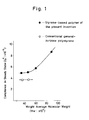
- Fig. 1 shows a relation between compliance in the steady state and molecular weight of a styrene-based polymer of the present invention and also of a conventional linear styrene-based polymer.
- the styrene-based polymers of the present invention can be produced by various methods. It is preferred, however, that they be produced by the process of the present invention.
- Styrene-based monomers which can be used in the present invention include, as well as styrene, ⁇ -substituted alkylstyrene such as a-methylstyrene, a-ethylstyrene, a-isopropylstyrene and the like, nucleus-substituted alkylstyrene such as p-methylstyrene, m-methylstyrene, 2,5-dimethylstyrene and the like, and nucleus-substituted halogenated styrene such as p-chlorostyrene, p-bromostyrene and the like.
- alkylstyrene such as a-methylstyrene, a-ethylstyrene, a-isopropylstyrene and the like
- nucleus-substituted alkylstyrene
- styrene-based monomers may be polymerized by themselves, they can be polymerized in combination with other monomers copolymerizable therewith.
- Other monomers which can be used include vinyl monomers such as acrylonitrile, methacrylonitrile, methacrylic acid, methyl methacrylate, acrylic acid, methyl acrylate and the like, maleic anhydride, maleimide, nuclues-substituted maleimide, and the like.
- styrene-based polymers of the present invention include, as well as homopolymers or copolymers (random copolymers, graft copolymers, etc.) of styrene-based monomers as described above, copolymers of styrene-based monomers and other monomers copolymerizable therewith.
- a polyfunctional mercaptan compound represented by the above general formula (II) is added before or during polymerization in a amount of 25 to 2,000 ppm based on the total weight of the monomers used, and the polymerization is carried out in the presence of the polyfunctional mercaptan compound.
- R is an alkyl radical having 1 to 10 carbon atoms or an aryl radical having 6 to 10 carbon atoms.
- the alkyl radical having 1 to 10 carbon atoms is a radical resulting from the removal of hydrogen atoms from the alkyl group depending on the number (k) of -S or -A-S bonded. Examples are groups resulting from the removal of 2 or 3 hydrogen atoms from, for example, a methyl group, an ethyl group, a propyl group, an isopropyl group, a butyl group, and a tert-butyl group.
- the aryl radical having 6 to 10 carbon atoms is a group resulting from the removal of 2 or 3 hydrogen atoms from, for example, a phenyl group, a nucleus-substituted phenyl group (e.g., a tolyl group), an a-naphthyl group, and a / 3-naphthyl group.
- A represents, for example, an organic radical represented by the general formula: (wherein m is an integer of 0 to 10, and n is an integer of 1 to 10). In the general formula (II), all of three or four -SH or -A-SH are bonded to R.
- polyfunctional mercaptan compounds can be used in the present invention.
- Representative examples of four functional mercaptan compounds are
- the amount of the polyfunctional mercaptan compound used is chosen within the range of 25 to 2,000 ppm based on the total weight of monomers used. If the amount of the polyfunctional mercaptan compound used is less than 25 ppm, the sulfur content of the resulting styrene-based polymer is less than 6 ppm and the impact strength is not increased because the molecular weight is not sufficiently increased. On the other hand, if it is in excess of 2,000 ppm, the sulfur content of the resulting styrene-based polymer is more than 550 ppm, and since the molecular weight is excessively increased, fluidity and moldability are reduced.
- the polyfunctional mercaptan compound be used in an amount of 100 to 1,500 ppm based on the total weight of monomers used.
- Radical polymerization of styrene-based monomers, or styrene-based monomers and other monomers copolymerizable therewith can be carried out by known techniques such as suspension polymerization, bulk-suspension two stage polymerization, bulk polymerization, by the use of a polymerization initiator, e.g., benzoyl peroxide, dicumyl peroxide, tertbutylperoxy isopropylcarbonate, 2,4-dichlorobenzoyl peroxide, and cumene hydroperoxide, usually under atmospheric pressure at a polymerization temperature of about 70 to 150°C.
- a polymerization initiator e.g., benzoyl peroxide, dicumyl peroxide, tertbutylperoxy isopropylcarbonate, 2,4-dichlorobenzoyl peroxide, and cumene hydroperoxide
- a suspension stabilizer as commonly used in the polymerization of this type can be used.
- a rubber-like substance such as polybutadiene may be dissolved in the starting monomer materials, or after polymerization, the rubber-like substance may be incorporated in the polymers by kneading.
- Rubber-like substances which can be used include diene-based rubbers such as polybutadiene rubber, acrylonitrile-butadiene copolymer rubber (NBR), styrene-butadiene copolymer rubber (SBR), acrylbased rubbers such as polybutyl acrylate, poiypropyl acrylate, and the like.
- diene-based rubbers such as polybutadiene rubber, acrylonitrile-butadiene copolymer rubber (NBR), styrene-butadiene copolymer rubber (SBR), acrylbased rubbers such as polybutyl acrylate, poiypropyl acrylate, and the like.
- EPDM ethylene-propylenediene-based rubber
- the radical polymerization is carried out until the conversion reaches at least 40% and preferably at lease 60%. If the conversion is less than 40%, the desired high molecular weight styrene-based polymer cannot be obtained and thus the impact resistance is not sufficiently improved. Maintaining the initial polymerization temperature at 85 to 95 ° C is effective to obtain styrene-based polymers having the above specified weight average molecular weight (Mw) and molecular weight distribution (Mw/Mn).
- the sulfur content of the styrene-based polymer was measured by the fluorescent X-ray analysis as described hereinafter. It was found that the amount of the mercaptan compound contained as calculated from the above sulfur content was equal to the amount of the mercaptan compound used.
- the styrene-based polymer was dissolved in chloroform and then precipitated by adding methanol. In the electric titration analysis of the methanol portion, no sulfur was detected. From the above results, it is considered that almost all of the mercaptan compound added is incorporated in the polymer chain of the styrene-based polymer obtained by the process of the present invention.
- the compliance in the steady state was determined from the melt viscoelasticity of the styrene-based polymer obtained.
- the melt viscoelasticity was measured by the use of a cone-disc type rheometer having a diameter of 2.5 cm and a cone angle of 0.1 rad, under conditions of temperature 230' C, strain 10% and angular speed of 600 to 1x10 2 (w)rad/sec.
- the compliance in the steady state (JeO) was determined by the following equation: where
- Fig. 1 the compliance in the steady state (determined by the aforementioned method) and molecular weight of a styrene-based polymer obtained using pentaerythritol tetraquis(3-mercaptopropionate) as a four functional mercaptan compound are plotted.
- the compliance in the steady state does not become constant, which confirms that the styrene-based is a branched polymer.
- the usual linear styrene polymer has an almost constant compliance in the steady state.
- the compliance in the steady state of the usual linear styrene polymer is constant.
- the sulfur content of the styrene-based polymer of the present invention is in correlation with the amount of the polyfunctional mercaptan compound of the general formula (II) used, and is from 6 to 550 ppm. If the sulfur content is less than 6 ppm or more than 550 ppm, undesirable problems as described in connection with the amount of the polyfunctional mercaptan compound used arise. Particularly preferably the sulfur content is in the range of 20 to 500 ppm.
- the weight average molecular weight of the styrene-based polymer of the present invention is 450,000 to 1,300,000 and preferably 500,000 to 1,200,000. If the weight average molecular weight is less than 450,000, impact resistance is not improved. On the other hand, if it is more than 1,300,000, fluidity drops and moldability is reduced.
- the weight average molecular weight/number average molecular weight (Mw/Mn) ratio is 2 to 15 and preferably 2.5 to 13. If the ratio is less than 2, moldability is reduced. On the other hand, if it is more than 15, super high molecular weight polymers and low molecular weight polymers are formed, leading to a reduction in fluidity and further to a reduction in impact strength.
- the styrene-based polymers of the present invention are greatly improved in impact resistance while maintaining their high fluidity and moldability.
- the flatwise impact strength of the styrene-based polymer of the present invention is about 26 kg cm/cm while that of the conventional general-purpose polystyrene (GPPS) is 12 kg cm/cm.
- GPPS general-purpose polystyrene
- the styrene-based polymers of the present invention when injection molded or extrusion molded, provide moldings having excellent mechanical strength.
- the styrene-based polymers of the present invention can be produced greatly efficiently by the process of the present invention.
- styrene-based polymers of the present invention can be widely and effectively utilized as materials for injection molding, extrusion molding or sheet molding.
- a polymer was pressed and the sulfur content was measured using fluorescent X-rays.
- MI Melt Index
- the amount of residual monomers in the polymer was measured by gas chromatography, and the conversion was calculated from the amount of reacted monomers.
- the flatwise impact strength (not notched) was measured according to JIS-K7110 (1/8 inch molding, molding temperature 230' C).
- the prepolymer and ion-exchanged water with 0.2% (based on the weight of water) of polyvinyl alcohol as a suspension stabilizer dissolved therein were placed in a 10-liter suspension polymerization vessel in a volume ratio of 1:2, and reacted at 500 rpm in a nitrogen atmosphere for 4 hours at 90° C, for 4 hours at 110° C and further for 4 hours at 120 C.
- an antioxidant trade name Irganox 1076
- Pentaerythritol tetraquis(3-mercaptopropionate) was added to the above polymer at a rate of 0.004 liter per hour, and the resulting mixture was sent to a 19-iiter volume second polymerization vesesl and then to a 20-liter third polymerization vessel, in which polymerization was continued at a temperature of 110 to 180 C. Then, volatile components were removed by the use of an evaporation apparatus, and a polystyrene resin in the form of pellets was obtained.
- Polymerization was performed in the same manner as in Example 1 except that 1,000 ppm of pentaerythritol tetraquis (3-mercaptopropionate) was added, and the polymerization at 110°C was omitted and the temperature at the final polymerization stage was change from 120°C to 135°C. The results are shown in Table 1.
- a styrene monomer solution containing 480 ppm of azobisisobutylonitirile (AIBN) and 8,900 ppm of neopentene tetrayl tetraquis(2-mercaptoacetate) was placed in a 10-liter polymerization vessel equipped with a stirrer and polymerized in a nitrogen atmosphere for 16 hours at 60°C.
- AIBN azobisisobutylonitirile
- neopentene tetrayl tetraquis(2-mercaptoacetate) was placed in a 10-liter polymerization vessel equipped with a stirrer and polymerized in a nitrogen atmosphere for 16 hours at 60°C.
- Table 1 The results are shown in Table 1.
- Polymerization was performed in the same manner at in Example 1 except that 1,000 ppm of pentaerythritol tetraquis (3-mercaptopropionate) was added, and after the polymerization for 3 hours at 90°C, the temperature was raised to 135°C at a rate of 25 C per hour and the polymerization was performed for 6 hours at 135° C.
- Table 1 The results are shown in Table 1.
Landscapes
- Chemical & Material Sciences (AREA)
- Health & Medical Sciences (AREA)
- Chemical Kinetics & Catalysis (AREA)
- Medicinal Chemistry (AREA)
- Polymers & Plastics (AREA)
- Organic Chemistry (AREA)
- Polymerisation Methods In General (AREA)
- Addition Polymer Or Copolymer, Post-Treatments, Or Chemical Modifications (AREA)
Applications Claiming Priority (4)
| Application Number | Priority Date | Filing Date | Title |
|---|---|---|---|
| JP23729787 | 1987-09-24 | ||
| JP237297/87 | 1987-09-24 | ||
| JP162428/88 | 1988-07-01 | ||
| JP63162428A JPH0714978B2 (ja) | 1987-09-24 | 1988-07-01 | スチレン系重合体及びその製造方法 |
Publications (3)
| Publication Number | Publication Date |
|---|---|
| EP0308916A2 true EP0308916A2 (de) | 1989-03-29 |
| EP0308916A3 EP0308916A3 (en) | 1989-06-14 |
| EP0308916B1 EP0308916B1 (de) | 1992-05-13 |
Family
ID=26488232
Family Applications (1)
| Application Number | Title | Priority Date | Filing Date |
|---|---|---|---|
| EP88115540A Expired EP0308916B1 (de) | 1987-09-24 | 1988-09-22 | Polymere auf der Basis von Styrol und Verfahren zu deren Herstellung |
Country Status (4)
| Country | Link |
|---|---|
| US (1) | US4918159A (de) |
| EP (1) | EP0308916B1 (de) |
| JP (1) | JPH0714978B2 (de) |
| DE (1) | DE3871054D1 (de) |
Cited By (1)
| Publication number | Priority date | Publication date | Assignee | Title |
|---|---|---|---|---|
| GB2304721A (en) * | 1995-09-06 | 1997-03-26 | Sumitomo Chemical Co | Production of styrenic polymers and articles therefrom |
Families Citing this family (25)
| Publication number | Priority date | Publication date | Assignee | Title |
|---|---|---|---|---|
| KR19990012881A (ko) * | 1997-07-31 | 1999-02-25 | 박홍기 | 스티렌 열가소성 수지의 제조방법 |
| KR100382517B1 (ko) * | 1997-10-06 | 2003-08-02 | 제일모직주식회사 | 열가소성수지조성물 |
| KR100449609B1 (ko) * | 1997-10-06 | 2004-12-04 | 제일모직주식회사 | 열가소성수지조성물 |
| KR100586743B1 (ko) * | 1999-08-16 | 2006-06-08 | 제일모직주식회사 | 내화학성 및 성형성이 우수한 열가소성 수지조성물의 제조방법 |
| WO2001094491A1 (en) * | 2000-06-02 | 2001-12-13 | National Starch And Chemical Investment Holding Corporation | Radiation curable free radically polymerized star-branched polymers |
| AU2000251762A1 (en) * | 2000-06-02 | 2001-12-24 | National Starch And Chemical Investment Holding Corporation | Water soluble ampiphilic heteratom star polymers and their use as emulsion stabilizers in emulsion polymerization |
| KR100450110B1 (ko) * | 2001-12-22 | 2004-09-24 | 제일모직주식회사 | 진공성형성이 우수한 열가소성 수지 조성물 |
| US6972311B2 (en) | 2003-05-27 | 2005-12-06 | Fina Technology, Inc. | Optimizing polystyrene in the presence of additives |
| KR100650910B1 (ko) * | 2004-10-13 | 2006-11-27 | 제일모직주식회사 | 난연성 열가소성 수지 조성물 |
| KR100722149B1 (ko) * | 2005-12-30 | 2007-05-28 | 제일모직주식회사 | 압출가공성 및 내충격성이 우수한 난연성 폴리카보네이트계열가소성 수지 조성물 |
| WO2007078083A1 (en) * | 2005-12-30 | 2007-07-12 | Cheil Industries Inc. | Flame retardant polycarbonate thermoplastic resin composition having good extrusion moldability and impact resistance |
| KR100885819B1 (ko) * | 2007-12-18 | 2009-02-26 | 제일모직주식회사 | 굴절률이 우수한 분지형 아크릴계 공중합체 및 그 제조방법 |
| KR101004040B1 (ko) * | 2007-12-18 | 2010-12-31 | 제일모직주식회사 | 상용성이 향상된 난연 내스크래치 열가소성 수지 조성물 |
| KR100902352B1 (ko) * | 2008-03-13 | 2009-06-12 | 제일모직주식회사 | 상용성이 향상된 열가소성 수지 조성물 |
| KR100886348B1 (ko) * | 2008-04-14 | 2009-03-03 | 제일모직주식회사 | 상용성이 개선된 난연 내스크래치 열가소성 수지 조성물 |
| KR101188349B1 (ko) * | 2008-12-17 | 2012-10-05 | 제일모직주식회사 | 투명성 및 내스크래치성이 향상된 폴리카보네이트계 수지 조성물 |
| US8735490B2 (en) * | 2009-12-30 | 2014-05-27 | Cheil Industries Inc. | Thermoplastic resin composition having improved impact strength and melt flow properties |
| EP2881408B1 (de) | 2013-12-04 | 2017-09-20 | Lotte Advanced Materials Co., Ltd. | Styrolbasierte Copolymere und thermoplastische Harzzusammensetzung damit |
| US9902850B2 (en) | 2014-06-26 | 2018-02-27 | Lotte Advanced Materials Co., Ltd. | Thermoplastic resin composition |
| US9790362B2 (en) | 2014-06-27 | 2017-10-17 | Lotte Advanced Materials Co., Ltd. | Thermoplastic resin composition and molded article made using the same |
| US9850333B2 (en) | 2014-06-27 | 2017-12-26 | Lotte Advanced Materials Co., Ltd. | Copolymers and thermoplastic resin composition including the same |
| US9856371B2 (en) | 2014-06-27 | 2018-01-02 | Lotte Advanced Materials Co., Ltd. | Thermoplastic resin composition and low-gloss molded article made therefrom |
| CN106573885B (zh) * | 2014-09-30 | 2020-06-02 | 富士胶片株式会社 | 硫醇化合物及其制造方法、聚合物、组合物、硬化膜及彩色滤光片 |
| KR101822697B1 (ko) | 2014-11-18 | 2018-01-30 | 롯데첨단소재(주) | 외관 특성이 우수한 열가소성 수지 조성물 및 이를 이용한 성형품 |
| WO2017159552A1 (ja) * | 2016-03-17 | 2017-09-21 | 富士フイルム株式会社 | 多官能チオール化合物の製造方法、多官能チオール化合物、硬化性組成物および硬化性組成物の製造方法 |
Family Cites Families (4)
| Publication number | Priority date | Publication date | Assignee | Title |
|---|---|---|---|---|
| US3832421A (en) * | 1972-05-05 | 1974-08-27 | Grace W R & Co | Curable compositions containing solid styrene-allyl alcohol copolymer based polyenes and polythiols |
| DE2354680B2 (de) * | 1973-11-02 | 1976-10-07 | Hoechst Ag, 6000 Frankfurt | Verfahren zur herstellung von wasserklar einstellbaren copolymerdispersionen |
| JPS60228540A (ja) * | 1984-04-26 | 1985-11-13 | Asahi Chem Ind Co Ltd | 新規な芳香族ビニレンスルフイド重合体 |
| DE3505747A1 (de) * | 1985-02-20 | 1986-08-21 | Bayer Ag, 5090 Leverkusen | Schwefelhaltige polymerisate |
-
1988
- 1988-07-01 JP JP63162428A patent/JPH0714978B2/ja not_active Expired - Fee Related
- 1988-08-29 US US07/237,982 patent/US4918159A/en not_active Expired - Fee Related
- 1988-09-22 DE DE8888115540T patent/DE3871054D1/de not_active Expired - Fee Related
- 1988-09-22 EP EP88115540A patent/EP0308916B1/de not_active Expired
Cited By (3)
| Publication number | Priority date | Publication date | Assignee | Title |
|---|---|---|---|---|
| GB2304721A (en) * | 1995-09-06 | 1997-03-26 | Sumitomo Chemical Co | Production of styrenic polymers and articles therefrom |
| GB2304721B (en) * | 1995-09-06 | 1997-11-05 | Sumitomo Chemical Co | Production of styrenic polymer, styrenic polymer, styrenic resin composition and molded articles produced therefrom |
| US5723554A (en) * | 1995-09-06 | 1998-03-03 | Sumitomo Chemical Company, Limited | Process for producing styrenic polymer |
Also Published As
| Publication number | Publication date |
|---|---|
| US4918159A (en) | 1990-04-17 |
| EP0308916A3 (en) | 1989-06-14 |
| JPH01158007A (ja) | 1989-06-21 |
| EP0308916B1 (de) | 1992-05-13 |
| JPH0714978B2 (ja) | 1995-02-22 |
| DE3871054D1 (de) | 1992-06-17 |
Similar Documents
| Publication | Publication Date | Title |
|---|---|---|
| EP0308916B1 (de) | Polymere auf der Basis von Styrol und Verfahren zu deren Herstellung | |
| US6262179B1 (en) | Process for the manufacture of a composition comprising a vinylaromatic polymer and a rubber by polymerization in the presence of a stable free radical | |
| US4075285A (en) | Rubber-modified polystyrene resin composition | |
| US4294937A (en) | Impact polymers | |
| EP0379284A2 (de) | Polymer auf der Basis von Styrol und Verfahren zu dessen Herstellung | |
| US5708081A (en) | Composition comprising a vinylaromatic polymer and a rubber and process for obtaining it | |
| US5948874A (en) | Acid catalyzed polymerization | |
| EP0095086B1 (de) | Polymerisationsfähiges und optisch aktives Polymer und Verfahren zur Herstellung eines polymerisationsfähigen Polymers | |
| US5962605A (en) | High molecular weight polystyrene production by vinyl acid catalyzed free radical polymerization | |
| EP0564703B1 (de) | Makromere von Polyvinylidenfluorid mit Acrylatendgruppen und ihre thermoplastischen Elastomercopolymere | |
| JPH0819170B2 (ja) | スチレン系重合体の製造方法 | |
| US6084044A (en) | Catalyzed process for producing high molecular weight monovinylidene aromatic polymers | |
| JPS624070B2 (de) | ||
| EP0862586A2 (de) | Verfahren zur herstellung einer verzweigtes polymer von ein vinylaromatisches monomer | |
| US5244993A (en) | Sulfate-terminated vinylidene fluoride polymers of controlled molecular weight | |
| EP0229678A2 (de) | Flüssige Organosilicon-Zusammensetzung | |
| US5244978A (en) | Thermoplastic elastomers and other copolymers of acrylate-terminated poly(vinylidene flouride) | |
| JPH05125106A (ja) | ゴム変性スチレン系重合体の製造法 | |
| KR100307673B1 (ko) | 신디오탁틱 스티렌계 공중합체 | |
| US4036911A (en) | Preparation of graft copolymers | |
| JP4112528B2 (ja) | 透明ゴム変性スチレン系樹脂 | |
| JPH0819238B2 (ja) | スチレン系重合体及びその製造方法 | |
| EP1311569A1 (de) | Hochmolekulargewicht-monovinylaromatische polymere mit einer guten verarbeitung | |
| JP2000501141A (ja) | ビニル芳香族モノマーからの枝分かれポリマーの製造方法 | |
| JPH04293908A (ja) | スチレン系樹脂の製造方法 |
Legal Events
| Date | Code | Title | Description |
|---|---|---|---|
| PUAI | Public reference made under article 153(3) epc to a published international application that has entered the european phase |
Free format text: ORIGINAL CODE: 0009012 |
|
| AK | Designated contracting states |
Kind code of ref document: A2 Designated state(s): BE CH DE FR GB IT LI NL SE |
|
| PUAL | Search report despatched |
Free format text: ORIGINAL CODE: 0009013 |
|
| AK | Designated contracting states |
Kind code of ref document: A3 Designated state(s): BE CH DE FR GB IT LI NL SE |
|
| 17P | Request for examination filed |
Effective date: 19891206 |
|
| 17Q | First examination report despatched |
Effective date: 19910701 |
|
| GRAA | (expected) grant |
Free format text: ORIGINAL CODE: 0009210 |
|
| AK | Designated contracting states |
Kind code of ref document: B1 Designated state(s): BE CH DE FR GB IT LI NL SE |
|
| PG25 | Lapsed in a contracting state [announced via postgrant information from national office to epo] |
Ref country code: SE Effective date: 19920513 Ref country code: LI Effective date: 19920513 Ref country code: CH Effective date: 19920513 |
|
| REF | Corresponds to: |
Ref document number: 3871054 Country of ref document: DE Date of ref document: 19920617 |
|
| ITF | It: translation for a ep patent filed | ||
| ET | Fr: translation filed | ||
| REG | Reference to a national code |
Ref country code: CH Ref legal event code: PL |
|
| PLBE | No opposition filed within time limit |
Free format text: ORIGINAL CODE: 0009261 |
|
| STAA | Information on the status of an ep patent application or granted ep patent |
Free format text: STATUS: NO OPPOSITION FILED WITHIN TIME LIMIT |
|
| 26N | No opposition filed | ||
| PGFP | Annual fee paid to national office [announced via postgrant information from national office to epo] |
Ref country code: FR Payment date: 19940909 Year of fee payment: 7 |
|
| PGFP | Annual fee paid to national office [announced via postgrant information from national office to epo] |
Ref country code: GB Payment date: 19940913 Year of fee payment: 7 |
|
| PGFP | Annual fee paid to national office [announced via postgrant information from national office to epo] |
Ref country code: DE Payment date: 19940921 Year of fee payment: 7 |
|
| PGFP | Annual fee paid to national office [announced via postgrant information from national office to epo] |
Ref country code: NL Payment date: 19940930 Year of fee payment: 7 |
|
| PGFP | Annual fee paid to national office [announced via postgrant information from national office to epo] |
Ref country code: BE Payment date: 19941104 Year of fee payment: 7 |
|
| PG25 | Lapsed in a contracting state [announced via postgrant information from national office to epo] |
Ref country code: GB Effective date: 19950922 |
|
| PG25 | Lapsed in a contracting state [announced via postgrant information from national office to epo] |
Ref country code: BE Effective date: 19950930 |
|
| BERE | Be: lapsed |
Owner name: IDEMITSU PETROCHEMICAL CO. LTD Effective date: 19950930 |
|
| PG25 | Lapsed in a contracting state [announced via postgrant information from national office to epo] |
Ref country code: NL Effective date: 19960401 |
|
| GBPC | Gb: european patent ceased through non-payment of renewal fee |
Effective date: 19950922 |
|
| PG25 | Lapsed in a contracting state [announced via postgrant information from national office to epo] |
Ref country code: FR Effective date: 19960531 |
|
| PG25 | Lapsed in a contracting state [announced via postgrant information from national office to epo] |
Ref country code: DE Effective date: 19960601 |
|
| NLV4 | Nl: lapsed or anulled due to non-payment of the annual fee |
Effective date: 19960401 |
|
| REG | Reference to a national code |
Ref country code: FR Ref legal event code: ST |
|
| PG25 | Lapsed in a contracting state [announced via postgrant information from national office to epo] |
Ref country code: IT Free format text: LAPSE BECAUSE OF NON-PAYMENT OF DUE FEES;WARNING: LAPSES OF ITALIAN PATENTS WITH EFFECTIVE DATE BEFORE 2007 MAY HAVE OCCURRED AT ANY TIME BEFORE 2007. THE CORRECT EFFECTIVE DATE MAY BE DIFFERENT FROM THE ONE RECORDED. Effective date: 20050922 |