EP0309956A2 - Verfahren und Apparatur zum Prüfen von Halbleiter-Elementen - Google Patents
Verfahren und Apparatur zum Prüfen von Halbleiter-Elementen Download PDFInfo
- Publication number
- EP0309956A2 EP0309956A2 EP88115783A EP88115783A EP0309956A2 EP 0309956 A2 EP0309956 A2 EP 0309956A2 EP 88115783 A EP88115783 A EP 88115783A EP 88115783 A EP88115783 A EP 88115783A EP 0309956 A2 EP0309956 A2 EP 0309956A2
- Authority
- EP
- European Patent Office
- Prior art keywords
- voltage
- electron beam
- grid
- testing
- electron
- Prior art date
- Legal status (The legal status is an assumption and is not a legal conclusion. Google has not performed a legal analysis and makes no representation as to the accuracy of the status listed.)
- Granted
Links
Images

Classifications
-
- G—PHYSICS
- G01—MEASURING; TESTING
- G01R—MEASURING ELECTRIC VARIABLES; MEASURING MAGNETIC VARIABLES
- G01R31/00—Arrangements for testing electric properties; Arrangements for locating electric faults; Arrangements for electrical testing characterised by what is being tested not provided for elsewhere
- G01R31/28—Testing of electronic circuits, e.g. by signal tracer
- G01R31/302—Contactless testing
- G01R31/305—Contactless testing using electron beams
Definitions
- This invention relates to a testing method for semiconductor elements and a testing apparatus therefor, and more particularly, to a testing method and a testing apparatus for testing respective elements not in contact with the semiconductor substrate.
- a dedicated monitor element for conducting this test was prepared to allow a measurement probe to be mechanically in contact with the respective terminals of this monitor element to apply voltages thereto to measure output signals, thereby conducting a test.
- the conventional testing method has the following problems.
- an object of this invention is to provide a testing method for semiconductor elements and a testing apparatus therefor capable of making the characteristic test of semiconductor elements without allowing the probe to be in contact with the semiconductor substrate.
- a method of testing semiconductor elements comprises: a voltage induction stage for irradiating an electron beam to one electrode of a capacitor connected in parallel with elements to be tested formed on a semiconductor substrate to thereby inject charges thereinto, thus to induce a predetermined voltage on the electrode by the charge injection, and a voltage measurement stage for irradiating an electron beam to terminals of electrodes of the elements to be tested to observe secondary electrons emitted from the terminals to measure voltage appearing on the terminals, thus to make a test of the elements to be tested on the basis of the relationship between the voltage induced at the voltage induction stage and the voltage measured at the voltage measurement stage.
- an apparatus for testing semiconductor elements comprises: electron beam generator means for irradiating an electron beam to a predetermined target on a semiconductor substrate on which semiconductor elements are formed, a grid provided between the electron beam generator means and the semiconductor substrate, control voltage supply means for supplying a control voltage to the grid in order to control a voltage induced on the target by irradiation of the electron beam, extraction voltage supply means for supplying an extraction voltage to the grid in order to extract or draw secondary electrons emitted from the target, switching means for connecting either the control voltage supply means or the extraction voltage supply means to the grid, and secondary electron detector means for detecting a quantity of secondary electrons which have passed the grid.
- this invention provides a non-contact testing method using an electron beam to irradiate an electron beam to a capacitive object to be measured to inject charges thereinto and thereby induce a voltage on the object to be measured so as to measure a voltage on the object to be measured after a predetermined time has passed by using an electron beam, thereby measuring the electrical parameters of the object to be measured.
- a capacitor connected in parallel with elements to be tested is utilized.
- a capacitor for testing may be formed in advance in the manufacturing process of the semiconductor device, or a capacitor provided for performing the function peculiar to the device may be utilized.
- two functions i.e., to deliver a voltage to a predetermined terminal of the element to be tested, and to measure a voltage appearing on that terminal.
- such two functions are performed by irradiation of an electron beam. Namely, by irradiating an electron beam to the capacitor connected in parallel with the element to be tested, thus to therefore charge the capacitor, it is possible to deliver a voltage to a predetermined terminal of the element.
- by irradiating an electron beam to that terminal to observe secondary electrons emitted therefrom, it is possible to measure a voltage appearing on that terminal.
- testing of elements can be made without allowing the probe to be mechanically touched.
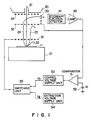
- FIG. 1 is a block diagram showing the configuration of a testing apparatus for semiconductor elements according to an embodiment of this invention.
- elements to be tested (not shown) which are subject to testing are formed.
- Electron beam is irradiated onto a target 11 connected to the elements to be tested.
- An electron beam generator 20 irradiates electron beam 21 toward the target 11.
- four grids 31 to 34 are provided.
- the electron beam 21 passes in order of grids 34, 32 and 31, and is irradiated to the target 11.
- secondary electrons 22, 23 and 24 are emitted from the target 11.
- secondary electron 22 is an electron driven back by grid 31
- secondary electron 23 is an electron driven back by grid 32
- secondary electron 24 is an electron deflected by grid 33.
- the secondary electron 24 is detected by a secondary electron detector 41.
- the secondary electron detector 41 outputs a voltage corresponding to a quantity thus detected. This output voltage is amplified at an amplifier 42, and is then delivered to the grid 32.
- the voltage amplified by the amplifier 42 is compared with a reference voltage V r produced from a reference power supply 52 at a comparator 51.
- the compared result is delivered to a control voltage supply unit 53.
- This control voltage supply unit 53 produces control voltage V c corresponding to an input.
- extraction voltage supply unit 54 produces an extraction voltage V e suitable for extracting or drawing secondary electrons from the target 11. Either the control voltage V c or the extraction voltage V e is selected by a switching unit 55. The voltage thus selected is delivered to the grid 31.
- This apparatus has two operational modes. First is a voltage induction mode for inducing a voltage on the target 11. Second is a voltage measurement mode for measuring a voltage appearing on the target 11. The apparatus is operative in either of two modes. The first voltage induction mode will be initially described.
- This voltage induction mode is a mode to irradiate electron beam 21 to target 11 to thereby carry out charge injection, thus to induce a predetermined voltage on the target 11.
- the control of the electron beam 21 in this mode is carried out at the grid 31.
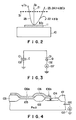
- the fundamental principle thereof will be described with reference to Fig. 2.
- electron beam 21 corresponding to a current I p is irradiated to the target 11, this electron beam 21 passes through the grid 31 to reach the target 11. At this time, a portion thereof is reflected on the surface of the target 11 as it is to serve as a reflected electron 25, a further portion thereof contributes to emission of secondary electrons 22, 23 and 24, and a still further portion thereof is accumulated or stored as charge.
- the coefficient of reflection and the secondary electron emission ratio are designated by ⁇ and ⁇ respectively
- the quantity of the reflected electron 25 and the total quantity of the secondary electrons 22, 23 and 24 are represented by ⁇ I p and ⁇ I p , respectively.
- ⁇ I p and ⁇ I p the quantity of the reflected electron 25 and the total quantity of the secondary electrons 22, 23 and 24 are represented by ⁇ I p and ⁇ I p , respectively.
- drive back coefficient K indicating ratio of drive back is defined, the quantity of the secondary electron 22 driven back and the quantity of the secondary electrons 23 and 24 which pass through the grid 31 are expressed as K ⁇ I p and (1-k) ⁇ I p , respectively.
- the reflection coefficient ⁇ and the secondary electron emission ratio ⁇ are determined exclusively by the material constituting the target 11, and the capacity C are determined exclusively by the configuration of the capacitor. Further, it is seen that the drive back coefficient K can be controlled by a voltage value applied to the grid 31. Accordingly, it is seen that the induced voltage V of the target 11 can be controlled by a voltage applied to the grid 31.
- the switching unit 55 selects the control voltage V c to deliver it to the grid 31.
- the induced voltage of the target 11 can be controlled by the control voltage supply unit 53.
- the control operation of the control voltage supply unit 53 will be described later.
- the switching unit 55 selects the extraction voltage V e to deliver it to the grid 31.
- the grid 31 functions as an extraction electrode for extracting or drawing secondary electrons from the target 11.
- positive voltage is applied to the grid 31.
- the secondary electrons which have passed the grid 31 are accelerated, and are directed toward the grid 32 as an electron of which the velocity component in a longitudinal direction is uniform.
- the grid 32 performs a function to generate a blocking retarding field for discriminating the energy of the secondary electron.
- the secondary electron 23 having an energy lower than a predetermined energy is driven back by the grid 32.
- the secondary electron 24 which has passed the grid 32 is deflected by a voltage applied to the grid 33, and is then detected by the secondary electron detector 41.
- the grid 34 absorbs secondary electrons produced when the reflected electron impinges on the electron beam generator 20.
- An indication of voltage supply means to grids 33 and 34 is omitted in Fig. 1.
- the secondary electron detector 41 outputs a voltage corresponding to the quantity of secondary electron detected. This output voltage is amplified at the amplifier 42, and is then delivered to the grid 32. By the grid 32, the secondary electron detector 41 and the amplifier 42, a feedback loop is formed. Thus, such a feedback control is conducted so that a quantity of secondary electrons detected at the secondary electron detector 41 becomes equal to a constant value. Namely, when a quantity of secondary electrons detected at the secondary electron detector 41 is above a constant value, a higher voltage is applied to the grid 32. Thus, such a control to suppress an quantity of passing secondary electrons is conducted. It is seen that such a feedback control eventually allows the output of the amplifier 42 to be related to a quantity of secondary electron emitted from the target 11. Since the quantity of secondary electrons is a value related to a voltage of the target 11, the voltage of the amplifier 42 becomes equal to a value indicative of the voltage of the target 11 as it is. Thus, voltage measurement is completed.
- the output of the amplifier 42 is delivered to one input terminal of the comparator 51, and is compared with reference voltage V r at this comparator 51. Since the output of the amplifier 42 becomes equal to a value indicative of the voltage of the target 11 as described above, such a comparison makes it possible to recognize whether the induced voltage of the target 11 is higher than a desired set value (corresponding to the reference voltage V r ) or lower than that.
- the control voltage supply unit 53 controls the control voltage V c on the basis of this comparison. Accordingly, correction of a voltage delivered to the grid 31 in the voltage induction mode subsequently carried out, can be made by making use of a measured result in this voltage measurement mode.
- test is made by inducing a voltage on a predetermined target in the voltage induction mode, thereafter to measure a voltage appearing on the target in the voltage measurement mode.
- test is made by repeatedly carrying out both modes at a fixed period to measure a leakage current into the semiconductor substrate while conducting such a control to keep constant an induced voltage of the target.
- Fig. 3 is an equivalent circuit diagram of a semiconductor device used as a test object in this embodiment and Fig. 4 is a cross sectional view showing the structure of the semiconductor device.
- insulating layers 101 and 102 for isolation between elements are formed on a P-type semiconductor substrate 100 and an N+ impurity diffused layer 104 is formed therebetween.
- the PN junction formed between the impurity diffused layer 104 and the semiconductor substrate 100 corresponds to the diode in the equivalent circuit of Fig. 3.
- this diode D serves as an element to be tested.
- capacitor C is provided for testing this diode D.
- This capacitor C is provided in parallel with the diode D which is the element to be tested.
- this capacitor C is constituted with an insulating film 105 between element isolation insulating layers 102 and 103, and a wiring layer 106 and the semiconductor substrate 100 between which the insulating film 105 is provided.
- the first electrode C1 of the capacitor C corresponds to the wiring layer 106
- the second electrode C2 thereof corresponds to the semiconductor substrate 100.
- the wiring layer 106 is in contact with the impurity diffused layer 104.
- Fig. 3 is the equivalent circuit of the structure shown in Fig. 4.
- this capacitor C is specially formed for testing the diode D.
- capacitors are generally distributed everywhere in the semiconductor device, capacitors designed for performing the function peculiar to the device may be utilized as they are.
- the apparatus shown in Fig. 1 is operated in the voltage induction mode to induce a predetermined voltage on the electrode C1.
- an electron beam is irradiated with the portion of wiring layer 106a in Fig. 4 being a target.
- the spacing between the surface of the semiconductor substrate and the grid 31 be about 2 mm and that the electron beam has an energy of about 1 KeV. If the energy of the electron beam is too high, unfavorable phenomenon such as damage due to irradiation or charging of the peripheral insulating film wound occur.
- the quantity Q of charge accumulated into the electrode C1 by this irradiation is determined by the above-mentioned equation (1), and is saturated at an induced voltage V shown by the above-mentioned equation (3). It has been described that the induced voltage V can be controlled by the control voltage Vc.
- this apparatus is operated in the voltage measurement mode.
- the electron beam is irradiated with the portion of wiring layer 106b in Fig. 4 being a target. Since the element to be tested is not capacitor C but diode D, the accuracy of the measurement at the portion 106b is still more improved than that at the portion 106a in order to measure a voltage on one terminal D1 of the diode D. As described above, the induced voltage of the portion 106b is measured by such a measurement.
- the control voltage supply unit 53 obtains as a feedback quantity, a compared value between the measured value and the reference voltage Vr.
- this apparatus is operated in the voltage induction mode for a second time.
- the irradiation position of the electron beam is also set again to the portion 106a.
- the control voltage supply unit 53 outputs a control voltage corrected in consideration of the feedback quantity given.
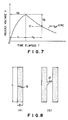
- Fig. 5 shows the characteristic underlying the principle of this invention.
- the primary energy E and the secondary electron emission efficiency are plotted on the abscissa and the ordinate, respectively.
- the primary electron energy E has a certain peak value.
- Fig. 6 shows a pattern which is the object to be irradiated by such an electron beam.
- An electron beam 12 is irradiated onto a polysilicon pattern 11 formed on a silicon substrate 10.
- the polysilicon pattern 11 is formed on an oxide film 13 1000 ⁇ thick formed on the silicon substrate 10.
- Polysilicon is ordinarily used for internal wiring of gate electrode or LSI. This process is present at an early stage of the entire process sequence. In-process inspection cannot be conducted with the conventional technique.
- Fig. 7 shows the behavior of changes in the voltage V G .
- V G V G e ⁇ t/RC (5).
- V G becomes equal to voltage value V1 determined by the capacity C and the parallel resistor after a predetermined time t2 has passed.
- the measurement of the voltage V1 shown by the characteristic curve of Fig. 7 is carried out with a measurement accuracy of several ten mV by using the same electron beam as that used for injection of charges to conduct an energy analysis of secondary electrons generated by irradiation of the electron beam using an energy analyzer.
- complete non-contact measurement can be conducted.
- Figs. 8(a) and (b) show examples where a measurement object tested by the method according to this invention is in an abnormal state.
- a disconnection 16 is present in the middle of the pattern as shown in Fig. 8(a)
- the length L of the pattern becomes small to a great extent and the capacity C also becomes small.
- the capacity C becomes equal to a value including the capacity of the adjacent pattern as well, and therefore indicates a large value.
- the pattern of this kind has the relationship between the length L and the width expressed as L » D. Accordingly, if the value of the capacity C is equal to a value in the vicinity of the expectation value mainly determined from the dimension of the pattern and shows unevenness, it can be said that this is the unevenness due to the line width D.
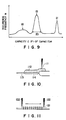
- Fig. 9 is a histogram obtained by measuring a large number of patterns to plot the value of the capacity C on the abscissa and the occurrence frequency on the ordinate.
- reference 18 denotes a pattern disconnection
- reference number 19 a normal pattern
- reference number 20 an unevenness of the pattern line width
- reference number 21 an unevenness of the capacity due to short-circuiting. Results patterned according to abnormal causes are obtained.
- the testing method according to this invention permits measurement of disconnection and short-circuiting of the pattern, and the line width value of the pattern and unevenness thereof.
- such a measurement can be carried out in a non-contact manner and at the same time.
- Fig. 10 shows an example where this invention is applied to a further measurement object.
- test of the electric characteristic of a capacity such as a memory cell in dynamic RAM is made.
- the leakage characteristic is important. This appears as a parallel resistor with respect to a capacitor composed of a polysilicon 112, a gate oxide film 113, and a memory cell side element 114.
- the voltage increase V D after time t1 has passed depends upon the parallel resistor R as a result of discharging.
- Fig. 10 shows the state immediately after the capacitor portion of the memory cell is formed, wherein measurement can be carried out immediately after the process is completed.
- Fig. 11 shows the case where this invention is applied to a still further measurement object.
- the withstand voltage characteristic (leakage characteristic) is measured in the state before the conductive film is formed. While the electron beam is irradiated to a fixed point because the conductive film is utilized in the example of Fig. 10, an electron beam 112 is face-irradiated directly to an insulating film 121 to uniformly charge the insulating film to induce a voltage in this example.
- the spot diameter of the electron beam may be widened to partially effect surface irradiation.
Landscapes
- Engineering & Computer Science (AREA)
- General Engineering & Computer Science (AREA)
- Physics & Mathematics (AREA)
- General Physics & Mathematics (AREA)
- Tests Of Electronic Circuits (AREA)
- Testing Or Measuring Of Semiconductors Or The Like (AREA)
- Testing Of Individual Semiconductor Devices (AREA)
- Measurement Of Current Or Voltage (AREA)
Applications Claiming Priority (2)
| Application Number | Priority Date | Filing Date | Title |
|---|---|---|---|
| JP62241629A JPH065691B2 (ja) | 1987-09-26 | 1987-09-26 | 半導体素子の試験方法および試験装置 |
| JP241629/87 | 1987-09-26 |
Publications (3)
| Publication Number | Publication Date |
|---|---|
| EP0309956A2 true EP0309956A2 (de) | 1989-04-05 |
| EP0309956A3 EP0309956A3 (de) | 1991-03-20 |
| EP0309956B1 EP0309956B1 (de) | 1994-08-03 |
Family
ID=17077163
Family Applications (1)
| Application Number | Title | Priority Date | Filing Date |
|---|---|---|---|
| EP88115783A Expired - Lifetime EP0309956B1 (de) | 1987-09-26 | 1988-09-26 | Verfahren und Apparatur zum Prüfen von Halbleiter-Elementen |
Country Status (4)
| Country | Link |
|---|---|
| US (2) | US4912052A (de) |
| EP (1) | EP0309956B1 (de) |
| JP (1) | JPH065691B2 (de) |
| DE (1) | DE3850926T2 (de) |
Cited By (8)
| Publication number | Priority date | Publication date | Assignee | Title |
|---|---|---|---|---|
| EP0542094A1 (de) * | 1991-11-05 | 1993-05-19 | ICT Integrated Circuit Testing Gesellschaft für HalbleiterprÀ¼ftechnik mbH | Korpuskularstrahltestverfahren mit Gegenspannungsnachführung |
| EP0747716A3 (de) * | 1995-06-08 | 1997-09-24 | Schlumberger Technologies Inc | Vorhersagende Wellenformmessung |
| FR2771853A1 (fr) * | 1997-11-28 | 1999-06-04 | Sgs Thomson Microelectronics | Plot de test de circuit integre |
| EP0892275A3 (de) * | 1997-07-15 | 1999-07-28 | Schlumberger Technologies, Inc. | Verfahren und Gerät zur Prüfung von Strukturen auf Halbleitern und auf integrierten Schaltungen |
| US6914441B2 (en) | 1999-01-08 | 2005-07-05 | Applied Materials, Inc. | Detection of defects in patterned substrates |
| US7528614B2 (en) | 2004-12-22 | 2009-05-05 | Applied Materials, Inc. | Apparatus and method for voltage contrast analysis of a wafer using a tilted pre-charging beam |
| CN101118864B (zh) * | 2006-08-04 | 2010-06-02 | 东京毅力科创株式会社 | 基板检测机构和使用其的基板处理装置 |
| EP2365512A2 (de) * | 2000-06-27 | 2011-09-14 | Ebara Corporation | Untersuchungsvorrichtung mit geladenen teilchenstrahlen |
Families Citing this family (42)
| Publication number | Priority date | Publication date | Assignee | Title |
|---|---|---|---|---|
| JPH065691B2 (ja) * | 1987-09-26 | 1994-01-19 | 株式会社東芝 | 半導体素子の試験方法および試験装置 |
| JPH01278065A (ja) * | 1988-04-28 | 1989-11-08 | Hitachi Ltd | 半導体記憶装置 |
| US5162240A (en) * | 1989-06-16 | 1992-11-10 | Hitachi, Ltd. | Method and apparatus of fabricating electric circuit pattern on thick and thin film hybrid multilayer wiring substrate |
| US5315167A (en) * | 1992-04-09 | 1994-05-24 | International Business Machines Corporation | Voltage burn-in scheme for BICMOS circuits |
| DE69313303T2 (de) * | 1992-12-31 | 1998-01-02 | United Technologies Corp | Gerät und verfahren zum berührungslosen stromeinspeisen zur verwendung bei linearen bipolaren schaltungen |
| US5404110A (en) * | 1993-03-25 | 1995-04-04 | International Business Machines Corporation | System using induced current for contactless testing of wiring networks |
| US5466614A (en) * | 1993-09-20 | 1995-11-14 | At&T Global Information Solutions Company | Structure and method for remotely measuring process data |
| US5905381A (en) * | 1996-08-22 | 1999-05-18 | Lsi Logic Corporation | Functional OBIC analysis |
| JP3568741B2 (ja) * | 1997-07-31 | 2004-09-22 | 株式会社東芝 | 半導体評価装置および半導体製造システム |
| US6104206A (en) * | 1997-08-05 | 2000-08-15 | Verkuil; Roger L. | Product wafer junction leakage measurement using corona and a kelvin probe |
| US6184046B1 (en) * | 1997-12-09 | 2001-02-06 | Texas Instruments Incorporated | Non-contact voltage stressing method for thin dielectrics at the wafer level |
| DE19758348A1 (de) * | 1997-12-22 | 1999-06-24 | Inst Halbleiterphysik Gmbh | Verfahren zur Aufnahme von Tiefenprofilen zum Nachweis von Verunreinigungen in Halbleitern |
| US6346821B1 (en) * | 1998-03-27 | 2002-02-12 | Infineon Technologies Ag | Method for nondestructive measurement of minority carrier diffusion length and minority carrier lifetime in semiconductor devices |
| KR100301040B1 (ko) * | 1998-05-19 | 2001-09-06 | 윤종용 | 반도체기판상에존재하는얕은핏트의인라인모니터링방법 |
| DE69900869T2 (de) * | 1999-07-29 | 2002-07-18 | Advantest Corp., Tokio/Tokyo | Verfahren und Vorrichtung zur Prüfung eines elektronischen Bauteils |
| FR2801680B3 (fr) * | 1999-11-26 | 2002-02-15 | Christophe Vaucher | Methode de test electrique de la conformite de l'interconnexion de conducteurs electriques disposes sur un substrat, sans contact et sans outillage |
| CA2308820A1 (en) * | 2000-05-15 | 2001-11-15 | The Governors Of The University Of Alberta | Wireless radio frequency technique design and method for testing of integrated circuits and wafers |
| TWI297167B (en) * | 2000-06-27 | 2008-05-21 | Ebara Corp | Inspection apparatus and inspection method |
| WO2002013227A1 (en) * | 2000-07-27 | 2002-02-14 | Ebara Corporation | Sheet beam test apparatus |
| JP3913454B2 (ja) * | 2000-08-29 | 2007-05-09 | 株式会社リガク | 試料の表面リーク電流の測定方法 |
| WO2002037526A1 (en) * | 2000-11-02 | 2002-05-10 | Ebara Corporation | Electron beam apparatus and method for manufacturing semiconductor device comprising the apparatus |
| US7244932B2 (en) * | 2000-11-02 | 2007-07-17 | Ebara Corporation | Electron beam apparatus and device fabrication method using the electron beam apparatus |
| US7109483B2 (en) * | 2000-11-17 | 2006-09-19 | Ebara Corporation | Method for inspecting substrate, substrate inspecting system and electron beam apparatus |
| US6855929B2 (en) | 2000-12-01 | 2005-02-15 | Ebara Corporation | Apparatus for inspection with electron beam, method for operating same, and method for manufacturing semiconductor device using former |
| US7095022B2 (en) | 2000-12-12 | 2006-08-22 | Ebara Corporation | Electron beam apparatus and method of manufacturing semiconductor device using the apparatus |
| EP1271604A4 (de) * | 2001-01-10 | 2005-05-25 | Ebara Corp | Untersuchungsvorrichtung und untersuchungs-verfahren mit elektronenstrahl und bauelemente-herstellungsverfahren mit der untersuchungs-vorrichtung |
| US6456019B1 (en) * | 2001-02-03 | 2002-09-24 | Nikon Corporation | Real time measurement of leakage current in high voltage electron guns |
| JP2004534360A (ja) | 2001-06-15 | 2004-11-11 | 株式会社荏原製作所 | 電子線装置及びその電子線装置を用いたデバイスの製造方法 |
| US6998611B2 (en) | 2001-09-06 | 2006-02-14 | Ebara Corporation | Electron beam apparatus and device manufacturing method using same |
| US6917209B2 (en) * | 2001-09-15 | 2005-07-12 | Energy Conversion Devices, Inc. | Non- contacting capacitive diagnostic device |
| JP2004111310A (ja) * | 2002-09-20 | 2004-04-08 | Nissin Ion Equipment Co Ltd | 基板の帯電電圧計測装置およびイオンビーム照射装置 |
| JP2006515464A (ja) * | 2002-12-11 | 2006-05-25 | ピー・デイ・エフ ソリユーシヨンズ インコーポレイテツド | 集積回路上の電気的故障を高速位置決めするシステムおよび方法 |
| US7220990B2 (en) * | 2003-08-25 | 2007-05-22 | Tau-Metrix, Inc. | Technique for evaluating a fabrication of a die and wafer |
| JP4519567B2 (ja) * | 2004-08-11 | 2010-08-04 | 株式会社日立ハイテクノロジーズ | 走査型電子顕微鏡およびこれを用いた試料観察方法 |
| KR100613169B1 (ko) * | 2004-10-12 | 2006-08-17 | 삼성전자주식회사 | 무접촉 반도체 소자 테스트 장치 및 테스트 방법 |
| JP4828162B2 (ja) * | 2005-05-31 | 2011-11-30 | 株式会社日立ハイテクノロジーズ | 電子顕微鏡応用装置および試料検査方法 |
| US7462497B2 (en) * | 2005-09-14 | 2008-12-09 | Semiconductor Manufacturing International (Shanghai) Corporation | Method and system for derivation of breakdown voltage for MOS integrated circuit devices |
| FR2897690B1 (fr) * | 2006-02-17 | 2008-04-18 | Commissariat Energie Atomique | Dispositif de test de connexions electriques, sans contact |
| JP4644617B2 (ja) * | 2006-03-23 | 2011-03-02 | 株式会社日立ハイテクノロジーズ | 荷電粒子線装置 |
| JP4728207B2 (ja) * | 2006-11-28 | 2011-07-20 | 株式会社日立製作所 | 検査装置 |
| US7525325B1 (en) * | 2006-12-18 | 2009-04-28 | Sandia Corporation | System and method for floating-substrate passive voltage contrast |
| US7733109B2 (en) * | 2007-10-15 | 2010-06-08 | International Business Machines Corporation | Test structure for resistive open detection using voltage contrast inspection and related methods |
Family Cites Families (23)
| Publication number | Priority date | Publication date | Assignee | Title |
|---|---|---|---|---|
| DE2903077C2 (de) * | 1979-01-26 | 1986-07-17 | Siemens AG, 1000 Berlin und 8000 München | Verfahren zur berührungslosen Potentialmessung an einem elektronischen Bauelement und Anordnung zur Durchführung des Verfahrens |
| JPS55156867A (en) * | 1979-05-28 | 1980-12-06 | Hitachi Ltd | Potential measuring device |
| JPS56126933A (en) * | 1980-03-11 | 1981-10-05 | Nippon Telegr & Teleph Corp <Ntt> | Contactless evaluator for semiconductor |
| JPS5745465A (en) * | 1980-09-02 | 1982-03-15 | Fujitsu Ltd | Voltage measuring device |
| US4415851A (en) * | 1981-05-26 | 1983-11-15 | International Business Machines Corporation | System for contactless testing of multi-layer ceramics |
| US4417203A (en) * | 1981-05-26 | 1983-11-22 | International Business Machines Corporation | System for contactless electrical property testing of multi-layer ceramics |
| DE3138901A1 (de) * | 1981-09-30 | 1983-04-14 | Siemens AG, 1000 Berlin und 8000 München | Verbessertes gegenfeld-spektrometer fuer die elektronenstrahl-messtechnik |
| JPS5932145A (ja) * | 1982-08-16 | 1984-02-21 | Hitachi Ltd | 電位検出装置 |
| DE3235100A1 (de) * | 1982-09-22 | 1984-03-22 | Siemens AG, 1000 Berlin und 8000 München | Verfahren zur messung elektrischer potentiale an vergrabener festkoerpersubstanz |
| JPS607049A (ja) * | 1983-06-24 | 1985-01-14 | Hitachi Ltd | 電位測定装置 |
| DE3334494A1 (de) * | 1983-09-23 | 1985-04-11 | Siemens AG, 1000 Berlin und 8000 München | Verfahren zum messen niederfrequenter signalverlaeufe innerhalb integrierter schaltungen mit der elektronensonde |
| DE3676846D1 (de) * | 1985-03-28 | 1991-02-21 | Integrated Circuit Testing | Verfahren zur indirekten bestimmung der intensitaetsverteilung der in einem korpuskularstrahl-messgeraet erzeugten korpuskularstrahlpulse. |
| JPS6239942A (ja) * | 1985-08-15 | 1987-02-20 | Toyo Commun Equip Co Ltd | デ−タ伝送用変復調装置 |
| JPH0646550B2 (ja) * | 1985-08-19 | 1994-06-15 | 株式会社東芝 | 電子ビ−ム定位置照射制御方法および電子ビ−ム定位置照射制御装置 |
| EP0232790A1 (de) * | 1986-02-06 | 1987-08-19 | Siemens Aktiengesellschaft | Verfahren und Anordnung zur Messung zeitabhängiger Signale mit einer Korpuskularsonde |
| US4786865A (en) * | 1986-03-03 | 1988-11-22 | The Boeing Company | Method and apparatus for testing integrated circuit susceptibility to cosmic rays |
| US4733174A (en) * | 1986-03-10 | 1988-03-22 | Textronix, Inc. | Circuit testing method and apparatus |
| DE3617044A1 (de) * | 1986-05-21 | 1987-11-26 | Siemens Ag | Messverarbeitungsanordnung fuer korpuskularstrahlung |
| US4730158A (en) * | 1986-06-06 | 1988-03-08 | Santa Barbara Research Center | Electron-beam probing of photodiodes |
| US4837506A (en) * | 1986-10-02 | 1989-06-06 | Ultraprobe, Inc. | Apparatus including a focused UV light source for non-contact measuremenht and alteration of electrical properties of conductors |
| US4843330A (en) * | 1986-10-30 | 1989-06-27 | International Business Machines Corporation | Electron beam contactless testing system with grid bias switching |
| US4766372A (en) * | 1987-02-10 | 1988-08-23 | Intel Corporation | Electron beam tester |
| JPH065691B2 (ja) * | 1987-09-26 | 1994-01-19 | 株式会社東芝 | 半導体素子の試験方法および試験装置 |
-
1987
- 1987-09-26 JP JP62241629A patent/JPH065691B2/ja not_active Expired - Lifetime
-
1988
- 1988-09-23 US US07/248,137 patent/US4912052A/en not_active Expired - Lifetime
- 1988-09-26 EP EP88115783A patent/EP0309956B1/de not_active Expired - Lifetime
- 1988-09-26 DE DE3850926T patent/DE3850926T2/de not_active Expired - Lifetime
-
1990
- 1990-01-23 US US07/468,934 patent/US5030908A/en not_active Expired - Lifetime
Cited By (10)
| Publication number | Priority date | Publication date | Assignee | Title |
|---|---|---|---|---|
| EP0542094A1 (de) * | 1991-11-05 | 1993-05-19 | ICT Integrated Circuit Testing Gesellschaft für HalbleiterprÀ¼ftechnik mbH | Korpuskularstrahltestverfahren mit Gegenspannungsnachführung |
| EP0747716A3 (de) * | 1995-06-08 | 1997-09-24 | Schlumberger Technologies Inc | Vorhersagende Wellenformmessung |
| EP0892275A3 (de) * | 1997-07-15 | 1999-07-28 | Schlumberger Technologies, Inc. | Verfahren und Gerät zur Prüfung von Strukturen auf Halbleitern und auf integrierten Schaltungen |
| US6504393B1 (en) | 1997-07-15 | 2003-01-07 | Applied Materials, Inc. | Methods and apparatus for testing semiconductor and integrated circuit structures |
| FR2771853A1 (fr) * | 1997-11-28 | 1999-06-04 | Sgs Thomson Microelectronics | Plot de test de circuit integre |
| US6914441B2 (en) | 1999-01-08 | 2005-07-05 | Applied Materials, Inc. | Detection of defects in patterned substrates |
| EP2365512A2 (de) * | 2000-06-27 | 2011-09-14 | Ebara Corporation | Untersuchungsvorrichtung mit geladenen teilchenstrahlen |
| US9368314B2 (en) | 2000-06-27 | 2016-06-14 | Ebara Corporation | Inspection system by charged particle beam and method of manufacturing devices using the system |
| US7528614B2 (en) | 2004-12-22 | 2009-05-05 | Applied Materials, Inc. | Apparatus and method for voltage contrast analysis of a wafer using a tilted pre-charging beam |
| CN101118864B (zh) * | 2006-08-04 | 2010-06-02 | 东京毅力科创株式会社 | 基板检测机构和使用其的基板处理装置 |
Also Published As
| Publication number | Publication date |
|---|---|
| JPS6484629A (en) | 1989-03-29 |
| US4912052A (en) | 1990-03-27 |
| DE3850926D1 (de) | 1994-09-08 |
| DE3850926T2 (de) | 1995-01-05 |
| JPH065691B2 (ja) | 1994-01-19 |
| EP0309956A3 (de) | 1991-03-20 |
| EP0309956B1 (de) | 1994-08-03 |
| US5030908A (en) | 1991-07-09 |
Similar Documents
| Publication | Publication Date | Title |
|---|---|---|
| US4912052A (en) | Method of testing semiconductor elements | |
| EP0196804B1 (de) | Methode und Gerät zum Testen eines integrierten elektronischen Bauteils | |
| US3531716A (en) | Method of testing an electronic device by use of an electron beam | |
| US5404110A (en) | System using induced current for contactless testing of wiring networks | |
| US4296372A (en) | Techniques for impressing a voltage with an electron beam | |
| JP2004500707A (ja) | コロナ放電を用いて応力誘電リーク電流を測定する方法とゲート誘電体の完全性を測定する方法 | |
| US5485097A (en) | Method of electrically measuring a thin oxide thickness by tunnel voltage | |
| JP2000021945A (ja) | 半導体集積回路のコンタクト抵抗測定方法及び回路 | |
| KR950004591B1 (ko) | 절연 파괴 평가용 시험 소자 | |
| US7170056B2 (en) | Methodology and apparatus for leakage detection | |
| Goeckner et al. | Evaluation of charging damage test structures for ion implantation processes | |
| Herrmann et al. | Some aspects concerning design for e-beam testability | |
| JPH0587789B2 (de) | ||
| JPH0648703B2 (ja) | 電子デバイスの試験方法およびその試験装置 | |
| CN223815413U (zh) | 电介质击穿测量电路及半导体检测设备 | |
| Felch et al. | Analysis techniques of charging damage studied on three different high-current ion implanters | |
| JPH07105429B2 (ja) | 電子デバイスの試験方法 | |
| Brunner | Detectable resistance in electron beam testing of wiring networks | |
| JPH0235421B2 (de) | ||
| JPS60180133A (ja) | 荷電ビ−ムによる電子デバイスの試験法 | |
| JPS60189953A (ja) | 集積回路 | |
| JP2005108984A (ja) | 半導体装置の検査方法および半導体装置の製造方法 | |
| Comizzoli | Investigation of Surface Ion Failure Mechanisms by Corona Discharge | |
| Hohn | Review Of E-Beam Electrical Test Techniques | |
| JPS6332945A (ja) | 電子デバイスの試験装置 |
Legal Events
| Date | Code | Title | Description |
|---|---|---|---|
| PUAI | Public reference made under article 153(3) epc to a published international application that has entered the european phase |
Free format text: ORIGINAL CODE: 0009012 |
|
| 17P | Request for examination filed |
Effective date: 19880926 |
|
| AK | Designated contracting states |
Kind code of ref document: A2 Designated state(s): DE FR GB |
|
| PUAL | Search report despatched |
Free format text: ORIGINAL CODE: 0009013 |
|
| AK | Designated contracting states |
Kind code of ref document: A3 Designated state(s): DE FR GB |
|
| 17Q | First examination report despatched |
Effective date: 19920915 |
|
| GRAA | (expected) grant |
Free format text: ORIGINAL CODE: 0009210 |
|
| AK | Designated contracting states |
Kind code of ref document: B1 Designated state(s): DE FR GB |
|
| REF | Corresponds to: |
Ref document number: 3850926 Country of ref document: DE Date of ref document: 19940908 |
|
| ET | Fr: translation filed | ||
| PLBE | No opposition filed within time limit |
Free format text: ORIGINAL CODE: 0009261 |
|
| STAA | Information on the status of an ep patent application or granted ep patent |
Free format text: STATUS: NO OPPOSITION FILED WITHIN TIME LIMIT |
|
| 26N | No opposition filed | ||
| REG | Reference to a national code |
Ref country code: GB Ref legal event code: 746 Effective date: 19980915 |
|
| REG | Reference to a national code |
Ref country code: FR Ref legal event code: D6 |
|
| REG | Reference to a national code |
Ref country code: GB Ref legal event code: IF02 |
|
| PGFP | Annual fee paid to national office [announced via postgrant information from national office to epo] |
Ref country code: DE Payment date: 20070920 Year of fee payment: 20 |
|
| PGFP | Annual fee paid to national office [announced via postgrant information from national office to epo] |
Ref country code: GB Payment date: 20070926 Year of fee payment: 20 |
|
| PGFP | Annual fee paid to national office [announced via postgrant information from national office to epo] |
Ref country code: FR Payment date: 20070914 Year of fee payment: 20 |
|
| REG | Reference to a national code |
Ref country code: GB Ref legal event code: PE20 Expiry date: 20080925 |
|
| PG25 | Lapsed in a contracting state [announced via postgrant information from national office to epo] |
Ref country code: GB Free format text: LAPSE BECAUSE OF EXPIRATION OF PROTECTION Effective date: 20080925 |