EP0310376A2 - Procédé de laminage d'acier plaqué - Google Patents
Procédé de laminage d'acier plaqué Download PDFInfo
- Publication number
- EP0310376A2 EP0310376A2 EP88309025A EP88309025A EP0310376A2 EP 0310376 A2 EP0310376 A2 EP 0310376A2 EP 88309025 A EP88309025 A EP 88309025A EP 88309025 A EP88309025 A EP 88309025A EP 0310376 A2 EP0310376 A2 EP 0310376A2
- Authority
- EP
- European Patent Office
- Prior art keywords
- rolling
- clad steel
- length
- reduction
- clad
- Prior art date
- Legal status (The legal status is an assumption and is not a legal conclusion. Google has not performed a legal analysis and makes no representation as to the accuracy of the status listed.)
- Granted
Links
- 238000005096 rolling process Methods 0.000 title claims abstract description 153
- 229910000831 Steel Inorganic materials 0.000 title claims abstract description 91
- 239000010959 steel Substances 0.000 title claims abstract description 91
- 230000009467 reduction Effects 0.000 claims abstract description 36
- 238000000034 method Methods 0.000 claims abstract description 33
- 230000008569 process Effects 0.000 claims abstract description 33
- 239000000463 material Substances 0.000 claims description 32
- 230000013011 mating Effects 0.000 claims description 2
- 229910052751 metal Inorganic materials 0.000 abstract description 9
- 239000002184 metal Substances 0.000 abstract description 9
- 230000002411 adverse Effects 0.000 abstract description 2
- 239000010410 layer Substances 0.000 description 20
- 238000002474 experimental method Methods 0.000 description 17
- 239000002356 single layer Substances 0.000 description 12
- 238000005098 hot rolling Methods 0.000 description 5
- 230000000052 comparative effect Effects 0.000 description 3
- 229910001220 stainless steel Inorganic materials 0.000 description 3
- 239000010935 stainless steel Substances 0.000 description 3
- XEEYBQQBJWHFJM-UHFFFAOYSA-N Iron Chemical compound [Fe] XEEYBQQBJWHFJM-UHFFFAOYSA-N 0.000 description 2
- 150000002739 metals Chemical class 0.000 description 2
- 229910000570 Cupronickel Inorganic materials 0.000 description 1
- 229910000792 Monel Inorganic materials 0.000 description 1
- RTAQQCXQSZGOHL-UHFFFAOYSA-N Titanium Chemical compound [Ti] RTAQQCXQSZGOHL-UHFFFAOYSA-N 0.000 description 1
- 239000004411 aluminium Substances 0.000 description 1
- 229910052782 aluminium Inorganic materials 0.000 description 1
- XAGFODPZIPBFFR-UHFFFAOYSA-N aluminium Chemical compound [Al] XAGFODPZIPBFFR-UHFFFAOYSA-N 0.000 description 1
- 239000012467 final product Substances 0.000 description 1
- 230000006872 improvement Effects 0.000 description 1
- 229910052742 iron Inorganic materials 0.000 description 1
- 238000012986 modification Methods 0.000 description 1
- 230000004048 modification Effects 0.000 description 1
- 239000010936 titanium Substances 0.000 description 1
- 229910052719 titanium Inorganic materials 0.000 description 1
Images




Classifications
-
- B—PERFORMING OPERATIONS; TRANSPORTING
- B21—MECHANICAL METAL-WORKING WITHOUT ESSENTIALLY REMOVING MATERIAL; PUNCHING METAL
- B21B—ROLLING OF METAL
- B21B1/00—Metal-rolling methods or mills for making semi-finished products of solid or profiled cross-section; Sequence of operations in milling trains; Layout of rolling-mill plant, e.g. grouping of stands; Succession of passes or of sectional pass alternations
- B21B1/38—Metal-rolling methods or mills for making semi-finished products of solid or profiled cross-section; Sequence of operations in milling trains; Layout of rolling-mill plant, e.g. grouping of stands; Succession of passes or of sectional pass alternations for rolling sheets of limited length, e.g. folded sheets, superimposed sheets, pack rolling
Definitions
- the present invention relates generally to a process for rolling a clad steel which combines iron base plate and stainless steel plate, cupronickel plate, monel metal plate, titanium plate, aluminium plate or the like. More specifically, the present invention relates to a hot rolling process for the clad steel which successfully avoids influence of difference of draft of the different materials of the clad steel.
- the different material metal plates composed into the clad steel have different deformation resistance in hot rolling. This causes a difference in drafts which redults in difference of rolling reductions. Therefore, thickness ratio of the different material plates is differentiated at the entrance of a rolling mill and at the exit thereof. Namely, the plate made of the material having smaller deformation resistance relative to the other, is reduced at greater magnitude than that of the other. This natually causes difference of expansion length of composed plates to lowering the yield of the hot rolling process. This is because the material having the smaller deformation resistance tends to flow toward the material having greater deformation resistance to form the single layer longitudinal ends where only the smaller deformation resistance material exists.
- Japanese Patent First (unexamined) Publication Showa 61-232003, published on October 16, 1986, discloses a process for rolling of clad steel, in which pre-form rolling is performed at least one of longitudinal ends. After pre-forming rolling, reduction rolling is performed for overall length of the clad steel.
- the publication further discloses that the preferred length of the end portion of the clad steel, for which pre-forming rolling is to be performed, is equal to the thickness of the clad steel at the maximum.
- the thickness ratio of the layers will be hereafter referred to as “clad ratio” are formed at the longitudinal ends.
- the portion where the clad ratio fluctuates, will be hereafter referred to as “uneven clad ratio portion".
- pre-form rolling is performed over 20% to 80% of the overall length of the clad steel.
- main reduction rolling is performed at a draft substantially equal to or greater than a draft of the pre-forming rolling.
- pre-form rolling process and reduction rolling process are performed for at least two passes.
- a process for rolling an elongate clad steel composed of a first layer of a first material and a second layer of a second material which has lower malleability than that of the first material comprises the steps of: performing pre-form rolling at a first given draft from one longitudinal end of the elongated clad steel for 20% to 80% of the overall length of clad steel; performing reduction rolling for a second given draft which is greater than or equal to the first given draft from the other longitudinal end of the elongated clad steel for rolling; and repeating the cycle of the pre-form rolling and reduction rolling at least for two cycles.
- the reduction rolling is performed on the portion of the clad steel maintained unrolled or, alternatively, for over entire length of the clad steel.
- a process for rolling an elongate clad steel composed of a first layer of a first material and a second layer of a second material which has lower mallerability than that of the first material comprises the steps of: defining a path of the elongated clad steel between a first and second rolls to pass the clad steel therethrough during rolling; driving the second roll mating with the second layer of the clad steel at higher speed than that of the first roll which mates the first layer of the clad steel; performing pre-form rolling at a first given draft from one longitudinal end of the elongated clad steel 20% to 80% of the overall length of clad steel; performing reduction rolling at a second given draft which is greater than or equal to the first given draft from the other longitudinal end of the elongated clad steel; and repeating the cycle of the pre-form rolling and reduction rolling at least for two cycles.
- the reduction rolling is performed on the portion of the clad steel maintained unrolled or, alternatively, for over entire length of the clad steel.
- Figs. 1(A), 1(B), 1(C), 1(D), 1(E), 1(F) and 1(G) illustrates the preferred rolling process according to the present invention.
- Rolling is performed by upper and lower rolls 1a and 1b by passing a clad steel 4 in the form of a plate, slab or so forth.
- the clad steel 4 is composed of a pair of layer of different material metals 2 and 3.
- a portion of the clad steel 4 is subject pre-form rolling by being passed through the clearance between the upper and lower rolls 1a and 1b .
- the pre-form rolling is performed from one longitudinal end of the clad steel 4 , for a length L0 that is in the range of 20% to 80% of the overall length L of the clad steel 4 .
- reduction rolling is performed from the the opposite longitudinal end of the clad steel 4 over the portion nopt rolled in the pre-form rolling process.
- the draft in the reduction rolling is greater than or equal to the draft in the pre-form rolling.
- the pre-form rolling and reduction rolling processes are performed in one rolling pass cycle.
- the rolling process is performed at least for two cycles.
- pre-form rolling is performed on both longitudinal ends of the clad steel 4 .
- pre-form rolling was performed over a distance corresponding to the thickness of the clad steel.
- the clad steel 4 passes, at first, from one end thereof and then from the other end.
- the clad steel 4 rolled by the preferred process has a substantially even clad ratio over the entire length.
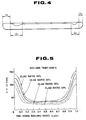
- the clad steel rolled by the process shown in Tokkai Showa 61-232003 had portions at both ends where no layer of the metal 2 is formed. The single layer portions extend for lengths l1 and l2 , as seen from Fig. 4 .
- the clad ratio becomes uneven.
- the rigion where single layer is formed, and uneven clad ratio region are hereafter referred to as "inferior quality region".
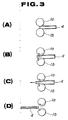
- the clad steel 4 processed by the process of reverse rolling of Figs. 3(A), 3(B), 3(C) and 3(D) had metal layers 2 and 3 where difference in length corresponded to the difference between the expansion ratios of the respective layers.
- Figs. 5 to 7 show results of experimentally performed rolling utilising the preferred processes.
- clad steel slab composed of a layer of stainless steel and a layer of soft steel was used.
- the slab was 200 mm thick and 5 m length.
- the clad slab was a total draft of 50% in total including the reduction in the pre-form rolling and reduction rolling stages.
- rolling was performed in two rolling pass cycles.
- clad steel composed of a layer of stainless steel and a layer of soft steel.
- the clad steel was in the form of a slab having length of 5m and thickness of 200 mm.
- Rolling was performed in two pass cycles, each of which pass cycles included pre-form rolling from one longitudinal end of the clad slab and reduction rolling from the other longitudinal end. The draft was 50%.
- comparative experiments were performed utilizing the conventional process. In the conventional rolling process, pre-form rolling was performed on one longitudinal end portion of the clad slab. Then, reduction rolling was performed from the other end. After one pass cycle, normal rolling was performed for another pass cycle.
- Figs. 11 and 13 Results of the experiments are shown in Figs. 11 and 13 .
- the result of the comparative example is shown by solid line
- the result of the preferred process with equal roll speed is shown by the broken line
- the result of the preferred process with different roll speed is shown by the one-dot chain line.
- Figs. 11 and 12 by setting the pre-form rolling length within the range of 20% to 80% of the overall length of the slab, substantial reduction of the single layer region (l1 + l2) and the uneven clad ratio region (C1 + C2) can be obtained.
- the length of single layer region (l1 + l2) and the uneven clad ratio region (C1 + C2) in the slab rolled by the preferred process of the present invention is much smaller than that of the slab rolled by the conventional process.
- the length of the inferior quality region in relation to the number of pass cycles performed for obtaining the desired draft versus the original thickness was observed and the results are shown in Fig. 13 .
- the rolling processes were performed for obtaining the desired draft, i.e. 50% by two pass cycles or more substantially reduces the length of the inferior quality region.
- the preferred process for rolling of clad steel provides a substantially increased yield when pre-form rolling is performed from one end on a portion, the length of which is 20% to 80% of the overall length of the clad steel, and the reduction rolling is performed subsequently from the other end with a draft that is greater than or equal to the draft used in the pre-forming.
- a still greater increase in yield can be obtained by repeating the foregoing rolling process at least two passes. Differentiating of the roll speed to mate the higher speed roll to the layer having lower malleability, further assist for improvement of the yield by reducing length of inferior quality portions.
Landscapes
- Engineering & Computer Science (AREA)
- Mechanical Engineering (AREA)
- Metal Rolling (AREA)
- Pressure Welding/Diffusion-Bonding (AREA)
Applications Claiming Priority (4)
| Application Number | Priority Date | Filing Date | Title |
|---|---|---|---|
| JP244190/87 | 1987-09-30 | ||
| JP244191/87 | 1987-09-30 | ||
| JP24419187A JPS6487002A (en) | 1987-09-30 | 1987-09-30 | Rolling method for clad metal sheet |
| JP24419087A JPS6487001A (en) | 1987-09-30 | 1987-09-30 | Rolling method for clad metal sheet |
Publications (3)
| Publication Number | Publication Date |
|---|---|
| EP0310376A2 true EP0310376A2 (fr) | 1989-04-05 |
| EP0310376A3 EP0310376A3 (en) | 1990-01-17 |
| EP0310376B1 EP0310376B1 (fr) | 1993-02-24 |
Family
ID=26536616
Family Applications (1)
| Application Number | Title | Priority Date | Filing Date |
|---|---|---|---|
| EP19880309025 Expired - Lifetime EP0310376B1 (fr) | 1987-09-30 | 1988-09-29 | Procédé de laminage d'acier plaqué |
Country Status (3)
| Country | Link |
|---|---|
| EP (1) | EP0310376B1 (fr) |
| AU (1) | AU608064B2 (fr) |
| DE (1) | DE3878620T2 (fr) |
Cited By (1)
| Publication number | Priority date | Publication date | Assignee | Title |
|---|---|---|---|---|
| US7546756B2 (en) | 2001-08-24 | 2009-06-16 | Corus Technology Bv | Method for processing a metal slab or billet, and product produced using said method |
Family Cites Families (1)
| Publication number | Priority date | Publication date | Assignee | Title |
|---|---|---|---|---|
| DE317588C (fr) * |
-
1988
- 1988-09-28 AU AU22903/88A patent/AU608064B2/en not_active Ceased
- 1988-09-29 EP EP19880309025 patent/EP0310376B1/fr not_active Expired - Lifetime
- 1988-09-29 DE DE19883878620 patent/DE3878620T2/de not_active Expired - Fee Related
Cited By (1)
| Publication number | Priority date | Publication date | Assignee | Title |
|---|---|---|---|---|
| US7546756B2 (en) | 2001-08-24 | 2009-06-16 | Corus Technology Bv | Method for processing a metal slab or billet, and product produced using said method |
Also Published As
| Publication number | Publication date |
|---|---|
| AU2290388A (en) | 1989-04-06 |
| EP0310376B1 (fr) | 1993-02-24 |
| EP0310376A3 (en) | 1990-01-17 |
| AU608064B2 (en) | 1991-03-21 |
| DE3878620T2 (de) | 1993-06-24 |
| DE3878620D1 (de) | 1993-04-01 |
Similar Documents
| Publication | Publication Date | Title |
|---|---|---|
| US4881355A (en) | Cold roll-formed structures and method and apparatus for producing same | |
| US4770018A (en) | Method for producing cold roll-formed structures | |
| JPH0249161B2 (fr) | ||
| US4528830A (en) | Method for changing widthwise distribution of thickness of metal strip | |
| EP0310376B1 (fr) | Procédé de laminage d'acier plaqué | |
| EP0484854B1 (fr) | Procédé pour le laminage de poutrelles en H | |
| US6189770B1 (en) | Method of producing sectional strips and sectional sheets | |
| EP0440650B1 (fr) | Fabrication de mince plaque de metal | |
| JP2982669B2 (ja) | 幅圧下プレス装置の金型および幅圧下方法 | |
| WO1982003347A1 (fr) | Production de formations dans un materiau traite en continu | |
| JPS62176603A (ja) | プラネタリ−ミルライン圧延方法 | |
| JP3288499B2 (ja) | 異形断面帯板の製造方法 | |
| JP3258143B2 (ja) | 異形断面条の製造方法 | |
| US4584862A (en) | Rolling procedures for eliminating alligator defect formation | |
| AU681219B2 (en) | H-steel manufacturing method | |
| JP2582748B2 (ja) | 薄肉ウエブh形鋼の製造方法 | |
| JP2005021960A (ja) | 鋼板の製造方法および製造装置 | |
| JPS58159901A (ja) | 異形断面条の製造方法 | |
| JPH0130562B2 (fr) | ||
| CA1302743C (fr) | Methode de controle du bombement de la bande, dans un laminoir planetaire | |
| JPH06254601A (ja) | 不等辺山形鋼の圧延方法 | |
| JPH0777642B2 (ja) | 難加工性材料の冷間圧延における耳割れ防止方法 | |
| JPH09108737A (ja) | H形鋼の残留応力除去方法及びその装置 | |
| JPH05245604A (ja) | 連続鋳造方法 | |
| SU1731312A1 (ru) | Способ изготовлени прокатного валка |
Legal Events
| Date | Code | Title | Description |
|---|---|---|---|
| PUAI | Public reference made under article 153(3) epc to a published international application that has entered the european phase |
Free format text: ORIGINAL CODE: 0009012 |
|
| AK | Designated contracting states |
Kind code of ref document: A2 Designated state(s): DE FR GB |
|
| PUAL | Search report despatched |
Free format text: ORIGINAL CODE: 0009013 |
|
| AK | Designated contracting states |
Kind code of ref document: A3 Designated state(s): DE FR GB |
|
| 17P | Request for examination filed |
Effective date: 19900702 |
|
| 17Q | First examination report despatched |
Effective date: 19910624 |
|
| GRAA | (expected) grant |
Free format text: ORIGINAL CODE: 0009210 |
|
| AK | Designated contracting states |
Kind code of ref document: B1 Designated state(s): DE FR GB |
|
| REF | Corresponds to: |
Ref document number: 3878620 Country of ref document: DE Date of ref document: 19930401 |
|
| ET | Fr: translation filed | ||
| PLBE | No opposition filed within time limit |
Free format text: ORIGINAL CODE: 0009261 |
|
| STAA | Information on the status of an ep patent application or granted ep patent |
Free format text: STATUS: NO OPPOSITION FILED WITHIN TIME LIMIT |
|
| 26N | No opposition filed | ||
| PGFP | Annual fee paid to national office [announced via postgrant information from national office to epo] |
Ref country code: FR Payment date: 19970909 Year of fee payment: 10 |
|
| PGFP | Annual fee paid to national office [announced via postgrant information from national office to epo] |
Ref country code: GB Payment date: 19970922 Year of fee payment: 10 |
|
| PGFP | Annual fee paid to national office [announced via postgrant information from national office to epo] |
Ref country code: DE Payment date: 19971010 Year of fee payment: 10 |
|
| PG25 | Lapsed in a contracting state [announced via postgrant information from national office to epo] |
Ref country code: GB Free format text: LAPSE BECAUSE OF NON-PAYMENT OF DUE FEES Effective date: 19980929 |
|
| GBPC | Gb: european patent ceased through non-payment of renewal fee |
Effective date: 19980929 |
|
| PG25 | Lapsed in a contracting state [announced via postgrant information from national office to epo] |
Ref country code: FR Free format text: LAPSE BECAUSE OF NON-PAYMENT OF DUE FEES Effective date: 19990531 |
|
| PG25 | Lapsed in a contracting state [announced via postgrant information from national office to epo] |
Ref country code: DE Free format text: LAPSE BECAUSE OF NON-PAYMENT OF DUE FEES Effective date: 19990701 |
|
| REG | Reference to a national code |
Ref country code: FR Ref legal event code: ST |