EP0312519A2 - Contrôle des bactéries sur les carcasses de poulets - Google Patents
Contrôle des bactéries sur les carcasses de poulets Download PDFInfo
- Publication number
- EP0312519A2 EP0312519A2 EP88870117A EP88870117A EP0312519A2 EP 0312519 A2 EP0312519 A2 EP 0312519A2 EP 88870117 A EP88870117 A EP 88870117A EP 88870117 A EP88870117 A EP 88870117A EP 0312519 A2 EP0312519 A2 EP 0312519A2
- Authority
- EP
- European Patent Office
- Prior art keywords
- carcass
- acid
- salmonella
- chicken
- treatment
- Prior art date
- Legal status (The legal status is an assumption and is not a legal conclusion. Google has not performed a legal analysis and makes no representation as to the accuracy of the status listed.)
- Withdrawn
Links
Images

Classifications
-
- A—HUMAN NECESSITIES
- A23—FOODS OR FOODSTUFFS; TREATMENT THEREOF, NOT COVERED BY OTHER CLASSES
- A23B—PRESERVATION OF FOODS, FOODSTUFFS OR NON-ALCOHOLIC BEVERAGES; CHEMICAL RIPENING OF FRUIT OR VEGETABLES
- A23B4/00—Preservation of meat, sausages, fish or fish products
- A23B4/12—Preserving with acids; Acid fermentation
-
- A—HUMAN NECESSITIES
- A23—FOODS OR FOODSTUFFS; TREATMENT THEREOF, NOT COVERED BY OTHER CLASSES
- A23B—PRESERVATION OF FOODS, FOODSTUFFS OR NON-ALCOHOLIC BEVERAGES; CHEMICAL RIPENING OF FRUIT OR VEGETABLES
- A23B4/00—Preservation of meat, sausages, fish or fish products
- A23B4/005—Preserving by heating
- A23B4/01—Preserving by heating by irradiation or electric treatment with or without shaping, e.g. in form of powder, granules or flakes
-
- A—HUMAN NECESSITIES
- A23—FOODS OR FOODSTUFFS; TREATMENT THEREOF, NOT COVERED BY OTHER CLASSES
- A23B—PRESERVATION OF FOODS, FOODSTUFFS OR NON-ALCOHOLIC BEVERAGES; CHEMICAL RIPENING OF FRUIT OR VEGETABLES
- A23B4/00—Preservation of meat, sausages, fish or fish products
- A23B4/10—Coating with a protective layer; Compositions or apparatus therefor
-
- A—HUMAN NECESSITIES
- A23—FOODS OR FOODSTUFFS; TREATMENT THEREOF, NOT COVERED BY OTHER CLASSES
- A23B—PRESERVATION OF FOODS, FOODSTUFFS OR NON-ALCOHOLIC BEVERAGES; CHEMICAL RIPENING OF FRUIT OR VEGETABLES
- A23B4/00—Preservation of meat, sausages, fish or fish products
- A23B4/14—Preserving with chemicals not covered by groups A23B4/02 or A23B4/12
- A23B4/18—Preserving with chemicals not covered by groups A23B4/02 or A23B4/12 in the form of liquids or solids
- A23B4/20—Organic compounds; Microorganisms; Enzymes
-
- A—HUMAN NECESSITIES
- A23—FOODS OR FOODSTUFFS; TREATMENT THEREOF, NOT COVERED BY OTHER CLASSES
- A23B—PRESERVATION OF FOODS, FOODSTUFFS OR NON-ALCOHOLIC BEVERAGES; CHEMICAL RIPENING OF FRUIT OR VEGETABLES
- A23B4/00—Preservation of meat, sausages, fish or fish products
- A23B4/26—Apparatus for preserving using liquids ; Processes therefor
Definitions
- This invention relates to the reduction of Salmonella , Camphylobacter or other skin attaching and colonizing bacteria on a meat-producing carcass. More particularly, this invention relates to the substantial reduction of Salmonella on a poultry carcass during the processing of freshly killed poultry.
- Salmonella gives rise to a most serious problem in the food supply of humans.
- U.S. alone it has been reported that some two million cases of food poisoning in humans annually and some deaths may be attributable to Salmonella .
- conventionally processed freshly killed chickens can be a source of Salmonella infection.
- chickens can become contaminated with Salmonella bacteria which thrive in the feed, water and litter of the chickens.
- the pathogen may be transmitted to young chickens; but the infection may result in a long lasting resistance thereto within the chickens.
- Salmonella and Camphylobacter have the ability to attach to skin surfaces and thus are difficult to remove and kill.
- Salmonella -free chickens can be realized by a variety of procedures including genetic manipulation. While the use of ultrasonics alone may result in at least some reduction of the colonies of Salmonella on the birds, the Salmonella are not generally killed but tend to remain with the treated bird for subsequent infestation elsewhere or reinfestation of the same bird.
- the present invention provides a method of reducing contamination of bacteria, such as Salmonella and Camohylobacter , which are capable of attaching to and colonizing our meat surfaces, such as skin surfaces.
- the method comprises immersing a meat-producing carcass in an aqueous bath containing an effective antimicrobial substance thorugh which ultrasonic waves move.
- the present invention provides a method for controlling Salmonella and/or Camphylobacter during processing of a meat-producing carcass and, in particular, a fresh chicken carcass, comprising contacting the carcass for an effective amount of time with an aqueous solution at an acidic pH, preferably below about pH 4, more preferably below about pH 3 and even more preferably from about pH 1.5 to about pH 2.5 and at optionally the same time subjecting the carcass to ultrasonic energy treatment.
- the low pH of this solution is preferably achieved by addition of phosphoric acid.
- the aqueous solution preferably contains an effective amount of an anionic surfactant selected from the group consisting of a C8-C18 alkyl sulfate, a benzenesulfonic acid, preferably having one or more C1-C15 alkyl substituents and a naphthalenesulfonic acid, preferably having one or more C1-C15 alkyl substituents and water-soluble food-acceptable salts thereof, preferably lauryl sulfate, dodecylbenzenesulfonic acid, methylnaphthalenesulfonic acid and acceptable salts thereof.
- an anionic surfactant selected from the group consisting of a C8-C18 alkyl sulfate, a benzenesulfonic acid, preferably having one or more C1-C15 alkyl substituents and a naphthalenesulfonic acid, preferably having one or more C1-C15 alkyl substituents and water
- the surfactant is used in an effective amount to reduce Salmonella , preferably from about 50 to about 400 parts per million, by weight, more preferably from about 100 to about 300 ppm or less. It has also been found that other microbial agents, such as chlorine, acetic acid and the like, together with an ultrasonic energy treatment are likewise effective.
- the process is preferably conducted at temperatures from about 0 to about 60°C.
- the method of the present invention enhances the lethal removal of Salmonella prevalent on the skin of a chicken carcass.
- the chicken carcass is immersed in the acidic surfactant-containing aqueous solution having ultrasonic waves moving therein during the conventional multi-step processing of a freshly killed chicken.
- the immersion preferably takes place after the chicken has been scalded, defeathered and eviscerated but before the chicken is finally washed and chilled.
- the present invention provides a method of reducing and killing Salmonella found on the skin of a chicken carcass, a source of Salmonella contamination affecting humans.
- the skin folds of a chicken affords an excellent environment for colonization of the Salmonella bacterial. These infection sites develop when the chicken is being grown for the food market.
- Conventional processing of freshly killed chickens having colonies of Salmonella attached to their skins simply has not satisfactorily reduced and killed such colonies of Salmonella .
- the present process is straight forward and can be conveniently incorporated in conventional chicken processing operations with very little additional equipment and processing costs.
- the time necessary for an antimicrobial substance to remove and kill the bacteria is reduced by the use of ultrasonics.
- Fig. 1 a photomicrograph of a section of a typical colony of Salmonella attached to the skin of a chicken is shown at 5000x magnification. Often chickens normally have such infections when they arrive at and leave the processing plants.
- Fig. 2 a photomicrograph of a section of chicken skin from which a colony of Salmonella has been detached in accordance with the present invention is shown at 5000x magnification.
- the crater-like features of the skin appear to be locations where the colonies were most deeply embedded in the skin prior to the decolonization by the practice of the present invention.
- Fig. 3 a conventional step-wise procedure for processing freshly killed chickens is shown to which the sonication step of the present invention has been included.
- the sonication step of the present invention After being killed, it is often standard practice to first scald the chicken after which the feathers of the chicken are removed by a plucking operation. After removal of the feathers, the chickens are eviscerated to remove the entrails and internal organs of the chickens. After being disemboweled, the chickens are conventionally washed, chilled and packaged for shipping to the consumers.
- the chickens after they have been defeathered and eviscerated are immersed in an aqueous sonication acid bath containing effective antimicrobial agents, such as the described anionic surfactants, prior to washing, chilling and shipping.
- effective antimicrobial agents such as the described anionic surfactants
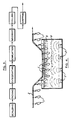
- Fig. 4 The continuous moving of a plurality of chickens through a sonication bath is illustrated in Fig. 4, wherein plucked eviscerated chickens 1 are moved one after another along an overhead conveyance track 2.
- the chickens are immersed in an aqueous bath 3 contained in a tank 4.
- a plurality of ultrasonic devices 5 of conventional construction are associated with the tank to cause the generation of and transmission of ultrasonic energy into contact with the chickens being processed in the aqueous bath.
- the ultrasonic devices may be deposed on the inside or outside of the tank. Often it is preferred to employ opposed arrays of such devices between which the carcasses pass when greater ultrasonic energy is needed.
- the ultrasonic energized bath containing an effective anionic surfactant through which the chickens are passed preferably has a pH below about 4. At higher pH's the decolonization and killing of Salmonella from the skin of the chicken may not be lowered to a satisfactory low level.
- the bath contains an effective amount of an anionic surfactant of a particular type.
- the preferred anionic surfactant is one selected from the group consisting of a C8-C18 alkyl sulfate, an alkyl substituted benzenesulfonic acid and an alkyl substituted naphthalenesulfonic acid.
- the aromatic moieties of the sulfonic acids have at least one C1-C15 alkyl substituent which may be straight or branched chains.
- Food acceptable salts of such sulfates and sulfonic acids are also effective.
- the most preferred surfactants are the more water soluble salts, such as the sodium salt of lauryl sulfate and the sodium salt of dodecylbenzenesulfonic acid.
- the acidity of the treating bath is maintained by the addition of mineral or organic acids, such as phosphoric acid and acetic acid. The most preferred acid is phosphoric acid.
- This invention is useful for controlling Salmonella contamination on any meat-producing carcasses, including pork, beef, chickens, turkeys, ducks, geese, and other commercial meat carcasses, including the edible viscera of these birds.
- meat-producing carcasses including pork, beef, chickens, turkeys, ducks, geese, and other commercial meat carcasses, including the edible viscera of these birds.
- the present invention will be referred to primarily in terms of processing of chickens. However, one skilled the art will understand that the discussion is applicable to other poultry and to other meat-producing carcasses as well.
- poultry processing begins with slaughtering of the chicken.
- the carcass is then immersed in a scald tank, which is typically maintained at a temperature from about 50 to about 60°C; and the carcass is maintained in the scald tank from about 1 ⁇ 2 minute to about 2 1 ⁇ 2 minutes.
- the carcass is plucked, eviscerated and cleaned.
- water is sprayed on the carcass to remove debris.
- the carcass is then taken to the chill tank, where the carcass is immersed in water from about 0 to about 16°C, preferably from about 0 to about 10°C, from about 15 to about 120 minutes, preferably from about 40 to about 120 minutes.
- the present invention can best be practiced as a separate treatment step after the chickens are defeathered and eviscerated and before final washing and chilling.
- the presence of the surfactant may sometimes result in some foaming.
- the invention be conducted to minimize foaming, e.g. by use of lower concentrations of surfactant, of less vigorous movement of the aqueous bath, or by other techniques known to one skilled in the art.
- the treatment may be conducted at elevated temperatures. Less time is normally required when elevated temperatures are used. The elevated temperatures should not be so high as to unduly adversely affect the appearance of the carcass.
- Preferred temperatures for an elevated temperature treatment are from about 45 to about 60°C for from a few seconds to about 10 minutes, more preferably from about 50 to about 52°C or even up to about 56°C for from about 1 to about 3 minutes.
- the treatment can also be conducted at ambient or reduced temperatures, for an appropriate period of time.
- This invention involves contacting the carcass with an acidic aqueous solution containing an anionic sulfate or sulfonic acid surfactant or suitable salts thereof as described above.
- the pH of the solution can be attained by addition of the appropriate amount of any acid, provided that it does not interfere with activity of the surfactant or adversely affect the appearance or taste of the chicken to the point that it reduces its marketability to an undesired extent.
- Preferred acids include acetic acid, lactic acid and phosphoric acid, with phosphoric acid being particularly preferred.
- Preferred surfactants include alkyl sulfates and alkylbenzenesulfonic acid, particularly lauryl sulfate and dodecylbenzenesulfonic acid.
- the surfactant contains a range of alkyl groups with the name designating the length of the alkyl group being derived from the average length of the alkyl group.
- the lauryl and the dodecyl groups referred to herein have an average of about 12 carbon atoms.
- the length and branching or lack of branching of the alkyl chain can vary without substantial loss of activity. Since the process of this invention is preferably carried out under acidic conditions and often under strongly acidic conditions, the surfactants of this invention can be added either in acid form or as a salt.
- the active form of the surfactant will be determined by the pH of the solution.
- the most preferred surfactants are sodium lauryl sulfate (SLS) and dodecylbenzenesulfonic acid (DDBSA).
- the optimum concentration for the surfactant can be determined by routine experimentation. There is some indication that as concentration of DDBSA increases, activity of the surfactant increases until a maximum is reached, from there on activity diminishes with increased concentration. See Example 1 below. The degree of this effect at different conditions and whether it occurs at different conditions or with different surfactants can also be determined by routine experimentation.
- the carcass is contacted with the aqueous solution for an amount of time and at an ultrasonic energy level effective to provide reduction of Salmonella .
- the present process not only provides for control of cross-contamination from one carcass to another, but also provides for control of Salmonella organisms on the carcass as well.
- the carcass is maintained in contact with the aqueous solution and ultrasonic energy for a period of time sufficient to achieve the desired degree of control. This amount of time is dependent upon a number of factors which would be apparent to one skilled in the art, such as temperature of the solution, the energy level of the ultrasonic vibrations, and a number of other factors. Often it is not necessary to modify the processing procedure to allow sufficient contact time between the carcass and the energized aqueous solution. This is particularly true where the aqueous solution is used in the scald and/or chill tanks.
- the energized aqueous solution of this invention may also optionally contain additional additives, such as sorbic acid, salts of sorbic acid, propylene glycol, etc.
- the broth was incubated at about 35°C for about 24 hours.
- One ml aliquots of this broth were incubated for 24 hours in a selinite-cystine broth or a tetrathionate broth to selectively grow Salmonella and related organisms.
- This incubated broth was streaked onto plates containing either bismuth sulfite agar or Salmonella-Shigella agar, which are also selective for Salmonella .
- the plates were examined for Salmonella colonies. Any existing colonies were tested to confirm that they were Salmonella .
- the results are reported in Table I. TABLE I Surfactant Surf. Conc. Acid/Base Acid/Base Conc.
- Example l Two series of experiments were conducted as in Example l at 18°C for 1 hour, to determine the effect of pH. Eight uninoculated wings were used in each run. Two hundred ppm of the indicated surfactant was used with sufficient phosphoric acid added to reach the indicated pH. The percentage of wings that tested positive is shown in Table III. TABLE III Surfactant pH % Positive none neutral 100% DDBSA 4.0 87% DDBSA 3.0 100% DDBSA 2.5 50% DDBSA 2.0 0% SLS 4.0 87% SLS 3.0 87% SLS 2.5 37% SLS 2.0 12% none 2.0 50%
- Example 1 A series of experiments was conducted as in Example 1 at 18°C for 1 hour to determine the effect of concentration of SLS at pH 2.3 in a phosphoric acid solution. Eight uninoculated wings were used for each experiment. The percentage of wings that tested positive is shown in Table IV. TABLE IV SLS Conc. % Positive 0 (neutral pH) 100% 25 ppm 87% 50 ppm 87% 100 ppm 62% 200 ppm 37% 300 ppm 37% 400 ppm 75% 0 75%
- Example 5 A series of experiments was conducted as in Example 5 to evaluate other surfactants.
- the Salmonella reduction procedure was as in Example 1.
- the results are in Table VI.
- TABLE VI Surfactant % Positive Octylphenoxy Polyethoxy Ethanol1 100% Sorbitan Monostearate (400 ppm)2 75% Dodecylbenzene Sulfonic Acid 37% Oleic Acid 100% 1. sold by Rohm and Haas Co. under the tradename Triton X-15 2. sold by ICI Americas, Inc. under the tradename Span 60
- the scald tank and the chiller were modified by addition of the indicated additives. Some of the runs also used a potassium sorbate additive (KS). Twelve carcasses were processed under each of the indicated conditions. The carcasses were evaluated for Salmonella contamination by individually shaking each carcass in a bag with 100 ml of sterile water containing an aqueous solution of 0.6% sodium heptadecyl sulfate sold by Union Carbide Corporation under the tradename Tergitol Anionic 7. The carcass was discarded and the water solution was diluted with selinite-crysteine broth resulting in a normal concentration of broth. The broth was incubated for 24 hrs.
- KS potassium sorbate additive
- the scald tank treatments with 1% lactic acid and 1% acetic acid were considered unsatisfactory because they resulted in a carcass with dry, fragile, easily split skin with a "bark-like" appearance.
- a sonication bath containing a small amount of moderately effective antimicrobial substance including chlorine and acetic acid and the use of a bath containing a small amount of the same substances but without sonication are illustrated.
- a number of commercially available chicken wings were obtained. An examination of the wings revealed that they had been colonized by Salmonella . Eight wings showing Salmonella contaminations were immersed for a period of one minute in a plain four liter water bath maintained at 18°C. In the bath, the wings were subjected to sonic treatment with a Branson Ultrasonic Cleaner having a power rating of 200 watts at 55 kHz. An examination of the treated chicken wings revealed that seven out of eight were contaminated with Salmonella .
- a 0.25% acetic acid solution was prepared and used as a bath for treating chickens contaminated with Salmonella . Again, eight wings per treatment were employed. In the first treatment, the wings were immersed in the bath for 15 minutes; and it was found that four of the eight wings were contaminated. In the second treatment, the first treatment was repeated with ultrasonics being applied during three minutes of immersion; and it was found that one of the eight wings was contaminated. In the third treatment, the second treatment was repeated with ultrasonics being applied during five minutes of immersion; and it was found that none of the eight wings were contaminated.
- This example shows that an aqueous bath having a small amount of acetic acid and having ultrasonic waves moving therethrough will effectively reduce the contamination of Salmonella on the skin of chickens in a time period wherein the use of acetic acid alone (no sonication) does not effectively reduce such contamination.
- a series of experiments was conducted using 20 cornish game hen carcasses per experiment and using a four liter tank having a plurality of bottom-mounted 5000 watt transducers.
- the tank contained water or an aqueous solution of 200 ppm sodium lauryl sulfate and 1200 ppm phosphoric acid. It was found that with no treatment 65% of the birds was infected with Salmonella .
- water with ultrasonic being applied was used at room temperature for 60 seconds. After this treatment, 55% of the treated carcasses was found to be infected with Salmonella .
- the aqueous bath contained the sulfate and acid and ultrasonics were applied at 35°C for 60 seconds, the percent Salmonella contamination was reduced to 0%. 100% removal of Salmonella was also accomplished when the aqueous bath contained the sulfate and acid and ultrasonics were applied at 43°C.
- the Salmonella count was determined by the method set forth above in Example 7.
- the Camphylobacter count was determined in accordance with the method of A. Cuff et al., Journal of Food Protection , 45:1276-1278 (1982).
- Half of the recovered rinse from each chicken carcass was diluted with concentrated Brucella-FBP-am raw to give a normal concentration in the final broth. This broth was held at 5°C for 12-24 hours and then incubated at 42°C for 48 hours in an atmosphere of 5% O2:10% CO2:85% N2 in an ANEE system.
- a loop full of the contents of each tube was then streaked onto Brucella-Camphylobacter agar plates.
- the plates were incubated at 42°C for 48 hours in the ANEE system in the same atmosphere. When needed, identity of colonies on the plates was confirmed by tests described by Blaser et al. in Ann. Intern. Med. , 91:179-185 (1979). These tests included gram reaction and morphology, oxidase reaction, catalyase reaction, motility H2S production, resistance to nalidixic acid, growth in 1% glycine and growth in brucella broth at 25°C and 42°C.
- Treatment 1 There were two controls run, one as the first treatment (Treatment 1) and one as the last treatment (Treatment 10). In the controls, neither the acidic aqueous bath containing an effective surfactant nor the application of ultrasonics was employed.
- Treatments 2-5 involved the use of the antimicrobial aqueous solution containing 1200 ppm phosphoric acid and 200 ppm sodium lauryl sulfate. In Treatment 2, the chickens were submerged in the antimicrobial solution after evisceration and before the chilling step in the tank with 15 seconds of sonication. Treatment 3 was the same as Treatment 2, but sonication was extended to 60 seconds.
- Treatment 4 involved the treatment of Treatment 1 in a chill tank.
- Treatment 5 was the same as Treatment 2, but the temperature of the solution was 38°C.
- Treatment 6 was the same as Treatment 2, but sonication and the use of the solution were carried during scalding.
- Treatment 7 was the same as Treatment 2, but sonication and the use of the solution were carried out in both the scald and chill steps.
- Treatment 8 was the application of the solution on the chickens during the scald and with a subsequent 15 second sonication in water.
- Treatment 9 involved a 60 second sonication in water without the use of the antimicrobial material of the present invention. The results of these ten treatments are listed below in Table XI. TABLE XI Treatment No. Salmonella No. Positives/12 Camphylobacter No. Positives/12 1 9/12 2/12 2 5/12 0/12 3 3/12 0/12 4 3/12 0/12 5 0/12 1/12 6 1/12 1/12 7 0/12 0/12 8 0/12 0/12 9 5/12 0/12 10 8/12 2/12
- an acid aqueous solution containing the surfactants of the present invention results in an effective reduction of Salmonella and Camphylobacter on the surface of poultry carcasses.
- Antimicrobial solutions can either be applied in a scald, chill or ultrasonic treatment with resultant reductions in the incidence of both of these pathogens.
- the preferred treatment is the application of ultrasonics in combination with an antimicrobial solution of the present invention.
- Example 13 In a similar manner as described in Example 13, eight lots each comprising twelve chickens were inoculated with Listeria monocylogenes .
- Various aqueous solutions with and without sonication were tested to determine the effectiveness of controlling Listeria in chickens which had been freshly killed, scalded, plucked, eviscerated and lightly water washed.
- Treatment 1 involved no sonication but involved the immersion of the chickens for 60 seconds in an aqueous solution containing 200 ppm sodium lauryl sulfate and 1200 ppm phosphoric acid.
- Treatment 2 involved 60 seconds of sonication and the simultaneous use of an aqueous solution containing 1200 ppm phosphoric acid.
- Treatment 3 involved 60 seconds of sonication and the simultaneous use of an aqueous solution containing 200 ppm sodium lauryl sulfate.
- Treatment 4 involved 60 seconds of sonication and the simultaneous use of an aqueous solution containing 1200 ppm phosphoric acid and 200 ppm sodium lauryl sulfate.
- Treatment 5 was the same as Treatment 4 but with only 15 seconds of sonication.
- Treatment 6 was the same as Treatment 4 but with only 30 seconds of sonication.
- Treatment 7 involved 60 seconds of sonication and the simultaneous use of 25 ppm chlorine dioxide.
- Treatment 8 involved 60 second sonication in water without any antimicrobial agent. The results of these treatments are set forth in Table XII below. TABLE XII Treatment No.
Landscapes
- Life Sciences & Earth Sciences (AREA)
- Engineering & Computer Science (AREA)
- Chemical & Material Sciences (AREA)
- Wood Science & Technology (AREA)
- Zoology (AREA)
- Food Science & Technology (AREA)
- Polymers & Plastics (AREA)
- Microbiology (AREA)
- Chemical Kinetics & Catalysis (AREA)
- General Chemical & Material Sciences (AREA)
- Meat, Egg Or Seafood Products (AREA)
- Agricultural Chemicals And Associated Chemicals (AREA)
Applications Claiming Priority (6)
| Application Number | Priority Date | Filing Date | Title |
|---|---|---|---|
| US07/098,446 US4770884A (en) | 1987-09-18 | 1987-09-18 | Control of Salmonella on poultry carcasses |
| US18203288A | 1988-04-29 | 1988-04-29 | |
| US18203188A | 1988-04-29 | 1988-04-29 | |
| US182032 | 1988-04-29 | ||
| US182031 | 1988-04-29 | ||
| US98446 | 1998-06-17 |
Publications (2)
| Publication Number | Publication Date |
|---|---|
| EP0312519A2 true EP0312519A2 (fr) | 1989-04-19 |
| EP0312519A3 EP0312519A3 (fr) | 1990-07-18 |
Family
ID=27378601
Family Applications (1)
| Application Number | Title | Priority Date | Filing Date |
|---|---|---|---|
| EP88870117A Withdrawn EP0312519A3 (fr) | 1987-09-18 | 1988-07-06 | Contrôle des bactéries sur les carcasses de poulets |
Country Status (6)
| Country | Link |
|---|---|
| EP (1) | EP0312519A3 (fr) |
| JP (1) | JPS6439966A (fr) |
| CN (1) | CN1031931A (fr) |
| AU (1) | AU1853688A (fr) |
| IL (1) | IL86899A0 (fr) |
| PT (1) | PT87891A (fr) |
Cited By (17)
| Publication number | Priority date | Publication date | Assignee | Title |
|---|---|---|---|---|
| WO1995007616A1 (fr) * | 1993-09-14 | 1995-03-23 | Minnesota Mining And Manufacturing Company | Composition desinfectante |
| US5569461A (en) * | 1995-02-07 | 1996-10-29 | Minnesota Mining And Manufacturing Company | Topical antimicrobial composition and method |
| WO1998033391A1 (fr) * | 1997-01-30 | 1998-08-06 | Koch Enterprises, Inc. | Composition antimicrobienne et procede de production d'un effet antimicrobien sur des produits alimentaires |
| WO1999037172A1 (fr) * | 1998-01-21 | 1999-07-29 | Health And Hygiene International Pty. Ltd. | Nettoyage de produits frais permettant d'augmenter la duree de conservation |
| WO1999055167A1 (fr) * | 1998-04-30 | 1999-11-04 | Glabe Elmer F | Viande de poulet conditionnee |
| WO2002082914A1 (fr) * | 2001-04-13 | 2002-10-24 | Glabe Elmer F | Produit de poisson frais conditionne et procede de preparation |
| WO2002098244A1 (fr) * | 2001-06-04 | 2002-12-12 | Mionix Corporation | Melange obtenu par metallation fortement acide d'acides organiques |
| WO2003045171A1 (fr) * | 2001-11-28 | 2003-06-05 | Johnsondiversey, Inc. | Composition de lavage de denrees alimentaires |
| US7090882B2 (en) | 2003-06-12 | 2006-08-15 | Cargill, Incorporated | Antimicrobial salt solutions for food safety applications |
| US7588696B2 (en) | 2003-06-12 | 2009-09-15 | Cargill, Incorporated | Antimicrobial water softener salt and solutions |
| US7658959B2 (en) | 2003-06-12 | 2010-02-09 | Cargill, Incorporated | Antimicrobial salt solutions for food safety applications |
| US7883732B2 (en) | 2003-06-12 | 2011-02-08 | Cargill, Incorporated | Antimicrobial salt solutions for cheese processing applications |
| US8486472B2 (en) | 2006-01-18 | 2013-07-16 | Cargill, Incorporated | Antimicrobial salt solutions for food safety applications |
| GB2541044A (en) * | 2015-03-10 | 2017-02-08 | Ultra Biotecs Ltd | Disinfection of foodstuffs |
| US9826770B2 (en) | 2005-03-10 | 2017-11-28 | 3M Innovative Properties Company | Antimicrobial compositions comprising esters of hydroxycarboxylic acids |
| US10471036B2 (en) | 2003-09-09 | 2019-11-12 | 3M Innovative Properties Company | Antimicrobial compositions and methods |
| US10918618B2 (en) | 2005-03-10 | 2021-02-16 | 3M Innovative Properties Company | Methods of reducing microbial contamination |
Families Citing this family (5)
| Publication number | Priority date | Publication date | Assignee | Title |
|---|---|---|---|---|
| JPWO2004080211A1 (ja) * | 2003-03-12 | 2006-06-08 | 大阪有機化学工業株式会社 | 食鳥肉の殺菌方法 |
| WO2006099325A2 (fr) | 2005-03-10 | 2006-09-21 | 3M Innovative Properties Company | Methodes destines au traitement d'infections de l'oreille |
| JP4975659B2 (ja) * | 2008-02-13 | 2012-07-11 | 国立大学法人 宮崎大学 | 超音波処理およびオゾン含有マイクロバブル処理による食品材料における微生物の制御方法 |
| JP5126249B2 (ja) | 2010-02-25 | 2013-01-23 | ブラザー工業株式会社 | 歯車機構及び画像形成装置 |
| CN104044484B (zh) * | 2013-03-15 | 2018-03-27 | 通用电气公司 | 驱动系统及驱动方法 |
Family Cites Families (4)
| Publication number | Priority date | Publication date | Assignee | Title |
|---|---|---|---|---|
| US3806615A (en) * | 1970-06-03 | 1974-04-23 | Exxon Research Engineering Co | Aliphatic diols and their esters as antimicrobial additives for cheese and meats |
| DE2450666C3 (de) * | 1974-10-25 | 1978-11-09 | Freimut 5135 Selfkant Riemer | Antimikrobielle Behandlung von Futtermitteln |
| US3934044A (en) * | 1974-12-06 | 1976-01-20 | Swift And Company Limited | Reducing levels of surface contamination on meat |
| GB8612954D0 (en) * | 1986-05-28 | 1986-07-02 | Bp Chem Int Ltd | Poultry processing |
-
1988
- 1988-06-28 IL IL86899A patent/IL86899A0/xx unknown
- 1988-06-29 AU AU18536/88A patent/AU1853688A/en not_active Abandoned
- 1988-07-01 PT PT87891A patent/PT87891A/pt not_active Application Discontinuation
- 1988-07-06 EP EP88870117A patent/EP0312519A3/fr not_active Withdrawn
- 1988-07-15 JP JP63176880A patent/JPS6439966A/ja active Pending
- 1988-09-17 CN CN88106743A patent/CN1031931A/zh active Pending
Cited By (21)
| Publication number | Priority date | Publication date | Assignee | Title |
|---|---|---|---|---|
| WO1995007616A1 (fr) * | 1993-09-14 | 1995-03-23 | Minnesota Mining And Manufacturing Company | Composition desinfectante |
| US5460833A (en) * | 1993-09-14 | 1995-10-24 | Minnesota Mining And Manufacturing Company | Disinfectant composition |
| US5490992A (en) * | 1993-09-14 | 1996-02-13 | Minnesota Mining And Manufacturing Company | Disinfectant composition |
| US5569461A (en) * | 1995-02-07 | 1996-10-29 | Minnesota Mining And Manufacturing Company | Topical antimicrobial composition and method |
| WO1998033391A1 (fr) * | 1997-01-30 | 1998-08-06 | Koch Enterprises, Inc. | Composition antimicrobienne et procede de production d'un effet antimicrobien sur des produits alimentaires |
| WO1999037172A1 (fr) * | 1998-01-21 | 1999-07-29 | Health And Hygiene International Pty. Ltd. | Nettoyage de produits frais permettant d'augmenter la duree de conservation |
| WO1999055167A1 (fr) * | 1998-04-30 | 1999-11-04 | Glabe Elmer F | Viande de poulet conditionnee |
| US6329003B1 (en) | 1998-04-30 | 2001-12-11 | Elmer F. Glabe | Chicken meat product and method of making |
| WO2002082914A1 (fr) * | 2001-04-13 | 2002-10-24 | Glabe Elmer F | Produit de poisson frais conditionne et procede de preparation |
| WO2002098244A1 (fr) * | 2001-06-04 | 2002-12-12 | Mionix Corporation | Melange obtenu par metallation fortement acide d'acides organiques |
| WO2003045171A1 (fr) * | 2001-11-28 | 2003-06-05 | Johnsondiversey, Inc. | Composition de lavage de denrees alimentaires |
| US7090882B2 (en) | 2003-06-12 | 2006-08-15 | Cargill, Incorporated | Antimicrobial salt solutions for food safety applications |
| US7588696B2 (en) | 2003-06-12 | 2009-09-15 | Cargill, Incorporated | Antimicrobial water softener salt and solutions |
| US7658959B2 (en) | 2003-06-12 | 2010-02-09 | Cargill, Incorporated | Antimicrobial salt solutions for food safety applications |
| US7883732B2 (en) | 2003-06-12 | 2011-02-08 | Cargill, Incorporated | Antimicrobial salt solutions for cheese processing applications |
| US10471036B2 (en) | 2003-09-09 | 2019-11-12 | 3M Innovative Properties Company | Antimicrobial compositions and methods |
| US9826770B2 (en) | 2005-03-10 | 2017-11-28 | 3M Innovative Properties Company | Antimicrobial compositions comprising esters of hydroxycarboxylic acids |
| US10918618B2 (en) | 2005-03-10 | 2021-02-16 | 3M Innovative Properties Company | Methods of reducing microbial contamination |
| US8486472B2 (en) | 2006-01-18 | 2013-07-16 | Cargill, Incorporated | Antimicrobial salt solutions for food safety applications |
| US8623439B2 (en) | 2006-05-22 | 2014-01-07 | Cargill, Incorporated | Antimicrobial salt solutions for cheese processing applications |
| GB2541044A (en) * | 2015-03-10 | 2017-02-08 | Ultra Biotecs Ltd | Disinfection of foodstuffs |
Also Published As
| Publication number | Publication date |
|---|---|
| AU1853688A (en) | 1989-04-06 |
| IL86899A0 (en) | 1988-11-30 |
| CN1031931A (zh) | 1989-03-29 |
| JPS6439966A (en) | 1989-02-10 |
| PT87891A (pt) | 1988-08-01 |
| EP0312519A3 (fr) | 1990-07-18 |
Similar Documents
| Publication | Publication Date | Title |
|---|---|---|
| EP0312519A2 (fr) | Contrôle des bactéries sur les carcasses de poulets | |
| US4770884A (en) | Control of Salmonella on poultry carcasses | |
| US5512309A (en) | Process for treating poultry carcasses to increase shelf-life | |
| US5143739A (en) | Process for treating poultry carcasses to control salmonellae growth | |
| US5234703A (en) | Disinfecting product and process | |
| US9486007B2 (en) | Bacteriophage treatment for reducing and preventing bacterial contamination | |
| US5069922A (en) | Process for treating poultry carcasses to control salmonellae growth | |
| US5354568A (en) | Process for treating red meat to control bacterial contamination and/or growth | |
| EP0750853A2 (fr) | Compositions antimicrobiennes, film et méthode pour le traitement de la surface des denrées alimentaires | |
| JP2008519821A (ja) | 抗菌組成物およびその方法 | |
| Hafez | Poultry meat and food safety: pre–and post-harvest approaches to reduce foodborne pathogens | |
| US5262186A (en) | Process for treating fish and shellfish to control bacterial contamination and/or growth | |
| Dickson et al. | Control of Salmonella on beef tissue surfaces in a model system by pre-and post-evisceration washing and sanitizing, with and without spray chilling | |
| EP0516878B1 (fr) | Procédé de traitement de carcasses d'animaux, pour la régulation de la croissance bactérienne | |
| Yang | Microbial ecology of beef carcasses and beef products | |
| RU2327390C2 (ru) | Способ обработки туши животного или растительного материала | |
| Dickson | Surface moisture and osmotic stress as factors that affect the sanitizing of beef tissue surfaces | |
| Dillon et al. | Microbiological control for fish smoking operations | |
| RU2342891C2 (ru) | Способ обработки подвергшихся технологической переработке пищевых продуктов | |
| JP2003102373A (ja) | 食鳥肉の殺菌方法 | |
| CA2137629C (fr) | Methode de traitement des carcasses de volaille pour augmenter la duree de conservation en empechant la croissance des salmonelles | |
| JPH06104028B2 (ja) | 細菌増殖抑制のための動物体の処理方法 | |
| JP2000503002A (ja) | 細菌汚染除去方法 | |
| US20240099319A1 (en) | Meat treatment | |
| Tower | Improvements in Preparing Fish for Shipment... |
Legal Events
| Date | Code | Title | Description |
|---|---|---|---|
| PUAI | Public reference made under article 153(3) epc to a published international application that has entered the european phase |
Free format text: ORIGINAL CODE: 0009012 |
|
| AK | Designated contracting states |
Kind code of ref document: A2 Designated state(s): AT BE CH DE ES FR GB GR IT LI LU NL SE |
|
| PUAL | Search report despatched |
Free format text: ORIGINAL CODE: 0009013 |
|
| AK | Designated contracting states |
Kind code of ref document: A3 Designated state(s): AT BE CH DE ES FR GB GR IT LI LU NL SE |
|
| STAA | Information on the status of an ep patent application or granted ep patent |
Free format text: STATUS: THE APPLICATION IS DEEMED TO BE WITHDRAWN |
|
| RAP1 | Party data changed (applicant data changed or rights of an application transferred) |
Owner name: MONSANTO COMPANY |
|
| 18D | Application deemed to be withdrawn |
Effective date: 19900801 |