EP0312832B1 - Suspension et utilisation de ces suspensions - Google Patents
Suspension et utilisation de ces suspensions Download PDFInfo
- Publication number
- EP0312832B1 EP0312832B1 EP88116453A EP88116453A EP0312832B1 EP 0312832 B1 EP0312832 B1 EP 0312832B1 EP 88116453 A EP88116453 A EP 88116453A EP 88116453 A EP88116453 A EP 88116453A EP 0312832 B1 EP0312832 B1 EP 0312832B1
- Authority
- EP
- European Patent Office
- Prior art keywords
- organic solvent
- suspension
- volume
- liquid
- polar organic
- Prior art date
- Legal status (The legal status is an assumption and is not a legal conclusion. Google has not performed a legal analysis and makes no representation as to the accuracy of the status listed.)
- Expired - Lifetime
Links
Images
Classifications
-
- C—CHEMISTRY; METALLURGY
- C09—DYES; PAINTS; POLISHES; NATURAL RESINS; ADHESIVES; COMPOSITIONS NOT OTHERWISE PROVIDED FOR; APPLICATIONS OF MATERIALS NOT OTHERWISE PROVIDED FOR
- C09K—MATERIALS FOR MISCELLANEOUS APPLICATIONS, NOT PROVIDED FOR ELSEWHERE
- C09K5/00—Heat-transfer, heat-exchange or heat-storage materials, e.g. refrigerants; Materials for the production of heat or cold by chemical reactions other than by combustion
- C09K5/08—Materials not undergoing a change of physical state when used
-
- H—ELECTRICITY
- H10—SEMICONDUCTOR DEVICES; ELECTRIC SOLID-STATE DEVICES NOT OTHERWISE PROVIDED FOR
- H10W—GENERIC PACKAGES, INTERCONNECTIONS, CONNECTORS OR OTHER CONSTRUCTIONAL DETAILS OF DEVICES COVERED BY CLASS H10
- H10W72/00—Interconnections or connectors in packages
- H10W72/851—Dispositions of multiple connectors or interconnections
- H10W72/874—On different surfaces
- H10W72/877—Bump connectors and die-attach connectors
Definitions
- the present invention is concerned with suspensions of coating materials and especially coating materials that can be applied in substantially uniform conformal layers of material onto workpieces.
- Integrated circuit modules generally include a cap portion to protect the integrated circuit chip.
- a typical configuration of an integrated circuit module can be found, for example, in U.S. Patent 4,233,620 to Darrow, et al. and assigned to the assignee of the present application, disclosure of which is incorporated herein by reference.
- a thermally conductive grease can be applied between the integrated circuit chip and the cap.
- the thermally conductive grease is usually in direct contact with the integrated circuit chip(s) and cap. Heat generated from the integrated circuit chip during use is conducted from the integrated circuit chip by the grease to the module cap; whereafter, it is dissipated into the ambient surroundings.
- Thermally conductive greases for this purpose are well-known and typically they contain a liquid carrier and a thermal filler to increase heat conduction. In addition, other components for specific purposes such as to thicken the grease or remove moisture from the grease can be added.
- a composition is provided that can be dispensed in relatively thin layers and over irregular surfaces. Moreover, since the compositions of the present invention can be dispensed in relatively thin layers at the desired interfaces without excessive grease volume, such makes it possible to employ relatively thin layers, thus tending to prevent significantly higher assembly loads as experienced in the prior art. Furthermore, the present invention makes it possible to dispense the coating over irregular surfaces and without causing mechanical damage to the surfaces coated. Moreover, the present invention facilitates the application of the coating material without changing the chemical and physical characteristics of the basic composition that does not include the modifications that are the subject of the present invention.
- the present invention is concerned with coating a substantially uniform, conformal layer of material onto a workpiece.
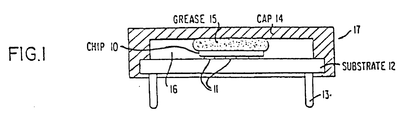
- the FIGURE shows in a schematic cross-sectional view a capped electronic component, in which a thermally conductive grease formed in accordance with the present invention provides an effective heat transfer between a chip and the cap.
- a polar organic solvent to a material having hydrogen bonds and predetermined physical and chemical characteristics in a predominantly solid state will result in breaking down the hydrogen bonds and in liquefying the composition to facilitate coating onto a workpiece.
- Predominantly solid state refers to the material in a paste-like or grease-like condition having relatively high solids packing fraction.
- the preferred polar organic solvents employed pursuant to the present invention are chlorinated hydrocarbons, examples of which are methyl chloroform (1,1,1,-trichloroethane) and methylene chloride. In the preferred aspects of the present invention, the solvent dissolves the liquid organo-silicone carrier of the grease.
- the coating material employed in accordance with the present invention is preferably a thixotropic, thermally conductive material such as a thermally conductive grease of the type disclosed in U.S. Patent 4,265,775, disclosure of which is incorporated herein by reference.
- the thixotropic, thermally conductive material includes a liquid organo-silicone carrier, substantially spherical silica in an amount effective to prevent bleeding of the liquid carrier and a thermal filler powder.
- the liquid organo-silicone carrier should be resistant to drying out over extended periods of time, retain the thermal filler powder and the silica particles without separation, and be chemically inert.
- the liquid organo-silicone compound has a viscosity of from about 10 centistokes to about 50,000 centistokes at about 25°C and more usually the liquid organo-silicone compound has a viscosity of from about 20 centistokes to about 1,000 centistokes at 25°C
- liquid organo-silicone compounds suitable for the present invention are the liquid organo-polysiloxanes represented by the following formula: R n SiO 4-n/2 wherein R represents an alkyl radical having up to 22 carbon atoms, a cycloalkyl radical having 5 to 7 carbon atoms in the ring, mononuclear and bi-nuclear aryl radicals, mononuclear aryl lower alkyl radicals, cyano lower alkyl radicals, and lower alkenyl radicals having from about 2 to about 8 carbon atoms; and n has a value of from 2 to 3.
- R represents an alkyl radical having up to 22 carbon atoms, a cycloalkyl radical having 5 to 7 carbon atoms in the ring, mononuclear and bi-nuclear aryl radicals, mononuclear aryl lower alkyl radicals, cyano lower alkyl radicals, and lower alkenyl radicals having from about 2 to about 8 carbon
- a specific example of a liquid organo-silicone material employed in the present invention is a polydimethylsiloxane having a viscosity of about 100 centistokes at 25°C and being commercially available from Dow Corning under the trade designation DC200.
- a conventional wetting agent can be used to increase the amount of thermal filler powder.
- the wetting agent can be selected from those conventionally known in the art.
- conventional anionic, cationic, or non-ionic wetting agents can be used, typical examples of which include Tergitol NR27 (non-ionic), Tergitol NR7 (anionic), and Triton X-100 (cationic) wetting agents.
- the amount of wetting agent is usually less than about 5 volume percent of the coating material.
- the use of the wetting agent or surface-active agent also facilitates mixing of the components of the coating material.
- the preferred thermal greases employed pursuant to the present invention also include silica fibers, the majority of which are usually about 0.01 ⁇ m in size and substantially all of which are less than 0.5 ⁇ m in size.
- the fibers tend to be rather spherical in shape in view of their extremely small particle size.
- the silica fibers be added to the liquid organo-silicone material prior to the addition of the thermal filler powder.
- the silica fibers employed are highly porous, less than about a 0.5 ⁇ m diameter, and generally at least about 80 volume percent thereof are smaller than 0.1 ⁇ m.
- the average diameter of the silica fibers generally is less than about 0.1 ⁇ m and most preferably about 0.01 ⁇ m.
- the use of the silica fibers as disclosed in U.S. Patent 4,265,775 substantially eliminates bleeding or loss of the liquid organo-silicone carrier from the thermally conductive grease.
- the thermal grease also includes a thermal filler powder.
- the preferred thermal filler powder is zinc oxide, which most preferably can be dendritic or generally elongated spheres. Of course, mixtures of the thermal filler powders can be employed if desired. Also, other known thermal filler materials can be employed, if desired.
- the size of the thermal filler powder generally decreasing the size increases the thermal conductivity without any harm to the other characteristics of the thermally conductive grease.
- the zinc oxide usually the zinc oxide has a submicron size with about 99% of all the particles having an average diameter of about 0.5 ⁇ m or less.
- the thermally conductive coating material generally contains about 15% by volume to about 60% by volume and preferably about 50% by volume to about 60% by volume of the thermal filler powder, from about 0.1% to about 4% by volume of the silica material with the balance being the liquid organo-silicone carrier.
- the amount of polar organic solvent employed is usually about 80% to about 40% by weight of the total of the polar organic solvent and the coating material and preferably about 50% by weight of the total of the polar organic solvent and coating material.
- the polar organic solvent is added to the coating material after all of the constituents of the coating material have been mixed together to provide the desired coating material in its predominantly solid state.
- the polar organic solvent can be added to the coating material under ambient conditions of temperature and pressure and agitated vigorously.
- the preferred thermal greases of the present invention are preferably prepared as disclosed in U.S. Patent 4,265,775 by adding the silica fibers to the liquid organo-silicone material and then adding the thermal filler powder to thereby produce formulations exhibiting the lowest degree of bleeding.
- this sequence is not entirely necessary and the various components of the thermally conductive grease can be mixed in any order desired.
- the polar organic solvent and the other components of the coating material can be mixed in any order desired.
- the mixing can be conducted using any conventional mixing means which does not, of course, destroy the character of the silica fibers or the thermal filler powder.
- a typical mixing means which can be utilized is a three-roll mill.
- the suspensions of the present invention are more easily applied to the workpiece than the thermally conductive greases from which the suspensions are derived. Accordingly, the film thicknesses applied can be better controlled and can be significantly thinner than those obtained from the thermally conductive greases, per se. For instance, typical film thicknesses obtained from the suspensions of the present invention are about 12.7 ⁇ m to about 2.54 ⁇ m. An average thickness for the normal greases is about 304.8 to about 381 ⁇ m.
- the compositions can be applied by any conventional means such as dipping, casting, spraying, or dispensing such as from a dispensing needle.
- the polar organic solvent will evaporate. Normally, the evaporation is carried out under ambient conditions. However, in the event the solvent employed is methyl chloroform, elevated temperatures up to about 65°C can be employed to facilitate removal of the methyl chloroform. When the polar solvent employed is methylene chloride, elevated temperatures of up to about 35°C can be employed to facilitate evaporation thereof.
- the coating material After evaporation of the polar solvents, the coating material returns to its predominantly solid state whereby it has the same predetermined physical and chemical characteristics as it would had not the polar organic solvent been present. This is surprising since normally when a material is dissolved in a solvent and the solvent is evaporated, the original structure of the material is not obtained.
- thermally conductive greases are particularly useful for heat transfer applications with electronic components such as in systems as illustrated in Figure 1 wherein reference (17) denotes the module, reference (10) denotes a conventional IC chip, reference (11) denotes metal contacts putting chip (10) into contact with substrate (12), provided with conductor pins (13). Cap (14) is placed over substrate (12) and IC chip (10), the thermally conductive grease (15) being interposed between chip (10) and cap (14) in intimate contact therewith.
- thermally conductive grease can be utilized to completely fill space (16) and module (17).
- coating materials of the present invention have been described as finding particular application in cooling components, it should be understood that its use is not so limited. In fact, the coating materials find general application wherever good heat transfer is required.
- polydimethylsiloxane is a reagent grade available from Dow Corning under the trade designation DC200 and has a specific gravity of about 0.97 at 25°C, a dielectric constant of 2.5 KHz, a dielectric strength of 350 volts per milliliter, and a viscosity of 100 centistokes at 25°C.
- silica fiber available under the trade designation M-5 Cab-O-Sil having a size of less than 0.5 ⁇ m, the majority of which is less than about 0.1 ⁇ m, with an average diameter of about 0.01 ⁇ m, are then mixed together at room temperature and well-mixed therein.
- methyl chloroform in an amount of about 50% by weight based upon the total weight of the grease and the methyl chloroform to liquify the grease and provide a colloidal suspension thereof.
- the colloidal suspension is then applied to an integrated circuit module by dispensing from a dispensing needle and the methyl chloroform is evaporated.
- a film thickness of about 101.6 ⁇ m is formed.
- the physical and chemical characteristics of the film are the same as the physical and chemical characteristics of a film obtained from the grease without the methyl chloroform.
- Example 1 The procedure of Example 1 is repeated, except that the solvent employed is methylene chloride. The results obtained are similar to those from Example 1.
Landscapes
- Chemical & Material Sciences (AREA)
- Engineering & Computer Science (AREA)
- Physics & Mathematics (AREA)
- Chemical Kinetics & Catalysis (AREA)
- Combustion & Propulsion (AREA)
- Thermal Sciences (AREA)
- Materials Engineering (AREA)
- Organic Chemistry (AREA)
- Cooling Or The Like Of Semiconductors Or Solid State Devices (AREA)
- Paints Or Removers (AREA)
- Lubricants (AREA)
- Application Of Or Painting With Fluid Materials (AREA)
Claims (11)
- Suspension d'une matière d'enduction thermiquement conductrice comprenant un support liquide de type organo silicone, de la silice en une quantité efficace pour empêcher l'écoulement du support liquide et une poudre de charge thermique, caractérisée en ce que cette matière d'enduction thermiquement conductrice est fournie sous la forme d'une suspension dans un solvant organique polaire de telle sorte qu'après évaporation de celui-ci, l'enduit conducteur restant présente sensiblement au moins les mêmes caractéristiques physiques et chimiques que s'il n'y avait pas eu ce solvant organique polaire.
- Suspension suivant la revendication 1, dans laquelle cet enduit thermiquement conducteur est une matière thixotrope conduisant la chaleur comprenant un support liquide de type organosilicone, de la silice pratiquement sphérique en une quantité efficace pour empêcher l'écoulement de ce support liquide, pratiquement la totalité de cette silice ayant une dimension inférieure à 0,5 µm et une charge thermique, de préférence, de l'oxyde de zinc.
- Suspension suivant la revendication 1 ou la revendication 2, dans laquelle ce solvant polaire est un hydrocarbure chloré, de préférence du méthylchloroforme ou du chlorure de méthylène.
- Procédé pour déposer une couche conforme sensiblement uniforme de matière sur une pièce d'ouvrage, qui comprend:a) la fourniture d'une suspension de matière d'enduction suivant l'une quelconque des revendications 1 à 3 dans laquelle cette matière d'enduction a des liaisons hydrogène et des caractéristiques physiques et chimiques prédéterminées à l'état pâteux dans un solvant organique polaire, lequel solvant organique polaire est capable de briser ces liaisons hydrogène et de fournir cette matière sous forme liquide;b) l'application de cette suspension sur une pièce d'ouvrage pour recouvrir celle-ci en épousant ses formes; etc) l'évaporation de ce solvant organique de telle sorte que cette matière est fournie sous la forme de son état solide de manière prédominante ayant au moins sensiblement ces caractéristiques physiques et chimiques prédéterminées.
- Procédé suivant la revendication 4, dans lequel cette matière d'enduction comprend un polymère de type silicone.
- Procédé suivant la revendication 4 ou la revendication 5, dans lequel ce solvant polaire est un hydrocarbure chloré, de préférence du méthylchloroforme ou du chlorure de méthylène.
- Procédé suivant l'une quelconque des revendications 4 à 6, dans lequel cette matière est appliquée sur cette pièce d'ouvrage par pulvérisation ou application de liquide.
- Procédé suivant l'une quelconque des revendications 4 à 7, dans lequel l'une de ces caractéristiques physiques est la conductivité thermique.
- Procédé suivant l'une quelconque des revendications 4 à 8, dans lequel ce solvant polaire est ajouté à cette matière jusqu'à liquéfaction et après évaporation de ce solvant polaire, cette matière retourne à son état d'origine solide de façon prédominante ayant sensiblement ces caractéristiques physiques et chimiques prédéterminées.
- Procédé suivant l'une quelconque des revendications 4 à 9, dans lequel cette matière d'enduction est une matière thixotrope conduisant la chaleur comprenant un support liquide de type organosilicone, de la silice pratiquement sphérique en une quantité efficace pour empêcher l'écoulement de ce support liquide, pratiquement la totalité de cette silice ayant une dimension inférieure à 0,5 µm, et une poudre de charge thermique, de préférence, de l'oxyde de zinc.
- Procédé suivant l'une quelconque des revendications 4 à 10, qui comprend d'environ 15% à 60% en volume et de préférence d'environ 50% à 60% en volume de cette poudre de charge thermique, d'environ 0,1% à 4% en volume de cette silice, le volume restant étant constitué par ce support liquide de type organosilicone.
Applications Claiming Priority (2)
| Application Number | Priority Date | Filing Date | Title |
|---|---|---|---|
| US110892 | 1987-10-21 | ||
| US07/110,892 US4803100A (en) | 1987-10-21 | 1987-10-21 | Suspension and use thereof |
Publications (2)
| Publication Number | Publication Date |
|---|---|
| EP0312832A1 EP0312832A1 (fr) | 1989-04-26 |
| EP0312832B1 true EP0312832B1 (fr) | 1992-06-03 |
Family
ID=22335496
Family Applications (1)
| Application Number | Title | Priority Date | Filing Date |
|---|---|---|---|
| EP88116453A Expired - Lifetime EP0312832B1 (fr) | 1987-10-21 | 1988-10-05 | Suspension et utilisation de ces suspensions |
Country Status (4)
| Country | Link |
|---|---|
| US (1) | US4803100A (fr) |
| EP (1) | EP0312832B1 (fr) |
| JP (1) | JPH01115985A (fr) |
| DE (1) | DE3871712T2 (fr) |
Families Citing this family (8)
| Publication number | Priority date | Publication date | Assignee | Title |
|---|---|---|---|---|
| US5541048A (en) * | 1995-05-12 | 1996-07-30 | Eastman Kodak Company | Lubricant particles, method of preparation, and photographic elements |
| EP0906945A1 (fr) * | 1997-10-03 | 1999-04-07 | American Oil and Supply LLC | Graisse thermique vaporisable |
| US6610635B2 (en) | 2000-09-14 | 2003-08-26 | Aos Thermal Compounds | Dry thermal interface material |
| US6475962B1 (en) | 2000-09-14 | 2002-11-05 | Aos Thermal Compounds, Llc | Dry thermal grease |
| US7528073B2 (en) * | 2004-11-04 | 2009-05-05 | Sumitomo Electric Industries, Ltd. | Dry etching method and diffractive optical element |
| EP2743092A4 (fr) | 2011-08-10 | 2015-04-01 | Taiyo Chemical Industry Co Ltd | Structure comprenant un film mince d'apprêt, et processus de production de ladite structure |
| JP6436035B2 (ja) * | 2015-09-25 | 2018-12-12 | 信越化学工業株式会社 | 熱軟化性熱伝導性シリコーングリース組成物、熱伝導性被膜の形成方法、放熱構造及びパワーモジュール装置 |
| EP3701549A1 (fr) | 2017-10-26 | 2020-09-02 | Syed Taymur Ahmad | Composition comprenant des fluides non newtoniens pour des revêtements hydrophobes, oléophobes et oléophiles, et leurs procédés d'utilisation |
Family Cites Families (14)
| Publication number | Priority date | Publication date | Assignee | Title |
|---|---|---|---|---|
| US2900338A (en) * | 1956-05-01 | 1959-08-18 | Postelnck William | Glass fiber-thickened grease compositions |
| US3660087A (en) * | 1966-09-26 | 1972-05-02 | Hughes Aircraft Co | Nucleation in recording and development |
| US3576656A (en) * | 1968-03-11 | 1971-04-27 | Nasa | Stabilized zinc oxide coating compositions |
| US3687723A (en) * | 1970-03-17 | 1972-08-29 | Thomas B Hutchins | Low density dielectric coating for electrode in electron tube |
| JPS514279B1 (fr) * | 1970-05-26 | 1976-02-10 | ||
| US4187340A (en) * | 1973-05-14 | 1980-02-05 | Asahi Glass Company, Ltd. | Method of forming patterned transparent electro-conductive film on the substrate of liquid crystal display |
| US3885984A (en) * | 1973-12-18 | 1975-05-27 | Gen Electric | Methyl alkyl silicone thermoconducting compositions |
| DE2556420A1 (de) * | 1975-12-15 | 1977-06-16 | Wacker Chemie Gmbh | Zu elastomeren haertbare massen auf grundlage von diorganopolysiloxanen und verfahren zum herstellen von organopolysiloxanelastomeren |
| DE2735484C2 (de) * | 1977-08-05 | 1984-06-07 | Siemens AG, 1000 Berlin und 8000 München | Verfahren zur Herstellung von Dickfilm-Varistoren mit Zinkoxid als Hauptkomponente |
| US4265775A (en) * | 1979-08-16 | 1981-05-05 | International Business Machines Corporation | Non-bleeding thixotropic thermally conductive material |
| FR2545259B1 (fr) * | 1983-04-29 | 1985-12-27 | Ceraver | Isolateur electrique presentant une insensibilite amelioree a la pollution |
| US4699802A (en) * | 1983-10-03 | 1987-10-13 | Loctite Corporation | Dual curing coating method for substrates with shadow areas |
| JPS61159427A (ja) * | 1984-12-29 | 1986-07-19 | Toshiba Silicone Co Ltd | 表面処理用ポリオルガノシロキサン組成物 |
| US4720518A (en) * | 1987-03-05 | 1988-01-19 | Gencorp Inc. | Coatings which are abrasion resistant |
-
1987
- 1987-10-21 US US07/110,892 patent/US4803100A/en not_active Expired - Lifetime
-
1988
- 1988-08-01 JP JP63190763A patent/JPH01115985A/ja active Granted
- 1988-10-05 DE DE8888116453T patent/DE3871712T2/de not_active Expired - Fee Related
- 1988-10-05 EP EP88116453A patent/EP0312832B1/fr not_active Expired - Lifetime
Non-Patent Citations (1)
| Title |
|---|
| R. Lambourne, Paint and Surface Coatings; Houben-Weyl Band XIII/5, Seite 148; Ullmans Band 21, Seite 520 * |
Also Published As
| Publication number | Publication date |
|---|---|
| JPH01115985A (ja) | 1989-05-09 |
| DE3871712T2 (de) | 1993-01-28 |
| DE3871712D1 (de) | 1992-07-09 |
| JPH0525918B2 (fr) | 1993-04-14 |
| EP0312832A1 (fr) | 1989-04-26 |
| US4803100A (en) | 1989-02-07 |
Similar Documents
| Publication | Publication Date | Title |
|---|---|---|
| JPH0695557B2 (ja) | 伝熱性化合物及びその製造方法 | |
| EP0813244B1 (fr) | Tampon thermique, semi-solide comportant une résistance à flux faible | |
| US6054198A (en) | Conformal thermal interface material for electronic components | |
| US4578215A (en) | Electrical conductivity-enhancing and protecting material | |
| CA2355171C (fr) | Procede permettant d'appliquer un materiau d'interface thermique a changement de phase | |
| EP0312832B1 (fr) | Suspension et utilisation de ces suspensions | |
| US10329424B2 (en) | Silicone composition | |
| USRE39992E1 (en) | Morphing fillers and thermal interface materials | |
| US5930893A (en) | Thermally conductive material and method of using the same | |
| US6946190B2 (en) | Thermal management materials | |
| EP2134823A1 (fr) | Article à graisse thermique et procédé | |
| EP1189278A2 (fr) | Graisse thermique sèche | |
| EP0411286A1 (fr) | Pâte thermique à base d'une matrice métallique liquide | |
| US5173256A (en) | Liquid metal matrix thermal paste | |
| JP2008277813A (ja) | 熱伝導性調合物 | |
| US5250209A (en) | Thermal coupling with water-washable thermally conductive grease | |
| US6656389B2 (en) | Thermal paste for low temperature applications | |
| EP1143511B1 (fr) | Préparation de composés conducteurs thermiques à l'aide d'amas particulaires enrobés de métal liquide | |
| US3212921A (en) | Method of forming a glass film on an object and the product produced thereby | |
| US4830922A (en) | Removable controlled thickness conformal coating | |
| JPH107795A (ja) | 導電性樹脂シート | |
| EP4606862A1 (fr) | Composition d'organopolysiloxane durcissable et dispositif à semi-conducteur | |
| US4535381A (en) | Capacitive device and method of packaging that device | |
| US6111005A (en) | Polymeric adhesive paste | |
| US4929284A (en) | Water removable solder stop |
Legal Events
| Date | Code | Title | Description |
|---|---|---|---|
| PUAI | Public reference made under article 153(3) epc to a published international application that has entered the european phase |
Free format text: ORIGINAL CODE: 0009012 |
|
| AK | Designated contracting states |
Kind code of ref document: A1 Designated state(s): DE FR GB |
|
| 17P | Request for examination filed |
Effective date: 19890809 |
|
| 17Q | First examination report despatched |
Effective date: 19910319 |
|
| GRAA | (expected) grant |
Free format text: ORIGINAL CODE: 0009210 |
|
| AK | Designated contracting states |
Kind code of ref document: B1 Designated state(s): DE FR GB |
|
| REF | Corresponds to: |
Ref document number: 3871712 Country of ref document: DE Date of ref document: 19920709 |
|
| ET | Fr: translation filed | ||
| PLBE | No opposition filed within time limit |
Free format text: ORIGINAL CODE: 0009261 |
|
| STAA | Information on the status of an ep patent application or granted ep patent |
Free format text: STATUS: NO OPPOSITION FILED WITHIN TIME LIMIT |
|
| 26N | No opposition filed | ||
| PGFP | Annual fee paid to national office [announced via postgrant information from national office to epo] |
Ref country code: FR Payment date: 19951009 Year of fee payment: 8 |
|
| PGFP | Annual fee paid to national office [announced via postgrant information from national office to epo] |
Ref country code: DE Payment date: 19951030 Year of fee payment: 8 |
|
| PGFP | Annual fee paid to national office [announced via postgrant information from national office to epo] |
Ref country code: GB Payment date: 19960925 Year of fee payment: 9 |
|
| PG25 | Lapsed in a contracting state [announced via postgrant information from national office to epo] |
Ref country code: FR Effective date: 19970630 |
|
| PG25 | Lapsed in a contracting state [announced via postgrant information from national office to epo] |
Ref country code: DE Effective date: 19970701 |
|
| REG | Reference to a national code |
Ref country code: FR Ref legal event code: ST |
|
| PG25 | Lapsed in a contracting state [announced via postgrant information from national office to epo] |
Ref country code: GB Free format text: LAPSE BECAUSE OF NON-PAYMENT OF DUE FEES Effective date: 19971005 |
|
| GBPC | Gb: european patent ceased through non-payment of renewal fee |
Effective date: 19971005 |