EP0315014A2 - Halogenierte Benzolderivate - Google Patents
Halogenierte Benzolderivate Download PDFInfo
- Publication number
- EP0315014A2 EP0315014A2 EP88117693A EP88117693A EP0315014A2 EP 0315014 A2 EP0315014 A2 EP 0315014A2 EP 88117693 A EP88117693 A EP 88117693A EP 88117693 A EP88117693 A EP 88117693A EP 0315014 A2 EP0315014 A2 EP 0315014A2
- Authority
- EP
- European Patent Office
- Prior art keywords
- trans
- cyclohexyl
- ethyl
- cyclohexane
- pentenyl
- Prior art date
- Legal status (The legal status is an assumption and is not a legal conclusion. Google has not performed a legal analysis and makes no representation as to the accuracy of the status listed.)
- Granted
Links
Classifications
-
- C—CHEMISTRY; METALLURGY
- C07—ORGANIC CHEMISTRY
- C07D—HETEROCYCLIC COMPOUNDS
- C07D239/00—Heterocyclic compounds containing 1,3-diazine or hydrogenated 1,3-diazine rings
- C07D239/02—Heterocyclic compounds containing 1,3-diazine or hydrogenated 1,3-diazine rings not condensed with other rings
- C07D239/24—Heterocyclic compounds containing 1,3-diazine or hydrogenated 1,3-diazine rings not condensed with other rings having three or more double bonds between ring members or between ring members and non-ring members
- C07D239/26—Heterocyclic compounds containing 1,3-diazine or hydrogenated 1,3-diazine rings not condensed with other rings having three or more double bonds between ring members or between ring members and non-ring members with only hydrogen atoms, hydrocarbon or substituted hydrocarbon radicals, directly attached to ring carbon atoms
-
- C—CHEMISTRY; METALLURGY
- C09—DYES; PAINTS; POLISHES; NATURAL RESINS; ADHESIVES; COMPOSITIONS NOT OTHERWISE PROVIDED FOR; APPLICATIONS OF MATERIALS NOT OTHERWISE PROVIDED FOR
- C09K—MATERIALS FOR MISCELLANEOUS APPLICATIONS, NOT PROVIDED FOR ELSEWHERE
- C09K19/00—Liquid crystal materials
- C09K19/04—Liquid crystal materials characterised by the chemical structure of the liquid crystal components, e.g. by a specific unit
- C09K19/06—Non-steroidal liquid crystal compounds
- C09K19/08—Non-steroidal liquid crystal compounds containing at least two non-condensed rings
- C09K19/10—Non-steroidal liquid crystal compounds containing at least two non-condensed rings containing at least two benzene rings
- C09K19/20—Non-steroidal liquid crystal compounds containing at least two non-condensed rings containing at least two benzene rings linked by a chain containing carbon and oxygen atoms as chain links, e.g. esters or ethers
-
- C—CHEMISTRY; METALLURGY
- C07—ORGANIC CHEMISTRY
- C07C—ACYCLIC OR CARBOCYCLIC COMPOUNDS
- C07C255/00—Carboxylic acid nitriles
- C07C255/45—Carboxylic acid nitriles having cyano groups bound to carbon atoms of rings other than six-membered aromatic rings
- C07C255/46—Carboxylic acid nitriles having cyano groups bound to carbon atoms of rings other than six-membered aromatic rings to carbon atoms of non-condensed rings
-
- C—CHEMISTRY; METALLURGY
- C07—ORGANIC CHEMISTRY
- C07C—ACYCLIC OR CARBOCYCLIC COMPOUNDS
- C07C43/00—Ethers; Compounds having groups, groups or groups
- C07C43/02—Ethers
- C07C43/18—Ethers having an ether-oxygen atom bound to a carbon atom of a ring other than a six-membered aromatic ring
- C07C43/188—Unsaturated ethers
-
- C—CHEMISTRY; METALLURGY
- C07—ORGANIC CHEMISTRY
- C07C—ACYCLIC OR CARBOCYCLIC COMPOUNDS
- C07C43/00—Ethers; Compounds having groups, groups or groups
- C07C43/02—Ethers
- C07C43/18—Ethers having an ether-oxygen atom bound to a carbon atom of a ring other than a six-membered aromatic ring
- C07C43/192—Ethers having an ether-oxygen atom bound to a carbon atom of a ring other than a six-membered aromatic ring containing halogen
-
- C—CHEMISTRY; METALLURGY
- C07—ORGANIC CHEMISTRY
- C07C—ACYCLIC OR CARBOCYCLIC COMPOUNDS
- C07C43/00—Ethers; Compounds having groups, groups or groups
- C07C43/02—Ethers
- C07C43/20—Ethers having an ether-oxygen atom bound to a carbon atom of a six-membered aromatic ring
- C07C43/225—Ethers having an ether-oxygen atom bound to a carbon atom of a six-membered aromatic ring containing halogen
-
- C—CHEMISTRY; METALLURGY
- C07—ORGANIC CHEMISTRY
- C07D—HETEROCYCLIC COMPOUNDS
- C07D239/00—Heterocyclic compounds containing 1,3-diazine or hydrogenated 1,3-diazine rings
- C07D239/02—Heterocyclic compounds containing 1,3-diazine or hydrogenated 1,3-diazine rings not condensed with other rings
- C07D239/24—Heterocyclic compounds containing 1,3-diazine or hydrogenated 1,3-diazine rings not condensed with other rings having three or more double bonds between ring members or between ring members and non-ring members
- C07D239/28—Heterocyclic compounds containing 1,3-diazine or hydrogenated 1,3-diazine rings not condensed with other rings having three or more double bonds between ring members or between ring members and non-ring members with hetero atoms or with carbon atoms having three bonds to hetero atoms with at the most one bond to halogen, directly attached to ring carbon atoms
-
- C—CHEMISTRY; METALLURGY
- C07—ORGANIC CHEMISTRY
- C07D—HETEROCYCLIC COMPOUNDS
- C07D319/00—Heterocyclic compounds containing six-membered rings having two oxygen atoms as the only ring hetero atoms
- C07D319/04—1,3-Dioxanes; Hydrogenated 1,3-dioxanes
- C07D319/06—1,3-Dioxanes; Hydrogenated 1,3-dioxanes not condensed with other rings
-
- C—CHEMISTRY; METALLURGY
- C07—ORGANIC CHEMISTRY
- C07D—HETEROCYCLIC COMPOUNDS
- C07D319/00—Heterocyclic compounds containing six-membered rings having two oxygen atoms as the only ring hetero atoms
- C07D319/10—1,4-Dioxanes; Hydrogenated 1,4-dioxanes
- C07D319/14—1,4-Dioxanes; Hydrogenated 1,4-dioxanes condensed with carbocyclic rings or ring systems
- C07D319/16—1,4-Dioxanes; Hydrogenated 1,4-dioxanes condensed with carbocyclic rings or ring systems condensed with one six-membered ring
-
- C—CHEMISTRY; METALLURGY
- C09—DYES; PAINTS; POLISHES; NATURAL RESINS; ADHESIVES; COMPOSITIONS NOT OTHERWISE PROVIDED FOR; APPLICATIONS OF MATERIALS NOT OTHERWISE PROVIDED FOR
- C09K—MATERIALS FOR MISCELLANEOUS APPLICATIONS, NOT PROVIDED FOR ELSEWHERE
- C09K19/00—Liquid crystal materials
- C09K19/04—Liquid crystal materials characterised by the chemical structure of the liquid crystal components, e.g. by a specific unit
- C09K19/06—Non-steroidal liquid crystal compounds
- C09K19/08—Non-steroidal liquid crystal compounds containing at least two non-condensed rings
- C09K19/10—Non-steroidal liquid crystal compounds containing at least two non-condensed rings containing at least two benzene rings
- C09K19/20—Non-steroidal liquid crystal compounds containing at least two non-condensed rings containing at least two benzene rings linked by a chain containing carbon and oxygen atoms as chain links, e.g. esters or ethers
- C09K19/2007—Non-steroidal liquid crystal compounds containing at least two non-condensed rings containing at least two benzene rings linked by a chain containing carbon and oxygen atoms as chain links, e.g. esters or ethers the chain containing -COO- or -OCO- groups
-
- C—CHEMISTRY; METALLURGY
- C09—DYES; PAINTS; POLISHES; NATURAL RESINS; ADHESIVES; COMPOSITIONS NOT OTHERWISE PROVIDED FOR; APPLICATIONS OF MATERIALS NOT OTHERWISE PROVIDED FOR
- C09K—MATERIALS FOR MISCELLANEOUS APPLICATIONS, NOT PROVIDED FOR ELSEWHERE
- C09K19/00—Liquid crystal materials
- C09K19/04—Liquid crystal materials characterised by the chemical structure of the liquid crystal components, e.g. by a specific unit
- C09K19/06—Non-steroidal liquid crystal compounds
- C09K19/08—Non-steroidal liquid crystal compounds containing at least two non-condensed rings
- C09K19/30—Non-steroidal liquid crystal compounds containing at least two non-condensed rings containing saturated or unsaturated non-aromatic rings, e.g. cyclohexane rings
- C09K19/3001—Cyclohexane rings
-
- C—CHEMISTRY; METALLURGY
- C09—DYES; PAINTS; POLISHES; NATURAL RESINS; ADHESIVES; COMPOSITIONS NOT OTHERWISE PROVIDED FOR; APPLICATIONS OF MATERIALS NOT OTHERWISE PROVIDED FOR
- C09K—MATERIALS FOR MISCELLANEOUS APPLICATIONS, NOT PROVIDED FOR ELSEWHERE
- C09K19/00—Liquid crystal materials
- C09K19/04—Liquid crystal materials characterised by the chemical structure of the liquid crystal components, e.g. by a specific unit
- C09K19/06—Non-steroidal liquid crystal compounds
- C09K19/34—Non-steroidal liquid crystal compounds containing at least one heterocyclic ring
- C09K19/3402—Non-steroidal liquid crystal compounds containing at least one heterocyclic ring having oxygen as hetero atom
-
- C—CHEMISTRY; METALLURGY
- C09—DYES; PAINTS; POLISHES; NATURAL RESINS; ADHESIVES; COMPOSITIONS NOT OTHERWISE PROVIDED FOR; APPLICATIONS OF MATERIALS NOT OTHERWISE PROVIDED FOR
- C09K—MATERIALS FOR MISCELLANEOUS APPLICATIONS, NOT PROVIDED FOR ELSEWHERE
- C09K19/00—Liquid crystal materials
- C09K19/04—Liquid crystal materials characterised by the chemical structure of the liquid crystal components, e.g. by a specific unit
- C09K19/06—Non-steroidal liquid crystal compounds
- C09K19/34—Non-steroidal liquid crystal compounds containing at least one heterocyclic ring
- C09K19/3441—Non-steroidal liquid crystal compounds containing at least one heterocyclic ring having nitrogen as hetero atom
- C09K19/345—Non-steroidal liquid crystal compounds containing at least one heterocyclic ring having nitrogen as hetero atom the heterocyclic ring being a six-membered aromatic ring containing two nitrogen atoms
- C09K19/3458—Uncondensed pyrimidines
- C09K19/3469—Pyrimidine with a specific end-group other than alkyl, alkoxy or -C*-
-
- C—CHEMISTRY; METALLURGY
- C07—ORGANIC CHEMISTRY
- C07C—ACYCLIC OR CARBOCYCLIC COMPOUNDS
- C07C2601/00—Systems containing only non-condensed rings
- C07C2601/12—Systems containing only non-condensed rings with a six-membered ring
- C07C2601/14—The ring being saturated
-
- C—CHEMISTRY; METALLURGY
- C09—DYES; PAINTS; POLISHES; NATURAL RESINS; ADHESIVES; COMPOSITIONS NOT OTHERWISE PROVIDED FOR; APPLICATIONS OF MATERIALS NOT OTHERWISE PROVIDED FOR
- C09K—MATERIALS FOR MISCELLANEOUS APPLICATIONS, NOT PROVIDED FOR ELSEWHERE
- C09K19/00—Liquid crystal materials
- C09K19/04—Liquid crystal materials characterised by the chemical structure of the liquid crystal components, e.g. by a specific unit
- C09K19/06—Non-steroidal liquid crystal compounds
- C09K19/34—Non-steroidal liquid crystal compounds containing at least one heterocyclic ring
- C09K19/3402—Non-steroidal liquid crystal compounds containing at least one heterocyclic ring having oxygen as hetero atom
- C09K2019/3422—Non-steroidal liquid crystal compounds containing at least one heterocyclic ring having oxygen as hetero atom the heterocyclic ring being a six-membered ring
Definitions
- the present invention relates to new halogenobenzene derivatives, liquid-crystalline mixtures containing these compounds, and the use for electro-optical purposes.
- Liquid crystals are mainly used as dielectrics in display devices, since the optical properties of such substances can be influenced by an applied voltage.
- Electro-optical devices based on liquid crystals are well known to the person skilled in the art and can be based on various effects. Examples of such devices are cells with dynamic scattering, DAP cells (deformation of aligned phases). Guest / host cells, TN cells with twisted nematic ("twisted nematic") structure, STN cells (“super-twisted nematic”), SBE cells (“super-birefringence effect”) and OMI cells ("optical mode interference "). The most common display devices are based on the Schadt-Helfrich effect and have a twisted nematic structure.
- the liquid crystal materials must have good chemical and thermal stability and good stability against electric fields and electromagnetic radiation. Furthermore, the liquid crystal materials should have a low viscosity and give short response times, low threshold voltages and a high contrast in the cells. Furthermore, they should have a suitable mesophase at conventional operating temperatures of about -30 ° C. to about + 80 ° C., in particular from about -20 ° C. to about + 60 ° C., for example a nematic or cholesteric mesophase for the above-mentioned cells. Other properties, such as electrical conductivity, dielectric anisotropy and optical anisotropy, must meet different requirements depending on the cell type and field of application.
- materials for cells with a twisted nematic structure should have positive dielectric anisotropy and the lowest possible electrical conductivity.
- materials with low optical anisotropy in particular for actively addressed liquid crystal displays.
- effects such as the occurrence of highly ordered smectic phases or an increase in the threshold voltage and the response times, which are frequently observed with such materials, should be avoided as far as possible.
- liquid crystals are generally used as mixtures of several components, it is important that the components are readily miscible with one another.
- the invention relates to the halogenobenzene derivatives of the general formula wherein X1 is fluorine or chlorine and X2 is hydrogen, fluorine or chlorine; R1 is 3E-alkenyl, 4-alkenyl, 2E-alkenyloxy or 3-alkenyloxy; n represents the number 0 or 1; one of the groups Y1 and Y2 is a single covalent bond, -COO-, -OOC-, -CH2CH2-, -CH2O- or -OCH2- and the other of the groups Y1 and Y2 is a single covalent bond; and the rings A1 and A2 independently substituted or unsubstituted trans-1,4-cyclohexylene, in which optionally 2 non-adjacent CH2 groups are replaced by oxygen, or substituted or unsubstituted 1,4-phenylene, in which optionally 1 or 2 CH- Groups are replaced by nitrogen; with the proviso that X2 denotes fluorine
- the compounds according to the invention generally have positive dielectric anisotropy. Although they are relatively little polar compared to cyano compounds, they result in incredibly low threshold voltages, which are often lower than those of cyano compounds. They also have high stability and lower electrical conductivity than the cyano compounds.
- the compounds according to the invention also result in short response times and highly ordered smectic phases are completely or at least largely suppressed, the melting points often also being reduced.
- the compounds according to the invention are therefore particularly suitable as components of nematic and cholesteric mixtures.
- the bicyclic compounds of the formula I are particularly suitable as dopants for achieving particularly low threshold voltages, response times and melting points.
- the tricyclic compounds of the formula I generally have a broad nematic or cholesteric mesophase range and are suitable for achieving broad mesophase ranges in mixtures, at the same time the threshold voltages and response times remain surprisingly low.
- optical anisotropy of the compounds of the formula I can vary within a wide range, depending on the choice of the rings A1 and B1, with saturated rings leading to deep and aromatic rings leading to high values of the optical anisotropy.
- the advantages mentioned above apply in the whole range and are found in particular for the compounds with low optical anisotropy.
- 3E-alkenyl examples include straight-chain and branched radicals.
- the straight-chain radicals such as 3-butenyl, 3E-pentenyl, 3E-hexenyl, 3E-heptenyl, 3E-octenyl, 3E-nonenyl, 3E-decenyl, 4-pentenyl, 4-hexenyl, 4-heptenyl, 4 are generally preferred -Octenyl, 4-nonenyl, 4-decenyl, allyloxy, 2E-butenyloxy, 2E-pentenyloxy, 2E-hexenyloxy, 2E-heptenyloxy, 2E-octenyloxy, 2E-nonenyloxy, 3-butenyloxy, 3-pentenyloxy, 3-hexenyloxy, 3 -
- connections with branched optically active radical R 1 such as 5-methyl-3E-heptenyl and 6-methyl-4-octenyl are of particular interest as chiral dopants and / or cholesteric liquid crystals.
- 4-alkenyl and 3-alkenyloxy radicals R 1 which may be in the E or Z form, the Z form is generally preferred.
- the 3E-alkenyl radicals expediently have approximately 4-15, the 4-alkenyl radicals approximately 5-15, the 2E-alkenyloxy radicals approximately 3-14 and the 3-alkenyloxy radicals approximately 4-14 carbon atoms.
- alkenyl radicals with up to 10 and alkenyloxy radicals with up to 9 carbon atoms are preferred.
- Particularly preferred radicals R 1 are 3-butenyl, 3E-pentenyl, 4-pentenyl, allyloxy and 3-butenyloxy.
- trans-1,4-cyclohexylene in which 2 non-adjacent CH2 groups are optionally replaced by oxygen
- saturated ring in the context of the present invention
- substituted or unsubstituted 1,4-phenylene, in which 1 or 2 CH groups are optionally replaced by nitrogen includes in particular 1,4-phenylene, pyridine -2,5-diyl, pyrazine-2,5-diyl and pyrimidine-2,5-diyl, and rings which are substituted with substituents customary in liquid crystals, such as cyano, methyl, fluorine or chlorine, for example 2-cyano-1 , 4-phenylene, 2-fluoro-1,4-phenylene, 2-chloro-1,4-phenylene or 2-methyl-1,4-phenylene.
- Formula I includes the compounds of the following general formulas wherein R1, X1, X2 and the rings A1 and A2 each have the above meanings.
- ring A2 is preferably substituted or unsubstituted trans-1,4-cyclohexylene, for substituted or unsubstituted 1,4-phenylene or, if ring A1 is substituted or unsubstituted trans-1,4-cyclohexylene or substituted or unsubstituted 1,4-phenylene, also for pyrimidine-2,5 -diyl or trans-m-dioxane-2,5-diyl. In general, particular preference is given to those compounds in which ring A 2 is trans-1,4-cyclohexylene.
- a trans-m-dioxane-2,5-diyl group optionally present for ring A2 is preferably linked in the 5-position to R1; Ring A1 in this case preferably denotes trans-1,4-cyclohexylene.
- ring A1 has one of the preferred meanings mentioned, and in particular denotes an unsubstituted group
- ring A2 are also trans-1 are particularly preferred in general , 4-Cyclohexylene means.
- Examples of preferred groups of compounds of the formula I are the compounds of the general formulas wherein R1, X1, X2, Y1 and Y2 have the above meanings.
- the compounds of the formula I can be prepared in a manner known per se, for example by the methods described in EP-A-122389, EP-A-167912 and EP-A-168683.
- the compounds of formula I, wherein R1 is 2E-alkenyloxy or 3-alkenyloxy, are generally am most simply obtained by etherifying the corresponding hydroxy compound with 2E-alkenyl halide or 3-alkenyl halide, preferably 2E-alkenyl bromide or 2E-alkenyl iodide, 3-alkenyl bromide or 3-alkenyl iodide.
- the required hydroxy compounds are known or analogs of known compounds.
- the compounds of formula I, wherein R1 is 3E-alkenyl or 4-alkenyl are generally obtained by reacting the corresponding propionaldehyde or butyraldehyde in the presence of a strong base with alkyl-triarylphosphonium halide, preferably with alkyl-triphenylphosphonium chloride or with alkyl -triphenylphosphonium bromide.
- the reaction can be carried out under the conditions customary for Wittig reactions.
- the required propionaldehydes and butyraldehydes can be obtained from the corresponding compounds with a formyl-substituted ring (derivatives of cyclohexane carboxaldehyde, benzaldehyde etc.) or the corresponding cyclic ketones (cyclohexanone derivatives) by successive chain extension via the acetaldehydes.
- the chain extension can e.g. in each case by Wittig reaction with methoxymethyl-triarylphosphonium halide, preferably methoxymethyl-triphenylphosphonium chloride, and subsequent hydrolysis (for example with acetic acid).
- a chain extension by 3 carbon atoms e.g.
- the central part of the formula I has a group which can easily be formed by final linking, such as an ester group or Methyleneoxy group for Y1 or Y2 or a dioxane ring for ring A1 or A2, it may be advantageous to the corresponding starting material (e.g. carboxylic acid, hydroxy compound, halogen compound, 1,3-diol, aldehyde) containing the alkenyl group or the alkenyloxy group in an analogous manner to the to produce the methods described above.
- the corresponding starting material e.g. carboxylic acid, hydroxy compound, halogen compound, 1,3-diol, aldehyde
- the carboxylic acid obtained can be esterified with a suitable hydroxy compound (to a compound of the formula I, in which Y 1 or Y 2 is -COO-), or the hydroxy compound obtained can be esterified with a suitable carboxylic acid or a suitable carboxylic acid chloride (to a compound of the formula I, in which Y1 or Y2 is -OOC-), or an obtained hydroxy compound is etherified with a suitable halogen compound (in particular a bromine or iodine compound) (to a compound of the formula I in which Y1 or Y2 is -OCH2-), or one obtained Halogen compound (especially a bromine or iodine compound) are etherified with a suitable hydroxy compound (to a compound of formula I, wherein, Y1 or Y2 is -CH2O-), or a 1,3-diol obtained with a suitable aldehyde or a obtained Aldehyde can be
- the reactions indicated can each take place in a manner known per se.
- the required starting materials are known or can be produced in a manner known per se.
- the above synthesis variants and the reaction conditions are further illustrated in the synthesis examples.
- the compounds of formula I can be used in the form of mixtures with one another and / or with other liquid crystal components, such as, for example, with substances from the Schiff base classes, azobenzenes, azoxybenzenes, phenylbenzoates, cyclohexanecarboxylic acid phenyl esters, cyclo cyclohexyl hexane carboxylate, biphenyls, phenylcyclohexanes, cyclohexylcyclohexanes, phenylpyrimidines, cyclohexylpyrimidines, phenyldioxanes, 2-cyclohexyl-1-phenylethanes, terphenyls, cyclohexylbiphenyls, cyclohexylphenylpyrimidines and the like.
- Such substances are known to the person skilled in the art and many of them are also commercially available.
- the liquid-crystalline mixtures according to the invention contain at least two components, of which at least one component is a compound of the formula I.
- a second and optionally further components can be further compounds of the formula I or other liquid crystal components.
- the compounds of the formula I are particularly suitable for nematic or, if at least one component of the mixture is optically active, also for cholesteric mixtures.
- the compounds of the formula I in which n is the number 0 and R 1 is 4-alkenyl are generally advantageously used together with other nematic or cholesteric materials, for example also together with tricyclic compounds of the formula I.
- the mixtures according to the invention therefore preferably contain one or more compounds of the formula I and a nematic or cholesteric carrier material.
- the mixtures according to the invention preferably contain one or more compounds from the group of the compounds of the general formula wherein R2 and R7 are alkyl, 1E-alkenyl, 3E-alkenyl or 4-alkenyl; R3 is cyano, -NCS, alkyl, 1E-alkenyl, 3E-alkenyl, 4-alkenyl, alkoxy, 2E-alkenyloxy or 3-alkenyloxy; R4 represents alkyl, 3E-alkenyl or 4-alkenyl; R5 is cyano, - NCS, alkyl, 3E-alkenyl, 4-alkenyl, alkoxy, 2E-alkenyloxy or 3-alkenyloxy; R6 is cyano, alkyl, 3E-alkenyl, 4-alkenyl, alkoxy, 2E-alkenyloxy or 3-alkenyloxy; Z represents a simple covalent bond or -
- the mixtures according to the invention can furthermore contain optically active compounds (e.g. optically active 4'-alkyl or 4'-alkoxy-4-biphenylcarbonitriles) and / or dichroic dyes (e.g. azo, azoxy or anthraquinone dyes).
- optically active compounds e.g. optically active 4'-alkyl or 4'-alkoxy-4-biphenylcarbonitriles
- dichroic dyes e.g. azo, azoxy or anthraquinone dyes.
- the mixtures according to the invention and the electro-optical devices can be produced in a manner known per se.
- C means a crystalline phase
- S B a smectic B
- N a nematic
- I the isotropic phase
- V10 and V50 denote the voltage for 10% and 50% transmission
- t on and t off denote the switch-on or switch-off time
- ⁇ n denotes the optical Anisotropy.
- trans-4- (4-pentenyl) cyclohexanecarboxylic acid 4-fluorophenyl ester mp. 31.3 ° C
- trans-4- (4-pentenyl) cyclohexane carboxylic acid 3,4-difluorophenyl ester mp 12.4 ° C
- 3,4-difluorophenyl 4- (3-butenyloxy) benzoate mp 47.5 ° C
- 4- (3-butenyloxy) 4-chlorophenyl benzoate 3,4-difluor
- the following compounds can be prepared by reacting the 3- [trans-4- (trans-4-cyanocyclohexyl) cyclohexyl] propionaldehyde obtained in stage g) in an analogous manner to stage j) and optionally E / Z isomerization in an analogous manner to example 3k) will: trans-4- [trans-4- (3-butenyl) cyclohexyl] cyclohexane carbonitrile; Mp (CN) 50.7 ° C, bp. (NI) 82.7 ° C; trans-4- [trans 4- (3E-pentenyl) cyclohexyl] cyclohexane carbonitrile; Mp (CN) 79.4 ° C, bp.
- a solution of 1.7 g of 4-fluorobenzoyl chloride in 5 ml of pyridine is prepared with 2.8 g of trans-4- [trans -4- [2- (1,3-dioxolan-2-yl) ethyl] cyclohexyl] cyclohexanol ( added according to Example 3) and stirred for 12 hours at room temperature.
- the reaction mixture is then poured onto ice water and extracted three times with diethyl ether.
- the organic phases are washed successively with saturated sodium bicarbonate solution, with 10 percent hydrochloric acid, with saturated sodium bicarbonate solution and with water, then dried over magnesium sulfate, filtered and concentrated.
- reaction mixture is then cooled, taken up in 200 ml of diethyl ether and washed three times with 200 ml of water each.
- the organic phase is dried over magnesium sulfate, filtered and evaporated to give trans-4- [trans-4- [2- (1,3-dioxolane-2-yl) ethyl] cyclohexyl] cyclohexyl-4-fluorobenzyl ether.
- the 4-alkenyl compounds mentioned in Example 1 and the following compounds can be prepared in an analogous manner: 1- [trans-4- [trans-4- (4-pentenyl) cyclohexyl] cyclohexyl-3,4-difluorobenzene; 1- [trans-4- [trans-4- (4-pentenyl) cyclohexyl] cyclohexyl-3-chloro-4-fluorobenzene; 1- [trans 4- [trans-4- (4-pentenyl) cyclohexyl] cyclohexyl-4-chlorobenzene; 1- [trans-4- [trans-4- (4-pentenyl) cyclohexyl] cyclohexyl-3-fluoro-4-chlorobenzene; 1- [trans-4- [2- (trans-4- (4-pentenyl) cyclohexyl) ethyl] cyclohexyl] -4-fluorobenzene; 1- [trans-4- [2-
- the 3E-alkenyl compounds mentioned in Example 1 and the following compounds can also be prepared in an analogous manner: 1- [trans-4- [trans-4- (3-butenyl) cyclohexyl] cyclohexyl-3,4-difluorobenzene; 1- [trans-4- [trans-4- (3-butenyl) cyclohexyl] cyclohexyl-3-chloro-4-fluorobenzene; 1- [trans-4- [trans-4- (3-butenyl) cyclohexyl] cyclohexyl-4-chlorobenzene; 1- [trans-4- [trans-4- (3-butenyl) cyclohexyl] cyclohexyl-3-fluoro-4-chlorobenzene; 1- [trans-4- [2- (trans-4- (3-butenyl) cyclohexyl) ethyl] cyclohexyl]
- the binary mixtures listed below were prepared from 4- (trans-4-pentylcyclohexyl) benzonitrile and a compound of the formula I.
- the electro-optical data were measured in a TN cell with a plate spacing of 8 ⁇ m at 22 ° C.
- the electro-optical data were measured in a TN cell with a plate spacing of 6 ⁇ m at 22 ° C., unless stated otherwise.
- trans-4- [trans-4- (3-butenyl) cyclohexyl] cyclohexane carbonitrile 15% by weight trans-4- [trans-4- (3E-pentenyl) cyclohexyl] cyclohexane carbonitrile, 10% by weight trans-4- [trans-4- (4-pentenyl) cyclohexyl] cyclohexane carbonitrile, 33% by weight trans-4-allyloxy-1- (trans-4-propylcyclohexyl) cyclohexane, 20% by weight trans-4- [trans-4- (3-butenyl) cyclohexyl] cyclohexanecarboxylic acid 4-fluorophenyl ester, 10% by weight trans-4- [trans-4- (4-pentenyl) cyclohexyl] cyclohexanecarboxylic acid 4-fluorophenyl ester; Mp. ⁇ -20 ° C, clp. (NI)
Landscapes
- Chemical & Material Sciences (AREA)
- Organic Chemistry (AREA)
- Crystallography & Structural Chemistry (AREA)
- Engineering & Computer Science (AREA)
- Materials Engineering (AREA)
- Organic Low-Molecular-Weight Compounds And Preparation Thereof (AREA)
- Liquid Crystal Substances (AREA)
- Heterocyclic Compounds That Contain Two Or More Ring Oxygen Atoms (AREA)
- Pyridine Compounds (AREA)
Abstract

und deren Verwendung für flüssigkristalline Gemische und elektro-optische Zwecke.
Description
- Die vorliegende Erfindung betrifft neue Halogenobenzolderivate, flüssigkristalline Gemische, die diese Verbindungen enthalten, sowie die Verwendung für elektro-optische Zwecke.
- Flüssige Kristalle werden vor allem als Dielektrika in Anzeigevorrichtungen eingesetzt, da die optischen Eigenschaften solcher Substanzen durch eine angelegte Spannung beeinflusst werden können. Elektro-optische Vorrichtungen auf der Basis von Flüssigkristallen sind dem Fachmann bestens bekannt und können auf verschiedenen Effekten beruhen. Beispiele solcher Vorrichtungen sind Zellen mit dynamischer Streuung, DAP-Zellen (Deformation aufgerichteter Phasen). Gast/Wirt Zellen, TN-Zellen mit verdrillt nematischer ("twisted nematic") Struktur, STN-Zellen ("super-twisted nematic"), SBE-Zellen ("super-birefringence effect") und OMI-Zellen ("optical mode interference"). Die gebräuchlichsten Anzeigevorrichtungen beruhen auf dem Schadt-Helfrich-Effekt und besitzen eine verdrillt nematische Struktur.
- Die Flüssigkristallmateralien müssen eine gute chemische und thermische Stabilität und eine gute Stabilität gegenüber elektrischen Feldern und elektromagnetischer Strahlung besitzen. Ferner sollten die Flüssigkristallmaterialien niedere Viskosität aufweisen und in den Zellen kurze Ansprechzeiten, tiefe Schwellenspannungen und einen hohen Kontrast ergeben. Weiterhin sollten sie bei üblichen Betriebstemperaturen von etwa -30°C bis etwa +80°C, insbesondere von etwa -20°C bis etwa +60°C eine geeignete Mesophase besitzen, beispielsweise für die oben genannten Zellen eine nematische oder cholesterische Mesophase. Weitere Eigenschaften, wie die elektrische Leitfähigkeit, die dielektrische Anisotropie und die optische Anisotropie, müssen je nach Zellentyp und Anwendungsgebiet unterschiedlichen Anforderungen genügen. Beispielsweise sollten Materialien für Zellen mit verdrillt nematischer Struktur eine positive dielektrische Anisotropie und eine möglichst geringe elektrische Leitfähigkeit aufweisen. Neben dem generellen Interesse an Verbindungen mit hoher optischer Anisotropie besteht in letzter Zeit ein vermehrtes Interesse an Materialien mit niedriger optischer Anisotropie, insbesondere für aktiv adressierte Flüssigkristallanzeigen. z.B. für TFT-Anwendungen ("thin film transistor" = Dünnfilmtransistor) in Fernsehgeräten, wobei jedoch Effekte, wie das Auftreten von hochgeordneten smektischen Phasen oder eine Erhöhung der Schwellenspannung und der Ansprechzeiten, die bei solchen Materialien häufig beobachtet werden, möglichst vermieden werden sollten.
- Da Flüssigkristalle in der Regel als Mischungen mehrerer Komponenten zur Anwendung gelangen, ist es wichtig, dass die Komponenten untereinander gut mischbar sind.
- Gegenstand der Erfindung sind die Halogenobenzolderivate der allgemeinen Formel

- Die erfindungsgemässen Verbindungen besitzen in der Regel eine Positive dielektrische Anisotropie. Obwohl sie im Vergleich zu Cyanoverbindungen relativ wenig Polar sind, ergeben sie erstaunlich tiefe Schwellenspannungen, die oft niedriger sind als jene von Cyanoverbindungen. Ferner besitzen sie eine hohe Stabilität und eine geringere elektrische Leitfähigkeit als die Cyanoverbindungen.
- Ueberraschenderweise ergeben die erfindungsgemässen Verbindungen neben den tiefen Schwellenspannungen zugleich kurze Ansprechzeiten und hochgeordnete smektische Phasen werden ganz oder zumindest weitgehend unterdrückt, wobei oft auch die Schmelzpunkte herabgesetzt werden.
- Die erfindungsgemässen Verbindungen eignen sich daher insbesondere als Komponenten nematischer und cholesterischer Gemische. Die bicyclischen Verbindungen der Formel I sind vor allem als Dotierstoffe zur Erzielung besonders niedriger Schwellenspannungen, Ansprechzeiten und Schmelzpunkte geeignet. Die tricyclischen Verbindungen der Formel I besitzen im allgemeinen einen breiten nematischen oder cholesterischen Mesophasebereich und eignen sich zur Erzielung breiter Mesophasebereiche in Gemischen, wobei zugleich die Schwellenspannungen und Ansprechzeiten erstaunlich niedrig bleiben.
- Dank der guten Löslichkeit der Verbindungen der Formel I untereinander und in bekannten Flüssigkristallen können im allgemeinen vergleichsweise hohe Konzentrationen verwendet und somit die Zahl der Komponenten in flüssigkristallinen Gemischen verringert werden. Dies gilt inbesondere auch für die tricyclischen Verbindungen der Formel I.
- Die optische Anisotropie der Verbindungen der Formel I kann je nach Wahl der Ringe A¹ und B¹ in einem breiten Bereich variieren, wobei gesättigte Ringe zu tiefen und aromatische Ringe zu hohen Werten der optischen Anisotropie führen. Die oben erwähnen Vorteile gelten im ganzen Bereich und werden insbesondere auch für die Verbindungen mit niedriger optischer Anisotropie gefunden.
- Die Ausdrücke "3E-Alkenyl", "4-Alkenyl", "2E-Alkenyloxy" und "3-Alkenyloxy" in Formel I umfassen geradkettige und verzweigte Reste. Bevorzugt sind im allgemeinen die geradkettigen Reste, wie 3-Butenyl, 3E-Pentenyl, 3E-Hexenyl, 3E-Heptenyl, 3E-Octenyl, 3E-Nonenyl, 3E-Decenyl, 4-Pentenyl, 4-Hexenyl, 4-Heptenyl, 4-Octenyl, 4-Nonenyl, 4-Decenyl, Allyloxy, 2E-Butenyloxy, 2E-Pentenyloxy, 2E-Hexenyloxy, 2E-Heptenyloxy, 2E-Octenyloxy, 2E-Nonenyloxy, 3-Butenyloxy, 3-Pentenyloxy, 3-Hexenyloxy, 3-Heptenyloxy, 3-Octenyloxy, 3-Nonenyloxy und dergleichen. Verbindungen mit verzweigtem optisch aktivem Rest R¹ wie z.B. 5-Methyl-3E-heptenyl und 6-Methyl-4-octenyl sind vor allem als chirale Dotierstoffe und/oder cholesterische Flüssigkristalle von Interesse. Im Falle von 4-Alkenyl- und 3-Alkenyloxyresten R¹, die in E- oder Z-Form vorliegen können, ist im allgemeinen die Z-Form bevorzugt. Zweckmässigerweise besitzen die 3E-Alkenylreste etwa 4-15, die 4-Alkenylreste etwa 5-15, die 2E-Alkenyloxyreste etwa 3-14 und die 3-Alkenyloxyreste etwa 4-14 Kohlenstoffatome. Im allgemeinen sind Alkenylreste mit bis zu 10 und Alkenyloxyreste mit bis zu 9 Kohlenstoffatomen bevorzugt. Besonders bevorzugte Reste R¹ sind 3-Butenyl, 3E-Pentenyl, 4-Pentenyl, Allyloxy und 3-Butenyloxy.
- Der Ausdruck "substituiertes oder unsubstituiertes trans-1,4-Cyclohexylen, in welchem gegebenenfalls 2 nicht benachbarte CH₂-Gruppen durch Sauerstoff ersetzt sind," (im Rahmen der vorliegenden Erfindung auch als "gesättigter Ring" bezeichnet) umfasst insbesondere trans-1,4-Cyclohexylen und trans-m-Dioxan-2,5-diyl sowie Ringe, die mit in Flüssigkristallen üblichen Substituenten, wie Cyano, Methyl, Fluor oder Chlor, substituiert sind, beispielsweise 1-Cyano-trans-1,4-cyclohexylen oder 2-Methyl-trans-1,4-cyclohexylen.
- Der Ausdruck "substituiertes oder unsubstituiertes 1,4-Phenylen, in welchem gegebenenfalls 1 oder 2 CH-Gruppen durch Stickstoff ersetzt sind," (im Rahmen der vorliegenden Erfindung auch als "aromatischer Ring" bezeichnet) umfasst insbesondere 1,4-Phenylen, Pyridin-2,5-diyl, Pyrazin-2,5-diyl und Pyrimidin-2,5-diyl, sowie Ringe, die mit in Flüssigkristallen üblichen Substituenten, wie Cyano, Methyl, Fluor oder Chlor substituiert sind, beispielsweise 2-Cyano-1,4-phenylen, 2-Fluor-1,4-phenylen, 2-Chlor-1,4-phenylen oder 2-Methyl-1,4-phenylen.
- Im allgemeinen sind Verbindungen der Formel I mit unsubstituierten Ringen A¹ und A² bevorzugt. Gewünschtenfalls können jedoch durch Verwendung substituierter Ringe die dielektrische Anisotropie, die Mesophasenbereiche, die Löslichkeit und dergleichen modifiziert werden.
- Formel I umfasst die Verbindungen der folgenden allgemeinen Formeln


- In obigen Formeln I, I-7 und I-8 bis I-17 steht Ring A² vorzugsweise für substituiertes oder unsubstituiertes trans-1,4-Cyclohexylen, für substituiertes oder unsubstituiertes 1,4-Phenylen oder, wenn Ring A¹ substituiertes oder unsubstituiertes trans-1,4-Cylohexylen oder substituiertes oder unsubstituiertes 1,4-Phenylen bedeutet, auch für Pyrimidin-2,5-diyl oder trans-m-Dioxan-2,5-diyl. Besonders bevorzugt sind im allgemeinen diejenigen Verbindungen, worin Ring A² für trans-1,4-Cyclohexylen steht. Eine für Ring A² gegebenenfalls vorhandene trans-m-Dioxan-2,5-diyl-Gruppe ist vorzugsweise in 5-Position mit R¹ verknüpft; Ring A¹ bezeichnet in diesem Fall vorzugsweise trans-1,4-Cyclohexylen.
- Ferner steht in obigen Formeln I und I-1 bis I-17 Ring A¹ jeweils vorzugsweise für substituiertes oder unsubstituiertes trans-1,4-Cyclohexylen, für substituiertes oder unsubstituiertes 1,4-Phenylen oder für Pyridin-2,5-diyl, Pyrimidin-2,5-diyl oder Pyrazin-2,5 diyl. Von den Verbindungen der Formeln I, I-7 und I-8 bis I-17 sind im allgemeinen diejenigen besonders bevorzugt, worin Ring A¹ eine der genannten, bevorzugten Bedeutungen hat, und insbesondere eine unsubstituierte Gruppe bezeichnet, und Ring A² zugleich trans-1,4-Cyclohexylen bedeutet.
- Beispiele bevorzugter Gruppen von Verbindungen der Formel I sind die Verbindungen der allgemeinen Formeln


- Von den Verbindungen der obigen Formeln I, I-1 bis I-32, I-33 und I-34 sind im allgemeinen diejenigen bevorzugt, worin jeweils X¹ Fluor und X² Wasserstoff bedeuten, oder X¹ und X² Fluor bedeuten, oder X¹ Chlor und X² Wasserstoff bedeuten. Ferner sind von den Verbindungen der Formeln I-18, 1-23 bis I-31, I-33 und I-34 im allgemeinen die jenigen bevorzugt. worin jeweils Y¹ eine einfache Kovalenzbindung oder -COO- bedeutet. Bevorzugte Reste R¹ in den obigen Formeln I und I-1 bis I-34 sind 3-Butenyl, 3E-Pentenyl und 4-Pentenyl.
- Die Verbindungen der Formel I können in an sich bekannter Weise hergestellt werden, beispielsweise nach den in EP-A-122389, EP-A-167912 und EP-A-168683 beschriebenen Methoden.
- Die Verbindungen der Formel I, worin R¹ 2E-Alkenyloxy oder 3-Alkenyloxy bedeutet, werden im allgemeinen am einfachsten dadurch erhalten, dass man die entsprechende Hydroxyverbindung mit 2E-Alkenylhalogenid oder 3-Alkenylhalogenid, vorzugsweise 2E-Alkenylbromid oder 2E-Alkenyljodid, 3-Alkenylbromid oder 3-Alkenyljodid veräthert. Die benötigten Hydroxyverbindungen sind bekannte oder Analoge bekannter Verbindungen.
- Die Verbindungen der Formel I, worin R¹ 3E-Alkenyl oder 4-Alkenyl bedeutet, werden im allgemeinen dadurch erhalten, dass man den entsprechenden Propionaldehyd bzw. Butyraldehyd in Gegenwart einer starken Base mit Alkyl-triarylphosphoniumhalogenid, vorzugsweise mit Alkyl-triphenyl phosphoniumchlorid oder mit Alkyl-triphenylphosphoniumbromid umsetzt. Die Umsetzung kann unter den für Wittig-Reaktionen üblichen Bedingungen erfolgen. Die benötigten Propionaldehyde und Butyraldehyde können aus den entsprechenden Verbindungen mit formylsubstituiertem Ring (Derivate von Cyclohexancarboxaldehyd, Benzaldehyd etc.) oder den entsprechenden cyclischen Ketonen (Cyclohexanonderivate) durch sukzessive Kettenverlängerung via die Acetaldehyde erhalten werden. Die Kettenverlängerung kann z.B. jeweils durch Wittig-Reaktion mit Methoxymethyl-triarylphosphoniumhalogenid, vorzugsweise Methoxymethyl-triphenylphosphoniumchlorid, und anschliessende Hydrolyse (beispielsweise mit Essigsäure) erfolgen. Ferner kann eine Kettenverlängerung um 3 Kohlenstoffatome z.B. auch durch Wittig-Reaktion mit 2-(1,3-Dioxolan-2-yl)äthyl-triarylphosphoniumhalogenid, vorzugsweise 2-(1,3-Dioxolan-2-yl)äthyl-triphenylphoshoniumbromid, anschliessende katalytische Hydrierung der C-C-Doppelbindung und Hydrolyse des Dioxolan-Ringes, z.B. mit Essigsäure, erfolgen. Letztere Methode hat zudem den Vorteile, dass vor der Hydrolyse des Dioxolan-Ringes gewünschtenfalls leicht andere funktionelle Gruppen im Molekül eingeführt oder umgesetzt werden können.
- Wenn der zentrale Teil der Formel I eine Gruppe aufweist, die leicht durch abschliessende Verknüpfung gebildet werden kann, wie beispielsweise eine Estergruppe oder Methylenoxygruppe für Y¹ oder Y² oder einen Dioxanring für Ring A¹ oder A², kann es von Vorteil sein, das entsprechende Edukt (z.B. Carbonsäure, Hydroxyverbindung, Halogenverbindung, 1,3-Diol, Aldehyd) enthaltend die Alkenylgruppe oder die Alkenyloxygruppe in analoger Weise zu den oben beschriebenen Methoden herzustellen. Anschliessend kann beispielsweise die erhaltene Carbonsäure mit einer geeigneten Hydroxyverbindung verestert werden (zu einer Verbindung der Formel I, worin Y¹ oder Y² -COO- bedeutet), oder die erhaltene Hydroxyverbindung mit einer geeigneten Carbonsäure oder einem geeigneten Carbonsäurechlorid verestert werden (zu einer Verbindung der Formel I, worin Y¹ oder Y² -OOC- bedeutet), oder eine erhaltene Hydroxyverbindung mit einer geeigneten Halogenverbindung (insbesondere einer Brom oder Jodverbindung) veräthert werden (zu einer Verbindung der Formel I, worin Y¹ oder Y² -OCH₂- bedeutet), oder eine erhaltene Halogenverbindung (insbesondere eine Brom- oder Jodverbindung) mit einer geeigneten Hydroxyverbindung veräthert werden (zu einer Verbindung der Formel I, worin, Y¹ oder Y² -CH₂O- bedeutet), oder ein erhaltenes 1,3-Diol mit einem geeigneten Aldehyd bzw. ein erhaltener Aldehyd mit einem geeigneten 1,3-Diol umgesetzt werden (zu einer Verbindung der Formel I, worin Ring A¹ oder A² trans-m-Dioxan-2,5-diyl bedeutet).
- Die angegebenen Reaktionen können jeweils in an sich bekannter Weise erfolgen. Die benötigten Ausgangsmaterialien sind bekannt oder können in an sich bekannter Weise hergestellt werden. Die obigen Synthesevarianten und die Reaktionsbedingungen sind in den Synthesebeispielen weiter veranschaulicht.
- Die Verbindungen der Formel I können in Form von Gemischen untereinander und/oder mit anderen Flüssigkristallkomponenten verwendet werden, wie z.B. mit Substanzen aus den Klassen der Schiffschen Basen, Azobenzole, Azoxybenzole, Phenylbenzoate, Cyclohexancarbonsäurephenylester, Cyclo hexancarbonsäurecyclohexylester, Biphenyle, Phenylcyclohexane, Cyclohexylcyclohexane, Phenylpyrimidine, Cyclohexylpyrimidine, Phenyldioxane, 2-Cyclohexyl-1-phenyläthane, Terphenyle, Cyclohexylbiphenyle, Cyclohexylphenylpyrimidine und dergleichen. Derartige Substanzen sind dem Fachmann bekannt und viele davon sind zudem im Handel erhältlich.
- Die erfindungsgemässen flüssigkristallinen Gemische enthalten mindestens zwei Komponenten, wovon mindestens eine Komponente eine Verbindung der Formel I ist. Eine zweite und gegebenenfalls weitere Komponenten können weitere Verbindungen der Formel I oder andere Flüssigkristallkomponenten sein. Die Verbindungen der Formel I eignen sich insbesondere für nematische oder, sofern mindestens eine Komponente des Gemisches optisch aktiv ist, auch für cholesterische Gemische.
- Die Verbindungen der Formel I, worin n für die Zahl 0 steht und R¹ 4-Alkenyl bedeutet, werden im allgemeinen mit Vorteil zusammen mit anderen nematischen oder cholesterischen Materialien, beispielsweise auch zusammen mit tricyclischen Verbindungen der Formel I verwendet. Die erfindungsgemässen Gemische enthalten daher vorzugsweise eine oder mehrere Verbindungen der Formel I und ein nematisches oder cholesterisches Trägermaterial.
- Aufgrund der guten Löslichkeit der Verbindungen der Formel I und aufgrund ihrer guten Mischbarkeit untereinander kann ihr Anteil in den erfindungsgemässen Gemischen relativ hoch sein. Im allgemeinen ist jedoch ein Anteil von etwa 1-50 Gew.-%, insbesondere etwa 5-30 Gew.-% an Verbindungen der Formel I bevorzugt.
- Vorzugsweise enthalten die erfindungsgemässen Gemische neben einer oder mehreren Verbindungen der Formel I eine oder mehrere Verbindungen aus der Gruppe der Verbindungen der allgemeinen Formel

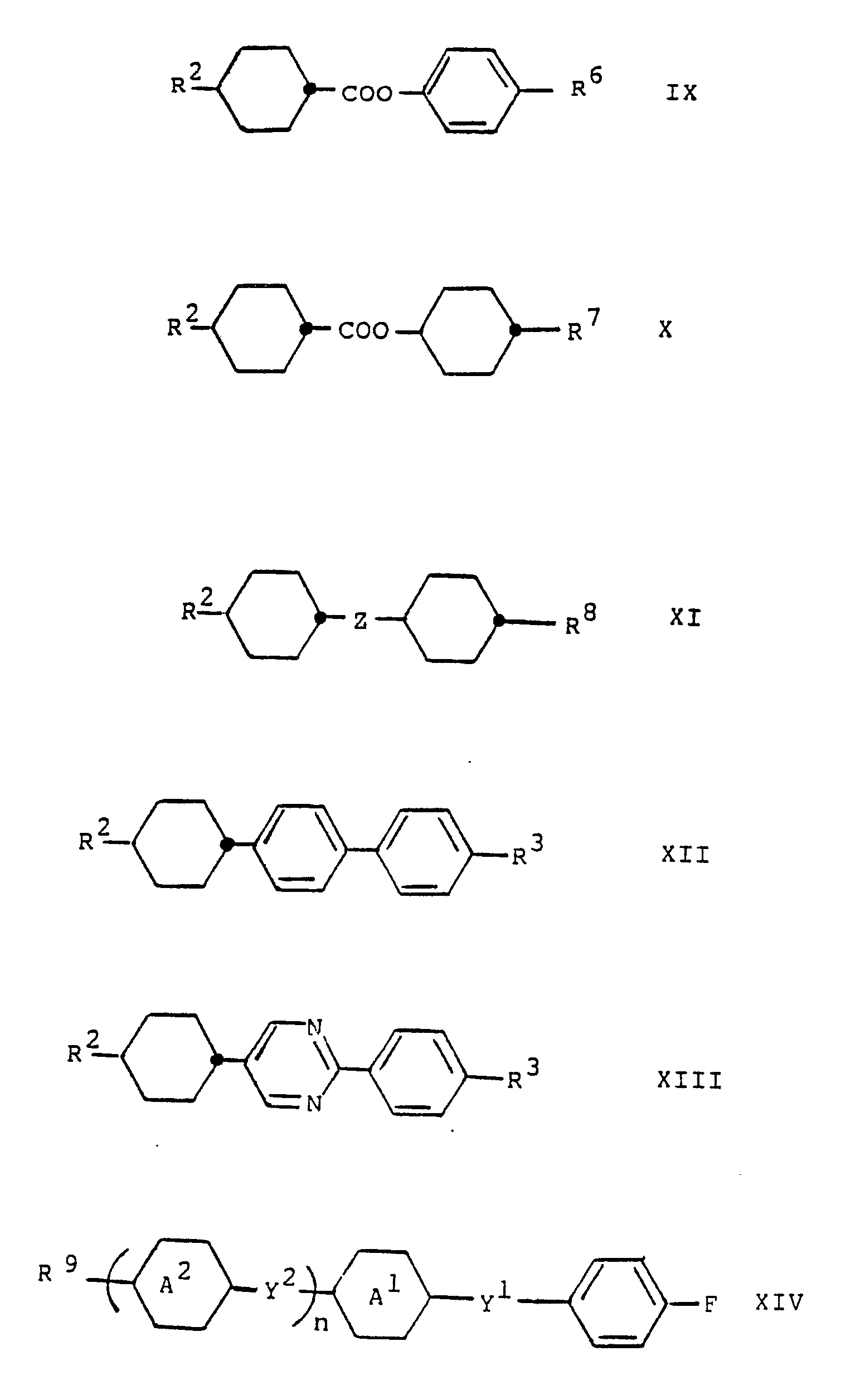

- Die Verbindungen der Formel XI, worin R² 1E-Alkenyl, 3E-Alkenyl oder 4-Alkenyl bedeutet sind neu. Sie können nach den in den Synthesebeispielen illustrierten Methoden hergestellt werden.
- Die erfindungsgemässen Mischungen können ferner optisch aktive Verbindungen (z.B. optisch aktive 4′-Alkyl- oder 4′-Alkoxy-4-biphenylcarbonitrile) und/oder dichroitische Farbstoffe (z.B. Azo-, Azoxy- oder Anthrachinonfarbstoffe) enthalten. Der Anteil solcher Verbindungen wird durch die Löslichkeit, die gewünschte Ganghöhe, Farbe, Extinktion und dergleichen bestimmt. Im allgemeinen beträgt der Anteil optisch aktiver Verbindungen und dichroitischer Farbstoffe höchstens je etwa 10 Gew.-% im Gesamtgemisch.
- Die Herstellung der erfindungsgemässen Gemische und die Herstellung der elektro-optischen Vorrichtungen können in an sich bekannter Weise erfolgen.
- Die Herstellung der Verbindungen der Formel I und der neuen Verbindungen der Formel XI sowie flüssigkristalline Gemische enthaltend diese Verbindungen werden durch die folgenden Beispiele weiter veranschaulicht. C bedeutet eine kristalline, SB eine smektisch B, N eine nematische und I die isotrope Phase. V₁₀ und V₅₀ bezeichnen die Spannung für 10% bzw. 50% Transmission, P = (V₅₀-V₁₀)/V₁₀ ist ein Mass für die Steilheit der Transmissionskurve, ton und toff bezeichnen die Einschaltzeit bzw. die Ausschaltzeit und Δn bezeichnet die optische Anisotropie.
-
- a) Eine Lösung von 1,71 g trans-4-[trans-4-(4-Pentenyl)cyclohexyl]cyclohexancarbonitril (hergestellt nach Beispiel 2) in 30 ml Diäthylenglykol wurde mit 3,11 g Kaliumhydroxid versetzt und 3 Stunden bei 130°C gerührt. Dann wurde das Gemisch auf Eiswasser gegossen, mit 25-prozentiger Salzsäure angesäuert und dreimal mit Diäthyläther extrahiert. Die organischen Phasen wurden vereinigt, dreimal mit Wasser gewaschen, über Magnesiumsulfat getrocknet und eingedampft. Umkristallisation des braunen, kristallinen Rückstandes (1,74 g) aus 30 ml Hexan ergab 996 mg trans-4-[trans-4-(4-Pentenyl)cyclohexyl]cyclohexancarbonsäure als gelbliche Kristalle.
- b) Eine Lösung von 996 mg trans-4-[trans-4-(4-Pentenyl)cyclohexyl]cyclohexancarbonsäure in 80 ml Methylenchlorid wurde mit 752 mg p-Fluorphenol,61 mg 4-(Dimethylamino)pyridin und 1,03 g Dicyclohexylcarbodiimid versetzt und 15 Stunden bei Raumtemperatur gerührt. Anschliessend wurde das Reaktionsgemisch filtriert. Das Filtrat wurde eingedampft und der erhaltene Rückstand an Kieselgel mit Aethylacetat/Petroläther (Vol. 3:97) chromatographisch gereinigt. Kristallisation des erhaltenen Produktes (1,24 g) aus 40 ml Hexan ergab 757 mg reinen trans-4-[trans-4-(4-Pentenyl)cyclohexyl]cyclohexancarbonsäure -4-fluorphenylester mit Smp. (C-N) 70,3°C und Klp. (N-I) 158,7°C.
- In analoger Weise können folgende Verbindungen hergestellt werden:
trans-4-(4-Pentenyl)cyclohexancarbonsäure-4-fluorphenylester, Smp. 31,3°C;
trans-4-(4-Pentenyl)cyclohexancarbonsäure 3,4-difluorphenylester, Smp. 12,4°C;
trans-4-(4-Pentenyl)cyclohexancarbonsäure 4-chlorphenylester;
4-(4-Pentenyl)benzoesäure-4-fluorphenylester;
4-(4-Pentenyl)benzoesäure-3,4-difluorphenylester;
4-(3-Butenyloxy)benzoesäure-4-fluorphenylester, Smp. 65°C;
4-(3-Butenyloxy)benzoesäure-3,4-difluorphenylester, Smp. 47,5°C;
4-(3-Butenyloxy)benzoesäure-4-chlorphenylester;
trans-4-[trans-4-(4-Pentenyl)cyclohexyl]cyclohexancarbonsäure-3,4-difluorphenylester;
trans-4-[trans-4-(4-Pentenyl)cyclohexyl]cyclohexancarbonsäure-4-chlorphenylester;
trans-4-[trans-4-(4-Pentenyl)cyclohexyl]cyclohexancarbonsäure-3-chlor-4-fluorphenylester;
trans-4-[trans-4-(4-Pentenyl)cyclohexyl]cyclohexancarbonsäure-3-fluor-4-chlorphenylester;
4-[trans-4-(4-Pentenyl)cyclohexyl]benzoesäure-4-fluorphenylester;
4-[trans-4-(4-Pentenyl)cyclohexyl]benzoesäure-3,4-difluorphenylester;
5-[trans-4 (4-Pentenyl)cyclohexyl]-2-pyrimidincarbonsäure-4-fluorphenylester;
2-[trans-4-(4-Pentenyl)cyclohexyl]-5-pyrimidincarbonsäure-4-fluorphenylester;
4-[5-(4-Pentenyl)-2-pyrimidinyl]benzoesäure-4-fluorphenylester;
4-[2-(4-Pentenyl)-5-pyrimidinyl]benzoesäure-4-fluorphenylester;
trans-4-(4Z-Hexenyl)cyclohexancarbonsäure-4-fluorphenylester;
trans-4-(4Z-Hexenyl)cyclohexancarbonsäure-3,4-difluorphenylester;
4-(3Z-Pentenyloxy)benzoesäure-4-fluorphenylester;
trans-4-[trans-4-(4Z-Hexenyl)cyclohexyl]cyclohexancarbonsäure-4-fluorphenylester;
4-[trans-4-(4Z-Hexenyl)cyclohexyl]benzoesäure-4-fluorphenylester;
trans-4-(3-Butenyl)cyclohexancarbonsäure-3,4-difluorphenylester, Smp. 42,0°C;
trans-4-(3-Butenyl)cyclohexancarbonsäure-4-chlorphenylester;
4-Allyoxybenzoesäure-4-fluorphenylester;
4-Allyloxybenzoesäure-3,4-difluorphenylester;
4-Allyloxybenzoesäure-4-chlorphenylester;
trans-4-[trans-4-(3-Butenyl)cyclohexyl]cyclohexancarbonsäure-3,4-difluorphenylester, Smp. (C-N) 55,1°C, Klp. (N-I) 153,6°C;
trans-4-[trans-4-(3-Butenyl)cyclohexyl]cyclohexancarbonsäure-4-chlorphenylester, Smp. (C-N) 78,3°C, Klp. (N-I) 213,5°C;
trans-4-[trans-4-(3-Butenyl)cyclohexyl]cyclohexancarbonsäure-3-chlor-4-fluorphenylester;
trans-4-[trans-4-(3-Butenyl)cyclohexyl]cyclohexancarbonsäure-3-fluor-4-chlorphenylester;
4-[trans-4-(3-Butenyl)cyclohexyl]benzoesäure-3,4-difluorphenylester;
trans-4-(3E-Pentenyl)cyclohexancarbonsäure-3,4-difluorphenylester;
4-(2E-Butenyloxy)benzoesäure-4-fluorphenylester. -
- a) 140,9 g 2-(1,3-Dioxolan-2-yl)äthyl-triphenylphosphoniumbromid wurden unter Stickstoffbegasung in 4,5 l Tetrahydrofuran suspendiert und die Suspension bei 0°C innert 5 Minuten mit 36,8 g Kalium-tert.butylat versetzt. Die orange Suspension wurde noch 1 Stunde bei Raumtemperatur gerührt und innert 5 Minuten mit 46,1 g 4-(4-Oxocyclohexyl)benzamid versetzt. Das Reaktionsgemisch wurde noch 4,5 Stunden bei Raumtemperatur gerührt und dann im Vakuum eingeengt. Die erhaltenen, gelblichen Kristalle (212,5 g) wurden mit 1,2 l Diäthyläther versetzt. Das Gemisch wurde 30 Minuten bei Raumtemperatur gerührt und dann genutscht. Der Rückstand wurde mit Diäthyläther gewaschen und dann in 700 ml Wasser aufgeschlämmt. Das Gemisch wurde 15 Minuten gerührt und dann genutscht. Der Rückstand wurde mit Wasser gewaschen und in 600 ml Dioxan heiss gelöst. Die Lösung wurde auf Raumtemperatur abkühlen gelassen. Die ausgefallenen Kristalle wurden abgenutscht, mit wenig Dioxan und Hexan gewaschen und im Vakuum bei 60°C getrocknet, wobei 39,2 g kristallines 4-[4-[2-(1,3-Dioxolan-2-yl)äthyliden]cyclohexyl]benzamid mit Smp. 209-212°C erhalten wurden. Aufarbeitung der Mutterlauge (72,6 g) ergab weitere 7,7 g Produkt und 64,2 g zweite Mutterlauge.
- b) Ein Gemisch von 500 mg 4-[4-[2-(1,3-Dioxolan-2-yl)äthyliden]cyclohexyl]benzamid und 20 ml Dioxan/Triäthylamin (Vol. 9:1) wurde mittels 500 mg 10-prozentiger Platin-Kohle 2 Stunden hydriert. Dann wurde das Reaktionsgemisch filtriert und das Filtrat eingedampft. Umkristallisation des Eindampfrückstandes aus 40 ml Dioxan ergab 230 mg 4-[trans-4-[2-(1,3-Dioxolan-2-yl)äthyl]cyclohexyl]benzamid als farblose Kristalle.
- c) 27 g 4-[trans-4-[2-(1,3-Dioxolan-2-yl)äthyl]cyclohexyl]benzamid wurden mit 5 g 5-prozentiger Ruthenium Kohle in Dioxan bei 120°C und 40 bar Wasserstoff 8 Stunden hydriert. Das nach Filtration und Waschen mit Tetrahydrofuran erhaltene Rohprodukt (25 g) enthielt 69% cis-Isomer und 25% trans-Isomer von 4-[trans-4-[2-(1,3-Dioxolan 2-yl)äthyl]cyclohexyl]cyclohexancarboxamid.
- d) 42 g rohes 4-[trans-4-[2-(1,3-Dioxolan -2-yl)äthyl]cyclohexyl]cyclohexancarboxamid wurden unter Argonbegasung in 500 ml Aethylenglykol aufgeschlämmt und dann mit 19 g festem Kaliumhydroxid versetzt. Das Gemisch wurde unter Rühren 5 Stunden auf 180°C (Badtemperatur) erhitzt. Nach dem Abkühlen wurde das Reaktionsgemisch auf 500 ml Wasser gegossen, mit 10-prozentiger Salzsäure auf pH ca. 3 angesäuert und dreimal mit je 300 ml Methylenchlorid extrahiert. Die vereinigten organischen Phasen wurden einmal mit 500 ml 1-prozentiger Salzsäure und zweimal mit je 500 ml Wasser gewaschen, über Magnesiumsulfat getrocknet, filtriert und eingedampft. Das dunkelbraune Rohprodukt (41 g) wurde an Kieselgel mit Aethylacetat chromatographisch gereinigt. Kristallisation des erhaltenen Produktes (36 g) aus Aceton ergab 13,8 g reine trans-4-[trans-4-[2-(1,3-Dioxolan-2-yl)äthyl]cyclohexyl]cyclohexancarbonsäure. Aufarbeitung der Mutterlauge ergab weitere 2,5 g reines Produkt.
- e) 18 g trans-4-[trans-4-[2-(1,3-Dioxolan -2-yl)äthyl]cyclohexyl]cyclohexancarbonsäure wurden unter Argonbegasung in 600 ml Chloroform gelöst und die Lösung bei 0°C unter Rühren innert 3 Minuten tropfenweise mit einer Lösung von 7,2 ml Chlorameisensäureäthylester in 40 ml Chloroform versetzt. Die Reaktionslösung wurde noch 30 Minuten gerührt. Dann wurde während 10 Minuten Ammoniak-Gas in die Lösung eingeleitet. Das Gemisch wurde noch 30 Minuten bei 0°C gerührt und dann zweimal mit je 300 ml Wasser extrahiert. Die wässrigen Phasen wurden mit je 100 ml Chloroform nachextrahiert. Die vereinigten organischen Phasen wurden über Magnesiumsulfat getrocknet, filtriert und eingedampft. Umkristallisation des erhaltenen, braunen kristallinen Rohproduktes (19 g) aus 800 ml Methylenchlorid ergab 13 g trans-4-[trans-4-[2-(1,3-Dioxolan - 2-yl)äthyl]cyclohexyl]cyclohexancarboxamid als hellbraune Kristalle.
- f) 2,1 g trans-4-[trans -4-[2-(1,3-Dioxolan -2-yl)äthyl]cyclohexyl]cyclohexancarboxamid wurden unter Argonbegasung in 60 ml Dimethylformamid aufgeschlämmt. Die Suspension wurde mit 1,32 ml Pyridin und 0,898 ml Methansulfochlorid versetzt und 1,5 Stunden bei 60°C (Badtemperatur) gerührt. Anschliessend wurde die Reaktionslösung in Methylenchlorid und 10-prozentiger Salzsäure verteilt. Die wässrige Phase wurde zweimal mit je 100 ml Methylenchlorid extrahiert. Die organischen Phasen wurden zweimal mit je 100 ml Wasser gewaschen, über Magnesiumsulfat getrocknet, filtriert und eingeengt. Hierbei wurden 2,5 g trans-4-[trans-4-[2 -(1,3-Dioxolan -2-yl)äthyl]cyclohexyl]cyclohexancarbonitril als gelbe Kristalle in einer Reinheit von 96% erhalten.
- g) 3,0 g rohes trans-4-[trans-4-[2-(1,3-Dioxolan -2-yl)äthyl]cyclohexyl]cyclohexancarbonitril wurden unter Argonbegasung in 50 ml Wasser, 25 ml Eisessig und 10 ml Dioxan aufgeschlämmt und 1 Stunde bei 100°C gerührt. Danach wurde die Reaktionslösung mit 100 ml Wasser versetzt. Die wässrige Phase wurde abgetrennt und dreimal mit je 100 ml Diäthylather extrahiert. Die organischen Phasen wurden mit 100 ml verdünnter Natriumhydrogencarbonat-Lösung und mit 100 ml Wasser gewaschen, über Magnesiumsulfat getrocknet, filtriert und eingeengt. Umkristallisation der erhaltenen gelben Kristalle (2,25 g) aus 60 ml Hexan ergab 1,98 g 3-[trans-4-(trans-4-Cyanocyclohexyl)cyclohexyl]propionaldehyd als farblose Kristalle.
- h) 4,11 g Methoxymethyl-triphenylphosphoniumchlorid wurden unter Argonbegasung in 60 ml tert.Butylmethyläther aufgeschlämmt und bei Raumtemperatur innert 2 Minuten mit 1,26 g Kalium-tert.butylat versetzt. Die Suspension wurde noch 1 Stunde bei Raumtemperatur gerührt, dann auf 0°C gekühlt und innert 5 Minuten tropfenweise mit einer Lösung von 1,98 g 3-[trans-4-(trans 4-Cyanocyclohexyl)cyclohexyl]propionaldehyd in 25 ml tert.Butylmethyläther versetzt. Das Reaktionsgemisch wurde noch 45 Minuten bei 0°C gerührt, dann mit 100 ml Wasser verdünnt und dreimal mit je 100 ml Diäthyläther extrahiert. Die organischen Phasen wurden zweimal mit je 100 ml Wasser gewaschen, über Magnesiumsulfat getrocknet, filtriert und eingeengt. Chromatographische Reinigung des Rohprodukts (5,1 g) an Kieselgel bei 0,5 bar mit Aethylacetat/Petroläther (Vol. 5:95) ergab 2,0 g trans-4-[trans-4-(4-Methoxy -3-butenyl)cyclohexyl]cyclohexancarbonitril als farbloses milchiges Oel.
- i) 1,65 g trans-4-[trans-4-(4-Methoxy -3-butenyl)cyclohexyl]cyclohexancarbonitril wurden unter Argonbegasung in 50 ml Wasser, 25 ml Eisessig und 12 ml Doxan aufgeschlämmt. Die Suspension wurde 2 Stunden bei 80°C (Badtemperatur) gerührt und dann mit 50 ml Wasser verdünnt. Die wässrige Phase wurde abgetrennt und dreimal mit je 100 ml Diathyläther extrahiert. Die organischen Phasen wurden zweimal mit je 100 ml Wasser, dann mit 100 ml gesättigter Natriumhydrogencarbonat-Lösung und nochmals mit 100 ml Wasser gewaschen, dann über Magnesiumsulfat getrocknet, filtriert und eingeengt. Hierbei wurden 1,5 g 4-[trans-4-(trans-4-Cyanocyclohexyl)cyclohexyl]butyraldehyd als farblose Kristalle erhalten.
- j) 3,28 g Methyltriphenylphosphoniumbromid wurden unter Argonbegasung in 40 ml tert.Butylmethyläther aufgeschlämmt. Die Suspension wurde bei Raumtemperatur innert 1 Minute mit 962 mg Kalium-tert.butylat versetzt und 1 Stunde gerührt. Anschliessend wurde das Gemisch auf 0°C gekühlt, innert 3 Minuten tropfenweise mit einer Lösung von 1,5 g 4-[trans-4-(trans-4-Cyanocyclohexyl)cyclohexyl]butyraldehyd in 20 ml tert.Butylmethyläther versetzt und noch 45 Minuten bei 0°C gerührt. Danach wurde das Reaktionsgemisch mit 80 ml Wasser verdünnt und dreimal mit je 100 ml Petroläther extrahiert. Die organichen Phasen wurden zweimal mit je 100 ml Wasser gewaschen, über Magnesiumsulfat getrocknet, filtriert und eingeengt. Chromtographische Reinigung des Rohproduktes (2,1 g) an Kieselgel bei 0,5 bar mit Aethylacetat/Petroläther (Vol. 2:98) und Umkristallisation aus 20 ml Methanol ergab 1,26 g trans-4-[trans-4-(4-Pentenyl)cyclohexyl]cyclohexancarbonitril als farblose Kristalle mit Smp. (C-SB) 20,1°C, SB-N 36,9°C, Klp. (N-I) 54,8°C.
- In analoger Weise können folgende Verbindungen hergestellt werden:
trans-4-[trans-4-(4Z-Hexenyl)cyclohexyl]cyclohexancarbonitril;
trans-4-[trans-4-(4Z-Heptenyl)cyclohexyl]cyclohexancarbonitril;
trans-4-[trans-4-(4Z-Octenyl)cyclohexyl]cyclohexancarbonitril;
trans-4-[trans-4-(4Z-Nonenyl)cyclohexyl]cyclohexancarbonitril;
trans-4-[trans-4-(4Z-Decenyl)cyclohexyl]cyclohexancarbonitril.
- Durch Umsetzung des in Stufe g) erhaltenen 3-[trans-4-(trans-4-Cyanocyclohexyl)cyclohexyl]propionaldehyds in analoger Weise zu Stufe j) und gegebenenfalls E/Z-Isomerisierung in analoger Weise zu Beispiel 3k) können folgende Verbindungen hergestellt werden:
trans-4-[trans-4-(3-Butenyl)cyclohexyl]cyclohexancarbonitril; Smp. (C-N) 50,7°C, Klp. (N-I) 82.7°C;
trans-4-[trans 4-(3E-pentenyl)cyclohexyl]cyclohexancarbonitril; Smp. (C-N) 79,4°C, Klp. (N-I) 99,5°C;
trans-4-[trans-4-(3E-Hexenyl)cyclohexyl]cyclohexancarbonitril;
trans-4-[trans-4-(3E-Heptenyl)cyclohexyl]cyclohexancarbonitril;
trans-4-[trans-4-(3E-Octenyl)cyclohexyl]cyclohexancarbonitril;
trans-4-[trans-4-(3E-Nonenyl)cyclohexyl]cyclohexancarbonitril;
trans-4-[trans-4-(3E-Decenyl)cyclohexyl]cyclohexancarbonitril.
- Durch Umsetzung des 4-(4-Oxocyclohexyl)benzamids in analoger Weise zu den Stufen h) und i), Acetalisierung des durch Kristallisation erhaltenen 4-(trans-4-Formylcyclohexyl)benzamids mit Aethylenglykol in Gegenwart von p-Toluolsulfonsäure, weitere Umsetzung des Dioxolans in analoger Weise zu den Stufen c) bis g), anschliessende Wittig-Reaktion in analoger Weise zu Stufe j) und gegebenen falls E/Z-Isomerisierung in analoger Weise zu Beispiel 3k) können folgende Verbindungen hergestellt werden:
trans-4-(trans-4-Vinylcyclohexyl)cyclohexancarbonitril;
trans-4-[trans-4-(1E-Propenyl)cyclohexyl]cyclohexancarbonitril;
trans-4-[trans-4-(1E-Butenyl)cyclohexyl]cyclohexancarbonitril;
trans-4-[trans-4-(1E-Pentenyl)cyclohexyl]cyclohexancarbonitril;
trans-4-[trans-4-(1E-Hexenyl)cyclohexyl]cyclohexancarbonitril;
trans-4-[trans-4-(1E-Heptenyl)cyclohexyl]cyclohexancarbonitril;
trans-4-[trans-4-(1E-Octenyl)cyclohexyl]cyclohexancarbonitril;
trans-4-[trans-4-(1E-Nonenyl)cyclohexyl]cyclohexancarbonitril;
trans-4-[trans-4-(1E-Decenyl)cyclohexyl]cyclohexancarbonitril.
- Ausgehend von 4-[2-(4-Oxocyclohexyl)äthyl]benzamid [herstellbar aus dem in Mol. Cryst. Liq. Cryst. 131, 327 (1985) beschriebenen Nitril] können in analoger Weise zur obigen Methode auch die folgenden Verbindungen hergestellt werden:
trans-4-[2-(trans-4-(4-Pentenyl)cyclohexyl)äthyl]cyclohexancarbonitril;
trans-4-[2-(trans-4-(4Z-Hexenyl)cyclohexyl)äthyl]cyclohexancarbonitril;
trans-4-[2-(trans-4-(4Z-Heptenyl)cyclohexyl)äthyl]cyclohexancarbonitril;
trans-4-[2-(trans-4-(4Z-Octenyl)cyclohexyl)äthyl]cyclohexancarbonitril;
trans-4-[2-(trans-4-(4Z-Nonenyl)cyclohexyl)äthyl]cyclohexancarbonitril;
trans-4-[2-(trans-4-(4Z-Decenyl)cyclohexyl)äthyl]cyclohexancarbonitril;
trans-4-[2-(trans-4-(3-Butenyl)cyclohexyl)äthyl]cyclohexancarbonitril;
trans-4-[2-(trans-4-(3E-Pentenyl)cyclohexyl)äthyl]cyclohexancarbonitril;
trans-4-[2-(trans-4-(3E-Hexenyl)cyclohexyl)äthyl]cyclohexancarbonitril;
trans-4-[2-(trans-4-(3E-Heptenyl)cyclohexyl)äthyl]cyclohexancarbonitril;
trans-4-[2-(trans-4-(3E-Octenyl)cyclohexyl)äthyl]cyclohexancarbonitril;
trans-4-[2-(trans-4-(3E-Nonenyl)cyclohexyl)äthyl]cyclohexancarbonitril;
trans-4-[2-(trans-4-(3E-Decenyl)cyclohexyl)äthyl]cyclohexancarbonitril;
trans-4-[2-(trans-4-Vinylcyclohexyl)äthyl]cyclohexancarbonitril;
trans-4-[2-(trans-4-(1E-Propenyl)cyclohexyl)äthyl]cyclohexancarbonitril;
trans-4-[2-(trans-4-(1E-Butenyl)cyclohexyl)äthyl]cyclohexancarbonitril;
trans-4-[2-(trans-4-(1E-Pentenyl)cyclohexyl)äthyl]cyclohexancarbonitril;
trans-4-[2-(trans-4-(1E-Hexenyl)cyclohexyl)äthyl]cyclohexancarbonitril;
trans-4-[2-(trans-4-(1E-Heptenyl)cyclohexyl)äthyl]cyclo hexancarbonitril;
trans-4-[2-(trans-4-(1E-Octenyl)cyclohexyl)äthyl]cyclohexancarbonitril;
trans-4-[2-(trans-4-(1E-Nonenyl)cyclohexyl)äthyl]cyclohexancarbonitril;
trans-4-[2-(trans-4-(1E-Decenyl)cyclohexyl)äthyl]cyclohexancarbonitril. -
- a) Eine Suspension von 109,6 g 4-(4-Nitrophenyl)cyclohexanon (herstellbar durch Nitrierung von 4-Phenylcyclohexanon) in 1 l Dioxan wurde mit 50 ml Triäthylamin und 2 g 5-prozentiger Palladium-Kohle versetzt und unter gutem Rühren bei Raumtemperatur und 0,3 bar Wasserstoffdruck hydriert. Nach 2 Stunden wurde das Gemisch filtriert. Das Filtrat wurde am Wasserstrahlvakuum bei einer Badtemperatur von 30°C eingedampft und der Eindampfrückstand über Nacht im Trockenschrank am Wasserstrahlvakuum bei 40°C getrocknet. Hierbei wurden 94,5 g 4-(4-Aminophenyl)cyclohexanon als weisse Kristalle mit Smp. 127-128°C erhalten.
- b) In einem Sulfierkolben wurden 200 ml 4N Schwefelsäure auf 80°C erwärmt und dann mit ca. 5% einer Lösung von 37,9 g 4-(4-Aminophenyl)cyclohexanon in 200 ml 4N Schwefelsäure versetzt. Anschliessend wurden bei 80°C innert 1,5 Stunden gleichzeitig die restliche Lösung von 4-(4-Aminophenyl)cyclohexanon sowie eine Lösung von 15,2 g Natriumnitrit in 45 ml Wasser zum Reaktionsgemisch zugetropft. Danach wurde das Gemisch bei 80°C innert 30 Minuten tropfenweise mit einer Lösung von 9 g Natriumnitrit in 27 ml Wasser versetzt und noch 1 Stunde bei 80°C weitergerührt. Nach dem Abkühlen des Reaktionsgemisches auf 0°C wurden die ausgefallenen Kristalle abgenutscht, mit 200 ml kaltem Wasser gewaschen und im Trockenschrank am Wasserstrahlvakuum bei 60°C bis zur Gewichtskonstanz getrocknet. Das kristalline Rohprodukt (34,6 g) wurde in 520 ml Aethylacetat suspendiert. Die Suspension wurde 1 Stunde zum Rückfluss erhitzt, dann mit 1,7 g Aktivkohle versetzt und dann noch 1 Stunde zum Rückfluss erhitzt. Anschliessend wurde das Gemisch genutscht (Nachwaschen mit 40 ml warmem Aethylacetat) und das Filtrat am Wasserstrahlvakuum bei einer Badtemperatur von 40°C eingedampft. Trocknung des Eindampfrückstandes im Trockenschrank am Wasserstrahlvakuum bei 60°C bis zur Gewichtskonstanz ergab 32,2 g 4-(4-Hydroxyphenyl)cyclohexanon als geib-braune Kristalle mit Smp. 165-166°C.
- c) In einem Sulfierkolben wurde unter schwachem Stickstoffstrom eine Suspension von 3,8 g 4-(4-Hydroxyphenyl)cyclohexanon in 60 ml tert.Butylmethyläther mit 10,6 g 2-(1,3-Dioxolan-2-yl)äthyl-triphenylphosphoniumbromid und 2,2 g Kalium-tert.butylat versetzt. Das Gemisch wurde zunächst 30 Minuten gerührt, dann innert 2,25 Stunden bei 25°C portionenweise mit weiteren 2,7 g Kalium-tert.butylat versetzt und noch 1 Stunde bei Raumtemperatur gerührt. Danach wurde das Reaktionsgemisch mit weiteren 1,8 g 2-(1,3-Dioxolan-2-yl)äthyl-triphenylphosphoniumbromid und 0,45 g Kalium-tert.butylat versetzt und noch 1 Stunde gerührt. Anschliessend wurde das Reaktionsgemisch auf 80 ml Wasser gegossen und mit 11 ml 2N Schwefelsäure angesäuert. Die wässrige Phase wurde abgetrennt und zweimal mit je 80 ml tert.Butylmethyläther extrahiert. Die organischen Phasen wurden zweimal mit je 50 ml Wasser gewaschen, über Natriumsulfat getrocknet und genutscht. Das Filtrat wurde am Wasserstrahlvakuum bei einer Badtemperatur von 40°C bis zur Gewichtskonstanz eingedampft. Das erhaltene rötliche Oel (10,9 g) wurde an Kieselgel mit Toluol und Toluol/tert.Butylmethyläther (Vol. 20:1) chromatographisch getrennt. Eindampfen der Produktfraktionen am Wasserstrahlvakuum und Trocknung des Rückstandes im Trockenschrank am Wasserstrahlvakuum bei 60°C bis zur Gewichtskonstanz ergab schliesslich 4,5 g 4-[4-[2-(1,3-Dioxolan-2-yl)äthyliden]cyclohexyl]phenol als gelbliche Kristalle mit Smp. 125,5 126,5°C.
- d) Eine Lösung von 36,5 g 4-[4-[2-(1,3-Dioxolan-2-yl)äthyliden]cyclohexyl]phenol in 500 ml Toluol und 50 ml Triäthylamin wurde in einem Hydrierautoklaven mit 3,2 g 5-prozentiger Platin-Kohle und 10 bar Wasserstoff bei 90°C 1 Stunde hydriert. Anschliessend wurde das Gemisch genutscht und der Rückstand mit 30 ml warmem Toluol gewaschen. Das Filtrat wurde am Wasserstrahlvakuum bei einer Badtemperatur von 40°C bis zur Gewichtskonstanz eingedampft. Die erhal tenen weissen Kristalle (37 g) wurden in 180 ml Methanol heiss gelöst. Die Lösung wurde auf Raumtemperatur abkühlen gelassen und dann 5 Stunden in den Kühlschrank gestellt. Anschliessend wurden die Kristalle abgenutscht, mit 50 ml kaltem Methanol gewaschen und im Trockenschrank am Wasserstrahlvakuum bei 60°C getrocknet. Hierbei wurden 27,6 g 4-[trans-4-[2-(1,3-Dioxolan-2-yl)äthyl]cyclohexyl]phenol als weisse Kristalle mit Smp. 153,5-154,5°C erhalten.
- e) In einem Stahl-Rührautoklaven wurde ein Gemisch von 100 g 4-[trans 4-[2-(1,3-Dioxolan-2-yl)äthyl]cyclohexyl]phenol, 10 g 5-prozentigem Rhodium/Aluminiumoxid und 1 l Aethylacetat mit 50 bar Wasserstoff bei 80°C 90 Minuten hydriert. Dann wurde der Katalysator abgenutscht und mit 100 ml Aethylacetat gewaschen. Das Filtrat wurde eingedampft und der Rückstand bei 25°C/0,4 mbar getrocknet. Hierbei wurden 101,75 g 4-[trans-4-[2-(1,3-Dioxolan-2-yl)äthyl]cyclohexyl]cyclohexanol enthaltend 59% cis-Isomer und 36% trans-Isomer erhalten.
- f) Eine Lösung von 12,9 g Pyridiniumchlorochromat in 80 ml Methylenchlorid wurde bei Raumtemperatur unter Stickstoffbegasung innert 5 Minuten tropfenweise mit einer Lösung von 13,0 g 4-[trans-4-[2-(1,3-Dioxolan-2-yl)äthyl]cyclohexyl]cyclohexanol in 40 ml Methylenchlorid versetzt. Das Gemisch wurde noch 1 Stunde gerührt, dann mit 100 ml Diäthyläther verdünnt und filtriert und das Filtrat eingedampft. Der Eindampfrückstand wurde in 200 ml Diäthyläther aufgenommen, das Gemisch filtriert, das Filtrat eingedampft und dann dieses Vorgehen noch zweimal wiederholt. Danach wurde die erhaltenen, bräunliche feste Masse (12,1 g) an Kieselgel mit Aethylacetat/Petroläther (Vol. 1:4) chromatographisch getrennt. Kristallisation der farblosen Ketonfraktion aus 60 ml Aethylacetat und 200 ml Petroläther ergab schliesslich 7,0 g reines 4-[trans-4 -[2-(1,3-Dioxolan-2-yl)äthyl]cyclohexyl]cyclohexanon.
- g) Eine Suspension von 2,97 g Natriumborhydrid in 300 ml Isopropanol wurde unter Stickstoffbegasung bei -70°C tropfenweise mit einer Lösung von 11 g 4-[trans-4-[2-(1,3-Dioxolan-2-yl)äthyl]cyclohexyl]cyclohexanon in 200 ml Isopropanol versetzt. Nach ca. 1 Stunde wurde das Reaktionsgemisch auf Raumtemperatur erwärmen gelassen, mit 500 ml 0,1N Salzsäure verdünnt und dreimal mit je 300 ml Methylenchlorid extrahiert. Die organischen Phasen wurden mit Wasser gewaschen, über Magnesiumsulfat getrocknet, filtriert und eingedampft. Kristallisation des Rückstandes (11 g) aus 500 ml Aethylacetat/Petroläther (Vol. 3:5) ergab 6,6 g reines trans-4-[trans-4 -[2-(1,3-Dioxolan-2-yl)äthyl]cyclohexyl]cyclohexanol mit Smp. 129,5°C.
- h) In einem Rundkolben wurden unter Stickstoffbegasung 2,04 g Natriumhydrid als ca. 50-prozentige ölige Suspension vorgelegt und zweimal mit Pentan gewaschen. Dann wurden zum Natriumhydrid 40 ml trockenes Tetrahydrofuran und eine Lösung von 6,0 g trans 4-[trans 4 -[2-(1,3-Dioxolan-2-yl)äthyl]cyclohexyl]cyclohexanol in 30 ml Tetrahydrofuran zugefügt. Das Gemisch wurde bei Raumtemperatur 30 Minuten gerührt, dann mit 4,0 ml Methyljodid versetzt und 2 Stunden zum Rückfluss erhitzt. Anschliessend wurde das Reaktionsgemisch abgekühlt, in 200 ml Diäthyläther aufgenommen und dreimal mit je 200 ml Wasser gewaschen. Die organische Phase wurde über Magnesiumsulfat getrocknet, filtriert und eingedampft, wobei 6,3 g 2-[2-[trans-4-(trans-4 Methoxycyclohexyl)cyclohexyl]äthyl] -1,3-dioxolan mit Smp. 74°C erhalten wurden.
- i) 6,2 g 2-[2-[trans-4-(trans-4-Methoxycyclohexyl)cyclohexyl]äthyl] -1,3-dioxolan wurden unter Stickstoffbegasung mit 100 ml Wasser, 50 ml Eisessig und 20 ml Dioxan versetzt. Das Gemisch wurde 1,5 Stunden bei 100°C (Badtemperatur) gerührt, dann mit verdünnter Natriumhydrogencarbonat-Lösung neutralisiert und dreimal mit Diäthyläther extrahiert. Die vereinigten Aetherphasen wurden einmal mit Wasser und zweimal mit verdünnter Natriumhydrogencarbonat-Lösung gewaschen, über Magnesiumsulfat getrocknet, filtriert und eingedampft. Umkristallisation des erhaltenen rohen Aldehyds (4,34 g) aus 150 ml Petroläther bei -20°C ergab 2,8 g 3-[trans-4-(trans -4-Methoxycyclohexyl)cyclohexyl]propionaldehyd in einer Reinheit von 96%.
- j) 2,65 g Aethyltriphenylphosphoniumbromid wurden unter Argonbegasung in 40 ml tert.Butylmethyläther aufgeschlämmt. Die Suspension wurde bei Raumtemperatur mit 797 mg Kalium-tert.butylat versetzt und 1 Stunde gerührt. Anschliessend wurde das Gemisch auf 0°C gekühlt, innert 3 Minuten tropfenweise mit einer Lösung von 1,1 g 3-[trans-4-(trans-4-Methoxycyclohexyl)cyclohexyl]propionaldehyd in 15 ml tert.Butylmethyläther versetzt und dann unter Rühren langsam auf Raumtemperatur erwärmen gelassen. Nach 2 Stunden wurde die hellgelbe Suspension in Diäthyläther/Wasser verteilt. Die wässrige Phase wurde abgetrennt und dreimal mit Diäthyläther gewaschen. Die organischen Phasen wurden zweimal mit Wasser gewaschen, über Magnesiumsulfat getrocknet, filtriert und eingedampft. Chromatographische Reinigung des gelben, festen Rohproduktes an Kieselgel mit Aethylacetat/Petroläther (Vol. 3:97) ergab 0,91 g trans-4-(3-Pentenyl)-1-(trans-4-methoxycyclohexyl)cyclohexan mit einem Z/E-Verhältnis von 86:11.
- k) 0,91 g trans-4-(3-Pentenyl)-1-(trans-4-methoxycyclohexyl)cyclohexan (Z/E = 86:11) wurden unter Stickstoffbegasung mit 6 ml Toluol, 0,11 g Natriumbenzolsulfinat und 1 ml 1N Salzsäure versetzt. Das Gemisch wurde 15 Stunden bei 50°C gerührt, dann auf 100 ml verdünnte Natriumhydrogencarbonat-Lösung gegossen und dreimal mit je 50 ml Diäthyläther extrahiert. Die vereinigten organischen Phasen wurden mit 100 ml verdünnter Natriumcarbonat-Lösung und mit 100 ml Wasser gewaschen, über Magnesiumsulfat getrocknet, filtriert und eingedampft. Das erhaltene gelbliche Oel (0,9 g) wurde an mit Silbernitrat imprägniertem Kieselgel mit Diäthyl äther/Hexan (Vol. 1:9) chromatographisch gereinigt. Umkristallisation des erhaltenen Produktes (486 mg) aus ml Methanol bei -20°C ergab reines trans-4-(3E-Pentenyl)-1-(trans-4-methoxycyclohexyl)cyclohexan mit Smp. (C-N) 16,6°C und Klp. (N-I) 43,7°C.
- In analoger Weise können folgende Verbindungen hergestellt werden:
trans-4-(3-Butenyl)-1-(trans-4-methoxycyclohexyl)cyclohexan, Smp. (C-N) -13,6°C. Klp. (N-I) 18,0°C;
trans-4-(3-Butenyl)-1-(trans-4-äthoxycyclohexyl)cyclohexan, Smp. (C-N) 13,1°C, Klp. (N-I) 45,3°C;
trans-4-(3-Butenyl)-1-(trans-4-propyloxycyclohexyl)cyclohexan;
trans-4-(3-Butenyl)-1-(trans-4-butyloxycyclohexyl)cyclohexan;
trans-4-(3-Butenyl)-1-(trans-4-pentyloxycyclohexyl)cyclohexan;
trans-4-(3-Butenyl)-1-(trans-4-hexyloxycyclohexyl)cyclohexan;
trans-4-(3E-Pentenyl)-1-(trans-4-äthoxycyclohexyl)cyclohexan, Smp. (C-N) 44,5°C, Klp. (N-I) 76,5°C;
trans-4-(3E-Pentenyl)-1-(trans-4-propyloxycyclohexyl)cyclohexan;
trans-4-(3E-Pentenyl) 1-(trans-4-butyloxycyclohexyl)cyclohexan;
trans-4-(3E-Pentenyl)-1-(trans-4-pentyloxycyclohexyl)cyclohexan;
trans-4-(3E-Pentenyl)-1-(trans-4-hexyloxycyclohexyl)cyclohexan;
trans-4-(3E-Hexenyl)-1-(trans-4-methoxycyclohexyl)cyclohexan;
trans-4-(3E-Hexenyl)-1-(trans-4-äthoxycyclohexyl)cyclohexan;
trans-4-(3E-Hexenyl)-1-(trans-4-propyloxycyclohexyl)cyclohexan;
trans-4-(3E-Hexenyl)-1-(trans-4-butyloxycyclohexyl)cyclohexan;
trans-4-(3E-Hexenyl)-1-(trans-4-pentyloxycyclohexyl)cyclohexan;
trans-4-(3E-Hexenyl)-1-(trans-4-hexyloxycyclohexyl)cyclohexan.
- In analoger Weise zu den Stufen a) bis i) und weitere Umsetzung des erhaltenen Propionaldehyds in analoger Weise zu Beispiel 2, Stufen h), i) und j) können folgende Verbindungen hergestellt werden:
trans-4-(4-Pentenyl)-1-(trans-4-methoxycyclohexyl)cyclohexan, Smp. (C-SB) 7,7°C, Klp. (SB-I) 14,0°C;
trans-4-(4-Pentenyl)-1-(trans-4-äthoxycyclohexyl)cyclohexan, Smp. (C-SB) 10,5°C, Klp. (SB-I) 43,1°C;
trans-4-(4-Pentenyl)-1-(trans-4-propyloxycyclohexyl)cyclohexan;
trans-4-(4-Pentenyl)-1-(trans-4-butyloxycyclohexyl)cyclohexan;
trans-4-(4-Pentenyl)-1-(trans-4-pentyloxycyclohexyl)cyclohexan;
trans-4-(4-Pentenyl)-1-(trans-4-hexyloxycyclohexyl)cyclohexan;
trans-4-(4Z-Hexenyl)-1-(trans-4-methoxycyclohexyl)cyclohexan;
trans-4-(4Z-Hexenyl)-1-(trans-4-äthoxycyclohexyl)cyclohexan;
trans-4-(4Z-Hexenyl)-1-(trans-4-propyloxycyclohexyl)cyclohexan;
trans-4-(4Z-Hexenyl)-1-(trans-4-butyloxycyclohexyl)cyclohexan;
trans-4-(4Z-Hexenyl)-1-(trans-4-pentyloxycyclohexyl)cyclohexan;
trans-4-(4Z-Hexenyl)-1-(trans-4-hexyloxycyclohexyl)cyclohexan.
- Durch Umsetzung des 4-(4-Hydroxyphenyl)cyclohexanons (Stufe b) in analoger Weise zu Beispiel 2, Stufen h) und i) Acetalisierung des erhaltenen 4-(trans-4-Formylcyclohexyl)phenols mit Aethylenglykol in Gegenwart von p-Toluolsulfonsäure und weitere Umsetzung des Dioxolans in analoger Weise zu den vorliegenden Stufen e) bis k) können folgende Verbindungen hergestellt werden:
trans-4-Vinyl-1-(trans-4-methoxycyclohexyl)cyclohexan;
trans-4-Vinyl-1-(trans-4-äthoxycyclohexyl)cyclohexan;
trans-4-Vinyl-1-(trans-4-propyloxycyclohexyl)cyclohexan;
trans-4-Vinyl-1-(trans-4-butyloxycyclohexyl)cyclohexan;
trans-4-Vinyl-1-(trans-4-pentyloxycyclohexyl)cyclohexan;
trans-4-Vinyl-1-(trans-4-hexyloxycyclohexyl)cyclohexan;
trans-4-(1E-Propenyl)-1-(trans-4-methoxycyclohexyl)cyclohexan;
trans-4-(1E-Propenyl)-1-(trans-4-äthoxycyclohexyl)cyclohexan;
trans-4-(1E-Propenyl)-1-(trans-4-propyloxycyclohexyl)cyclohexan;
trans-4-(1E-Propenyl)-1-(trans-4-butyloxycyclohexyl)cyclohexan;
trans-4-(1E-Propenyl)-1-(trans-4-pentyloxycyclohexyl)cyclohexan;
trans-4-(1E-Propenyl)-1-(trans-4-hexyloxycyclohexyl)cyclohexan;
trans-4-(1E-Butenyl)-1-(trans-4-methoxycyclohexyl)cyclohexan;
trans-4-(1E-Butenyl)-1-(trans-4-äthoxycyclohexyl)cyclohexan;
trans-4-(1E-Butenyl)-1-,trans-4-propyloxycyclohexyl)cyclohexan;
trans-4-(1E-Butenyl)-1-(trans-4-butyloxycyclohexyl)cyclohexan;
trans-4-(1E-Butenyl)-1-(trans-4-pentyloxycyclohexyl)cyclohexan;
trans-4-(1E-Pentenyl)-1-(trans-4-methoxycyclohexyl)cyclohexan;
trans-4-(1E-Pentenyl)-1-(trans-4-athoxycyclohexyl)cyclohexan;
trans-4-(1E-Pentenyl)-1-(trans-4-propyloxycyclohexyl)cyclohexan;
trans-4-(1E-Pentenyl)-1-(trans-4-butyloxycyclohexyl)cyclohexan.
- Ausgehend von 4-(2-Phenyläthyl)cyclohexanon [herstellbar in analoger Weise zum in Mol. Cryst. Liq. Cryst. 131, 327 (1985) beschriebenen Nitril] können nach der obigen Methode auch die folgenden Verbindungen hergestellt werden:
4-[2-[trans-4-(2-(1,3-Dioxolan-2-yl)äthyl)cyclohexyl]äthyl]cyclohexanon;
trans-4-(3-Butenyl)-1-[2-(trans-4-methoxycyclohexyl)äthyl]cyclohexan;
trans-4-(3-Butenyl)-1-[2-(trans-4-äthoxycyclohexyl)äthyl]cyclohexan;
trans-4-(3-Butenyl)-1-[2-(trans-4-propyloxycyclohexyl)äthyl]cyclohexan;
trans-4-(3-Butenyl)-1-[2-(trans-4-butyloxycyclohexyl)äthyl]cyclohexan;
trans-4-(3-Butenyl)-1-[2-(trans-4-pentyloxycyclohexyl)äthyl]cyclohexan;
trans-4-(3-Butenyl)-1-[2-(trans-4-hexyloxycyclohexyl)äthyl]cyclohexan;
trans-4-(3E-Pentenyl)-1-[2-(trans-4-methoxycyclohexyl)äthyl]cyclohexan;
trans-4-(3E-Pentenyl)-1-[2-(trans-4-äthoxycyclohexyl)äthyl]cyclohexan;
trans-4-(3E-Pentenyl)-1-[2-(trans-4-propyloxycyclohexyl)äthyl]cyclohexan;
trans-4-(3E-Pentenyl)-1-[2-(trans-4-butyloxycyclohexyl)äthyl]cyclohexan;
trans-4-(3E-Pentenyl)-1-[2-(trans-4-pentyloxycyclohexyl)äthyl]cyclohexan;
trans-4-(3E-Pentenyl)-1-[2-(trans-4-hexyloxycyclohexyl)äthyl]cyclohexan;
trans-4-(3E-Hexenyl)-1-[2-(trans-4-methoxycyclohexyl)äthyl]cyclohexan;
trans-4-(3E-Hexenyl)-1-[2-(trans-4-äthoxycyclohexyl)äthyl]cyclohexan;
trans-4-(3E-Hexenyl)-1-[2-(trans-4-propyloxycyclohexyl)äthyl]cyclohexan;
trans-4-(3E-Hexenyl)-1-[2-(trans-4-butyloxycyclohexyl)äthyl]cyclohexan;
trans-4-(3E-Hexenyl)-1-[2-(trans-4-pentyloxycyclohexyl)äthyl]cyclohexan;
trans-4-(3E-Hexenyl)-1-[2-(trans-4-hexyloxycyclohexyl)äthyl]cyclohexan;
trans-4-(4-Pentenyl)-1-[2-(trans-4-methoxycyclohexyl)äthyl]cyclohexan;
trans-4-(4-Pentenyl)-1-[2-(trans-4-äthoxycyclohexyl)äthyl]cyclohexan;
trans-4-(4-Pentenyl)-1-[2-(trans-4-propyloxycyclohexyl)äthyl]cyclohexan;
trans-4-(4-Pentenyl)-1-[2-(trans-4-butyloxycyclohexyl)äthyl]cyclohexan;
trans-4-(4-Pentenyl)-1-[2-(trans-4-pentyloxycyclohexyl)äthyl]cyclohexan;
trans-4-(4-Pentenyl)-1-[2-(trans-4-hexyloxycyclohexyl)äthyl]cyclohexan; trans-4-(4Z-Hexenyl)-1-[2-(trans-4-methoxycyclohexyl)äthyl]cyclohexan;
trans-4-(4Z-Hexenyl)-1-[2-(trans-4-äthoxycyclohexyl)äthyl]cyclohexan;
trans-4-(4Z-Hexenyl)-1-[2-(trans-4-propyloxycyclohexyl)äthyl]cyclohexan;
trans-4-(4Z-Hexenyl)-1-[2-(trans-4-butyloxycyclohexyl)äthyl]cyclohexan;
trans-4-Vinyl-1-[2-(trans-4-methoxycyclohexyl)äthyl]cyclohexan;
trans-4-Vinyl-1-[2-(trans-4-äthoxycyclohexyl)äthyl]cyclohexan;
trans-4-Vinyl-1-[2-(trans-4-propyloxycyclohexyl)äthyl]cyclohexan;
trans-4-Vinyl-1-[2-(trans-4-butyloxycyclohexyl)äthyl]cyclohexan;
trans-4-Vinyl-1-[2-(trans-4-pentyloxycyclohexyl)äthyl]cyclohexan;
trans-4-Vinyl-1-[2-(trans-4-hexyloxycyclohexyl)äthyl]cyclohexan;
trans-4-(1E-Propenyl)-1-[2-(trans-4-methoxycyclohexyl)äthyl]cyclohexan;
trans-4-(1E-Propenyl)-1-[2-(trans-4-äthoxycyclohexyl)äthyl]cyclohexan;
trans-4-(1E-Propenyl)-1-[2-(trans-4-propyloxycyclohexyl)äthyl]cyclohexan;
trans-4-(1E-Propenyl)-1-[2-(trans-4-butyloxycyclohexyl)äthyl]cyclohexan;
trans-4-(1E-Propenyl)-1-[2-(trans-4-pentyloxycyclohexyl)äthyl]cyclohexan;
trans-4-(1E-Propenyl)-1-[2-(trans-4-hexyloxycyclohexyl)äthyl]cyclohexan;
trans-4-(1E-Butenyl)-1-[2-(trans-4-methoxycyclohexyl)äthyl]cyclohexan;
trans-4-(1E-Butenyl)-1-[2-(trans-4-äthoxycyclohexyl)äthyl]cyclohexan;
trans-4-(1E-Butenyl)-1-[2-(trans-4-propyloxycyclohexyl)äthyl]cyclohexan;
trans-4-(1E-Butenyl)-1-[2-(trans-4-butyloxycyclohexyl)äthyl]cyclohexan;
trans-4-(1E-Butenyl)-1-[2-(trans-4-pentyloxycyclohexyl)äthyl]cyclohexan;
trans-4-(1E-Pentenyl)-1-[2-(trans-4-methoxycyclohexyl)äthyl]cyclohexan;
trans-4-(1E-Pentenyl)-1-[2-(trans-4-äthoxycyclohexyl)äthyl]cyclohexan;
trans-4-(1E-Pentenyl)-1-[2-(trans-4 propyloxycyclohexyl)athyl]cyclohexan;
trans-4-(1E-Pentenyl)-1-[2-(trans-4-butyloxycyclohexyl)äthyl]cyclohexan. -
- a) Eine Grignard-Lösung aus 3,59 g Magnesium und 16,75 ml 1-Brom-4-fluorbenzol in 70 ml Tetrahydrofuran wurde bei 0°C innert 30 Minuten tropfenweise mit einer Lösung von 33,1 g 4-[trans-4 -[2-(1,3-Dioxolan-2-yl)äthyl]cyclohexyl]cyclohexanon (hergestellt nach Beispiel 3) in 90 ml Tetrahydrofuran versetzt. Das Reaktionsgemisch wurde noch 4 Stunden bei Raumtemperatur gerührt und dann 1,5 Stunden zum Sieden erhitzt. Anschliessend wurde das Reaktionsgemisch abkühlen gelassen, mit 100 ml Diäthyläther verdünnt und mit 80 ml halbgesättigter Ammoniumchlorid-Lösung gewaschen. Die wässrige Phase wurde mit 100 ml Diäthyläther nachextrahiert. Die vereinigten organischen Phasen wurden dreimal mit je 60 ml gesättigter Kochsalzlösung gewaschen, über Natriumsulfat getrocknet, filtriert und eingedampft. Hierbei wurden 41,0 g rohes 1-[4-[trans 4-(2-(1,3-Dioxolan 2-yl)äthyl)cyclohexyl] -1-hydroxycyclohexyl]-4-fluorbenzol erhalten.
- b) Eine Lösung von 41,0 g rohem 1-[4-[trans-4-(2-(1,3-Dioxolan-2-yl)äthyl]cyclohexyl] -1-hydroxycyclohexyl]-4-fluorbenzol in 225 ml m-Xylol wurde mit 15 g Kaliumhydrogensulfat versetzt und das Gemisch unter Rühren 11 Stunden zum Sieden erhitzt. Nach dem Erkalten wurde das Salz abfiltriert. Das Filtrat wurde mit 250 ml Diäthyläther verdünnt, mit 200 ml gesättigter Natriumhydrogencarbonat-Lösung und zweimal mit je 150 ml Wasser gewaschen, über Natriumsulfat getrocknet und eingeengt. Hierbei wurden 30,3 g rohes 1-[4-[trans-4-(2-(1,3-Dioxolan-2-yl)äthyl)cyclohexyl] -1-cyclohexenyl]-4-fluorbenzol erhalten.
- c) Eine Lösung von 31,5 g rohem 1-[4-[trans-4-(2-(1,3-Dioxolan-2-yl)äthyl)cyclohexyl] -1-cyclohexenyl]-4-fluorbenzol und 0,5 ml Triäthylamin in 1 l Toluol wurde mit 4,5 g 5-prozentiger Palladium-Kohle bei Raumtemperatur und Normaldruck hydriert, bis die Wasserstoffaufnahme zum Stillstand kam. Der Katalysator wurde abfiltriert und das Filtrat eingedampft. Das erhaltene 1-[4-[trans-4-(2-(1,3-Dioxolan -2-yl)äthyl)cyclohexyl]cyclohexyl] 4-fluorbenzol (31,1 g; cis/trans-Verhältnis ca. 1:1) wurde zur Isomerisierung mit einer Lösung von 10,0 g Kalium-tert.butylat in 310 ml N,N-Dimethylformamid versetzt und 23 Stunden auf 105°C erhitzt. Anschliessend wurde das Reaktionsgemisch auf 400 g Eis und 100 ml gesättigte Natriumhydrogencarbonat-Lösung gegossen. Das Gemisch wurde einmal mit 500 ml und zweimal mit je 250 ml Diäthyläther extrahiert. Die organischen Phasen wurden dreimal mit je 200 ml Wasser gewaschen, über Natriumsulfat getrocknet, filtriert und eingedampft. Hierbei wurden 30,5 g überwiegend festes 1-[trans-4-[trans-4-(2-(1,3-Dioxolan -2-yl)äthyl)cyclohexyl]cyclohexyl]-4-fluorbenzol erhalten, welches ohne zusätzliche Reinigung weiterverwendet wurde.
- In analoger Weise können folgende Verbindungen hergestellt werden:
1-[trans-4-[trans-4-(2-(1,3-Dioxolan-2-yl)äthyl)cyclohexyl]cyclohexyl]-3,4-difluorbenzol;
1-[trans-4-[trans-4-(2-(1,3-Dioxolan-2-yl)äthyl)cyclohexyl]cyclohexyl]-3-chlor-4-fluorbenzol;
1-[trans-4-[trans-4-(2-(1,3-Dioxolan-2-yl)äthyl)cyclohexyl]cyclohexyl]-3-fluor-4-chlorbenzol;
1-[trans-4-[trans-4-(2-(1,3-Dioxolan-2-yl)äthyl)cyclohexyl]cyclohexyl]-4-chlorbenzol;
1-[trans-4-[2-[trans-4-(2-(1,3-Dioxolan-2-yl)äthyl)cyclohexyl]äthyl]cyclohexyl]-4-fluorbenzol;
1-[trans-4-[2-[trans-4-(2-(1,3-Dioxolan-2-yl)äthyl)cyclohexyl]äthyl]cyclohexyl]-3,4-difluorbenzol;
1-[trans-4-[2-[trans-4-(2-(1,3-Dioxolan-2-yl)äthyl)cyclohexyl]äthyl]cyclohexyl]-3-chlor-4-fluorbenzol;
1-[trans-4-[2-[trans-4-(2-(1,3-Dioxolan-2-yl)äthyl)cyclohexyl]äthyl]cyclohexyl]-4-chlorbenzol]:
1-[trans-4-[2-[trans-4-(2-(1,3-Dioxolan-2-yl)äthyl)cyclohexyl]äthyl]cyclohexyl]-3-fluor-4-chlorbenzol. -
- a) Eine Lösung von 3,1 g trans-4-[trans-4 -[2-(1,3-Dioxolan-2-yl)äthyl]cyclohexyl]cyclohexancarbonsäure (hergestellt nach Beispiel 2) in 50 ml trockenem Diäthyläther wird bei 0°C mit 380 mg Lithiumaluminiumhydrid versetzt und dann 4 Stunden zum Rückfluss erhitzt. Danach wird das Reaktionsgemisch abgekühlt, mit Eiswasser und Ammoniumchlorid-Lösung versetzt und mit Diäthyläther extrahiert. Die organische Phase wird mit Wasser gewaschen, über Magnesiumsulfat getrocknet, filtriert und eingedampft. Das erhaltene Rohprodukt von [trans-4-[trans-4 -(2-(1,3-Dioxolan-2-yl)äthyl)cyclohexyl]cyclohexyl]methanol wird ohne zusätzliche Reinigung weiterverwendet.
- b) Eine Lösung von 2,96 g rohem [trans-4-[trans-4-(2-(1,3-Dioxolan-2-yl)äthyl)cyclohexyl]cyclohexyl]methanol in 20 ml trockenem Pyridin wird bei 0°C mit 2,1 g p-Toluolsulfonylchlorid versetzt. Das Gemisch wird 15 Stunden bei Raumtemperatur gerührt, dann mit 200 ml Methylenchlorid verdünnt und mehrmals mit Wasser gewaschen. Die organische Phase wird über Magnesiumsulfat getrocknet, filtriert und eingedampft. Chromatographische Reinigung des erhaltenen Rohproduktes an Kieselgel mit Aethylacetat/Petroläther (Vol. 1:9) ergibt [trans-4-[trans-4 -(2-(1,3-Dioxolan-2-yl)äthyl)cyclohexyl]cyclohexyl]methyl -p-toluolsulfonat.
- c) Eine Lösung von 0,33 g Kaliumhydroxid in 7 ml 95-prozentigem Aethanol wird mit 1,12 g p-Fluorphenol versetzt. Danach wird das Gemisch mit einer Lösung von 2,26 g [trans-4-[trans-4 -(2-(1,3-Dioxolan-2-yl)äthyl)cyclohexyl]cyclohexyl]methyl -p-toluolsulfonat in 23 ml Aethanol versetzt und 24 Stunden bei 80°C (Badtemperatur) gerührt. Anschliessend wird das Reaktionsgemisch in 1N Salzsäure und Methylenchlorid verteilt. Die organische Phase wird mehrmals mit Wasser gewaschen, über Magnesiumsulfat getrocknet, filtriert und eingedampft. Chromatographische Reinigung des erhaltenen Rohproduktes an Kieselgel mit Aethylacetat/Petroläther ergibt 1-[[trans-4-(trans-4- (2-(1,3-Dioxolan-2-yl)äthyl)cyclohexyl)cyclohexyl]methoxy]-4-fluorbenzol.
- In analoger Weise können folgende Verbindungen hergestellt werden:
1-[[trans-4-(trans-4-(2-(1,3-Dioxolan-2-yl)-äthyl)cyclohexyl)cyclohexyl]methoxy]-3,4-difluorbenzol;
1-[[trans-4-(trans-4-(2-(1,3-Dioxolan-2-yl)-äthyl)cyclohexyl)cyclohexyl]methoxy]-3-chlor-4-fluorbenzol;
1-[[trans-4-(trans-4-(2-(1,3-Dioxolan-2-yl)-äthyl)cyclohexyl)cyclohexyl]methoxy]-4-chlorbenzol;
1-[[trans 4-(trans 4-(2-(1,3-Dioxolan-2-yl) äthyl)cyclohexyl)cyclohexyl]methoxy]-3-fluor-4-chlorbenzol. -
- a) Eine Lösung von 3,1 g Pyridiniumchlorochromat in 20 ml Methylenchlorid wird bei Raumtemperatur tropfenweise mit einer Lösung von 3 g [trans-4-[trans-4 -(2-(1,3-Dioxolan-2-yl)äthyl)cyclohexyl]cyclohexyl]methanol (herstellbar nach Beispiel 5) in 10 ml Methylenchlorid versetzt. Das Gemisch wird noch 1 Stunde gerührt, dann mit 50 ml Diäthyläther verdünnt und filtriert. Das Filtrat wird eingedampft, der Eindampfrückstand in 50 ml Diäthyläther aufgenommen und die erhaltene Lösung nochmals filtriert. Chromatographische Reinigung an Kieselgel mit Aethylacetat/Petroläther (Vol. 1:4) und Kristallisation aus Aethylacetat/Hexan ergibt schliesslich trans-4-[trans-4-[2-(1,3-Dioxolan -2-yl)äthyl] cyclohexyl]cyclohexancarboxaldehyd.
- b) 3 g p-Fluorbenzyl-triphenylphosphoniumbromid (herstellbar aus p-Fluorbenzylbromid und Triphenylphosphin) werden in 50 ml tert.Butylmethyläther aufgeschlämmt. Die Suspension wird bei Raumtemperatur mit 0,75 g Kalium-tert.butylat versetzt und 1,5 Stunden gerührt. Anschliessend wird das Gemisch bei 0°C innert 5 Minuten tropfenweise mit einer Lösung von 1,40 g trans-4-[trans-4-[2-(1,3-Dioxoalan-2-yl)athyl]cyclohexyl]cyclohexancarboxaldehyd in 25 ml tert.Butylmethyläther versetzt und noch 24 Stunden bei Raumtemperatur gerührt. Danach wird das Reaktionsgemisch in Diäthyläther aufgenommen, mehrmals mit Wasser gewaschen, über Magnesiumsulfat getrocknet, filtriert und eingeengt. Chromatographische Reinigung des erhaltenen Rohproduktes an Kieselgel mit Aethylacetat/Petroläther (Vol. 3:97) ergibt β-[trans-4-[trans-4-(2-(1,3-Dioxolan -2-yl)äthyl)cyclohexyl]cyclohexyl]-4-fluorstyrol.
- c) Eine Lösung von 1 g β-[trans-4-[trans-4-(2-(1,3-Dioxolan-2-yl)äthyl)cyclohexyl]cyclohexyl]-4-fluorstyrol in 10 ml Toluol und 5 ml Aethanol wird mit 500 mg 5-prozentiger Palladium-Kohle bei Raumtemperatur und Normaldruck bis zum Stillstand der Wasserstoffaufnahme hydriert. Anschliessend wird die schwarze Suspension filtriert. Eindampfen des Filtrates ergibt 1-[2-[trans-4-[trans-4-(2-(1,3-Dioxolan-2-yl)äthyl)cyclohexyl]cyclohexyl]äthyl]-4-fluorbenzol.
- In analoger Weise können folgende Verbindungen hergestellt werden:
1-[2-[trans-4-[trans-4-(2-(1,3-Dioxolan-2-yl)äthyl)cyclohexyl]cyclohexyl]äthyl]-3,4-difluorbenzol;
1-,2-[trans-4-[trans-4-(2-(1,3-Dioxolan-2-yl)äthyl)cyclohexyl]cyclohexyl]äthyl]-3-chlor-4-fluorbenzol;
1-[2-[trans-4-[trans-4-(2-(1,3-Dioxolan-2-yl)äthyl)cyclohexyl]cyclohexyl]äthyl]-4-chlorbenzol;
1-[2-[trans-4-[trans-4-(2-(1,3-Dioxolan-2-yl)äthyl)cyclohexyl]cyclohexyl]äthyl]-3-fluor-4-chlorbenzol. - Eine Lösung von 1,7 g 4-Fluorbenzoylchlorid in 5 ml Pyridin wird mit 2,8 g trans-4-[trans -4-[2-(1,3-Dioxolan-2-yl)äthyl]cyclohexyl]cyclohexanol (hergestellt nach Beispiel 3) versetzt und 12 Stunden bei Raumtemperatur gerührt. Danach wird das Reaktionsgemisch auf Eiswasser gegossen und dreimal mit Diäthyläther extrahiert. Die organischen Phasen werden nacheinander mit gesättigter Natriumhydrogencarbonat-Lösung, mit 10-prozentiger Salz säure, mit gesättigter Natriumhydrogencarbonat-Lösung und mit Wasser gewaschen, dann über Magnesiumsulfat getrocknet, filtriert und eingeengt. Chromatographische Reinigung des erhaltenen Rohproduktes an Kieselgel mit Aethylacetat/Petroläther (Vol. 3:97) ergibt 4-Fluorbenzoesäure-trans-4-[trans-4-[2-(1,3-dioxolan -2-yl)äthyl]cyclohexyl]cyclohexylester.
- In analoger Weise können folgende Verbindungen hergestellt werden:
3,4-Difluorbenzoesäure-trans-4-[trans-4-[2-(1,3-dioxolan2-yl)äthyl]cyclohexyl]cyclohexylester;
3-Chlor 4 fluorbenzoesäure-trans-4-[trans-4-[2-(1,3-dioxolan-2-yl)äthyl]cyclohexyl]cyclohexylester;
4-Chlorbenzoesäure-trans-4-[trans-4-[2-(1,3-dioxolan2-yl)äthyl]cyclohexyl]cyclohexylester;
3-Fluor-4-chlorbenzoesäure-trans-4-[trans 4-[2-(1,3-dioxolan-2-yl)äthyl]cyclohexyl]cyclohexylester. - 2,04 g Natriumhydrid als ca. 50-prozentige ölige Suspension werden unter Stickstoffbegasung vorgelegt und zweimal mit Pentan gewaschen. Dann werden zum Natriumhydrid 40 ml trockenes Tetrahydrofuran und eine Lösung von 6,0 g trans-4-[trans -4-[2-(1,3-Dioxolan-2-yl)äthyl]cyclohexyl]cyclohexanol (hergestellt nach Beispiel 2) in 30 ml Tetrahydrofuran zugefügt. Das Gemisch wird bei Raumtemperatur 30 Minuten gerührt, dann mit 6,03 g 4-Fluorbenzylbromid versetzt und 2 Stunden zum Rückfluss erhitzt. Anschliessend wird das Reaktionsgemisch abgekühlt, in 200 ml Diäthyläther aufgenommen und dreimal mit je 200 ml Wasser gewaschen. Die organische Phase wird über Magnesiumsulfat getrocknet, filtriert und eingedampft wobei trans-4-[trans-4-[2-(1,3-Dioxolan -2-yl)äthyl]cyclohexyl]cyclohexyl-4-fluorbenzyläther erhalten wird.
- In analoger Weise können folgende Verbindungen hergestellt werden:
trans-4-[trans-4-[2-(1,3-Dioxolan-2-yl)äthyl]cyclohexyl]cyclohexyl-3,4-difluorbenzyläther;
trans-4-[trans-4-[2-(1,3-Dioxolan-2-yl)äthyl]cyclohexyl]cyclohexyl-3-chlor-4-fluorbenzyläther;
trans-4-[trans-4-[2-(1,3-Dioxolan-2 yl)äthyl]cyclohexyl]cyclohexyl-4-chlorbenzyläther;
trans-4-[trans-4-[2-(1,3-Dioxolan-2-yl)äthyl]cyclohexyl]cyclohexyl-3-fluor 4-chlorbenzyläther. -
- a) Ein Gemisch von 29,1 g rohem 1-[trans-4-[trans-4-(2-(1,3-Dioxolan -2-yl)äthyl)cyclohexyl]cyclohexyl]-4-fluorbenzol, 200 ml Dioxan, 200 ml Eisessig und 400 ml Wasser wurde unter Rühren und Stickstoffbegasung 5 Stunden zu leichtem Sieden erhitzt (Badtemperatur 115°C). Dann wurde das Reaktionsgemisch auf 500 g Eis gegossen. Die wässrige Phase wurde abgetrennt und dreimal mit je 400 ml Diathyläther extrahiert. Die vereinigten organischen Phasen wurden mit 500 ml gesättigter Natriumhydrogencarbonat-Lösung und mit 500 ml Wasser gewaschen, über Natriumsulfat getrocknet, filtriert und eingeengt. Hierbei wurden 25,2 g roher, fester 3-[trans-4-[trans -4-(4-Fluorphenyl)cyclohexyl]cyclohexyl]propionaldehyd erhalten.
- b) Eine Suspension von 9,1 g Methoxymethyl-triphenylphosphoniumchlorid in 50 ml Diäthyläther wurde unter Stickstoffbegasung mit 2,85 g Kalium-tert.butylat versetzt. Die rote Suspension wurde noch 30 Minuten bei Raumtemperatur gerührt und dann bei 0°C tropfenweise mit einer Lösung von 5,43 g rohem 3-[trans-4 -[trans-4-(4-Fluorphenyl)cyclohexyl]cyclohexyl]propionaldehyd in 30 ml trockenem Diäthyläther versetzt. Das Reaktionsgemisch wurde noch 90 Minuten bei Raumtemperatur gerührt, dann auf 300 ml Hexan gegossen und filtriert. Chromatogrpahische Reinigung des eingeengten Filtrates an Kieselgel mit Hexan ergab 4,9 g festes 1-[trans-4-[trans-4-(4-Methoxy -3-butenyl)cyclohexyl]cyclohexyl]-4-fluorbenzol.
- c) Unter Rühren und Stickstoffbegasung wurde ein Gemisch von 2,48 g 1-[trans-4-[trans-4-(4-Methoxy -3-butenyl)cyclohexyl]cyclohexyl]-4-fluorbenzol, 30 ml Dioxan, 20 ml Eisessig und 40 ml Wasser 6 Stunden zu leichtem Sieden erhitzt (Badtemperatur 115°C). Nach dem Erkalten wurde die Suspension mit 70 ml Wasser verdünnt. Die wässrige Phase wurde abgetrennt und dreimal mit je 80 ml Diäthyläther extrahiert. Die vereinigten organischen Phasen wurden zweimal mit je 100 ml Wasser gewaschen, über Natriumsulfat getrocknet, filtriert und eingeengt. Hierbei wurden 2,3 g fester 4-[trans-4-[trans -4-(4-Fluorphenyl)cyclohexyl]cyclohexyl]butyraldehyd erhalten.
- d) Eine Suspension von 5,19 g Methyl-triphenylphosphoniumbromid in 80 ml Diäthyläther wurde unter Stickstoffbegasung mit 1,55 g Kalium-tert.butylat versetzt. Die gelbe Suspension wurde noch 45 Minuten bei Raumtemperatur gerührt und dann bei 0°C tropfenweise mit einer Lösung von 2,3 g 4-[trans-4-[trans -4-(4-Fluorphenyl)cyclohexyl]cyclohexyl]butyraldehyd versetzt. Das Reaktionsgemisch wurde noch 2 Stunden bei 0°C gerührt und dann mit 60 ml Wasser verdünnt. Die wässrige Phase wurde abgetrennt und zweimal mit je 60 ml Hexan extrahiert. Die vereinigten organischen Phasen wurden mit Wasser neutral gewaschen, über Natriumsulfat getrocknet, filtriert und eingeengt. Chromatographische Reinigung des Rückstandes an Kieselgel mit Hexan ergab 1,89 g Rohprodukt. Nach zweimaliger Umkristallisation aus Aceton bei -20°C wurden 1,22 g 1-[trans-4-[trans-4-(4-Pentenyl)cyclohexyl]cyclohexyl] -4-fluorbenzol mit Smp. (C-N) 65,7°C und Klp. (N-I) 129,7°C erhalten.
- In analoger Weise können die in Beispiel 1 genannten 4-Alkenylverbindungen sowie die folgenden Verbindungen hergestellt werden:
1-[trans-4-[trans-4-(4-Pentenyl)cyclohexyl]cyclohexyl-3,4-difluorbenzol;
1-[trans-4-[trans-4-(4-Pentenyl)cyclohexyl]cyclohexyl-3-chlor-4-fluorbenzol;
1-[trans 4-[trans-4-(4-Pentenyl)cyclohexyl]cyclohexyl-4-chlorbenzol;
1-[trans-4-[trans-4-(4-Pentenyl)cyclohexyl]cyclohexyl-3-fluor-4-chlorbenzol;
1-[trans-4-[2-(trans-4-(4-Pentenyl)cyclohexyl)äthyl]cyclohexyl]-4-fluorbenzol;
1-[trans-4-[2-(trans-4-(4-Pentenyl)cyclohexyl)äthyl]cyclohexyl]-3,4-difluorbenzol;
1-[trans-4-[2-(trans-4-(4-Pentenyl)cyclohexyl)äthyl]cyclohexyl]-3-chlor-4-fluorbenzol;
1-[trans-4-[2-(trans-4-(4-Pentenyl)cyclohexyl)äthyl]cyclohexyl]-4-chlorbenzol;
1-[trans-4-[2-(trans-4-(4-Pentenyl)cyclohexyl)äthyl]cyclohexyl]-3-fluor-4-chlorbenzol;
1-[[trans-4-(trans-4-(4-Pentenyl)cyclohexyl)cyclohexyl]methoxy]-4-fluorbenzol;
1-[[trans-4-(trans-4-(4-Pentenyl)cyclohexyl)cyclohexyl]methoxy]-3,4-difluorbenzol;
1-[[trans-4-(trans-4-(4-Pentenyl)cyclohexyl)cyclohexyl]methoxy]-3-chlor-4-fluorbenzol;
1-[[trans-4 (trans-4-(4-Pentenyl)cyclohexyl)cyclohexyl]methoxy]-4-chlorbenzol;
1-[[trans-4-(trans-4-(4-Pentenyl)cyclohexyl)cyclohexyl]methoxy]-3-fluor-4-chlorbenzol;
1-[2-[trans-4-(trans-4-(4-Pentenyl)cyclohexyl)cyclohexyl]äthyl]-4-fluorbenzol, Smp. (C-SB) 7,1°C, Phasenübergang (SB-N) 93°C, Klp. (N-I) 116,6°C;
1-[2-[trans-4-(trans-4-(4-Pentenyl)cyclohexyl)cyclohexyl]äthyl] 3,4-difluorbenzol;
1-[2-[trans-4-(trans-4-(4-Pentenyl)cyclohexyl)cyclohexyl]äthyl]-3-chlor-4-fluorbenzol;
1-[2-[trans-4-(trans-4-(4-Pentenyl)cyclohexyl)cyclohexyl]äthyl]-4-chlorbenzol;
1-[2-[trans-4-(trans-4-(4-Pentenyl)cyclohexyl)cyclohexyl]äthyl]-3-fluor-4-chlorbenzol;
4-Fluorbenzoesäure-trans-4-[trans-4-(4-pentenyl)cyclohexyl]cyclohexylester;
3,4-Difluorbenzoesäure-trans-4-[trans-4-(4-pentenyl)cyclohexyl]cyclohexylester;
3-Chlor-4-fluorbenzoesäure-trans-4-[trans-4-(4-pentenyl)cyclohexyl]cyclohexylester;
4-Chlorbenzoesäure-trans-4-[trans-4-(4-pentenyl)cyclohexyl]cyclohexylester;
3-Fluor-4-chlorbenzoesäure-trans-4-[trans-4-(4-pentenyl)cyclohexyl]cyclohexylester;
trans-4-[trans-4-(4-Pentenyl)cyclohexyl]cyclohexyl-4-fluorbenzyläther;
trans-4-[trans-4-(4-Pentenyl)cyclohexyl]cyclohexyl-3,4-difluorbenzyläther;
trans-4-[trans-4-(4-Pentenyl)cyclohexyl]cyclohexyl-3-chlor-4-fluorbenzyläther;
trans-4-[trans-4-(4-Pentenyl)cyclohexyl]cyclohexyl-4-chlorbenzyläther;
trans-4-[trans-4-(4-Pentenyl)cyclohexyl]cyclohexyl-3-fluor-4-chlorbenzyläther;
1-[trans-4-[trans-4-(4Z-Hexenyl)cyclohexyl]cyclohexyl]-4-fluorbenzol;
1-[trans 4-[trans-4-(4Z-Hexenyl)cyclohexyl]cyclohexyl]-3,4-difluorbenzol;
1-[trans-4-[2-(trans-4-(4Z-Hexenyl)cyclohexyl)äthyl]cyclohexyl]-4-fluorbenzol;
1-[trans-4-[2-(trans-4-(4Z-Hexenyl)cyclohexyl)äthyl]cyclohexyl]-3,4-difluorbenzol;
1-[[trans-4-(trans-4-(4Z-Hexenyl)cyclohexyl)cyclohexyl]methoxy]-4-fluorbenzol;
1-[[trans-4-(trans-4-(4Z-Hexenyl)cyclohexyl)cyclohexyl]methoxy]-3,4-difluorbenzol;
1-[2-[trans-4-(trans-4-(4Z-Hexenyl)cyclohexyl)cyclohexyl]äthyl]-4-fluorbenzol;
1-[2-[trans-4-(trans-4-(4Z-Hexenyl)cyclohexyl)cyclohexyl]äthyl] 3,4-difluorbenzol;
4-Fluorbenzoesäure-trans-4-[trans-4-(4Z-hexenyl)cyclohexyl]cyclohexylester;
3,4-Difluorbenzoesäure-trans-4-[trans-4-(4Z-hexenyl)cyclohexyl]cyclohexylester;
trans-4-[trans-4-(4Z-Hexenyl)cyclohexyl]cyclohexyl-4-fluorbenzyläther;
trans-4 [trans-4-(4Z-Hexenyl)cyclohexyl]cyclohexyl-3,4-difluorbenzyläther.
- Durch Weglassen der Stufen b) und c) können in analoger Weise auch die in Beispiel 1 genannten 3E-Alkenylverbindungen sowie die folgenden Verbindungen hergestellt werden:
1-[trans-4-[trans-4-(3-Butenyl)cyclohexyl]cyclohexyl-3,4-difluorbenzol;
1-[trans-4-[trans-4-(3-Butenyl)cyclohexyl]cyclohexyl-3-chlor-4-fluorbenzol;
1-[trans-4-[trans-4-(3-Butenyl)cyclohexyl]cyclohexyl-4-chlorbenzol;
1-[trans-4-[trans-4-(3-Butenyl)cyclohexyl]cyclohexyl-3-fluor-4-chlorbenzol;
1-[trans-4-[2-(trans-4-(3-Butenyl)cyclohexyl)äthyl]cyclohexyl]-3,4-difluorbenzol;
1-[trans-4-[2-(trans-4-(3-Butenyl)cyclohexyl)äthyl]cyclohexyl]-3-chlor-4-fluorbenzol;
1-[trans-4-[2-(trans-4-(3-Butenyl)cyclohexyl)äthyl]cyclohexyl]-4-chlorbenzol;
1-[trans-4-[2-(trans-4-(3-Butenyl)cyclohexyl)äthyl]cyclohexyl]-3-fluor-4-chlorbenzol;
1-[[trans-4-(trans-4-(3-Butenyl)cyclohexyl)cyclohexyl]methoxy]-4-fluorbenzol Smp. (C-N) 82,2°C, Klp. (N-I) 131,7°C;
1-[[trans-4-(trans-4-(3-Butenyl)cyclohexyl)cyclohexyl]methoxy]-3,4-difluorbenzol;
1-[[trans-4-(trans-4-(3-Butenyl)cyclohexyl)cyclohexyl]methoxy]-3-chlor-4-fluorbenzol;
1-[[trans-4-(trans-4-(3-Butenyl)cyclohexyl)cyclohexyl]methoxy]-4-chlorbenzol;
1-[[trans-4-(trans-4-(3-Butenyl)cyclohexyl)cyclohexyl]methoxy]-3-fluor-4-chlorbenzol;
1-[2-[trans-4-(trans-4-(3-Butenyl)cyclohexyl)cyclohexyl]äthyl]-3,4-difluorbenzol;
1-[2-[trans-4 (trans-4-(3-Butenyl)cyclohexyl)cyclohexyl]äthyl]-3-chlor-4-fluorbenzol;
1-[2-[trans-4-(trans-4-(3-Butenyl)cyclohexyl)cyclohexyl]äthyl]-4-chlorbenzol;
1-[2-[trans-4-(trans-4-(3-Butenyl)cyclohexyl)cyclohexyl]äthyl]-3-fluor-4-chlorbenzol;
3,4-Difluorbenzoesäure-trans-4-[trans-4-(3-butenyl)cyclohexyl]cyclohexylester;
3-Chlor-4-fluorbenzoesäure-trans-4-[trans-4-(3-butenyl)cyclohexyl]cyclohexylester;
4-Chlorbenzoesäure-trans-4-[trans-4-(3-butenyl)cyclohexyl]cyclohexylester;
3-Fluor-4-chlorbenzoesäure-trans-4-[trans-4-(3-butenyl)cyclohexyl]cyclohexylester;
trans-4-[trans-4-(3-Butenyl)cyclohexyl]cyclohexyl-4-fluorbenzyläther, Smp. (C-N) 37,7°C, Klp. (N-I) 92,8°C;
trans-4-[trans-4-(3-Butenyl)cyclohexyl]cyclohexyl-3,4-difluorbenzyläther;
trans-4-[trans-4-(3-Butenyl)cyclohexyl]cyclohexyl-3-chlor-4-fluorbenzyläther;
trans-4-[trans-4-(3-Butenyl)cyclohexyl]cyclohexyl-4-chlorbenzyläther;
trans-4-[trans-4-(3-Butenyl)cyclohexyl]cyclohexyl-3-fluor-4-chlorbenzyläther;
1-[trans-4-[trans-4-(3E-Pentenyl)cyclohexyl]cyclohexyl]-3,4-difluorbenzol;
1-[trans-4-[2-(trans-4-(3E-Pentenyl)cyclohexyl)äthyl]cyclohexyl]-3,4-difluorbenzol;
1-[[trans-4-(trans-4-(3E-Pentenyl)cyclohexyl)cyclohexyl]methoxy]-4-fluorbenzol;
1-[[trans-4-(trans-4-(3E-Pentenyl)cyclohexyl)cyclohexyl]methoxy]-3,4-difluorbenzol;
1-[2-[trans-4-(trans-4-(3E-Pentenyl)cyclohexyl)cyclohexyl]äthyl]-3,4-difluorbenzol;
trans-4-[trans-4-(3E-Pentenyl)cyclohexyl]cyclohexyl-4-fluorbenzyläther;
trans-4-[trans-4-(3E-pentenyl)cyclohexyl]cyclohexyl-3,4-difluorbenzyläther;
3,4-Difluorbenzoesäure-trans-4-[trans-4-(3E-pentenyl)cyclohexyl]cyclohexylester;
trans-4-[trans-4-(3E-Pentenyl)cyclohexyl]cyclohexyl-3,4-difluorbenzyläther. -
- a) Eine Suspension von 1,20 g Lithiumaluminiumhydrid in 50 ml Diäthyläther wurde innert 15 Minuten tropfenweise mit einer Lösung von 6,67 g trans-4-(4-Fluorphenyl)cyclohexancarbonsäure in 200 ml Diäthyläther und 40 ml Tetrahydofuran versetzt. Das Reaktionsgemisch wurde 2 Stunden bei Raumtemperatur gerührt, dann tropfenweise mit 4 ml Aceton und 14 ml Wasser versetzt und mit 3N Salzsäure sauer (pH ca. 1) gestellt. Die wässrige Phase wurde abgetrennt. Die organische Phase wurde mit 30 ml Wasser, zweimal mit je 20 ml halbgesättigter Sodalösung und dreimal mit je 30 ml Wasser gewaschen, über Natriumsulfat getrocknet und eingedampft. Hierbei wurden 6,08 g rohes [trans-4-(4-Fluorphenyl)cyclohexyl]methanol mit Smp. 65-70°C erhalten.
- b) Eine Suspension von 11,35 g Pyridiniumchlorochromat in 80 ml Dichlormethan wurde tropfenweise mit einer Lösung von 6,06 g [trans-4-(4-Fluorphenyl)cyclohexyl]methanol in 18 ml Diäthyläther versetzt. Das Reaktionsgemisch wurde 4 Stunden gerührt, dann mit 50 ml Diäthyläther verdünnt, vom schwarzen Rückstand dekantiert und filtriert. Einengen des Filtrates ergb 4,86 g trans-4-(4-Fluorphenyl)cyclohexancarboxaldehyd als gelbliches Oel, das bei Raumtemperatur erstarrte; Smp. <30°C.
- In einem Sulfierkolben mit absteigendem Kühler wurde eine Lösung von 0,98 g 2-(4-Pentenyl) 1,3-propandiol und 1,34 g trans-4-(4-Fluorphenyl)cyclohexancarboxaldehyd in 40 ml Toluol mit 4 Tropfen 10-prozentiger Schwefelsäure versetzt. Das Gemisch wurde 1 Stunde gekocht, wobei das abdestillierte feuchte Lösungsmittel durch Zutropfen von frischem Toluol ersetzt wurde. Anschliessend wurde das Reaktionsgemisch mit Triäthylamin (ca. 8 Tropfen) neutralisiert, zweimal mit je 15 ml Wasser gewaschen, über Natriumsulfat getrocknet, filtriert und eingeengt. Chromatographische Reinigung des Rückstandes (2,22 g) an Kieselgel mit Hexan/Aethylacetat (Vol. 39:1) und mehrmalige Umkristallisation aus Aethanol ergab schliesslich 0,44 g reines trans-2-[trans-4-(4-Fluorphenyl)cyclohexyl]-5-(4-Pentenyl)-m-dioxan; Smp. (C-SB) 68,5°C, Phasenübergang (SB-N) 77°C, Klp. (N-I) 96,5°C.
- In analoger Weise können folgende Verbindungen hergestellt werden:
trans-2-[trans-4-(3,4-Difluorphenyl)cyclohexyl]-5-(4-pentenyl)-m-dioxan;
trans-2-[trans-4-(4-Chlorphenyl)cyclohexyl]-5-(4-pentenyl)-m-dioxan;
trans-2-[trans-4-(3,4-Difluorphenyl)cyclohexyl]-5-(3-butenyl)-m-dioxan;
trans-2-[trans-4-(4-Chlorphenyl)cyclohexyl]-5-(3-butenyl)-m-dioxan;
trans-2-[trans-4-[2-(4-Fluorphenyl)äthyl]cyclohexyl]-5-(4-pentenyl)-m-dioxan;
trans-2-[trans-4-[2-(3,4-Difluorphenyl)äthyl]cyclohexyl]-5-(4-pentenyl) m-dioxan;
trans-2-[trans-4-[2-(4-Chlorphenyl)äthyl]cyclohexyl]-5-(4-pentenyl) m-dioxan;
trans-2-[trans-4-[2-(3,4-Difluorphenyl)äthyl]cyclohexyl]-5-(3-butenyl) m-dioxan;
trans-2-[trans-4-[2-(4-Chlorphenyl)äthyl]cyclohexyl]-5-(3-butenyl)-m-dioxan;
trans-2-(4-Fluorphenyl)-5-(4-pentenyl)-m-dioxan, Smp. (C-I) 18,7°C;
trans-2-(3,4-Difluorphenyl)-5-(4-pentenyl)-m-dioxan;
trans-2-(4-Chlorphenyl)-5-(4-pentenyl)-m-dioxan;
trans-2-(3,4-Difluorphenyl)-5-(3-butenyl)-m-dioxan;
trans-2-(4-Chlorphenyl)-5-(3-butenyl)-m-dioxan;
trans-2-[2-(4-Fluorphenyl)äthyl]-5-(4-pentenyl)-m-dioxan; trans-2-[2-(3,4-Difluorphenyl)äthyl]-5-(4-pentenyl)-m-dioxan;
trans-2-[2-(4-Chlorphenyl)äthyl]-5-(4-pentenyl)-m-dioxan;
trans-2-[2-(3,4-Difluorphenyl)äthyl]-5-(3-butenyl)-m-dioxan;
trans-2-[2-(4-Chlorphenyl)äthyl]-5-(3-butenyl)-m-dioxan. - Ein Gemisch von 3,6 g 7-Dimethoxy-6-(dimethoxymethyl)-1-hepten. 75 mg p-Toluolsulfonsäure-monohydrat und 0,35 ml Wasser wurde unter Rühren und Stickstoffatmosphäre in einem Oelbad von 110°C 2 Stunden zu leichtem Sieden erhitzt. Danach wurde das Gemisch mit 0,5 g Natriumhydrogencarbonat versetzt, 10 Minuten ohne Oelbad gerührt und dann filtriert (Nachwaschen mit wenig Methanol). Das Filtrat wurde zu einer Lösung von 2,9 g 4-Fluorbenzamidin-hydrochlorid in 60 ml Methanol gegeben. Anschliessend wurde das Reaktionsgemisch tropfenweise mit einer Natriummethylat-Lösung (hergestellt aus 0,6 g Natrium und 15 ml Methanol) versetzt, über Nacht bei Raumtemperatur gerührt, dann mit konzentrierter Salzsäue auf pH 5 gestellt und eingedampft. Der Rückstand wurde mit Wasser versetzt und mit Diäthyltäther extrahiert. Die organische Phase wurde mit Wasser gewaschen, über Natriumsulfat getrocknet, filtriert und eingedampft. Chromatographische Reinigung des Rohproduktes an Kieselgel mit Hexan/Aethylacetat (Vol. 19:1) und Umkristallisation aus Hexan ergab 1,0 g reines 2-(4-Fluorphenyl)-5-(4-pentenyl)pyrimidin mit Smp. 21,8°C.
- In analoger Weise können folgende Verbindungen hergestellt werden:
2-(3,4-Difluorphenyl)-5-(4-pentenyl)pyrimidin;
2-(4-Chlorphenyl)-5-(4-pentenyl)pyrimidin;
2-(3,4-Difluorphenyl)-5-(3-butenyl)pyrimidin;
2-(4-Chlorphenyl)-5-(3-butenyl)pyrimidin;
2-(4-Fluorphenyl)-5-[trans-4-(4-pentenyl)cyclohexyl]pyrimidin;
2-(3,4-Difluorphenyl)-5-[trans-4-(4-pentenyl)cyclohexyl]pyrimidin;
2-(4-Chlorphenyl) 5-[trans-4-(4-pentenyl)cyclohexyl]pyrimidin;
2-(3,4-Difluorphenyl)-5-[trans-4-(3-butenyl)cyclohexyl]pyrimidin;
2-(4-Chlorphenyl)-5-[trans-4-(3-butenyl)cyclohexyl]pyrimidin;
2-(4′-Fluor-4-biphenylyl)-5-(4-pentenyl)pyrimidin;
2-(3′,4′-Difluor-4-biphenylyl)-5-(4-pentenyl)pyrimidin;
2-(4′-Chlor-4-biphenylyl)-5-(4-pentenyl)pyrimidin;
2-(3′,4′-Difluor-4-biphenylyl)-5-(3-butenyl)pyrimidin;
2-(3′-Chlor-4-biphenylyl)-5-(3-butenyl)pyrimidin. - Aus 4-(trans-4-Pentylcyclohexyl)benzonitril und einer Verbindung der Formel I wurden die nachstehend aufgeführten binären Gemische hergestellt. Die elektro-optischen Daten wurden in einer TN-Zelle mit einem Plattenabstand von 8 µm bei 22°C gemessen. Die entsprechenden Werte für 4-(trans-4-Pentylcyclohexyl)benzonitril betragen: V₁₀ = 1,62V, ton = 30 ms, Δn = 0,120; Klp. (N-I) 54,6°C.
-
90 Gew.-% 4-(trans-4-Pentylcyclohexyl)benzonitril, 10 Gew.-% 4-(3-Butenyloxy)benzoesäure-4-fluorphenylester; -
90 Gew.-% 4-(trans-4-Pentylcyclohexyl)benzonitril, 10 Gew.-% trans-4-(4-Pentenyl)cyclohexancarbonsäure-4-fluorphenylester; -
70 Gew.-% 4-(trans-4-Pentylcyclohexyl)benzonitril, 30 Gew.-% trans-4-[trans-4-(4-Pentenyl)cyclohexyl]cyclohexancarbonsäure-4-fluorphenylester; -
90 Gew.-% 4-(trans-4-Pentylcyclohexyl)benzonitril, 10 Gew.-% 4-(4-Pentenyl)benzoesäure-4-fluorphenylester; -
90 Gew.-% 4-(trans-4-Pentylcyclohexyl)benzonitril, 10 Gew.-% 4-(3-Butenyloxy)benzoesäure-3,4-difluorphenylester; -
90 Gew.-% 4-(trans-4-Pentylcyclohexyl)benzonitril, 10 Gew.-% 1-[trans-4-[trans-4-(4-Pentenyl)cyclohexyl]cyclohexyl]-4-fluorbenzol; -
90 Gew.-% 4-(trans-4-Pentylcyclohexyl)benzonitril, 10 Gew.-% trans-2-[trans-4-(4-Fluorphenyl)cyclohexyl]-5-(4-pentenyl)-m-dioxan; - Die folgenden Mischungen wurden hergestellt. Die elektro-optischen Daten wurden in einer TN-Zelle mit einem Plattenabstand von 6 µm bei 22°C gemessen, sofern nicht anders angegeben.
-
15 Gew.-% trans-4-[trans-4-(3-Butenyl)cyclohexyl]cyclohexancarbonitril, 12 Gew.-% trans-4-[trans-4-(3E-Pentenyl)cyclohexyl]cyclohexancarbonitril, 10 Gew.-% trans-4-[trans-4-(4-Pentenyl)cyclohexyl]cyclohexancarbonitril, 10 Gew.-% 4-[trans-4-(1E-Propenyl)cyclohexyl]benzonitril, 20 Gew.-% trans-4-Allyloxy-1-(trans-4-propylcyclohexyl)cyclohexan, 15 Gew.-% 4-Aethoxy-1-[trans-4-(3E-pentenyl)cyclohexyl]benzol, 10 Gew.-% trans-4-[trans-4-(3-Butenyl)cyclohexyl]cyclohexancarbonsäure-4-fluorphenylester, 8 Gew.-% trans-4-[trans-4-(4-Pentenyl)cyclohexyl]cyclohexancarbonsäure-4-fluorphenylester; -
15 Gew.-% trans-4-[trans-4-(3-Butenyl)cyclohexyl]cyclohexancarbonitril, 12 Gew.-% trans-4-[trans-4-(3E-Pentenyl)cyclohexyl]cyclohexancarbonitril, 10 Gew.-% trans-4-[trans-4-(4-Pentenyl)cyclohexyl]cyclohexancarbonitril, 33 Gew.-% trans-4-Allyloxy-1-(trans-4-propylcyclohexyl)cyclohexan, 20 Gew.-% trans-4-[trans-4-(3-Butenyl)cyclohexyl]cyclohexancarbonsäure-4-fluorphenylester, 10 Gew.-% trans-4-[trans-4-(4-Pentenyl)cyclohexyl]cyclohexancarbonsäure-4-fluorphenylester; -
10 Gew.-% 4-[trans-4-(1E-Propenyl)cyclohexyl]benzonitril, 15 " 4-Aethoxy-1-[trans-4-(3E-Pentenyl)cyclohexyl]benzol, 12 " trans-4-[trans-4-(3-Butenyl)cyclohexyl]cyclohexancarbonitril, 10 " trans-4-[trans-4-(3E-Pentenyl)cyclohexyl]cyclohexancarbonitril, 8 " trans-4-[trans-4-(4-Pentenyl)cyclohexyl]cyclohexancarbonitril, 15 " trans-4-(3-Butenyl)-1-(trans-4-äthoxycyclohexyl)cyclohexan, 8 " 1-[2-(trans-4-Butylcyclohexyl)äthyl]-4-(trans-4-pentylcyclohexyl)benzol, 8 " trans-4-[trans-4-(3-Butenyl)cyclohexyl]cyclohexancarbonsäure-4-fluorphenylester, 8 " trans-4-[trans-4-(3E-Pentenyl)cyclohexyl]cyclohexancarbonsäure-4-fluorphenylester, 6 " trans-4-[trans-4-(4-Pentenyl)cyclohexyl]cyclohexancarbonsäure-4-fluorphenylester; -
10 Gew.-% 4-[trans-4-(1E-Propenyl)cyclohexyl]benzonitril, 6 " 4-[trans-4-(3E-Propenyl)cyclohexyl]benzonitril, 12 " 4-Aethoxy-1-[trans-4-(3E-pentenyl)cyclohexyl]benzol, 5 Gew.-% trans-4-[trans-4-(3-Butenyl)cyclohexyl]cyclohexancarbonitril, 7 " trans-4-[trans-4-(3E-Pentenyl)cyclohexyl]cyclohexancarbonitril, 12 " trans-4-Allyloxy-1-(trans-4-propylcyclohexyl)cyclohexan, 10 " trans-4-(3E-Pentenyl)-1-(trans-4-äthoxycyclohexyl)cyclohexan, 6 " 4-[trans-4-(3E-Pentenyl)cyclohexyl]-4′-propylbiphenyl, 6 " trans-4-Propylcyclohexancarbonsäure-4-[trans-4-(3E-pentenyl)cyclohexyl]phenylester, 10 " 1-[2-(trans-4-Butylcyclohexyl)äthyl]-4-(trans-4-pentylcyclohexyl)benzol, 4 " 4-[2-(trans-4-Butylcyclohexyl)äthyl]-4′-[trans-4-(3E-pentenyl)cyclohexyl]biphenyl, 8 " trans-4-[trans-4-(3-Butenyl)cyclohexyl]cyclohexancarbonsäure-4-fluorphenylester, 4 " trans-4-[trans-4-(3E-Pentenyl)cyclohexyl]cyclohexancarbonsäure-4-fluorphenylester; -
9,40 Gew.-% 4-[trans-4-(1E-Propenyl)cyclohexyl]benzonitril, 5,64 " 4-[trans-4-(3E-Pentenyl)cyclohexyl]benzonitril, 11,28 " 4-Aethoxy-1-[trans-4-(3E-pentenyl)cyclohexyl]benzol, 4,70 " trans-4-[trans-4-(3-Butenyl)cyclohexyl]cyclohexancarbonitril, 6,58 " trans-4-[trans-4-(3E-Pentenyl)cyclohexyl]cyclohexancarbonitril, 11,28 " trans-4-Allyloxy-1-(trans-4-propylcyclohexyl)cyclohexan, 9,40 Gew.-% trans-4-(3E-Pentenyl)-1-(trans-4-äthoxycyclohexyl)cyclohexan, 6,00 " 2-Cyano-5-(trans-4-butylcyclohexyl)pyrimidin, 5,64 " trans-4-Propylcyclohexancarbonsäure-4-[trans-4-(3E-pentenyl)cyclohexyl]phenylester, 5,64 " 4-[trans-4-(3E-Pentenyl)cyclohexyl]-4′-propylbiphenyl, 9,40 " 1-[2-(trans-4-Butylcyclohexyl)äthyl]-4-(trans-4-pentylcyclohexyl)benzol, 3,76 " 4-[2-(trans-4-Butylcyclohexyl)äthyl]-4′-[trans-4-(3E-pentenyl)cyclohexyl]biphenyl, 7,52 " trans-4-[trans-4-(3-Butenyl)cyclohexyl]cyclohexancarbonsäure-4-fluorphenylester, 3,76 " trans-4-[trans-4-(3E-Pentenyl)cyclohexyl]cyclohexancarbonsäure-4-fluorphenylester; -
10 Gew.-% 4-[trans-4-(1E-Propenyl)cyclohexyl]benzonitril, 12 " 4-(2E-Butenyloxy)-1-(trans-4-propylcyclohexyl)benzol, 5 " trans-4-[trans-4-(3-Butenyl)cyclohexyl]cyclohexancarbonitril, 7 " trans-4-[trans-4-(3E-Pentenyl)cyclohexyl]cyclohexancarbonitril, 6 " trans-4-[trans-4-(4-Pentenyl)cyclohexyl]cyclohexancarbonitril, 12 " trans-4-Allyloxy-1-(trans-4-propylcyclohexyl)cyclohexan, 10 " trans-4-(3E-Pentenyl)-1-(trans-4-äthoxycyclohexyl)cyclohexan, 8 " trans-4-Propylcyclohexancarbonsäure-4-[trans-4-(3E-pentenyl)cyclohexyl]phenylester, 10 Gew.-% 1-[2-(trans-4-Butylcyclohexyl)äthyl]-4-(trans-4-pentylcyclohexyl)benzol, 5 " 4-[2-(trans-4-Butylcyclohexyl)äthyl]-4-(trans-4-pentylcyclohexyl)biphenyl, 3 " 5-(trans-4-Pentylcyclohexyl)-2-[4-(trans-4-propylcyclohexyl)phenyl]pyrimidin, 4 " trans-4-[trans-4-(3-Butenyl)cyclohexyl]cyclohexancarbonsäure-4-fluorphenylester, 8 " trans-4-[trans-4-(3E-Pentenyl)cyclohexyl]cyclohexancarbonsäure-4-fluorphenylester; -
10 Gew.-% 4-(trans-4-Propylcyclohexyl)benzonitril, 8 " 4-[trans-4-(1E-Propenyl)cyclohexyl]benzonitril, 10 " trans-4-(trans-4-Vinylcyclohexyl)cyclohexancarbonitril, 8 " trans-4-[trans-4-(3E-Pentenyl)cyclohexyl]cyclohexancarbonitril, 10 " trans-4-Aethoxy-1-[trans-4-(3E-pentenyl)cyclohexyl]cyclohexan, 8 " trans-4-Aethoxy-1-[trans-4-(4-pentenyl)cyclohexyl]cyclohexan, 8 " 2-Cyano-5-(trans-4-butylcyclohexyl)pyrimidin, 3 " 2-Cyano-5-(trans-4-pentylcyclohexyl)pyrimidin, 7 " 4-(2E-Butenyloxy)-1-[trans-4-(trans-4-propylcyclohexyl)cyclohexyl]benzol, 5 " trans-4-[5-(trans-4-Butylcyclohexyl)-2-pyrimidinyl]cyclohexancarbonitril, 8 " trans-4-Propylcyclohexancarbonsäure-4-[trans-4-(3E-pentenyl)cyclohexyl]phenylester, 7 " 1-[trans-4-(trans-4-Propylcyclohexyl)cyclohexyl-4-fluorbenzol, 5 Gew.-% trans-4-[trans-4-(3-Butenyl)cyclohexyl]cyclohexancarbonsäure-4-fluorphenylester, 7 " trans-4-[trans-4-(4-Pentenyl)cyclohexyl]cyclohexancarbonsäure-4-fluorphenylester; -
7 Gew.-% 4-(trans-4-Propylcyclohexyl)benzonitril, 8 " 4-[trans-4-(1E-Propenyl)cyclohexyl]benzonitril, 10 " trans-4-(trans-4-Vinylcyclohexyl)cyclohexancarbonitril, 10 " trans-4-Methoxy-1-[trans-4-(3E-pentenyl)cyclohexyl]cyclohexan, 10 " trans-4-Aethoxy-1-[trans-4-(3-butenyl)cyclohexyl]cyclohexan, 12 " trans-4-Aethoxy-1-[trans-4-(3E-pentenyl)cyclohexyl]cyclohexan, 8 " 1-[2-(trans-4-Butylcyclohexyl)äthyl]-4-(trans-4-pentylcyclohexl)benzol, 6 " trans-4-Propylcyclohexancarbonsäure-4-[trans-4-(3E-pentenyl)cyclohexyl]phenylester, 8 " 1-[trans-4-(trans-4-Propylcyclohexyl)cyclohexl]-4-fluorbenzol, 6 " 1-[trans-4-(trans-4-Vinylcyclohexyl)cyclohexyl]-4-fluorbenzol, 4 " 4-[2-(trans-4-Butylcyclohexyl)äthyl]-4′-[trans-4-(3E-pentenyl)cyclohexl]biphenyl, 3 " 5-(trans-4-Pentylcyclohexyl)-2-[4-(trans-4-propylcyclohexyl)phenyl]pyrimidin, 8 " trans-4-(4-Pentenyl)cyclohexancarbonsäure-4-fluorphenylester; -
7 Gew.-% 4-(trans-4-Propylcyclohexyl)benzonitril, 8 " 4-(trans-4-(1E-Propenyl)cyclohexyl)benzonitril, 10 " trans-4-(trans-4-Vinylcyclohexyl)cyclohexancarbonitril, 10 " trans-4-Methoxy-1-[trans-4-(3E-pentenyl)cyclohexyl]cyclohexan, 10 " trans-4-Aethoxy-1-[trans-4-(3-butenyl)cyclohexyl]cyclohexan, 12 " trans-4-Aethoxy-1-[trans-4-(3E-pentenyl)cyclohexyl]cyclohexan, 8 " 1-[2-(trans-4-Butylcyclohexyl)äthyl]-4-(trans-4-pentylcyclohexyl)benzol, 6 " trans-4-Propylcyclohexancarbonsäure-4-[trans-4-(3E-pentenyl)cyclohexyl]phenylester, 8 " 1-[trans-4-(trans-4-Propylcyclohexyl)cyclohexyl]-4-fluorbenzol, 6 " 1-[trans-4-(trans-4-Vinylcyclohexyl)cyclohexyl]-4-fluorbenzol, 4 " 4-[2-(trans-4-Butylcyclohexyl)äthyl]-4′-[trans-4-(3E-pentenyl)cyclohexyl]biphenyl, 3 " 5-(trans-4-Pentylcyclohexyl)-2-[4-(trans-4-propylcyclohexyl)phenyl]pyrimidin, 8 " trans-2-(4-Fluorphenyl)-5-(4-pentenyl)-m-dioxan; -
10 Gew.-% 4-(trans-4-Propylcyclohexyl)benzonitril, 7 " 4-(trans-4-Vinylcyclohexyl)benzonitril, 8 " 4-[trans-4-(1E-Propenyl)cyclohexyl]benzonitril, 6 " 4-Aethoxy-1-(trans-4-propylcyclohexyl)benzol, 10 " trans-4-Methoxy-1-[trans-4-(3E-pentenyl)cyclohexyl]cyclohexan, 10 Gew.-% trans-4-Aethoxy-1-[trans-4-(3-butenyl)cyclohexyl]cyclohexan, 12 " trans-4-Aethoxy-1-[trans-4-(3E-pentenyl)cyclohexyl]cyclohexan, 8 " 4-(2E-Butenyloxy)-1-[trans-4-(trans-4-propylcyclohexyl)cyclohexyl]benzol, 8 " 1-[2-(trans-4-Butylcyclohexyl)äthyl]-4-(trans-4-pentylcyclohexyl)benzol, 6 " trans-4-Propylcyclohexancarbonsäure-4-[trans-4-(3E-pentenyl)cyclohexyl]phenylester, 4 " 4,4′-Bis-(trans-4-propylcyclohexyl)biphenyl, 3 " 5-(trans-4-Pentylcyclohexyl)-2-[4-(trans-4-propylcyclohexyl)phenyl]pyrimidin, 8 " trans-4-[trans-4-(4-Pentenyl)cyclohexyl]cyclohexancarbonsäure-4-fluorphenylester;
Claims (10)


Applications Claiming Priority (4)
| Application Number | Priority Date | Filing Date | Title |
|---|---|---|---|
| CH434487 | 1987-11-06 | ||
| CH4344/87 | 1987-11-06 | ||
| CH308088 | 1988-08-18 | ||
| CH3080/88 | 1988-08-18 |
Publications (3)
| Publication Number | Publication Date |
|---|---|
| EP0315014A2 true EP0315014A2 (de) | 1989-05-10 |
| EP0315014A3 EP0315014A3 (de) | 1991-02-06 |
| EP0315014B1 EP0315014B1 (de) | 1994-01-12 |
Family
ID=25692122
Family Applications (1)
| Application Number | Title | Priority Date | Filing Date |
|---|---|---|---|
| EP88117693A Expired - Lifetime EP0315014B1 (de) | 1987-11-06 | 1988-10-25 | Halogenierte Benzolderivate |
Country Status (6)
| Country | Link |
|---|---|
| US (3) | US5230826A (de) |
| EP (1) | EP0315014B1 (de) |
| JP (1) | JP2642967B2 (de) |
| KR (1) | KR0132678B1 (de) |
| DE (1) | DE3887084D1 (de) |
| HK (1) | HK33295A (de) |
Cited By (29)
| Publication number | Priority date | Publication date | Assignee | Title |
|---|---|---|---|---|
| WO1990014406A1 (en) * | 1989-05-16 | 1990-11-29 | MERCK Patent Gesellschaft mit beschränkter Haftung | Fluorinated cyclohexyl derivatives |
| DE4025550A1 (de) * | 1989-08-16 | 1991-02-21 | Merck Patent Gmbh | Phenylcyclohexane und fluessigkristallines medium |
| EP0415090A1 (de) * | 1989-07-28 | 1991-03-06 | Dainippon Ink And Chemicals, Inc. | Ätherbindung enthaltende fluorsubstituierte Verbindung und Zwischenstufe dafür |
| WO1991002780A1 (de) * | 1989-08-12 | 1991-03-07 | MERCK Patent Gesellschaft mit beschränkter Haftung | 2,5-disubstituierte heterocyclen und flüssigkristallines medium |
| WO1991009026A3 (en) * | 1989-12-08 | 1991-08-08 | Merck Patent Gmbh | Phenyldioxanes |
| EP0433836A3 (en) * | 1989-12-19 | 1991-09-25 | F. Hoffmann-La Roche Ag | Halophenyl substituted dioxanes |
| WO1991016401A1 (de) * | 1990-04-13 | 1991-10-31 | MERCK Patent Gesellschaft mit beschränkter Haftung | Flüssigkristallines medium |
| WO1991016321A1 (de) * | 1990-04-26 | 1991-10-31 | MERCK Patent Gesellschaft mit beschränkter Haftung | 1,3-dioxanderivate und flüssigkristallines medium |
| EP0475273A1 (de) * | 1990-09-14 | 1992-03-18 | F. Hoffmann-La Roche Ag | Halogenierte Alkenyl-Verbindungen |
| EP0452274A3 (en) * | 1990-04-12 | 1992-03-18 | Dainippon Ink And Chemicals, Inc. | Phenylcyclohexyldioxane derivatives having an ether bond for electro-optical displays |
| EP0460436A3 (en) * | 1990-06-08 | 1992-04-22 | Merck Patent Gesellschaft Mit Beschraenkter Haftung | Supertwist liquid-.crystal display |
| EP0450354A3 (en) * | 1990-03-31 | 1992-05-06 | Merck Patent Gesellschaft Mit Beschraenkter Haftung | Matrix-liquid crystal display |
| EP0460434A3 (en) * | 1990-06-08 | 1992-05-13 | Merck Patent Gesellschaft Mit Beschraenkter Haftung | Liquid crystal medium |
| US5171473A (en) * | 1989-10-18 | 1992-12-15 | Hoffmann-La Roche Inc. | Liquid crystal compounds having a terminal 1-alkynyl residue |
| US5174921A (en) * | 1990-05-21 | 1992-12-29 | Hoffmann-La Roche Inc. | Bicyclohexyl derivatives |
| EP0497176A3 (en) * | 1991-02-01 | 1993-01-13 | F. Hoffmann-La Roche Ag | Four rings compounds and liquid crystal mixtures containing them |
| WO1993002152A1 (de) * | 1991-07-15 | 1993-02-04 | MERCK Patent Gesellschaft mit beschränkter Haftung | Flüssigkristallines medium |
| US5185098A (en) * | 1990-04-05 | 1993-02-09 | Hoffmann-La Roche Inc. | Liquid crystalline mixtures containing 3,4-difluorophenyl-substituted bicyclohexyls |
| WO1993007136A1 (en) * | 1991-10-01 | 1993-04-15 | F. Hoffmann-La Roche Ag | Fluorobenzonitriles and liquid crystalline mixtures containing them |
| US5250220A (en) * | 1989-08-12 | 1993-10-05 | Merck Patent Gesellschaft Mit Beschrankter Haftung | 2,5-disubstituted heterocyclic compounds, and a liquid-crystalline medium |
| US5264149A (en) * | 1989-10-18 | 1993-11-23 | Hoffmann-La Roche Inc. | Liquid crystal compounds having a terminal 1-alkynyl residue |
| US5389289A (en) * | 1990-03-09 | 1995-02-14 | Merck Patent Gesellschaft Mit Beschrankter Haftung | Liquid-crystalline medium |
| WO1995009827A1 (de) * | 1993-10-05 | 1995-04-13 | Merck Patent Gmbh | 3,4-difluorbenzole und ihre verwendung in flüssigkristallmischungen |
| US5494606A (en) * | 1990-04-26 | 1996-02-27 | Merck Patent Gesellscaft Mit Beschrankter Haftung | 1,3-dioxane derivatives, and liquid-crystalline medium |
| WO1997013821A1 (en) * | 1995-10-09 | 1997-04-17 | Chisso Corporation | Fluorine-substituted alkenyl liquid crystalline compounds |
| EP0782995A3 (de) * | 1996-01-02 | 1997-07-16 | Rolic AG | Optisch aktive Bis-Methyldioxan-Derivate und ihre Verwendung als elektrooptische Stoffe |
| WO1998013339A1 (en) * | 1996-09-26 | 1998-04-02 | The Secretary Of State For Defence | Liquid crystal compounds, mixtures and devices |
| US5888423A (en) * | 1995-07-17 | 1999-03-30 | Rolic Ag | Fluorobenzyl ether derivatives |
| EP0882696A4 (de) * | 1995-12-05 | 1999-04-21 | Chisso Corp | Alkenylverbindungen mit sauerstoffbindungen, flussigkristalline zusammensetzungen und flussigkristallines anzeigeelement |
Families Citing this family (13)
| Publication number | Priority date | Publication date | Assignee | Title |
|---|---|---|---|---|
| EP0315014B1 (de) * | 1987-11-06 | 1994-01-12 | F. Hoffmann-La Roche Ag | Halogenierte Benzolderivate |
| US5482653A (en) * | 1989-05-30 | 1996-01-09 | Merck Patent Gesellschaft Mit Beschrankter Haftung | Fluoro-chloro-benzene derivatives |
| ES2069089T3 (es) * | 1989-09-06 | 1995-05-01 | Merck Patent Gmbh | Derivados de fluorobenceno y medio fluidocristalino. |
| EP0481032A1 (de) * | 1990-04-13 | 1992-04-22 | MERCK PATENT GmbH | Flüssigkristallines medium |
| EP0770663A4 (de) * | 1995-04-25 | 1999-02-24 | Chisso Corp | Flüssigkristallzusammensetzung und flüssigkristallanzeigeelement |
| KR100462959B1 (ko) * | 1995-08-01 | 2004-12-24 | 메르크 파텐트 게엠베하 | 액정 매질 |
| DE19626771C2 (de) * | 1996-07-03 | 1998-09-24 | Merck Patent Gmbh | 4-(4-Oxocyclohexyl)-benzamide |
| AU5067398A (en) | 1996-11-28 | 1998-06-22 | Chisso Corporation | Liquid crystal compounds exhibiting negative anisotropy of permittivity, liquid crystal compositions, and liquid crystal displays |
| JP4091987B2 (ja) | 1996-11-28 | 2008-05-28 | チッソ株式会社 | クロロベンゼン誘導体、液晶組成物および液晶表示素子 |
| US6402779B1 (en) | 1999-07-26 | 2002-06-11 | Endomed, Inc. | Balloon-assisted intraluminal stent graft |
| US6183481B1 (en) | 1999-09-22 | 2001-02-06 | Endomed Inc. | Delivery system for self-expanding stents and grafts |
| DE19961702B4 (de) * | 1999-12-21 | 2010-09-30 | Merck Patent Gmbh | Flüssigkristallines Medium und seine Verwendung |
| AU2001286631A1 (en) | 2000-08-23 | 2002-03-04 | Endomed, Inc. | Method of manufacturing custom intravascular devices |
Family Cites Families (45)
| Publication number | Priority date | Publication date | Assignee | Title |
|---|---|---|---|---|
| DE2907332A1 (de) * | 1979-02-24 | 1980-09-18 | Merck Patent Gmbh | Fluorphenylcyclohexane, verfahren zu ihrer herstellung und ihre verwendung als komponenten fluessigkristalliner dielektrika |
| JPS5754148A (ja) * | 1980-09-19 | 1982-03-31 | Chisso Corp | 44harogenoansokukosantoransuu4 toransuu4 arukirushikurohekishiru shikurohekishiruesuteru |
| US4405488A (en) * | 1980-10-09 | 1983-09-20 | Chisso Corporation | Liquid-crystalline halogenobenzene derivatives |
| JPS57118538A (en) * | 1981-01-13 | 1982-07-23 | Chisso Corp | 4-halogenobenzoic acid 4-(4'-alkylphenyl)phenol ester derivative |
| JPS57139074A (en) * | 1981-02-20 | 1982-08-27 | Chisso Corp | P-(trans-5-alkyl-1,3-dioxane-2-yl)phenyl p- halogenobenzoate |
| DE3233641C2 (de) * | 1981-09-10 | 1984-11-08 | Dainippon Ink And Chemicals, Inc., Tokio/Tokyo | Neue nematische Halogenverbindungen |
| JPS5910533A (ja) * | 1982-07-08 | 1984-01-20 | Dainippon Ink & Chem Inc | 新規ネマチツクハロゲン化合物 |
| DE3151356A1 (de) * | 1981-12-24 | 1983-07-07 | Merck Patent Gmbh, 6100 Darmstadt | 4-fluorbiphenylderivate, verfahren zu ihrer herstellung, diese enthaltende dielektrika und elektrooptisches anzeigeelement |
| US4502974A (en) * | 1982-03-31 | 1985-03-05 | Chisso Corporation | High temperature liquid-crystalline ester compounds |
| US4985583A (en) * | 1982-08-26 | 1991-01-15 | Merck Patent Gesellschaft Mit Beschrankter Haftung | Cyclohexane derivatives |
| GB2132612B (en) * | 1982-10-30 | 1986-01-22 | Dainippon Ink & Chemicals | Nematic liquid crystalline cyclohexyl esters |
| JPS5982382A (ja) * | 1982-11-04 | 1984-05-12 | Chisso Corp | 含ハロゲンメタジオキサンエステル |
| US4565425A (en) * | 1983-03-16 | 1986-01-21 | Hoffmann-La Roche Inc. | Liquid crystals |
| DE3465192D1 (en) * | 1983-03-16 | 1987-09-10 | Hoffmann La Roche | Liquid crystal components having an alkenyl chain |
| US4581155A (en) * | 1983-03-31 | 1986-04-08 | Chisso Corporation | Halogenopyrimidine derivatives |
| JPS59193880A (ja) * | 1983-04-18 | 1984-11-02 | Sumitomo Chem Co Ltd | 新規なω−ピペラジノプロピルベンゼン誘導体およびその製造法 |
| JPS59193848A (ja) * | 1983-04-20 | 1984-11-02 | Dainippon Ink & Chem Inc | 新規ネマチツク液晶化合物 |
| JPS59193850A (ja) * | 1983-04-20 | 1984-11-02 | Dainippon Ink & Chem Inc | 新規ネマチツク液晶化合物 |
| JPS59210048A (ja) * | 1983-05-13 | 1984-11-28 | Seimi Kagaku Kk | 3−クロロ−4−フロロフエニルエステル |
| JPS6013731A (ja) * | 1983-07-01 | 1985-01-24 | Chisso Corp | 置換フエニルエ−テル化合物 |
| JPS6041638A (ja) * | 1983-08-16 | 1985-03-05 | Asahi Glass Co Ltd | 4−置換安息香酸トランス−4′−(4″−置換フエニル)シクロヘキシルエステル |
| JPS6097925A (ja) * | 1983-11-02 | 1985-05-31 | Chisso Corp | 置換シクロヘキサン誘導体 |
| JPS60130542A (ja) * | 1983-12-20 | 1985-07-12 | Chisso Corp | エ−テル結合を有する置換シクロヘキサン誘導体 |
| JPS60161941A (ja) * | 1984-01-31 | 1985-08-23 | Chisso Corp | エ−テル結合を有するシクロヘキサン誘導体 |
| US4629581A (en) * | 1984-06-29 | 1986-12-16 | Hoffmann-La Roche Inc. | Cyclohexanecarbonitriles |
| DE3575158D1 (de) * | 1984-07-12 | 1990-02-08 | Hoffmann La Roche | Fluessigkristalline gemische enthaltend komponenten mit einer 4-alkenyl- oder 2z-alkenyl-seitenkette. |
| US5238602A (en) * | 1984-07-16 | 1993-08-24 | Hoffmann La Roche Inc. | Liquid crystals |
| EP0168683B1 (de) * | 1984-07-16 | 1990-11-28 | F. Hoffmann-La Roche Ag | Flüssigkristalle mit Alkenyl- oder Alkenyloxygruppen |
| DE3506446A1 (de) * | 1985-02-23 | 1986-08-28 | Merck Patent Gmbh, 6100 Darmstadt | Pyrimidinderivate |
| JPS61207347A (ja) * | 1985-03-12 | 1986-09-13 | Chisso Corp | シクロヘキサン誘導体 |
| DE3608764A1 (de) * | 1985-03-22 | 1986-10-02 | Merck Patent Gmbh, 6100 Darmstadt | Carbocyclische verbindungen |
| JPS61227546A (ja) * | 1985-03-22 | 1986-10-09 | メルク・パテント・ゲゼルシヤフト・ミツト・ベシユレンクテル・ハフツング | 炭素環式化合物 |
| EP0195974B1 (de) * | 1985-03-26 | 1989-11-29 | F. Hoffmann-La Roche Ag | Alkenylsubstituierte Phenylisothiocyanate und Benzonitrile |
| US4654421A (en) * | 1985-06-20 | 1987-03-31 | Dainippon Ink And Chemicals, Inc. | 4-substituted phenyl crotyl ether derivative |
| DE3768691D1 (de) * | 1986-04-22 | 1991-04-25 | Hoffmann La Roche | Fluessigkristalline pyridinderivate. |
| JPH01500837A (ja) * | 1986-09-08 | 1989-03-23 | メルク・パテント・ゲゼルシヤフト・ミツト・ベシユレンクテル・ハフツング | 液晶相 |
| DE3631611C2 (de) * | 1986-09-17 | 1999-05-20 | Merck Patent Gmbh | Hydroterphenyle, ihre Verwendung als Komponenten flüssigkristalliner Phasen und Sie enhaltende flüssigkristalline Phasen für elektrooptische Anzeigeelemente |
| EP0315014B1 (de) * | 1987-11-06 | 1994-01-12 | F. Hoffmann-La Roche Ag | Halogenierte Benzolderivate |
| US5013477A (en) * | 1987-11-06 | 1991-05-07 | Hoffmann-La Roche Inc. | Alkenylbicyclohexane liquid crystals |
| US5102578A (en) * | 1988-08-15 | 1992-04-07 | Hoffmann-La Roche Inc. | Liquid crystalline mixtures and method of making same |
| KR920701195A (ko) * | 1989-12-08 | 1992-08-11 | 위르겐 호이만·라인하르트 슈틀러 | 페닐디옥산 |
| US5160661A (en) * | 1989-12-22 | 1992-11-03 | Hoffmann-La Roche Inc. | Dioxanylpyridine |
| US5185098A (en) * | 1990-04-05 | 1993-02-09 | Hoffmann-La Roche Inc. | Liquid crystalline mixtures containing 3,4-difluorophenyl-substituted bicyclohexyls |
| EP0458176B1 (de) * | 1990-05-21 | 1995-08-02 | F. Hoffmann-La Roche Ag | Bicyclohexylderivate |
| US5292452A (en) * | 1990-09-14 | 1994-03-08 | Hoffmann-La Roche Inc. | Alkenylcyclohexane liquid crystalline compounds |
-
1988
- 1988-10-25 EP EP88117693A patent/EP0315014B1/de not_active Expired - Lifetime
- 1988-10-25 DE DE88117693T patent/DE3887084D1/de not_active Expired - Fee Related
- 1988-10-26 US US07/262,652 patent/US5230826A/en not_active Expired - Lifetime
- 1988-11-01 JP JP63274624A patent/JP2642967B2/ja not_active Expired - Lifetime
- 1988-11-04 KR KR1019880014490A patent/KR0132678B1/ko not_active Expired - Fee Related
-
1993
- 1993-03-29 US US08/038,395 patent/US5302317A/en not_active Expired - Lifetime
-
1994
- 1994-01-06 US US08/178,180 patent/US5454974A/en not_active Expired - Lifetime
-
1995
- 1995-03-09 HK HK33295A patent/HK33295A/xx not_active IP Right Cessation
Cited By (36)
| Publication number | Priority date | Publication date | Assignee | Title |
|---|---|---|---|---|
| WO1990014406A1 (en) * | 1989-05-16 | 1990-11-29 | MERCK Patent Gesellschaft mit beschränkter Haftung | Fluorinated cyclohexyl derivatives |
| EP0415090A1 (de) * | 1989-07-28 | 1991-03-06 | Dainippon Ink And Chemicals, Inc. | Ätherbindung enthaltende fluorsubstituierte Verbindung und Zwischenstufe dafür |
| WO1991002780A1 (de) * | 1989-08-12 | 1991-03-07 | MERCK Patent Gesellschaft mit beschränkter Haftung | 2,5-disubstituierte heterocyclen und flüssigkristallines medium |
| US5250220A (en) * | 1989-08-12 | 1993-10-05 | Merck Patent Gesellschaft Mit Beschrankter Haftung | 2,5-disubstituted heterocyclic compounds, and a liquid-crystalline medium |
| WO1991002709A1 (de) * | 1989-08-16 | 1991-03-07 | MERCK Patent Gesellschaft mit beschränkter Haftung | Phenylcyclohexane und flüssigkristallines medium |
| DE4025550A1 (de) * | 1989-08-16 | 1991-02-21 | Merck Patent Gmbh | Phenylcyclohexane und fluessigkristallines medium |
| DE4025550B4 (de) * | 1989-08-16 | 2007-05-03 | Merck Patent Gmbh | Phenylcyclohexane und flüssigkristallines Medium |
| US5264149A (en) * | 1989-10-18 | 1993-11-23 | Hoffmann-La Roche Inc. | Liquid crystal compounds having a terminal 1-alkynyl residue |
| US5171473A (en) * | 1989-10-18 | 1992-12-15 | Hoffmann-La Roche Inc. | Liquid crystal compounds having a terminal 1-alkynyl residue |
| WO1991009026A3 (en) * | 1989-12-08 | 1991-08-08 | Merck Patent Gmbh | Phenyldioxanes |
| EP0433836A3 (en) * | 1989-12-19 | 1991-09-25 | F. Hoffmann-La Roche Ag | Halophenyl substituted dioxanes |
| US5322638A (en) * | 1989-12-19 | 1994-06-21 | Hoffmann-La Roche Inc. | Halophenyl substituted dioxanes |
| US5389289A (en) * | 1990-03-09 | 1995-02-14 | Merck Patent Gesellschaft Mit Beschrankter Haftung | Liquid-crystalline medium |
| EP0450354A3 (en) * | 1990-03-31 | 1992-05-06 | Merck Patent Gesellschaft Mit Beschraenkter Haftung | Matrix-liquid crystal display |
| US5185098A (en) * | 1990-04-05 | 1993-02-09 | Hoffmann-La Roche Inc. | Liquid crystalline mixtures containing 3,4-difluorophenyl-substituted bicyclohexyls |
| US5171472A (en) * | 1990-04-12 | 1992-12-15 | Dainippon Ink And Chemicals, Inc. | Phenylcyclohexyldioxane derivatives having an ether bond for electro-optical displays |
| EP0452274A3 (en) * | 1990-04-12 | 1992-03-18 | Dainippon Ink And Chemicals, Inc. | Phenylcyclohexyldioxane derivatives having an ether bond for electro-optical displays |
| US5868962A (en) * | 1990-04-13 | 1999-02-09 | Merck Patent Gesellschaft Mit Beschrankter Haftung | Liquid-crystalline medium |
| WO1991016401A1 (de) * | 1990-04-13 | 1991-10-31 | MERCK Patent Gesellschaft mit beschränkter Haftung | Flüssigkristallines medium |
| US5494606A (en) * | 1990-04-26 | 1996-02-27 | Merck Patent Gesellscaft Mit Beschrankter Haftung | 1,3-dioxane derivatives, and liquid-crystalline medium |
| WO1991016321A1 (de) * | 1990-04-26 | 1991-10-31 | MERCK Patent Gesellschaft mit beschränkter Haftung | 1,3-dioxanderivate und flüssigkristallines medium |
| US5174921A (en) * | 1990-05-21 | 1992-12-29 | Hoffmann-La Roche Inc. | Bicyclohexyl derivatives |
| EP0460434A3 (en) * | 1990-06-08 | 1992-05-13 | Merck Patent Gesellschaft Mit Beschraenkter Haftung | Liquid crystal medium |
| EP0460436A3 (en) * | 1990-06-08 | 1992-04-22 | Merck Patent Gesellschaft Mit Beschraenkter Haftung | Supertwist liquid-.crystal display |
| EP0475273A1 (de) * | 1990-09-14 | 1992-03-18 | F. Hoffmann-La Roche Ag | Halogenierte Alkenyl-Verbindungen |
| US5292452A (en) * | 1990-09-14 | 1994-03-08 | Hoffmann-La Roche Inc. | Alkenylcyclohexane liquid crystalline compounds |
| EP0497176A3 (en) * | 1991-02-01 | 1993-01-13 | F. Hoffmann-La Roche Ag | Four rings compounds and liquid crystal mixtures containing them |
| WO1993002152A1 (de) * | 1991-07-15 | 1993-02-04 | MERCK Patent Gesellschaft mit beschränkter Haftung | Flüssigkristallines medium |
| WO1993007136A1 (en) * | 1991-10-01 | 1993-04-15 | F. Hoffmann-La Roche Ag | Fluorobenzonitriles and liquid crystalline mixtures containing them |
| WO1995009827A1 (de) * | 1993-10-05 | 1995-04-13 | Merck Patent Gmbh | 3,4-difluorbenzole und ihre verwendung in flüssigkristallmischungen |
| US5888423A (en) * | 1995-07-17 | 1999-03-30 | Rolic Ag | Fluorobenzyl ether derivatives |
| WO1997013821A1 (en) * | 1995-10-09 | 1997-04-17 | Chisso Corporation | Fluorine-substituted alkenyl liquid crystalline compounds |
| EP0882696A4 (de) * | 1995-12-05 | 1999-04-21 | Chisso Corp | Alkenylverbindungen mit sauerstoffbindungen, flussigkristalline zusammensetzungen und flussigkristallines anzeigeelement |
| EP0782995A3 (de) * | 1996-01-02 | 1997-07-16 | Rolic AG | Optisch aktive Bis-Methyldioxan-Derivate und ihre Verwendung als elektrooptische Stoffe |
| US6225479B1 (en) | 1996-01-02 | 2001-05-01 | Rolic Ag | Optically active bis-dioxane derivatives |
| WO1998013339A1 (en) * | 1996-09-26 | 1998-04-02 | The Secretary Of State For Defence | Liquid crystal compounds, mixtures and devices |
Also Published As
| Publication number | Publication date |
|---|---|
| EP0315014A3 (de) | 1991-02-06 |
| US5302317A (en) | 1994-04-12 |
| HK33295A (en) | 1995-03-17 |
| KR0132678B1 (ko) | 1998-04-14 |
| JP2642967B2 (ja) | 1997-08-20 |
| DE3887084D1 (de) | 1994-02-24 |
| US5454974A (en) | 1995-10-03 |
| EP0315014B1 (de) | 1994-01-12 |
| KR890008067A (ko) | 1989-07-08 |
| JPH01157925A (ja) | 1989-06-21 |
| US5230826A (en) | 1993-07-27 |
Similar Documents
| Publication | Publication Date | Title |
|---|---|---|
| EP0315014B1 (de) | Halogenierte Benzolderivate | |
| EP0315050B1 (de) | Alkenylbicyclohexane | |
| EP0122389B1 (de) | Flüssigkristallkomponenten mit einer Alkenylseitenkette | |
| EP0172360B1 (de) | Cyclohexancarbonitrile und deren Verwendung als Komponenten für flüssigkristalline Gemische | |
| EP0789067A1 (de) | Cyclopentyl-Derivate als Flüssigkristalle | |
| EP0117476A1 (de) | Tetrahydropyrane | |
| EP0169327A2 (de) | Phenylisothiocyanate | |
| EP0458176B1 (de) | Bicyclohexylderivate | |
| EP0501268B1 (de) | Flüssigkristalline Verbindungen mit endständigem 1-Alkinylrest | |
| EP0433836B1 (de) | Halophenyl-substituierte Dioxane | |
| EP0442306B1 (de) | (4E-Cyclohexyl-3-butenyl)aryl-Derivate | |
| EP0834491A1 (de) | Bisalkenylbicyclohexane und flüssigkristallines Medium | |
| US5185098A (en) | Liquid crystalline mixtures containing 3,4-difluorophenyl-substituted bicyclohexyls | |
| EP0593997B1 (de) | Fluorsubstituierte Phenyl-Cyclohexylacetylene und sie enthaltende flüssigkristalline Gemische | |
| EP0736513A1 (de) | 1-Fluorcyclohexen-Difluorphenyl-Derivate | |
| EP0589331B1 (de) | Acetylen Derivate und sie enthaltende flüssigkristalline Mischungen | |
| EP0355552B1 (de) | Alkoxymethyl- und Alkenyloxymethyl-cyclohexane | |
| EP0475273B1 (de) | Flüssigkristallines Gemisch mit halogenierten Alkenyl-Verbindungen | |
| EP0427957B1 (de) | Alkinyl-substituierte Flüssigkristallkomponenten | |
| EP0242716A1 (de) | Flüssigkristalline Pyridinderivate | |
| EP0497176B1 (de) | Vierringverbindungen und sie enthaltende flüssigkristalline Gemische | |
| EP0543244A1 (de) | Fluorsubstituierte Tolane und sie enthaltende flüssigkristalline Gemische | |
| EP0754668B1 (de) | Fluorbenzylether-Derivate | |
| EP0331933A2 (de) | Flüssigkristalline Gemische mit niedriger optischer Anisotropie | |
| EP0471287B1 (de) | Alkyloxypropenyl Derivate |
Legal Events
| Date | Code | Title | Description |
|---|---|---|---|
| PUAI | Public reference made under article 153(3) epc to a published international application that has entered the european phase |
Free format text: ORIGINAL CODE: 0009012 |
|
| 17P | Request for examination filed |
Effective date: 19881025 |
|
| AK | Designated contracting states |
Kind code of ref document: A2 Designated state(s): CH DE FR GB IT LI NL |
|
| RAP1 | Party data changed (applicant data changed or rights of an application transferred) |
Owner name: F. HOFFMANN-LA ROCHE AG |
|
| PUAL | Search report despatched |
Free format text: ORIGINAL CODE: 0009013 |
|
| AK | Designated contracting states |
Kind code of ref document: A3 Designated state(s): CH DE FR GB IT LI NL |
|
| 17Q | First examination report despatched |
Effective date: 19930113 |
|
| GRAA | (expected) grant |
Free format text: ORIGINAL CODE: 0009210 |
|
| AK | Designated contracting states |
Kind code of ref document: B1 Designated state(s): CH DE FR GB IT LI NL |
|
| REF | Corresponds to: |
Ref document number: 3887084 Country of ref document: DE Date of ref document: 19940224 |
|
| ITF | It: translation for a ep patent filed | ||
| GBT | Gb: translation of ep patent filed (gb section 77(6)(a)/1977) |
Effective date: 19940407 |
|
| ET | Fr: translation filed | ||
| PLBE | No opposition filed within time limit |
Free format text: ORIGINAL CODE: 0009261 |
|
| STAA | Information on the status of an ep patent application or granted ep patent |
Free format text: STATUS: NO OPPOSITION FILED WITHIN TIME LIMIT |
|
| 26N | No opposition filed | ||
| PGFP | Annual fee paid to national office [announced via postgrant information from national office to epo] |
Ref country code: FR Payment date: 19951003 Year of fee payment: 8 |
|
| PGFP | Annual fee paid to national office [announced via postgrant information from national office to epo] |
Ref country code: CH Payment date: 19951019 Year of fee payment: 8 |
|
| PG25 | Lapsed in a contracting state [announced via postgrant information from national office to epo] |
Ref country code: LI Effective date: 19961031 Ref country code: CH Effective date: 19961031 |
|
| REG | Reference to a national code |
Ref country code: CH Ref legal event code: PL |
|
| PG25 | Lapsed in a contracting state [announced via postgrant information from national office to epo] |
Ref country code: FR Effective date: 19970630 |
|
| REG | Reference to a national code |
Ref country code: GB Ref legal event code: 732E |
|
| REG | Reference to a national code |
Ref country code: FR Ref legal event code: ST |
|
| PGFP | Annual fee paid to national office [announced via postgrant information from national office to epo] |
Ref country code: NL Payment date: 19971029 Year of fee payment: 10 |
|
| PGFP | Annual fee paid to national office [announced via postgrant information from national office to epo] |
Ref country code: DE Payment date: 19971031 Year of fee payment: 10 |
|
| PG25 | Lapsed in a contracting state [announced via postgrant information from national office to epo] |
Ref country code: NL Free format text: LAPSE BECAUSE OF NON-PAYMENT OF DUE FEES Effective date: 19990501 |
|
| NLV4 | Nl: lapsed or anulled due to non-payment of the annual fee |
Effective date: 19990501 |
|
| PG25 | Lapsed in a contracting state [announced via postgrant information from national office to epo] |
Ref country code: DE Free format text: LAPSE BECAUSE OF NON-PAYMENT OF DUE FEES Effective date: 19990803 |
|
| PGFP | Annual fee paid to national office [announced via postgrant information from national office to epo] |
Ref country code: GB Payment date: 20001025 Year of fee payment: 13 |
|
| NLS | Nl: assignments of ep-patents |
Owner name: MERCK PATENT GMBH |
|
| PG25 | Lapsed in a contracting state [announced via postgrant information from national office to epo] |
Ref country code: GB Free format text: LAPSE BECAUSE OF NON-PAYMENT OF DUE FEES Effective date: 20011025 |
|
| REG | Reference to a national code |
Ref country code: GB Ref legal event code: IF02 |
|
| GBPC | Gb: european patent ceased through non-payment of renewal fee |
Effective date: 20011025 |
|
| PG25 | Lapsed in a contracting state [announced via postgrant information from national office to epo] |
Ref country code: IT Free format text: LAPSE BECAUSE OF NON-PAYMENT OF DUE FEES Effective date: 20051025 |