EP0315518A1 - Céphalosporines comportant en position 3 un radical vinyle substitué, leur procédé de préparation, leur application comme médicaments, les compositions les renfermant et les intermédiaires obtenus - Google Patents
Céphalosporines comportant en position 3 un radical vinyle substitué, leur procédé de préparation, leur application comme médicaments, les compositions les renfermant et les intermédiaires obtenus Download PDFInfo
- Publication number
- EP0315518A1 EP0315518A1 EP88402740A EP88402740A EP0315518A1 EP 0315518 A1 EP0315518 A1 EP 0315518A1 EP 88402740 A EP88402740 A EP 88402740A EP 88402740 A EP88402740 A EP 88402740A EP 0315518 A1 EP0315518 A1 EP 0315518A1
- Authority
- EP
- European Patent Office
- Prior art keywords
- amino
- products
- radical
- formula
- radicals
- Prior art date
- Legal status (The legal status is an assumption and is not a legal conclusion. Google has not performed a legal analysis and makes no representation as to the accuracy of the status listed.)
- Granted
Links
- 239000003814 drug Substances 0.000 title claims abstract description 15
- 239000000203 mixture Substances 0.000 title abstract description 19
- 238000000034 method Methods 0.000 title abstract description 11
- 238000002360 preparation method Methods 0.000 title abstract description 7
- 239000000543 intermediate Substances 0.000 title abstract description 3
- 229930186147 Cephalosporin Natural products 0.000 title description 2
- 229940124587 cephalosporin Drugs 0.000 title description 2
- 150000001780 cephalosporins Chemical class 0.000 title description 2
- ORGHESHFQPYLAO-UHFFFAOYSA-N vinyl radical Chemical class C=[CH] ORGHESHFQPYLAO-UHFFFAOYSA-N 0.000 title 1
- 150000003839 salts Chemical class 0.000 claims abstract description 24
- FYYHWMGAXLPEAU-UHFFFAOYSA-N Magnesium Chemical compound [Mg] FYYHWMGAXLPEAU-UHFFFAOYSA-N 0.000 claims abstract description 7
- 239000011777 magnesium Substances 0.000 claims abstract description 7
- 229910052749 magnesium Inorganic materials 0.000 claims abstract description 7
- 229910052784 alkaline earth metal Inorganic materials 0.000 claims abstract description 5
- 150000001342 alkaline earth metals Chemical class 0.000 claims abstract description 5
- 125000003342 alkenyl group Chemical group 0.000 claims abstract description 4
- 125000000217 alkyl group Chemical group 0.000 claims abstract description 4
- 125000000304 alkynyl group Chemical group 0.000 claims abstract description 4
- -1 amino organic base Chemical class 0.000 claims description 167
- 125000002924 primary amino group Chemical group [H]N([H])* 0.000 claims description 37
- 125000002777 acetyl group Chemical group [H]C([H])([H])C(*)=O 0.000 claims description 23
- 239000002253 acid Substances 0.000 claims description 17
- MDFFNEOEWAXZRQ-UHFFFAOYSA-N aminyl Chemical compound [NH2] MDFFNEOEWAXZRQ-UHFFFAOYSA-N 0.000 claims description 16
- 125000003903 2-propenyl group Chemical group [H]C([*])([H])C([H])=C([H])[H] 0.000 claims description 15
- SMZMHUCIDGHERP-UHFFFAOYSA-N thieno[2,3-b]pyridine Chemical compound C1=CN=C2SC=CC2=C1 SMZMHUCIDGHERP-UHFFFAOYSA-N 0.000 claims description 15
- 125000004185 ester group Chemical group 0.000 claims description 14
- 125000004432 carbon atom Chemical group C* 0.000 claims description 11
- 125000006239 protecting group Chemical group 0.000 claims description 10
- 125000004786 difluoromethoxy group Chemical group [H]C(F)(F)O* 0.000 claims description 9
- 125000004435 hydrogen atom Chemical group [H]* 0.000 claims description 9
- 125000001841 imino group Chemical group [H]N=* 0.000 claims description 9
- 150000007513 acids Chemical class 0.000 claims description 8
- 239000002585 base Substances 0.000 claims description 7
- 238000006243 chemical reaction Methods 0.000 claims description 7
- 239000003153 chemical reaction reagent Substances 0.000 claims description 7
- TUJKJAMUKRIRHC-UHFFFAOYSA-N hydroxyl Chemical compound [OH] TUJKJAMUKRIRHC-UHFFFAOYSA-N 0.000 claims description 7
- 150000007524 organic acids Chemical class 0.000 claims description 7
- 235000005985 organic acids Nutrition 0.000 claims description 7
- QGZKDVFQNNGYKY-UHFFFAOYSA-N Ammonia Chemical compound N QGZKDVFQNNGYKY-UHFFFAOYSA-N 0.000 claims description 6
- 150000002148 esters Chemical class 0.000 claims description 6
- 229910052500 inorganic mineral Inorganic materials 0.000 claims description 6
- 239000011707 mineral Substances 0.000 claims description 6
- UMGDCJDMYOKAJW-UHFFFAOYSA-N thiourea Chemical compound NC(N)=S UMGDCJDMYOKAJW-UHFFFAOYSA-N 0.000 claims description 6
- 239000003513 alkali Substances 0.000 claims description 5
- 230000032050 esterification Effects 0.000 claims description 4
- 238000005886 esterification reaction Methods 0.000 claims description 4
- 125000005843 halogen group Chemical group 0.000 claims description 4
- QGZKDVFQNNGYKY-UHFFFAOYSA-O Ammonium Chemical compound [NH4+] QGZKDVFQNNGYKY-UHFFFAOYSA-O 0.000 claims description 3
- XSQUKJJJFZCRTK-UHFFFAOYSA-N Urea Natural products NC(N)=O XSQUKJJJFZCRTK-UHFFFAOYSA-N 0.000 claims description 3
- 229910021529 ammonia Inorganic materials 0.000 claims description 3
- 230000007062 hydrolysis Effects 0.000 claims description 3
- 238000006460 hydrolysis reaction Methods 0.000 claims description 3
- 150000007522 mineralic acids Chemical class 0.000 claims description 3
- 239000008194 pharmaceutical composition Substances 0.000 claims description 3
- 229910052736 halogen Inorganic materials 0.000 claims description 2
- 150000002367 halogens Chemical class 0.000 claims description 2
- 238000004519 manufacturing process Methods 0.000 claims 1
- 125000000753 cycloalkyl group Chemical group 0.000 abstract description 3
- 150000007530 organic bases Chemical class 0.000 abstract description 3
- 229940079593 drug Drugs 0.000 abstract description 2
- 229910052783 alkali metal Inorganic materials 0.000 abstract 1
- 150000001340 alkali metals Chemical class 0.000 abstract 1
- 238000002483 medication Methods 0.000 abstract 1
- 239000000047 product Substances 0.000 description 67
- 150000003254 radicals Chemical class 0.000 description 18
- YMWUJEATGCHHMB-UHFFFAOYSA-N Dichloromethane Chemical compound ClCCl YMWUJEATGCHHMB-UHFFFAOYSA-N 0.000 description 12
- RTZKZFJDLAIYFH-UHFFFAOYSA-N Diethyl ether Chemical compound CCOCC RTZKZFJDLAIYFH-UHFFFAOYSA-N 0.000 description 12
- VYPSYNLAJGMNEJ-UHFFFAOYSA-N Silicium dioxide Chemical compound O=[Si]=O VYPSYNLAJGMNEJ-UHFFFAOYSA-N 0.000 description 10
- 125000002221 trityl group Chemical group [H]C1=C([H])C([H])=C([H])C([H])=C1C([*])(C1=C(C(=C(C(=C1[H])[H])[H])[H])[H])C1=C([H])C([H])=C([H])C([H])=C1[H] 0.000 description 10
- XLYOFNOQVPJJNP-UHFFFAOYSA-N water Substances O XLYOFNOQVPJJNP-UHFFFAOYSA-N 0.000 description 10
- CSCPPACGZOOCGX-UHFFFAOYSA-N Acetone Chemical compound CC(C)=O CSCPPACGZOOCGX-UHFFFAOYSA-N 0.000 description 9
- WEVYAHXRMPXWCK-UHFFFAOYSA-N Acetonitrile Chemical compound CC#N WEVYAHXRMPXWCK-UHFFFAOYSA-N 0.000 description 9
- XEKOWRVHYACXOJ-UHFFFAOYSA-N Ethyl acetate Chemical compound CCOC(C)=O XEKOWRVHYACXOJ-UHFFFAOYSA-N 0.000 description 9
- KDDQRKBRJSGMQE-UHFFFAOYSA-N 4-thiazolyl Chemical group [C]1=CSC=N1 KDDQRKBRJSGMQE-UHFFFAOYSA-N 0.000 description 8
- LFQSCWFLJHTTHZ-UHFFFAOYSA-N Ethanol Chemical compound CCO LFQSCWFLJHTTHZ-UHFFFAOYSA-N 0.000 description 7
- 229910052801 chlorine Inorganic materials 0.000 description 7
- 0 CC*(C)C(C(N=C(C)[*-])=CS)=N*=C Chemical compound CC*(C)C(C(N=C(C)[*-])=CS)=N*=C 0.000 description 6
- OKKJLVBELUTLKV-UHFFFAOYSA-N Methanol Chemical compound OC OKKJLVBELUTLKV-UHFFFAOYSA-N 0.000 description 6
- ZMANZCXQSJIPKH-UHFFFAOYSA-N Triethylamine Chemical compound CCN(CC)CC ZMANZCXQSJIPKH-UHFFFAOYSA-N 0.000 description 6
- 125000001797 benzyl group Chemical group [H]C1=C([H])C([H])=C(C([H])=C1[H])C([H])([H])* 0.000 description 6
- BDAGIHXWWSANSR-UHFFFAOYSA-N methanoic acid Natural products OC=O BDAGIHXWWSANSR-UHFFFAOYSA-N 0.000 description 6
- NLKNQRATVPKPDG-UHFFFAOYSA-M potassium iodide Chemical compound [K+].[I-] NLKNQRATVPKPDG-UHFFFAOYSA-M 0.000 description 6
- FVAUCKIRQBBSSJ-UHFFFAOYSA-M sodium iodide Chemical compound [Na+].[I-] FVAUCKIRQBBSSJ-UHFFFAOYSA-M 0.000 description 6
- 239000002904 solvent Substances 0.000 description 6
- 125000006017 1-propenyl group Chemical group 0.000 description 5
- SCNWTQPZTZMXBG-UHFFFAOYSA-N 2-methyloct-2-enoic acid Chemical compound CCCCCC=C(C)C(O)=O SCNWTQPZTZMXBG-UHFFFAOYSA-N 0.000 description 5
- 125000002252 acyl group Chemical group 0.000 description 5
- GDTBXPJZTBHREO-UHFFFAOYSA-N bromine Substances BrBr GDTBXPJZTBHREO-UHFFFAOYSA-N 0.000 description 5
- 239000000460 chlorine Substances 0.000 description 5
- 235000010755 mineral Nutrition 0.000 description 5
- 230000002829 reductive effect Effects 0.000 description 5
- 239000000377 silicon dioxide Substances 0.000 description 5
- HEMHJVSKTPXQMS-UHFFFAOYSA-M sodium hydroxide Inorganic materials [OH-].[Na+] HEMHJVSKTPXQMS-UHFFFAOYSA-M 0.000 description 5
- HZAXFHJVJLSVMW-UHFFFAOYSA-N 2-Aminoethan-1-ol Chemical compound NCCO HZAXFHJVJLSVMW-UHFFFAOYSA-N 0.000 description 4
- 241000894006 Bacteria Species 0.000 description 4
- ZAMOUSCENKQFHK-UHFFFAOYSA-N Chlorine atom Chemical compound [Cl] ZAMOUSCENKQFHK-UHFFFAOYSA-N 0.000 description 4
- HEDRZPFGACZZDS-UHFFFAOYSA-N Chloroform Chemical compound ClC(Cl)Cl HEDRZPFGACZZDS-UHFFFAOYSA-N 0.000 description 4
- BAVYZALUXZFZLV-UHFFFAOYSA-N Methylamine Chemical compound NC BAVYZALUXZFZLV-UHFFFAOYSA-N 0.000 description 4
- YNAVUWVOSKDBBP-UHFFFAOYSA-N Morpholine Chemical compound C1COCCN1 YNAVUWVOSKDBBP-UHFFFAOYSA-N 0.000 description 4
- JUJWROOIHBZHMG-UHFFFAOYSA-N Pyridine Chemical compound C1=CC=NC=C1 JUJWROOIHBZHMG-UHFFFAOYSA-N 0.000 description 4
- WGQKYBSKWIADBV-UHFFFAOYSA-N benzylamine Chemical compound NCC1=CC=CC=C1 WGQKYBSKWIADBV-UHFFFAOYSA-N 0.000 description 4
- 229910052794 bromium Inorganic materials 0.000 description 4
- WGLUMOCWFMKWIL-UHFFFAOYSA-N dichloromethane;methanol Chemical compound OC.ClCCl WGLUMOCWFMKWIL-UHFFFAOYSA-N 0.000 description 4
- 125000003754 ethoxycarbonyl group Chemical group C(=O)(OCC)* 0.000 description 4
- XMBWDFGMSWQBCA-UHFFFAOYSA-N hydrogen iodide Chemical compound I XMBWDFGMSWQBCA-UHFFFAOYSA-N 0.000 description 4
- 229910052740 iodine Inorganic materials 0.000 description 4
- 125000001160 methoxycarbonyl group Chemical group [H]C([H])([H])OC(*)=O 0.000 description 4
- 125000002496 methyl group Chemical group [H]C([H])([H])* 0.000 description 4
- 239000012074 organic phase Substances 0.000 description 4
- 125000001997 phenyl group Chemical group [H]C1=C([H])C([H])=C(*)C([H])=C1[H] 0.000 description 4
- WGYKZJWCGVVSQN-UHFFFAOYSA-N propylamine Chemical compound CCCN WGYKZJWCGVVSQN-UHFFFAOYSA-N 0.000 description 4
- GETQZCLCWQTVFV-UHFFFAOYSA-N trimethylamine Chemical compound CN(C)C GETQZCLCWQTVFV-UHFFFAOYSA-N 0.000 description 4
- ZWEHNKRNPOVVGH-UHFFFAOYSA-N 2-Butanone Chemical compound CCC(C)=O ZWEHNKRNPOVVGH-UHFFFAOYSA-N 0.000 description 3
- OSWFIVFLDKOXQC-UHFFFAOYSA-N 4-(3-methoxyphenyl)aniline Chemical compound COC1=CC=CC(C=2C=CC(N)=CC=2)=C1 OSWFIVFLDKOXQC-UHFFFAOYSA-N 0.000 description 3
- ZCYVEMRRCGMTRW-UHFFFAOYSA-N 7553-56-2 Chemical compound [I] ZCYVEMRRCGMTRW-UHFFFAOYSA-N 0.000 description 3
- WKBOTKDWSSQWDR-UHFFFAOYSA-N Bromine atom Chemical compound [Br] WKBOTKDWSSQWDR-UHFFFAOYSA-N 0.000 description 3
- DGAQECJNVWCQMB-PUAWFVPOSA-M Ilexoside XXIX Chemical compound C[C@@H]1CC[C@@]2(CC[C@@]3(C(=CC[C@H]4[C@]3(CC[C@@H]5[C@@]4(CC[C@@H](C5(C)C)OS(=O)(=O)[O-])C)C)[C@@H]2[C@]1(C)O)C)C(=O)O[C@H]6[C@@H]([C@H]([C@@H]([C@H](O6)CO)O)O)O.[Na+] DGAQECJNVWCQMB-PUAWFVPOSA-M 0.000 description 3
- KWYUFKZDYYNOTN-UHFFFAOYSA-M Potassium hydroxide Chemical compound [OH-].[K+] KWYUFKZDYYNOTN-UHFFFAOYSA-M 0.000 description 3
- 150000001412 amines Chemical class 0.000 description 3
- 239000007864 aqueous solution Substances 0.000 description 3
- 230000003115 biocidal effect Effects 0.000 description 3
- 125000002915 carbonyl group Chemical group [*:2]C([*:1])=O 0.000 description 3
- 125000005982 diphenylmethyl group Chemical group [H]C1=C([H])C([H])=C(C([H])=C1[H])C([H])(*)C1=C([H])C([H])=C([H])C([H])=C1[H] 0.000 description 3
- 229910052731 fluorine Inorganic materials 0.000 description 3
- 235000019253 formic acid Nutrition 0.000 description 3
- 239000011630 iodine Substances 0.000 description 3
- 125000000286 phenylethyl group Chemical group [H]C1=C([H])C([H])=C(C([H])=C1[H])C([H])([H])C([H])([H])* 0.000 description 3
- 125000004742 propyloxycarbonyl group Chemical group 0.000 description 3
- 238000003756 stirring Methods 0.000 description 3
- 125000000999 tert-butyl group Chemical group [H]C([H])([H])C(*)(C([H])([H])[H])C([H])([H])[H] 0.000 description 3
- 125000006000 trichloroethyl group Chemical group 0.000 description 3
- 125000000391 vinyl group Chemical group [H]C([*])=C([H])[H] 0.000 description 3
- 229920002554 vinyl polymer Polymers 0.000 description 3
- UTQNKKSJPHTPBS-UHFFFAOYSA-N 2,2,2-trichloroethanone Chemical group ClC(Cl)(Cl)[C]=O UTQNKKSJPHTPBS-UHFFFAOYSA-N 0.000 description 2
- YQTCQNIPQMJNTI-UHFFFAOYSA-N 2,2-dimethylpropan-1-one Chemical group CC(C)(C)[C]=O YQTCQNIPQMJNTI-UHFFFAOYSA-N 0.000 description 2
- BSKHPKMHTQYZBB-UHFFFAOYSA-N 2-methylpyridine Chemical compound CC1=CC=CC=N1 BSKHPKMHTQYZBB-UHFFFAOYSA-N 0.000 description 2
- 125000004080 3-carboxypropanoyl group Chemical group O=C([*])C([H])([H])C([H])([H])C(O[H])=O 0.000 description 2
- 125000004217 4-methoxybenzyl group Chemical group [H]C1=C([H])C(=C([H])C([H])=C1OC([H])([H])[H])C([H])([H])* 0.000 description 2
- 239000004475 Arginine Substances 0.000 description 2
- XBPCUCUWBYBCDP-UHFFFAOYSA-N Dicyclohexylamine Chemical compound C1CCCCC1NC1CCCCC1 XBPCUCUWBYBCDP-UHFFFAOYSA-N 0.000 description 2
- ZAFNJMIOTHYJRJ-UHFFFAOYSA-N Diisopropyl ether Chemical compound CC(C)OC(C)C ZAFNJMIOTHYJRJ-UHFFFAOYSA-N 0.000 description 2
- IAZDPXIOMUYVGZ-UHFFFAOYSA-N Dimethylsulphoxide Chemical compound CS(C)=O IAZDPXIOMUYVGZ-UHFFFAOYSA-N 0.000 description 2
- PXGOKWXKJXAPGV-UHFFFAOYSA-N Fluorine Chemical compound FF PXGOKWXKJXAPGV-UHFFFAOYSA-N 0.000 description 2
- ODKSFYDXXFIFQN-BYPYZUCNSA-P L-argininium(2+) Chemical compound NC(=[NH2+])NCCC[C@H]([NH3+])C(O)=O ODKSFYDXXFIFQN-BYPYZUCNSA-P 0.000 description 2
- HNDVDQJCIGZPNO-YFKPBYRVSA-N L-histidine Chemical compound OC(=O)[C@@H](N)CC1=CN=CN1 HNDVDQJCIGZPNO-YFKPBYRVSA-N 0.000 description 2
- KDXKERNSBIXSRK-YFKPBYRVSA-N L-lysine Chemical compound NCCCC[C@H](N)C(O)=O KDXKERNSBIXSRK-YFKPBYRVSA-N 0.000 description 2
- KDXKERNSBIXSRK-UHFFFAOYSA-N Lysine Natural products NCCCCC(N)C(O)=O KDXKERNSBIXSRK-UHFFFAOYSA-N 0.000 description 2
- 239000004472 Lysine Substances 0.000 description 2
- CSNNHWWHGAXBCP-UHFFFAOYSA-L Magnesium sulfate Chemical compound [Mg+2].[O-][S+2]([O-])([O-])[O-] CSNNHWWHGAXBCP-UHFFFAOYSA-L 0.000 description 2
- UEEJHVSXFDXPFK-UHFFFAOYSA-N N-dimethylaminoethanol Chemical compound CN(C)CCO UEEJHVSXFDXPFK-UHFFFAOYSA-N 0.000 description 2
- MBBZMMPHUWSWHV-BDVNFPICSA-N N-methylglucamine Chemical compound CNC[C@H](O)[C@@H](O)[C@H](O)[C@H](O)CO MBBZMMPHUWSWHV-BDVNFPICSA-N 0.000 description 2
- 241000588769 Proteus <enterobacteria> Species 0.000 description 2
- VMHLLURERBWHNL-UHFFFAOYSA-M Sodium acetate Chemical compound [Na+].CC([O-])=O VMHLLURERBWHNL-UHFFFAOYSA-M 0.000 description 2
- FAPWRFPIFSIZLT-UHFFFAOYSA-M Sodium chloride Chemical compound [Na+].[Cl-] FAPWRFPIFSIZLT-UHFFFAOYSA-M 0.000 description 2
- 241000295644 Staphylococcaceae Species 0.000 description 2
- DTQVDTLACAAQTR-UHFFFAOYSA-N Trifluoroacetic acid Chemical compound OC(=O)C(F)(F)F DTQVDTLACAAQTR-UHFFFAOYSA-N 0.000 description 2
- 125000003647 acryloyl group Chemical group O=C([*])C([H])=C([H])[H] 0.000 description 2
- WNLRTRBMVRJNCN-UHFFFAOYSA-N adipic acid Chemical compound OC(=O)CCCCC(O)=O WNLRTRBMVRJNCN-UHFFFAOYSA-N 0.000 description 2
- 150000007933 aliphatic carboxylic acids Chemical class 0.000 description 2
- 125000001931 aliphatic group Chemical group 0.000 description 2
- 125000003545 alkoxy group Chemical group 0.000 description 2
- HSFWRNGVRCDJHI-UHFFFAOYSA-N alpha-acetylene Natural products C#C HSFWRNGVRCDJHI-UHFFFAOYSA-N 0.000 description 2
- 125000003277 amino group Chemical group 0.000 description 2
- RDOXTESZEPMUJZ-UHFFFAOYSA-N anisole Chemical compound COC1=CC=CC=C1 RDOXTESZEPMUJZ-UHFFFAOYSA-N 0.000 description 2
- ODKSFYDXXFIFQN-UHFFFAOYSA-N arginine Natural products OC(=O)C(N)CCCNC(N)=N ODKSFYDXXFIFQN-UHFFFAOYSA-N 0.000 description 2
- 125000003118 aryl group Chemical group 0.000 description 2
- 125000001584 benzyloxycarbonyl group Chemical group C(=O)(OCC1=CC=CC=C1)* 0.000 description 2
- 125000000484 butyl group Chemical group [H]C([*])([H])C([H])([H])C([H])([H])C([H])([H])[H] 0.000 description 2
- 125000004063 butyryl group Chemical group O=C([*])C([H])([H])C([H])([H])C([H])([H])[H] 0.000 description 2
- 125000003917 carbamoyl group Chemical group [H]N([H])C(*)=O 0.000 description 2
- 125000001309 chloro group Chemical group Cl* 0.000 description 2
- 125000002668 chloroacetyl group Chemical group ClCC(=O)* 0.000 description 2
- 125000004218 chloromethyl group Chemical group [H]C([H])(Cl)* 0.000 description 2
- 238000004587 chromatography analysis Methods 0.000 description 2
- 125000001559 cyclopropyl group Chemical group [H]C1([H])C([H])([H])C1([H])* 0.000 description 2
- NPOMSUOUAZCMBL-UHFFFAOYSA-N dichloromethane;ethoxyethane Chemical compound ClCCl.CCOCC NPOMSUOUAZCMBL-UHFFFAOYSA-N 0.000 description 2
- HPNMFZURTQLUMO-UHFFFAOYSA-N diethylamine Chemical compound CCNCC HPNMFZURTQLUMO-UHFFFAOYSA-N 0.000 description 2
- 201000010099 disease Diseases 0.000 description 2
- 208000037265 diseases, disorders, signs and symptoms Diseases 0.000 description 2
- 125000001495 ethyl group Chemical group [H]C([H])([H])C([H])([H])* 0.000 description 2
- 125000002534 ethynyl group Chemical group [H]C#C* 0.000 description 2
- 239000000706 filtrate Substances 0.000 description 2
- 239000011737 fluorine Substances 0.000 description 2
- 125000002485 formyl group Chemical group [H]C(*)=O 0.000 description 2
- 238000004128 high performance liquid chromatography Methods 0.000 description 2
- HNDVDQJCIGZPNO-UHFFFAOYSA-N histidine Natural products OC(=O)C(N)CC1=CN=CN1 HNDVDQJCIGZPNO-UHFFFAOYSA-N 0.000 description 2
- 239000007924 injection Substances 0.000 description 2
- 238000002347 injection Methods 0.000 description 2
- 125000000959 isobutyl group Chemical group [H]C([H])([H])C([H])(C([H])([H])[H])C([H])([H])* 0.000 description 2
- 125000001449 isopropyl group Chemical group [H]C([H])([H])C([H])(*)C([H])([H])[H] 0.000 description 2
- 230000000670 limiting effect Effects 0.000 description 2
- 239000007788 liquid Substances 0.000 description 2
- HQKMJHAJHXVSDF-UHFFFAOYSA-L magnesium stearate Chemical compound [Mg+2].CCCCCCCCCCCCCCCCCC([O-])=O.CCCCCCCCCCCCCCCCCC([O-])=O HQKMJHAJHXVSDF-UHFFFAOYSA-L 0.000 description 2
- 125000002801 octanoyl group Chemical group C(CCCCCCC)(=O)* 0.000 description 2
- 125000003431 oxalo group Chemical group 0.000 description 2
- 125000001147 pentyl group Chemical group C(CCCC)* 0.000 description 2
- 239000000546 pharmaceutical excipient Substances 0.000 description 2
- UYWQUFXKFGHYNT-UHFFFAOYSA-N phenylmethyl ester of formic acid Natural products O=COCC1=CC=CC=C1 UYWQUFXKFGHYNT-UHFFFAOYSA-N 0.000 description 2
- BWHMMNNQKKPAPP-UHFFFAOYSA-L potassium carbonate Chemical compound [K+].[K+].[O-]C([O-])=O BWHMMNNQKKPAPP-UHFFFAOYSA-L 0.000 description 2
- MFDFERRIHVXMIY-UHFFFAOYSA-N procaine Chemical compound CCN(CC)CCOC(=O)C1=CC=C(N)C=C1 MFDFERRIHVXMIY-UHFFFAOYSA-N 0.000 description 2
- 229960004919 procaine Drugs 0.000 description 2
- 125000001501 propionyl group Chemical group O=C([*])C([H])([H])C([H])([H])[H] 0.000 description 2
- UMJSCPRVCHMLSP-UHFFFAOYSA-N pyridine Natural products COC1=CC=CN=C1 UMJSCPRVCHMLSP-UHFFFAOYSA-N 0.000 description 2
- 235000015424 sodium Nutrition 0.000 description 2
- 239000001632 sodium acetate Substances 0.000 description 2
- 235000017281 sodium acetate Nutrition 0.000 description 2
- 235000009518 sodium iodide Nutrition 0.000 description 2
- 159000000000 sodium salts Chemical class 0.000 description 2
- AKHNMLFCWUSKQB-UHFFFAOYSA-L sodium thiosulfate Chemical compound [Na+].[Na+].[O-]S([O-])(=O)=S AKHNMLFCWUSKQB-UHFFFAOYSA-L 0.000 description 2
- 235000019345 sodium thiosulphate Nutrition 0.000 description 2
- 239000000243 solution Substances 0.000 description 2
- 239000012453 solvate Substances 0.000 description 2
- 125000001424 substituent group Chemical group 0.000 description 2
- 125000005931 tert-butyloxycarbonyl group Chemical group [H]C([H])([H])C(OC(*)=O)(C([H])([H])[H])C([H])([H])[H] 0.000 description 2
- RIOQSEWOXXDEQQ-UHFFFAOYSA-N triphenylphosphine Chemical compound C1=CC=CC=C1P(C=1C=CC=CC=1)C1=CC=CC=C1 RIOQSEWOXXDEQQ-UHFFFAOYSA-N 0.000 description 2
- LENZDBCJOHFCAS-UHFFFAOYSA-N tris Chemical compound OCC(N)(CO)CO LENZDBCJOHFCAS-UHFFFAOYSA-N 0.000 description 2
- 125000003774 valeryl group Chemical group O=C([*])C([H])([H])C([H])([H])C([H])([H])C([H])([H])[H] 0.000 description 2
- BDNKZNFMNDZQMI-UHFFFAOYSA-N 1,3-diisopropylcarbodiimide Chemical compound CC(C)N=C=NC(C)C BDNKZNFMNDZQMI-UHFFFAOYSA-N 0.000 description 1
- 125000000453 2,2,2-trichloroethyl group Chemical group [H]C([H])(*)C(Cl)(Cl)Cl 0.000 description 1
- AXCIDIRTPQQPFQ-UHFFFAOYSA-N 2-(difluoromethoxyimino)-2-[2-(tritylamino)-1,3-thiazol-4-yl]acetic acid Chemical compound FC(F)ON=C(C(=O)O)C1=CSC(NC(C=2C=CC=CC=2)(C=2C=CC=CC=2)C=2C=CC=CC=2)=N1 AXCIDIRTPQQPFQ-UHFFFAOYSA-N 0.000 description 1
- QSKPIOLLBIHNAC-UHFFFAOYSA-N 2-chloro-acetaldehyde Chemical compound ClCC=O QSKPIOLLBIHNAC-UHFFFAOYSA-N 0.000 description 1
- 125000001340 2-chloroethyl group Chemical group [H]C([H])(Cl)C([H])([H])* 0.000 description 1
- 125000001731 2-cyanoethyl group Chemical group [H]C([H])(*)C([H])([H])C#N 0.000 description 1
- 125000000954 2-hydroxyethyl group Chemical group [H]C([*])([H])C([H])([H])O[H] 0.000 description 1
- 125000001494 2-propynyl group Chemical group [H]C#CC([H])([H])* 0.000 description 1
- 125000002774 3,4-dimethoxybenzyl group Chemical group [H]C1=C([H])C(=C([H])C(OC([H])([H])[H])=C1OC([H])([H])[H])C([H])([H])* 0.000 description 1
- GBEPMLYZCPHOBB-UHFFFAOYSA-N 5-thia-1-azabicyclo[4.2.0]oct-2-ene-2-carboxylic acid Chemical compound OC(=O)C1=CCSC2CCN12 GBEPMLYZCPHOBB-UHFFFAOYSA-N 0.000 description 1
- 244000215068 Acacia senegal Species 0.000 description 1
- BVKZGUZCCUSVTD-UHFFFAOYSA-M Bicarbonate Chemical compound OC([O-])=O BVKZGUZCCUSVTD-UHFFFAOYSA-M 0.000 description 1
- 201000004813 Bronchopneumonia Diseases 0.000 description 1
- COVZYZSDYWQREU-UHFFFAOYSA-N Busulfan Chemical compound CS(=O)(=O)OCCCCOS(C)(=O)=O COVZYZSDYWQREU-UHFFFAOYSA-N 0.000 description 1
- OYPRJOBELJOOCE-UHFFFAOYSA-N Calcium Chemical compound [Ca] OYPRJOBELJOOCE-UHFFFAOYSA-N 0.000 description 1
- 206010007247 Carbuncle Diseases 0.000 description 1
- 206010007882 Cellulitis Diseases 0.000 description 1
- KZBUYRJDOAKODT-UHFFFAOYSA-N Chlorine Chemical compound ClCl KZBUYRJDOAKODT-UHFFFAOYSA-N 0.000 description 1
- JNCMHMUGTWEVOZ-UHFFFAOYSA-N F[CH]F Chemical compound F[CH]F JNCMHMUGTWEVOZ-UHFFFAOYSA-N 0.000 description 1
- 229920000084 Gum arabic Polymers 0.000 description 1
- 108010081348 HRT1 protein Hairy Proteins 0.000 description 1
- 102100021881 Hairy/enhancer-of-split related with YRPW motif protein 1 Human genes 0.000 description 1
- CPELXLSAUQHCOX-UHFFFAOYSA-N Hydrogen bromide Chemical class Br CPELXLSAUQHCOX-UHFFFAOYSA-N 0.000 description 1
- GUBGYTABKSRVRQ-QKKXKWKRSA-N Lactose Natural products OC[C@H]1O[C@@H](O[C@H]2[C@H](O)[C@@H](O)C(O)O[C@@H]2CO)[C@H](O)[C@@H](O)[C@H]1O GUBGYTABKSRVRQ-QKKXKWKRSA-N 0.000 description 1
- WHXSMMKQMYFTQS-UHFFFAOYSA-N Lithium Chemical compound [Li] WHXSMMKQMYFTQS-UHFFFAOYSA-N 0.000 description 1
- 208000032376 Lung infection Diseases 0.000 description 1
- 241001465754 Metazoa Species 0.000 description 1
- 229930182555 Penicillin Natural products 0.000 description 1
- JGSARLDLIJGVTE-MBNYWOFBSA-N Penicillin G Chemical compound N([C@H]1[C@H]2SC([C@@H](N2C1=O)C(O)=O)(C)C)C(=O)CC1=CC=CC=C1 JGSARLDLIJGVTE-MBNYWOFBSA-N 0.000 description 1
- ZLMJMSJWJFRBEC-UHFFFAOYSA-N Potassium Chemical compound [K] ZLMJMSJWJFRBEC-UHFFFAOYSA-N 0.000 description 1
- 208000006311 Pyoderma Diseases 0.000 description 1
- 241000607142 Salmonella Species 0.000 description 1
- 206010039438 Salmonella Infections Diseases 0.000 description 1
- 206010041925 Staphylococcal infections Diseases 0.000 description 1
- 206010056430 Staphylococcal sepsis Diseases 0.000 description 1
- 229920002472 Starch Polymers 0.000 description 1
- NINIDFKCEFEMDL-UHFFFAOYSA-N Sulfur Chemical group [S] NINIDFKCEFEMDL-UHFFFAOYSA-N 0.000 description 1
- 206010052428 Wound Diseases 0.000 description 1
- 208000027418 Wounds and injury Diseases 0.000 description 1
- 239000000205 acacia gum Substances 0.000 description 1
- 235000010489 acacia gum Nutrition 0.000 description 1
- PBCJIPOGFJYBJE-UHFFFAOYSA-N acetonitrile;hydrate Chemical compound O.CC#N PBCJIPOGFJYBJE-UHFFFAOYSA-N 0.000 description 1
- NIXOWILDQLNWCW-UHFFFAOYSA-N acrylic acid group Chemical group C(C=C)(=O)O NIXOWILDQLNWCW-UHFFFAOYSA-N 0.000 description 1
- 239000004480 active ingredient Substances 0.000 description 1
- 230000001154 acute effect Effects 0.000 description 1
- 239000001361 adipic acid Substances 0.000 description 1
- 235000011037 adipic acid Nutrition 0.000 description 1
- 125000004453 alkoxycarbonyl group Chemical group 0.000 description 1
- 125000003282 alkyl amino group Chemical group 0.000 description 1
- 125000004414 alkyl thio group Chemical group 0.000 description 1
- FWZUNOYOVVKUNF-UHFFFAOYSA-N allyl acetate Chemical compound CC(=O)OCC=C FWZUNOYOVVKUNF-UHFFFAOYSA-N 0.000 description 1
- 239000008346 aqueous phase Substances 0.000 description 1
- 239000008135 aqueous vehicle Substances 0.000 description 1
- 159000000032 aromatic acids Chemical group 0.000 description 1
- 125000003710 aryl alkyl group Chemical group 0.000 description 1
- 150000005840 aryl radicals Chemical group 0.000 description 1
- 125000005110 aryl thio group Chemical group 0.000 description 1
- QVGXLLKOCUKJST-UHFFFAOYSA-N atomic oxygen Chemical group [O] QVGXLLKOCUKJST-UHFFFAOYSA-N 0.000 description 1
- 230000001580 bacterial effect Effects 0.000 description 1
- 244000052616 bacterial pathogen Species 0.000 description 1
- BUKJBGNGPQXFTH-UHFFFAOYSA-N benzhydryl 2-methyloct-2-enoate Chemical compound C=1C=CC=CC=1C(OC(=O)C(C)=CCCCCC)C1=CC=CC=C1 BUKJBGNGPQXFTH-UHFFFAOYSA-N 0.000 description 1
- 235000010233 benzoic acid Nutrition 0.000 description 1
- WPYMKLBDIGXBTP-UHFFFAOYSA-N benzoic acid group Chemical group C(C1=CC=CC=C1)(=O)O WPYMKLBDIGXBTP-UHFFFAOYSA-N 0.000 description 1
- 125000003236 benzoyl group Chemical group [H]C1=C([H])C([H])=C(C([H])=C1[H])C(*)=O 0.000 description 1
- 125000004369 butenyl group Chemical group C(=CCC)* 0.000 description 1
- 125000004744 butyloxycarbonyl group Chemical group 0.000 description 1
- 239000011575 calcium Substances 0.000 description 1
- 229910052791 calcium Inorganic materials 0.000 description 1
- 239000002775 capsule Substances 0.000 description 1
- 125000003178 carboxy group Chemical group [H]OC(*)=O 0.000 description 1
- 238000005119 centrifugation Methods 0.000 description 1
- 239000003795 chemical substances by application Substances 0.000 description 1
- 238000003776 cleavage reaction Methods 0.000 description 1
- 229940110456 cocoa butter Drugs 0.000 description 1
- 235000019868 cocoa butter Nutrition 0.000 description 1
- 239000006071 cream Substances 0.000 description 1
- 239000013078 crystal Substances 0.000 description 1
- 125000001995 cyclobutyl group Chemical group [H]C1([H])C([H])([H])C([H])(*)C1([H])[H] 0.000 description 1
- 125000001511 cyclopentyl group Chemical group [H]C1([H])C([H])([H])C([H])([H])C([H])(*)C1([H])[H] 0.000 description 1
- 239000000645 desinfectant Substances 0.000 description 1
- 125000004663 dialkyl amino group Chemical group 0.000 description 1
- BGRWYRAHAFMIBJ-UHFFFAOYSA-N diisopropylcarbodiimide Natural products CC(C)NC(=O)NC(C)C BGRWYRAHAFMIBJ-UHFFFAOYSA-N 0.000 description 1
- 238000003113 dilution method Methods 0.000 description 1
- 125000002147 dimethylamino group Chemical group [H]C([H])([H])N(*)C([H])([H])[H] 0.000 description 1
- ZZVUWRFHKOJYTH-UHFFFAOYSA-N diphenhydramine Chemical group C=1C=CC=CC=1C(OCCN(C)C)C1=CC=CC=C1 ZZVUWRFHKOJYTH-UHFFFAOYSA-N 0.000 description 1
- 230000000694 effects Effects 0.000 description 1
- 239000003480 eluent Substances 0.000 description 1
- 230000001804 emulsifying effect Effects 0.000 description 1
- IDGUHHHQCWSQLU-UHFFFAOYSA-N ethanol;hydrate Chemical compound O.CCO IDGUHHHQCWSQLU-UHFFFAOYSA-N 0.000 description 1
- 125000005745 ethoxymethyl group Chemical group [H]C([H])([H])C([H])([H])OC([H])([H])* 0.000 description 1
- 125000006351 ethylthiomethyl group Chemical group [H]C([H])([H])C([H])([H])SC([H])([H])* 0.000 description 1
- 125000001153 fluoro group Chemical group F* 0.000 description 1
- VUWZPRWSIVNGKG-UHFFFAOYSA-N fluoromethane Chemical compound F[CH2] VUWZPRWSIVNGKG-UHFFFAOYSA-N 0.000 description 1
- 238000004108 freeze drying Methods 0.000 description 1
- 125000002541 furyl group Chemical group 0.000 description 1
- 239000000499 gel Substances 0.000 description 1
- 125000003055 glycidyl group Chemical group C(C1CO1)* 0.000 description 1
- 150000002334 glycols Chemical class 0.000 description 1
- 239000008187 granular material Substances 0.000 description 1
- 230000009036 growth inhibition Effects 0.000 description 1
- 125000001188 haloalkyl group Chemical group 0.000 description 1
- IXCSERBJSXMMFS-UHFFFAOYSA-N hcl hcl Chemical compound Cl.Cl IXCSERBJSXMMFS-UHFFFAOYSA-N 0.000 description 1
- 238000010438 heat treatment Methods 0.000 description 1
- MNWFXJYAOYHMED-UHFFFAOYSA-N heptanoic acid group Chemical group C(CCCCCC)(=O)O MNWFXJYAOYHMED-UHFFFAOYSA-N 0.000 description 1
- 125000005842 heteroatom Chemical group 0.000 description 1
- 125000000623 heterocyclic group Chemical group 0.000 description 1
- FUZZWVXGSFPDMH-UHFFFAOYSA-N hexanoic acid group Chemical class C(CCCCC)(=O)O FUZZWVXGSFPDMH-UHFFFAOYSA-N 0.000 description 1
- 125000004051 hexyl group Chemical group [H]C([H])([H])C([H])([H])C([H])([H])C([H])([H])C([H])([H])C([H])([H])* 0.000 description 1
- AFQIYTIJXGTIEY-UHFFFAOYSA-N hydrogen carbonate;triethylazanium Chemical compound OC(O)=O.CCN(CC)CC AFQIYTIJXGTIEY-UHFFFAOYSA-N 0.000 description 1
- 238000007327 hydrogenolysis reaction Methods 0.000 description 1
- 238000000338 in vitro Methods 0.000 description 1
- 238000011065 in-situ storage Methods 0.000 description 1
- 238000011534 incubation Methods 0.000 description 1
- 208000015181 infectious disease Diseases 0.000 description 1
- 206010022000 influenza Diseases 0.000 description 1
- 230000002401 inhibitory effect Effects 0.000 description 1
- 239000002198 insoluble material Substances 0.000 description 1
- 150000002496 iodine Chemical class 0.000 description 1
- PNDPGZBMCMUPRI-UHFFFAOYSA-N iodine Chemical compound II PNDPGZBMCMUPRI-UHFFFAOYSA-N 0.000 description 1
- 125000002346 iodo group Chemical group I* 0.000 description 1
- 125000006352 iso-propylthiomethyl group Chemical group [H]C([H])([H])C([H])(SC([H])([H])*)C([H])([H])[H] 0.000 description 1
- 125000001972 isopentyl group Chemical group [H]C([H])([H])C([H])(C([H])([H])[H])C([H])([H])C([H])([H])* 0.000 description 1
- 239000008101 lactose Substances 0.000 description 1
- 229910052744 lithium Inorganic materials 0.000 description 1
- 235000019359 magnesium stearate Nutrition 0.000 description 1
- 229910052943 magnesium sulfate Inorganic materials 0.000 description 1
- 235000019341 magnesium sulphate Nutrition 0.000 description 1
- 230000003211 malignant effect Effects 0.000 description 1
- 229910052751 metal Inorganic materials 0.000 description 1
- 239000002184 metal Substances 0.000 description 1
- UZKWTJUDCOPSNM-UHFFFAOYSA-N methoxybenzene Substances CCCCOC=C UZKWTJUDCOPSNM-UHFFFAOYSA-N 0.000 description 1
- 125000004184 methoxymethyl group Chemical group [H]C([H])([H])OC([H])([H])* 0.000 description 1
- 125000000250 methylamino group Chemical group [H]N(*)C([H])([H])[H] 0.000 description 1
- 125000004170 methylsulfonyl group Chemical group [H]C([H])([H])S(*)(=O)=O 0.000 description 1
- 125000004092 methylthiomethyl group Chemical group [H]C([H])([H])SC([H])([H])* 0.000 description 1
- 238000002156 mixing Methods 0.000 description 1
- 210000004400 mucous membrane Anatomy 0.000 description 1
- SYSQUGFVNFXIIT-UHFFFAOYSA-N n-[4-(1,3-benzoxazol-2-yl)phenyl]-4-nitrobenzenesulfonamide Chemical class C1=CC([N+](=O)[O-])=CC=C1S(=O)(=O)NC1=CC=C(C=2OC3=CC=CC=C3N=2)C=C1 SYSQUGFVNFXIIT-UHFFFAOYSA-N 0.000 description 1
- 230000000050 nutritive effect Effects 0.000 description 1
- 239000002674 ointment Substances 0.000 description 1
- ZQPPMHVWECSIRJ-KTKRTIGZSA-N oleic acid group Chemical group C(CCCCCCC\C=C/CCCCCCCC)(=O)O ZQPPMHVWECSIRJ-KTKRTIGZSA-N 0.000 description 1
- 229910052760 oxygen Inorganic materials 0.000 description 1
- 239000001301 oxygen Substances 0.000 description 1
- 125000003854 p-chlorophenyl group Chemical group [H]C1=C([H])C(*)=C([H])C([H])=C1Cl 0.000 description 1
- 125000003232 p-nitrobenzoyl group Chemical group [N+](=O)([O-])C1=CC=C(C(=O)*)C=C1 0.000 description 1
- 125000006503 p-nitrobenzyl group Chemical group [H]C1=C([H])C(=C([H])C([H])=C1[N+]([O-])=O)C([H])([H])* 0.000 description 1
- IPCSVZSSVZVIGE-UHFFFAOYSA-N palmitic acid group Chemical group C(CCCCCCCCCCCCCCC)(=O)O IPCSVZSSVZVIGE-UHFFFAOYSA-N 0.000 description 1
- 229940049954 penicillin Drugs 0.000 description 1
- 125000002255 pentenyl group Chemical group C(=CCCC)* 0.000 description 1
- 230000000144 pharmacologic effect Effects 0.000 description 1
- 125000000951 phenoxy group Chemical group [H]C1=C([H])C([H])=C(O*)C([H])=C1[H] 0.000 description 1
- WLJVXDMOQOGPHL-UHFFFAOYSA-N phenylacetic acid Chemical compound OC(=O)CC1=CC=CC=C1 WLJVXDMOQOGPHL-UHFFFAOYSA-N 0.000 description 1
- 125000003356 phenylsulfanyl group Chemical group [*]SC1=C([H])C([H])=C([H])C([H])=C1[H] 0.000 description 1
- 125000005633 phthalidyl group Chemical group 0.000 description 1
- 125000000612 phthaloyl group Chemical group C(C=1C(C(=O)*)=CC=CC1)(=O)* 0.000 description 1
- 239000011591 potassium Substances 0.000 description 1
- 229910052700 potassium Inorganic materials 0.000 description 1
- 235000015497 potassium bicarbonate Nutrition 0.000 description 1
- 229910000027 potassium carbonate Inorganic materials 0.000 description 1
- 235000011181 potassium carbonates Nutrition 0.000 description 1
- 235000011118 potassium hydroxide Nutrition 0.000 description 1
- 239000000843 powder Substances 0.000 description 1
- 239000003755 preservative agent Substances 0.000 description 1
- 108090000765 processed proteins & peptides Proteins 0.000 description 1
- 125000001436 propyl group Chemical group [H]C([*])([H])C([H])([H])C([H])([H])[H] 0.000 description 1
- 125000002568 propynyl group Chemical group [*]C#CC([H])([H])[H] 0.000 description 1
- 230000001681 protective effect Effects 0.000 description 1
- 239000012429 reaction media Substances 0.000 description 1
- 239000011541 reaction mixture Substances 0.000 description 1
- 206010039447 salmonellosis Diseases 0.000 description 1
- 229920006395 saturated elastomer Polymers 0.000 description 1
- 230000007017 scission Effects 0.000 description 1
- 125000002914 sec-butyl group Chemical group [H]C([H])([H])C([H])([H])C([H])(*)C([H])([H])[H] 0.000 description 1
- 125000003548 sec-pentyl group Chemical group [H]C([H])([H])C([H])([H])C([H])([H])C([H])(*)C([H])([H])[H] 0.000 description 1
- 229910001494 silver tetrafluoroborate Inorganic materials 0.000 description 1
- 239000011734 sodium Substances 0.000 description 1
- 229910052708 sodium Inorganic materials 0.000 description 1
- CDBYLPFSWZWCQE-UHFFFAOYSA-L sodium carbonate Substances [Na+].[Na+].[O-]C([O-])=O CDBYLPFSWZWCQE-UHFFFAOYSA-L 0.000 description 1
- 229910000029 sodium carbonate Inorganic materials 0.000 description 1
- 239000011780 sodium chloride Substances 0.000 description 1
- 239000001488 sodium phosphate Substances 0.000 description 1
- BLSRNVDCHVKXSO-UHFFFAOYSA-M sodium;2-ethylbutanoate Chemical compound [Na+].CCC(CC)C([O-])=O BLSRNVDCHVKXSO-UHFFFAOYSA-M 0.000 description 1
- VYPDUQYOLCLEGS-UHFFFAOYSA-M sodium;2-ethylhexanoate Chemical compound [Na+].CCCCC(CC)C([O-])=O VYPDUQYOLCLEGS-UHFFFAOYSA-M 0.000 description 1
- 239000007787 solid Substances 0.000 description 1
- 239000008107 starch Substances 0.000 description 1
- 235000019698 starch Nutrition 0.000 description 1
- 239000000126 substance Substances 0.000 description 1
- 238000006467 substitution reaction Methods 0.000 description 1
- 229910052717 sulfur Chemical group 0.000 description 1
- 239000011593 sulfur Chemical group 0.000 description 1
- 239000000829 suppository Substances 0.000 description 1
- 239000003826 tablet Substances 0.000 description 1
- 239000000454 talc Substances 0.000 description 1
- 229910052623 talc Inorganic materials 0.000 description 1
- 125000001973 tert-pentyl group Chemical group [H]C([H])([H])C([H])([H])C(*)(C([H])([H])[H])C([H])([H])[H] 0.000 description 1
- 125000003831 tetrazolyl group Chemical group 0.000 description 1
- 125000001544 thienyl group Chemical group 0.000 description 1
- 125000003944 tolyl group Chemical group 0.000 description 1
- 125000004044 trifluoroacetyl group Chemical group FC(C(=O)*)(F)F 0.000 description 1
- RIOQSEWOXXDEQQ-UHFFFAOYSA-O triphenylphosphanium Chemical compound C1=CC=CC=C1[PH+](C=1C=CC=CC=1)C1=CC=CC=C1 RIOQSEWOXXDEQQ-UHFFFAOYSA-O 0.000 description 1
- RYFMWSXOAZQYPI-UHFFFAOYSA-K trisodium phosphate Chemical compound [Na+].[Na+].[Na+].[O-]P([O-])([O-])=O RYFMWSXOAZQYPI-UHFFFAOYSA-K 0.000 description 1
- 229910000406 trisodium phosphate Inorganic materials 0.000 description 1
- 235000019801 trisodium phosphate Nutrition 0.000 description 1
- 235000013311 vegetables Nutrition 0.000 description 1
- 239000003981 vehicle Substances 0.000 description 1
- 239000000080 wetting agent Substances 0.000 description 1
Classifications
-
- C—CHEMISTRY; METALLURGY
- C07—ORGANIC CHEMISTRY
- C07D—HETEROCYCLIC COMPOUNDS
- C07D519/00—Heterocyclic compounds containing more than one system of two or more relevant hetero rings condensed among themselves or condensed with a common carbocyclic ring system not provided for in groups C07D453/00 or C07D455/00
-
- A—HUMAN NECESSITIES
- A61—MEDICAL OR VETERINARY SCIENCE; HYGIENE
- A61P—SPECIFIC THERAPEUTIC ACTIVITY OF CHEMICAL COMPOUNDS OR MEDICINAL PREPARATIONS
- A61P31/00—Antiinfectives, i.e. antibiotics, antiseptics, chemotherapeutics
- A61P31/04—Antibacterial agents
Definitions
- the present invention relates to new cephalosporins comprising in position 3 a substituted vinyl radial, their preparation process, their application as medicaments, the compositions containing them and the new intermediates obtained.
- the subject of the invention is the products of general formula (I): syn isomer wherein R represents a hydrogen atom or an alkyl radical, linear or branched, alkenyl, alkynyl or cycloalkyl having at most 6 carbon atoms, each of these radicals being optionally substituted; R1 represents a radical chosen from A represents a hydrogen atom, an equivalent of alkali, alkaline metal earthy, magnesium, ammonium or an amino organic base or A represents the remainder of an easily cleavable ester group or CO2A represents CO2 ⁇ , the wavy line means that the CH2R1 group can be in position E or Z , as well as the salts of the products of formula (I) with mineral or organic acids.
- alkyl linear or branched, having at most 6 carbon atoms includes the radicals methyl, ethyl, propyl, isopropyl, butyl, isobutyl, sec-butyl, tert-butyl, pentyl, isopentyl, sec-pentyl, tert-pentyl , neopentyle, hexyle, isohexyle, sec-hexyle, tert-hexyle.
- alkenyl having at most 6 carbon atoms includes the vinyl, allyl, 1-propenyl, butenyl, pentenyl, hexenyl radicals.
- alkynyl having at most 6 carbon atoms includes the ethynyl, propargyl, butynyl radicals.
- cycloalkyl having at most 6 carbon atoms includes the cyclopropyl, cyclobutyl, cyclopentyl and cyclohexyl radicals.
- radicals targeted can be substituted by one or more of the following radicals: optionally salified or esterified carboxy, alkoxycarbonyl, such as methoxycarbonyl, ethoxycarbonyl, carbamoyl, dimethylcarbamoyl; amino; dialkylamino such as dimethylamino; alkylamino such as methylamino; halogen such as fluorine, chlorine, bromine, iodine; alkoxy such as methoxy, ethoxy, propyloxy; alkylthio such as methylthio, ethylthio; aryl such as phenyl; heterocyclic aryl such as tetrazolyl; arylthio such as optionally substituted phenylthio; thio heterocyclic aryl such as tetrazolylthio, thiadiazolylthio optionally substituted with alkyl such as methyl.
- R optionally salified or esterified carboxy,
- radical R represents an alkyl radical, preferably methyl, it can also be substituted by a cycloalkyl radical such as cyclopropyl.
- a cycloalkyl radical such as cyclopropyl.
- A there may be mentioned an equivalent of sodium, potassium, lithium, calcium, magnesium or ammonium.
- organic bases mention may be made of methylamine, propylamine, trimethylamine, diethylamine, triethylamine, N, N-dimethylethanolamine, tris (hydroxymethyl) aminomethane, ethanolamine, pyridine, picoline, dicyclohexylamine , morpholine, benzylamine, procaine, lysine, arginine, histidine, N-methylglucamine.
- ester groups which may be represented by A, methoxyethoxymethyl, dimethylaminoethyl, cyanomethyl, tert-butoxycarbonylmethyl, 2,2-ethylidenedioxyethyl, cyanoethyl, 2,2-dimethoxyethyl groups; 2-chloroethoxymethyl, 2-hydroxyethoxyethyl, 2,3-epoxypropyl, 3-dimethylamino, 2-hydroxypropyl, 2-hydroxyethyl, 2-methylaminoethoxymethyl, 2-aminoethoxymethyl, 3-methoxy 2,4-thiadiazol-5-yle, 2-tetrahydropyrannyl , 1-methoxy 1-methylethyl 2-hydroxy 1-methylethyl, isopropyl; carbamoylmethyl, chloromethyl, 2-chloroethyl, acetylmethyl, 2-methylthioethyl or thiocyanatomethyl.
- ester groups which 2-chloro 1-acetyloxyethyl, 2-bromo 1-acetyloxyethyl, 2-fluoro 1-acetyloxyethyl, 2-methoxy 1-acetyloxyethyl, 2-methyl 1- groups may represent.
- acetyloxypropyl 1-methyl 1-acetyloxyethyl, 1-methoxyacetyloxyethyl, 1-acetylcarbonyloxyethyl, 1-hydroxyacetyloxyethyl, 1-formylcarbonyloxyethyl, 1- (2-thienyl) carbonyloxyethyl, 1- (2-furyl) carbonyloxyethyl, 1- (5-nitro -fyryl) carbonyloxyethyl, 1- (2-pyrrolyl) carbonyloxyethyl, 1- (propionyloxycarbonyloxy) ethyl, 1- (propyloxycarbonyloxy) ethyl, 1- (isopropyloxycarbonyloxy) ethyl, 1- (methoxyethoxycarbonyloxy) ethyl, 1-allyloxycarbonyloxy) ethyl, 1- [(2,3-epoxypropyl) oxycarbonyloxy] e
- the products of formula (I) can also be in the form of salts of organic or mineral acids.
- acids with which the amino group or groups of the products (I) can be salified there may be mentioned, inter alia, acetic, trifluoroacetic, maleic, tartaric, methanesulfonic, benzenesulfonic, para-toluenesulfonic, phosphoric, sulfuric, hydrochloric, hydrobromic acids , hydroiodic.
- the products can also be in the form of internal salts.
- a more particular subject of the invention is the products of general formula (I) as defined above, in which R represents an alkyl radical, linear or branched, having from 1 to 4 carbon atoms optionally substituted by one or more radicals chosen from free, esterified or salified, amino and halogenated carboxy radicals as well as the products of general formula (I) in which R1 represents a radical
- a more particular subject of the invention is the products defined below in the examples, namely: - le 7 - [(E) -3 - [(6R, 7R) -7 - [[(2-amino 4-thiazolyl) [(Z) - (methoxyimino)] acetyl] amino] 2-carboxy 8-oxo 5 -thia 1-azabicyclo [4.2.0.] oct-2-en-3-yl] 2-propenyl] thieno [2,3-b] pyridinium, - le 7 - [(E) -3 - [(6R, 7R) -7 - [[(2-amino 4-thiazolyl) [(Z) - [(difluoromethoxy) imino]] acetyl] amino] 2-carboxy 8 -oxo 5-thia 1-azabicyclo [4.2.0.] oct-2-en-3-yl] 2-propenyl] thieno [2,
- the easily removable ester group which A ′ can represent can for example be the ester formed with the butyl, isobutyl, tert-butyl, pentyl, hexyl, acetoxymethyl, propionyloxymethyl, butyryloxymethyl, valeryloxymethyl radicals, pivaloyloxymethyl, 2-acetoxyethyl, 2-propionyloxyethyl, 2-butyryloxyethyl.
- the protecting group of the amino radical which R′1 can represent can be, for example, an alkyl radical of 1 to 6 carbon atoms such as, preferably, tert-butyl or tert-amyl.
- R′1 can also represent an aliphatic, aromatic or heterocyclic acyl group or a carbamoyl group.
- R′1 can also represent a lower alkoxy or cycloalkoxycarbonyl group, such as, for example, methoxycarbonyl, ethoxycarbonyl, propoxycarbonyl, 1-cyclopropylethoxycarbonyl, isopropyloxycabonyl, butyloxycarbonyl, tert-butyloxycarbonyl, pentyloxycarbonyl hexyloxycarbonyl, phenylethyl, carboyl, phenyl , phenylpropionyl, an aralkoxycarbonyl group, such as benzyloxycarbonyl.
- aralkoxycarbonyl group such as benzyloxycarbonyl.
- the acyl groups can be substituted, for example, by a chlorine, bromine, iodine or fluorine atom. Mention may be made of the chloroacetyl, dichloroacetyl, trichloroacetyl, bromoacetyl or trifluoroacetyl radicals.
- R′1 can also represent a lower aralkyl group such as benzyl, 4-methoxybenzyl, phenylethyl, trityl, 3,4-dimethoxybenzyl or benzhydryl.
- R′1 can also represent a haloalkyl group such as trichloroethyl.
- R′1 can also represent a chlorobenzoyl, paranitrobenzoyl, para-tert-butylbenzoyl, phenoxyacetyl, caprylyl, n-decanoyl, n-decanoyl, acryloyl, trichloroethoxycarbonyl group.
- R′1 can also represent a methylcarbamoyl, phenylcarbamoyl, naphthylcarbamoyl group, as well as the corresponding thiocarbamoyles.
- R′1 can represent an acyl group such as for example formyl, acetyl, chloroacetyl, bromoacetyl, dichloroacetyl, trichloroacetyl, trifluoroacetyl, methoxyacetyl, phenoxyacetyl, benzoyl, benzoylformyl, p-nitrobenzoyl.
- R ′ can represent an acyl group such as for example formyl, acetyl, chloroacetyl, bromoacetyl, dichloroacetyl, trichloroacetyl, trifluoroacetyl, methoxyacetyl, phenoxyacetyl, benzoyl, benzoylformyl, p-nitrobenzoyl.
- acyls such as propionyl, butyryl, isobutyryl, valeryl, isovaleryl, oxalyl, succinyl and pivaloyl.
- Hal represents, for example, a chlorine atom
- a substitution of the chlorine atom with an iodine atom in the presence of sodium iodide is carried out in situ or separately, then the desired reagent is added. Examples of such a reaction are described below in the experimental part.
- the products of formula (III) may or may not constitute products of formula (I).
- the products of formula (III) constitute products of formula (I) when R′1 represents a hydrogen atom, when R ′ does not represent a protective group of the hydroxyl radical which it is desired to eliminate and when A ′ does not represent not, among the easily cleavable ester groups, one of those which one would like to eliminate.
- the action on the product of formula (III) of one or more hydrolysis, hydrogenolysis or thiourea agents has the purpose of eliminating the radical R′1 when the latter represents a protective radical of the amino radical, to eliminate the radical R ′ when the latter is different from R and / or to eliminate the radical A ′ when the latter represents, among the easily cleavable ester groups, one of those which it is desired to eliminate.
- R′1 without touching the substituents R ′ and A ′ when these must be kept. This is so for example when A ′ represents an ester group which it is desired to keep such as a propionyloxymethyl group.
- the salification of the products can be carried out according to the usual methods.
- Salification can, for example, be obtained by action on a product in acid form or on a solvate, for example, the ethanolic solvate or a hydrate of this acid, of a mineral base such as sodium or potassium hydroxide , sodium or potassium carbonate or acid carbonate. It is also possible to use the salts of mineral acids such as trisodium phosphate. It is also possible to use salts of organic acids.
- salts of organic acids there may be mentioned, for example, the sodium salts of aliphatic carboxylic acids, linear or branched, saturated or unsaturated from 1 to 18 and preferably from 2 to 10 carbon atoms.
- the aliphatic chains of these acids can be interrupted by one or more heteroatoms such as oxygen or sulfur or substituted by aryl radicals, such as, for example, phenyl, thienyl, furyl, by one or more hydroxyl radicals or by one or more halogen atoms such as fluorine, chlorine or bromine, preferably chlorine, by one or more carboxylic or lower alkoxycarbonyl radicals, preferably methoxycarbonyl, ethoxycarbonyl or propyloxycarbonyl, by one or more aryloxy radicals, preferably phenoxy.
- organic acids sufficiently soluble aromatic acids such as, for example, benzoic acids substituted, preferably by lower alkyl radicals.
- organic acids there may be mentioned: formic, acetic, acrylic, butyric, adipic, isobutyric, n-caproic, isocaproic, chloropropionic, crotonic, phenylacetic, 2-thienylacetic, 3-thienylacetic, 4-ethylphenylacetic, glutaric, monoethyl ester of adipic acid, hexanoic acids, heptanoic, decanoic, oleic, stearic, palmitic, 3-hydroxypropionic, 3-methoxypropionic, 3-methylthiobutyric, 4-chlorobutyric, 4-phenylbutyric, 3-phenoxybutyric, 4-ethylbenzoic, 1-propylbenzoic.
- sodium salts sodium acetate, sodium 2-ethylhexanoate or sodium diethylacetate.
- Salification can also be obtained by the action of an organic base such as triethylamine, diethylamine, trimethylamine, propylamine, N, N-dimethylethanolamine, tris (hydroxymethyl) amino methane, methylamine, ethanolamine, pyridine. , picoline, dicyclohexylamine, morpholine and benzylamine.
- organic base such as triethylamine, diethylamine, trimethylamine, propylamine, N, N-dimethylethanolamine, tris (hydroxymethyl) amino methane, methylamine, ethanolamine, pyridine.
- picoline dicyclohexylamine, morpholine and benzylamine.
- This salification is preferably carried out in a solvent or a mixture of solvents such as water, ethyl ether, methanol, ethanol or acetone.
- the salts are obtained in amorphous or crystallized form according to the reaction conditions employed.
- the crystallized salts are preferably prepared by reacting the free acids with one of the salts of the aliphatic carboxylic acids mentioned above, preferably with sodium acetate.
- the possible esterification of the products is carried out under conventional conditions.
- the reaction is carried out by reacting the acid of formula (I) or a functional derivative with a derivative of formula: Z-Re in which Z represents a hydroxyl radical or a halogen atom such as chlorine, bromine, iodine and Re denotes the ester group to be introduced, a group of which a non-exhaustive list is given above.
- Z represents a hydroxyl radical or a halogen atom such as chlorine, bromine, iodine
- Re denotes the ester group to be introduced, a group of which a non-exhaustive list is given above.
- the products of general formula (I) have very good antibiotic activity on gram (+) bacteria such as staphylococci, streptococci and in particular on penicillin-resistant staphylococci. Their efficacy on gram (-) bacteria, in particular on coliform bacteria, klebsellia, salmonella and proteus is particularly remarkable.
- staphylococcal diseases such as staphylococcal septicemia, malignant staphylococcal infections of the face or skin, pyoderma, septic or suppurative wounds, carbuncles, phlegmons, eseripelas, acute primary or post-influenza staphylococcias, bronchopneumonia, pulmonary suppurations.
- These products can also be used as drugs in the treatment of colibacillosis and associated infections, in proteus, klebsellia and salmonella infections and in other conditions caused by gram (-) bacteria.
- the present invention therefore also has as an object, as medicaments and in particular antibiotic medicaments, the products of formula (I) as defined above as well as their pharmaceutically acceptable acid salts.
- a more particular subject of the invention is, as medicaments, the products of formula (I) as described above in which R represents an alkyl radical, linear or branched, having from 1 to 4 carbon atoms optionally substituted by one or more radicals chosen from free, esterified or salified, amino or halogenated carboxy radicals and those in which R1 represents a radical
- the subject of the invention is especially, as medicaments and in particular antibiotic medicaments, the products described below in the examples, namely: - le 7 - [(E) -3 - [(6R, 7R) -7 - [[(2-amino 4-thiazolyl) [(Z) - (methoxyimino)] acetyl] amino] 2-carboxy 8-oxo 5 -thia 1-azabicyclo [4.2.0.] oct-2-en-3-yl] 2-propenyl] thieno [2,3-b] pyridinium, - le 7 - [(E) -3 - [(6R, 7R) -7 - [[(2-amino 4-thiazolyl) [(Z) - [(difluoromethoxy) imino]] acetyl] amino] 2-carboxy 8 -oxo 5-thia 1-azabicyclo [4.2.0.] oct-2-en-3-yl] 2-prop
- the invention extends to pharmaceutical compositions containing, as active principle, at least one of the medicaments defined above.
- compositions can be administered by the oral, rectal route, parenteral, especially intramuscularly or locally applied topically to the skin and mucous membranes.
- compositions according to the invention can be solid or liquid and can be presented in the pharmaceutical forms commonly used in human medicine such as, for example, simple or coated tablets, capsules, granules, suppositories, injections, ointments, creams, gels; they are prepared according to the usual methods.
- the active ingredient (s) can be incorporated therein into excipients usually used in these pharmaceutical compositions, such as talc, gum arabic, lactose, starch, magnesium stearate, cocoa butter, aqueous vehicles or not , fatty substances of animal or vegetable origin, paraffinic derivatives, glycols, various dispersing or emulsifying wetting agents, preservatives.
- compositions can in particular be in the form of a powder intended to be dissolved extemporaneously in a suitable vehicle, for example, sterile pyrogen-free water.
- the dose administered is variable depending on the condition treated, the subject in question, the route of administration and the product considered. It can be, for example, between 0.250 g and 4 g per day, orally in humans, with the product described in Example 1 or even between 0.500 g and 1 g three times a day intramuscularly .
- the products of formula (I) can also be used as disinfectants for surgical instruments.
- Example 1 Iodide of 7 - [(E) -3 - [(6R, 7R) -7 - [[(2-amino 4-thiazolyl) [(Z) - (methoxyimino)] acetyl] amino] 2-carboxy 8 -oxo 5-thia 1-azabicyclo [4.2.0.] oct-2-en-3-yl] 2-propenyl] thieno [2,3-b] pyridinium.
- 150 mg of the product obtained above are dissolved in 2 cm3 of 66% formic acid, heating at 70 ° C. for 45 minutes. The solvent is evaporated off under reduced pressure, the residue is mixed with ether, filtered, rinsed with ether and 94 mg of expected product is obtained. 51 mg of the product thus obtained is taken up in 0.25 cm 3 of 66% formic acid and heated to 60 ° C. for 1 hour 30 minutes. Cool, add 0.25 cm3 of demineralized water and wash with ethyl ether. The aqueous solution is evaporated to dryness and taken up several times with anhydrous ethanol. The crystals formed are isolated and washed with ethanol by centrifugation. 30 mg of expected product are obtained.
- Example 2 (6R, 7R) -7 - [[(2-amino 4-thiazolyl) [(Z) - [(difluoromethoxy) imino]] acetyl] amino] 8-oxo 3 - [(E) -3- [ 7- [thieno [2,3-b] pyridinio] 1-propenyl] 5-thia 1-azabicyclo [4.2.0] oct-2-en-2-carboxylate (internal salt).
- stage B The procedure is carried out as in stage B above from 303 mg of the product obtained in stage C in 5 cm3 of anhydrous acetone and 252 mg of potassium iodide and 327 mg of iodine derivative are obtained. 227 mg of thieno [2,3-b] pyridine and 2.5 cm3 of anhydrous acetonitrile are added thereto, followed by stirring for one hour at room temperature, and finally evaporated to dryness. The residue is chromatographed on silica, eluted first with a methylene chloride-ethyl ether mixture (9-1) then methylene chloride-methanol (95-5) and 95 mg of expected product are isolated.
- Example 3 (6R, 7R) -7 - [[(2-amino 4-thiazolyl) [(Z) [methoxyimino]] acetyl] amino] 8-oxo 3 - [(E) -3- [7- [thieno [2,3-b] pyridinio] 1-propenyl] 5-thia 1-azabicyclo [4.2.0.] Oct-2-en-2-carboxylate (internal salt).
- stage A The product obtained in stage A is dissolved in 27 cm3 of formic acid at 33% water, placed in a bath at 70 ⁇ C for 1 hour then evaporated to dryness. The residue is taken up in an ethanol-water mixture and then evaporated to dryness again. The residue is pasted with ether and filtered. The product is dissolved in 2.5 cm3 of a 1M aqueous solution of triethylamine carbonate and 2.5 cm3 of acetonitrile. HPLC is carried out on the product (lichrosorb RP 18 column), eluting with acetonitrile-water mixtures (5-95), (10-90), (15-85) and (20-80). 0.652 g of the expected product is isolated in liophylized form.
- a series of tubes is prepared in which the same quantity of sterile nutritive medium is distributed. Increasing quantities of the product to be studied are distributed in each tube, then each tube is seeded with a bacterial strain. After incubation for 24 or 48 hours in an oven at 37 ⁇ C, growth inhibition is assessed by transillumination, which makes it possible to determine the minimum inhibitory concentrations (C.M.I.) expressed in micrograms / cm3.
Landscapes
- Chemical & Material Sciences (AREA)
- Organic Chemistry (AREA)
- Health & Medical Sciences (AREA)
- Chemical Kinetics & Catalysis (AREA)
- Life Sciences & Earth Sciences (AREA)
- General Chemical & Material Sciences (AREA)
- Medicinal Chemistry (AREA)
- Nuclear Medicine, Radiotherapy & Molecular Imaging (AREA)
- Communicable Diseases (AREA)
- Pharmacology & Pharmacy (AREA)
- Oncology (AREA)
- Animal Behavior & Ethology (AREA)
- General Health & Medical Sciences (AREA)
- Public Health (AREA)
- Veterinary Medicine (AREA)
- Cephalosporin Compounds (AREA)
- Pharmaceuticals Containing Other Organic And Inorganic Compounds (AREA)
- Nitrogen And Oxygen Or Sulfur-Condensed Heterocyclic Ring Systems (AREA)
Abstract
Description
- La présente invention concerne de nouvelles céphalosporines comportant en position 3 un radial vinyle substitué, leur procédé de préparation, leur application comme médicaments, les compositions les renfermant et les nouveaux intermédiaires obtenus.
- L'invention a pour objet les produits de formule générale (I) :

dans laquelle R représente un atome d'hydrogène ou un radical alkyle, linéaire ou ramifié, alkényle, alkynyle ou cycloalkyle ayant au plus 6 atomes de carbone, chacun de ces radicaux étant éventuellement substitué ; R₁ représente un radical choisi parmi
- L'expression alkyle, linéaire ou ramifié, ayant au plus 6 atomes de carbone inclut les radicaux méthyle, éthyle, propyle, isopropyle, butyle, isobutyle, sec-butyle, tert-butyle, pentyle, isopentyle, sec-pentyle, tert-pentyle, néopentyle, hexyle, isohexyle, sec-hexyle, tert-hexyle.
- L'expression alkényle ayant au plus 6 atomes de carbone inclut les radicaux vinyle, allyle, 1-propényle, butényle, pentényle, hexényle.
- L'expression alkynyle ayant au plus 6 atomes de carbone inclut les radicaux éthynyle, propargyle, butynyle.
- L'expression cycloalkyle ayant au plus 6 atomes de carbone inclut les radicaux cyclopropyle, cyclobutyle, cyclopentyle et cyclohexyle.
- L'expression éventuellement substitué indique que les radicaux visés peuvent être substitués par un ou plusieurs des radicaux suivants :
carboxy éventullement salifié ou estérifié, alkoxycarbonyle, tel que méthoxycarbonyle, éthoxycarbonyle, carbamoyle, diméthylcarbamoyle ; amino ; dialkylamino tel que diméthylamino ; alkylamino tel que méthylamino ; halogène tel que fluor, chlore, brome, iode ; alkoxy tel que méthoxy, éthoxy, propyloxy ; alkylthio tel que méthylthio, éthylthio ; aryle tel que phényle ; aryle hétérocyclique tel que tétrazolyle ; arylthio tel que phénylthio éventuellement substitué ; aryle hétérocyclique thio tel que tétrazolylthio, thiadiazolylthio éventuellement substitué par alkyle tel que méthyle. Parmi les valeurs de R, on préfère les valeurs CH₃, CHF₂, CH₂F, CH₂CO₂H. - Lorsque le radical R représente un radical alkyle, de préférence méthyle, il peut être substitué également par un radical cycloalkyle tel que cyclopropyle. On préfère ainsi le radical

- Parmi les valeurs de A, on peut citer un équivalent de sodium, de potassium, de lithium, de calcium, de magnésium ou d'ammonium. On peut citer, parmi les bases organiques, la méthylamine, la propylamine, la triméthylamine, la diéthylamine, la triéthylamine, la N,N-diméthyléthanolamine, le tris (hydroxyméthyl) aminométhane, l'éthanolamine, la pyridine, la picoline, la dicyclohexylamine, la morpholine, la benzylamine, la procaïne, la lysine, l'arginine, l'histidine, la N-méthylglucamine.
- On peut citer entre autres restes de groupements esters facilement clivables que peut représenter A, les groupements méthoxyméthyle, éthoxyméthyle, isopropyloxyméthyle, alpha-méthoxyéthyle, alpha-éthoxyéthyle, méthylthiométhyle, éthylthiométhyle, isopropylthiométhyle, pivaloyloxyméthyle, acétoxyméthyle, propionyloxyméthyle, butyryloxyméthyle, isobutyryloxyméthyle, valéryloxyméthyle, isovaléryloxyméthyle, tert-butylcarbonyloxyméthyle, hexadécanoyloxyméthyle, propionyloxyéthyle, isovaléryloxyéthyle, 1-acétyloxyéthyle, 1-propionyloxyéthyle, 1-butyryloxyéthyle, 1-tert-butylcarbonyloxyéthyle, 1-acétyloxypropyle, 1-hexadénoyloxyéthyle, 1-propionyloxypropyle, 1-méthoxycarbonyloxyéthyle, méthoxycarbonyloxyméthyle, 1-acétyloxybutyle, 1-acétyloxyhexyle, 1-acétyloxyheptyle, phtalidyle, 5,6-diméthoxyphtalidyle, tert-butylcarbonylméthyle, allyle, 2-chloroallyle, méthoxycarbonylméthyle, benzyle ou tert-butyle.
- On peut encore citer entre autres restes de groupements esters que peut représenter A, les groupements méthoxyéthoxyméthyle, diméthylaminoéthyle, cyanométhyle, tert-butoxycarbonylméthyle, 2,2-éthylidènedioxyéthyle, cyanoéthyle, 2,2-diméthoxyéthyle ; 2-chloroéthoxyméthyle, 2-hydroxyéthoxyéthyle, 2,3-époxypropyle, 3-diméthylamino, 2-hydroxypropyle, 2-hydroxyéthyle, 2-méthylaminoéthoxyméthyle, 2-aminoéthoxyméthyle, 3-méthoxy 2,4-thiadiazol-5-yle, 2-tétrahydropyrannyle, 1-méthoxy 1-méthyléthyl 2-hydroxy 1-méthyléthyle, isopropyle ; carbamoylméthyle, chlorométhyle, 2-chloroéthyle, acétylméthyle, 2-méthylthioéthyle ou thiocyanatométhyle.
- On peut encore citer entre autres restes de groupements esters que peut représenter A, les groupements 2-chloro 1-acétyloxyéthyle, 2-bromo 1-acétyloxyéthyle, 2-fluoro 1-acétyloxyéthyle, 2-méthoxy 1-acétyloxyéthyle, 2-méthyl 1-acétyloxypropyle, 1-méthyl 1-acétyloxyéthyle, 1-méthoxyacétyloxyéthyle, 1-acétylcarbonyloxyéthyle, 1-hydroxyacétyloxyéthyle, 1-formylcarbonyloxyéthyle, 1-(2-thiényl) carbonyloxyéthyle, 1-(2-furyl) carbonyloxyéthyle, 1-(5-nitro 2-fyryl) carbonyloxyéthyle, 1-(2-pyrrolyl)carbonyloxyéthyle, 1-(propionyloxycarbonyloxy) éthyle, 1-(propyloxycarbonyloxy) éthyle, 1-(isopropyloxycarbonyloxy) éthyle, 1-(méthoxyéthoxycarbonyloxy) éthyle, 1-allyloxycarbonyloxy) éthyle, 1-[(2,3-époxypropyl) oxycarbonyloxy] éthyle, 1-[(2-furyl) méthyloxycarbonyloxy] éthyle, 1-(2-fluoroéthyl) oxycarbonyloxyéthyle, 1-(méthoxycarbonyloxy) propyle, 1-(méthoxycarbonyloxy) 1-méthyléthyle, (méthoxycarbonyloxy) chlorométhyle, 1-(méthoxycarboxyloxy) 2-chloroéthyle, 1-(méthoxycarbonyloxy) 2-méthoxyéthyle, 1-(méthoxycarbonyloxy) allyle.
- Les produits de formule (I) peuvent également se présenter sous forme de sels d'acides organiques ou minéraux.
- Parmi les acides avec lesquels on peut salifier le ou les groupements amino des produits (I), on peut citer entre autres, les acides acétique, trifluoroacétique, maléïque, tartrique, méthanesulfonique, benzènesulfonique, para-toluènesulfonique, phosphorique, sulfurique, chlorhydrique, bromydrique, iodhydrique.
- Les produits peuvent également se présenter sous forme de sels internes.
- L'invention a plus particulèrement pour objet les produits de formule générale (I) telle que définie ci-dessus, dans laquelle R représente un radical alkyle, linéaire ou ramifié, ayant de 1 à 4 atomes de carbone éventuellement substitué par un ou plusieurs radicaux choisis parmi les radicaux carboxy libre, estérifié ou salifié, amino et halogène ainsi que les produits de formule générale (I) dans laquelle R₁ représente un radical

- L'invention a plus particulièrement pour objet les produits définis ci-après dans les exemples, à savoir :
- le 7-[(E)-3-[(6R,7R)-7-[[(2-amino 4-thiazolyl) [(Z)-(méthoxyimino)] acétyl] amino] 2-carboxy 8-oxo 5-thia 1-azabicyclo [4.2.0.] oct-2-èn-3-yl] 2-propényl] thiéno [2,3-b] pyridinium,
- le 7-[(E)-3-[(6R,7R)-7-[[(2-amino 4-thiazolyl) [(Z)-[(difluorométhoxy) imino]] acétyl] amino] 2-carboxy 8-oxo 5-thia 1-azabicyclo [4.2.0.] oct-2-èn-3-yl] 2-propényl] thiéno [2,3-b] pyridinium,
ainsi que leurs sels avec les métaux alcalin, alcalino-terreux, le magnésium, l'ammoniaque, les bases organiques aminées, les acides, le cas échéant leurs sels internes et leurs esters facilement clivables. - Il est entendu que les produits de formule (I) précités peuvent exister :
- soit sous la forme indiquée par ladite formule (I),
- soit sous la forme de produits de formule (IZ) :
- L'invention concerne également un procédé de préparation des produits de formule (I) telle que décrite ci-dessus, caractérisé en ce que l'on fait agir un réactif choisi parmi les réactifs de formules :


- a) coupure par hydrolyse ou par action de la thiourée de tout ou partie des groupements esters ou des groupements de protection du ou des radicaux amino ou du radical hydroxyle,
- b) estérification ou salification par une base du ou des radicaux carboxyliques,
- c) salification par un acide du ou des radicaux amino.
- En plus des groupements cités ci-dessus, le groupement ester facilement éliminable que peut représenter A′ peut être par exemple l'ester formé avec les radicaux butyle, isobutyle, tert-butyle, pentyle, hexyle, acétoxyméthyle, propionyloxyméthyle, butyryloxyméthyle, valéryloxyméthyle, pivaloyloxyméthyle, 2-acétoxyéthyle, 2-propionyloxyéthyle, 2-butyryloxyéthyle.
- On peut également citer les radicaux 2-iodoéthyle, 2,2,2-trichloroéthyle, vinyle, allyle, éthynyle, propynyle, benzyle, 4-méthoxybenzyle, 4-nitrobenzyle, phényléthyle, trityle, diphénylméthyle, 3,4-diméthoxyphényle.
- On peut également citer les radicaux phényle, 4-chlorophényle, tolyle, tert-butylphényle.
- Le groupement protecteur du radical amino que peut représenter R′₁ peut être par exemple un radical alkyle de 1 à 6 atomes de carbone tel que, préférentiellement, tert-butyle ou tert-amyle. R′₁ peut également représenter un groupement acyle aliphatique, aromatique ou hétérocyclique ou un groupe carbamoyle.
- On peut citer les groupements alcanoyles inférieurs tel que par exemple formyle, acétyle, propionyle, butyryle, isobutyryle, valéryle, isovaléryle, oxalyle, succinyle, pivaloyle. R′₁ peut également représenter un groupe alkoxy ou cycloalkoxycarbonyle inférieur tel que par exemple méthoxycarbonyle, éthoxycarbonyle, propoxycarbonyle, 1-cyclopropyléthoxycarbonyle, isopropyloxycabonyle, butyloxycarbonyle, tert-butyloxycarbonyle, pentyloxycarbonyle hexyloxycarbonyle, un groupe benzoyle, toluolyle, naphtoyle, phtaloyle, mésyle, phénylacétyle, phénylpropionyle, un groupe aralcoxycarbonyle, tel que benzyloxycarbonyle.
- Les groupements acyles peuvent être substitués par exemple par un atome de chlore, de brome, d'iode ou de fluor. On peut citer les radicaux chloroacétyle, dichloroacétyle, trichloroacétyle, bromoacétyle ou trifluoroacétyle.
- R′₁ peut également représenter un groupement aralkyle inférieur tel que benzyle, 4-méthoxybenzyle, phényléthyle, trityle, 3,4-diméthoxybenzyle ou benzhydryle.
- R′₁ peut également représenter un groupe haloalkyle tel que trichloroéthyle.
- R′₁ peut également représenter un groupement chlorobenzoyle, paranitrobenzoyle, para-tert-butylbenzoyle, phénoxyacétyle, caprylyle, n-décanoyle, acryloyle, trichloroéthoxycarbonyle.
- R′₁ peut également représenter un groupement méthylcarbamoyle, phénylcarbamoyle, naphtylcarbamoyle, ainsi que les thiocarbamoyles correspondants.
- La liste ci-dessus n'est pas limitative, il est évident que d'autres groupements protecteurs des amines, groupements connus en particulier dans la chimie des peptides, peuvent également être utilisés.
- Le groupement de protection du radical hydroxyle que peut représenter R′₁, peut être choisi dans la liste ci-dessous :
R′ peut représenter un groupe acyle tel que par exemple formyle, acétyle, chloroacétyle, bromoacétyle, dichloroacétyle, trichloroacétyle, trifluoroacétyle, méthoxyacétyle, phénoxyacétyle, benzoyle, benzoylformyle, p-nitrobenzoyle. On peut citer également les groupements éthoxycarbonyle, méthoxycarbonyle, propoxycarbonyle, 2,2,2-trichloroéthoxycarbonyle, benzyloxycarbonyle, tert-butoxycarbonyle, 1-cyclopropyléthoxycarbonyle, tétahydropyrannyle, tétrahydrothiopyrannyle, méthoxytétrahydropyrannyle, trityle, benzyle, 4-méthoxybenzyle, benzhydryle, trichloroéthyle, 1-méthyl 1-méthoxy éthyle, phtaloyle. - On peut également citer d'autres acyles tels que propionyle, butyryle, isobutyryle, valéryle, isovaléryle, oxalyle, succinyle et pivaloyle.
- On peut également citer les radicaux phénylacétyle, phénylpropionyle, mésyle, chlorobenzoyle, para-nitrobenzoyle, para-tert-butylbenzoyle, caprylyle, acryloyle, méthylcarbamoyle, phénylcarbamoyle, naphtylcarbamoyle.
- Dans un mode préférentiel d'exécution du procédé :
- l'action d'un réactif de formule:

- Lorsque Hal représente par exemple un atome de chlore, on effectue in situ ou séparément une substitution de l'atome de chlore par un atome d'iode en présence d'iodure de sodium puis ajoute ensuite le réactif désiré. Des exemples d'une telle réaction sont décrits ci-après dans la partie expérimentale.
- Dans la préparation des produits de formule (III), on peut, selon les conditions employées, obtenir un mélange d'isomères E et Z en quantités variables ou au contraire un isomère de façon très prépondérante, le cas échéant par inversion de la configuration du produit de formule (II) lors de la réaction. Lorsque l'on obtient un mélange d'isomères, on peut les séparer par les méthodes usuelles notamment la chromatographie.
- Dans les conditions décrites dans la partie expérimentale ci-après, on obtient l'isomère E de façon très prépondérante et seul cet isomère est isolé.
- Selon les valeurs de R′₁, R′ et A′, les produits de formule (III) peuvent ou non constituer des produits de formule (I).
- Les produits de formule (III) constituent des produits de formule (I) lorsque R′₁ représente un atome d'hydrogène, lorsque R′ ne représente pas un groupement protecteur du radical hydroxyle que l'on désire éliminer et lorsque A′ ne représente pas, parmi les groupements esters facilement clivables, l'un de ceux que l'on désirerait éliminer.
- Dans les autres cas, l'action sur le produit de formule (III) d'un ou plusieurs agents d'hydrolyse, d'hydrogénolyse ou de la thiourée a pour but d'éliminer le radical R′₁ lorsque celui-ci représente un radical protecteur du radical amino, d'éliminer le radical R′ lorsque celui-di est différent de R et/ou d'éliminer le radical A′ lorsque celui-ci représente, parmi les groupements esters facilement clivables, l'un de ceux que l'on désire éliminer.
- Cependant, il est bien entendu possible d'éliminer R′₁ sans toucher aux substituants R′ et A′ lorsque ceux-ci doivent être conservés. Il en est ainsi par exemple lorsque A′ représente un groupement ester que l'on souhaite conserver tel qu'un groupement propionyloxyméthyle.
- La nature des réactifs à mettre en jeu dans un tel cas est bien connu de l'homme de métier. Des exemples de telles réactions sont donnés plus loin dans la partie expérimentale.
- On trouvera par exemple une description des différentes méthodes d'élimination des différents groupements protecteurs dans la demande de brevet français B.F. 2 499 995.
- La salification des produits peut être effectuée selon les méthodes usuelles.
- La salification peut, par exemple, être obtenue par action sur un produit sous forme acide ou sur un solvat, par exemple, le solvat éthanolique ou un hydrate de cet acide, d'une base minérale telle que l'hydroxyde de sodium ou de potassium, le carbonate ou le carbonate acide de sodium ou de potassium. On peut également utiliser les sels d'acides minéraux tels que le phosphate trisodique. On peut également faire appel à des sels d'acides organiques.
- Comme sels d'acides organiques, on peut mentionner, par exemple, les sels de sodium d'acides carboxyliques aliphatiques, linéaires ou ramifiés, saturés ou insaturés de 1 à 18 et de préférence de 2 à 10 atomes de carbone. Les chaînes aliphatiques de ces acides peuvent être interrompues par un ou plusieurs hétéroatomes tels que l'oxygène ou le soufre ou substituées par des radicaux aryle, comme par exemple, phényle, thiényle, furyle, par un ou plusieurs radicaux hydroxyles ou par on ou plusiers atomes d'halogène tels que fluor, chlore ou brome, préférentiellement chlore, par on ou plusieurs radicaux carboxyliques ou alkoxycarbonyles inférieurs, de préférence méthoxycarbonyle, éthoxycarbonyle ou propyloxycarbonyle, par un ou plusieurs radicaux aryloxy, de préférence phénoxy.
- De plus, on peut utiliser comme acides organiques, des acides aromatiques suffisamment solubles comme, par exemple, des acides benzoïques substitués, de préférence par des radicaux alkyles inférieurs.
- Comme exemples de tels acides organiques, on peut mentionner :
les acides formique, acétique, acrylique, butyrique, adipique, isobutyrique, n-caproïque, isocaproïque, chloropropioniques, crotonique, phénylacétique, 2-thiénylacétique, 3-thiénylacétique, 4-éthylphénylacétique, glutarique, l'ester monoéthylique de l'acide adipique, les acides hexanoïque, heptanoïque, décanoïque, oleïque, stéarique, palmitique, 3-hydroxypropionique, 3-méthoxypropionique, 3-méthylthiobutyrique, 4-chlorobutyrique, 4-phénylbutyrique, 3-phénoxybutyrique, 4-éthylbenzoïque, 1-propylbenzoïque. - On utilise cependant de préférence comme sels de sodium, l'acétate de sodium, le 2-éthylhexanoate de sodium ou le diéthylacétate de sodium.
- La salification peut également être obtenue par action d'une base organique comme la triéthylamine, la diéthylamine, la triméthylamine, la propylamine, la N,N-diméthyléthanolamine, le tris (hydroxyméthyl) amino méthane, la méthylamine, l'éthanolamine, la pyridine, la picoline, la dicyclohexylamine, la morpholine et la benzylamine.
- Elle peut également être obtenue par action de l'arginine, de la lysine, de la procaïne, de l'histidine, de la N-méthylglucamine.
- Cette salification est réalisée de préférence dans un solvant ou un mélange de solvants tels que l'eau, l'éther éthylique, le méthanol, l'éthanol ou l'acétone.
- Les sels sont obtenus sous forme amorphe ou cristallisée selon les conditions réactionnelles employées.
- Les sels cristallisés sont préparés de préférence en faisant réagir les acides libres avec l'un des sels des acides carboxyliques aliphatiques mentionnés ci-dessus, de préférence, avec l'acétate de sodium.
- La salification des produits par les acides minéraux ou organiques est effectué dans les conditions usuelles.
- L'estérification éventuelle des produits est effectuée dans les conditions classiques. On opère en général en faisant réagir l'acide de formule (I) ou un dérivé fonctionnel avec un dérivé de formule :
Z-Re
dans laquelle Z représente un radical hydroxyle ou un atome d'halogène tel que le chlore, le brome, l'iode et Re désigne le groupement ester à introduire, groupement dont une liste non exhaustive figure ci-dessus. Dans certains cas, il peut être avantageux d'effectuer une estérification sur un produit dont l'amine et/ou un éventuel groupement oxyimino sont bloqués avant d'enlever le groupement protecteur de l'amine et du groupement oxyimino. - Les produits de formule générale (I) possèdent une très bonne activité antibiotique sur les bactéries gram (+) telles que les staphylocoques, les streptocoques et notamment sur les staphylocoques pénicillino-résistants. Leur efficacité sur les bactéries gram (-) notamment sur les bactéries coliformes, les klebsellia, les salmonella et les proteus est particulièrement remarquable.
- Ces propriétés rendent aptes lesdits produits ainsi que leurs sels d'acides pharmaceutiquement acceptables, à être utilisés comme médicaments dans le traitement des affections à germes sensibles et notamment dans celui des staphylococcies, telles que septicémies à staphylocoques, staphylococcies malignes de la face ou cutanée, pyodermites, plaies septiques ou suppurantes, anthrax, phlegmons, érésipèles, staphylococcies aigües primitives ou postgrippales, bronchopneumonies, suppurations pulmonaires.
- Ces produits peuvent également être utilisés comme médicaments dans le traitement des colibacilloses et infections associées, dans les infections à proteus, à klebsellia et à salmonella et dans d'autres affections provoquées par des bactéries à gram (-).
- La présente invention a donc également pour objet, à titre de médicaments et notamment de médicaments antibiotiques, les produits de formule (I) tels que définis ci-dessus ainsi que leurs sels d'acides pharmaceutiquement acceptables.
- L'invention a plus particulièrement pour objet, à titre de médicaments, les produits de formule (I) telle que décrite ci-dessus dans laquelle R représente un radical alkyle, linéaire ou ramifié, ayant de 1 à 4 atomes de carbone éventuellement substitué par un ou plusieurs radicaux choisis parmi les radicaux carboxy libre, estérifié ou salifié, amino ou halogène et ceux dans laquelle R₁ représente un radical

- L'invention a spécialement pour objet, à titre de médicaments et notamment de médicaments antibiotiques, les produits décrits ci-après dans les exemples, à savoir :
- le 7-[(E)-3-[(6R,7R)-7-[[(2-amino 4-thiazolyl) [(Z)-(méthoxyimino)] acétyl] amino] 2-carboxy 8-oxo 5-thia 1-azabicyclo [4.2.0.] oct-2-èn-3-yl] 2-propényl] thiéno [2,3-b] pyridinium,
- le 7-[(E)-3-[(6R,7R)-7-[[(2-amino 4-thiazolyl) [(Z)-[(difluorométhoxy) imino]] acétyl] amino] 2-carboxy 8-oxo 5-thia 1-azabicyclo [4.2.0.] oct-2-èn-3-yl] 2-propényl] thiéno [2,3-b] pyridinium,
ainsi que leurs sels avec les métaux alcalin, alcalino-terreux, le magnésium, l'ammoniaque, les bases organiques aminées, les acides, le cas échéant leurs sels internes et leurs esters facilement clivables. - L'invention s'étend aux compositions pharmaceutiques renfermant, comme princpe actif, au moins un des médicaments définis ci-dessus.
- Ces compositions peuvent être administrées par voie buccale, rectale, parentérale, notamment intramusculaire ou par voie locale en application topique sur la peau et les muqueuses.
- Les produits de formule (I) et notamment ceux dans laquelle A représente un ester clivable peuvent être administrés par voie orale.
- Les compositions selon l'invention peuvent être solides ou liquides et se présenter sous les formes pharmaceutiques couramment utilisées en médecine humaine comme par exemple, les comprimés simples ou dragéifiés, les gélules, les granulés, les suppositoires, les préparations injectables, les pommades, les crèmes, les gels ; elles sont préparées selon les méthodes usuelles. Le ou les principes actifs peuvent y être incorporés à des excipients habituellement employés dans ces compositions pharmaceutiques, tels que le talc, la gomme arabique, le lactose, l'amidon, le stéarate de magnésium, le beurre de cacao, les véhicules aqueux ou non, les corps gras d'origine animale ou végétale, les dérivés paraffiniques, les glycols, les divers agents mouillants dispersants ou émulsifiants, les conservateurs.
- Ces compositions peuvent notamment se présenter sous forme d'une poudre destinée à être dissoute extemporanément dans un véhiclue approprié, par exemple, de l'eau stérile apyrogène.
- La dose administrée est variable selon l'affection traitée, le sujet en cause, la voie d'administration et le produit considéré. Elle peut être, par exemple, comprise entre 0,250 g et 4 g par jour, par voie orale chez l'homme, avec le produit décrit à l'exemple 1 ou encore comprise entre 0,500 g et 1 g trois fois par jour par voie intramusculaire.
- Les produits de formule (I) peuvent également être utilisés comme désinfectants des instruments chirurgicaux.
- L'invention a enfin pour objet, à titre de produits industriels nouveaux, les produits de formule (III) telle que définie ci-dessus dans laquelle R′₁ représente un groupement protecteur du radical amino.
- En plus des produits décrits dans les exemples qui illustrent l'invention sans toutefois la limiter, les produits suivants constituent des produits pouvant être obtenus dans le cadre de la présente invention ; les substituants R₁, A et R sont ceux indiqués dans la formule (I) :

- Les produits de formule (II) sont connus dans la littérature, notamment dans la demande de brevet britannique GB 2 134 522 ou peuvent être préparés selon les méthodes usuelles. Des méthodes de préparation de tels produits sont décrits ci-après dans la partie expérimentale.
- Les exemples suivants illustrent l'invention sans toutefois la limiter.
- Iodure de 7-[(E)-3-[(6R,7R)-2-[(diphénylméthoxy) carbonyl] 7-[[[(Z)-(méthoxyimino)] [2-[(triphénylméthyl) amino] 4-thiazolyl] acétyl] amino] 8-oxo 5-thia 1-azabicyclo [4.2.0.] oct-2-èn-3-yl] 2-propényl] thiéno [2,3-b] pyridinium.
- On agite 1 heure 10 minutes, 1,033 g de (6R,7R)-3-[(Z)-3-chloro 1-propényl] 7-[[[(Z)-(méthoxyimino)] [2-[(triphénylméthyl) amino] 4-thiazolyl] acétyl] amino] 8-oxo 5-thia 1-azabicyclo [4.2.0.] oct-2-èn-2-carboxylate de diphénylméthyle, 542 mg d'iodure de potassium dans 22 cm3 d'acétone anhydre, évapore le solvant et reprend le résidu dans l'acétate d'éthyle. On lave la phase organique avec du thiosulfate de sodium 0,2N, sèche et évapore le solvant. On ajoute au résidu 334 ul de thiéno [2,3-b] pyridine et 3,2 cm3 de diméthylsulfoxyde anhydre, agite 1 heure 15 minutes, verse le milieu réactionnel dans l'eau et extrait à l'acétate d'éthyle. On lave à l'eau les phases organiques, sèche et évapore à sec. On chromatographie sur silice le résidu, élue par les mélanges chlorure de méthylène-méthanol (95-5) puis (92-8) et obtient 259 mg de produit attendu.

- Iodure de 7-[(E)-3-[(6R,7R)-7-[[(2-amino 4-thiazolyl) [(Z)-(méthoxyimino)] acétyl] amino] 2-carboxy 8-oxo 5-thia 1-azabicyclo [4.2.0.] oct-2-èn-3-yl] 2-propényl] thiéno [2,3-b] pyridinium.
- On dissout 150 mg de produit obtenu ci-dessus dans 2 cm3 d'acide formique à 66%, chauffe à 70¤C pendant 45 minutes. On évapore le solvant sous pression réduite, empâte le résidu à l'éther, filtre, rince à l'éther et obtient 94 mg de produit attendu. On reprend 51 mg de produit ainsi obtenu dans 0,25 cm3 d'acide formique à 66% et chauffe à 60¤C pendant 1 heure 30 minutes. On refroidit, ajoute 0,25 cm3 d'eau déminéralisée et lave à l'éther éthylique. On évapore la solution aqueuse à sec et reprend à plusieurs reprises par de l'éthanol anhydre. On isole les cristaux formés et lave à ' l'éthanol par centrifugation. On obtient 30 mg de produit attendu.

- (6R,7R)-(3-chlorométhyl) 7-[[[(Z)-(difluorométhoxy) imino] [2-[(triphénylméthyl) amino] 4-thiazolyl] acétyl] amino] 8-oxo 5-thia 1-azabicyclo [4.2.0.] oct-2-èn-2-carboxylate de diphénylméthyle.
- On mélange en agitant 948,2 mg de chlorhydrate de (6R,7R) 7-amino 3-(chlorométhyl) 8-oxo 5-thia 1-azabicyclo [4.2.0.] oct-2-èn-2-carboxylate de diphénylméthyle, 1,108 g d'acide [(difluorométhoxy) imino] [2-[(triphénylméthyl) amino] 4-thiazolyl] acétique dans 21 cm3 de chlorure de méthylène et ajoute goutte à goutte 362,3 ul de diisopropylcarbodiimide et maintient l'agitation pendant une demi-heure à température ambiante. On évapore à sec le mélange réactionnel à 30¤C maximum sous pression réduite. On chromatiographie le résidu sur silice avec un mélange chlorure de méthylène-acétate d'éthyle (97-3). On isole 1,506 g de produit attendu.

- Iodure de [[(6R,7R)-7-[[[((Z)-[(difluorométhoxy) imino]] ]2-[(triphénylméthyl) amino] 4-thiazolyl] acétyl] amino] 2-[(diphénylméthoxy)carbonyl] 8-oxo 5-thia 1-azabicyclo [4.2.0.] oct-2-èn-3-yl] méthyl] triphényl phosphonium.
- On agite une heure à température ambiante 1,467 g de produit obtenu ci-dessus dans 20,2 cm3 de méthyléthylcétone anhydre et 1,255 g d'iodure de sodium sec. On amène à sec sous pression réduite à 30¤C maximum, reprend le résidu par 82 cm3 d'acétate d'éthyle, lave la phase organique avec une solution 0,5N de thiosulfate de sodium puis à l'eau et sèche la solution de dérivé iodo obtenue. A celle-ci, on ajoute en 1 fois 915 mg de triphényl phosphine, agite 20 minutes et amène à sec sous pression réduite. On empâte le résidu à l'éther (60 cm3), agite 1/4 d'heure, essore et obtient 1,74 g de produit attendu.

- (6R,7R)-3-[(Z)-3-chloro 1-propényl] 7-[[[(Z)-[(difluorométhoxy) imino]] [2-[(triphénylméthyl) amino] 4-thiazolyl] acétyl] amino] 8-oxo 5-thia 1-azabicyclo [4.2.0.] oct-2-èn-2-carboxylate de diphénylméthyle.
- On mélange 799,6 mg de produit obtenu en B dans 8,5 cm3 de chloroforme, ajoute 5,8 cm3 d'eau puis 0,78 cm3 de soude N et agite 5 minutes. On décante en présence de chlorure de sodium, extrait les phases aqueuses au chloroforme, réunit les phases organiques, lave à l'eau, sèche et filtre. On ajoute au filtrat du sulfate de magnésium, 0,51 cm3 d'une solution aqueuse à 50-55% de chloroacétaldéhyde et agite 3 heures à température ambiante. On filtre, évapore à sec, chormatographie le résidu sur silice (éluant : chlorure de méthylène-éther éthylique 97-3) et obtient 145 mg de produit attendu.

- Iodure de 7-[(E)-3-[(6R,7R)-7-[[[(Z)-[(difluorométhoxy) imino]] [2-[(triphénylméthyl) amino] 4-thiazolyl] acétyl] amino] 2-[(diphénylméthoxy) carbonyl] 8-oxo 5-thia 1-azabicyclo [4.2.0.] oct-2-èn-3-yl] 2-propényl] thiéno [2,3-b] pyridinium.
- On opère comme au stade B ci-dessus à partir de 303 mg du produit obenu au stade C dans 5 cm3 d'acétone anhydre et 252 mg d'iodure de potassium et obtient 327 mg de dérivé iodé. On ajoute à celui-ci 227 mg de thiéno [2,3-b] pyridine et 2,5 cm3 d'acétonitrile anhydre puis agite une heure à température ambiante, enfin on évapore à sec. On chromatographie le résidu sur silice, élue d'abord avec un mélange chlorure de méthylène-éther éthylique (9-1) puis chlorure de méthylène-méthanol (95-5) et isole 95 mg de produit attendu.

- (6R,7R)-7-[[(2-amino 4-thiazolyl) [(Z)-[difluorométhoxy) imino]] acétyl] amino] 8-oxo 3-[(E)-3-[7-[thiéno [2,3-b] pyridinio] 1-propényl] 5-thia 1-azabicyclo [4.2.0.] oct-2-èn-2-carboxylate.
- On agite 1/4 d'heure 110 mg de produit obtenu ci-dessus avec 3,5 cm3 d'acide trifluoroacétique à 10% d'anisole, filtre l'insoluble en faisant couler le filtrat goutte à goutte directement dans 35 cm3 d'éther isopropylique vivement agités. On centrifuge, effectue deux lavages à l'éther isopropylique en empâtant le résidu et centrifugeant à chaque fois. On sèche sous pression réduite et obtient 67 mg de produit attendu. On effectue un HPLC sur 60 mg de produit (colonne lichrosorb RP 18) avec de l'eau à 20% d'acétonitrile. Après lyophilisation, on obtient 22 mg de produit.
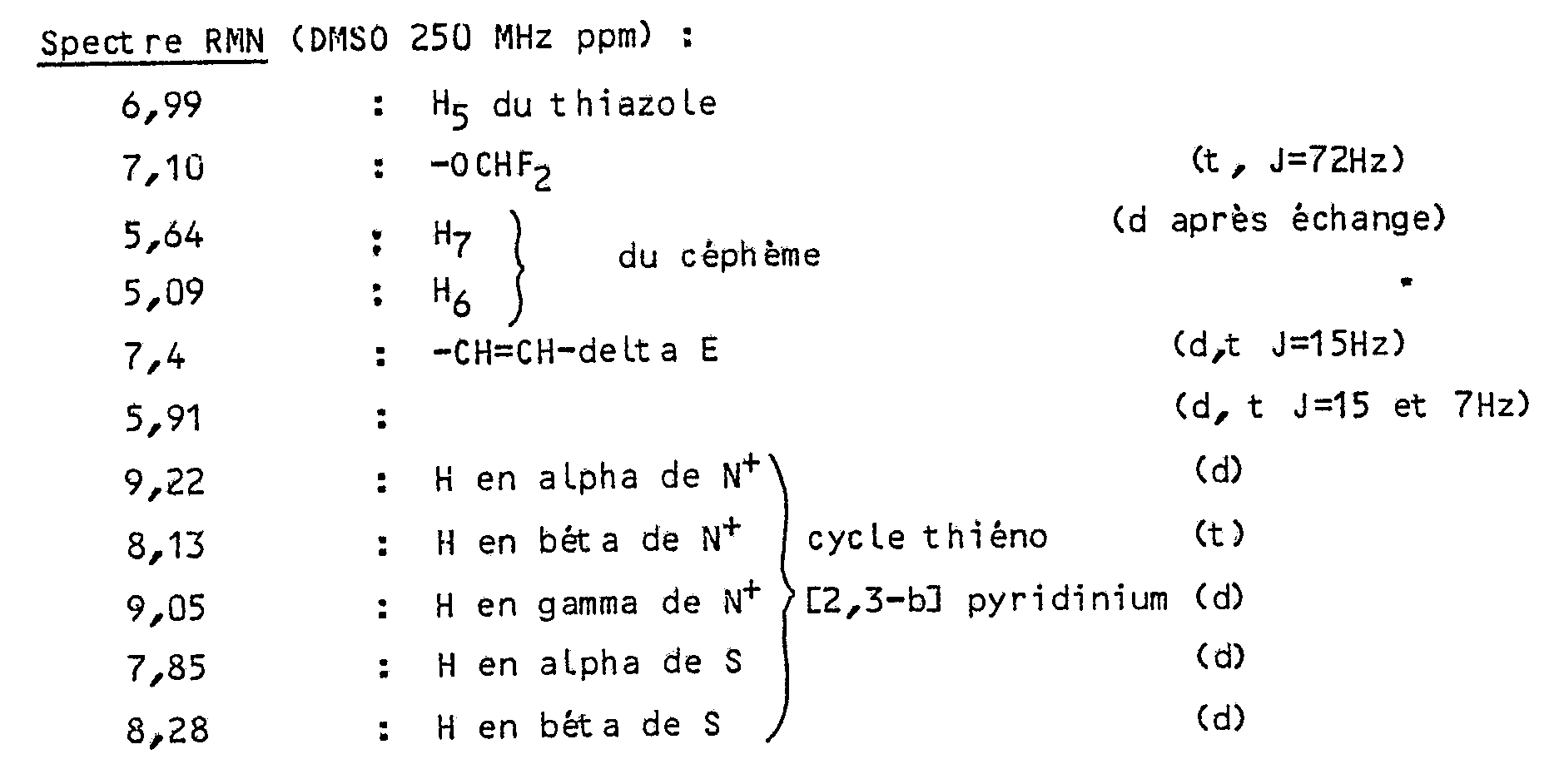
- Tétrafluoroborate de 7-[(E)-3-[(6R,7R)-2-[(diphénylméthoxy) carbonyl] 7-[[[(Z)-(méthoxyimino)] [2-[(triphénylméthyl) amino ] 4-thiazolyl] acétyl] amino] 8-oxo 5-thia 1-azabicyclo [4.2.0.] oct-2-èn-3-yl] 2-propényl] thiéno [2,3-b] pyridinium.
- On mélange 1,331 g de tétrafluoroborate d'argent et 40 cm3 de chlorure de méthylène puis ajoute le mélange constitué de 3,366 g de (6R,7R)-3-[(Z)-3-chloro 1-propényl] 7-[[[(Z)-(méthoxyimino)] ]2-[(triphénylméthyl) amino] 4-thiazolyl] acétyl] amino] 8-oxo 5-thia 1-azabicyclo [4.2.0.] oct-2-èn-2-carboxylate de diphénylméthyle, 38 cm3 de chlorure de méthylène et 1,05 cm3 de thiéno [2,3-b] pyridine. On mélange pendant 3 heures et 20 minutes à 20¤C, filtre, évapore le solvant et chromatographie sur silice en éluant au chlorure de méthylène puis avec des mélanges chlorure de méthylène-méthanol renfermant 2, 4, 6 et 8% de méthanol. On obtient finalement 2,004 g de produit attendu.

- (6R,7R)-7-[[(2-amino 4-thiazolyl) [(Z)[méthoxyimino]] acétyl] amino] 8-oxo 3-[(E)-3-[7-[thiéno [2,3-b] pyridinio] 1-propényl] 5-thia 1-azabicyclo [4.2.0.] oct-2-èn-2-carboxylate (sel interne).
- On dissout le produit obtenu au stade A dans 27 cm3 d'acide formique à 33% d'eau, place dans un bain à 70¤C pendant 1 heure puis évapore à sec. On reprend le résidu par un mélange éthanol-eau puis évapore à sec de nouveau. On empâte le résidu à l'éther et filtre. On dissout le produit dans 2,5 cm3 d'une solution aqueuse 1M de carbonate de triéthylamine et 2,5 cm3 d'acétonitrile. On effectue une HPLC sur le produit (colonne lichrosorb RP 18) en éluant avec des mélanges acétonitrile-eau (5-95), (10-90), (15-85) et (20-80). On isole sous forme liophylisée 0,652 g de produit attendu.

- On a réalisé des préparations pour injections de formule :
40 - 7-[(E)-3-[(6R,7R)-7-[[(2-amino 4-thiazolyl) [(Z)-(méthoxyimino)] acétyl] amino] 2-carboxy 8-oxo 5-thia 1-azabicyclo [4.2.0.] oct-2-èn3-yl] 2-propényl] thiéno [2,3-b] pyridinium 500 mg - Excipient aqueux stérile q.s.p. 5 cm3. - On prépare une série de tubes dans lequel on répartit une même quantité de milieu nutritif stérile. On distribue dans chaque tube des quantités croissantes du produit a étudier, puis chaque tube est ensemencé avec une souche bactérienne. Après incubation de 24 ou 48 heures à l'étuve à 37¤C, l'inhibition de la croissance est appréciée par transillumination, ce qui permet de déterminer les concentrations minimales inhibitrices (C.M.I.) exprimées en microgrammes/cm3.
- Les résultats suivants sont obtenus :

Claims (9)

dans laquelle R représent un atome d'hydrogène ou un radical alkyle, linéaire ou ramifié, alkényle, alkynyle ou cycloalkyle ayant au plus 6 atomes de carbone, chacun de ces radicaux étant éventuellement substitué ; R₁ représente un radical choisi parmi les radicaux suivants :


- le 7-[(E)-3-[(6R,7R)-7-[[(2-amino 4-thiazolyl) [(Z)-(méthoxyimino)] acétyl] amino] 2-carboxy 8-oxo 5-thia 1-azabicyclo [4.2.0.] oct-2-èn-3-yl] 2- propényl] thiéno [2,3-b] pyridinium,
- le 7-[(E)-3-[(6R,7R)-7-[[(2-amino 4-thiazolyl) [(Z)-[(difluorométhoxy) imino]] acétyl] amino] 2-carboxy 8-oxo 5-thia 1-azabicyclo [4.2.0.] oct-2-èn-3-yl] 2-propényl] thiéno [2,3-b] pyridinium,
ainsi que leurs sels avec les métaux alcalin, alcalino-terreux, le magnésium, l'ammoniaque, les bases organiques aminées, les acides, le cas échéant leurs sels internes et leurs esters facilement clivables.


Priority Applications (1)
| Application Number | Priority Date | Filing Date | Title |
|---|---|---|---|
| AT88402740T ATE101611T1 (de) | 1987-11-03 | 1988-11-02 | Cephalosporine, mit an der stelle 3 einem substituierten vinylradikal, verfahren zu ihrer herstellung, ihre anwendung als medikamente, ihre sie enthaltenden praeparate und zwischenverbindungen. |
Applications Claiming Priority (2)
| Application Number | Priority Date | Filing Date | Title |
|---|---|---|---|
| FR8715210 | 1987-11-03 | ||
| FR8715210A FR2622585B1 (fr) | 1987-11-03 | 1987-11-03 | Nouvelles cephalosporines comportant en position 3 un radical vinyle substitue, leur procede de preparation, leur application comme medicaments, les compositions les renfermant et les nouveaux intermediaires obtenus |
Publications (2)
| Publication Number | Publication Date |
|---|---|
| EP0315518A1 true EP0315518A1 (fr) | 1989-05-10 |
| EP0315518B1 EP0315518B1 (fr) | 1994-02-16 |
Family
ID=9356422
Family Applications (1)
| Application Number | Title | Priority Date | Filing Date |
|---|---|---|---|
| EP88402740A Expired - Lifetime EP0315518B1 (fr) | 1987-11-03 | 1988-11-02 | Céphalosporines comportant en position 3 un radical vinyle substitué, leur procédé de préparation, leur application comme médicaments, les compositions les renfermant et les intermédiaires obtenus |
Country Status (8)
| Country | Link |
|---|---|
| US (1) | US5075298A (fr) |
| EP (1) | EP0315518B1 (fr) |
| JP (1) | JP2717820B2 (fr) |
| AT (1) | ATE101611T1 (fr) |
| CA (1) | CA1313654C (fr) |
| DE (1) | DE3887824T2 (fr) |
| ES (1) | ES2061709T3 (fr) |
| FR (1) | FR2622585B1 (fr) |
Cited By (12)
| Publication number | Priority date | Publication date | Assignee | Title |
|---|---|---|---|---|
| EP0462009A1 (fr) * | 1990-06-15 | 1991-12-18 | Roussel Uclaf | Céphalosporines comportant en position 3 un radical propényle substitué par un ammonium quaternaire, leur procédé de préparation, leur application comme médicaments, les compositions les renfermant et les intermédiaires obtenus |
| EP0474049A1 (fr) * | 1990-08-23 | 1992-03-11 | Bristol-Myers Squibb Company | Composés antibiotiques de céphalosporines substituées au C-3 par pyrocatéchine, compositions et utilsations et utilisation de ceux-la |
| FR2684995A1 (en) * | 1991-12-12 | 1993-06-18 | Roussel Uclaf | Cephalosporins containing a ( alpha -carboxy-3,4-dihydroxybenzyloxyimino) group, preparation process and intermediates, application as medicaments and pharmaceutical compositions |
| FR2684994A1 (fr) * | 1991-12-12 | 1993-06-18 | Roussel Uclaf | Nouvelles cephalosporines comportant en position 7, un radical benzyloxyimino substitue, leur procede de preparation et leur application comme medicaments. |
| AT396108B (de) * | 1991-08-21 | 1993-06-25 | Biochemie Gmbh | Neues verfahren und neue zwischenprodukte zur herstellung von 7-aminocephalosporansaeurederivaten |
| EP0551034A3 (en) * | 1991-12-12 | 1993-08-25 | Roussel Uclaf | Cephalosporins having in position 7 a benzyloxyimino radical substitute, process for their preparation and their use as medicaments |
| FR2696180A1 (fr) * | 1992-09-28 | 1994-04-01 | Roussel Uclaf | Nouvelles céphalosporines comportant en position 7, un radical benzyloxyimino substitué, leur procédé de préparation et leur application comme médicaments. |
| FR2699177A1 (fr) * | 1992-12-11 | 1994-06-17 | Roussel Uclaf | Nouvelles céphalosporines comportant en position 7 un radical oxyimino substitué, leur procédé et intermédiaires de préparation et leur application comme médicaments. |
| EP0628562A1 (fr) * | 1993-06-10 | 1994-12-14 | Roussel Uclaf | Céphalosporines comportant en position 7 un radical oxymino substitué, leurs intermédiaires, leurs procédé de préparation et leur application comme médicaments |
| EP0636627A1 (fr) * | 1993-07-29 | 1995-02-01 | KATAYAMA SEIYAKUSYO CO. Ltd. | Composés cephem et agents antimicrobials |
| EP0723966A4 (fr) * | 1994-08-16 | 1997-01-29 | Meiji Seika Co | Nouveau derive de cepheme |
| US6583133B1 (en) | 1998-06-22 | 2003-06-24 | Basilea Pharmaceutica Ag | Propenyl cephalosporin derivatives and process for the manufacture thereof |
Families Citing this family (7)
| Publication number | Priority date | Publication date | Assignee | Title |
|---|---|---|---|---|
| US5373001A (en) * | 1990-06-15 | 1994-12-13 | Roussel Uclaf | Cephalosporins |
| US5397779A (en) * | 1990-06-15 | 1995-03-14 | Roussel-Uclaf | Cephalosporins |
| US5234920A (en) * | 1990-08-23 | 1993-08-10 | Bristol-Myers Squibb Company | Antibiotic C-7 catechol-substituted cephalosporin compounds, compositions, and method of use thereof |
| US5143911A (en) * | 1990-08-23 | 1992-09-01 | Bristol-Myers Squibb Company | Antibiotic c-3 di-hydroxyphenyl substituted cephalosporin compounds, compositions and method of use thereof |
| FR2678273B1 (fr) * | 1991-06-25 | 1995-03-03 | Roussel Uclaf | Nouvelles cephalosporines comportant un noyau 2-thia cepheme, leur procede de preparation, leur application comme medicaments, et les nouveaux intermediaires obtenus. |
| US7427680B2 (en) * | 2001-01-12 | 2008-09-23 | The Regents Of The University Of California | Fluorogenic substrates for BETA-lactamase gene expression |
| WO2005071096A2 (fr) * | 2004-01-21 | 2005-08-04 | Molecular Probes, Inc. | Substrats d'enzyme aptes a la detection optique et leur procede d'utilisation |
Citations (2)
| Publication number | Priority date | Publication date | Assignee | Title |
|---|---|---|---|---|
| GB2134522A (en) * | 1983-02-10 | 1984-08-15 | Bristol Myers Co | Cephalosporin derivatives |
| GB2157293A (en) * | 1984-04-09 | 1985-10-23 | Bristol Myers Co | Chemical compounds |
Family Cites Families (1)
| Publication number | Priority date | Publication date | Assignee | Title |
|---|---|---|---|---|
| US4708955A (en) * | 1985-06-24 | 1987-11-24 | Bristol-Myers Company | 3-(substituted)propenyl-7-aminothiazol-ylcephalosporanic acids and esters thereof |
-
1987
- 1987-11-03 FR FR8715210A patent/FR2622585B1/fr not_active Expired - Fee Related
-
1988
- 1988-10-31 US US07/265,252 patent/US5075298A/en not_active Expired - Fee Related
- 1988-11-02 DE DE3887824T patent/DE3887824T2/de not_active Expired - Fee Related
- 1988-11-02 EP EP88402740A patent/EP0315518B1/fr not_active Expired - Lifetime
- 1988-11-02 ES ES88402740T patent/ES2061709T3/es not_active Expired - Lifetime
- 1988-11-02 AT AT88402740T patent/ATE101611T1/de not_active IP Right Cessation
- 1988-11-02 CA CA000581927A patent/CA1313654C/fr not_active Expired - Fee Related
- 1988-11-04 JP JP63277542A patent/JP2717820B2/ja not_active Expired - Lifetime
Patent Citations (2)
| Publication number | Priority date | Publication date | Assignee | Title |
|---|---|---|---|---|
| GB2134522A (en) * | 1983-02-10 | 1984-08-15 | Bristol Myers Co | Cephalosporin derivatives |
| GB2157293A (en) * | 1984-04-09 | 1985-10-23 | Bristol Myers Co | Chemical compounds |
Non-Patent Citations (1)
| Title |
|---|
| PATENT ABSTRACTS OF JAPAN, vol. 9, no. 28 (C-264)[1751], 6 février 1985, page 14 C 264; & JP-A-59 172 493 (BURISUTORU BANYUU KENKYUSHO K.K.) 29-09-1984 * |
Cited By (18)
| Publication number | Priority date | Publication date | Assignee | Title |
|---|---|---|---|---|
| FR2663332A1 (fr) * | 1990-06-15 | 1991-12-20 | Roussel Uclaf | Nouvelles cephalosporines comportant en position 3 un radical propenyle substitue par un ammonium quaternaire, leur procede de preparation, leur application comme medicaments, les compositions les renfermant et les nouveaux intermediaires obtenus. |
| EP0462009A1 (fr) * | 1990-06-15 | 1991-12-18 | Roussel Uclaf | Céphalosporines comportant en position 3 un radical propényle substitué par un ammonium quaternaire, leur procédé de préparation, leur application comme médicaments, les compositions les renfermant et les intermédiaires obtenus |
| EP0474049A1 (fr) * | 1990-08-23 | 1992-03-11 | Bristol-Myers Squibb Company | Composés antibiotiques de céphalosporines substituées au C-3 par pyrocatéchine, compositions et utilsations et utilisation de ceux-la |
| US5644052A (en) * | 1991-08-21 | 1997-07-01 | Biochemie Gesellschaft M.B.H. | Process for the production of cephalosporines and novel intermediates in this process |
| AT396108B (de) * | 1991-08-21 | 1993-06-25 | Biochemie Gmbh | Neues verfahren und neue zwischenprodukte zur herstellung von 7-aminocephalosporansaeurederivaten |
| US6169180B1 (en) | 1991-08-21 | 2001-01-02 | Biochemie Gesellschaft | Process for the production of cephalosporines |
| US5686604A (en) * | 1991-08-21 | 1997-11-11 | Biochemie Gesellschaft | Cephalosporines |
| FR2684995A1 (en) * | 1991-12-12 | 1993-06-18 | Roussel Uclaf | Cephalosporins containing a ( alpha -carboxy-3,4-dihydroxybenzyloxyimino) group, preparation process and intermediates, application as medicaments and pharmaceutical compositions |
| FR2684994A1 (fr) * | 1991-12-12 | 1993-06-18 | Roussel Uclaf | Nouvelles cephalosporines comportant en position 7, un radical benzyloxyimino substitue, leur procede de preparation et leur application comme medicaments. |
| EP0551034A3 (en) * | 1991-12-12 | 1993-08-25 | Roussel Uclaf | Cephalosporins having in position 7 a benzyloxyimino radical substitute, process for their preparation and their use as medicaments |
| FR2696180A1 (fr) * | 1992-09-28 | 1994-04-01 | Roussel Uclaf | Nouvelles céphalosporines comportant en position 7, un radical benzyloxyimino substitué, leur procédé de préparation et leur application comme médicaments. |
| FR2699177A1 (fr) * | 1992-12-11 | 1994-06-17 | Roussel Uclaf | Nouvelles céphalosporines comportant en position 7 un radical oxyimino substitué, leur procédé et intermédiaires de préparation et leur application comme médicaments. |
| EP0628562A1 (fr) * | 1993-06-10 | 1994-12-14 | Roussel Uclaf | Céphalosporines comportant en position 7 un radical oxymino substitué, leurs intermédiaires, leurs procédé de préparation et leur application comme médicaments |
| US5534508A (en) * | 1993-07-29 | 1996-07-09 | Katayama Seiyakusyo Co., Ltd. | Cephem compounds and antimicrobial agents |
| EP0636627A1 (fr) * | 1993-07-29 | 1995-02-01 | KATAYAMA SEIYAKUSYO CO. Ltd. | Composés cephem et agents antimicrobials |
| EP0723966A4 (fr) * | 1994-08-16 | 1997-01-29 | Meiji Seika Co | Nouveau derive de cepheme |
| US5661144A (en) * | 1994-08-16 | 1997-08-26 | Meiji Seika Kabushiki Kaisha | Cephem derivatives with 3-substituted bis heterocycles |
| US6583133B1 (en) | 1998-06-22 | 2003-06-24 | Basilea Pharmaceutica Ag | Propenyl cephalosporin derivatives and process for the manufacture thereof |
Also Published As
| Publication number | Publication date |
|---|---|
| CA1313654C (fr) | 1993-02-16 |
| JP2717820B2 (ja) | 1998-02-25 |
| ES2061709T3 (es) | 1994-12-16 |
| ATE101611T1 (de) | 1994-03-15 |
| FR2622585A1 (fr) | 1989-05-05 |
| FR2622585B1 (fr) | 1991-04-19 |
| DE3887824D1 (de) | 1994-03-24 |
| EP0315518B1 (fr) | 1994-02-16 |
| US5075298A (en) | 1991-12-24 |
| JPH01151586A (ja) | 1989-06-14 |
| DE3887824T2 (de) | 1994-06-16 |
Similar Documents
| Publication | Publication Date | Title |
|---|---|---|
| EP0034536B1 (fr) | Nouvelles oximes dérivées de l'acide 3-alkyloxy ou 3-alkylthiométhyl 7-amino thiazolylacétamido céphalosporanique, leur préparation, leur application comme médicaments et les compositions les renfermant | |
| EP0315518B1 (fr) | Céphalosporines comportant en position 3 un radical vinyle substitué, leur procédé de préparation, leur application comme médicaments, les compositions les renfermant et les intermédiaires obtenus | |
| EP0462009B1 (fr) | Céphalosporines comportant en position 3 un radical propényle substitué par un ammonium quaternaire, leur procédé de préparation, leur application comme médicaments, les compositions les renfermant et les intermédiaires obtenus | |
| CH633292A5 (fr) | Oximes derivees de l'acide 3-acetoxymethyl 7-amino thiazolyl acetamido cephalosporanique, procede de preparation et compositions pharmaceutiques. | |
| FR2474034A2 (fr) | Nouvelles oximes 0-substituees derivees de l'acide 7-aminothiazolyl acetamido cephalosporanique, leur procede de preparation et leur application comme medicaments | |
| CH629815A5 (en) | Oximes derived from 7-(aminothiazolylacetamido)cephalosporanic acid, process of preparation and pharmaceutical compositions | |
| CA1148937A (fr) | Procede de preparation de nouvelles aco-yloximes substituees derivees de l'acide 7-(2-amino 4-thiazolyl) acetamido cephalosporanique | |
| FR2610629A2 (fr) | Nouveaux derives de l'acide 1-dethia 2-thia cephalosporanique, leur procede de preparation, leur application comme medicaments et les compositions pharmaceutiques les contenant | |
| LU84146A1 (fr) | Nouveaux produits derives de l'acide 2-amino thiazolyl 2-oxyimino acetamido bicyclo-octene carboxylique,leur preparation leur application comme medicaments,les compositions les renfermant et les nouveaux intermediaires obtenus | |
| CH639388A5 (fr) | Cephalosporines derivees de l'acide 7-/2-(2-amino 4-thiazolyl) 2-(carboxymethoxyimino) acetamido/ 3-substitue cephalosporanique, leurs procedes de preparation et medicaments les renfermant. | |
| EP0520880A1 (fr) | Nouvelles céphalosporines comportant un noyau 2-thia céphème, leur procédé de préparation, leur application comme médicaments, les compositions pharmaceutiques les renfermant et les nouveaux intermédiaires obtenus | |
| EP0104671B1 (fr) | Nouvelles oximes dérivées de l'acide 3-alkyloxy ou 3-alkylthiométhyl-7 amino thiazolylacétamido céphalosporaniques, leur préparation, leur application comme médicaments et les compositions les renfermant | |
| EP0282365B1 (fr) | Dérivés de l'acide l-déthia 2-thia céphalosporanique, leur procédé de préparation, leur application comme médicaments et les compositions pharmaceutiques les contenant | |
| CH638811A5 (fr) | Oximes o-substituees derivees de l'acide 7-amino thiazolyl acetamido cephalosporanique et les compositions pharmaceutiques les renfermant. | |
| CA2111164A1 (fr) | Cephalosporines comportant en position 7 un radical oxyimino substitue, leurs procede et intermediaires de preparation et leur application comme medicaments | |
| CH640858A5 (fr) | Oximes derivees de l'acide 3-azidomethyl 7-amino thiazolyl acetamido cephalosporanique, leurs procedes de preparation et les medicaments les renfermant. | |
| CA1140113A (fr) | Procede de preparation de nouvelles oximes 0-substituees par un radical comportant un ammonium quatermaire et derivees de l'acide 7-amino thiazolyl acetamido cephalosporanique | |
| FR2684995A1 (en) | Cephalosporins containing a ( alpha -carboxy-3,4-dihydroxybenzyloxyimino) group, preparation process and intermediates, application as medicaments and pharmaceutical compositions | |
| FR2499995A1 (fr) | Nouvelles oximes derivees de l'acide 3-alkyloxy ou 3-alkylthiomethyl 7-amino thiazolylacetamido cephalosporanique, leur preparation, leur application comme medicaments, les compositions les renfermant et les nouveaux intermediaires obtenus. | |
| EP0761672B1 (fr) | Nouvelles céphalosporines comportant en position 7 un radical benzyloxyimino substitué, leurs procédés et intermédiaires de préparation, leur application comme médicaments | |
| FR2722790A1 (fr) | Nouvelles cephalosporines comportant en position 7 un radical benzyloxymino subtitue, leur procede de preparation leur application comme medicaments | |
| FR2506307A1 (fr) | Nouveaux derives substitues de l'acide 2-(2-amino 4-thiazolyl) 2-hydroxyimino acetique et leur procede de preparation | |
| FR2553770A2 (fr) | Nouveaux produits derives de l'acide 2(2-amino thiazol-4-yl) 2-alcoxy-imino acetique substitues sur l'oxime et leur procede de preparation | |
| FR2699177A1 (fr) | Nouvelles céphalosporines comportant en position 7 un radical oxyimino substitué, leur procédé et intermédiaires de préparation et leur application comme médicaments. | |
| FR2481288A2 (fr) | Nouvelles oximes o-substituees derivees de l'acide 7-aminothiazolyl acetamido cephalosporanique, leur procede de preparation et leur application comme medicaments |
Legal Events
| Date | Code | Title | Description |
|---|---|---|---|
| PUAI | Public reference made under article 153(3) epc to a published international application that has entered the european phase |
Free format text: ORIGINAL CODE: 0009012 |
|
| AK | Designated contracting states |
Kind code of ref document: A1 Designated state(s): AT BE CH DE ES FR GB GR IT LI LU NL SE |
|
| 17P | Request for examination filed |
Effective date: 19890914 |
|
| 17Q | First examination report despatched |
Effective date: 19910906 |
|
| GRAA | (expected) grant |
Free format text: ORIGINAL CODE: 0009210 |
|
| ITF | It: translation for a ep patent filed | ||
| AK | Designated contracting states |
Kind code of ref document: B1 Designated state(s): AT BE CH DE ES FR GB GR IT LI LU NL SE |
|
| REF | Corresponds to: |
Ref document number: 101611 Country of ref document: AT Date of ref document: 19940315 Kind code of ref document: T |
|
| REF | Corresponds to: |
Ref document number: 3887824 Country of ref document: DE Date of ref document: 19940324 |
|
| REG | Reference to a national code |
Ref country code: GR Ref legal event code: FG4A Free format text: 3010775 |
|
| GBT | Gb: translation of ep patent filed (gb section 77(6)(a)/1977) |
Effective date: 19940413 |
|
| REG | Reference to a national code |
Ref country code: ES Ref legal event code: FG2A Ref document number: 2061709 Country of ref document: ES Kind code of ref document: T3 |
|
| PLBE | No opposition filed within time limit |
Free format text: ORIGINAL CODE: 0009261 |
|
| STAA | Information on the status of an ep patent application or granted ep patent |
Free format text: STATUS: NO OPPOSITION FILED WITHIN TIME LIMIT |
|
| EAL | Se: european patent in force in sweden |
Ref document number: 88402740.0 |
|
| 26N | No opposition filed | ||
| REG | Reference to a national code |
Ref country code: FR Ref legal event code: CD Ref country code: FR Ref legal event code: CA |
|
| REG | Reference to a national code |
Ref country code: FR Ref legal event code: TP |
|
| REG | Reference to a national code |
Ref country code: CH Ref legal event code: PFA Free format text: ROUSSEL-UCLAF TRANSFER- ROUSSEL UCLAF * ROUSSEL UCLAF TRANSFER- HOECHST MARION ROUSSEL |
|
| REG | Reference to a national code |
Ref country code: GB Ref legal event code: 732E |
|
| NLS | Nl: assignments of ep-patents |
Owner name: HOECHST MARION ROUSSEL |
|
| REG | Reference to a national code |
Ref country code: FR Ref legal event code: TP |
|
| PGFP | Annual fee paid to national office [announced via postgrant information from national office to epo] |
Ref country code: GB Payment date: 20011025 Year of fee payment: 14 |
|
| PGFP | Annual fee paid to national office [announced via postgrant information from national office to epo] |
Ref country code: SE Payment date: 20011029 Year of fee payment: 14 |
|
| PGFP | Annual fee paid to national office [announced via postgrant information from national office to epo] |
Ref country code: ES Payment date: 20011114 Year of fee payment: 14 Ref country code: CH Payment date: 20011114 Year of fee payment: 14 |
|
| PGFP | Annual fee paid to national office [announced via postgrant information from national office to epo] |
Ref country code: LU Payment date: 20011116 Year of fee payment: 14 Ref country code: BE Payment date: 20011116 Year of fee payment: 14 |
|
| PGFP | Annual fee paid to national office [announced via postgrant information from national office to epo] |
Ref country code: FR Payment date: 20011128 Year of fee payment: 14 |
|
| PGFP | Annual fee paid to national office [announced via postgrant information from national office to epo] |
Ref country code: GR Payment date: 20011129 Year of fee payment: 14 Ref country code: AT Payment date: 20011129 Year of fee payment: 14 |
|
| PGFP | Annual fee paid to national office [announced via postgrant information from national office to epo] |
Ref country code: NL Payment date: 20011130 Year of fee payment: 14 |
|
| REG | Reference to a national code |
Ref country code: GB Ref legal event code: IF02 |
|
| PGFP | Annual fee paid to national office [announced via postgrant information from national office to epo] |
Ref country code: DE Payment date: 20020130 Year of fee payment: 14 |
|
| PG25 | Lapsed in a contracting state [announced via postgrant information from national office to epo] |
Ref country code: LU Free format text: LAPSE BECAUSE OF NON-PAYMENT OF DUE FEES Effective date: 20021102 Ref country code: GB Free format text: LAPSE BECAUSE OF NON-PAYMENT OF DUE FEES Effective date: 20021102 Ref country code: AT Free format text: LAPSE BECAUSE OF NON-PAYMENT OF DUE FEES Effective date: 20021102 |
|
| PG25 | Lapsed in a contracting state [announced via postgrant information from national office to epo] |
Ref country code: SE Free format text: LAPSE BECAUSE OF NON-PAYMENT OF DUE FEES Effective date: 20021103 Ref country code: ES Free format text: LAPSE BECAUSE OF NON-PAYMENT OF DUE FEES Effective date: 20021103 |
|
| REG | Reference to a national code |
Ref country code: CH Ref legal event code: PFA Free format text: HOECHST MARION ROUSSEL TRANSFER- AVENTIS PHARMA S.A. |
|
| PG25 | Lapsed in a contracting state [announced via postgrant information from national office to epo] |
Ref country code: LI Free format text: LAPSE BECAUSE OF NON-PAYMENT OF DUE FEES Effective date: 20021130 Ref country code: CH Free format text: LAPSE BECAUSE OF NON-PAYMENT OF DUE FEES Effective date: 20021130 Ref country code: BE Free format text: LAPSE BECAUSE OF NON-PAYMENT OF DUE FEES Effective date: 20021130 |
|
| NLS | Nl: assignments of ep-patents |
Owner name: AVENTIS PHARMA S.A. |
|
| BECA | Be: change of holder's address |
Owner name: S.A. *AVENTIS PHARMA20 AVENUE RAYMOND ARON, F-9216 Effective date: 20030311 |
|
| BECH | Be: change of holder |
Owner name: S.A. *AVENTIS PHARMA Effective date: 20030311 |
|
| BERE | Be: lapsed |
Owner name: S.A. *AVENTIS PHARMA Effective date: 20021130 |
|
| PG25 | Lapsed in a contracting state [announced via postgrant information from national office to epo] |
Ref country code: NL Free format text: LAPSE BECAUSE OF NON-PAYMENT OF DUE FEES Effective date: 20030601 |
|
| PG25 | Lapsed in a contracting state [announced via postgrant information from national office to epo] |
Ref country code: DE Free format text: LAPSE BECAUSE OF NON-PAYMENT OF DUE FEES Effective date: 20030603 |
|
| PG25 | Lapsed in a contracting state [announced via postgrant information from national office to epo] |
Ref country code: GR Free format text: LAPSE BECAUSE OF NON-PAYMENT OF DUE FEES Effective date: 20030609 |
|
| GBPC | Gb: european patent ceased through non-payment of renewal fee | ||
| EUG | Se: european patent has lapsed | ||
| REG | Reference to a national code |
Ref country code: CH Ref legal event code: PL |
|
| PG25 | Lapsed in a contracting state [announced via postgrant information from national office to epo] |
Ref country code: FR Free format text: LAPSE BECAUSE OF NON-PAYMENT OF DUE FEES Effective date: 20030731 |
|
| NLV4 | Nl: lapsed or anulled due to non-payment of the annual fee |
Effective date: 20030601 |
|
| REG | Reference to a national code |
Ref country code: FR Ref legal event code: ST |
|
| REG | Reference to a national code |
Ref country code: ES Ref legal event code: FD2A Effective date: 20031213 |
|
| PG25 | Lapsed in a contracting state [announced via postgrant information from national office to epo] |
Ref country code: IT Free format text: LAPSE BECAUSE OF NON-PAYMENT OF DUE FEES;WARNING: LAPSES OF ITALIAN PATENTS WITH EFFECTIVE DATE BEFORE 2007 MAY HAVE OCCURRED AT ANY TIME BEFORE 2007. THE CORRECT EFFECTIVE DATE MAY BE DIFFERENT FROM THE ONE RECORDED. Effective date: 20051102 |