EP0316140A2 - Composition de résine aromatique thermodurcissable - Google Patents
Composition de résine aromatique thermodurcissable Download PDFInfo
- Publication number
- EP0316140A2 EP0316140A2 EP88310499A EP88310499A EP0316140A2 EP 0316140 A2 EP0316140 A2 EP 0316140A2 EP 88310499 A EP88310499 A EP 88310499A EP 88310499 A EP88310499 A EP 88310499A EP 0316140 A2 EP0316140 A2 EP 0316140A2
- Authority
- EP
- European Patent Office
- Prior art keywords
- condensed
- mixture
- resin
- polynuclear aromatic
- composition
- Prior art date
- Legal status (The legal status is an assumption and is not a legal conclusion. Google has not performed a legal analysis and makes no representation as to the accuracy of the status listed.)
- Granted
Links
Images
Classifications
-
- C—CHEMISTRY; METALLURGY
- C08—ORGANIC MACROMOLECULAR COMPOUNDS; THEIR PREPARATION OR CHEMICAL WORKING-UP; COMPOSITIONS BASED THEREON
- C08G—MACROMOLECULAR COMPOUNDS OBTAINED OTHERWISE THAN BY REACTIONS ONLY INVOLVING UNSATURATED CARBON-TO-CARBON BONDS
- C08G10/00—Condensation polymers of aldehydes or ketones with aromatic hydrocarbons or halogenated aromatic hydrocarbons only
- C08G10/02—Condensation polymers of aldehydes or ketones with aromatic hydrocarbons or halogenated aromatic hydrocarbons only of aldehydes
Definitions
- This invention relates to a novel thermosetting resin composition and to a process for the production of a heat-resisting, condensed polynuclear aromatic hydrocarbon resin.
- Aromatic polyamide and polyimide resins, phenol resins and their modified resins are examples of known aromatic polymers.
- thermosetting resin composition affording an infusible, insoluble, condensed, polynuclear aromatic hydrocarbon resin (COPNA resin).
- the thermosetting resin composition includes a fusible product obtained by reacting a mixture containing (a) one or more condensed polynuclear aromatic compounds having at least three condensed benzene rings, (b) a crosslinking agent containing an aromatic compound having at least two hydroxymethyl or halomethyl groups, and (c) an acid catalyst, to crosslink the aromatic compounds.
- the thermosetting resin composition is suitably used as binders 20 and as raw materials for the production of heat resisting, molded articles.
- the COPNA resin obtained from the known thermosetting resin composition has been found to begin decomposing when heated to a temperature of about 450 °C in an inert atmosphere.
- the thermal decomposition of the COPNA resin proceeds rapidly with the simultaneous reduction in weight.
- the weight loss generally exceeds 50 % when heated to 800 °C.
- the present invention has been made to overcome the above problems and has as its object the provision of a thermosetting resin composition which affords an improved COPNA resin having an excellent heat resisting property.
- thermosetting resin composition comprising a fusible product obtained by a method including the steps of: providing a mixture which comprises (a) a raw material containing one or more condensed polynuclear aromatic compounds having at least two condensed benzene rings, (b) a crosslinking agent containing an aromatic compound having one or more aldehyde groups directly bonded to the aromatic nuclei thereof, and (c) an acid catalyst; and reacting said mixture at a temperature sufficient to effect the crosslinking of said one or more condensed polynuclear aromatic compounds, thereby to obtain said fusible product.
- the present invention provides a process for the production of a heat-resisting, condensed polynuclear aromatic hydrocarbon resin, comprising the steps of: providing a mixture which comprises (a) a raw material containing one or more condensed polynuclear aromatic compounds having at least two condensed benzene rings, (b) a crosslinking agent containing an aromatic compound having one or more aldehyde groups directly bonded to the aromatic nuclei thereof, and (c) an acid catalyst; reacting said mixture at a temperature sufficient to effect the crosslinking of said one or more condensed polynuclear aromatic compounds and to form the heat-resisting, condensed plynuclear aromatic hydrocarbon resin as an infusible product.
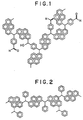
- FIG. 1 and 2 are schematic representations of the chemical structures of precursors (B-stage resins) of COPNA resins according to the present invention.
- thermosetting resin composition comprises a fusible product (B-stage resin) obtained by reacting a mixture containing (a) a raw material containing one or more condensed polynuclear aromatic compounds having at least two condensed benzene rings, (b) a crosslinking agent containing an aromatic compound having one or more aldehyde groups directly bonded to the aromatic nuclei thereof, and (c) an acid catalyst to crosslink the condensed polynuclear aromatic compound or compounds.
- B-stage resin obtained by reacting a mixture containing (a) a raw material containing one or more condensed polynuclear aromatic compounds having at least two condensed benzene rings, (b) a crosslinking agent containing an aromatic compound having one or more aldehyde groups directly bonded to the aromatic nuclei thereof, and (c) an acid catalyst to crosslink the condensed polynuclear aromatic compound or compounds.
- suitable condensed polynuclear aromatic compounds to be used as the raw material (a) include naphthalene, phenanthrene, anthracene, pyrene, chrysene, naphthacene, fluoranthene, perylene, picene, benzpyrenes, benzperylenes, and mixtures thereof.
- Derivatives of these aromatic compounds such as those having one or more substituents bonded to their aromatic nuclei and selected from alkyl groups, a hydroxyl group, alkoxy groups and a carboxy group may also be suitably used.
- Coal tar, coal tar pitches and petroleum pitches are also preferred examples of the raw material.
- crosslinking agent (b) examples include benzaldehyde, terephthaladehyde and naphthylaldehyde. Derivatives of these aldehydes, such as those having one or more substituents bonded to their aromatic nuclei and selected from alkyl groups, a hydroxymethyl group, alkoxy groups and a carboxyl group may also be used.
- Any acid catalyst conventionally used for catalyzing electrophilic substitution may be used for the crosslinking of the raw material.
- suitable acid catalysts (c) are p-toluenesulfonic acid, trichloroacetic acid, sulfuric acid and other proton acids.
- the molar ratio of the crosslinking agent (b) to the raw material (a) is preferably 0.75:1 to 3.0:1. When the molar ratio is below 0.75:1, the amount of unreacted raw material (a) in the product is increased. When the molar ratio exceeds 3:1, the amount of unreacted crosslinking agent (b) is increased in the product.
- the crosslinking reaction can be effected with or without using a solvent. When no solvent is used, the reaction proceed in a fused state. It is also possible to carry out the crosslinking reaction in a slurried form using an alcohol as a reaction medium.
- the reaction for the formation of the B-stage resin is performed at a temperature of, generally 100-350 °C, preferably 140-350 °C, though the tempeature varies with the kinds and amounts of the raw material, crosslinking agent and acid catalyst.
- the reactivity of the raw material decreases in the order of: naphthol> pyrene, anthracene> pitches» phenanthrene, methylnaphthalene and naphthalene.
- the last three compounds have quite low reactivity and require a reaction temperature of 200-350 °C for forming a B-stage resin when p-toluenesulfonic acid is used in an amount of 5 wt %.
- a reaction temperature of 160 °C can give the B-stage resin.
- B-stage resin is generally insoluble in methanol and n-hexane, hardly soluble in benzene and soluble in pyridine, quinoline and tetrahydrofuran.
- the B-stage resin obtained at an early stage of the reaction is in the form of a paste at room temperature. As the reaction proceeds further, the softening point of the B-stage resin becomes high.
- the reaction be continued so that the resulting B-stge resin becomes fluid at a temperature of 70-120 °C.
- the reaction is suitably allowed to proceed so that the resulting resin has a viscosity suitable for pouring into a mold cavity at a temperature of 80-150 °C. If the molding or shaping is carried out using powder of the B-stage resin, the reaction is desirably performed so as to obtain the B-stage resin with a high melting point.
- the B-stage resin has a chemical structure represented by a model structure shown in Figs. 1 and 2.
- the B-stage resin of Fig. 1 is obtained using pyrene as the condensed polynuclear aromatic compound (a) and terephthaldehyde as the crosslinking agent (b), while the B-stage resin of Fig. 2 is obtained using pyrene as the aromatic compound (a) and benzaldehyde as the crosslinking agent.
- the pyrene molecules are crosslinked by methyne linkages derived from the aldehyde compounds.
- the model structures are in well conformity with those deduced from the results of infra-red spectra and elementary analyses.
- the B-stage resin can be formed into films, powder or fibers and can be used together with an inorganic fibers such as carbon fibers and glass fibers for the formation of a composite material.
- the B-stage resin gives, when heated to 130 °C or more, a COPNA resin which is infusible and insoluble in a solvent and which has an excellent heat resistance.
- the formation of COPNA resin is considered to result from the formation of new condensed rings accompanied with dehydrogenation.
- the conversion of the B-stage resin into the COPNA resin can be also effected by contacting the B-stage resin with a concentrated acid such as concentrated sulfuric acid. This method is effective in hardening a thin film of the B-stage resin.
- the COPNA resin may be of course prepared directly from the previously described mixture.
- the COPNA resin with excellent properties can be obtained when it is post-treated by heating it at a temperature of 250-350 °C.
- thermosetting composition containing pyrene, benzaldehyde and p-toluenesulfonic acid and having a molar ratio of benzaldehyde to pyrene of 1.25 and a p-toluenesulfonic acid concentration of 5 % by weight was thoroughly pulverized and mixed, and the mixture (10 g) was placed into a test tube. The contents in the test tube were then heated to 160 °C and maintained at that temperature for 6 hours to obtain a black product (B-stage resin) having a softening point of about 120 °C. The heating of the B-stage resin at 160 °C for 3 hours gave an infusible product (COPNA resin) which was insoluble in organic solvents.
- COPNA resin infusible product
- the infusible product was further heated at 300 °C for 30 minutes (post-treatment) and then subjected to a thermograviometric analysis (heating rate 10 °C/minute) to reveal that the COPNA resin began decomposing at a temperature of 503 °C.
- the decomposition proceeded slowly as the temperature is raised. At 800 °C, the reduction in weight was about 50 %.
- thermosetting composition (10 g) containing pyrene, terephthaldehyde and p-toluenesulfonic acid and having a molar ratio of the aldehyde to pyrene of 1.25 and a p-toluene-sulfonic acid concentration of 5 % by weight was thoroughly mixed and the mixture was placed in a test tube. The contents in the test tube were then heated with stirring under a nitrogen stream at 160 °C. After 90 minutes from the commencement of the heating, the mixture became impossible to stir. Thus, the heating was stopped and the reaction mixture was allowed to be cooled to room temperature. A black glassy product (B-stage resin) having a softening point of 130 °C was obtained.
- This resin was converted into a hardened, infusible, insoluble product (COPNA resin) upon heated at 150 °C for 24 hours.
- the infusible product was further heated at 300 °C for 30 minutes (post-treatment) and then subjected to a thermograviometric analysis (heating rate 10 °C/minute) to reveal that the COPNA resin began decomposing at a temperature of 525 °C.
- the decomposition proceeded slowly as the temperature is raised. At 800 °C, the reduction in weight was about 55 %.
- Thermosetting compositions containing the aromatic compounds shown in Table 1 below, terephthaldehyde and p-toluenesulfonic acid and each having a molar ratio of the aldehyde to the aromatic compound of 1.25 and a p-toluenesulfonic acid concentration of 5 % by weight were each thoroughly mixed and each mixture was placed in a test tube. The contents in each test tube were then heated with stirring under a nitrogen stream at 160 °C. As the reaction proceeded, the mixture was turned cream color in the case of beta-naphthol and black in the other cases. The heating was stopped when it became impossible to continue the stirring.
- the time period from the commencement till the stop of the heating was herein defined as a time period required for forming B-stage resin, and the results were as shown in Table 1.
- the reactivities of the aromatic compounds were found to decrease in the order of beta-naphthol, pyrene, anthracene, phenanthrene, methylnaphthalene and naphthalene.
- the last three compounds failed to give B-stage resins in the above reaction conditions.
- the B-stage resins obtained with the use of beta-naphthol, pyrene and anthracene had softening points of 100-130 °C and gave infusible, insoluble resins (COPNA resins) upon further heat treatments.
Landscapes
- Chemical & Material Sciences (AREA)
- Health & Medical Sciences (AREA)
- Chemical Kinetics & Catalysis (AREA)
- Medicinal Chemistry (AREA)
- Polymers & Plastics (AREA)
- Organic Chemistry (AREA)
- Polyoxymethylene Polymers And Polymers With Carbon-To-Carbon Bonds (AREA)
- Phenolic Resins Or Amino Resins (AREA)
Applications Claiming Priority (2)
| Application Number | Priority Date | Filing Date | Title |
|---|---|---|---|
| JP28208087 | 1987-11-10 | ||
| JP282080/87 | 1987-11-10 |
Publications (3)
| Publication Number | Publication Date |
|---|---|
| EP0316140A2 true EP0316140A2 (fr) | 1989-05-17 |
| EP0316140A3 EP0316140A3 (en) | 1990-07-04 |
| EP0316140B1 EP0316140B1 (fr) | 1994-11-23 |
Family
ID=17647865
Family Applications (1)
| Application Number | Title | Priority Date | Filing Date |
|---|---|---|---|
| EP88310499A Expired - Lifetime EP0316140B1 (fr) | 1987-11-10 | 1988-11-08 | Composition de résine aromatique thermodurcissable |
Country Status (3)
| Country | Link |
|---|---|
| US (1) | US4866157A (fr) |
| EP (1) | EP0316140B1 (fr) |
| DE (1) | DE3852170T2 (fr) |
Cited By (2)
| Publication number | Priority date | Publication date | Assignee | Title |
|---|---|---|---|---|
| EP0414537A3 (en) * | 1989-08-23 | 1992-10-07 | Director-General Of Agency Of Industrial Science And Technology | Organic ferromagnetic substance |
| CN102453227A (zh) * | 2010-10-26 | 2012-05-16 | 武汉保华石化新材料开发有限公司 | 一种制备多环芳烃树脂的方法 |
Families Citing this family (4)
| Publication number | Priority date | Publication date | Assignee | Title |
|---|---|---|---|---|
| US4954536A (en) * | 1988-04-20 | 1990-09-04 | Tokico Ltd. | Brake-friction material |
| US4954607A (en) * | 1988-08-25 | 1990-09-04 | Gunma University | Ferromagnetic organic substance having triaryl methane structure and process for manufacturing the same |
| US5419900A (en) * | 1993-05-19 | 1995-05-30 | The United States Of America As Represented By The Department Of Of Health And Human Services | Immunologic enhancement with intermittent interleukin-2 therapy |
| CN116836370A (zh) * | 2023-06-30 | 2023-10-03 | 华东理工大学 | 使用石化富芳烃油制备copna树脂的方法及copna树脂的用途 |
Family Cites Families (10)
| Publication number | Priority date | Publication date | Assignee | Title |
|---|---|---|---|---|
| DE387836C (de) * | 1918-09-29 | 1924-01-04 | Chemische Fabriken | Verfahren zur Darstellung von Harzen |
| GB633923A (en) * | 1947-12-16 | 1949-12-30 | Dorman Long & Company Ltd | Manufacture of resins from aldehydes and aromatic hydrocarbons |
| NL256860A (fr) * | 1959-10-14 | |||
| GB942223A (en) * | 1961-07-24 | 1963-11-20 | Exxon Research Engineering Co | Preparation of resins from aromatics and aldehydes |
| US3565832A (en) * | 1967-09-05 | 1971-02-23 | Hughes Aircraft Co | Polymerization of aromatic monomers in presence of lewis acid catalyst and oxygen |
| US4192824A (en) * | 1976-09-23 | 1980-03-11 | Coal Industry (Patents) Limited | Aromatic hydrocarbon resins |
| EP0027305A1 (fr) * | 1979-09-21 | 1981-04-22 | Coal Industry (Patents) Limited | Résines polyamide-imides thermiquement stables dérivées de phénanthrène et procédé pour leur préparation |
| US4403089A (en) * | 1980-07-25 | 1983-09-06 | Johnson & Johnson Products, Inc. | Carboxylated naphthalene formaldehyde condensation polymers as dental plaque barriers |
| US4758653A (en) * | 1985-02-18 | 1988-07-19 | Fuji Standard Research Inc. | Thermosetting composition, method of producing fusible thermosetting resin using same, and process for the production of condensed, polynuclear aromatic hydrocarbon resin using same |
| US4788341A (en) * | 1987-10-13 | 1988-11-29 | Eastman Kodak Company | Process for preparing 2-acetonaphthones |
-
1988
- 1988-11-07 US US07/268,048 patent/US4866157A/en not_active Expired - Fee Related
- 1988-11-08 EP EP88310499A patent/EP0316140B1/fr not_active Expired - Lifetime
- 1988-11-08 DE DE3852170T patent/DE3852170T2/de not_active Expired - Fee Related
Cited By (3)
| Publication number | Priority date | Publication date | Assignee | Title |
|---|---|---|---|---|
| EP0414537A3 (en) * | 1989-08-23 | 1992-10-07 | Director-General Of Agency Of Industrial Science And Technology | Organic ferromagnetic substance |
| CN102453227A (zh) * | 2010-10-26 | 2012-05-16 | 武汉保华石化新材料开发有限公司 | 一种制备多环芳烃树脂的方法 |
| CN102453227B (zh) * | 2010-10-26 | 2013-05-22 | 武汉保华石化新材料开发有限公司 | 一种制备多环芳烃树脂的方法 |
Also Published As
| Publication number | Publication date |
|---|---|
| DE3852170D1 (de) | 1995-01-05 |
| EP0316140B1 (fr) | 1994-11-23 |
| DE3852170T2 (de) | 1995-06-22 |
| US4866157A (en) | 1989-09-12 |
| EP0316140A3 (en) | 1990-07-04 |
Similar Documents
| Publication | Publication Date | Title |
|---|---|---|
| US4362860A (en) | Addition curing polystyryl pyridine | |
| EP0196160B1 (fr) | Composition thermodurcissable, procédé de préparation d'une résine thermodurcissable fusible utilisant cette composition et procédé de préparation d'une résine hydrocarbure aromatique polynucléaire condensée utilisant une de ces compositions | |
| US4866157A (en) | Thermosetting aromatic resin composition | |
| SU867317A3 (ru) | Термостойка термореактивна композици | |
| US4839446A (en) | Thermosetting bis oxazoline-polyphenol based resins for resin transfer molding which contain a monooxazine or monooxazoline diluent | |
| JPS62521A (ja) | 縮合多環多核芳香族樹脂の製造方法及びその製造に用いる熱硬化性組成物 | |
| DE2749190C2 (fr) | ||
| US5372702A (en) | Composition for use in the production of composite carbon materials, composition carbon material produced therefrom, and process for producing the same | |
| JPS6291537A (ja) | フェノ−ル樹脂を基材とするクリ−プのないプレプレグの製造方法 | |
| JPH02274714A (ja) | 石油系重質油類またはピッチ類により変性したフェノール樹脂の製造法 | |
| US4525573A (en) | Thermoset polymers and prepolymers obtained by polycondensation of alkyl pyridine with hydroxyl aromatic monoaldehydes | |
| JPH01230614A (ja) | 熱硬化性樹脂組成物及び縮合多環芳香族樹脂の製造方法 | |
| JPS61235413A (ja) | フエノ−ル変性芳香族炭化水素ホルムアルデヒド樹脂の製造方法 | |
| EP0064055B1 (fr) | Resols et lamines de phenol-formaldehyde | |
| JPS6351419A (ja) | 熱硬化性炭化水素樹脂の製造方法 | |
| JPS6351421A (ja) | 高炭化収率を与える熱硬化性樹脂の製造方法 | |
| JPS6257413A (ja) | 熱硬化性組成物 | |
| JPS63112147A (ja) | 炭素、黒鉛質接着構造物及びその製造方法 | |
| JPH01101320A (ja) | 熱硬化性芳香族炭化水素樹脂の製造方法 | |
| SU1054366A1 (ru) | Способ получени феноформолитов | |
| JPH0693086A (ja) | 熱硬化性組成物 | |
| JPS6322814A (ja) | 熱硬化性耐熱樹脂組成物の製造方法 | |
| JPS6215217A (ja) | ビスフエノ−ルaノボラツク樹脂の製造法 | |
| JPS62207314A (ja) | 熱硬化性炭化水素樹脂の製造方法 | |
| JPS6351426A (ja) | 熱硬化性炭化水素樹脂の製造方法 |
Legal Events
| Date | Code | Title | Description |
|---|---|---|---|
| PUAI | Public reference made under article 153(3) epc to a published international application that has entered the european phase |
Free format text: ORIGINAL CODE: 0009012 |
|
| AK | Designated contracting states |
Kind code of ref document: A2 Designated state(s): DE FR GB |
|
| PUAL | Search report despatched |
Free format text: ORIGINAL CODE: 0009013 |
|
| AK | Designated contracting states |
Kind code of ref document: A3 Designated state(s): DE FR GB |
|
| 17P | Request for examination filed |
Effective date: 19901204 |
|
| 17Q | First examination report despatched |
Effective date: 19920805 |
|
| GRAA | (expected) grant |
Free format text: ORIGINAL CODE: 0009210 |
|
| AK | Designated contracting states |
Kind code of ref document: B1 Designated state(s): DE FR GB |
|
| REF | Corresponds to: |
Ref document number: 3852170 Country of ref document: DE Date of ref document: 19950105 |
|
| ET | Fr: translation filed | ||
| PLBE | No opposition filed within time limit |
Free format text: ORIGINAL CODE: 0009261 |
|
| STAA | Information on the status of an ep patent application or granted ep patent |
Free format text: STATUS: NO OPPOSITION FILED WITHIN TIME LIMIT |
|
| PG25 | Lapsed in a contracting state [announced via postgrant information from national office to epo] |
Ref country code: GB Effective date: 19951108 |
|
| 26N | No opposition filed | ||
| GBPC | Gb: european patent ceased through non-payment of renewal fee |
Effective date: 19951108 |
|
| PG25 | Lapsed in a contracting state [announced via postgrant information from national office to epo] |
Ref country code: FR Effective date: 19960731 |
|
| PG25 | Lapsed in a contracting state [announced via postgrant information from national office to epo] |
Ref country code: DE Effective date: 19960801 |
|
| REG | Reference to a national code |
Ref country code: FR Ref legal event code: ST |