EP0317059A2 - Wähl-Nebenstellenanlagen - Google Patents
Wähl-Nebenstellenanlagen Download PDFInfo
- Publication number
- EP0317059A2 EP0317059A2 EP88308630A EP88308630A EP0317059A2 EP 0317059 A2 EP0317059 A2 EP 0317059A2 EP 88308630 A EP88308630 A EP 88308630A EP 88308630 A EP88308630 A EP 88308630A EP 0317059 A2 EP0317059 A2 EP 0317059A2
- Authority
- EP
- European Patent Office
- Prior art keywords
- information
- pabx
- teletext
- exchange
- display
- Prior art date
- Legal status (The legal status is an assumption and is not a legal conclusion. Google has not performed a legal analysis and makes no representation as to the accuracy of the status listed.)
- Withdrawn
Links
Images


Classifications
-
- H—ELECTRICITY
- H04—ELECTRIC COMMUNICATION TECHNIQUE
- H04M—TELEPHONIC COMMUNICATION
- H04M3/00—Automatic or semi-automatic exchanges
- H04M3/42—Systems providing special services or facilities to subscribers
- H04M3/42314—Systems providing special services or facilities to subscribers in private branch exchanges
-
- H—ELECTRICITY
- H04—ELECTRIC COMMUNICATION TECHNIQUE
- H04M—TELEPHONIC COMMUNICATION
- H04M11/00—Telephonic communication systems specially adapted for combination with other electrical systems
- H04M11/08—Telephonic communication systems specially adapted for combination with other electrical systems specially adapted for optional reception of entertainment or informative matter
- H04M11/085—Telephonic communication systems specially adapted for combination with other electrical systems specially adapted for optional reception of entertainment or informative matter using a television receiver, e.g. viewdata system
-
- H—ELECTRICITY
- H04—ELECTRIC COMMUNICATION TECHNIQUE
- H04Q—SELECTING
- H04Q3/00—Selecting arrangements
- H04Q3/58—Arrangements providing connection between main exchange and sub-exchange or satellite
- H04Q3/62—Arrangements providing connection between main exchange and sub-exchange or satellite for connecting to private branch exchanges
- H04Q3/625—Arrangements in the private branch exchange
Definitions
- This invention relates to Private Automatic Branch Exchanges (PABX).
- PABX Private Automatic Branch Exchanges
- a PABX is normally arranged in one or more cabinets containing shelves, each shelf carrying printed circuit boards for the various PABX functions.
- the PABX comprises a central processor unit for controlling call routing and timeslot switching for PCM voice signals, a services control function providing tone generation and detection facilities, and an interface control for providing required signal conversion and buffering to external entities such as analogue telephones, display terminals, Public Switched Telephone Network trunks, packet-switched networks, and other PABX'S.
- viewdata facilities in a PABX and viewdata terminals have been provided, with display screen telephone and modem, for making a connection through the PABX to the viewdata data base.
- viewdata facilities function adequately, they do not take full advantage of the capabilities offered by a PABX for information retrieval facilities based on existing circuitry within the PABX.
- the present invention recognizes that at most PABX sites, television receiver facilities are provided, and that the teletext information signal present in the television video signal may simply be decoded by circuitry provided in the PABX, in order that the teletext information may subsequently be disseminated via the PABX to any terminal connected to the PABX equipped with display facilities.
- the invention provides a Private Automatic Branch Exchange including a video receiver for receiving television broadcast signals, a decoder for decoding teletext signals present in the television signal, memory means for storing some or all of the teletext information, and control means for transmitting the stored teletext information through the PABX to one or more display terminals connected to the PABX.
- teletext is an information broadcasting system in which pages of text and graphics are transmitted in coded form on unused television lines during the field interval.
- the teletext information provided to the terminals may be selectively filtered in that only certain categories of teletext pages may be made available at any terminal.
- a viewdata facility may be provided so that the PABX may route calls from a video terminal to the viewdata data base.
- a central memory store may be provided in the PABX so that selected pages of information may be held in the central store and accessed by video terminals connected to the PABX.
- a locally generated data base may be provided in addition to or as an alternative to the viewdata facility.
- the present invention provides in a second aspect a private automatic branch exchange including means for providing information to a memory store which is arranged to store the information as a data base in one or more pages of information, and control means for transmitting the information through the PABX to one or more display terminals connected to the PABX.
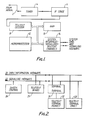
- a PCB provided in a PABX has connected thereto the coaxial lead 2 from a television aerial terminated on the PCB, and a television receiver is provided comprising a tuner 4 and an IF stage 6 for processing the incoming video signals and providing teletext signals to a teletext decoder 8, which decodes the teletext signals and provides appropriate signals for storage in a memory RAM 10.
- the signals stored in the RAM 10 represent one or more magazines of information stored on a page-by-page basis.
- a microprocessor 12 is provided for controlling the decoder 8 and RAM 10, and also for controlling an interface 14 to the remainder of the PABX.
- one UK implementation of teletext is made up of 8 magazines each containing 100 pages. There can be 3200 subpages associated with each page. Each page consists of 24 lines of 40 characters. Each character takes up 1 byte of storage.
- Various alternatives for the storage of this teletext information within the memory are possible:
- Option 1 requires a large amount of memory which would require a large board area to implement fully. However in UK teletext there is not normally more than 20 subpages associated with each page. This would bring the memory capacity to a more reasonable 16 Mbytes. Option 3 would require the same memory as option 2 if 800 terminals requested different pages at once. Option 2 is regarded as the best option for storage of the teletext information.
- Figure 2 shows a schematic of the teletext system architecture with data/information highways 20 and signalling highways 22.
- a PABX switch control 24 is connected to signalling highways 22 and the teletext PCB 26 of Figure 1 is coupled to both sets of highways 20, 22.
- a teletext terminal 28, to be described below, is connected to highways 20, 22 as is also a further terminal 30, to which, inter alia, a further teletext terminal 32 is connected.
- the teletext information is routed over data highways 20 at 64 kbits ⁇ 1/16 kbits ⁇ 1.
- the signalling highways 22 employ an HDLC control protocol as shown in Figure 2 wherein a teletext terminal requesting information provides a request packet on bus 22.
- the switch control 24 receives the request, acknowledges the request in a request packet and instructs the terminal to receive the teletext information in a data channel X.
- the switch control also transmits a packet to board 26, instructing the board to transmit the required information in the assigned channel X.
- the required pages are transmitted in channel X as soon as they are received within board 26. 8 pages per second may be transmitted with a 64 kbits ⁇ 1 channel.
- a terminal is shown in block-diagrammatic form in Figure 4 as comprising an interface 40 connected to the highways 20, 22, directly or via a standard data port (e.g. V24, V28, X21), for passing control information and teletext information.
- a control processor 42 is coupled to interface 40 as well as to a keyboard 44, a RAM memory 46 for storing teletext information and EPROM memory 48 for storing control routines.
- a liquid crystal display 50 is provided which may comprise one or more lines for displaying one or more teletext lines simultaneously.
- each character for display could be defined by transmission order or row, page addressing or delimiters.
- a liquid crystal display (lcd) 50 is used.
- a 24 line 40 character display allows the display of complete pages. Smaller line capacity displays would restrict the display to page fractions or rows but this disadvantage would be largely overcome using the scroll facility.
- keys 44 allow the control of the display 50 and interact with the CPU 42 via the singalling highway 22 for data (teletext) requests.
- a preferred layout of keys and display is shown in figure 5.
- keys 44 comprise a standard telephone dialling keypad 60 and two sets of keys 62 a - 62 j and 64 S1 - 64 S6 which are 'soft keys' in the sense that their function is defined by software routines, and there function may be defined by the terminal subscriber.
- Display 50 comprises an 8 row X 40 column display with rows 1-5 forming an area 70 for display of text, and rows 6 and 7 forming an area 72 for display of information regarding the system, and row 8 forming an area 76 informing the subscriber of the function performed by depression of any of keys 62-64.
- keys MENU, NEXT and PREV allow scrolling of the display.
- Keys HELP and HANDSFREE are also displayed.
- keys 62 - 64 may allow the display of the rows, pages or subpages.
- Other keys may provide 'enlarge' display, 'scroll' display (either forward or back) (for example if a row is displayed then one may scroll to previous or next row; if half a page is displayed then one may scroll to next or previous half page etc.).
- a 'page scroll' allows the display of the next or previous subpage.
- a 'new page' scroll initiates a new page request to the switch control.
- the 'scroll' key could be a soft key and dynamically assigned any of the scroll functions.
- the teletext decoder board could be adapted to store Viewdata information for example.
- the Tuner, IF stage, Teletext Decoder, shown in Figure 1 would be replaced by a PSTN trunk interface, controlled by the microprocessor. The information is routed through the system as described above. It provides customer cost savings and traffic advantages as only one trunk access is required.
- a call could be made automatically to the relevant Viewdata access at regular intervals under processor control, for information refresh of the Viewdata Board Memory.
- the information store may be used to hold messages both for and from each subscriber ie. the control software is adapted to that the memory is written to as well as read. Such messages are displayed in area 74. For example a subscriber on departure types on his display; 'back at time, date'; 'now on extension y', etc. This is then transmitted to the information store using a dedicated 'transmit' key. Alternatively the information is predefined and selected by continual pressing of a 'message' key. Once the required message is displayed another key(s) adds/edits the variable data. Pressing the 'transmit' key deposits that message in the associated subscribers information store.
Landscapes
- Engineering & Computer Science (AREA)
- Signal Processing (AREA)
- Physics & Mathematics (AREA)
- Astronomy & Astrophysics (AREA)
- General Physics & Mathematics (AREA)
- Computer Networks & Wireless Communication (AREA)
- Sub-Exchange Stations And Push- Button Telephones (AREA)
- Television Systems (AREA)
- Exchange Systems With Centralized Control (AREA)
Applications Claiming Priority (2)
| Application Number | Priority Date | Filing Date | Title |
|---|---|---|---|
| GB8726858A GB2212697A (en) | 1987-11-17 | 1987-11-17 | Pabx with teletext facility |
| GB8726858 | 1987-11-17 |
Publications (2)
| Publication Number | Publication Date |
|---|---|
| EP0317059A2 true EP0317059A2 (de) | 1989-05-24 |
| EP0317059A3 EP0317059A3 (de) | 1991-01-30 |
Family
ID=10627074
Family Applications (1)
| Application Number | Title | Priority Date | Filing Date |
|---|---|---|---|
| EP19880308630 Withdrawn EP0317059A3 (de) | 1987-11-17 | 1988-09-16 | Wähl-Nebenstellenanlagen |
Country Status (10)
| Country | Link |
|---|---|
| EP (1) | EP0317059A3 (de) |
| JP (1) | JPH01160294A (de) |
| CN (1) | CN1033341A (de) |
| AU (1) | AU2288188A (de) |
| DK (1) | DK627988A (de) |
| FI (1) | FI885316A7 (de) |
| GB (1) | GB2212697A (de) |
| NO (1) | NO885011L (de) |
| PT (1) | PT89008A (de) |
| ZA (1) | ZA886658B (de) |
Cited By (2)
| Publication number | Priority date | Publication date | Assignee | Title |
|---|---|---|---|---|
| GB2302775B (en) * | 1995-06-29 | 1997-07-23 | Terence John Edward Mechan | A PABX controlled video-on-demand system |
| EP0781023A3 (de) * | 1995-12-22 | 2002-11-06 | Deutsche Telekom AG | Bidirektionaler Datenaustausch (Protokoll) zwischen einer TK-Anlage und einer Endeinrichtung |
Family Cites Families (4)
| Publication number | Priority date | Publication date | Assignee | Title |
|---|---|---|---|---|
| FR2212058A5 (de) * | 1972-12-26 | 1974-07-19 | Ibm France | |
| GB2062419A (en) * | 1979-10-12 | 1981-05-20 | Post Office | Improvements in or relating to information retrieval |
| NL8303991A (nl) * | 1983-11-18 | 1985-06-17 | Nl Standard Electric Mij B V | Kabeltelevisienetwerk. |
| JPS60219848A (ja) * | 1984-04-17 | 1985-11-02 | Fujitsu Ltd | ビデオテツクス端末システム |
-
1987
- 1987-11-17 GB GB8726858A patent/GB2212697A/en not_active Withdrawn
-
1988
- 1988-07-02 CN CN88104660A patent/CN1033341A/zh active Pending
- 1988-09-07 ZA ZA886658A patent/ZA886658B/xx unknown
- 1988-09-16 EP EP19880308630 patent/EP0317059A3/de not_active Withdrawn
- 1988-09-27 AU AU22881/88A patent/AU2288188A/en not_active Abandoned
- 1988-10-31 JP JP63273405A patent/JPH01160294A/ja active Pending
- 1988-11-10 NO NO88885011A patent/NO885011L/no unknown
- 1988-11-10 DK DK627988A patent/DK627988A/da not_active Application Discontinuation
- 1988-11-15 PT PT89008A patent/PT89008A/pt not_active Application Discontinuation
- 1988-11-16 FI FI885316A patent/FI885316A7/fi not_active Application Discontinuation
Cited By (2)
| Publication number | Priority date | Publication date | Assignee | Title |
|---|---|---|---|---|
| GB2302775B (en) * | 1995-06-29 | 1997-07-23 | Terence John Edward Mechan | A PABX controlled video-on-demand system |
| EP0781023A3 (de) * | 1995-12-22 | 2002-11-06 | Deutsche Telekom AG | Bidirektionaler Datenaustausch (Protokoll) zwischen einer TK-Anlage und einer Endeinrichtung |
Also Published As
| Publication number | Publication date |
|---|---|
| FI885316A0 (fi) | 1988-11-16 |
| DK627988A (da) | 1989-05-12 |
| GB8726858D0 (en) | 1987-12-23 |
| EP0317059A3 (de) | 1991-01-30 |
| CN1033341A (zh) | 1989-06-07 |
| PT89008A (pt) | 1989-09-14 |
| NO885011D0 (no) | 1988-11-10 |
| GB2212697A (en) | 1989-07-26 |
| FI885316L (fi) | 1989-05-18 |
| AU2288188A (en) | 1989-05-18 |
| DK627988D0 (da) | 1988-11-10 |
| FI885316A7 (fi) | 1989-05-18 |
| NO885011L (no) | 1989-05-18 |
| ZA886658B (en) | 1989-04-26 |
| JPH01160294A (ja) | 1989-06-23 |
Similar Documents
| Publication | Publication Date | Title |
|---|---|---|
| US4150254A (en) | Telephone system for selecting and reproducing text on a screen | |
| JPH03145860A (ja) | 音声データ信号転送方法とその処理システム | |
| EP0178111A2 (de) | Datenverarbeitungssystem | |
| GB2212697A (en) | Pabx with teletext facility | |
| KR19990047970A (ko) | 랜 접속을 위한 통신 장치 | |
| KR100360226B1 (ko) | 사설간이전자교환장치를이용한발신자전화번호의저장,조회및호출방법 | |
| US20020075851A1 (en) | Terminal of a packet-switching communications network and method for operating a telecommunications system having a packet-switching communications network | |
| JP2994285B2 (ja) | 多機能電話機 | |
| CA2170086A1 (en) | Video and audio directory assistance | |
| US6882710B2 (en) | Telephone and system for direct delivery of information | |
| JPH0637929A (ja) | 通信用端末装置 | |
| KR100594154B1 (ko) | 아이에스디엔 단말의 표시기능을 이용한 교환시스템의 기능을원격 설정하는 방법 | |
| KR0159638B1 (ko) | 아이에스디엔 전화기 | |
| KR100247190B1 (ko) | 교환시스템에서 다국언어 날짜 표시방법 | |
| RU2152139C1 (ru) | Способ передачи интерактивной видеографии службой циркулярной видеографии | |
| JP3282759B2 (ja) | 着信表示方式 | |
| JP2801011B2 (ja) | 多対地通信装置 | |
| JPH02222250A (ja) | Isdnデジタル電話系端末 | |
| KR20020069529A (ko) | 공중전화망과 단말기를 이용한 정보 제공방법 및 그 시스템 | |
| KR19990016061A (ko) | 적외선 통신을 이용한 무선호출정보 표시 방법 및 문자정보입력 방법 | |
| JPH03250955A (ja) | 選択応答方式 | |
| JPH01188062A (ja) | 電話装置 | |
| JPH01180169A (ja) | 通信経路通知システム | |
| JP2978917B1 (ja) | 構内交換機に収容されるphs端末への内線番号案内通知方式及びその方法 | |
| KR19990052287A (ko) | 구내교환기에서 인터넷서비스 제공방법 |
Legal Events
| Date | Code | Title | Description |
|---|---|---|---|
| PUAI | Public reference made under article 153(3) epc to a published international application that has entered the european phase |
Free format text: ORIGINAL CODE: 0009012 |
|
| AK | Designated contracting states |
Kind code of ref document: A2 Designated state(s): BE DE ES FR GR IT LU NL SE |
|
| RAP1 | Party data changed (applicant data changed or rights of an application transferred) |
Owner name: GEC PLESSEY TELECOMMUNICATIONS LIMITED |
|
| PUAL | Search report despatched |
Free format text: ORIGINAL CODE: 0009013 |
|
| AK | Designated contracting states |
Kind code of ref document: A3 Designated state(s): BE DE ES FR GR IT LU NL SE |
|
| STAA | Information on the status of an ep patent application or granted ep patent |
Free format text: STATUS: THE APPLICATION HAS BEEN WITHDRAWN |
|
| 18W | Application withdrawn |
Withdrawal date: 19910701 |
|
| R18W | Application withdrawn (corrected) |
Effective date: 19910701 |