EP0320041A2 - Dispositif d'accès multiple - Google Patents
Dispositif d'accès multiple Download PDFInfo
- Publication number
- EP0320041A2 EP0320041A2 EP88202675A EP88202675A EP0320041A2 EP 0320041 A2 EP0320041 A2 EP 0320041A2 EP 88202675 A EP88202675 A EP 88202675A EP 88202675 A EP88202675 A EP 88202675A EP 0320041 A2 EP0320041 A2 EP 0320041A2
- Authority
- EP
- European Patent Office
- Prior art keywords
- data
- address
- circuit
- signal
- data transmission
- Prior art date
- Legal status (The legal status is an assumption and is not a legal conclusion. Google has not performed a legal analysis and makes no representation as to the accuracy of the status listed.)
- Granted
Links
Images



Classifications
-
- H—ELECTRICITY
- H04—ELECTRIC COMMUNICATION TECHNIQUE
- H04Q—SELECTING
- H04Q11/00—Selecting arrangements for multiplex systems
- H04Q11/04—Selecting arrangements for multiplex systems for time-division multiplexing
- H04Q11/0407—Selecting arrangements for multiplex systems for time-division multiplexing using a stored program control
- H04Q11/0414—Details
-
- G—PHYSICS
- G06—COMPUTING OR CALCULATING; COUNTING
- G06F—ELECTRIC DIGITAL DATA PROCESSING
- G06F13/00—Interconnection of, or transfer of information or other signals between, memories, input/output devices or central processing units
- G06F13/14—Handling requests for interconnection or transfer
- G06F13/16—Handling requests for interconnection or transfer for access to memory bus
- G06F13/18—Handling requests for interconnection or transfer for access to memory bus based on priority control
Definitions
- the present invention relates to a multi-access device including a common data resource to which a plurality of stations are coupled for the transmission of data.
- Another solution which is also valid when more than two stations are coupled to the common data resource, is to assign to each station a recursive predefined time slot during which a corresponding transmission of data is allowed.
- a disadvantage of this solution is that, when one or more stations do not require the transmission of data during their allocated time slot, the time then wasted causes the multi-access device to be inefficiently used. Furthermore, two or more stations can not transmit simultaneously.
- An object of the present invention is to provide a multi-access device which, while being relatively simple and operating efficiently, nevertheless allows transmission of data between the common data resource and at least two stations without conflict even when at least one of these stations has to transmit, i.e. output or input, data at predetermined moments.
- the multi-access device further includes : - at least one data buffer circuit; - a first data transmission circuit coupling said common data resource and a first of said stations; - at least one second data transmission circuit coupling said common data resource and said data buffer circuit; - at least one third data transmission circuit coupling said data buffer circuit and a second of said stations and used for the transmission of data thereon at predetermined moments; - first requesting means to request for the use of said first data transmission circuit for the transmission of data thereon; - second requesting means to request for the use of said second data transmission circuit for the transmission of data thereon; and - a priority circuit to which said first and second requesting means are coupled and which grants priority to requests of said first requesting means over requests of said second requesting means; and in that said second requesting means perform a request a time interval before the next occurrence of one of said predetermined moments, said time interval having such a duration that said priority circuit is able to grant priority to said request performed by said second requesting
- the second station wants to input data coming from the common data resource at a first predetermined moment
- the second requesting means formulate a request a time interval before this moment.
- the required data are transferred to the data buffer circuit via the second data transmission circuit as soon as priority to do so is granted by the priority circuit, i.e. when no transmission of data is requested by the first requesting means.
- the time interval is so chosen that the transfer of the required data from the common data resource to the data buffer circuit is accomplished prior to the predetermined moment.
- these data can afterwards be transferred from the data buffer circuit to the second station at the predetermined moment even if the first requesting means simultaneously request for the transmission of data between the first station and the common data resource.
- the second station wants to output, at a predetermined moment, data having the common data resource as destination.
- the second requesting means request for the use of the second data transmission circuit after this predetermined moment but during the time interval preceding the next occurrence of this moment.
- said common data resource is coupled to a plurality of said second stations via a same plurality of said second data transmission circuits, a same plurality of said data buffer circuits and a same plurality of said third data transmission circuits, and said second requesting means are able to request for the use of each of said second data transmission circuits at moments in relation with said predetermined moments.
- Another characteristic feature of the present device is that said predetermined moments have constant frequencies which are distinct for each said second data transmission circuits.
- Still another characteristic of the present device is that said circuit grants the highest priority to the requests of said first requesting means and the following priorities to the requests of said second requesting means in decreasing order of said frequencies at which data are transmitted on said second data transmission circuits.
- Yet another characteristic feature of the present device is that it further includes : - first address generation means to provide to said common data resource, the address therein if the location of data transmitted on said first data transmission circuit; - a plurality of second address generation means to provide to said common data resource the addresses therein of the locations of data transmitted on said second data transmission circuits; - an address buffer circuit; - a first address transmission circuit coupling said first address generation means and said common data resource; - a second address transmission circuit coupling said plurality of second address generation means and said address buffer circuit; and - a third address transmission circuit coupling said address buffer circuit and said common data resource; and that said first/third address transmission circuit is used simultaneously with said first/second data transmission circuit.
- the address provided by one of said second address generation means is stored in said address buffer circuit prior to the next occurrence of one of said predetermined moments of the corresponding one of said second data transmission circuits.
- the multi-access device MAM shown in Fig. 1 forms part of a digital telecommunication exchange which moreover includes a switching network, a plurality of telecommunication line circuits and a processor PR.
- the MAM includes a Random-Access-Memory RAM with a single data access bus DB and an associated Control Circuit CC coupled to it via a single address bus AB.
- the memory RAM is used to store digital signals to be sent to 8 telecommunication line circuits mounted on a line card LC and to the processor PR or to be received from these 8 line circuits and this processor. These signals are transmitted on input and output links SI and SO interconnecting MAM and LC and on the bus DBU which interconnects MAM and PR respectively.
- the signals coming from or going to the 8 line circuits of each line card LC are transmitted on the respective serial links SI and SO according to Time Division Multiplex (TDM) techniques. From now on the line circuits are indicated by LC.
- TDM Time Division Multiplex
- the pair of input and output links SI and SO and the bus DBU are coupled to the RAM so that the processor PR and the 8 line circuits LC are associated to a same RAM.
- the processor PR is generally provided in common for a plurality, e.g. 3, of such RAMs each associated to a distinct line card, i.e. to 8 line circuits.
- the latch LD2 shown is coupled to these RAMs through a demultiplexer (not shown) and the common access bus DB.
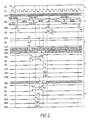
- the device MAM is controlled by a clock signal C4 (Fig. 2, part a) with a bitrate of 4 Megabits/second and has three main functions : - to output data stored in the RAM towards the line circuits LC via the serial output link SO at the clock bitrate of 4 Megabits-second; these data are included in the signal SOUT (Fig. 2, part b) flowing on the serial output link SO and comprising 8 channels OC0 to OC7 which are subdivided into 8 bytes OB0 to OB7 having 8 bits Ob0 to Ob7 each; - to input data from the line circuits LC via the serial input link SI at a bitrate of 1 Megabit/second; these data are included in the signal SIN (Fig.
- data from the RAM should be output to the line circuits LC in a synchronous way and also data from these line circuits LC and to be transferred to the RAM should be input in a synchronous way.
- data transfers from the RAM to the processor PR and vice versa may occur asynchronously.
- data transfers on the common access bus DB of the RAM towards and from the processor PR should have priority over data transfers on this bus DB towards and from the line circuits LC.
- the Random-Access-Memory RAM of the device MAM has an associated data input/output buffer IOB, an address decoder ADD, and a restore logic circuit RL, whilst the control circuit CC includes : - a data multiplexer MD; - an address multiplexer MA; - two bidirectional data latches LD1 and LD2; - two data latches LR and LW; - a parallel-in-serial-out and latch circuit PISO; - a serial-in-parallel-out and latch circuit SIPO; - three address latches LA1, LA2 and LA3; - a control logic circuit CLC; and - a 4 Megabits/second synchronizer SYNC.
- the control circuit CC is coupled to the processor PR via a bidirectional 8 bits parallel data bus DBU already mentioned and PR is coupled to CC via an unidirectional 8 bits parallel address bus ABU and control lines ALE (Address Latch Enable), CS (Chip Select), RD (ReaD) and WR (WRite) on which like-named signals flow respectively.
- CC is further coupled to the line circuits LC via the serial output link SO and the serial input link SI and to the above mentioned switching network from which it receives, on like-named control lines, a frame signal FR (Fig. 2, part a), the clock signal C4 (Fig. 2, part a) and another clock signal C1.
- the frame signal FR has a frequency of 8 Kilohertz whilst C4 and C1 have a bitrate of 4 and 1 Megabits/second respectively. It is to be noted that the 1 Megabits/second clock signal C1 is synchronized with and derived from the clock signal C4 in a frequency division circuit well known in the art and is not described here.
- the data bus DB links the data multiplexer MD to the data input/output buffer IOB of the RAM, whilst an address bus AB links the address multiplexer MA of CC to the address decoder ADD of the RAM.
- the data bus DBU of the processor PR is connected to the data multiplexer MD via the cascade connection of the two bidirectional data latches LD1 and LD2.
- MD is further connected to the serial output link SO via the cascade connection of the data latch LR and the parallel-in-serial-out and latch circuit PISO
- the serial input link SI is connected to MD via the cascade connection of the serial-in-parallel-out and latch circuit SIPO and the data latch LW.
- PISO and SIPO are respectively controlled by the clock signals C4 and C1.
- the address bus ABU of the processor PR is connected to the address multiplexer MA via the cascade connection of the address latches LA1 and LA2.
- An internal address bus IBA links the control logic circuit CLC to the address multiplexer MA via the address latch LA3 and carries the addresses of the data of line circuits LC which have to be read from or written into the RAM.
- control signals ALE, CS, RD and WR are all supplied from the processor PR to the 4 Megabits/second synchronizer SYNC which synchronizes them with the clock signal C4 and provides a control signal UPA (Processor Active; Fig. 2, parts d an e and Fig. 3, parts b, c and d) which is transmitted to the control logic circuit CLC via a separate control line whilst other control signals are supplied from SYNC to CLC via a second internal bus IBB.
- UPA Process Active
- the latches LD1, LD2; LR; LW; LA2 and LA3 are controlled by the control logic circuit CLC via respective internal control lines DA, DS; SOA; SIA; ALS and ALI carrying like-named signals.
- the address latch LA1 is directly controlled by the synchronizer SYNC via an internal control line ALA carrying a like-named signal, whilst the data MD and address MA multiplexers are controlled by the control logic circuit CLC via respective internal selection lines MDS and MAS carrying like-named signals.
- the circuits PISO and SIPO are controlled by the circuit CLC via respective internal control lines SOS and SIS carrying like-named signals.
- the data bytes OB0/OB7 to be transferred from the RAM to the line circuits LC are stored in this memory RAM at successive addresses provided by a counter CT included in the control logic circuit CLC.
- Each address is transmitted from CLC to the address latch LA3 via the internal address bus IBA.
- the selection signal MAS which indicates to the address multiplexer MA that the bus which connects it to LA3 has to be selected, this address is transmitted to the address decoder ADD of the RAM via the address bus AB.
- the data byte OB0/OB7 in LR is transferred on the serial output link SO via the circuit PISO.
- a pulse T1/T3 opens the PISO circuit and allows the byte latched in LR to be transferred to the PISO circuit and, therein, this byte OB0/OB7 is converted from the parallel to the serial form and put on the serial output link SO.
- the pulses of the control signal SOS are synchronized with the signals C4 and FR and are generated every last bit Ob7 of each output byte OB0/OB7 of the output channels OC0/OC7.
- the bytes of data or channels IC0 to IC7 incoming on the serial input link SI at a bitrate of 1 Megabit/second are first stored in the SIPO circuit.
- a pulse T4 is generated by CLC. This pulse forms part of the control signal SIS (Serial Input Synchronous).
- SIS Serial Input Synchronous
- control signal SIS is synchronized with the signals C4 and FR, and thus also with the clock signal C1, and is generated in coincidence with the last bit Ib7, and more particularly with the second half of Ib7B thereof, of each input byte or channel IC0/IC7.
- the locations at which the bytes of input data have to be stored in the memory RAM are also at successive addresses. Indeed, these addresses are also supplied to the address decoder ADD of the memory RAM by the counter CT included in the control logic circuit CLC. The address is then transmitted to ADD via the address bus IBA, the address latch LA3, the address multiplexer MA and the address bus AB. When no other operation of the RAM is required, the address is released from LA3 under the control of the signal ALI and is transferred to ADD via the address multiplexer MA under the control of the selection signal MAS.
- CLC then supplies a control signal SIA (Serial Input Asynchronous) which opens the data latch LW and a selection signal MDS which orders the data multiplexer MD to select the bus connected to this latch LW.
- SIA Serial Input Asynchronous
- MDS selection signal which orders the data multiplexer MD to select the bus connected to this latch LW.
- the data latched in LW are so released to the input/output buffer IOB of the RAM from where they are stored in the location which is indicated by the address decoder ADD as soon as the control signal RMB is activated.
- the processor PR When the processor PR wants to write data into or read data from the memory RAM, it activates the ALE and the CS signals (Fig. 2, part c) which indicate to the device MAM that the corresponding address A is available on the address bus ABU and that the data D will be written onto or read from the memory RAM via the data bus DBU.
- the signal ALA is then activated by SYNC to open the address latch LA1 in order to receive and store therein the address A then present on the address bus ABU. This address A is then also immediately transferred and stored in the address latch LA2 interconnected with LA1.
- a write signal WR (Fig. 2, part d) is supplied by the processor PR.
- the front edge w1 of WR indicates a forthcoming write operation and orders CLC to activate the signal DA (Data Asynchrone) which opens the data latch LD1.
- This data latch LD1 is then ready to receive and store the data D which will be loaded on the data bus DBU by the processor PR.
- the read edge w2 of the signal WR indicates to the control circuit CC that the data D are now on the data bus DBU and thus also stored in the latch LD1.
- This latter latch LD1 is then closed by the control logic circuit CLC which de-activates the control signal DA.
- the data D are then also immediately transferred and stores in the data latch LD2 which is interconnected with LD1.
- the control signals DS (Data Synchrone) and ALS are activated by CLC and the selection signals MDS and MAS controlling the respective multiplexers MD and MA are set to select the busses DBU and ABU respectively.
- the data D and the address A of the RAM wherein they have to be stored are then simultaneously provided to this memory RAM, the signal RMB activated by CLC validating this write operation on the address decoder ADD.
- the indication UW in the signal RMB shown in part d of Fig. 2 means that the latter is activated for a write operation of the processor PR.
- the signal UPA is activated indicating to the control logic circuit CLC that a write operation of the processor PR indicated by UW in UPA is running and that possible data ouput or input operations of the line circuits LC should be delayed. Such a priority process will be described later.
- a read signal RD is supplied to the control circuit CC by the processor PR.
- the front edge r1 of RD indicates a forthcoming read operation and orders CLC to activate the signal DA which opens the data latch LD1.
- This data latch LD1 will remain open until the end of this read operation.
- the control signals DS and ALS are activated by CLC to open the latches LD2 and LA2 respectively, and the selection signals MDS and MAS are set to select busses DBU and ABU respectively.
- the signals UPA and RMB are also activated, UR in Fig. 2 indicating that these signals are activated for a read operation of the processor PR.
- the read address provided to ADD and valided by the control signal RMB causes the data stored in the memory RAM at that address to be transferred to the data bus DBU. Since the data latches LD2 and LD1 are open, the data are immediately transmitted to the processor PR. The signals DS, ALS, UPA and RMB are then de-activated and the processor PR acknowledges this read operation by de-activating the signal RD whose rear edge r2 causes the control signal DA to be de-activated in turn by CLC.
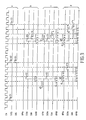
- Fig. 3 Three examples of simultaneous access to the device MAM are shown in the Fig. 3, parts b, c and d respectively.
- the signals shown in these examples make reference to the above mentioned signals C4, SOS and SIS and the pulses T1, T2, T3 and T4 of the Fig. 2, parts a and b, and reproduced in the Fig. 3, part a.
- the signal UPA is permanently de-activated meaning that no operation is required by the processor PR.
- the signal SOA is activated at moments corresponding to pulses t2 and t3 which occur four clock cycles before the respective pulses T2 and T3 of the signal SOS and when the clock signal C4 is low or at a logical level 0. This delay of four clock cycles is necessary in case the processor PR should require write or read access to the memory RAM. Indeed, since the processor PR has the highest access priority to the memory RAM, the operations that it requires must be executed first and the transfer of data to the data latch LR must then be delayed.
- This delay in the activation of the signal SOA is of one clock cycle for each operation of the processor PR.
- the data to output to the line circuits LC must be stored in the data latch LR prior to the next occurrence of the pulses T2, T3 of the signal SOS and by also taking into account the maximum number of consecutive operations that the processor PR can perform, i.e. the maximum number of clock cycles that the activation of the signal SOA can be delayed, it has been found that the delay of 4 clock cycles between the activations of the signals SOA and SOS is sufficient in practice.
- the pulses t2 and t3 of the signal SOA indicate that the data latch LR is open and that the data to be output to the line circuits LC via the serial output link SO may be loaded therein.
- the signal SOA and the simultaneously activated signal RMB indicated by SO need not to be delayed because no operation is required by the processor PR.
- the output data are thus present in the data latch LR at the de-activation of the signals the SOA and RMB and are ready to be transferred to the PISO circuit at the next occurrence of the signal SOS, i.e. during the pulses T2, T3 which open this PISO circuit.
- the SO operation start one half clock cycle before the pulse t2, i.e. when the clock signal C4 is high or at the logical level 1, and the signal RMB stays activated during the whole clock cycle.
- the signal SIA is activated at a moment corresponding to a pulse t4 to transfer to the RAM the data then present in the data latch LW. These data were previously loaded in LW during a pulse T4 of the signal SIS, i.e. when the SIPO circuit was opened. Since the input frequency SIS (1 Megabit/second) is lower than the output frequency SOS (4 Megabits/second), the pulse t4 of the signal SIA which must occur after the pulse T4 of the signal SIS and when the clock signal C4 is high has a lower priority than the pulse t3 of the signal SOA which must occur before the pulse T3 of the signal SOS and when the clock signal C4 is low.
- the pulse t4 together with the corresponding activation of the signal RMB indicated by SI occur as soon as possible after the pulse T4 but after the pulse t3.
- SI Serial In
- the pulses t3 and t4 are not delayed because no operation is requested by the processor PR, the signal RMB is thus activated one half clock cycle prior to the pulse t3 and stays activated for two consecutive clock cycles corresponding respectively to the successive operations SO and SI of the line circuits LC.
- the processor PR requires a read operation UR at a moment o1 and a write operation UW at a moment i1.
- These read UR and write UW operations of the processor PR both correspond to an activation of the signal UPA for a whole clock cycle and starting when the clock signal C4 is high.
- the moment o1 occurs 1.5 clock cycle before the pulse t2 of the signal SOA and the moment i1 occurs immediately after the pulse t3 of the signal SOA and simultaneously with the pulse t4 of the signal SIA.
- the read operation UR of the processor PR is executed immediately at the moment o1 and is followed by the data output operation SO of the line circuits LC described in the first example and which is not delayed because the preceding operation UR was completed when the operation SO had normally to start.
- the signal RMB is successively activated from the moment o1 for the two consecutive clock cycles corresponding to the operations UR and SO respectively.
- the second data output operation SO corresponding to the pulse t3 is not delayed because it does not hinder the following write operation UW of the processor PR starting at the moment i1.
- the data input operation SI of the line circuits LC simultaneously required by the pulse t4 of the signal SIA has to be delayed and processed as soon as possible after the completion of the write operation UW of the processor PR.
- the activation of the signal SIA is only delayed by one clock cycle so that the data input operation SI of the line circuits LC occurs at a moment corresponding to a pulse t′4 which appears one clock cycle after the pulse t4.
- the signal RMB is thus successively activated for three clock cycles corresponding to the respective operations SO, UW and SI. Since the next activation of the signal SIS will occur much later, the above delay of one clock cycle of the pulse t4 of the signal SIA will not affect the normal operation of the device MAM.
- the processor PR requires two times a write operation UW immediately followed by a read operation UR.
- the first write operation UW starts at a moment i2 occuring an half clock cycle before the pulse t2 of the signal SOA whilst the first read operation UR starts one clock cycle later at a moment o2.
- the data output operation SO which had normally to start an half clock cycle beforer the pulse t2 will be delayed until the operations UW and UR of the processor PR are completed. In this case the delay is thus of two clock cycles and the pulse t2 of the signal SOA corresponding to the operation SO becomes t′2.
- the signal RMB is thus activated from the moment i2 for three consecutive clock cycles corresponding to the successive operations UW, UR and SO. It is to be noted that the operation SO although delayed by two clock cycles is completed before the pulse T2 of the signal SOS so that the data to output will be present in the data latch LR at this pulse T2. The data output operation SO to the line circuits LC is thus not hindered by the preceding operations UW and UR of the processor PR.
- the second write operation UW of the processor PR starts at a moment i3 which occurs an half clock cycle before the pulse t3 of the signal SOA and the second read operation UR starts at a moment o3 which occurs one clock cycle after i3 and corresponds to the pulse t4 of the signal SIA.
- the operations SO and SI are now both delayed by two clock cycles and occur at moments corresponding to the pulses t′3 and t ⁇ 4 of the signals SOA and SIA respectively.
- the signal RMB is activated from the moment i3 for four consecutive clock cycles corresponding to the successive operations UW, UR, SO and SI.
- the highest priority is always grant to the write UW or read UR operations of the processor PR and the following priorities are successively grant to the date output operation SO and to the data input operation SI of the line circuits LC.
- a signal generator SG able to generate the pulses of the signals SOA and SIA by taking into account the above mentioned priorities is included in the control logic circuit CLC of Fig. 1 and is schematically represented in Fig. 4.
- the signal SOA which opens the data latch LR to store therein data coming from the RAM must be activated before the corresponding signal SOS which opens the circuit PISO and allows the data previously stored in LR to be transmitted to these line circuits LC via the circuit PISO. Therefore, a data output request signal ORQ is generated in the control logic circuit CLC in relation with the clock signal C4 and the frame signal FR and in function of a forthcoming pulse T1/T2/T3 of the signal SOS.
- CLC generates a data input request signal IRQ which should activate the signal SIA in order to open the data latch LW. As also mentioned above, this signal IRQ must occur after the pulse T4 of the signal SIS which opens the circuit SIPO.
- the pulses Q1 and Q2 of the the signal ORQ shown in Fig. 5 and activated by the control logic circuit CLC occur five clock cycles before the respective pulses T2 and T3 (not shown in Fig. 5) of the signal SOS.
- the pulses Q1 and Q2 correspond to a low state of the clock signal C4.
- the pulse Q3 of the signal IRQ also shown in Fig. 5 and activated by CLC occurs five clock cycles after the pulse T4 of the signal SIS and also when the clock signal C4 is low.
- the pulse Q3 occurs one clock cycle after the pulse Q2.
- the signal generator SG has a first input terminal ORQ to which the like-named data output request signal is applied and which is connected to the "Set" input of an RS flip-flop constituted by two logical NOR gates NO1 and NO2 intercoupled as shown.
- the output INA1 of this RS flip-flop NO1/NO2 is connected to a first input of a NAND gate NA1 whilst the signal UPA is applied to a like-named input terminal of SG which is coupled to a second input UPA of this gate NA1 via an inverter IN1.
- the output ONA1 of the gate NA1 is coupled to the "Reset" input R1 of the above RS flip-flop NO1/NO2 via the series connection of five inverters IN2, IN3, IN4, IN5 and IN6.
- the output IIN7 of the inverter IN3 is further connected to a first input of an AND gate AN1 via an inverter IN7 whilst the inverse C4 of the clock signal C4 is supplied to a second input of this gate AN1 which provides, at an output terminal SOA connected to its output, the signal SOA which controls the data latch LR.
- the inverter IN3, IN4 and IN5 are controlled by the respective signals C4, C4 and C4. This means that a signal at the input of these inverters only appears, inverted, at its output when the corresponding control signal (C4, C4 ) is high. Then, the output signal remains unchanged as long as this control signal is low and can only be modified when this control signal becomes again high.
- the signal generator SG has a second input terminal IRQ to which the like-named data input request signal is applied and which is connected to the "Set" input of a second RS flip-flop comprising the NOR gates NO3 and NO4 intercoupled as shown.
- the output INA2 of this second RS flip-flop NO3/NO4 is connected to a first input of a second NAND gate NA2 which as a second and a third input to which the signals UPA and IIN7 are applied respectively.
- the output ONA2 of the gate NA2 is coupled to the "Reset" input R2 of the second RS flip-flop NO3/NO4 via the series connection of five inverters IN8, IN9, IN10, IN11 and IN12.
- the inverters IN9, IN10 and IN11 are controlled by the respective signals C4, C4 and C4.
- the ouput IIN13 of the inverter IN9 is further connected to a first input of a second AND gate AN2 via an inverter IN13 whilst the clock signal C4 is applied to a second input of this gate AN2.
- the output of the gate AN2 is connected to an output terminal SIA on which appears the signal SIA which controls the data latch LW.
- Fig. 5 The above mentioned clock signal C4 and its inverse C4 are shown in Fig. 5 and the location of the pulse T2/T4 is indicated in this signal as a reference to the Figs. 2 and 3.
- Fig. 5 also the signal UPA is shown and, as an example, a write operation UW is requested by the processor PR at a moment i4 occurring four clock cycles after the pulse T2/T4 and when the clock signal C4 is high.
- the pulse Q1 normally causes, as will be described below, the signal SOA to be activated as represented by the pulse t2 occurring four clock cycles before the corresponding pulse T2 of the signal SOS and when the clock signal C4 is low.
- the outputs of the RS flip-flops NO1/NO2 and NO3/NO4 are low or at a logical level 0, i.e. when no signal is applied to their respective "Set” inputs ORQ and IRQ.
- the output of these flip-flops becomes high or at a logical level 1 when the signal at their "set” input is high, and remains in that state as long as the signal applied to their "Reset” input is low.
- the signal UPA Since the signal UPA is low during the pulse Q1, its inverse UPA is high and, at the activation of the signal ORQ, the two inputs of the gate NA1 are thus high so that the output signal ONA1 which was previously high becomes low. Because R1 is still low, the signal INA1 and thus also ONA1 remain high after the de-activation of ORQ, i.e. after the pulse Q1. As a consequence, the signal IIN7 which was previously high becomes low with the clock signal C4 going to the logical level 1 and remains low when C4 goes back to the logical level 0. The pulse t2 of the data output signal SOA is then generated at the required moment, i.e. four clock cycles before the pulse T2.
- INA1 becomes high and ONA1 becomes low.
- IIN7 remains high because the clock signal C4 is low.
- the signal ONA1 becomes high.
- the signal IIN7 remains high and the signal SOA is not activated at the occurrence of the pulse t3 as expected.
- the pulse Q3 of the signal IRQ causes the signal INA2 to become high and to stay in that state until a logical level 1 is supplied to the terminal R2 of the flip-flop NO3/NO4. Due to the signal UPA which is then low, the signal ONA2 remains high and the same is true for the signal IIN13.
- UPA becomes high but IIN7 becomes low so that ONA2 and thus also IIN13 remain high and that the signal SIA can not be activated at the expected moment corresponding to the pulse t4.
- a clock cycle after the pulse Q3, the signals IIN7, UPA and INA2 are all three at the logical level 1 so that the signal ONA2 then becomes low.
- the clock signal C4 is then high, the signal IIN13 becomes low and stays in that state for one clock cycle.
- the signal SIA is activated for one half clock cycle. This produces the pulse t′4 which appears one clock cycle after the expected pulse t4 of the signal SIA. As mentioned above, this delay of one clock cycle is due to the operation UW of the processor PR. Because of the succession of the pulses UW, t ⁇ 3 and T′4 of the respective signals UPA, SOA and SIA, the priorities of the operations of the device MAM are respected.
Landscapes
- Engineering & Computer Science (AREA)
- Theoretical Computer Science (AREA)
- Computer Networks & Wireless Communication (AREA)
- Physics & Mathematics (AREA)
- General Engineering & Computer Science (AREA)
- General Physics & Mathematics (AREA)
- Bus Control (AREA)
- Small-Scale Networks (AREA)
- Preparation Of Compounds By Using Micro-Organisms (AREA)
- Use Of Switch Circuits For Exchanges And Methods Of Control Of Multiplex Exchanges (AREA)
- Information Transfer Systems (AREA)
- Memory System (AREA)
- Communication Control (AREA)
- Selective Calling Equipment (AREA)
- Transmitters (AREA)
- Dram (AREA)
Priority Applications (1)
| Application Number | Priority Date | Filing Date | Title |
|---|---|---|---|
| AT88202675T ATE103723T1 (de) | 1987-12-07 | 1988-11-24 | Mehrfachzugriffsvorrichtung. |
Applications Claiming Priority (2)
| Application Number | Priority Date | Filing Date | Title |
|---|---|---|---|
| BE8701402 | 1987-12-07 | ||
| BE8701402A BE1001383A7 (fr) | 1987-12-07 | 1987-12-07 | Dispositif a acces multiples. |
Publications (3)
| Publication Number | Publication Date |
|---|---|
| EP0320041A2 true EP0320041A2 (fr) | 1989-06-14 |
| EP0320041A3 EP0320041A3 (en) | 1990-03-28 |
| EP0320041B1 EP0320041B1 (fr) | 1994-03-30 |
Family
ID=3883009
Family Applications (1)
| Application Number | Title | Priority Date | Filing Date |
|---|---|---|---|
| EP88202675A Expired - Lifetime EP0320041B1 (fr) | 1987-12-07 | 1988-11-24 | Dispositif d'accès multiple |
Country Status (9)
| Country | Link |
|---|---|
| US (1) | US5068848A (fr) |
| EP (1) | EP0320041B1 (fr) |
| JP (1) | JPH065523B2 (fr) |
| AT (1) | ATE103723T1 (fr) |
| AU (1) | AU613983B2 (fr) |
| BE (1) | BE1001383A7 (fr) |
| CA (1) | CA1312386C (fr) |
| DE (1) | DE3888801T2 (fr) |
| ES (1) | ES2054789T3 (fr) |
Cited By (2)
| Publication number | Priority date | Publication date | Assignee | Title |
|---|---|---|---|---|
| FR2656710A1 (fr) * | 1989-12-29 | 1991-07-05 | Radiotechnique Compelec | Microcontroleur pour l'execution rapide d'un grand nombre d'operations decomposable en sequence d'operations de meme nature. |
| EP0527260A1 (fr) * | 1991-08-14 | 1993-02-17 | Siemens Aktiengesellschaft | Unité d'interface pour supporter la communication entre des systèmes à processeur |
Families Citing this family (1)
| Publication number | Priority date | Publication date | Assignee | Title |
|---|---|---|---|---|
| JP3778579B2 (ja) * | 1993-11-16 | 2006-05-24 | 株式会社ルネサステクノロジ | 半導体記憶装置 |
Family Cites Families (6)
| Publication number | Priority date | Publication date | Assignee | Title |
|---|---|---|---|---|
| FR2465269B1 (fr) * | 1979-09-12 | 1985-12-27 | Cii Honeywell Bull | Selecteur de demandes asynchrones dans un systeme de traitement de l'information |
| US4393464A (en) * | 1980-12-12 | 1983-07-12 | Ncr Corporation | Chip topography for integrated circuit communication controller |
| IT1140233B (it) * | 1981-10-20 | 1986-09-24 | Italtel Spa | Unita' di controllo dei circuiti di interfaccia di ingresso-uscita di un elaboratore elettronico |
| US4514823A (en) * | 1982-01-15 | 1985-04-30 | International Business Machines Corporation | Apparatus and method for extending a parallel channel to a serial I/O device |
| DE3502721A1 (de) * | 1985-01-28 | 1986-07-31 | Robert Bosch Gmbh, 7000 Stuttgart | Multiprozessorsystem |
| US4740956A (en) * | 1985-12-30 | 1988-04-26 | Ibm Corporation | Linear-space signalling for a circuit-switched network |
-
1987
- 1987-12-07 BE BE8701402A patent/BE1001383A7/fr not_active IP Right Cessation
-
1988
- 1988-11-23 AU AU25822/88A patent/AU613983B2/en not_active Ceased
- 1988-11-24 AT AT88202675T patent/ATE103723T1/de not_active IP Right Cessation
- 1988-11-24 EP EP88202675A patent/EP0320041B1/fr not_active Expired - Lifetime
- 1988-11-24 ES ES88202675T patent/ES2054789T3/es not_active Expired - Fee Related
- 1988-11-24 DE DE3888801T patent/DE3888801T2/de not_active Expired - Lifetime
- 1988-12-06 CA CA000585056A patent/CA1312386C/fr not_active Expired - Fee Related
- 1988-12-06 US US07/280,701 patent/US5068848A/en not_active Expired - Lifetime
- 1988-12-07 JP JP63307966A patent/JPH065523B2/ja not_active Expired - Lifetime
Cited By (5)
| Publication number | Priority date | Publication date | Assignee | Title |
|---|---|---|---|---|
| FR2656710A1 (fr) * | 1989-12-29 | 1991-07-05 | Radiotechnique Compelec | Microcontroleur pour l'execution rapide d'un grand nombre d'operations decomposable en sequence d'operations de meme nature. |
| EP0439855A1 (fr) * | 1989-12-29 | 1991-08-07 | Philips Composants Et Semiconducteurs | Microcontrôleur pour l'exécution rapide d'un grand nombre d'opérations décomposables en séquences d'opérations de même nature |
| US5163154A (en) * | 1989-12-29 | 1992-11-10 | U.S. Philips Corp. | Microcontroller for the rapid execution of a large number of operations which can be broken down into sequences of operations of the same kind |
| EP0527260A1 (fr) * | 1991-08-14 | 1993-02-17 | Siemens Aktiengesellschaft | Unité d'interface pour supporter la communication entre des systèmes à processeur |
| US5404449A (en) * | 1991-08-14 | 1995-04-04 | Siemens Aktiengesellschaft | Interface module for supporting communication between processor systems |
Also Published As
| Publication number | Publication date |
|---|---|
| EP0320041B1 (fr) | 1994-03-30 |
| AU2582288A (en) | 1989-06-15 |
| US5068848A (en) | 1991-11-26 |
| DE3888801D1 (de) | 1994-05-05 |
| DE3888801T2 (de) | 1994-08-18 |
| ATE103723T1 (de) | 1994-04-15 |
| JPH01169559A (ja) | 1989-07-04 |
| BE1001383A7 (fr) | 1989-10-17 |
| JPH065523B2 (ja) | 1994-01-19 |
| AU613983B2 (en) | 1991-08-15 |
| CA1312386C (fr) | 1993-01-05 |
| EP0320041A3 (en) | 1990-03-28 |
| ES2054789T3 (es) | 1994-08-16 |
Similar Documents
| Publication | Publication Date | Title |
|---|---|---|
| US3963870A (en) | Time-division multiplex switching system | |
| US5195185A (en) | Dynamic bus arbitration with concurrent same bus granting every cycle | |
| US3761879A (en) | Bus transport system for selection information and data | |
| CA1237188A (fr) | Dipositif et methode de commande pour systeme de commutation a repartition temporelle | |
| JPH02156750A (ja) | 多重アクセス制御方法および該方法を実施する多重アクセス制御システム | |
| CA1147865A (fr) | Systeme pour interchanger les messages entre des microprocesseurs connectes par un dispositif de transmission synchrone | |
| US4692862A (en) | Rapid message transmission system between computers and method | |
| US4890279A (en) | Multiplexer and computer network using the same | |
| US4209841A (en) | Interface unit facilitating data exchange between central processor memory and high-speed peripheral unit | |
| EP0289733B1 (fr) | Procédé de commutation pour signaux de voix et de données intégrés | |
| US5068848A (en) | Multi-access device | |
| US5197065A (en) | Distribution mechanism for establishing communications between user interfaces of a communication system | |
| US3665398A (en) | Input/output multiplex control system | |
| US3551894A (en) | Serial cross-bar bussing system | |
| DK165150B (da) | Fremgangsmaade og apparat til formidling af multipel, vilkaarlig adgang til en transmissionslinie i et lokalt netvaerk til tale og data | |
| US3174135A (en) | Program-controlled electronic data-processing system | |
| CA1241776A (fr) | Dispositif de test en boucle sur une liaison multiplex dans un systeme de transmission de donnees | |
| JP3639651B2 (ja) | 少なくとも2台のプロセッサからなる情報処理装置 | |
| US3809819A (en) | Tdm switching apparatus | |
| JP2527994B2 (ja) | 通話路導通試験方式 | |
| JPH064401A (ja) | メモリアクセス回路 | |
| JPH0916517A (ja) | バスインタフェース | |
| JP2770375B2 (ja) | 伝送遅延位相補償回路 | |
| JP3586520B2 (ja) | ディジタルメッセージ中継システム | |
| KR950003970B1 (ko) | 디지탈 전자교환기의 피시엠 데이타 접속장치 |
Legal Events
| Date | Code | Title | Description |
|---|---|---|---|
| PUAI | Public reference made under article 153(3) epc to a published international application that has entered the european phase |
Free format text: ORIGINAL CODE: 0009012 |
|
| AK | Designated contracting states |
Kind code of ref document: A2 Designated state(s): AT BE CH DE ES FR GB IT LI NL SE |
|
| PUAL | Search report despatched |
Free format text: ORIGINAL CODE: 0009013 |
|
| AK | Designated contracting states |
Kind code of ref document: A3 Designated state(s): AT BE CH DE ES FR GB IT LI NL SE |
|
| 17P | Request for examination filed |
Effective date: 19900918 |
|
| 17Q | First examination report despatched |
Effective date: 19930318 |
|
| GRAA | (expected) grant |
Free format text: ORIGINAL CODE: 0009210 |
|
| AK | Designated contracting states |
Kind code of ref document: B1 Designated state(s): AT BE CH DE ES FR GB IT LI NL SE |
|
| REF | Corresponds to: |
Ref document number: 103723 Country of ref document: AT Date of ref document: 19940415 Kind code of ref document: T |
|
| REF | Corresponds to: |
Ref document number: 3888801 Country of ref document: DE Date of ref document: 19940505 |
|
| ITF | It: translation for a ep patent filed | ||
| ET | Fr: translation filed | ||
| REG | Reference to a national code |
Ref country code: ES Ref legal event code: FG2A Ref document number: 2054789 Country of ref document: ES Kind code of ref document: T3 |
|
| EAL | Se: european patent in force in sweden |
Ref document number: 88202675.0 |
|
| PLBE | No opposition filed within time limit |
Free format text: ORIGINAL CODE: 0009261 |
|
| STAA | Information on the status of an ep patent application or granted ep patent |
Free format text: STATUS: NO OPPOSITION FILED WITHIN TIME LIMIT |
|
| 26N | No opposition filed | ||
| PGFP | Annual fee paid to national office [announced via postgrant information from national office to epo] |
Ref country code: NL Payment date: 19991014 Year of fee payment: 12 Ref country code: CH Payment date: 19991014 Year of fee payment: 12 |
|
| PGFP | Annual fee paid to national office [announced via postgrant information from national office to epo] |
Ref country code: AT Payment date: 19991021 Year of fee payment: 12 |
|
| PGFP | Annual fee paid to national office [announced via postgrant information from national office to epo] |
Ref country code: BE Payment date: 19991122 Year of fee payment: 12 |
|
| PG25 | Lapsed in a contracting state [announced via postgrant information from national office to epo] |
Ref country code: AT Free format text: LAPSE BECAUSE OF NON-PAYMENT OF DUE FEES Effective date: 20001124 |
|
| PG25 | Lapsed in a contracting state [announced via postgrant information from national office to epo] |
Ref country code: LI Free format text: LAPSE BECAUSE OF NON-PAYMENT OF DUE FEES Effective date: 20001130 Ref country code: BE Free format text: LAPSE BECAUSE OF NON-PAYMENT OF DUE FEES Effective date: 20001130 Ref country code: CH Free format text: LAPSE BECAUSE OF NON-PAYMENT OF DUE FEES Effective date: 20001130 |
|
| BERE | Be: lapsed |
Owner name: ALCATEL BELL Effective date: 20001130 |
|
| PG25 | Lapsed in a contracting state [announced via postgrant information from national office to epo] |
Ref country code: NL Free format text: LAPSE BECAUSE OF NON-PAYMENT OF DUE FEES Effective date: 20010601 |
|
| REG | Reference to a national code |
Ref country code: CH Ref legal event code: PL |
|
| NLV4 | Nl: lapsed or anulled due to non-payment of the annual fee |
Effective date: 20010601 |
|
| REG | Reference to a national code |
Ref country code: GB Ref legal event code: IF02 |
|
| PGFP | Annual fee paid to national office [announced via postgrant information from national office to epo] |
Ref country code: DE Payment date: 20071123 Year of fee payment: 20 Ref country code: ES Payment date: 20071129 Year of fee payment: 20 |
|
| PGFP | Annual fee paid to national office [announced via postgrant information from national office to epo] |
Ref country code: IT Payment date: 20071126 Year of fee payment: 20 |
|
| PGFP | Annual fee paid to national office [announced via postgrant information from national office to epo] |
Ref country code: SE Payment date: 20071114 Year of fee payment: 20 |
|
| PGFP | Annual fee paid to national office [announced via postgrant information from national office to epo] |
Ref country code: FR Payment date: 20071122 Year of fee payment: 20 Ref country code: GB Payment date: 20071120 Year of fee payment: 20 |
|
| REG | Reference to a national code |
Ref country code: GB Ref legal event code: PE20 Expiry date: 20081123 |
|
| REG | Reference to a national code |
Ref country code: ES Ref legal event code: FD2A Effective date: 20081125 |
|
| PG25 | Lapsed in a contracting state [announced via postgrant information from national office to epo] |
Ref country code: ES Free format text: LAPSE BECAUSE OF EXPIRATION OF PROTECTION Effective date: 20081125 |
|
| PG25 | Lapsed in a contracting state [announced via postgrant information from national office to epo] |
Ref country code: GB Free format text: LAPSE BECAUSE OF EXPIRATION OF PROTECTION Effective date: 20081123 |