EP0332006A1 - Smektisches Flüssigkristallmedium - Google Patents
Smektisches Flüssigkristallmedium Download PDFInfo
- Publication number
- EP0332006A1 EP0332006A1 EP89103413A EP89103413A EP0332006A1 EP 0332006 A1 EP0332006 A1 EP 0332006A1 EP 89103413 A EP89103413 A EP 89103413A EP 89103413 A EP89103413 A EP 89103413A EP 0332006 A1 EP0332006 A1 EP 0332006A1
- Authority
- EP
- European Patent Office
- Prior art keywords
- formula
- compounds
- carbon atoms
- medium according
- difluoro
- Prior art date
- Legal status (The legal status is an assumption and is not a legal conclusion. Google has not performed a legal analysis and makes no representation as to the accuracy of the status listed.)
- Granted
Links
- 239000004990 Smectic liquid crystal Substances 0.000 title claims abstract description 21
- 239000000203 mixture Substances 0.000 title description 7
- 150000001875 compounds Chemical class 0.000 claims abstract description 58
- 239000007788 liquid Substances 0.000 claims abstract description 26
- 239000002019 doping agent Substances 0.000 claims abstract description 11
- 125000005450 2,3-difluoro-1,4-phenylene group Chemical group [H]C1=C([*:2])C(F)=C(F)C([*:1])=C1[H] 0.000 claims abstract description 9
- -1 piperidine-1, 4-diyl Chemical group 0.000 claims description 71
- 125000004432 carbon atom Chemical group C* 0.000 claims description 42
- 125000000217 alkyl group Chemical group 0.000 claims description 28
- 229910052731 fluorine Inorganic materials 0.000 claims description 18
- 125000001424 substituent group Chemical group 0.000 claims description 16
- 239000011737 fluorine Substances 0.000 claims description 13
- 125000003545 alkoxy group Chemical group 0.000 claims description 12
- 125000001153 fluoro group Chemical group F* 0.000 claims description 9
- PXGOKWXKJXAPGV-UHFFFAOYSA-N Fluorine Chemical compound FF PXGOKWXKJXAPGV-UHFFFAOYSA-N 0.000 claims description 8
- 229910052736 halogen Inorganic materials 0.000 claims description 7
- 125000001140 1,4-phenylene group Chemical group [H]C1=C([H])C([*:2])=C([H])C([H])=C1[*:1] 0.000 claims description 6
- 229910052799 carbon Inorganic materials 0.000 claims description 6
- 229910052801 chlorine Inorganic materials 0.000 claims description 6
- 239000000460 chlorine Chemical group 0.000 claims description 6
- 150000002367 halogens Chemical class 0.000 claims description 6
- 229910052739 hydrogen Inorganic materials 0.000 claims description 5
- 125000004955 1,4-cyclohexylene group Chemical group [H]C1([H])C([H])([H])C([H])([*:1])C([H])([H])C([H])([H])C1([H])[*:2] 0.000 claims description 4
- ZAMOUSCENKQFHK-UHFFFAOYSA-N Chlorine atom Chemical group [Cl] ZAMOUSCENKQFHK-UHFFFAOYSA-N 0.000 claims description 4
- 125000004423 acyloxy group Chemical group 0.000 claims description 4
- 125000003342 alkenyl group Chemical group 0.000 claims description 4
- 125000004453 alkoxycarbonyl group Chemical group 0.000 claims description 4
- UFHFLCQGNIYNRP-UHFFFAOYSA-N Hydrogen Chemical compound [H][H] UFHFLCQGNIYNRP-UHFFFAOYSA-N 0.000 claims description 3
- 125000002947 alkylene group Chemical group 0.000 claims description 3
- 125000005843 halogen group Chemical group 0.000 claims description 3
- 239000001257 hydrogen Substances 0.000 claims description 3
- 125000000956 methoxy group Chemical group [H]C([H])([H])O* 0.000 claims description 3
- 229910052757 nitrogen Inorganic materials 0.000 claims description 3
- 125000004430 oxygen atom Chemical group O* 0.000 claims description 3
- KWKAKUADMBZCLK-UHFFFAOYSA-N 1-octene Chemical group CCCCCCC=C KWKAKUADMBZCLK-UHFFFAOYSA-N 0.000 claims description 2
- 125000001309 chloro group Chemical group Cl* 0.000 claims description 2
- 230000001939 inductive effect Effects 0.000 claims description 2
- 125000004434 sulfur atom Chemical group 0.000 claims description 2
- 125000000843 phenylene group Chemical group C1(=C(C=CC=C1)*)* 0.000 claims 1
- 230000002349 favourable effect Effects 0.000 abstract description 5
- 230000010287 polarization Effects 0.000 description 26
- 230000002269 spontaneous effect Effects 0.000 description 26
- 125000001570 methylene group Chemical group [H]C([H])([*:1])[*:2] 0.000 description 9
- OWBDECISILOCJX-UHFFFAOYSA-N 2-(2,3-difluoro-4-nonoxyphenyl)-5-nonylpyrimidine Chemical compound FC1=C(F)C(OCCCCCCCCC)=CC=C1C1=NC=C(CCCCCCCCC)C=N1 OWBDECISILOCJX-UHFFFAOYSA-N 0.000 description 7
- IALWCYFULVHLEC-UHFFFAOYSA-N 4-(octyloxy)benzoic acid Chemical compound CCCCCCCCOC1=CC=C(C(O)=O)C=C1 IALWCYFULVHLEC-UHFFFAOYSA-N 0.000 description 7
- GOYDNIKZWGIXJT-UHFFFAOYSA-N 1,2-difluorobenzene Chemical compound FC1=CC=CC=C1F GOYDNIKZWGIXJT-UHFFFAOYSA-N 0.000 description 6
- 125000002496 methyl group Chemical group [H]C([H])([H])* 0.000 description 6
- WUMDMTNUPWTDAM-UHFFFAOYSA-N 4-(3-fluoro-4-octoxyphenyl)benzoic acid Chemical compound C1=C(F)C(OCCCCCCCC)=CC=C1C1=CC=C(C(O)=O)C=C1 WUMDMTNUPWTDAM-UHFFFAOYSA-N 0.000 description 5
- 238000006243 chemical reaction Methods 0.000 description 5
- RWPKQMZBKRJQGK-UHFFFAOYSA-N 2-(4-heptoxyphenyl)-5-(4-pentylphenyl)-1,3,4-thiadiazole Chemical compound C1=CC(OCCCCCCC)=CC=C1C1=NN=C(C=2C=CC(CCCCC)=CC=2)S1 RWPKQMZBKRJQGK-UHFFFAOYSA-N 0.000 description 4
- UHOVQNZJYSORNB-UHFFFAOYSA-N Benzene Chemical compound C1=CC=CC=C1 UHOVQNZJYSORNB-UHFFFAOYSA-N 0.000 description 4
- YXFVVABEGXRONW-UHFFFAOYSA-N Toluene Chemical compound CC1=CC=CC=C1 YXFVVABEGXRONW-UHFFFAOYSA-N 0.000 description 4
- WPYMKLBDIGXBTP-UHFFFAOYSA-N benzoic acid group Chemical group C(C1=CC=CC=C1)(=O)O WPYMKLBDIGXBTP-UHFFFAOYSA-N 0.000 description 4
- 239000012039 electrophile Substances 0.000 description 4
- 150000002148 esters Chemical class 0.000 description 4
- 239000000463 material Substances 0.000 description 4
- 238000000034 method Methods 0.000 description 4
- HHMIBINOGMUIED-UHFFFAOYSA-N 2-(4-heptylphenyl)-5-(4-octoxyphenyl)-1,3,4-thiadiazole Chemical compound C1=CC(OCCCCCCCC)=CC=C1C1=NN=C(C=2C=CC(CCCCCCC)=CC=2)S1 HHMIBINOGMUIED-UHFFFAOYSA-N 0.000 description 3
- WHXKPENKUURZDS-UHFFFAOYSA-N 4-(2,3-difluoro-4-octoxyphenyl)benzoic acid Chemical compound FC1=C(F)C(OCCCCCCCC)=CC=C1C1=CC=C(C(O)=O)C=C1 WHXKPENKUURZDS-UHFFFAOYSA-N 0.000 description 3
- YNBBQLUKHHSKPW-UHFFFAOYSA-N 4-(4-octoxyphenyl)benzoic acid Chemical compound C1=CC(OCCCCCCCC)=CC=C1C1=CC=C(C(O)=O)C=C1 YNBBQLUKHHSKPW-UHFFFAOYSA-N 0.000 description 3
- ORABVGFYURQKJI-UHFFFAOYSA-N C1=CC(OCCCCCCCCCC)=CC=C1C1=CC(OCCCCCCCCCC)=CC=C1C(O)=O Chemical compound C1=CC(OCCCCCCCCCC)=CC=C1C1=CC(OCCCCCCCCCC)=CC=C1C(O)=O ORABVGFYURQKJI-UHFFFAOYSA-N 0.000 description 3
- RTZKZFJDLAIYFH-UHFFFAOYSA-N Diethyl ether Chemical compound CCOCC RTZKZFJDLAIYFH-UHFFFAOYSA-N 0.000 description 3
- PHDGAURDIAKSFN-UHFFFAOYSA-N [4-(5-heptylpyrimidin-2-yl)phenyl] 2-chloro-3-methylbutanoate Chemical compound N1=CC(CCCCCCC)=CN=C1C1=CC=C(OC(=O)C(Cl)C(C)C)C=C1 PHDGAURDIAKSFN-UHFFFAOYSA-N 0.000 description 3
- 125000001495 ethyl group Chemical group [H]C([H])([H])C([H])([H])* 0.000 description 3
- VLKZOEOYAKHREP-UHFFFAOYSA-N n-Hexane Chemical compound CCCCCC VLKZOEOYAKHREP-UHFFFAOYSA-N 0.000 description 3
- AOOGUDRBFKNIDF-UHFFFAOYSA-N (2-fluoro-4-heptylphenyl) 4-(3-fluoro-4-heptoxyphenyl)benzoate Chemical compound C1=C(F)C(OCCCCCCC)=CC=C1C1=CC=C(C(=O)OC=2C(=CC(CCCCCCC)=CC=2)F)C=C1 AOOGUDRBFKNIDF-UHFFFAOYSA-N 0.000 description 2
- ZZPSMWAPTJBFKS-UHFFFAOYSA-N (2-fluoro-4-heptylphenyl) 4-(4-heptoxyphenyl)benzoate Chemical compound C1=CC(OCCCCCCC)=CC=C1C1=CC=C(C(=O)OC=2C(=CC(CCCCCCC)=CC=2)F)C=C1 ZZPSMWAPTJBFKS-UHFFFAOYSA-N 0.000 description 2
- PNHSTIHDWVGTTD-UHFFFAOYSA-N (2-fluoro-4-pentylphenyl) 4-octoxybenzoate Chemical compound C1=CC(OCCCCCCCC)=CC=C1C(=O)OC1=CC=C(CCCCC)C=C1F PNHSTIHDWVGTTD-UHFFFAOYSA-N 0.000 description 2
- RXJMCDLQNDHAPR-UHFFFAOYSA-N (3-fluoro-4-octoxyphenyl) 4-hexoxybenzoate Chemical compound C1=C(F)C(OCCCCCCCC)=CC=C1OC(=O)C1=CC=C(OCCCCCC)C=C1 RXJMCDLQNDHAPR-UHFFFAOYSA-N 0.000 description 2
- JGSCCJJWIZEFJL-UHFFFAOYSA-N (3-fluoro-4-octoxyphenyl) 4-octoxybenzoate Chemical compound C1=CC(OCCCCCCCC)=CC=C1C(=O)OC1=CC=C(OCCCCCCCC)C(F)=C1 JGSCCJJWIZEFJL-UHFFFAOYSA-N 0.000 description 2
- XFWVAMYMZVCVCC-UHFFFAOYSA-N (4-octoxyphenyl) 4-decoxybenzoate Chemical compound C1=CC(OCCCCCCCCCC)=CC=C1C(=O)OC1=CC=C(OCCCCCCCC)C=C1 XFWVAMYMZVCVCC-UHFFFAOYSA-N 0.000 description 2
- RPEPGIOVXBBUMJ-UHFFFAOYSA-N 2,3-difluorophenol Chemical class OC1=CC=CC(F)=C1F RPEPGIOVXBBUMJ-UHFFFAOYSA-N 0.000 description 2
- ASGKBAUXUXOKGG-UHFFFAOYSA-N 2-(2,3-difluoro-4-heptoxyphenyl)-5-nonylpyrimidine Chemical compound N1=CC(CCCCCCCCC)=CN=C1C1=CC=C(OCCCCCCC)C(F)=C1F ASGKBAUXUXOKGG-UHFFFAOYSA-N 0.000 description 2
- PWHARVXOVAHNPY-UHFFFAOYSA-N 2-(2,3-difluoro-4-heptylphenyl)-5-(4-heptoxyphenyl)-1,3,4-thiadiazole Chemical compound C1=CC(OCCCCCCC)=CC=C1C1=NN=C(C=2C(=C(F)C(CCCCCCC)=CC=2)F)S1 PWHARVXOVAHNPY-UHFFFAOYSA-N 0.000 description 2
- DHZOKEKJKSNUKM-UHFFFAOYSA-N 2-(2,3-difluoro-4-octoxyphenyl)-5-heptyl-1,3,4-thiadiazole Chemical compound FC1=C(F)C(OCCCCCCCC)=CC=C1C1=NN=C(CCCCCCC)S1 DHZOKEKJKSNUKM-UHFFFAOYSA-N 0.000 description 2
- CVPIFUOMJJPQSM-UHFFFAOYSA-N 2-(2,3-difluoro-4-octoxyphenyl)-5-nonyl-1,3,4-thiadiazole Chemical compound S1C(CCCCCCCCC)=NN=C1C1=CC=C(OCCCCCCCC)C(F)=C1F CVPIFUOMJJPQSM-UHFFFAOYSA-N 0.000 description 2
- VLNVSYRSYHNYPU-UHFFFAOYSA-N 2-(2,3-difluoro-4-octoxyphenyl)-5-octylpyridine Chemical compound FC1=C(F)C(OCCCCCCCC)=CC=C1C1=CC=C(CCCCCCCC)C=N1 VLNVSYRSYHNYPU-UHFFFAOYSA-N 0.000 description 2
- BHHFELFXXXSCMM-UHFFFAOYSA-N 2-(2,3-difluoro-4-octoxyphenyl)-5-octylpyrimidine Chemical compound FC1=C(F)C(OCCCCCCCC)=CC=C1C1=NC=C(CCCCCCCC)C=N1 BHHFELFXXXSCMM-UHFFFAOYSA-N 0.000 description 2
- GMKQVWBBCAJHKV-UHFFFAOYSA-N 2-(4-heptoxyphenyl)-5-(4-heptylphenyl)-1,3,4-thiadiazole Chemical compound C1=CC(OCCCCCCC)=CC=C1C1=NN=C(C=2C=CC(CCCCCCC)=CC=2)S1 GMKQVWBBCAJHKV-UHFFFAOYSA-N 0.000 description 2
- IHQUQNPGVVLDKR-UHFFFAOYSA-N 2-(4-heptoxyphenyl)-5-nonylpyrimidine Chemical compound N1=CC(CCCCCCCCC)=CN=C1C1=CC=C(OCCCCCCC)C=C1 IHQUQNPGVVLDKR-UHFFFAOYSA-N 0.000 description 2
- VPQIQYGDNSLFCA-UHFFFAOYSA-N 2-(4-heptylphenyl)-5-(4-hexoxyphenyl)-1,3,4-thiadiazole Chemical compound C1=CC(CCCCCCC)=CC=C1C1=NN=C(C=2C=CC(OCCCCCC)=CC=2)S1 VPQIQYGDNSLFCA-UHFFFAOYSA-N 0.000 description 2
- RIGOOXYZHNCGDW-UHFFFAOYSA-N 2-(4-heptylphenyl)-5-(4-pentoxyphenyl)-1,3,4-thiadiazole Chemical compound C1=CC(CCCCCCC)=CC=C1C1=NN=C(C=2C=CC(OCCCCC)=CC=2)S1 RIGOOXYZHNCGDW-UHFFFAOYSA-N 0.000 description 2
- YQQXBCJQEGWHRW-UHFFFAOYSA-N 2-(4-hexoxyphenyl)-5-nonylpyrimidine Chemical compound N1=CC(CCCCCCCCC)=CN=C1C1=CC=C(OCCCCCC)C=C1 YQQXBCJQEGWHRW-UHFFFAOYSA-N 0.000 description 2
- GTPJWQZJAGFLRR-UHFFFAOYSA-N 2-(4-nonoxyphenyl)-5-nonylpyrimidine Chemical compound C1=CC(OCCCCCCCCC)=CC=C1C1=NC=C(CCCCCCCCC)C=N1 GTPJWQZJAGFLRR-UHFFFAOYSA-N 0.000 description 2
- LPKDCEIPXONJCB-UHFFFAOYSA-N 2-[2,3-difluoro-4-(4-heptoxyphenyl)phenyl]-5-pentyl-1,3,4-thiadiazole Chemical compound C1=CC(OCCCCCCC)=CC=C1C(C(=C1F)F)=CC=C1C1=NN=C(CCCCC)S1 LPKDCEIPXONJCB-UHFFFAOYSA-N 0.000 description 2
- VKQNFMVTFJDOSC-UHFFFAOYSA-N 2-[2,3-difluoro-4-(4-pentoxyphenyl)phenyl]-5-heptylpyrimidine Chemical compound N1=CC(CCCCCCC)=CN=C1C1=CC=C(C=2C=CC(OCCCCC)=CC=2)C(F)=C1F VKQNFMVTFJDOSC-UHFFFAOYSA-N 0.000 description 2
- IPDHRYJLIICURW-UHFFFAOYSA-N 2-[4-(4-heptoxyphenyl)phenyl]-4-octoxybenzoic acid Chemical compound CCCCCCCCOC1=CC=C(C(O)=O)C(C=2C=CC(=CC=2)C=2C=CC(OCCCCCCC)=CC=2)=C1 IPDHRYJLIICURW-UHFFFAOYSA-N 0.000 description 2
- APYPZCBLEORKEC-UHFFFAOYSA-N 4-decoxy-2-(4-decoxy-2,3-difluorophenyl)benzoic acid Chemical compound CCCCCCCCCCOC(C=C1)=CC(C(C=CC(OCCCCCCCCCC)=C2F)=C2F)=C1C(O)=O APYPZCBLEORKEC-UHFFFAOYSA-N 0.000 description 2
- HBQUXMZZODHFMJ-UHFFFAOYSA-N 4-hexoxybenzoic acid Chemical compound CCCCCCOC1=CC=C(C(O)=O)C=C1 HBQUXMZZODHFMJ-UHFFFAOYSA-N 0.000 description 2
- FMCGFINLOXSJPV-UHFFFAOYSA-N 5-nonyl-2-(4-octoxyphenyl)pyrimidine Chemical compound N1=CC(CCCCCCCCC)=CN=C1C1=CC=C(OCCCCCCCC)C=C1 FMCGFINLOXSJPV-UHFFFAOYSA-N 0.000 description 2
- FNLVDGQSYPMTLN-UHFFFAOYSA-N CCCCCCCCCCOC(C=C1)=CC(C(C=CC(OCCCCCCCC)=C2F)=C2F)=C1C(O)=O Chemical compound CCCCCCCCCCOC(C=C1)=CC(C(C=CC(OCCCCCCCC)=C2F)=C2F)=C1C(O)=O FNLVDGQSYPMTLN-UHFFFAOYSA-N 0.000 description 2
- CURLTUGMZLYLDI-UHFFFAOYSA-N Carbon dioxide Chemical compound O=C=O CURLTUGMZLYLDI-UHFFFAOYSA-N 0.000 description 2
- KWYHDKDOAIKMQN-UHFFFAOYSA-N N,N,N',N'-tetramethylethylenediamine Chemical compound CN(C)CCN(C)C KWYHDKDOAIKMQN-UHFFFAOYSA-N 0.000 description 2
- IMNFDUFMRHMDMM-UHFFFAOYSA-N N-Heptane Chemical compound CCCCCCC IMNFDUFMRHMDMM-UHFFFAOYSA-N 0.000 description 2
- WYURNTSHIVDZCO-UHFFFAOYSA-N Tetrahydrofuran Chemical compound C1CCOC1 WYURNTSHIVDZCO-UHFFFAOYSA-N 0.000 description 2
- KDJDEZYGWAKDIF-UHFFFAOYSA-N [4-(4-octoxyphenyl)phenyl] 2-cyano-2-methylhexanoate Chemical compound C1=CC(OCCCCCCCC)=CC=C1C1=CC=C(OC(=O)C(C)(CCCC)C#N)C=C1 KDJDEZYGWAKDIF-UHFFFAOYSA-N 0.000 description 2
- 125000000484 butyl group Chemical group [H]C([*])([H])C([H])([H])C([H])([H])C([H])([H])[H] 0.000 description 2
- 125000000623 heterocyclic group Chemical group 0.000 description 2
- 125000000959 isobutyl group Chemical group [H]C([H])([H])C([H])(C([H])([H])[H])C([H])([H])* 0.000 description 2
- 125000001972 isopentyl group Chemical group [H]C([H])([H])C([H])(C([H])([H])[H])C([H])([H])C([H])([H])* 0.000 description 2
- 125000001449 isopropyl group Chemical group [H]C([H])([H])C([H])(*)C([H])([H])[H] 0.000 description 2
- 125000002914 sec-butyl group Chemical group [H]C([H])([H])C([H])([H])C([H])(*)C([H])([H])[H] 0.000 description 2
- 230000007704 transition Effects 0.000 description 2
- OFBLURMZRSVZOA-UHFFFAOYSA-N (2,3-difluoro-4-heptoxyphenyl) 4-(4-octoxyphenyl)benzoate Chemical compound C1=CC(OCCCCCCCC)=CC=C1C1=CC=C(C(=O)OC=2C(=C(F)C(OCCCCCCC)=CC=2)F)C=C1 OFBLURMZRSVZOA-UHFFFAOYSA-N 0.000 description 1
- FMSVXIOOHIZOLA-UHFFFAOYSA-N (2,3-difluoro-4-heptoxyphenyl) 4-octoxybenzoate Chemical compound C1=CC(OCCCCCCCC)=CC=C1C(=O)OC1=CC=C(OCCCCCCC)C(F)=C1F FMSVXIOOHIZOLA-UHFFFAOYSA-N 0.000 description 1
- LMJKXHSAZIVIMQ-UHFFFAOYSA-N (2,3-difluoro-4-octanoyloxyphenyl) 2-fluoro-4-(5-hexylpyrimidin-2-yl)benzoate Chemical compound FC1=C(F)C(OC(=O)CCCCCCC)=CC=C1OC(=O)C1=CC=C(C=2N=CC(CCCCCC)=CN=2)C=C1F LMJKXHSAZIVIMQ-UHFFFAOYSA-N 0.000 description 1
- VZSKFUJETRYNFC-UHFFFAOYSA-N (2,3-difluoro-4-octylphenyl) 2-fluoro-4-octoxybenzoate Chemical compound FC1=CC(OCCCCCCCC)=CC=C1C(=O)OC1=CC=C(CCCCCCCC)C(F)=C1F VZSKFUJETRYNFC-UHFFFAOYSA-N 0.000 description 1
- DGXBYRXWKNQTCV-UHFFFAOYSA-N (2,3-difluoro-4-octylphenyl) 4-octoxybenzoate Chemical compound C1=CC(OCCCCCCCC)=CC=C1C(=O)OC1=CC=C(CCCCCCCC)C(F)=C1F DGXBYRXWKNQTCV-UHFFFAOYSA-N 0.000 description 1
- ZQJCYDDRFFCCBP-UHFFFAOYSA-N (4-decoxy-2,3-difluorophenyl) 5-heptylpyridine-2-carboxylate Chemical compound FC1=C(F)C(OCCCCCCCCCC)=CC=C1OC(=O)C1=CC=C(CCCCCCC)C=N1 ZQJCYDDRFFCCBP-UHFFFAOYSA-N 0.000 description 1
- VJOBXTYCQWZCGF-UHFFFAOYSA-N (4-decyl-2,3-difluorophenyl) 4-octoxybenzoate Chemical compound FC1=C(F)C(CCCCCCCCCC)=CC=C1OC(=O)C1=CC=C(OCCCCCCCC)C=C1 VJOBXTYCQWZCGF-UHFFFAOYSA-N 0.000 description 1
- GGSHODQPCQKSIQ-UHFFFAOYSA-N (4-nonoxyphenyl) 4-decoxybenzoate Chemical compound C1=CC(OCCCCCCCCCC)=CC=C1C(=O)OC1=CC=C(OCCCCCCCCC)C=C1 GGSHODQPCQKSIQ-UHFFFAOYSA-N 0.000 description 1
- RYHBNJHYFVUHQT-UHFFFAOYSA-N 1,4-Dioxane Chemical compound C1COCCO1 RYHBNJHYFVUHQT-UHFFFAOYSA-N 0.000 description 1
- BSDNPJMIQZSBAA-UHFFFAOYSA-N 1-nonoxy-4-[4-(1-octylcyclohexyl)phenyl]benzene Chemical compound C(CCCCCCCC)OC1=CC=C(C=C1)C1=CC=C(C=C1)C1(CCCCC1)CCCCCCCC BSDNPJMIQZSBAA-UHFFFAOYSA-N 0.000 description 1
- DIIOWJORGYWCBT-UHFFFAOYSA-N 2,3-difluoro-1-nonoxy-4-(4-nonylphenyl)benzene Chemical group FC1=C(F)C(OCCCCCCCCC)=CC=C1C1=CC=C(CCCCCCCCC)C=C1 DIIOWJORGYWCBT-UHFFFAOYSA-N 0.000 description 1
- PJLFYOXHQRTEQZ-UHFFFAOYSA-N 2,3-difluoro-1-octoxy-4-(4-octylphenyl)benzene Chemical group FC1=C(F)C(OCCCCCCCC)=CC=C1C1=CC=C(CCCCCCCC)C=C1 PJLFYOXHQRTEQZ-UHFFFAOYSA-N 0.000 description 1
- VTSHTDGLOLZHRG-UHFFFAOYSA-N 2,3-difluoro-4-nonoxy-5-[4-(4-octylphenyl)phenyl]benzoic acid Chemical compound CCCCCCCCCOC(C(C(C=C1)=CC=C1C1=CC=C(CCCCCCCC)C=C1)=CC(C(O)=O)=C1F)=C1F VTSHTDGLOLZHRG-UHFFFAOYSA-N 0.000 description 1
- QLKWZXXUWUOXCH-UHFFFAOYSA-N 2,3-difluorobenzene-1,4-diol Chemical class OC1=CC=C(O)C(F)=C1F QLKWZXXUWUOXCH-UHFFFAOYSA-N 0.000 description 1
- JLZVIWSFUPLSOR-UHFFFAOYSA-N 2,3-difluorobenzoic acid Chemical class OC(=O)C1=CC=CC(F)=C1F JLZVIWSFUPLSOR-UHFFFAOYSA-N 0.000 description 1
- DBCKYBARDUNHPM-UHFFFAOYSA-N 2-(2,3-difluoro-4-nonanoyloxyphenyl)-4-octoxybenzoic acid Chemical compound CCCCCCCCC(=O)OC1=C(C(=C(C=C1)C2=C(C=CC(=C2)OCCCCCCCC)C(=O)O)F)F DBCKYBARDUNHPM-UHFFFAOYSA-N 0.000 description 1
- WTOHVFNOUXTVPY-UHFFFAOYSA-N 2-(2,3-difluoro-4-nonoxyphenyl)-5-octylpyrimidine Chemical compound FC1=C(F)C(OCCCCCCCCC)=CC=C1C1=NC=C(CCCCCCCC)C=N1 WTOHVFNOUXTVPY-UHFFFAOYSA-N 0.000 description 1
- QNBNFZQBTFEOEK-UHFFFAOYSA-N 2-(2,3-difluoro-4-octoxyphenyl)-4-octoxybenzoic acid Chemical compound CCCCCCCCOC1=CC=C(C(O)=O)C(C=2C(=C(F)C(OCCCCCCCC)=CC=2)F)=C1 QNBNFZQBTFEOEK-UHFFFAOYSA-N 0.000 description 1
- GDWOEZVDPZIJCA-UHFFFAOYSA-N 2-(2,3-difluoro-4-octoxyphenyl)-5-heptylpyrimidine Chemical compound FC1=C(F)C(OCCCCCCCC)=CC=C1C1=NC=C(CCCCCCC)C=N1 GDWOEZVDPZIJCA-UHFFFAOYSA-N 0.000 description 1
- LRLGRBOFFNCSQY-UHFFFAOYSA-N 2-(2-heptoxyphenyl)-5-heptylpyrimidine Chemical compound CCCCCCCOC1=CC=CC=C1C1=NC=C(CCCCCCC)C=N1 LRLGRBOFFNCSQY-UHFFFAOYSA-N 0.000 description 1
- RDLQRXKCUNPLLC-UHFFFAOYSA-N 2-(2-octoxyphenyl)-5-octylpyrimidine Chemical compound CCCCCCCCOC1=CC=CC=C1C1=NC=C(CCCCCCCC)C=N1 RDLQRXKCUNPLLC-UHFFFAOYSA-N 0.000 description 1
- QDURPSGFNFSCLC-UHFFFAOYSA-N 2-(4-ethoxyphenyl)-5-heptylpyrimidine Chemical compound N1=CC(CCCCCCC)=CN=C1C1=CC=C(OCC)C=C1 QDURPSGFNFSCLC-UHFFFAOYSA-N 0.000 description 1
- ZGQWJAHXPRPMPI-UHFFFAOYSA-N 2-(4-heptoxyphenyl)-5-(4-octylphenyl)-1,3,4-thiadiazole Chemical compound C1=CC(CCCCCCCC)=CC=C1C1=NN=C(C=2C=CC(OCCCCCCC)=CC=2)S1 ZGQWJAHXPRPMPI-UHFFFAOYSA-N 0.000 description 1
- LGCWNHQHPFBPBP-UHFFFAOYSA-N 2-(4-hexoxyphenyl)-5-hexylpyrimidine Chemical compound C1=CC(OCCCCCC)=CC=C1C1=NC=C(CCCCCC)C=N1 LGCWNHQHPFBPBP-UHFFFAOYSA-N 0.000 description 1
- RMAFJFORFGJHLD-UHFFFAOYSA-N 2-(4-octoxyphenyl)-5-pentylpyrimidine Chemical compound C1=CC(OCCCCCCCC)=CC=C1C1=NC=C(CCCCC)C=N1 RMAFJFORFGJHLD-UHFFFAOYSA-N 0.000 description 1
- UAWWGBDICUZAHJ-UHFFFAOYSA-N 2-(4-octylphenyl)-5-(4-pentoxyphenyl)-1,3,4-thiadiazole Chemical compound C1=CC(CCCCCCCC)=CC=C1C1=NN=C(C=2C=CC(OCCCCC)=CC=2)S1 UAWWGBDICUZAHJ-UHFFFAOYSA-N 0.000 description 1
- SBUFKQKNZCEFHX-UHFFFAOYSA-N 2-[2,3-difluoro-4-(4-hexoxyphenyl)phenyl]-5-heptylpyrimidine Chemical compound N1=CC(CCCCCCC)=CN=C1C1=CC=C(C=2C=CC(OCCCCCC)=CC=2)C(F)=C1F SBUFKQKNZCEFHX-UHFFFAOYSA-N 0.000 description 1
- ZMZVMDLRMQGABQ-UHFFFAOYSA-N 2-[4-(2,3-difluoro-4-octoxyphenyl)phenyl]-4-nonoxybenzoic acid Chemical compound CCCCCCCCCOC1=CC=C(C(O)=O)C(C=2C=CC(=CC=2)C=2C(=C(F)C(OCCCCCCCC)=CC=2)F)=C1 ZMZVMDLRMQGABQ-UHFFFAOYSA-N 0.000 description 1
- BGMGYCJWZGAVDK-UHFFFAOYSA-N 2-[4-(2,3-difluoro-4-octoxyphenyl)phenyl]-5-heptylpyrimidine Chemical compound FC1=C(F)C(OCCCCCCCC)=CC=C1C1=CC=C(C=2N=CC(CCCCCCC)=CN=2)C=C1 BGMGYCJWZGAVDK-UHFFFAOYSA-N 0.000 description 1
- DDTJFSPKEIAZAM-UHFFFAOYSA-N 2-chloro-3-methylbutanoic acid Chemical compound CC(C)C(Cl)C(O)=O DDTJFSPKEIAZAM-UHFFFAOYSA-N 0.000 description 1
- 125000004200 2-methoxyethyl group Chemical group [H]C([H])([H])OC([H])([H])C([H])([H])* 0.000 description 1
- 125000004493 2-methylbut-1-yl group Chemical group CC(C*)CC 0.000 description 1
- 125000005916 2-methylpentyl group Chemical group 0.000 description 1
- RIVZASOPEBQKFK-UHFFFAOYSA-N 3-cyano-3-methylheptanoic acid Chemical compound CCCCC(C)(C#N)CC(O)=O RIVZASOPEBQKFK-UHFFFAOYSA-N 0.000 description 1
- 125000005917 3-methylpentyl group Chemical group 0.000 description 1
- QCYBQGCYKMDSSP-UHFFFAOYSA-N 4-(2,3-difluoro-4-pentoxyphenyl)benzoic acid Chemical compound FC1=C(F)C(OCCCCC)=CC=C1C1=CC=C(C(O)=O)C=C1 QCYBQGCYKMDSSP-UHFFFAOYSA-N 0.000 description 1
- BDDYPNQQJHNKSC-UHFFFAOYSA-N 4-(4-heptoxyphenyl)benzoic acid Chemical compound C1=CC(OCCCCCCC)=CC=C1C1=CC=C(C(O)=O)C=C1 BDDYPNQQJHNKSC-UHFFFAOYSA-N 0.000 description 1
- HXBKPYIEQLLNBK-UHFFFAOYSA-N 4-(4-octylphenyl)benzoic acid Chemical compound C1=CC(CCCCCCCC)=CC=C1C1=CC=C(C(O)=O)C=C1 HXBKPYIEQLLNBK-UHFFFAOYSA-N 0.000 description 1
- KXJCXLOWISYCQU-UHFFFAOYSA-N 4-heptoxy-2-[4-(4-nonoxyphenyl)phenyl]benzoic acid Chemical compound C1=CC(OCCCCCCCCC)=CC=C1C1=CC=C(C=2C(=CC=C(OCCCCCCC)C=2)C(O)=O)C=C1 KXJCXLOWISYCQU-UHFFFAOYSA-N 0.000 description 1
- BBNGDXPGAOLROT-UHFFFAOYSA-N 4-heptoxy-2-[4-(4-octoxyphenyl)phenyl]benzoic acid Chemical compound C1=CC(OCCCCCCCC)=CC=C1C1=CC=C(C=2C(=CC=C(OCCCCCCC)C=2)C(O)=O)C=C1 BBNGDXPGAOLROT-UHFFFAOYSA-N 0.000 description 1
- ZOAFDIZUTXWRQJ-UHFFFAOYSA-N 4-octoxy-2-(4-octoxyphenyl)benzoic acid Chemical compound C1=CC(OCCCCCCCC)=CC=C1C1=CC(OCCCCCCCC)=CC=C1C(O)=O ZOAFDIZUTXWRQJ-UHFFFAOYSA-N 0.000 description 1
- RTWLYJJVSHCYQT-UHFFFAOYSA-N 4-octoxy-2-[4-(4-octoxyphenyl)phenyl]benzoic acid Chemical compound C1=CC(OCCCCCCCC)=CC=C1C1=CC=C(C=2C(=CC=C(OCCCCCCCC)C=2)C(O)=O)C=C1 RTWLYJJVSHCYQT-UHFFFAOYSA-N 0.000 description 1
- IZEKGVYCAYHABP-UHFFFAOYSA-N 5,6-difluoro-4-heptoxy-6-(5-octylpyridin-2-yl)cyclohexa-2,4-diene-1-carboxylic acid Chemical compound N1=CC(CCCCCCCC)=CC=C1C1(F)C(F)=C(OCCCCCCC)C=CC1C(O)=O IZEKGVYCAYHABP-UHFFFAOYSA-N 0.000 description 1
- JZRSQUSQNWCJLJ-UHFFFAOYSA-N 5-[2,3-difluoro-4-(4-octoxyphenyl)phenyl]-2,3-difluoro-4-pentylbenzoic acid Chemical compound CCCCCCCCOC1=CC=C(C=C1)C2=C(C(=C(C=C2)C3=CC(=C(C(=C3CCCCC)F)F)C(=O)O)F)F JZRSQUSQNWCJLJ-UHFFFAOYSA-N 0.000 description 1
- 239000005711 Benzoic acid Substances 0.000 description 1
- XLDTYKAPGBDUFN-UHFFFAOYSA-N C1=CC(OCCCCCCCCC)=CC=C1C1=CC(OCCCCCCCC)=CC=C1C(O)=O Chemical compound C1=CC(OCCCCCCCCC)=CC=C1C1=CC(OCCCCCCCC)=CC=C1C(O)=O XLDTYKAPGBDUFN-UHFFFAOYSA-N 0.000 description 1
- QGXVTMMHCQCVRY-UHFFFAOYSA-N CCCCCCCCCC(C=C1)=CC=C1C(C(OCCCCCCCCC)=C1F)=CC(C(O)=O)=C1F Chemical compound CCCCCCCCCC(C=C1)=CC=C1C(C(OCCCCCCCCC)=C1F)=CC(C(O)=O)=C1F QGXVTMMHCQCVRY-UHFFFAOYSA-N 0.000 description 1
- ASBVCQGVEPIDQL-UHFFFAOYSA-N CCCCCCCCCCOC1=CC=C(C(O)=O)C(C=2C=CC(OCCCCCCCCC)=CC=2)=C1 Chemical compound CCCCCCCCCCOC1=CC=C(C(O)=O)C(C=2C=CC(OCCCCCCCCC)=CC=2)=C1 ASBVCQGVEPIDQL-UHFFFAOYSA-N 0.000 description 1
- XRLMSXOCTVPTND-UHFFFAOYSA-N CCCCCCCCOC1=CC=C(C(O)=O)C(C=2C=CC(=CC=2)C=2C=CC(OCCCCC)=CC=2)=C1 Chemical compound CCCCCCCCOC1=CC=C(C(O)=O)C(C=2C=CC(=CC=2)C=2C=CC(OCCCCC)=CC=2)=C1 XRLMSXOCTVPTND-UHFFFAOYSA-N 0.000 description 1
- XDTMQSROBMDMFD-UHFFFAOYSA-N Cyclohexane Chemical compound C1CCCCC1 XDTMQSROBMDMFD-UHFFFAOYSA-N 0.000 description 1
- XTHFKEDIFFGKHM-UHFFFAOYSA-N Dimethoxyethane Chemical compound COCCOC XTHFKEDIFFGKHM-UHFFFAOYSA-N 0.000 description 1
- SNRUBQQJIBEYMU-UHFFFAOYSA-N Dodecane Natural products CCCCCCCCCCCC SNRUBQQJIBEYMU-UHFFFAOYSA-N 0.000 description 1
- 239000004593 Epoxy Substances 0.000 description 1
- BZLVMXJERCGZMT-UHFFFAOYSA-N Methyl tert-butyl ether Chemical compound COC(C)(C)C BZLVMXJERCGZMT-UHFFFAOYSA-N 0.000 description 1
- MZRVEZGGRBJDDB-UHFFFAOYSA-N N-Butyllithium Chemical compound [Li]CCCC MZRVEZGGRBJDDB-UHFFFAOYSA-N 0.000 description 1
- 239000004988 Nematic liquid crystal Substances 0.000 description 1
- ONVRBRIWAIYZDU-UHFFFAOYSA-N OC(=O)C1C=CC(OCCCCCCCCC)=C(F)C1(F)C1=NC=C(CCCCCCCCC)C=N1 Chemical compound OC(=O)C1C=CC(OCCCCCCCCC)=C(F)C1(F)C1=NC=C(CCCCCCCCC)C=N1 ONVRBRIWAIYZDU-UHFFFAOYSA-N 0.000 description 1
- XBDQKXXYIPTUBI-UHFFFAOYSA-M Propionate Chemical compound CCC([O-])=O XBDQKXXYIPTUBI-UHFFFAOYSA-M 0.000 description 1
- HCHKCACWOHOZIP-UHFFFAOYSA-N Zinc Chemical compound [Zn] HCHKCACWOHOZIP-UHFFFAOYSA-N 0.000 description 1
- PQLKQWJNOKMLPD-UHFFFAOYSA-N [4-(2,3-difluoro-4-octoxyphenyl)phenyl] decanoate Chemical group C1=CC(OC(=O)CCCCCCCCC)=CC=C1C1=CC=C(OCCCCCCCC)C(F)=C1F PQLKQWJNOKMLPD-UHFFFAOYSA-N 0.000 description 1
- DSGVRVGWUASVLY-UHFFFAOYSA-N [4-(2,3-difluoro-4-octoxyphenyl)phenyl] octanoate Chemical group FC1=C(F)C(OCCCCCCCC)=CC=C1C1=CC=C(OC(=O)CCCCCCC)C=C1 DSGVRVGWUASVLY-UHFFFAOYSA-N 0.000 description 1
- WNCJGGSRWGBIJT-UHFFFAOYSA-N [4-(4-hexoxyphenyl)phenyl] 2-cyano-2-methylhexanoate Chemical compound C1=CC(OCCCCCC)=CC=C1C1=CC=C(OC(=O)C(C)(CCCC)C#N)C=C1 WNCJGGSRWGBIJT-UHFFFAOYSA-N 0.000 description 1
- OQBRVNDPQUUCGY-UHFFFAOYSA-N [4-(5-heptylpyrimidin-2-yl)phenyl] 2,3-difluoro-4-octoxybenzoate Chemical compound FC1=C(F)C(OCCCCCCCC)=CC=C1C(=O)OC1=CC=C(C=2N=CC(CCCCCCC)=CN=2)C=C1 OQBRVNDPQUUCGY-UHFFFAOYSA-N 0.000 description 1
- XSXSTMGFFXWHBV-UHFFFAOYSA-N [4-(5-heptylpyrimidin-2-yl)phenyl] 2-cyano-2-methylhexanoate Chemical compound N1=CC(CCCCCCC)=CN=C1C1=CC=C(OC(=O)C(C)(CCCC)C#N)C=C1 XSXSTMGFFXWHBV-UHFFFAOYSA-N 0.000 description 1
- NQJPKNILDNKJHG-UHFFFAOYSA-N [4-(5-nonylpyrimidin-2-yl)phenyl] 2-cyano-2-methylhexanoate Chemical compound N1=CC(CCCCCCCCC)=CN=C1C1=CC=C(OC(=O)C(C)(CCCC)C#N)C=C1 NQJPKNILDNKJHG-UHFFFAOYSA-N 0.000 description 1
- REWWPZOKKSDCJA-UHFFFAOYSA-N [4-(5-octylpyridin-2-yl)phenyl] 2,3-difluoro-4-octoxybenzoate Chemical compound FC1=C(F)C(OCCCCCCCC)=CC=C1C(=O)OC1=CC=C(C=2N=CC(CCCCCCCC)=CC=2)C=C1 REWWPZOKKSDCJA-UHFFFAOYSA-N 0.000 description 1
- DPEPLKQPSIXXHS-UHFFFAOYSA-N [4-(5-octylpyrimidin-2-yl)phenyl] 2-chloro-3-methylbutanoate Chemical compound N1=CC(CCCCCCCC)=CN=C1C1=CC=C(OC(=O)C(Cl)C(C)C)C=C1 DPEPLKQPSIXXHS-UHFFFAOYSA-N 0.000 description 1
- 239000002253 acid Substances 0.000 description 1
- 239000000654 additive Substances 0.000 description 1
- 230000002411 adverse Effects 0.000 description 1
- 150000001299 aldehydes Chemical class 0.000 description 1
- 125000001931 aliphatic group Chemical group 0.000 description 1
- 125000005194 alkoxycarbonyloxy group Chemical group 0.000 description 1
- 150000008064 anhydrides Chemical class 0.000 description 1
- 235000010233 benzoic acid Nutrition 0.000 description 1
- 230000015572 biosynthetic process Effects 0.000 description 1
- 229910052794 bromium Inorganic materials 0.000 description 1
- 125000001589 carboacyl group Chemical group 0.000 description 1
- 239000001569 carbon dioxide Substances 0.000 description 1
- 229910002092 carbon dioxide Inorganic materials 0.000 description 1
- 150000001732 carboxylic acid derivatives Chemical class 0.000 description 1
- 238000006555 catalytic reaction Methods 0.000 description 1
- 230000003098 cholesteric effect Effects 0.000 description 1
- 239000008139 complexing agent Substances 0.000 description 1
- 238000002425 crystallisation Methods 0.000 description 1
- 230000008025 crystallization Effects 0.000 description 1
- JHAYEQICABJSTP-UHFFFAOYSA-N decoquinate Chemical group N1C=C(C(=O)OCC)C(=O)C2=C1C=C(OCC)C(OCCCCCCCCCC)=C2 JHAYEQICABJSTP-UHFFFAOYSA-N 0.000 description 1
- 125000002704 decyl group Chemical group [H]C([H])([H])C([H])([H])C([H])([H])C([H])([H])C([H])([H])C([H])([H])C([H])([H])C([H])([H])C([H])([H])C([H])([H])* 0.000 description 1
- VILAVOFMIJHSJA-UHFFFAOYSA-N dicarbon monoxide Chemical group [C]=C=O VILAVOFMIJHSJA-UHFFFAOYSA-N 0.000 description 1
- 239000003989 dielectric material Substances 0.000 description 1
- 125000003438 dodecyl group Chemical group [H]C([H])([H])C([H])([H])C([H])([H])C([H])([H])C([H])([H])C([H])([H])C([H])([H])C([H])([H])C([H])([H])C([H])([H])C([H])([H])C([H])([H])* 0.000 description 1
- 125000003700 epoxy group Chemical group 0.000 description 1
- 125000005745 ethoxymethyl group Chemical group [H]C([H])([H])C([H])([H])OC([H])([H])* 0.000 description 1
- 150000004820 halides Chemical class 0.000 description 1
- 125000003187 heptyl group Chemical group [H]C([*])([H])C([H])([H])C([H])([H])C([H])([H])C([H])([H])C([H])([H])C([H])([H])[H] 0.000 description 1
- GNOIPBMMFNIUFM-UHFFFAOYSA-N hexamethylphosphoric triamide Chemical compound CN(C)P(=O)(N(C)C)N(C)C GNOIPBMMFNIUFM-UHFFFAOYSA-N 0.000 description 1
- 125000004051 hexyl group Chemical group [H]C([H])([H])C([H])([H])C([H])([H])C([H])([H])C([H])([H])C([H])([H])* 0.000 description 1
- 229930195733 hydrocarbon Natural products 0.000 description 1
- 150000002430 hydrocarbons Chemical class 0.000 description 1
- 125000004435 hydrogen atom Chemical group [H]* 0.000 description 1
- 238000011065 in-situ storage Methods 0.000 description 1
- 239000012442 inert solvent Substances 0.000 description 1
- 229910052740 iodine Inorganic materials 0.000 description 1
- 125000004491 isohexyl group Chemical group C(CCC(C)C)* 0.000 description 1
- 150000002576 ketones Chemical class 0.000 description 1
- 239000004973 liquid crystal related substance Substances 0.000 description 1
- 229910052744 lithium Inorganic materials 0.000 description 1
- BNHFWQQYLUPDOG-UHFFFAOYSA-N lithium;1,2,2,3-tetramethylpiperidine Chemical compound [Li].CC1CCCN(C)C1(C)C BNHFWQQYLUPDOG-UHFFFAOYSA-N 0.000 description 1
- UBJFKNSINUCEAL-UHFFFAOYSA-N lithium;2-methylpropane Chemical compound [Li+].C[C-](C)C UBJFKNSINUCEAL-UHFFFAOYSA-N 0.000 description 1
- WGOPGODQLGJZGL-UHFFFAOYSA-N lithium;butane Chemical compound [Li+].CC[CH-]C WGOPGODQLGJZGL-UHFFFAOYSA-N 0.000 description 1
- 125000002560 nitrile group Chemical group 0.000 description 1
- 150000002825 nitriles Chemical class 0.000 description 1
- 125000001400 nonyl group Chemical group [H]C([*])([H])C([H])([H])C([H])([H])C([H])([H])C([H])([H])C([H])([H])C([H])([H])C([H])([H])C([H])([H])[H] 0.000 description 1
- 125000002347 octyl group Chemical group [H]C([*])([H])C([H])([H])C([H])([H])C([H])([H])C([H])([H])C([H])([H])C([H])([H])C([H])([H])[H] 0.000 description 1
- 230000003287 optical effect Effects 0.000 description 1
- 125000001147 pentyl group Chemical group C(CCCC)* 0.000 description 1
- 125000000951 phenoxy group Chemical group [H]C1=C([H])C([H])=C(O*)C([H])=C1[H] 0.000 description 1
- DIZXBLOHWVNDKX-UHFFFAOYSA-N phenyl 2,3-difluorobenzoate Chemical compound FC=1C(=C(C=CC1)C(=O)OC1=CC=CC=C1)F DIZXBLOHWVNDKX-UHFFFAOYSA-N 0.000 description 1
- NHKJPPKXDNZFBJ-UHFFFAOYSA-N phenyllithium Chemical compound [Li]C1=CC=CC=C1 NHKJPPKXDNZFBJ-UHFFFAOYSA-N 0.000 description 1
- 229920000647 polyepoxide Polymers 0.000 description 1
- 125000001436 propyl group Chemical group [H]C([*])([H])C([H])([H])C([H])([H])[H] 0.000 description 1
- 239000011541 reaction mixture Substances 0.000 description 1
- 239000007787 solid Substances 0.000 description 1
- 239000002904 solvent Substances 0.000 description 1
- 239000007858 starting material Substances 0.000 description 1
- 239000000126 substance Substances 0.000 description 1
- 238000003786 synthesis reaction Methods 0.000 description 1
- 125000000999 tert-butyl group Chemical group [H]C([H])([H])C(*)(C([H])([H])[H])C([H])([H])[H] 0.000 description 1
- YLQBMQCUIZJEEH-UHFFFAOYSA-N tetrahydrofuran Natural products C=1C=COC=1 YLQBMQCUIZJEEH-UHFFFAOYSA-N 0.000 description 1
- 229910052723 transition metal Inorganic materials 0.000 description 1
- 150000003624 transition metals Chemical class 0.000 description 1
- 125000002948 undecyl group Chemical group [H]C([*])([H])C([H])([H])C([H])([H])C([H])([H])C([H])([H])C([H])([H])C([H])([H])C([H])([H])C([H])([H])C([H])([H])C([H])([H])[H] 0.000 description 1
- 229910052725 zinc Inorganic materials 0.000 description 1
- 239000011701 zinc Substances 0.000 description 1
Classifications
-
- C—CHEMISTRY; METALLURGY
- C09—DYES; PAINTS; POLISHES; NATURAL RESINS; ADHESIVES; COMPOSITIONS NOT OTHERWISE PROVIDED FOR; APPLICATIONS OF MATERIALS NOT OTHERWISE PROVIDED FOR
- C09K—MATERIALS FOR MISCELLANEOUS APPLICATIONS, NOT PROVIDED FOR ELSEWHERE
- C09K19/00—Liquid crystal materials
- C09K19/04—Liquid crystal materials characterised by the chemical structure of the liquid crystal components, e.g. by a specific unit
- C09K19/42—Mixtures of liquid crystal compounds covered by two or more of the preceding groups C09K19/06 - C09K19/40
-
- C—CHEMISTRY; METALLURGY
- C09—DYES; PAINTS; POLISHES; NATURAL RESINS; ADHESIVES; COMPOSITIONS NOT OTHERWISE PROVIDED FOR; APPLICATIONS OF MATERIALS NOT OTHERWISE PROVIDED FOR
- C09K—MATERIALS FOR MISCELLANEOUS APPLICATIONS, NOT PROVIDED FOR ELSEWHERE
- C09K19/00—Liquid crystal materials
- C09K19/04—Liquid crystal materials characterised by the chemical structure of the liquid crystal components, e.g. by a specific unit
- C09K19/06—Non-steroidal liquid crystal compounds
- C09K19/08—Non-steroidal liquid crystal compounds containing at least two non-condensed rings
- C09K19/10—Non-steroidal liquid crystal compounds containing at least two non-condensed rings containing at least two benzene rings
- C09K19/12—Non-steroidal liquid crystal compounds containing at least two non-condensed rings containing at least two benzene rings at least two benzene rings directly linked, e.g. biphenyls
- C09K19/126—Compounds containing at least one asymmetric carbon atom
-
- C—CHEMISTRY; METALLURGY
- C09—DYES; PAINTS; POLISHES; NATURAL RESINS; ADHESIVES; COMPOSITIONS NOT OTHERWISE PROVIDED FOR; APPLICATIONS OF MATERIALS NOT OTHERWISE PROVIDED FOR
- C09K—MATERIALS FOR MISCELLANEOUS APPLICATIONS, NOT PROVIDED FOR ELSEWHERE
- C09K19/00—Liquid crystal materials
- C09K19/04—Liquid crystal materials characterised by the chemical structure of the liquid crystal components, e.g. by a specific unit
- C09K19/06—Non-steroidal liquid crystal compounds
- C09K19/08—Non-steroidal liquid crystal compounds containing at least two non-condensed rings
- C09K19/10—Non-steroidal liquid crystal compounds containing at least two non-condensed rings containing at least two benzene rings
- C09K19/12—Non-steroidal liquid crystal compounds containing at least two non-condensed rings containing at least two benzene rings at least two benzene rings directly linked, e.g. biphenyls
-
- C—CHEMISTRY; METALLURGY
- C09—DYES; PAINTS; POLISHES; NATURAL RESINS; ADHESIVES; COMPOSITIONS NOT OTHERWISE PROVIDED FOR; APPLICATIONS OF MATERIALS NOT OTHERWISE PROVIDED FOR
- C09K—MATERIALS FOR MISCELLANEOUS APPLICATIONS, NOT PROVIDED FOR ELSEWHERE
- C09K19/00—Liquid crystal materials
- C09K19/04—Liquid crystal materials characterised by the chemical structure of the liquid crystal components, e.g. by a specific unit
- C09K19/42—Mixtures of liquid crystal compounds covered by two or more of the preceding groups C09K19/06 - C09K19/40
- C09K19/46—Mixtures of liquid crystal compounds covered by two or more of the preceding groups C09K19/06 - C09K19/40 containing esters
Definitions
- the invention relates to chiral tilted smectic liquid crystal media with at least two liquid crystalline components and at least one chiral dopant, at least one compound containing the structural element 2,3-difluoro-1,4-phenylene, with the exception of fluorinated oligophenyls of the formula I, wherein a is 0 or 1, and where the terminal substituents R1, R2 and R3 each independently, optionally substituted with CN or with at least one halogen atom, alkyl or alkenyl radical having up to 15 carbon atoms, in which one or more non-adjacent CH2 groups of these radicals also by -O-, -S -, -CO-, -O-CO-, -CO-O-, -O-CO-O- or -C ⁇ C- can be replaced, one of these radicals R1 and R2 also a group of the formula in one of the following pairs of lateral substituents, both substituents are fluorine: (
- the invention particularly relates to media of this type which contain at least one compound of the formula I, wherein R1 and R2 each independently of one another unsubstituted, simply substituted by cyan or at least simply substituted by fluorine or chlorine, alkyl having 1 to 15 carbon atoms or alkenyl having 3-15 carbon atoms, in each of these radicals also a CH2 group by -O -, -CO-, -O-CO-, -CO-O- or -O-CO-O- can be replaced, one of the radicals R1 and R2 also a chirality-inducing organic radical Q * with an asymmetric carbon atom, A1 and A2 each independently of one another 1,4-phenylene which is unsubstituted or substituted by one or two F and / or Cl atoms and / or CH3 groups and / or CN groups, in which also one or two CH groups are replaced by N.
- R1 and R2 each independently of one another unsubstituted, simply
- Chiral tilted smectic liquid crystalline media with ferroelectric properties can be produced by adding a suitable chiral dopant to base mixtures with one or more tilted smectic phases (LA Beresnev et al., Mol. Cryst. Liq. Cryst. 89 , 327 ( 1982); HR Brand et al., J. Physique 44 (lett.), L-771 (1983)).
- Such phases can be used as dielectrics for fast-switching displays based on the principle of SSFLC technology described by Clark and Lagerwall (NA Clark and ST Lagerwall, Appl. Phys. Lett.
- the elongated molecules are arranged in layers, the molecules having a tilt angle to the layer normal.
- the tilt direction changes by a small angle with respect to an axis perpendicular to the layers, so that a helical structure is formed.
- the smectic layers are arranged perpendicular to the plates of the cell. The helical arrangement of the tilt directions of the molecules is suppressed by a very small distance between the plates (approx. 1-2 ⁇ m).
- a major disadvantage for many applications of the currently available materials with chiral tilted smectic phases is their minor chemical, thermal and photo stability.
- Another disadvantageous property of displays based on currently available chiral tilted smectic media is that the spontaneous polarization has values that are too small, so that the switching time behavior of the displays is adversely affected and / or the pitch and / or the tilt and / or the viscosity of the phases does not meet the requirements of display technology.
- the temperature range of the ferroelectric media is usually too small and is predominantly at too high temperatures.
- the compounds of the formula I are therefore particularly suitable as components of chiral tilted smectic liquid-crystalline media.
- chemically particularly stable chiral tilted smectic liquid-crystalline media with favorable ferroelectric phase ranges, favorable widths for the viscosity, especially with wide Sc * phase ranges, excellent supercoolability down to temperatures below 0 ° C without crystallization and high values for such phases can be produced for spontaneous polarization.
- P is the spontaneous polarization in nC / cm2.
- the compounds of formula I have a wide range of applications. Depending on the choice of the substituents, these compounds can serve as base materials from which liquid-crystalline smectic media are predominantly composed; However, it is also possible to add compounds of the formula I to liquid-crystalline base materials from other classes of compounds, for example to improve the dielectric and / or optical anisotropy and / or the viscosity and / or the spontaneous polarization and / or the phase ranges and / or the tilt angle and / or the To vary the pitch of such a dielectric.
- the invention thus relates to a chiral tilted smectic liquid-crystal medium comprising at least two liquid-crystalline components and at least one chiral dopant, this medium containing at least one compound with the structural element 2,3-difluoro-1,4-phenylene, and the use of such compounds, in particular those of the formula I as components of chiral tilted smectic liquid-crystalline media.
- the invention further relates to electro-optical display elements, in particular ferroelectric electro-optical display elements, which contain such media.
- the media of the invention preferably contain at least two, in particular at least three compounds of the formula I.
- the achiral base mixture in addition to compounds of the formula I at least one other component having magnitude smaller dielectric anisotropy, low viscosity and wide S C - Phase range included.
- These further component (s) of the achiral base mixture can, for example, make up 40 to 90%, preferably 50 to 80%, of the base mixture.
- Suitable components are, in particular, compounds of the sub-formulas IIa to IIh:
- R4 and R5 are each preferably alkyl, alkoxy, alkanoyloxy or alkoxycarbonyl, each having 3 to 12 carbon atoms.
- X is preferably 0.
- a 1,4-phenylene group can also be substituted laterally by halogen, particularly preferably by fluorine.
- one of the groups R4 and R5 is alkyl and the other group is alkoxy.
- L is independent of each other H or F. In IIa the F atom can be in the ortho or meta position to R5.
- R4 and R5 each represent straight-chain alkyl or alkoxy each having 5 to 10 carbon atoms.
- media according to the invention which, in addition to components of the formulas IIa to IIg, also contain at least one component with clearly negative dielectric anisotropy ( ⁇ ⁇ -2).
- Compounds of the formulas IIIa to IIIc are particularly suitable here, wherein R4 and R5 have the general and preferred meanings given in the formulas IIa to IIg.
- a 1,4-phenylene group can also be substituted laterally by halogen, preferably fluorine.
- the compounds of formula I include, in particular, dinuclear and trinuclear materials. Of the dinuclear ones which are preferred, those are preferred in which R 1 denotes n-alkyl or n-alkoxy having 7 to 12, in particular 7 to 9, carbon atoms.
- R1 is n-alkyl having 7 to 10 C atoms and R2 is n-alkanoyloxy, n-alkoxycarbonyl or n-alkylthio each having 5 to 10 C atoms.
- the media according to the invention preferably contain at least one trinuclear compound of the formula I. These media are distinguished by particularly high S C / S A conversion temperatures.
- R.sup.1 and R.sup.2 each independently of one another are preferably alkyl or alkoxy having 5 to 15 carbon atoms.
- A1 and A2 are preferably Cy or Ph.
- Ph preferably denotes a 1,4-phenylene- (Phe), a pyrimidine-2,5-diyl- (Pyr), a pyridine-2, 5-diyl (Pyn), a pyrazine-3,6-diyl or a pyridazine-2,5-diyl group, particularly preferably Phe, Pyr or Pyn.
- the compounds according to the invention preferably contain no more than one 1,4-phenylene group in which one or two CH groups have been replaced by N.
- Cy preferably represents a 1,4-cyclohexylene group.
- -Ph-Ph- is particularly preferred.
- -Ph-Ph- is preferably -Phe-Phe-, Phe-Pyr or Phe-Pyn.
- the groups are particularly preferred and also unsubstituted or singly or multiply substituted by fluorine 4,4'-biphenylyl.
- - (A1-Z1) m -PheF2- (Z2-A2) n is preferably a group of the following formulas 1 to 16 or its mirror image:
- L is H or F.
- the radical R 1 can also be an optically active organic radical with an asymmetric carbon atom.
- the asymmetric carbon atom is then preferably linked to two differently substituted carbon atoms, one hydrogen atom and one substituent selected from the group consisting of halogen (in particular F, Cl or Br), alkyl or alkoxy, each having 1 to 5 carbon atoms and CN.
- Q ' is preferably -CH2-, -CH2CH2-, -CH2CH2CH2- or a single bond, particularly preferably a single bond.
- Y ' is preferably CH3, -CN, F or Cl, particularly preferably CN or F.
- R5 is preferably straight-chain or branched alkyl having 1 to 10, in particular having 1 to 7, carbon atoms.
- R ° is an alkyl group different from X and Q2-R2, preferably having 1 to 5 carbon atoms. Methyl and ethyl, in particular methyl, are particularly preferred.
- R2 is preferably an alkyl group with 2 to 10, in particular with 2 to 6, carbon atoms.
- Q1 and Q2 each preferably independently of one another denote -O-CO- (where the carbonyl carbon atom is linked to the asymmetric C atom C *), -O-CH2- (where the methylene group is linked to the asymmetrical C atom C *), -CH2CH2-, -CH2- or a single bond (-).
- Particularly preferred combinations of Q1 and Q2 are given in the following table: Q1 -O-CO- -O-CH2- -CH2- -CH2CH2- -CH2- -CH2CH2- Q2 - - -CO-O- -CO-O- -CH2-O- -CH2-O- -CH2-O- -CH2-O-
- a merdium according to the invention which contains at least 25% of one or more compounds of the formula II is particularly preferred, wherein R3 and R4 each independently of one another unsubstituted, simply substituted by cyan or at least simply substituted by fluorine or chlorine, alkyl having 1 to 15 carbon atoms or alkenyl having 3 to 15 carbon atoms, in each case a CH2 group by -O -, -O-CO-, -CO-O- or -O-CO-O- can be replaced, and Ring A is pyrimidine-2,5-diyl or pyridine-2,5-diyl.
- R4 and R5 each independently of the other, denote alkyl, alkoxy, alkanoyloxy or alkoxycarbonyl, each having 3 to 12 carbon atoms.
- a medium which contains one or more compounds of the formulas IId and / or IIh and at the same time one or more compounds of the formula IIg is particularly preferred.
- a preferred medium contains 2 to 25% of a chiral dopant, which preferably has an S * c Phase.
- a preferred medium contains 8 to 50% of one or more compounds with the structural element 2,3-difluoro-1,4-phenylene, which preferably correspond to formula I.
- a preferred medium contains one or more compounds of the formulas Ia, Ib or Ic, wherein R3 'and R4' are each independently alkyl with 1 to 15 carbon atoms and o, p and q each represent 0 or 1.
- media which, in addition to one or more compounds of the formula I, contain one or more oligophenyl compounds of the formula 1.
- the media according to the invention contain one or more chiral components.
- the corresponding basic mixtures ie the achiral part
- a tilted smectic phase eg S C
- Preferred dopants are those according to WO 86/06373, WO 87/05018, DOS 36 38 026, DOS 38 07 802, DOS 38 43 128 and British patent applications 86 15 316, 86 29 322, 87 24 458, 87 29 502, 87 29 503, 87 29 865 and 87 29 866.
- All components of the media according to the invention are either known or can be prepared in a manner known per se analogously to known compounds.
- the compounds with the structural element 2,3-difluoro-1,4-phenylene are prepared by methods known per se, as described in the literature (for example in the standard works such as Houben-Weyl, methods of organic chemistry, Georg-Thieme -Verlag, Stuttgart) are described, under reaction conditions that are known and suitable for the reactions mentioned. Use can also be made of variants which are known per se and are not mentioned here in detail.
- the starting materials can also be formed in situ in such a way that they are not isolated from the reaction mixture, but instead are immediately converted further to the target compounds.
- 1,2-difluorobenzene or 1-substituted 2,3-difluorobenzene is in an inert solvent such as diethyl ether, tetrahydrofuran, dimethoxyethane, tert-butyl methyl ether or dioxane, hydrocarbons such as hexane, heptane, cyclohexane, benzene or toluene or mixtures of these solvents, if appropriate with addition a complexing agent such as tetramethylethylenediamine (TMEDA) or hexamethylphosphoric triamide with phenyllithium, lithium tetramethylpiperidine, n-, sec- or tert-butyllithium at temperatures from -100 ° C to +50 ° C, preferably -78 ° C to 0 ° C.
- TEDA tetramethylethylenediamine
- the lithium-2,3-difluorophenyl compounds are reacted at -100 ° C. to 0 ° C., preferably at -50 ° C., with the corresponding electrophiles.
- Suitable electrophiles are aldehydes, ketones, nitriles, epoxies, carboxylic acid derivatives such as esters, anhydrides or halides, halogen formate or carbon dioxide.
- the lithium 2,3-difluorophenyl compounds are transmetallated and coupled with transition metal catalysis.
- Zinc cf. DE OS 36 32 410) or titanium-2,3-difluorophenyl compounds (cf. DE OS 37 36 489) are particularly suitable for this.
- the new compounds of formula I are the subject of the following DE patent applications with the same filing date: Derivatives of 2,3-difluorohydroquinone (P 38 07 801) Derivatives of 2,3-difluorobenzoic acid (P 38 07 823) Derivatives of 2,3-difluorophenol (P 38 07 803) Difluorobenzoic acid phenyl ester (P 38 07 870) Derivatives of 2,3-difluorophenol (P 38 07 819) 2,3-difluorobiphenyls (P 38 07 861) Heterocyclic derivatives of 1,2-difluorobenzene (P 38 07 871) Chiral derivatives of 1,2-difluorobenzene (P 38 07 802)
- the media according to the invention are produced in a conventional manner.
- the components are dissolved in one another, expediently at elevated temperature.
- liquid-crystalline media according to the invention can be modified such that they can be used in all types of liquid-crystal display elements which have hitherto become known.
- Percentages above and below mean percentages by weight; all temperatures are given in degrees Celsius.
- the values for the spontaneous polarization apply to room temperature. It also means: K: crystalline solid state, S: smectic phase (the index indicates the phase type), N: nematic state, Ch: cholesteric phase, I: isotropic phase. The number between two symbols indicates the transition temperature in degrees Celsius.
- a liquid crystalline medium consisting of 8% 2-p-heptyloxyphenyl-5-octylpyrrimidine, 10% 2-p-octyloxyphenyl-5-octylpyrimidine, 14% 2-p-nonyloxyphenyl-5-octylpyrimidine, 3% 2-p-hexyloxyphenyl-5-nonylpyrimidine, 23% 2-p-nonyloxyphenyl-5-nonylpyrimidine, 7% 2- (2,3-difluoro-4-nonyloxyphenyl) -5-octylpyrimidine, 9% 2- (2,3-difluoro-4-nonyloxyphenyl) -5-nonylpyrimidine, 8% 2- (p-pentyloxyphenyl) -5- (p-octylphenyl) -1,3,4-thiadiazole, 8% 2- (p-heptyloxyphenyl) -5-
- a liquid crystalline medium consisting of 4% 2-p-octyloxyphenyl-5-heptylpyrimidine, 4% 2-p-nonyloxyphenyl-5-heptylpyrimidine, 7% 2-p-hexyloxyphenyl-5-nonylpyrimidine, 12% 2-p-heptyloxyphenyl-5-nonylpyrimidine, 25% 2-p-nonyloxyphenyl-5-nonylpyrimidine, 8% 2- (2,3-difluoro-4-nonyloxyphenyl) -5-nonylpyrimidine, 8% 2- (2,3-difluoro-4-octyloxybiphenyl-4'-yl) -5-heptylpyrimidine, 8% r-1-cyano-cis-4- (4'-octyloxybiphenyl-4-yl) -1-octylcyclohexane, 7% 2- (p-hept
- a liquid crystalline medium consisting of 6% 4-octyloxyphenyl 4-decyloxybenzoate, 9% 4-nonyloxyphenyl 4-decyloxybenzoate, 14% 4-decyloxyphenyl-4-decyloxybenzoate, 5% 2,3-difluoro-4-octyloxyphenyl-4-octyloxybenzoate, 7% 2,3-difluoro-4-octyloxyphenyl-4-decyloxybenzoate, 9% 2,3-difluoro-4-decyloxyphenyl-4-decyloxybenzoate, 4% 2,3-difluoro-4-nonanoyloxyphenyl-4-octyloxybenzoate, 10% 4'-pentyloxybiphenyl-4-yl-4-octyloxybenzoate, 8% 4′-heptyloxybiphenyl-4-yl-4-
- a liquid crystalline medium consisting of 8% 2-p-octyloxyphenyl-5-octylpyrimidine, 10% 2-p-nonyloxyphenyl-5-octylpyrimidine, 12% 2-p-octyloxyphenyl-5-nonylpyrimidine, 20% 2-p-nonyloxyphenyl-5-nonylpyrimidine, 7% 2,3-difluoro-4-decyloxyphenyl-4-decyloxybenzoate, 7% 2,3-difluoro-4-octyloxyphenyl-4-decyloxybenzoate, 9% 2- (p-heptylphenyl) -5- (p-hexyloxyphenyl) -1,3,4-thiadiazole, 9% 2- (p-heptylphenyl) -5- (p-octyloxyphenyl) -1,3,4-thiadiazole, 8% 2,3-diflu
- a liquid crystalline medium consisting of 3% 2-p-heptyloxyphenyl-5-heptylpyrimidine, 5% 2-p-nonyloxyphenyl-5-heptylpyrimidine, 7% 2-p-hexyloxyphenyl-5-nonylpyrimidine, 22% 2-p-nonyloxyphenyl-5-nonylpyrimidine, 5% 2- (5-octylpyridyl) -2,3-difluoro-4-heptyloxybenzoate, 9% [4- (5-octylpyridin-2-yl) phenyl] -2,3-difluoro-4-octyloxybenzoate, 7% r-1-cyano-cis-4- (4′-heptylbiphenyl-4-yl) -1-hexylcyclohexane, 12% r-1-cyano-cis-4- (4'-octylbiphenyl
- a liquid crystalline medium consisting of 6% 2-p-octyloxyphenyl-5-octylpyrimidine, 8% 2-p-nonyloxyphenyl-5-octylpyrimidine, 6% 2-p-octyloxyphenyl-5-nonylpyrimidine, 24% 2-p-nonyloxyphenyl-5-nonylpyrimidine, 7% 2- (5-nonylpyrimidyl) -2,3-difluoro-4-nonyloxybenzoate, 5% [4- (5-heptylpyrimidin-2-yl) phenyl] -2,3-difluoro-4-octyloxybenzoate, 8% 2- (p-heptyloxyphenyl) -5- (p-pentylphenyl) -1,3,4-thiadiazole, 9% 2- (p-octyloxyphenyl) -5- (p-heptylpheny
- a liquid crystalline medium consisting of 3% 2-p-heptyloxyphenyl-5-heptylpyrimidine, 3% 2-p-nonyloxyphenyl-5-heptylpyrimidine, 8% 2-p-octyloxyphenyl-5-nonylpyrimidine, 22% 2-p-nonyloxyphenyl-5-nonylpyrimidine, 8% (2,3-difluoro-4-hexyloxyphenyl) -4- (5-heptylpyrimidin-2-yl) benzoate 10% (2,3-difluoro-4-decyloxyphenyl) -5-heptylpyridine-2-carboxylate 6% (2,3-difluoro-4-ethoxyethylphenyl) -2-fluoro-4- (5-hexylpyrimidin-2-yl) benzoate 10% r-1-cyano-cis-4- (4'-octylbiphenyl-4
- a liquid crystalline medium consisting of 11% 4-octyloxyphenyl 4-decyloxybenzoate, 13% 4-decyloxyphenyl-4-decyloxybenzoate, 8% 4-nonylphenyl-2,3-difluoro-4-nonyloxybenzoate, 12% 4-heptylphenyl p- (4-octyloxyphenyl) benzoate, 14% 4′-octyloxybiphenyl-4-yl-4-heptyloxybenzoate, 7% 4′-octylbiphenyl-4-yl-2,3-difluoro-4-nonyloxybenzoate, 5% 4'-octyloxy-2,3-difluorobiphenyl-4-yl-2,3-difluoro-4-pentylbenzoate, 5% 4′-octyloxy-2 ′, 3′-difluorobiphenyl-4
- a liquid crystalline medium consisting of 9% 4-octyloxyphenyl-4-octyloxybenzoate, 12% 4-nonyloxyphenyl-4-octyloxybenzoate, 8% 4-nonyloxyphenyl-4-decyloxybenzoate, 10% 4-decyloxyphenyl-4-decyloxybenzoate, 6% (2,3-difluoro-4-octylphenyl) -4-octyloxybenzoate, 8% (2,3-difluoro-4-decylphenyl) -4-octyloxybenzoate, 4% (2,3-difluoro-4-octylphenyl) -2-fluoro-4-octyloxybenzoate, 15% 4′-heptyloxybiphenyl-4-yl-4-octyloxybenzoate, 18% 4'-octyloxybiphenyl-4
- a liquid crystalline medium consisting of 7% 2-p-heptyloxyphenyl-5-octylpyrimidine, 11% 2-p-octyloxyphenyl-5-octylpyrimidine, 6% 2-p-hexyloxyphenyl-5-nonylpyrimidine, 14% 2-p-nonyloxyphenyl-5-nonylpyrimidine, 5% 4'-octyl-2,3-difluoro-4-octyloxybiphenyl, 7% 4′-nonyl-2,3-difluoro-4-nonyloxybiphenyl, 8% 4-pentyloxy-2,3-difluorobiphenyl-4'-carboxylic acid (p-hexylphenyl ester), 20% r-1-cyano-cis-4- (4'-octyloxybiphenyl-4-yl) -1-octylcyclohexane,
- a liquid crystalline medium consisting of 8% 2-p-octyloxyphenyl-5-octylpyrimidine, 12% 2-p-nonyloxyphenyl-5-octylpyrimidine, 7% 2-p-hexyloxyphenyl-5-nonylpyrimidine, 23% 2-p-nonyloxyphenyl-5-nonylpyrimidine, 8% 2- (2,3-difluoro-4-octyloxyphenyl) -5-nonyl-1,3,4-thiadiazole, 8% 2- (2,3-difluoro-4-octyloxyphenyl) -5-heptyl-1,3,4-thiadiazole, 7% 2- (p-pentyloxyphenyl) -5- (p-heptylphenyl) -1,3,4-thiadiazole, 7% 2- (p-heptyloxyphenyl) -5- (p-heptylphenyl)
- a liquid crystalline medium consisting of 3% 2-p-heptyloxyphenyl-5-heptylpyrimidine, 4% 2-p-nonyloxyphenyl-5-heptylpyrimidine, 11% 2-p-octyloxyphenyl-5-nonylpyrimidine, 21% 2-p-nonyloxyphenyl-5-nonylpyrimidine, 7% 2- (2,3-difluoro-4-octyloxyphenyl) -5-octylpyrimidine, 8% 2- (2,3-difluoro-4-nonyloxyphenyl) -5-nonylpyrimidine, 4% 2- (2,3-difluoro-4-octyloxyphenyl) -5-octylpyridine, 7% 2- (p-heptyloxyphenyl) -5- (p-pentylphenyl) -1,3,4-thiadiazole, 17% r-1-cyano
- a liquid crystalline medium consisting of 8% 2-octyloxyphenyl-5-octylpyrimidine, 12% 2-p-nonyloxyphenyl-5-octylpyrimidine, 7% 2-p-hexyloxyphenyl-5-nonylpyrimidine, 23% 2-p-nonyloxyphenyl-5-nonylpyrimidine, 8% 2- (2,3-difluoro-4-octyloxyphenyl) -5-nonyl-1,3,4-thiadiazole, 8% 2- (2,3-difluoro-4-octyloxyphenyl) -5-heptyl-1,3,4-thiadiazole, 7% 2- (p-pentyloxyphenyl) -5- (p-heptylphenyl) -1,3,4-thiadiazole, 7% 2- (p-heptyloxyphenyl) -5- (p-heptylphenyl) -1
- a liquid crystalline medium consisting of 3% 2-heptyloxyphenyl-5-heptylpyrimidine, 4% 2-p-nonyloxyphenyl-5-heptylpyrimidine, 11% 2-p-octyloxyphenyl-5-nonylpyrimidine, 21% 2-p-nonyloxyphenyl-5-nonylpyrimidine, 7% 2- (2,3-difluoro-4-octyloxyphenyl) -5-octylpyrimidine, 8% 2- (2,3-difluoro-4-nonyloxyphenyl) -5-nonylpyrimidine, 4% 2- (2,3-difluoro-4-octyloxyphenyl) -5-octylpyridine, 7% 2- (p-heptyloxyphenyl) -5- (p-pentylphenyl) -1,3,4-thiadiazole, 17% r-1-cyano-c
- a liquid crystalline medium consisting of 12.5% 4- (p-octyloxyphenyl) benzoic acid 4-heptyloxy-2,3-difluorophenyl ester, 14.2% p-octyloxybenzoic acid 4-heptyloxy-2,3-difluorophenyl ester, 12.5% 4- (p-heptoxyphenyl) benzoic acid 4-heptyl-2-fluorophenyl ester, 12.5% 4- (4-heptyloxy-3-fluorophenyl) benzoic acid 4-heptyl-2-fluorophenyl ester, 14.2% p-octyloxybenzoic acid 4-octyloxy-3-fluorophenyl ester, 12.34% p-octyloxybenzoic acid 4-pentyl-2-fluorophenyl ester, 14.24% p-hexyloxybenzoic acid 4-octyloxy-3-fluorophenyl ester
- a liquid crystalline medium consisting of 16.87% 4- (4-octyloxy-2,3-difluorophenyl) benzoic acid (4-octyl-2-fluorophenyl ester), 9% 4- (4-octyloxy-2,3-difluorophenyl) benzoic acid (4-heptyl-3-fluorophenyl ester), 16.87% 4- (p-heptyloxyphenyl) benzoic acid 4-heptyl-2-fluorophenyl ester, 16.87% 4- (4-heptyloxy-3-fluorophenyl) benzoic acid 4-heptyl-2-fluorophenyl ester, 14% p-octyloxybenzoic acid 4-octyloxy-3-fluorophenyl ester, 10% p-octyloxybenzoic acid 4-pentyl-2-fluorophenyl ester, 14% 4-octyloxy-3-fluorophen
- a liquid crystalline medium consisting of 8% 2- (4-heptyloxy-2,3-difluorophenyl) -5-nonylpyrimidine, 9% 2- (4-nonyloxy-2,3-difluorophenyl) -5-nonylpyrimidine, 17% 2- (p-hexyloxyphenyl) -5-nonylpyrimidine, 17% 2- (p-heptyloxyphenyl) -5-nonylpyrimidine, 17% 2- (p-octyloxyphenyl) -5-nonylpyrimidine, 17% 2- (p-nonyloxyphenyl) -5-nonylpyrimidine and 15% optically active 2- (pn-octyloxyphenyl) -5- (3-fluoro-n-nonyl) pyridine shows S * c 63 S A 70 I and a switching time of 30 ⁇ s at 20 ° C and 15 V / ⁇ m.
- a liquid crystalline medium consisting of 8% 2- (4-heptyloxy-2,3-difluorophenyl) -5-nonylpyrimidine, 9% 2- (4-nonyloxy-2,3-difluorophenyl) -5-nonylpyrimidine, 6% 2- (p-octyloxyphenyl) -5-pentylpyrimidine, 6% 2- (p-hexyloxyphenyl) -5-hexylpyrimidine, 6% 2- (p-ethoxyphenyl) -5-heptylpyrimidine, 12% 2- (p-hexyloxyphenyl) -5-nonylpyrimidine, 12% 2- (p-heptyloxyphenyl) -5-nonylpyrimidine, 13% 2- (p-octyloxyphenyl) -5-nonylpyrimidine, 13% 2- (p-nonyloxyphenyl) -5-nonyl
- a liquid crystalline medium consisting of 17.5% p- (3-fluoro-4-octyloxyphenyl) benzoic acid- (2-fluoro-4-heptylphenyl ester), 17.5% 2,3-difluoro-4-octyloxy-4'-octanoyloxybiphenyl, 17.5% 2,3-difluoro-4-octyloxy-4'-decanoyloxybiphenyl 12.5% p- (2,3-difluoro-4-octyloxyphenyl) benzoic acid- (3-fluoro-4-heptylphenyl ester), 15% p-octyloxybenzoic acid (3-fluoro-4-octyloxyphenyl ester), 15% p-hexyloxybenzoic acid (3-fluoro-4-octyloxyphenyl ester), 5% p-Octyloxybenzoic acid (2-fluoro-4-
- a liquid crystalline medium consisting of 12.17% p- (3-fluoro-4-octyloxyphenyl) benzoic acid (2-fluoro-4-heptylphenyl ester), 12.17% p- (p-heptyloxyphenyl) benzoic acid (2-fluoro-4-heptylphenyl ester) ), 12.17% p- (3-fluoro-4-octyloxyphenyl) benzoic acid (2,3-difluoro-4-heptyloxyphenyl ester), 13.83% p-octyloxybenzoic acid (3-fluoro-4-octyloxyphenyl ester), 13.83% p-octyloxybenzoic acid (2,3-difluoro-4-octyloxyphenyl ester), 13.96% p-hexyoxybenzoic acid (3-fluoro-4-octyloxyphenyl ester), 9.0% p-
- a liquid crystalline medium consisting of 16.2% p- (2,3-difluoro-4-octyloxyphenyl) benzoic acid (trans-4-heptylcyclohexyl ester), 16.2% p- (3-fluoro-4-octyloxyphenyl) benzoic acid (trans-4-heptylcyclohexyl ester), 16.2% of p- (3-fluoro-4-octyloxyphenyl) benzoic acid (2-fluoro-4-heptylphenyl ester), 15.0% p-octyloxybenzoic acid (3-fluoro-4-octyloxyphenyl ester), 14.0% p-Hexyloxybenzoic acid (3-fluoro-4-octyloxyphenyl ester), 20% p-Octyloxybenzoic acid (2-fluoro-4-pentylphenyl ester) and 2.4% optically active p- (p-oc
Landscapes
- Chemical & Material Sciences (AREA)
- Crystallography & Structural Chemistry (AREA)
- Engineering & Computer Science (AREA)
- Materials Engineering (AREA)
- Organic Chemistry (AREA)
- Liquid Crystal Substances (AREA)
- Pyridine Compounds (AREA)
Abstract
Description
- Die Erfindung betrifft chirale getiltete smektische Flüssigkristallmedien mit mindestens zwei flüssigkristallinen Komponenten und mindestens einem chiralen Dotierstoff, wobei mindestens eine Verbindung das Strukturelement 2,3-Difluor-1,4-phenylen enthält, wobei fluorierte Oligophenyle der Formel I ausgenommen sind,

worin die terminalen Substituenten
R₁, R₂ und R₃ jeweils unabhängig voneinander, gegebenenfalls mit CN oder mit mindestens einem Halogenatom substituierten, Alkyl- oder Alkenylrest mit bis zu 15 C-Atomen, worin eine oder mehrere nicht benachbarte CH₂-Gruppen dieser Reste auch durch -O-, -S-, -CO-, -O-CO-, -CO-O-, -O-CO-O- oder -C≡C- ersetzt sein können, einer dieser Reste R₁ und R₂ auch eine Gruppe der Formel,
(A,B), (C,D), (C′,D′)
und alle übrigen lateralen Substituenten Wasserstoff oder Fluor bedeuten. - Die Erfindung betrifft insbesondere derartige Medien, die mindestens eine Verbindung der Formel I enthalten,

R¹ und R² jeweils unabhängig voneinander unsubstituiertes, einfach durch Cyan oder mindestens einfach durch Fluor oder Chlor substituiertes Alkyl mit 1 bis 15 C-Atomen oder Alkenyl mit 3-15 C-Atomen, wobei in diesen Resten jeweils auch eine CH₂-Gruppe durch -O-, -CO-, -O-CO-, -CO-O- oder -O-CO-O- ersetzt sein kann, einer der Reste R¹ und R² auch einen Chiralität induzierenden organischen Rest Q* mit einem asymmetrischem Kohlenstoffatom,
A¹ und A² jeweils unabhängig voneinander unsubstituiertes oder durch ein oder zwei F-und/oder Cl-Atome und/oder CH₃-Gruppen und/oder CN-Gruppen substituiertes 1,4-Phenylen, worin auch eine oder zwei CH-Gruppen durch N ersetzt sein können, 1,4-Cyclohexylen, worin auch eine oder zwei nicht benachbarte CH₂-Gruppen durch O-Atome und/oder S-Atome ersetzt sein können, Piperidin-1,4-diyl, 1,4-Bicyclo(2,2,2)octylen, 1,3,4-Thiadiazol-2,5-diyl, Naphthalin-2,6-diyl-oder 1,2,3,4-Tetrahydronaphthalin-2,6-diyl,
Z¹ + Z² jeweils -CO-O-, -O-CO, -CH₂-CH₂-, -OCH₂-, -CH₂O-, -C≡C- oder eine Einfachbindung,
m und n jeweils 0, 1 oder 2, und
(m + n) 1 oder 2 bedeutet,
mit der Maßgabe, daß eine oder zwei der im Molekül der Formel I anwesenden Gruppen Z¹ und/oder Z² -CO-O-, -O-CO-, -CH₂CH₂-, -OCH₂-, -CH₂O- oder -C≡C- bedeuten, falls A¹ und A² jeweils unabhängig voneinander unsubstituiertes oder durch ein oder zwei F-Atome substituiertes 1,4-Phenylen bedeuten. - Verbindungen der Formel 1 bzw. chirale getiltete smektische Flüssigkristallmedien enthaltend Oligophenyle der Formel 1 sind Gegenstand der Internationalen Patentanmeldung PCT/EP 88/00724 (WO ).
- Chirale getiltete smektische flüssigkristalline Medien mit ferroelektrischen Eigenschaften können hergestellt werden, in dem man Basis-Mischungen mit einer oder mehreren getilteten smektischen Phasen mit einem geeigneten chiralen Dotierstoff versetzt (L.A. Beresnev et al., Mol. Cryst. Liq. Cryst. 89, 327 (1982); H.R. Brand et al., J. Physique 44 (lett.), L-771 (1983)). Solche Phasen können als Dielektrika für schnell schaltende Displays verwendet werden, die auf dem von Clark und Lagerwall beschriebenen Prinzip der SSFLC-Technologie (N.A. Clark und S.T. Lagerwall, Appl. Phys. Lett. 36, 899 (1980); USP 4,367,924) auf der Basis der ferroelektischen Eigenschaften des chiralen getilteten Mediums beruhen. In diesem Medium sind die langgestreckten Moleküle in Schichten angeordnet, wobei die Moleküle einen Tiltwinkel zur Schichtennormalen aufweisen. Beim Fortschreiten von Schicht zu Schicht ändert sich die Tiltrichtung um einen kleinen Winkel bezüglich einer senkrecht zu den Schichten stehenden Achse, so daß eine Helixstruktur ausgebildet wird. In Displays, die auf dem Prinzip der SSFLC-Technologie beruhen, sind die smektischen Schichten senkrecht zu den Platten der Zelle angeordnet. Die helixartige Anordnung der Tiltrichtungen der Moleküle wird durch einen sehr geringen Abstand der Platten (ca. 1 - 2 µm) unterdrückt. Dadurch werden die Längsachsen der Moleküle gezwungen, sich in einer Ebene parallel zu den Platten der Zelle anzuordnen, wodurch zwei ausgezeichnete Tiltorientierungen entstehen. Durch Anlegen eines geeigneten elek- trischen Wechselfeldes kann in dem eine spontane Polarisation aufweisenden flüssigkristallinen Medium zwischen diesen beiden Zuständen hin- und hergeschaltet werden. Dieser Schaltvorgang ist wesentlich schneller als bei herkömmlichen verdrillten Zellen (TN-LCD's), die auf nematischen Flüssigkristallen basieren.
- Ein großer Nachteil für viele Anwendungen der derzeit verfügbaren Materialien mit chiralen getilteten smektischen Phasen (wie z.B. Sc*, jedoch auch SH*, SI*, SJ*, SK*, SG*, SF*) ist deren geringe chemische, thermische und Photo-Stabilität. Eine weitere nachteilige Eigenschaft von Displays basierend auf derzeit verfügbaren chiralen getilteten smektischen Medien ist, daß die Spontanpolarisation zu kleine Werte aufweist, so daß das Schaltzeitverhalten der Displays ungünstig beeinflußt wird und/oder der Pitch und/oder der Tilt und/ oder die Viskosität der Phasen nicht den Anforderungen der Display-Technologie entspricht. Darüberhinaus ist meist der Temperaturbereich der ferroelektrischen Medien zu klein und liegt überwiegend bei zu hohen Temperaturen.
- Es wurde nun gefunden, daß die Verwendung von Verbindungen der Formel I als Komponenten chiraler getilteter smektischer Medien die erwähnten Nachteile wesentlich vermindern kann. Die Verbindungen der Formel I sind somit als Komponenten chiraler getilteter smektischer flüssigkristalliner Medien vorzüglich geeignet. Insbesondere sind mit ihrer Hilfe chemisch besonders stabile chirale getiltete smektische flüssigkristalline Medien mit günstigen ferroelektrischen Phasenbereichen, günstigen Weiten für die Viskosität, insbesondere mit breiten Sc* Phasenbereichen, hervorragender Unterkühlbarkeit bis zu Temperaturen unter 0 °C ohne daß Kristallisation auftritt und für derartige Phasen hohen Werten für die spontane Polarisation herstellbar. P ist die spontane Polarisation in nC/cm².
- Die Verbindungen der Formel I besitzen einen breiten Anwendungsbereich. In Abhängigkeit von der Auswahl der Substituenten können diese Verbindungen als Basismaterialien dienen, aus denen flüssigkristalline smektische Medien zum überwiegenden Teil zusammengesetzt sind; es können aber auch Verbindungen der Formel I flüssigkristallinen Basismaterialien aus anderen Verbindungklassen zugesetzt werden, um beispielsweise die dielektrische und/oder optische Anisotropie und/oder die Viskosität und/oder die spontane Polarisation und/oder den Phasenbereiche und/oder der Tiltwinkel und/oder den Pitch eines solchen Dielektrikums zu variieren.
- Gegenstand der Erfindung ist somit ein chirales getiltetes smektisches Flüssigkristallmedium enthaltend mindestens zwei flüssigkristalline Komponenten und mindestens einen chiralen Dotierstoff, wobei dieses Medium mindestens eine Verbindung mit dem Strukturelement 2,3-Difluor-1,4-phenylen enthält, und die Verwendung derartiger Verbindungen, insbesondere solcher der Formel I als Komponenten chiraler getilteter smektischer flüssigkristalliner Medien. Gegenstand der Erfindung sind ferner elektrooptische Anzeigeelemente, insbesondere ferroelektrische elektrooptische Anzeigeelemente, die derartige Medien enthalten.
- Die erfindungsgemäßen Medien enthalten vorzugsweise mindestens zwei, insbesondere mindestens drei Verbindungen der Formel I. Besonders bevorzugt sind erfindungsgemäße chirale getiltete smektische flüssigkristalline Medien, deren achirale Basismischung neben Verbindungen der Formel I mindestens eine andere Komponente mit betragsmäßig kleiner dielektrischer Anisotropie, niedriger Viskosität und breitem SC-Phasenbereich enthalten. Diese weitere(n) Komponente(n) der achiralen Basismischung können beispielsweise 40 bis 90 %, vorzugsweise 50 bis 80 %, der Basismischung ausmachen. Als geeignete Komponenten kommen insbesondere Verbindungen der Teilformeln IIa bis IIh in Frage:

- R⁴ und R⁵ sind jeweils vorzugsweise Alkyl, Alkoxy, Alkanoyloxy oder Alkoxycarbonyl mit jeweils 3 bis 12 C-Atomen. X ist vorzugsweise 0. In den Verbindungen der Formeln IIa bis IIg kann auch eine 1,4-Phenylengruppe lateral durch Halogen, insbesondere bevorzugt durch Fluor, substituiert sein. Vorzugsweise ist einer der Gruppen R⁴ und R⁵ Alkyl und die andere Gruppe Alkoxy. L ist jeweils unabhänig voneinander H oder F. In IIa kann das F-Atom in ortho- oder meta-Position zu R⁵ sein.
- Besonders bevorzugt sind die Verbindungen der Teilformeln IIa bis IIh, worin R⁴ und R⁵ jeweils geradkettiges Alkyl oder Alkoxy mit jeweils 5 bis 10 C-Atomen bedeutet.
- Ferner bevorzugt sind erfindungsgemäße Medien, die neben Komponenten der Formeln IIa bis IIg noch mindestens eine Komponente mit deutlich negativer dielektrischer Anisotropie enthalten (Δε ≦ -2). Besonders geeignet sind hier Verbindungen der Formeln IIIa bis IIIc,

- Die Verbindungen der Formel I umfassen insbesondere zweikernige und dreikernige Materialien. Von den zweikernigen, welche bevorzugt sind, sind diejenigen bevorzugt, worin R¹ n-Alkyl oder n-Alkoxy mit 7 bis 12, insbesondere 7 bis 9, C-Atome bedeutet.
- Weiterhin bevorzugt sind Verbindungen der Formel I worin R¹ n-Alkyl mit 7 bis 10 C-Atomen bedeutet und R² n-Alkanoyloxy, n-Alkoxycarbonyl oder n-Alkylthio mit jeweils 5 bis 10 C-Atomen ist.
- Die erfindungsgemäßen Medien enthalten vorzugsweise mindestens eine dreikernige Verbindung der Formel I. Diese Medien zeichnen sich durch besonders hohe SC/SA-Umwandlungstemperaturen aus.
- In Formel I bedeuten R¹ und R² jeweils unabhängig voneinander vorzugsweise Alkyl oder Alkoxy mit 5 bis 15 C-Atomen.
- A¹ und A² sind bevorzugt Cy oder Ph. In den Verbindungen der vor- und nachstehenden Formeln bedeutet Ph vorzugsweise eine 1,4-Phenylen- (Phe), eine Pyrimidin-2,5-diyl- (Pyr), eine Pyridin-2,5-diyl- (Pyn), eine Pyrazin-3,6-diyl- oder eine Pyridazin-2,5-diyl-Gruppe, insbesondere bevorzugt Phe, Pyr oder Pyn. Vorzugsweise enthalten die erfindungsgemäßen Verbindungen nicht mehr als eine 1,4-Phenylengruppe, worin eine oder zwei CH-Gruppen durch N ersetzt sind. Cy bedeutet vorzugsweise eine 1,4-Cyclohexylengruppe. Insbesondere bevorzugt sind jedoch Verbindungen der Formel I, worin eine der Gruppen A², A³ und A⁴ eine in 1- oder 4-Position durch CN substituierte 1,4-Cyclohexylengruppe bedeutet und die Nitrilgruppe sich in axialer Position befindet, d.h. die Gruppe A², A³ bzw. A⁴ die folgende Konfiguration aufweist:

- Besonders bevorzugt sind Verbindungen der Formel I und der vorstehenden Teilformeln, die eine Gruppierung -Ph-Ph- enthalten. -Ph-Ph- ist vorzugsweise -Phe-Phe-, Phe-Pyr oder Phe-Pyn. Besonders bevorzugt sind die Gruppen

- Z¹ und Z² sind bevorzugt Einfachbindungen, in zweiter Linie bevorzugt -O-CO-, -CO-O-, -C≡C- oder -CH₂CH₂-Gruppen. Vorzugsweise ist nur eine der im Molekül vorhandenen Gruppen Z¹ und Z² von der Einfachbindung verschieden. Z¹ = Z² = Einfachbindung ist besonders bevorzugt.
- Bevorzugte verzweigte Reste R¹ bzw. R² sind Isopropyl, 2-Butyl (= 1-Methylpropyl), Isobutyl (= 2-Methylpropyl), tert.-Butyl, 2-Methylbutyl, Isopentyl (= 3-Methylbutyl), 2-Methylpentyl, 3-Methylpentyl, 4-Methylpentyl, 2-Ethylhexyl, 5-Methylhexyl, 2-Propylpentyl, 6-Methylheptyl, 7-Methyloctyl, Isopropoxy, 2-Methylpropoxy, 2-Methylbutoxy, 3-Methylbutoxy, 2-Methylpentoxy, 3-Methylpentoxy, 2-Ethylhexoxy, 1-Methylhexoxy, 1-Methylheptoxy, 2-Oxa-3-methylbutyl, 3-Oxa-4-methylpentyl.
- In den Verbindungen der Formel I sowie in den vor- und nachstehenden Teilformeln ist -(A¹-Z¹)m-PheF₂-(Z²-A²)n-vorzugsweise eine Gruppe der folgenden Formeln 1 bis 16 oder deren Spiegelbild:

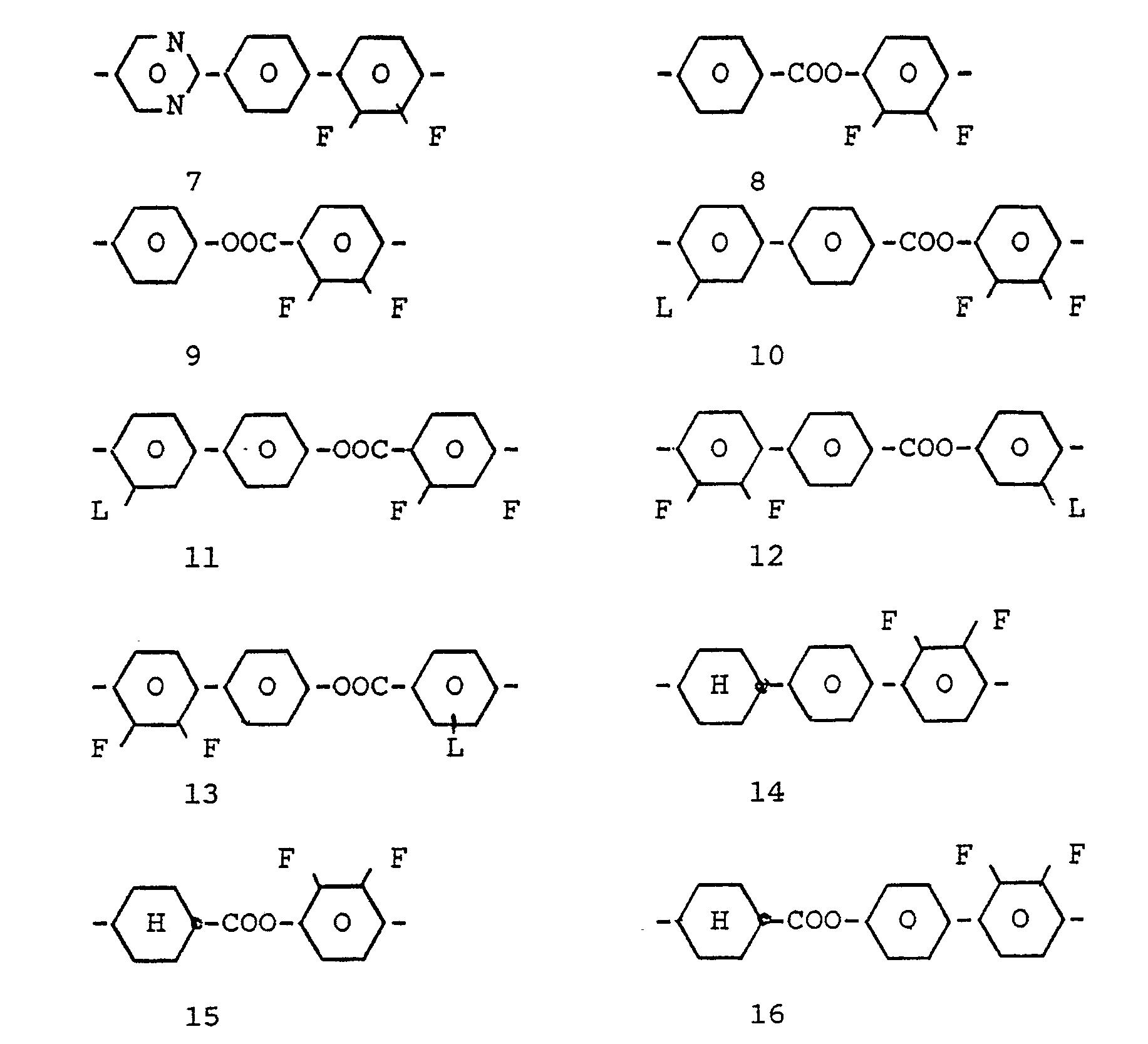
- Gruppen der Formeln 1, 3, 4, 5, 7, 8, 10, 11, 12 und 13, insbesondere diejenigen der Formeln 1, 3 und 10-13, sind besonders bevorzugt. L ist H oder F.
- Der Rest R¹ kann auch ein optisch aktiver organischer Rest mit einem asymmetrischen Kohlenstoffatom sein. Vorzugsweise ist dann das asymmetrische Kohlenstoffatom mit zwei unterschiedlich substituierten C-Atomen, einem H-Atom und einem Substituenten ausgewählt aus der Gruppe Halogen (insbesondere F, Cl oder Br), Alkyl oder Alkoxy mit jeweils 1 bis 5 C-Atomen und CN verknüpft. Der optisch aktive organische Rest R¹ bzw. Q* hat vorzugsweise die Formel,

Q′ Alkylen mit 1 bis 5 C-Atomen, worin auch eine nicht mit X′ verknüpfte CH₂-Gruppe durch -O-, -CO-, -O-CO-, -CO-O- oder -CH=CH- ersetzt sein kann, oder eine Einfachbindung,
Y′ CN, Halogen, Methyl oder Methoxy, und
R⁵ eine von Y verschiedene Alkylgruppe mit 1 bis 15 C-Atomen, worin auch eine oder zwei nicht benachbarte CH₂-Gruppen durch -O-, -CO-, -O-CO-, -CO-O- und/oder -CH=CH- ersetzt sein können,
bedeutet.
X′ ist vorzugsweise -CO-O-, -O-CO-, -CH=CH-COO- (trans) oder eine Einfachbindung. Besonders bevorzugt sind -CO-O-/-O-CO- oder eine Einfachbindung.
Q′ ist vorzugsweise -CH₂-, -CH₂CH₂-, -CH₂CH₂CH₂- oder eine Einfachbindung, insbesondere bevorzugt eine Einfachbindung.
Y′ ist vorzugsweise CH₃, -CN, F oder Cl, insbesondere bevorzugt CN oder F.
R⁵ ist vorzugsweise geradkettiges oder verzweigtes Alkyl mit 1 bis 10, insbesondere mit 1 bis 7, C-Atomen. - Besonders bevorzugt sind Verbindungen der Formel I′

Q¹ -O-CO- -O-CH₂- -CH₂- -CH₂CH₂- -CH₂- -CH₂CH₂- Q² - - -CO-O- -CO-O- -CH₂-O- -CH₂-O- - In den bevorzugten Verbindungen der vor- und nachstehenden Formeln können die Alkylreste, in denen auch eine CH₂-Gruppe (Alkoxy bzw. Oxaalkyl) durch ein 0-Atom ersetzt sein kann, geradkettig oder verzweigt sein. Vorzugsweise haben sie 5, 6, 7, 8, 9 oder 10 C-Atome und bedeuten demnach bevorzugt Pentyl, Hexyl, Heptyl, Octyl, Nonyl, Decyl, Pentoxy, Hexoxy, Heptoxy, Octoxy, Nonoxy oder Decoxy, ferner auch Ethyl, Propyl, Butyl, Undecyl, Dodecyl, Propoxy, Ethoxy, Butoxy, Undecoxy, Dodecoxy, 2-Oxapropyl (= 2-Methoxymethyl), 2- (= Ethoxymethyl) oder 3-Oxabutyl (= 2-Methoxy ethyl), 2-, 3- oder 4-Oxapentyl, 2-, 3-, 4- oder 5-Oxahexyl, 2-, 3-, 4-, 5- oder 6-Oxaheptyl.
- Besonders bevorzugt ist ein erfindungsgemäßes Merdium, welches mindestens 25 % an einer oder mehreren Verbindungender Formel II enthält,

R³ und R⁴ jeweils unabhängig voneinander unsubstituiertes, einfach durch Cyan oder mindestens einfach durch Fluor oder Chlor substituiertes Alkyl mit 1 bis 15 C-Atomen oder Alkenyl mit 3 bis 15 C-Atomen, wobei in diesen Resten jeweils auch eine CH₂-Gruppe durch -O-, -O-CO-, -CO-O- oder -O-CO-O- ersetzt sein kann,
und Ring A Pyrimidin-2,5-diyl oder Pyridin-2,5-diyl ist. - Bevorzugt sind Verbindungen der Formel IId, IIg und/oder IIh enthalten.


- Besonders bevorzugt ist ein Medium welches eine oder mehrere Verbindungen der Formeln IId und/oder IIh und gleichzeitig eine oder mehrere Verbindungen der Formel IIg enthält.
- Ein bevorzugtes Medium enthält 2 bis 25 % eines chiralen Dotierstoffes, welcher vorzugsweise eine S

- Ein bevorzugtes Medium enthält 8 bis 50 % an einer oder mehreren Verbindungen mit dem Strukturelement 2,3-Difluor-1,4-phenylen, welche vorzugsweise der Formel I entsprechen.
- Bevorzugt sind Verbindungen der Formel Ia′,

Q* ist vorzugsweise ein Rest der Formel
-Q¹-C*R°X-Q²-R²
worin
Q¹ und Q² jeweils unabhängig voneinander Alkylen mit 2 bis 4-C-Atomen, worin auch eine CH₂-Gruppe durch -O-, -S-, -CO-, -O-CO-, -CO-O-, -S-CO-, -CO-S-, -CH=CH-COO-, -CH=CH-, -CHHalogen und/oder -CHCN- ersetzt sein kann, oder eine Einfachbindung,
X Halogen, CN, CH₃, CH₂CN oder OCH₃,
R° H oder eine von X und -Q²-R² verschiedene Alkylgruppe mit 1 bis 10 C-Atomen, und
C* ein mit vier verschiedenen Substituenten verknüpftes Kohlenstoffatom bedeutet. - Ein bevorzugtes Medium enthält eine oder mehrere Verbindungen der Formeln Ia, Ib oder Ic,

o, p und q jeweils 0 oder 1 bedeutet. - Ferner bevorzugt sind erfindungsgemäße Medien enthaltend lediglich Verbindungen der Formel I, worin m = O bedeutet. Diese Medien zeichnen sich durch ein besonders günstiges Tieftemperaturverhalten und besonders niedrige Viskositätswerte aus. Ferner bevorzugt sind erfindungsgemäße Medien enthaltend Verbindungen der Formel I, worin mindestens eine Gruppe R¹ oder R² einen verzweigtkettigen Alkyl- oder Alkoxyrest darstellt. Diese Medien zeigen ebenfalls ein günstiges Tieftemperaturverhalten.
- R¹ und R² sind jeweils unabhängig voneinander vorzugsweise Alkyl, Alkoxy, Alkanoyl, Alkanoyloxy, Alkoxycarbonyl oder Alkoxycarbonyloxy mit jeweils vorzugsweise 5 bis 12, insbesondere 6 bis 10 C-Atomen. Besonders bevorzugt sind Alkyl und Alkoxy. Vorzugsweise ist eine der Gruppen R¹ und R² Alkyl. Eine besonders bevorzugte Kombination ist R¹ = Alkyl und R² = Alkoxy und ferner R¹ = Alkoxy und R² = Alkyl. Besonders bevorzugt sind R¹- und R²-Gruppen mit geradkettigem Alkylrest.
- Ferner bevorzugt sind Medien welche neben einer oder mehrerer Verbindungen der Formel I eine oder mehrere Oligophenylverbindungen der Formel 1 enthalten.
- Die erfindungsgemäßen Medien enthalten eine oder mehrere chirale Komponenten. Die entsprechenden Basismischungen (d.h. der achirale Teil), welche eine getiltete smektiksche Phase aufweisen (z.B. SC) sind ebenfalls Gegenstand der vorliegenden Erfindung. Durch Zugabe eines oder mehrerer Dotierstoffe kann der FAchmann ohne erfinderisches Zutun chirale getiltete smektische Medien erhalten. Bevorzugte Dotierstoffe sind diejenigen entsprechend WO 86/06373, WO 87/05018, DOS 36 38 026, DOS 38 07 802, DOS 38 43 128 und den Britischen Patentanmeldungen 86 15 316, 86 29 322, 87 24 458, 87 29 502, 87 29 503, 87 29 865 und 87 29 866.
- Alle Komponenten der erfindungsgemäßen Medien sind entweder bekannt oder in an sich bekannter Weise analog zu bekannten Verbindungen herstellbar.
- Die Verbindungen mit dem Strukturelement 2,3-Difluor-1,4-phenylen werden nach an sich bekannten Methoden hergestellt, wie sie in der Literatur (z. B. in den Standardwerken wie Houben-Weyl, Methoden der Organischen Chemie, Georg-Thieme-Verlag, Stuttgart) beschrieben sind, und zwar unter Reaktionsbedingungen, die für die genannten Umsetzungen bekannt und geeignet sind. Dabei kann man auch von an sich bekannten, hier nicht näher erwähnten Varianten Gebrauch machen.
- Die Ausgangsstoffe können gewünschtenfalls auch in situ gebildet werden, derart, daß man sie aus dem Reaktionsgemisch nicht isoliert, sondern sofort weiter zu den Zielverbindungen umsetzt.
- Verbindungen der Formel I sind ausgehend von 1,2-Difluorbenzol zugänglich. Dieses wird nach bekanntem Verfahren (z.B. A.M. Roe et al., J. Chem. Soc. Chem. Comm., 22, 582 (1965)) metalliert und mit dem entsprechenden Elektrophil umgesetzt. Mit dem so erhaltenen 1-substituierten 2,3-Difluorbenzol läßt sich diese Reaktionssequenz ein zweites Mal mit einem geeigneten Elektrophil durchführen und man gelangt so zu den für die Synthesen der Heterocyclen geeigneten 1,4-disubstituierten 2,3-Difluorbenzolen. 1,2-Difluorbenzol bzw. 1-substituiertes 2,3-Difluorbenzol wird in einem inerten Lösungsmittel wie Diethylether, Tetrahydrofuran, Dimethoxyethan, tert-Butylmethylether oder Dioxan, Kohlenwasserstoffen wie Hexan, Heptan, Cyclohexan Benzol oder Toluol oder Gemischen dieser Lösungsmittel gegebenenfalls unter Zusatz eine Komplexierungsmittels wie Tetramethylethylendiamin (TMEDA) oder Hexamethylphosphorsäuretriamid mit Phenyllithium, Lithiumtetramethylpiperidin, n-, sek- oder tert-Butyllithium bei Temperaturen von -100 °C bis +50 °C vorzugsweise -78 °C bis 0 °C umgesetzt.
- Die Lithium-2,3-difluorphenyl-Verbindungen werden bei -100 °C bis 0 °C vorzugsweise bei -50 °C mit den entsprechenden Elektrophilen umgesetzt. Geeignete Elektrophile sind Aldehyde, Ketone, Nitrile, Epoxide, Carbonsäure-Derivate wie Ester, Anhydride oder Halogenide, Halogenameisensäureester oder Kohlendioxid.
- Zur Umsetzung mit aliphatischen oder aromatischen Halogen-Verbindungen werden die Lithium-2,3-difluorphenyl-Verbindungen transmetalliert und unter Übergangsmetallkatalyse gekoppelt. Besonders geeignet sind hierfür die Zink- (vgl. DE OS 36 32 410) oder die Titan-2,3-difluorphenyl-Verbindungen (vgl. DE OS 37 36 489).
- Die neuen Verbindungen der Formel I sind Gegenstand folgender DE Patentanmeldungen mit demselben Anmeldetag:
Derivate des 2,3-Difluorhydrochinons (P 38 07 801) Derivate der 2,3-Difluorbenzoesäure (P 38 07 823) Derivate des 2,3-Difluorphenols (P 38 07 803) Difluorbenzoesäurephenylester (P 38 07 870) Derivate des 2,3-Difluorphenols (P 38 07 819) 2,3-Difluorbiphenyle (P 38 07 861) Heterocyclische Derivate des 1,2-Difluorbenzols (P 38 07 871) Chirale Derivate des 1,2-Difluorbenzols (P 38 07 802) - Die dort beschriebenen Verbindungen sind bevorzugte Verbindungen der Formel I.
- Die Herstellung der erfindungsgemäßen Medien erfolgt in an sich üblicher Weise. In den Regeln werden die Komponenten ineinander gelöst, zweckmäßig bei erhöhter Temperatur.
- Durch geeignete Zusätze können die flüssigkristallinen Medien nach der Erfindung so modifiziert werden, daß sie in allen bisher bekannt gewordenen Arten von Flüssigkristallanzeigeelementen verwendet werden können.
- Die folgenden Beispiele sollen die Erfindung erläutern, ohne sie zu begrenzen. Vor- und nachstehend bedeuten Prozentangaben Gewichtsprozent; alle Temperaturen sind in Grad Celsius angegeben. Die Werte für die spontane Polarisation gelten für Raumtemperatur. Es bedeuten ferner: K: Kristallin-fester Zustand, S: smektische Phase (der Index kennzeichnet den Phasentyp), N: nematischer Zustand, Ch: cholesterische Phase, I: isotrope Phase. Die zwischen zwei Symbolen stehende Zahl gibt die Umwandlungstemperatur in Grad Celsius an.
- Ein flüssigkristallines Medium bestehend aus
8 % 2-p-Heptyloxyphenyl-5-octylpyrrimidin,
10% 2-p-Octyloxyphenyl-5-octylpyrimidin,
14 % 2-p-Nonyloxyphenyl-5-octylpyrimidin,
3 % 2-p-Hexyloxyphenyl-5-nonylpyrimidin,
23 % 2-p-Nonyloxyphenyl-5-nonylpyrimidin,
7 % 2-(2,3-Difluor-4-nonyloxyphenyl)-5-octylpyrimidin,
9 % 2-(2,3-Difluor-4-nonyloxyphenyl)-5-nonylpyrimidin,
8 % 2-(p-Pentyloxyphenyl)-5-(p-octylphenyl)-1,3,4-thiadiazol,
8 % 2-(p-Heptyloxyphenyl)-5-(p-octylphenyl)-1,3,4-thiadiazol und
10 % optisch aktivem 2-Cyan-2-methylhexancarbonsäure-(4′-octyloxybiphenyl-4-ylester)
zeigt S
- Ein flüssigkristallines Medium bestehend aus
4 % 2-p-Octyloxyphenyl-5-heptylpyrimidin,
4 % 2-p-Nonyloxyphenyl-5-heptylpyrimidin, 7 % 2-p-Hexyloxyphenyl-5-nonylpyrimidin,
12 % 2-p-Heptyloxyphenyl-5-nonylpyrimidin,
25 % 2-p-Nonyloxyphenyl-5-nonylpyrimidin,
8 % 2-(2,3-Difluor-4-nonyloxyphenyl)-5-nonylpyrimidin, 8 % 2-(2,3-Difluor-4-octyloxybiphenyl-4′-yl)-5-heptylpyrimidin,
8 % r-1-Cyan-cis-4-(4′-octyloxybiphenyl-4-yl)-1-octylcyclohexan,
7 % 2-(p-Heptyloxyphenyl)-5-(p-pentylphenyl)-1,3,4-thiadiazol,
7 % 2-(p-Octyloxyphenyl)-5-(p-heptylphenyl)-1,3,4-thiadiazol und
10 % chiralem Ethyl-2-[p-(5-nonylpyrimidin-2-yl)-phenoxy]-propionat
zeigt S
- Ein flüssigkristallines Medium bestehend aus
6 % 4-Octyloxyphenyl-4-decyloxybenzoat,
9 % 4-Nonyloxyphenyl-4-decyloxybenzoat,
14 % 4-Decyloxyphenyl-4-decyloxybenzoat,
5 % 2,3-Difluor-4-octyloxyphenyl-4-octyloxybenzoat,
7 % 2,3-Difluor-4-octyloxyphenyl-4-decyloxybenzoat,
9 % 2,3-Difluor-4-decyloxyphenyl-4-decyloxybenzoat,
4 % 2,3-Difluor-4-nonanoyloxyphenyl-4-octyloxybenzoat,
10 % 4′-Pentyloxybiphenyl-4-yl-4-octyloxybenzoat,
8 % 4′-Heptyloxybiphenyl-4-yl-4-octyloxybenzoat,
17 % r-1-Cyan-cis-4-(4′-octyloxybiphenyl-4-yl)-1-octylcyclohexan und
11 % chiralem 2-Chlor-3-methylbuttersäure-[p-(5-heptylpyrimidin-2-yl)-phenylester]
zeigt S
- Ein flüssigkristallines Medium bestehend aus
8 % 2-p-Octyloxyphenyl-5-octylpyrimidin,
10 % 2-p-Nonyloxyphenyl-5-octylpyrimidin,
12 % 2-p-Octyloxyphenyl-5-nonylpyrimidin,
20 % 2-p-Nonyloxyphenyl-5-nonylpyrimidin,
7 % 2,3-Difluor-4-decyloxyphenyl-4-decyloxybenzoat,
7 % 2,3-Difluor-4-octyloxyphenyl-4-decyloxybenzoat,
9 % 2-(p-Heptylphenyl)-5-(p-hexyloxyphenyl)-1,3,4-thiadiazol,
9 % 2-(p-Heptylphenyl)-5-(p-octyloxyphenyl)-1,3,4-thiadiazol,
8 % 2,3-Difluor-4-octanoyloxyphenyl-4-(5-hexylpyrimidin-2-yl)-2-fluorbenzoat und
10 % chiralem Isopropyl-2-[p-(p-decyloxyphenyl)-phenoxy]-propionat
zeigt S
- Ein flüssigkristallines Medium bestehend aus
3 % 2-p-Heptyloxyphenyl-5-heptylpyrimidin,
5% 2-p-Nonyloxyphenyl-5-heptylpyrimidin,
7 % 2-p-Hexyloxyphenyl-5-nonylpyrimidin,
22 % 2-p-Nonyloxyphenyl-5-nonylpyrimidin,
5 % 2-(5-Octylpyridyl)-2,3-difluor-4-heptyloxybenzoat,
9 % [4-(5-Octylpyridin-2-yl)-phenyl]-2,3-difluor-4-octyloxybenzoat,
7 % r-1-Cyan-cis-4-(4′-heptylbiphenyl-4-yl)-1-hexylcyclohexan,
12 % r-1-Cyan-cis-4-(4′-octylbiphenyl-4-yl)-1-butylcyclohexan,
20 % r-1-Cyan-cis-4-(4′-nonyloxybiphenyl-4-yl-1-octylcyclohexan und
10 % optisch aktivem 2-Cyan-2-methylhexansäure-[p-(5-nonylpyrimidin-2-yl)-phenyl]-ester
zeigt S
- Ein flüssigkristallines Medium bestehend aus
6 % 2-p-Octyloxyphenyl-5-octylpyrimidin,
8 % 2-p-Nonyloxyphenyl-5-octylpyrimidin,
6 % 2-p-Octyloxyphenyl-5-nonylpyrimidin,
24 % 2-p-Nonyloxyphenyl-5-nonylpyrimidin,
7 % 2-(5-Nonylpyrimidyl)-2,3-difluor-4-nonyloxybenzoat,
5 % [4-(5-Heptylpyrimidin-2-yl)-phenyl]-2,3-difluor-4-octyloxybenzoat,
8 % 2-(p-Heptyloxyphenyl)-5-(p-pentylphenyl)-1,3,4-thiadiazol,
9 % 2-(p-Octyloxyphenyl)-5-(p-heptylphenyl)-1,3,4-thiadiazol,
15 % r-1-Cyan-cis-4-(4′-octyloxybiphenyl-4-yl)-1-hexylcyclohexan und
12 % optisch aktivem 2-Chlor-3-methylbuttersäure-[p-(5-octylpyrimidin-2-yl)-phenyl]-ester
zeigt S
- Ein flüssigkristallines Medium bestehend aus
3 % 2-p-Heptyloxyphenyl-5-heptylpyrimidin,
3 % 2-p-Nonyloxyphenyl-5-heptylpyrimidin,
8 % 2-p-Octyloxyphenyl-5-nonylpyrimidin,
22 % 2-p-Nonyloxyphenyl-5-nonylpyrimidin,
8 % (2,3-Difluor-4-hexyloxyphenyl)-4-(5-heptylpyrimidin-2-yl)-benzoat
10 % (2,3-Difluor-4-decyloxyphenyl)-5-heptylpyridin-2-carboxylat
6 % (2,3-Difluor-4-ethoxyethylphenyl)-2-fluor-4-(5-hexylpyrimidin-2-yl)-benzoat
10 % r-1-Cyan-cis-4-(4′-octylbiphenyl-4-yl)-1-butylcyclohexan,
20 % r-1-Cyan-cis-4-(4′-nonyloxybiphenyl-4-yl)-1-octylcyclohexan und
10 % optisch aktivem 2-Cyan-2-methylhexansäure-(4′-hexyloxybiphenyl-4-yl)-ester
zeigt S
- Ein flüssigkristallines Medium bestehend aus
11 % 4-Octyloxyphenyl-4-decyloxybenzoat,
13 % 4-Decyloxyphenyl-4-decyloxybenzoat,
8 % 4-Nonylphenyl-2,3-difluor-4-nonyloxybenzoat,
12 % 4-Heptylphenyl-p-(4-octyloxyphenyl)-benzoat,
14 % 4′-Octyloxybiphenyl-4-yl-4-heptyloxybenzoat,
7 % 4′-Octylbiphenyl-4-yl-2,3-difluor-4-nonyloxybenzoat,
5 % 4′-Octyloxy-2,3-difluorbiphenyl-4-yl-2,3-difluor-4-pentylbenzoat,
5 % 4′-Octyloxy-2′,3′-difluorbiphenyl-4-yl-4-nonyloxybenzoat,
11 % 4′-Nonyloxybiphenyl-4-yl-4-heptyloxybenzoat und
14 % optisch aktivem 2-Chlor-3-methylbuttersäure-[p-(5-heptylpyrimidin-2-yl)-phenyl]-ester
zeigt S
- Ein flüssigkristallines Medium bestehend aus
9 % 4-Octyloxyphenyl-4-octyloxybenzoat,
12 % 4-Nonyloxyphenyl-4-octyloxybenzoat,
8 % 4-Nonyloxyphenyl-4-decyloxybenzoat,
10 % 4-Decyloxyphenyl-4-decyloxybenzoat,
6 % (2,3-Difluor-4-octylphenyl)-4-octyloxybenzoat,
8 % (2,3-Difluor-4-decylphenyl)-4-octyloxybenzoat,
4 % (2,3-Difluor-4-octylphenyl)-2-fluor-4-octyloxybenzoat,
15 % 4′-Heptyloxybiphenyl-4-yl-4-octyloxybenzoat,
18 % 4′-Octyloxybiphenyl-4-yl-4-octyloxybenzoat und
10 % optisch aktivem Butyl-2-[p-(5-nonylpyrimidin-2-yl-)-phenoxy]-propionat
zeigt S
- Ein flüssigkristallines Medium bestehend aus
7 % 2-p-Heptyloxyphenyl-5-octylpyrimidin,
11 % 2-p-Octyloxyphenyl-5-octylpyrimidin,
6 % 2-p-Hexyloxyphenyl-5-nonylpyrimidin,
14 % 2-p-Nonyloxyphenyl-5-nonylpyrimidin,
5 % 4′-Octyl-2,3-difluor-4-octyloxybiphenyl,
7 % 4′-Nonyl-2,3-difluor-4-nonyloxybiphenyl,
8 % 4-Pentyloxy-2,3-difluorbiphenyl-4′-carbonsäure-(p-hexylphenylester),
20 % r-1-Cyan-cis-4-(4′-octyloxybiphenyl-4-yl)-1-octylcyclohexan,
12 % r-1-Cyan-cis-4-(4′-octylbiphenyl-4-yl)-1-butylcyclohexan und
10 % optisch aktivem 2-Cyan-2-methylhexansäure-[p-(5-heptyl-pyrimidin-2-yl)-phenyl]-ester
zeigt S
- Ein flüssigkristallines Medium bestehend aus
8 % 2-p-Octyloxyphenyl-5-octylpyrimidin,
12 % 2-p-Nonyloxyphenyl-5-octylpyrimidin,
7 % 2-p-Hexyloxyphenyl-5-nonylpyrimidin,
23 % 2-p-Nonyloxyphenyl-5-nonylpyrimidin,
8 % 2-(2,3-Difluor-4-octyloxyphenyl)-5-nonyl-1,3,4-thiadiazol,
8 % 2-(2,3-Difluor-4-octyloxyphenyl)-5-heptyl-1,3,4-thiadiazol,
7 % 2-(p-Pentyloxyphenyl)-5-(p-heptylphenyl)-1,3,4-thiadiazol,
7 % 2-(p-Heptyloxyphenyl)-5-(p-heptylphenyl)-1,3,4-thiadiazol,
6 % 2-(p-Heptyloxyphenyl)-5-(2,3-difluor-4-heptylphenyl)-1,3,4-thiadiazol,
4 % 2-(4′-Heptyloxy-2,3-difluorbiphenyl-4-yl)-5-pentyl-1,3,4-thiadiazol und
10 % optisch aktivem 2-Cyan-2-methylhexansäure-(4′-octyloxybiphenyl-4-yl)-ester
zeigt S
- Ein flüssigkristallines Medium bestehend aus
3 % 2-p-Heptyloxyphenyl-5-heptylpyrimidin,
4 % 2-p-Nonyloxyphenyl-5-heptylpyrimidin,
11 % 2-p-Octyloxyphenyl-5-nonylpyrimidin,
21 % 2-p-Nonyloxyphenyl-5-nonylpyrimidin,
7 % 2-(2,3-Difluor-4-octyloxyphenyl)-5-octylpyrimidin,
8 % 2-(2,3-Difluor-4-nonyloxyphenyl)-5-nonylpyrimidin,
4 % 2-(2,3-Difluor-4-octyloxyphenyl)-5-octylpyridin,
7 % 2-(p-Heptyloxyphenyl)-5-(p-pentylphenyl)-1,3,4-thiadiazol,
17 % r-1-Cyan-cis-4-(4′-octyloxybiphenyl-4-yl)-1-octylcyclohexan,
8 % 2-(4′-Pentyloxy-2,3-difluorbiphenyl-4-yl)-5-heptylpyrimidin und
10 % optisch aktivem 2-Chlor-3-methylbuttersäure-[p-(5-heptylpyrimidin-2-yl)-phenyl]-ester
zeigt S
- Ein flüssigkristallines Medium bestehend aus
8 % 2-Octyloxyphenyl-5-octylpyrimidin,
12 % 2-p-Nonyloxyphenyl-5-octylpyrimidin,
7 % 2-p-Hexyloxyphenyl-5-nonylpyrimidin,
23 % 2-p-Nonyloxyphenyl-5-nonylpyrimidin,
8 % 2-(2,3-Difluor-4-octyloxyphenyl)-5-nonyl-1,3,4-thiadiazol,
8 % 2-(2,3-Difluor-4-octyloxyphenyl)-5-heptyl-1,3,4-thiadiazol,
7 % 2-(p-Pentyloxyphenyl)-5-(p-heptylphenyl)-1,3,4-thiadiazol,
7 % 2-(p-Heptyloxyphenyl)-5-(p-heptylphenyl)-1,3,4-thiadiazol,
6 % 2-(p-Heptyloxyphenyl)-5-(2,3-difluor-4-heptylphenyl)-1,3,4-thiadiazol,
4 % 2-(4′-Heptyloxy-2,3-difluorbiphenyl-4-yl)-5-pentyl-1,3,4-thiadiazol und
10 % optisch aktivem 2-Cyan-2-methylhexansäure-(4′-octyl-oxybiphenyl-4-yl)-ester
zeigt S
- Ein flüssigkristallines Medium bestehend aus
3 % 2-Heptyloxyphenyl-5-heptylpyrimidin,
4 % 2-p-Nonyloxyphenyl-5-heptylpyrimidin,
11 % 2-p-Octyloxyphenyl-5-nonylpyrimidin,
21 % 2-p-Nonyloxyphenyl-5-nonylpyrimidin,
7 % 2-(2,3-Difluor-4-octyloxyphenyl)-5-octylpyrimidin,
8 % 2-(2,3-Difluor-4-nonyloxyphenyl)-5-nonylpyrimidin,
4 % 2-(2,3-Difluor-4-octyloxyphenyl)-5-octylpyridin,
7 % 2-(p-Heptyloxyphenyl)-5-(p-pentylphenyl)-1,3,4-thiadiazol,
17 % r-1-Cyan-cis-4-(4′-octyloxybiphenyl-4-yl)-1-octylcyclohexan,
8 % 2-(4′-Pentyloxy-2,3-difluorbiphenyl-4-yl)-5-heptylpyrimidin und
10 % optisch aktivem 2-Chlor-3-methylbuttersäure-[p-(5-heptylpyrimidin-2-yl)-phenyl]-ester
zeigt S
- Eine achirale SC-Basismischung bestehend aus
4,4 % 2-p-Heptyloxyphenyl-5-heptylpyrimidin,
4,4 % 2-p-Octyloxyphenyl-5-heptylpyrimidin,
4,4 % 2-p-Nonyloxyphenyl-5-heptylpyrimidin,
7,8 % 2-(2,3-Difluor-4-octyloxyphenyl)-5-heptylpyrimidin
7,8 % 2-p-Hexyloxyphenyl-5-nonylpyrimidin,
25,6 % 2-p-Nonyloxyphenyl-5-nonylpyrimidin,
10,0 % 2-(2,3-Difluor-4-nonyloxyphenyl)-5-nonylpyrimidin,
8,9 % 2-(p-Hexyloxyphenyl)-5-(-p-heptylphenyl)-1,3,4-thiadiazol,
11,1 % r-1-Cyan-cis-4-(4′-octyloxybiphenyl-4-yl)-1-octylcyclohexan, 8,9 % 2-(4′-Hexyloxy-2,3-difluorbiphenyl-4-yl)-5-heptylpyrimidin und
6,7 % 2-(2,3-Difluor-4-pentyloxyphenyl)-5-(p-heptylphenyl)-1,3,4,-thiadiazol
wird mit jeweils 10 % der folgenden Dotierstoffe A bis L versetzt. Die Phasenübergangstemperaturen und die Werte der Spontanpolarisation bei Raumtemperatur sind in der folgenden Tabelle zusammengefaßt:

- Ein flüssigkristallines Medium bestehend aus
12,5 % 4-(p-Octyloxyphenyl)benzoesäure-4-heptyloxy-2,3-difluorphenylester,
14,2 % p-Octyloxybenzoesäure-4-heptyloxy-2,3-difluorphenylester,
12,5 % 4-(p-Heptoxyphenyl)-benzoesäure-4-heptyl-2-fluor-phenylester,
12,5 % 4-(4-Heptyloxy-3-fluorphenyl)-benzoesäure-4-heptyl-2-fluorphenylester,
14,2 % p-Octyloxybenzoesäure-4-octyloxy-3-fluorphenylester,
12,34 % p-Octyloxybenzoesäure-4-pentyl-2-fluorphenylester, 14,24 % p-Hexyloxybenzoesäure-4-octyloxy-3-fluorphenylester,
5,04 % optisch aktivem 4-(p-Octylphenyl)-benzoesäure-p-(2-methylbutylphenyl)-ester und
2,48 % optisch aktivem 4-(p-Octyloxy)-benzoesäure-(1-cyan-2-methylpropylester)
zeigt S
- Ein flüssigkristallines Medium bestehend aus
16,87 % 4-(4-Octyloxy-2,3-difluorphenyl)-benzoesäure-(4-octyl-2-fluorphenylester),
9 % 4-(4-Octyloxy-2,3-difluorphenyl)-benzoesäure-(4-heptyl-3-fluorphenylester),
16,87 % 4-(p-Heptyloxyphenyl)-benzoesäure-4-heptyl-2-fluorphenylester,
16,87 % 4-(4-Heptyloxy-3-fluorphenyl)-benzoesäure-4-heptyl-2-fluorphenylester,
14 % p-Octyloxybenzoesäure-4-octyloxy-3-fluorphenylester,
10 % p-Octyloxybenzoesäure-4-pentyl-2-fluorphenylester,
14 % p-Hexyloxybenzoesäure-4-octyloxy-3-fluorphenylester,
2,4 % optisch aktivem 4-(p-Octyloxy)-benzoesäure-(1-cyan-2-methylpropylester)
zeigt S
- Ein flüssigkristallines Medium bestehend aus
8 % 2-(4-Heptyloxy-2,3-difluorphenyl)-5-nonylpyrimidin,
9 % 2-(4-Nonyloxy-2,3-difluorphenyl)-5-nonylpyrimidin,
17 % 2-(p-Hexyloxyphenyl)-5-nonylpyrimidin,
17 % 2-(p-Heptyloxyphenyl)-5-nonylpyrimidin,
17 % 2-(p-Octyloxyphenyl)-5-nonylpyrimidin,
17 % 2-(p-Nonyloxyphenyl)-5-nonylpyrimidin und
15 % optisch aktivem 2-(p-n-Octyloxyphenyl)-5-(3-fluor-n-nonyl)-pyridin
zeigt S
- Ein flüssigkristallines Medium bestehend aus
8 % 2-(4-Heptyloxy-2,3-difluorphenyl)-5-nonylpyrimidin,
9 % 2-(4-Nonyloxy-2,3--difluorphenyl)-5-nonylpyrimidin,
6 % 2-(p-Octyloxyphenyl)-5-pentylpyrimidin,
6 % 2-(p-Hexyloxyphenyl)-5-hexylpyrimidin,
6 % 2-(p-Ethoxyphenyl)-5-heptylpyrimidin,
12 % 2-(p-Hexyloxyphenyl)-5-nonylpyrimidin,
12 % 2-(p-Heptyloxyphenyl)-5-nonylpyrimidin,
13 % 2-(p-Octyloxyphenyl)-5-nonylpyrimidin,
13 % 2-(p-Nonyloxyphenyl)-5-nonylpyrimidin und
15 % optisch aktivem 2-(p-n-Octyloxyphenyl)-5-(3-fluor-n-nonyl)-pyridin
zeigt S
- Ein flüssigkristallines Medium bestehend aus
17,5 % p-(3-Fluor-4-octyloxyphenyl)-benzoesäure-(2-fluor-4-heptylphenylester),
17,5 % 2,3-Difluor-4-octyloxy-4′-octanoyloxybiphenyl,
17,5 % 2,3-Difluor-4-octyloxy-4′-decanoyloxybiphenyl
12,5 % p-(2,3-Difluor-4-octyloxyphenyl)-benzeoesäure-(3-fluor-4-heptylphenylester),
15 % p-Octyloxybenzoesäure-(3-fluor-4-octyloxyphenylester),
15 % p-Hexyloxybenzoesäure-(3-fluor-4-octyloxyphenylester),
5 % p-Octyloxybenzoesäure-(2-fluor-4-pentylphenylester) und
2,4 % optisch aktivem p-(p-Octyloxyphenyl)-benzoesäure-(1-cyan-2-methylpropylester)
zeigt S
- Ein flüssigkristallines Medium bestehend aus
12,17 % p-(3-Fluor-4-octyloxyphenyl)-benzoesäure-(2-fluor-4-heptylphenylester), 12,17 % p-(p-Heptyloxyphenyl)-benzoesäure-(2-fluor-4-heptylphenylester),
12,17 % p-(3-Fluor-4-octyloxyphenyl)-benzoesäure-(2,3-difluor-4-heptyloxyphenylester), 13,83 % p-Octyloxybenzoesäure-(3-fluor-4-octyloxyphenylester),
13,83 % p-Octyloxybenzoesäure-(2,3-difluor-4-octyloxyphenylester),
13,96 % p-Hexyoxybenzoesäure-(3-fluor-4-octyloxyphenylester),
9,0 % p-[p-(p-Octyloxybenzoyloxy)-phenyl)-benzoesäure-(2-methylbutylester),
2,42 % optisch aktivem p-(p-Octyloxyphenyl)-benzoesäure-(1-cyan-2-methylpropylester),
0,45 % optisch aktivem p-(3-Fluor-4-octyloxyphenyl)-benzoesäure-(1-cyanethylester) und
10,0 % p-Octyloxybenzoesäure-(2-fluor-4-pentylphenylester)
zeigt S
- Ein flüssigkristallines Medium bestehend aus
16,2 % p-(2,3-Difluor-4-octyloxyphenyl)-benzoesäure-(trans-4-heptylcyclohexylester),
16,2 % p-(3-Fluor-4-octyloxyphenyl)-benzoesäure-(trans-4-heptylcyclohexylester),
16,2 % p-(3-Fluor-4-octyloxyphenyl)-benzoesäure-(2-fluor-4-heptylphenylester),
15,0 % p-Octyloxybenzoesäure-(3-fluor-4-octyloxyphenylester),
14,0 % p-Hexyloxybenzoesäure-(3-fluor-4-octyloxyphenylester), 20 % p-Octyloxybenzoesäure-(2-fluor-4-pentylphenylester) und
2,4 % optisch aktivem p-(p-Octyloxyphenyl)-benzoesäure-(1-cyan-2-methylpropylester)
zeigt S
Claims (14)

worin die terminalen Substituenten
R¹, R² und R³ jeweils unabhängig voneinander, gegebenenfalls mit CN oder mit mindestens einem Halogenatom substituierten, Alkyl- oder Alkenylrest mit bis zu 15 C-Atomen, worin eine oder mehrere nicht benachbarte CH₂-Gruppen dieser Reste auch durch -O-, -S-, -CO-, -O-CO-, -CO-O-, -O-CO-O- oder -C≡C- ersetzt sein können, einer dieser Reste R₁ und R₂ auch eine Gruppe der Formel,

(A,B), (C,D), (C′,D′)
und alle übrigen lateralen Substituenten Wasserstoff oder Fluor bedeuten.

R¹ und R² jeweils unabhängig voneinander unsubstituiertes, einfach durch Cyan oder mindestens einfach durch Fluor oder Chlor substituiertes Alkyl mit 1 bis 15 C-Atomen oder Alkenyl mit 3 bis 15 C-Atomen, wobei in diesen Resten jeweils auch eine CH₂-Gruppe durch -O-, -CO-, -O-CO-, -CO-O- oder -O-CO-O- ersetzt sein kann, einer der Reste R¹ und R² auch einen Chiralität induzierenden organischen Rest Q* mit einem asymmetrischem Kohlenstoffatom,
A¹ und A² jeweils unabhängig voneinander unsubstituiertes oder durch ein oder zwei F- und/oder Cl-Atome und/oder CH₃-Gruppen und/oder CN-Gruppen substituiertes 1,4- Phenylen, worin auch eine oder zwei CH-Gruppen durch N ersetzt sein können, 1,4-Cyclohexylen, worin auch eine oder zwei nicht benachbarte CH₂-Gruppen durch O-Atome und/oder S-Atome ersetzt sein können, Piperidin-1,4-diyl, 1,4-Bicyclo-(2,2,2)octylen, 1,3,4-Thiadiazol-2,5-diyl, Naphthalin-2,6-diyl- oder 1,2,3,4-Tetrahydronaphthalin-2,6-diyl,
Z¹ und Z² jeweils -CO-O-, -O-CO-, -CH₂CH₂-, -OCH₂-, -CH₂O-, -C≡C- oder eine Einfachbindung,
m und n jeweils 0, 1 oder 2, und
(m + n) 1 oder 2 bedeutet,
mit der Maßgabe, daß eine oder zwei der im Molekül der Formel I anwesenden Gruppen Z¹ und/oder Z² -CO-O-, -O-CO-, -CH₂CH₂-, -OCH₂-, -CH₂O- oder -C≡C- bedeuten, falls A¹ und A² jeweils unabhängig voneinander unsubstituiertes oder durch ein oder zwei F-Atome substituiertes 1,4-Phenylen bedeuten.
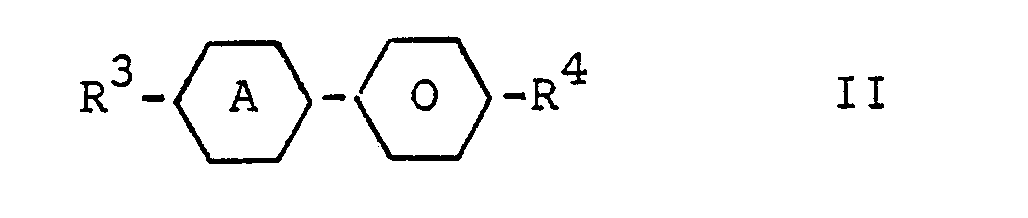
R³ und R⁴ jeweils unabhängig voneinander unsubstituiertes, einfach durch Cyan oder mindestens einfach durch Fluor oder Chlor substituiertes Alkyl mit 1 bis 15 C-Atomen oder Alkenyl mit 3 bis 15 C-Atomen, wobei in diesen Resten jeweils auch eine CH₂-Gruppe durch -O-, -CO-, -O-CO-, -CO-O- oder -O-CO-O- ersetzt sein kann,
und Ring A Pyrimidin-2,5-diyl oder Pyridin-2,5-diyl ist.


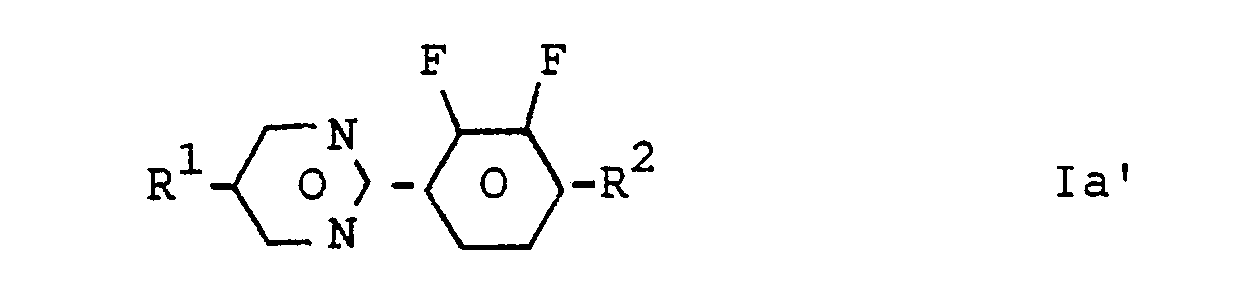
-Q¹-C*R°X-Q²-R²
bedeutet, worin
Q¹und Q² jeweils unabhängig voneinander Alkylen mit 2 bis 4-C-Atomen, worin auch eine CH₂-Gruppe durch -O-, -S-, -CO-, -O-CO-, -CO-O-, -S-CO-, -CO-S-, -CH=CH-COO-, -CH=CH-, -CHHalogen und/oder -CHCN- ersetzt sein kann, oder eine Einfachbindung,
X Halogen, CN, CH₃, CH₂CN oder OCH₃,
R° H oder eine von X und -Q²-R² verschiedene Alkylgruppe mit 1 bis 10 C-Atomen, und
C* ein mit vier verschiedenen Substituenten verknüpftes Kohlenstoffatom bedeutet.

o, p und q jeweils 0 oder 1 bedeutet.

worin die terminalen Substituenten
R¹, R² und R³ jeweils unabhängig voneinander, gegebenenfalls mit CN oder mit mindestens einem Halogenatom substituierten, Alkyl- oder Alkenylrest mit bis zu 15 C-Atomen, worin eine oder mehrere nicht benachbarte CH₂-Gruppen dieser Reste auch durch -O-, -S-, -CO-, -O-CO-, -CO-O-, -O-CO-O- oder -C≡C- ersetzt sein können, einer dieser Reste R₁ und R₂ auch eine Gruppe der Formel,
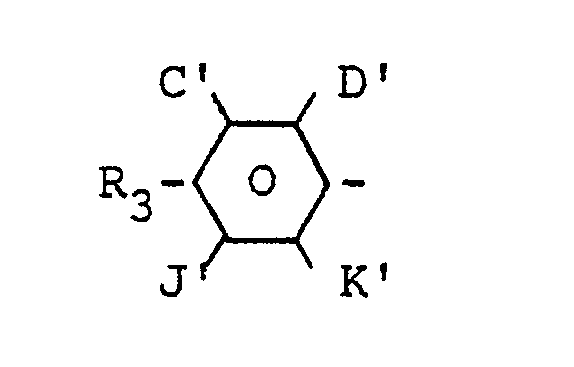
(A,B), (C,D), (C′,D′)
und alle übrigen lateralen Substituenten Wasserstoff oder Fluor bedeuten,
als Komponenten chiraler getilter smektischer Flüssigkristallmedien.
Applications Claiming Priority (2)
| Application Number | Priority Date | Filing Date | Title |
|---|---|---|---|
| DE3807862A DE3807862A1 (de) | 1988-03-10 | 1988-03-10 | Smektische fluessigkristallphase |
| DE3807862 | 1988-03-10 |
Publications (2)
| Publication Number | Publication Date |
|---|---|
| EP0332006A1 true EP0332006A1 (de) | 1989-09-13 |
| EP0332006B1 EP0332006B1 (de) | 1993-01-13 |
Family
ID=6349318
Family Applications (2)
| Application Number | Title | Priority Date | Filing Date |
|---|---|---|---|
| EP89103413A Expired - Lifetime EP0332006B1 (de) | 1988-03-10 | 1989-02-27 | Smektisches Flüssigkristallmedium |
| EP89902768A Pending EP0362317A1 (de) | 1988-03-10 | 1989-02-27 | Smektisches flüssigkristallmedium |
Family Applications After (1)
| Application Number | Title | Priority Date | Filing Date |
|---|---|---|---|
| EP89902768A Pending EP0362317A1 (de) | 1988-03-10 | 1989-02-27 | Smektisches flüssigkristallmedium |
Country Status (6)
| Country | Link |
|---|---|
| US (1) | US5198149A (de) |
| EP (2) | EP0332006B1 (de) |
| JP (1) | JP2813396B2 (de) |
| KR (1) | KR900700572A (de) |
| DE (2) | DE3807862A1 (de) |
| WO (1) | WO1989008690A1 (de) |
Cited By (2)
| Publication number | Priority date | Publication date | Assignee | Title |
|---|---|---|---|---|
| WO1994008268A1 (en) * | 1992-10-02 | 1994-04-14 | Merck Patent Gmbh | Liquid crystalline material |
| WO1995016760A1 (en) * | 1993-12-13 | 1995-06-22 | The Secretary Of State For Defence | Ferroelectric liquid crystal devices |
Families Citing this family (23)
| Publication number | Priority date | Publication date | Assignee | Title |
|---|---|---|---|---|
| DE4023867A1 (de) * | 1990-07-27 | 1992-01-30 | Merck Patent Gmbh | Ferroelektrische fluessigkristallanzeige |
| US5437815A (en) * | 1991-10-02 | 1995-08-01 | Seiko Epson Corporation | Tolan derivative, liquid crystal composition containing the derivative, and liquid crystal display device having the composition |
| GB2271118B (en) * | 1992-09-30 | 1996-09-18 | Merck Patent Gmbh | Ferroelectric liquid-crystalline media, and their use in electro-optical devices |
| JP3347775B2 (ja) * | 1992-11-11 | 2002-11-20 | メルク パテント ゲゼルシャフト ミット ベシュレンクテル ハフトング | ネマチック液晶混合物および弗素化クロルテルフェニル |
| US5417885A (en) * | 1993-08-03 | 1995-05-23 | Showa Shell Sekiyu Kabushiki Kaisha | Antiferroelectric liquid crystal compound |
| JP3565521B2 (ja) * | 1995-07-11 | 2004-09-15 | シャープ株式会社 | 重合性化合物およびそれを用いた液晶表示素子 |
| JP3563860B2 (ja) * | 1996-02-23 | 2004-09-08 | シャープ株式会社 | 重合性化合物およびそれを用いた液晶表示素子 |
| US5750213A (en) * | 1996-02-26 | 1998-05-12 | Sharp Kabushiki Kaisha | Polymerizable compound and liquid crystal display device using the same |
| US6366330B1 (en) | 1997-05-23 | 2002-04-02 | Kent Displays Incorporated | Cholesteric liquid crystal display that prevents image sticking |
| US6172720B1 (en) | 1997-05-23 | 2001-01-09 | Kent Displays Incorporated | Low viscosity liquid crystal material |
| DE19934799B4 (de) * | 1999-07-28 | 2008-01-24 | Az Electronic Materials (Germany) Gmbh | Chiral-smektische Flüssigkristallmischung und ihre Verwendung in Aktivmatrix-Displays mit hohen Kontrastwerten |
| JP4547742B2 (ja) | 1999-10-13 | 2010-09-22 | チッソ株式会社 | 液晶組成物および液晶表示素子 |
| DE10211597A1 (de) * | 2002-03-15 | 2003-10-02 | Merck Patent Gmbh | Verfahren zur Herstellung von Ringverbindungen |
| US7409593B2 (en) * | 2003-06-30 | 2008-08-05 | At&T Delaware Intellectual Property, Inc. | Automated diagnosis for computer networks |
| WO2005123878A1 (de) * | 2004-06-18 | 2005-12-29 | Merck Patent Gmbh | Flüssigkristallines medium |
| US9550942B2 (en) * | 2004-07-02 | 2017-01-24 | Merck Patent Gmbh | Liquid crystal medium and electrooptical display containing same |
| JO3598B1 (ar) | 2006-10-10 | 2020-07-05 | Infinity Discovery Inc | الاحماض والاسترات البورونية كمثبطات اميد هيدروليز الحامض الدهني |
| JP5487967B2 (ja) * | 2007-09-06 | 2014-05-14 | Jnc株式会社 | ラテラルフッ素を有する4、5環液晶性化合物、液晶組成物および液晶表示素子 |
| AU2009233711B2 (en) * | 2008-04-09 | 2015-02-12 | Infinity Pharmaceuticals, Inc | Inhibitors of fatty acid amide hydrolase |
| WO2010118159A1 (en) | 2009-04-07 | 2010-10-14 | Infinity Pharmaceuticals, Inc. | Inhibitors of fatty acid amide hydrolase |
| WO2010118155A1 (en) | 2009-04-07 | 2010-10-14 | Infinity Pharmaceuticals, Inc. | Inhibitors of fatty acid amide hydrolase |
| BR112012019120A2 (pt) | 2010-02-03 | 2016-06-28 | Infinity Pharmaceuticais Inc | forma sólida, composição farmacêutica, método de preparação do composto 1, método de tratamento de uma condição mediada por faah |
| EP3913068B1 (de) | 2015-10-12 | 2023-08-02 | Advanced Cell Diagnostics, Inc. | In-situ-detektion von nukleotidvarianten bei proben mit hohem rauschen sowie zugehörige zusammensetzungen und verfahren |
Citations (3)
| Publication number | Priority date | Publication date | Assignee | Title |
|---|---|---|---|---|
| DE3710069A1 (de) * | 1987-03-27 | 1988-10-06 | Merck Patent Gmbh | Ethinderivate |
| WO1988007514A1 (fr) * | 1987-04-03 | 1988-10-06 | MERCK Patent Gesellschaft mit beschränkter Haftung | Tolanes |
| WO1988009322A1 (fr) * | 1987-05-23 | 1988-12-01 | MERCK Patent Gesellschaft mit beschränkter Haftung | Derives de cyclobutane |
Family Cites Families (24)
| Publication number | Priority date | Publication date | Assignee | Title |
|---|---|---|---|---|
| DE2967129D1 (en) * | 1979-05-28 | 1984-08-30 | Merck Patent Gmbh | Liquid-crystal compositions |
| DE2933563A1 (de) * | 1979-07-18 | 1981-02-05 | Bbc Brown Boveri & Cie | Anisotrope verbindungen mit negativer dk-anisotropie |
| DE3042391A1 (de) * | 1980-11-10 | 1982-06-16 | Merck Patent Gmbh, 6100 Darmstadt | Fluorhaltige cyclohexylbiphenylderivate, diese enthaltende dielektrika und elektrooptisches anzeigeelement |
| EP0084194B1 (de) * | 1982-01-14 | 1986-04-30 | MERCK PATENT GmbH | Flüssigkristallmischungen |
| DE3362830D1 (en) * | 1982-02-04 | 1986-05-15 | Merck Patent Gmbh | Anisotropic compounds and liquid crystal compositions |
| DE3209178A1 (de) * | 1982-03-13 | 1983-09-15 | Merck Patent Gmbh, 6100 Darmstadt | Polyhalogenaromaten |
| US4985583A (en) * | 1982-08-26 | 1991-01-15 | Merck Patent Gesellschaft Mit Beschrankter Haftung | Cyclohexane derivatives |
| DE3317597A1 (de) * | 1983-05-14 | 1984-11-15 | Merck Patent Gmbh, 6100 Darmstadt | Bicyclohexylethane |
| GB8314077D0 (en) * | 1983-05-20 | 1983-06-29 | Secr Defence | Disubstituted ethanes |
| EP0133489B1 (de) * | 1983-08-04 | 1988-01-20 | MERCK PATENT GmbH | Nematische Verbindungen |
| DE3401320A1 (de) * | 1984-01-17 | 1985-07-25 | Merck Patent Gmbh, 6100 Darmstadt | Ethanderivate |
| CH660003A5 (de) * | 1984-04-16 | 1987-03-13 | Merck Patent Gmbh | Anisotrope verbindungen und fk-mischungen mit diesen. |
| DE3506446A1 (de) * | 1985-02-23 | 1986-08-28 | Merck Patent Gmbh, 6100 Darmstadt | Pyrimidinderivate |
| DE3510434A1 (de) * | 1985-03-22 | 1986-09-25 | Merck Patent Gmbh, 6100 Darmstadt | Cyclohexanderivate |
| JPS61229870A (ja) * | 1985-04-03 | 1986-10-14 | Chisso Corp | 複素環含有化合物 |
| JPH06723B2 (ja) * | 1985-04-05 | 1994-01-05 | 旭硝子株式会社 | 光学活性含フツ素エ−テル化合物およびそれを用いた液晶組成物 |
| DE3515373A1 (de) * | 1985-04-27 | 1986-11-06 | Merck Patent Gmbh, 6100 Darmstadt | Stickstoffhaltige heterocyclen |
| DE3518734A1 (de) * | 1985-05-24 | 1986-11-27 | Merck Patent Gmbh, 6100 Darmstadt | Smektische fluessigkristalline phasen |
| EP0247466B1 (de) * | 1986-05-22 | 1993-11-24 | F. Hoffmann-La Roche Ag | Flüssigkristalline Derivate von Phenylbenzoat |
| WO1988002130A2 (en) * | 1986-09-16 | 1988-03-24 | MERCK Patent Gesellschaft mit beschränkter Haftung | Liquid crystal phases for electro-optic display elements based on the ecb effect |
| DD257638A1 (de) * | 1987-02-19 | 1988-06-22 | Univ Halle Wittenberg | Ferroelektrische fluessigkristalle |
| DE3807910A1 (de) * | 1988-03-10 | 1989-09-21 | Merck Patent Gmbh | Verfahren zur herstellung von 2,3-difluorbenzolen |
| US4897216A (en) * | 1988-03-10 | 1990-01-30 | Merck Patent Gesellschaft Mit Beschrankter Haftung | 2,3-difluorophenol derivatives |
| US4925590A (en) * | 1988-03-10 | 1990-05-15 | Merck Patent Gesellschaft Mit Beschrankter Haftung | Derivatives of 4-cyano-2,3-difluorophenol |
-
1988
- 1988-03-10 DE DE3807862A patent/DE3807862A1/de not_active Withdrawn
-
1989
- 1989-02-27 WO PCT/EP1989/000177 patent/WO1989008690A1/de not_active Ceased
- 1989-02-27 EP EP89103413A patent/EP0332006B1/de not_active Expired - Lifetime
- 1989-02-27 KR KR1019890702078A patent/KR900700572A/ko not_active Withdrawn
- 1989-02-27 EP EP89902768A patent/EP0362317A1/de active Pending
- 1989-02-27 JP JP1502558A patent/JP2813396B2/ja not_active Expired - Lifetime
- 1989-02-27 DE DE8989103413T patent/DE58903248D1/de not_active Expired - Lifetime
- 1989-02-27 US US07/362,469 patent/US5198149A/en not_active Expired - Lifetime
Patent Citations (3)
| Publication number | Priority date | Publication date | Assignee | Title |
|---|---|---|---|---|
| DE3710069A1 (de) * | 1987-03-27 | 1988-10-06 | Merck Patent Gmbh | Ethinderivate |
| WO1988007514A1 (fr) * | 1987-04-03 | 1988-10-06 | MERCK Patent Gesellschaft mit beschränkter Haftung | Tolanes |
| WO1988009322A1 (fr) * | 1987-05-23 | 1988-12-01 | MERCK Patent Gesellschaft mit beschränkter Haftung | Derives de cyclobutane |
Cited By (4)
| Publication number | Priority date | Publication date | Assignee | Title |
|---|---|---|---|---|
| WO1994008268A1 (en) * | 1992-10-02 | 1994-04-14 | Merck Patent Gmbh | Liquid crystalline material |
| WO1995016760A1 (en) * | 1993-12-13 | 1995-06-22 | The Secretary Of State For Defence | Ferroelectric liquid crystal devices |
| GB2299095A (en) * | 1993-12-13 | 1996-09-25 | Secr Defence | Ferroelectric liquid crystal devices |
| GB2299095B (en) * | 1993-12-13 | 1998-10-21 | Secr Defence | Ferroelectric liquid crystal devices |
Also Published As
| Publication number | Publication date |
|---|---|
| WO1989008690A1 (fr) | 1989-09-21 |
| DE3807862A1 (de) | 1989-09-21 |
| JP2813396B2 (ja) | 1998-10-22 |
| KR900700572A (ko) | 1990-08-16 |
| EP0332006B1 (de) | 1993-01-13 |
| DE58903248D1 (de) | 1993-02-25 |
| US5198149A (en) | 1993-03-30 |
| EP0362317A1 (de) | 1990-04-11 |
| JPH02503444A (ja) | 1990-10-18 |
Similar Documents
| Publication | Publication Date | Title |
|---|---|---|
| EP0332006B1 (de) | Smektisches Flüssigkristallmedium | |
| EP0309514B2 (de) | Thiazol- und thiadiazol-derivate enthaltende medien mit smektischer flüssigkristalliner phase | |
| EP0257048B1 (de) | Optisch aktive verbindungen | |
| EP0224579B1 (de) | Smektische flüssigkristalline phasen | |
| EP0332025B1 (de) | Chirale Derivate des 1,2 -Difluorbenzols | |
| CH678334A5 (de) | ||
| EP0373191B1 (de) | Heterocyclische derivate des 1,2-difluorbenzols | |
| DE4006743A1 (de) | Chirale oder achirale ringverbindungen | |
| DE4211694B4 (de) | Flüssigkristalline Verbindungen | |
| DE3638026A1 (de) | Chirale verbindungen | |
| EP0428720B1 (de) | Optisch aktive verbindungen und flüssigkristalline phase | |
| DE3919104A1 (de) | Fluorphenylpyrimidine | |
| DE3712995B4 (de) | Thiazol- und Thiadiazol-Derivate enthaltende Medien mit smektischer flüssigkristalliner Phase und die Verwendung dieser Medien in elektrooptischen Anzeigeelementen | |
| DE4245018B4 (de) | Flüssigkristalline Verbindungen | |
| EP0304738A2 (de) | Optisch aktive Flüssigkristallkomponenten | |
| EP0523543B1 (de) | Chirale Piperazin-Derivative | |
| DE4322905A1 (de) | Chirale 2,6-Difluorbenzol-Derivate | |
| EP0433826B1 (de) | Fluorphenylpyridine | |
| WO1991002722A1 (de) | 5-oxy-2-phenylpyridine und flüssigkristallines medium | |
| DE3915698A1 (de) | Optisch aktive verbindungen und fluessigkristalline phase | |
| DE3923324A1 (de) | Chirale oder achirale ringverbindungen | |
| DE3920571A1 (de) | 2.5-disubstituierter heterocyclus und fluessigkristalline phase | |
| DE3807956A1 (de) | Derivate des p-ter- bzw. p-quaterphenyls | |
| DE4204535A1 (de) | Spirolactone | |
| DE4204536A1 (de) | Spirolactone |
Legal Events
| Date | Code | Title | Description |
|---|---|---|---|
| PUAI | Public reference made under article 153(3) epc to a published international application that has entered the european phase |
Free format text: ORIGINAL CODE: 0009012 |
|
| AK | Designated contracting states |
Kind code of ref document: A1 Designated state(s): ES GR |
|
| 17P | Request for examination filed |
Effective date: 19900120 |
|
| 17Q | First examination report despatched |
Effective date: 19910418 |
|
| RBV | Designated contracting states (corrected) |
Designated state(s): CH DE ES FR GB GR IT LI LU NL SE |
|
| XX | Miscellaneous (additional remarks) |
Free format text: VERBUNDEN MIT 89902768.4/0362317 (EUROPAEISCHE ANMELDENUMMER/VEROEFFENTLICHUNGSNUMMER) DURCH ENTSCHEIDUNG VOM 28.11.91. |
|
| GRAA | (expected) grant |
Free format text: ORIGINAL CODE: 0009210 |
|
| AK | Designated contracting states |
Kind code of ref document: B1 Designated state(s): CH DE ES FR GB GR IT LI LU NL SE |
|
| PG25 | Lapsed in a contracting state [announced via postgrant information from national office to epo] |
Ref country code: IT Free format text: LAPSE BECAUSE OF FAILURE TO SUBMIT A TRANSLATION OF THE DESCRIPTION OR TO PAY THE FEE WITHIN THE PRE;WARNING: LAPSES OF ITALIAN PATENTS WITH EFFECTIVE DATE BEFORE 2007 MAY HAVE OCCURRED AT ANY TIME BEFORE 2007. THE CORRECT EFFECTIVE DATE MAY BE DIFFERENT FROM THE ONE RECORDED.SCRIBED TIME-LIMIT Effective date: 19930113 Ref country code: NL Effective date: 19930113 Ref country code: SE Effective date: 19930113 Ref country code: FR Effective date: 19930113 Ref country code: ES Free format text: THE PATENT HAS BEEN ANNULLED BY A DECISION OF A NATIONAL AUTHORITY Effective date: 19930113 Ref country code: GR Free format text: LAPSE BECAUSE OF FAILURE TO SUBMIT A TRANSLATION OF THE DESCRIPTION OR TO PAY THE FEE WITHIN THE PRESCRIBED TIME-LIMIT Effective date: 19930113 |
|
| XX | Miscellaneous (additional remarks) |
Free format text: VERBUNDEN MIT 89902768.4/0362317 (EUROPAEISCHE ANMELDENUMMER/VEROEFFENTLICHUNGSNUMMER) DURCH ENTSCHEIDUNG VOM 28.11.91. |
|
| GBT | Gb: translation of ep patent filed (gb section 77(6)(a)/1977) |
Effective date: 19930127 |
|
| REF | Corresponds to: |
Ref document number: 58903248 Country of ref document: DE Date of ref document: 19930225 |
|
| PG25 | Lapsed in a contracting state [announced via postgrant information from national office to epo] |
Ref country code: LU Free format text: LAPSE BECAUSE OF NON-PAYMENT OF DUE FEES Effective date: 19930228 |
|
| EN | Fr: translation not filed | ||
| NLV1 | Nl: lapsed or annulled due to failure to fulfill the requirements of art. 29p and 29m of the patents act | ||
| PLBE | No opposition filed within time limit |
Free format text: ORIGINAL CODE: 0009261 |
|
| STAA | Information on the status of an ep patent application or granted ep patent |
Free format text: STATUS: NO OPPOSITION FILED WITHIN TIME LIMIT |
|
| 26N | No opposition filed | ||
| REG | Reference to a national code |
Ref country code: CH Ref legal event code: PUE Owner name: HOECHST AKTIENGESELLSCHAFT |
|
| REG | Reference to a national code |
Ref country code: GB Ref legal event code: 732E |
|
| PGFP | Annual fee paid to national office [announced via postgrant information from national office to epo] |
Ref country code: CH Payment date: 19990201 Year of fee payment: 11 |
|
| PG25 | Lapsed in a contracting state [announced via postgrant information from national office to epo] |
Ref country code: CH Free format text: LAPSE BECAUSE OF NON-PAYMENT OF DUE FEES Effective date: 20000229 Ref country code: LI Free format text: LAPSE BECAUSE OF NON-PAYMENT OF DUE FEES Effective date: 20000229 |
|
| REG | Reference to a national code |
Ref country code: CH Ref legal event code: PL |
|
| REG | Reference to a national code |
Ref country code: GB Ref legal event code: IF02 |
|
| PGFP | Annual fee paid to national office [announced via postgrant information from national office to epo] |
Ref country code: GB Payment date: 20041216 Year of fee payment: 17 |
|
| PG25 | Lapsed in a contracting state [announced via postgrant information from national office to epo] |
Ref country code: GB Free format text: LAPSE BECAUSE OF NON-PAYMENT OF DUE FEES Effective date: 20060227 |
|
| GBPC | Gb: european patent ceased through non-payment of renewal fee |
Effective date: 20060227 |
|
| PGFP | Annual fee paid to national office [announced via postgrant information from national office to epo] |
Ref country code: DE Payment date: 20080221 Year of fee payment: 20 |