EP0338799A2 - Sol-Gel-Verfahren zur Herstellung von keramischen Materialien - Google Patents
Sol-Gel-Verfahren zur Herstellung von keramischen Materialien Download PDFInfo
- Publication number
- EP0338799A2 EP0338799A2 EP89303872A EP89303872A EP0338799A2 EP 0338799 A2 EP0338799 A2 EP 0338799A2 EP 89303872 A EP89303872 A EP 89303872A EP 89303872 A EP89303872 A EP 89303872A EP 0338799 A2 EP0338799 A2 EP 0338799A2
- Authority
- EP
- European Patent Office
- Prior art keywords
- sol
- mixed
- ceramic
- gel
- ceramics
- Prior art date
- Legal status (The legal status is an assumption and is not a legal conclusion. Google has not performed a legal analysis and makes no representation as to the accuracy of the status listed.)
- Withdrawn
Links
- 239000000919 ceramic Substances 0.000 title claims abstract description 45
- 238000003980 solgel method Methods 0.000 title description 2
- 239000000203 mixture Substances 0.000 claims abstract description 44
- 238000000034 method Methods 0.000 claims abstract description 43
- 229910052751 metal Inorganic materials 0.000 claims abstract description 19
- 239000002184 metal Substances 0.000 claims abstract description 19
- 229910000859 α-Fe Inorganic materials 0.000 claims abstract description 9
- 239000012266 salt solution Substances 0.000 claims abstract description 8
- 229910052744 lithium Inorganic materials 0.000 claims abstract description 5
- GWEVSGVZZGPLCZ-UHFFFAOYSA-N Titan oxide Chemical compound O=[Ti]=O GWEVSGVZZGPLCZ-UHFFFAOYSA-N 0.000 claims description 51
- MCMNRKCIXSYSNV-UHFFFAOYSA-N Zirconium dioxide Chemical compound O=[Zr]=O MCMNRKCIXSYSNV-UHFFFAOYSA-N 0.000 claims description 24
- 239000000243 solution Substances 0.000 claims description 20
- 229910010293 ceramic material Inorganic materials 0.000 claims description 14
- 238000004519 manufacturing process Methods 0.000 claims description 14
- 150000003839 salts Chemical class 0.000 claims description 12
- 238000002156 mixing Methods 0.000 claims description 11
- JXGGISJJMPYXGJ-UHFFFAOYSA-N lithium;oxido(oxo)iron Chemical compound [Li+].[O-][Fe]=O JXGGISJJMPYXGJ-UHFFFAOYSA-N 0.000 claims description 10
- 238000010438 heat treatment Methods 0.000 claims description 8
- 230000008878 coupling Effects 0.000 claims description 7
- 238000010168 coupling process Methods 0.000 claims description 7
- 238000005859 coupling reaction Methods 0.000 claims description 7
- 229910052788 barium Inorganic materials 0.000 claims description 5
- 229910052802 copper Inorganic materials 0.000 claims description 5
- 229910052749 magnesium Inorganic materials 0.000 claims description 5
- 229910052712 strontium Inorganic materials 0.000 claims description 5
- 230000015572 biosynthetic process Effects 0.000 claims description 4
- 150000001875 compounds Chemical class 0.000 claims description 4
- 229910052700 potassium Inorganic materials 0.000 claims description 4
- 229910052701 rubidium Inorganic materials 0.000 claims description 4
- 229910052708 sodium Inorganic materials 0.000 claims description 4
- 238000001694 spray drying Methods 0.000 claims description 4
- RTAQQCXQSZGOHL-UHFFFAOYSA-N Titanium Chemical compound [Ti] RTAQQCXQSZGOHL-UHFFFAOYSA-N 0.000 claims description 3
- 229910052793 cadmium Inorganic materials 0.000 claims description 3
- 229910052804 chromium Inorganic materials 0.000 claims description 3
- 229910052737 gold Inorganic materials 0.000 claims description 3
- 229910052745 lead Inorganic materials 0.000 claims description 3
- 229910052748 manganese Inorganic materials 0.000 claims description 3
- 229910052759 nickel Inorganic materials 0.000 claims description 3
- 230000005418 spin wave Effects 0.000 claims description 3
- 229910052725 zinc Inorganic materials 0.000 claims description 3
- 229910052791 calcium Inorganic materials 0.000 claims description 2
- 238000010494 dissociation reaction Methods 0.000 claims description 2
- 230000005593 dissociations Effects 0.000 claims description 2
- LDHBWEYLDHLIBQ-UHFFFAOYSA-M iron(3+);oxygen(2-);hydroxide;hydrate Chemical compound O.[OH-].[O-2].[Fe+3] LDHBWEYLDHLIBQ-UHFFFAOYSA-M 0.000 claims description 2
- 229910052746 lanthanum Inorganic materials 0.000 claims description 2
- 229910052709 silver Inorganic materials 0.000 claims description 2
- 230000009466 transformation Effects 0.000 claims description 2
- 239000000499 gel Substances 0.000 abstract description 45
- WHXSMMKQMYFTQS-UHFFFAOYSA-N Lithium Chemical compound [Li] WHXSMMKQMYFTQS-UHFFFAOYSA-N 0.000 abstract 1
- 239000000843 powder Substances 0.000 description 24
- 229910052451 lead zirconate titanate Inorganic materials 0.000 description 14
- 238000000354 decomposition reaction Methods 0.000 description 13
- 150000004703 alkoxides Chemical class 0.000 description 11
- XEEYBQQBJWHFJM-UHFFFAOYSA-N iron Substances [Fe] XEEYBQQBJWHFJM-UHFFFAOYSA-N 0.000 description 10
- RLJMLMKIBZAXJO-UHFFFAOYSA-N lead nitrate Chemical compound [O-][N+](=O)O[Pb]O[N+]([O-])=O RLJMLMKIBZAXJO-UHFFFAOYSA-N 0.000 description 10
- 238000002360 preparation method Methods 0.000 description 10
- 239000010936 titanium Substances 0.000 description 10
- 238000005245 sintering Methods 0.000 description 9
- XLYOFNOQVPJJNP-UHFFFAOYSA-N water Substances O XLYOFNOQVPJJNP-UHFFFAOYSA-N 0.000 description 9
- 239000000463 material Substances 0.000 description 8
- 238000006243 chemical reaction Methods 0.000 description 7
- 239000007921 spray Substances 0.000 description 6
- 238000002441 X-ray diffraction Methods 0.000 description 5
- 239000012528 membrane Substances 0.000 description 5
- 239000002245 particle Substances 0.000 description 5
- 239000000047 product Substances 0.000 description 5
- DHEQXMRUPNDRPG-UHFFFAOYSA-N strontium nitrate Chemical compound [Sr+2].[O-][N+]([O-])=O.[O-][N+]([O-])=O DHEQXMRUPNDRPG-UHFFFAOYSA-N 0.000 description 5
- 150000001450 anions Chemical class 0.000 description 4
- 238000001354 calcination Methods 0.000 description 4
- 238000004814 ceramic processing Methods 0.000 description 4
- 238000001879 gelation Methods 0.000 description 4
- HFGPZNIAWCZYJU-UHFFFAOYSA-N lead zirconate titanate Chemical compound [O-2].[O-2].[O-2].[O-2].[O-2].[Ti+4].[Zr+4].[Pb+2] HFGPZNIAWCZYJU-UHFFFAOYSA-N 0.000 description 4
- 229910052733 gallium Inorganic materials 0.000 description 3
- 239000007863 gel particle Substances 0.000 description 3
- 229910052738 indium Inorganic materials 0.000 description 3
- 239000002243 precursor Substances 0.000 description 3
- 238000003825 pressing Methods 0.000 description 3
- 238000003756 stirring Methods 0.000 description 3
- 239000000758 substrate Substances 0.000 description 3
- 238000002076 thermal analysis method Methods 0.000 description 3
- CSCPPACGZOOCGX-UHFFFAOYSA-N Acetone Chemical compound CC(C)=O CSCPPACGZOOCGX-UHFFFAOYSA-N 0.000 description 2
- 206010067482 No adverse event Diseases 0.000 description 2
- 229920003171 Poly (ethylene oxide) Polymers 0.000 description 2
- 239000002253 acid Substances 0.000 description 2
- 229910052785 arsenic Inorganic materials 0.000 description 2
- 238000000889 atomisation Methods 0.000 description 2
- ITHZDDVSAWDQPZ-UHFFFAOYSA-L barium acetate Chemical compound [Ba+2].CC([O-])=O.CC([O-])=O ITHZDDVSAWDQPZ-UHFFFAOYSA-L 0.000 description 2
- IWOUKMZUPDVPGQ-UHFFFAOYSA-N barium nitrate Inorganic materials [Ba+2].[O-][N+]([O-])=O.[O-][N+]([O-])=O IWOUKMZUPDVPGQ-UHFFFAOYSA-N 0.000 description 2
- 239000011651 chromium Substances 0.000 description 2
- 230000015271 coagulation Effects 0.000 description 2
- 238000005345 coagulation Methods 0.000 description 2
- 239000002131 composite material Substances 0.000 description 2
- 230000018044 dehydration Effects 0.000 description 2
- 238000006297 dehydration reaction Methods 0.000 description 2
- 229910052732 germanium Inorganic materials 0.000 description 2
- 238000000227 grinding Methods 0.000 description 2
- 229910052742 iron Inorganic materials 0.000 description 2
- 238000000462 isostatic pressing Methods 0.000 description 2
- IIPYXGDZVMZOAP-UHFFFAOYSA-N lithium nitrate Chemical compound [Li+].[O-][N+]([O-])=O IIPYXGDZVMZOAP-UHFFFAOYSA-N 0.000 description 2
- 229910052758 niobium Inorganic materials 0.000 description 2
- 239000010955 niobium Substances 0.000 description 2
- 239000008188 pellet Substances 0.000 description 2
- YHBDIEWMOMLKOO-UHFFFAOYSA-I pentachloroniobium Chemical compound Cl[Nb](Cl)(Cl)(Cl)Cl YHBDIEWMOMLKOO-UHFFFAOYSA-I 0.000 description 2
- 239000002244 precipitate Substances 0.000 description 2
- 239000011164 primary particle Substances 0.000 description 2
- 230000001737 promoting effect Effects 0.000 description 2
- 229910052707 ruthenium Inorganic materials 0.000 description 2
- 229910052706 scandium Inorganic materials 0.000 description 2
- 229910052596 spinel Inorganic materials 0.000 description 2
- 239000011029 spinel Substances 0.000 description 2
- 239000000126 substance Substances 0.000 description 2
- 229910052715 tantalum Inorganic materials 0.000 description 2
- 229910052718 tin Inorganic materials 0.000 description 2
- 229910052721 tungsten Inorganic materials 0.000 description 2
- 229910052720 vanadium Inorganic materials 0.000 description 2
- 229910052727 yttrium Inorganic materials 0.000 description 2
- 229910052726 zirconium Inorganic materials 0.000 description 2
- QTBSBXVTEAMEQO-UHFFFAOYSA-M Acetate Chemical compound CC([O-])=O QTBSBXVTEAMEQO-UHFFFAOYSA-M 0.000 description 1
- BVKZGUZCCUSVTD-UHFFFAOYSA-L Carbonate Chemical compound [O-]C([O-])=O BVKZGUZCCUSVTD-UHFFFAOYSA-L 0.000 description 1
- 229910052684 Cerium Inorganic materials 0.000 description 1
- 229910052692 Dysprosium Inorganic materials 0.000 description 1
- 229910052691 Erbium Inorganic materials 0.000 description 1
- 229910052693 Europium Inorganic materials 0.000 description 1
- VTLYFUHAOXGGBS-UHFFFAOYSA-N Fe3+ Chemical compound [Fe+3] VTLYFUHAOXGGBS-UHFFFAOYSA-N 0.000 description 1
- 229910052688 Gadolinium Inorganic materials 0.000 description 1
- GYHNNYVSQQEPJS-UHFFFAOYSA-N Gallium Chemical compound [Ga] GYHNNYVSQQEPJS-UHFFFAOYSA-N 0.000 description 1
- 229910052689 Holmium Inorganic materials 0.000 description 1
- 229910052765 Lutetium Inorganic materials 0.000 description 1
- 229910002651 NO3 Inorganic materials 0.000 description 1
- 229910019804 NbCl5 Inorganic materials 0.000 description 1
- 229910052779 Neodymium Inorganic materials 0.000 description 1
- NHNBFGGVMKEFGY-UHFFFAOYSA-N Nitrate Chemical compound [O-][N+]([O-])=O NHNBFGGVMKEFGY-UHFFFAOYSA-N 0.000 description 1
- 229910003781 PbTiO3 Inorganic materials 0.000 description 1
- 229910052777 Praseodymium Inorganic materials 0.000 description 1
- 229910052772 Samarium Inorganic materials 0.000 description 1
- 229910052771 Terbium Inorganic materials 0.000 description 1
- 229910052776 Thorium Inorganic materials 0.000 description 1
- 229910052775 Thulium Inorganic materials 0.000 description 1
- LCKIEQZJEYYRIY-UHFFFAOYSA-N Titanium ion Chemical compound [Ti+4] LCKIEQZJEYYRIY-UHFFFAOYSA-N 0.000 description 1
- 229910052770 Uranium Inorganic materials 0.000 description 1
- 229910052769 Ytterbium Inorganic materials 0.000 description 1
- QCWXUUIWCKQGHC-UHFFFAOYSA-N Zirconium Chemical compound [Zr] QCWXUUIWCKQGHC-UHFFFAOYSA-N 0.000 description 1
- BQMLATKNEPOSAR-UHFFFAOYSA-N [Si+4].[Ce+4] Chemical compound [Si+4].[Ce+4] BQMLATKNEPOSAR-UHFFFAOYSA-N 0.000 description 1
- 229910052784 alkaline earth metal Inorganic materials 0.000 description 1
- 150000001342 alkaline earth metals Chemical class 0.000 description 1
- 229910052782 aluminium Inorganic materials 0.000 description 1
- REDXJYDRNCIFBQ-UHFFFAOYSA-N aluminium(3+) Chemical compound [Al+3] REDXJYDRNCIFBQ-UHFFFAOYSA-N 0.000 description 1
- 229910052787 antimony Inorganic materials 0.000 description 1
- 239000012736 aqueous medium Substances 0.000 description 1
- 239000003125 aqueous solvent Substances 0.000 description 1
- DSAJWYNOEDNPEQ-UHFFFAOYSA-N barium atom Chemical compound [Ba] DSAJWYNOEDNPEQ-UHFFFAOYSA-N 0.000 description 1
- 239000011230 binding agent Substances 0.000 description 1
- 229910052797 bismuth Inorganic materials 0.000 description 1
- 238000009529 body temperature measurement Methods 0.000 description 1
- LHQLJMJLROMYRN-UHFFFAOYSA-L cadmium acetate Chemical compound [Cd+2].CC([O-])=O.CC([O-])=O LHQLJMJLROMYRN-UHFFFAOYSA-L 0.000 description 1
- 239000011575 calcium Substances 0.000 description 1
- VSGNNIFQASZAOI-UHFFFAOYSA-L calcium acetate Chemical compound [Ca+2].CC([O-])=O.CC([O-])=O VSGNNIFQASZAOI-UHFFFAOYSA-L 0.000 description 1
- 229960005147 calcium acetate Drugs 0.000 description 1
- 235000011092 calcium acetate Nutrition 0.000 description 1
- 239000001639 calcium acetate Substances 0.000 description 1
- BFGKITSFLPAWGI-UHFFFAOYSA-N chromium(3+) Chemical compound [Cr+3] BFGKITSFLPAWGI-UHFFFAOYSA-N 0.000 description 1
- 238000000975 co-precipitation Methods 0.000 description 1
- 239000012612 commercial material Substances 0.000 description 1
- 239000000470 constituent Substances 0.000 description 1
- RKTYLMNFRDHKIL-UHFFFAOYSA-N copper;5,10,15,20-tetraphenylporphyrin-22,24-diide Chemical compound [Cu+2].C1=CC(C(=C2C=CC([N-]2)=C(C=2C=CC=CC=2)C=2C=CC(N=2)=C(C=2C=CC=CC=2)C2=CC=C3[N-]2)C=2C=CC=CC=2)=NC1=C3C1=CC=CC=C1 RKTYLMNFRDHKIL-UHFFFAOYSA-N 0.000 description 1
- 238000010586 diagram Methods 0.000 description 1
- 239000006185 dispersion Substances 0.000 description 1
- 230000000694 effects Effects 0.000 description 1
- 238000005516 engineering process Methods 0.000 description 1
- 238000001704 evaporation Methods 0.000 description 1
- 230000008020 evaporation Effects 0.000 description 1
- 230000005294 ferromagnetic effect Effects 0.000 description 1
- 239000012467 final product Substances 0.000 description 1
- 229910052735 hafnium Inorganic materials 0.000 description 1
- 150000004820 halides Chemical class 0.000 description 1
- 230000007062 hydrolysis Effects 0.000 description 1
- 238000006460 hydrolysis reaction Methods 0.000 description 1
- 230000002706 hydrostatic effect Effects 0.000 description 1
- XLYOFNOQVPJJNP-UHFFFAOYSA-M hydroxide Chemical compound [OH-] XLYOFNOQVPJJNP-UHFFFAOYSA-M 0.000 description 1
- APFVFJFRJDLVQX-UHFFFAOYSA-N indium atom Chemical compound [In] APFVFJFRJDLVQX-UHFFFAOYSA-N 0.000 description 1
- 238000002347 injection Methods 0.000 description 1
- 239000007924 injection Substances 0.000 description 1
- 238000003780 insertion Methods 0.000 description 1
- 230000037431 insertion Effects 0.000 description 1
- JEIPFZHSYJVQDO-UHFFFAOYSA-N iron(III) oxide Inorganic materials O=[Fe]O[Fe]=O JEIPFZHSYJVQDO-UHFFFAOYSA-N 0.000 description 1
- JLRJWBUSTKIQQH-UHFFFAOYSA-K lanthanum(3+);triacetate Chemical compound [La+3].CC([O-])=O.CC([O-])=O.CC([O-])=O JLRJWBUSTKIQQH-UHFFFAOYSA-K 0.000 description 1
- 239000011572 manganese Substances 0.000 description 1
- 229910052753 mercury Inorganic materials 0.000 description 1
- 229910052750 molybdenum Inorganic materials 0.000 description 1
- -1 nitrate or halide Chemical class 0.000 description 1
- 150000002823 nitrates Chemical class 0.000 description 1
- 231100000989 no adverse effect Toxicity 0.000 description 1
- 239000006259 organic additive Substances 0.000 description 1
- 229910052763 palladium Inorganic materials 0.000 description 1
- 229910052697 platinum Inorganic materials 0.000 description 1
- 239000011148 porous material Substances 0.000 description 1
- 238000001556 precipitation Methods 0.000 description 1
- 238000003672 processing method Methods 0.000 description 1
- 239000002901 radioactive waste Substances 0.000 description 1
- 229910052761 rare earth metal Inorganic materials 0.000 description 1
- 150000002910 rare earth metals Chemical class 0.000 description 1
- 229910052703 rhodium Inorganic materials 0.000 description 1
- 239000011435 rock Substances 0.000 description 1
- 229910052710 silicon Inorganic materials 0.000 description 1
- 239000007787 solid Substances 0.000 description 1
- 238000003746 solid phase reaction Methods 0.000 description 1
- 238000010671 solid-state reaction Methods 0.000 description 1
- 239000012798 spherical particle Substances 0.000 description 1
- CIOAGBVUUVVLOB-UHFFFAOYSA-N strontium atom Chemical compound [Sr] CIOAGBVUUVVLOB-UHFFFAOYSA-N 0.000 description 1
- 239000000725 suspension Substances 0.000 description 1
- 229910052713 technetium Inorganic materials 0.000 description 1
- 229910052716 thallium Inorganic materials 0.000 description 1
- 238000002411 thermogravimetry Methods 0.000 description 1
- 229910052719 titanium Inorganic materials 0.000 description 1
- 230000007704 transition Effects 0.000 description 1
- GBNDTYKAOXLLID-UHFFFAOYSA-N zirconium(4+) ion Chemical compound [Zr+4] GBNDTYKAOXLLID-UHFFFAOYSA-N 0.000 description 1
- XJUNLJFOHNHSAR-UHFFFAOYSA-J zirconium(4+);dicarbonate Chemical compound [Zr+4].[O-]C([O-])=O.[O-]C([O-])=O XJUNLJFOHNHSAR-UHFFFAOYSA-J 0.000 description 1
Images


Classifications
-
- C—CHEMISTRY; METALLURGY
- C04—CEMENTS; CONCRETE; ARTIFICIAL STONE; CERAMICS; REFRACTORIES
- C04B—LIME, MAGNESIA; SLAG; CEMENTS; COMPOSITIONS THEREOF, e.g. MORTARS, CONCRETE OR LIKE BUILDING MATERIALS; ARTIFICIAL STONE; CERAMICS; REFRACTORIES; TREATMENT OF NATURAL STONE
- C04B33/00—Clay-wares
- C04B33/02—Preparing or treating the raw materials individually or as batches
-
- H—ELECTRICITY
- H10—SEMICONDUCTOR DEVICES; ELECTRIC SOLID-STATE DEVICES NOT OTHERWISE PROVIDED FOR
- H10N—ELECTRIC SOLID-STATE DEVICES NOT OTHERWISE PROVIDED FOR
- H10N30/00—Piezoelectric or electrostrictive devices
- H10N30/01—Manufacture or treatment
- H10N30/07—Forming of piezoelectric or electrostrictive parts or bodies on an electrical element or another base
- H10N30/074—Forming of piezoelectric or electrostrictive parts or bodies on an electrical element or another base by depositing piezoelectric or electrostrictive layers, e.g. aerosol or screen printing
- H10N30/077—Forming of piezoelectric or electrostrictive parts or bodies on an electrical element or another base by depositing piezoelectric or electrostrictive layers, e.g. aerosol or screen printing by liquid phase deposition
- H10N30/078—Forming of piezoelectric or electrostrictive parts or bodies on an electrical element or another base by depositing piezoelectric or electrostrictive layers, e.g. aerosol or screen printing by liquid phase deposition by sol-gel deposition
-
- C—CHEMISTRY; METALLURGY
- C01—INORGANIC CHEMISTRY
- C01G—COMPOUNDS CONTAINING METALS NOT COVERED BY SUBCLASSES C01D OR C01F
- C01G23/00—Compounds of titanium
- C01G23/003—Titanates
-
- C—CHEMISTRY; METALLURGY
- C01—INORGANIC CHEMISTRY
- C01G—COMPOUNDS CONTAINING METALS NOT COVERED BY SUBCLASSES C01D OR C01F
- C01G25/00—Compounds of zirconium
- C01G25/006—Compounds containing zirconium, with or without oxygen or hydrogen, and containing two or more other elements
-
- C—CHEMISTRY; METALLURGY
- C01—INORGANIC CHEMISTRY
- C01G—COMPOUNDS CONTAINING METALS NOT COVERED BY SUBCLASSES C01D OR C01F
- C01G49/00—Compounds of iron
- C01G49/0018—Mixed oxides or hydroxides
-
- C—CHEMISTRY; METALLURGY
- C04—CEMENTS; CONCRETE; ARTIFICIAL STONE; CERAMICS; REFRACTORIES
- C04B—LIME, MAGNESIA; SLAG; CEMENTS; COMPOSITIONS THEREOF, e.g. MORTARS, CONCRETE OR LIKE BUILDING MATERIALS; ARTIFICIAL STONE; CERAMICS; REFRACTORIES; TREATMENT OF NATURAL STONE
- C04B35/00—Shaped ceramic products characterised by their composition; Ceramics compositions; Processing powders of inorganic compounds preparatory to the manufacturing of ceramic products
- C04B35/01—Shaped ceramic products characterised by their composition; Ceramics compositions; Processing powders of inorganic compounds preparatory to the manufacturing of ceramic products based on oxide ceramics
- C04B35/26—Shaped ceramic products characterised by their composition; Ceramics compositions; Processing powders of inorganic compounds preparatory to the manufacturing of ceramic products based on oxide ceramics based on ferrites
- C04B35/2608—Compositions containing one or more ferrites of the group comprising manganese, zinc, nickel, copper or cobalt and one or more ferrites of the group comprising rare earth metals, alkali metals, alkaline earth metals or lead
- C04B35/2616—Compositions containing one or more ferrites of the group comprising manganese, zinc, nickel, copper or cobalt and one or more ferrites of the group comprising rare earth metals, alkali metals, alkaline earth metals or lead containing lithium
-
- C—CHEMISTRY; METALLURGY
- C04—CEMENTS; CONCRETE; ARTIFICIAL STONE; CERAMICS; REFRACTORIES
- C04B—LIME, MAGNESIA; SLAG; CEMENTS; COMPOSITIONS THEREOF, e.g. MORTARS, CONCRETE OR LIKE BUILDING MATERIALS; ARTIFICIAL STONE; CERAMICS; REFRACTORIES; TREATMENT OF NATURAL STONE
- C04B35/00—Shaped ceramic products characterised by their composition; Ceramics compositions; Processing powders of inorganic compounds preparatory to the manufacturing of ceramic products
- C04B35/01—Shaped ceramic products characterised by their composition; Ceramics compositions; Processing powders of inorganic compounds preparatory to the manufacturing of ceramic products based on oxide ceramics
- C04B35/48—Shaped ceramic products characterised by their composition; Ceramics compositions; Processing powders of inorganic compounds preparatory to the manufacturing of ceramic products based on oxide ceramics based on zirconium or hafnium oxides, zirconates, zircon or hafnates
- C04B35/49—Shaped ceramic products characterised by their composition; Ceramics compositions; Processing powders of inorganic compounds preparatory to the manufacturing of ceramic products based on oxide ceramics based on zirconium or hafnium oxides, zirconates, zircon or hafnates containing also titanium oxides or titanates
- C04B35/491—Shaped ceramic products characterised by their composition; Ceramics compositions; Processing powders of inorganic compounds preparatory to the manufacturing of ceramic products based on oxide ceramics based on zirconium or hafnium oxides, zirconates, zircon or hafnates containing also titanium oxides or titanates based on lead zirconates and lead titanates, e.g. PZT
-
- C—CHEMISTRY; METALLURGY
- C01—INORGANIC CHEMISTRY
- C01P—INDEXING SCHEME RELATING TO STRUCTURAL AND PHYSICAL ASPECTS OF SOLID INORGANIC COMPOUNDS
- C01P2002/00—Crystal-structural characteristics
- C01P2002/30—Three-dimensional structures
- C01P2002/32—Three-dimensional structures spinel-type (AB2O4)
-
- C—CHEMISTRY; METALLURGY
- C01—INORGANIC CHEMISTRY
- C01P—INDEXING SCHEME RELATING TO STRUCTURAL AND PHYSICAL ASPECTS OF SOLID INORGANIC COMPOUNDS
- C01P2002/00—Crystal-structural characteristics
- C01P2002/30—Three-dimensional structures
- C01P2002/34—Three-dimensional structures perovskite-type (ABO3)
-
- C—CHEMISTRY; METALLURGY
- C01—INORGANIC CHEMISTRY
- C01P—INDEXING SCHEME RELATING TO STRUCTURAL AND PHYSICAL ASPECTS OF SOLID INORGANIC COMPOUNDS
- C01P2002/00—Crystal-structural characteristics
- C01P2002/80—Crystal-structural characteristics defined by measured data other than those specified in group C01P2002/70
- C01P2002/88—Crystal-structural characteristics defined by measured data other than those specified in group C01P2002/70 by thermal analysis data, e.g. TGA, DTA, DSC
-
- C—CHEMISTRY; METALLURGY
- C01—INORGANIC CHEMISTRY
- C01P—INDEXING SCHEME RELATING TO STRUCTURAL AND PHYSICAL ASPECTS OF SOLID INORGANIC COMPOUNDS
- C01P2004/00—Particle morphology
- C01P2004/30—Particle morphology extending in three dimensions
- C01P2004/32—Spheres
-
- C—CHEMISTRY; METALLURGY
- C01—INORGANIC CHEMISTRY
- C01P—INDEXING SCHEME RELATING TO STRUCTURAL AND PHYSICAL ASPECTS OF SOLID INORGANIC COMPOUNDS
- C01P2004/00—Particle morphology
- C01P2004/60—Particles characterised by their size
- C01P2004/61—Micrometer sized, i.e. from 1-100 micrometer
-
- C—CHEMISTRY; METALLURGY
- C01—INORGANIC CHEMISTRY
- C01P—INDEXING SCHEME RELATING TO STRUCTURAL AND PHYSICAL ASPECTS OF SOLID INORGANIC COMPOUNDS
- C01P2006/00—Physical properties of inorganic compounds
- C01P2006/10—Solid density
-
- H—ELECTRICITY
- H10—SEMICONDUCTOR DEVICES; ELECTRIC SOLID-STATE DEVICES NOT OTHERWISE PROVIDED FOR
- H10N—ELECTRIC SOLID-STATE DEVICES NOT OTHERWISE PROVIDED FOR
- H10N30/00—Piezoelectric or electrostrictive devices
- H10N30/80—Constructional details
- H10N30/85—Piezoelectric or electrostrictive active materials
- H10N30/853—Ceramic compositions
- H10N30/8548—Lead-based oxides
- H10N30/8554—Lead-zirconium titanate [PZT] based
Definitions
- This invention is concerned with sol-gel processing techniques which are used for making ceramic materials, for example titania-based products having a perovskite structure, and ferrite ceramics having a spinel structure, that have application in the field of electroceramics.
- ceramic materials for example titania-based products having a perovskite structure, and ferrite ceramics having a spinel structure
- PZT lead zirconate titanate
- Previous reports on solution preparation of such materials have concentrated almost exclusively on alkoxide precursor routes via either sol-gel or sol-precipitate methods.
- Such techniques suffer from a number of disadvantages: - Gels produced from alkoxide precursors are generally not re-dispersible. - With mixed alkoxides the different hydrolysis rates of the individual alkoxides can result in serious inhomogeneity. - It is not easily possible to control density or porosity of alkoxide-derived sols.
- US Patent 3725298 describes a technique for making lead zirconate titanate, in which a mixed sol is gelled by anion removal.
- EPA 184900 describes a sol-gel technique for making synthetic rock material to encapsulate radioactive waste.
- EPA 141696 describes a sol-gel technique for making barium and other alkaline earth metal titanates, which involves calcination at 700°C to 1300°C under specified conditions.
- the present invention provides a method of making a ceramic material, selected from a titanate ceramic having a perovskite-type structure and a ferrite ceramic having a spinel-type structure, which method comprises mixing a first hydrated oxide sol with at least one second sol and/or at least one metal salt solution in proportions to form a mixed sol having a composition corresponding to that of the desired ceramic material, dehydrating the mixed sol to form a homogeneous gel, and heating the gel to form the desired ceramic material.
- Titanate ceramics having a perovskite-type structure include metal titanates and metal zirconates and particularly lead zirconium titanate (PZT-type) ceramics which may typically have the formula M Zr x Ti 1-x O3 where M is Pb which may be partly or indeed completely replaced by one or more of Ca, Sr, Ba, La, Mg, Na, K, Rb, Li, Cu, Ag, Au or Cd; x is 0 to 1, preferably 0.4 to 0.6; wherein the system may also be doped with small amounts of Na, Mg, Li, K, Sc, V, Cr, Mn, Fe, Co, Y, Nb, In, Hf, Ta, W, Ce, Pr, Nd, Sm, Eu, Gd, Tb, Dy, Ho, Er, Tm, Yb, Lu, Th, U, Ni, Cu, Zn, As, Ga, Ge, Rb, Ru or Sn.
- PZT-type ceramics which may typically have the formula M Zr x Ti 1-x O
- PZT-type ceramics can be made by mixing a hydrated titania sol with a hydrated zirconia sol and a solution of a salt, e.g. nitrate or halide, of Pb which may be partly or indeed completely replaced by one or more of the elements listed above, in proportions to form a mixed sol having a composition corresponding to that of the desired ceramic.
- a salt e.g. nitrate or halide
- Ferrite ceramics having a spinel-type structure may typically have the formula Z y Fe 3-y O4 where Z is Li which may be partly or indeed completely replaced by Mg, Mn, Zn, Cu, Ni, Co, Cr, Ba, Sr or Pb; Y is 0.4 to 2.0; wherein the system may also include: Al, Si, Na, K, Sc, Ti, V, Ga, Ge, As, Rb, Y, Zr, Nb, Mo, Tc, Ru, Rh, Pd, Az, Cd, In, Sn, Sb, Te, Cs, La, Hf, Ta, W, Pt, Au, Hg, Tl, Bi or a rare-earth.
- Ferrite ceramics can be made by mixing a hydrated ferric oxide sol with a solution of a salt of Li which may be partly or indeed completely replaced by one or more the elements listed above, and optionally also with a hydrated titania sol, in proportions to form a mixed sol having a composition corresponding to that of the desired ceramic.
- Mixed sol compositions need to be chosen to take account of the fact that some components, particularly Pb and Li, are liable to be volatilized to some extent during sintering. This problem is readily handled in known manner by including an excess of the volatile component in the mixed sol.
- a sol represents a suspension or dispersion of discrete colloidal (sub-micron) particles.
- the method of this invention involves forming a mixed sol by mixing a first sol with at least one second sol and/or at least one metal salt solution. Techniques for doing this without destabilising the sol or forming a precipitate are well known in the art.
- the first sol is a hydrated oxide sol, for example of zirconium (IV), indium (III), gallium (III), iron (III), aluminium (III), chromium (III), cerium (IV) silicon (IV), or preferably titanium (IV).
- the second sol may be an alkoxide sol but is preferably selected from the same group as the first sol, and is most preferably a zirconium (IV) sol or an iron (III) sol.
- Preferred sols are transparent or translucent, which implies the absence of particles greater than about 0.1 microns, and may be prepared by peptizing with acid a precipitated oxide, hydroxide or carbonate. Calcined oxide powders tend to aggregate in aqueous media and are preferably not used. These sols may be prepared with widely differing properties with respect to primary particle shape and size, and the degree to which the primary particles are aggregated. By treating sols in known manner, or allowing them to mature, there can be obtained high-density gels and oxides. These low and high density sols can then be mixed to cover a range of chemical compositions and to provide the compositions in a range of predetermined densities and/or pore structures.
- mixed sols can be doped with salt solutions to provide mixed compositions known to have preferred properties, e.g. piezoelectric property.
- the following list contains examples of mixed sols.
- the mixed sol is then dehydrated to form a homogeneous gel.
- Dehydration can be effected by use of a non-aqueous solvent, or more preferably by evaporation of water, under conditions such that the gel is homogeneous. Techniques which involve gelling by anion removal would not yield homogeneous gels and are not envisaged.
- the preferred dehydration technique is spray drying. Depending on the viscosity of the sol, this can result in the formation of spherical particles or of fibres of gel. If desired, the viscosity of the sol can be increased by addition of an organic additive such as polyethylene oxide, to an extent that fibres may be formed from it.
- Gels produced by these techniques are generally re-hydratable, i.e. readily form sols on addition of water. By contrast, gels formed in other ways e.g. by removal of anions are generally not re-dispersible.
- the resulting gel is heated to remove free and bound water.
- the gel Before or after heating, the gel may be fabricated in known manner, e.g. by grinding to form a powder or pressing to form a shaped body which is subsequently sintered. Generally, the gel is heated to a temperature to perform a chemical reaction such as dissociation, compound formation or polymorphic transformation of the mixed components, and it is a feature of this invention that such reactions often take place at surprisingly low temperatures, typically in the range 250°C to 650°C.
- Decomposition of the metal salts on hydrous gel substrates results in reactions at suprisingly low temperatures and in a suprisingly clean manner.
- the decomposition of metal salts or of hydrous gels alone usually results in a multi-step decomposition to the relevant oxide phase.
- the method described here results in a single-step decomposition of the metal salt on the hydrous gel substrate.
- hydrous gel compounds e.g. TiO2 or ZrO2 or Fe2O3, promoting the decomposition of the metal salt components, e.g. Ba(NO3)2 or Pb(NO3)2 or LiNO3.
- the combined water in the hydrous gel allows the metal salt to ionise and promotes removal of the anion as a volatile acid.
- Our hydrated oxide sols typically have particles almost exclusively below 20 nm, e.g. 1 - 20 nm, in size.
- Our hydrated oxide sols typically have a pH below 0.8, e.g. -0.5 to +0.8, although sols with pH's up to about 1.2 are possible.
- the resulting calcined powder typically has a crystallite size below 50 nm, e.g. 5 - 20 nm. Pressing and sintering results in a ceramic whose grain size is correspondingly small.
- the product which results from heating the gel at temperatures below 700°C has (depending on composition) a perovskite-type or a spinel-type structure.
- This product can be comminuted, e.g. by grinding or simply by pressing. Shaped compacts can then be sintered by heating at higher temperatures in the range 700°C to 1500°C to develop the required electrical properties.
- preferred sintering conditions are 1050°C to 1300°C, e.g. 1200°C for 1 to 12 hours e.g. 2 hours.
- preferred sintering conditions are 800°C to 1200°C e.g. 900°C to 1050°C, with the optimum temperature depending on Ti content. These temperatures are lower than are required when preparative routes have included alkoxide sols or powder mixtures. These lower temperatures reduce manufacturing costs, grain growth and volatilisation.
- the resulting ceramic materials have excellent homogeneity, with at least 95%, preferably at least 97% and ideally 100%, of the desired perovskite or spinel structures.
- the grain size is small and uniform, generally less than 50 microns and often around 5-10 microns; this is in contrast to prior lithium ferrite materials which often have grain sizes around 60 microns. This is important since the power handling capacity of the lithium ferrite ceramic is inversely proportional to grain size.
- the density is generally at least 97% of theoretical, and higher densities are achieved at lower sintering temperatures than in the prior art. Dielectric loss figures for lithium ferrite materials are generally much lower than prior art materials of corresponding formula, which result in much lower insertion losses.
- Lithium ferrite ceramics having the following properties:
- a typical method for preparing a lead zirconate titanate (PZT) material was as follows: Zirconia sol (0.083 l) containing 467 gl ⁇ 1 ZrO2 equivalent was mixed with titania sol (0.035 l) containing 308 gl ⁇ 1 TiO2 equivalent. With stirring lead nitrate solution (0.395 l), containing 254 gl ⁇ 1 PbO equivalent, was added. No adverse effect, e.g. coagulation, uncontrolled viscosity increase etc., occurred when the mixtures were prepared and aged at 22°C over several days. The feed had the following properties: - concentration, 274 gl ⁇ 1 mixed oxide; density, 1.35 g/cc; viscosity, 5 cp; pH, 0.46.
- the gel was completely redispersible in water. Thermal analysis showed the gel to contain 66% oxide and from the traces it could be seen that the composite material decomposed in a different manner to that found for the individual components. The decomposition temperature was significantly lower and significantly cleaner than that for the respective components.
- Titania sol (0.042 1) containing 353 gl ⁇ 1 TiO2 equivalent was slowly added to 0.162 l of 253 gl-1 PbO equivalent lead nitrate solution (Pb(NO3)2.
- the mixture as stirred for 20 minutes.
- the feed had the following properties: concentration, 274 gl ⁇ 1 mixed oxide; density, 1 .312 gcc ⁇ 1; viscosity, 5 cp; pH, 0.3.
- the feed was spray dried at a flow rate of 2.5 l hr ⁇ 1.
- Thermal analysis showed the gel to contain 72% oxide.
- X-ray analysis showed that the perovskite phase was well formed by 350°C.
- the feed was spray dried at a flow rate of 2.5 l hr ⁇ 1.
- Thermal analysis showed the gel to contain 59% oxide.
- X-ray analysis showed perovskite phase to be well formed by 600°C.
- Example 1 To the PZT feed described in Example 1 was added approximately 4 w/o (on oxide content of PZT feed) polyethylene oxide such that its viscosity increased to 530 cp. Spray drying resulted in a 100% yield of PZT fibres with diameter in the range of 1-5 ⁇ m, and length between 10 and 10,000 ⁇ m. Calcination of said fibres resulted in the formation of perovskite phase at around 350°C.
- composition chosen for this study was that of PZT4A: (Pb .94 Sr .06 ) (Zr .527 Ti .473 )O3 the so-called 'hard' PZT used for gas igniters, ultrasonic drivers and pressure sensing. It is this material and the PZT5 type which dominate the piezoelectric ceramic market.
- the above composition is near the morphotrophic phase boundary for the PbZrO3-PbTiO3 system and is known to give optimum permittivities and coupling coefficients.
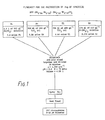
- a flow diagram for the preparation of 3 kg of PZT powder is given in figure 1.
- the properties of the component solutions and sols are summarised in Table 1.
- the titania sol was prepared from Ti(iv)-chloride using the method of GB 1412937, the zirconia sol from basic zirconium carbonate according to the method of GB 1181794 and the salt solutions from GPR grade strontium and lead nitrates.
- the zirconia sol (0.91 l) containing 446 gl ⁇ 1 ZrO2 equivalent was mixed with the titania sol (0.795 l) containing 298 gl ⁇ 1 TiO2 equivalent.
- lead nitrate solution (4.289 l) containing 307 gl ⁇ 1 PbO equivalent
- strontium nitrate solution containing 225 gl ⁇ 1 SrO equivalent were added.
- the feed had the following properties: concentration 305 gl ⁇ 1 mixed oxide equivalent; density, 1 .366 gcc ⁇ 1; pH, 0.6; viscosity, 5 cp and conductivity, 77.7 mmho.
- the feed was spray dried by disc atomization using a flow rate of 2.5 l hr ⁇ 1 and inlet temperature of 230°C and an outlet temperature of 105°C to yield ⁇ 3 kg of free flowing gel particles.
- the spherical morphology of the particles imparts excellent flow characteristics to the gel product.
- the average size of the particles, around 20 ⁇ m, can be varied over large ranges by either employing different gelling procedures, i.e. chemical gelation (2-100 ⁇ m) or gel precipitation (80-100 ⁇ m), or by modifying the feed characteristics for spray drying using either disc atomization (10-40 ⁇ m) or nozzle injection (40-80 ⁇ m).
- the gel unlike those produced by alkoxide routes, was completely redispersible in water. This is an extremely useful attribute, since if, for whatever reasons, the product is unsuitable for its intended use, it can be re-dispersed in water to form a mixed sol; this sol can then be adjusted accordingly, or if a different morphology is desired, the gelling procedure can be modified.
- Thermo-gravimetric analysis showed the gel to contain 66% oxide and from the traces ( Figure 2) it was clear that the composite material chemically decomposed in a manner different to that found for the individual components.
- the decomposition temperature was significantly lower and the decomposition significantly ceaner than was seen for the respective components.
- the decomposition of the metal salts or the hydrous gels alone usually results in a multi-step decomposition to the relevant oxide phase.
- the processing method described here results in an almost single-step decompositon of the metal salt on the hydrous gel substrate. We believe that these low temperature reactions are due to one or more of the hydrous gel compounds promoting the decomposition of the metal salt components.
- Densities typicaly 97-99% theoretical, compare favourably with those produced both by standard powder mixing routes (95-97%) and by alkoxide, co-precipitation routes. It is worth noting that these higher-than-normal densities are achieved some hundred degrees or so lower than normal sintering temperatures employed (1260-1380°C).
- Zirconia sol (0.670 litres) containing 464 gl ⁇ 1 ZrO2 equivalent was mixed with titania sol (0.875 litres) containing 196 gl ⁇ 1 TiO2 equivalent.
- Lead nitrate solution (4.240 litres, 210 gl ⁇ 1 PbO plus either 0.0424 l or 0.0848 l to compensate for Pb volatilization losses)
- strontium nitrate solution (0.420 litres, 97 gl ⁇ 1 SrO)
- a solution of niobium pentachloride (12.69 g NbCl5 in 120 ml water) were added to the sols with stirring.
- This mixture termed the feed, had the following properties:- concentration 237 gl ⁇ 1 oxide equivalent; density, 128 gcc ⁇ 1; viscosity, 5 cp; pH, 0.07 and total volume, 6.28 litres.
- the feed was spray dried and calcined at 600°C to yield 1.486 kg of free-flowing oxide powder.
- the oxide powder was ball-milled in acetone for at least 4 hours then dried at room temperature.
- the powder was uniaxially pressed in 5g batches in a 15mm die at 200 psi followed by isostatic pressing at 25000 psi.
- the green pellets were sintered, using the double crucible technique, at temperatures between 1050°C and 1300°C, preferably 1200°C for 2 to 12 hours, preferably 2 hours.
- the commercial rejection rate may be as high as 80%.
Landscapes
- Chemical & Material Sciences (AREA)
- Engineering & Computer Science (AREA)
- Organic Chemistry (AREA)
- Ceramic Engineering (AREA)
- Materials Engineering (AREA)
- Inorganic Chemistry (AREA)
- Manufacturing & Machinery (AREA)
- Structural Engineering (AREA)
- Dispersion Chemistry (AREA)
- Life Sciences & Earth Sciences (AREA)
- Environmental & Geological Engineering (AREA)
- General Life Sciences & Earth Sciences (AREA)
- Geology (AREA)
- Composite Materials (AREA)
- Compositions Of Oxide Ceramics (AREA)
- Compounds Of Iron (AREA)
- Magnetic Ceramics (AREA)
Applications Claiming Priority (2)
| Application Number | Priority Date | Filing Date | Title |
|---|---|---|---|
| GB888809608A GB8809608D0 (en) | 1988-04-22 | 1988-04-22 | Sol-gel method of making ceramics |
| GB8809608 | 1988-04-22 |
Publications (2)
| Publication Number | Publication Date |
|---|---|
| EP0338799A2 true EP0338799A2 (de) | 1989-10-25 |
| EP0338799A3 EP0338799A3 (de) | 1990-04-11 |
Family
ID=10635696
Family Applications (1)
| Application Number | Title | Priority Date | Filing Date |
|---|---|---|---|
| EP89303872A Withdrawn EP0338799A3 (de) | 1988-04-22 | 1989-04-19 | Sol-Gel-Verfahren zur Herstellung von keramischen Materialien |
Country Status (10)
| Country | Link |
|---|---|
| US (1) | US5091348A (de) |
| EP (1) | EP0338799A3 (de) |
| JP (1) | JPH01313356A (de) |
| KR (1) | KR900016065A (de) |
| CN (1) | CN1037888A (de) |
| AU (1) | AU3326889A (de) |
| BR (1) | BR8901916A (de) |
| GB (1) | GB8809608D0 (de) |
| NO (1) | NO891642L (de) |
| ZA (1) | ZA892883B (de) |
Cited By (14)
| Publication number | Priority date | Publication date | Assignee | Title |
|---|---|---|---|---|
| EP0429088A1 (de) * | 1989-11-24 | 1991-05-29 | SELENIA INDUSTRIE ELETTRONICHE ASSOCIATE S.p.A. | Lithium-Titan-Zink-Ferrite zur Verwendung im Mikrowellenbereich |
| WO1992002471A1 (es) * | 1990-07-30 | 1992-02-20 | Ercros S.A. | Procedimiento para la preparacion de materiales ceramicos piezoelectricos de pztn |
| EP0513478A3 (en) * | 1991-02-13 | 1993-10-06 | Mitsubishi Materials Corporation | Method for controlling crystal orientation of ferroelectric thin film |
| DE4242368A1 (de) * | 1992-12-16 | 1994-07-07 | Licentia Gmbh | Widerstandsmaterial und daraus hergestellter Widerstand |
| EP0611192A1 (de) * | 1993-02-10 | 1994-08-17 | Rhone-Poulenc Chimie | Verfahren zur Herstellung von Zusammensetzungen auf der Basis von Zirkonium und Cerium |
| DE4405411C1 (de) * | 1994-02-21 | 1995-01-19 | Kernforschungsz Karlsruhe | Verfahren zur Herstellung eines Sols für die Produktion einer PZT-oder einer PMNT-Keramik |
| EP0637089A1 (de) * | 1993-07-27 | 1995-02-01 | MAN Roland Druckmaschinen AG | Verfahren zur Herstellung von PZT-Schichten |
| WO1996010538A1 (de) * | 1994-09-30 | 1996-04-11 | Zentrum für Sonnenenergie- und Wasserstoff-Forschung Baden-Württemberg Gemeinnützige Stiftung | Ternäre lithium-mischoxide, verfahren zu deren herstellung sowie deren verwendung |
| EP0739866A1 (de) * | 1995-04-21 | 1996-10-30 | Murata Manufacturing Co., Ltd. | Piezoelektrische Keramiken |
| DE102007029600A1 (de) * | 2007-06-27 | 2009-01-02 | Siemens Ag | Bleizirkonattitanat mit Scandium-Wolfram-Dotierung, Verfahren zum Herstellen eines piezokeramischen Bauteils unter Verwendung des Bleizirkonattitanats und Verwendung des piezokeramischen Bauteils |
| DE102007029613A1 (de) * | 2007-06-27 | 2009-01-02 | Siemens Ag | Bleizirkonattitanat mit Nickel-Wolfram-Dotierung, Verfahren zum Herstellen eines piezokeramischen Bauteils unter Verwendung des Bleizirkonattitanats und Verwendung des piezokeramischen Bauteils |
| CN101565323B (zh) * | 2009-06-05 | 2011-11-09 | 哈尔滨工业大学(威海) | 一种含氧化铝微晶玻璃复合材料制备方法 |
| US9724302B2 (en) | 2010-04-09 | 2017-08-08 | Pacira Pharmaceuticals, Inc. | Method for formulating large diameter synthetic membrane vesicles |
| CN119306495A (zh) * | 2024-12-18 | 2025-01-14 | 湖南省美程陶瓷科技有限公司 | 一种低温烧结制备压电陶瓷的方法 |
Families Citing this family (41)
| Publication number | Priority date | Publication date | Assignee | Title |
|---|---|---|---|---|
| JPH06737A (ja) * | 1991-03-29 | 1994-01-11 | Shin Etsu Chem Co Ltd | 静電チャック基板 |
| US5369067A (en) * | 1992-02-19 | 1994-11-29 | Chichibu Cement Co., Ltd. | Composite substrates and their production |
| US5531974A (en) * | 1992-07-08 | 1996-07-02 | Hughes Aircraft Company | Flux grown, monosize oxide particles |
| DE4231757C2 (de) * | 1992-09-23 | 1994-08-11 | Merck Patent Gmbh | Verfahren zur Herstellung von PZT-Keramikpulver |
| DE4402420C2 (de) * | 1993-01-27 | 1996-03-28 | Toshiba Kawasaki Kk | Piezoelektrisches Material und Ultraschallsonde |
| FR2701471B1 (fr) * | 1993-02-10 | 1995-05-24 | Rhone Poulenc Chimie | Procédé de synthèse de compositions à base d'oxydes mixtes de zirconium et de cérium, compositions ainsi obtenues et utilisations de ces dernières. |
| US6126743A (en) * | 1993-03-12 | 2000-10-03 | Sumitomo Chemical Company, Limited | Process for producing dielectrics and fine single crystal powders and thin film capacitor |
| US5409548A (en) * | 1993-05-17 | 1995-04-25 | The United States Of America As Represented By The Secretary Of The Army | Ferroelectric detector array utilizing material and fabrication technique |
| US5384294A (en) * | 1993-11-30 | 1995-01-24 | The United States Of America As Represented By The Secretary Of The Air Force | Sol-gel derived lead oxide containing ceramics |
| EP0691376B1 (de) | 1994-01-24 | 1999-08-04 | Sumitomo Chemical Company Limited | Harzzusammensetzung, laminat und verbundfolie |
| CN1056198C (zh) * | 1994-05-19 | 2000-09-06 | 北京科技大学 | 溶胶凝胶法制备抗高温氧化陶瓷涂层的工艺方法 |
| JP3238006B2 (ja) * | 1994-06-07 | 2001-12-10 | パウダーテック株式会社 | 電子写真現像剤用フェライトキャリアおよび該キャリアを用いた現像剤 |
| US5677825A (en) * | 1995-02-27 | 1997-10-14 | Evans, Jr.; Joseph T. | Ferroelectric capacitor with reduced imprint |
| US5585136A (en) * | 1995-03-22 | 1996-12-17 | Queen's University At Kingston | Method for producing thick ceramic films by a sol gel coating process |
| US5772820A (en) * | 1995-08-07 | 1998-06-30 | Northrop Grumman Corporation | Process for fabricating a microwave power device |
| JP3207206B2 (ja) * | 1996-07-17 | 2001-09-10 | シチズン時計株式会社 | 強誘電体素子及びその製造方法 |
| GB9709449D0 (en) * | 1997-05-10 | 1997-07-02 | Univ Warwick | Low temperature production of metal oxides |
| US6375871B1 (en) * | 1998-06-18 | 2002-04-23 | 3M Innovative Properties Company | Methods of manufacturing microfluidic articles |
| US5908802A (en) * | 1997-10-30 | 1999-06-01 | Sandia Corporation | Nonaqueous solution synthesis process for preparing oxide powders of lead zirconate titanate and related materials |
| CN1079087C (zh) * | 1998-01-16 | 2002-02-13 | 张萍 | 一种利用溶胶凝胶法制备氧化锆陶瓷微球的方法 |
| US6297419B1 (en) * | 1998-05-29 | 2001-10-02 | British Nuclear Fuels Plc | Method of waste treatment |
| US6503861B1 (en) * | 1999-01-14 | 2003-01-07 | Kyocera Corporation | Dielectric ceramic composition, method of preparing dielectric ceramic material, and dielectric resonator |
| CN1105699C (zh) * | 1999-09-02 | 2003-04-16 | 吉林大学 | 复合本体溶胶-凝胶制备方法 |
| KR100492935B1 (ko) * | 2002-11-15 | 2005-06-02 | 한국에너지기술연구원 | 압전소자의 저온소결방법 |
| JP4145262B2 (ja) * | 2004-03-23 | 2008-09-03 | 三洋電機株式会社 | 積層セラミック基板 |
| EP1637502A1 (de) * | 2004-09-14 | 2006-03-22 | Kerr-McGee Pigments GmbH | Feinteilige Erdalkalititanate und Verfahren zu deren Herstellung unter Verwendung von Titanoxidhydratpartikeln |
| JP2006096626A (ja) * | 2004-09-30 | 2006-04-13 | Tdk Corp | 圧電磁器の製造方法、圧電素子の製造方法、圧電素子 |
| JP4552940B2 (ja) * | 2004-10-01 | 2010-09-29 | 株式会社村田製作所 | 透光性セラミックを用いたハイブリッドレンズ |
| EP1669325A1 (de) * | 2004-12-13 | 2006-06-14 | Kerr-McGee Pigments GmbH | Feinteilige Bleizirkonattitanate und Zirkoniumtitanate und Verfahren zu deren Herstellung unter Verwendung von Titanoxidhydratpartikeln |
| FR2881133B1 (fr) * | 2005-01-27 | 2007-03-02 | Commissariat Energie Atomique | Procede de preparation de solutions sol-gel stable precurseurs de ceramiques oxydes a base de plomb, de titane, de zirconium et de lanthanide(s) et procede de preparation de ladite ceramique |
| JP2007258301A (ja) * | 2006-03-22 | 2007-10-04 | Tdk Corp | 積層型圧電素子及びその製造方法 |
| US20070224359A1 (en) * | 2006-03-22 | 2007-09-27 | Burin David L | Method for preparing strain tolerant coatings by a sol-gel process |
| CN101456732B (zh) * | 2008-12-31 | 2013-01-16 | 中国科学院上海硅酸盐研究所 | 高温高灵敏度压电陶瓷材料及其制备方法 |
| CN102709473B (zh) * | 2012-06-20 | 2014-02-05 | 东北大学 | 一种Ru-Al共掺杂镍锡复合薄膜的制备方法 |
| CN107043131B (zh) * | 2017-03-21 | 2019-03-15 | 海安南京大学高新技术研究院 | 纳米锶铁氧体的制备方法 |
| CN111348924A (zh) * | 2018-12-20 | 2020-06-30 | 攀枝花学院 | 抗钛熔体的耐火耐蚀材料及其制备方法和应用 |
| CN110540434A (zh) * | 2019-09-06 | 2019-12-06 | 辽宁科技大学 | 一种氧化锆溶胶增强镁铝尖晶石多孔陶瓷的制备方法 |
| CN114853471B (zh) * | 2022-05-31 | 2023-02-10 | 成都汇通西电电子有限公司 | 一种高电压叠堆式压电陶瓷致动器及其制备方法 |
| CN115739064B (zh) * | 2022-11-22 | 2024-09-24 | 仙居县蔚徕新材料科技有限公司 | 一种用于紫外光催化降解的纳米材料及其制备方法 |
| CN118026675B (zh) * | 2024-03-13 | 2025-07-25 | 南京航空航天大学 | 一种用于高储能性能场景的铅基反铁电储能陶瓷及其制备方法 |
| CN120208656B (zh) * | 2025-05-28 | 2025-09-02 | 赣州研创电子科技有限公司 | 一种6g用低介电陶瓷材料超细颗粒的制备方法 |
Family Cites Families (9)
| Publication number | Priority date | Publication date | Assignee | Title |
|---|---|---|---|---|
| GB1231385A (de) * | 1967-08-04 | 1971-05-12 | ||
| US4349456A (en) * | 1976-04-22 | 1982-09-14 | Minnesota Mining And Manufacturing Company | Non-vitreous ceramic metal oxide microcapsules and process for making same |
| JPS59203720A (ja) * | 1983-05-04 | 1984-11-17 | Tokuyama Soda Co Ltd | 結晶性金属酸化物及びその製造方法 |
| FR2551743B1 (fr) * | 1983-09-14 | 1985-10-25 | Rhone Poulenc Spec Chim | Titanate d'alcalino-terreux, son procede de preparation et son application dans des compositions ceramiques |
| GB8406883D0 (en) * | 1984-03-16 | 1984-04-18 | Atomic Energy Authority Uk | Materials |
| GB8427655D0 (en) * | 1984-11-01 | 1985-01-03 | Atomic Energy Authority Uk | Materials |
| FR2578240B1 (fr) * | 1985-03-01 | 1987-04-17 | Rhone Poulenc Spec Chim | Titanate de neodyme et titanate de baryum neodyme, leurs procedes de preparation et leurs applications dans des compositions ceramiques |
| JPS61202564A (ja) * | 1985-03-05 | 1986-09-08 | Nec Home Electronics Ltd | 画像入力装置 |
| JPS62216965A (ja) * | 1986-03-18 | 1987-09-24 | 三菱鉱業セメント株式会社 | 磁器組成物の製造方法 |
-
1988
- 1988-04-22 GB GB888809608A patent/GB8809608D0/en active Pending
-
1989
- 1989-04-17 US US07/339,306 patent/US5091348A/en not_active Expired - Fee Related
- 1989-04-19 EP EP89303872A patent/EP0338799A3/de not_active Withdrawn
- 1989-04-19 ZA ZA892883A patent/ZA892883B/xx unknown
- 1989-04-19 BR BR898901916A patent/BR8901916A/pt unknown
- 1989-04-20 NO NO89891642A patent/NO891642L/no unknown
- 1989-04-21 AU AU33268/89A patent/AU3326889A/en not_active Abandoned
- 1989-04-21 JP JP1103293A patent/JPH01313356A/ja active Pending
- 1989-04-22 CN CN89103910A patent/CN1037888A/zh active Pending
- 1989-04-22 KR KR1019890005388A patent/KR900016065A/ko not_active Withdrawn
Cited By (27)
| Publication number | Priority date | Publication date | Assignee | Title |
|---|---|---|---|---|
| EP0429088A1 (de) * | 1989-11-24 | 1991-05-29 | SELENIA INDUSTRIE ELETTRONICHE ASSOCIATE S.p.A. | Lithium-Titan-Zink-Ferrite zur Verwendung im Mikrowellenbereich |
| WO1992002471A1 (es) * | 1990-07-30 | 1992-02-20 | Ercros S.A. | Procedimiento para la preparacion de materiales ceramicos piezoelectricos de pztn |
| US5453294A (en) * | 1991-02-13 | 1995-09-26 | Mitsubishi Materials Corporation | Method of controlling crystal orientation of PZT and PLZT thin films on platinum substrates |
| EP0513478A3 (en) * | 1991-02-13 | 1993-10-06 | Mitsubishi Materials Corporation | Method for controlling crystal orientation of ferroelectric thin film |
| DE4242368A1 (de) * | 1992-12-16 | 1994-07-07 | Licentia Gmbh | Widerstandsmaterial und daraus hergestellter Widerstand |
| EP0611192A1 (de) * | 1993-02-10 | 1994-08-17 | Rhone-Poulenc Chimie | Verfahren zur Herstellung von Zusammensetzungen auf der Basis von Zirkonium und Cerium |
| FR2701472A1 (fr) * | 1993-02-10 | 1994-08-19 | Rhone Poulenc Chimie | Procédé de préparation de compositions à base d'oxydes mixtes de zirconium et de cérium. |
| US5532198A (en) * | 1993-02-10 | 1996-07-02 | Rhone-Poulenc Chimie | Zirconium/cerium mixed oxide catalyst/catalyst support compositions having high/stable specific surfaces |
| US5501876A (en) * | 1993-07-27 | 1996-03-26 | Man Roland Druckmaschinen Ag | Process for the manufacture of PZT films |
| EP0637089A1 (de) * | 1993-07-27 | 1995-02-01 | MAN Roland Druckmaschinen AG | Verfahren zur Herstellung von PZT-Schichten |
| DE4405411C1 (de) * | 1994-02-21 | 1995-01-19 | Kernforschungsz Karlsruhe | Verfahren zur Herstellung eines Sols für die Produktion einer PZT-oder einer PMNT-Keramik |
| US6080510A (en) * | 1994-09-30 | 2000-06-27 | Zentrum Fur Sonnenenergie-Und Wasserstoff Forshung Baden Wurttemberg Gemeinnultzige Stiftung | Ternary mixed lithium oxides, process for preparing the same, and secondary lithium battery formed therefrom |
| WO1996010538A1 (de) * | 1994-09-30 | 1996-04-11 | Zentrum für Sonnenenergie- und Wasserstoff-Forschung Baden-Württemberg Gemeinnützige Stiftung | Ternäre lithium-mischoxide, verfahren zu deren herstellung sowie deren verwendung |
| EP0739866A1 (de) * | 1995-04-21 | 1996-10-30 | Murata Manufacturing Co., Ltd. | Piezoelektrische Keramiken |
| DE102007029600A1 (de) * | 2007-06-27 | 2009-01-02 | Siemens Ag | Bleizirkonattitanat mit Scandium-Wolfram-Dotierung, Verfahren zum Herstellen eines piezokeramischen Bauteils unter Verwendung des Bleizirkonattitanats und Verwendung des piezokeramischen Bauteils |
| DE102007029613A1 (de) * | 2007-06-27 | 2009-01-02 | Siemens Ag | Bleizirkonattitanat mit Nickel-Wolfram-Dotierung, Verfahren zum Herstellen eines piezokeramischen Bauteils unter Verwendung des Bleizirkonattitanats und Verwendung des piezokeramischen Bauteils |
| CN101565323B (zh) * | 2009-06-05 | 2011-11-09 | 哈尔滨工业大学(威海) | 一种含氧化铝微晶玻璃复合材料制备方法 |
| US9724302B2 (en) | 2010-04-09 | 2017-08-08 | Pacira Pharmaceuticals, Inc. | Method for formulating large diameter synthetic membrane vesicles |
| US9730892B2 (en) | 2010-04-09 | 2017-08-15 | Pacira Pharmaceuticals, Inc. | Method for formulating large diameter synthetic membrane vesicles |
| US9737483B2 (en) | 2010-04-09 | 2017-08-22 | Pacira Pharmaceuticals, Inc. | Method for formulating large diameter synthetic membrane vesicles |
| US9737482B2 (en) | 2010-04-09 | 2017-08-22 | Pacira Pharmaceuticals, Inc. | Method for formulating large diameter synthetic membrane vesicles |
| US9757336B2 (en) | 2010-04-09 | 2017-09-12 | Pacira Pharmaceuticals, Inc. | Method for formulating large diameter synthetic membrane vesicles |
| US9808424B2 (en) | 2010-04-09 | 2017-11-07 | Pacira Pharmaceuticals, Inc. | Method for formulating large diameter synthetic membrane vesicles |
| US10045941B2 (en) | 2010-04-09 | 2018-08-14 | Pacira Pharmaceuticals, Inc. | Method for formulating large diameter synthetic membrane vesicles |
| US10398648B2 (en) | 2010-04-09 | 2019-09-03 | Pacira Pharmaceuticals, Inc. | Method for formulating large diameter synthetic membrane vesicles |
| CN119306495A (zh) * | 2024-12-18 | 2025-01-14 | 湖南省美程陶瓷科技有限公司 | 一种低温烧结制备压电陶瓷的方法 |
| CN119306495B (zh) * | 2024-12-18 | 2025-03-07 | 湖南省美程陶瓷科技有限公司 | 一种低温烧结制备压电陶瓷的方法 |
Also Published As
| Publication number | Publication date |
|---|---|
| ZA892883B (en) | 1989-12-27 |
| AU3326889A (en) | 1989-10-26 |
| US5091348A (en) | 1992-02-25 |
| GB8809608D0 (en) | 1988-05-25 |
| CN1037888A (zh) | 1989-12-13 |
| NO891642L (no) | 1989-10-23 |
| EP0338799A3 (de) | 1990-04-11 |
| NO891642D0 (no) | 1989-04-20 |
| JPH01313356A (ja) | 1989-12-18 |
| KR900016065A (ko) | 1990-11-12 |
| BR8901916A (pt) | 1989-11-28 |
Similar Documents
| Publication | Publication Date | Title |
|---|---|---|
| US5091348A (en) | Sol-gel method of making ceramics | |
| US5112433A (en) | Process for producing sub-micron ceramic powders of perovskite compounds with controlled stoichiometry and particle size | |
| US5900223A (en) | Process for the synthesis of crystalline powders of perovskite compounds | |
| DE69200395T2 (de) | Angereichertes lanthancrhomit zum brennen bei niederen temperaturen. | |
| WO2001064600A1 (en) | Method for fabrication of lead based perovskite materials | |
| JP3154509B2 (ja) | チタン酸バリウムおよびその製造方法 | |
| CN1059179C (zh) | 金属铌酸盐和/或钽酸盐,它们的制备和由它们形成的钙钛矿 | |
| EP0428387B1 (de) | Verfahren zur Herstellung von Pulver für Blei-Perovskit-Keramik | |
| JP3154513B2 (ja) | 球状チタン酸バリウム系半導体磁器材料粉末およびその製造方法 | |
| EP0439620B1 (de) | Verfahren zur herstellung von pulverförmigen perovskiteverbindungen | |
| US4820668A (en) | Process for preparing powdered ceramic raw materials of complex oxide | |
| JPH04505912A (ja) | 制御された化学量論的組成及び粒子寸法をもつ高結晶性均質でドーピングされまたはされないミクロン以下の圧電性セラミック粉末の製造方法 | |
| JPH0580427B2 (de) | ||
| US8475706B2 (en) | Method of making mixed metal oxide ceramics | |
| JPH0832559B2 (ja) | ペロブスカイト型化合物の無機微粉体の製造方法 | |
| JPH0517150A (ja) | セラミツク原料粉末の製造方法 | |
| US4820669A (en) | Process for preparing powdered ceramic raw materials of complex oxide | |
| JPH01172256A (ja) | 易焼結性鉛含有酸化物製造用原料粉末 | |
| JPH0159205B2 (de) | ||
| JPH0676258B2 (ja) | セラミック誘電体の製造方法 | |
| JPH06321630A (ja) | セラミツク誘電体用組成物 | |
| JP3149467B2 (ja) | 半導体磁器用微粉末の製造方法 | |
| JPH05319894A (ja) | 易焼結性マイクロ波誘電体用粉体 | |
| WO2024250380A1 (zh) | 一种铁酸铋基无铅压电陶瓷材料及其制备方法 | |
| JPH0457615B2 (de) |
Legal Events
| Date | Code | Title | Description |
|---|---|---|---|
| PUAI | Public reference made under article 153(3) epc to a published international application that has entered the european phase |
Free format text: ORIGINAL CODE: 0009012 |
|
| AK | Designated contracting states |
Kind code of ref document: A2 Designated state(s): AT BE CH DE ES FR GB GR IT LI NL SE |
|
| PUAL | Search report despatched |
Free format text: ORIGINAL CODE: 0009013 |
|
| AK | Designated contracting states |
Kind code of ref document: A3 Designated state(s): AT BE CH DE ES FR GB GR IT LI NL SE |
|
| 17P | Request for examination filed |
Effective date: 19900928 |
|
| 17Q | First examination report despatched |
Effective date: 19910606 |
|
| STAA | Information on the status of an ep patent application or granted ep patent |
Free format text: STATUS: THE APPLICATION IS DEEMED TO BE WITHDRAWN |
|
| 18D | Application deemed to be withdrawn |
Effective date: 19930119 |