EP0340708A2 - Verfahren zur Herstellung von 3-(3,4,5,6-Tetrahydrophthalimido)-benzaldehyden - Google Patents
Verfahren zur Herstellung von 3-(3,4,5,6-Tetrahydrophthalimido)-benzaldehyden Download PDFInfo
- Publication number
- EP0340708A2 EP0340708A2 EP89107884A EP89107884A EP0340708A2 EP 0340708 A2 EP0340708 A2 EP 0340708A2 EP 89107884 A EP89107884 A EP 89107884A EP 89107884 A EP89107884 A EP 89107884A EP 0340708 A2 EP0340708 A2 EP 0340708A2
- Authority
- EP
- European Patent Office
- Prior art keywords
- tetrahydrophthalimido
- benzaldehydes
- iii
- acetal
- preparation
- Prior art date
- Legal status (The legal status is an assumption and is not a legal conclusion. Google has not performed a legal analysis and makes no representation as to the accuracy of the status listed.)
- Granted
Links
- 0 [O-][N+](C1CC(*2O*2)=CCC1)=O Chemical compound [O-][N+](C1CC(*2O*2)=CCC1)=O 0.000 description 2
Classifications
-
- C—CHEMISTRY; METALLURGY
- C07—ORGANIC CHEMISTRY
- C07D—HETEROCYCLIC COMPOUNDS
- C07D209/00—Heterocyclic compounds containing five-membered rings, condensed with other rings, with one nitrogen atom as the only ring hetero atom
- C07D209/02—Heterocyclic compounds containing five-membered rings, condensed with other rings, with one nitrogen atom as the only ring hetero atom condensed with one carbocyclic ring
- C07D209/44—Iso-indoles; Hydrogenated iso-indoles
- C07D209/48—Iso-indoles; Hydrogenated iso-indoles with oxygen atoms in positions 1 and 3, e.g. phthalimide
-
- C—CHEMISTRY; METALLURGY
- C07—ORGANIC CHEMISTRY
- C07D—HETEROCYCLIC COMPOUNDS
- C07D317/00—Heterocyclic compounds containing five-membered rings having two oxygen atoms as the only ring hetero atoms
- C07D317/08—Heterocyclic compounds containing five-membered rings having two oxygen atoms as the only ring hetero atoms having the hetero atoms in positions 1 and 3
- C07D317/10—Heterocyclic compounds containing five-membered rings having two oxygen atoms as the only ring hetero atoms having the hetero atoms in positions 1 and 3 not condensed with other rings
- C07D317/14—Heterocyclic compounds containing five-membered rings having two oxygen atoms as the only ring hetero atoms having the hetero atoms in positions 1 and 3 not condensed with other rings with substituted hydrocarbon radicals attached to ring carbon atoms
- C07D317/16—Radicals substituted by halogen atoms or nitro radicals
-
- C—CHEMISTRY; METALLURGY
- C07—ORGANIC CHEMISTRY
- C07D—HETEROCYCLIC COMPOUNDS
- C07D317/00—Heterocyclic compounds containing five-membered rings having two oxygen atoms as the only ring hetero atoms
- C07D317/08—Heterocyclic compounds containing five-membered rings having two oxygen atoms as the only ring hetero atoms having the hetero atoms in positions 1 and 3
- C07D317/10—Heterocyclic compounds containing five-membered rings having two oxygen atoms as the only ring hetero atoms having the hetero atoms in positions 1 and 3 not condensed with other rings
- C07D317/14—Heterocyclic compounds containing five-membered rings having two oxygen atoms as the only ring hetero atoms having the hetero atoms in positions 1 and 3 not condensed with other rings with substituted hydrocarbon radicals attached to ring carbon atoms
- C07D317/28—Radicals substituted by nitrogen atoms
-
- C—CHEMISTRY; METALLURGY
- C07—ORGANIC CHEMISTRY
- C07D—HETEROCYCLIC COMPOUNDS
- C07D319/00—Heterocyclic compounds containing six-membered rings having two oxygen atoms as the only ring hetero atoms
- C07D319/04—1,3-Dioxanes; Hydrogenated 1,3-dioxanes
- C07D319/06—1,3-Dioxanes; Hydrogenated 1,3-dioxanes not condensed with other rings
Definitions
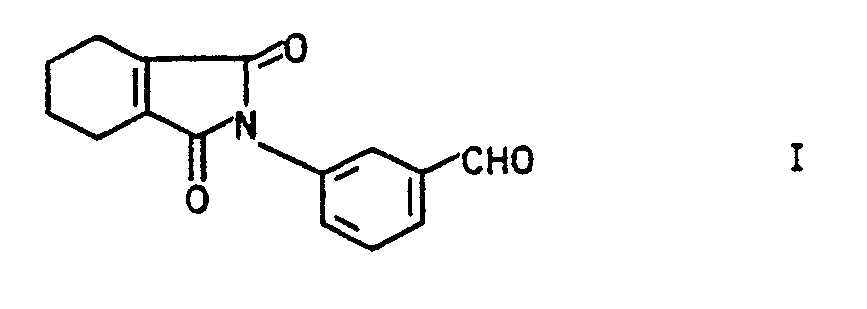
- the present invention relates to a new process for the preparation of 3- (3,4,5,6-tetrahydrophthalimido) benzaldehydes (I).
- the invention further relates to new 3- (3,4,5,6-tetrahydrophthalimido) benzaldehydes of the general formula Ia in which R1 is hydrogen or halogen and R2 is halogen, with the proviso that R2 is not chlorine if R1 is fluorine, and new precursors of Ia of the general formula IIa, in which A represents a 1,2-ethylene or 1,3-propylene bridge, which bridge members in turn can carry up to three C1-C3 alkyl groups.
- the invention was therefore generally based on a universally applicable process for the preparation of 3- (3,4,5,6-tetrahydrophthalimido) benzaldehydes of type I as a task, the task extending specifically to the new compounds Ia and their precursors IIa.
- Suitable acidic catalysts are, for example, inorganic acids such as hydrochloric acid, sulfuric acid and phosphoric acid; organic carboxylic, sulfonic and phosphonic acids such as, in particular, aliphatic and aromatic sulfonic acids (methanesulfonic acid, trifluoromethanesulfonic acid, benzenesulfonic acid and toluenesulfonic acid) and salts such as iron (III) chloride, zinc (II) chloride and sodium hydrogen sulfate, the catalyst concentration being 0.01 to 10 mol. %, preferably 0.1 to 1 mol.%, based on the starting material III.
- inorganic acids such as hydrochloric acid, sulfuric acid and phosphoric acid
- organic carboxylic, sulfonic and phosphonic acids such as, in particular, aliphatic and aromatic sulfonic acids (methanesulfonic acid, trifluoromethanesulfonic acid, benzenesul
- Aromatic hydrocarbons such as benzene, toluene and xylene are suitable, for example; aliphatic hydrocarbons such as hexane, heptane and cyclohexane; chlorinated hydrocarbons such as chloroform, carbon tetrachloride, 1,2-dichloroethane and chlorobenzene, and ethers such as diethyl ether, methyl butyl ether and diisopropyl ether.
- Nitrophenylacetal V is isolated by customary methods.
- the acetal V thus obtained is then reduced to the aminophenylacetal II using hydrogen over a metal or noble metal catalyst.
- Platinum, palladium, rhodium, ruthenium and rhenium come into consideration as catalysts, with Raney nickel being particularly advantageous.
- the catalyst concentration is advantageously 10 to 30% by weight, based on the starting material V.
- the reaction is carried out in an inert protic or aprotic polar organic solvent such as alcohols such as methanol, ethanol, isopropanol and glycol, carboxylic acids such as acetic acid and propionic acid or ethers as mentioned above, and tetrahydrofuran and dioxane or corresponding mixtures at temperatures from 0 to 100 ° C, preferably 25 to 50 ° C and hydrogen pressures from 1 to 50 bar, in particular 1 to 10 bar.
- alcohols such as methanol, ethanol, isopropanol and glycol
- carboxylic acids such as acetic acid and propionic acid or ethers as mentioned above
- tetrahydrofuran and dioxane or corresponding mixtures at temperatures from
- aminophenylacetal II is isolated from the reaction mixture in a generally customary manner and then condensed with 3,4,5,6-tetrahydrophthalic anhydride by methods known per se.
- the condensation is usually carried out in protic polar solvents such as acetic acid and propionic acid or corresponding mixtures at temperatures from 50 to 150 ° C., preferably 70 to 120 ° C. Under these reaction conditions, the acetal group is split to form the aldehyde function.
- protic polar solvents such as acetic acid and propionic acid or corresponding mixtures
- nitrobenzaldehydes III required for the process are known from the literature or can be prepared by known processes (Houben-Weyl, Vol. E3).
- Suitable starting compounds for the process according to the invention are, in addition to the 3-nitrobenzaldehyde as the parent, also nucleus-substituted derivatives, provided that their substituents are inert under the reaction conditions.
- suitable substituents are halogen, such as, in particular, fluorine, chlorine and bromine, the hydroxyl group, alkyl groups, alkoxy groups, dialkylamino groups and alkoxycarbonyl groups, alkyl radicals in these groups preferably containing up to 12 carbon atoms and in turn halogen atoms such as preferably fluorine and chlorine, hydroxyl and can carry C1-C4 alkoxy groups.
Landscapes
- Chemical & Material Sciences (AREA)
- Organic Chemistry (AREA)
- Indole Compounds (AREA)
- Low-Molecular Organic Synthesis Reactions Using Catalysts (AREA)
- Organic Low-Molecular-Weight Compounds And Preparation Thereof (AREA)
- Heterocyclic Compounds That Contain Two Or More Ring Oxygen Atoms (AREA)
- Catalysts (AREA)
- Combustion Of Fluid Fuel (AREA)
Abstract
- a) Acetalisierung eines 3-Nitrobenzaldehyds III oder eines entsprechenden Derivats in Gegenwart eines sauren Katalysators mit einem Alkohol IV zum entsprechenden cyclischen Acetal V

- b) Reduktion des cyclischen Acetals V mit Wasserstoff zur entsprechenden Aminoverbindung II und
- c) anschließende Kondensation dieses Aminophenylacetals II in einem sauren Reaktionsmedium mit 3,4,5,6-Tetrahydrophthalsäureanhydrid.
Description
- Die vorliegende Erfindung betrifft ein neues Verfahren zur Herstellung von 3-(3,4,5,6-Tetrahydrophthalimido)-benzaldehyden (I).
- Weiterhin betrifft die Erfindung neue 3-(3,4,5,6-Tetrahydrophthalimido)-benzaldehyde der allgemeinen Formel Ia


- Aus der JP-A 60/152 465 ist bekannt, 3-Nitrobenzaldehyde mit Eisen in essigsaurem Medium zu den entsprechenden 3-Aminobenzaldehyden zu reduzieren und diese anschließend mit 3,4,5,6-Tetrahydrophthalsäureanhydrid in die Verbindungen des Typs I zu überführen:

- Der Erfindung lag daher allgemein ein universell anwendbares Verfahren zur Herstellung der 3-(3,4,5,6-Tetrahydrophthalimido)-benzaldehyde des Typs I als Aufgabe zugrunde, wobei sich die Aufgabe speziell auf die neuen Verbindungen Ia und deren Vorstufen IIa erstreckte.
- Demgemäß wurde ein neues Verfahren zur Herstellung von 3-(3,4,5,6-Tetrahydrophthalimido)-benzaldehyden des Typs I gefunden, welches dadurch gekennzeichnet ist, daß man
- a) die Aldehydgruppe eines 3-Nitrobenzaldehyds III in einem inerten organischen Lösungsmittel in Gegenwart eines sauren Katalysators mit einem Alkandiol HO-A-OH IV, worin A für eine 1,2-Ethylen- oder 1,3-Propylenkette steht, wobei diese Ketten ihrerseits bis zu drei C₁-C₃-Alkylgruppen tragen können, zum entsprechenden cyclischen Acetal V umsetzt,
- b) das cyclische Acetal V mit Wasserstoff katalytisch zur entsprechenden Aminoverbindung II reduziert und
- c) dieses Aminophenylacetal II in einem sauren Reaktionsmedium mit 3,4,5,6-Tetrahydrophthalsäureanhydrid kondensiert, wobei das bei der Cyclisierung freigesetzte Wasser die Entacetalisierung der Formylgruppe bewirkt und direkt der gewünschte (3,4,5,6-Tetrahydrophthalimido)-benzaldehyd I entsteht.
- Weiterhin wurden die eingangs definierten neuen Verbindungen Ia und IIa gefunden

- Geeignete saure Katalysatoren sind beispielsweise anorganische Säuren wie Salzsäure, Schwefelsäure und Phosphorsäure; organische Carbon-, Sulfon-und Phosphonsäuren wie insbesondere aliphatische und aromatische Sulfonsäuren (Methansulfonsäure, Trifluormethansulfonsäure, Benzolsulfonsäure und Toluolsulfonsäure) und Salze wie Eisen-III-chlorid, Zink-II-chlorid und Natriumhydrogensulfat, wobei die Katalysatorkonzentration 0,01 bis 10 Mol.%, vorzugsweise 0,1 bis 1 Mol.%, bezogen auf das Edukt III beträgt. Als Lösungsmittel werden bevorzugt inerte organische Lösungsmittel, die in der Lage sind mit Wasser Aceotrope zu bilden, sofern sich die Edukte und/oder die Produkte darin zumindest teilweise lösen. Geeignet sind beispielsweise aromatische Kohlenwasserstoffe wie Benzol, Toluol und Xylol; aliphatische Kohlenwasserstoffe wie Hexan, Heptan und Cyclohexan; chlorierte Kohlenwasserstoffe wie Chloroform, Tetrachlorkohlenstoff, 1,2-Dichlorethan und Chlorbenzol, sowie Ether wie Diethylether, Methyl-butylether und Diisopropylether.
- Die Isolierung des Nitrophenylacetals V erfolgt nach üblichen Methoden.
- Das so erhaltene Acetal V wird anschließend mit Wasserstoff an einem Metall- oder Edelmetallkatalysator zum Aminophenylacetal II reduziert.
- Als Katalysatoren kommen hierbei Platin, Palladium, Rhodium, Ruthenium und Rhenium in Betracht, wobei Raney-Nickel besonders vorteilhaft ist. Die Katalysatorkonzentration liegt vorteilhaft bei 10 bis 30 Gew.%, bezogen auf das Edukt V. Die Umsetzung wird in einem inerten protischen oder aprotisch polaren organischen Lösungsmittel wie Alkohole wie Methanol, Ethanol, Iso-Propanol und Glykol, Carbonsäuren wie Essigsäure und Propionsäure oder Ethern wie vorstehend genannt sowie Tetrahydrofuran und Dioxan oder entsprechenden Gemischen bei Temperaturen von 0 bis 100°C, vorzugsweise 25 bis 50°C und Wasserstoffdrucken von 1 bis 50 bar, insbesondere 1 bis 10 bar durchgeführt.
- Das Aminophenylacetal II wird aus dem Reaktionsgemisch in allgemein üblicher Weise isoliert und anschließend nach an sich bekannten Methoden mit 3,4,5,6-Tetrahydrophthalsäureanhydrid kondensiert.
- Die Kondensation wird üblicherweise in protisch polaren Lösungsmitteln wie Essigsäure und Propionsäure oder entsprechenden Gemischen bei Temperaturen von 50 bis 150°C, vorzugsweise 70 bis 120°C durchgeführt. Unter diesen Reaktionsbedingungen tritt gleichzeitig eine Spaltung der Acetalgruppe zur Aldehydfunktion auf.
- Die für das Verfahren benötigten Nitrobenzaldehyde III sind aus der Literatur bekannt oder können nach bekannten Verfahren (Houben-Weyl, Bd. E3) hergestellt werden.
- Als Ausgangsverbindungen für das erfindungsgemäße Verfahren eignen sich neben dem 3-Nitrobenzaldehyd als Stammkörper auch kernsubstituierte Derivate, sofern deren Substituenten sich unter den Reaktionsbedingungen inert verhalten. Als Substituenten kommen beispielsweise Halogen wie insbesondere Fluor, Chlor und Brom, die Hydroxylgruppe, Alkylgruppen, Alkoxygruppen, Dialkylaminogruppen und Alkoxycarbonylgruppen in Betracht, wobei Alkylreste in diesen Gruppen vorzugsweise bis zu 12 C-Atome enthalten und ihrerseits Halogenatome wie vorzugsweise Fluor und Chlor, Hydroxyl- und C₁-C₄-Alkoxygruppen tragen können.
- Bevorzugt werden diejenigen Verbindungen III und damit diejenigen Verfahrensprodukte I welche den neuen Verbindungen Ia bzw. IIa entsprechen, darunter vor allem die in den nachfolgenden Tabellen A und B genannten Substanzen.


- Die 3-(3,4,5,6-Tetrahydrophthalimido)-benzaldehyde I sind wertvolle Zwischenprodukte zur Herstellung von Herbiziden und Wachstumsregulatoren der allgemeinen Struktur VI

- Das neue Verfahren zur Herstellung der Verbindungen I ist nachstehend anhand von Beispielen erläutert:
- Herstellung von 2-Chlor-5-(3,4,5,6-tetrahydrophthalimido)-benzaldehyd
- a) Eine Lösung aus 371 g (2,00 mol) 2-Chlor-5-nitrobenzaldehyd, 137 g (2,2 mol) Ethylenglykol, 1 g p-Toluolsulfonsäure und 1,5 l Toluol wurde 5 Stunden bei Siedetemperatur gerührt, wobei das Reaktionswasser kontinuierlich entfernt wurde. Anschließend wurde das Lösungsmittel bei vermindertem Druck entfernt, wobei als Rückstand das Ethylenglykolacetal des 2-Chlor-5-nitrobenzaldehyds in nahezu quantitativer Ausbeute anfiel. Smp. einer gereinigten Probe: 88-90°C.
- b) 115 g (0,5 mol) des Ethylenglykolacetals aus a) wurden in 1 l Tetrahydrofuran in Anwesenheit von 20 g Raney-Nickel unter einem Wasserstoffdruck von 1,05 bar bei 50°C hydriert. Aus der Reaktionslösung erhielt man nach üblicher Aufarbeitung das Ethylenglykolacetal des 5-Amino-2-chlorbenzaldehyds in fast quantitativer Ausbeute als Öl.
- c) Eine Lösung aus 99,8 g (0,5 mol) des 5-Amino-2-chlorbenzaldehydacetals aus b), 76,1 g (0,5 mol) 3,4,5,6-Tetrahydrophthalsäureanhydrid und 0,5 l Eisessig wurde 5 Stunden bei Siedetemperatur gerührt. Das so erhaltene Reaktionsgemisch wurde auf 25°C gekühlt und mit 0,5 l Wasser versetzt, wobei der 2-Chlor-5-(3,4,5,6-tetrahydrophthalimido)benzaldehyd ausfiel. Ausbeute: 83 %; Smp. 140-141°C.
- Analog diesem Beispiel wurden die in den nachfolgenden Tabellen 1, 2 und 3 aufgeführten Versuche durchgeführt.


Claims (6)


HO-A-OH IV
worin A eine 1,2-Ethylen- oder 1,3-Propylenkette bedeutet, wobei diese Ketten ihrerseits bis zu drei C₁-C₃-Alkylgruppen tragen können, zum entsprechenden cyclischen Acetal V


Applications Claiming Priority (2)
| Application Number | Priority Date | Filing Date | Title |
|---|---|---|---|
| DE3815042 | 1988-05-04 | ||
| DE3815042A DE3815042A1 (de) | 1988-05-04 | 1988-05-04 | N-(5-formyl)-phenyl-3,4,5,6-tetrahydrophthalimidverbindungen, 5-aminobenzaldehydacetale, verfahren zu ihrer herstellung und ihre verwendung als zwischenprodukte |
Publications (3)
| Publication Number | Publication Date |
|---|---|
| EP0340708A2 true EP0340708A2 (de) | 1989-11-08 |
| EP0340708A3 EP0340708A3 (en) | 1990-10-10 |
| EP0340708B1 EP0340708B1 (de) | 1992-08-12 |
Family
ID=6353517
Family Applications (1)
| Application Number | Title | Priority Date | Filing Date |
|---|---|---|---|
| EP89107884A Expired - Lifetime EP0340708B1 (de) | 1988-05-04 | 1989-04-29 | Verfahren zur Herstellung von 3-(3,4,5,6-Tetrahydrophthalimido)-benzaldehyden |
Country Status (7)
| Country | Link |
|---|---|
| US (1) | US4937354A (de) |
| EP (1) | EP0340708B1 (de) |
| JP (1) | JP2820429B2 (de) |
| KR (2) | KR900018024A (de) |
| CA (1) | CA1340663C (de) |
| DE (2) | DE3815042A1 (de) |
| HU (1) | HU206319B (de) |
Families Citing this family (1)
| Publication number | Priority date | Publication date | Assignee | Title |
|---|---|---|---|---|
| DE4015144A1 (de) * | 1990-05-11 | 1991-11-14 | Basf Ag | N-aryltetrahydrophthalimide |
Family Cites Families (6)
| Publication number | Priority date | Publication date | Assignee | Title |
|---|---|---|---|---|
| AU550845B2 (en) * | 1981-03-30 | 1986-04-10 | Sumitomo Chemical Company, Limited | Tetrahydrophthalimides and their starting compounds |
| DE3209178A1 (de) * | 1982-03-13 | 1983-09-15 | Merck Patent Gmbh, 6100 Darmstadt | Polyhalogenaromaten |
| JPS59152465A (ja) * | 1983-02-21 | 1984-08-31 | Canon Inc | 変倍複写装置 |
| JPS60152465A (ja) * | 1984-01-23 | 1985-08-10 | Mitsubishi Chem Ind Ltd | テトラヒドロフタルイミド類およびこれを有効成分とする除草剤 |
| IL82657A0 (en) * | 1986-06-03 | 1987-11-30 | Rhone Poulenc Agrochimie | N-(5-substituted methylene)phenyl herbicides |
| DE3819464A1 (de) * | 1988-06-08 | 1989-12-14 | Basf Ag | Substituierte n-(heterocylylidenmethyl)-pentyl-3,4,5,6-tetrahydrophthalimide, verfahren zu ihrer herstellung und sie enthaltende herbizide |
-
1988
- 1988-05-04 DE DE3815042A patent/DE3815042A1/de not_active Withdrawn
-
1989
- 1989-04-14 US US07/337,865 patent/US4937354A/en not_active Expired - Lifetime
- 1989-04-17 CA CA000596854A patent/CA1340663C/en not_active Expired - Fee Related
- 1989-04-24 JP JP1101855A patent/JP2820429B2/ja not_active Expired - Fee Related
- 1989-04-29 EP EP89107884A patent/EP0340708B1/de not_active Expired - Lifetime
- 1989-04-29 DE DE8989107884T patent/DE58902026D1/de not_active Expired - Lifetime
- 1989-05-03 HU HU892078A patent/HU206319B/hu not_active IP Right Cessation
- 1989-05-04 KR KR1019890006015A patent/KR900018024A/ko not_active Withdrawn
-
1990
- 1990-04-28 KR KR1019900006015A patent/KR0136109B1/ko not_active Expired - Lifetime
Also Published As
| Publication number | Publication date |
|---|---|
| JP2820429B2 (ja) | 1998-11-05 |
| KR910018723A (ko) | 1991-11-30 |
| JPH0272159A (ja) | 1990-03-12 |
| HUT50119A (en) | 1989-12-28 |
| HU206319B (en) | 1992-10-28 |
| EP0340708B1 (de) | 1992-08-12 |
| KR900018024A (ko) | 1990-12-20 |
| EP0340708A3 (en) | 1990-10-10 |
| CA1340663C (en) | 1999-07-20 |
| DE58902026D1 (de) | 1992-09-17 |
| US4937354A (en) | 1990-06-26 |
| KR0136109B1 (ko) | 1998-04-25 |
| DE3815042A1 (de) | 1989-11-16 |
Similar Documents
| Publication | Publication Date | Title |
|---|---|---|
| DE2533920A1 (de) | Verfahren zur herstellung von resorcinen | |
| DE69206250T2 (de) | Verfahren zur herstellung von nitrilen. | |
| DE1129153B (de) | Verfahren zur Herstellung von ª-Cyan-ª-Alkyl-ª-phenylacrylsaeureestern | |
| DE3825119A1 (de) | Verfahren zur gemeinschaftlichen herstellung von 3-dialkylaminopropionitrilen, bis-(2-cyanoethyl)-ether und gewuenschtenfalls ethylencyanhydrin | |
| EP0340708B1 (de) | Verfahren zur Herstellung von 3-(3,4,5,6-Tetrahydrophthalimido)-benzaldehyden | |
| DE2402695A1 (de) | Verfahren zur herstellung von 3-aminophenolen | |
| DE2057840C3 (de) | Verfahren zur Herstellung von Indolderivaten | |
| EP0430001B1 (de) | Verfahren zur Herstellung von Benzaldehyden | |
| DE2542494A1 (de) | Verfahren zur herstellung reiner substituierter 2,5-diarylaminoterephthalsaeureester und der entsprechenden freien saeuren | |
| DE1670248C3 (de) | Verfahren zur Herstellung von 4-Isothiazolcarbonsäuren | |
| DE2437983A1 (de) | Verfahren zur herstellung von resorcinen | |
| EP0210564A2 (de) | Verfahren zur Herstellung von Bis-hydroxyphenyl-n-alkanen | |
| DE2263527B2 (de) | 2,2-Disubstituierte Phenylacetonitril-Derivate, Verfahren zu ihrer Herstellung und deren Verwendung | |
| WO1998003465A1 (de) | Verfahren zur herstellung von racemischen phenethylaminen | |
| EP0570817B1 (de) | Verfahren zur Herstellung von 5-Chloroxindol | |
| DE4408083C1 (de) | Verfahren zur Herstellung von 4-Fluoralkoxyzimtsäurenitrilen | |
| EP0046193B1 (de) | 1-Hydroxypyrazol und Verfahren zu seiner Herstellung | |
| EP0285109B1 (de) | Verfahren zur Herstellung von 2-Amino-4-acylaminophenylethern | |
| DE2854627B1 (de) | Verfahren zur Herstellung von Aminocarbonsaeruehydrochloriden bzw. Diaminocarbonsaeure-di-hydrochloriden | |
| DE2163394C3 (de) | Verfahren zur Herstellung von cis-Cycloalkandiolen-U | |
| EP0007516B1 (de) | 7-Alpha-Methyl-Östrogene, Verfahren zu deren Herstellung und deren Verwendung zur Weiterverarbeitung | |
| DE2207111C2 (de) | 9-(3-Oxo-1-propenyl)-9,10-dihydro-9,10-äthano-anthracen-Verbindungen | |
| DE1795325C3 (de) | 3,3-Dialkyl-tetrahydro-chinoxaline sowie ein Verfahren zu deren Herstellung | |
| DE102024208832A1 (de) | Verfahren zur Synthese von Acridin-9(10H)-on-Derivaten | |
| EP0110202A2 (de) | Verfahren zur Herstellung von Phenylethanolaminen |
Legal Events
| Date | Code | Title | Description |
|---|---|---|---|
| PUAI | Public reference made under article 153(3) epc to a published international application that has entered the european phase |
Free format text: ORIGINAL CODE: 0009012 |
|
| AK | Designated contracting states |
Kind code of ref document: A2 Designated state(s): BE CH DE FR GB IT LI NL |
|
| PUAL | Search report despatched |
Free format text: ORIGINAL CODE: 0009013 |
|
| AK | Designated contracting states |
Kind code of ref document: A3 Designated state(s): BE CH DE FR GB IT LI NL |
|
| 17P | Request for examination filed |
Effective date: 19900907 |
|
| 17Q | First examination report despatched |
Effective date: 19910129 |
|
| GRAA | (expected) grant |
Free format text: ORIGINAL CODE: 0009210 |
|
| AK | Designated contracting states |
Kind code of ref document: B1 Designated state(s): BE CH DE FR GB IT LI NL |
|
| ITF | It: translation for a ep patent filed | ||
| GBT | Gb: translation of ep patent filed (gb section 77(6)(a)/1977) | ||
| REF | Corresponds to: |
Ref document number: 58902026 Country of ref document: DE Date of ref document: 19920917 |
|
| ET | Fr: translation filed | ||
| PLBE | No opposition filed within time limit |
Free format text: ORIGINAL CODE: 0009261 |
|
| STAA | Information on the status of an ep patent application or granted ep patent |
Free format text: STATUS: NO OPPOSITION FILED WITHIN TIME LIMIT |
|
| 26N | No opposition filed | ||
| REG | Reference to a national code |
Ref country code: GB Ref legal event code: IF02 |
|
| PGFP | Annual fee paid to national office [announced via postgrant information from national office to epo] |
Ref country code: FR Payment date: 20030324 Year of fee payment: 15 |
|
| PGFP | Annual fee paid to national office [announced via postgrant information from national office to epo] |
Ref country code: NL Payment date: 20030325 Year of fee payment: 15 |
|
| PGFP | Annual fee paid to national office [announced via postgrant information from national office to epo] |
Ref country code: GB Payment date: 20030331 Year of fee payment: 15 |
|
| PGFP | Annual fee paid to national office [announced via postgrant information from national office to epo] |
Ref country code: CH Payment date: 20030401 Year of fee payment: 15 |
|
| PGFP | Annual fee paid to national office [announced via postgrant information from national office to epo] |
Ref country code: BE Payment date: 20030425 Year of fee payment: 15 |
|
| PGFP | Annual fee paid to national office [announced via postgrant information from national office to epo] |
Ref country code: DE Payment date: 20030522 Year of fee payment: 15 |
|
| PG25 | Lapsed in a contracting state [announced via postgrant information from national office to epo] |
Ref country code: GB Free format text: LAPSE BECAUSE OF NON-PAYMENT OF DUE FEES Effective date: 20040429 |
|
| PG25 | Lapsed in a contracting state [announced via postgrant information from national office to epo] |
Ref country code: LI Free format text: LAPSE BECAUSE OF NON-PAYMENT OF DUE FEES Effective date: 20040430 Ref country code: CH Free format text: LAPSE BECAUSE OF NON-PAYMENT OF DUE FEES Effective date: 20040430 Ref country code: BE Free format text: LAPSE BECAUSE OF NON-PAYMENT OF DUE FEES Effective date: 20040430 |
|
| PG25 | Lapsed in a contracting state [announced via postgrant information from national office to epo] |
Ref country code: DE Free format text: LAPSE BECAUSE OF THE APPLICANT RENOUNCES Effective date: 20040602 |
|
| BERE | Be: lapsed |
Owner name: *BASF A.G. Effective date: 20040430 |
|
| PG25 | Lapsed in a contracting state [announced via postgrant information from national office to epo] |
Ref country code: NL Free format text: LAPSE BECAUSE OF NON-PAYMENT OF DUE FEES Effective date: 20041101 |
|
| REG | Reference to a national code |
Ref country code: CH Ref legal event code: PL |
|
| GBPC | Gb: european patent ceased through non-payment of renewal fee |
Effective date: 20040429 |
|
| PG25 | Lapsed in a contracting state [announced via postgrant information from national office to epo] |
Ref country code: FR Free format text: LAPSE BECAUSE OF NON-PAYMENT OF DUE FEES Effective date: 20041231 |
|
| NLV4 | Nl: lapsed or anulled due to non-payment of the annual fee |
Effective date: 20041101 |
|
| REG | Reference to a national code |
Ref country code: FR Ref legal event code: ST |
|
| PG25 | Lapsed in a contracting state [announced via postgrant information from national office to epo] |
Ref country code: IT Free format text: LAPSE BECAUSE OF NON-PAYMENT OF DUE FEES;WARNING: LAPSES OF ITALIAN PATENTS WITH EFFECTIVE DATE BEFORE 2007 MAY HAVE OCCURRED AT ANY TIME BEFORE 2007. THE CORRECT EFFECTIVE DATE MAY BE DIFFERENT FROM THE ONE RECORDED. Effective date: 20050429 |